Articles | Volume 19, issue 17
https://doi.org/10.5194/amt-19-5567-2026
Research article
 | 
01 Sep 2026
Research article |  | 01 Sep 2026

Configuration of climatological limits for surface radiation measurement quality control: a global assessment using a novel radiation climate classification

Zhiwen Wang, Yun Chen, Dazhi Yang, Hongrong Shi, Yanbo Shen, and Xiang'ao Xia

Related authors

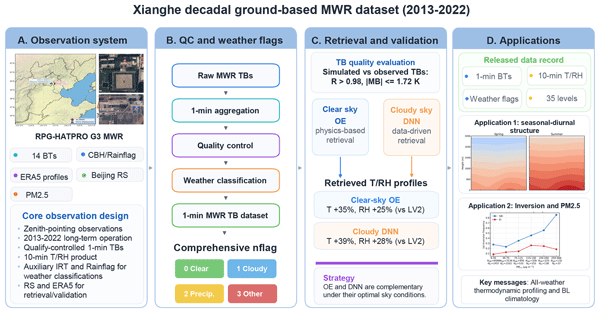
The first decadal-scale ground-based microwave radiometer dataset in China: brightness temperature and thermodynamic profiles from Xianghe (2013–2022)
Yueyuan Gong, Wenying He, Disong Fu, Xiang'ao Xia, Hongrong Shi, Weidong Nan, Pucai Wang, and Hongbin Chen
Earth Syst. Sci. Data, 18, 4725–4744, https://doi.org/10.5194/essd-18-4725-2026,https://doi.org/10.5194/essd-18-4725-2026, 2026
Short summary
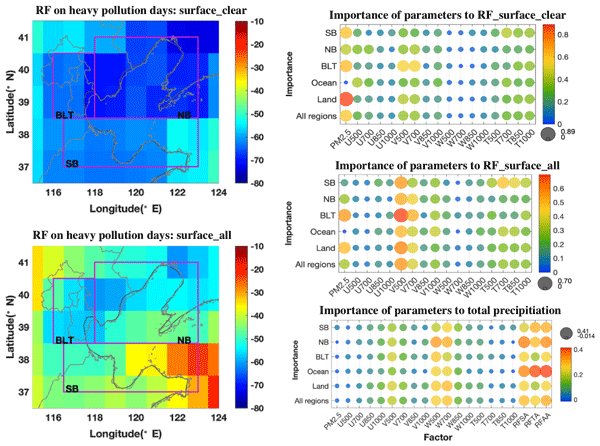
The radiative forcing of PM2.5 heavy pollution, its influencing factors and importance to precipitation during 2014–2023 in the Bohai Rim, China
Jun Zhu, Yingying Wang, Xu Yue, Huizheng Che, Xiangao Xia, Xiaofei Lu, Chenguang Tian, and Hong Liao
Atmos. Chem. Phys., 26, 5679–5696, https://doi.org/10.5194/acp-26-5679-2026,https://doi.org/10.5194/acp-26-5679-2026, 2026
Short summary
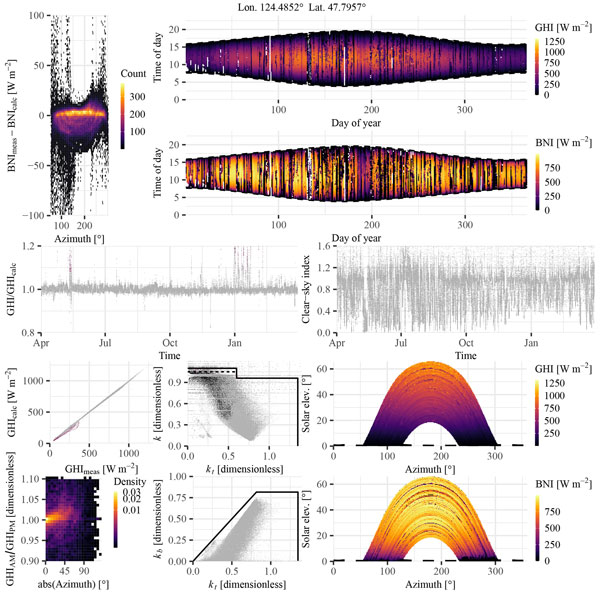
Validating physical and semi-empirical satellite-based irradiance retrievals using high- and low-accuracy radiometric observations in a monsoon-influenced continental climate
Yun Chen, Dazhi Yang, Chunlin Huang, Hongrong Shi, Adam R. Jensen, Xiang'ao Xia, Yves-Marie Saint-Drenan, Christian A. Gueymard, Martin János Mayer, and Yanbo Shen
Atmos. Meas. Tech., 18, 7315–7336, https://doi.org/10.5194/amt-18-7315-2025,https://doi.org/10.5194/amt-18-7315-2025, 2025
Short summary
Identification of Snowfall Riming and Aggregation Processes Using Ground-Based Triple-Frequency Radar
Danyang Wang, Wenying He, Yongheng Bi, Xiangao Xia, and Hongbin Chen
EGUsphere, https://doi.org/10.5194/egusphere-2025-4233,https://doi.org/10.5194/egusphere-2025-4233, 2025
Preprint archived
Short summary
A Global Terrestrial Precipitable Water Vapor Dataset from 2012 to 2020 Based on Microwave Radiation Imager Measurements from Three Fengyun Satellites
Xinran Xia, Rubin Jiang, Min Min, Shengli Wu, Peng Zhang, and Xiangao Xia
Earth Syst. Sci. Data Discuss., https://doi.org/10.5194/essd-2024-395,https://doi.org/10.5194/essd-2024-395, 2024
Revised manuscript not accepted
Short summary

Cited articles

Anas, H., Mghouchi Youness, E., Halima, Y., Nawal, A., and Mohamed, C.: Novel climate classification based on the information of solar radiation intensity: An application to the climatic zoning of Morocco, Energ. Convers. Manage., 247, 114770, https://doi.org/10.1016/j.enconman.2021.114770, 2021. a
Beck, H. E., Zimmermann, N. E., McVicar, T. R., Vergopolan, N., Berg, A., and Wood, E. F.: Present and future Köppen–Geiger climate classification maps at 1-km resolution, Sci. Data, 5, 180214, https://doi.org/10.1038/sdata.2018.214, 2018. a
Byrd, R. H., Lu, P., Nocedal, J., and Zhu, C.: A limited memory algorithm for bound constrained optimization, SIAM J. Sci. Comput., 16, 1190–1208, 1995. a
Chen, Y., Yang, D., Huang, C., Shi, H., Jensen, A. R., Xia, X., Saint-Drenan, Y.-M., Gueymard, C. A., Mayer, M. J., and Shen, Y.: Validating physical and semi-empirical satellite-based irradiance retrievals using high- and low-accuracy radiometric observations in a monsoon-influenced continental climate, Atmos. Meas. Tech., 18, 7315–7336, https://doi.org/10.5194/amt-18-7315-2025, 2025. a
Dash, P. K., Gupta, N. C., Rawat, R., and Pant, P. C.: A novel climate classification criterion based on the performance of solar photovoltaic technologies, Sol. Energy, 144, 392–398, https://doi.org/10.1016/j.solener.2017.01.046, 2017. a
Download
Short summary
Quality control of ground-based solar radiation measurements is essential for climate and energy research. The current tests apply a global rule that is often too loose, missing anomalies, or too strict in polar regions, rejecting valid data. Using 75 stations, this study identifies seven radiation climates and configures regime-specific quality-control limits. The new limits better match local conditions, retaining valid polar data while restoring sensitivity in aerosol-polluted regions
Share