Articles | Volume 19, issue 18
https://doi.org/10.5194/amt-19-5951-2026
© Author(s) 2026. This work is distributed under
the Creative Commons Attribution 4.0 License.
https://doi.org/10.5194/amt-19-5951-2026
© Author(s) 2026. This work is distributed under
the Creative Commons Attribution 4.0 License.
Role of low-level jet evolution in vertical aerosol redistribution: a Doppler wind lidar study over East China

Tianle Bai
The State Key Laboratory of Climate System Prediction and Risk Management (CPRM), School of Atmospheric Physics, Nanjing University of Information Science & Technology, Nanjing, 210044, China
Yuanyi Lin
The State Key Laboratory of Climate System Prediction and Risk Management (CPRM), School of Atmospheric Physics, Nanjing University of Information Science & Technology, Nanjing, 210044, China
Mengya Wang
CORRESPONDING AUTHOR
The State Key Laboratory of Climate System Prediction and Risk Management (CPRM), School of Atmospheric Physics, Nanjing University of Information Science & Technology, Nanjing, 210044, China
Tianwen Wei
The State Key Laboratory of Climate System Prediction and Risk Management (CPRM), School of Atmospheric Physics, Nanjing University of Information Science & Technology, Nanjing, 210044, China
Fangzhi Wei
The State Key Laboratory of Climate System Prediction and Risk Management (CPRM), School of Atmospheric Physics, Nanjing University of Information Science & Technology, Nanjing, 210044, China
Kuancheng Lv
The State Key Laboratory of Climate System Prediction and Risk Management (CPRM), School of Atmospheric Physics, Nanjing University of Information Science & Technology, Nanjing, 210044, China
Haiyun Xia
The State Key Laboratory of Climate System Prediction and Risk Management (CPRM), School of Atmospheric Physics, Nanjing University of Information Science & Technology, Nanjing, 210044, China
Related authors
No articles found.
Sihan Liu, Tianwen Wei, Ning Zhang, Fangzhi Wei, Xinyuan Liang, Qian Huang, Yuan Wang, and Haiyun Xia
EGUsphere, https://doi.org/10.5194/egusphere-2026-2865, https://doi.org/10.5194/egusphere-2026-2865, 2026
Short summary
Short summary
Using wind lidar, ERA5, and WRF data, this study explores nocturnal tropospheric gravity waves in a double-jet environment over the Taklimakan Desert. Results show 10–20 min oscillations within the weak-wind layer between a lower easterly and upper westerly jet, triggered by shear instability. Thermal and Doppler ducting jointly trap these waves. Notably, lower jet intensification compresses the waveguide, shifting trapped modes to higher frequencies.
Zhekai Li, Dawei Tang, Tianwen Wei, Saifen Yu, Jing Cai, Kenan Wu, Zhen Zhang, Jiadong Hu, Haobin Han, Yubin Wang, and Haiyun Xia
Atmos. Meas. Tech., 19, 3253–3269, https://doi.org/10.5194/amt-19-3253-2026, https://doi.org/10.5194/amt-19-3253-2026, 2026
Short summary
Short summary
In April 2024, we observed a fluorescent layer using fluorescence lidar at Nanping, South China. By combining multiple sources of information, we found that the long-range transported biomass burning aerosol (BBA) emitted by weak fire activity in the Indo-China Peninsula (ICP) was a major contributor to this layer. Our observations show that even weak fires in the ICP can affect South China, providing new insights into BBA transport in this region.
Lian Su, Haiyun Xia, Chunsong Lu, Jinlong Yuan, Kenan Wu, Tianwen Wei, Xiaofei Wang, Qing He, Mohamed Elshora, Xi Luo, and Xinyang Li
Atmos. Meas. Tech., 19, 2657–2668, https://doi.org/10.5194/amt-19-2657-2026, https://doi.org/10.5194/amt-19-2657-2026, 2026
Short summary
Short summary
1. The formation of ice crystal clouds catalyzed by dust aerosols were observed by coherent Doppler wind lidar in the Taklimakan Desert. 2. The wind provides a dynamic basis for the formation of ice crystal clouds and plays an important role in the decomposition process. 3. The special basin topography, turbulence and downdrafts keep the base height of the ice crystal clouds at around 3 km.
Daihao Yu, Qiuwei Xia, Saifen Yu, Yixiang Chen, Keyi Xu, Haobin Han, Jianjun Guo, Kexin Guo, Jiadong Hu, Zhen Zhang, Jing Cai, Yuanjian Yang, and Haiyun Xia
EGUsphere, https://doi.org/10.5194/egusphere-2025-6470, https://doi.org/10.5194/egusphere-2025-6470, 2026
Short summary
Short summary
Industrial parks are critical nodes in the global carbon cycle. This study combines high-resolution lidar observations and the WRF-GHG model to examine CO2 accumulation and dispersion in a semi-enclosed bay. Distinct diurnal patterns emerge: nighttime accumulation and daytime dispersion driven by terrain, atmospheric stability and sea breezes. WRF-GHG captures temporal trends, but it underestimates CO2 levels, indicating limitations in emission inventories and terrain-wind interactions.
Tianwen Wei, Mengya Wang, Kenan Wu, Jinlong Yuan, Haiyun Xia, and Simone Lolli
Atmos. Meas. Tech., 18, 1841–1857, https://doi.org/10.5194/amt-18-1841-2025, https://doi.org/10.5194/amt-18-1841-2025, 2025
Short summary
Short summary
This study analyzes three years of wind lidar measurements to explore the dynamics of the urban planetary boundary layer in Hefei, China. Results reveal that nocturnal low-level jets are most frequent in spring and intensify in summer, significantly enhancing turbulence and shear near the surface, particularly at night. Additionally, cloud cover raises the mixing layer height by approximately 100 m at night due to the greenhouse effect but reduces it by up to 200 m in the afternoon.
Lian Su, Chunsong Lu, Jinlong Yuan, Xiaofei Wang, Qing He, and Haiyun Xia
Atmos. Chem. Phys., 24, 10947–10963, https://doi.org/10.5194/acp-24-10947-2024, https://doi.org/10.5194/acp-24-10947-2024, 2024
Short summary
Short summary
The cold downhill airflow of the Tibetan Plateau leading to the low-level jet weakens the height and intensity of the inversion layer, which reduces the energy demand for the broken inversion layer. The low-level jet causes dust aerosols to accumulate near the ground. The material conditions for the development of the desert atmospheric boundary layer can be quickly transformed into thermal conditions.
Kenan Wu, Tianwen Wei, Jinlong Yuan, Haiyun Xia, Xin Huang, Gaopeng Lu, Yunpeng Zhang, Feifan Liu, Baoyou Zhu, and Weidong Ding
Atmos. Meas. Tech., 16, 5811–5825, https://doi.org/10.5194/amt-16-5811-2023, https://doi.org/10.5194/amt-16-5811-2023, 2023
Short summary
Short summary
A compact all-fiber coherent Doppler wind lidar (CDWL) working at the 1.5 µm wavelength is applied to probe the dynamics and microphysics structure of thunderstorms. It was found that thunderclouds below the 0 ℃ isotherm have significant spectrum broadening and an increase in skewness, and that lightning affects the microphysics structure of the thundercloud. It is proven that the precise spectrum of CDWL is a promising indicator for studying the charge structure of thunderstorms.
Lian Zong, Yuanjian Yang, Haiyun Xia, Meng Gao, Zhaobin Sun, Zuofang Zheng, Xianxiang Li, Guicai Ning, Yubin Li, and Simone Lolli
Atmos. Chem. Phys., 22, 6523–6538, https://doi.org/10.5194/acp-22-6523-2022, https://doi.org/10.5194/acp-22-6523-2022, 2022
Short summary
Short summary
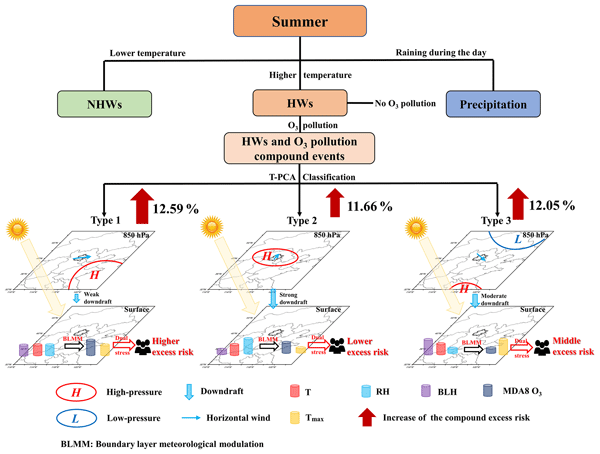
Heatwaves (HWs) paired with higher ozone (O3) concentration at surface level pose a serious threat to human health. Taking Beijing as an example, three unfavorable synoptic weather patterns were identified to dominate the compound HW and O3 pollution events. Under the synergistic stress of HWs and O3 pollution, public mortality risk increased, and synoptic patterns and urbanization enhanced the compound risk of events in Beijing by 33.09 % and 18.95 %, respectively.
Dawei Tang, Tianwen Wei, Jinlong Yuan, Haiyun Xia, and Xiankang Dou
Atmos. Meas. Tech., 15, 2819–2838, https://doi.org/10.5194/amt-15-2819-2022, https://doi.org/10.5194/amt-15-2819-2022, 2022
Short summary
Short summary
During 11–20 March 2020, three aerosol transport events were investigated by a lidar system and an online bioaerosol detection system in Hefei, China.
Observation results reveal that the events not only contributed to high particulate matter pollution but also to the transport of external bioaerosols, resulting in changes in the fraction of fluorescent biological aerosol particles.
This detection method improved the time resolution and provided more parameters for aerosol detection.
Pu Jiang, Jinlong Yuan, Kenan Wu, Lu Wang, and Haiyun Xia
Atmos. Meas. Tech. Discuss., https://doi.org/10.5194/amt-2021-288, https://doi.org/10.5194/amt-2021-288, 2021
Revised manuscript not accepted
Short summary
Short summary
To analyse the atmospheric turbulence in high resolution, we proposed a new method by combining the advantages of two remote sensing instruments. A contrastive experiment was conducted horizontally to verify the method. Based on the result, we obtained and analyzed the continuous Cn2 and other turbulence profiles with high temporal and spatial resolution simultaneously. It is significant for studying the complex and fast-changing atmospheric environment.
Cited articles
Andújar-Maqueda, J., Ortiz-Amezcua, P., Demoz, B., Roots, M., Abril-Gago, J., Pandey, S., Pérez-Ramírez, D., Alados-Arboledas, L., and Guerrero-Rascado, J. L.: Doppler lidar observations of low-level jets and wind maxima over urban complex terrain in the southeastern Iberian Peninsula, Urban Clim., 65, 102744, https://doi.org/10.1016/j.uclim.2025.102744, 2026.
Banakh, V. A., Brewer, A., Pichugina, E. L., and Smalikho, I. N.: Measurements of wind velocity and direction with coherent Doppler lidar in conditions of a weak echo signal, Atmos. Oceanic Opt., 23, 381–388, https://doi.org/10.1134/S1024856010050076, 2010.
Banakh, V. A., Smalikho, I. N., and Falits, A. V.: Estimation of the turbulence energy dissipation rate in the atmospheric boundary layer from measurements of the radial wind velocity by micropulse coherent Doppler lidar, Opt. Express, 25, 22679–22692, https://doi.org/10.1364/oe.25.022679, 2017.
Banta, R. M., Newsom, R. K., Lundquist, J. K., Pichugina, Y. L., Coulter, R. L., and Mahrt, L.: Nocturnal low-level jet characteristics over Kansas during CASES-99, Bound.-Lay. Meteorol., 105, 221–252, https://doi.org/10.1023/A:1019992330866, 2002.
Beu, C. M. L. and Landulfo, E.: Turbulence kinetic energy dissipation rate estimate for a low-level jet with Doppler lidar data: A case study, Earth Interact., 26, 112–121, https://doi.org/10.1175/EI-D-20-0027.1, 2022.
Blackadar, A. K.: Boundary layer wind maxima and their significance for the growth of nocturnal inversions, B. Am. Meteorol. Soc., 38, 283–290, https://doi.org/10.1175/1520-0477-38.5.283, 1957.
Chen, G., Wang, W.-C., and Chen, J.-P.: Circulation responses to regional aerosol climate forcing in summer over East Asia, Clim. Dynam., 51, 3973–3984, https://doi.org/10.1007/s00382-018-4267-3, 2018.
Dieudonné, E., Delbarre, H., Sokolov, A., Ebojie, F., Augustin, P., and Fourmentin, M.: Characteristics of the low-level jets observed over Dunkerque (North Sea French Coast) using 4 years of wind lidar data, Q. J. Roy. Meteor. Soc., 149, 1745–1768, https://doi.org/10.1002/qj.4480, 2023.
Du, Y., Zhang, Q., Chen, Y.-L., Zhao, Y., and Wang, X.: Numerical simulations of spatial distributions and diurnal variations of low-level jets in China during early summer, J. Climate, 27, 5747–5767, https://doi.org/10.1175/JCLI-D-13-00571.1, 2014.
Fiedler, S., Schepanski, K., Heinold, B., Knippertz, P., and Tegen, I.: Climatology of nocturnal low-level jets over North Africa and implications for modeling mineral dust emission, J. Geophys. Res.-Atmos., 118, 6100–6121, https://doi.org/10.1002/jgrd.50394, 2013.
Frehlich, R.: Coherent Doppler lidar signal covariance including wind shear and wind turbulence, Appl. Optics, 33, 6472–6481, https://doi.org/10.1364/AO.33.006472, 1994.
Guo, J., Miao, Y., Zhang, Y., Liu, H., Li, Z., Zhang, W., He, J., Lou, M., Yan, Y., Bian, L., and Zhai, P.: The climatology of planetary boundary layer height in China derived from radiosonde and reanalysis data, Atmos. Chem. Phys., 16, 13309–13319, https://doi.org/10.5194/acp-16-13309-2016, 2016.
Gutierrez, W., Ruiz-Columbie, A., Tutkun, M., and Castillo, L.: Impacts of the low-level jet's negative wind shear on the wind turbine, Wind Energ. Sci., 2, 533–545, https://doi.org/10.5194/wes-2-533-2017, 2017.
Heinold, B., Knippertz, P., Marsham, J. H., Fiedler, S., Dixon, N. S., Schepanski, K., Laurent, B., and Tegen, I.: The role of deep convection and nocturnal low-level jets for dust emission in summertime West Africa: Estimates from convection-permitting simulations, J. Geophys. Res.-Atmos., 118, 4385–4400, https://doi.org/10.1002/jgrd.50402, 2013.
Heinold, B., Knippertz, P., and Beare, R. J.: Idealized large-eddy simulations of nocturnal low-level jets over subtropical desert regions and implications for dust-generating winds, Q. J. Roy. Meteor. Soc., 141, 1740–1752, https://doi.org/10.1002/qj.2475, 2015.
Hersbach, H., Bell, B., Berrisford, P., Hirahara, S., Horányi, A., Muñoz-Sabater, J., Nicolas, J., Peubey, C., Radu, R., Schepers, D., Simmons, A., Soci, C., Abdalla, S., Abellan, X., Balsamo, G., Bechtold, P., Biavati, G., Bidlot, J., Bonavita, M., De Chiara, G., Dahlgren, P., Dee, D., Diamantakis, M., Dragani, R., Flemming, J., Forbes, R., Fuentes, M., Geer, A., Haimberger, L., Healy, S., Hogan, R. J., Hólm, E., Janisková, M., Keeley, S., Laloyaux, P., Lopez, P., Lupu, C., Radnoti, G., De Rosnay, P., Rozum, I., Vamborg, F., Villaume, S., and Thépaut, J.-N.: The ERA5 global reanalysis, Q. J. Roy. Meteor. Soc., 146, 1999–2049, https://doi.org/10.1002/qj.3803, 2020.
Hersbach, H., Bell, B., Berrisford, P., Biavati, G., Horányi, A., Muñoz Sabater, J., Nicolas, J., Peubey, C., Radu, R., Rozum, I., Schepers, D., Simmons, A., Soci, C., Dee, D., and Thépaut, J.-N.: ERA5 hourly data on pressure levels from 1940 to present, Copernicus Climate Change Service (C3S) Climate Data Store (CDS) [data set], https://doi.org/10.24381/cds.bd0915c6, 2023.
Huang, T., Yim, S. H., Yang, Y., Lee, O. S., Lam, D. H., Cheng, J. C., and Guo, J.: Observation of turbulent mixing characteristics in the typical daytime cloud-topped boundary layer over Hong Kong in 2019, Remote Sens., 12, 1533, https://doi.org/10.3390/rs12091533, 2020a.
Huang, T., Li, Y., Cheng, J. C. H., Haywood, J., Hon, K. K., Lam, D. H. Y., Lee, O. S. M., Lolli, S., O'Connor, E. J., Lee, H. F., Wang, M., and Yim, S. H. L.: Assessing transboundary-local aerosols interaction over complex terrain using a Doppler LiDAR network, Geophys. Res. Lett., 48, e2021GL093238, https://doi.org/10.1029/2021GL093238, 2021a.
Huang, T., Yang, Y., O'Connor, E. J., Lolli, S., Haywood, J., Osborne, M., Cheng, J. C. H., Guo, J., and Yim, S. H. L.: Influence of a weak typhoon on the vertical distribution of air pollution in Hong Kong: A perspective from a Doppler LiDAR network, Environ. Pollut., 276, 116534, https://doi.org/10.1016/j.envpol.2021.116534, 2021b.
Huang, X., Ding, A., Wang, Z., Ding, K., Gao, J., Chai, F., and Fu, C.: Amplified transboundary transport of haze by aerosol–boundary layer interaction in China, Nat. Geosci., 13, 428–434, https://doi.org/10.1038/s41561-020-0583-4, 2020b.
Iwai, H., Murayama, Y., Ishii, S., Mizutani, K., Ohno, Y., and Hashiguchi, T.: Strong updraft at a sea-breeze front and associated vertical transport of near-surface dense aerosol observed by Doppler lidar and ceilometer, Bound.-Lay. Meteorol., 141, 117–142, https://doi.org/10.1007/s10546-011-9635-z, 2011.
Jia, M., Yuan, J., Wang, C., Xia, H., Wu, Y., Zhao, L., Wei, T., Wu, J., Wang, L., Gu, S.-Y., Liu, L., Lu, D., Chen, R., Xue, X., and Dou, X.: Long-lived high-frequency gravity waves in the atmospheric boundary layer: observations and simulations, Atmos. Chem. Phys., 19, 15431–15446, https://doi.org/10.5194/acp-19-15431-2019, 2019.
Knippertz, P. and Todd, M. C.: Mineral dust aerosols over the Sahara: meteorological controls on emission and transport and implications for modeling, Rev. Geophys., 50, 2011RG000362, https://doi.org/10.1029/2011RG000362, 2012.
Kok, J. F., Storelvmo, T., Karydis, V. A., Adebiyi, A. A., Mahowald, N. M., Evan, A. T., He, C., and Leung, D. M.: Mineral dust aerosol impacts on global climate and climate change, Nat. Rev. Earth Environ., 4, 71–86, https://doi.org/10.1038/s43017-022-00379-5, 2023.
Li, Z., Lau, W. K.-M., Ramanathan, V., Wu, G., Ding, Y., Manoj, M. G., Liu, J., Qian, Y., Li, J., Zhou, T., Fan, J., Rosenfeld, D., Ming, Y., Wang, Y., Huang, J., Wang, B., Xu, X., Lee, S.-S., Cribb, M., Zhang, F., Yang, X., Zhao, C., Takemura, T., Wang, K., Xia, X., Yin, Y., Zhang, H., Guo, J., Zhai, P. M., Sugimoto, N., Babu, S. S., and Brasseur, G. P.: Aerosol and monsoon climate interactions over Asia, Rev. Geophys., 54, 866–929, https://doi.org/10.1002/2015RG000500, 2016.
Li, Z., Guo, J., Ding, A., Liao, H., Liu, J., Sun, Y., Wang, T., Xue, H., Zhang, H., and Zhu, B.: Aerosol and boundary-layer interactions and impact on air quality, Natl. Sci. Rev., 4, 810–833, https://doi.org/10.1093/nsr/nwx117, 2017.
Li, Z., Wang, Y., Guo, J., Zhao, C., Cribb, M. C., Dong, X., Fan, J., Gong, D., Huang, J., Jiang, M., Jiang, Y., Lee, S.-S., Li, H., Li, J., Liu, J., Qian, Y., Rosenfeld, D., Shan, S., Sun, Y., Wang, H., Xin, J., Yan, X., Yang, X., Yang, X., Zhang, F., and Zheng, Y.: East Asian study of tropospheric aerosols and their impact on regional clouds, precipitation, and climate (EAST-AIRCPC), J. Geophys. Res.-Atmos., 124, 13026–13054, https://doi.org/10.1029/2019JD030758, 2019.
Mahrt, L.: Nocturnal boundary-layer regimes, Bound.-Lay. Meteorol., 88, 255–278, https://doi.org/10.1023/A:1001171313493, 1998.
Mai, Z. and Zhang, T.: Analysis of the March 2022 atmospheric circulation and weather, Meteorol. Mon., 48, 794–800, https://doi.org/10.7519/j.issn.1000-0526.2022.051001, 2022 (in Chinese).
Mai, Z., Zhang, T., and Sheng, J.: Analysis of the April 2021 atmospheric circulation and weather, Meteorol. Mon., 47, 893–900, https://doi.org/10.7519/j.issn.1000-0526.2021.07.012, 2021 (in Chinese).
Miao, Y., Liu, S., Sheng, L., Huang, S., and Li, J.: Influence of boundary layer structure and low-level jet on PM2.5 pollution in Beijing: a case study, Int. J. Env. Res. Pub. He., 16, 616, https://doi.org/10.3390/ijerph16040616, 2019.
O'Connor, E. J., Illingworth, A. J., and Hogan, R. J.: A technique for autocalibration of cloud lidar, J. Atmos. Ocean. Tech., 21, 777–786, https://doi.org/10.1175/1520-0426(2004)021<0777:ATFAOC>2.0.CO;2, 2004.
Pentikäinen, P., O'Connor, E. J., Manninen, A. J., and Ortiz-Amezcua, P.: Methodology for deriving the telescope focus function and its uncertainty for a heterodyne pulsed Doppler lidar, Atmos. Meas. Tech., 13, 2849–2863, https://doi.org/10.5194/amt-13-2849-2020, 2020.
Pichugina, Y. L., Brewer, W. A., Banta, R. M., Choukulkar, A., Clack, C. T. M., Marquis, M. C., McCarty, B. J., Weickmann, A. M., Sandberg, S. P., Marchbanks, R. D., and Hardesty, R. M.: Properties of the offshore low level jet and rotor layer wind shear as measured by scanning Doppler Lidar, Wind Energy, 20, 987–1002, https://doi.org/10.1002/we.2075, 2017.
Pöschl, U.: Atmospheric aerosols: Composition, transformation, climate and health effects, Angew. Chem. Int. Edit., 44, 7520–7540, https://doi.org/10.1002/anie.200501122, 2005.
Qin, K., Wu, L., Wong, M. S., Letu, H., Hu, M., Lang, H., Sheng, S., Teng, J., Xiao, X., and Yuan, L.: Trans-boundary aerosol transport during a winter haze episode in China revealed by ground-based lidar and CALIPSO satellite, Atmos. Environ., 141, 20–29, https://doi.org/10.1016/j.atmosenv.2016.06.042, 2016.
Ren, Y., Zhang, H., Zhang, X., Wu, B., Cai, X., Song, Y., and Zhu, T.: Quantitative verification of the turbulence barrier effect during heavy haze pollution events, Environ. Res. Commun., 4, 045005, https://doi.org/10.1088/2515-7620/ac6381, 2022.
Sandu, I., Beljaars, A., Bechtold, P., Mauritsen, T., and Balsamo, G.: Why is it so difficult to represent stably stratified conditions in numerical weather prediction (NWP) models?, J. Adv. Model. Earth Sy., 5, 117–133, https://doi.org/10.1002/jame.20013, 2013.
Shangguan, M., Qiu, J., Yuan, J., Shu, Z., Zhou, L., and Xia, H.: Doppler Wind Lidar From UV to NIR: A Review With Case Study Examples, Front. Remote Sens., 2, 787111, https://doi.org/10.3389/frsen.2021.787111, 2022.
Shangguan, M., Yang, Z., Lin, Z., Lee, Z., Xia, H., and Weng, Z.: Compact long-range single-photon underwater lidar with high spatial-temporal resolution, IEEE Geosci. Remote S., 20, 1501905, https://doi.org/10.1109/LGRS.2023.3274449, 2023.
Shangguan, M., Yang, Z., Lin, Z., Weng, Z., and Sun, J.: Full-day profiling of a beam attenuation coefficient using a single-photon underwater lidar with a large dynamic measurement range, Opt. Lett., 49, 626–629, https://doi.org/10.1364/OL.514622, 2024.
Smalikho, I.: Techniques of wind vector estimation from data measured with a scanning coherent Doppler lidar, J. Atmos. Ocean. Tech., 20, 276–291, https://doi.org/10.1175/1520-0426(2003)020<0276:TOWVEF>2.0.CO;2, 2003.
Stensrud, D. J.: Importance of low-level jets to climate: A review, J. Climate, 9, 1698–1711, https://doi.org/10.1175/1520-0442(1996)009<1698:IOLLJT>2.0.CO;2, 1996.
Su, T., Li, Z., Li, C., Li, J., Han, W., Shen, C., Tan, W., Wei, J., and Guo, J.: The significant impact of aerosol vertical structure on lower atmosphere stability and its critical role in aerosol–planetary boundary layer (PBL) interactions, Atmos. Chem. Phys., 20, 3713–3724, https://doi.org/10.5194/acp-20-3713-2020, 2020.
Sullivan, J. T., Rabenhorst, S. D., Dreessen, J., McGee, T. J., Delgado, R., Twigg, L., and Sumnicht, G.: Lidar observations revealing transport of O3 in the presence of a nocturnal low-level jet: Regional implications for “next-day” pollution, Atmos. Environ., 158, 160–171, https://doi.org/10.1016/j.atmosenv.2017.03.039, 2017.
Tian, P., Cao, X., Zhang, L., Sun, N., Sun, L., Logan, T., Shi, J., Wang, Y., Ji, Y., Lin, Y., Huang, Z., Zhou, T., Shi, Y., and Zhang, R.: Aerosol vertical distribution and optical properties over China from long-term satellite and ground-based remote sensing, Atmos. Chem. Phys., 17, 2509–2523, https://doi.org/10.5194/acp-17-2509-2017, 2017.
Tuononen, M., O'Connor, E. J., Sinclair, V. A., and Vakkari, V.: Low-level jets over Utö, Finland, based on Doppler lidar observations, J. Appl. Meteorol. Clim., 56, 2577–2594, https://doi.org/10.1175/JAMC-D-16-0411.1, 2017.
Wang, L., Liu, J., Gao, Z., Li, Y., Huang, M., Fan, S., Zhang, X., Yang, Y., Miao, S., Zou, H., Sun, Y., Chen, Y., and Yang, T.: Vertical observations of the atmospheric boundary layer structure over Beijing urban area during air pollution episodes, Atmos. Chem. Phys., 19, 6949–6967, https://doi.org/10.5194/acp-19-6949-2019, 2019.
Wang, M., Wei, T., Lolli, S., Wu, K., Wang, Y., Hu, H., Yuan, J., Tang, D., and Xia, H.: A long-term Doppler wind LiDAR study of heavy pollution episodes in western Yangtze River Delta region, China, Atmos. Res., 310, 107616, https://doi.org/10.1016/j.atmosres.2024.107616, 2024.
Wang, M., Wei, T., Lolli, S., Rocadenbosch, F., Salcedo-Bosch, A., Du, Y., Wang, Y., Wang, C., Zong, L., Gu, Y., Wan, B., Su, L., Wei, F., and Xia, H.: A comparative study of low-level jets in different climate regions in China using multi-site Doppler wind lidar observations, IEEE T. Geosci. Remote, 4105014, https://doi.org/10.1109/TGRS.2026.3672972, 2026.
Wang, Y., Tang, J., Zhang, Z., Wang, W., Wang, J., and Wang, Z.: Hybrid Methods' Integration for Remote Sensing Monitoring and Process Analysis of Dust Storm Based on Multi-Source Data, Atmosphere, 14, 3, https://doi.org/10.3390/atmos14010003, 2023a.
Wang, Y., Li, B., Bao, P., Wang, R., Min, A., and Xiong, P.: A Case Study of Leaf Wettability Variability and the Relations with Leaf Traits and Surface Water Storage for Urban Landscape Plants, Water, 15, 2152, https://doi.org/10.3390/w15122152, 2023b.
Wei, T., Xia, H., Hu, J., Wang, C., Shangguan, M., Wang, L., Jia, M., and Dou, X.: Simultaneous wind and rainfall detection by power spectrum analysis using a VAD scanning coherent Doppler lidar, Opt. Express, 27, 31235–31245, https://doi.org/10.1364/oe.27.031235, 2019.
Wei, T., Xia, H., Wu, Y., Yuan, J., Wang, C., and Dou, X.: Inversion probability enhancement of all-fiber CDWL by noise modeling and robust fitting, Opt. Express, 28, 29662–29675, https://doi.org/10.1364/oe.401054, 2020.
Wei, T., Xia, H., Wu, K., Yang, Y., Liu, Q., and Ding, W.: Dark/bright band of a melting layer detected by coherent Doppler lidar and micro rain radar, Opt. Express, 30, 3654–3663, https://doi.org/10.1364/OE.450714, 2022.
Wei, T., Wang, M., Wu, K., Yuan, J., Xia, H., and Lolli, S.: Characterizing urban planetary boundary layer dynamics using 3-year Doppler wind lidar measurements in a western Yangtze River Delta city, China, Atmos. Meas. Tech., 18, 1841–1857, https://doi.org/10.5194/amt-18-1841-2025, 2025a.
Wei, T., Wang, M., Jiang, P., Wu, K., Zhang, Z., Yuan, J., Xia, H., and Lolli, S.: Retrieving aerosol backscatter coefficient using coherent Doppler wind lidar, Opt. Express, 33, 6832–6849, https://doi.org/10.1364/OE.551730, 2025b.
Wei, W., Zhang, H., Zhang, X., and Che, H.: Low-level jets and their implications on air pollution: a review, Front. Environ. Sci., 10, 1082623, https://doi.org/10.3389/fenvs.2022.1082623, 2023.
Wu, B., Li, Z., Ju, T., and Zhang, H.: Characteristics of low-level jets during 2015–2016 and the effect on fog in Tianjin, Atmos. Res., 245, 105102, https://doi.org/10.1016/j.atmosres.2020.105102, 2020.
Yang, B., Finn, D., Rich, J., Gao, Z., and Liu, H.: Effects of low-level jets on near-surface turbulence and wind direction changes in the nocturnal boundary layer, J. Geophys. Res.-Atmos., 128, e2022JD037657, https://doi.org/10.1029/2022JD037657, 2023.
Yang, S., Preißler, J., Wiegner, M., von Löwis, S., Petersen, G. N., Parks, M. M., and Finger, D. C.: Monitoring dust events using Doppler lidar and ceilometer in Iceland, Atmosphere, 11, 1294, https://doi.org/10.3390/atmos11121294, 2020.
Yang, Y., Yim, S. H. L., Haywood, J., Osborne, M., Chan, J. C. S., Zeng, Z., and Cheng, J. C. H.: Characteristics of Heavy Particulate Matter Pollution Events Over Hong Kong and Their Relationships With Vertical Wind Profiles Using High-Time-Resolution Doppler Lidar Measurements, J. Geophys. Res.-Atmos., 124, 9609–9623, https://doi.org/10.1029/2019JD031140, 2019.
Zhang, K., Mao, H., Civerolo, K., Berman, S., Ku, J.-Y., Rao, S. T., Doddridge, B., Philbrick, C. R., and Clark, R.: Numerical investigation of boundary-layer evolution and nocturnal low-level jets: Local versus non-local PBL schemes, Environ. Fluid Mech., 1, 171–208, https://doi.org/10.1023/A:1011557402158, 2001.
Zhao, W. and Zou, Y.: Hefei: An emerging city in inland China, Cities, 77, 158–169, https://doi.org/10.1016/j.cities.2018.01.008, 2018.
Zheng, X. Y., Fu, Y. F., Yang, Y. J., and Liu, G. S.: Impact of atmospheric circulations on aerosol distributions in autumn over eastern China: observational evidence, Atmos. Chem. Phys., 15, 12115–12138, https://doi.org/10.5194/acp-15-12115-2015, 2015.
Zhou, J., Yu, G., Jin, C., Qi, F., Liu, D., Hu, H., Gong, Z., Shi, G., Nakajima, T., and Takamura, T.: Lidar observations of Asian dust over Hefei, China, in spring 2000, J. Geophys. Res., 107, https://doi.org/10.1029/2001JD000802, 2002.
Zhou, L., Liu, G., Shen, M., Liu, Y., and Lam, P. K. S.: Characteristics of indoor dust in an industrial city: Comparison with outdoor dust and atmospheric particulates, Chemosphere, 272, 129952, https://doi.org/10.1016/j.chemosphere.2021.129952, 2021.
Short summary
This study investigates how fast-moving air currents close to the ground influence the vertical transport of dust over Hefei in eastern China. Using laser-based wind observations during two dust events, it shows that one event rapidly brings dust down to the surface, whereas the other keeps dust suspended at higher altitudes and delays surface pollution. These findings improve understanding of how dust is redistributed in the lower atmosphere and help improve weather and air-quality forecasts.
This study investigates how fast-moving air currents close to the ground influence the vertical...