
Articles | Volume 19, issue 6
https://doi.org/10.5194/amt-19-2125-2026
© Author(s) 2026. This work is distributed under
the Creative Commons Attribution 4.0 License.
the Creative Commons Attribution 4.0 License.
https://doi.org/10.5194/amt-19-2125-2026
© Author(s) 2026. This work is distributed under
the Creative Commons Attribution 4.0 License.
the Creative Commons Attribution 4.0 License.
Research article
| 
27 Mar 2026
Research article |
| 27 Mar 2026
| 27 Mar 2026
First nationwide analysis of riming using vertical observations from the operational German C-band radar network
Paul Ockenfuß
CORRESPONDING AUTHOR

Meteorologisches Institut, Ludwig-Maximilians-Universität München, München, Germany
Michael Frech
German Meteorological Service (Deutscher Wetterdienst, DWD), Observatorium Hohenpeißenberg, Hohenpeißenberg, Germany
Mathias Gergely
German Meteorological Service (Deutscher Wetterdienst, DWD), Observatorium Hohenpeißenberg, Hohenpeißenberg, Germany
Stefan Kneifel
Meteorologisches Institut, Ludwig-Maximilians-Universität München, München, Germany
Related authors
Paul Ockenfuß, Gregor Köcher, Isabel Petit, and Stefan Kneifel
EGUsphere, https://doi.org/10.5194/egusphere-2026-3446, https://doi.org/10.5194/egusphere-2026-3446, 2026
Short summary
Short summary
Remote sensing instruments often point vertically, producing time-height cross-sections of the atmosphere. In this case, each particle is observed only once. To learn about particle evolution, we need either assumptions about their distribution or scanning observations to "follow" them. In this work, we do both. To illustrate, we introduce new techniques to reveal the spatial distribution of rimed snowflakes, and we discuss the observed patterns and rimed particle evolution.
Paul Ockenfuß, Gregor Köcher, Matthias Bauer-Pfundstein, and Stefan Kneifel
Atmos. Meas. Tech., 19, 2961–2984, https://doi.org/10.5194/amt-19-2961-2026, https://doi.org/10.5194/amt-19-2961-2026, 2026
Short summary
Short summary
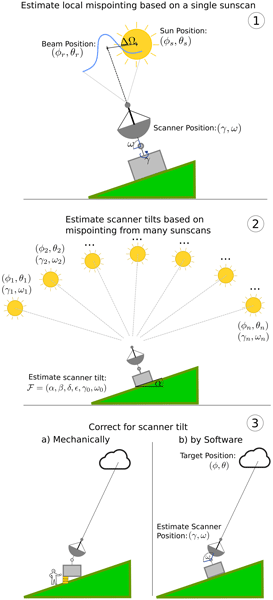
The pointing of scanning weather and cloud radars must be very accurate, to within 0.1°. We present a general method to calibrate the pointing of a scanning radar with an elevation and an azimuth axis. Using the Sun as a reference, we can determine the specific misalignments of the radar pedestal, axes and antenna. Once the misalignments are known, we can correct for them by steering the scanner motors accordingly. We provide recommendations and code to apply this method to any scanning radar.
Marika Hiemisch, Michael Frech, Annette M. Boehm, and Matthias Toussaint
EGUsphere, https://doi.org/10.5194/egusphere-2026-5570, https://doi.org/10.5194/egusphere-2026-5570, 2026
This preprint is open for discussion and under review for Atmospheric Measurement Techniques (AMT).
Short summary
Short summary
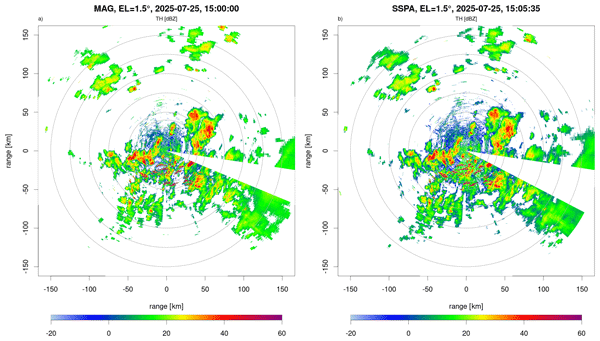
Weather radars are vital for rain monitoring and warnings, but nearby turbines can distort measurements. We assessed an operational algorithm detecting turbine-related signals using one year of radar observations and real-time data from twelve turbines in northern Germany. Detection was most reliable at high rotor speeds and when turbines faced towards or away from the radar. Side-on turbines produced brief signals that may be missed. We recommend a suitable time resolution for turbine data.
Cornelius Hald, Maximilian Schaper, Michael Frech, and Benjamin Rohrdantz
Atmos. Meas. Tech., 19, 5401–5424, https://doi.org/10.5194/amt-19-5401-2026, https://doi.org/10.5194/amt-19-5401-2026, 2026
Short summary
Short summary
A solid state power amplifier (SSPA) was integrated into an existing C-band magnetron weather radar. This unique setup allows for an easy comparison of the data quality of both transmitters. Reflectivity, Doppler and Dual Pol moments are compared. The SSPA shows better data quality in areas with low signal strength. The gap between short and long pulse is treated well, range sidelobes around strong targets are an issue. SSPA is considered as a possible replacement for the magnetron transmitters.
Leonie von Terzi, Axel Seifert, Christoph Siewert, Fabian Jakub, and Stefan Kneifel
EGUsphere, https://doi.org/10.5194/egusphere-2026-3865, https://doi.org/10.5194/egusphere-2026-3865, 2026
Short summary
Short summary
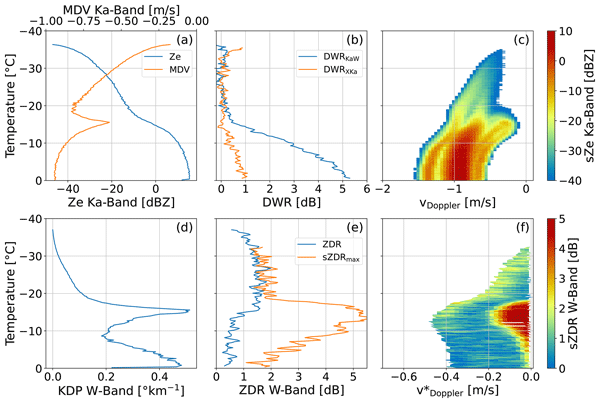
A distinct temperature layer in clouds promotes growth of dendritic ice crystals, producing characteristic radar signatures whose origin has remained unclear. We combined radar observations with microphysical simulations to identify the dominant microphysical processes. Collisions breaking particles into fragments prove essential to reproducing the signatures, alongside crystal growth and aggregation, clarifying the link between radar signals and ice processes for weather models.
Paul Ockenfuß, Gregor Köcher, Isabel Petit, and Stefan Kneifel
EGUsphere, https://doi.org/10.5194/egusphere-2026-3446, https://doi.org/10.5194/egusphere-2026-3446, 2026
Short summary
Short summary
Remote sensing instruments often point vertically, producing time-height cross-sections of the atmosphere. In this case, each particle is observed only once. To learn about particle evolution, we need either assumptions about their distribution or scanning observations to "follow" them. In this work, we do both. To illustrate, we introduce new techniques to reveal the spatial distribution of rimed snowflakes, and we discuss the observed patterns and rimed particle evolution.
Lukas Pieper, Patric Seifert, Hannes Griesche, Albert Ansmann, George McCosh, Florian Ewald, and Stefan Kneifel
EGUsphere, https://doi.org/10.5194/egusphere-2026-3092, https://doi.org/10.5194/egusphere-2026-3092, 2026
This preprint is open for discussion and under review for Atmospheric Chemistry and Physics (ACP).
Short summary
Short summary
Using ground-based cloud Doppler radar observations and aerosol model data, a strong relationship between Saharan dust and enhanced turbulence in cirrus clouds over Europe was identified. Dust-infused cirrus formed mainly within moist, dust-laden air masses and showed strong correlation with in-cloud turbulence. The results provide a baseline observational overview on dust-turbulence-cirrus interactions, informing weather and climate models regarding possible methodological improvements.
Paul Ockenfuß, Gregor Köcher, Matthias Bauer-Pfundstein, and Stefan Kneifel
Atmos. Meas. Tech., 19, 2961–2984, https://doi.org/10.5194/amt-19-2961-2026, https://doi.org/10.5194/amt-19-2961-2026, 2026
Short summary
Short summary
The pointing of scanning weather and cloud radars must be very accurate, to within 0.1°. We present a general method to calibrate the pointing of a scanning radar with an elevation and an azimuth axis. Using the Sun as a reference, we can determine the specific misalignments of the radar pedestal, axes and antenna. Once the misalignments are known, we can correct for them by steering the scanner motors accordingly. We provide recommendations and code to apply this method to any scanning radar.
Michael Frech, Annette M. Boehm, and Patrick Tracksdorf
Atmos. Meas. Tech., 19, 1711–1727, https://doi.org/10.5194/amt-19-1711-2026, https://doi.org/10.5194/amt-19-1711-2026, 2026
Short summary
Short summary
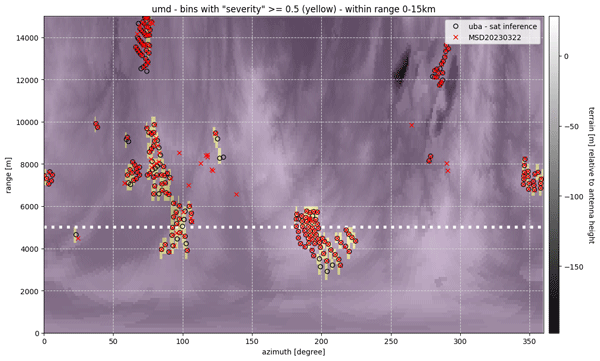
Wind turbine clutter (WTC) reduces the accuracy of weather radar measurements, as turbines may now be built closer to radar sites. A dynamic algorithm reliably detects WTC when wind turbine rotor speeds exceed 5 rpm. Beamblockage due to WT in the 5 km range is significant. A wind turbine-free 5 km radius is recommended.
Leonie von Terzi, Davide Ori, and Stefan Kneifel
Geosci. Model Dev., 19, 887–910, https://doi.org/10.5194/gmd-19-887-2026, https://doi.org/10.5194/gmd-19-887-2026, 2026
Short summary
Short summary
We present a new database of radar-relevant optical properties for a wide range of ice particle shapes, computed using the Discrete Dipole Approximation (DDA) at 5.6, 9.6, 35.6, and 94 GHz. The database is designed to support habit-evolving microphysical schemes, which predict continuous changes in ice particle properties rather than the traditionally assumed fixed categories. It includes over 2600 individual crystals and 450 aggregates with varying riming degrees and morphology.
Alexander Myagkov, Tatiana Nomokonova, and Michael Frech
Atmos. Meas. Tech., 18, 1621–1640, https://doi.org/10.5194/amt-18-1621-2025, https://doi.org/10.5194/amt-18-1621-2025, 2025
Short summary
Short summary
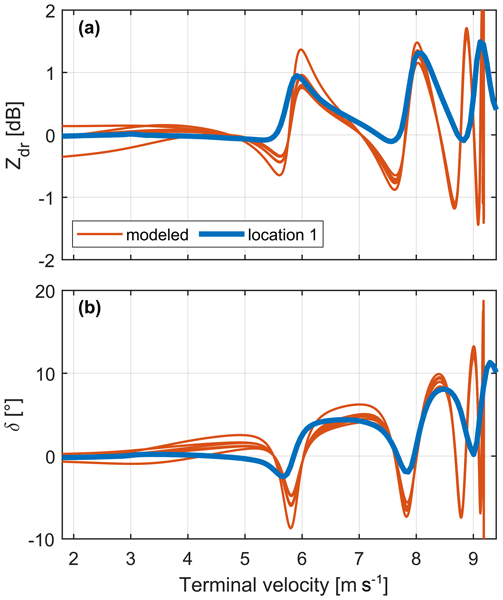
The study examines the use of the spheroidal shape approximation for calculating cloud radar observables in rain and identifies some limitations. To address these, it introduces the empirical scattering model (ESM) based on high-quality Doppler spectra from a 94 GHz radar. The ESM offers improved accuracy and directly incorporates natural rain's microphysical effects. This new model can enhance retrieval and calibration methods, benefiting cloud radar polarimetry experts and scattering modelers.
Cornelius Hald, Maximilian Schaper, Annette Böhm, Michael Frech, Jan Petersen, Bertram Lange, and Benjamin Rohrdantz
Atmos. Meas. Tech., 17, 4695–4707, https://doi.org/10.5194/amt-17-4695-2024, https://doi.org/10.5194/amt-17-4695-2024, 2024
Short summary
Short summary
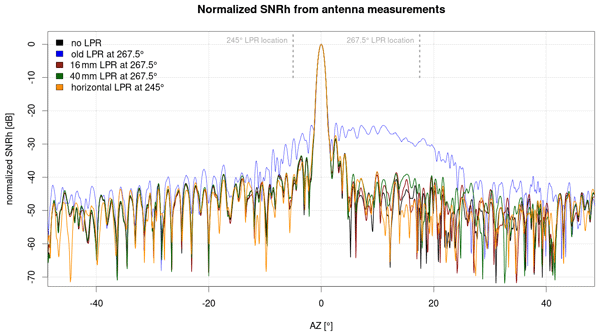
Weather radars should use lightning protection to be safe from damage, but the rods can reduce the quality of the radar measurements. This study presents three new solutions for lightning protection for weather radars and evaluates their influence on data quality. The results are compared to the current system. All tested ones have very little effect on data, and a new lightning protection system with four rods is recommended for the German Meteorological Service.
Giovanni Chellini, Rosa Gierens, Kerstin Ebell, Theresa Kiszler, Pavel Krobot, Alexander Myagkov, Vera Schemann, and Stefan Kneifel
Earth Syst. Sci. Data, 15, 5427–5448, https://doi.org/10.5194/essd-15-5427-2023, https://doi.org/10.5194/essd-15-5427-2023, 2023
Short summary
Short summary
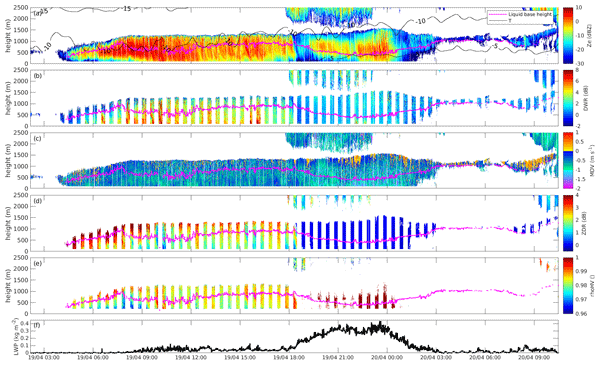
We present a comprehensive quality-controlled dataset of remote sensing observations of low-level mixed-phase clouds (LLMPCs) taken at the high Arctic site of Ny-Ålesund, Svalbard, Norway. LLMPCs occur frequently in the Arctic region, and substantially warm the surface. However, our understanding of microphysical processes in these clouds is incomplete. This dataset includes a comprehensive set of variables which allow for extensive investigation of such processes in LLMPCs at the site.
Michael Frech, Cornelius Hald, Maximilian Schaper, Bertram Lange, and Benjamin Rohrdantz
Atmos. Meas. Tech., 16, 295–309, https://doi.org/10.5194/amt-16-295-2023, https://doi.org/10.5194/amt-16-295-2023, 2023
Short summary
Short summary
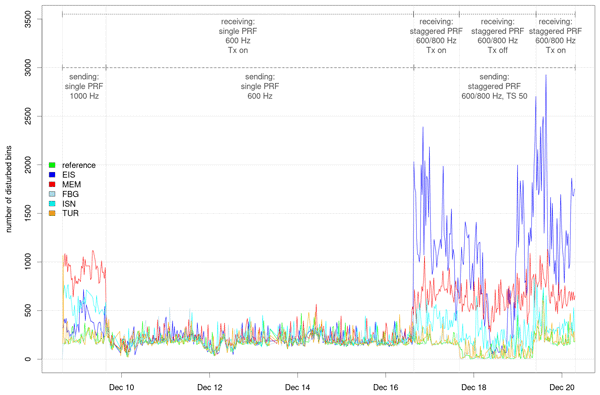
Weather radar data are the backbone of a lot of meteorological products. In order to obtain a better low-level coverage with radar data, additional systems have to be included. The frequency range in which radars are allowed to operate is limited. A potential radar-to-radar interference has to be avoided. The paper derives guidelines on how additional radars can be included into a C-band weather radar network and how interferences can be avoided.
Mathias Gergely, Maximilian Schaper, Matthias Toussaint, and Michael Frech
Atmos. Meas. Tech., 15, 7315–7335, https://doi.org/10.5194/amt-15-7315-2022, https://doi.org/10.5194/amt-15-7315-2022, 2022
Short summary
Short summary
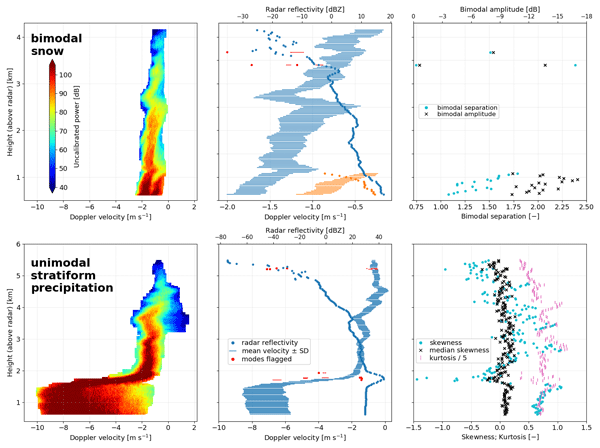
This study presents the new vertically pointing birdbath scan of the German C-band radar network, which provides high-resolution profiles of precipitating clouds above all DWD weather radars since the spring of 2021. Our AI-based postprocessing method for filtering and analyzing the recorded radar data offers a unique quantitative view into a wide range of precipitation events from snowfall over stratiform rain to intense frontal showers and will be used to complement DWD's operational services.
Maximilian Schaper, Michael Frech, David Michaelis, Cornelius Hald, and Benjamin Rohrdantz
Atmos. Meas. Tech., 15, 6625–6642, https://doi.org/10.5194/amt-15-6625-2022, https://doi.org/10.5194/amt-15-6625-2022, 2022
Short summary
Short summary
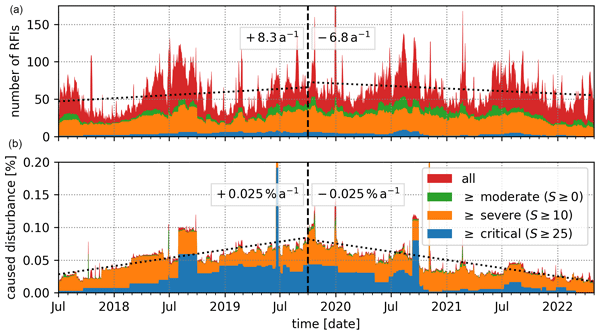
C-band weather radar data are commonly compromised by radio frequency interference (RFI) from external sources. It is not possible to separate a superimposed interference signal from the radar data. Therefore, the best course of action is to shut down RFI sources as quickly as possible. An automated RFI detection algorithm has been developed. Since its implementation, persistent RFI sources are eliminated much more quickly, while the number of short-lived RFI sources keeps steadily increasing.
Frederic Tridon, Israel Silber, Alessandro Battaglia, Stefan Kneifel, Ann Fridlind, Petros Kalogeras, and Ranvir Dhillon
Atmos. Chem. Phys., 22, 12467–12491, https://doi.org/10.5194/acp-22-12467-2022, https://doi.org/10.5194/acp-22-12467-2022, 2022
Short summary
Short summary
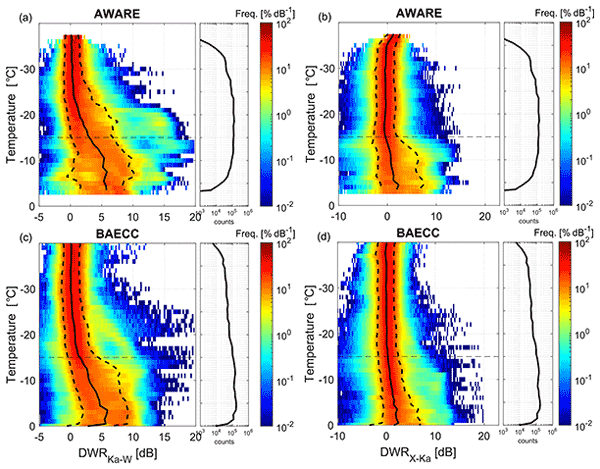
The role of ice precipitation in the Earth water budget is not well known because ice particles are complex, and their formation involves intricate processes. Riming of ice crystals by supercooled water droplets is an efficient process, but little is known about its importance at high latitudes. In this work, by exploiting the deployment of an unprecedented number of remote sensing systems in Antarctica, we find that riming occurs at much lower temperatures compared with the mid-latitudes.
Leonie von Terzi, José Dias Neto, Davide Ori, Alexander Myagkov, and Stefan Kneifel
Atmos. Chem. Phys., 22, 11795–11821, https://doi.org/10.5194/acp-22-11795-2022, https://doi.org/10.5194/acp-22-11795-2022, 2022
Short summary
Short summary
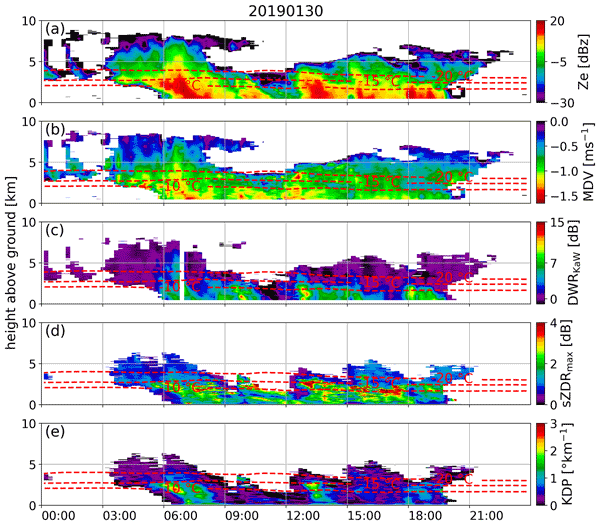
We present a statistical analysis of ice microphysical processes (IMP) in mid-latitude clouds. Combining various radar approaches, we find that the IMP active at −20 to −10 °C seems to be the main driver of ice particle size, shape and concentration. The strength of aggregation at −20 to −10 °C correlates with the increase in concentration and aspect ratio of locally formed ice particles. Despite ongoing aggregation, the concentration of ice particles stays enhanced until −4 °C.

Teresa Vogl, Maximilian Maahn, Stefan Kneifel, Willi Schimmel, Dmitri Moisseev, and Heike Kalesse-Los
Atmos. Meas. Tech., 15, 365–381, https://doi.org/10.5194/amt-15-365-2022, https://doi.org/10.5194/amt-15-365-2022, 2022
Short summary
Short summary
We are using machine learning techniques, a type of artificial intelligence, to detect graupel formation in clouds. The measurements used as input to the machine learning framework were performed by cloud radars. Cloud radars are instruments located at the ground, emitting radiation with wavelenghts of a few millimeters vertically into the cloud and measuring the back-scattered signal. Our novel technique can be applied to different radar systems and different weather conditions.
Silke Trömel, Clemens Simmer, Ulrich Blahak, Armin Blanke, Sabine Doktorowski, Florian Ewald, Michael Frech, Mathias Gergely, Martin Hagen, Tijana Janjic, Heike Kalesse-Los, Stefan Kneifel, Christoph Knote, Jana Mendrok, Manuel Moser, Gregor Köcher, Kai Mühlbauer, Alexander Myagkov, Velibor Pejcic, Patric Seifert, Prabhakar Shrestha, Audrey Teisseire, Leonie von Terzi, Eleni Tetoni, Teresa Vogl, Christiane Voigt, Yuefei Zeng, Tobias Zinner, and Johannes Quaas
Atmos. Chem. Phys., 21, 17291–17314, https://doi.org/10.5194/acp-21-17291-2021, https://doi.org/10.5194/acp-21-17291-2021, 2021
Short summary
Short summary
The article introduces the ACP readership to ongoing research in Germany on cloud- and precipitation-related process information inherent in polarimetric radar measurements, outlines pathways to inform atmospheric models with radar-based information, and points to remaining challenges towards an improved fusion of radar polarimetry and atmospheric modelling.
Markus Karrer, Axel Seifert, Davide Ori, and Stefan Kneifel
Atmos. Chem. Phys., 21, 17133–17166, https://doi.org/10.5194/acp-21-17133-2021, https://doi.org/10.5194/acp-21-17133-2021, 2021
Short summary
Short summary
Modeling precipitation is of great relevance, e.g., for mitigating damage caused by extreme weather. A key component in accurate precipitation modeling is aggregation, i.e., sticking together of snowflakes. Simulating aggregation is difficult due to multiple parameters that are not well-known. Knowing how these parameters affect aggregation can help its simulation. We put new parameters in the model and select a combination of parameters with which the model can simulate observations better.
Cited articles
DWD: Precipitation Observations Germany, DWD Open Data Server, https://opendata.dwd.de/climate_environment/CDC/observations_germany/climate/hourly/precipitation/BESCHREIBUNG_obsgermany_climate_hourly_precipitation_de.pdf (last access: 4 June 2025), 2025. a
Blanke, A., Gergely, M., and Trömel, S.: A new aggregation and riming discrimination algorithm based on polarimetric weather radars, Atmos. Chem. Phys., 25, 4167–4184, https://doi.org/10.5194/acp-25-4167-2025, 2025. a, b
Borque, P., Luke, E., and Kollias, P.: On the unified estimation of turbulence eddy dissipation rate using Doppler cloud radars and lidars, J. Geophys. Res.-Atmos., 121, 5972–5989, https://doi.org/10.1002/2015jd024543, 2016. a
Borys, R. D., Lowenthal, D. H., Cohn, S. A., and Brown, W. O. J.: Mountaintop and radar measurements of anthropogenic aerosol effects on snow growth and snowfall rate, Geophys. Res. Lett., 30, https://doi.org/10.1029/2002gl016855, 2003. a
DeLaFrance, A., McMurdie, L. A., Rowe, A. K., and Conrick, R.: Effects of Riming on Ice-Phase Precipitation Growth and Transport Over an Orographic Barrier, J. Adv. Model. Earth Sy., 16, https://doi.org/10.1029/2023ms003778, 2024. a, b, c
Ebell, K., Görsdorf, U., Knist, C., Marke, T., Pfitzenmaier, L., Pospichal, B., Schween, J. H., and O'Connor, E. J.: Custom collection of categorize data from Jülich, and Lindenberg between 6 Mar 2010 and 1 Jan 2025, ACTRIS Cloud remote sensing data centre unit (CLU) [data set], https://doi.org/10.60656/f0afbd060bfe4a78, 2026. a
Frech, M. and Hubbert, J.: Monitoring the differential reflectivity and receiver calibration of the German polarimetric weather radar network, Atmos. Meas. Tech., 13, 1051–1069, https://doi.org/10.5194/amt-13-1051-2020, 2020. a
Frech, M. and Steinert, J.: Polarimetric radar observations during an orographic rain event, Hydrol. Earth Syst. Sci., 19, 1141–1152, https://doi.org/10.5194/hess-19-1141-2015, 2015. a
Frech, M., Hagen, M., and Mammen, T.: Monitoring the Absolute Calibration of a Polarimetric Weather Radar, J. Atmos. Ocean. Tech., 34, 599–615, https://doi.org/10.1175/jtech-d-16-0076.1, 2017. a
Frech, M., Kneifel, S., Ockenfuss, P., and Gergely, M.: Exploring the Untapped Potential of Operational Weather Radars for Vertical Profiling of Precipitation and Clouds, B. Am. Meteor. Soc., 107, E127–E141, https://doi.org/10.1175/bams-d-24-0113.1, 2026. a, b
Gergely, M., Schaper, M., Toussaint, M., and Frech, M.: Doppler spectra from DWD's operational C-band radar birdbath scan: sampling strategy, spectral postprocessing, and multimodal analysis for the retrieval of precipitation processes, Atmos. Meas. Tech., 15, 7315–7335, https://doi.org/10.5194/amt-15-7315-2022, 2022. a, b, c
Gergely, M., Ockenfuß, P., Seeger, F., Kneifel, S., and Frech, M.: Retrieval of the hail size distribution and vertical air motion from weather radar Doppler spectra, J. Atmos. Ocean. Tech., in review, 2025. a
Grazioli, J., Lloyd, G., Panziera, L., Hoyle, C. R., Connolly, P. J., Henneberger, J., and Berne, A.: Polarimetric radar and in situ observations of riming and snowfall microphysics during CLACE 2014, Atmos. Chem. Phys., 15, 13787–13802, https://doi.org/10.5194/acp-15-13787-2015, 2015. a, b
Görsdorf, U., Lehmann, V., Bauer-Pfundstein, M., Peters, G., Vavriv, D., Vinogradov, V., and Volkov, V.: A 35-GHz Polarimetric Doppler Radar for Long-Term Observations of Cloud Parameters-Description of System and Data Processing, J. Atmos. Ocean. Tech., 32, 675–690, https://doi.org/10.1175/jtech-d-14-00066.1, 2015. a
Hersbach, H., Bell, B., Berrisford, P., Hirahara, S., Horányi, A., Muñoz-Sabater, J., Nicolas, J., Peubey, C., Radu, R., Schepers, D., Simmons, A., Soci, C., Abdalla, S., Abellan, X., Balsamo, G., Bechtold, P., Biavati, G., Bidlot, J., Bonavita, M., De Chiara, G., Dahlgren, P., Dee, D., Diamantakis, M., Dragani, R., Flemming, J., Forbes, R., Fuentes, M., Geer, A., Haimberger, L., Healy, S., Hogan, R. J., Hólm, E., Janisková, M., Keeley, S., Laloyaux, P., Lopez, P., Lupu, C., Radnoti, G., de Rosnay, P., Rozum, I., Vamborg, F., Villaume, S., and Thépaut, J.-N.: The ERA5 global reanalysis, Q. J. Roy. Meteor. Soc., 146, 1999–2049, https://doi.org/10.1002/qj.3803, 2020. a
Heymsfield, A. J., Schmitt, C., and Bansemer, A.: Ice Cloud Particle Size Distributions and Pressure-Dependent Terminal Velocities from In Situ Observations at Temperatures from 0° to -86°C, J. Atmos. Sci., 70, 4123–4154, https://doi.org/10.1175/jas-d-12-0124.1, 2013. a
Heymsfield, A. J., Bansemer, A., Theis, A., and Schmitt, C.: Survival of Snow in the Melting Layer: Relative Humidity Influence, J. Atmos. Sci., 78, 1823–1845, https://doi.org/10.1175/jas-d-20-0353.1, 2021. a
Houze, R. A. and Medina, S.: Turbulence as a Mechanism for Orographic Precipitation Enhancement, J. Atmos. Sci., 62, 3599–3623, https://doi.org/10.1175/JAS3555.1, 2005. a
Huuskonen, A., Saltikoff, E., and Holleman, I.: The Operational Weather Radar Network in Europe, B. Am. Meteor. Soc., 95, 897–907, https://doi.org/10.1175/bams-d-12-00216.1, 2014. a
Illingworth, A. J., Hogan, R. J., O'Connor, E., Bouniol, D., Brooks, M. E., Delanoé, J., Donovan, D. P., Eastment, J. D., Gaussiat, N., Goddard, J. W. F., Haeffelin, M., Baltink, H. K., Krasnov, O. A., Pelon, J., Piriou, J.-M., Protat, A., Russchenberg, H. W. J., Seifert, A., Tompkins, A. M., van Zadelhoff, G.-J., Vinit, F., Willén, U., Wilson, D. R., and Wrench, C. L.: Cloudnet, B. Am. Meteor. Soc., 88, 883–898, https://doi.org/10.1175/bams-88-6-883, 2007. a, b
Jung, S. and Lee, G.: Radar-based cell tracking with fuzzy logic approach, Meteorol. Appl., 22, 716–730, https://doi.org/10.1002/met.1509, 2015. a
Kalesse, H., Szyrmer, W., Kneifel, S., Kollias, P., and Luke, E.: Fingerprints of a riming event on cloud radar Doppler spectra: observations and modeling, Atmos. Chem. Phys., 16, 2997–3012, https://doi.org/10.5194/acp-16-2997-2016, 2016. a
Knox, J. A., Nevius, D. S., and Knox, P. N.: Two Simple and Accurate Approximations for Wet-Bulb Temperature in Moist Conditions, with Forecasting Applications, B. Am. Meteor. Soc., 98, 1897–1906, https://doi.org/10.1175/bams-d-16-0246.1, 2017. a
Kreienkamp, F. (Ed.): Nationaler Klimareport, Deutscher Wetterdienst, Offenbach, 6. überarbeitete auflage edn., ISBN 9783881485364, 2022. a
Leinonen, J. and Szyrmer, W.: Radar signatures of snowflake riming: A modeling study, Earth Space Sci., 2, 346–358, https://doi.org/10.1002/2015ea000102, 2015. a
Löhnert, U., Schween, J. H., Acquistapace, C., Ebell, K., Maahn, M., Barrera-Verdejo, M., Hirsikko, A., Bohn, B., Knaps, A., O'Connor, E., Simmer, C., Wahner, A., and Crewell, S.: JOYCE: Jülich Observatory for Cloud Evolution, B. Am. Meteor. Soc., 96, 1157–1174, https://doi.org/10.1175/bams-d-14-00105.1, 2015. a
Matrosov, S.: Radar reflectivity in snowfall, IEEE T. Geosci. Remote, 30, 454–461, https://doi.org/10.1109/36.142923, 1992. a
Mitchell, D. L., Zhang, R., and Pitter, R. L.: Mass-Dimensional Relationships for Ice Particles and the Influence of Riming on Snowfall Rates, J. Appl. Meteorol., 29, 153–163, https://doi.org/10.1175/1520-0450(1990)029<0153:mdrfip>2.0.co;2, 1990. a
Moisseev, D., von Lerber, A., and Tiira, J.: Quantifying the effect of riming on snowfall using ground-based observations, J. Geophys. Res.-Atmos., 122, 4019–4037, https://doi.org/10.1002/2016JD026272, 2017. a
Mosimann, L.: An improved method for determining the degree of snow crystal riming by vertical Doppler radar, Atmos. Res., 37, 305–323, https://doi.org/10.1016/0169-8095(94)00050-n, 1995. a, b, c
Muñoz, C., Wang, L.-P., and Willems, P.: Enhanced object-based tracking algorithm for convective rain storms and cells, Atmos. Res., 201, 144–158, https://doi.org/10.1016/j.atmosres.2017.10.027, 2018. a
Ockenfuß, P.: Ockenfuss/Ockenfuss_Riming_Birdbath_Copernicus: Initial release (v1.0), Zenodo [code], https://doi.org/10.5281/zenodo.18095412, 2025. a
Peters, G., Fischer, B., and Andersson, T.: Rain observations with a vertically looking Micro Rain Radar (MRR), Boreal Environ, Res., 7, 353–362, 2002. a
Pinsky, M. B. and Khain, A. P.: Effects of in-cloud nucleation and turbulence on droplet spectrum formation in cumulus clouds, Q. J. Roy. Meteor. Soc., 128, 501–533, https://doi.org/10.1256/003590002321042072, 2002. a
Pruppacher, H. R. and Klett, J. D.: Microphysics of Clouds and Precipitation, Atmospheric and Oceanographic Sciences Library, Springer, ISBN 9780792344094, 1996. a
Quinlan, M.: An Intercomparison of Precipitation Gauges at KNMI in De Bilt, Netherlands, techreport, The 2022 WMO Technical Conference on Meteorological and Environmental Instruments and Methods of Observation (TECO-2022), https://www.knmi.nl/research/publications/an-intercomparison-of-precipitation-gauges-at-knmi-in-de-bilt-netherlands (last access: 23 March 2026), 2022. a
Roh, W., Satoh, M., Matsugishi, S., Aoki, S., Kubota, T., and Okamoto, H.: Vertical motions in clouds from EarthCare satellite and a global storm-resolving modeling, Sci. Rep., 16, https://doi.org/10.1038/s41598-025-32256-8, 2025. a
Saha, R., Testik, F. Y., and Testik, M. C.: Assessment of OTT Pluvio2 Rain Intensity Measurements, J. Atmos. Ocean. Tech., 38, 897–908, https://doi.org/10.1175/jtech-d-19-0219.1, 2021. a
Saltikoff, E., Haase, G., Delobbe, L., Gaussiat, N., Martet, M., Idziorek, D., Leijnse, H., Novák, P., Lukach, M., and Stephan, K.: OPERA the Radar Project, Atmosphere, 10, 320, https://doi.org/10.3390/atmos10060320, 2019. a
Sanchez-Rivas, D. and Rico-Ramirez, M. A.: Detection of the melting level with polarimetric weather radar, Atmos. Meas. Tech., 14, 2873–2890, https://doi.org/10.5194/amt-14-2873-2021, 2021. a, b
Shupe, M. D., Kollias, P., Persson, P. O. G., and McFarquhar, G. M.: Vertical Motions in Arctic Mixed-Phase Stratiform Clouds, J. Atmos. Sci., 65, 1304–1322, https://doi.org/10.1175/2007jas2479.1, 2008. a
Snider, J. R. and Brenguier, J.-L.: Cloud condensation nuclei and cloud droplet measurements during ACE-2, Tellus B, 52, 828–842, https://doi.org/10.1034/j.1600-0889.2000.00044.x, 2000. a
Taszarek, M., Allen, J., Púčik, T., Groenemeijer, P., Czernecki, B., Kolendowicz, L., Lagouvardos, K., Kotroni, V., and Schulz, W.: A Climatology of Thunderstorms across Europe from a Synthesis of Multiple Data Sources, J. Climate, 32, 1813–1837, https://doi.org/10.1175/jcli-d-18-0372.1, 2019. a
Wolfensberger, D., Scipion, D., and Berne, A.: Detection and characterization of the melting layer based on polarimetric radar scans, Q. J. Roy. Meteor. Soc., 142, 108–124, https://doi.org/10.1002/qj.2672, 2015. a
Zhang, Y., Zheng, H., Zhang, L., Huang, Y., Liu, X., and Wu, Z.: Assessing the Effect of Riming on Snow Microphysics: The First Observational Study in East China, J. Geophys. Res.-Atmos., 126, https://doi.org/10.1029/2020jd033763, 2021. a, b
Short summary
The 17 operational German weather radars regularly point vertical for calibration. We proof that this data also contains valuable scientific information. To demonstrate this, we use it to detect the melting level in clouds and strong snowflake riming. Riming is the collision of a snowflake with liquid droplets, which can create precipitation. We analyze the frequency and temperature dependence of riming for all German weather radar sites and relate it to the local precipitation climatology.
The 17 operational German weather radars regularly point vertical for calibration. We proof that...


