
Articles | Volume 19, issue 12
https://doi.org/10.5194/amt-19-4233-2026
© Author(s) 2026. This work is distributed under
the Creative Commons Attribution 4.0 License.
the Creative Commons Attribution 4.0 License.
https://doi.org/10.5194/amt-19-4233-2026
© Author(s) 2026. This work is distributed under
the Creative Commons Attribution 4.0 License.
the Creative Commons Attribution 4.0 License.
Research article
| 
30 Jun 2026
Research article |
| 30 Jun 2026
| 30 Jun 2026
Improved NO2 spectral fits for TROPOMI and OMI by removing wavelengths around 430 nm

Royal Netherlands Meteorological Institute (KNMI), De Bilt, the Netherlands
Henk Eskes
Royal Netherlands Meteorological Institute (KNMI), De Bilt, the Netherlands
Maarten Sneep
Royal Netherlands Meteorological Institute (KNMI), De Bilt, the Netherlands
Mark ter Linden
Royal Netherlands Meteorological Institute (KNMI), De Bilt, the Netherlands
J. Pepijn Veefkind
Royal Netherlands Meteorological Institute (KNMI), De Bilt, the Netherlands
Delft University of Technology (TUDelft), Delft, the Netherlands
Related authors
Yuhang Zhang, Huan Yu, Isabelle De Smedt, Jintai Lin, Nicolas Theys, Michel Van Roozendael, Gaia Pinardi, Steven Compernolle, Ruijing Ni, Fangxuan Ren, Sijie Wang, Lulu Chen, Jos Van Geffen, Mengyao Liu, Alexander M. Cede, Martin Tiefengraber, Alexis Merlaud, Martina M. Friedrich, Andreas Richter, Ankie Piters, Vinod Kumar, Vinayak Sinha, Thomas Wagner, Yongjoo Choi, Hisahiro Takashima, Yugo Kanaya, Hitoshi Irie, Robert Spurr, Wenfu Sun, and Lorenzo Fabris
Atmos. Meas. Tech., 18, 1561–1589, https://doi.org/10.5194/amt-18-1561-2025, https://doi.org/10.5194/amt-18-1561-2025, 2025
Short summary
Short summary
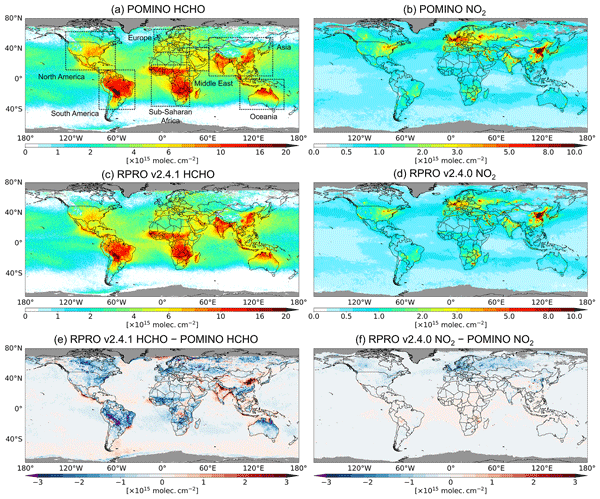
We developed an advanced algorithm for global retrieval of TROPOspheric Monitoring Instrument (TROPOMI) HCHO and NO2 vertical column densities with much improved consistency. Sensitivity tests demonstrate the complexity and nonlinear interactions of auxiliary parameters in the air mass factor calculation. An improved agreement is found with measurements from a global ground-based instrument network. The scientific retrieval provides a useful source of information for studies combining HCHO and NO2.
Beata Opacka, Trissevgeni Stavrakou, Jean-François Müller, Isabelle De Smedt, Jos van Geffen, Eloise A. Marais, Rebekah P. Horner, Dylan B. Millet, Kelly C. Wells, and Alex B. Guenther
Atmos. Chem. Phys., 25, 2863–2894, https://doi.org/10.5194/acp-25-2863-2025, https://doi.org/10.5194/acp-25-2863-2025, 2025
Short summary
Short summary
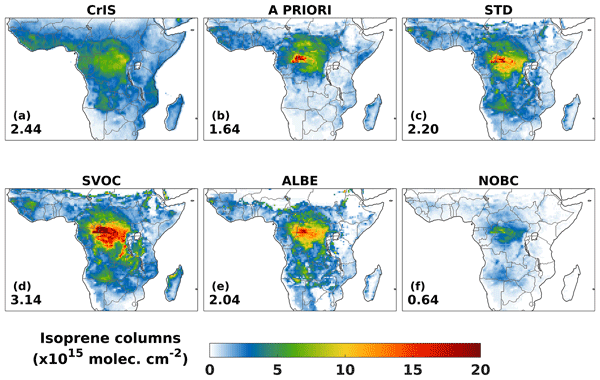
Vegetation releases biogenic volatile organic compounds, while soils and lightning contribute to the natural emissions of nitrogen oxides into the atmosphere. These gases interact in complex ways. Using satellite data and models, we developed a new method to simultaneously optimize these natural emissions over Africa in 2019. Our approach resulted in an increase in natural emissions, supported by independent data indicating that current estimates are underestimated.
Adrianus de Laat, Jos van Geffen, Piet Stammes, Ronald van der A, Henk Eskes, and J. Pepijn Veefkind
Atmos. Chem. Phys., 24, 4511–4535, https://doi.org/10.5194/acp-24-4511-2024, https://doi.org/10.5194/acp-24-4511-2024, 2024
Short summary
Short summary
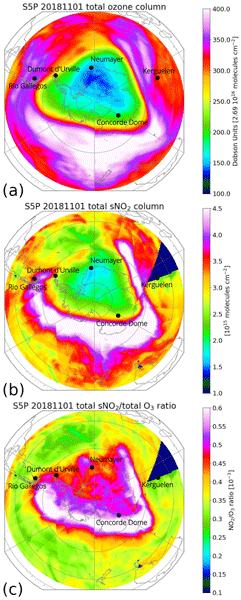
Removal of stratospheric nitrogen oxides is crucial for the formation of the ozone hole. TROPOMI satellite measurements of nitrogen dioxide reveal the presence of a not dissimilar "nitrogen hole" that largely coincides with the ozone hole. Three very distinct regimes were identified: inside and outside the ozone hole and the transition zone in between. Our results introduce a valuable and innovative application highly relevant for Antarctic ozone hole and ozone layer recovery.
John Douros, Henk Eskes, Jos van Geffen, K. Folkert Boersma, Steven Compernolle, Gaia Pinardi, Anne-Marlene Blechschmidt, Vincent-Henri Peuch, Augustin Colette, and Pepijn Veefkind
Geosci. Model Dev., 16, 509–534, https://doi.org/10.5194/gmd-16-509-2023, https://doi.org/10.5194/gmd-16-509-2023, 2023
Short summary
Short summary
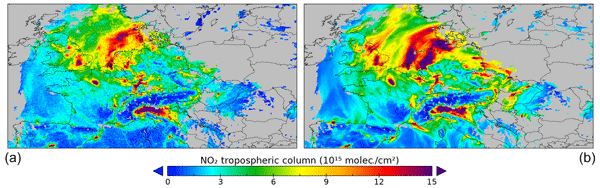
We focus on the challenges associated with comparing atmospheric composition models with satellite products such as tropospheric NO2 columns. The aim is to highlight the methodological difficulties and propose sound ways of doing such comparisons. Building on the comparisons, a new satellite product is proposed and made available, which takes advantage of higher-resolution, regional atmospheric modelling to improve estimates of troposheric NO2 columns over Europe.
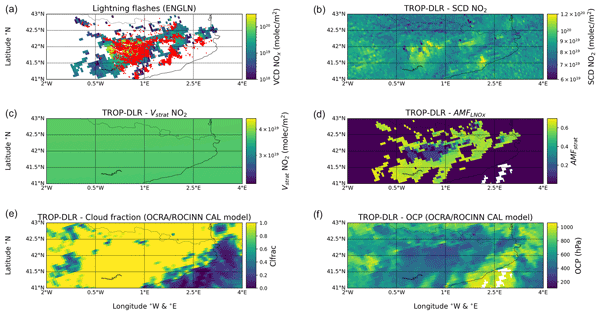
Francisco J. Pérez-Invernón, Heidi Huntrieser, Thilo Erbertseder, Diego Loyola, Pieter Valks, Song Liu, Dale J. Allen, Kenneth E. Pickering, Eric J. Bucsela, Patrick Jöckel, Jos van Geffen, Henk Eskes, Sergio Soler, Francisco J. Gordillo-Vázquez, and Jeff Lapierre
Atmos. Meas. Tech., 15, 3329–3351, https://doi.org/10.5194/amt-15-3329-2022, https://doi.org/10.5194/amt-15-3329-2022, 2022
Short summary
Short summary
Lightning, one of the major sources of nitrogen oxides in the atmosphere, contributes to the tropospheric concentration of ozone and to the oxidizing capacity of the atmosphere. In this work, we contribute to improving the estimation of lightning-produced nitrogen oxides in the Ebro Valley and the Pyrenees by using two different TROPOMI products and comparing the results.
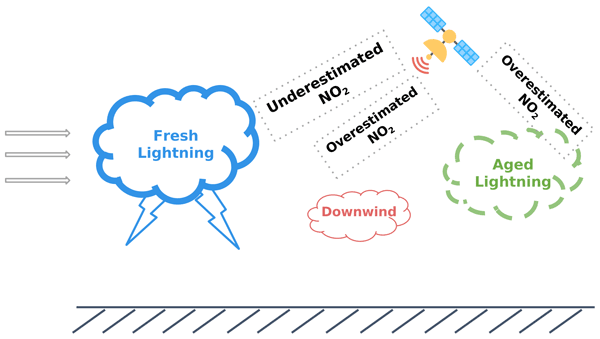
Xin Zhang, Yan Yin, Ronald van der A, Henk Eskes, Jos van Geffen, Yunyao Li, Xiang Kuang, Jeff L. Lapierre, Kui Chen, Zhongxiu Zhen, Jianlin Hu, Chuan He, Jinghua Chen, Rulin Shi, Jun Zhang, Xingrong Ye, and Hao Chen
Atmos. Chem. Phys., 22, 5925–5942, https://doi.org/10.5194/acp-22-5925-2022, https://doi.org/10.5194/acp-22-5925-2022, 2022
Short summary
Short summary
The importance of convection to the ozone and nitrogen oxides (NOx) produced from lightning has long been an open question. We utilize the high-resolution chemistry model with ozonesondes and space observations to discuss the effects of convection over southeastern China, where few studies have been conducted. Our results show the transport and chemistry contributions for various storms and demonstrate the ability of TROPOMI to estimate the lightning NOx production over small-scale convection.
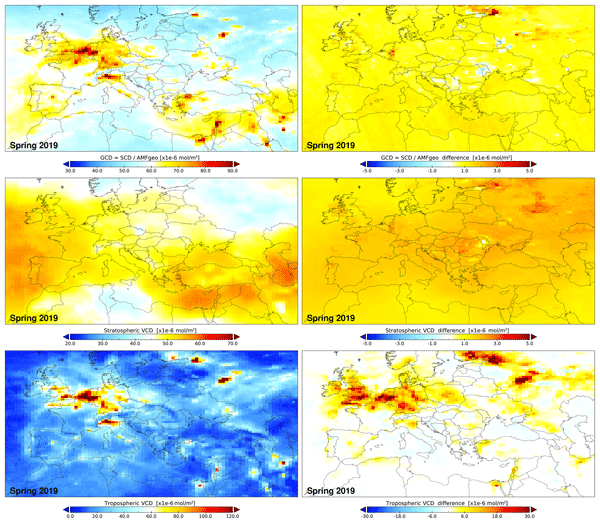
Jos van Geffen, Henk Eskes, Steven Compernolle, Gaia Pinardi, Tijl Verhoelst, Jean-Christopher Lambert, Maarten Sneep, Mark ter Linden, Antje Ludewig, K. Folkert Boersma, and J. Pepijn Veefkind
Atmos. Meas. Tech., 15, 2037–2060, https://doi.org/10.5194/amt-15-2037-2022, https://doi.org/10.5194/amt-15-2037-2022, 2022
Short summary
Short summary
Nitrogen dioxide (NO2) is one of the main data products measured by the Tropospheric Monitoring Instrument (TROPOMI) on the Sentinel-5 Precursor (S5P) satellite. This study describes improvements in the TROPOMI NO2 retrieval leading to version v2.2, operational since 1 July 2021. It compares results with previous versions v1.2–v1.4 and with Ozone Monitoring Instrument (OMI) and ground-based measurements.
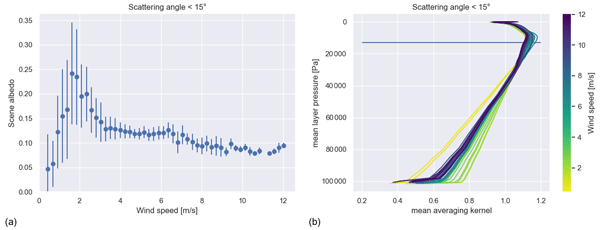
Tobias Christoph Valentin Werner Riess, Klaas Folkert Boersma, Jasper van Vliet, Wouter Peters, Maarten Sneep, Henk Eskes, and Jos van Geffen
Atmos. Meas. Tech., 15, 1415–1438, https://doi.org/10.5194/amt-15-1415-2022, https://doi.org/10.5194/amt-15-1415-2022, 2022
Short summary
Short summary
This paper reports on improved monitoring of ship nitrogen oxide emissions by TROPOMI. With its fantastic resolution we can identify lanes of ship nitrogen dioxide (NO2) pollution not detected from space before. The quality of TROPOMI NO2 data over sea is improved further by recent upgrades in cloud retrievals and the use of sun glint scenes. Lastly, we study the impact of COVID-19 on ship NO2 in European seas and compare the found reductions to emission estimates gained from ship-specific data.
Barbara Dix, Lindsey D. Anderson, J. Pepijn Veefkind, and Joost de Gouw
EGUsphere, https://doi.org/10.5194/egusphere-2026-5052, https://doi.org/10.5194/egusphere-2026-5052, 2026
This preprint is open for discussion and under review for Atmospheric Chemistry and Physics (ACP).
Short summary
Short summary
Wildfire smoke affects climate, but its properties depend on how fires burn and how smoke changes after emission. Using satellite observations of Australian wildfires, we found that flaming fires produce more light-absorbing smoke, while smoldering fires produce more aerosol that scatters light. Smoke becomes more optically uniform away from fire cores, showing that both combustion and early plume processing shape its climate effects.
Tobias Borsdorff, Maarten Krol, Pepijn Veefkind, and Jochen Landgraf
Atmos. Meas. Tech., 19, 4617–4636, https://doi.org/10.5194/amt-19-4617-2026, https://doi.org/10.5194/amt-19-4617-2026, 2026
Short summary
Short summary
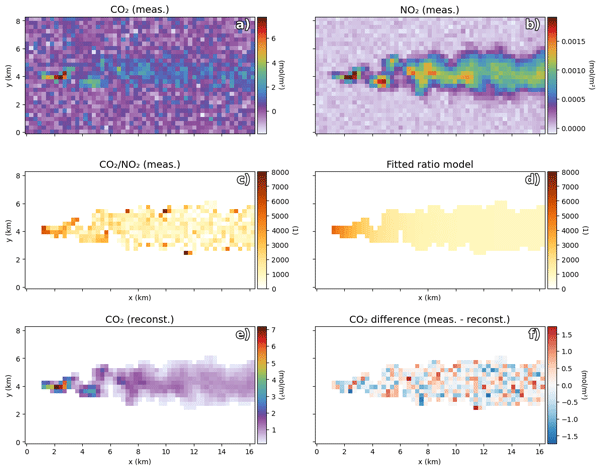
Industrial facilities release carbon dioxide and nitrogen dioxide. The Twin Anthropogenic Greenhouse Gas Observers (TANGO) mission, launching in 2028, will monitor both gases from ten thousand facilities per year using two satellites. We studied whether combining both improves carbon dioxide emission estimates and reveals plume chemistry. While this produces cleaner carbon dioxide images, precision does not improve as noise is redistributed not eliminated. Their ratio captures how nitrogen oxide converts to nitrogen dioxide within plumes.
Tyler Wizenberg, Enrico Dammers, Arjo Segers, Mark W. Shephard, Pierre Coheur, Lieven Clarisse, Martin Van Damme, Henk Eskes, Roy Wichink Kruit, Shelley van der Graaf, and Martijn Schaap
Atmos. Chem. Phys., 26, 9589–9623, https://doi.org/10.5194/acp-26-9589-2026, https://doi.org/10.5194/acp-26-9589-2026, 2026
Short summary
Short summary
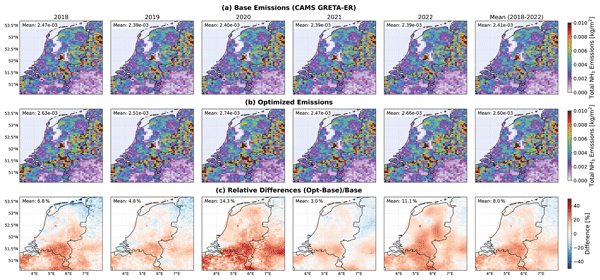
We combined five years of satellite data on ammonia and nitrogen dioxide concentrations with a regional model to better estimate nitrogen emissions and deposition in the Netherlands. This improved the accuracy of pollution maps and trends, especially in agricultural regions. Our approach helps identify when and where emissions are highest, supporting better air quality management and environmental protection by showing the benefits of using multiple complimentary satellite datasets together.
Jinkyul Choi, Kazuyuki Miyazaki, Takashi Sekiya, Jinhyeok Yu, Shin-Ya Ogino, Henk Eskes, Pieter Rijdijk, Ryan Bennett, Anke Roiger, Leon Knez, Glenn S. Diskin, Jason A. Miech, Joshua P. DiGangi, Yonghoon Choi, Alessandro Franchin, Changmin Cho, Eric C. Apel, Louisa K. Emmons, Nattamon Maneenoi, Jason M. St. Clair, Reem A. Hannun, Glenn M. Wolfe, Erin Delaria, Abby Sebol, Donald R. Blake, Monica Crippa, Rachel M. Hoesly, Steven J. Smith, Jung-Hun Woo, Le Kuai, and Ronald Macatangay
EGUsphere, https://doi.org/10.5194/egusphere-2026-2380, https://doi.org/10.5194/egusphere-2026-2380, 2026
Short summary
Short summary
Asia produces half of the world's air pollution, yet emission estimates from different sources disagree widely. We assimilated satellite observations of six pollutant species to correct both concentrations and emissions. Aircraft measurements from a 2024 NASA campaign across four Asian countries confirmed the improvements. Our results reveal underreported emissions in some countries, overestimated vegetation emissions, unresolved fire estimates, and weather control on cross-border pollution.
Takashi Sekiya, Kazuyuki Miyazaki, Henk Eskes, Pieter Rijsdijk, Kengo Sudo, and Yugo Kanaya
EGUsphere, https://doi.org/10.5194/egusphere-2026-1681, https://doi.org/10.5194/egusphere-2026-1681, 2026
Short summary
Short summary
This study evaluates the synergistic effects of satellite aerosol optical depth (AOD) and trace gas data assimilation on aerosol composition analyses. The simultaneous data assimilation (DA) improved the PM2.5 model biases in Northeast Asia compared to conventional DA run that separately assimilate AOD satellite observations. This coupled aerosol and trace gas DA framework offers significant advantages for improving global aerosol composition analyses.
Yutao Chen, Ronald J. van der A, Jieying Ding, Henk Eskes, Felipe Cifuentes, and Pieternel F. Levelt
Atmos. Meas. Tech., 19, 2737–2750, https://doi.org/10.5194/amt-19-2737-2026, https://doi.org/10.5194/amt-19-2737-2026, 2026
Short summary
Short summary
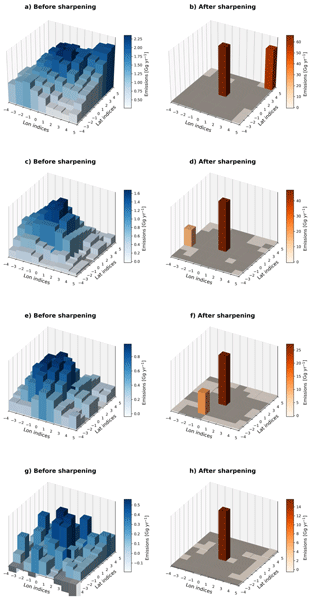
The SO2 gridded point emissions calculated from satellite measurements appear spread out around the source. This is inherent to the inversion method and the resolution of the satellite measurements. We made a new sharpening algorithm to reverse the spreading and make the emission signal clearer. With this method, the effective resolution is improved. Known sources can be located more precisely, and new ones can be found from space. The same approach also works for other gases like NOx.
Felipe Cifuentes, Henk Eskes, Ankie Piters, Julian Gomez, John Douros, Gaia Pinardi, Martina M. Friedrich, Enrico Dammers, Manuel Gebetsberger, and K. Folkert Boersma
Atmos. Meas. Tech., 19, 2437–2477, https://doi.org/10.5194/amt-19-2437-2026, https://doi.org/10.5194/amt-19-2437-2026, 2026
Short summary
Short summary
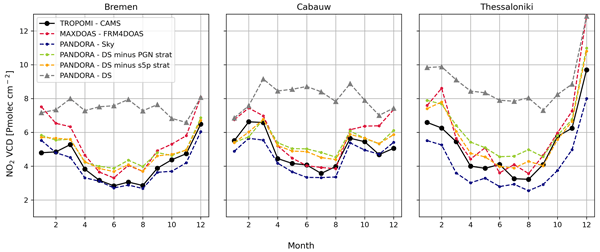
Satellite NO2 data are essential for monitoring air pollution, but they are affected by several sources of uncertainty. This study evaluates the major error contributors in TROPOMI (TROPOspheric Monitoring Instrument) NO2 retrievals by analyzing each retrieval step and comparing with ground-based observations. Key findings include biases in the separation of stratospheric and tropospheric NO2, representation and smoothing errors, and substantial variability among the ground-based instruments used for validation.
Serena Di Pede, Erwin Loots, Antje Ludewig, Emiel van der Plas, Edward van Amelrooy, Mirna van Hoek, Maarten Sneep, Mark ter Linden, Arno Keppens, and J. Pepijn Veefkind
Atmos. Meas. Tech., 19, 1875–1899, https://doi.org/10.5194/amt-19-1875-2026, https://doi.org/10.5194/amt-19-1875-2026, 2026
Short summary
Short summary
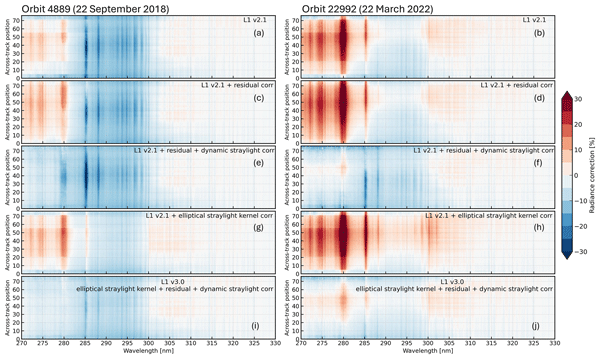
TROPOMI (TROPOspheric Monitoring Instrument) provides daily ozone profile data from ultraviolet bands 1–2. Accurate radiometric calibration is critical below 300 nm where signals are low. A Level-2 soft calibration complements L1 calibration and reveals spectral, temporal, and across-track biases. Re-analysis of calibration data enabled improved L1 corrections to address remaining straylight and residual signal effects, reducing soft calibration magnitude by ~15–20 % and associated biases in L1b v3.0 and ozone processor v2.9.0.

Robert J. D. Spurr, Matt Christi, Nickolay A. Krotkov, Won-Ei Choi, Simon Carn, Can Li, Natalya Kramarova, David Haffner, Eun-Su Yang, Nick Gorkavyi, Alexander Vasilkov, Krzysztof Wargan, Omar Torres, Diego Loyola, Serena Di Pede, J. Pepijn Veefkind, Parker Case, Thomas Schroeder, and Pawan K. Bhartia
Atmos. Meas. Tech., 19, 993–1021, https://doi.org/10.5194/amt-19-993-2026, https://doi.org/10.5194/amt-19-993-2026, 2026
Short summary
Short summary
The submarine eruption of the Hunga volcano released water vapor and sulfur dioxide directly into the stratosphere. The sulfur dioxide formed sulfuric acid aerosols leading to increased scattering of solar ultraviolet radiation (UV), interfering with satellite ozone retrievals. We present a new satellite technique for deriving the amount and height of Hunga aerosols from UV measurements, revealing an unusually low sulfuric acid concentration due to the water-rich conditions in the fresh plume.
Simon Chabrillat, Samuel Rémy, Quentin Errera, Vincent Huijnen, Christine Bingen, Jonas Debosscher, François Hendrick, Swen Metzger, Adrien Mora, Daniele Minganti, Marc Op de beek, Léa Reisenfeld, Jason E. Williams, Henk Eskes, and Johannes Flemming
Geosci. Model Dev., 18, 8973–9014, https://doi.org/10.5194/gmd-18-8973-2025, https://doi.org/10.5194/gmd-18-8973-2025, 2025
Short summary
Short summary
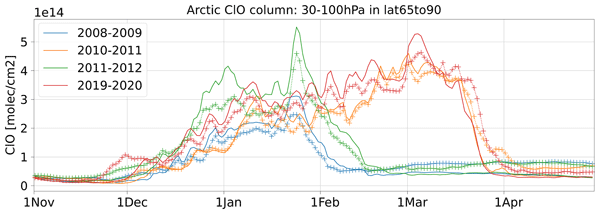
We document the forecasts of the composition of the stratosphere by the Copernicus Atmosphere Monitoring Service. The model's predictions are compared with satellite measurements over a recent period, during polar ozone depletion events, and after the Mount Pinatubo volcanic eruption. The system performs well for sulfate aerosols, ozone and several other key gases but not as well for several nitrogen-containing gases. Chemical processes in aerosols and polar clouds should be improved.
Arno Keppens, Daan Hubert, José Granville, Oindrila Nath, Jean-Christopher Lambert, Catherine Wespes, Pierre-François Coheur, Cathy Clerbaux, Anne Boynard, Richard Siddans, Barry Latter, Brian Kerridge, Serena Di Pede, Pepijn Veefkind, Juan Cuesta, Gaelle Dufour, Klaus-Peter Heue, Melanie Coldewey-Egbers, Diego Loyola, Andrea Orfanoz-Cheuquelaf, Swathi Maratt Satheesan, Kai-Uwe Eichmann, Alexei Rozanov, Viktoria F. Sofieva, Jerald R. Ziemke, Antje Inness, Roeland Van Malderen, and Lars Hoffmann
Atmos. Meas. Tech., 18, 6893–6916, https://doi.org/10.5194/amt-18-6893-2025, https://doi.org/10.5194/amt-18-6893-2025, 2025
Short summary
Short summary
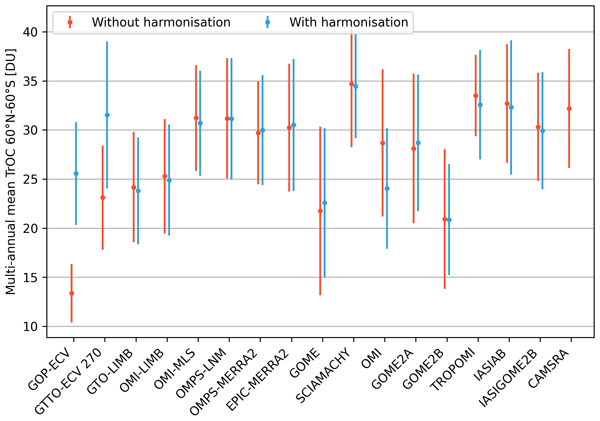
The first Tropospheric Ozone Assessment Report (TOAR) encountered discrepancies between several satellite sensors’ estimates of the distribution and change of ozone in the free troposphere. Therefore, contributing to the second TOAR, we harmonise as much as possible the observational perspective of sixteen tropospheric ozone products from satellites. This only partially accounts for the observed discrepancies, with a reduction of 10–40 % of the inter-product dispersion upon harmonisation.

Harikrishnan Charuvil Asokan, Jochen Landgraf, Pepijn Veefkind, Stijn Dellaert, and André Butz
Atmos. Meas. Tech., 18, 5247–5264, https://doi.org/10.5194/amt-18-5247-2025, https://doi.org/10.5194/amt-18-5247-2025, 2025
Short summary
Short summary
Greenhouse gases like CO2 and CH4 drive climate change. Satellites enable monitoring of these emissions from space. Our simulations show that the upcoming Twin ANthropogenic Greenhouse gas Observers (TANGO) mission can detect about 500 targets per 4 d cycle under clear skies, but cloud cover reduces detection. Integrating cloud forecasts into TANGO’s manoeuvering boosts detection, highlighting its potential for improving global emission monitoring.
Augustin Colette, Gaëlle Collin, François Besson, Etienne Blot, Vincent Guidard, Frédérik Meleux, Adrien Royer, Valentin Petiot, Claire Miller, Oihana Fermond, Alizé Jeant, Mario Adani, Joaquim Arteta, Anna Benedictow, Robert Bergström, Dene Bowdalo, Jorgen Brandt, Gino Briganti, Ana C. Carvalho, Jesper Heile Christensen, Florian Couvidat, Ilaria D'Elia, Massimo D'Isidoro, Hugo Denier van der Gon, Gaël Descombes, Enza Di Tomaso, John Douros, Jeronimo Escribano, Henk Eskes, Hilde Fagerli, Yalda Fatahi, Johannes Flemming, Elmar Friese, Lise Frohn, Michael Gauss, Camilla Geels, Guido Guarnieri, Marc Guevara, Antoine Guion, Jonathan Guth, Risto Hänninen, Kaj Hansen, Ulas Im, Ruud Janssen, Marine Jeoffrion, Mathieu Joly, Luke Jones, Oriol Jorba, Evgeni Kadantsev, Michael Kahnert, Jacek W. Kaminski, Rostislav Kouznetsov, Richard Kranenburg, Jeroen Kuenen, Anne Caroline Lange, Joachim Langner, Victor Lannuque, Francesca Macchia, Astrid Manders, Mihaela Mircea, Agnes Nyiri, Miriam Olid, Carlos Pérez García-Pando, Yuliia Palamarchuk, Antonio Piersanti, Blandine Raux, Miha Razinger, Lennard Robertson, Arjo Segers, Martijn Schaap, Pilvi Siljamo, David Simpson, Mikhail Sofiev, Anders Stangel, Joanna Struzewska, Carles Tena, Renske Timmermans, Thanos Tsikerdekis, Svetlana Tsyro, Svyatoslav Tyuryakov, Anthony Ung, Andreas Uppstu, Alvaro Valdebenito, Peter van Velthoven, Lina Vitali, Zhuyun Ye, Vincent-Henri Peuch, and Laurence Rouïl
Geosci. Model Dev., 18, 6835–6883, https://doi.org/10.5194/gmd-18-6835-2025, https://doi.org/10.5194/gmd-18-6835-2025, 2025
Short summary
Short summary
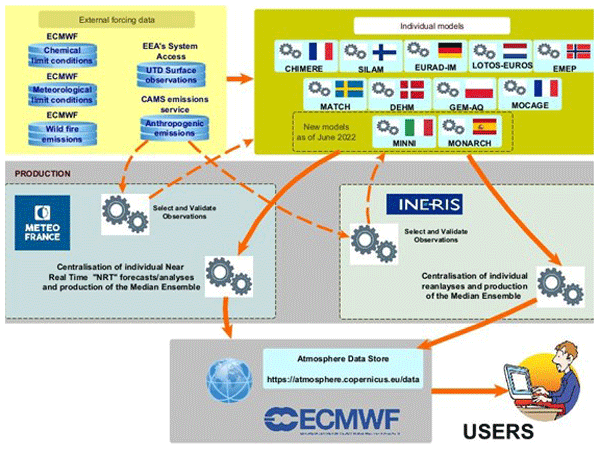
The Copernicus Atmosphere Monitoring Service – Regional Production delivers daily forecasts, analyses, and reanalyses of air quality in Europe. The service relies on a distributed modelling production by 11 leading European modelling teams following stringent requirements with an operational design that has no equivalent in the world. All the products are free, open, and quality-assured and disseminated with a high level of reliability.
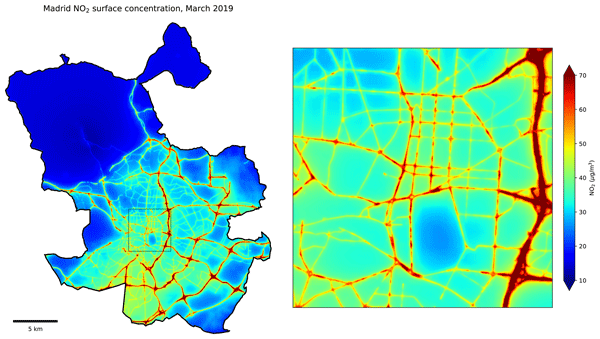
Bas Mijling, Henk Eskes, Sascha Hofmann, Pau Moreno, David García Falin, and María Encarnación de Vega Pastor
Geosci. Model Dev., 18, 6439–6460, https://doi.org/10.5194/gmd-18-6439-2025, https://doi.org/10.5194/gmd-18-6439-2025, 2025
Short summary
Short summary
Given the serious health risks of urban air pollution, monitoring local pollution levels is crucial. The Retina v2 algorithm creates high-resolution pollution maps by integrating satellite and local measurements with an air quality model. Easily portable to other cities, it balances accuracy with low computational demands, matching or outperforming complex dispersion models and data-heavy machine learning. Satellite data proves especially valuable in cities with sparse or no monitoring networks.
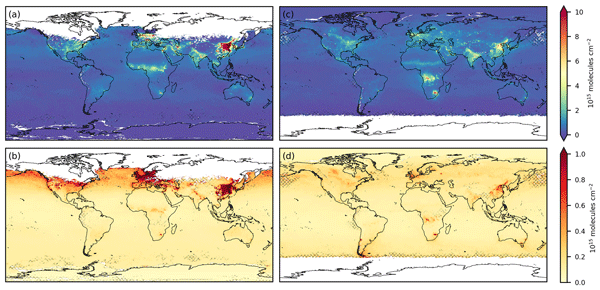
Isolde Glissenaar, Klaas Folkert Boersma, Isidora Anglou, Pieter Rijsdijk, Tijl Verhoelst, Steven Compernolle, Gaia Pinardi, Jean-Christopher Lambert, Michel Van Roozendael, and Henk Eskes
Earth Syst. Sci. Data, 17, 4627–4650, https://doi.org/10.5194/essd-17-4627-2025, https://doi.org/10.5194/essd-17-4627-2025, 2025
Short summary
Short summary
We developed a new global dataset of nitrogen dioxide (NO2) levels in the lower atmosphere, using data from TROPOMI for 2018–2021. This dataset offers improved accuracy and detail compared to earlier versions, meeting high international standards for climate data. By refining how measurement errors are calculated and reduced over time and space, we provide clearer insights into pollution patterns. This work supports better air quality monitoring and informs actions to address pollution globally.
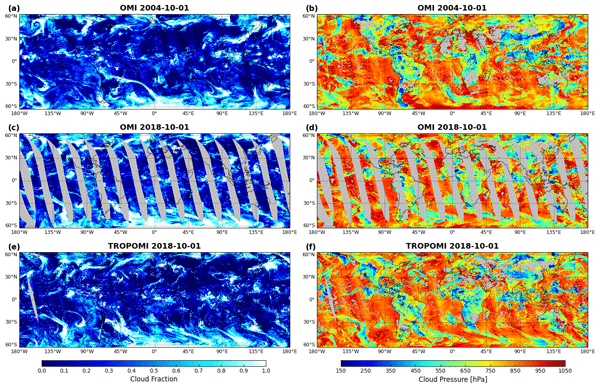
Huan Yu, Isabelle De Smedt, Nicolas Theys, Maarten Sneep, Pepijn Veefkind, and Michel Van Roozendael
Atmos. Meas. Tech., 18, 4131–4163, https://doi.org/10.5194/amt-18-4131-2025, https://doi.org/10.5194/amt-18-4131-2025, 2025
Short summary
Short summary
We introduce a new cloud retrieval algorithm using the O2–O2 absorption band at 477 nm to generate harmonized cloud datasets from OMI and TROPOMI. The algorithm improves upon the OMI O2–O2 operational cloud algorithm in several aspects. The new approach improves consistency in cloud parameters and NO2 retrievals between two sensors.
Rimal Abeed, Audrey Fortems-Cheiney, Grégoire Broquet, Robin Plauchu, Isabelle Pison, Antoine Berchet, Elise Potier, Bo Zheng, Gaëlle Dufour, Adriana Coman, Dilek Savas, Guillaume Siour, Henk Eskes, Beatriz Revilla-Romero, Antony Delavois, and Philippe Ciais
EGUsphere, https://doi.org/10.5194/egusphere-2025-3329, https://doi.org/10.5194/egusphere-2025-3329, 2025
Preprint archived
Short summary
Short summary
We investigate changes in air pollution from nitrogen oxides NOx (=NO+NO2) across Eastern China from 2019 to 2021, using a satellite-based modelling approach. Our results show a drop in pollution in 2020 in most provinces, and along the China-Mongolia-Russia Economic Corridor. The analysis also captures emission variations during the Lunar New Year. By estimating emissions at the provincial level, the study provides insights into how major events and policy measures influence local air quality.
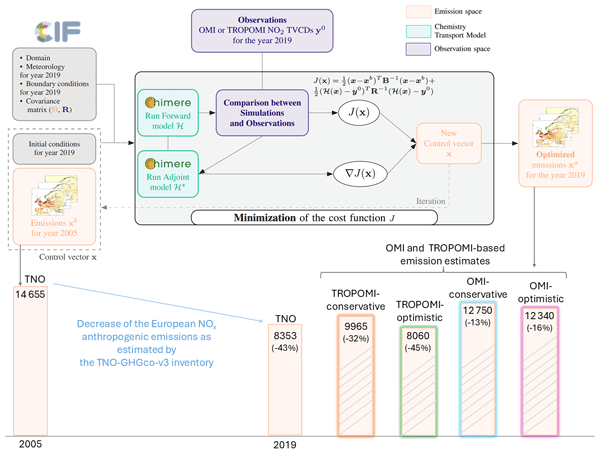
Audrey Fortems-Cheiney, Grégoire Broquet, Elise Potier, Antoine Berchet, Isabelle Pison, Adrien Martinez, Robin Plauchu, Rimal Abeed, Aurélien Sicsik-Paré, Gaelle Dufour, Adriana Coman, Dilek Savas, Guillaume Siour, Henk Eskes, Hugo A. C. Denier van der Gon, and Stijn N. C. Dellaert
Atmos. Chem. Phys., 25, 6047–6068, https://doi.org/10.5194/acp-25-6047-2025, https://doi.org/10.5194/acp-25-6047-2025, 2025
Short summary
Short summary
This study assesses the potential of the Ozone Monitoring Instrument (OMI) and the TROPOspheric Monitoring Instrument (TROPOMI) satellite observations to inform about the decrease in anthropogenic emissions of nitrogen oxides (NOx) in 2019 compared with 2005 at regional to national scales in Europe. Both the OMI and TROPOMI inversions show decreases in European NOx anthropogenic emission budgets in 2019 compared to 2005 but with different magnitudes.
Martin de Graaf, Maarten Sneep, Mark ter Linden, L. Gijsbert Tilstra, David P. Donovan, Gerd-Jan van Zadelhoff, and J. Pepijn Veefkind
Atmos. Meas. Tech., 18, 2553–2571, https://doi.org/10.5194/amt-18-2553-2025, https://doi.org/10.5194/amt-18-2553-2025, 2025
Short summary
Short summary
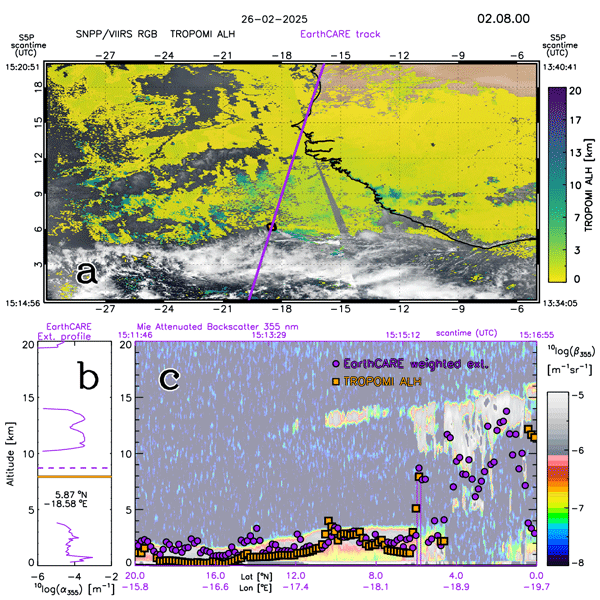
The aerosol layer height (ALH) from the TROPOspheric Monitoring Instrument (TROPOMI) has been constantly improved since its release in 2019. Over bright surfaces, fitting the albedo improved the retrieval, as shown for a set of situations, ranging from multiple layers of smoke to thick desert dust plumes and low-altitude industrial pollution. The latest results of the operational ALH are compared to profiles from the ATmospheric LIDar (ATLID) on board the recently launched EarthCARE mission.
Alexander C. Bradley, Barbara Dix, Fergus Mackenzie, J. Pepijn Veefkind, and Joost A. de Gouw
Atmos. Meas. Tech., 18, 1675–1687, https://doi.org/10.5194/amt-18-1675-2025, https://doi.org/10.5194/amt-18-1675-2025, 2025
Short summary
Short summary
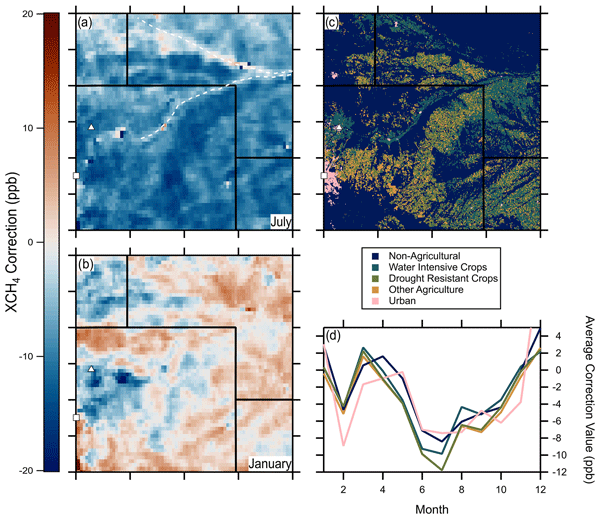
Currently, measurement of methane from the TROPOMI satellite is biased with respect to surface reflectance. This study demonstrates a new method of correcting for this bias on a seasonal timescale to allow for differences in surface reflectance in areas of intense agriculture where growing seasons may introduce a reflectance bias. We have successfully implemented this technique in the Denver–Julesburg basin, where agriculture and methane extraction infrastructure is often co-located.
Yuhang Zhang, Huan Yu, Isabelle De Smedt, Jintai Lin, Nicolas Theys, Michel Van Roozendael, Gaia Pinardi, Steven Compernolle, Ruijing Ni, Fangxuan Ren, Sijie Wang, Lulu Chen, Jos Van Geffen, Mengyao Liu, Alexander M. Cede, Martin Tiefengraber, Alexis Merlaud, Martina M. Friedrich, Andreas Richter, Ankie Piters, Vinod Kumar, Vinayak Sinha, Thomas Wagner, Yongjoo Choi, Hisahiro Takashima, Yugo Kanaya, Hitoshi Irie, Robert Spurr, Wenfu Sun, and Lorenzo Fabris
Atmos. Meas. Tech., 18, 1561–1589, https://doi.org/10.5194/amt-18-1561-2025, https://doi.org/10.5194/amt-18-1561-2025, 2025
Short summary
Short summary
We developed an advanced algorithm for global retrieval of TROPOspheric Monitoring Instrument (TROPOMI) HCHO and NO2 vertical column densities with much improved consistency. Sensitivity tests demonstrate the complexity and nonlinear interactions of auxiliary parameters in the air mass factor calculation. An improved agreement is found with measurements from a global ground-based instrument network. The scientific retrieval provides a useful source of information for studies combining HCHO and NO2.
Beata Opacka, Trissevgeni Stavrakou, Jean-François Müller, Isabelle De Smedt, Jos van Geffen, Eloise A. Marais, Rebekah P. Horner, Dylan B. Millet, Kelly C. Wells, and Alex B. Guenther
Atmos. Chem. Phys., 25, 2863–2894, https://doi.org/10.5194/acp-25-2863-2025, https://doi.org/10.5194/acp-25-2863-2025, 2025
Short summary
Short summary
Vegetation releases biogenic volatile organic compounds, while soils and lightning contribute to the natural emissions of nitrogen oxides into the atmosphere. These gases interact in complex ways. Using satellite data and models, we developed a new method to simultaneously optimize these natural emissions over Africa in 2019. Our approach resulted in an increase in natural emissions, supported by independent data indicating that current estimates are underestimated.
Yutao Chen, Ronald J. van der A, Jieying Ding, Henk Eskes, Jason E. Williams, Nicolas Theys, Athanasios Tsikerdekis, and Pieternel F. Levelt
Atmos. Chem. Phys., 25, 1851–1868, https://doi.org/10.5194/acp-25-1851-2025, https://doi.org/10.5194/acp-25-1851-2025, 2025
Short summary
Short summary
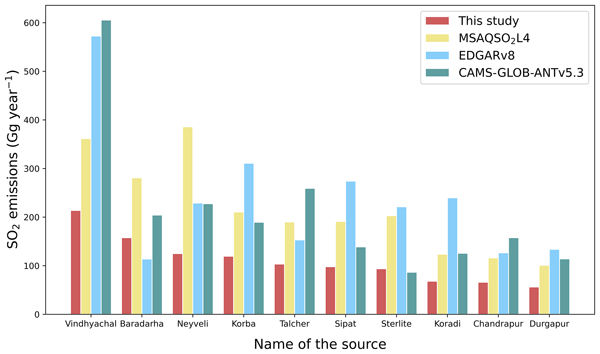
There is a lack of local SO2 top-down emission inventories in India. With the improvement in the divergence method and the derivation of SO2 local lifetime, gridded SO2 emissions over a large area can be estimated efficiently. This method can be applied to any region in the world to derive SO2 emissions. Especially for regions with high latitudes, our methodology has the potential to significantly improve the top-down derivation of SO2 emissions.
Felipe Cifuentes, Henk Eskes, Enrico Dammers, Charlotte Bryan, and Folkert Boersma
Geosci. Model Dev., 18, 621–649, https://doi.org/10.5194/gmd-18-621-2025, https://doi.org/10.5194/gmd-18-621-2025, 2025
Short summary
Short summary
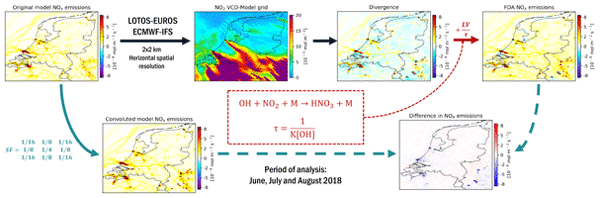
We tested the capability of the flux divergence approach (FDA) to reproduce known NOx emissions using synthetic NO2 satellite column retrievals from high-resolution model simulations. The FDA accurately reproduced NOx emissions when column observations were limited to the boundary layer and when the variability of the NO2 lifetime, the NOx : NO2 ratio, and NO2 profile shapes were correctly modeled. This introduces strong model dependency, reducing the simplicity of the original FDA formulation.
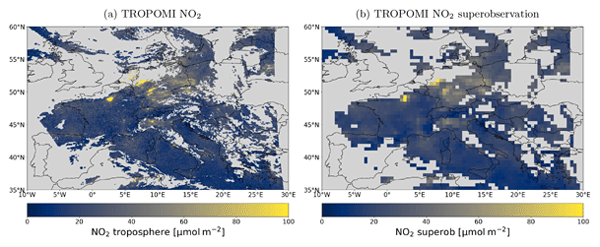
Pieter Rijsdijk, Henk Eskes, Arlene Dingemans, K. Folkert Boersma, Takashi Sekiya, Kazuyuki Miyazaki, and Sander Houweling
Geosci. Model Dev., 18, 483–509, https://doi.org/10.5194/gmd-18-483-2025, https://doi.org/10.5194/gmd-18-483-2025, 2025
Short summary
Short summary
Clustering high-resolution satellite observations into superobservations improves model validation and data assimilation applications. In our paper, we derive quantitative uncertainties for satellite NO2 column observations based on knowledge of the retrievals, including a detailed analysis of spatial error correlations and representativity errors. The superobservations and uncertainty estimates are tested in a global chemical data assimilation system and are found to improve the forecasts.
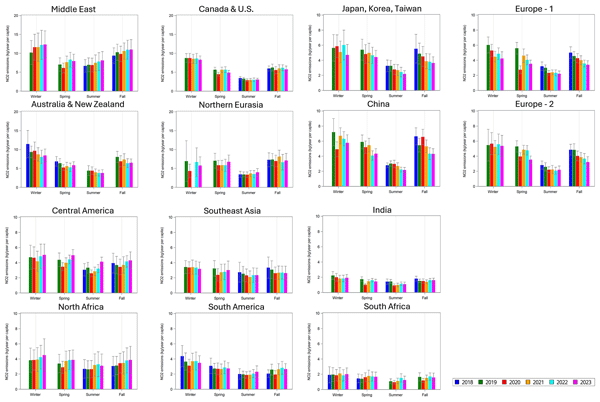
Vitali Fioletov, Chris A. McLinden, Debora Griffin, Xiaoyi Zhao, and Henk Eskes
Atmos. Chem. Phys., 25, 575–596, https://doi.org/10.5194/acp-25-575-2025, https://doi.org/10.5194/acp-25-575-2025, 2025
Short summary
Short summary
Satellite data were used to estimate urban per capita emissions for 261 major cities worldwide. Three components in tropospheric NO2 data (background NO2, NO2 from urban sources, and NO2 from industrial point sources) were isolated, and then each of these components was analyzed separately. The largest per capita emissions were found in the Middle East and the smallest in India and southern Africa. Urban weekend emissions are 20 %–50 % less than workday emissions for all regions except China.
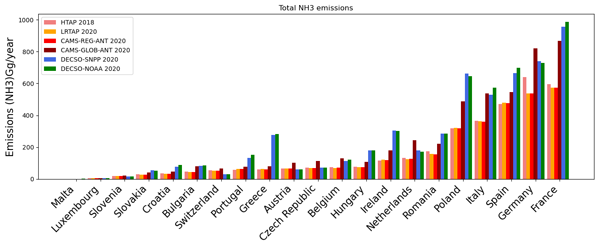
Jieying Ding, Ronald van der A, Henk Eskes, Enrico Dammers, Mark Shephard, Roy Wichink Kruit, Marc Guevara, and Leonor Tarrason
Atmos. Chem. Phys., 24, 10583–10599, https://doi.org/10.5194/acp-24-10583-2024, https://doi.org/10.5194/acp-24-10583-2024, 2024
Short summary
Short summary
Here we applied the existing Daily Emissions Constrained by Satellite Observations (DECSO) inversion algorithm to NH3 observations from the CrIS satellite instrument to estimate NH3 emissions. As NH3 in the atmosphere is influenced by NOx, we implemented DECSO to estimate NOx and NH3 emissions simultaneously. The emissions are derived over Europe for 2020 at a spatial resolution of 0.2° using daily observations from CrIS and TROPOMI. Results are compared to bottom-up emission inventories.
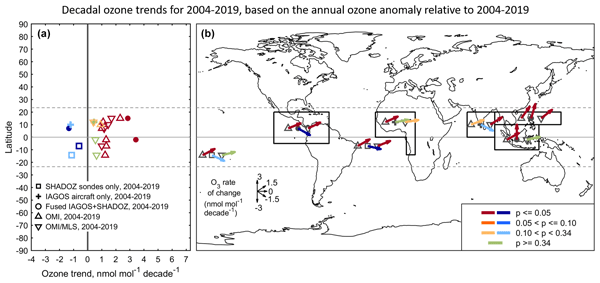
Audrey Gaudel, Ilann Bourgeois, Meng Li, Kai-Lan Chang, Jerald Ziemke, Bastien Sauvage, Ryan M. Stauffer, Anne M. Thompson, Debra E. Kollonige, Nadia Smith, Daan Hubert, Arno Keppens, Juan Cuesta, Klaus-Peter Heue, Pepijn Veefkind, Kenneth Aikin, Jeff Peischl, Chelsea R. Thompson, Thomas B. Ryerson, Gregory J. Frost, Brian C. McDonald, and Owen R. Cooper
Atmos. Chem. Phys., 24, 9975–10000, https://doi.org/10.5194/acp-24-9975-2024, https://doi.org/10.5194/acp-24-9975-2024, 2024
Short summary
Short summary
The study examines tropical tropospheric ozone changes. In situ data from 1994–2019 display increased ozone, notably over India, Southeast Asia, and Malaysia and Indonesia. Sparse in situ data limit trend detection for the 15-year period. In situ and satellite data, with limited sampling, struggle to consistently detect trends. Continuous observations are vital over the tropical Pacific Ocean, Indian Ocean, western Africa, and South Asia for accurate ozone trend estimation in these regions.
Mengyao Liu, Ronald van der A, Michiel van Weele, Lotte Bryan, Henk Eskes, Pepijn Veefkind, Yongxue Liu, Xiaojuan Lin, Jos de Laat, and Jieying Ding
Atmos. Meas. Tech., 17, 5261–5277, https://doi.org/10.5194/amt-17-5261-2024, https://doi.org/10.5194/amt-17-5261-2024, 2024
Short summary
Short summary
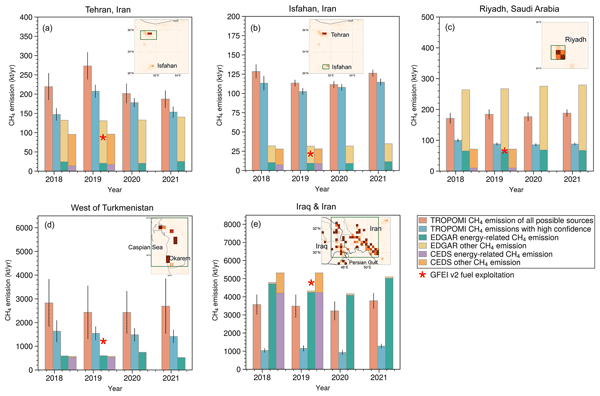
A new divergence method was developed and applied to estimate methane emissions from TROPOMI observations over the Middle East, where it is typically challenging for a satellite to measure methane due to its complicated orography and surface albedo. Our results show the potential of TROPOMI to quantify methane emissions from various sources rather than big emitters from space after objectively excluding the artifacts in the retrieval.
Henk Eskes, Athanasios Tsikerdekis, Melanie Ades, Mihai Alexe, Anna Carlin Benedictow, Yasmine Bennouna, Lewis Blake, Idir Bouarar, Simon Chabrillat, Richard Engelen, Quentin Errera, Johannes Flemming, Sebastien Garrigues, Jan Griesfeller, Vincent Huijnen, Luka Ilić, Antje Inness, John Kapsomenakis, Zak Kipling, Bavo Langerock, Augustin Mortier, Mark Parrington, Isabelle Pison, Mikko Pitkänen, Samuel Remy, Andreas Richter, Anja Schoenhardt, Michael Schulz, Valerie Thouret, Thorsten Warneke, Christos Zerefos, and Vincent-Henri Peuch
Atmos. Chem. Phys., 24, 9475–9514, https://doi.org/10.5194/acp-24-9475-2024, https://doi.org/10.5194/acp-24-9475-2024, 2024
Short summary
Short summary
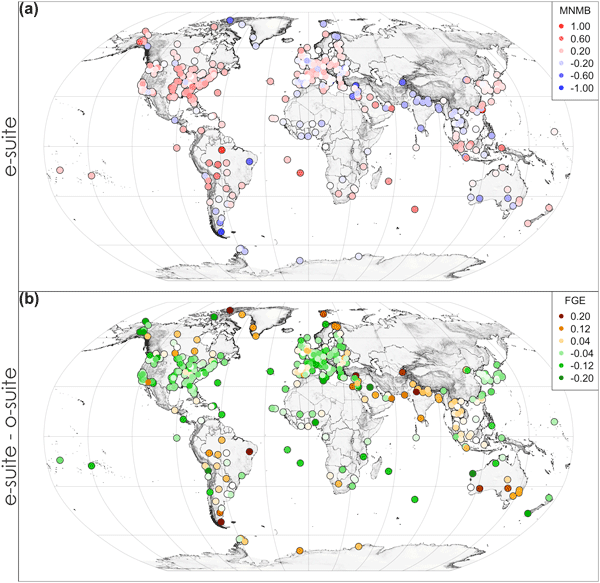
The Copernicus Atmosphere Monitoring Service (CAMS) provides global analyses and forecasts of aerosols and trace gases in the atmosphere. On 27 June 2023 a major upgrade, Cy48R1, became operational. Comparisons with in situ, surface remote sensing, aircraft, and balloon and satellite observations show that the new CAMS system is a significant improvement. The results quantify the skill of CAMS to forecast impactful events, such as wildfires, dust storms and air pollution peaks.
Robin Plauchu, Audrey Fortems-Cheiney, Grégoire Broquet, Isabelle Pison, Antoine Berchet, Elise Potier, Gaëlle Dufour, Adriana Coman, Dilek Savas, Guillaume Siour, and Henk Eskes
Atmos. Chem. Phys., 24, 8139–8163, https://doi.org/10.5194/acp-24-8139-2024, https://doi.org/10.5194/acp-24-8139-2024, 2024
Short summary
Short summary
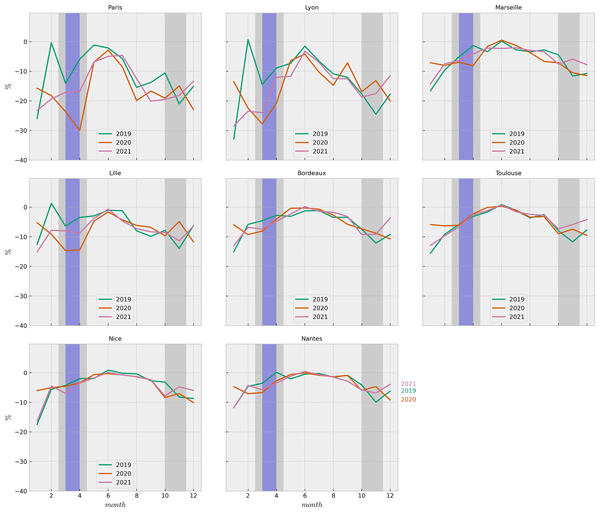
This study uses the Community Inversion Framework and CHIMERE model to assess the potential of TROPOMI-S5P PAL NO2 tropospheric column data to estimate NOx emissions in France (2019–2021). Results show a 3 % decrease in average emissions compared to the 2016 CAMS-REG/INS, lower than the 14 % decrease from CITEPA. The study highlights challenges in capturing emission anomalies due to limited data coverage and error levels but shows promise for local inventory improvements.
Arno Keppens, Serena Di Pede, Daan Hubert, Jean-Christopher Lambert, Pepijn Veefkind, Maarten Sneep, Johan De Haan, Mark ter Linden, Thierry Leblanc, Steven Compernolle, Tijl Verhoelst, José Granville, Oindrila Nath, Ann Mari Fjæraa, Ian Boyd, Sander Niemeijer, Roeland Van Malderen, Herman G. J. Smit, Valentin Duflot, Sophie Godin-Beekmann, Bryan J. Johnson, Wolfgang Steinbrecht, David W. Tarasick, Debra E. Kollonige, Ryan M. Stauffer, Anne M. Thompson, Angelika Dehn, and Claus Zehner
Atmos. Meas. Tech., 17, 3969–3993, https://doi.org/10.5194/amt-17-3969-2024, https://doi.org/10.5194/amt-17-3969-2024, 2024
Short summary
Short summary
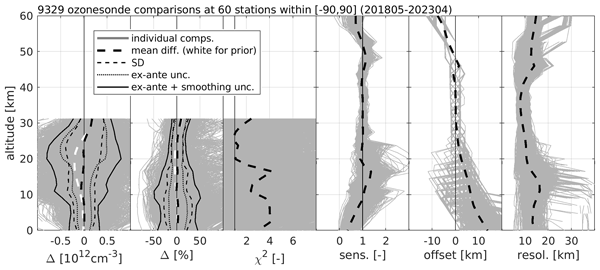
The Sentinel-5P satellite operated by the European Space Agency has carried the TROPOspheric Monitoring Instrument (TROPOMI) around the Earth since October 2017. This mission also produces atmospheric ozone profile data which are described in detail for May 2018 to April 2023. Independent validation using ground-based reference measurements demonstrates that the operational ozone profile product mostly fully and at least partially complies with all mission requirements.
Ronald J. van der A, Jieying Ding, and Henk Eskes
Atmos. Chem. Phys., 24, 7523–7534, https://doi.org/10.5194/acp-24-7523-2024, https://doi.org/10.5194/acp-24-7523-2024, 2024
Short summary
Short summary
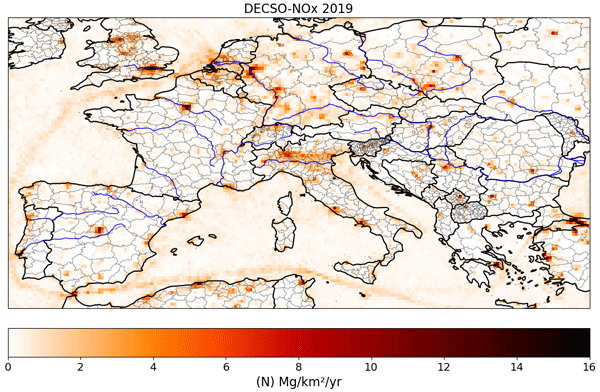
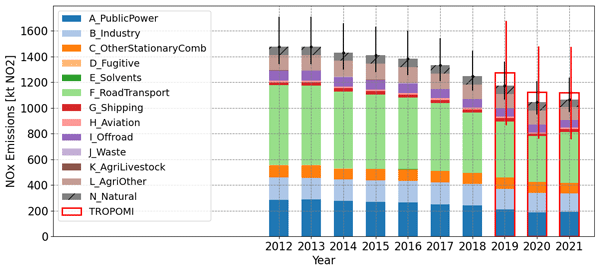
Using observations of the Sentinel-5P satellite and the latest version of the inversion algorithm DECSO, anthropogenic NOx emissions are derived for Europe for the years 2019–2022 with a spatial resolution of 0.2°. The results are compared with European emissions of the Copernicus Atmosphere Monitoring Service.
Enrico Dammers, Janot Tokaya, Christian Mielke, Kevin Hausmann, Debora Griffin, Chris McLinden, Henk Eskes, and Renske Timmermans
Geosci. Model Dev., 17, 4983–5007, https://doi.org/10.5194/gmd-17-4983-2024, https://doi.org/10.5194/gmd-17-4983-2024, 2024
Short summary
Short summary
Nitrogen dioxide (NOx) is produced by sources such as industry and traffic and is directly linked to negative impacts on health and the environment. The current construction of emission inventories to keep track of NOx emissions is slow and time-consuming. Satellite measurements provide a way to quickly and independently estimate emissions. In this study, we apply a consistent methodology to derive NOx emissions over Germany and illustrate the value of having such a method for fast projections.
Andrés Yarce Botero, Michiel van Weele, Arjo Segers, Pier Siebesma, and Henk Eskes
Geosci. Model Dev., 17, 3765–3781, https://doi.org/10.5194/gmd-17-3765-2024, https://doi.org/10.5194/gmd-17-3765-2024, 2024
Short summary
Short summary
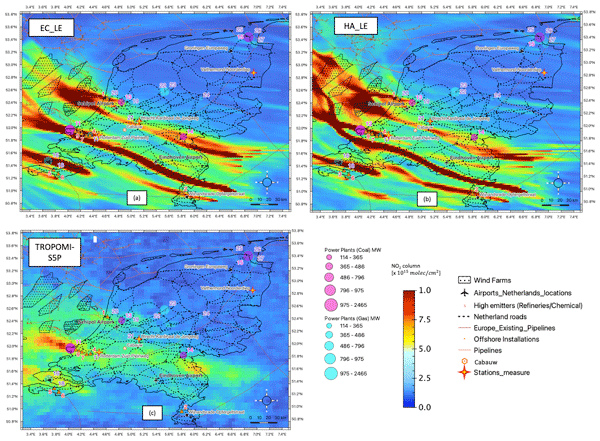
HARMONIE WINS50 reanalysis data with 0.025° × 0.025° resolution from 2019 to 2021 were coupled with the LOTOS-EUROS Chemical Transport Model. HARMONIE and ECMWF meteorology configurations against Cabauw observations (52.0° N, 4.9° W) were evaluated as simulated NO2 concentrations with ground-level sensors. Differences in crucial meteorological input parameters (boundary layer height, vertical diffusion coefficient) between the hydrostatic and non-hydrostatic models were analysed.
Adrianus de Laat, Jos van Geffen, Piet Stammes, Ronald van der A, Henk Eskes, and J. Pepijn Veefkind
Atmos. Chem. Phys., 24, 4511–4535, https://doi.org/10.5194/acp-24-4511-2024, https://doi.org/10.5194/acp-24-4511-2024, 2024
Short summary
Short summary
Removal of stratospheric nitrogen oxides is crucial for the formation of the ozone hole. TROPOMI satellite measurements of nitrogen dioxide reveal the presence of a not dissimilar "nitrogen hole" that largely coincides with the ozone hole. Three very distinct regimes were identified: inside and outside the ozone hole and the transition zone in between. Our results introduce a valuable and innovative application highly relevant for Antarctic ozone hole and ozone layer recovery.
Xiaojuan Lin, Ronald van der A, Jos de Laat, Henk Eskes, Frédéric Chevallier, Philippe Ciais, Zhu Deng, Yuanhao Geng, Xuanren Song, Xiliang Ni, Da Huo, Xinyu Dou, and Zhu Liu
Atmos. Chem. Phys., 23, 6599–6611, https://doi.org/10.5194/acp-23-6599-2023, https://doi.org/10.5194/acp-23-6599-2023, 2023
Short summary
Short summary
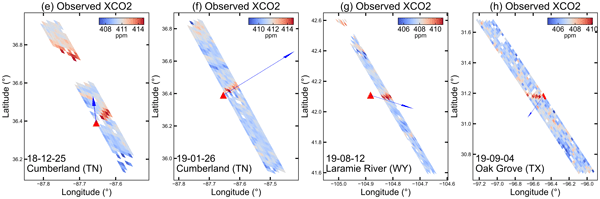
Satellite observations provide evidence for CO2 emission signals from isolated power plants. We use these satellite observations to quantify emissions. We found that for power plants with multiple observations, the correlation of estimated and reported emissions is significantly improved compared to a single observation case. This demonstrates that accurate estimation of power plant emissions can be achieved by monitoring from future satellite missions with more frequent observations.
Anna Agustí-Panareda, Jérôme Barré, Sébastien Massart, Antje Inness, Ilse Aben, Melanie Ades, Bianca C. Baier, Gianpaolo Balsamo, Tobias Borsdorff, Nicolas Bousserez, Souhail Boussetta, Michael Buchwitz, Luca Cantarello, Cyril Crevoisier, Richard Engelen, Henk Eskes, Johannes Flemming, Sébastien Garrigues, Otto Hasekamp, Vincent Huijnen, Luke Jones, Zak Kipling, Bavo Langerock, Joe McNorton, Nicolas Meilhac, Stefan Noël, Mark Parrington, Vincent-Henri Peuch, Michel Ramonet, Miha Razinger, Maximilian Reuter, Roberto Ribas, Martin Suttie, Colm Sweeney, Jérôme Tarniewicz, and Lianghai Wu
Atmos. Chem. Phys., 23, 3829–3859, https://doi.org/10.5194/acp-23-3829-2023, https://doi.org/10.5194/acp-23-3829-2023, 2023
Short summary
Short summary
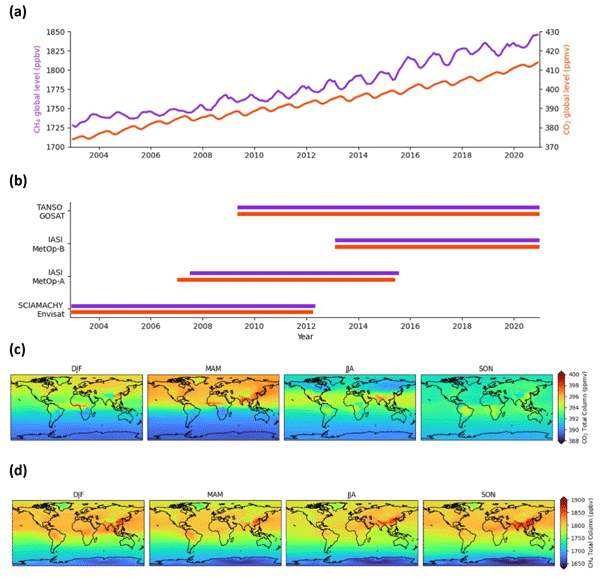
We present a global dataset of atmospheric CO2 and CH4, the two most important human-made greenhouse gases, which covers almost 2 decades (2003–2020). It is produced by combining satellite data of CO2 and CH4 with a weather and air composition prediction model, and it has been carefully evaluated against independent observations to ensure validity and point out deficiencies to the user. This dataset can be used for scientific studies in the field of climate change and the global carbon cycle.
Kezia Lange, Andreas Richter, Anja Schönhardt, Andreas C. Meier, Tim Bösch, André Seyler, Kai Krause, Lisa K. Behrens, Folkard Wittrock, Alexis Merlaud, Frederik Tack, Caroline Fayt, Martina M. Friedrich, Ermioni Dimitropoulou, Michel Van Roozendael, Vinod Kumar, Sebastian Donner, Steffen Dörner, Bianca Lauster, Maria Razi, Christian Borger, Katharina Uhlmannsiek, Thomas Wagner, Thomas Ruhtz, Henk Eskes, Birger Bohn, Daniel Santana Diaz, Nader Abuhassan, Dirk Schüttemeyer, and John P. Burrows
Atmos. Meas. Tech., 16, 1357–1389, https://doi.org/10.5194/amt-16-1357-2023, https://doi.org/10.5194/amt-16-1357-2023, 2023
Short summary
Short summary
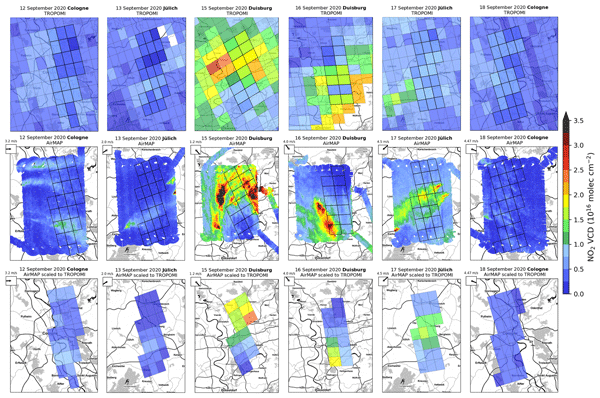
We present airborne imaging DOAS and ground-based stationary and car DOAS measurements conducted during the S5P-VAL-DE-Ruhr campaign in the Rhine-Ruhr region. The measurements are used to validate spaceborne NO2 data products from the Sentinel-5 Precursor TROPOspheric Monitoring Instrument (TROPOMI). Auxiliary data of the TROPOMI NO2 retrieval, such as spatially higher resolved a priori NO2 vertical profiles, surface reflectivity, and cloud treatment are investigated to evaluate their impact.
Konstantinos Michailidis, Maria-Elissavet Koukouli, Dimitris Balis, J. Pepijn Veefkind, Martin de Graaf, Lucia Mona, Nikolaos Papagianopoulos, Gesolmina Pappalardo, Ioanna Tsikoudi, Vassilis Amiridis, Eleni Marinou, Anna Gialitaki, Rodanthi-Elisavet Mamouri, Argyro Nisantzi, Daniele Bortoli, Maria João Costa, Vanda Salgueiro, Alexandros Papayannis, Maria Mylonaki, Lucas Alados-Arboledas, Salvatore Romano, Maria Rita Perrone, and Holger Baars
Atmos. Chem. Phys., 23, 1919–1940, https://doi.org/10.5194/acp-23-1919-2023, https://doi.org/10.5194/acp-23-1919-2023, 2023
Short summary
Short summary
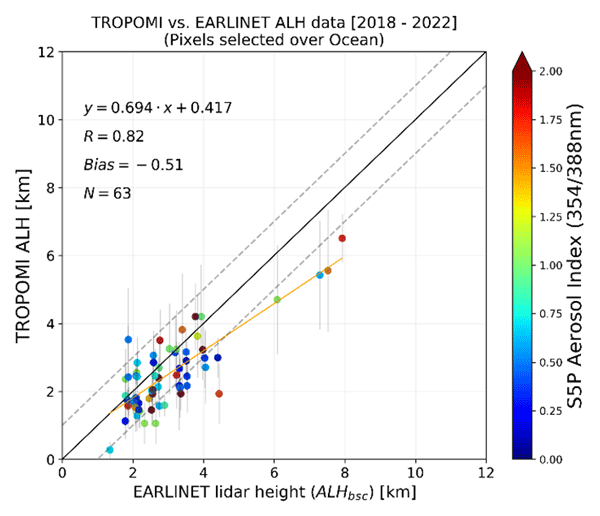
Comparisons with ground-based correlative lidar measurements constitute a key component in the validation of satellite aerosol products. This paper presents the validation of the TROPOMI aerosol layer height (ALH) product, using archived quality assured ground-based data from lidar stations that belong to the EARLINET network. Comparisons between the TROPOMI ALH and co-located EARLINET measurements show good agreement over the ocean.
John Douros, Henk Eskes, Jos van Geffen, K. Folkert Boersma, Steven Compernolle, Gaia Pinardi, Anne-Marlene Blechschmidt, Vincent-Henri Peuch, Augustin Colette, and Pepijn Veefkind
Geosci. Model Dev., 16, 509–534, https://doi.org/10.5194/gmd-16-509-2023, https://doi.org/10.5194/gmd-16-509-2023, 2023
Short summary
Short summary
We focus on the challenges associated with comparing atmospheric composition models with satellite products such as tropospheric NO2 columns. The aim is to highlight the methodological difficulties and propose sound ways of doing such comparisons. Building on the comparisons, a new satellite product is proposed and made available, which takes advantage of higher-resolution, regional atmospheric modelling to improve estimates of troposheric NO2 columns over Europe.

Qianqian Zhang, K. Folkert Boersma, Bin Zhao, Henk Eskes, Cuihong Chen, Haotian Zheng, and Xingying Zhang
Atmos. Chem. Phys., 23, 551–563, https://doi.org/10.5194/acp-23-551-2023, https://doi.org/10.5194/acp-23-551-2023, 2023
Short summary
Short summary
We developed an improved superposition column model and used the latest released (v2.3.1) TROPOMI satellite NO2 observations to estimate daily city-scale NOx and CO2 emissions. The results are verified against bottom-up emissions and OCO-2 XCO2 observations. We obtained the day-to-day variation of city NOx and CO2 emissions, allowing policymakers to gain real-time information on spatial–temporal emission patterns and the effectiveness of carbon and nitrogen regulation in urban environments.
Miriam Latsch, Andreas Richter, Henk Eskes, Maarten Sneep, Ping Wang, Pepijn Veefkind, Ronny Lutz, Diego Loyola, Athina Argyrouli, Pieter Valks, Thomas Wagner, Holger Sihler, Michel van Roozendael, Nicolas Theys, Huan Yu, Richard Siddans, and John P. Burrows
Atmos. Meas. Tech., 15, 6257–6283, https://doi.org/10.5194/amt-15-6257-2022, https://doi.org/10.5194/amt-15-6257-2022, 2022
Short summary
Short summary
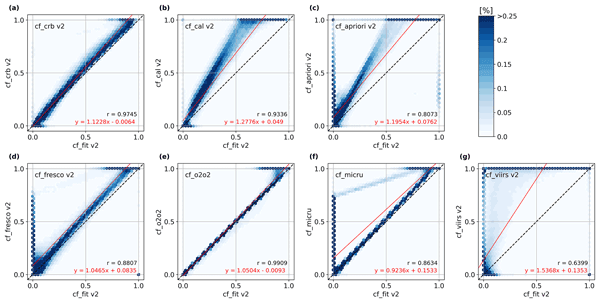
The article investigates different S5P TROPOMI cloud retrieval algorithms for tropospheric trace gas retrievals. The cloud products show differences primarily over snow and ice and for scenes under sun glint. Some issues regarding across-track dependence are found for the cloud fractions as well as for the cloud heights.
Johan F. de Haan, Ping Wang, Maarten Sneep, J. Pepijn Veefkind, and Piet Stammes
Geosci. Model Dev., 15, 7031–7050, https://doi.org/10.5194/gmd-15-7031-2022, https://doi.org/10.5194/gmd-15-7031-2022, 2022
Short summary
Short summary
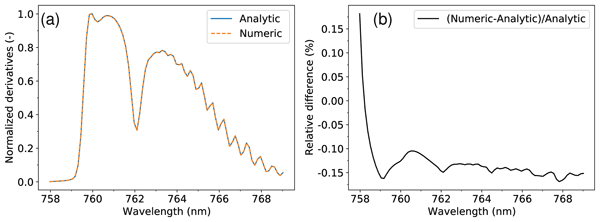
We present an overview of the DISAMAR radiative transfer code, highlighting the novel semi-analytical derivatives for the doubling–adding formulae and the new DISMAS technique for weak absorbers. DISAMAR includes forward simulations and retrievals for satellite spectral measurements from 270 to 2400 nm to determine instrument specifications for passive remote sensing. It has been used in various Sentinel-4/5P/5 projects and in the TROPOMI aerosol layer height and ozone profile products.
John T. Sullivan, Arnoud Apituley, Nora Mettig, Karin Kreher, K. Emma Knowland, Marc Allaart, Ankie Piters, Michel Van Roozendael, Pepijn Veefkind, Jerry R. Ziemke, Natalya Kramarova, Mark Weber, Alexei Rozanov, Laurence Twigg, Grant Sumnicht, and Thomas J. McGee
Atmos. Chem. Phys., 22, 11137–11153, https://doi.org/10.5194/acp-22-11137-2022, https://doi.org/10.5194/acp-22-11137-2022, 2022
Short summary
Short summary
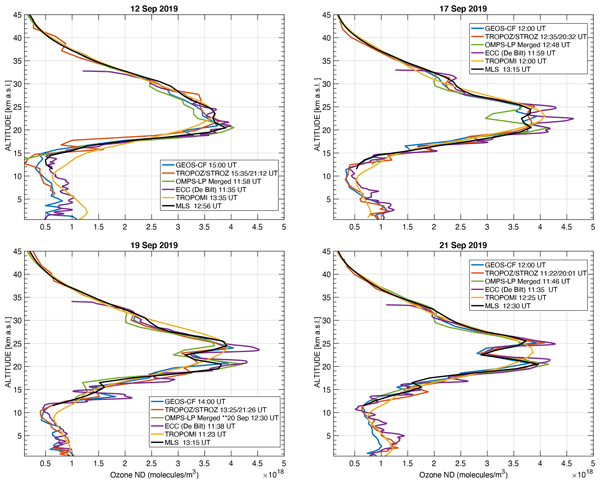
A TROPOspheric Monitoring Instrument (TROPOMI) validation campaign (TROLIX-19) was held in the Netherlands in September 2019. The research presented here focuses on using ozone lidars from NASA’s Goddard Space Flight Center to better evaluate the characterization of ozone throughout TROLIX-19 as compared to balloon-borne, space-borne and ground-based passive measurements, as well as a global coupled chemistry meteorology model.
Pieternel F. Levelt, Deborah C. Stein Zweers, Ilse Aben, Maite Bauwens, Tobias Borsdorff, Isabelle De Smedt, Henk J. Eskes, Christophe Lerot, Diego G. Loyola, Fabian Romahn, Trissevgeni Stavrakou, Nicolas Theys, Michel Van Roozendael, J. Pepijn Veefkind, and Tijl Verhoelst
Atmos. Chem. Phys., 22, 10319–10351, https://doi.org/10.5194/acp-22-10319-2022, https://doi.org/10.5194/acp-22-10319-2022, 2022
Short summary
Short summary
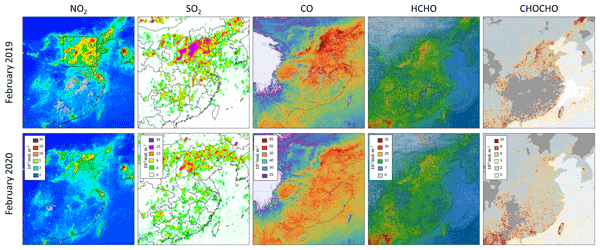
Using the COVID-19 lockdown periods as an example, we show how Sentinel-5P/TROPOMI trace gas data (NO2, SO2, CO, HCHO and CHOCHO) can be used to understand impacts on air quality for regions and cities around the globe. We also provide information for both experienced and inexperienced users about how we created the data using state-of-the-art algorithms, where to get the data, methods taking meteorological and seasonal variability into consideration, and insights for future studies.

Quintus Kleipool, Nico Rozemeijer, Mirna van Hoek, Jonatan Leloux, Erwin Loots, Antje Ludewig, Emiel van der Plas, Daley Adrichem, Raoul Harel, Simon Spronk, Mark ter Linden, Glen Jaross, David Haffner, Pepijn Veefkind, and Pieternel F. Levelt
Atmos. Meas. Tech., 15, 3527–3553, https://doi.org/10.5194/amt-15-3527-2022, https://doi.org/10.5194/amt-15-3527-2022, 2022
Short summary
Short summary
A new collection-4 dataset for the Ozone Monitoring Instrument (OMI) mission has been established to supersede the current collection-3 level-1b (L1b) data, produced with a newly developed L01b data processor based on the TROPOspheric Monitoring Instrument (TROPOMI) L01b processor. The collection-4 L1b data have a similar output format to the TROPOMI L1b data for easy connection of the data series. Many insights from the TROPOMI algorithms, as well as from OMI collection-3 usage, were included.
Francisco J. Pérez-Invernón, Heidi Huntrieser, Thilo Erbertseder, Diego Loyola, Pieter Valks, Song Liu, Dale J. Allen, Kenneth E. Pickering, Eric J. Bucsela, Patrick Jöckel, Jos van Geffen, Henk Eskes, Sergio Soler, Francisco J. Gordillo-Vázquez, and Jeff Lapierre
Atmos. Meas. Tech., 15, 3329–3351, https://doi.org/10.5194/amt-15-3329-2022, https://doi.org/10.5194/amt-15-3329-2022, 2022
Short summary
Short summary
Lightning, one of the major sources of nitrogen oxides in the atmosphere, contributes to the tropospheric concentration of ozone and to the oxidizing capacity of the atmosphere. In this work, we contribute to improving the estimation of lightning-produced nitrogen oxides in the Ebro Valley and the Pyrenees by using two different TROPOMI products and comparing the results.

Nora Mettig, Mark Weber, Alexei Rozanov, John P. Burrows, Pepijn Veefkind, Anne M. Thompson, Ryan M. Stauffer, Thierry Leblanc, Gerard Ancellet, Michael J. Newchurch, Shi Kuang, Rigel Kivi, Matthew B. Tully, Roeland Van Malderen, Ankie Piters, Bogumil Kois, René Stübi, and Pavla Skrivankova
Atmos. Meas. Tech., 15, 2955–2978, https://doi.org/10.5194/amt-15-2955-2022, https://doi.org/10.5194/amt-15-2955-2022, 2022
Short summary
Short summary
Vertical ozone profiles from combined spectral measurements in the UV and IR spectral ranges were retrieved by using data from TROPOMI/S5P and CrIS/Suomi-NPP. The vertical resolution and accuracy of the ozone profiles are improved by combining both wavelength ranges compared to retrievals limited to UV or IR spectral data only. The advancement of our TOPAS algorithm for combined measurements is required because in the UV-only retrieval the vertical resolution in the troposphere is very limited.
Xin Zhang, Yan Yin, Ronald van der A, Henk Eskes, Jos van Geffen, Yunyao Li, Xiang Kuang, Jeff L. Lapierre, Kui Chen, Zhongxiu Zhen, Jianlin Hu, Chuan He, Jinghua Chen, Rulin Shi, Jun Zhang, Xingrong Ye, and Hao Chen
Atmos. Chem. Phys., 22, 5925–5942, https://doi.org/10.5194/acp-22-5925-2022, https://doi.org/10.5194/acp-22-5925-2022, 2022
Short summary
Short summary
The importance of convection to the ozone and nitrogen oxides (NOx) produced from lightning has long been an open question. We utilize the high-resolution chemistry model with ozonesondes and space observations to discuss the effects of convection over southeastern China, where few studies have been conducted. Our results show the transport and chemistry contributions for various storms and demonstrate the ability of TROPOMI to estimate the lightning NOx production over small-scale convection.
Jos van Geffen, Henk Eskes, Steven Compernolle, Gaia Pinardi, Tijl Verhoelst, Jean-Christopher Lambert, Maarten Sneep, Mark ter Linden, Antje Ludewig, K. Folkert Boersma, and J. Pepijn Veefkind
Atmos. Meas. Tech., 15, 2037–2060, https://doi.org/10.5194/amt-15-2037-2022, https://doi.org/10.5194/amt-15-2037-2022, 2022
Short summary
Short summary
Nitrogen dioxide (NO2) is one of the main data products measured by the Tropospheric Monitoring Instrument (TROPOMI) on the Sentinel-5 Precursor (S5P) satellite. This study describes improvements in the TROPOMI NO2 retrieval leading to version v2.2, operational since 1 July 2021. It compares results with previous versions v1.2–v1.4 and with Ozone Monitoring Instrument (OMI) and ground-based measurements.
Vitali Fioletov, Chris A. McLinden, Debora Griffin, Nickolay Krotkov, Fei Liu, and Henk Eskes
Atmos. Chem. Phys., 22, 4201–4236, https://doi.org/10.5194/acp-22-4201-2022, https://doi.org/10.5194/acp-22-4201-2022, 2022
Short summary
Short summary
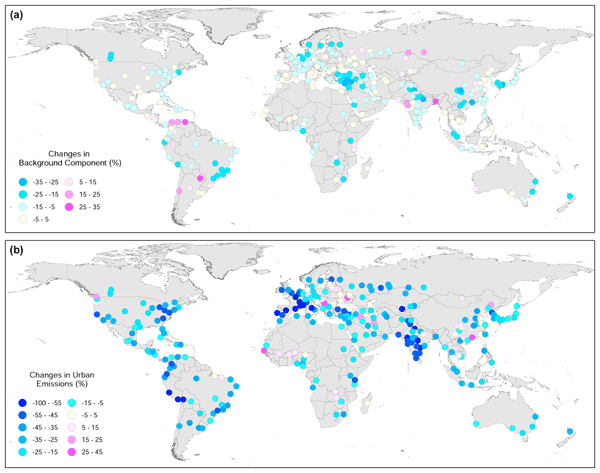
The COVID-19 lockdown had a large impact on anthropogenic emissions and particularly on nitrogen dioxide (NO2). A new method of isolation of background, urban, and industrial components in NO2 is applied to estimate the lockdown impact on each of them. From 16 March to 15 June 2020, urban NO2 declined by −18 % to −28 % in most regions of the world, while background NO2 typically declined by less than −10 %.

Takashi Sekiya, Kazuyuki Miyazaki, Henk Eskes, Kengo Sudo, Masayuki Takigawa, and Yugo Kanaya
Atmos. Meas. Tech., 15, 1703–1728, https://doi.org/10.5194/amt-15-1703-2022, https://doi.org/10.5194/amt-15-1703-2022, 2022
Short summary
Short summary
This study gives a systematic comparison of TROPOMI version 1.2 and OMI QA4ECV tropospheric NO2 column through global chemical data assimilation (DA) integration for April–May 2018. DA performance is controlled by measurement sensitivities, retrieval errors, and coverage. Due to reduced errors in TROPOMI, agreements against assimilated and independent observations were improved by TROPOMI DA compared to OMI DA. These results demonstrate that TROPOMI DA improves global analyses of NO2 and ozone.
Tobias Christoph Valentin Werner Riess, Klaas Folkert Boersma, Jasper van Vliet, Wouter Peters, Maarten Sneep, Henk Eskes, and Jos van Geffen
Atmos. Meas. Tech., 15, 1415–1438, https://doi.org/10.5194/amt-15-1415-2022, https://doi.org/10.5194/amt-15-1415-2022, 2022
Short summary
Short summary
This paper reports on improved monitoring of ship nitrogen oxide emissions by TROPOMI. With its fantastic resolution we can identify lanes of ship nitrogen dioxide (NO2) pollution not detected from space before. The quality of TROPOMI NO2 data over sea is improved further by recent upgrades in cloud retrievals and the use of sun glint scenes. Lastly, we study the impact of COVID-19 on ship NO2 in European seas and compare the found reductions to emission estimates gained from ship-specific data.
Daan Hubert, Klaus-Peter Heue, Jean-Christopher Lambert, Tijl Verhoelst, Marc Allaart, Steven Compernolle, Patrick D. Cullis, Angelika Dehn, Christian Félix, Bryan J. Johnson, Arno Keppens, Debra E. Kollonige, Christophe Lerot, Diego Loyola, Matakite Maata, Sukarni Mitro, Maznorizan Mohamad, Ankie Piters, Fabian Romahn, Henry B. Selkirk, Francisco R. da Silva, Ryan M. Stauffer, Anne M. Thompson, J. Pepijn Veefkind, Holger Vömel, Jacquelyn C. Witte, and Claus Zehner
Atmos. Meas. Tech., 14, 7405–7433, https://doi.org/10.5194/amt-14-7405-2021, https://doi.org/10.5194/amt-14-7405-2021, 2021
Short summary
Short summary
We assess the first 2 years of TROPOMI tropical tropospheric ozone column data. Comparisons to reference measurements by ozonesonde and satellite sensors show that TROPOMI bias (−0.1 to +2.3 DU) and precision (1.5 to 2.5 DU) meet mission requirements. Potential causes of bias and its spatio-temporal structure are discussed, as well as ways to identify sampling errors. Our analysis of known geophysical patterns demonstrates the improved performance of TROPOMI with respect to its predecessors.
Cited articles
Barlow, R. J.: Statistics: a guide to the use of statistical methods in the physical sciences, John Wiley & Sons, New York, ISBN 978-0-471-92295-7, 1989. a
Boersma, K. F., Eskes, H. J., Veefkind, J. P., Brinksma, E. J., van der A, R. J., Sneep, M., van den Oord, G. H. J., Levelt, P. F., Stammes, P., Gleason, J. F., and Bucsela, E. J.: Near-real time retrieval of tropospheric NO2 from OMI, Atmos. Chem. Phys., 7, 2103–2118, https://doi.org/10.5194/acp-7-2103-2007, 2007. a
Boersma, K. F., Eskes, H. J., Dirksen, R. J., van der A, R. J., Veefkind, J. P., Stammes, P., Huijnen, V., Kleipool, Q. L., Sneep, M., Claas, J., Leitão, J., Richter, A., Zhou, Y., and Brunner, D.: An improved tropospheric NO2 column retrieval algorithm for the Ozone Monitoring Instrument, Atmos. Meas. Tech., 4, 1905–1928, https://doi.org/10.5194/amt-4-1905-2011, 2011. a
Boersma, K. F., Eskes, H. J., Richter, A., De Smedt, I., Lorente, A., Beirle, S., van Geffen, J. H. G. M., Zara, M., Peters, E., Van Roozendael, M., Wagner, T., Maasakkers, J. D., van der A, R. J., Nightingale, J., De Rudder, A., Irie, H., Pinardi, G., Lambert, J.-C., and Compernolle, S. C.: Improving algorithms and uncertainty estimates for satellite NO2 retrievals: results from the quality assurance for the essential climate variables (QA4ECV) project, Atmos. Meas. Tech., 11, 6651–6678, https://doi.org/10.5194/amt-11-6651-2018, 2018. a, b
Cannizzaro, J. P. and Carder, K. L.: Estimating chlorophyll a concentrations from remote-sensing reflectance in optically shallow waters, Rem. Sens. Environment, 101, 13–24, https://doi.org/10.1016/j.rse.2005.12.002, 2006. a
Chance, K. V. and Spurr, R. J. D.: Ring effect studies: Rayleigh scattering, including molecular parameters for rotational Raman scattering, and the Fraunhofer spectrum, Appl. Opt., 36, 5224–5230, https://doi.org/10.1364/AO.36.005224 1997. a, b
Chatzistergos, T., Krivova, N. A., and Ermolli, I.: Understanding the secular variability of solar irradiance: the potential of Ca II K observations, J. Space Weather Space Clim., 14, 24 pp., https://doi.org/10.1051/swsc/2024006, 2024. a
Crutzen, P. J.: The influence of nitrogen oxides on the atmospheric ozone content, Quart. J. R. Meteorol. Soc., 96, 320–325, https://doi.org/10.1002/qj.49709640815, 1970. a
Dinter, T., Rozanov, V. V., Burrows, J. P., and Bracher, A.: Retrieving the availability of light in the ocean utilising spectral signatures of vibrational Raman scattering in hyper-spectral satellite measurements, Ocean Sci., 11, 373–389, https://doi.org/10.5194/os-11-373-2015, 2015. a, b, c, d
Dobber, M., Voors, R., Dirksen, R., Kleipool, Q., and Levelt, P.: The high-resolution solar reference spectrum between 250 and 550 nm and its application to measurements with the Ozone Monitoring Instrument, Solar Phys., 249, 281–291, https://doi.org/10.1007/s11207-008-9187-7, 2008. a
Eskes, H. J., van Geffen, J. H. G. M., Boersma, K. F., Eichmann K.-U.. Apituley, A., Pedergnana, M., Sneep, M., Veefkind, J. P., and Loyola, D.: S5P/TROPOMI Level-2 Product User Manual Nitrogen Dioxide, Report S5P-KNMI-L2-0021-MA, version 4.4.0, 2024-11-08, ESA, https://sentiwiki.copernicus.eu/web/s5p-products (last access: 15 June 2026), 2024. a
Fuglestvedt, J. S., Berntsen, T., Isaksen, I. S. A., Mao, H., Liang, X.-Z., and Wang, W.-C.: Climatic forcing of nitrogen oxides through changes in tropospheric ozone and methane, Atmos. Environ., 33, 961–977, https://doi.org/10.1016/s1352-2310(98)00217-9, 1999. a
Grainger, J. F. and Ring, J.: Anomalous Fraunhofer line profiles, Nature, 193, 762, https://doi.org/10.1038/193762a0, 1962. a
Hendrick, F., Mahieu, E., Bodeker, G. E., Boersma, K. F., Chipperfield, M. P., De Mazière, M., De Smedt, I., Demoulin, P., Fayt, C., Hermans, C., Kreher, K., Lejeune, B., Pinardi, G., Servais, C., Stübi, R., van der A, R., Vernier, J.-P., and Van Roozendael, M.: Analysis of stratospheric NO2 trends above Jungfraujoch using ground-based UV-visible, FTIR, and satellite nadir observations, Atmos. Chem. Phys., 12, 8851–8864, https://doi.org/10.5194/acp-12-8851-2012, 2012. a
Holtrop, T., Huisman, J., Stomp, M., Biersteker, L., Aerts, J., Grébert, T., Partensky, F., Garczarek, L., and Woerd, H. J. V.: Vibrational modes of water predict spectral niches for photosynthesis in lakes and oceans, Nat. Ecol. Evol., 5, 55–66, https://doi.org/10.1038/s41559-020-01330-x, 2021. a, b, c
Joiner, J., Vasilkov, A. P., Flittner, D. E., Gleason, J. F., and Bhartia, P. K.: Retrieval of cloud pressure and oceanic chlorophyll content using Raman scattering in GOME ultraviolet spectra, J. Geophys. Res., 109, D01109, https://doi.org/10.1029/2003JD003698, 2004. a, b
Kleipool, Q., Ludewig, A., Babić, L., Bartstra, R., Braak, R., Dierssen, W., Dewitte, P.-J., Kenter, P., Landzaat, R., Leloux, J., Loots, E., Meijering, P., van der Plas, E., Rozemeijer, N., Schepers, D., Schiavini, D., Smeets, J., Vacanti, G., Vonk, F., and Veefkind, P.: Pre-launch calibration results of the TROPOMI payload on-board the Sentinel-5 Precursor satellite, Atmos. Meas. Tech., 11, 6439–6479, https://doi.org/10.5194/amt-11-6439-2018, 2018. a
Kong, H., Lin, J., Zhang, Y., Li, C., Xu, C., Shen, L., Liu, X., Yang, K., Su, H., and Xu, W.: High natural nitric oxide emissions from lakes on Tibetan Plateau under rapid warming, Nat. Geosci., 16, 474–477, https://doi.org/10.1038/s41561-023-01200-8, 2023. a, b
Labzovskii, L. D., van Geffen, J., Liu, M., van der A, R., de Laat, J., Leune, B., Eskes, H., Lin, X., Ding, J., and Richter, A.: NO2 satellite retrievals biased by absorption in water, Nat. Geosci., 17, 972–975, https://doi.org/10.1038/s41561-024-01545-8, 2024. a, b, c
Lambert, J.-C., Keppens, A., Compernolle, S., Eichmann, K.-U., de Graaf, M., Hubert, D., Langerock, B., Sha, M. K., van der Plas, E., Verhoelst, T., Wagner, T., Ahn, C., Argyrouli, A., Balis, D., Chan, K. L., Coldewey-Egbers, M., De Smedt, I., Eskes, H., Fjæraa, A. M., Garane, K., Gleason, J. F., Granville, J., Hedelt, P., Heue, K.-P., Jaross, G., Koukouli, M.-L., Loots, E., Lutz, R., Martinez Velarte, M. C., Michailidis, K., Pseftogkas, S., Nanda, S., Niemeijer, S., Pazmiño, A., Pinardi, G., Richter, A., Rozemeijer, N., Sneep, M., Stein Zweers, D., Theys, N., Tilstra, G., Torres, O., Valks, P., van Geffen, J., Vigouroux, C., Wang, P., and Weber, M.: Quarterly Validation Report of the Copernicus Sentinel-5 Precursor Operational Data Products, #30: April 2018 – February 2026, S5P MPC Routine Operations Consolidated Validation Report series, Issue 30.01.00, 237 pp., 2026-03-15, https://mpc-vdaf.tropomi.eu/index.php/nitrogen-dioxide/ (last access: 15 June 2026), 2026. a
Lampel, J., Frieß, U., and Platt, U.: The impact of vibrational Raman scattering of air on DOAS measurements of atmospheric trace gases, Atmos. Meas. Tech., 8, 3767–3787, https://doi.org/10.5194/amt-8-3767-2015, 2015. a
Levelt, P. F., van den Oord, G. H. J., Dobber, M. R. Dobber, Mälkki, A., Visser, H., de Vries, J., Stammes, P., Lundell, J. O. V., and Saari, H.: The Ozone Monitoring Instrument, IEEE Trans. Geosci. Rem. Sens., 44, 1093–1101, https://doi.org/10.1109/tgrs.2006.872333, 2006. a
Levelt, P. F., Joiner, J., Tamminen, J., Veefkind, J. P., Bhartia, P. K., Stein Zweers, D. C., Duncan, B. N., Streets, D. G., Eskes, H., van der A, R., McLinden, C., Fioletov, V., Carn, S., de Laat, J., DeLand, M., Marchenko, S., McPeters, R., Ziemke, J., Fu, D., Liu, X., Pickering, K., Apituley, A., González Abad, G., Arola, A., Boersma, F., Chan Miller, C., Chance, K., de Graaf, M., Hakkarainen, J., Hassinen, S., Ialongo, I., Kleipool, Q., Krotkov, N., Li, C., Lamsal, L., Newman, P., Nowlan, C., Suleiman, R., Tilstra, L. G., Torres, O., Wang, H., and Wargan, K.: The Ozone Monitoring Instrument: overview of 14 years in space, Atmos. Chem. Phys., 18, 5699–5745, https://doi.org/10.5194/acp-18-5699-2018, 2018. a
Ludewig, A., Kleipool, Q., Bartstra, R., Landzaat, R., Leloux, J., Loots, E., Meijering, P., van der Plas, E., Rozemeijer, N., Vonk, F., and Veefkind, P.: In-flight calibration results of the TROPOMI payload on board the Sentinel-5 Precursor satellite, Atmos. Meas. Tech., 13, 3561–3580, https://doi.org/10.5194/amt-13-3561-2020, 2020. a, b
Marchenko, S. V., Ludewig, A., Criscuoli, S., Al Moulla, K., Choudhary, D. P., DeLand, M. T., Kopp, G., Loots, E., van der Plas, E., and Veefkind, P.: Sun-as-a-star spectral line variability in the 300–2390 nm wavelength range, Astrophys. J., 977, 17 pp., https://doi.org/10.3847/1538-4357/ad888f, 2024. a
Murphy, D. M., Fahey, D. W., Proffitt, M. H., Liu, S. C., Chan, K. R., Eubank, C. S., Kawa, S. R., and Kelly, K. K.: Reactive nitrogen and its correlation with ozone in the lower stratosphere and upper troposphere, J. Geophys. Res., 98, 8751–8773, https://doi.org/10.1029/92JD00681, 1993. a
Peters, E., Wittrock, F., Richter, A., Alvarado, L. M. A., Rozanov, V. V., and Burrows, J. P.: Liquid water absorption and scattering effects in DOAS retrievals over oceans, Atmos. Meas. Tech., 7, 4203–4221, https://doi.org/10.5194/amt-7-4203-2014, 2014. a, b, c
Platt, U.: Differential Optical Absorption Spectroscopy (DOAS), in: Air monitoring by spectroscopic techniques, edited by: Sigrist, M. W., Chemical Analisys Series, 127, 27–76, Wiley, New York, 1994. a
Platt, U. and Stutz, Z.: Differential Optical Absorption Spectroscopy, Principles and Applications, Springer, Heidelberg, Germany, 597 pp., https://doi.org/10.1007/978-3-540-75776-4, 2008. a, b
Richter, A., Begoin, M., Hilboll, A., and Burrows, J. P.: An improved NO2 retrieval for the GOME-2 satellite instrument, Atmos. Meas. Tech., 4, 1147–1159, https://doi.org/10.5194/amt-4-1147-2011, 2011. a
Rodgers, C. D.: Inverse Methods for Atmospheric Sounding: Theory and Practice, World Scientific Publishing, ISBN: 978-9-810-22740-1, https://doi.org/10.1142/3171, 2000. a
Schenkeveld, V. M. E., Jaross, G., Marchenko, S., Haffner, D., Kleipool, Q. L., Rozemeijer, N. C., Veefkind, J. P., and Levelt, P. F.: In-flight performance of the Ozone Monitoring Instrument, Atmos. Meas. Tech., 10, 1957–1986, https://doi.org/10.5194/amt-10-1957-2017, 2017. a
Seinfeld, J. H. and Pandis, S. N.: Atmospheric Chemistry and Physics – From Air Pollution to Climate Change (2nd Edn.), John Wiley & Sons, ISBN 978-1-118-94740-1, 2006. a
Sillman, S., Logan, J. A., and Wofsy, S. C.: The sensitivity of ozone to nitrogen oxides and hydrocarbons in regional ozone episodes, J. Geophys. Res., 95, 1837–1851, https://doi.org/10.1029/JD095iD02p01837, 1990. a
Srinivasa, A., Sreedevi, A, Raju, K. P., Nagaraju, K., Singh, J., Karuppath, N., Devendran, P., Kumar, T. R., and Kumaravel, P.: Variations of the Ca ii K line profile parameters with solar latitude and time observed from Kodaikanal Solar Observatory, Mon. Not. R. Astron. Soc., 541, 3320–3330, https://doi.org/10.1093/mnras/staf1163, 2025. a
Taniguchi, M. and Lindsey, J. S.: Absorption and fluorescence spectral database of chlorophylls and analogues, Photochem. Photobiol., 97, 136–165, https://doi.org/10.1111/php.13319, 2021. a
van der A, R. J., Ding, J., and Eskes, H.: Monitoring European anthropogenic NOx emissions from space, Atmos. Chem. Phys., 24, 7523–7534, https://doi.org/10.5194/acp-24-7523-2024, 2024. a
van Geffen, J., Eskes, H., Compernolle, S., Pinardi, G., Verhoelst, T., Lambert, J.-C., Sneep, M., ter Linden, M., Ludewig, A., Boersma, K. F., and Veefkind, J. P.: Sentinel-5P TROPOMI NO2 retrieval: impact of version v2.2 improvements and comparisons with OMI and ground-based data, Atmos. Meas. Tech., 15, 2037–2060, https://doi.org/10.5194/amt-15-2037-2022, 2022. a, b, c
van Geffen, J., Eskes, H., Boersma, F., ter Linden, M., and Veefkind, P.: Algorithm Theoretical Basis Document for the OMI L2 OMNO2A Data Processor Collection 4. Report AURA-OMI-KNMI-L2-0300-SD, version 4.1.0.x, KNMI, De Bilt, The Netherlands, https://doi.org/10.5067/AURA/OMI/DATA2433, 2026. a, b, c
van Geffen, J. H. G. M., Eskes, H. J., Boersma, K. F., and Veefkind, J. P.: TROPOMI ATBD of the total and tropospheric NO2 data products, Report S5P-KNMI-L2-0005-RP, version 2.9.1, 2025-10-27, KNMI, De Bilt, The Netherlands, https://sentiwiki.copernicus.eu/web/s5p-products (last access: 15 June 2026), 2025. a, b, c, d, e, f, g, h
Veefkind, J. P., Aben, I., McMullan, K., Förster, H., de Vries, J., Otter, G., Claas, J., Eskes, H. J., de Haan, J. F., Kleipool, Q., van Weele, M., Hasekamp, O., Hoogeveen, R., Landgraf, J., Snel, R., Tol, P., Ingmann, P., Voors, R., Kruizinga, B., Vink, R., Visser, H., and Levelt, P. F.: TROPOMI on the ESA Sentinel-5 Precursor: A GMES mission for global observations of the atmospheric composition for climate, air quality and ozone layer applications, Rem. Sens. Environ., 120, 70–83, https://doi.org/10.1016/j.rse.2011.09.027, 2012. a
Vasilkov, A. P., Joiner, J., Gleason, J., and Bhartia, P. K.: Ocean Raman scattering in satellite backscatter UV measurements, Geophys. Res. Lett., 29, 1837–1840, https://doi.org/10.1029/2002GL014955, 2002. a
Vountas, M., Richter, A., Wittrock, F., and Burrows, J. P.: Inelastic scattering in ocean water and its impact on trace gas retrievals from satellite data, Atmos. Chem. Phys., 3, 1365–1375, https://doi.org/10.5194/acp-3-1365-2003, 2003. a
Vountas, M., Dinter, T., Bracher, A., Burrows, J. P., and Sierk, B.: Spectral studies of ocean water with space-borne sensor SCIAMACHY using Differential Optical Absorption Spectroscopy (DOAS), Ocean Sci., 3, 429–440, https://doi.org/10.5194/os-3-429-2007, 2007. a, b, c
World Health Organisation: Health aspects of air pollution with particulate matter, ozone and nitrogen dioxide, World Health Organisation, Bonn, Germany, EUR/03/5042688, 98 pp., https://iris.who.int/handle/10665/107478 (last access: 15 June 2026), 2003. a
Zara, M., Boersma, K. F., De Smedt, I., Richter, A., Peters, E., van Geffen, J. H. G. M., Beirle, S., Wagner, T., Van Roozendael, M., Marchenko, S., Lamsal, L. N., and Eskes, H. J.: Improved slant column density retrieval of nitrogen dioxide and formaldehyde for OMI and GOME-2A from QA4ECV: intercomparison, uncertainty characterisation, and trends, Atmos. Meas. Tech., 11, 4033–4058, https://doi.org/10.5194/amt-11-4033-2018, 2018. a, b
Short summary
The Fraunhofer absorption feature at 430 nm, which varies in strength with the solar activity cycle influences the retrieval of nitrogen dioxide (NO2) from from Tropospheric Monitoring Instrument (TROPOMI) and Ozone Monitoring Instrument (OMI) measurements. This study describes the benefits of removing the wavelength range 428–433 nm from the retrieval, which is implemented for TROPOMI retrievals as of v2.9.1.
The Fraunhofer absorption feature at 430 nm, which varies in strength with the solar activity...


