Articles | Volume 19, issue 14
https://doi.org/10.5194/amt-19-4833-2026
© Author(s) 2026. This work is distributed under
the Creative Commons Attribution 4.0 License.
https://doi.org/10.5194/amt-19-4833-2026
© Author(s) 2026. This work is distributed under
the Creative Commons Attribution 4.0 License.
How does assimilating a large commercial GNSS RO dataset impact HAFS hurricane forecasts? An evaluation in support of the ROMEX experiment
William J. Miller
CORRESPONDING AUTHOR
Cooperative Institute for Satellite Earth System Studies (CISESS), Earth System Science Interdisciplinary Center, University of Maryland, College Park, MD, 20740, USA
Yong Chen
NOAA National Environmental Satellite, Data, and Information Service, Center for Satellite Applications and Research, College Park, MD, 20740, USA
Shu-Peng Ho
NOAA National Environmental Satellite, Data, and Information Service, Center for Satellite Applications and Research, College Park, MD, 20740, USA
Xi Shao
Cooperative Institute for Satellite Earth System Studies (CISESS), Earth System Science Interdisciplinary Center, University of Maryland, College Park, MD, 20740, USA
Related authors
No articles found.
Yong Chen, Xinjia Zhou, Xin Jing, Shu-Peng Ho, Xi Shao, and Tung-Chang Liu
Atmos. Meas. Tech., 19, 3781–3800, https://doi.org/10.5194/amt-19-3781-2026, https://doi.org/10.5194/amt-19-3781-2026, 2026
Short summary
Short summary
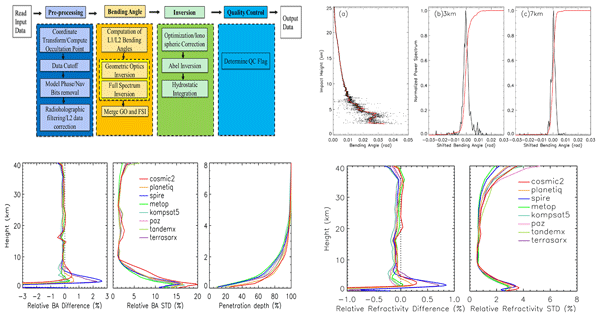
We developed a Full Spectrum Inversion algorithm to process Global Navigation Satellite System Radio Occultation (RO) data, a key source for weather forecasting. Comparing it with standard systems, we found strong agreement mid-atmosphere but larger differences near the surface and upper levels. This clarifies processing uncertainties and supports improved use of RO data in numerical weather prediction and atmospheric research.
Tim Trent, Marc Schröder, Shu-Peng Ho, Steffen Beirle, Ralf Bennartz, Eva Borbas, Christian Borger, Helene Brogniez, Xavier Calbet, Elisa Castelli, Gilbert P. Compo, Wesley Ebisuzaki, Ulrike Falk, Frank Fell, John Forsythe, Hans Hersbach, Misako Kachi, Shinya Kobayashi, Robert E. Kursinski, Diego Loyola, Zhengzao Luo, Johannes K. Nielsen, Enzo Papandrea, Laurence Picon, Rene Preusker, Anthony Reale, Lei Shi, Laura Slivinski, Joao Teixeira, Tom Vonder Haar, and Thomas Wagner
Atmos. Chem. Phys., 24, 9667–9695, https://doi.org/10.5194/acp-24-9667-2024, https://doi.org/10.5194/acp-24-9667-2024, 2024
Short summary
Short summary
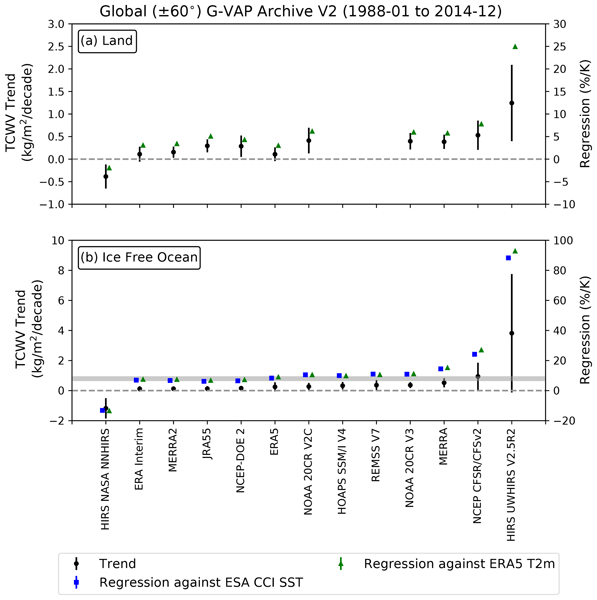
In a warmer future, water vapour will spend more time in the atmosphere, changing global rainfall patterns. In this study, we analysed the performance of 28 water vapour records between 1988 and 2014. We find sensitivity to surface warming generally outside expected ranges, attributed to breakpoints in individual record trends and differing representations of climate variability. The implication is that longer records are required for high confidence in assessing climate trends.
Xi Shao, Shu-Peng Ho, Xin Jing, Xinjia Zhou, Yong Chen, Tung-Chang Liu, Bin Zhang, and Jun Dong
Atmos. Chem. Phys., 23, 14187–14218, https://doi.org/10.5194/acp-23-14187-2023, https://doi.org/10.5194/acp-23-14187-2023, 2023
Short summary
Short summary
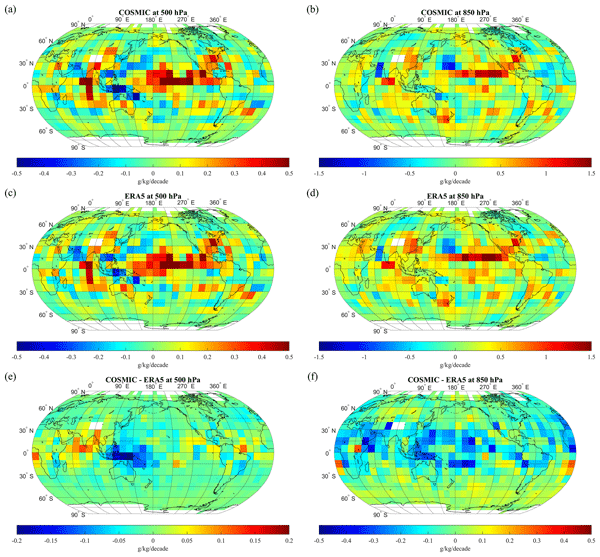
Atmospheric water vapor plays an essential role in the global energy balance, hydrological cycle, and climate system. This paper characterizes and compares the global, latitudinal, and regional variabilities of COSMIC and ERA5 water vapor distribution, as well as the seasonality and long-term trends at selected pressure levels from 2007 to 2018. Evaluation of spatiotemporal variabilities of atmospheric water vapor ensures the qualities of COSMIC and reanalysis water vapor for climate studies.
Cited articles
Anthes, R. A., Sjoberg, J., Feng, X., and Syndergaard, S.: Comparison of COSMIC and COSMIC-2 radio occultation refractivity and bending angle uncertainties in August 2006 and 2021, Atmosphere, 13, 790, https://doi.org/10.3390/atmos13050790, 2022.
Anthes, R. A., Marquardt, C., Ruston, B., and Shao, H.: Radio Occultation Modeling Experiment (ROMEX): Determining the impact of radio occultation observations on numerical weather prediction, Bull. Amer. Meteor. Soc., 105, 1552–1568, https://doi.org/10.1175/BAMS-D-23-0326.1, 2024.
Blake, E. S.: Tropical cyclone report: Hurricane Earl (AL062022), National Hurricane Center, Tech. Rep., 18 pp., https://www.nhc.noaa.gov/data/tcr/AL062022_Earl.pdf (last access: 13 July 2026), 2023.
Bonavita, M.: On some aspects of the impact of GPSRO observations in global numerical weather prediction, Q. J. Roy. Meteor. Soc., 140, 2546–2562, https://doi.org/10.1002/qj.2320, 2014.
Bowler, N. E.: Revised GNSS-RO observation uncertainties in the Met Office NWP System, Q. J. Roy. Meteor. Soc., 146, 2274–2296, https://doi.org/10.1002/qj.3791, 2020.
Braun, S. A., Sippel, J. A., and Nolan, D. S.: The impact of dry midlevel air on hurricane intensity in idealized simulations with no mean flow, J. Atmos. Sci., 69, 236–257, https://doi.org/10.1175/JAS-D-10-05007.1, 2012.
Bucci, L., Alaka, L., Hagen, A., Delgado, S., and Beven, J.: Tropical cyclone report: Hurricane Ian (AL092022), National Hurricane Center, Tech. Rep., 72 pp., https://www.nhc.noaa.gov/data/tcr/AL092022_Ian.pdf (last access: 13 July 2026), 2023.
Cangialosi, J. P.: Tropical cyclone report: Hurricane Julia (AL132022), National Hurricane Center, Tech. Rep., 23 pp., https://www.nhc.noaa.gov/data/tcr/AL132022_EP182022_Julia.pdf (last access: 13 July 2026), 2023.
Chan, J. C. L. and Gray, W. M.: Tropical cyclone movement and surrounding flow relationships, Mon. Wea. Rev., 110, 1354–1374, https://doi.org/10.1175/1520-0493(1982)110<1354:TCMASF>2.0.CO;2, 1982.
Chavas, D. R., Knaff, J. A., and Klotzbach, P.: A simple model for predicting tropical cyclone minimum central pressure from intensity and size, Wea. Forecasting, 40, 333–346, https://doi.org/10.1175/WAF-D-24-0031.1, 2025.
Chen, S.-Y., Kuo, Y.-H., and Huang, C.-Y.: The impact of GPS RO data on predicting tropical cyclogenesis using a nonlocal observation operator: an initial assessment, Mon. Wea. Rev., 148, 2701–2717, https://doi.org/10.1175/MWR-D-19-0286.1, 2020.
Chen, X., Wang, Y., Fang, J., and Xue, M.: A numerical study on rapid intensification of Typhoon Vicente (2012) in the South China Sea. Part II: Roles of inner-core processes, J. Atmos. Sci., 75, 235–255, https://doi.org/10.1175/JAS-D-17-0129.1, 2018.
Christophersen, H., Sippel, J., Aksoy, A., and Baker, N. L.: Recent advancements for tropical cyclone data assimilation, Ann. NY Acad. Sci., 1517, 25–43, https://doi.org/10.1111/nyas.14873, 2022.
Cram, T. A., Persing, J., Montgomery, M. T., and Braun, S. A.: A Lagrangian trajectory view on transport and mixing processes between the eye, eyewall, and environment using a high-resolution simulation of Hurricane Bonnie (1998), J. Atmos. Sci., 64, 1835–1856, https://doi.org/10.1175/JAS3921.1, 2007.
Cucurull, L.: Implementation of a quality control for radio occultation observations in the presence of large gradients of atmospheric refractivity, Atmos. Meas. Tech., 8, 1275–1285, https://doi.org/10.5194/amt-8-1275-2015, 2015.
Cucurull, L. and Purser, R. J.: An improved one-dimensional bending angle forward operator for the assimilation of radio occultation profiles in the lower troposphere, Mon. Wea. Rev., 151, 1093–1108, https://doi.org/10.1175/MWR-D-22-0073.1, 2023.
Cucurull, L., Derber, J. C., and Purser, R. J.: A bending angle forward operator for global positioning system radio occultation measurements, J. Geophys. Res.-Atmos., 118, 14–28, https://doi.org/10.1029/2012JD017782, 2013.
DeMaria, M.: The effect of vertical shear on tropical cyclone intensity change, J. Atmos. Sci., 53, 2076–2088, https://doi.org/10.1175/1520-0469(1996)053<2076:TEOVSO>2.0.CO;2, 1996.
DeMaria, M., Mainelli, M., Shay, L. K., Knaff, J. A., and Kaplan, J.: Further improvements to the Statistical Hurricane Intensity Prediction Scheme (SHIPS), Wea. Forecasting, 20, 531–543, https://doi.org/10.1175/WAF862.1, 2005.
Desroziers, G., Berre, L., Chapnik, B., and Poli, P.: Diagnosis of observation, background and analysis-error statistics in observation space, Q. J. Roy. Meteor. Soc., 131, 3385–3396, https://doi.org/10.1256/qj.05.108, 2005.
Doyle, J. D., Reynolds, C. A., Amerault, C., and Moskaitis, J.: Adjoint sensitivity and predictability of tropical cyclogenesis, J. Atmos. Sci., 69, 3535–3557, https://doi.org/10.1175/JAS-D-12-0110.1, 2012.
Dutta, S., Vandenberghe, F., Shao, H., Zhang, H., and Doe, J.: Assessment of radio-occultation from multiple GNSS platforms: Operational and non-operational, JCSDA Quarterly, 62, 33–37, https://doi.org/10.25923/w2dh-ep66, 2019.
Frank, W. M. and Ritchie, E. A.: Effects of vertical wind shear on the intensity and structure of numerically simulated hurricanes, Mon. Wea. Rev., 129, 2249–2269, https://doi.org/10.1175/1520-0493(2001)129<2249:EOVWSO>2.0.CO;2, 2001.
Galarneau, T. J. Jr. and Davis, C. A.: Diagnosing forecast errors in tropical cyclone motion, Mon. Wea. Rev., 141, 405–430, https://doi.org/10.1175/MWR-D-12-00071.1, 2013.
Harnisch, F., Healy, S. B., Bauer, P., and English, S. J.: Scaling of GNSS radio occultation impact with observation number using an ensemble of data assimilations, Mon. Wea. Rev., 141, 4395–4413, https://doi.org/10.1175/MWR-D-13-00098.1, 2013.
Hazelton, A., Alaka Jr., G. J., Gramer, L., Ramstrom, W., Ditchek, S., Chen, X., Liu, B., Zhang, Z., Zhu, L., Wang, W., Thomas, B., Shin, J., Wang, C.-K., Kim, H.-S., Zhang, X., Metro, A., Marks, F., and Gopalakrishnan, S.: 2022 real-time hurricane forecasts from an experimental version of the Hurricane Analysis and Forecast System (HAFSV0.3S), Front. Earth Sci., 11, 1264969, https://doi.org/10.3389/feart.2023.1264969, 2023.
Healy, S. B., Eyre, J. R., Hamrud, M., and Thépaut, J.-N.: Assimilating GPS radio occultation measurements with two-dimensional bending angle observation operators, Q. J. Roy. Meteor. Soc., 133, 1213–1227, https://doi.org/10.1002/qj.63, 2007.
Ho, S.-P., Anthes, R. A., Ao, C. O., Healy, S., Horanyi, A., Hunt, D., Mannucci, A. J., Pedatella, N., Randel, W. J., Simmons, A., Steiner, A., Xie, F., Yue, X., and Zeng, Z.: The COSMIC/FORMOSAT-3 radio occultation mission after 12 years: Accomplishments, remaining challenges, and potential impacts of COSMIC-2, Bull. Amer. Meteor. Soc., 101, E1107–E1136, https://doi.org/10.1175/bams-d-18-0290.1, 2020a.
Ho, S.-P., Zhou, X., Shao, X., Zhang, B., Adhikari, L., Kireev, S., He, Y., Yoe, J. G., Xia-Serafino, W., and Lynch, E.: Initial Assessment of the COSMIC-2/FORMOSAT-7 Neutral Atmosphere Data Quality in NESDIS/STAR using in-situ and satellite data, Remote Sens., 12, 4099, https://doi.org/10.3390/rs12244099, 2020b.
Jarvinen, B. R., Neumann, C. J., and Davis, M. A. S.: A tropical cyclone data tape for the North Atlantic basin, 1886–1983: Contents, limitations, and uses, NOAA Tech. Memo. NWS NHC 22, 21 pp., https://www.nhc.noaa.gov/pdf/NWS-NHC-1988-22.pdf (last access: 13 July 2026), 1984.
Jones, S. C.: The evolution of vortices in vertical shear. I: Initially barotropic vortices, Q. J. Roy. Meteor. Soc., 121, 821–851, https://doi.org/10.1002/qj.49712152406, 1995.
Kaplan, J. and DeMaria, M.: Large-scale characteristics of rapidly intensifying tropical cyclones in the North Atlantic basin, Wea. Forecasting, 18, 1093–1108, https://doi.org/10.1175/1520-0434(2003)018<1093:LCORIT>2.0.CO;2, 2003.
Kuo, Y. H., Wee, T. K., Sokolovskiy, S., Rocken, C., Schreiner, W., Hunt, D., and Anthes, R. A.: Inversion and error estimation of GPS radio occultation data, J. Meteorol. Soc. Jpn., 82, 507–531, https://doi.org/10.2151/jmsj.2004.507, 2004.
Kursinski, E. R., Hajj, G. A., Schofield, J. T., Linfield, R. P., and Hardy, K. R.: Observing Earth's atmosphere with radio occultation measurements using the Global Positioning System, J. Geophys. Res., 102, 23429–23465, https://doi.org/10.1029/97JD01569, 1997.
Lien, G.-Y., Lin, C.-H., Huang, Z.-M., Teng, W.-H., Chen, J.-H., Lin, C.-C., Ho, H.-H., Huang, J.-Y., Hong, J.-S., Cheng, C.-P., and Huang, C.-Y.: Assimilation impact of early FORMOSAT-7/COSMIC-2 GNSS radio occultation data with Taiwan's CWB Global Forecast System, Mon. Wea. Rev., 149, 2171–2191, https://doi.org/10.1175/MWR-D-20-0267.1, 2021.
Liu, H., Anderson, J., and Kuo, Y.-H.: Improved analyses and forecasts of Hurricane Ernesto's genesis using radio occultation data in an ensemble filter assimilation system, Mon. Wea. Rev., 140, 151–166, https://doi.org/10.1175/MWR-D-11-00024.1, 2012.
Liu, Q., Zhang, X., Tong, M., Zhang, Z., Liu, B., Wang, W., Zhu, L., Zhang, B., Xu, X., Trahan, S., Bernardet, L., Mehra, A., and Tallapragada, V.: Vortex initialization in the NCEP operational hurricane models, Atmosphere, 11, 968, https://doi.org/10.3390/atmos11090968, 2020.
Lonitz, K., Marquardt, C., Bowler, N., and Healy, S.: Final Technical Note of “Impact assessment of commercial GNSS-RO data”, ESA Contract Report No. 4000131086/20/NL/FF/a, https://www.ecmwf.int/sites/default/files/elibrary/2021/20240-final-technical-note-impact-assessment-commercial-gnss-ro-data_2.pdf (last access: 13 July 2026), 2021.
Miller, W. J., Chen, Y., Ho, S.-P., and Shao, X.: Evaluating the impacts of COSMIC-2 GNSS RO bending angle assimilation on Atlantic hurricane forecasts using the HWRF Model, Mon. Wea. Rev., 151, 1821–1847, https://doi.org/10.1175/mwr-d-22-0198.1, 2023.
Miller, W. J., Chen, Y., Ho, S.-P., and Shao, X.: Exploring the Value of Spire GNSS Radio Occultation bending angle assimilation for improving HWRF model forecasts of Atlantic hurricane intensity, Wea. Forecasting, 40, 809–827, https://doi.org/10.1175/WAF-D-24-0092.1, 2025.
Molinari, J., Frank, J., and Vollaro, D.: Convective bursts, downdraft cooling, and boundary layer recovery in a sheared tropical storm, Mon. Wea. Rev., 141, 1048–1060, https://doi.org/10.1175/MWR-D-12-00135.1, 2013.
Montgomery, M. T. and Smith, R. K.: Paradigms for tropical cyclone intensification, Aust. Meteor. Oceanogr. J., 64, 37–66, https://doi.org/10.22499/2.6401.005, 2014.
Nolan, D. S.: What is the trigger for tropical cyclogenesis?, Aust. Meteor. Mag., 56, 241–266, https://doi.org/10.1071/es06025, 2007.
Pasch, R. J., Reinhart, B. J., and Alaka, L.: Tropical cyclone report: Hurricane Fiona (AL072022), National Hurricane Center Tech. Rep., 60 pp., https://www.nhc.noaa.gov/data/tcr/AL072022_Fiona.pdf (last access: 13 July 2026), 2023.
Poli, P., Healy, S. B., and Dee, D. P.: Assimilation of Global Positioning System radio occultation data in the ECMWF ERA-Interim reanalysis, Q. J. Roy. Meteor. Soc., 136, 1972–1990, https://doi.org/10.1002/qj.722, 2010.
Rotunno, R. and Emanuel, K. A.: An Air–Sea Interaction Theory for Tropical Cyclones. Part II: Evolutionary Study Using a Nonhydrostatic Axisymmetric Numerical Model, J. Atmos. Sci., 44, 542–561, https://doi.org/10.1175/1520-0469(1987)044<0542:AAITFT>2.0.CO;2, 1987.
Schreiner, W. S., Weiss, J.-P., Anthes, R. A., Braun, J., Chu, V., Fong, J., Hunt, D., Kuo, Y.-H., Meehan, T., Serafino, W., Sjoberg, J., Sokolovskiy, S., Talbot, E., Wee, T. K., and Zeng, Z.: COSMIC-2 radio occultation constellation: First results, Geophys. Res. Lett., 47, e2019GL086841, https://doi.org/10.1029/2019GL086841, 2020.
Simpson, R. H. and Riehl, H.: Mid-tropospheric ventilation as a constraint on hurricane development and maintenance, Proc. Tech. Conf. on Hurricanes, Miami, FL, Amer. Meteor. Soc., D4.1–D4.10, 1958.
Teng, H.-F., Kuo, Y.-H., and Done, J. M.: Importance of midlevel moisture for tropical cyclone formation in easterly and monsoon environments over the western North Pacific, Mon. Wea. Rev., 149, 2449–2469, https://doi.org/10.1175/MWR-D-20-0313.1, 2021.
Teng, H.-F., Kuo, Y.-H., and Done, J. M.: Potential impacts of radio occultation data assimilation on forecast skill of tropical cyclone formation in the Western North Pacific, Geophys. Res. Lett., 50, 1–10, https://doi.org/10.1029/2021GL096750, 2023.
Trahan, S. and Sparling, L.: An analysis of NCEP tropical cyclone vitals and potential effects on forecasting models, Wea. Forecasting, 27, 744–756, https://doi.org/10.1175/WAF-D-11-00063.1, 2012.
Wang, X., Parrish, D., Kleist, D., and Whitaker, J.: GSI 3DVar-based ensemble-variational hybrid data assimilation for NCEP Global Forecast System: Single-resolution experiments, Mon. Wea. Rev., 141, 4098–4117, https://doi.org/10.1175/MWR-D-12-00141.1, 2013.
Zhang, D.-L., Liu, Y., and Yau, M. K.: A multiscale numerical study of Hurricane Andrew (1992). Part IV: Unbalanced flows, Mon. Wea. Rev., 129, 92–107, https://doi.org/10.1175/1520-0493(2001)129<0092:AMNSOH>2.0.CO;2, 2001.
Short summary
This study evaluates the impacts of assimilating commercial Global Navigation Satellite System (GNSS) radio occultation (RO) observations on HAFS-A regional model forecasts of four 2022 Atlantic hurricanes. Containing about 20 000 daily profiles, the commercial dataset roughly quadruples the volume of GNSS RO observations assimilated operationally. Findings show that the temperature and water information provided when assimilating the commercial RO dataset reduces an over-intensification bias.
This study evaluates the impacts of assimilating commercial Global Navigation Satellite System...