
Articles | Volume 19, issue 21
https://doi.org/10.5194/amt-19-7039-2026
© Author(s) 2026. This work is distributed under
the Creative Commons Attribution 4.0 License.
the Creative Commons Attribution 4.0 License.
https://doi.org/10.5194/amt-19-7039-2026
© Author(s) 2026. This work is distributed under
the Creative Commons Attribution 4.0 License.
the Creative Commons Attribution 4.0 License.
Research article
| 
05 Nov 2026
Research article |
| 05 Nov 2026
| 05 Nov 2026
Comparison of tomographic wind retrievals with different geometric implementations for multistatic meteor radar networks

Institute of Applied Physics, University of Bern, Bern, Switzerland
Oeschger Center for Climate Change Research, University of Bern, Bern, Switzerland
Gunter Stober
Institute of Applied Physics, University of Bern, Bern, Switzerland
Oeschger Center for Climate Change Research, University of Bern, Bern, Switzerland
Witali Krochin
Institute of Applied Physics, University of Bern, Bern, Switzerland
Oeschger Center for Climate Change Research, University of Bern, Bern, Switzerland
Alan Liu
Center for Space and Atmospheric Research, Department of Physical Sciences, Embry-Riddle Aeronautical University, Daytona Beach, Florida, USA
Alexander Kozlovsky
Sodankylä Geophysical Observatory, University of Oulu, Oulu, Finland
Diego Janches
ITM Physics Laboratory, Mail Code 675, NASA Goddard Space Flight Center, Greenbelt, MD 20771, USA
National Key Laboratory of Deep Space Exploration, School of Earth and Space Sciences, University of Science and Technology of China, Hefei 230026, China
CAS Center for Excellence in Comparative Planetology, University of Science and Technology of China, Hefei, China
Anhui Mengcheng National Geophysical Observatory and Research Station, School of Earth and Space Sciences, University of Science and Technology of China, Hefei, China
Hanli Liu
High Altitude Observatory, NSF National Center for Atmospheric Research, Boulder, Colorado, USA
Zishun Qiao
High Altitude Observatory, NSF National Center for Atmospheric Research, Boulder, Colorado, USA
Kaoru Sato
Department of Earth and Planetary Science, University of Tokyo, Tokyo, Japan
Masaki Tsutsumi
National Institute of Polar Research, Tachikawa, Japan
The Graduate University for Advanced Studies (SOKENDAI), Tokyo, Japan
Njål Gulbrandsen
Tromsø Geophysical Observatory UiT – The Arctic University of Norway, Tromsø, Norway
Satonori Nozawa
Institute for Space-Earth Environmental Research, Nagoya University, Nagoya, Japan
Mark Lester
Department of Physics and Astronomy, University of Leicester, Leicester, UK
Johan Kero
Swedish Institute of Space Physics (IRF), Kiruna, Sweden
Nicholas Mitchell
British Antarctic Survey, Cambridge, UK
Department of Physics and Astronomy, University of Leicester, Leicester, UK
Related authors
Loretta Pearl Poku, Gunter Stober, Diego Janches, Brian Fuller, Daniel O’Connor, Leandro Maslov, Eric Marderwald, Jose Luis Hormaechea, and Marcelo Colazo
EGUsphere, https://doi.org/10.5194/egusphere-2026-2287, https://doi.org/10.5194/egusphere-2026-2287, 2026
This preprint is open for discussion and under review for Atmospheric Measurement Techniques (AMT).
Short summary
Short summary
SAAMER-NOVA is the first imaging meteor radar network at high southern latitudes, located in the southern tip of the Andes. We present 3D tomographic wind retrievals at the MLT, altitude-time wind plots, and keogram plots revealing large-scale dynamics and multiple atmospheric waves. Its strategic location, rectangular-triangle arrangement, and angular diversity provide robust, continuous measurements. Performance is demonstrated by capturing Q2DW spatial characteristics and GW residuals.
Gunter Stober, Hanli Liu, Zishun Qiao, Kaoru Sato, Loretta Pearl Poku, Witali Krochin, Alan Liu, Alexander Kozlovsky, Diego Janches, Jie Zeng, Wen Yi, Masaki Tsutsumi, Njål Gulbrandsen, Satonori Nozawa, Mark Lester, Johan Kero, and Nicholas Mitchell
EGUsphere, https://doi.org/10.5194/egusphere-2026-3156, https://doi.org/10.5194/egusphere-2026-3156, 2026
Short summary
Short summary
Vertical winds are a crucial atmospheric parameter in the mesosphere/lower thermosphere and are connected to adiabatic heating and cooling of the atmosphere. Mesospheric temperatures are affected by the vertical transport driven by a pole-to-pole circulation with upwelling in the summer hemisphere and downwelling in the winter hemisphere. We present results based on a new retrieval technique for the seasonal climatological vertical winds and an intercomparison to current state-of-the-art models.
Ales Kuchar, Matthias Stocker, Alistair Bell, Bruno Lehner, Jessica Kult-Herdin, Gabriel Chiodo, Timofei Sukhodolov, Eugene Rozanov, Gunter Stober, and Harald E. Rieder
Atmos. Chem. Phys., 26, 15479–15493, https://doi.org/10.5194/acp-26-15479-2026, https://doi.org/10.5194/acp-26-15479-2026, 2026
Short summary
Short summary
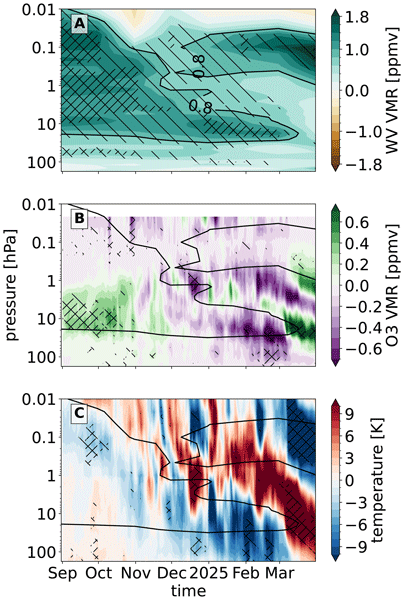
We investigated why the Northern Hemisphere winter polar vortex became unusually strong in the winter of 2024/2025. Using satellite and reanalysis datasets, and model simulations, we found that extra water erupted high in the atmosphere by the 2022 Hunga Tonga eruption led to cooling of polar latitudes of the upper atmosphere, helping the winds aloft intensify. This link suggests such volcanic eruptions can shape winters in the upper atmosphere for several years.
Guochun Shi, V. Lynn Harvey, Hanli Liu, Nicholas Pedatella, and Gunter Stober
EGUsphere, https://doi.org/10.5194/egusphere-2026-5705, https://doi.org/10.5194/egusphere-2026-5705, 2026
This preprint is open for discussion and under review for Atmospheric Chemistry and Physics (ACP).
Short summary
Short summary
We examined how major wintertime disruptions of the Arctic atmosphere affect the downward transport of nitric oxide. Using satellite observations and a whole-atmosphere model, we found that large-scale waves repeatedly organize nitric oxide into distinct regions and that this transport differs between split and displaced polar vortices. The results improve understanding of how atmospheric dynamics control chemical transport between the upper atmosphere and stratosphere.
Bernd Funke, Michael Höpfner, Stefan Bender, Quentin Errera, Udo Grabowski, Alex Hoffmann, Han-Li Liu, Nick M. Pedatella, Piera Raspollini, Jörn Ungermann, and Björn-Martin Sinnhuber
EGUsphere, https://doi.org/10.5194/egusphere-2026-3881, https://doi.org/10.5194/egusphere-2026-3881, 2026
Short summary
Short summary
We introduce two performance modeling tools, the Linear Performance Estimator (LPE) and the Fast L2 Simulator (FL2S), developed for CAIRT, a proposed ESA Earth Explorer mission. CAIRT aims to observe the middle atmosphere using an Imaging Fourier Transform Spectrometer. LPE quantifies spatial resolution and tomographic retrieval uncertainties, while FL2S generates synthetic data products that mimic the retrieval chain. Together, they demonstrate CAIRT's ability to meet scientific requirements.
Wen Yi, Jianyuan Wang, Xianghui Xue, Chengyun Yang, Iain M. Reid, Robert A. Vincent, Andrew MacKinnon, Damian J. Murphy, Njål Gulbrandsen, Masaki Tsutsumi, Baiqi Ning, Guozhu Li, Nicholas J. Mitchell, Tracy Moffat-Griffin, Toshitaka Tsuda, Haiying Li, Paulo P. Batista, Jianfei Wu, Tingdi Chen, and Xiankang Dou
Atmos. Chem. Phys., 26, 13441–13462, https://doi.org/10.5194/acp-26-13441-2026, https://doi.org/10.5194/acp-26-13441-2026, 2026
Short summary
Short summary
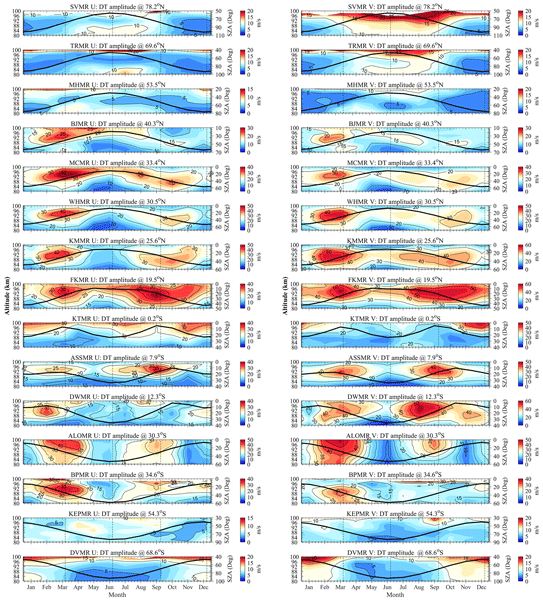
This study provides observational evidence that the solar zenith angle (SZA) influences the vertical structure of diurnal tides in the mesosphere and lower thermosphere (MLT) region. Diurnal tides are strongest at low and mid-latitudes (10–50° N/S) and weaker near the Equator and at polar latitudes. The results further suggest that background zonal winds influence tidal propagation and structure through filtering and momentum drag.
Simone Brunamonti, Yann Poltera, Gonzague Romanens, Alex Weitnauer, Philipp Scheidegger, Adrianos Filinis, Alistair Bell, Giovanni Martucci, Frank Gunther Wienhold, Thomas Peter, Peter Oelsner, Ruud Dirksen, Alexander Haefele, Lukas Emmenegger, Gunter Stober, and Béla Tuzson
EGUsphere, https://doi.org/10.5194/egusphere-2026-4762, https://doi.org/10.5194/egusphere-2026-4762, 2026
Short summary
Short summary
Accurate measurements of the concentration of water vapor in the upper atmosphere are essential for reliable climate predictions. We investigated the performance of a new lightweight (less than 4 kg) hygrometer, based on laser absorption spectroscopy, in a series of atmospheric test flights using weather balloons, reaching up to 35 km altitude. The results demonstrate the high accuracy and suitability of this technique for applications in long-term climate monitoring and atmospheric research.
Joseph Klemp, William Skamarock, Soudeh Kamali, Han-Li Liu, and Jihyeon Jang
EGUsphere, https://doi.org/10.5194/egusphere-2026-3568, https://doi.org/10.5194/egusphere-2026-3568, 2026
Short summary
Short summary
In numerically simulating atmospheric phenomena that extend into the thermosphere, it is important to allow the atmosphere to expand/contract vertically in response the significant diabatic heating/cooling that occurs at these high altitudes. This paper examines the suitability of employing a new treatment of the upper boundary in the MPAS-A model that permits its vertical mobility in deep-atmosphere global applications.
Louis Mirallie, Eliane Maillard Barras, Caroline Jonas, Corinne Vigouroux, Roeland Van Malderen, Irina Petropavlovskikh, Sophie Godin-Beekmann, Thierry Leblanc, Wolfgang Steinbrecht, Antoine Vadès, Rolf Ruefenacht, Alexander Haefele, Gunter Stober, Peter Effertz, Julian Gröbner, Gerard Ancellet, María Cazorla, Petra Duff, Matthias M. Frey, Michael Gill, James W. Hannigan, Nicholas Jones, Rigel Kivi, Raphael Köhler, Bogumil Kois, Debra E. Kollonige, Emmanuel Mahieu, Glen McConville, Johan Mellqvist, Gary Morris, Isao Murata, Tomoo Nagahama, Gerald E. Nedoluha, Shin-Ya Ogino, Richard Querel, Ryan M. Stauffer, Wolfgang Stremme, Kimberly Strong, Ralf Sussmann, Anne M. Thompson, and Yana Virolainen
Atmos. Chem. Phys., 26, 10303–10330, https://doi.org/10.5194/acp-26-10303-2026, https://doi.org/10.5194/acp-26-10303-2026, 2026
Short summary
Short summary
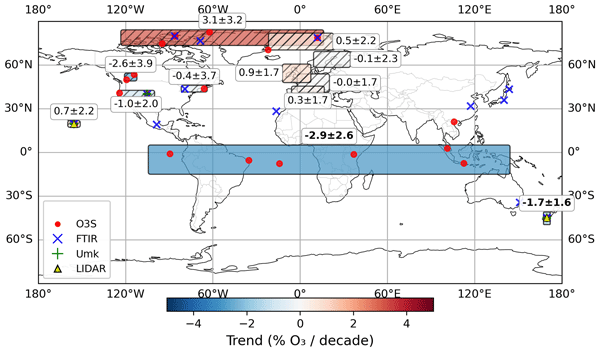
We present regional Bayesian composites of ground-based ozone partial column records. Defining coherent regions using a CAMS (Copernicus Atmosphere Monitoring Service) representativeness study, we merge five instrument types using the BASIC (Ball et al., 2017) algorithm, reducing trend uncertainties by 9.4 % compared to a weighted mean. Results confirm upper stratospheric recovery, predominantly negative middle stratospheric trends, while lower stratospheric trends remain mostly non-significant.
Loretta Pearl Poku, Gunter Stober, Diego Janches, Brian Fuller, Daniel O’Connor, Leandro Maslov, Eric Marderwald, Jose Luis Hormaechea, and Marcelo Colazo
EGUsphere, https://doi.org/10.5194/egusphere-2026-2287, https://doi.org/10.5194/egusphere-2026-2287, 2026
This preprint is open for discussion and under review for Atmospheric Measurement Techniques (AMT).
Short summary
Short summary
SAAMER-NOVA is the first imaging meteor radar network at high southern latitudes, located in the southern tip of the Andes. We present 3D tomographic wind retrievals at the MLT, altitude-time wind plots, and keogram plots revealing large-scale dynamics and multiple atmospheric waves. Its strategic location, rectangular-triangle arrangement, and angular diversity provide robust, continuous measurements. Performance is demonstrated by capturing Q2DW spatial characteristics and GW residuals.
Devin Huyghebaert, Juha Vierinen, Björn Gustavsson, Ralph Latteck, Toralf Renkwitz, Marius Zecha, Claudia C. Stephan, J. Federico Conte, Daniel Kastinen, Johan Kero, and Jorge L. Chau
Atmos. Meas. Tech., 19, 4277–4292, https://doi.org/10.5194/amt-19-4277-2026, https://doi.org/10.5194/amt-19-4277-2026, 2026
Short summary
Short summary
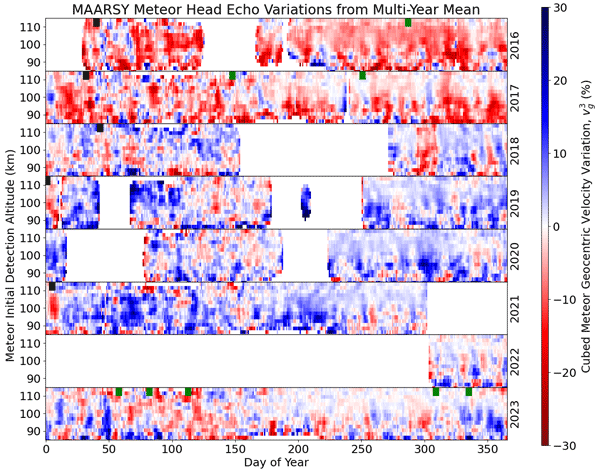
The phenomena of meteors occurs at altitudes of 60–120 km and can be used to measure the neutral atmosphere. We use a large high power radar system in Norway (Middle Atmosphere Alomar Radar System (MAARSY)) to measure the meteors and determine changes to the atmospheric density between the years of 2016–2023 at altitudes of 85–115 km. The same time period between years are compared, minimizing changes to the measurements due to factors other than the atmosphere.
Gunter Stober, Hanli Liu, Zishun Qiao, Kaoru Sato, Loretta Pearl Poku, Witali Krochin, Alan Liu, Alexander Kozlovsky, Diego Janches, Jie Zeng, Wen Yi, Masaki Tsutsumi, Njål Gulbrandsen, Satonori Nozawa, Mark Lester, Johan Kero, and Nicholas Mitchell
EGUsphere, https://doi.org/10.5194/egusphere-2026-3156, https://doi.org/10.5194/egusphere-2026-3156, 2026
Short summary
Short summary
Vertical winds are a crucial atmospheric parameter in the mesosphere/lower thermosphere and are connected to adiabatic heating and cooling of the atmosphere. Mesospheric temperatures are affected by the vertical transport driven by a pole-to-pole circulation with upwelling in the summer hemisphere and downwelling in the winter hemisphere. We present results based on a new retrieval technique for the seasonal climatological vertical winds and an intercomparison to current state-of-the-art models.
Jiahui Hu, Alan Liu, Adriana Feener, Wenjun Dong, Jing Li, and Tao Li
EGUsphere, https://doi.org/10.48550/arXiv.2603.03669, https://doi.org/10.48550/arXiv.2603.03669, 2026
Short summary
Short summary
All-sky OH airglow imaging captures mesospheric gravity waves near ~87 km, but ripple-scale instabilities (5–15 km) are difficult to identify manually. We develop an automated SE-CNN framework trained on image patches to detect ripples in 512×512 images. Using MAD normalization and sliding-window detection with clustering, the model achieves 92% F1-score and recovers ~90% of manual events, enabling objective, scalable analysis of ripple occurrence and variability.
Witali Krochin, Axel Murk, and Gunter Stober
EGUsphere, https://doi.org/10.5194/egusphere-2026-2364, https://doi.org/10.5194/egusphere-2026-2364, 2026
This preprint is open for discussion and under review for Annales Geophysicae (ANGEO).
Short summary
Short summary
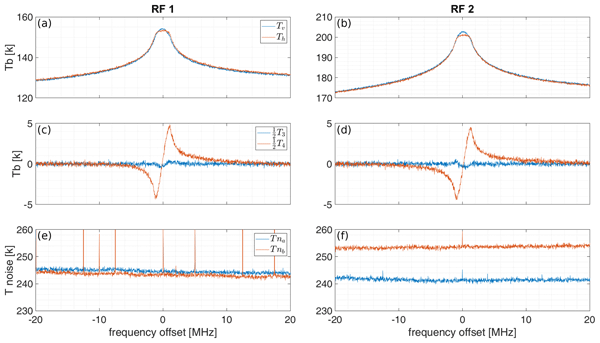
This manuscript presents measurements of the microwave emission spectra of oxygen. These spectra depend strongly on the geomagnetic field, since oxygen's magnetic dipole couples to it what produces measurable spectral shifts. The interaction is analyzed in detail, including observation geometry and polarization. Using the relation between magnetic field and spectral characteristics, a method is proposed for remote monitoring of geomagnetic variations.
Rahul Rathi, Adrian Grocott, Tim K. Yeoman, and Mark Lester
Ann. Geophys., 44, 353–368, https://doi.org/10.5194/angeo-44-353-2026, https://doi.org/10.5194/angeo-44-353-2026, 2026
Short summary
Short summary
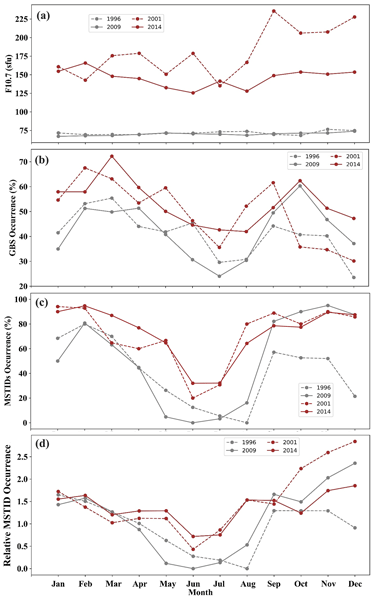
We investigate high-latitude medium scale traveling ionospheric disturbances (MSTIDs) over European Incoherent Scatter (EISCAT)-3D site. Using Hankasalmi radar data during solar max & min years of solar cycles 23 & 24, we observed that MSTIDs normally propagate equatorward with velocity and period of 50–150 m s-1 and 30–60 minutes, respectively. Along with seasonal variation, MSTIDs showed dependency on solar activity as well as on northward and southward interplanetary magnetic field (IMF) Bz.
Alex Timothy Chartier, Ryan Poffenbarger, Rafael Mesquita, Diego Janches, Jorge Chau, Toralf Renkwitz, Ralph Latteck, and William Bristow
EGUsphere, https://doi.org/10.5194/egusphere-2026-1634, https://doi.org/10.5194/egusphere-2026-1634, 2026
Short summary
Short summary
We created a new long-term record of upper atmosphere winds using data from a global network of radars spanning more than 30 years. Because these measurements do not directly show altitude, we developed a method to estimate where the signals come from and tested it against other observations and models. The results show good agreement, meaning these data can now be used with greater confidence to study atmospheric motion and its effects on communication and space systems.
Witali Krochin, Axel Murk, Andres Luder, and Gunter Stober
Atmos. Meas. Tech., 19, 2103–2123, https://doi.org/10.5194/amt-19-2103-2026, https://doi.org/10.5194/amt-19-2103-2026, 2026
Short summary
Short summary
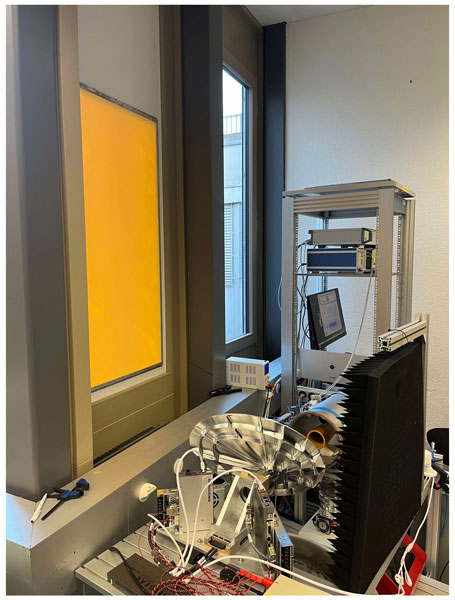
In this manuscript a new fully polarimetric radiometer for ground-based temperature sounding, TEMPERA-C (Campaign Temperature Radiometer), is presented. The advantages of the fully polarimetric approach are discussed, and a fully polarimetric calibration method is described in detail. The final measurements and the continuous series of temperature retrievals from the high altitude research station on the Jungfraujoch are also shown in this manuscript.
Adrianos Filinis, Alistair Bell, Axel Murk, and Gunter Stober
Atmos. Meas. Tech., 19, 1783–1799, https://doi.org/10.5194/amt-19-1783-2026, https://doi.org/10.5194/amt-19-1783-2026, 2026
Short summary
Short summary
Water vapor is an essential climate variable in the Earth's atmosphere and plays an important role in the radiative balance, serving as the most significant greenhouse gas in the upper troposphere. Hence, high-quality and continuous measurements are required. In this paper, we present the breadboard design of a newly developed radiometer, which will retrieve vertical profiles of middle atmospheric water vapor.
Chao Ban, Xin Fang, Wen Yi, Jie Zeng, Gunter Stober, Weilin Pan, Tao Li, and Xianghui Xue
Atmos. Meas. Tech., 19, 1697–1709, https://doi.org/10.5194/amt-19-1697-2026, https://doi.org/10.5194/amt-19-1697-2026, 2026
Short summary
Short summary
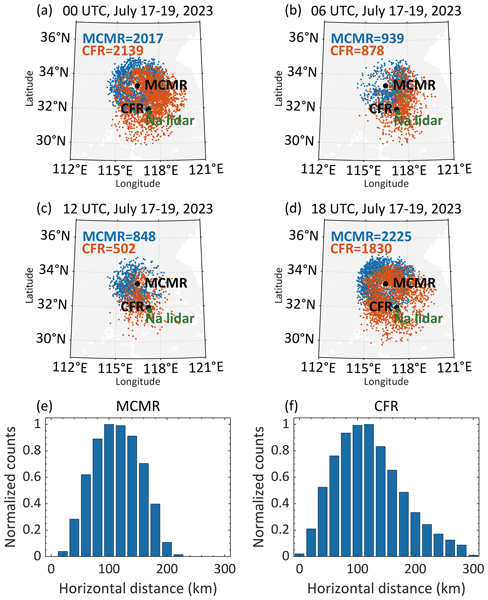
This paper presents an intercomparison of zonal winds observed by a sodium fluorescence lidar and three types of meteor radars – a multistatic meteor radar, a conventional monostatic radar, and a forward remote receiver – located near Hefei, China. The multistatic meteor radar shows the best agreement with the lidar measurements, confirming the reliability of its wind retrievals in the mesosphere and lower thermosphere and highlighting its potential for future atmospheric dynamics studies.
Florian Günzkofer, Anders Tjulin, Gang Lu, Hanli Liu, and Gunter Stober
EGUsphere, https://doi.org/10.5194/egusphere-2026-823, https://doi.org/10.5194/egusphere-2026-823, 2026
Short summary
Short summary
Incoherent scatter radars (ISRs) are an important measurement tool for space weather research. However, ISR measurements require previous knowledge of the state of the ionosphere, especially the ratio of atomic oxygen ions (O+) to electrons. We present ISR measurements during the May 2024 "Mothers' Day Storm" and apply data assimilation-based O+ ratios, which should result in more accurate ISR measurements. The advantages and disadvantages of our method are compared to those of other approaches.
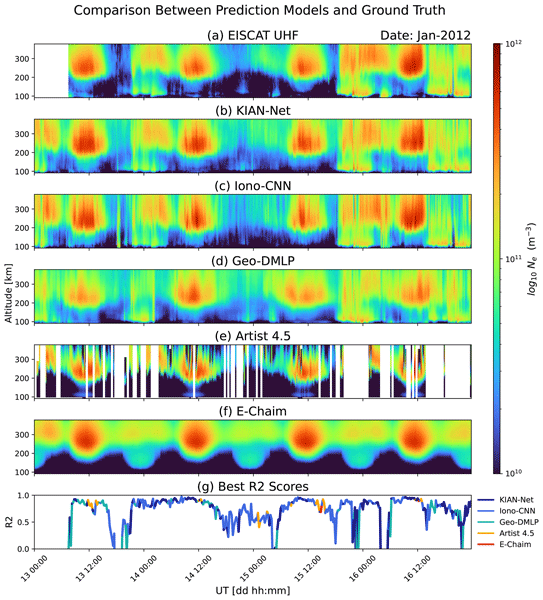
Kian Sartipzadeh, Andreas Kvammen, Björn Gustavsson, Njål Gulbrandsen, Magnar G. Johnsen, Devin Huyghebaert, and Juha Vierinen
Ann. Geophys., 44, 85–107, https://doi.org/10.5194/angeo-44-85-2026, https://doi.org/10.5194/angeo-44-85-2026, 2026
Short summary
Short summary
Knowledge of the charged environment in the upper atmosphere is essential for understanding space weather effects on satellites and radio communication. This environment is difficult to estimate at high latitudes, where aurora cause strong variability. We developed an artificial intelligence model to estimate this environment continuously. Our results show that the model provides reliable estimates even during auroral activity, improving monitoring of the polar upper atmosphere.
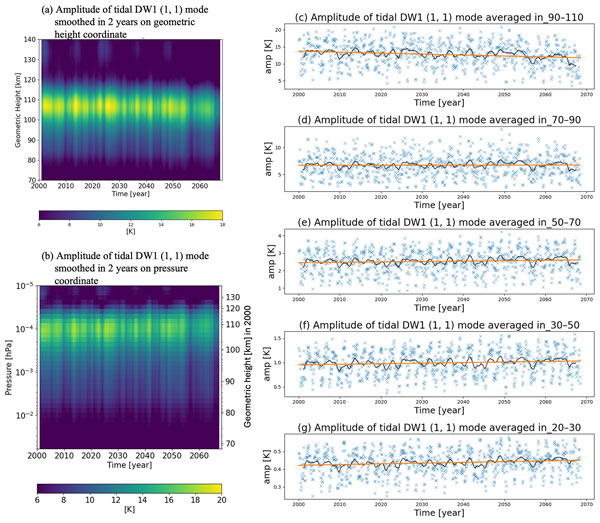
Masaru Kogure, In-Sun Song, Huixin Liu, and Han-Li Liu
Atmos. Chem. Phys., 26, 665–680, https://doi.org/10.5194/acp-26-665-2026, https://doi.org/10.5194/acp-26-665-2026, 2026
Short summary
Short summary
We investigate how rising CO₂ changes the migrating diurnal tide driven by solar heating and latent heat. Using a state-of-the-art model under the most extreme scenario in the Intergovernmental Panel on Climate Change report, we find that the tide strengthens between 20–70 km but weakens between 90–110 km. The increase likely reflects lower density and stronger tropical convection, whereas the decrease is consistent with enhanced diffusion.
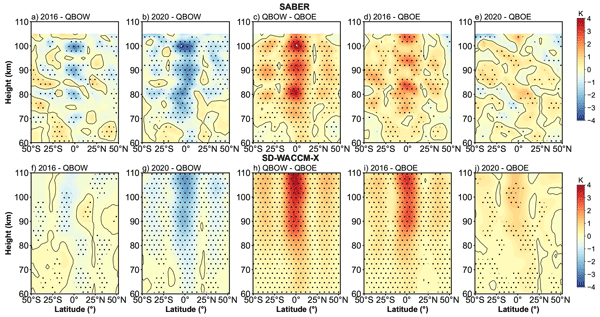
Shuai Liu, Guoying Jiang, Bingxian Luo, Xiao Liu, Jiyao Xu, Yajun Zhu, and Wen Yi
Atmos. Chem. Phys., 25, 17725–17746, https://doi.org/10.5194/acp-25-17725-2025, https://doi.org/10.5194/acp-25-17725-2025, 2025
Short summary
Short summary
Disruptions of the Quasi-Biennial Oscillation modulate the migrating diurnal tide in the mesosphere and lower thermosphere. During the events, wavelengths and phases of the tide remain unchanged, but its amplitude strengthens. The variation of heating sources, dissipation, zonal wind latitude shear and gravity wave drag may contribute to the amplification of the tide amplitude. These features provide insight into the dynamical coupling of troposphere, stratosphere, mesosphere and lower thermosphere.
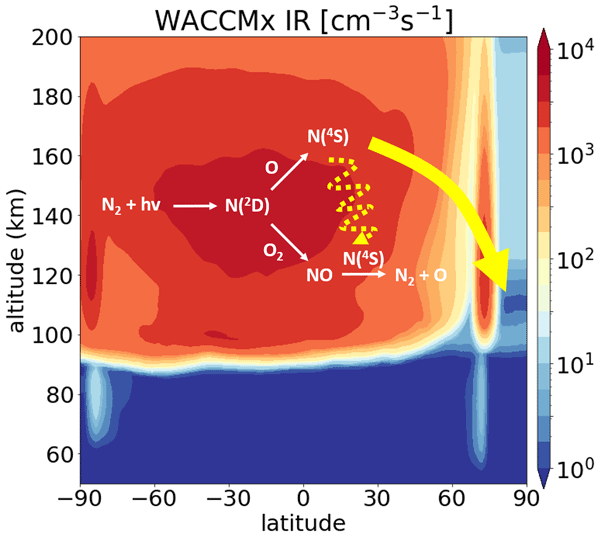
Miriam Sinnhuber, Christina Arras, Stefan Bender, Bernd Funke, Hanli Liu, Daniel R. Marsh, Thomas Reddmann, Eugene Rozanov, Timofei Sukhodolov, Monika E. Szelag, and Jan Maik Wissing
Atmos. Chem. Phys., 25, 14719–14734, https://doi.org/10.5194/acp-25-14719-2025, https://doi.org/10.5194/acp-25-14719-2025, 2025
Short summary
Short summary
Nitric oxide in the upper atmosphere varies with solar activity. Observations show that this starts a chain of processes affecting the ozone layer and climate system. This is often underestimated in models. We compare five models which show large differences in simulated NO. Analysis of these discrepancies identify two processes which interact with each other: the balance between atomic and molecular oxygen in the thermosphere, and a poleward - downward transport in the winter thermosphere.
J. Federico Conte, Jorge L. Chau, Toralf Renkwitz, Ralph Latteck, Masaki Tsutsumi, Christoph Jacobi, Njål Gulbrandsen, and Satonori Nozawa
Ann. Geophys., 43, 603–619, https://doi.org/10.5194/angeo-43-603-2025, https://doi.org/10.5194/angeo-43-603-2025, 2025
Short summary
Short summary
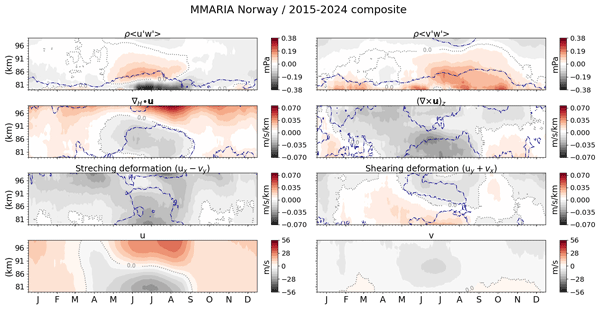
Analysis of 10 years of continuous measurements provided MMARIA/SIMONe Norway and MMARIA/SIMONe Germany reveals that the divergent and vortical motions in the mesosphere and lower thermosphere exchange the dominant role depending on the height and the time of the year. At summer mesopause altitudes over middle latitudes, the horizontal divergence and the relative vorticity contribute approximately the same, indicating an energetic balance between mesoscale divergent and vortical motions.
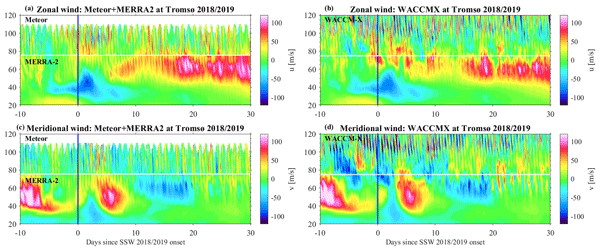
Guochun Shi, Hanli Liu, Masaki Tsutsumi, Njål Gulbrandsen, Alexander Kozlovsky, Dimitry Pokhotelov, Mark Lester, Christoph Jacobi, Kun Wu, and Gunter Stober
Atmos. Chem. Phys., 25, 9403–9430, https://doi.org/10.5194/acp-25-9403-2025, https://doi.org/10.5194/acp-25-9403-2025, 2025
Short summary
Short summary
Concerns about climate change are growing due to its widespread impacts, including rising temperatures, extreme weather events, and disruptions to ecosystems. To address these challenges, urgent global action is needed to monitor the distribution of trace gases and understand their effects on the atmosphere.
Ales Kuchar, Gunter Stober, Dimitry Pokhotelov, Huixin Liu, Han-Li Liu, Manfred Ern, Damian Murphy, Diego Janches, Tracy Moffat-Griffin, Nicholas Mitchell, and Christoph Jacobi
EGUsphere, https://doi.org/10.5194/egusphere-2025-2827, https://doi.org/10.5194/egusphere-2025-2827, 2025
Short summary
Short summary
We studied how the healing of the Antarctic ozone layer is affecting winds high above the South Pole. Using ground-based radar, satellite data, and computer models, we found that winds in the upper atmosphere have become stronger over the past two decades. These changes appear to be linked to shifts in the lower atmosphere caused by ozone recovery. Our results show that human efforts to repair the ozone layer are also influencing climate patterns far above Earth’s surface.
Arthur Gauthier, Claudia Borries, Alexander Kozlovsky, Diego Janches, Peter Brown, Denis Vida, Christoph Jacobi, Damian Murphy, Masaki Tsutsumi, Njål Gulbrandsen, Satonori Nozawa, Mark Lester, Johan Kero, Nicholas Mitchell, Tracy Moffat-Griffin, and Gunter Stober
Ann. Geophys., 43, 427–440, https://doi.org/10.5194/angeo-43-427-2025, https://doi.org/10.5194/angeo-43-427-2025, 2025
Short summary
Short summary
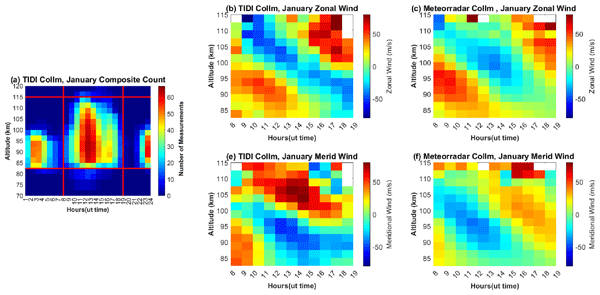
This study focuses on a TIMED Doppler Interferometer (TIDI)–meteor radar (MR) comparison of zonal and meridional winds and their dependence on local time and latitude. The correlation calculation between TIDI wind measurements and MR winds shows good agreement. A TIDI–MR seasonal comparison and analysis of the altitude–latitude dependence for winds are performed. TIDI reproduces the mean circulation well when compared with MRs and may be a useful lower boundary for general circulation models.
Florian Günzkofer, Gunter Stober, Johan Kero, David R. Themens, Anders Tjulin, Njål Gulbrandsen, Masaki Tsutsumi, and Claudia Borries
Ann. Geophys., 43, 331–348, https://doi.org/10.5194/angeo-43-331-2025, https://doi.org/10.5194/angeo-43-331-2025, 2025
Short summary
Short summary
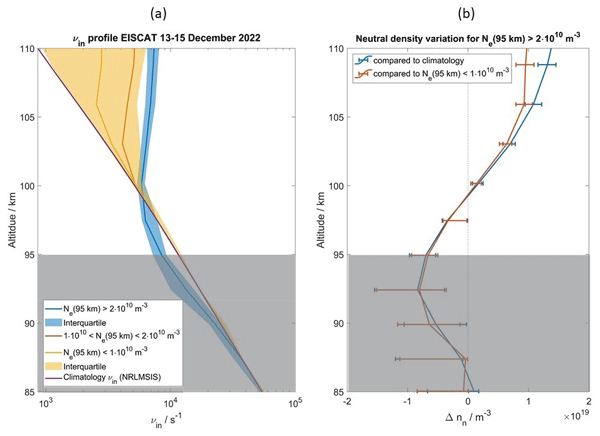
The Earth’s magnetic field is not closed at high latitudes. Electrically charged particles can penetrate the Earth’s atmosphere, deposit their energy, and heat the local atmosphere–ionosphere. This presumably causes an upwelling of the neutral atmosphere, which affects the atmosphere–ionosphere coupling. We apply a new analysis technique to infer the atmospheric density from incoherent scatter radar measurements. We identify signs of particle precipitation impact on the neutral atmosphere.
Alistair Bell, Axel Murk, and Gunter Stober
EGUsphere, https://doi.org/10.5194/egusphere-2025-1396, https://doi.org/10.5194/egusphere-2025-1396, 2025
Short summary
Short summary
Increases in middle atmospheric water vapour from the 2022 Hunga eruption have been measured worldwide. This study uses remote sensing measurements at two latitudes and accurate radiative transfer modeling to show significant long-wave heating effects. Though minimal at the surface, the water vapour enhancement can alter middle-atmospheric dynamics, potentially affecting ozone chemistry and weather patterns.
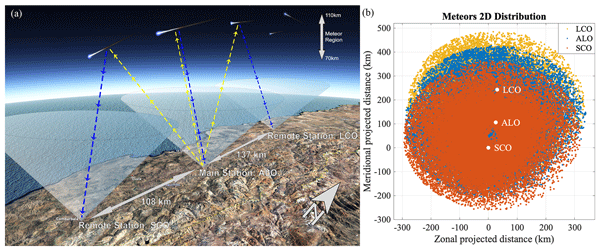
Zishun Qiao, Alan Z. Liu, Gunter Stober, Javier Fuentes, Fabio Vargas, Christian L. Adami, and Iain M. Reid
Atmos. Meas. Tech., 18, 1091–1104, https://doi.org/10.5194/amt-18-1091-2025, https://doi.org/10.5194/amt-18-1091-2025, 2025
Short summary
Short summary
This paper describes the installation of the Chilean Observation Network De Meteor Radars (CONDOR) and its initial results. The routine winds are point-to-point comparable to the co-located lidar winds. The retrievals of spatially resolved horizontal wind fields and vertical winds are also facilitated, benefiting from the extensive meteor detections. The successful deployment and maintenance of CONDOR provide 24/7 and state-of-the-art wind measurements to the research community.
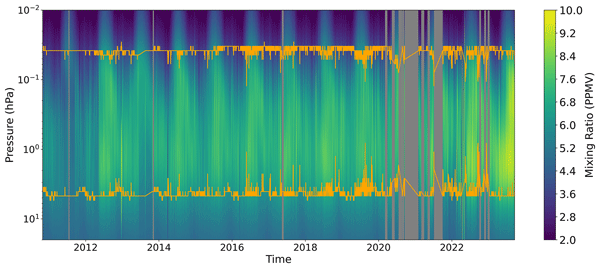
Alistair Bell, Eric Sauvageat, Gunter Stober, Klemens Hocke, and Axel Murk
Atmos. Meas. Tech., 18, 555–567, https://doi.org/10.5194/amt-18-555-2025, https://doi.org/10.5194/amt-18-555-2025, 2025
Short summary
Short summary
Hardware and software developments have been made on a 22 GHz microwave radiometer for the measurement of middle-atmospheric water vapour near Bern, Switzerland. Previous measurements dating back to 2010 have been re-calibrated and an improved optimal estimation retrieval performed on these measurements, giving a 13-year dataset. Measurements made with new and improved instrumental hardware are used to correct previous measurements, which show better agreement than the non-corrected dataset.
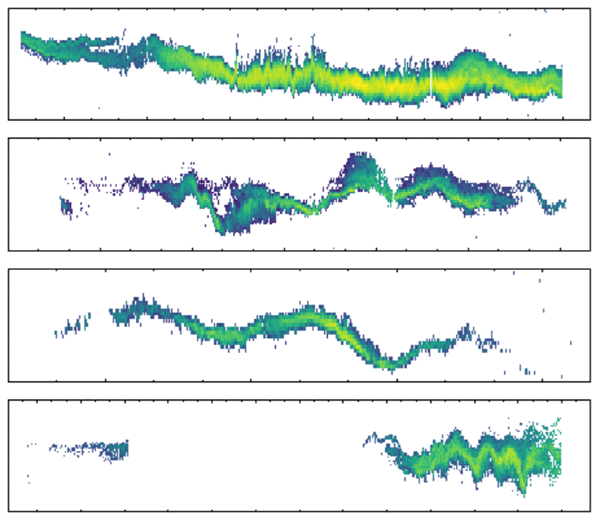
Natalie Kaifler, Bernd Kaifler, Markus Rapp, Guiping Liu, Diego Janches, Gerd Baumgarten, and Jose-Luis Hormaechea
Atmos. Chem. Phys., 24, 14029–14044, https://doi.org/10.5194/acp-24-14029-2024, https://doi.org/10.5194/acp-24-14029-2024, 2024
Short summary
Short summary
Noctilucent clouds (NLCs) are silvery clouds that can be viewed during twilight and indicate atmospheric conditions like temperature and water vapor in the upper mesosphere. High-resolution measurements from a remote sensing laser instrument provide NLC height, brightness, and occurrence rate since 2017. Most observations occur in the morning hours, likely caused by strong tidal winds, and NLC ice particles are thus transported from elsewhere to the observing location in the Southern Hemisphere.
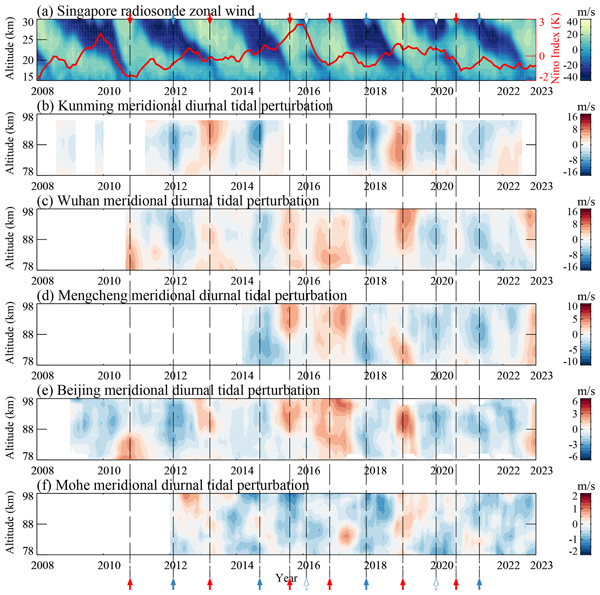
Jianyuan Wang, Na Li, Wen Yi, Xianghui Xue, Iain M. Reid, Jianfei Wu, Hailun Ye, Jian Li, Zonghua Ding, Jinsong Chen, Guozhu Li, Yaoyu Tian, Boyuan Chang, Jiajing Wu, and Lei Zhao
Atmos. Chem. Phys., 24, 13299–13315, https://doi.org/10.5194/acp-24-13299-2024, https://doi.org/10.5194/acp-24-13299-2024, 2024
Short summary
Short summary
We present the impact of quasi-biennial oscillation (QBO) disruption events on diurnal tides over the low- and mid-latitude MLT region observed by a meteor radar chain. By using a global atmospheric model and reanalysis data, it is found that the stratospheric QBO winds can affect the mesospheric diurnal tides by modulating the subtropical ozone variability in the upper stratosphere and the interaction between tides and gravity waves in the mesosphere.
Sebastian Rhode, Peter Preusse, Jörn Ungermann, Inna Polichtchouk, Kaoru Sato, Shingo Watanabe, Manfred Ern, Karlheinz Nogai, Björn-Martin Sinnhuber, and Martin Riese
Atmos. Meas. Tech., 17, 5785–5819, https://doi.org/10.5194/amt-17-5785-2024, https://doi.org/10.5194/amt-17-5785-2024, 2024
Short summary
Short summary
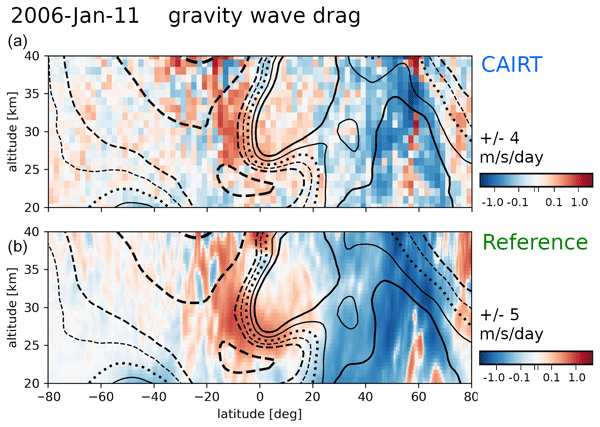
We investigate the capabilities of a proposed satellite mission, CAIRT, for observing gravity waves throughout the middle atmosphere and present the necessary methodology for in-depth wave analysis. Our findings suggest that such a satellite mission is highly capable of resolving individual wave parameters and could give new insights into the role of gravity waves in general atmospheric circulation and atmospheric processes.
Guochun Shi, Witali Krochin, Eric Sauvageat, and Gunter Stober
Atmos. Chem. Phys., 24, 10187–10207, https://doi.org/10.5194/acp-24-10187-2024, https://doi.org/10.5194/acp-24-10187-2024, 2024
Short summary
Short summary
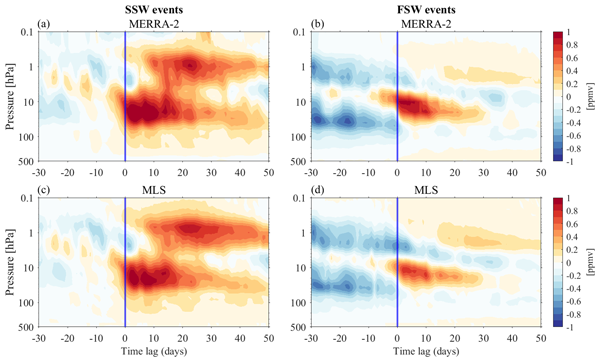
Here we investigated ozone anomalies over polar regions during sudden stratospheric and final stratospheric warming with ground-based microwave radiometers at polar latitudes compared with reanalysis and satellite data. The underlying dynamical and chemical mechanisms are responsible for the observed ozone anomalies in both events. Our research sheds light on these processes, emphasizing the need for a deeper understanding of these processes for more accurate climate modeling and forecasting.
Witali Krochin, Axel Murk, and Gunter Stober
Atmos. Meas. Tech., 17, 5015–5028, https://doi.org/10.5194/amt-17-5015-2024, https://doi.org/10.5194/amt-17-5015-2024, 2024
Short summary
Short summary
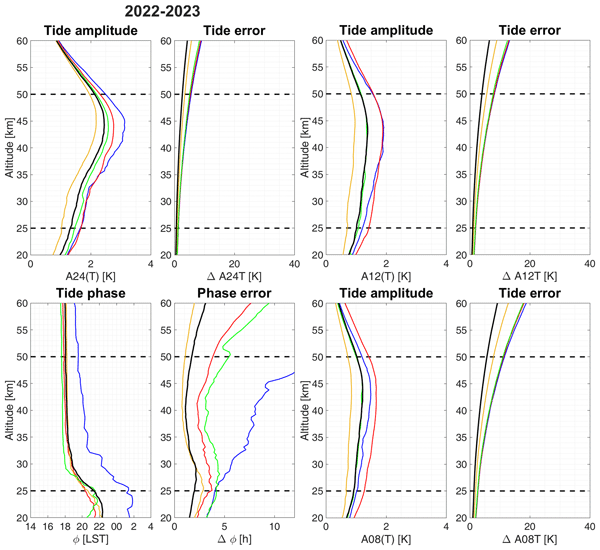
Atmospheric tides are global-scale oscillations with periods of a fraction of a day. Their observation in the middle atmosphere is challenging and rare, as it requires continuous measurements with a high temporal resolution. In this paper, temperature time series of a ground-based microwave radiometer were analyzed with a spectral filter to derive thermal tide amplitudes and phases in an altitude range of 25–50 km at the geographical locations of Payerne and Bern (Switzerland).
Qinzeng Li, Jiyao Xu, Aditya Riadi Gusman, Hanli Liu, Wei Yuan, Weijun Liu, Yajun Zhu, and Xiao Liu
Atmos. Chem. Phys., 24, 8343–8361, https://doi.org/10.5194/acp-24-8343-2024, https://doi.org/10.5194/acp-24-8343-2024, 2024
Short summary
Short summary
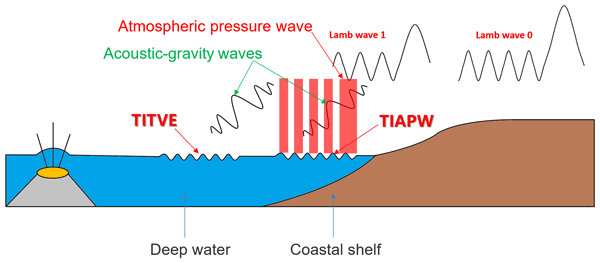
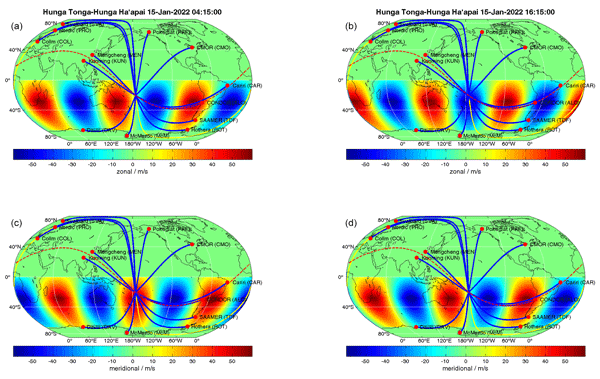
The 2022 Hunga Tonga–Hunga Ha’apai (HTHH) volcanic eruption not only triggered broad-spectrum atmospheric waves but also generated unusual tsunamis which can generate atmospheric gravity waves (AGWs). Multiple strong atmospheric waves were observed in the far-field area of the 2022 HTHH volcano eruption in the upper atmosphere by a ground-based airglow imager network. AGWs caused by tsunamis can propagate to the mesopause region; there is a good match between atmospheric waves and tsunamis.
Gunter Stober, Sharon L. Vadas, Erich Becker, Alan Liu, Alexander Kozlovsky, Diego Janches, Zishun Qiao, Witali Krochin, Guochun Shi, Wen Yi, Jie Zeng, Peter Brown, Denis Vida, Neil Hindley, Christoph Jacobi, Damian Murphy, Ricardo Buriti, Vania Andrioli, Paulo Batista, John Marino, Scott Palo, Denise Thorsen, Masaki Tsutsumi, Njål Gulbrandsen, Satonori Nozawa, Mark Lester, Kathrin Baumgarten, Johan Kero, Evgenia Belova, Nicholas Mitchell, Tracy Moffat-Griffin, and Na Li
Atmos. Chem. Phys., 24, 4851–4873, https://doi.org/10.5194/acp-24-4851-2024, https://doi.org/10.5194/acp-24-4851-2024, 2024
Short summary
Short summary
On 15 January 2022, the Hunga Tonga-Hunga Ha‘apai volcano exploded in a vigorous eruption, causing many atmospheric phenomena reaching from the surface up to space. In this study, we investigate how the mesospheric winds were affected by the volcanogenic gravity waves and estimated their propagation direction and speed. The interplay between model and observations permits us to gain new insights into the vertical coupling through atmospheric gravity waves.

Bing Cao and Alan Z. Liu
Atmos. Meas. Tech., 17, 2123–2146, https://doi.org/10.5194/amt-17-2123-2024, https://doi.org/10.5194/amt-17-2123-2024, 2024
Short summary
Short summary
A narrow-band sodium lidar measures atmospheric waves but is limited to vertical variations. We propose to utilize phase shifts among observations from different laser beams to derive horizontal wave information. Two gravity wave packets were identified by this method. Both waves were found to interact with thin evanescent layers, partially reflected, but transmitted energy to higher altitudes. The method can detect more medium-frequency gravity waves for similar lidar systems worldwide.
Peter Dalin, Urban Brändström, Johan Kero, Peter Voelger, Takanori Nishiyama, Trond Trondsen, Devin Wyatt, Craig Unick, Vladimir Perminov, Nikolay Pertsev, and Jonas Hedin
Atmos. Meas. Tech., 17, 1561–1576, https://doi.org/10.5194/amt-17-1561-2024, https://doi.org/10.5194/amt-17-1561-2024, 2024
Short summary
Short summary
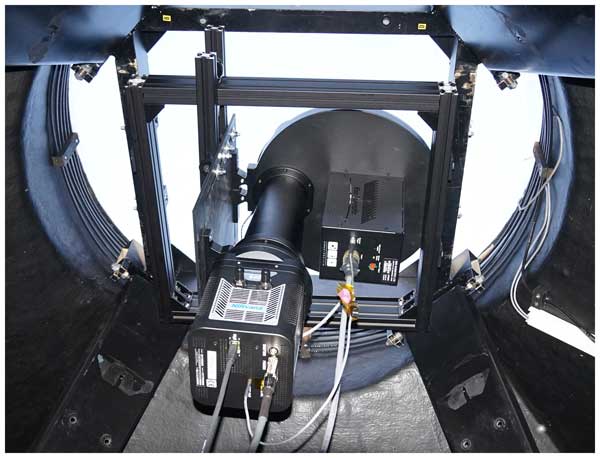
A novel infrared imaging instrument (OH imager) was put into operation in November 2022 at the Swedish Institute of Space Physics in Kiruna (Sweden). The OH imager is dedicated to the study of nightglow emissions coming from the hydroxyl (OH) and molecular oxygen (O2) layers in the mesopause (80–100 km). Based on a brightness ratio of two OH emission lines, the neutral temperature is estimated at around 87 km. The average daily winter temperature for the period January–April 2023 is 203±10 K.
Florian Günzkofer, Gunter Stober, Dimitry Pokhotelov, Yasunobu Miyoshi, and Claudia Borries
Atmos. Meas. Tech., 16, 5897–5907, https://doi.org/10.5194/amt-16-5897-2023, https://doi.org/10.5194/amt-16-5897-2023, 2023
Short summary
Short summary
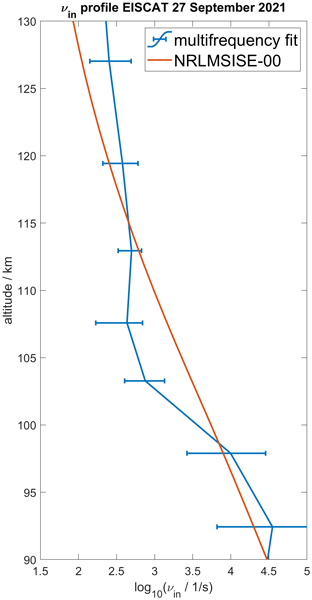
Electric currents in the ionosphere can impact both satellite and ground-based infrastructure. These currents depend strongly on the collisions of ions and neutral particles. Measuring ion–neutral collisions is often only possible via certain assumptions. The direct measurement of ion–neutral collision frequencies is possible with multifrequency incoherent scatter radar measurements. This paper presents one analysis method of such measurements and discusses its advantages and disadvantages.
Juliana Jaen, Toralf Renkwitz, Huixin Liu, Christoph Jacobi, Robin Wing, Aleš Kuchař, Masaki Tsutsumi, Njål Gulbrandsen, and Jorge L. Chau
Atmos. Chem. Phys., 23, 14871–14887, https://doi.org/10.5194/acp-23-14871-2023, https://doi.org/10.5194/acp-23-14871-2023, 2023
Short summary
Short summary
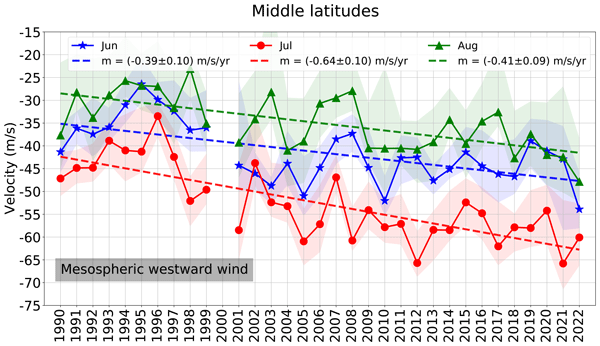
Investigation of winds is important to understand atmospheric dynamics. In the summer mesosphere and lower thermosphere, there are three main wind flows: the mesospheric westward, the mesopause southward (equatorward), and the lower-thermospheric eastward wind. Combining almost 2 decades of measurements from different radars, we study the trend, their interannual oscillations, and the effects of the geomagnetic activity over these wind maxima.
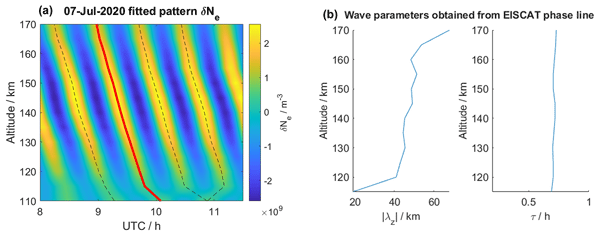
Florian Günzkofer, Dimitry Pokhotelov, Gunter Stober, Ingrid Mann, Sharon L. Vadas, Erich Becker, Anders Tjulin, Alexander Kozlovsky, Masaki Tsutsumi, Njål Gulbrandsen, Satonori Nozawa, Mark Lester, Evgenia Belova, Johan Kero, Nicholas J. Mitchell, and Claudia Borries
Ann. Geophys., 41, 409–428, https://doi.org/10.5194/angeo-41-409-2023, https://doi.org/10.5194/angeo-41-409-2023, 2023
Short summary
Short summary
Gravity waves (GWs) are waves in Earth's atmosphere and can be observed as cloud ripples. Under certain conditions, these waves can propagate up into the ionosphere. Here, they can cause ripples in the ionosphere plasma, observable as oscillations of the plasma density. Therefore, GWs contribute to the ionospheric variability, making them relevant for space weather prediction. Additionally, the behavior of these waves allows us to draw conclusions about the atmosphere at these altitudes.
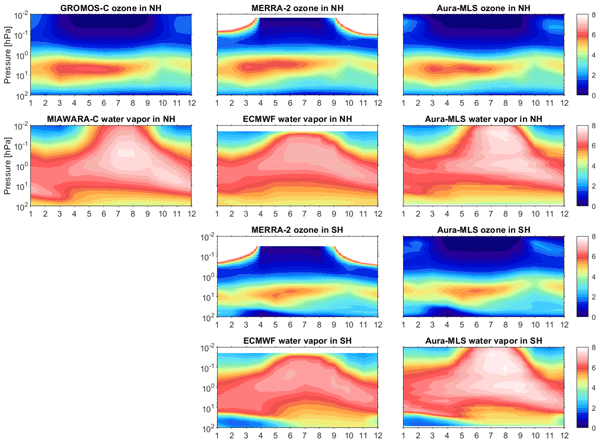
Guochun Shi, Witali Krochin, Eric Sauvageat, and Gunter Stober
Atmos. Chem. Phys., 23, 9137–9159, https://doi.org/10.5194/acp-23-9137-2023, https://doi.org/10.5194/acp-23-9137-2023, 2023
Short summary
Short summary
We present the interannual and climatological behavior of ozone and water vapor from microwave radiometers in the Arctic.
By defining a virtual conjugate latitude station in the Southern Hemisphere, we investigate altitude-dependent interhemispheric differences and estimate the ascent and descent rates of water vapor in both hemispheres. Ozone and water vapor measurements will create a deeper understanding of the evolution of middle atmospheric ozone and water vapor.
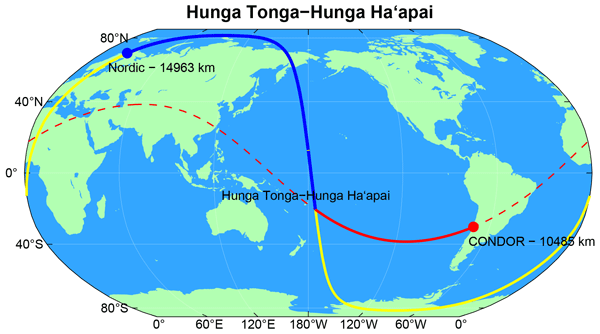
Gunter Stober, Alan Liu, Alexander Kozlovsky, Zishun Qiao, Witali Krochin, Guochun Shi, Johan Kero, Masaki Tsutsumi, Njål Gulbrandsen, Satonori Nozawa, Mark Lester, Kathrin Baumgarten, Evgenia Belova, and Nicholas Mitchell
Ann. Geophys., 41, 197–208, https://doi.org/10.5194/angeo-41-197-2023, https://doi.org/10.5194/angeo-41-197-2023, 2023
Short summary
Short summary
The Hunga Tonga–Hunga Ha‘apai volcanic eruption was one of the most vigorous volcanic explosions in the last centuries. The eruption launched many atmospheric waves traveling around the Earth. In this study, we identify these volcanic waves at the edge of space in the mesosphere/lower-thermosphere, leveraging wind observations conducted with multi-static meteor radars in northern Europe and with the Chilean Observation Network De Meteor Radars (CONDOR).
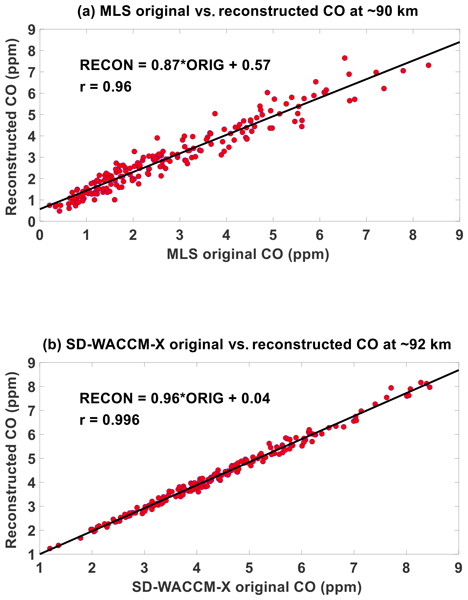
Cornelius Csar Jude H. Salinas, Dong L. Wu, Jae N. Lee, Loren C. Chang, Liying Qian, and Hanli Liu
Atmos. Chem. Phys., 23, 1705–1730, https://doi.org/10.5194/acp-23-1705-2023, https://doi.org/10.5194/acp-23-1705-2023, 2023
Short summary
Short summary
Upper mesospheric carbon monoxide's (CO) photochemical lifetime is longer than dynamical timescales. This work uses satellite observations and model simulations to establish that the migrating diurnal tide and its seasonal and interannual variabilities drive CO primarily through vertical advection. Vertical advection is a transport process that is currently difficult to observe. This work thus shows that we can use CO as a tracer for vertical advection across seasonal and interannual timescales.
Wen Yi, Jie Zeng, Xianghui Xue, Iain Reid, Wei Zhong, Jianfei Wu, Tingdi Chen, and Xiankang Dou
Atmos. Meas. Tech. Discuss., https://doi.org/10.5194/amt-2022-254, https://doi.org/10.5194/amt-2022-254, 2022
Revised manuscript not accepted
Short summary
Short summary
In recent years, the concept of multistatic meteor radar systems has attracted the attention of the atmospheric radar community, focusing on the MLT region. In this study, we apply a multistatic meteor radar system consisting of a monostatic meteor radar in Mengcheng (33.36° N, 116.49° E) and a remote receiver in Changfeng (31.98° N, 117.22° E) to estimate the two-dimensional horizontal wind field, and the horizontal divergence and relative vorticity of the wind field.
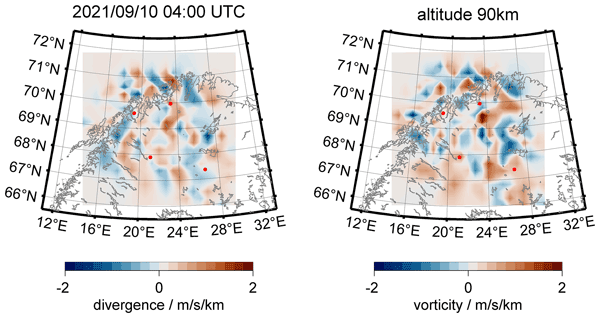
Gunter Stober, Alan Liu, Alexander Kozlovsky, Zishun Qiao, Ales Kuchar, Christoph Jacobi, Chris Meek, Diego Janches, Guiping Liu, Masaki Tsutsumi, Njål Gulbrandsen, Satonori Nozawa, Mark Lester, Evgenia Belova, Johan Kero, and Nicholas Mitchell
Atmos. Meas. Tech., 15, 5769–5792, https://doi.org/10.5194/amt-15-5769-2022, https://doi.org/10.5194/amt-15-5769-2022, 2022
Short summary
Short summary
Precise and accurate measurements of vertical winds at the mesosphere and lower thermosphere are rare. Although meteor radars have been used for decades to observe horizontal winds, their ability to derive reliable vertical wind measurements was always questioned. In this article, we provide mathematical concepts to retrieve mathematically and physically consistent solutions, which are compared to the state-of-the-art non-hydrostatic model UA-ICON.
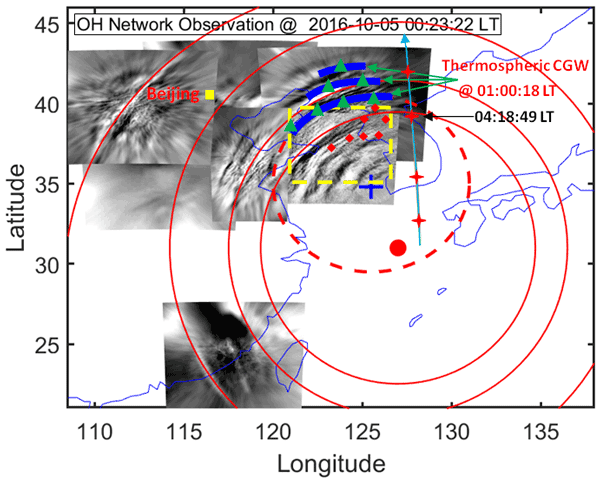
Qinzeng Li, Jiyao Xu, Hanli Liu, Xiao Liu, and Wei Yuan
Atmos. Chem. Phys., 22, 12077–12091, https://doi.org/10.5194/acp-22-12077-2022, https://doi.org/10.5194/acp-22-12077-2022, 2022
Short summary
Short summary
We use ground-based airglow network observations, reanalysis data, and satellite observations to explore the propagation process of concentric gravity waves (CGWs) excited by a typhoon between the troposphere, stratosphere, mesosphere, and thermosphere. We find that CGWs in the mesosphere are generated directly by the typhoon but the CGW observed in the thermosphere may be excited by CGW dissipation in the mesosphere, rather than directly excited by a typhoon and propagated to the thermosphere.
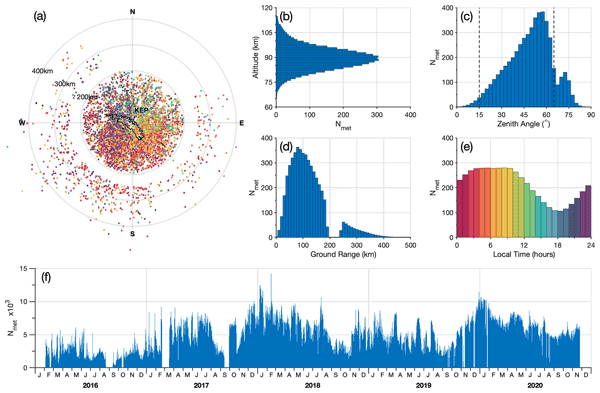
Neil P. Hindley, Nicholas J. Mitchell, Neil Cobbett, Anne K. Smith, Dave C. Fritts, Diego Janches, Corwin J. Wright, and Tracy Moffat-Griffin
Atmos. Chem. Phys., 22, 9435–9459, https://doi.org/10.5194/acp-22-9435-2022, https://doi.org/10.5194/acp-22-9435-2022, 2022
Short summary
Short summary
We present observations of winds in the mesosphere and lower thermosphere (MLT) from a recently installed meteor radar on the remote island of South Georgia (54° S, 36° W). We characterise mean winds, tides, planetary waves, and gravity waves in the MLT at this location and compare our measured winds with a leading climate model. We find that the observed wintertime winds are unexpectedly reversed from model predictions, probably because of missing impacts of secondary gravity waves in the model.
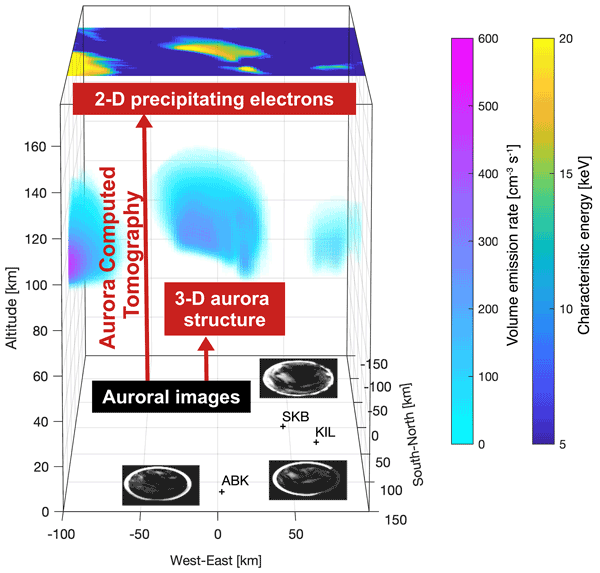
Mizuki Fukizawa, Takeshi Sakanoi, Yoshimasa Tanaka, Yasunobu Ogawa, Keisuke Hosokawa, Björn Gustavsson, Kirsti Kauristie, Alexander Kozlovsky, Tero Raita, Urban Brändström, and Tima Sergienko
Ann. Geophys., 40, 475–484, https://doi.org/10.5194/angeo-40-475-2022, https://doi.org/10.5194/angeo-40-475-2022, 2022
Short summary
Short summary
The pulsating auroral generation mechanism has been investigated by observing precipitating electrons using rockets or satellites. However, it is difficult for such observations to distinguish temporal changes from spatial ones. In this study, we reconstructed the horizontal 2-D distribution of precipitating electrons using only auroral images. The 3-D aurora structure was also reconstructed. We found that there were both spatial and temporal changes in the precipitating electron energy.
Matthew J. Griffith and Nicholas J. Mitchell
Ann. Geophys., 40, 327–358, https://doi.org/10.5194/angeo-40-327-2022, https://doi.org/10.5194/angeo-40-327-2022, 2022
Short summary
Short summary
There is great scientific interest in extending atmospheric models, such as the Met Office’s Unified Model, upwards to include the upper atmosphere. Atmospheric tides are an important driver of circulation at these greater heights. This study provides a first in-depth analysis of the migrating and non-migrating components of these tides, examining important tidal properties. Our results show that the ExUM produces a rich spectrum of spatial components, with significant non-migrating components.
Phoebe Noble, Neil Hindley, Corwin Wright, Chihoko Cullens, Scott England, Nicholas Pedatella, Nicholas Mitchell, and Tracy Moffat-Griffin
Atmos. Chem. Phys. Discuss., https://doi.org/10.5194/acp-2022-150, https://doi.org/10.5194/acp-2022-150, 2022
Revised manuscript not accepted
Short summary
Short summary
We use long term radar data and the WACCM-X model to study the impact of dynamical phenomena, including the 11-year solar cycle, ENSO, QBO and SAM, on Antarctic mesospheric winds. We find that in summer, the zonal wind (both observationally and in the model) is strongly correlated with the solar cycle. We also see important differences in the results from the other processes. In addition we find important and large biases in the winter model zonal winds relative to the observations.
Witali Krochin, Francisco Navas-Guzmán, David Kuhl, Axel Murk, and Gunter Stober
Atmos. Meas. Tech., 15, 2231–2249, https://doi.org/10.5194/amt-15-2231-2022, https://doi.org/10.5194/amt-15-2231-2022, 2022
Short summary
Short summary
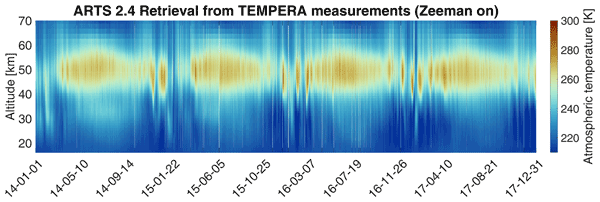
This study leverages atmospheric temperature measurements performed with a ground-based radiometer making use of data that was collected during a 4-year observational campaign applying a new retrieval algorithm that improves the maximal altitude range from 45 to 55 km. The measurements are validated against two independent data sets, MERRA2 reanalysis data and the meteorological analysis of NAVGEM-HA.
Sumanta Sarkhel, Gunter Stober, Jorge L. Chau, Steven M. Smith, Christoph Jacobi, Subarna Mondal, Martin G. Mlynczak, and James M. Russell III
Ann. Geophys., 40, 179–190, https://doi.org/10.5194/angeo-40-179-2022, https://doi.org/10.5194/angeo-40-179-2022, 2022
Short summary
Short summary
A rare gravity wave event was observed on the night of 25 April 2017 over northern Germany. An all-sky airglow imager recorded an upward-propagating wave at different altitudes in mesosphere with a prominent wave front above 91 km and faintly observed below. Based on wind and satellite-borne temperature profiles close to the event location, we have found the presence of a leaky thermal duct layer in 85–91 km. The appearance of this duct layer caused the wave amplitudes to diminish below 91 km.

Dai Koshin, Kaoru Sato, Masashi Kohma, and Shingo Watanabe
Geosci. Model Dev., 15, 2293–2307, https://doi.org/10.5194/gmd-15-2293-2022, https://doi.org/10.5194/gmd-15-2293-2022, 2022
Short summary
Short summary
The 4D ensemble Kalman filter data assimilation system for the whole neutral atmosphere has been updated. The update includes the introduction of a filter to reduce the generation of spurious waves, change in the order of horizontal diffusion of the forecast model to reproduce more realistic tidal amplitudes, and use of additional satellite observations. As a result, the analysis performance has been greatly improved, even for disturbances with periods of less than 1 d.
Juliana Jaen, Toralf Renkwitz, Jorge L. Chau, Maosheng He, Peter Hoffmann, Yosuke Yamazaki, Christoph Jacobi, Masaki Tsutsumi, Vivien Matthias, and Chris Hall
Ann. Geophys., 40, 23–35, https://doi.org/10.5194/angeo-40-23-2022, https://doi.org/10.5194/angeo-40-23-2022, 2022
Short summary
Short summary
To study long-term trends in the mesosphere and lower thermosphere (70–100 km), we established two summer length definitions and analyzed the variability over the years (2004–2020). After the analysis, we found significant trends in the summer beginning of one definition. Furthermore, we were able to extend one of the time series up to 31 years and obtained evidence of non-uniform trends and periodicities similar to those known for the quasi-biennial oscillation and El Niño–Southern Oscillation.

Christoph Jacobi, Friederike Lilienthal, Dmitry Korotyshkin, Evgeny Merzlyakov, and Gunter Stober
Adv. Radio Sci., 19, 185–193, https://doi.org/10.5194/ars-19-185-2021, https://doi.org/10.5194/ars-19-185-2021, 2021
Short summary
Short summary
We compare winds and tidal amplitudes in the upper mesosphere/lower thermosphere region for cases with disturbed and undisturbed geomagnetic conditions. The zonal winds in both the mesosphere and lower thermosphere tend to be weaker during disturbed conditions. The summer equatorward meridional wind jet is weaker for disturbed geomagnetic conditions. The effect of geomagnetic variability on tidal amplitudes, except for the semidiurnal tide, is relatively small.
John P. McCormack, V. Lynn Harvey, Cora E. Randall, Nicholas Pedatella, Dai Koshin, Kaoru Sato, Lawrence Coy, Shingo Watanabe, Fabrizio Sassi, and Laura A. Holt
Atmos. Chem. Phys., 21, 17577–17605, https://doi.org/10.5194/acp-21-17577-2021, https://doi.org/10.5194/acp-21-17577-2021, 2021
Short summary
Short summary
In order to have confidence in atmospheric predictions, it is important to know how well different numerical model simulations of the Earth’s atmosphere agree with one another. This work compares four different data assimilation models that extend to or beyond the mesosphere. Results shown here demonstrate that while the models are in close agreement below ~50 km, large differences arise at higher altitudes in the mesosphere and lower thermosphere that will need to be reconciled in the future.
Cited articles
Amante, C. and Eakins, B. W.: ETOPO1 arc-minute global relief model: procedures, data sources and analysis, National Geophysical Data Center, NOAA, NESDIS NGDC-24, 2009. a
Andrews, D., Holton, J., and Leovy, C.: Middle Atmosphere Dynamics, International Geophysics, Elsevier Science, ISBN 9780120585762, 1987. a
Ban, C., Fang, X., Yi, W., Zeng, J., Stober, G., Pan, W., Li, T., and Xue, X.: A comparative study of mesospheric zonal wind observations from Na lidar and multistatic meteor radars above Hefei, China, Atmos. Meas. Tech., 19, 1697–1709, https://doi.org/10.5194/amt-19-1697-2026, 2026. a, b, c
Baumgarten, K., Gerding, M., Baumgarten, G., and Lübken, F.-J.: Temporal variability of tidal and gravity waves during a record long 10 day continuous lidar sounding, Atmos. Chem. Phys., 18, 371–384, https://doi.org/10.5194/acp-18-371-2018, 2018. a
Becker, E.: Dynamical Control of the Middle Atmosphere, Space Sci. Rev., 168, 283–314, https://doi.org/10.1007/s11214-011-9841-5, 2012. a
Becker, E. and Vadas, S. L.: Explicit Global Simulation of Gravity Waves in the Thermosphere, J. Geophys. Res.-Space, 125, e2020JA028034, https://doi.org/10.1029/2020JA028034, 2020. a
Becker, E., Vadas, S. L., Bossert, K., Harvey, V. L., Zülicke, C., and Hoffmann, L.: A High-Resolution Whole-Atmosphere Model With Resolved Gravity Waves and Specified Large-Scale Dynamics in the Troposphere and Stratosphere, J. Geophys. Res.-Atmos., 127, e2021JD035018, https://doi.org/10.1029/2021JD035018, 2022. a
Browning, K. and Wexler, R.: The Determination of Kinematic Properties of a Wind field Using Doppler Radar, J. Appl. Meteorol., 7, 105–113, https://doi.org/10.1175/1520-0450(1968)007<0105:TDOKPO>2.0.CO;2, 1968. a, b, c
Chu, X., Li, X., Jandreau, J., and Chen, Y.: Vertical Wind Measurements with High-Resolution Lidars & Impacts on Antarctica Upper Atmosphere Studies, EPJ Web Conf., 362, 01035, https://doi.org/10.1051/epjconf/202636201035, 2026. a
Conte, J. F., Chau, J. L., Renkwitz, T., Latteck, R., Tsutsumi, M., Jacobi, C., Gulbrandsen, N., and Nozawa, S.: Observing mesoscale dynamics with multistatic specular meteor radars: first climatology of momentum flux, horizontal divergence and relative vorticity over northern central Europe, Ann. Geophys., 43, 603–619, https://doi.org/10.5194/angeo-43-603-2025, 2025. a
Dawkins, E. C., Stober, G., Carrillo-Sánchez, J. D., Janches, D., Weryk, R., Hormaechea, J. L., Bruzzone, J. S., and Plane, J. M.: A novel methodology to estimate pre-atmospheric dynamical conditions of small meteoroids, Planet. Space Sci., 238, 105796, https://doi.org/10.1016/j.pss.2023.105796, 2023a. a, b
Dawkins, E. C. M., Stober, G., Janches, D., Carrillo-Sánchez, J. D., Lieberman, R. S., Jacobi, C., Moffat-Griffin, T., Mitchell, N. J., Cobbett, N., Batista, P. P., Andrioli, V. F., Buriti, R. A., Murphy, D. J., Kero, J., Gulbrandsen, N., Tsutsumi, M., Kozlovsky, A., Kim, J. H., Lee, C., and Lester, M.: Solar Cycle and Long-Term Trends in the Observed Peak of the Meteor Altitude Distributions by Meteor Radars, Geophys. Res. Lett., 50, e2022GL101953, https://doi.org/10.1029/2022GL101953, 2023b. a, b, c
de Wit, R. J., Hibbins, R. E., Espy, P. J., Orsolini, Y. J., Limpasuvan, V., and Kinnison, D. E.: Observations of gravity wave forcing of the mesopause region during the January 2013 major Sudden Stratospheric Warming, Geophys. Res. Lett., 41, 4745–4752, https://doi.org/10.1002/2014GL060501, 2014. a
Fritts, D. C., Vadas, S. L., and Yamada, Y.: An estimate of strong local body forcing and gravity wave radiation based on OH airglow and meteor radar observations, Geophys. Res. Lett., 29, 71-1–71-4, https://doi.org/10.1029/2001GL013753, 2002. a
Fritts, D. C., Janches, D., Iimura, H., Hocking, W. K., Mitchell, N. J., Stockwell, R. G., Fuller, B., Vandepeer, B., Hormaechea, J., Brunini, C., and Levato, H.: Southern Argentina Agile Meteor Radar: System design and initial measurements of large-scale winds and tides, J. Geophys. Res.-Atmos., 115, https://doi.org/10.1029/2010JD013850, 2010. a
Gudadze, N., Stober, G., and Chau, J. L.: Can VHF radars at polar latitudes measure mean vertical winds in the presence of PMSE?, Atmos. Chem. Phys., 19, 4485–4497, https://doi.org/10.5194/acp-19-4485-2019, 2019. a, b
Hagen, J., Murk, A., Rüfenacht, R., Khaykin, S., Hauchecorne, A., and Kämpfer, N.: WIRA-C: a compact 142-GHz-radiometer for continuous middle-atmospheric wind measurements, Atmos. Meas. Tech., 11, 5007–5024, https://doi.org/10.5194/amt-11-5007-2018, 2018. a
Hall, C. and Tsutsumi, M.: Neutral temperatures at 90 km altitude over Svalbard (78° N 16° E), 2002–2019, derived from meteor radar observations, Polar Sci., 24, 100530, https://doi.org/10.1016/j.polar.2020.100530, 2020. a
He, M., Forbes, J. M., Jacobi, C., Li, G., Liu, L., Stober, G., and Wang, C.: Observational Verification of High-Order Solar Tidal Harmonics in the Earth's Atmosphere, Geophys. Res. Lett., 51, e2024GL108439, https://doi.org/10.1029/2024GL108439, 2024. a
Hindley, N. P., Mitchell, N. J., Cobbett, N., Smith, A. K., Fritts, D. C., Janches, D., Wright, C. J., and Moffat-Griffin, T.: Radar observations of winds, waves and tides in the mesosphere and lower thermosphere over South Georgia island (54° S, 36° W) and comparison with WACCM simulations, Atmos. Chem. Phys., 22, 9435–9459, https://doi.org/10.5194/acp-22-9435-2022, 2022. a, b, c, d
Hocking, W., Fuller, B., and Vandepeer, B.: Real-time determination of meteor-related parameters utilizing modern digital technology, J. Atmos. Sol-Terr. Phy., 63, 155–169, https://doi.org/10.1016/S1364-6826(00)00138-3 2001. a
Holdsworth, D. A., Reid, I. M., and Cervera, M. A.: Buckland Park all-sky interferometric meteor radar, Radio Sci., 39, rS5009, https://doi.org/10.1029/2003RS003014, 2004. a
Hook, J.: Winds at the 75–110 km level at College, Alaska, Planet. Space Sci., 18, 1623–1638, 1970. a
Janches, D., Dyrud, L. P., Broadley, S. L., and Plane, J. M. C.: First observation of micrometeoroid differential ablation in the atmosphere, Geophys. Res. Lett., 36, https://doi.org/10.1029/2009GL037389, 2009. a
Koshin, D., Sato, K., Miyazaki, K., and Watanabe, S.: An ensemble Kalman filter data assimilation system for the whole neutral atmosphere, Geosci. Model Dev., 13, 3145–3177, https://doi.org/10.5194/gmd-13-3145-2020, 2020. a
Koshin, D., Sato, K., Kohma, M., and Watanabe, S.: An update on the 4D-LETKF data assimilation system for the whole neutral atmosphere, Geosci. Model Dev., 15, 2293–2307, https://doi.org/10.5194/gmd-15-2293-2022, 2022. a, b
Koshin, D., Sato, K., Watanabe, S., and Miyazaki, K.: The JAGUAR-DAS whole neutral atmosphere reanalysis: JAWARA, Prog. Earth Planet. Sci., 12, https://doi.org/10.1186/s40645-024-00674-3, 2025. a, b
Kozlovsky, A., Stober, G., Sherstyukov, R., Lester, M., Belova, E., Kero, J., Tsutsumi, M., Gulbrandsen, N., and Nozawa, S.: Atmospheric Gravity Waves and Medium Scale Traveling Ionospheric Disturbances at Auroral Latitudes, Surv. Geophys., https://doi.org/10.1007/s10712-025-09880-0, 2025. a, b
Krochin, W., Navas-Guzmán, F., Kuhl, D., Murk, A., and Stober, G.: Continuous temperature soundings at the stratosphere and lower mesosphere with a ground-based radiometer considering the Zeeman effect, Atmos. Meas. Tech., 15, 2231–2249, https://doi.org/10.5194/amt-15-2231-2022, 2022. a
Krochin, W., Murk, A., and Stober, G.: Thermal tides in the middle atmosphere at mid-latitudes measured with a ground-based microwave radiometer, Atmos. Meas. Tech., 17, 5015–5028, https://doi.org/10.5194/amt-17-5015-2024, 2024. a
Lauritzen, P. H., Nair, R. D., Herrington, A. R., Callaghan, P., Goldhaber, S., Dennis, J. M., Bacmeister, J. T., Eaton, B. E., Zarzycki, C. M., Taylor, M. A., Ullrich, P. A., Dubos, T., Gettelman, A., Neale, R. B., Dobbins, B., Reed, K. A., Hannay, C., Medeiros, B., Benedict, J. J., and Tribbia, J. J.: NCAR Release of CAM-SE in CESM2.0: A Reformulation of the Spectral Element Dynamical Core in Dry-Mass Vertical Coordinates With Comprehensive Treatment of Condensates and Energy, J. Adv. Model. Earth Sy., 10, 1537–1570, https://doi.org/10.1029/2017MS001257, 2018. a
Lieberman, R. S., Stober, G., Becker, E., Janches, D., Ma, J., and Liu, A.: Two-Day Wave Modulation of Gravity Wave Momentum Fluxes Observed Over South America, J. Geophys. Res.-Atmos., 130, e2024JD042788, https://doi.org/10.1029/2024JD042788, 2025. a
Lindzen, R. S.: Turbulence and stress owing to gravity wave and tidal breakdown, J. Geophys. Res.-Oceans, 86, 9707–9714, https://doi.org/10.1029/JC086iC10p09707, 1981. a
Liu, H.-L.: Variability and predictability of the space environment as related to lower atmosphere forcing, Space Weather, 14, 634–658, https://doi.org/10.1002/2016SW001450, 2016. a
Liu, H.-L.: Transport of Nitric Oxide in the Winter Mesosphere and Lower Thermosphere, Geophys. Res. Lett., 52, e2024GL113027, https://doi.org/10.1029/2024GL113027, 2025. a, b
Liu, H.-L., Bardeen, C. G., Foster, B. T., Lauritzen, P., Liu, J., Lu, G., Marsh, D. R., Maute, A., McInerney, J. M., Pedatella, N. M., Qian, L., Richmond, A. D., Roble, R. G., Solomon, S. C., Vitt, F. M., and Wang, W.: Development and Validation of the Whole Atmosphere Community Climate Model With Thermosphere and Ionosphere Extension (WACCM-X 2.0), J. Adv. Model. Earth Sy., 10, 381–402, https://doi.org/10.1002/2017MS001232, 2018. a
Liu, H.-L., Lauritzen, P. H., Vitt, F., and Goldhaber, S.: Assessment of Gravity Waves From Tropopause to Thermosphere and Ionosphere in High-Resolution WACCM-X Simulations, J. Adv. Model. Earth Sy., 16, e2023MS004024, https://doi.org/10.1029/2023MS004024, 2024. a, b
Manning, L., Villard, O., and Peterson, A.: Meteoric echo study of upper atmosphere winds, P. IRE, 38, 877–883, https://doi.org/10.1109/JRPROC.1950.234124, 2006. a
National Imagery and Mapping Agency: Department of Defense World Geodetic System 1984: its definition and relationships with local geodetic systems, Tech. Rep. TR8350.2, National Imagery and Mapping Agency, St. Louis, MO, USA, https://www.bibsonomy.org/bibtex/2973e0a8e29f9a8fb17b1c215cf44f2f2/nilsma (last access: 28 August 2025), 2000. a
Plane, J. M. C., Gumbel, J., Kalogerakis, K. S., Marsh, D. R., and von Savigny, C.: Opinion: Recent developments and future directions in studying the mesosphere and lower thermosphere, Atmos. Chem. Phys., 23, 13255–13282, https://doi.org/10.5194/acp-23-13255-2023, 2023. a
Qiao, Z., Liu, A. Z., Stober, G., Fuentes, J., Vargas, F., Adami, C. L., and Reid, I. M.: Chilean Observation Network De Meteor Radars (CONDOR): multi-static system configuration and wind comparison with co-located lidar, Atmos. Meas. Tech., 18, 1091–1104, https://doi.org/10.5194/amt-18-1091-2025, 2025. a, b, c, d, e, f, g
Reid, I. M.: Meteor Radar for Investigation of the MLT Region: A Review, Atmosphere, 15, https://doi.org/10.3390/atmos15040505, 2024. a
Sato, K., Koshin, D., Suclupe, J., Chau, J. L., Lima, L. M., Li, G., Bhaskara Rao, S. V., Ratnam, M. V., Rodriguez, R., and Scipion, D.: Causes of the Abnormally Strong Easterly Phase of the Mesopause Semiannual Oscillation During the March Equinox of 2023 Revealed by a New Reanalysis Data Covering the Entire Middle Atmosphere, Geophys. Res. Lett., 52, e2025GL114658, https://doi.org/10.1029/2025GL114658, 2025. a
Shannon, C. E.: A Mathematical Theory of Communication, Bell Syst. Tech. J., 27, 379–423, https://doi.org/10.1002/j.1538-7305.1948.tb01338.x, 1948. a
Shannon, C. E. and Weaver, W.: The Mathematical Theory of Communication, University of Illinois Press, Urbana, ISBN 978-0-252-72548-7, 1963. a
Sica, R. J. and Haefele, A.: Retrieval of temperature from a multiple-channel Rayleigh-scatter lidar using an optimal estimation method, Appl. Optics, 54, 1872–1889, https://doi.org/10.1364/AO.54.001872, 2015. a
Smith, A. K.: Global Dynamics of the MLT, Surv. Geophys., 33, 1177–1230, https://doi.org/10.1007/s10712-012-9196-9, 2012. a
Smith, S. M., Stober, G., Jacobi, C., Chau, J. L., Gerding, M., Mlynczak, M. G., Russell, J. M., Baumgardner, J. L., Mendillo, M., Lazzarin, M., and Umbriaco, G.: Characterization of a Double Mesospheric Bore Over Europe, J. Geophys. Res.-Space, 122, 9738–9750, https://doi.org/10.1002/2017JA024225, 2017. a
Snively, J. B. and Pasko, V. P.: Excitation of ducted gravity waves in the lower thermosphere by tropospheric sources, J. Geophys. Res.-Space, 113, a06303, https://doi.org/10.1029/2007JA012693, 2008. a
Snively, J. B., Pasko, V. P., Taylor, M. J., and Hocking, W. K.: Doppler ducting of short-period gravity waves by midlatitude tidal wind structure, J. Geophys. Res.-Space, 112, a03304, https://doi.org/10.1029/2006JA011895, 2007. a
Stober, G. and Chau, J. L.: A multistatic and multifrequency novel approach for specular meteor radars to improve wind measurements in the MLT region, Radio Sci., 50, 431–442, https://doi.org/10.1002/2014RS005591, 2015. a, b, c, d
Stober, G., Jacobi, C., Matthias, V., Hoffmann, P., and Gerding, M.: Neutral air density variations during strong planetary wave activity in the mesopause region derived from meteor radar observations, J. Atmos. Sol.-Terr. Phy., 74, 55–63, https://doi.org/10.1016/j.jastp.2011.10.007, 2012a. a
Stober, G., Jacobi, C., Matthias, V., Hoffmann, P., and Gerding, M.: Neutral air density variations during strong planetary wave activity in the mesopause region derived from meteor radar observations, J. Atmos. Sol.-Terr. Phy., 74, 55–63, https://doi.org/10.1016/j.jastp.2011.10.007, 2012b. a
Stober, G., Sommer, S., Rapp, M., and Latteck, R.: Investigation of gravity waves using horizontally resolved radial velocity measurements, Atmos. Meas. Tech., 6, 2893–2905, https://doi.org/10.5194/amt-6-2893-2013, 2013. a, b
Stober, G., Matthias, V., Brown, P., and Chau, J. L.: Neutral density variation from specular meteor echo observations spanning one solar cycle, Geophys. Res. Lett., 41, 6919–6925, https://doi.org/10.1002/2014GL061273, 2014. a, b
Stober, G., Chau, J. L., Vierinen, J., Jacobi, C., and Wilhelm, S.: Retrieving horizontally resolved wind fields using multi-static meteor radar observations, Atmos. Meas. Tech., 11, 4891–4907, https://doi.org/10.5194/amt-11-4891-2018, 2018. a, b, c
Stober, G., Baumgarten, K., McCormack, J. P., Brown, P., and Czarnecki, J.: Comparative study between ground-based observations and NAVGEM-HA analysis data in the mesosphere and lower thermosphere region, Atmos. Chem. Phys., 20, 11979–12010, https://doi.org/10.5194/acp-20-11979-2020, 2020. a
Stober, G., Kozlovsky, A., Liu, A., Qiao, Z., Tsutsumi, M., Hall, C., Nozawa, S., Lester, M., Belova, E., Kero, J., Espy, P. J., Hibbins, R. E., and Mitchell, N.: Atmospheric tomography using the Nordic Meteor Radar Cluster and Chilean Observation Network De Meteor Radars: network details and 3D-Var retrieval, Atmos. Meas. Tech., 14, 6509–6532, https://doi.org/10.5194/amt-14-6509-2021, 2021a. a, b, c, d, e
Stober, G., Kuchar, A., Pokhotelov, D., Liu, H., Liu, H.-L., Schmidt, H., Jacobi, C., Baumgarten, K., Brown, P., Janches, D., Murphy, D., Kozlovsky, A., Lester, M., Belova, E., Kero, J., and Mitchell, N.: Interhemispheric differences of mesosphere–lower thermosphere winds and tides investigated from three whole-atmosphere models and meteor radar observations, Atmos. Chem. Phys., 21, 13855–13902, https://doi.org/10.5194/acp-21-13855-2021, 2021b. a, b, c
Stober, G., Liu, A., Kozlovsky, A., Qiao, Z., Kuchar, A., Jacobi, C., Meek, C., Janches, D., Liu, G., Tsutsumi, M., Gulbrandsen, N., Nozawa, S., Lester, M., Belova, E., Kero, J., and Mitchell, N.: Meteor radar vertical wind observation biases and mathematical debiasing strategies including the 3DVAR+DIV algorithm, Atmos. Meas. Tech., 15, 5769–5792, https://doi.org/10.5194/amt-15-5769-2022, 2022. a, b, c, d, e, f, g
Stober, G., Liu, A., Kozlovsky, A., Qiao, Z., Krochin, W., Shi, G., Kero, J., Tsutsumi, M., Gulbrandsen, N., Nozawa, S., Lester, M., Baumgarten, K., Belova, E., and Mitchell, N.: Identifying gravity waves launched by the Hunga Tonga–Hunga Ha′apai volcanic eruption in mesosphere/lower-thermosphere winds derived from CONDOR and the Nordic Meteor Radar Cluster, Ann. Geophys., 41, 197–208, https://doi.org/10.5194/angeo-41-197-2023, 2023. a, b, c
Stober, G., Vadas, S. L., Becker, E., Liu, A., Kozlovsky, A., Janches, D., Qiao, Z., Krochin, W., Shi, G., Yi, W., Zeng, J., Brown, P., Vida, D., Hindley, N., Jacobi, C., Murphy, D., Buriti, R., Andrioli, V., Batista, P., Marino, J., Palo, S., Thorsen, D., Tsutsumi, M., Gulbrandsen, N., Nozawa, S., Lester, M., Baumgarten, K., Kero, J., Belova, E., Mitchell, N., Moffat-Griffin, T., and Li, N.: Gravity waves generated by the Hunga Tonga–Hunga Ha′apai volcanic eruption and their global propagation in the mesosphere/lower thermosphere observed by meteor radars and modeled with the High-Altitude general Mechanistic Circulation Model, Atmos. Chem. Phys., 24, 4851–4873, https://doi.org/10.5194/acp-24-4851-2024, 2024. a
Urco, J. M., Feraco, F., Chau, J. L., and Marino, R.: Augmented Four-Dimensional Mesosphere and Lower Thermosphere Wind Field Reconstruction via the Physics-Informed Machine Learning Approach HYPER, Journal of Geophysical Research: Machine Learning and Computation, 1, e2024JH000162, https://doi.org/10.1029/2024JH000162, 2024. a
Vadas, S. L.: Compressible f-plane solutions to body forces, heatings, and coolings, and application to the primary and secondary gravity waves generated by a deep convective plume, J. Geophys. Res.-Space, 118, 2377–2397, https://doi.org/10.1002/jgra.50163, 2013. a
Vadas, S. L., Fritts, D. C., and Alexander, M. J.: Mechanism for the Generation of Secondary Waves in Wave Breaking Regions, J. Atmos. Sci., 60, 194–214, https://doi.org/10.1175/1520-0469(2003)060<0194:MFTGOS>2.0.CO;2, 2003. a
Vadas, S. L., Becker, E., Figueiredo, C., Bossert, K., Harding, B. J., and Gasque, L. C.: Primary and Secondary Gravity Waves and Large-Scale Wind Changes Generated by the Tonga Volcanic Eruption on 15 January 2022: Modeling and Comparison With ICON-MIGHTI Winds, J. Geophys. Res.-Space, 128, e2022JA031138, https://doi.org/10.1029/2022JA031138, 2023a. a
Vadas, S. L., Figueiredo, C., Becker, E., Huba, J. D., Themens, D. R., Hindley, N. P., Mrak, S., Galkin, I., and Bossert, K.: Traveling ionospheric disturbances induced by the secondary gravity waves from the Tonga eruption on 15 January 2022: Modeling with MESORAC/HIAMCM/SAMI3 and comparison with GPS/TEC and ionosonde data, J. Geophys. Res.-Space, e2023JA031408, https://doi.org/10.1029/2023JA031408, 2023b. a
Vadas, S. L., Becker, E., Bossert, K., Hozumi, Y., Stober, G., Harvey, V. L., Baumgarten, G., and Hoffmann, L.: The Role of the Polar Vortex Jet for Secondary and Higher-Order Gravity Waves in the Northern Mesosphere and Thermosphere During 11–14 January 2016, J. Geophys. Res.-Space, 129, e2024JA032521, https://doi.org/10.1029/2024JA032521, 2024. a, b
Volz, R., Chau, J. L., Erickson, P. J., Vierinen, J. P., Urco, J. M., and Clahsen, M.: Four-dimensional mesospheric and lower thermospheric wind fields using Gaussian process regression on multistatic specular meteor radar observations, Atmos. Meas. Tech., 14, 7199–7219, https://doi.org/10.5194/amt-14-7199-2021, 2021. a
Vondrak, T., Plane, J. M. C., Broadley, S., and Janches, D.: A chemical model of meteoric ablation, Atmos. Chem. Phys., 8, 7015–7031, https://doi.org/10.5194/acp-8-7015-2008, 2008. a
Wilhelm, S., Stober, G., and Brown, P.: Climatologies and long-term changes in mesospheric wind and wave measurements based on radar observations at high and mid latitudes, Ann. Geophys., 37, 851–875, https://doi.org/10.5194/angeo-37-851-2019, 2019. a
Yi, W., Xue, X., Reid, I. M., Murphy, D. J., Hall, C. M., Tsutsumi, M., Ning, B., Li, G., Vincent, R. A., Chen, J., Wu, J., Chen, T., and Dou, X.: Climatology of the mesopause relative density using a global distribution of meteor radars, Atmos. Chem. Phys., 19, 7567–7581, https://doi.org/10.5194/acp-19-7567-2019, 2019. a
Yi, W., Zeng, J., Xue, X., Stober, G., Wu, J., and Chen, T.: Spatiotemporal Characteristics of Meteor Trails Observed by the Multistatic Meteor Radar Network in Central and Eastern China, China Commun., 23, 71-84, https://doi.org/10.23919/JCC.fa.2025-0480.202605, 2026. a
Zeng, J., Stober, G., Yi, W., Xue, X., Zhong, W., Reid, I., Adami, C., Ning, B., Li, G., and Dou, X.: Mesosphere/Lower Thermosphere 3-Dimensional Spatially Resolved Winds Observed by Chinese Multistatic Meteor Radar Network Using the Newly Developed VVP Method, J. Geophys. Res.-Atmos., 129, e2023JD040642, https://doi.org/10.1029/2023JD040642, 2024. a, b, c, d, e, f, g, h, i, j, k
Zeng, J., Yi, W., Stober, G., Xue, X., Reid, I., Adami, C., Li, T., Fang, X., Lu, J., Ning, B., Li, G., and Dou, X.: A Lidar-Validated Comparison of Two Multistatic Meteor Radar-Based Wind Retrieval Methods for Spatially Resolved Horizontal Winds, J. Geophys. Res.-Atmos., 131, e2025JD046277, https://doi.org/10.1029/2025JD046277, 2026. a, b, c
Short summary
Reliable vertical wind retrieval is essential for understanding atmospheric coupling and
dynamics. We present a novel Volume Velocity Processing method in spherical coordinates for
the mesosphere and lower thermosphere, improve physical consistency, and compare results with
current state-of-the-art models (VVP, 3DVAR+DIV, JAWARA, and SE-WACCM-X). Results
show reduced altitude-dependent biases from incomplete representation of the observation
geometry in mean horizontal and vertical winds.
Reliable vertical wind retrieval is essential for understanding atmospheric coupling and


Altmetrics
Final-revised paper
Preprint