
Articles | Volume 18, issue 23
https://doi.org/10.5194/amt-18-7243-2025
© Author(s) 2025. This work is distributed under
the Creative Commons Attribution 4.0 License.
the Creative Commons Attribution 4.0 License.
https://doi.org/10.5194/amt-18-7243-2025
© Author(s) 2025. This work is distributed under
the Creative Commons Attribution 4.0 License.
the Creative Commons Attribution 4.0 License.
Research article
| 
02 Dec 2025
Research article |
| 02 Dec 2025
| 02 Dec 2025
The Ice Cloud Imager: retrieval of frozen water mass profiles

Department of Space, Earth and Environment, Chalmers University of Technology, Gothenburg, Sweden
Patrick Eriksson
Department of Space, Earth and Environment, Chalmers University of Technology, Gothenburg, Sweden
Related authors
Peter McEvoy, Eleanor May, and Patrick Eriksson
EGUsphere, https://doi.org/10.5194/egusphere-2026-2456, https://doi.org/10.5194/egusphere-2026-2456, 2026
Short summary
Short summary
Clouds containing ice play an important role in Earth's climate, yet measuring them from space remains challenging. Using a new weather satellite, we developed a method to measure the amount of atmospheric ice across the globe. Computer simulations are used to train a neural network, making all assumptions explicit. It matches the accuracy of specialised radar instruments, but covers a much larger area. With upcoming satellites, observations can continue until 2045, for long-term monitoring.
Patrick Eriksson, Alejandro Baró Pérez, Nils Müller, Hanna Hallborn, Eleanor May, Manfred Brath, Stefan A. Buehler, and Luisa Ickes
Atmos. Chem. Phys., 26, 2741–2768, https://doi.org/10.5194/acp-26-2741-2026, https://doi.org/10.5194/acp-26-2741-2026, 2026
Short summary
Short summary
Our study shows that accurately representing atmospheric ice mass remains a major challenge. We compared climate models to satellite data, finding that conventional models consistently underestimate the amount of ice. While new, higher-resolution models perform better, both models and observations still have significant discrepancies. These shortcomings limit our confidence in cloud-related climate feedbacks, which are critical for our predictions of the future climate.
Eleanor May, Bengt Rydberg, Inderpreet Kaur, Vinia Mattioli, Hanna Hallborn, and Patrick Eriksson
Atmos. Meas. Tech., 17, 5957–5987, https://doi.org/10.5194/amt-17-5957-2024, https://doi.org/10.5194/amt-17-5957-2024, 2024
Short summary
Short summary
The upcoming Ice Cloud Imager (ICI) mission is set to improve measurements of atmospheric ice through passive microwave and sub-millimetre wave observations. In this study, we perform detailed simulations of ICI observations. Machine learning is used to characterise the atmospheric ice present for a given simulated observation. This study acts as a final pre-launch assessment of ICI's capability to measure atmospheric ice, providing valuable information to climate and weather applications.
Lara Leko, Gunnar Behrens, Nils Müller, Adrià Amell, Axel Lauer, and Patrick Eriksson
EGUsphere, https://doi.org/10.5194/egusphere-2026-3869, https://doi.org/10.5194/egusphere-2026-3869, 2026
Short summary
Short summary
We look at daily cycles of tropical ice clouds and their representation in models. New satellite data of ice clouds captures daily cycles over land and oceans, which was not possible yet. These are often shifted in time in reanalysis, and biased depending on the variable. High-resolution models show improvements but still have regional biases. We show that combining different satellite observations helps to understand daily cycles and improve the simulation of tropical ice clouds and rainfall.
Peter McEvoy, Eleanor May, and Patrick Eriksson
EGUsphere, https://doi.org/10.5194/egusphere-2026-2456, https://doi.org/10.5194/egusphere-2026-2456, 2026
Short summary
Short summary
Clouds containing ice play an important role in Earth's climate, yet measuring them from space remains challenging. Using a new weather satellite, we developed a method to measure the amount of atmospheric ice across the globe. Computer simulations are used to train a neural network, making all assumptions explicit. It matches the accuracy of specialised radar instruments, but covers a much larger area. With upcoming satellites, observations can continue until 2045, for long-term monitoring.
Patrick Eriksson, Alejandro Baró Pérez, Nils Müller, Hanna Hallborn, Eleanor May, Manfred Brath, Stefan A. Buehler, and Luisa Ickes
Atmos. Chem. Phys., 26, 2741–2768, https://doi.org/10.5194/acp-26-2741-2026, https://doi.org/10.5194/acp-26-2741-2026, 2026
Short summary
Short summary
Our study shows that accurately representing atmospheric ice mass remains a major challenge. We compared climate models to satellite data, finding that conventional models consistently underestimate the amount of ice. While new, higher-resolution models perform better, both models and observations still have significant discrepancies. These shortcomings limit our confidence in cloud-related climate feedbacks, which are critical for our predictions of the future climate.
Patrick Eriksson, Anders Emrich, Kalle Kempe, Johan Riesbeck, Alhassan Aljarosha, Olivier Auriacombe, Joakim Kugelberg, Enne Hekma, Roland Albers, Axel Murk, Søren Møller Pedersen, Laurenz John, Jan Stake, Peter McEvoy, Bengt Rydberg, Adam Dybbroe, Anke Thoss, Alessio Canestri, Christophe Accadia, Paolo Colucci, Daniele Gherardi, and Ville Kangas
Atmos. Meas. Tech., 18, 4709–4729, https://doi.org/10.5194/amt-18-4709-2025, https://doi.org/10.5194/amt-18-4709-2025, 2025
Short summary
Short summary
The Arctic Weather Satellite (AWS), developed by the European Space Agency, highlights a new approach in satellite design, aiming to expand the network of operational microwave sensors cost-effectively. Launched in August 2024, AWS features a 19-channel microwave cross-track radiometer. Notably, it introduces groundbreaking channels at 325.15 GHz. In addition, AWS acts as the stepping stone to a suggested constellation of satellites, denoted as EUMETSAT Polar System Sterna.
Eleanor May, Bengt Rydberg, Inderpreet Kaur, Vinia Mattioli, Hanna Hallborn, and Patrick Eriksson
Atmos. Meas. Tech., 17, 5957–5987, https://doi.org/10.5194/amt-17-5957-2024, https://doi.org/10.5194/amt-17-5957-2024, 2024
Short summary
Short summary
The upcoming Ice Cloud Imager (ICI) mission is set to improve measurements of atmospheric ice through passive microwave and sub-millimetre wave observations. In this study, we perform detailed simulations of ICI observations. Machine learning is used to characterise the atmospheric ice present for a given simulated observation. This study acts as a final pre-launch assessment of ICI's capability to measure atmospheric ice, providing valuable information to climate and weather applications.
Adrià Amell, Simon Pfreundschuh, and Patrick Eriksson
Atmos. Meas. Tech., 17, 4337–4368, https://doi.org/10.5194/amt-17-4337-2024, https://doi.org/10.5194/amt-17-4337-2024, 2024
Short summary
Short summary
The representation of clouds in numerical weather and climate models remains a major challenge that is difficult to address because of the limitations of currently available data records of cloud properties. In this work, we address this issue by using machine learning to extract novel information on ice clouds from a long record of satellite observations. Through extensive validation, we show that this novel approach provides surprisingly accurate estimates of clouds and their properties.
Karina McCusker, Anthony J. Baran, Chris Westbrook, Stuart Fox, Patrick Eriksson, Richard Cotton, Julien Delanoë, and Florian Ewald
Atmos. Meas. Tech., 17, 3533–3552, https://doi.org/10.5194/amt-17-3533-2024, https://doi.org/10.5194/amt-17-3533-2024, 2024
Short summary
Short summary
Polarised radiative transfer simulations are performed using an atmospheric model based on in situ measurements. These are compared to large polarisation measurements to explore whether such measurements can provide information on cloud ice, e.g. particle shape and orientation. We find that using oriented particle models with shapes based on imagery generally allows for accurate simulations. However, results are sensitive to shape assumptions such as the choice of single crystals or aggregates.
Simon Pfreundschuh, Clément Guilloteau, Paula J. Brown, Christian D. Kummerow, and Patrick Eriksson
Atmos. Meas. Tech., 17, 515–538, https://doi.org/10.5194/amt-17-515-2024, https://doi.org/10.5194/amt-17-515-2024, 2024
Short summary
Short summary
The latest version of the GPROF retrieval algorithm that produces global precipitation estimates using observations from the Global Precipitation Measurement mission is validated against ground-based radars. The validation shows that the algorithm accurately estimates precipitation on scales ranging from continental to regional. In addition, we validate candidates for the next version of the algorithm and identify principal challenges for further improving space-borne rain measurements.
Michael Kiefer, Dale F. Hurst, Gabriele P. Stiller, Stefan Lossow, Holger Vömel, John Anderson, Faiza Azam, Jean-Loup Bertaux, Laurent Blanot, Klaus Bramstedt, John P. Burrows, Robert Damadeo, Bianca Maria Dinelli, Patrick Eriksson, Maya García-Comas, John C. Gille, Mark Hervig, Yasuko Kasai, Farahnaz Khosrawi, Donal Murtagh, Gerald E. Nedoluha, Stefan Noël, Piera Raspollini, William G. Read, Karen H. Rosenlof, Alexei Rozanov, Christopher E. Sioris, Takafumi Sugita, Thomas von Clarmann, Kaley A. Walker, and Katja Weigel
Atmos. Meas. Tech., 16, 4589–4642, https://doi.org/10.5194/amt-16-4589-2023, https://doi.org/10.5194/amt-16-4589-2023, 2023
Short summary
Short summary
We quantify biases and drifts (and their uncertainties) between the stratospheric water vapor measurement records of 15 satellite-based instruments (SATs, with 31 different retrievals) and balloon-borne frost point hygrometers (FPs) launched at 27 globally distributed stations. These comparisons of measurements during the period 2000–2016 are made using robust, consistent statistical methods. With some exceptions, the biases and drifts determined for most SAT–FP pairs are < 10 % and < 1 % yr−1.
Simon Pfreundschuh, Ingrid Ingemarsson, Patrick Eriksson, Daniel A. Vila, and Alan J. P. Calheiros
Atmos. Meas. Tech., 15, 6907–6933, https://doi.org/10.5194/amt-15-6907-2022, https://doi.org/10.5194/amt-15-6907-2022, 2022
Short summary
Short summary
We used methods from the field of artificial intelligence to train an algorithm to estimate rain from satellite observations. In contrast to other methods, our algorithm not only estimates rain, but also the uncertainty of the estimate. Using independent measurements from rain gauges, we show that our method performs better than currently available methods and that the provided uncertainty estimates are reliable. Our method makes satellite-based measurements of rain more accurate and reliable.
Adrià Amell, Patrick Eriksson, and Simon Pfreundschuh
Atmos. Meas. Tech., 15, 5701–5717, https://doi.org/10.5194/amt-15-5701-2022, https://doi.org/10.5194/amt-15-5701-2022, 2022
Short summary
Short summary
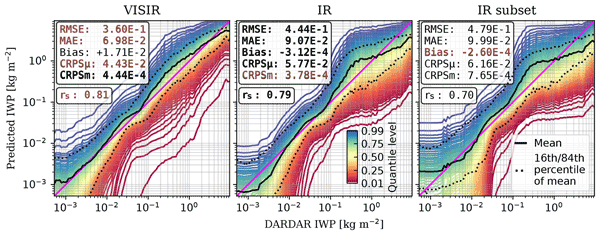
Geostationary satellites continuously image a given location on Earth, a feature that satellites designed to characterize atmospheric ice lack. However, the relationship between geostationary images and atmospheric ice is complex. Machine learning is used here to leverage such images to characterize atmospheric ice throughout the day in a probabilistic manner. Using structural information from the image improves the characterization, and this approach compares favourably to traditional methods.
Simon Pfreundschuh, Paula J. Brown, Christian D. Kummerow, Patrick Eriksson, and Teodor Norrestad
Atmos. Meas. Tech., 15, 5033–5060, https://doi.org/10.5194/amt-15-5033-2022, https://doi.org/10.5194/amt-15-5033-2022, 2022
Short summary
Short summary
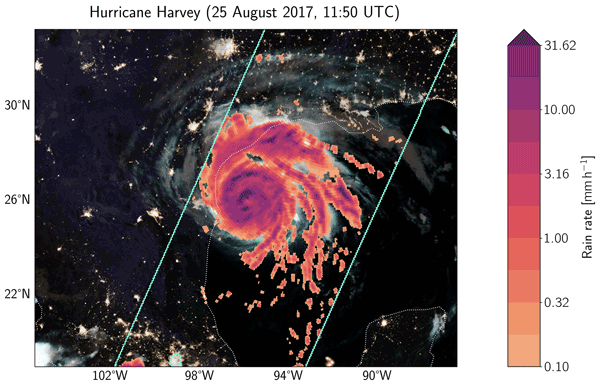
The Global Precipitation Measurement mission is an international satellite mission providing regular global rain measurements. We present two newly developed machine-learning-based implementations of one of the algorithms responsible for turning the satellite observations into rain measurements. We show that replacing the current algorithm with a neural network improves the accuracy of the measurements. A neural network that also makes use of spatial information unlocks further improvements.
William G. Read, Gabriele Stiller, Stefan Lossow, Michael Kiefer, Farahnaz Khosrawi, Dale Hurst, Holger Vömel, Karen Rosenlof, Bianca M. Dinelli, Piera Raspollini, Gerald E. Nedoluha, John C. Gille, Yasuko Kasai, Patrick Eriksson, Christopher E. Sioris, Kaley A. Walker, Katja Weigel, John P. Burrows, and Alexei Rozanov
Atmos. Meas. Tech., 15, 3377–3400, https://doi.org/10.5194/amt-15-3377-2022, https://doi.org/10.5194/amt-15-3377-2022, 2022
Short summary
Short summary
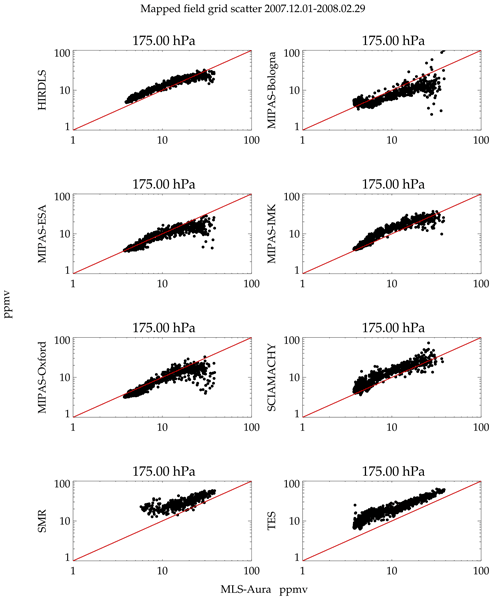
This paper attempts to provide an assessment of the accuracy of 21 satellite-based instruments that remotely measure atmospheric humidity in the upper troposphere of the Earth's atmosphere. The instruments made their measurements from 1984 to the present time; however, most of these instruments began operations after 2000, and only a few are still operational. The objective of this study is to quantify the accuracy of each satellite humidity data set.
Simon Pfreundschuh, Stuart Fox, Patrick Eriksson, David Duncan, Stefan A. Buehler, Manfred Brath, Richard Cotton, and Florian Ewald
Atmos. Meas. Tech., 15, 677–699, https://doi.org/10.5194/amt-15-677-2022, https://doi.org/10.5194/amt-15-677-2022, 2022
Short summary
Short summary
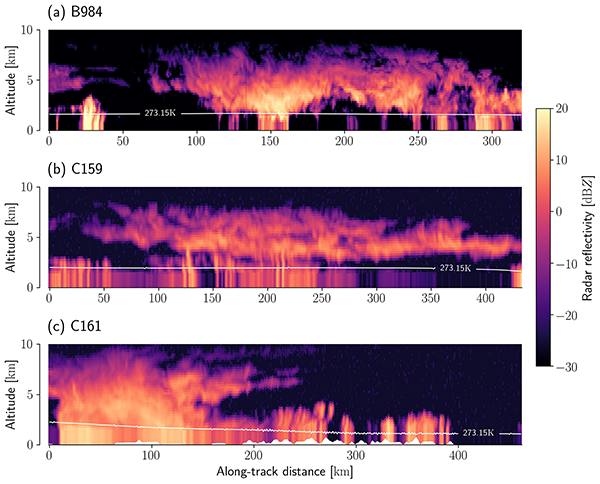
We test a novel method to remotely measure ice particles in clouds. This is important because such measurements are required to improve climate and weather models. The method combines a radar with newly developed sensors measuring microwave radiation at very short wavelengths. We use observations made from aircraft flying above the cloud and compare them to real measurements from inside the cloud. This works well given that one can model the ice particles in the cloud sufficiently well.
Alan J. Geer, Peter Bauer, Katrin Lonitz, Vasileios Barlakas, Patrick Eriksson, Jana Mendrok, Amy Doherty, James Hocking, and Philippe Chambon
Geosci. Model Dev., 14, 7497–7526, https://doi.org/10.5194/gmd-14-7497-2021, https://doi.org/10.5194/gmd-14-7497-2021, 2021
Short summary
Short summary
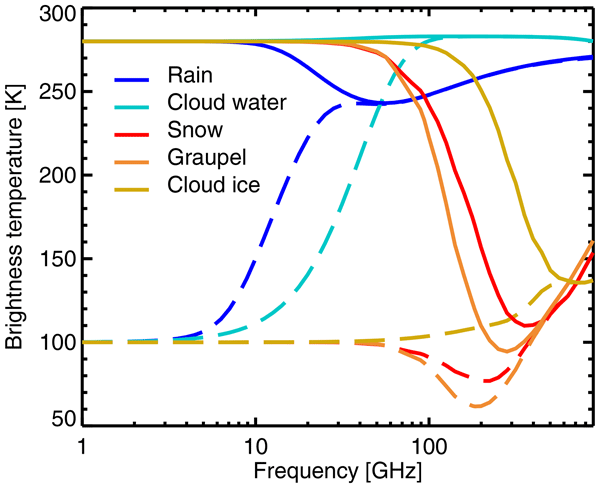
Satellite observations of radiation from the earth can have strong sensitivity to cloud and precipitation in the atmosphere, with applications in weather forecasting and the development of models. Computing the radiation received at the satellite sensor using radiative transfer theory requires a simulation of the optical properties of a volume containing a large number of cloud and precipitation particles. This article describes the physics used to generate these
bulkoptical properties.
Jie Gong, Dong L. Wu, and Patrick Eriksson
Earth Syst. Sci. Data, 13, 5369–5387, https://doi.org/10.5194/essd-13-5369-2021, https://doi.org/10.5194/essd-13-5369-2021, 2021
Short summary
Short summary
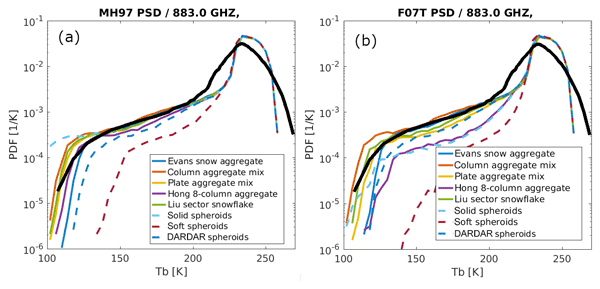
Launched from the International Space Station, the IceCube radiometer orbited the Earth for 15 months and collected the first spaceborne radiance measurements at 874–883 GHz. This channel is uniquely important to fill in the sensitivity gap between operational visible–infrared and microwave remote sensing for atmospheric cloud ice and snow. This paper delivers the IceCube Level 1 radiance data processing algorithm and provides a data quality evaluation and discussion on its scientific merit.
Cited articles
Amell, A., Pfreundschuh, S., and Eriksson, P.: The Chalmers Cloud Ice Climatology: retrieval implementation and validation, Atmos. Meas. Tech., 17, 4337–4368, https://doi.org/10.5194/amt-17-4337-2024, 2024. a, b, c, d
Barker, H. W., Jerg, M. P., Wehr, T., Kato, S., Donovan, D. P., and Hogan, R. J.: A 3D cloud-construction algorithm for the EarthCARE satellite mission, Q. J. Roy. Meteor. Soc., 137, 1042–1058, https://doi.org/10.1002/qj.824, 2011. a, b
Barlakas, V. and Eriksson, P.: Three dimensional radiative effects in passive millimeter/sub-millimeter all-sky observations, Remote Sens., 12, 531, https://doi.org/10.3390/rs12030531, 2020. a
Barlakas, V., Geer, A. J., and Eriksson, P.: Introducing hydrometeor orientation into all-sky microwave and submillimeter assimilation, Atmos. Meas. Tech., 14, 3427–3447, https://doi.org/10.5194/amt-14-3427-2021, 2021. a
Bergadá, M., Labriola, M., González, R., Palacios, M., Marote, D., Andrés, A., García, J., Sánchez-Pascuala, D., Ordóñez, L., Rodríguez, M., Ortín, M., Esteso, V., Martínez, J., and Klein, U.: The Ice Cloud Imager (ICI) preliminary design and performance, in: 2016 14th Specialist Meeting on Microwave Radiometry and Remote Sensing of the Environment (MicroRad), 27–31, https://doi.org/10.1109/MICRORAD.2016.7530498, 2016. a
Bolot, M., Harris, L. M., Cheng, K.-Y., Merlis, T. M., Blossey, P. N., Bretherton, C. S., Clark, S. K., Kaltenbaugh, A., Zhou, L., and Fueglistaler, S.: Kilometer-scale global warming simulations and active sensors reveal changes in tropical deep convection, npj Clim. Atmos. Sci., 6, 1–8, https://doi.org/10.1038/s41612-023-00525-w, 2023. a
Brath, M., Pfreundschuh, S., Eriksson, P., Lemke, O., and Buehler, S. A.: D11 Executive Summary, Scientific concept study for wide-swath high-resolution cloud profiling, Tech. rep., University of Hamburg, https://nebula.esa.int/content/scientific-concept-study-wide-swath-high-resolution-cloud-profiling (last access: 1 December 2025), 2019. a
Buehler, S. A., Larsson, R., Lemke, O., Pfreundschuh, S., Brath, M., Adams, I., Fox, S., Roemer, F. E., Czarnecki, P., and Eriksson, P.: The atmospheric radiative transfer simulator ARTS, version 2.6 – Deep python integration, J. Quant. Spectrosc. Radiat. Transfer, 341, 109443, https://doi.org/10.1016/j.jqsrt.2025.109443, 2025. a
Cazenave, Q., Ceccaldi, M., Delanoë, J., Pelon, J., Groß, S., and Heymsfield, A.: Evolution of DARDAR-CLOUD ice cloud retrievals: new parameters and impacts on the retrieved microphysical properties, Atmos. Meas. Tech., 12, 2819–2835, https://doi.org/10.5194/amt-12-2819-2019, 2019. a, b, c, d
Davis, C. P., Evans, K. F., Buehler, S. A., Wu, D. L., and Pumphrey, H. C.: 3-D polarised simulations of space-borne passive mm/sub-mm midlatitude cirrus observations: a case study, Atmos. Chem. Phys., 7, 4149–4158, https://doi.org/10.5194/acp-7-4149-2007, 2007. a
Delanoë, J. M. E., Heymsfield, A. J., Protat, A., Bansemer, A., and Hogan, R. J.: Normalized particle size distribution for remote sensing application, J. Geophys. Res. Atmos., 119, 4204–4227, https://doi.org/10.1002/2013JD020700, 2014. a
Deng, M., Mace, G. G., Wang, Z., and Berry, E.: CloudSat 2C-ICE product update with a new Z parameterization in lidar-only region, J. Geophys. Res. Atmos., 120, 12,198–12,208, https://doi.org/10.1002/2015JD023600, 2015. a, b
Deutloff, J., Buehler, S. A., Brath, M., and Naumann, A. K.: Insights on tropical high-cloud radiative effect from a new conceptual model, J. Adv. Model. Earth Syst., 17, e2024MS004615, https://doi.org/10.1029/2024MS004615, 2025. a
Ekelund, R., Eriksson, P., and Pfreundschuh, S.: Using passive and active observations at microwave and sub-millimetre wavelengths to constrain ice particle models, Atmos. Meas. Tech., 13, 501–520, https://doi.org/10.5194/amt-13-501-2020, 2020. a
Eriksson, P., Ekelund, R., Mendrok, J., Brath, M., Lemke, O., and Buehler, S. A.: A general database of hydrometeor single scattering properties at microwave and sub-millimetre wavelengths, Earth Syst. Sci. Data, 10, 1301–1326, https://doi.org/10.5194/essd-10-1301-2018, 2018. a
Eriksson, P., Emrich, A., Kempe, K., Riesbeck, J., Aljarosha, A., Auriacombe, O., Kugelberg, J., Hekma, E., Albers, R., Murk, A., Møller Pedersen, S., John, L., Stake, J., McEvoy, P., Rydberg, B., Dybbroe, A., Thoss, A., Canestri, A., Accadia, C., Colucci, P., Gherardi, D., and Kangas, V.: The Arctic Weather Satellite radiometer, EGUsphere [preprint], https://doi.org/10.5194/egusphere-2025-1769, 2025. a, b
Evans, K. F., Walter, S. J., Heymsfield, A. J., and McFarquhar, G. M.: Submillimeter-wave cloud ice radiometer: simulations of retrieval algorithm performance, J. Geophys. Res. Atmos., 107, AAC 2-1–AAC 2-21, https://doi.org/10.1029/2001JD000709, 2002. a, b
Evans, K. F., Wang, J. R., O'C Starr, D., Heymsfield, G., Li, L., Tian, L., Lawson, R. P., Heymsfield, A. J., and Bansemer, A.: Ice hydrometeor profile retrieval algorithm for high-frequency microwave radiometers: application to the CoSSIR instrument during TC4, Atmos. Meas. Tech., 5, 2277–2306, https://doi.org/10.5194/amt-5-2277-2012, 2012. a
Grützun, V., Buehler, S. A., Kluft, L., Mendrok, J., Brath, M., and Eriksson, P.: All-sky information content analysis for novel passive microwave instruments in the range from 23.8 to 874.4 GHz, Atmos. Meas. Tech., 11, 4217–4237, https://doi.org/10.5194/amt-11-4217-2018, 2018. a, b, c, d, e, f, g, h
Harlow, C.: Millimeter microwave emissivities and effective temperatures of snow-covered surfaces: evidence for lambertian surface scattering, IEEE T. Geosci. Remote, 47, 1957–1970, https://doi.org/10.1109/TGRS.2008.2011893, 2009. a
Harlow, C. and Essery, R.: Tundra snow emissivities at MHS frequencies: MEMLS validation using airborne microwave data measured during CLPX-II, IEEE. T. Geosci. Remote., 50, 4262–4278, https://doi.org/10.1109/TGRS.2012.2193132, 2012. a
Hartmann, D. L. and Berry, S. E.: The balanced radiative effect of tropical anvil clouds, Journal of Geophysical Research: Atmospheres, 122, 5003–5020, https://doi.org/10.1002/2017JD026460, 2017. a
Hersbach, H., Bell, B., Berrisford, P., Hirahara, S., Horányi, A., Muñoz-Sabater, J., Nicolas, J., Peubey, C., Radu, R., Schepers, D., Simmons, A., Soci, C., Abdalla, S., Abellan, X., Balsamo, G., Bechtold, P., Biavati, G., Bidlot, J., Bonavita, M., De Chiara, G., Dahlgren, P., Dee, D., Diamantakis, M., Dragani, R., Flemming, J., Forbes, R., Fuentes, M., Geer, A., Haimberger, L., Healy, S., Hogan, R. J., Hólm, E., Janisková, M., Keeley, S., Laloyaux, P., Lopez, P., Lupu, C., Radnoti, G., de Rosnay, P., Rozum, I., Vamborg, F., Villaume, S., and Thépaut, J.-N.: The ERA5 global reanalysis, Q. J. Roy. Meteor. Soc., 146, 1999–2049, https://doi.org/10.1002/qj.3803, 2020. a
Hewison, T., Selbach, N., Heygster, G., Taylor, J., and Mcgrath, A.: Airborne measurements of Arctic sea ice, glacier and snow emissivity at 24–183 GHz, Toronto, ON, Canada, ISBN 978-0-7803-7536-9, vol. 5, 2851–2855, https://doi.org/10.1109/IGARSS.2002.1026797, 2002. a
Illingworth, A. J., Barker, H. W., Beljaars, A., Ceccaldi, M., Chepfer, H., Clerbaux, N., Cole, J., Delanoë, J., Domenech, C., Donovan, D. P., Fukuda, S., Hirakata, M., Hogan, R. J., Huenerbein, A., Kollias, P., Kubota, T., Nakajima, T., Nakajima, T. Y., Nishizawa, T., Ohno, Y., Okamoto, H., Oki, R., Sato, K., Satoh, M., Shephard, M. W., Velázquez-Blázquez, A., Wandinger, U., Wehr, T., and Zadelhoff, G.-J. v.: The EarthCARE satellite: the next step forward in global measurements of clouds, aerosols, precipitation, and radiation, Bull. Amer. Met. Soc., 96, 1311–1332, https://doi.org/10.1175/BAMS-D-12-00227.1, 2015. a
IPCC: Climate Change 2021: The Physical Science Basis. Contribution of Working Group I to the Sixth Assessment Report of the Intergovernmental Panel on Climate Change, Cambridge University Press, https://doi.org/10.1017/9781009157896, 2021. a
Kaur, I., Eriksson, P., Barlakas, V., Pfreundschuh, S., and Fox, S.: Fast radiative transfer approximating ice hydrometeor orientation and its implication on IWP retrievals, Remote Sens., 14, 1594, https://doi.org/10.3390/rs14071594, 2022. a, b
Liu, Y. and Adams, I. S.: Tomographic reconstruction algorithms for retrieving two-dimensional ice cloud microphysical parameters using along-track (sub)millimeter-wave radiometer observations, Atmos. Meas. Tech., 18, 1659–1674, https://doi.org/10.5194/amt-18-1659-2025, 2025. a, b
Liu, Y., Buehler, S. A., Brath, M., Liu, H., and Dong, X.: Ensemble Optimization Retrieval Algorithm of Hydrometeor Profiles for the Ice Cloud Imager Submillimeter-Wave Radiometer, J. Geophys. Res. Atmos., 123, 4594–4612, https://doi.org/10.1002/2017JD027892, 2018. a
Lupi, T., Tominetti, F., Grilli, M., Di Nicolantonio, W., Tabart, C., Bredin, C., Bayle, F., Vetrano, E., De Viti, E., Scialino, L., Catalani, A., and D'Addio, S.: Microwave imager instrument for MetOp second generation: Design and verification, in: 2016 14th Specialist Meeting on Microwave Radiometry and Remote Sensing of the Environment (MicroRad), 32–36, https://doi.org/10.1109/MICRORAD.2016.7530499, 2016. a
Mather, J. H., McFarlane, S. A., Miller, M. A., and Johnson, K. L.: Cloud properties and associated radiative heating rates in the tropical western Pacific, Journal of Geophysical Research: Atmospheres, 112, https://doi.org/10.1029/2006JD007555, 2007. a
Mattioli, V., Accadia, C., Ackermann, J., Di Michele, S., Hans, I., Schlüssel, P., Colucci, P., and Canestri, A.: The EUMETSAT Polar System – Second Generation (EPS-SG) Passive Microwave and Sub-mm Wave Missions, in: Photonics & Electromagnetics Research Symposium, 3926–3933, https://doi.org/10.1109/PIERS-Spring46901.2019.9017822, 2019. a
Matus, A. V. and L'Ecuyer, T. S.: The role of cloud phase in Earth's radiation budget, J. Geophys. Res. Atmos., 122, 2559–2578, https://doi.org/10.1002/2016JD025951, 2017. a
May, E.: The Ice Cloud Imager: retrieval of frozen water mass profiles – Code, Zenodo [code], https://doi.org/10.5281/zenodo.15374048, 2025. a
May, E., Rydberg, B., Kaur, I., Mattioli, V., Hallborn, H., and Eriksson, P.: The Ice Cloud Imager: retrieval of frozen water column properties, Atmos. Meas. Tech., 17, 5957–5987, https://doi.org/10.5194/amt-17-5957-2024, 2024. a, b, c, d, e, f, g, h, i, j, k, l, m, n, o, p, q, r, s, t, u, v, w, x, y
Munchak, S. J., Ringerud, S., Brucker, L., You, Y., De Gelis, I., and Prigent, C.: An active–passive microwave land surface database from GPM, IEEE T. Geosci. Remote, 58, 6224–6242, https://doi.org/10.1109/TGRS.2020.2975477, 2020. a
Pfreundschuh, S., Eriksson, P., Duncan, D., Rydberg, B., Håkansson, N., and Thoss, A.: A neural network approach to estimating a posteriori distributions of Bayesian retrieval problems, Atmos. Meas. Tech., 11, 4627–4643, https://doi.org/10.5194/amt-11-4627-2018, 2018. a, b, c
Pfreundschuh, S., Fox, S., Eriksson, P., Duncan, D., Buehler, S. A., Brath, M., Cotton, R., and Ewald, F.: Synergistic radar and sub-millimeter radiometer retrievals of ice hydrometeors in mid-latitude frontal cloud systems, Atmos. Meas. Tech., 15, 677–699, https://doi.org/10.5194/amt-15-677-2022, 2022. a, b
Pfreundschuh, S., Kukulies, J., Amell, A., Hallborn, H., May, E., and Eriksson, P.: The Chalmers Cloud Ice Climatology: A novel robust climate record of frozen cloud hydrometeor concentrations, J. Geophys. Res. Atmos., 130, e2024JD042618, https://doi.org/10.1029/2024JD042618, 2025. a, b, c
Platnick, S., King, M., Ackerman, S., Menzel, W., Baum, B., Riedi, J., and Frey, R.: The MODIS cloud products: algorithms and examples from terra, IEEE T. Geosci. Remote, 41, 459–473, https://doi.org/10.1109/TGRS.2002.808301, 2003. a, b
Prigent, C., Aires, F., Wang, D., Fox, S., and Harlow, C.: Sea-surface emissivity parametrization from microwaves to millimetre waves, Q. J. Roy. Meteor. Soc., 143, 596–605, https://doi.org/10.1002/qj.2953, 2017. a
Rodgers, C. D.: Inverse methods for atmospheric sounding: theory and practice, vol. 2 of Series on Atmospheric, Oceanic and Planetary Physics, World Scientific, ISBN 978-981-02-2740-1, https://doi.org/10.1142/3171, 2000. a, b
Rydberg, B.: EPS-SG ICI ice water path product: ATBD, report, https://research.chalmers.se/en/publication/514522 (last access: 1 December 2025), 2018. a
Rydberg, B., Eriksson, P., Buehler, S. A., and Murtagh, D. P.: Non-Gaussian Bayesian retrieval of tropical upper tropospheric cloud ice and water vapour from Odin-SMR measurements, Atmos. Meas. Tech., 2, 621–637, https://doi.org/10.5194/amt-2-621-2009, 2009. a, b
Stephens, G. L., Vane, D. G., Boain, R. J., Mace, G. G., Sassen, K., Wang, Z., Illingworth, A. J., O'connor, E. J., Rossow, W. B., Durden, S. L., Miller, S. D., Austin, R. T., Benedetti, A., and Mitrescu, C.: The CloudSat mission and the A-Train: A new dimension of space-based observations of clouds and precipitation, Bull. Amer. Met. Soc., 83, 1771–1790, https://doi.org/10.1175/BAMS-83-12-1771, 2002. a
Wang, D., Prigent, C., Aires, F., and Jimenez, C.: A statistical retrieval of cloud parameters for the millimeter wave Ice Cloud Imager on board MetOp-SG, IEEE Access, PP, 1–1, https://doi.org/10.1109/ACCESS.2016.2625742, 2016. a, b
Wang, D., Prigent, C., Kilic, L., Fox, S., Harlow, C., Jimenez, C., Aires, F., Grassotti, C., and Karbou, F.: Surface emissivity at microwaves to millimeter waves over polar regions: parameterization and evaluation with aircraft experiments, J. Atmos. Ocean. Tech., 34, 1039–1059, https://doi.org/10.1175/JTECH-D-16-0188.1, 2017. a
Wu, D. L., Gong, J., Deal, W. R., Gaines, W., Cooke, C. M., De Amici, G., Pantina, P., Liu, Y., Yang, P., Eriksson, P., and Bennartz, R.: Remote sensing of ice cloud properties with millimeter and submillimeter-wave polarimetry, IEEE J. Microwaves, 4, 847–857, https://doi.org/10.1109/JMW.2024.3487758, 2024. a
Short summary
The vertical distribution of atmospheric ice impacts Earth's weather and climate. The Ice Cloud Imager (ICI) will measure at microwave and sub-millimetre frequencies, which are well suited to detect atmospheric ice. In this study, a machine learning model is trained on ICI simulations. Results show that the vertical distribution of ice can be derived from ICI observations, and that ICI could offer a valuable data source that complements existing radar- and lidar-based measurements.
The vertical distribution of atmospheric ice impacts Earth's weather and climate. The Ice Cloud...


