Articles | Volume 18, issue 23
https://doi.org/10.5194/amt-18-7369-2025
© Author(s) 2025. This work is distributed under
the Creative Commons Attribution 4.0 License.
https://doi.org/10.5194/amt-18-7369-2025
© Author(s) 2025. This work is distributed under
the Creative Commons Attribution 4.0 License.
Water vapor content retrieval under cloudy sky conditions from SWIR satellite measurements in the context of C3IEL space mission project

Raphaël Peroni
Univ. Lille, CNRS, UMR 8518 – LOA – Laboratoire d'Optique Atmosphérique, 59000 Lille, France
now at: Department of Earth and Atmospheric Sciences, Université du Québec à Montréal, Montreal, Canada
Guillaume Penide
Univ. Lille, CNRS, UMR 8518 – LOA – Laboratoire d'Optique Atmosphérique, 59000 Lille, France
Céline Cornet
CORRESPONDING AUTHOR
Univ. Lille, CNRS, UMR 8518 – LOA – Laboratoire d'Optique Atmosphérique, 59000 Lille, France
Olivier Pujol
Univ. Lille, CNRS, UMR 8518 – LOA – Laboratoire d'Optique Atmosphérique, 59000 Lille, France
Institut Universitaire de France (IUF), Paris, France
Clémence Pierangelo
Centre National d'Etudes Spatiales (CNES), 18 avenue Edouard Belin, 31401 Toulouse CEDEX 9, France
Related authors
No articles found.
Robin Miri, Olivier Pujol, Qiaoyun Hu, Philippe Goloub, Igor Veselovskii, Thierry Podvin, and Fabrice Ducos
Atmos. Meas. Tech., 18, 5729–5747, https://doi.org/10.5194/amt-18-5729-2025, https://doi.org/10.5194/amt-18-5729-2025, 2025
Short summary
Short summary
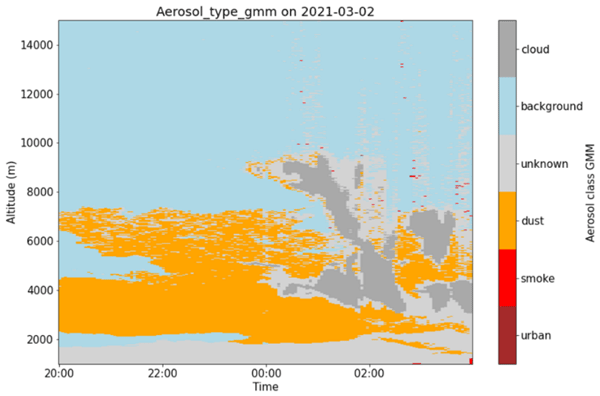
We developed a new method to automatically identify types of particles in the air, such as smoke, dust, or pollution, using a specialized laser system. This helps monitor air quality more efficiently and in greater detail. Our method uses real data collected over 3 years in northern France and can detect changes caused by weather conditions. It offers a faster and more accurate way to understand what is in the air we breathe.
Raphaël Peroni, Céline Cornet, Olivier Pujol, Guillaume Penide, Clémence Pierangelo, and François Thieuleux
EGUsphere, https://doi.org/10.5194/egusphere-2024-1560, https://doi.org/10.5194/egusphere-2024-1560, 2024
Preprint withdrawn
Short summary
Short summary
A new retrieval algorithm to measure integrated water vapor content above clouds using shortwave infrared (SWIR) observations has been developed and evaluated through both idealized and realistic atmospheric profiles. For the latter, the algorithm shows a positive bias in retrieving water vapor content above low/mid-level clouds, with an error margin of about 2.6 kg.m-2.
Robin Miri, Olivier Pujol, Qiaoyun Hu, Philippe Goloub, Igor Veselovskii, Thierry Podvin, and Fabrice Ducos
Atmos. Meas. Tech., 17, 3367–3375, https://doi.org/10.5194/amt-17-3367-2024, https://doi.org/10.5194/amt-17-3367-2024, 2024
Short summary
Short summary
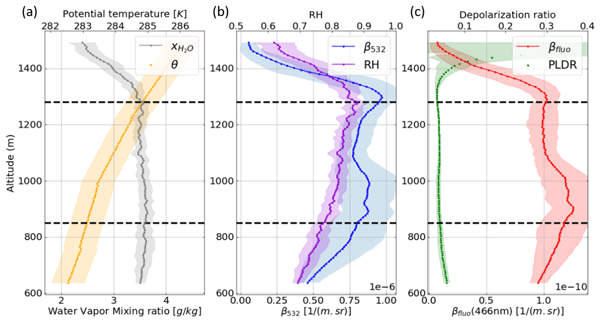
This paper focuses on the use of fluorescence to study aerosols with lidar. An innovative method for aerosol hygroscopic growth study using fluorescence is presented. The paper presents case studies to showcase the effectiveness and potential of the proposed approach. These advancements will contribute to better understanding the interactions between aerosols and water vapor, with future work expected to be dedicated to aerosol–cloud interaction.
Valery Shcherbakov, Frédéric Szczap, Guillaume Mioche, and Céline Cornet
Atmos. Meas. Tech., 17, 3011–3028, https://doi.org/10.5194/amt-17-3011-2024, https://doi.org/10.5194/amt-17-3011-2024, 2024
Short summary
Short summary
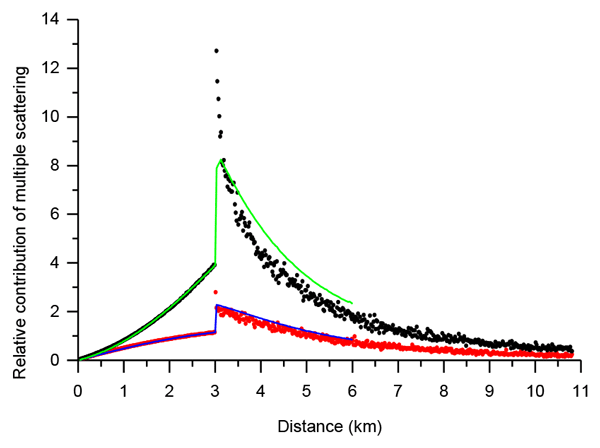
We performed Monte Carlo simulations of single-wavelength lidar signals from multi-layered clouds with special attention focused on the multiple-scattering (MS) effect in regions of the cloud-free molecular atmosphere. The MS effect on lidar signals always decreases with the increasing distance from the cloud far edge. The decrease is the direct consequence of the fact that the forward peak of particle phase functions is much larger than the receiver field of view.
Christian Matar, Céline Cornet, Frédéric Parol, Laurent C.-Labonnote, Frédérique Auriol, and Marc Nicolas
Atmos. Meas. Tech., 16, 3221–3243, https://doi.org/10.5194/amt-16-3221-2023, https://doi.org/10.5194/amt-16-3221-2023, 2023
Short summary
Short summary
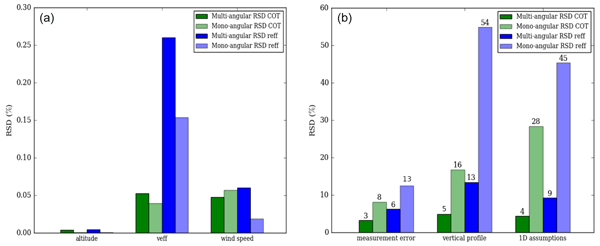
The optimal estimation formalism is applied to OSIRIS airborne high-resolution multi-angular measurements to retrieve COT and Reff. The corresponding uncertainties related to measurement errors, which are up to 6 and 12 %, the non-retrieved parameters, which are less than 0.5 %, and the cloud model assumptions show that the heterogeneous vertical profiles and the 3D radiative transfer effects lead to average uncertainties of 5 and 4 % for COT and 13 and 9 % for Reff.
Huazhe Shang, Souichiro Hioki, Guillaume Penide, Céline Cornet, Husi Letu, and Jérôme Riedi
Atmos. Chem. Phys., 23, 2729–2746, https://doi.org/10.5194/acp-23-2729-2023, https://doi.org/10.5194/acp-23-2729-2023, 2023
Short summary
Short summary
We find that cloud profiles can be divided into four prominent patterns, and the frequency of these four patterns is related to intensities of cloud-top entrainment and precipitation. Based on these analyses, we further propose a cloud profile parameterization scheme allowing us to represent these patterns. Our results shed light on how to facilitate the representation of cloud profiles and how to link them to cloud entrainment or precipitating status in future remote-sensing applications.
Paolo Dandini, Céline Cornet, Renaud Binet, Laetitia Fenouil, Vadim Holodovsky, Yoav Y. Schechner, Didier Ricard, and Daniel Rosenfeld
Atmos. Meas. Tech., 15, 6221–6242, https://doi.org/10.5194/amt-15-6221-2022, https://doi.org/10.5194/amt-15-6221-2022, 2022
Short summary
Short summary
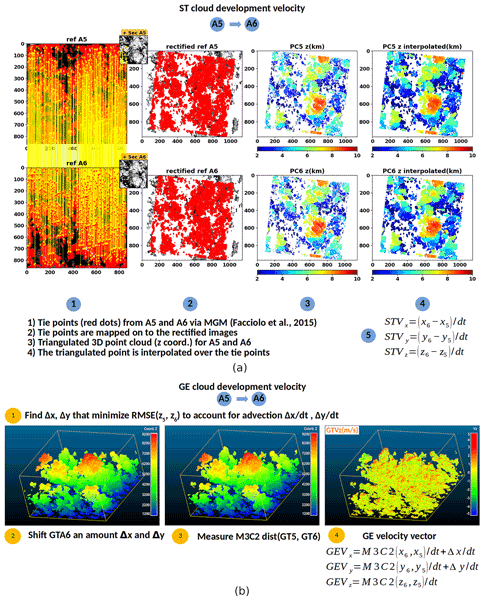
3D cloud envelope and development velocity are retrieved from realistic simulations of multi-view
CLOUD (C3IEL) images. Cloud development velocity is derived by finding matching features
between acquisitions separated by 20 s. The tie points are then mapped from image to space via 3D
reconstruction of the cloud envelope obtained from 2 simultaneous images. The retrieved cloud
topography as well as the velocities are in good agreement with the estimates obtained from the
physical models.
Sandrine Bony, Marie Lothon, Julien Delanoë, Pierre Coutris, Jean-Claude Etienne, Franziska Aemisegger, Anna Lea Albright, Thierry André, Hubert Bellec, Alexandre Baron, Jean-François Bourdinot, Pierre-Etienne Brilouet, Aurélien Bourdon, Jean-Christophe Canonici, Christophe Caudoux, Patrick Chazette, Michel Cluzeau, Céline Cornet, Jean-Philippe Desbios, Dominique Duchanoy, Cyrille Flamant, Benjamin Fildier, Christophe Gourbeyre, Laurent Guiraud, Tetyana Jiang, Claude Lainard, Christophe Le Gac, Christian Lendroit, Julien Lernould, Thierry Perrin, Frédéric Pouvesle, Pascal Richard, Nicolas Rochetin, Kevin Salaün, Alfons Schwarzenboeck, Guillaume Seurat, Bjorn Stevens, Julien Totems, Ludovic Touzé-Peiffer, Gilles Vergez, Jessica Vial, Leonie Villiger, and Raphaela Vogel
Earth Syst. Sci. Data, 14, 2021–2064, https://doi.org/10.5194/essd-14-2021-2022, https://doi.org/10.5194/essd-14-2021-2022, 2022
Short summary
Short summary
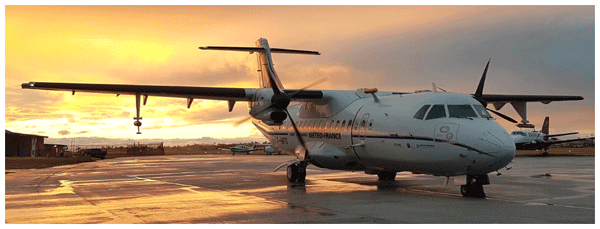
The French ATR42 research aircraft participated in the EUREC4A international field campaign that took place in 2020 over the tropical Atlantic, east of Barbados. We present the extensive instrumentation of the aircraft, the research flights and the different measurements. We show that the ATR measurements of humidity, wind, aerosols and cloudiness in the lower atmosphere are robust and consistent with each other. They will make it possible to advance understanding of cloud–climate interactions.
Valery Shcherbakov, Frédéric Szczap, Alaa Alkasem, Guillaume Mioche, and Céline Cornet
Atmos. Meas. Tech., 15, 1729–1754, https://doi.org/10.5194/amt-15-1729-2022, https://doi.org/10.5194/amt-15-1729-2022, 2022
Short summary
Short summary
We performed extensive Monte Carlo (MC) simulations of lidar signals and developed an empirical model to account for the multiple scattering in the lidar signals. The simulations have taken into consideration four types of lidar configurations (the ground based, the airborne, the CALIOP, and the ATLID) and four types of particles (coarse aerosol, water cloud, jet-stream cirrus, and cirrus).
The empirical model has very good quality of MC data fitting for all considered cases.
Bjorn Stevens, Sandrine Bony, David Farrell, Felix Ament, Alan Blyth, Christopher Fairall, Johannes Karstensen, Patricia K. Quinn, Sabrina Speich, Claudia Acquistapace, Franziska Aemisegger, Anna Lea Albright, Hugo Bellenger, Eberhard Bodenschatz, Kathy-Ann Caesar, Rebecca Chewitt-Lucas, Gijs de Boer, Julien Delanoë, Leif Denby, Florian Ewald, Benjamin Fildier, Marvin Forde, Geet George, Silke Gross, Martin Hagen, Andrea Hausold, Karen J. Heywood, Lutz Hirsch, Marek Jacob, Friedhelm Jansen, Stefan Kinne, Daniel Klocke, Tobias Kölling, Heike Konow, Marie Lothon, Wiebke Mohr, Ann Kristin Naumann, Louise Nuijens, Léa Olivier, Robert Pincus, Mira Pöhlker, Gilles Reverdin, Gregory Roberts, Sabrina Schnitt, Hauke Schulz, A. Pier Siebesma, Claudia Christine Stephan, Peter Sullivan, Ludovic Touzé-Peiffer, Jessica Vial, Raphaela Vogel, Paquita Zuidema, Nicola Alexander, Lyndon Alves, Sophian Arixi, Hamish Asmath, Gholamhossein Bagheri, Katharina Baier, Adriana Bailey, Dariusz Baranowski, Alexandre Baron, Sébastien Barrau, Paul A. Barrett, Frédéric Batier, Andreas Behrendt, Arne Bendinger, Florent Beucher, Sebastien Bigorre, Edmund Blades, Peter Blossey, Olivier Bock, Steven Böing, Pierre Bosser, Denis Bourras, Pascale Bouruet-Aubertot, Keith Bower, Pierre Branellec, Hubert Branger, Michal Brennek, Alan Brewer, Pierre-Etienne Brilouet, Björn Brügmann, Stefan A. Buehler, Elmo Burke, Ralph Burton, Radiance Calmer, Jean-Christophe Canonici, Xavier Carton, Gregory Cato Jr., Jude Andre Charles, Patrick Chazette, Yanxu Chen, Michal T. Chilinski, Thomas Choularton, Patrick Chuang, Shamal Clarke, Hugh Coe, Céline Cornet, Pierre Coutris, Fleur Couvreux, Susanne Crewell, Timothy Cronin, Zhiqiang Cui, Yannis Cuypers, Alton Daley, Gillian M. Damerell, Thibaut Dauhut, Hartwig Deneke, Jean-Philippe Desbios, Steffen Dörner, Sebastian Donner, Vincent Douet, Kyla Drushka, Marina Dütsch, André Ehrlich, Kerry Emanuel, Alexandros Emmanouilidis, Jean-Claude Etienne, Sheryl Etienne-Leblanc, Ghislain Faure, Graham Feingold, Luca Ferrero, Andreas Fix, Cyrille Flamant, Piotr Jacek Flatau, Gregory R. Foltz, Linda Forster, Iulian Furtuna, Alan Gadian, Joseph Galewsky, Martin Gallagher, Peter Gallimore, Cassandra Gaston, Chelle Gentemann, Nicolas Geyskens, Andreas Giez, John Gollop, Isabelle Gouirand, Christophe Gourbeyre, Dörte de Graaf, Geiske E. de Groot, Robert Grosz, Johannes Güttler, Manuel Gutleben, Kashawn Hall, George Harris, Kevin C. Helfer, Dean Henze, Calvert Herbert, Bruna Holanda, Antonio Ibanez-Landeta, Janet Intrieri, Suneil Iyer, Fabrice Julien, Heike Kalesse, Jan Kazil, Alexander Kellman, Abiel T. Kidane, Ulrike Kirchner, Marcus Klingebiel, Mareike Körner, Leslie Ann Kremper, Jan Kretzschmar, Ovid Krüger, Wojciech Kumala, Armin Kurz, Pierre L'Hégaret, Matthieu Labaste, Tom Lachlan-Cope, Arlene Laing, Peter Landschützer, Theresa Lang, Diego Lange, Ingo Lange, Clément Laplace, Gauke Lavik, Rémi Laxenaire, Caroline Le Bihan, Mason Leandro, Nathalie Lefevre, Marius Lena, Donald Lenschow, Qiang Li, Gary Lloyd, Sebastian Los, Niccolò Losi, Oscar Lovell, Christopher Luneau, Przemyslaw Makuch, Szymon Malinowski, Gaston Manta, Eleni Marinou, Nicholas Marsden, Sebastien Masson, Nicolas Maury, Bernhard Mayer, Margarette Mayers-Als, Christophe Mazel, Wayne McGeary, James C. McWilliams, Mario Mech, Melina Mehlmann, Agostino Niyonkuru Meroni, Theresa Mieslinger, Andreas Minikin, Peter Minnett, Gregor Möller, Yanmichel Morfa Avalos, Caroline Muller, Ionela Musat, Anna Napoli, Almuth Neuberger, Christophe Noisel, David Noone, Freja Nordsiek, Jakub L. Nowak, Lothar Oswald, Douglas J. Parker, Carolyn Peck, Renaud Person, Miriam Philippi, Albert Plueddemann, Christopher Pöhlker, Veronika Pörtge, Ulrich Pöschl, Lawrence Pologne, Michał Posyniak, Marc Prange, Estefanía Quiñones Meléndez, Jule Radtke, Karim Ramage, Jens Reimann, Lionel Renault, Klaus Reus, Ashford Reyes, Joachim Ribbe, Maximilian Ringel, Markus Ritschel, Cesar B. Rocha, Nicolas Rochetin, Johannes Röttenbacher, Callum Rollo, Haley Royer, Pauline Sadoulet, Leo Saffin, Sanola Sandiford, Irina Sandu, Michael Schäfer, Vera Schemann, Imke Schirmacher, Oliver Schlenczek, Jerome Schmidt, Marcel Schröder, Alfons Schwarzenboeck, Andrea Sealy, Christoph J. Senff, Ilya Serikov, Samkeyat Shohan, Elizabeth Siddle, Alexander Smirnov, Florian Späth, Branden Spooner, M. Katharina Stolla, Wojciech Szkółka, Simon P. de Szoeke, Stéphane Tarot, Eleni Tetoni, Elizabeth Thompson, Jim Thomson, Lorenzo Tomassini, Julien Totems, Alma Anna Ubele, Leonie Villiger, Jan von Arx, Thomas Wagner, Andi Walther, Ben Webber, Manfred Wendisch, Shanice Whitehall, Anton Wiltshire, Allison A. Wing, Martin Wirth, Jonathan Wiskandt, Kevin Wolf, Ludwig Worbes, Ethan Wright, Volker Wulfmeyer, Shanea Young, Chidong Zhang, Dongxiao Zhang, Florian Ziemen, Tobias Zinner, and Martin Zöger
Earth Syst. Sci. Data, 13, 4067–4119, https://doi.org/10.5194/essd-13-4067-2021, https://doi.org/10.5194/essd-13-4067-2021, 2021
Short summary
Short summary
The EUREC4A field campaign, designed to test hypothesized mechanisms by which clouds respond to warming and benchmark next-generation Earth-system models, is presented. EUREC4A comprised roughly 5 weeks of measurements in the downstream winter trades of the North Atlantic – eastward and southeastward of Barbados. It was the first campaign that attempted to characterize the full range of processes and scales influencing trade wind clouds.
Frédéric Szczap, Alaa Alkasem, Guillaume Mioche, Valery Shcherbakov, Céline Cornet, Julien Delanoë, Yahya Gour, Olivier Jourdan, Sandra Banson, and Edouard Bray
Atmos. Meas. Tech., 14, 199–221, https://doi.org/10.5194/amt-14-199-2021, https://doi.org/10.5194/amt-14-199-2021, 2021
Short summary
Short summary
Spaceborne lidar and radar are suitable tools to investigate cloud vertical properties on a global scale. This paper presents the McRALI code that provides simulations of lidar and radar signals from the EarthCARE mission. Regarding radar signals, cloud heterogeneity induces a severe bias in velocity estimates. Regarding lidar signals, multiple scattering is not negligible. Our results also give some insight into the reliability of lidar signal modeling using independent column approximation.
Igor Veselovskii, Qiaoyun Hu, Philippe Goloub, Thierry Podvin, Mikhail Korenskiy, Olivier Pujol, Oleg Dubovik, and Anton Lopatin
Atmos. Meas. Tech., 13, 6691–6701, https://doi.org/10.5194/amt-13-6691-2020, https://doi.org/10.5194/amt-13-6691-2020, 2020
Short summary
Short summary
To study the feasibility of a fluorescence lidar for aerosol characterization, the fluorescence channel is added to the multiwavelength Mie-Raman lidar of Lille University. A part of the fluorescence spectrum is selected by the interference filter of 44 nm bandwidth centered at 466 nm. Such an approach has demonstrated high sensitivity, allowing fluorescence signals from weak aerosol layers to be detected. The technique can also be used for monitoring the aerosol inside the cloud layers.
Cited articles
Albert, P., Bennartz, R., and Fischer, J.: Remote Sensing of Atmospheric Water Vapor from Backscattered Sunlight in Cloudy Atmospheres, Journal of Atmospheric and Oceanic Technology, https://doi.org/10.1175/1520-0426(2001)018<0865:RSOAWV>2.0.CO;2, 2001. a, b, c
Barker, H. W., Jerg, M. P., Wehr, T., Kato, S., Donovan, D. P., and Hogan, R. J.: A 3D cloud-construction algorithm for the EarthCARE satellite mission, Quarterly Journal of the Royal Meteorological Society, 1042–1058, https://doi.org/10.1002/qj.824, 2011. a
Bennartz, R. and Fischer, J.: Retrieval of columnar water vapour over land from backscattered solar radiation using the Medium Resolution Imaging Spectrometer, Remote Sensing of Environment, 274–283, https://doi.org/10.1016/S0034-4257(01)00218-8, 2001. a
Blyth, A. M.: Entrainment in Cumulus Clouds, American Meteorological Society, https://doi.org/10.1175/1520-0450(1993)032<0626:eicc>2.0.co;2, 1993. a
Bony, S., Stevens, B., Frierson, D. M. W., Jakob, C., Kageyama, M., Pincus, R., Shepherd, T. G., Sherwood, S. C., Siebesma, A. P., Sobel, A. H., Watanabe, M., and Webb, M. J.: Clouds, circulation and climate sensitivity, Nature Geoscience, 8, 261–268, ISSN 1752-0894, ISSN 1752-0908, https://doi.org/10.1038/ngeo2398, 2015. a
Bouffiès, S., Bréon, F. M., Tanré, D., and Dubuisson, P.: Atmospheric water vapor estimate by a differential absorption technique with the polarisation and directionality of the Earth reflectances (POLDER) instrument, Journal of Geophysical Research: Atmospheres, 3831–3841, https://doi.org/10.1029/96JD03126, 1997. a
Carbajal Henken, C. K., Lindstrot, R., Preusker, R., and Fischer, J.: FAME-C: cloud property retrieval using synergistic AATSR and MERIS observations, Atmos. Meas. Tech., 7, 3873–3890, https://doi.org/10.5194/amt-7-3873-2014, 2014. a
Cox, C. and Munk, W.: Statistics Of The Sea Surface Derived From Sun Glitter, Journal of Marine Research, 198–227, https://elischolar.library.yale.edu/journal_of_marine_research/814, 1954a. a
Cox, C. and Munk, W.: Measurement of the Roughness of the Sea Surface from Photographs of the Sun's Glitter, Journal of the Optical Society of America, 838, https://doi.org/10.1364/JOSA.44.000838, 1954b. a
Crutzen, P. J. and Ramanathan, V.: The Parasol Effect on Climate, Science, 1679–1681, https://doi.org/10.1126/science.302.5651.1679, 2003. a
Dandini, P., Cornet, C., Binet, R., Fenouil, L., Holodovsky, V., Y. Schechner, Y., Ricard, D., and Rosenfeld, D.: 3D cloud envelope and cloud development velocity from simulated CLOUD (C3IEL) stereo images, Atmos. Meas. Tech., 15, 6221–6242, https://doi.org/10.5194/amt-15-6221-2022, 2022. a, b, c, d, e
Davis, A., Marshak, A., Cahalan, R., and Wiscombe, W.: The Landsat Scale Break in Stratocumulus as a Three-Dimensional Radiative Transfer Effect: Implications for Cloud Remote Sensing, Journal of the Atmospheric Sciences, 241–260, https://doi.org/10.1175/1520-0469(1997)054<0241:TLSBIS>2.0.CO;2, 1997. a
de Haan, J. F., Bosma, P. B., and Hovenier, J. W.: The adding method for multiple scattering calculations of polarized light, Astronomy and Astrophysics, 183, 371–391, 1987. a
Desbois, M., Capderou, M., Eymard, L., Roca, R., Viltard, N., Viollier, M., and Karouche, N.: Megha-Tropiques: un satellite hydrométéorologique franco-indien, La Météorologie, https://doi.org/10.4267/2042/18185, 2007. a
Eresmaa, R. and McNally, A. P.: Diverse Profile Datasets from the ECMWF 137-Level Short-Range Forecasts, EUMETSAT Satellite Application Facility (NWP SAF), https://arts.mi.uni-hamburg.de/svn/rt/arts-xml-data/branches/arts-xml-data-2.6/planets/Earth/ECMWF/IFS/Eresmaa_137L/nwp_saf_profiles137.pdf (last access: 1 December 2025), 12 pp., 2014. a
Fermepin, S. and Bony, S.: Influence of low‐cloud radiative effects on tropical circulation and precipitation, Journal of Advances in Modeling Earth Systems, 513–526, https://doi.org/10.1002/2013MS000288, 2014. a
Gao, B. C. and Kaufman, Y. J.: Water vapor retrievals using Moderate Resolution Imaging Spectroradiometer (MODIS) near-infrared channels, Journal of Geophysical Research: Atmospheres, https://doi.org/10.1029/2002jd003023, 2003. a
Harrison, E. F., Minnis, P., Barkstrom, B. R., Ramanathan, V., Cess, R. D., and Gibson, G. G.: Seasonal variation of cloud radiative forcing derived from the Earth Radiation Budget Experiment, Journal of Geophysical Research: Atmospheres, https://doi.org/10.1029/JD095iD11p18687, 1990. a
Hilton, F., Armante, R., August, T., Barnet, C., Bouchard, A., Camy-Peyret, C., Capelle, V., Lieven, C., Clerbaux, C., Coheur, P.-F., Collard, A., Crevoisier, C., Dufour, G., Edwards, D., Faijan, F., Fourrié, N., Gambacorta, A., Goldberg, M., Guidard, V., Hurtmans, D., Illingworth, S., Jacquinet-Husson, N., Kerzenmacher, T., Klaes, D., Lavanant, L., Masiello, G., Matricardi, M., McNally, A., Newman, S., Pavelin, E., Payan, S., Péquignot, E., Peyridieu, S., Phulpin, T., Remedios, J., Schlüssel, P., Serio, C., Strow, L., Stubenrauch, C., Taylor, J., Tobin, D., Wolf, W., and Zhou, D.: Hyperspectral Earth Observation from IASI: Five Years of Accomplishments, Bulletin of the American Meteorological Society, https://doi.org/10.1175/BAMS-D-11-00027.1, 2012. a
Jensen, E. J., Toon, O. B., Selkirk, H. B., Spinhirne, J. D., and Schoeberl, M. R.: On the formation and persistence of subvisible cirrus clouds near the tropical tropopause, Journal of Geophysical Research: Atmospheres, https://doi.org/10.1029/95JD03575, 1996. a
Karbou, F., Aires, F., Prigent, C., and Eymard, L.: Potential of Advanced Microwave Sounding Unit-A (AMSU-A) and AMSU-B measurements for atmospheric temperature and humidity profiling over land, Journal of Geophysical Research: Atmospheres, https://doi.org/10.1029/2004JD005318, 2005. a
King, M. D., Platnick, S., Yang, P., Arnold, G. T., Gray, M. A., Riedi, J. C., Ackerman, S. A., and Liou, K.-N.: Remote Sensing of Liquid Water and Ice Cloud Optical Thickness and Effective Radius in the Arctic: Application of Airborne Multispectral MAS Data, Journal of Atmospheric and Oceanic Technology, 857–875, https://doi.org/10.1175/1520-0426(2004)021<0857:RSOLWA>2.0.CO;2, 2004. a
King, M. D., Platnick, S., Menzel, W. P., Ackerman, S. A., and Hubanks, P. A.: Spatial and Temporal Distribution of Clouds Observed by MODIS Onboard the Terra and Aqua Satellites, IEEE Transactions on Geoscience and Remote Sensing, 3826–3852, https://doi.org/10.1109/TGRS.2012.2227333, 2013. a
Lee, J., Yang, P., Dessler, A. E., Gao, B.-C., and Platnick, S.: Distribution and Radiative Forcing of Tropical Thin Cirrus Clouds, Journal of the Atmospheric Sciences, https://doi.org/10.1175/2009JAS3183.1, 2009. a
Leonarski, L., C.-Labonnote, L., Compiègne, M., Vidot, J., Baran, A. J., and Dubuisson, P.: Potential of Hyperspectral Thermal Infrared Spaceborne Measurements to Retrieve Ice Cloud Physical Properties: Case Study of IASI and IASI-NG, Remote Sensing, https://doi.org/10.3390/rs13010116, 2020. a
Lynch, D. K. (Ed.): Cirrus, Oxford University Press, Cambridge, New York, ISBN 9780195130720, 2002. a
Marshak, A.: The verisimilitude of the independent pixel approximation used in cloud remote sensing, Remote Sensing of Environment, 71–78, https://doi.org/10.1016/0034-4257(95)00016-T, 1995. a
Masson-Delmotte, V. P., Zhai, A., Pirani, S. L., Connors, C., Péan, S., Berger, N., Caud, Y., Chen, L., Goldfarb, M. I., Gomis, M., Huang, K., Leitzell, E., Lonnoy, J. B. R., Matthews, T. K., Maycock, T., Waterfield, O., Yelekçi, R. Y., and Zhou, B.: Climate Change 2021: The Physical Science Basis. Contribution of Working Group I to the Sixth Assessment Report of the Intergovernmental Panel on Climate Change, Cambridge University Press, in press, https://doi.org/10.1017/9781009157896, 2021. a
Matar, C., Cornet, C., Parol, F., C.-Labonnote, L., Auriol, F., and Nicolas, M.: Liquid cloud optical property retrieval and associated uncertainties using multi-angular and bispectral measurements of the airborne radiometer OSIRIS, Atmos. Meas. Tech., 16, 3221–3243, https://doi.org/10.5194/amt-16-3221-2023, 2023. a, b
McFarquhar, G. M., Heymsfield, A. J., Spinhirne, J., and Hart, B.: Thin and Subvisual Tropopause Tropical Cirrus: Observations and Radiative Impacts, Journal of the Atmospheric Sciences, https://doi.org/10.1175/1520-0469(2000)057<1841:TASTTC>2.0.CO;2, 2000. a
Nakajima, T. and King, M. D.: Determination of the Optical Thickness and Effective Particle Radius of Clouds from Reflected Solar Radiation Measurements. Part I: Theory, Journal of the Atmospheric Sciences, 1878–1893, https://doi.org/10.1175/1520-0469(1990)047<1878:DOTOTA>2.0.CO;2, 1990. a
Nakajima, T., King, M. D., Spinhirne, J. D., and Radke, L. F.: Determination of the Optical Thickness and Effective Particle Radius of Clouds from Reflected Solar Radiation Measurements. Part II: Marine Stratocumulus Observations, Journal of Atmospheric Sciences, 728–751, https://doi.org/10.1175/1520-0469(1991)048<0728:DOTOTA>2.0.CO;2, 1991. a
Preusker, R., Carbajal Henken, C., and Fischer, J.: Retrieval of Daytime Total Column Water Vapour from OLCI Measurements over Land Surfaces, Remote Sensing, 932, https://doi.org/10.3390/rs13050932, 2021. a
Ramanathan, V., Cess, R. D., Harrison, E. F., Minnis, P., Barkstrom, B. R., Ahmad, E., and Hartmann, D.: Cloud-Radiative Forcing and Climate: Results from the Earth Radiation Budget Experiment, Science, 57–63, https://doi.org/10.1126/science.243.4887.57, 1989. a
Rao, T. N., Sunilkumar, K., and Jayaraman, A.: Validation of humidity profiles obtained from SAPHIR, on-board Megha-Tropiques, Current Science, 104, 1635–1642, http://www.jstor.org/stable/24092599 (last access: 1 December 2025), 2013. a
Riedi, J., Marchant, B., Platnick, S., Baum, B. A., Thieuleux, F., Oudard, C., Parol, F., Nicolas, J.-M., and Dubuisson, P.: Cloud thermodynamic phase inferred from merged POLDER and MODIS data, Atmos. Chem. Phys., 10, 11851–11865, https://doi.org/10.5194/acp-10-11851-2010, 2010. a
Rodgers, C. D.: Inverse Methods for Atmospheric Sounding: Theory and Practice, Series on Atmospheric, Oceanic and Planetary Physics, World Scientific, ISBN 978-981-02-2740-1 978-981-281-371-8, https://doi.org/10.1142/3171, 2000. a, b
Rosenfeld, D., Cornet, C., Aviad, S., Binet, R., Crebassol, P., Dandini, P., Defer, E., Deschamps, A., Fenouil, L., Frid, A., Holodovsky, V., Kaidar, A., Peroni, R., Pierangelo, C., Price, C., Ricard, D., Schechner, Y., and Yair, Y.: C3IEL: Cluster for Cloud Evolution, ClImatE and Lightning, arXiv, https://doi.org/10.48550/arXiv.2202.03182, 2022. a
Rosenkranz, P. W.: Retrieval of temperature and moisture profiles from AMSU-A and AMSU-B measurements, IEEE Transactions on Geoscience and Remote Sensing, https://doi.org/10.1109/36.964979, 2001. a
Schepers, D., Butz, A., Hu, H., Hasekamp, O. P., Arnold, S. G., Schneider, M., Feist, D. G., Morino, I., Pollard, D., Aben, I., and Landgraf, J.: Methane and carbon dioxide total column retrievals from cloudy GOSAT soundings over the oceans, Journal of Geophysical Research: Atmospheres, https://doi.org/10.1002/2015JD023389, 2016. a
Schlüssel, P. and Goldberg, M.: Retrieval of atmospheric temperature and water vapour from IASI measurements in partly cloudy situations, Advances in Space Research, https://doi.org/10.1016/S0273-1177(02)00101-1, 2002. a
Schmidt, G. A., Ruedy, R. A., Miller, R. L., and Lacis, A. A.: Attribution of the present-day total greenhouse effect, Journal of Geophysical Research, https://doi.org/10.1029/2010JD014287, 2010. a
Schneider, T., O'Gorman, P. A., and Levine, X. J.: Water vapor and the dynamics of climate changes, Reviews of Geophysics, https://doi.org/10.1029/2009RG000302, 2010. a
Sourdeval, O., Labonnote, L. C., Brogniez, G., Jourdan, O., Pelon, J., and Garnier, A.: A variational approach for retrieving ice cloud properties from infrared measurements: application in the context of two IIR validation campaigns, Atmos. Chem. Phys., 13, 8229–8244, https://doi.org/10.5194/acp-13-8229-2013, 2013. a
Sourdeval, O., Labonnote, L. C., Baran, A. J., and Brogniez, G.: A methodology for simultaneous retrieval of ice and liquid water cloud properties. Part I: Information content and case study, Quarterly Journal of the Royal Meteorological Society, https://doi.org/10.1002/qj.2405, 2015. a
Stocker, T. F., Qin, D., Plattner, G.-K., Tignor, M. M. B., Allen, S. K., Boschung, J., Nauels, A., Xia, Y., Bex, V., and Midgley, P. M. (Eds.): Climate change 2013: the physical science basis: Working Group I contribution to the Fifth assessment report of the Intergovernmental Panel on Climate Change, Cambridge University Press, ISBN 9781107057999, 2013. a
Trenberth, K. E. and Smith, L.: The Mass of the Atmosphere: A Constraint on Global Analyses, Journal of Climate, 864–875, https://doi.org/10.1175/JCLI-3299.1, 2005. a
Vesperini, M., Breon, F.-M., and Tanre, D.: Atmospheric Water Vapor Content from Spaceborne POLDER Measurements, IEEE Transactions on Geoscience and Remote Sensing, https://doi.org/10.1109/36.763275, 1999. a
Vidot, J., Bennartz, R., O'Dell, C. W., Preusker, R., Lindstrot, R., and Heidinger, A. K.: CO2 Retrieval over Clouds from the OCO Mission: Model Simulations and Error Analysis, Journal of Atmospheric and Oceanic Technology, https://doi.org/10.1175/2009JTECHA1200.1, 2009. a
Várnai, T.: Influence of Three-Dimensional Radiative Effects on the Spatial Distribution of Shortwave Cloud Reflection, Journal of the Atmospheric Sciences, 216–229, https://doi.org/10.1175/1520-0469(2000)057<0216:IOTDRE>2.0.CO;2, 2000. a
Wyser, K.: The Effective Radius in Ice Clouds, Journal of Climate, 1793–1802, https://doi.org/10.1175/1520-0442(1998)011<1793:TERIIC>2.0.CO;2, 1998. a
Short summary
An algorithm to retrieve water vapor above clouds, based on shortwave infrared observations, is developed and tested with idealized and realistic atmospheric profiles. It aims to improve understanding of interactions between water vapor and clouds to enhance models. Integrated into the C3IEL space mission planned for 2028, it uses a Bayesian method and shows good accuracy, except for thin or low clouds.
An algorithm to retrieve water vapor above clouds, based on shortwave infrared observations, is...