
Articles | Volume 19, issue 8
https://doi.org/10.5194/amt-19-2715-2026
© Author(s) 2026. This work is distributed under
the Creative Commons Attribution 4.0 License.
the Creative Commons Attribution 4.0 License.
https://doi.org/10.5194/amt-19-2715-2026
© Author(s) 2026. This work is distributed under
the Creative Commons Attribution 4.0 License.
the Creative Commons Attribution 4.0 License.
Research article
| 
22 Apr 2026
Research article |
| 22 Apr 2026
| 22 Apr 2026
A novel technique for the humidity dependent calibration of hypoiodous acid (HOI) and iodine (I2)

Wolfson Atmospheric Chemistry Laboratories, Department of Chemistry, University of York, Heslington, York, YO10 5DD, UK
Wolfson Atmospheric Chemistry Laboratories, Department of Chemistry, University of York, Heslington, York, YO10 5DD, UK
Stephen J. Andrews
Wolfson Atmospheric Chemistry Laboratories, Department of Chemistry, University of York, Heslington, York, YO10 5DD, UK
Maya Zmajkovic
Wolfson Atmospheric Chemistry Laboratories, Department of Chemistry, University of York, Heslington, York, YO10 5DD, UK
Phil Rund
Department of Atmospheric and Climate Sciences, University of Washington, Seattle, WA 98195, USA
Becky Alexander
Department of Atmospheric and Climate Sciences, University of Washington, Seattle, WA 98195, USA
Joel Thornton
Department of Atmospheric and Climate Sciences, University of Washington, Seattle, WA 98195, USA
Andrew Peters
Bermuda Institute of Ocean Sciences, St George's, Bermuda, UK
Peter Karadakov
Department of Chemistry, University of York, Heslington, York, YO10 5DD, UK
Lucy J. Carpenter
Wolfson Atmospheric Chemistry Laboratories, Department of Chemistry, University of York, Heslington, York, YO10 5DD, UK
Related authors
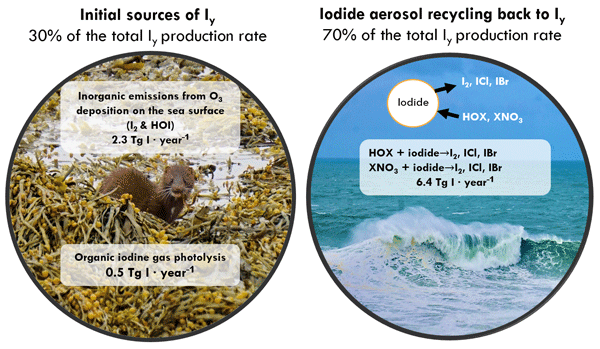
Allison R. Moon, Leyang Liu, Xuan Wang, Yuk-Chun Chan, Alyson Fritzmann, Ryan Pound, Amy Lees, Lewis Marden, Mat Evans, Lucy J. Carpenter, Jochen Stutz, Joel A. Thornton, Gordon Novak, Andrew Rollins, Gregory P. Schill, Xu-Cheng He, Henning Finkenzeller, Mago Reza, Rainer Volkamer, Kelvin H. Bates, Alfonso Saiz-Lopez, Anoop S. Mahajan, and Becky Alexander
Atmos. Chem. Phys., 26, 2353–2389, https://doi.org/10.5194/acp-26-2353-2026, https://doi.org/10.5194/acp-26-2353-2026, 2026
Short summary
Short summary
Global chemical transport models previously treated aerosols as a sink for reactive iodine (Iy); however, aerosol iodide is also a source of Iy via heterogeneous reactions involving hypohalous acids and halogen nitrates. We implemented this chemistry into GEOS-Chem, in addition to explicitly representing three aerosol iodine types: soluble organic iodine (SOI), iodide, and iodate. We found that aerosol recycling of iodide to form Iy is more than twice as fast as the other Iy sources combined.
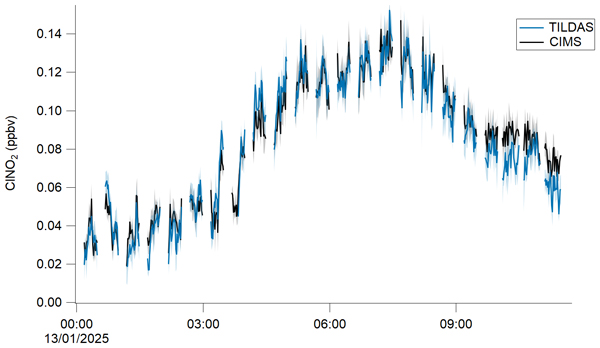
John W. Halfacre, Lewis Marden, Marvin D. Shaw, Lucy J. Carpenter, Emily Matthews, Thomas J. Bannan, Hugh Coe, Scott C. Herndon, Joseph R. Roscioli, Christoph Dyroff, Tara I. Yacovitch, Patrick R. Veres, Michael A. Robinson, Steven S. Brown, and Pete M. Edwards
Atmos. Meas. Tech., 18, 3799–3818, https://doi.org/10.5194/amt-18-3799-2025, https://doi.org/10.5194/amt-18-3799-2025, 2025
Short summary
Short summary
Nitryl chloride (ClNO2) is a reservoir of chlorine atoms and nitrogen oxides, both of which play important roles in atmospheric chemistry. However, all ambient ClNO2 observations so far have been made by a single technique, mass spectrometry, which needs complex calibrations. Here, we present a laser-based method that detects ClNO2 (TD-TILDAS – thermal dissociation–tunable infrared laser direct absorption spectrometry) without the need for complicated calibrations. The results show excellent agreement between these two methods from both laboratory and ambient samples.
Megan S. Claflin, Felipe Lopez-Hilfiker, Urs Rohner, Vasyl Yatsyna, Brian M. Lerner, Joel Thornton, Douglas Worsnop, Manjula Canagaratna, and John Jayne
EGUsphere, https://doi.org/10.5194/egusphere-2026-6002, https://doi.org/10.5194/egusphere-2026-6002, 2026
This preprint is open for discussion and under review for Atmospheric Measurement Techniques (AMT).
Short summary
Short summary
Measurement of volatile organic compounds in diverse environments is important to understand changing emissions and their impact on health and climate. We present a measurement system that is compact, low power, and provides both high-time resolution and molecularly resolved data. This system enables simpler deployment, operation, and analysis while providing a path toward meaningful measurements at long-term monitoring sites, on mobile platforms, and in locations where resources are limited.
Sneha Aggarwal, Matthew Salter, Olga Garmash, Felipe Lopez-Hilfiker, Julika Zinke, Joel A. Thornton, Timothy H. Bertram, Jian Wang, Paul Zieger, and Claudia Mohr
EGUsphere, https://doi.org/10.26434/chemrxiv.15000402/v3, https://doi.org/10.26434/chemrxiv.15000402/v3, 2026
Short summary
Short summary
Perfluoroalkyl carboxylic acids (PFCAs) are persistent global contaminants. While sea spray aerosol (SSA) formed by wave breaking is known to transport PFCAs from the ocean to the atmosphere, the focus has primarily been on particle-phase transport. Here, we present evidence that particle-bound PFCAs are subsequently converted to gas phase following SSA emission. This previously unconsidered process may cause particle-only measurements to underestimate the total atmospheric PFCA from SSA.
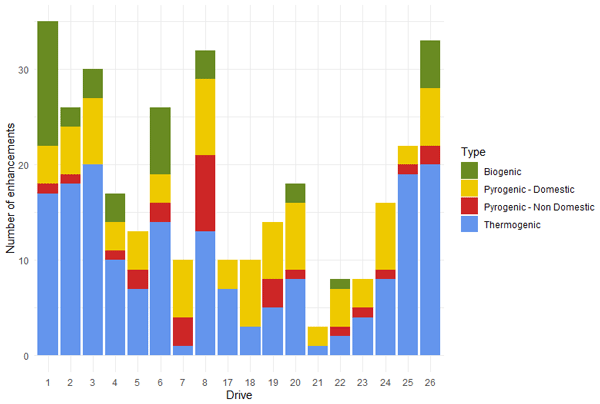
Thomas C. Moore, James R. Hopkins, Will S. Drysdale, Stuart Young, Sri Hapsari Budisulistiorini, Marvin D. Shaw, Mackenzie LeVernois, James L. France, David Lowry, and James D. Lee
Atmos. Meas. Tech., 19, 4459–4475, https://doi.org/10.5194/amt-19-4459-2026, https://doi.org/10.5194/amt-19-4459-2026, 2026
Short summary
Short summary
The Global Methane Pledge has led to increased effort to reduce methane emissions globally. One sector under increased scrutiny is the oil and gas industry, a major source of methane in this industry is from fugitive emissions (gas leaks). Locating these from pipework in cities requires mobile measurements. This work adapts previous methodologies to detect smaller leaks and suggests previous methods may detect 53.5 % less gas leaks.
Zixuan Cheng, Doğuşhan Kılıç, Daniel Wilson, Amanda Lea-Langton, Michael Flynn, Leonard Kirago, Marvin Shaw, Andrew Rickard, Jim R. Hopkins, Daniel Bryant, Gordon McFiggans, Jacqueline F. Hamilton, Hugh Coe, and James Allan
Aerosol Research Discuss., https://doi.org/10.5194/ar-2026-24, https://doi.org/10.5194/ar-2026-24, 2026
Revised manuscript accepted for AR
Short summary
Short summary
Wood burning is seen as cleaner in modern stoves, but user behaviour can change this when burning dry wood. We burned dry ash wood in a UK modern stove with six common operations and measured the wood smoke. Reloading while hot, using too much or too little wood, or opening the stove door increased small particels and harmful smoke emissions. We found a burning stage that helps explain these emissions. Using big pieces of wood and following guidance can reduce pollution and health risks.
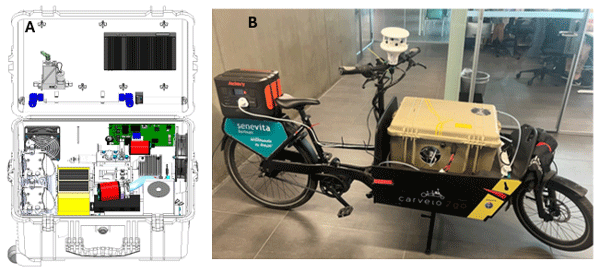
Austin D. Dobrecevich, Felipe Lopez-Hilfiker, Chris J. Wright, Urs Rohner, and Joel A. Thornton
Atmos. Meas. Tech., 19, 3481–3490, https://doi.org/10.5194/amt-19-3481-2026, https://doi.org/10.5194/amt-19-3481-2026, 2026
Short summary
Short summary
A portable mass spectrometer has been developed to sensitively measure key environmental pollutants at high temporal resolution. Its low power consumption and compact design enable battery-powered operation and deployment in challenging settings such as light aircraft, tall towers, and remote, off-grid locations, providing new insight into atmospheric chemical variability with high spatial and temporal accuracy.
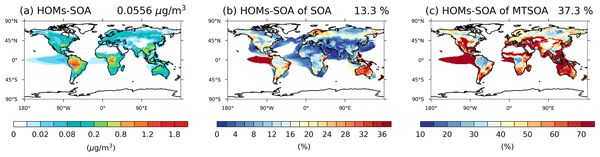
Xinyue Shao, Yaman Liu, Xinyi Dong, Minghuai Wang, Ruochong Xu, Joel A. Thornton, Duseong S. Jo, Man Yue, Wenxiang Shen, Manish Shrivastava, Stephen R. Arnold, and Ken S. Carslaw
Atmos. Chem. Phys., 26, 6427–6448, https://doi.org/10.5194/acp-26-6427-2026, https://doi.org/10.5194/acp-26-6427-2026, 2026
Short summary
Short summary
Highly Oxygenated Organic Molecules (HOMs) are key precursors of secondary organic aerosols (SOA). Incorporating the HOMs chemical mechanism into a global climate model allows for a reasonable reproduction of observed HOM characteristics. HOM-SOA constitutes a significant fraction of global SOA, and its distribution and formation pathways exhibit strong sensitivity to uncertainties in autoxidation processes and peroxy radical branching ratios.
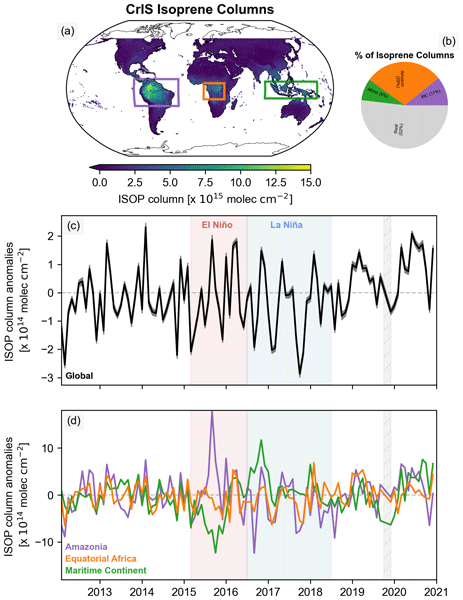
James Young Suk Yoon, Kelley C. Wells, Dylan B. Millet, Christian Frankenberg, Suniti Sanghavi, Abigail L. S. Swann, Joel A. Thornton, and Alexander J. Turner
Atmos. Chem. Phys., 26, 4509–4529, https://doi.org/10.5194/acp-26-4509-2026, https://doi.org/10.5194/acp-26-4509-2026, 2026
Short summary
Short summary
Isoprene is a molecule emitted by trees that is oxidized in the atmosphere within hours. Much of the isoprene globally is emitted in the remote tropics, where we have few direct observations of isoprene. Here, we use new satellite retrievals of isoprene to infer drivers of tropical isoprene variability. Across three regions, isoprene column variability is controlled by different factors, namely changes in isoprene emissions or changes in natural nitrogen oxide sources, like soils and fires.
Allison R. Moon, Leyang Liu, Xuan Wang, Yuk-Chun Chan, Alyson Fritzmann, Ryan Pound, Amy Lees, Lewis Marden, Mat Evans, Lucy J. Carpenter, Jochen Stutz, Joel A. Thornton, Gordon Novak, Andrew Rollins, Gregory P. Schill, Xu-Cheng He, Henning Finkenzeller, Mago Reza, Rainer Volkamer, Kelvin H. Bates, Alfonso Saiz-Lopez, Anoop S. Mahajan, and Becky Alexander
Atmos. Chem. Phys., 26, 2353–2389, https://doi.org/10.5194/acp-26-2353-2026, https://doi.org/10.5194/acp-26-2353-2026, 2026
Short summary
Short summary
Global chemical transport models previously treated aerosols as a sink for reactive iodine (Iy); however, aerosol iodide is also a source of Iy via heterogeneous reactions involving hypohalous acids and halogen nitrates. We implemented this chemistry into GEOS-Chem, in addition to explicitly representing three aerosol iodine types: soluble organic iodine (SOI), iodide, and iodate. We found that aerosol recycling of iodide to form Iy is more than twice as fast as the other Iy sources combined.
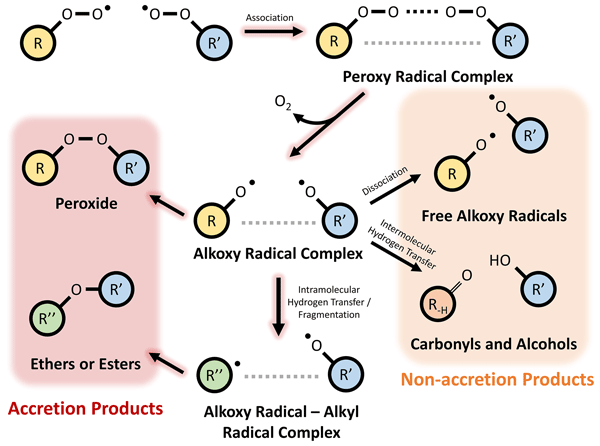
Alfred W. Mayhew, Lauri Franzon, Kelvin H. Bates, Theo Kurtén, Felipe D. Lopez-Hilfiker, Claudia Mohr, Andrew R. Rickard, Joel A. Thornton, and Jessica D. Haskins
Atmos. Chem. Phys., 25, 17027–17046, https://doi.org/10.5194/acp-25-17027-2025, https://doi.org/10.5194/acp-25-17027-2025, 2025
Short summary
Short summary
This work outlines an investigation into an understudied atmospheric chemical reaction pathway with the potential to form particulate pollution that has important impacts on air quality and climate. It suggests that this chemical pathway is responsible for a large fraction of the atmospheric particulate matter observed in tropical forested regions, but also highlights the need for further ambient and lab investigations to inform an accurate representation of this process in atmospheric models.
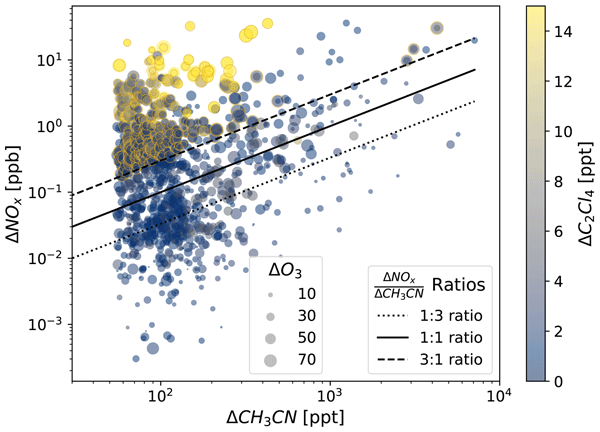
Joseph O. Palmo, Colette L. Heald, Donald R. Blake, Ilann Bourgeois, Matthew Coggon, Jeff Collett, Frank Flocke, Alan Fried, Georgios Gkatzelis, Samuel Hall, Lu Hu, Jose L. Jimenez, Pedro Campuzano-Jost, I-Ting Ku, Benjamin Nault, Brett Palm, Jeff Peischl, Ilana Pollack, Amy Sullivan, Joel Thornton, Carsten Warneke, Armin Wisthaler, and Lu Xu
Atmos. Chem. Phys., 25, 17107–17124, https://doi.org/10.5194/acp-25-17107-2025, https://doi.org/10.5194/acp-25-17107-2025, 2025
Short summary
Short summary
This study investigates ozone production within wildfire smoke plumes as they age, using both aircraft observations and models. We find that the chemical environment and resulting ozone production within smoke changes as plumes evolve, with implications for climate and public health.
Phil Rund, Ben H. Lee, Siddharth Iyer, Gordon A. Novak, Jake T. Vallow, and Joel A. Thornton
Atmos. Meas. Tech., 18, 6979–6995, https://doi.org/10.5194/amt-18-6979-2025, https://doi.org/10.5194/amt-18-6979-2025, 2025
Short summary
Short summary
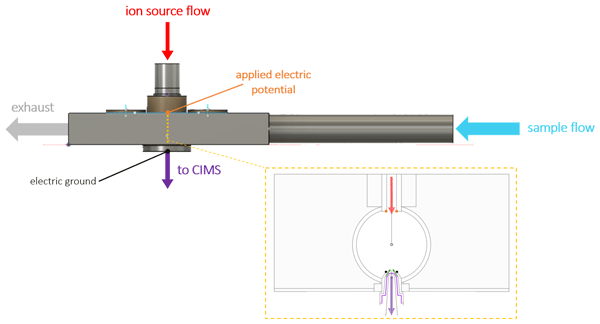
We introduce a custom-built chamber (known as an IMR) for use with a Chemical Ionization Mass Spectrometry (CIMS) gas measurement instrument. The IMR shows large improvements compared to previous designs in reducing non-real signal in the instrument, reducing uncertainties for trace gas studies in the laboratory and the field. We characterize this new IMR and demonstrate its use in analyzing air masses of unknown composition during a field campaign, reporting concentrations of important gases.
Yuki Ota, Takuya Saito, Stephen J. Andrews, Tetsuo I. Kohyama, Yoshihisa Suyama, Yoshihiko Tsumura, and Tsutom Hiura
Atmos. Meas. Tech., 18, 5861–5872, https://doi.org/10.5194/amt-18-5861-2025, https://doi.org/10.5194/amt-18-5861-2025, 2025
Short summary
Short summary
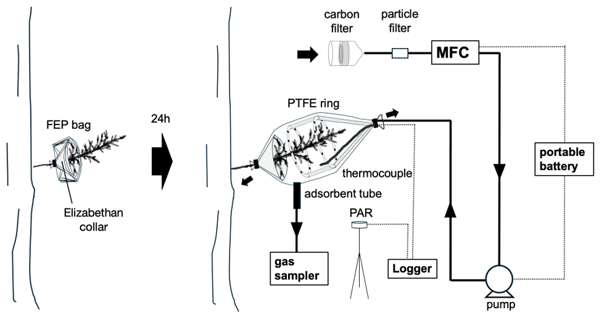
We developed a portable system to collect biogenic volatile organic compounds (BVOCs) emitted by trees, which can affect air quality and climate. Our system minimizes interference from contact with tree branches and enables sample collections from several trees in a single day. Field testing with Japanese cedar showed the system's robust performance, capturing BVOC variability and diurnal patterns, highlighting its value for advancing our understanding of BVOC dynamics in diverse ecosystems.
Laura M. D. Heinlein, Junwei He, Michael Oluwatoyin Sunday, Fangzhou Guo, James Campbell, Allison Moon, Sukriti Kapur, Ting Fang, Kasey Edwards, Meeta Cesler-Maloney, Alyssa J. Burns, Jack Dibb, William Simpson, Manabu Shiraiwa, Becky Alexander, Jingqiu Mao, James H. Flynn III, Jochen Stutz, and Cort Anastasio
Atmos. Chem. Phys., 25, 9561–9581, https://doi.org/10.5194/acp-25-9561-2025, https://doi.org/10.5194/acp-25-9561-2025, 2025
Short summary
Short summary
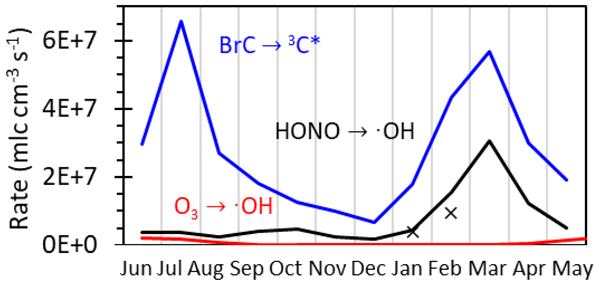
High-latitude cities like Fairbanks, Alaska, experience severe wintertime pollution episodes. While conventional wisdom holds that oxidation is slow under these conditions, field measurements find oxidized products in particles. To explore this, we measured oxidants in aqueous extracts of winter particles from Fairbanks. We find high concentrations of oxidants during illumination experiments, indicating that particle photochemistry can be significant even in high latitudes during winter.
John W. Halfacre, Lewis Marden, Marvin D. Shaw, Lucy J. Carpenter, Emily Matthews, Thomas J. Bannan, Hugh Coe, Scott C. Herndon, Joseph R. Roscioli, Christoph Dyroff, Tara I. Yacovitch, Patrick R. Veres, Michael A. Robinson, Steven S. Brown, and Pete M. Edwards
Atmos. Meas. Tech., 18, 3799–3818, https://doi.org/10.5194/amt-18-3799-2025, https://doi.org/10.5194/amt-18-3799-2025, 2025
Short summary
Short summary
Nitryl chloride (ClNO2) is a reservoir of chlorine atoms and nitrogen oxides, both of which play important roles in atmospheric chemistry. However, all ambient ClNO2 observations so far have been made by a single technique, mass spectrometry, which needs complex calibrations. Here, we present a laser-based method that detects ClNO2 (TD-TILDAS – thermal dissociation–tunable infrared laser direct absorption spectrometry) without the need for complicated calibrations. The results show excellent agreement between these two methods from both laboratory and ambient samples.
Carley D. Fredrickson, Scott J. Janz, Lok N. Lamsal, Ursula A. Jongebloed, Joshua L. Laughner, and Joel A. Thornton
Atmos. Meas. Tech., 18, 3669–3689, https://doi.org/10.5194/amt-18-3669-2025, https://doi.org/10.5194/amt-18-3669-2025, 2025
Short summary
Short summary
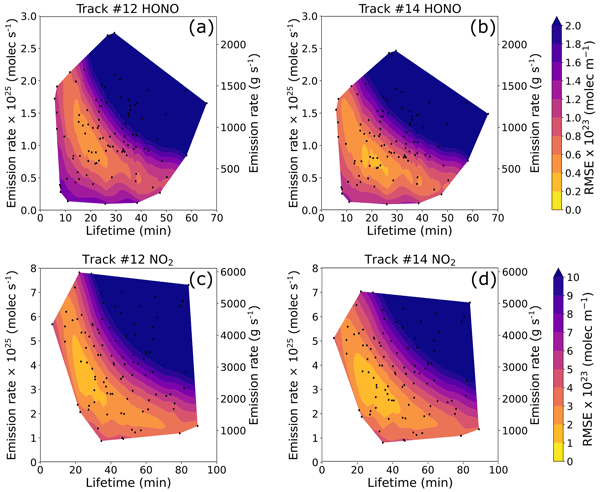
We present an analysis of high-resolution remote sensing measurements of nitrogen-containing trace gases emitted by wildfires. The measurements were made using an instrument on the NASA ER-2 aircraft in the summer of 2019. We find that time-resolved fire intensity is critical to quantify trace gas emissions over a fire's entire lifespan. These findings have implications for improving air pollution forecasts downwind of wildfires using computer models of atmospheric chemistry and meteorology.
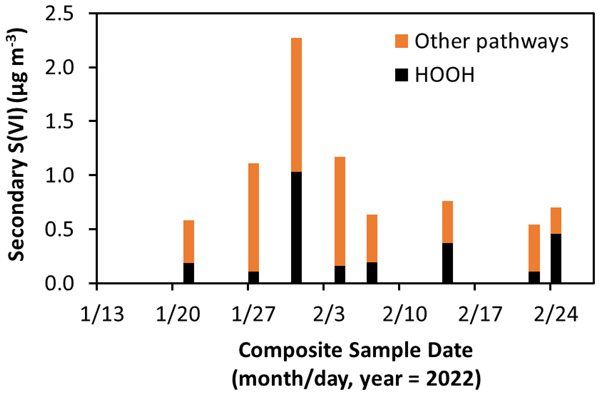
Michael Oluwatoyin Sunday, Laura Marie Dahler Heinlein, Junwei He, Allison Moon, Sukriti Kapur, Ting Fang, Kasey C. Edwards, Fangzhou Guo, Jack Dibb, James H. Flynn III, Becky Alexander, Manabu Shiraiwa, and Cort Anastasio
Atmos. Chem. Phys., 25, 5087–5100, https://doi.org/10.5194/acp-25-5087-2025, https://doi.org/10.5194/acp-25-5087-2025, 2025
Short summary
Short summary
Hydrogen peroxide (HOOH) is an important oxidant that forms atmospheric sulfate. We demonstrate that the illumination of brown carbon can rapidly form HOOH within particles, even under the low-sunlight conditions of Fairbanks, Alaska, during winter. This in-particle formation of HOOH is fast enough that it forms sulfate at significant rates. In contrast, the formation of HOOH in the gas phase during the campaign is expected to be negligible because of high NOx levels.
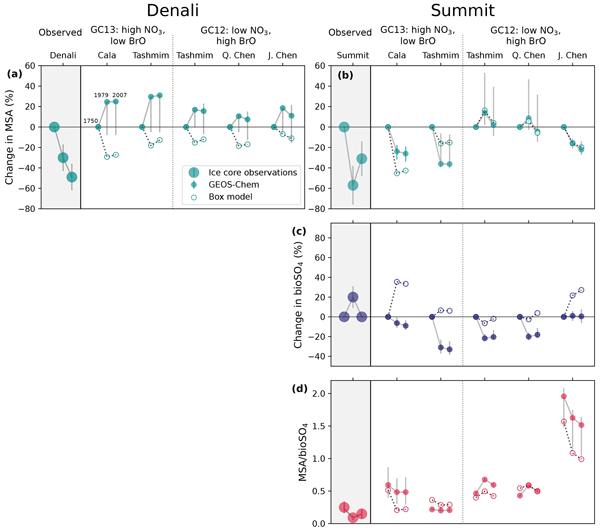
Ursula A. Jongebloed, Jacob I. Chalif, Linia Tashmim, William C. Porter, Kelvin H. Bates, Qianjie Chen, Erich C. Osterberg, Bess G. Koffman, Jihong Cole-Dai, Dominic A. Winski, David G. Ferris, Karl J. Kreutz, Cameron P. Wake, and Becky Alexander
Atmos. Chem. Phys., 25, 4083–4106, https://doi.org/10.5194/acp-25-4083-2025, https://doi.org/10.5194/acp-25-4083-2025, 2025
Short summary
Short summary
Marine phytoplankton emit dimethyl sulfide (DMS), which forms methanesulfonic acid (MSA) and sulfate. MSA concentrations in ice cores decreased over the industrial era, which has been attributed to pollution-driven changes in DMS chemistry. We use a model to investigate DMS chemistry compared to observations of DMS, MSA, and sulfate. We find that modeled DMS, MSA, and sulfate are influenced by pollution-sensitive oxidant concentrations, characterization of DMS chemistry, and other variables.
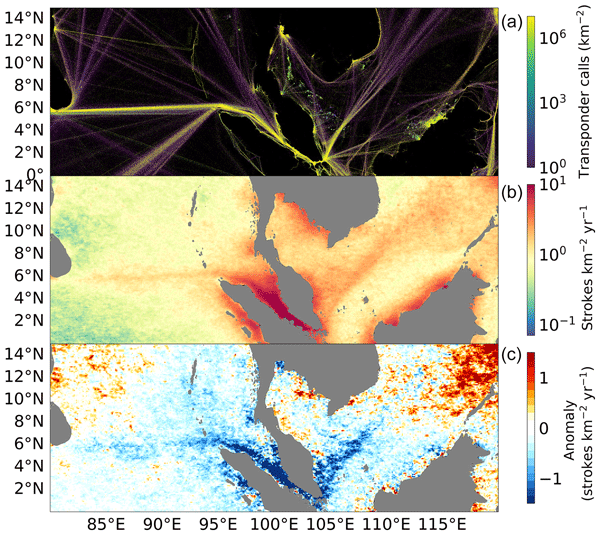
Chris J. Wright, Joel A. Thornton, Lyatt Jaeglé, Yang Cao, Yannian Zhu, Jihu Liu, Randall Jones II, Robert Holzworth, Daniel Rosenfeld, Robert Wood, Peter Blossey, and Daehyun Kim
Atmos. Chem. Phys., 25, 2937–2946, https://doi.org/10.5194/acp-25-2937-2025, https://doi.org/10.5194/acp-25-2937-2025, 2025
Short summary
Short summary
Aerosol particles influence clouds, which exert a large forcing on solar radiation and freshwater. To better understand the mechanisms by which aerosol influences thunderstorms, we look at the two busiest shipping lanes in the world, where recent regulations have reduced sulfur emissions by nearly an order of magnitude. We find that the reduction in emissions has been accompanied by a dramatic decrease in both lightning and the number of droplets in clouds over the shipping lanes.
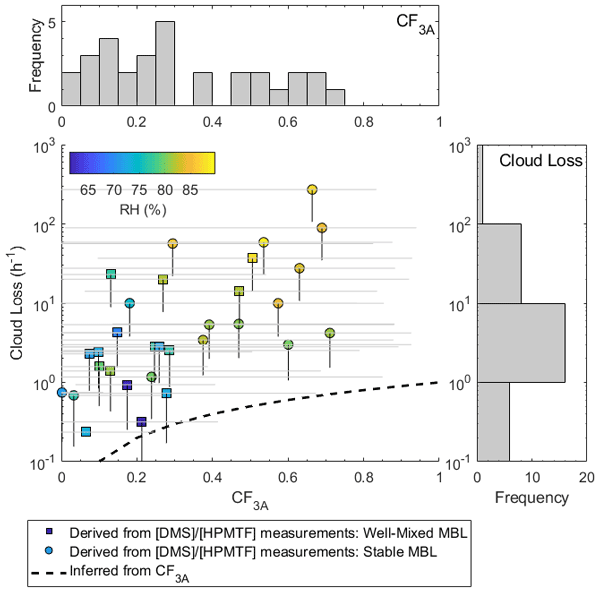
Delaney B. Kilgour, Christopher M. Jernigan, Olga Garmash, Sneha Aggarwal, Shengqian Zhou, Claudia Mohr, Matt E. Salter, Joel A. Thornton, Jian Wang, Paul Zieger, and Timothy H. Bertram
Atmos. Chem. Phys., 25, 1931–1947, https://doi.org/10.5194/acp-25-1931-2025, https://doi.org/10.5194/acp-25-1931-2025, 2025
Short summary
Short summary
We report simultaneous measurements of dimethyl sulfide (DMS) and hydroperoxymethyl thioformate (HPMTF) in the eastern North Atlantic. We use an observationally constrained box model to show that cloud loss is the dominant sink of HPMTF in this region over 6 weeks, resulting in large reductions in DMS-derived products that contribute to aerosol formation and growth. Our findings indicate that fast cloud processing of HPMTF must be included in global models to accurately capture the sulfur cycle.
Natalie Brett, Kathy S. Law, Steve R. Arnold, Javier G. Fochesatto, Jean-Christophe Raut, Tatsuo Onishi, Robert Gilliam, Kathleen Fahey, Deanna Huff, George Pouliot, Brice Barret, Elsa Dieudonné, Roman Pohorsky, Julia Schmale, Andrea Baccarini, Slimane Bekki, Gianluca Pappaccogli, Federico Scoto, Stefano Decesari, Antonio Donateo, Meeta Cesler-Maloney, William Simpson, Patrice Medina, Barbara D'Anna, Brice Temime-Roussel, Joel Savarino, Sarah Albertin, Jingqiu Mao, Becky Alexander, Allison Moon, Peter F. DeCarlo, Vanessa Selimovic, Robert Yokelson, and Ellis S. Robinson
Atmos. Chem. Phys., 25, 1063–1104, https://doi.org/10.5194/acp-25-1063-2025, https://doi.org/10.5194/acp-25-1063-2025, 2025
Short summary
Short summary
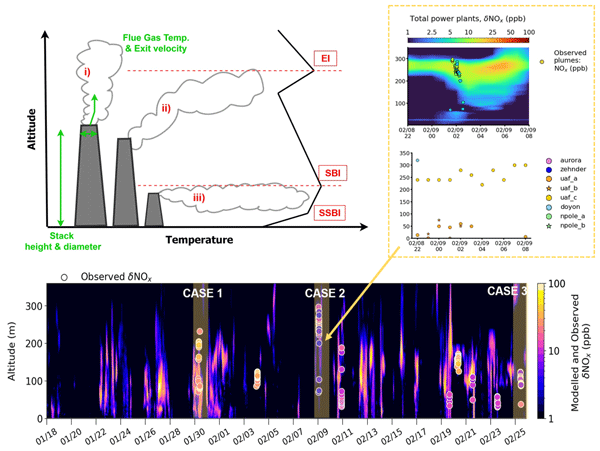
Processes influencing dispersion of local anthropogenic pollution in Arctic wintertime are investigated with Lagrangian dispersion modelling. Simulated power plant plume rise that considers temperature inversion layers improves results compared to observations (interior Alaska). Modelled surface concentrations are improved by representation of vertical mixing and emission estimates. Large increases in diesel vehicle emissions at temperatures reaching −35°C are required to reproduce observed NOx.
Matthieu Riva, Veronika Pospisilova, Carla Frege, Sebastien Perrier, Priyanka Bansal, Spiro Jorga, Patrick Sturm, Joel A. Thornton, Urs Rohner, and Felipe Lopez-Hilfiker
Atmos. Meas. Tech., 17, 5887–5901, https://doi.org/10.5194/amt-17-5887-2024, https://doi.org/10.5194/amt-17-5887-2024, 2024
Short summary
Short summary
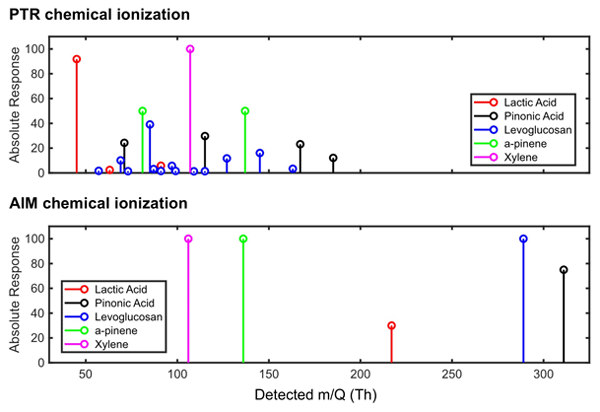
We present a newly designed reduced-pressure chemical ionization reactor for detection of gas-phase organic and inorganic species. The system operates through the combined use of vacuum ultraviolet ionization and photosensitizers to generate numerous adduct ionization schemes. As a result, it offers the ability to simultaneously measure a wide variety of organic and inorganic species in terms of compound volatility and functionality, while being largely independent of changes in sample humidity.
Beth S. Nelson, Zhenze Liu, Freya A. Squires, Marvin Shaw, James R. Hopkins, Jacqueline F. Hamilton, Andrew R. Rickard, Alastair C. Lewis, Zongbo Shi, and James D. Lee
Atmos. Chem. Phys., 24, 9031–9044, https://doi.org/10.5194/acp-24-9031-2024, https://doi.org/10.5194/acp-24-9031-2024, 2024
Short summary
Short summary
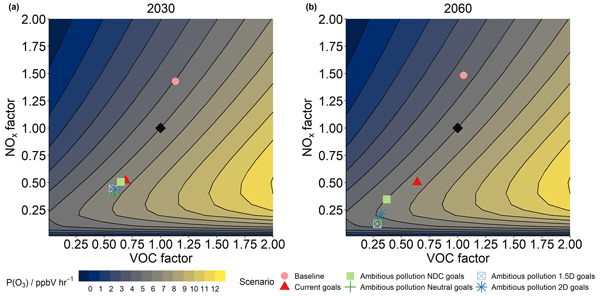
The impact of combined air quality and carbon neutrality policies on O3 formation in Beijing was investigated. Emissions inventory data were used to estimate future pollutant mixing ratios relative to ground-level observations. O3 production was found to be most sensitive to changes in alkenes, but large reductions in less reactive compounds led to larger reductions in future O3 production. This study highlights the importance of understanding the emissions of organic pollutants.
Chuanyang Shen, Xiaoyan Yang, Joel Thornton, John Shilling, Chenyang Bi, Gabriel Isaacman-VanWertz, and Haofei Zhang
Atmos. Chem. Phys., 24, 6153–6175, https://doi.org/10.5194/acp-24-6153-2024, https://doi.org/10.5194/acp-24-6153-2024, 2024
Short summary
Short summary
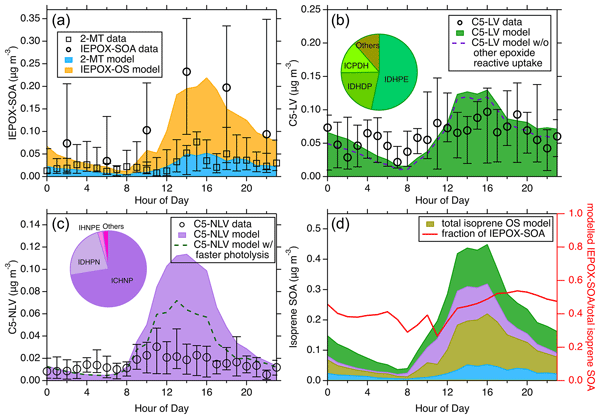
In this work, a condensed multiphase isoprene oxidation mechanism was developed to simulate isoprene SOA formation from chamber and field studies. Our results show that the measured isoprene SOA mass concentrations can be reasonably reproduced. The simulation results indicate that multifunctional low-volatility products contribute significantly to total isoprene SOA. Our findings emphasize that the pathways to produce these low-volatility species should be considered in models.
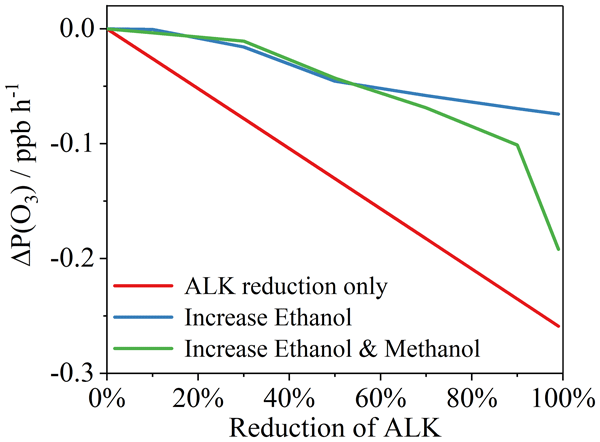
Jianghao Li, Alastair C. Lewis, Jim R. Hopkins, Stephen J. Andrews, Tim Murrells, Neil Passant, Ben Richmond, Siqi Hou, William J. Bloss, Roy M. Harrison, and Zongbo Shi
Atmos. Chem. Phys., 24, 6219–6231, https://doi.org/10.5194/acp-24-6219-2024, https://doi.org/10.5194/acp-24-6219-2024, 2024
Short summary
Short summary
A summertime ozone event at an urban site in Birmingham is sensitive to volatile organic compounds (VOCs) – particularly those of oxygenated VOCs. The roles of anthropogenic VOC sources in urban ozone chemistry are examined by integrating the 1990–2019 national atmospheric emission inventory into model scenarios. Road transport remains the most powerful means of further reducing ozone in this case study, but the benefits may be offset if solvent emissions of VOCs continue to increase.
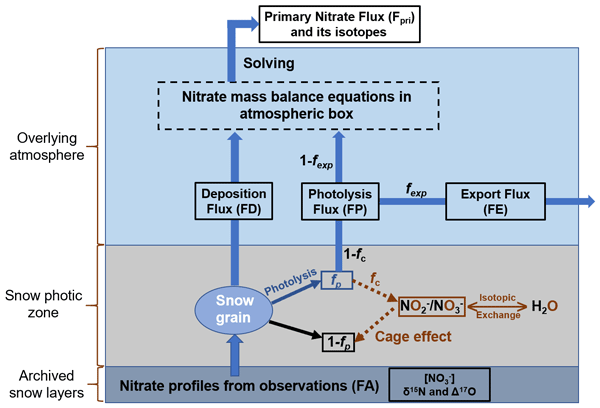
Zhuang Jiang, Becky Alexander, Joel Savarino, and Lei Geng
Atmos. Chem. Phys., 24, 4895–4914, https://doi.org/10.5194/acp-24-4895-2024, https://doi.org/10.5194/acp-24-4895-2024, 2024
Short summary
Short summary
Ice-core nitrate could track the past atmospheric NOx and oxidant level, but its interpretation is hampered by the post-depositional processing. In this work, an inverse model was developed and tested against two polar sites and was shown to well reproduce the observed nitrate signals in snow and atmosphere, suggesting that the model can properly correct for the effect of post-depositional processing. This model offers a very useful tool for future studies on ice-core nitrate records.
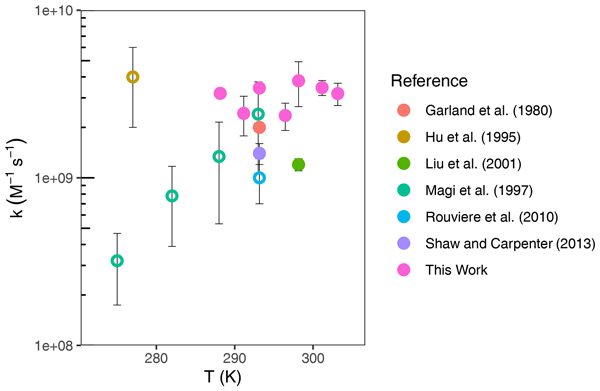
Lucy V. Brown, Ryan J. Pound, Lyndsay S. Ives, Matthew R. Jones, Stephen J. Andrews, and Lucy J. Carpenter
Atmos. Chem. Phys., 24, 3905–3923, https://doi.org/10.5194/acp-24-3905-2024, https://doi.org/10.5194/acp-24-3905-2024, 2024
Short summary
Short summary
Ozone is deposited from the lower atmosphere to the surface of the ocean; however, the chemical reactions which drive this deposition are currently not well understood. Of particular importance is the reaction between ozone and iodide, and this work measures the kinetics of this reaction and its temperature dependence, which we find to be negligible. We then investigate the subsequent emissions of iodine-containing species from the surface ocean, which can further impact ozone.
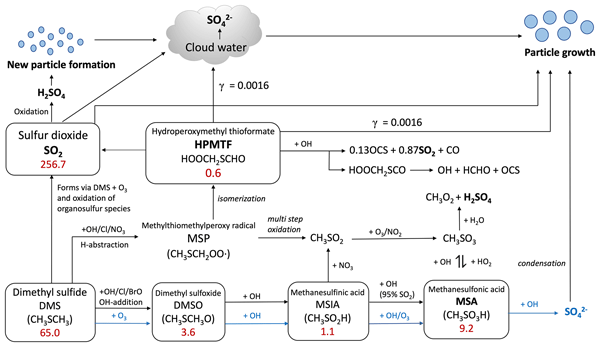
Linia Tashmim, William C. Porter, Qianjie Chen, Becky Alexander, Charles H. Fite, Christopher D. Holmes, Jeffrey R. Pierce, Betty Croft, and Sakiko Ishino
Atmos. Chem. Phys., 24, 3379–3403, https://doi.org/10.5194/acp-24-3379-2024, https://doi.org/10.5194/acp-24-3379-2024, 2024
Short summary
Short summary
Dimethyl sulfide (DMS) is mostly emitted from ocean surfaces and represents the largest natural source of sulfur for the atmosphere. Once in the atmosphere, DMS forms stable oxidation products such as SO2 and H2SO4, which can subsequently contribute to airborne particle formation and growth. In this study, we update the DMS oxidation mechanism in the chemical transport model GEOS-Chem and describe resulting changes in particle growth as well as the overall global sulfur budget.
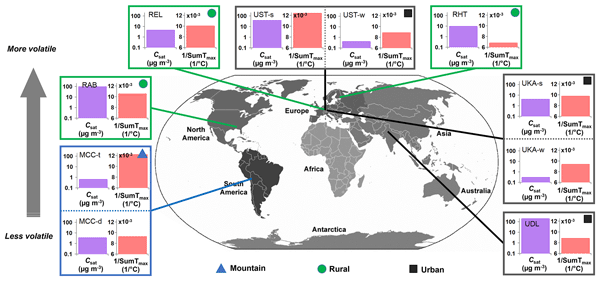
Wei Huang, Cheng Wu, Linyu Gao, Yvette Gramlich, Sophie L. Haslett, Joel Thornton, Felipe D. Lopez-Hilfiker, Ben H. Lee, Junwei Song, Harald Saathoff, Xiaoli Shen, Ramakrishna Ramisetty, Sachchida N. Tripathi, Dilip Ganguly, Feng Jiang, Magdalena Vallon, Siegfried Schobesberger, Taina Yli-Juuti, and Claudia Mohr
Atmos. Chem. Phys., 24, 2607–2624, https://doi.org/10.5194/acp-24-2607-2024, https://doi.org/10.5194/acp-24-2607-2024, 2024
Short summary
Short summary
We present distinct molecular composition and volatility of oxygenated organic aerosol particles in different rural, urban, and mountain environments. We do a comprehensive investigation of the relationship between the chemical composition and volatility of oxygenated organic aerosol particles across different systems and environments. This study provides implications for volatility descriptions of oxygenated organic aerosol particles in different model frameworks.
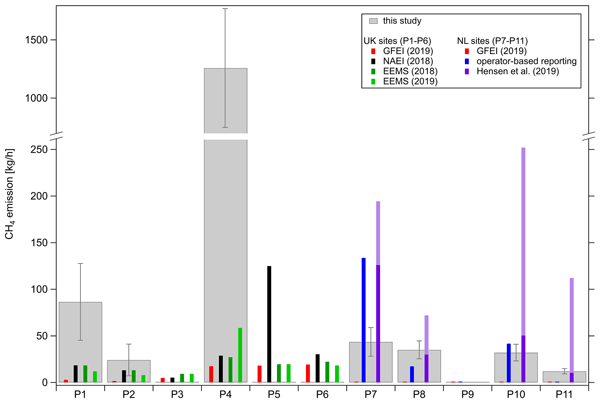
Magdalena Pühl, Anke Roiger, Alina Fiehn, Alan M. Gorchov Negron, Eric A. Kort, Stefan Schwietzke, Ignacio Pisso, Amy Foulds, James Lee, James L. France, Anna E. Jones, Dave Lowry, Rebecca E. Fisher, Langwen Huang, Jacob Shaw, Prudence Bateson, Stephen Andrews, Stuart Young, Pamela Dominutti, Tom Lachlan-Cope, Alexandra Weiss, and Grant Allen
Atmos. Chem. Phys., 24, 1005–1024, https://doi.org/10.5194/acp-24-1005-2024, https://doi.org/10.5194/acp-24-1005-2024, 2024
Short summary
Short summary
In April–May 2019 we carried out an airborne field campaign in the southern North Sea with the aim of studying methane emissions of offshore gas installations. We determined methane emissions from elevated methane measured downstream of the sampled installations. We compare our measured methane emissions with estimated methane emissions from national and global annual inventories. As a result, we find inconsistencies of inventories and large discrepancies between measurements and inventories.

Adedayo R. Adedeji, Stephen J. Andrews, Matthew J. Rowlinson, Mathew J. Evans, Alastair C. Lewis, Shigeru Hashimoto, Hitoshi Mukai, Hiroshi Tanimoto, Yasunori Tohjima, and Takuya Saito
Atmos. Chem. Phys., 23, 9229–9244, https://doi.org/10.5194/acp-23-9229-2023, https://doi.org/10.5194/acp-23-9229-2023, 2023
Short summary
Short summary
We use the GEOS-Chem model to interpret observations of CO, C2H6, C3H8, NOx, NOy and O3 made from Hateruma Island in 2018. The model captures many synoptic-scale events and the seasonality of most pollutants at the site but underestimates C2H6 and C3H8 during the winter. These underestimates are unlikely to be reconciled by increases in biomass burning emissions but could be reconciled by increasing the Asian anthropogenic source of C2H6 and C3H8 by factors of around 2 and 3, respectively.
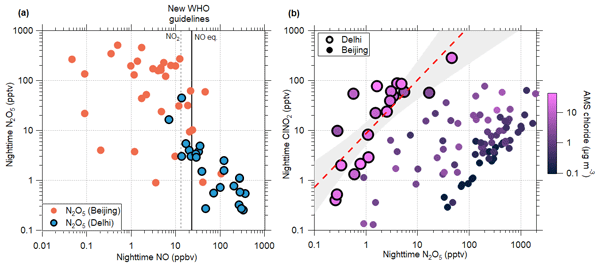
Sophie L. Haslett, David M. Bell, Varun Kumar, Jay G. Slowik, Dongyu S. Wang, Suneeti Mishra, Neeraj Rastogi, Atinderpal Singh, Dilip Ganguly, Joel Thornton, Feixue Zheng, Yuanyuan Li, Wei Nie, Yongchun Liu, Wei Ma, Chao Yan, Markku Kulmala, Kaspar R. Daellenbach, David Hadden, Urs Baltensperger, Andre S. H. Prevot, Sachchida N. Tripathi, and Claudia Mohr
Atmos. Chem. Phys., 23, 9023–9036, https://doi.org/10.5194/acp-23-9023-2023, https://doi.org/10.5194/acp-23-9023-2023, 2023
Short summary
Short summary
In Delhi, some aspects of daytime and nighttime atmospheric chemistry are inverted, and parodoxically, vehicle emissions may be limiting other forms of particle production. This is because the nighttime emissions of nitrogen oxide (NO) by traffic and biomass burning prevent some chemical processes that would otherwise create even more particles and worsen the urban haze.
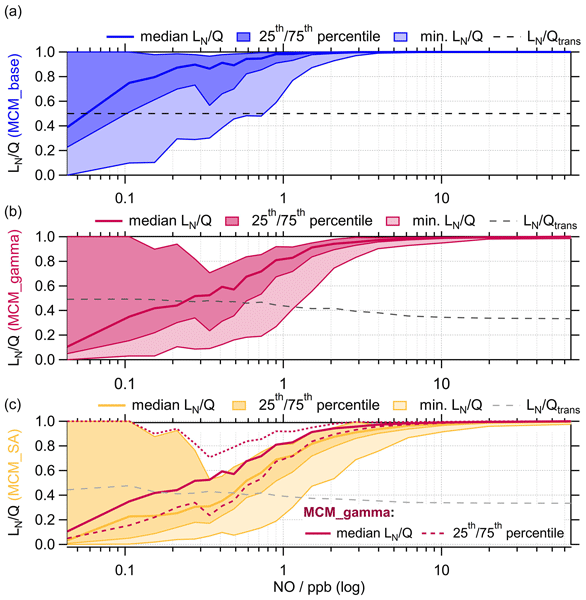
Joanna E. Dyson, Lisa K. Whalley, Eloise J. Slater, Robert Woodward-Massey, Chunxiang Ye, James D. Lee, Freya Squires, James R. Hopkins, Rachel E. Dunmore, Marvin Shaw, Jacqueline F. Hamilton, Alastair C. Lewis, Stephen D. Worrall, Asan Bacak, Archit Mehra, Thomas J. Bannan, Hugh Coe, Carl J. Percival, Bin Ouyang, C. Nicholas Hewitt, Roderic L. Jones, Leigh R. Crilley, Louisa J. Kramer, W. Joe F. Acton, William J. Bloss, Supattarachai Saksakulkrai, Jingsha Xu, Zongbo Shi, Roy M. Harrison, Simone Kotthaus, Sue Grimmond, Yele Sun, Weiqi Xu, Siyao Yue, Lianfang Wei, Pingqing Fu, Xinming Wang, Stephen R. Arnold, and Dwayne E. Heard
Atmos. Chem. Phys., 23, 5679–5697, https://doi.org/10.5194/acp-23-5679-2023, https://doi.org/10.5194/acp-23-5679-2023, 2023
Short summary
Short summary
The hydroxyl (OH) and closely coupled hydroperoxyl (HO2) radicals are vital for their role in the removal of atmospheric pollutants. In less polluted regions, atmospheric models over-predict HO2 concentrations. In this modelling study, the impact of heterogeneous uptake of HO2 onto aerosol surfaces on radical concentrations and the ozone production regime in Beijing in the summertime is investigated, and the implications for emissions policies across China are considered.
John W. Halfacre, Jordan Stewart, Scott C. Herndon, Joseph R. Roscioli, Christoph Dyroff, Tara I. Yacovitch, Michael Flynn, Stephen J. Andrews, Steven S. Brown, Patrick R. Veres, and Pete M. Edwards
Atmos. Meas. Tech., 16, 1407–1429, https://doi.org/10.5194/amt-16-1407-2023, https://doi.org/10.5194/amt-16-1407-2023, 2023
Short summary
Short summary
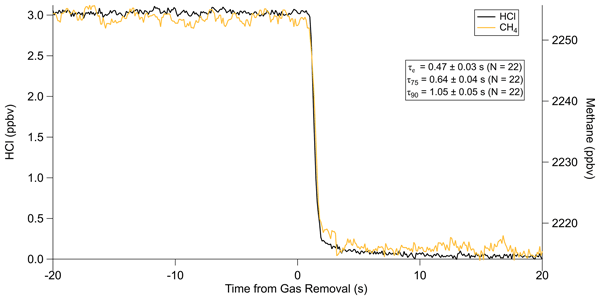
This study details a new sampling method for the optical detection of hydrogen chloride (HCl). HCl is an important atmospheric reservoir for chlorine atoms, which can affect nitrogen oxide cycling and the lifetimes of volatile organic compounds and ozone. However, HCl has a high affinity for interacting with surfaces, thereby preventing fast, quantitative measurements. The sampling technique in this study minimizes these surface interactions and provides a high-quality measurement of HCl.
Siegfried Schobesberger, Emma L. D'Ambro, Lejish Vettikkat, Ben H. Lee, Qiaoyun Peng, David M. Bell, John E. Shilling, Manish Shrivastava, Mikhail Pekour, Jerome Fast, and Joel A. Thornton
Atmos. Meas. Tech., 16, 247–271, https://doi.org/10.5194/amt-16-247-2023, https://doi.org/10.5194/amt-16-247-2023, 2023
Short summary
Short summary
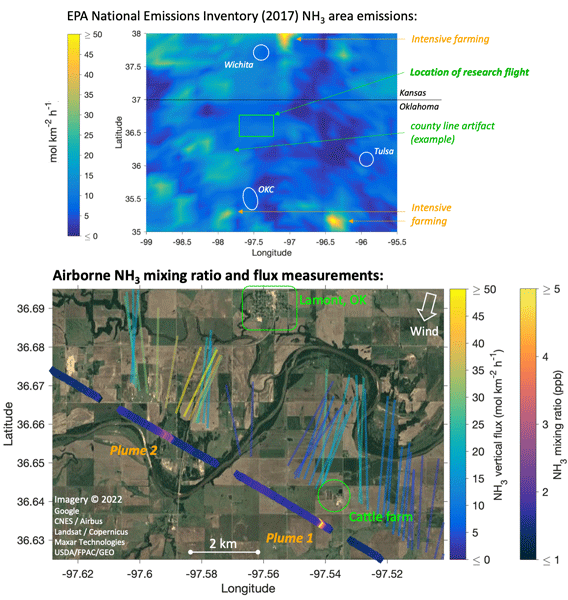
We present a new, highly sensitive technique for measuring atmospheric ammonia, an important trace gas that is emitted mainly by agriculture. We deployed the instrument on an aircraft during research flights over rural Oklahoma. Due to its fast response, we could analyze correlations with turbulent winds and calculate ammonia emissions from nearby areas at 1 to 2 km resolution. We observed high spatial variability and point sources that are not resolved in the US National Emissions Inventory.

Alfred W. Mayhew, Ben H. Lee, Joel A. Thornton, Thomas J. Bannan, James Brean, James R. Hopkins, James D. Lee, Beth S. Nelson, Carl Percival, Andrew R. Rickard, Marvin D. Shaw, Peter M. Edwards, and Jaqueline F. Hamilton
Atmos. Chem. Phys., 22, 14783–14798, https://doi.org/10.5194/acp-22-14783-2022, https://doi.org/10.5194/acp-22-14783-2022, 2022
Short summary
Short summary
Isoprene nitrates are chemical species commonly found in the atmosphere that are important for their impacts on air quality and climate. This paper compares 3 different representations of the chemistry of isoprene nitrates in computational models highlighting cases where the choice of chemistry included has significant impacts on the concentration and composition of the modelled nitrates. Calibration of mass spectrometers is also shown to be an important factor when analysing isoprene nitrates.
William F. Swanson, Chris D. Holmes, William R. Simpson, Kaitlyn Confer, Louis Marelle, Jennie L. Thomas, Lyatt Jaeglé, Becky Alexander, Shuting Zhai, Qianjie Chen, Xuan Wang, and Tomás Sherwen
Atmos. Chem. Phys., 22, 14467–14488, https://doi.org/10.5194/acp-22-14467-2022, https://doi.org/10.5194/acp-22-14467-2022, 2022
Short summary
Short summary
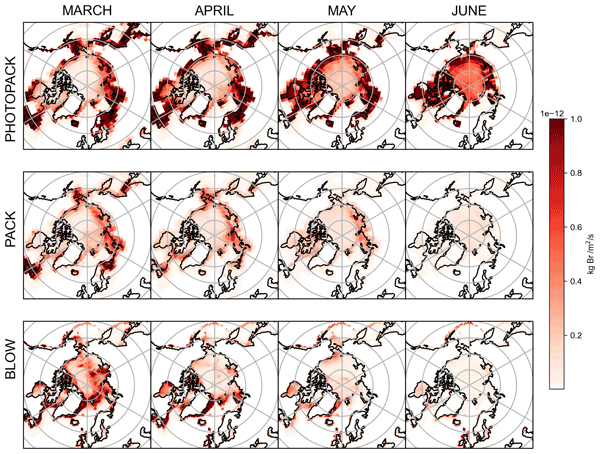
Radical bromine molecules are seen at higher concentrations during the Arctic spring. We use the global model GEOS-Chem to test whether snowpack and wind-blown snow sources can explain high bromine concentrations. We run this model for the entire year of 2015 and compare results to observations of bromine from floating platforms on the Arctic Ocean and at Utqiaġvik. We find that the model performs best when both sources are enabled but may overestimate bromine production in summer and fall.
Yanzhi Cao, Zhuang Jiang, Becky Alexander, Jihong Cole-Dai, Joel Savarino, Joseph Erbland, and Lei Geng
Atmos. Chem. Phys., 22, 13407–13422, https://doi.org/10.5194/acp-22-13407-2022, https://doi.org/10.5194/acp-22-13407-2022, 2022
Short summary
Short summary
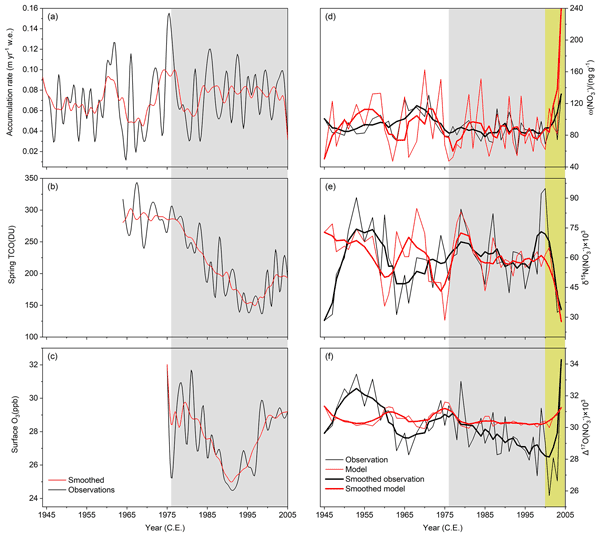
We investigate the potential of ice-core preserved nitrate isotopes as proxies of stratospheric ozone variability by measuring nitrate isotopes in a shallow ice core from the South Pole. The large variability in the snow accumulation rate and its slight increase after the 1970s masked any signals caused by the ozone hole. Moreover, the nitrate oxygen isotope decrease may reflect changes in the atmospheric oxidation environment in the Southern Ocean.
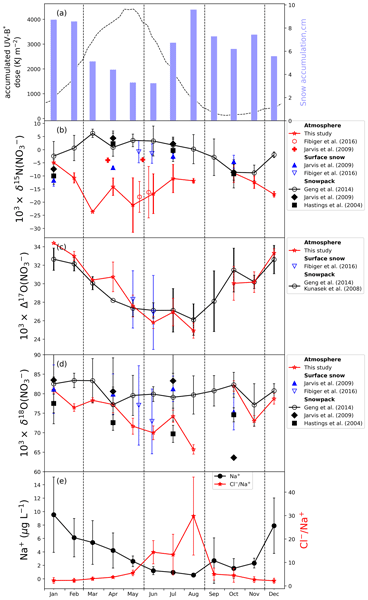
Zhuang Jiang, Joel Savarino, Becky Alexander, Joseph Erbland, Jean-Luc Jaffrezo, and Lei Geng
The Cryosphere, 16, 2709–2724, https://doi.org/10.5194/tc-16-2709-2022, https://doi.org/10.5194/tc-16-2709-2022, 2022
Short summary
Short summary
A record of year-round atmospheric nitrate isotopic composition along with snow nitrate isotopic data from Summit, Greenland, revealed apparent enrichments in nitrogen isotopes in snow nitrate compared to atmospheric nitrate, in addition to a relatively smaller degree of changes in oxygen isotopes. The results suggest that at this site post-depositional processing takes effect, which should be taken into account when interpreting ice-core nitrate isotope records.
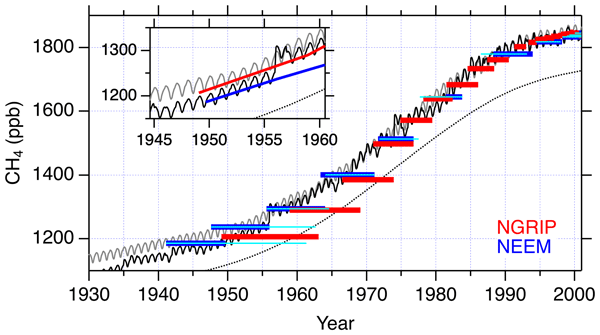
Taku Umezawa, Satoshi Sugawara, Kenji Kawamura, Ikumi Oyabu, Stephen J. Andrews, Takuya Saito, Shuji Aoki, and Takakiyo Nakazawa
Atmos. Chem. Phys., 22, 6899–6917, https://doi.org/10.5194/acp-22-6899-2022, https://doi.org/10.5194/acp-22-6899-2022, 2022
Short summary
Short summary
Greenhouse gas methane in the Arctic atmosphere has not been accurately reported for 1900–1980 from either direct observations or ice core reconstructions. By using trace gas data from firn (compacted snow layers above ice sheet), air samples at two Greenland sites, and a firn air transport model, this study suggests a likely range of the Arctic methane reconstruction for the 20th century. Atmospheric scenarios from two previous studies are also evaluated for consistency with the firn data sets.
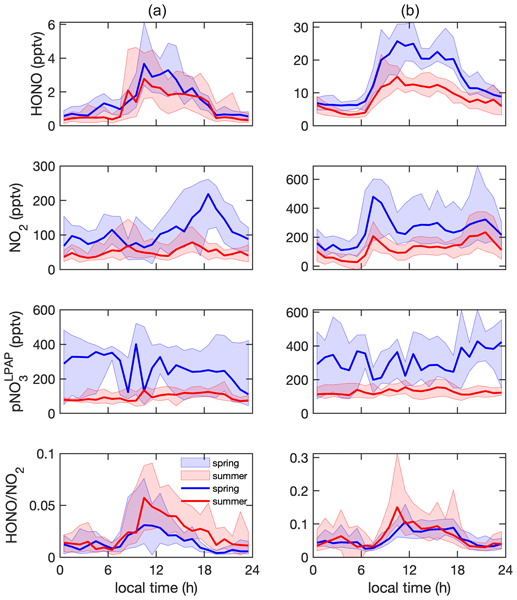
Yuting Zhu, Youfeng Wang, Xianliang Zhou, Yasin F. Elshorbany, Chunxiang Ye, Matthew Hayden, and Andrew J. Peters
Atmos. Chem. Phys., 22, 6327–6346, https://doi.org/10.5194/acp-22-6327-2022, https://doi.org/10.5194/acp-22-6327-2022, 2022
Short summary
Short summary
The daytime chemistry of nitrous acid (HONO), which plays an important role in the oxidation capacity of the troposphere, is not well understood. In this work, we report new field measurement results of HONO and the relevant parameters in the marine boundary layer at Tudor Hill Marine Atmospheric Observatory in Bermuda. We evaluate the daytime HONO budgets in air masses under different types of interaction with the island and examine the strengths of different HONO formation and loss mechanisms.

Ruochong Xu, Joel A. Thornton, Ben H. Lee, Yanxu Zhang, Lyatt Jaeglé, Felipe D. Lopez-Hilfiker, Pekka Rantala, and Tuukka Petäjä
Atmos. Chem. Phys., 22, 5477–5494, https://doi.org/10.5194/acp-22-5477-2022, https://doi.org/10.5194/acp-22-5477-2022, 2022
Short summary
Short summary
Monoterpenes are emitted into the atmosphere by vegetation and by the use of certain consumer products. Reactions of monoterpenes in the atmosphere lead to low-volatility products that condense to grow particulate matter or participate in new particle formation and, thus, affect air quality and climate. We use a model of atmospheric chemistry and transport to evaluate the global-scale importance of recent updates to our understanding of monoterpene chemistry in particle formation and growth.
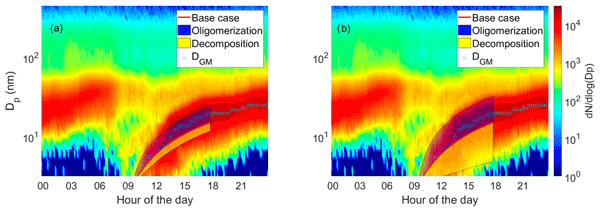
Arto Heitto, Kari Lehtinen, Tuukka Petäjä, Felipe Lopez-Hilfiker, Joel A. Thornton, Markku Kulmala, and Taina Yli-Juuti
Atmos. Chem. Phys., 22, 155–171, https://doi.org/10.5194/acp-22-155-2022, https://doi.org/10.5194/acp-22-155-2022, 2022
Short summary
Short summary
For atmospheric aerosol particles to take part in cloud formation, they need to be at least a few tens of nanometers in diameter. By using a particle condensation model, we investigated how two types of chemical reactions, oligomerization and decomposition, of organic molecules inside the particle may affect the growth of secondary aerosol particles to these sizes. We show that the effect is potentially significant, which highlights the importance of increasing understanding of these processes.
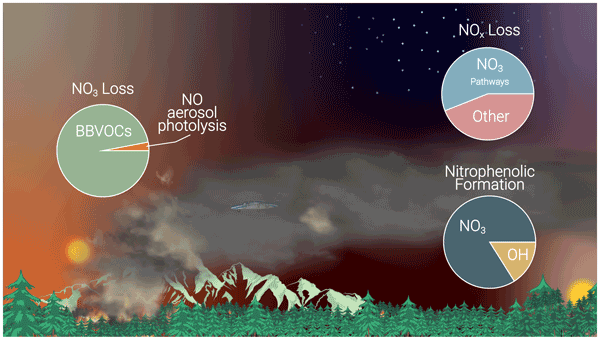
Zachary C. J. Decker, Michael A. Robinson, Kelley C. Barsanti, Ilann Bourgeois, Matthew M. Coggon, Joshua P. DiGangi, Glenn S. Diskin, Frank M. Flocke, Alessandro Franchin, Carley D. Fredrickson, Georgios I. Gkatzelis, Samuel R. Hall, Hannah Halliday, Christopher D. Holmes, L. Gregory Huey, Young Ro Lee, Jakob Lindaas, Ann M. Middlebrook, Denise D. Montzka, Richard Moore, J. Andrew Neuman, John B. Nowak, Brett B. Palm, Jeff Peischl, Felix Piel, Pamela S. Rickly, Andrew W. Rollins, Thomas B. Ryerson, Rebecca H. Schwantes, Kanako Sekimoto, Lee Thornhill, Joel A. Thornton, Geoffrey S. Tyndall, Kirk Ullmann, Paul Van Rooy, Patrick R. Veres, Carsten Warneke, Rebecca A. Washenfelder, Andrew J. Weinheimer, Elizabeth Wiggins, Edward Winstead, Armin Wisthaler, Caroline Womack, and Steven S. Brown
Atmos. Chem. Phys., 21, 16293–16317, https://doi.org/10.5194/acp-21-16293-2021, https://doi.org/10.5194/acp-21-16293-2021, 2021
Short summary
Short summary
To understand air quality impacts from wildfires, we need an accurate picture of how wildfire smoke changes chemically both day and night as sunlight changes the chemistry of smoke. We present a chemical analysis of wildfire smoke as it changes from midday through the night. We use aircraft observations from the FIREX-AQ field campaign with a chemical box model. We find that even under sunlight typical
nighttimechemistry thrives and controls the fate of key smoke plume chemical processes.

Hossein Dadashazar, Majid Alipanah, Miguel Ricardo A. Hilario, Ewan Crosbie, Simon Kirschler, Hongyu Liu, Richard H. Moore, Andrew J. Peters, Amy Jo Scarino, Michael Shook, K. Lee Thornhill, Christiane Voigt, Hailong Wang, Edward Winstead, Bo Zhang, Luke Ziemba, and Armin Sorooshian
Atmos. Chem. Phys., 21, 16121–16141, https://doi.org/10.5194/acp-21-16121-2021, https://doi.org/10.5194/acp-21-16121-2021, 2021
Short summary
Short summary
This study investigates precipitation impacts on long-range transport of North American outflow over the western North Atlantic Ocean (WNAO). Results demonstrate that precipitation scavenging plays a significant role in modifying surface aerosol concentrations over the WNAO, especially in winter and spring due to large-scale scavenging processes. This study highlights how precipitation impacts surface aerosol properties with relevance for other marine regions vulnerable to continental outflow.
Cited articles
Auzmendi-Murua, I., Castillo, A., and Bozzelli, J.: Mercury Oxidation via Chlorine, Bromine, and Iodine under Atmospheric Conditions: Thermochemistry and Kinetics, J. Phys. Chem. A, 118, 2959–2975, https://doi.org/10.1021/jp412654s, 2014.
Bitter, M., Ball, S. M., Povey, I. M., and Jones, R. L.: A broadband cavity ringdown spectrometer for in-situ measurements of atmospheric trace gases, Atmos. Chem. Phys., 5, 2547–2560, https://doi.org/10.5194/acp-5-2547-2005, 2005.
Braban, C. F., Adams, J. W., Rodriguez, D., Cox, R. E., Crowley, J. N., and Schuster, G.: Heterogeneous reactions of HOI, ICl and IBr on sea salt and sea salt proxies, Phys. Chem. Chem. Phys., 9, 3136–3148, https://doi.org/10.1039/b700829e, 2007.
Breitenlechner, M., Novak, G. A., Neuman, J. A., Rollins, A. W., and Veres, P. R.: A versatile vacuum ultraviolet ion source for reduced pressure bipolar chemical ionization mass spectrometry, Atmos. Meas. Tech., 15, 1159–1169, https://doi.org/10.5194/amt-15-1159-2022, 2022.
Buys, Z., Brough, N., Huey, L. G., Tanner, D. J., von Glasow, R., and Jones, A. E.: High temporal resolution Br2, BrCl and BrO observations in coastal Antarctica, Atmos. Chem. Phys., 13, 1329–1343, https://doi.org/10.5194/acp-13-1329-2013, 2013.
Calvert, J. G. and Lindberg, S. E.: The potential influence of iodine-containing compounds on the chemistry of the troposphere in the polar spring. II. Mercury depletion, Atmos. Environ., 38, 5105–5116, https://doi.org/10.1016/j.atmosenv.2004.05.050, 2004.
Caram, C., Szopa, S., Cozic, A., Bekki, S., Cuevas, C. A., and Saiz-Lopez, A.: Sensitivity of tropospheric ozone to halogen chemistry in the chemistry–climate model LMDZ-INCA vNMHC, Geosci. Model Dev., 16, 4041–4062, https://doi.org/10.5194/gmd-16-4041-2023, 2023.
Carpenter, L. J., MacDonald, S. M., Shaw, M. D., Kumar, R., Saunders, R. W., Parthipan, R., Wilson, J., and Plane, J. M. C.: Atmospheric iodine levels influenced by sea surface emissions of inorganic iodine, Nat. Geosci., 6, 108–111, https://doi.org/10.1038/ngeo1687, 2013.
Chameides, W. L. and Davis, D. D.: IODINE – ITS POSSIBLE ROLE IN TROPOSPHERIC PHOTOCHEMISTRY, J. Geophys. Res.-Oceans, 85, 7383–7398, https://doi.org/10.1029/JC085iC12p07383, 1980.
Cuevas, C. A., Maffezzoli, N., Corella, J. P., Spolaor, A., Vallelonga, P., Kjaer, H. A., Simonsen, M., Winstrup, M., Vinther, B., Horvat, C., Fernandez, R. P., Kinnison, D., Lamarque, J. F., Barbante, C., and Saiz-Lopez, A.: Rapid increase in atmospheric iodine levels in the North Atlantic since the mid-20th century, Nat. Commun., 9, 6, https://doi.org/10.1038/s41467-018-03756-1, 2018.
Custard, K., Pratt, K., Wang, S., and Shepson, P.: Constraints on Arctic Atmospheric Chlorine Production through Measurements and Simulations of Cl2 and ClO, Environ. Sci. Technol., 50, 12394–12400, https://doi.org/10.1021/acs.est.6b03909, 2016.
Deming, B. L., Pagonis, D., Liu, X., Day, D. A., Talukdar, R., Krechmer, J. E., de Gouw, J. A., Jimenez, J. L., and Ziemann, P. J.: Measurements of delays of gas-phase compounds in a wide variety of tubing materials due to gas–wall interactions, Atmos. Meas. Tech., 12, 3453–3461, https://doi.org/10.5194/amt-12-3453-2019, 2019.
Dörich, R., Eger, P., Lelieveld, J., and Crowley, J. N.: Iodide CIMS and
Finkenzeller, H., Iyer, S., He, X.-C., Simon, M., Koenig, T. K., Lee, C. F., Valiev, R., Hofbauer, V., Amorim, A., Baalbaki, R., Baccarini, A., Beck, L., Bell, D. M., Caudillo, L., Chen, D., Chiu, R., Chu, B., Dada, L., Duplissy, J., Heinritzi, M., Kemppainen, D., Kim, C., Krechmer, J., Kürten, A., Kvashnin, A., Lamkaddam, H., Lee, C. P., Lehtipalo, K., Li, Z., Makhmutov, V., Manninen, H. E., Marie, G., Marten, R., Mauldin, R. L., Mentler, B., Müller, T., Petäjä, T., Philippov, M., Ranjithkumar, A., Rörup, B., Shen, J., Stolzenburg, D., Tauber, C., Tham, Y. J., Tomé, A., Vazquez-Pufleau, M., Wagner, A. C., Wang, D. S., Wang, M., Wang, Y., Weber, S. K., Nie, W., Wu, Y., Xiao, M., Ye, Q., Zauner-Wieczorek, M., Hansel, A., Baltensperger, U., Brioude, J., Curtius, J., Donahue, N. M., Haddad, I. E., Flagan, R. C., Kulmala, M., Kirkby, J., Sipilä, M., Worsnop, D. R., Kurten, T., Rissanen, M., and Volkamer, R.: The gas-phase formation mechanism of iodic acid as an atmospheric aerosol source, Nat. Chem., 15, 129–135, https://doi.org/10.1038/s41557-022-01067-z, 2023.
Frisch, M. J., Trucks, G. W., Schlegel, H. B., Scuseria, G. E., Robb, M. A., Cheeseman, J. R., Scalmani, G., Barone, V., Petersson, G. A., Nakatsuji, H., Li, X., Caricato, M., Marenich, A. V., Bloino, J., Janesko, B. G., Gomperts, R., Mennucci, B., Hratchian, H.P., Ortiz, J. V., Izmaylov, A. F., Sonnenberg, J. L., Williams-Young, D., Ding, F., Lipparini, F., Egidi, F., Goings, J., Peng, B., Petrone, A., Henderson, T., Ranasinghe, D., Zakrzewski, V. G., Gao, J., Rega, N., Zheng, G., Liang, W., Hada, M., Ehara, M., Toyota, K., Fukuda, R., Hasegawa, J., Ishida, M., Nakajima, T., Honda, Y., Kitao, O., Nakai, H., Vreven, T., Throssell, K., Montgomery, J. A., Jr., Peralta, J. E., Ogliaro, F., Bearpark, M. J., Heyd, J. J., Brothers, E. N., Kudin, K. N., Staroverov, V. N., Keith, T. A., Kobayashi, R., Normand, J., Raghavachari, K., Rendell, A. P., Burant, J. C., Iyengar, S. S., Tomasi, J., Cossi, M., Millam, J. M., Klene, M., Adamo, C., Cammi, R., Ochterski, J. W., Martin, R. L., Morokuma, K., Farkas, O., Foresman, J. B., and Fox, D. J.: Gaussian 16, Revision C.02, Gaussian Inc., Wallingford CT, https://gaussian.com (last access: 5 April 2026), 2019.
Garland, J. A., Elzerman, A. W., and Penkett, S. A.: THE MECHANISM FOR DRY DEPOSITION OF OZONE TO SEAWATER SURFACES, J. Geophys. Res.-Oceans, 85, 7488–7492, https://doi.org/10.1029/JC085iC12p07488, 1980.
He, X.-C., Shen, J., Iyer, S., Juuti, P., Zhang, J., Koirala, M., Kytökari, M. M., Worsnop, D. R., Rissanen, M., Kulmala, M., Maier, N. M., Mikkilä, J., Sipilä, M., and Kangasluoma, J.: Characterisation of gaseous iodine species detection using the multi-scheme chemical ionisation inlet 2 with bromide and nitrate chemical ionisation methods, Atmos. Meas. Tech., 16, 4461–4487, https://doi.org/10.5194/amt-16-4461-2023, 2023.
Huang, R.-J., Seitz, K., Buxmann, J., Pöhler, D., Hornsby, K. E., Carpenter, L. J., Platt, U., and Hoffmann, T.: In situ measurements of molecular iodine in the marine boundary layer: the link to macroalgae and the implications for O3, IO, OIO and NOx, Atmos. Chem. Phys., 10, 4823–4833, https://doi.org/10.5194/acp-10-4823-2010, 2010.
Huang, Y., Zhao, R., Charan, S., Kenseth, C., Zhang, X., and Seinfeld, J.: Unified Theory of Vapor-Wall Mass Transport in Teflon-Walled Environmental Chambers, Environ. Sci. Technol., 52, 2134–2142, https://doi.org/10.1021/acs.est.7b05575, 2018.
Huey, L.: Measurement of trace atmospheric species by chemical ionization mass spectrometry: Speciation of reactive nitrogen and future directions, Mass Spectrom. Rev., 26, 166–184, https://doi.org/10.1002/mas.20118, 2007.
Iglesias-Suarez, F., Badia, A., Fernandez, R. P., Cuevas, C. A., Kinnison, D. E., Tilmes, S., Lamarque, J. F., Long, M. C., Hossaini, R., and Saiz-Lopez, A.: Natural halogens buffer tropospheric ozone in a changing climate, Nat. Clim. Change, 10, 147-+, https://doi.org/10.1038/s41558-019-0675-6, 2020.
Iyer, S., Lopez-Hilfiker, F., Lee, B., Thornton, J., and Kurtén, T.: Modeling the Detection of Organic and Inorganic Compounds Using Iodide-Based Chemical Ionization, J. Phys. Chem. A, 120, 576–587, https://doi.org/10.1021/acs.jpca.5b09837, 2016.
Ji, Y., Huey, L. G., Tanner, D. J., Lee, Y. R., Veres, P. R., Neuman, J. A., Wang, Y., and Wang, X.: A vacuum ultraviolet ion source (VUV-IS) for iodide–chemical ionization mass spectrometry: a substitute for radioactive ion sources, Atmos. Meas. Tech., 13, 3683–3696, https://doi.org/10.5194/amt-13-3683-2020, 2020.
Kassel, L. S.: Studies in homogeneous gas reactions II Introduction of quantum theory, J. Phys. Chem., 32, 1065–1079, https://doi.org/10.1021/j150289a011, 1928.
Kercher, J. P., Riedel, T. P., and Thornton, J. A.: Chlorine activation by N2O5: simultaneous, in situ detection of ClNO2 and N2O5 by chemical ionization mass spectrometry, Atmos. Meas. Tech., 2, 193–204, https://doi.org/10.5194/amt-2-193-2009, 2009.
Klobas, J., Hansen, J., Weisenstein, D., Kennedy, R., and Wilmouth, D.: Sensitivity of Iodine-Mediated Stratospheric Ozone Loss Chemistry to Future Chemistry-Climate Scenarios, Front. Earth Sci., 9, https://doi.org/10.3389/feart.2021.617586, 2021.
Koenig, T., Baidar, S., Campuzano-Jost, P., Cuevas, C., Dix, B., Fernandez, R., Guo, H., Hall, S., Kinnison, D., Nault, B., Ullmann, K., Jimenez, J., Saiz-Lopez, A., and Volkamer, R.: Quantitative detection of iodine in the stratosphere, P. Natl. Acad. Sci. USA, 117, 1860–1866, https://doi.org/10.1073/pnas.1916828117, 2020.
Krechmer, J., Pagonis, D., Ziemann, P., and Jimenez, J.: Quantification of Gas-Wall Partitioning in Teflon Environmental Chambers Using Rapid Bursts of Low-Volatility Oxidized Species Generated in Situ, Environ. Sci. Technol., 50, 5757–5765, https://doi.org/10.1021/acs.est.6b00606, 2016.
Kurtén, T., Kuang, C. A., Gómez, P., McMurry, P. H., Vehkamäki, H., Ortega, I., Noppel, M., and Kulmala, M.: The role of cluster energy nonaccommodation in atmospheric sulfuric acid nucleation, J. Chem. Phys., 132, 8, https://doi.org/10.1063/1.3291213, 2010.
Laidler, K. J.: Chemical Kinetics, 3rd Edn., Harper & Row, 531 pp., ISBN 0-06-043862-2, 1987.
Lawler, M. J., Sander, R., Carpenter, L. J., Lee, J. D., von Glasow, R., Sommariva, R., and Saltzman, E. S.: HOCl and Cl2 observations in marine air, Atmos. Chem. Phys., 11, 7617–7628, https://doi.org/10.5194/acp-11-7617-2011, 2011.
Lawler, M. J., Mahajan, A. S., Saiz-Lopez, A., and Saltzman, E. S.: Observations of I2 at a remote marine site, Atmos. Chem. Phys., 14, 2669–2678, https://doi.org/10.5194/acp-14-2669-2014, 2014.
Le Breton, M., Bannan, T., Shallcross, D., Khan, M., Evans, M., Lee, J., Lidster, R., Andrews, S., Carpenter, L., Schmidt, J., Jacob, D., Harris, N., Bauguitte, S., Gallagher, M., Bacak, A., Leather, K., and Percival, C.: Enhanced ozone loss by active inorganic bromine chemistry in the tropical troposphere, Atmos. Environ., 155, 21–28, https://doi.org/10.1016/j.atmosenv.2017.02.003, 2017.
Lee, B. H., Lopez-Hilfiker, F. D., Veres, P. R., McDuffie, E. E., Fibiger, D. L., Sparks, T. L., Ebben, C. J., Green, J. R., Schroder, J. C., Campuzano-Jost, P., Iyer, S., D’Ambro, E. L., Schobesberger, S., Brown, S. S., Wooldridge, P. J., Cohen, R. C., Fiddler, M. N., Bililign, S., Jimenez, J. L., Kurtén, T., Weinheimer, A. J., Jaegle, L., and Thornton, J. A.: Flight Deployment of a High-Resolution Time-of-Flight Chemical Ionization Mass Spectrometer: Observations of Reactive Halogen and Nitrogen Oxide Species, J. Geophys. Res.-Atmos., 123, 7670–7686, https://doi.org/10.1029/2017JD028082, 2018.
Lee, B. H., Lopez-Hilfiker, F. D., Mohr, C., Kurtén, T., Worsnop, D. R., and Thornton, J. A.: An Iodide-Adduct High-Resolution Time-of-Flight Chemical-Ionization Mass Spectrometer: Application to Atmospheric Inorganic and Organic Compounds, Environ. Sci. Technol., 48, 6309–6317, https://doi.org/10.1021/es500362a, 2014.
Lee, C., Elgiar, T., David, L., Wilmot, T., Reza, M., Hirshorn, N., McCubbin, I., Shah, V., Lin, J., Lyman, S., Hallar, A., Gratz, L., and Volkamer, R.: Elevated Tropospheric Iodine Over the Central Continental United States: Is Iodine a Major Oxidant of Atmospheric Mercury?, Geophys. Res. Lett., 51, https://doi.org/10.1029/2024GL109247, 2024.
Legrand, M., McConnell, J., Preunkert, S., Arienzo, M., Chellman, N., Gleason, K., Sherwen, T., Evans, M., and Carpenter, L.: Alpine ice evidence of a three-fold increase in atmospheric iodine deposition since 1950 in Europe due to increasing oceanic emissions, P. Natl. Acad. Sci. USA, 115, 12136-12141, 10.1073/pnas.1809867115, 2018.
Liao, J., Huey, L. G., Scheuer, E., Dibb, J. E., Stickel, R. E., Tanner, D. J., Neuman, J. A., Nowak, J. B., Choi, S., Wang, Y., Salawitch, R. J., Canty, T., Chance, K., Kurosu, T., Suleiman, R., Weinheimer, A. J., Shetter, R. E., Fried, A., Brune, W., Anderson, B., Zhang, X., Chen, G., Crawford, J., Hecobian, A., and Ingall, E. D.: Characterization of soluble bromide measurements and a case study of BrO observations during ARCTAS, Atmos. Chem. Phys., 12, 1327–1338, https://doi.org/10.5194/acp-12-1327-2012, 2012.
Liao, J., Huey, L. G., Liu, Z., Tanner, D. J., Cantrell, C. A., Orlando, J. J., Flocke, F. M., Shepson, P. B., Weinheimer, A. J., Hall, S. R., Ullmann, K., Beine, H. J., Wang, Y., Ingall, E. D., Stephens, C. R., Hornbrook, R. S., Apel, E. C., Riemer, D., Fried, A., Mauldin III, R. L., Smith, J. N., Staebler, R. M., Neuman, J. A., and Nowak, J. B.: High levels of molecular chlorine in the Arctic atmosphere, Nat. Geosci., 7, 91–94, https://doi.org/10.1038/ngeo2046, 2014.
MacDonald, S. M., Gómez Martín, J. C., Chance, R., Warriner, S., Saiz-Lopez, A., Carpenter, L. J., and Plane, J. M. C.: A laboratory characterisation of inorganic iodine emissions from the sea surface: dependence on oceanic variables and parameterisation for global modelling, Atmos. Chem. Phys., 14, 5841–5852, https://doi.org/10.5194/acp-14-5841-2014, 2014.
Mahajan, A., Oetjen, H., Saiz-Lopez, A., Lee, J., McFiggans, G., and Plane, J.: Reactive iodine species in a semi-polluted environment, Geophys. Res. Lett., 36, https://doi.org/10.1029/2009GL038018, 2009.
Marcy, T., Gao, R., Northway, M., Popp, P., Stark, H., and Fahey, D.: Using chemical ionization mass spectrometry for detection of HNO3, HOl, and CIONO2 in the atmosphere, Int. J. Mass Spectrom., 243, 63–70, https://doi.org/10.1016/j.ijms.2004.11.012, 2005.
Marden, L.: A novel technique for the humidity dependent calibration of hypoiodous acid (HOI) and iodine (I2): Data resources, University of York [data set], https://doi.org/10.15124/48ade8f3-d750-4fe6-a2d9-b8f69bf86262, 2025.
Moon, A. R., Liu, L., Wang, X., Chan, Y.-C., Fritzmann, A., Pound, R., Lees, A., Marden, L., Evans, M., Carpenter, L. J., Stutz, J., Thornton, J. A., Novak, G., Rollins, A., Schill, G. P., He, X.-C., Finkenzeller, H., Reza, M., Volkamer, R., Bates, K. H., Saiz-Lopez, A., Mahajan, A. S., and Alexander, B.: Aerosol iodine recycling is a major control on tropospheric reactive iodine abundance, Atmos. Chem. Phys., 26, 2353–2389, https://doi.org/10.5194/acp-26-2353-2026, 2026.
Neale, P. J., Hylander, S., Banaszak, A. T., Häder, D. P., Rose, K. C., Vione, D., Wängberg, S. Å., Jansen, M. A. K., Busquets, R., Andersen, M. P. S., Madronich, S., Hanson, M. L., Schikowski, T., Solomon, K. R., Sulzberger, B., Wallington, T. J., Heikkilä, A. M., Pandey, K. K., Andrady, A. L., Bruckman, L. S., White, C. C., Zhu, L. P., Bernhard, G. H., Bais, A., Aucamp, P. J., Chiodo, G., Cordero, R. R., Petropavlovskikh, I., Neale, R. E., Olsen, C. M., Hales, S., Lal, A., Lingham, G., Rhodes, L. E., Young, A. R., Robson, T. M., Robinson, S. A., Barnes, P. W., Bornman, J. F., Harper, A. B., Lee, H., Calderón, R. M., Ossola, R., Paul, N. D., Revell, L. E., Wang, Q. W., and Zepp, R. G.: Environmental consequences of interacting effects of changes in stratospheric ozone, ultraviolet radiation, and climate: UNEP Environmental Effects Assessment Panel, Update 2024, Photoch. Photobio. Sci., 24, 357–392, https://doi.org/10.1007/s43630-025-00687-x, 2025.
Neuman, J. A., Nowak, J. B., Huey, L. G., Burkholder, J. B., Dibb, J. E., Holloway, J. S., Liao, J., Peischl, J., Roberts, J. M., Ryerson, T. B., Scheuer, E., Stark, H., Stickel, R. E., Tanner, D. J., and Weinheimer, A.: Bromine measurements in ozone depleted air over the Arctic Ocean, Atmos. Chem. Phys., 10, 6503–6514, https://doi.org/10.5194/acp-10-6503-2010, 2010.
O'Dowd, C., Hämeri, K., Mäkelä, J., Väkeva, M., Aalto, P., de Leeuw, G., Kunz, G., Becker, E., Hansson, H., Allen, A., Harrison, R., Berresheim, H., Geever, M., Jennings, S., and Kulmala, M.: Coastal new particle formation:: Environmental conditions and aerosol physicochemical characteristics during nucleation bursts: art. no. 8107, J. Geophys. Res.-Atmos., 107, https://doi.org/10.1029/2000JD000206, 2002.
Peng, X., Wang, T., Wang, W., Ravishankara, A. R., George, C., Xia, M., Cai, M., Li, Q., Salvador, C. M., Lau, C., Lyu, X., Poon, C. N., Mellouki, A., Mu, Y., Hallquist, M., Saiz-Lopez, A., Guo, H., Herrmann, H., Yu, C., Dai, J., Wang, Y., Wang, X., Yu, A., Leung, K., Lee, S., and Chen, J.: Photodissociation of particulate nitrate as a source of daytime tropospheric Cl2, Nat. Commun., 13, 939, https://doi.org/10.1038/s41467-022-28383-9, 2022.
Peters, C., Pechtl, S., Stutz, J., Hebestreit, K., Hönninger, G., Heumann, K. G., Schwarz, A., Winterlik, J., and Platt, U.: Reactive and organic halogen species in three different European coastal environments, Atmos. Chem. Phys., 5, 3357–3375, https://doi.org/10.5194/acp-5-3357-2005, 2005.
Pound, R., Durcan, D., Evans, M., and Carpenter, L.: Comparing the Importance of Iodine and Isoprene on Tropospheric Photochemistry, Geophys. Res. Lett., 50, https://doi.org/10.1029/2022GL100997, 2023.
Pound, R. J., Brown, L. V., Evans, M. J., and Carpenter, L. J.: An improved estimate of inorganic iodine emissions from the ocean using a coupled surface microlayer box model, Atmos. Chem. Phys., 24, 9899–9921, https://doi.org/10.5194/acp-24-9899-2024, 2024.
Prados-Roman, C., Cuevas, C. A., Hay, T., Fernandez, R. P., Mahajan, A. S., Royer, S.-J., Galí, M., Simó, R., Dachs, J., Großmann, K., Kinnison, D. E., Lamarque, J.-F., and Saiz-Lopez, A.: Iodine oxide in the global marine boundary layer, Atmos. Chem. Phys., 15, 583–593, https://doi.org/10.5194/acp-15-583-2015, 2015.
Priestley, M., le Breton, M., Bannan, T. J., Worrall, S. D., Bacak, A., Smedley, A. R. D., Reyes-Villegas, E., Mehra, A., Allan, J., Webb, A. R., Shallcross, D. E., Coe, H., and Percival, C. J.: Observations of organic and inorganic chlorinated compounds and their contribution to chlorine radical concentrations in an urban environment in northern Europe during the wintertime, Atmos. Chem. Phys., 18, 13481–13493, https://doi.org/10.5194/acp-18-13481-2018, 2018.
Pritchard, B., Altarawy, D., Didier, B., Gibson, T., and Windus, T.: New Basis Set Exchange: An Open, Up-to-Date Resource for the Molecular Sciences Community, J. Chem. Inf. Model., 59, 4814–4820, https://doi.org/10.1021/acs.jcim.9b00725, 2019.
Raso, A., Custard, K., May, N., Tanner, D., Newburn, M., Walker, L., Moore, R., Huey, L., Alexander, L., Shepson, P., and Pratt, K.: Active molecular iodine photochemistry in the Arctic, P. Natl. Acad. Sci. USA, 114, 10053–10058, https://doi.org/10.1073/pnas.1702803114, 2017.
Read, K. A., Mahajan, A. S., Carpenter, L. J., Evans, M. J., Faria, B. V. E., Heard, D. E., Hopkins, J. R., Lee, J. D., Moller, S. J., Lewis, A. C., Mendes, L., McQuaid, J. B., Oetjen, H., Saiz-Lopez, A., Pilling, M. J., and Plane, J. M. C.: Extensive halogen-mediated ozone destruction over the tropical Atlantic Ocean, Nature, 453, 1232–1235, https://doi.org/10.1038/nature07035, 2008.
Reza, M., Iezzi, L., Finkenzeller, H., Roose, A., Ammann, M., and Volkamer, R.: Iodine Activation from Iodate Reduction in Aqueous Films via Photocatalyzed and Dark Reactions, ACS Earth Space Chem., 8, 2495–2508, https://doi.org/10.1021/acsearthspacechem.4c00224, 2024.
Rice, O. K. and Ramsperger, H. C.: Theories of unimolecular gas reactions at low pressures, J. Ame. Chem. Soc., 49, 1617–1629, https://doi.org/10.1021/ja01406a001, 1927.
Rissanen, M. P., Mikkilä, J., Iyer, S., and Hakala, J.: Multi-scheme chemical ionization inlet (MION) for fast switching of reagent ion chemistry in atmospheric pressure chemical ionization mass spectrometry (CIMS) applications, Atmos. Meas. Tech., 12, 6635–6646, https://doi.org/10.5194/amt-12-6635-2019, 2019.
Riva, M., Pospisilova, V., Frege, C., Perrier, S., Bansal, P., Jorga, S., Sturm, P., Thornton, J. A., Rohner, U., and Lopez-Hilfiker, F.: Evaluation of a reduced-pressure chemical ion reactor utilizing adduct ionization for the detection of gaseous organic and inorganic species, Atmos. Meas. Tech., 17, 5887–5901, https://doi.org/10.5194/amt-17-5887-2024, 2024.
Robinson, M. A., Neuman, J. A., Huey, L. G., Roberts, J. M., Brown, S. S., and Veres, P. R.: Temperature-dependent sensitivity of iodide chemical ionization mass spectrometers, Atmos. Meas. Tech., 15, 4295–4305, https://doi.org/10.5194/amt-15-4295-2022, 2022.
Roscoe, H., Brough, N., Jones, A., Wittrock, F., Richter, A., Van Roozendael, M., and Hendrick, F.: Characterisation of vertical BrO distribution during events of enhanced tropospheric BrO in Antarctica, from combined remote and in-situ measurements, J. Quant. Spectrosc. Ra., 138, 70–81, https://doi.org/10.1016/j.jqsrt.2014.01.026, 2014.
Saiz-Lopez, A. and Plane, J.: Novel iodine chemistry in the marine boundary layer, Geophys. Res. Lett., 31, https://doi.org/10.1029/2003GL019215, 2004.
Saiz-Lopez, A. and von Glasow, R.: Reactive halogen chemistry in the troposphere, Chem. Soc. Rev., 41, 6448–6472, https://doi.org/10.1039/c2cs35208g, 2012.
Saiz-Lopez, A., Plane, J. M. C., Baker, A. R., Carpenter, L. J., von Glasow, R., Martin, J. C. G., McFiggans, G., and Saunders, R. W.: Atmospheric Chemistry of Iodine, Chem. Rev., 112, 1773–1804, https://doi.org/10.1021/cr200029u, 2012.
Saiz-Lopez, A., Fernandez, R. P., Ordóñez, C., Kinnison, D. E., Gómez Martín, J. C., Lamarque, J.-F., and Tilmes, S.: Iodine chemistry in the troposphere and its effect on ozone, Atmos. Chem. Phys., 14, 13119–13143, https://doi.org/10.5194/acp-14-13119-2014, 2014.
Sanchez, J., Tanner, D. J., Chen, D., Huey, L. G., and Ng, N. L.: A new technique for the direct detection of HO2 radicals using bromide chemical ionization mass spectrometry (Br-CIMS): initial characterization, Atmos. Meas. Tech., 9, 3851–3861, https://doi.org/10.5194/amt-9-3851-2016, 2016.
Shaw, M. and Carpenter, L.: Modification of Ozone Deposition and I2 Emissions at the Air-Aqueous Interface by Dissolved Organic Carbon of Marine Origin, Environ. Sci. Technol., 47, 10947–10954, https://doi.org/10.1021/es4011459, 2013.
Sherwen, T., Evans, M. J., Carpenter, L. J., Andrews, S. J., Lidster, R. T., Dix, B., Koenig, T. K., Sinreich, R., Ortega, I., Volkamer, R., Saiz-Lopez, A., Prados-Roman, C., Mahajan, A. S., and Ordóñez, C.: Iodine's impact on tropospheric oxidants: a global model study in GEOS-Chem, Atmos. Chem. Phys., 16, 1161–1186, https://doi.org/10.5194/acp-16-1161-2016, 2016a.
Sherwen, T., Schmidt, J. A., Evans, M. J., Carpenter, L. J., Großmann, K., Eastham, S. D., Jacob, D. J., Dix, B., Koenig, T. K., Sinreich, R., Ortega, I., Volkamer, R., Saiz-Lopez, A., Prados-Roman, C., Mahajan, A. S., and Ordóñez, C.: Global impacts of tropospheric halogens (Cl, Br, I) on oxidants and composition in GEOS-Chem, Atmos. Chem. Phys., 16, 12239–12271, https://doi.org/10.5194/acp-16-12239-2016, 2016b.
Simpson, W. R., Brown, S. S., Saiz-Lopez, A., Thornton, J. A., and von Glasow, R.: Tropospheric Halogen Chemistry: Sources, Cycling, and Impacts, Chem. Rev., 115, 4035–4062, https://doi.org/10.1021/cr5006638, 2015.
Sipilä, M., Sarnela, N., Jokinen, T., Henschel, H., Junninen, H., Kontkanen, J., Richters, S., Kangasluoma, J., Franchin, A., Peräkylä, O., Rissanen, M. P., Ehn, M., Vehkamäki, H., Kurten, T., Berndt, T., Petäjä, T., Worsnop, D., Ceburnis, D., Kerminen, V.-M., Kulmala, M., and O'Dowd, C.: Molecular-scale evidence of aerosol particle formation via sequential addition of HIO3, Nature, 537, 532–534, https://doi.org/10.1038/nature19314, 2016.
Sjostedt, S. and Abbatt, J.: Release of gas-phase halogens from sodium halide substrates: heterogeneous oxidation of frozen solutions and desiccated salts by hydroxyl radicals, Environ. Res. Lett., 3, https://doi.org/10.1088/1748-9326/3/4/045007, 2008.
Solomon, S., Garcia, R., and Ravishankara, A.: ON THE ROLE OF IODINE IN OZONE DEPLETION, J. Geophys. Res.-Atmos., 99, 20491–20499, 1994.
Stark, H., Yatayelli, R., Thompson, S., Kimmel, J., Cubison, M., Chhabra, P., Canagaratna, M., Jayne, J., Worsnop, D., and Jimenez, J.: Methods to extract molecular and bulk chemical information from series of complex mass spectra with limited mass resolution, Int. J. Mass Spectrom., 389, 26–38, https://doi.org/10.1016/j.ijms.2015.08.011, 2015.
Tham, Y. J., He, X.-C., Li, Q., Cuevas, C. A., Shen, J., Kalliokoski, J., Yan, C., Iyer, S., Lehmusjärvi, T., Jang, S., Thakur, R. C., Beck, L., Kemppainen, D., Olin, M., Sarnela, N., Mikkilä, J., Hakala, J., Marbouti, M., Yao, L., Li, H., Huang, W., Wang, Y., Wimmer, D., Zha, Q., Virkanen, J., Spain, T. G., O’Doherty, S., Jokinen, T., Bianchi, F., Petäjä, T., Worsnop, D. R., Mauldin, R. L., Ovadnevaite, J., Ceburnis, D., Maier, N. M., Kulmala, M., O’Dowd, C., Dal Maso, M., Saiz-Lopez, A., and Sipilä, M.: Direct field evidence of autocatalytic iodine release from atmospheric aerosol, P. Natl. Acad. Sci. USA, 118, e2009951118, https://doi.org/10.1073/pnas.2009951118, 2021.
Vogt, R., Sander, R., Von Glasow, R., and Crutzen, P.: Iodine chemistry and its role in halogen activation and ozone loss in the marine boundary layer: A model study, J. Atmos. Chem., 32, 375–395, https://doi.org/10.1023/A:1006179901037, 1999.
Wang, M., Kong, W., Marten, R., He, X., Chen, D., Pfeifer, J., Heitto, A., Kontkanen, J., Dada, L., Kürten, A., Yli-Juuti, T., Manninen, H. E., Amanatidis, S., Amorim, A., Baalbaki, R., Baccarini, A., Bell, D. M., Bertozzi, B., Bräkling, S., Brilke, S., Murillo, L. C., Chiu, R., Chu, B., De Menezes, L.-P., Duplissy, J., Finkenzeller, H., Carracedo, L. G., Granzin, M., Guida, R., Hansel, A., Hofbauer, V., Krechmer, J., Lehtipalo, K., Lamkaddam, H., Lampimäki, M., Lee, C. P., Makhmutov, V., Marie, G., Mathot, S., Mauldin, R. L., Mentler, B., Müller, T., Onnela, A., Partoll, E., Petäjä, T., Philippov, M., Pospisilova, V., Ranjithkumar, A., Rissanen, M., Rörup, B., Scholz, W., Shen, J., Simon, M., Sipilä, M., Steiner, G., Stolzenburg, D., Tham, Y. J., Tomé, A., Wagner, A. C., Wang, D. S., Wang, Y., Weber, S. K., Winkler, P. M., Wlasits, P. J., Wu, Y., Xiao, M., Ye, Q., Zauner-Wieczorek, M., Zhou, X., Volkamer, R., Riipinen, I., Dommen, J., Curtius, J., Baltensperger, U., Kulmala, M., Worsnop, D. R., Kirkby, J., Seinfeld, J. H., El-Haddad, I., Flagan, R. C., and Donahue, N. M.: Rapid growth of new atmospheric particles by nitric acid and ammonia condensation, Nature, 581, 184–189, https://doi.org/10.1038/s41586-020-2270-4, 2020.
Wang, M., He, X.-C., Finkenzeller, H., Iyer, S., Chen, D., Shen, J., Simon, M., Hofbauer, V., Kirkby, J., Curtius, J., Maier, N., Kurtén, T., Worsnop, D. R., Kulmala, M., Rissanen, M., Volkamer, R., Tham, Y. J., Donahue, N. M., and Sipilä, M.: Measurement of iodine species and sulfuric acid using bromide chemical ionization mass spectrometers, Atmos. Meas. Tech., 14, 4187–4202, https://doi.org/10.5194/amt-14-4187-2021, 2021a.
Wang, X., Jacob, D. J., Downs, W., Zhai, S., Zhu, L., Shah, V., Holmes, C. D., Sherwen, T., Alexander, B., Evans, M. J., Eastham, S. D., Neuman, J. A., Veres, P. R., Koenig, T. K., Volkamer, R., Huey, L. G., Bannan, T. J., Percival, C. J., Lee, B. H., and Thornton, J. A.: Global tropospheric halogen (Cl, Br, I) chemistry and its impact on oxidants, Atmos. Chem. Phys., 21, 13973–13996, https://doi.org/10.5194/acp-21-13973-2021, 2021b.
Yeoman, A., Heeley-Hill, A., Shaw, M., Andrews, S., and Lewis, A.: Inhalation of VOCs from facial moisturizers and the influence of dose proximity, Indoor Air, 32, https://doi.org/10.1111/ina.12948, 2022.
Zhang, Y., Liu, R., Yang, D., Guo, Y., Li, M., and Hou, K.: Chemical ionization mass spectrometry: Developments and applications for on-line characterization of atmospheric aerosols and trace gases, Trac-Trend. Anal. Chem., 168, https://doi.org/10.1016/j.trac.2023.117353, 2023.
Short summary
Hypoiodous acid (HOI) and molecular iodine (I2) are the dominant precursors of reactive gaseous iodine, which plays an important role in the atmospheric oxidative capacity and in aerosol formation. However, difficulties in the quantification of HOI and I2 mean that very few measurements are available. This work describes a novel calibration method for HOI and reports the detection of HOI and I2 in the marine boundary layer using Br- chemical ionisation mass spectrometry.
Hypoiodous acid (HOI) and molecular iodine (I2) are the dominant precursors of reactive gaseous...


