
Articles | Volume 19, issue 11
https://doi.org/10.5194/amt-19-3667-2026
© Author(s) 2026. This work is distributed under
the Creative Commons Attribution 4.0 License.
the Creative Commons Attribution 4.0 License.
https://doi.org/10.5194/amt-19-3667-2026
© Author(s) 2026. This work is distributed under
the Creative Commons Attribution 4.0 License.
the Creative Commons Attribution 4.0 License.
Research article
| 
04 Jun 2026
Research article |
| 04 Jun 2026
| 04 Jun 2026
CopterSonde-SWX: development of a UAS-based Vertical Atmospheric Profiler for severe weather

Cooperative Institute for Severe and High-Impact Weather Research and Operations, The University of Oklahoma, 120 David L. Boren Blvd., Norman, OK 73072, United States
NOAA/OAR National Severe Storm Laboratory, The University of Oklahoma, 120 David L. Boren Blvd., Norman, OK 73072, United States
Tyler M. Bell
NOAA/OAR National Severe Storm Laboratory, The University of Oklahoma, 120 David L. Boren Blvd., Norman, OK 73072, United States
Abdullah A. Tasim
Cooperative Institute for Severe and High-Impact Weather Research and Operations, The University of Oklahoma, 120 David L. Boren Blvd., Norman, OK 73072, United States
School of Engineering, The University of Oklahoma, 660 Parrington Oval, Norman, OK 73019, United States
Aaron Quiroz
Cooperative Institute for Severe and High-Impact Weather Research and Operations, The University of Oklahoma, 120 David L. Boren Blvd., Norman, OK 73072, United States
School of Meteorology, The University of Oklahoma, 660 Parrington Oval, Norman, OK 73019, United States
Jeremy D. Simms
Cooperative Institute for Severe and High-Impact Weather Research and Operations, The University of Oklahoma, 120 David L. Boren Blvd., Norman, OK 73072, United States
School of Meteorology, The University of Oklahoma, 660 Parrington Oval, Norman, OK 73019, United States
Joshua G. Gebauer
Cooperative Institute for Severe and High-Impact Weather Research and Operations, The University of Oklahoma, 120 David L. Boren Blvd., Norman, OK 73072, United States
NOAA/OAR National Severe Storm Laboratory, The University of Oklahoma, 120 David L. Boren Blvd., Norman, OK 73072, United States
Elizabeth N. Smith
NOAA/OAR National Severe Storm Laboratory, The University of Oklahoma, 120 David L. Boren Blvd., Norman, OK 73072, United States
Related authors
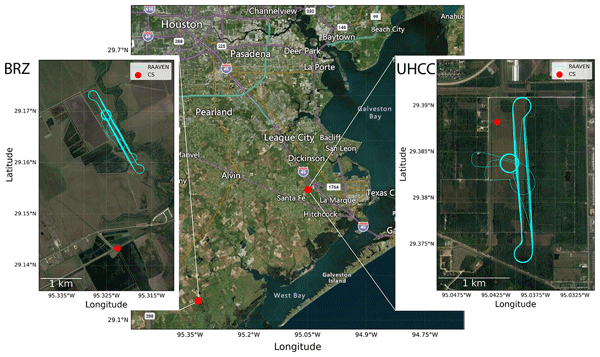
Francesca Lappin, Gijs de Boer, Petra Klein, Jonathan Hamilton, Michelle Spencer, Radiance Calmer, Antonio R. Segales, Michael Rhodes, Tyler M. Bell, Justin Buchli, Kelsey Britt, Elizabeth Asher, Isaac Medina, Brian Butterworth, Leia Otterstatter, Madison Ritsch, Bryony Puxley, Angelina Miller, Arianna Jordan, Ceu Gomez-Faulk, Elizabeth Smith, Steven Borenstein, Troy Thornberry, Brian Argrow, and Elizabeth Pillar-Little
Earth Syst. Sci. Data, 16, 2525–2541, https://doi.org/10.5194/essd-16-2525-2024, https://doi.org/10.5194/essd-16-2525-2024, 2024
Short summary
Short summary
This article provides an overview of the lower-atmospheric dataset collected by two uncrewed aerial systems near the Gulf of Mexico coastline south of Houston, TX, USA, as part of the TRacking Aerosol Convection interactions ExpeRiment (TRACER) campaign. The data were collected through boundary layer transitions, through sea breeze circulations, and in the pre- and near-storm environment to understand how these processes influence the coastal environment.
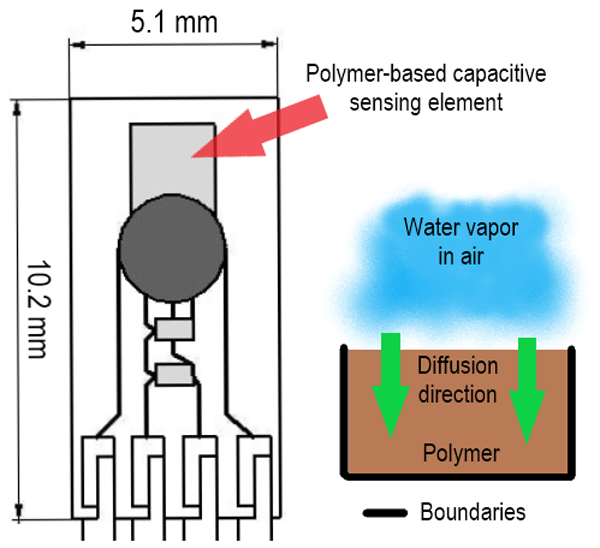
Antonio R. Segales, Phillip B. Chilson, and Jorge L. Salazar-Cerreño
Atmos. Meas. Tech., 15, 2607–2621, https://doi.org/10.5194/amt-15-2607-2022, https://doi.org/10.5194/amt-15-2607-2022, 2022
Short summary
Short summary
The mitigation of undesired contamination, sensor characterization, and signal conditioning and restoration is crucial to improve the reliability of the weather unmanned aerial system (UAS) deliverables. This study presents an overview of the general considerations and procedures to compensate for slow sensor response and other sources of error for temperature and humidity measurements collected using a UAS.
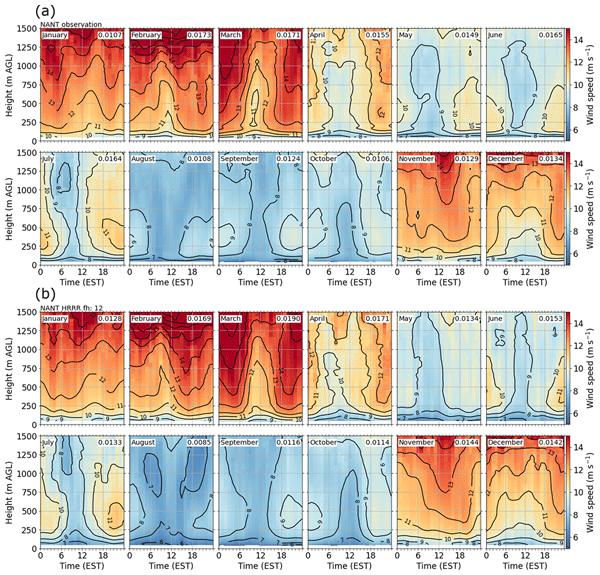
Bianca Adler, Laura Bianco, David D. Turner, Joseph Olson, Xia Sun, Joshua Gebauer, Nicola Bodini, Stefano Letizia, and James M. Wilczak
Geosci. Model Dev., 19, 8627–8649, https://doi.org/10.5194/gmd-19-8627-2026, https://doi.org/10.5194/gmd-19-8627-2026, 2026
Short summary
Short summary
Accurate operational forecasts of temperature and wind in the coastal marine boundary layer are important for a wide range of applications. Leveraging data that were collected along the United States northeast coast during a multi-year period for the Third Wind Forecast Improvement project, we investigated the performance of the operational forecast model and identified systematic errors in wind and temperature forecasts that are now being addressed by the model developers.
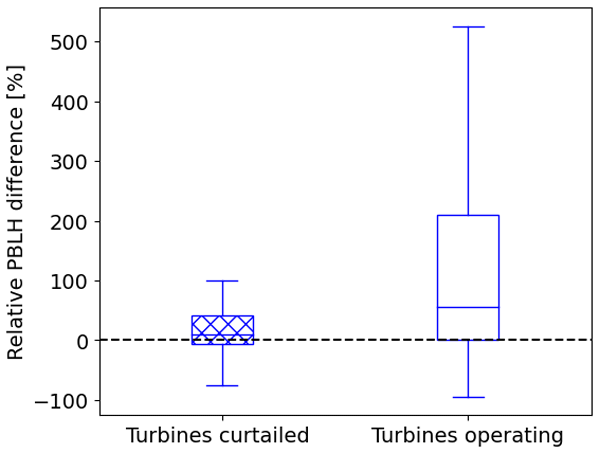
Aliza Abraham, Matteo Puccioni, Arianna Jordan, Emina Maric, Nicola Bodini, Nicholas Hamilton, Stefano Letizia, Petra M. Klein, Elizabeth N. Smith, Sonia Wharton, Jonathan Gero, Jamey D. Jacob, Raghavendra Krishnamurthy, Rob K. Newsom, Mikhail Pekour, William Radünz, and Patrick Moriarty
Wind Energ. Sci., 10, 1681–1705, https://doi.org/10.5194/wes-10-1681-2025, https://doi.org/10.5194/wes-10-1681-2025, 2025
Short summary
Short summary
This study is the first to use real-world atmospheric measurements to show that large wind plants can increase the height of the planetary boundary layer, the part of the atmosphere near the surface where life takes place. The planetary boundary layer height governs processes like pollutant transport and cloud formation and is a key parameter for modeling the atmosphere. The results of this study provide important insights into interactions between wind plants and their local environment.
Elizabeth N. Smith and Jacob T. Carlin
Atmos. Meas. Tech., 17, 4087–4107, https://doi.org/10.5194/amt-17-4087-2024, https://doi.org/10.5194/amt-17-4087-2024, 2024
Short summary
Short summary
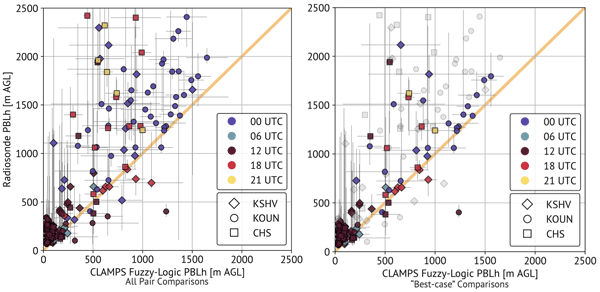
Boundary-layer height observations remain sparse in time and space. In this study we create a new fuzzy logic method for synergistically combining boundary-layer height estimates from a suite of instruments. These estimates generally compare well to those from radiosondes; plus, the approach offers near-continuous estimates through the entire diurnal cycle. Suspected reasons for discrepancies are discussed. The code for the newly presented fuzzy logic method is provided for the community to use.
Francesca Lappin, Gijs de Boer, Petra Klein, Jonathan Hamilton, Michelle Spencer, Radiance Calmer, Antonio R. Segales, Michael Rhodes, Tyler M. Bell, Justin Buchli, Kelsey Britt, Elizabeth Asher, Isaac Medina, Brian Butterworth, Leia Otterstatter, Madison Ritsch, Bryony Puxley, Angelina Miller, Arianna Jordan, Ceu Gomez-Faulk, Elizabeth Smith, Steven Borenstein, Troy Thornberry, Brian Argrow, and Elizabeth Pillar-Little
Earth Syst. Sci. Data, 16, 2525–2541, https://doi.org/10.5194/essd-16-2525-2024, https://doi.org/10.5194/essd-16-2525-2024, 2024
Short summary
Short summary
This article provides an overview of the lower-atmospheric dataset collected by two uncrewed aerial systems near the Gulf of Mexico coastline south of Houston, TX, USA, as part of the TRacking Aerosol Convection interactions ExpeRiment (TRACER) campaign. The data were collected through boundary layer transitions, through sea breeze circulations, and in the pre- and near-storm environment to understand how these processes influence the coastal environment.
Antonio R. Segales, Phillip B. Chilson, and Jorge L. Salazar-Cerreño
Atmos. Meas. Tech., 15, 2607–2621, https://doi.org/10.5194/amt-15-2607-2022, https://doi.org/10.5194/amt-15-2607-2022, 2022
Short summary
Short summary
The mitigation of undesired contamination, sensor characterization, and signal conditioning and restoration is crucial to improve the reliability of the weather unmanned aerial system (UAS) deliverables. This study presents an overview of the general considerations and procedures to compensate for slow sensor response and other sources of error for temperature and humidity measurements collected using a UAS.
James B. Duncan Jr., Laura Bianco, Bianca Adler, Tyler Bell, Irina V. Djalalova, Laura Riihimaki, Joseph Sedlar, Elizabeth N. Smith, David D. Turner, Timothy J. Wagner, and James M. Wilczak
Atmos. Meas. Tech., 15, 2479–2502, https://doi.org/10.5194/amt-15-2479-2022, https://doi.org/10.5194/amt-15-2479-2022, 2022
Short summary
Short summary
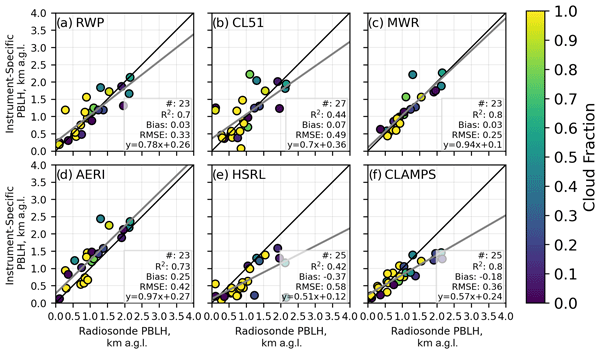
In this study, several ground-based remote sensing instruments are used to estimate the height of the convective planetary boundary layer, and their performance is compared against independent boundary layer depth estimates obtained from radiosondes launched as part of the CHEESEHEAD19 field campaign. The impact of clouds (particularly boundary layer clouds) on the estimation of the boundary layer depth is also investigated.
Francesca M. Lappin, Tyler M. Bell, Elizabeth A. Pillar-Little, and Phillip B. Chilson
Atmos. Meas. Tech., 15, 1185–1200, https://doi.org/10.5194/amt-15-1185-2022, https://doi.org/10.5194/amt-15-1185-2022, 2022
Short summary
Short summary
This study evaluates how a classically defined variable, air parcel buoyancy, can be used to interpret transitions in the atmospheric boundary layer (ABL). To capture the high-resolution variations, remotely piloted aircraft systems are used to collect data in two field campaigns. This paper finds that buoyancy has distinct evolutions prior to low-level jet and convective initiation cases. Additionally, buoyancy mixes well to act as an ABL height indicator comparable to other methods.
Cited articles
Barbieri, L., Kral, S. T., Bailey, S. C. C., Frazier, A. E., Jacob, J. D., Reuder, J., Brus, D., Chilson, P. B., Crick, C., Detweiler, C., Doddi, A., Elston, J., Foroutan, H., González-Rocha, J., Greene, B. R., Guzman, M. I., Houston, A. L., Islam, A., Kemppinen, O., Lawrence, D., Pillar-Little, E. A., Ross, S. D., Sama, M. P., Schmale, D. G., Schuyler, T. J., Shankar, A., Smith, S. W., Waugh, S., Dixon, C., Borenstein, S., and de Boer, G.: Intercomparison of Small Unmanned Aircraft System (sUAS) Measurements for Atmospheric Science during the LAPSE-RATE Campaign, Sensors, 19, https://doi.org/10.3390/s19092179, 2019. a
Bell, T. and Segales, A. R.: M2HATS: CopterSonde WxUAS Profile Data, NSF NCAR Earth Observing Laboratory [data set], https://doi.org/10.26023/KNPE-Z557-360A, 2024. a
Bell, T., Segales, A. R., and Smith, E. N.: PERiLS_2023: CopterSonde WxUAS Profile Data, NSF NCAR Earth Observing Laboratory [data set], https://doi.org/10.26023/ZF5M-CRDN-8103, 2024. a
Bell, T. M., Greene, B. R., Klein, P. M., Carney, M., and Chilson, P. B.: Confronting the boundary layer data gap: evaluating new and existing methodologies of probing the lower atmosphere, Atmos. Meas. Tech., 13, 3855–3872, https://doi.org/10.5194/amt-13-3855-2020, 2020. a, b
Chilson, P. B., Bell, T. M., Brewster, K. A., Britto Hupsel de Azevedo, G., Carr, F. H., Carson, K., Doyle, W., Fiebrich, C. A., Greene, B. R., Grimsley, J. L., Kanneganti, S. T., Martin, J., Moore, A., Palmer, R. D., Pillar-Little, E. A., Salazar-Cerreno, J. L., Segales, A. R., Weber, M. E., Yeary, M., and Droegemeier, K. K.: Moving towards a Network of Autonomous UAS Atmospheric Profiling Stations for Observations in the Earth's Lower Atmosphere: The 3D Mesonet Concept, Sensors, 19, https://doi.org/10.3390/s19122720, 2019. a, b, c
Chilson, P. B., Espinosa, A. R. S., Doyle, W. J., Bell, T. M., Greene, B. R., Martin, J. J., Pillar-Little, E. A., and de Azevedo, G. B. H.: Unmanned Aerial System for Sampling Atmospheric Data, Tech. Rep. US20210214079A1, University of Oklahoma, Norman, OK, patent number: US12084181B2, https://patents.google.com/patent/US12084181B2/en (last access: 22 May 2026), 2021. a, b
Curtis, S., Fair, A., Wistow, J., Val, D. V., and Oven, K.: Impact of extreme weather events and climate change for health and social care systems, Environmental Health, 16, 128, https://doi.org/10.1186/s12940-017-0324-3, 2017. a
Dabberdt, W. F., Schlatter, T. W., Carr, F. H., Friday, E. W. J., Jorgensen, D., Koch, S., Pirone, M., Ralph, F. M., Sun, J., Welsh, P., Wilson, J. W., and Zou, X.: Multifunctional Mesoscale Observing Networks, B. Am. Meteorol. Soc., 86, 961–982, https://doi.org/10.1175/BAMS-86-7-961, 2005. a
de Boer, G., Diehl, C., Jacob, J., Houston, A., Smith, S. W., Chilson, P., Schmale, D. G., Intrieri, J., Pinto, J., Elston, J., Brus, D., Kemppinen, O., Clark, A., Lawrence, D., Bailey, S. C. C., Sama, M. P., Frazier, A., Crick, C., Natalie, V., Pillar-Little, E., Klein, P., Waugh, S., Lundquist, J. K., Barbieri, L., Kral, S. T., Jensen, A. A., Dixon, C., Borenstein, S., Hesselius, D., Human, K., Hall, P., Argrow, B., Thornberry, T., Wright, R., and Kelly, J. T.: Development of Community, Capabilities, and Understanding through Unmanned Aircraft-Based Atmospheric Research: The LAPSE-RATE Campaign, B. Am. Meteorol. Soc., 101, E684–E699, https://doi.org/10.1175/BAMS-D-19-0050.1, 2020a. a
de Boer, G., Lawrence, D., and Doddi, A.: DataHawk2 files from LAPSE-RATE, Version 2.0, Zenodo [data set], https://doi.org/10.5281/zenodo.3891620, 2020b. a
de Boer, G., Borenstein, S., Calmer, R., Cox, C., Rhodes, M., Choate, C., Hamilton, J., Osborn, J., Lawrence, D., Argrow, B., and Intrieri, J.: Measurements from the University of Colorado RAAVEN Uncrewed Aircraft System during ATOMIC, Earth Syst. Sci. Data, 14, 19–31, https://doi.org/10.5194/essd-14-19-2022, 2022. a
de Boer, G., Butterworth, B. J., Elston, J. S., Houston, A., Pillar-Little, E., Argrow, B., Bell, T. M., Chilson, P., Choate, C., Greene, B. R., Islam, A., Martz, R., Rhodes, M., Rico, D., Stachura, M., Lappin, F. M., Segales, A. R., Whyte, S., and Wilson, M.: Evaluation and Intercomparison of Small Uncrewed Aircraft Systems Used for Atmospheric Research, J. Atmos. Ocean. Tech., 41, 127–145, https://doi.org/10.1175/JTECH-D-23-0067.1, 2024. a
Fiebrich, C. A., Ziolkowska, J. R., Chilson, P. B., and Pillar-Little, E. A.: Potential Socioeconomic and Environmental Benefits and Beneficiaries of UAS Atmospheric Profiles from a 3D Mesonet, Weather Clim. Soc., 13, 377–391, https://doi.org/10.1175/WCAS-D-20-0118.1, 2021. a
Flagg, D. D., Doyle, J. D., Holt, T. R., Tyndall, D. P., Amerault, C. M., Burmeister, D., Haack, T., Nachamkin, J. E., Peng, M., and Xu, L.: On the impact of unmanned aerial system observations on numerical weather prediction in the coastal zone, Mon. Weather Rev., 146, 599–622, https://doi.org/10.1175/MWR-D-17-0028.1, 2018. a
Frame, D. J., Rosier, S. M., Noy, I., Harrington, L. J., Carey-Smith, T., Sparrow, S. N., Stone, D. A., and Dean, S. M.: Climate change attribution and the economic costs of extreme weather events: a study on damages from extreme rainfall and drought, Climatic Change, 162, 781–797, https://doi.org/10.1007/s10584-020-02729-y, 2020. a
Geerts, B., Raymond, D. J., Grubišić, V., Davis, C. A., Barth, M. C., Detwiler, A., Klein, P. M., Lee, W.-C., Markowski, P. M., Mullendore, G. L., and Moore, J. A.: Recommendations for In Situ and Remote Sensing Capabilities in Atmospheric Convection and Turbulence, B. Am. Meteorol. Soc., 99, 2463–2470, https://doi.org/10.1175/BAMS-D-17-0310.1, 2018. a
Gill, R. and D'Andrea, R.: Computationally Efficient Force and Moment Models for Propellers in UAV Forward Flight Applications, Drones, 3, https://doi.org/10.3390/drones3040077, 2019. a, b
Goklany, I.: Deaths and death rates from extreme weather events: 1900-2008, Journal of American Physicians and Surgeons, 14, 102–109, 2009. a
Greene, B. R., Segales, A. R., Waugh, S., Duthoit, S., and Chilson, P. B.: Considerations for temperature sensor placement on rotary-wing unmanned aircraft systems, Atmos. Meas. Tech., 11, 5519–5530, https://doi.org/10.5194/amt-11-5519-2018, 2018. a, b, c
Greene, B. R., Segales, A. R., Bell, T. M., Pillar-Little, E. A., and Chilson, P. B.: Environmental and Sensor Integration Influences on Temperature Measurements by Rotary-Wing Unmanned Aircraft Systems, Sensors, 19, https://doi.org/10.3390/s19061470, 2019. a, b
Greene, B. R., Bell, T. M., Pillar-Little, E. A., Segales, A. R., Britto Hupsel de Azevedo, G., Doyle, W., Tripp, D. D., Kanneganti, S. T., and Chilson, P. B.: University of Oklahoma CopterSonde Files from LAPSE-RATE, Version v1, Zenodo [data set], https://doi.org/10.5281/zenodo.3737087, 2020. a
Greene, B. R., Kral, S. T., Chilson, P. B., and Reuder, J.: Gradient-Based Turbulence Estimates from Multicopter Profiles in the Arctic Stable Boundary Layer, Bound.-Lay. Meteorol., 183, 321–353, https://doi.org/10.1007/s10546-022-00693-x, 2022. a
Gregory, P. J., Ingram, J. S. I., and Brklacich, M.: Climate change and food security, Philos. T. Roy. Soc. B, 360, 2139–2148, https://doi.org/10.1098/rstb.2005.1745, 2005. a
Han, J.: From PID to Active Disturbance Rejection Control, IEEE T. Ind. Electron., 56, 900–906, https://doi.org/10.1109/TIE.2008.2011621, 2009. a
Hasan, M., Haque, R., Jahirul, M., Rasul, M., Fattah, I., Hassan, N., and Mofijur, M.: Advancing energy storage: The future trajectory of lithium-ion battery technologies, Journal of Energy Storage, 120, 116511, https://doi.org/10.1016/j.est.2025.116511, 2025. a
Hervo, M., Romanens, G., Martucci, G., Weusthoff, T., and Haefele, A.: Evaluation of an Automatic Meteorological Drone Based on a 6-Month Measurement Campaign, Atmosphere, 14, 1382, https://doi.org/10.3390/atmos14091382, 2023. a
Houston, A. L. and Keeler, J. M.: The Impact of Sensor Response and Airspeed on the Representation of the Convective Boundary Layer and Airmass Boundaries by Small Unmanned Aircraft Systems, J. Atmos. Ocean. Tech., 35, 1687–1699, https://doi.org/10.1175/JTECH-D-18-0019.1, 2018. a
Houston, A. L., Weiss, C. C., Rasmussen, E. N., Coniglio, M. C., Ziegler, C. L., Argrow, B. M., and Frew, E. W.: Targeted Observation by Radars and UAS of Supercells: TORUS, B. Am. Meteorol. Soc., 107, E249–E276, https://doi.org/10.1175/BAMS-D-23-0265.1, 2026. a
Islam, A., Houston, A., Shankar, A., and Detweiler, C.: Design and Evaluation of Sensor Housing for Boundary Layer Profiling Using Multirotors, Sensors (Basel), 19, 2481, https://doi.org/10.3390/s19112481, 2019. a
Itani, K. and De Bernardinis, A.: Review on New-Generation Batteries Technologies: Trends and Future Directions, Energies, 16, https://doi.org/10.3390/en16227530, 2023. a
Jacob, J. D., Chilson, P. B., Houston, A. L., and Smith, S. W.: Considerations for Atmospheric Measurements with Small Unmanned Aircraft Systems, Atmosphere, 9, https://doi.org/10.3390/atmos9070252, 2018. a, b
Jensen, A. A., Stensrud, D. J., and Alaoui, N.: Assimilation of Thermodynamic Information from UAS into Convection-Allowing Forecasts, Mon. Weather Rev., 149, 1091–1108, https://doi.org/10.1175/MWR-D-20-0150.1, 2021. a
Kistner, J., Neuhaus, L., and Wildmann, N.: High-resolution wind speed measurements with quadcopter uncrewed aerial systems: calibration and verification in a wind tunnel with an active grid, Atmos. Meas. Tech., 17, 4941–4955, https://doi.org/10.5194/amt-17-4941-2024, 2024. a
Koch, S. E., Fengler, M., Chilson, P. B., Elmore, K. L., Argrow, B., Andra Jr., D. L., and Lindley, T.: On the Use of Unmanned Aircraft for Sampling Mesoscale Phenomena in the Preconvective Boundary Layer, J. Atmos. Ocean. Tech., 35, 2265–2288, https://doi.org/10.1175/JTECH-D-18-0101.1, 2018. a, b
Kosiba, K. A., Lyza, A. W., Trapp, R. J., Rasmussen, E. N., Parker, M., Biggerstaff, M. I., Nesbitt, S. W., Weiss, C. C., Wurman, J., Knupp, K. R., Coffer, B., Chmielewski, V. C., Dawson, D. T., Bruning, E., Bell, T. M., Coniglio, M. C., Murphy, T. A., French, M., Blind-Doskocil, L., Reinhart, A. E., Wolff, E., Schneider, M. E., Silcott, M., Smith, E., Aikins, J., Wagner, M., Robinson, P., Wilczak, J. M., White, T., Diedrichsen, M. R., Bodine, D., Kumjian, M. R., Waugh, S. M., Alford, A. A., Elmore, K., Kollias, P., and Turner, D. D.: The Propagation, Evolution, and Rotation in Linear Storms (PERiLS) Project, B. Am. Meteorol. Soc., 105, E1768–E1799, https://doi.org/10.1175/BAMS-D-22-0064.1, 2024. a
Kral, S., Reuder, J., Vihma, T., Suomi, I., O'Connor, E., Kouznetsov, R., Wrenger, B., Rautenberg, A., Urbancic, G., Jonassen, M., Båserud, L., Maronga, B., Mayer, S., Lorenz, T., Holtslag, A., Steeneveld, G.-J., Seidl, A., Müller, M., Lindenberg, C., Langohr, C., Voss, H., Bange, J., Hundhausen, M., Hilsheimer, P., and Schygulla, M.: Innovative Strategies for Observations in the Arctic Atmospheric Boundary Layer (ISOBAR) – The Hailuoto 2017 Campaign, Atmosphere, 9, 268, https://doi.org/10.3390/atmos9070268, 2018. a
Lappin, F., Pillar‐Little, E., Segales, A. R., Jordan, A., Medina, I., Otterstatter, L., Puxley, B., Spencer, M., and Smith, E.: TRACER UAS CopterSonde Profiles, ARM user facility [data set], https://doi.org/10.5439/1969004, 2023. a
Lazo, J. K., Lawson, M., Larsen, P. H., and Waldman, D. M.: U.S. Economic Sensitivity to Weather Variability, B. Am. Meteorol. Soc., 92, 709–720, https://doi.org/10.1175/2011BAMS2928.1, 2011. a
Li, S., Yang, J., Chen, W.-H., and Chen, X.: Generalized Extended State Observer Based Control for Systems With Mismatched Uncertainties, IEEE T. Ind. Electron., 59, 4792–4802, 2012. a
Liu, C.: Severe weather in a warming climate, Nature, 544, 422–423, https://doi.org/10.1038/544422a, 2017. a
Markolf, S. A., Hoehne, C., Fraser, A., Chester, M. V., and Underwood, B. S.: Transportation resilience to climate change and extreme weather events – Beyond risk and robustness, Transp. Policy, 74, 174–186, https://doi.org/10.1016/j.tranpol.2018.11.003, 2019. a
McFarquhar, G. M., Smith, E., Pillar-Little, E. A., Brewster, K., Chilson, P. B., Lee, T. R., Waugh, S., Yussouf, N., Wang, X., Xue, M., de Boer, G., Gibbs, J. A., Fiebrich, C., Baker, B., Brotzge, J., Carr, F., Christophersen, H., Fengler, M., Hall, P., Hock, T., Houston, A., Huck, R., Jacob, J., Palmer, R., Quinn, P. K., Wagner, M., Zhang, Y. R., and Hawk, D.: Current and Future Uses of UAS for Improved Forecasts/Warnings and Scientific Studies, B. Am. Meteorol. Soc., 101, E1322–E1328, https://doi.org/10.1175/BAMS-D-20-0015.1, 2020. a
Mirza, M. M. Q.: Climate change and extreme weather events: can developing countries adapt?, Clim. Policy, 3, 233–248, https://doi.org/10.3763/cpol.2003.0330, 2003. a
Murdzek, S. S. and Ladwig, T. T.: The Development of a Regional, High-Resolution OSSE Framework to Study the Impact of Observations from Uncrewed Aircraft Systems on Numerical Weather Prediction, J. Atmos. Ocean. Tech., 42, 207–229, https://doi.org/10.1175/JTECH-D-24-0056.1, 2025. a
National Academies of Sciences, Engineering, and Medicine: Thriving on Our Changing Planet: A Decadal Strategy for Earth Observation from Space, The National Academies Press, Washington, DC, https://doi.org/10.17226/24938, ISBN 978-0-309-46754-4, 2018. a
National Oceanic and Atmospheric Administration (NOAA): Precipitation prediction grand challenge strategic plan, https://www.noaa.gov/sites/default/files/2022-01/PPGC-Strategy_FINAL_2020-1030.pdf (last access: 30 August 2025), 2020. a
National Research Council (NRC): Observing Weather and Climate from the Ground Up: A Nationwide Network of Networks, Natl. Acad. Press, Washington, D.C., https://doi.org/10.17226/12540, 2009. a
National Severe Storm Laboratory (NSSL): MRMS: Multiple Radar/Multiple Sensor, https://www.nssl.noaa.gov/news/factsheets/MRMS_2015.March.16.pdf (last access: 30 August 2025), 2015. a
National Weather Service (NWS): Building a Weather-Ready Nation. 2019-2022 stratigic plan, https://www.weather.gov/media/wrn/NWS_Weather-Ready-Nation_Strategic_Plan_2019-2022.pdf (last access: 30 August 2025), 2019. a
Neumann, P. P. and Bartholmai, M.: Real-time wind estimation on a micro unmanned aerial vehicle using its inertial measurement unit, Sensor Actuat. A-Phys., 235, 300–310, https://doi.org/10.1016/j.sna.2015.09.036, 2015. a
Oue, M., Ryzhkov, A. V., Matrosov, S. Y., Bukovčić, P., and Kollias, P.: Estimating Ice Water Content for Winter Storms from Millimeter-Wavelength Radar Measurements Using a Synthesis of Polarimetric and Dual-Frequency Radar Observations, J. Atmos. Ocean. Tech., 42, 75–90, https://doi.org/10.1175/JTECH-D-23-0143.1, 2025. a
Rosenzweig, C., Iglesias, A., Yang, X. B., Epstein, P. R., and Chivian, E.: Climate Change and Extreme Weather Events; Implications for Food Production, Plant Diseases, and Pests, Global Change and Human Health, 2, 90–104, https://doi.org/10.1023/A:1015086831467, 2001. a
Scheffers, B. R. and Pecl, G.: Persecuting, protecting or ignoring biodiversity under climate change, Nat. Clim. Change, 9, 581–586, https://doi.org/10.1038/s41558-019-0526-5, 2019. a
Segales, A. R., Greene, B. R., Bell, T. M., Doyle, W., Martin, J. J., Pillar-Little, E. A., and Chilson, P. B.: The CopterSonde: an insight into the development of a smart unmanned aircraft system for atmospheric boundary layer research, Atmos. Meas. Tech., 13, 2833–2848, https://doi.org/10.5194/amt-13-2833-2020, 2020. a, b, c, d, e
Segales, A. R., Chilson, P. B., and Salazar-Cerreño, J. L.: Considerations for improving data quality of thermo-hygrometer sensors on board unmanned aerial systems for planetary boundary layer research, Atmos. Meas. Tech., 15, 2607–2621, https://doi.org/10.5194/amt-15-2607-2022, 2022. a
Segales, A. R., Tridgell, A., Mackay, R., Barker, P., Marchi, L. D., WickedShell, Riseborough, P., Pittenger, T., Jason4short, Kancir, P., Jschall, de Sousa, G. J., Hall, L., Oborne, M., Walser, J., Hickey, P., Lucas, A., Lefebvre, R., Purohit, S. B., Ferreira, F., Katsutoshi, M., de Oliveira Filho, C. M., Staroselskii, G., Morphett, G., Denecke, M., Shamaev, E., Beraud, J., Jehangir, R., Hall, P., Goppert, J., and Vilches, V. M.: oucass/BLISS-ardupilot: BLISSv1.6.9-Copter-4.5.6, Zenodo [code], https://doi.org/10.5281/zenodo.3494655, 2024. a
Shakhatreh, H., Sawalmeh, A. H., Al-Fuqaha, A., Dou, Z., Almaita, E., Khalil, I., Othman, N. S., Khreishah, A., and Guizani, M.: Unmanned Aerial Vehicles (UAVs): A Survey on Civil Applications and Key Research Challenges, IEEE Access, 7, 48572–48634, https://doi.org/10.1109/ACCESS.2019.2909530, 2019. a
Smith, E. N., Bell, T., and Segales, A. R.: PERiLS_2022: CopterSonde WxUAS Profile Data, NSF NCAR Earth Observing Laboratory [data set], https://doi.org/10.26023/V6BM-2N1K-B03, 2024. a
Stevens, B. L., Lewis, F. L., and Johnson, E. N.: Robustness and Multivariable Frequency-Domain Techniques, John Wiley & Sons, Ltd, Chap. 6, 500–583, https://doi.org/10.1002/9781119174882.ch6, ISBN 9781119174882, 2015. a
Tang, J., Jain, K. P., and Mueller, M. W.: QUaRTM: A Quadcopter with Unactuated Rotor Tilting Mechanism capable of faster, more agile, and more efficient flight, Frontiers in Robotics and AI, 9, 1033715, https://doi.org/10.3389/frobt.2022.1033715, 2022. a, b
Wagner, T. J., Klein, P. M., and Turner, D. D.: A New Generation of Ground-Based Mobile Platforms for Active and Passive Profiling of the Boundary Layer, B. Am. Meteorol. Soc., 100, 137–153, https://doi.org/10.1175/BAMS-D-17-0165.1, 2019. a
Webster, P. J.: Improve weather forecasts for the developing world, Nature, 493, 17–19, https://doi.org/10.1038/493017a, 2013. a
Wildmann, N. and Wetz, T.: Towards vertical wind and turbulent flux estimation with multicopter uncrewed aircraft systems, Atmos. Meas. Tech., 15, 5465–5477, https://doi.org/10.5194/amt-15-5465-2022, 2022. a
Wildmann, N., Hofsäß, M., Weimer, F., Joos, A., and Bange, J.: MASC – a small Remotely Piloted Aircraft (RPA) for wind energy research, Adv. Sci. Res., 11, 55–61, https://doi.org/10.5194/asr-11-55-2014, 2014. a
WMO: Plan for a global demonstration project on Uncrewed Aircraft Vehicles (UAVs) use in operational meteorology, https://community.wmo.int/uas-demonstration (last access: 30 August 2025), 2021. a
Zhang, J., Howard, K., Langston, C., Kaney, B., Qi, Y., Tang, L., Grams, H., Wang, Y., Cocks, S., Martinaitis, S., Arthur, A., Cooper, K., Brogden, J., and Kitzmiller, D.: Multi-Radar Multi-Sensor (MRMS) Quantitative Precipitation Estimation: Initial Operating Capabilities, B. Am. Meteorol. Soc., 97, 621–638, https://doi.org/10.1175/BAMS-D-14-00174.1, 2016. a
Short summary
Severe weather can change quickly, but routine weather measurements often miss important details near the ground. We built and tested CopterSonde-SWX, a small weather drone designed to collect vertical profiles in strong winds and measure temperature, humidity, and wind. Field tests showed it closely matched trusted instruments and handled stronger winds than earlier versions. This work supports future drone networks to improve storm monitoring, forecasting, and public safety.
Severe weather can change quickly, but routine weather measurements often miss important details...


