
Articles | Volume 19, issue 16
https://doi.org/10.5194/amt-19-5539-2026
© Author(s) 2026. This work is distributed under
the Creative Commons Attribution 4.0 License.
the Creative Commons Attribution 4.0 License.
https://doi.org/10.5194/amt-19-5539-2026
© Author(s) 2026. This work is distributed under
the Creative Commons Attribution 4.0 License.
the Creative Commons Attribution 4.0 License.
Research article
| 
28 Aug 2026
Research article |
| 28 Aug 2026
| 28 Aug 2026
Evaluation of Pandora HCHO and NO2 with airborne in situ observations

Department of Atmospheric and Oceanic Science, University of Maryland, College Park, MD, USA
Glenn M. Wolfe
Atmospheric Chemistry and Dynamics Laboratory, NASA Goddard Space Flight Center Greenbelt, MD, USA
Timothy Canty
Department of Atmospheric and Oceanic Science, University of Maryland, College Park, MD, USA
Jason St. Clair
Atmospheric Chemistry and Dynamics Laboratory, NASA Goddard Space Flight Center Greenbelt, MD, USA
University of Maryland, Baltimore County, Baltimore, MD, USA
Erin Delaria
Atmospheric Chemistry and Dynamics Laboratory, NASA Goddard Space Flight Center Greenbelt, MD, USA
Jennifer Kaiser
School of Earth and Atmospheric Sciences, Georgia Institute of Technology, Atlanta, GA, USA
Nidhi Desai
School of Earth and Atmospheric Sciences, Georgia Institute of Technology, Atlanta, GA, USA
Andrew Rollins
NOAA Chemical Science Laboratory, Boulder, CO, USA
Eleanor Waxman
NOAA Chemical Science Laboratory, Boulder, CO, USA
University of Colorado Boulder, CIRES, Boulder, CO, USA
Kristen Zuraski
NOAA Chemical Science Laboratory, Boulder, CO, USA
University of Colorado Boulder, CIRES, Boulder, CO, USA
Bryan Place
Atmospheric Chemistry and Dynamics Laboratory, NASA Goddard Space Flight Center Greenbelt, MD, USA
Sciglob Instruments and Services LLC, Columbia, MD, USA
Apoorva Pandey
Atmospheric Chemistry and Dynamics Laboratory, NASA Goddard Space Flight Center Greenbelt, MD, USA
University of Maryland, Baltimore County, Baltimore, MD, USA
Akanksha Singh
Department of Atmospheric and Oceanic Science, University of Maryland, College Park, MD, USA
Allison Ring
Department of Atmospheric and Oceanic Science, University of Maryland, College Park, MD, USA
Charles Gatebe
NASA Ames Research Center, Moffett Field, CA, USA
Jonathan Dean-Day
Bay Area Environmental Research Institute, Moffett Field, CA, USA
Related authors
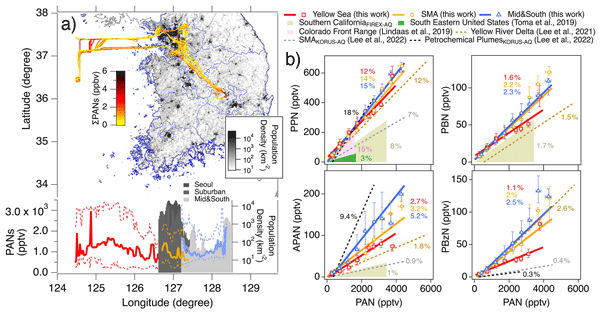
Young Ro Lee, Linda Arterburn, Masayuki Takeuchi, David J. Tanner, James M. Roberts, Behrooz Roozitalab, Daun Jeong, Alan J. Hills, Rebecca S. Hornbrook, Eric C. Apel, Simone Meinardi, Barbara Barletta, Nicola J. Blake, Donald R. Blake, Saewung Kim, Wojciech Wojnowski, Felix Piel, Armin Wisthaler, Katherine Ball, John D. Crounse, Paul O. Wennberg, Jason Miech, Yonghoon Choi, Joshua P. DiGangi, Glenn S. Diskin, Abby Sebol, Erin R. Delaria, Reem A. Hannun, Jason M. St. Clair, Glenn M. Wolfe, Changmin Cho, Courtney Owen, Kirk Lesko, Alessandro Franchin, Edward L. Winstead, Luke D. Ziemba, Richard Moore, Elizabeth B. Wiggins, Guy Symonds, Dongwook Kim, Douglas A. Day, Pedro Campuzano-Jost, Jose L. Jimenez, Kirk Ullmann, Samuel R. Hall, James H. Crawford, and L. Gregory Huey
Atmos. Chem. Phys., 26, 8695–8715, https://doi.org/10.5194/acp-26-8695-2026, https://doi.org/10.5194/acp-26-8695-2026, 2026
Short summary
Short summary
We flew a large variety of instruments on the NASA DC-8 research aircraft to measure pollution over South Korea in the winter of 2024. This works focuses on acyl peroxynitrates (PANs for short) which are formed by chemistry in air. We found high levels of PANs often associated with industrial emissions of pollutants such as ethanol and ethylene oxide. This work helps to understand how to reduce pollution of this sort.
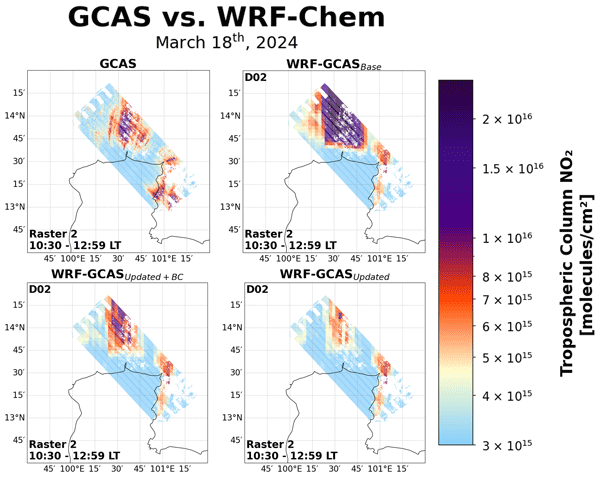
Julianna A. Christopoulos, Pablo E. Saide, Manas R. Mohanty, Nattamon Maneenoi, Jhoon Kim, Laura Judd, Katherine R. Travis, Savitri Garivait, Agapol Junpen, Kazuyuki Miyazaki, Jinkyul Choi, Takashi Sekiya, David Peterson, Theodore M. McHardy, Nicholas Gapp, Jason M. St. Clair, Erin Delaria, Glenn M. Wolfe, Abby Sebol, Alessandro Franchin, Changmin Cho, Morgan L. Silverman, and James H. Crawford
Atmos. Chem. Phys., 26, 8021–8050, https://doi.org/10.5194/acp-26-8021-2026, https://doi.org/10.5194/acp-26-8021-2026, 2026
Short summary
Short summary
Air quality in rapidly growing cities is difficult to model because emissions vary during the day and are often poorly constrained. We demonstrate a methodology for constraining urban emissions using hourly satellite observations combined with high-resolution air quality modeling in Bangkok. We find that emissions inventories likely overestimate nitrogen dioxide emissions, and that updated emissions improve agreement between the model and independent aircraft and ground-based observations.
Jinkyul Choi, Kazuyuki Miyazaki, Takashi Sekiya, Jinhyeok Yu, Shin-Ya Ogino, Henk Eskes, Pieter Rijdijk, Ryan Bennett, Anke Roiger, Leon Knez, Glenn S. Diskin, Jason A. Miech, Joshua P. DiGangi, Yonghoon Choi, Alessandro Franchin, Changmin Cho, Eric C. Apel, Louisa K. Emmons, Nattamon Maneenoi, Jason M. St. Clair, Reem A. Hannun, Glenn M. Wolfe, Erin Delaria, Abby Sebol, Donald R. Blake, Monica Crippa, Rachel M. Hoesly, Steven J. Smith, Jung-Hun Woo, Le Kuai, and Ronald Macatangay
EGUsphere, https://doi.org/10.5194/egusphere-2026-2380, https://doi.org/10.5194/egusphere-2026-2380, 2026
Short summary
Short summary
Asia produces half of the world's air pollution, yet emission estimates from different sources disagree widely. We assimilated satellite observations of six pollutant species to correct both concentrations and emissions. Aircraft measurements from a 2024 NASA campaign across four Asian countries confirmed the improvements. Our results reveal underreported emissions in some countries, overestimated vegetation emissions, unresolved fire estimates, and weather control on cross-border pollution.
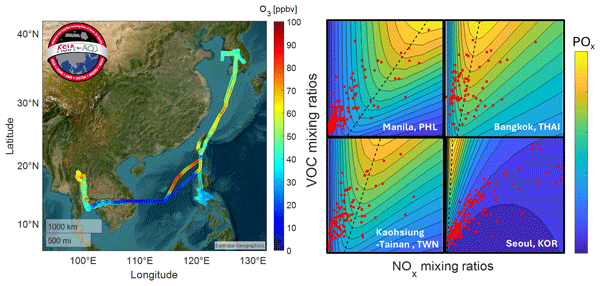
Changmin Cho, Alessandro Franchin, Frank Flocke, Kirk Lesko, Courtney Owen, Samuel R. Hall, Kirk Ullmann, Eric C. Apel, Alan J. Hills, Rebecca S. Hornbrook, Behrooz Roozitalab, Daun Jeong, Glenn S. Diskin, Yonghoon Choi, Joshua P. DiGangi, Jason Miech, Glenn M. Wolfe, Thomas F. Hanisco, Jason M. St. Clair, Jin Liao, Erin R. Delaria, Abby Sebol, Reem A. Hannun, Paul O. Wennberg, Katherine Ball, Young Ro Lee, L. Gregory Huey, David J. Tanner, Linda Arterburn, Donald R. Blake, Nicola J. Blake, Barbara Barletta, Simone Meinardi, Kyung-Eun Min, Heejoo Kang, Woohui Nam, Armin Wisthaler, Felix Piel, Wojciech Wojnowski, Jack Dibb, and James Crawford
Atmos. Chem. Phys., 26, 6097–6116, https://doi.org/10.5194/acp-26-6097-2026, https://doi.org/10.5194/acp-26-6097-2026, 2026
Short summary
Short summary
Ozone pollution is a challenge in Asian cities due to its nonlinear response to precursor controls. Using aircraft measurements, we examined how ozone production depends on nitrogen oxides and volatile organic compounds using a new isopleth-based approach. Ozone production is limited by nitrogen oxides in Metro Manila and Tainan–Kaohsiung, mixed in Bangkok, and limited by volatile organic compounds in Seoul. These results inform city-specific control strategies to reduce ozone in urban areas.
Magesh Mohan, Amy Sullivan, Emily Lill, Ilana Pollack, Alison Piasecki, Sarah Albertin, Ann Middlebrook, Wyndom Chace, Andrew Rollins, Carsten Warneke, Steven Brown, Lu Xu, Katherine Ball, John Crounse, Paul Wennberg, Stelios Kakavas, Spyros Pandis, Athanasios Nenes, and Rodney Weber
EGUsphere, https://doi.org/10.5194/egusphere-2026-4960, https://doi.org/10.5194/egusphere-2026-4960, 2026
This preprint is open for discussion and under review for Atmospheric Chemistry and Physics (ACP).
Short summary
Short summary
Atmospheric fine particles contain liquid water and can be highly acidic. The amount of water and the acidity affect how these particles impact human health, ecosystems, and climate. Flying an aircraft across the continental United States in summer 2023, with a focus on four North American cities, we measured the properties needed to model particle water and acidity. We found the particles were consistently strongly acidic, even within wildfire smoke, and verified the model against observations.
Carly KleinStern, Benjamin Clouser, Thaopaul Bui, Jonathan Dean-Day, Adrien Desmoulin, James Franke, Hisashi Nakamura, Rei Ueyama, Shingo Watanabe, and Elisabeth Moyer
EGUsphere, https://doi.org/10.5194/egusphere-2026-4533, https://doi.org/10.5194/egusphere-2026-4533, 2026
This preprint is open for discussion and under review for Atmospheric Chemistry and Physics (ACP).
Short summary
Short summary
Tropical cyclones (TCs) create gravity waves that spread in near-concentric rings above the storm, creating temperature fluctuations that help dry the stratosphere via cirrus formation. Understanding the amplitudes of those waves has been difficult because few direct measurements exist. We show new measurements taken during a high-altitude overflight of TC Hinnamnor in 2022. The large wave observed suggests that TC gravity waves are underestimated in the commonly-used ERA5 reanalysis.
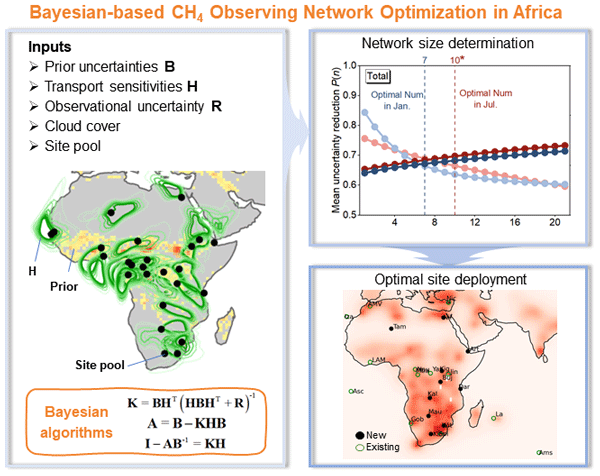
Hui Li, Philippe Ciais, Frédéric Chevallier, Bo Zheng, Paul I. Palmer, Frank Hase, Morgan Lopez, Elsa M. Ordway, Shushi Peng, Danielle Monteverde, Michel Ramonet, Jason M. St. Clair, Le Bienfaiteur Sagang, and Benjamin Poulter
Atmos. Chem. Phys., 26, 11893–11908, https://doi.org/10.5194/acp-26-11893-2026, https://doi.org/10.5194/acp-26-11893-2026, 2026
Short summary
Short summary
We studied how to best place methane monitoring instruments across Africa to better understand where emissions come from. Because observations can overlap in what they detect, adding more sites does not always improve results equally. Using a statistical approach, we identified both the ideal number and locations of sites (ten new sites can reduce emission uncertainty by over 65 % for total African CH4). Our results help guide cost-effective monitoring strategies in regions with limited data.
Xin Chen, Dylan B. Millet, Glenn M. Wolfe, Erin R. Delaria, M. Julian Deventer, Markus Müller, Arne Schiller, Kenneth Lee Thornhill, and Armin Wisthaler
Atmos. Meas. Tech., 19, 5353–5372, https://doi.org/10.5194/amt-19-5353-2026, https://doi.org/10.5194/amt-19-5353-2026, 2026
Short summary
Short summary
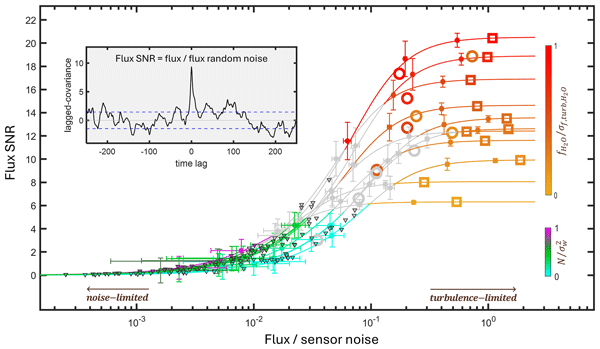
Air-sea exchange is a major uncertainty source for many volatile organic compounds (VOCs). Aircraft-based eddy covariance can be used to quantify these fluxes over large regions but such applications have been limited. We used observations over the Atlantic to characterize VOC fluxes and elucidate the drivers of measurement error. Results show how sensor noise and turbulent variability interact to determine flux detectability, and define instrumental priorities for future use of this technique.
Apoorva Pandey, Bryan K. Place, Thomas F. Hanisco, Jong-Uk Park, Elena S. Lind, Jason M. St. Clair, Erin R. Delaria, Glenn M. Wolfe, Ronaldo Lopez, Paul V. Zimba, and K. Lee Thornhill
EGUsphere, https://doi.org/10.5194/egusphere-2026-3479, https://doi.org/10.5194/egusphere-2026-3479, 2026
Short summary
Short summary
The burden and vertical distribution of formaldehyde affects air quality and health. Pandora ground instruments observe formaldehyde in the lower atmosphere using scattered sunlight. The quality of these continuous daytime measurements needs evaluation. We compared these measurements with aircraft observations at four U.S. East Coast sites and found strong agreement at all comparison sites. We also improved the Pandora algorithm to better capture the vertical distribution of formaldehyde.
David Wilmouth, Jennifer Hare, Laila Howar, Ross Salawitch, Eric Hintsa, Jessica Smith, David Sayres, James Anderson, Jason St. Clair, Erin Delaria, Reem Hannun, Thomas Hanisco, Daniel Czizco, Xiaoli Shen, Cameron Homeyer, Michelle Santee, T. Paul Bui, Paul Newman, Frank Keutsch, and Kenneth Bowman
EGUsphere, https://doi.org/10.5194/egusphere-2026-3480, https://doi.org/10.5194/egusphere-2026-3480, 2026
Short summary
Short summary
Inorganic chlorine chemistry in the stratosphere is extensively examined over two summers using high precision in situ aircraft data and satellite data. Measured values both agree and enable refinement to current understanding. Chlorine measurements obtained under perturbed stratospheric conditions of enhanced water vapor from convective storms or aged organic aerosol from wildfires do not appear significantly different from chlorine measurements obtained in the background stratosphere.
Young Ro Lee, Linda Arterburn, Masayuki Takeuchi, David J. Tanner, James M. Roberts, Behrooz Roozitalab, Daun Jeong, Alan J. Hills, Rebecca S. Hornbrook, Eric C. Apel, Simone Meinardi, Barbara Barletta, Nicola J. Blake, Donald R. Blake, Saewung Kim, Wojciech Wojnowski, Felix Piel, Armin Wisthaler, Katherine Ball, John D. Crounse, Paul O. Wennberg, Jason Miech, Yonghoon Choi, Joshua P. DiGangi, Glenn S. Diskin, Abby Sebol, Erin R. Delaria, Reem A. Hannun, Jason M. St. Clair, Glenn M. Wolfe, Changmin Cho, Courtney Owen, Kirk Lesko, Alessandro Franchin, Edward L. Winstead, Luke D. Ziemba, Richard Moore, Elizabeth B. Wiggins, Guy Symonds, Dongwook Kim, Douglas A. Day, Pedro Campuzano-Jost, Jose L. Jimenez, Kirk Ullmann, Samuel R. Hall, James H. Crawford, and L. Gregory Huey
Atmos. Chem. Phys., 26, 8695–8715, https://doi.org/10.5194/acp-26-8695-2026, https://doi.org/10.5194/acp-26-8695-2026, 2026
Short summary
Short summary
We flew a large variety of instruments on the NASA DC-8 research aircraft to measure pollution over South Korea in the winter of 2024. This works focuses on acyl peroxynitrates (PANs for short) which are formed by chemistry in air. We found high levels of PANs often associated with industrial emissions of pollutants such as ethanol and ethylene oxide. This work helps to understand how to reduce pollution of this sort.
Julianna A. Christopoulos, Pablo E. Saide, Manas R. Mohanty, Nattamon Maneenoi, Jhoon Kim, Laura Judd, Katherine R. Travis, Savitri Garivait, Agapol Junpen, Kazuyuki Miyazaki, Jinkyul Choi, Takashi Sekiya, David Peterson, Theodore M. McHardy, Nicholas Gapp, Jason M. St. Clair, Erin Delaria, Glenn M. Wolfe, Abby Sebol, Alessandro Franchin, Changmin Cho, Morgan L. Silverman, and James H. Crawford
Atmos. Chem. Phys., 26, 8021–8050, https://doi.org/10.5194/acp-26-8021-2026, https://doi.org/10.5194/acp-26-8021-2026, 2026
Short summary
Short summary
Air quality in rapidly growing cities is difficult to model because emissions vary during the day and are often poorly constrained. We demonstrate a methodology for constraining urban emissions using hourly satellite observations combined with high-resolution air quality modeling in Bangkok. We find that emissions inventories likely overestimate nitrogen dioxide emissions, and that updated emissions improve agreement between the model and independent aircraft and ground-based observations.
Jinkyul Choi, Kazuyuki Miyazaki, Takashi Sekiya, Jinhyeok Yu, Shin-Ya Ogino, Henk Eskes, Pieter Rijdijk, Ryan Bennett, Anke Roiger, Leon Knez, Glenn S. Diskin, Jason A. Miech, Joshua P. DiGangi, Yonghoon Choi, Alessandro Franchin, Changmin Cho, Eric C. Apel, Louisa K. Emmons, Nattamon Maneenoi, Jason M. St. Clair, Reem A. Hannun, Glenn M. Wolfe, Erin Delaria, Abby Sebol, Donald R. Blake, Monica Crippa, Rachel M. Hoesly, Steven J. Smith, Jung-Hun Woo, Le Kuai, and Ronald Macatangay
EGUsphere, https://doi.org/10.5194/egusphere-2026-2380, https://doi.org/10.5194/egusphere-2026-2380, 2026
Short summary
Short summary
Asia produces half of the world's air pollution, yet emission estimates from different sources disagree widely. We assimilated satellite observations of six pollutant species to correct both concentrations and emissions. Aircraft measurements from a 2024 NASA campaign across four Asian countries confirmed the improvements. Our results reveal underreported emissions in some countries, overestimated vegetation emissions, unresolved fire estimates, and weather control on cross-border pollution.
Changmin Cho, Alessandro Franchin, Frank Flocke, Kirk Lesko, Courtney Owen, Samuel R. Hall, Kirk Ullmann, Eric C. Apel, Alan J. Hills, Rebecca S. Hornbrook, Behrooz Roozitalab, Daun Jeong, Glenn S. Diskin, Yonghoon Choi, Joshua P. DiGangi, Jason Miech, Glenn M. Wolfe, Thomas F. Hanisco, Jason M. St. Clair, Jin Liao, Erin R. Delaria, Abby Sebol, Reem A. Hannun, Paul O. Wennberg, Katherine Ball, Young Ro Lee, L. Gregory Huey, David J. Tanner, Linda Arterburn, Donald R. Blake, Nicola J. Blake, Barbara Barletta, Simone Meinardi, Kyung-Eun Min, Heejoo Kang, Woohui Nam, Armin Wisthaler, Felix Piel, Wojciech Wojnowski, Jack Dibb, and James Crawford
Atmos. Chem. Phys., 26, 6097–6116, https://doi.org/10.5194/acp-26-6097-2026, https://doi.org/10.5194/acp-26-6097-2026, 2026
Short summary
Short summary
Ozone pollution is a challenge in Asian cities due to its nonlinear response to precursor controls. Using aircraft measurements, we examined how ozone production depends on nitrogen oxides and volatile organic compounds using a new isopleth-based approach. Ozone production is limited by nitrogen oxides in Metro Manila and Tainan–Kaohsiung, mixed in Bangkok, and limited by volatile organic compounds in Seoul. These results inform city-specific control strategies to reduce ozone in urban areas.
Endre Z. Farago, Laura A. McBride, Brian F. Bennett, Austin P. Hope, Timothy P. Canty, and Ross J. Salawitch
Earth Syst. Dynam., 17, 451–474, https://doi.org/10.5194/esd-17-451-2026, https://doi.org/10.5194/esd-17-451-2026, 2026
Short summary
Short summary
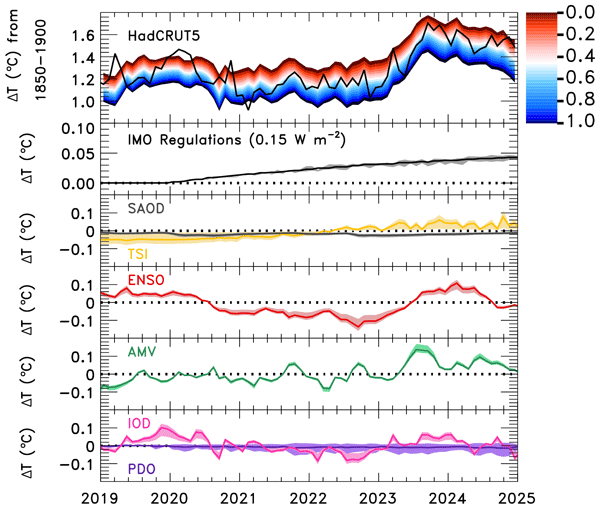
Global mean surface temperature anomalies in 2023 and 2024 were the highest on the modern record. We quantify contributions to these anomalies from human activity, including the steep reduction in sulfur emissions from ships that began in 2020, and numerous natural factors. We attribute about 92% of the observed anomalies to a combination of various human-induced and natural factors, including important contributions from the reduction in marine sulfur emissions and the Indian Ocean Dipole.
Daun Jeong, Rebecca S. Hornbrook, Alan J. Hills, Glenn Diskin, Hannah S. Halliday, Joshua P. DiGangi, Alan Fried, Dirk Richter, James Walega, Petter Weibring, Thomas F. Hanisco, Glenn M. Wolfe, Jason St. Clair, Jeff Peischl, Armin Wisthaler, Tomas Mikoviny, John B. Nowak, Felix Piel, Laura Tomsche, Christopher D. Holmes, Amber Soja, Emily Gargulinski, James H. Crawford, Jack Dibb, Carsten Warneke, Joshua Schwarz, and Eric C. Apel
Atmos. Meas. Tech., 19, 2985–3000, https://doi.org/10.5194/amt-19-2985-2026, https://doi.org/10.5194/amt-19-2985-2026, 2026
Short summary
Short summary
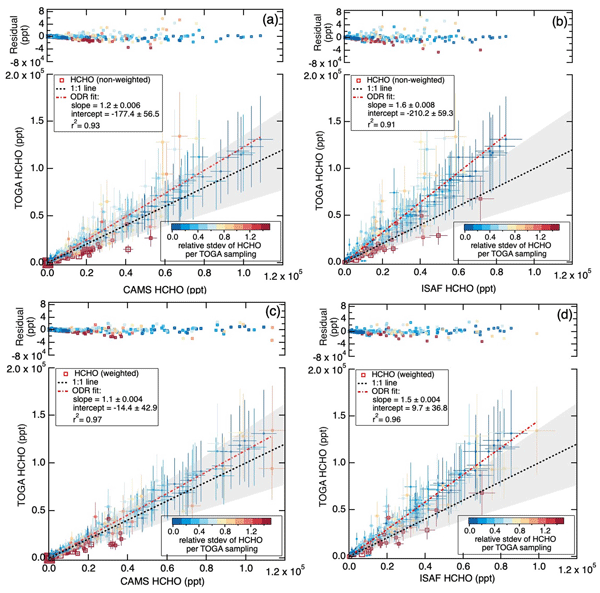
Formaldehyde is an important atmospheric species that is present at all times throughout the troposphere. Accurately measuring formaldehyde is necessary for understanding key atmospheric chemical cycles. We describe here the first wide-scale demonstration of the gas chromatographic mass spectrometric (GC/MS) technique (NSF NCAR TOGA-TOF (National Science Foundation - National Center for Atmospheric Research - Trace Organic Gas Analyzer with Time-of-Flight mass spectrometer)) for quantifying formaldehyde in the atmosphere and we show this technique to be highly sensitive and selective.
James R. Campbell, Brice Temime-Roussel, Barbara D'Anna, Kathy S. Law, Weihang Zhang, Rodney J. Weber, Michael Battaglia Jr., Kayane K. Dingilian, Meeta Cesler-Maloney, Jason M. St. Clair, and Jingqiu Mao
EGUsphere, https://doi.org/10.5194/egusphere-2026-2073, https://doi.org/10.5194/egusphere-2026-2073, 2026
Short summary
Short summary
Fairbanks, Alaska experiences episodes of high concentrations of PM2.5 pollution in the wintertime. The sources and mixing ratios of gas-phase pollution, and the extent to which it affects the formation of PM2.5, are not well understood. Here, we examine the sources of gas-phase species measured in wintertime Fairbanks. We compare these results with other PM2.5 measurements to determine how various sources can affect the formation of PM2.5 pollution.
Leon Knez, Maximilian Eckl, Paul Waldmann, Alina Fiehn, Magdalena Pühl, Oleg Aseev, Glenn S. Diskin, Joshua P. DiGangi, Yonghoon Choi, Jason A. Miech, Ryan Bennett, Charles K. Gatebe, Jonathan M. Dean-Day, Rajesh Poudyal, Gangwoong Lee, Jeonghwan Kim, and Anke Roiger
EGUsphere, https://doi.org/10.5194/egusphere-2026-1686, https://doi.org/10.5194/egusphere-2026-1686, 2026
Short summary
Short summary
To mitigate N2O emissions, the processes behind the emissions need to be well understood. Because of this, we developed a new measurement setup for precise and simultaneously fast airborne in-situ N2O measurements. We developed an empirical water vapor correction enabling measurements in regions with high humidity and found no significant influence of different flight parameters on the measurements during two campaigns. This setup can help to measure N2O in humid and undersampled regions.

Loren G. Temple, Stuart Young, Thomas Bannan, Stephanie E. Batten, Stéphane Bauguitte, Hugh Coe, Eve Grant, Stuart E. Lacy, James D. Lee, Emily Matthews, Dominika Pasternak, Samuel D. A. Rogers, Andrew W. Rollins, Jake Vallow, Mingxi Yang, and Pete M. Edwards
Atmos. Meas. Tech., 19, 1165–1178, https://doi.org/10.5194/amt-19-1165-2026, https://doi.org/10.5194/amt-19-1165-2026, 2026
Short summary
Short summary
Sulfur dioxide (SO2) is a key precursor to aerosol formation, particularly in remote marine environments, ultimately affecting cloud properties and climate. Accurate quantification of atmospheric SO2 is therefore crucial. This work compares a custom-built laser-based instrument to two commercial SO2 analysers during measurements from a large research aircraft. Our results show that this custom-built system offers greater sensitivity at time resolutions required for aircraft measurements.

Benjamin W. Clouser, Carly C. KleinStern, Adrien Desmoulin, Clare E. Singer, Jason M. St. Clair, Thomas F. Hanisco, David S. Sayres, and Elisabeth J. Moyer
Atmos. Meas. Tech., 19, 1147–1163, https://doi.org/10.5194/amt-19-1147-2026, https://doi.org/10.5194/amt-19-1147-2026, 2026
Short summary
Short summary
Water molecules comes in several varieties, of which H216O is the most common. These varieties behave differently enough under freezing to create strong changes in the ratio of heavy to light water molecules. Here we compare observations of these ratios from satellites and high-altitude airborne instruments. These observations provide information about how air reaches the upper parts of the atmosphere, so it is important to reconcile difference between different modes of observations.
Allison R. Moon, Leyang Liu, Xuan Wang, Yuk-Chun Chan, Alyson Fritzmann, Ryan Pound, Amy Lees, Lewis Marden, Mat Evans, Lucy J. Carpenter, Jochen Stutz, Joel A. Thornton, Gordon Novak, Andrew Rollins, Gregory P. Schill, Xu-Cheng He, Henning Finkenzeller, Mago Reza, Rainer Volkamer, Kelvin H. Bates, Alfonso Saiz-Lopez, Anoop S. Mahajan, and Becky Alexander
Atmos. Chem. Phys., 26, 2353–2389, https://doi.org/10.5194/acp-26-2353-2026, https://doi.org/10.5194/acp-26-2353-2026, 2026
Short summary
Short summary
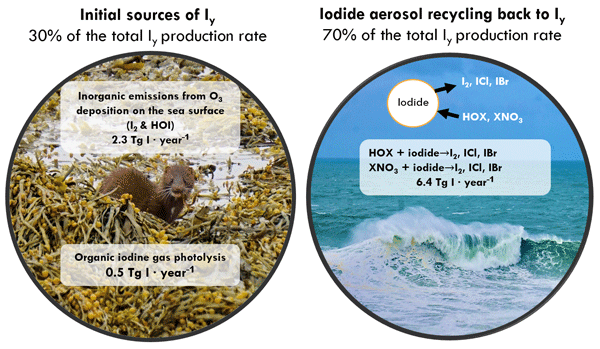
Global chemical transport models previously treated aerosols as a sink for reactive iodine (Iy); however, aerosol iodide is also a source of Iy via heterogeneous reactions involving hypohalous acids and halogen nitrates. We implemented this chemistry into GEOS-Chem, in addition to explicitly representing three aerosol iodine types: soluble organic iodine (SOI), iodide, and iodate. We found that aerosol recycling of iodide to form Iy is more than twice as fast as the other Iy sources combined.
Kasper Juurikkala, Christina J. Williamson, Karl D. Froyd, Jonathan Dean-Day, and Ari Laaksonen
Atmos. Chem. Phys., 25, 13995–14013, https://doi.org/10.5194/acp-25-13995-2025, https://doi.org/10.5194/acp-25-13995-2025, 2025
Short summary
Short summary
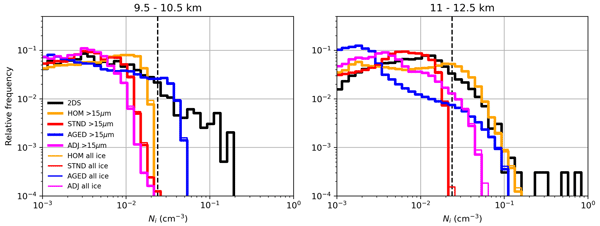
This study uses Large Eddy Simulations (LES) to investigate synoptic cirrus clouds from NASA’s Mid-latitude Airborne Cirrus Properties Experiment (MACPEX) campaign. Results show that prior heterogeneous ice nucleation depletes ice nuclei, creating conditions for subsequent homogeneous freezing. The findings highlight limitations of ice residual analysis in capturing cirrus evolution and provide insights into aerosol-cloud interactions critical to atmospheric and climate processes.
Endre Z. Farago, Laura A. McBride, Austin P. Hope, Timothy P. Canty, Brian F. Bennett, and Ross J. Salawitch
Earth Syst. Dynam., 16, 1739–1758, https://doi.org/10.5194/esd-16-1739-2025, https://doi.org/10.5194/esd-16-1739-2025, 2025
Short summary
Short summary
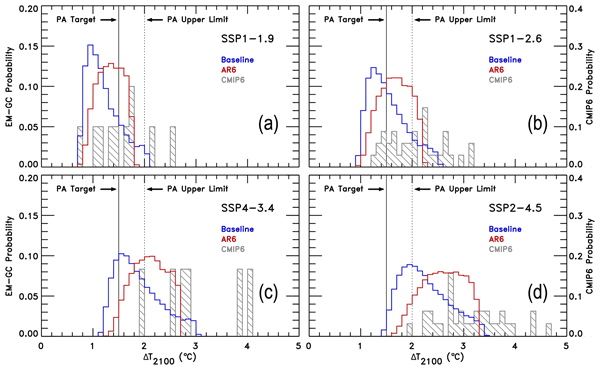
We show that recent assessed updates to the future abundance and radiative forcing (RF) of greenhouse gases (GHGs) and tropospheric aerosols result in a 0.2 to 0.4 ⁰C rise in global mean surface temperature by the end of the century, relative to prior projections. For society to have confidence in achieving the 2 ⁰C warming limit of the Paris Agreement, the RF due to GHGs and aerosols must be placed close to the primary 2.6 W m−2 Shared Socioeconomic Pathway scenario (SSP1−2.6) over the coming decades.
Jiaqi Shen, Ronald C. Cohen, Glenn M. Wolfe, and Xiaomeng Jin
Atmos. Chem. Phys., 25, 8701–8718, https://doi.org/10.5194/acp-25-8701-2025, https://doi.org/10.5194/acp-25-8701-2025, 2025
Short summary
Short summary
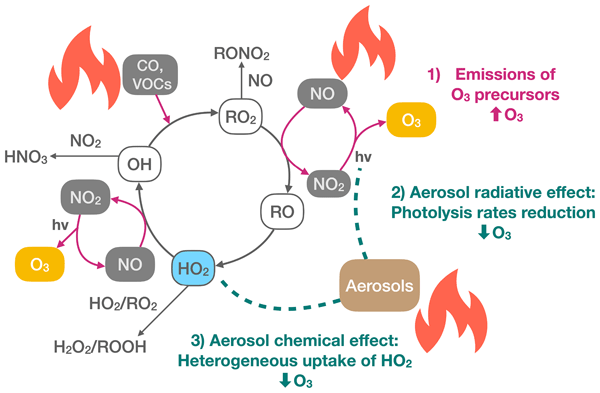
This study shows large chemical and radiative effects of smoke aerosols from fires on near-surface ozone production. Aerosol loading and NOx levels are identified as the primary factors influencing these effects. Furthermore, we show that the ratio of surface PM2.5 to NO2 tropospheric column can be used as an indicator for identifying aerosol-dominated regimes, facilitating the assessment of aerosol impacts on ozone formation through satellite observations.
Jasna V. Pittman, Bruce C. Daube, Steven C. Wofsy, Elliot L. Atlas, Maria A. Navarro, Eric J. Hintsa, Fred L. Moore, Geoff S. Dutton, James W. Elkins, Troy D. Thornberry, Andrew W. Rollins, Eric J. Jensen, Thaopaul Bui, Jonathan Dean-Day, and Leonhard Pfister
Atmos. Chem. Phys., 25, 7543–7562, https://doi.org/10.5194/acp-25-7543-2025, https://doi.org/10.5194/acp-25-7543-2025, 2025
Short summary
Short summary
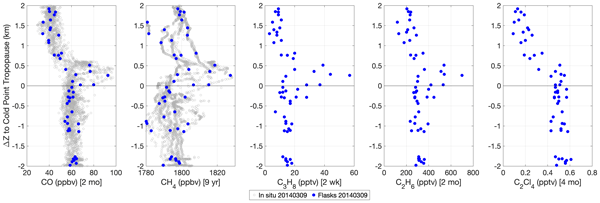
Biomass fires emit aerosols and precursors that can provide a novel environment for initiating stratospheric ozone loss. The Airborne Tropical TRopopause EXperiment campaign sampled the western Pacific, the dominant longitudes for surface air lofted by convection to enter the global stratosphere. Aircraft measurements over multiple flights revealed persistent layers of biomass burning pollutants entering the lower stratosphere and originating from fires as far away as Africa and Indonesia.
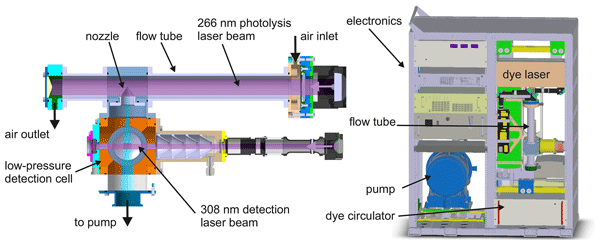
Hendrik Fuchs, Aaron Stainsby, Florian Berg, René Dubus, Michelle Färber, Andreas Hofzumahaus, Frank Holland, Kelvin H. Bates, Steven S. Brown, Matthew M. Coggon, Glenn S. Diskin, Georgios I. Gkatzelis, Christopher M. Jernigan, Jeff Peischl, Michael A. Robinson, Andrew W. Rollins, Nell B. Schafer, Rebecca H. Schwantes, Chelsea E. Stockwell, Patrick R. Veres, Carsten Warneke, Eleanor M. Waxman, Lu Xu, Kristen Zuraski, Andreas Wahner, and Anna Novelli
Atmos. Meas. Tech., 18, 881–895, https://doi.org/10.5194/amt-18-881-2025, https://doi.org/10.5194/amt-18-881-2025, 2025
Short summary
Short summary
Significant improvements have been made to the instruments used to measure OH reactivity, which is equivalent to the sum of air pollutant concentrations. Accurate and precise measurements with a high time resolution have been achieved, allowing use on aircraft, as demonstrated during flights in the USA.
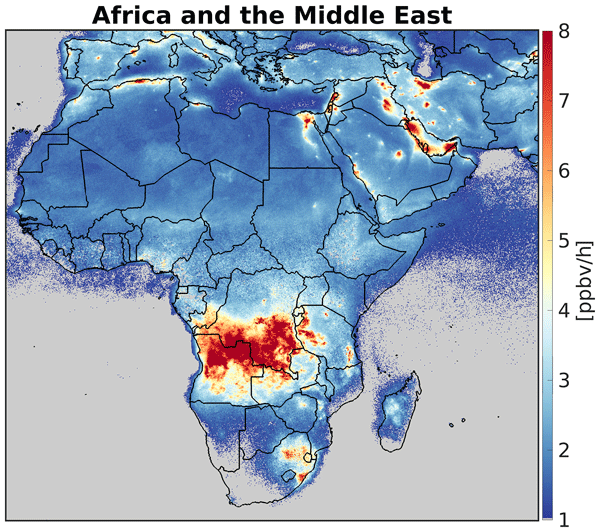
Amir H. Souri, Gonzalo González Abad, Glenn M. Wolfe, Tijl Verhoelst, Corinne Vigouroux, Gaia Pinardi, Steven Compernolle, Bavo Langerock, Bryan N. Duncan, and Matthew S. Johnson
Atmos. Chem. Phys., 25, 2061–2086, https://doi.org/10.5194/acp-25-2061-2025, https://doi.org/10.5194/acp-25-2061-2025, 2025
Short summary
Short summary
We establish a simple yet robust relationship between ozone production rates and geophysical parameters obtained from several intensive atmospheric composition campaigns. We show that satellite remote sensing data can effectively constrain these parameters, enabling us to produce the first global maps of ozone production rates with unprecedented resolution.
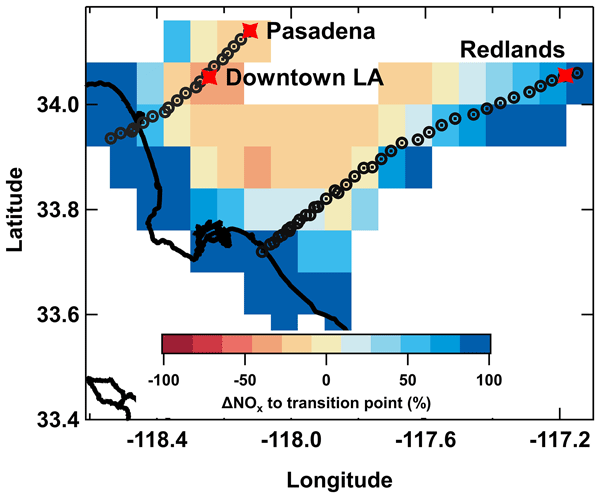
Chelsea E. Stockwell, Matthew M. Coggon, Rebecca H. Schwantes, Colin Harkins, Bert Verreyken, Congmeng Lyu, Qindan Zhu, Lu Xu, Jessica B. Gilman, Aaron Lamplugh, Jeff Peischl, Michael A. Robinson, Patrick R. Veres, Meng Li, Andrew W. Rollins, Kristen Zuraski, Sunil Baidar, Shang Liu, Toshihiro Kuwayama, Steven S. Brown, Brian C. McDonald, and Carsten Warneke
Atmos. Chem. Phys., 25, 1121–1143, https://doi.org/10.5194/acp-25-1121-2025, https://doi.org/10.5194/acp-25-1121-2025, 2025
Short summary
Short summary
In urban areas, emissions from everyday products like paints, cleaners, and personal care products, along with non-traditional sources such as cooking, are increasingly important and impact air quality. This study uses a box model to evaluate how these emissions impact ozone in the Los Angeles Basin and quantifies the impact of gaseous cooking emissions. Accurate representation of these and other anthropogenic sources in inventories is crucial for informing effective air quality policies.
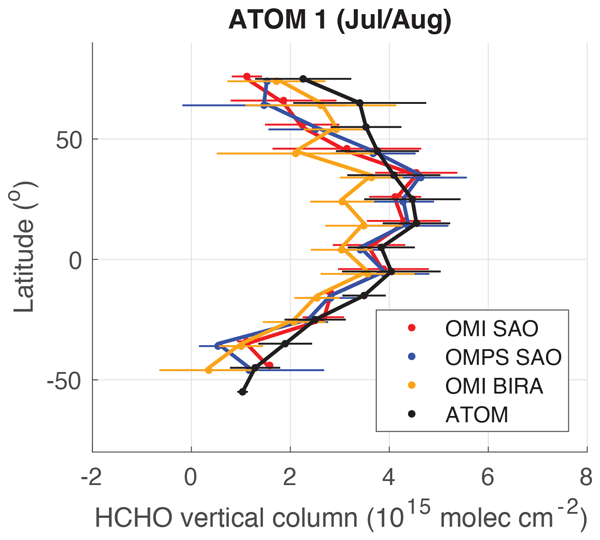
Jin Liao, Glenn M. Wolfe, Alexander E. Kotsakis, Julie M. Nicely, Jason M. St. Clair, Thomas F. Hanisco, Gonzalo González Abad, Caroline R. Nowlan, Zolal Ayazpour, Isabelle De Smedt, Eric C. Apel, and Rebecca S. Hornbrook
Atmos. Meas. Tech., 18, 1–16, https://doi.org/10.5194/amt-18-1-2025, https://doi.org/10.5194/amt-18-1-2025, 2025
Short summary
Short summary
Validation of satellite HCHO over the remote marine regions is relatively low, and modeled HCHO in these regions is usually added as a global satellite HCHO background. This paper intercompares three satellite HCHO retrievals and validates them against in situ observations from the NASA ATom mission. All retrievals are correlated with ATom-integrated columns over remote oceans, with OMI SAO (v004) showing the best agreement. A persistent low bias is found in all retrievals at high latitudes.
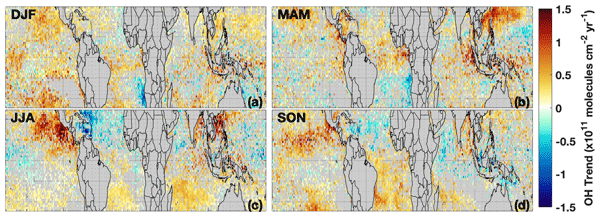
Bryan N. Duncan, Daniel C. Anderson, Arlene M. Fiore, Joanna Joiner, Nickolay A. Krotkov, Can Li, Dylan B. Millet, Julie M. Nicely, Luke D. Oman, Jason M. St. Clair, Joshua D. Shutter, Amir H. Souri, Sarah A. Strode, Brad Weir, Glenn M. Wolfe, Helen M. Worden, and Qindan Zhu
Atmos. Chem. Phys., 24, 13001–13023, https://doi.org/10.5194/acp-24-13001-2024, https://doi.org/10.5194/acp-24-13001-2024, 2024
Short summary
Short summary
Trace gases emitted to or formed within the atmosphere may be chemically or physically removed from the atmosphere. One trace gas, the hydroxyl radical (OH), is responsible for initiating the chemical removal of many trace gases, including some greenhouse gases. Despite its importance, scientists have not been able to adequately measure OH. In this opinion piece, we discuss promising new methods to indirectly constrain OH using satellite data of trace gases that control the abundance of OH.
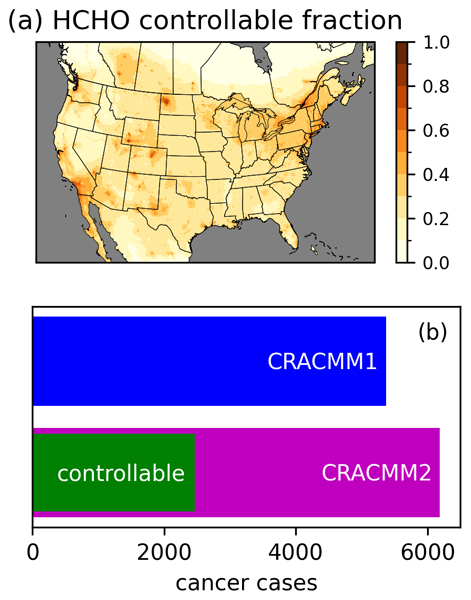
T. Nash Skipper, Emma L. D'Ambro, Forwood C. Wiser, V. Faye McNeill, Rebecca H. Schwantes, Barron H. Henderson, Ivan R. Piletic, Colleen B. Baublitz, Jesse O. Bash, Andrew R. Whitehill, Lukas C. Valin, Asher P. Mouat, Jennifer Kaiser, Glenn M. Wolfe, Jason M. St. Clair, Thomas F. Hanisco, Alan Fried, Bryan K. Place, and Havala O.T. Pye
Atmos. Chem. Phys., 24, 12903–12924, https://doi.org/10.5194/acp-24-12903-2024, https://doi.org/10.5194/acp-24-12903-2024, 2024
Short summary
Short summary
We develop the Community Regional Atmospheric Chemistry Multiphase Mechanism (CRACMM) version 2 to improve predictions of formaldehyde in ambient air compared to satellite-, aircraft-, and ground-based observations. With the updated chemistry, we estimate the cancer risk from inhalation exposure to ambient formaldehyde across the contiguous USA and predict that 40 % of this risk is controllable through reductions in anthropogenic emissions of nitrogen oxides and reactive organic carbon.
Andrew O. Langford, Raul J. Alvarez II, Kenneth C. Aikin, Sunil Baidar, W. Alan Brewer, Steven S. Brown, Matthew M. Coggan, Patrick D. Cullis, Jessica Gilman, Georgios I. Gkatzelis, Detlev Helmig, Bryan J. Johnson, K. Emma Knowland, Rajesh Kumar, Aaron D. Lamplugh, Audra McClure-Begley, Brandi J. McCarty, Ann M. Middlebrook, Gabriele Pfister, Jeff Peischl, Irina Petropavlovskikh, Pamela S. Rickley, Andrew W. Rollins, Scott P. Sandberg, Christoph J. Senff, and Carsten Warneke
EGUsphere, https://doi.org/10.5194/egusphere-2024-1938, https://doi.org/10.5194/egusphere-2024-1938, 2024
Preprint withdrawn
Short summary
Short summary
High ozone (O3) formed by reactions of nitrogen oxides (NOx) and volatile organic compounds (VOCs) can harm human health and welfare. High O3 is usually associated with hot summer days, but under certain conditions, high O3 can also form under winter conditions. In this study, we describe a high O3 event that occurred in Colorado during the COVID-19 quarantine that was caused in part by the decrease in traffic, and in part by a shallow inversion created by descent of stratospheric air.
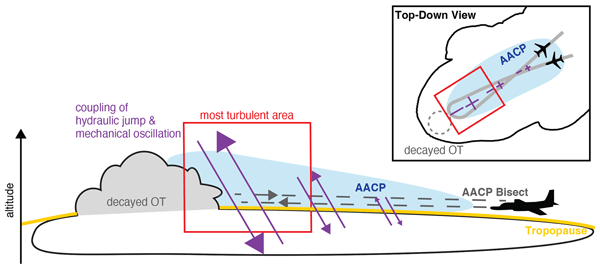
Andrea E. Gordon, Cameron R. Homeyer, Jessica B. Smith, Rei Ueyama, Jonathan M. Dean-Day, Elliot L. Atlas, Kate Smith, Jasna V. Pittman, David S. Sayres, David M. Wilmouth, Apoorva Pandey, Jason M. St. Clair, Thomas F. Hanisco, Jennifer Hare, Reem A. Hannun, Steven Wofsy, Bruce C. Daube, and Stephen Donnelly
Atmos. Chem. Phys., 24, 7591–7608, https://doi.org/10.5194/acp-24-7591-2024, https://doi.org/10.5194/acp-24-7591-2024, 2024
Short summary
Short summary
In situ airborne observations of ongoing tropopause-overshooting convection and an above-anvil cirrus plume from the 31 May 2022 flight of the Dynamics and Chemistry of the Summer Stratosphere (DCOTSS) field campaign are examined. Upper troposphere and lower stratosphere composition changes are evaluated along with possible contributing dynamical and physical processes. Measurements reveal multiple changes in air mass composition and stratospheric hydration throughout the flight.
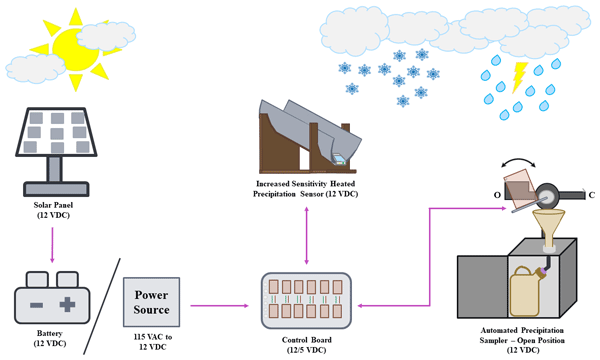
Alessia A. Colussi, Daniel Persaud, Melodie Lao, Bryan K. Place, Rachel F. Hems, Susan E. Ziegler, Kate A. Edwards, Cora J. Young, and Trevor C. VandenBoer
Atmos. Meas. Tech., 17, 3697–3718, https://doi.org/10.5194/amt-17-3697-2024, https://doi.org/10.5194/amt-17-3697-2024, 2024
Short summary
Short summary
A new modular and affordable instrument was developed to automatically collect wet deposition continuously with an off-grid solar top-up power package. Monthly collections were performed across the Newfoundland and Labrador Boreal Ecosystem Latitudinal Transect of experimental forest sites from 2015 to 2016. The proof-of-concept systems were validated with baseline measurements of pH and conductivity and then applied to dissolved organic carbon as an analyte of emerging biogeochemical interest.
Asher P. Mouat, Zelda A. Siegel, and Jennifer Kaiser
Atmos. Meas. Tech., 17, 1979–1994, https://doi.org/10.5194/amt-17-1979-2024, https://doi.org/10.5194/amt-17-1979-2024, 2024
Short summary
Short summary
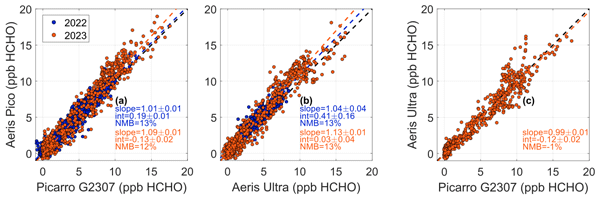
Three fast-measurement formaldehyde monitors were deployed at two field sites in Atlanta, GA, over 1 year. Four different zeroing methods were tested to develop an optimal field setup as well as procedures for instrument calibration. Observations agreed well after calibration but were much higher compared to the TO-11A monitoring method, which is the golden standard. Historical HCHO concentrations were compared with measurements in this work, showing a 22 % reduction in midday HCHO since 1999.
Huisheng Bian, Mian Chin, Peter R. Colarco, Eric C. Apel, Donald R. Blake, Karl Froyd, Rebecca S. Hornbrook, Jose Jimenez, Pedro Campuzano Jost, Michael Lawler, Mingxu Liu, Marianne Tronstad Lund, Hitoshi Matsui, Benjamin A. Nault, Joyce E. Penner, Andrew W. Rollins, Gregory Schill, Ragnhild B. Skeie, Hailong Wang, Lu Xu, Kai Zhang, and Jialei Zhu
Atmos. Chem. Phys., 24, 1717–1741, https://doi.org/10.5194/acp-24-1717-2024, https://doi.org/10.5194/acp-24-1717-2024, 2024
Short summary
Short summary
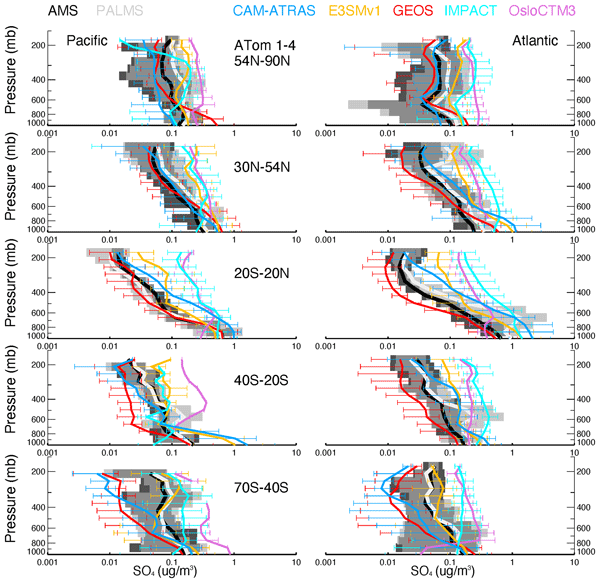
This work studies sulfur in the remote troposphere at global and seasonal scales using aircraft measurements and multi-model simulations. The goal is to understand the sulfur cycle over remote oceans, spread of model simulations, and observation–model discrepancies. Such an understanding and comparison with real observations are crucial to narrow down the uncertainties in model sulfur simulations and improve understanding of the sulfur cycle in atmospheric air quality, climate, and ecosystems.
Georgios I. Gkatzelis, Matthew M. Coggon, Chelsea E. Stockwell, Rebecca S. Hornbrook, Hannah Allen, Eric C. Apel, Megan M. Bela, Donald R. Blake, Ilann Bourgeois, Steven S. Brown, Pedro Campuzano-Jost, Jason M. St. Clair, James H. Crawford, John D. Crounse, Douglas A. Day, Joshua P. DiGangi, Glenn S. Diskin, Alan Fried, Jessica B. Gilman, Hongyu Guo, Johnathan W. Hair, Hannah S. Halliday, Thomas F. Hanisco, Reem Hannun, Alan Hills, L. Gregory Huey, Jose L. Jimenez, Joseph M. Katich, Aaron Lamplugh, Young Ro Lee, Jin Liao, Jakob Lindaas, Stuart A. McKeen, Tomas Mikoviny, Benjamin A. Nault, J. Andrew Neuman, John B. Nowak, Demetrios Pagonis, Jeff Peischl, Anne E. Perring, Felix Piel, Pamela S. Rickly, Michael A. Robinson, Andrew W. Rollins, Thomas B. Ryerson, Melinda K. Schueneman, Rebecca H. Schwantes, Joshua P. Schwarz, Kanako Sekimoto, Vanessa Selimovic, Taylor Shingler, David J. Tanner, Laura Tomsche, Krystal T. Vasquez, Patrick R. Veres, Rebecca Washenfelder, Petter Weibring, Paul O. Wennberg, Armin Wisthaler, Glenn M. Wolfe, Caroline C. Womack, Lu Xu, Katherine Ball, Robert J. Yokelson, and Carsten Warneke
Atmos. Chem. Phys., 24, 929–956, https://doi.org/10.5194/acp-24-929-2024, https://doi.org/10.5194/acp-24-929-2024, 2024
Short summary
Short summary
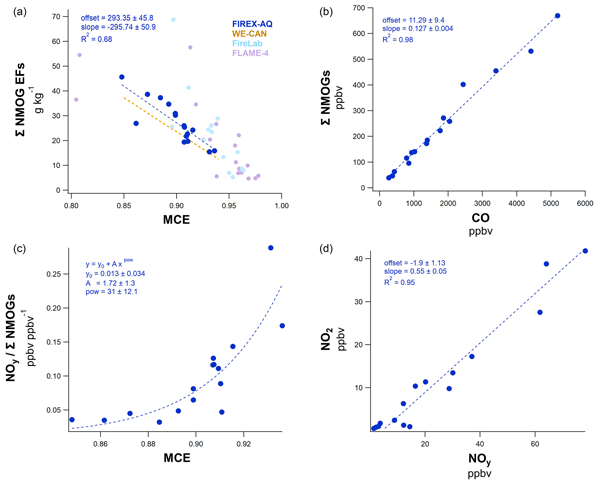
This study reports emissions of gases and particles from wildfires. These emissions are related to chemical proxies that can be measured by satellite and incorporated into models to improve predictions of wildfire impacts on air quality and climate.
Kevin C. Cossel, Eleanor M. Waxman, Eli Hoenig, Daniel Hesselius, Christopher Chaote, Ian Coddington, and Nathan R. Newbury
Atmos. Meas. Tech., 16, 5697–5707, https://doi.org/10.5194/amt-16-5697-2023, https://doi.org/10.5194/amt-16-5697-2023, 2023
Short summary
Short summary
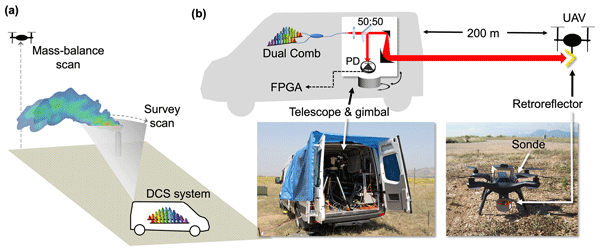
Measurements of the emission rate of a gas or gases from point and area sources are important in a range of monitoring applications. We demonstrate a method for rapid quantification of the emission rate of multiple gases using a spatially scannable open-path sensor. The open-path spectrometer measures the total column density of gases between the spectrometer and a retroreflector mounted on an uncrewed aerial vehicle (UAV). By scanning the UAV altitude, we can determine the total gas emissions.
Emma L. Yates, Laura T. Iraci, Susan S. Kulawik, Ju-Mee Ryoo, Josette E. Marrero, Caroline L. Parworth, Jason M. St. Clair, Thomas F. Hanisco, Thao Paul V. Bui, Cecilia S. Chang, and Jonathan M. Dean-Day
Earth Syst. Sci. Data, 15, 2375–2389, https://doi.org/10.5194/essd-15-2375-2023, https://doi.org/10.5194/essd-15-2375-2023, 2023
Short summary
Short summary
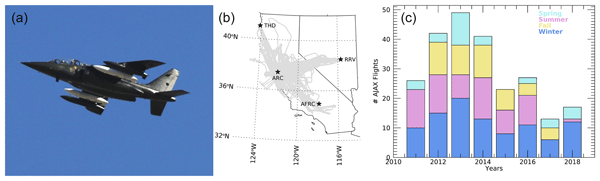
The Alpha Jet Atmospheric eXperiment (AJAX) flew scientific flights between 2011 and 2018 providing measurements of carbon dioxide, methane, ozone, formaldehyde, water vapor and meteorological parameters over California and Nevada, USA. AJAX was a multi-year, multi-objective, multi-instrument program with a variety of sampling strategies resulting in an extensive dataset of interest to a wide variety of users. AJAX measurements have been published at https://asdc.larc.nasa.gov/project/AJAX.
Amir H. Souri, Matthew S. Johnson, Glenn M. Wolfe, James H. Crawford, Alan Fried, Armin Wisthaler, William H. Brune, Donald R. Blake, Andrew J. Weinheimer, Tijl Verhoelst, Steven Compernolle, Gaia Pinardi, Corinne Vigouroux, Bavo Langerock, Sungyeon Choi, Lok Lamsal, Lei Zhu, Shuai Sun, Ronald C. Cohen, Kyung-Eun Min, Changmin Cho, Sajeev Philip, Xiong Liu, and Kelly Chance
Atmos. Chem. Phys., 23, 1963–1986, https://doi.org/10.5194/acp-23-1963-2023, https://doi.org/10.5194/acp-23-1963-2023, 2023
Short summary
Short summary
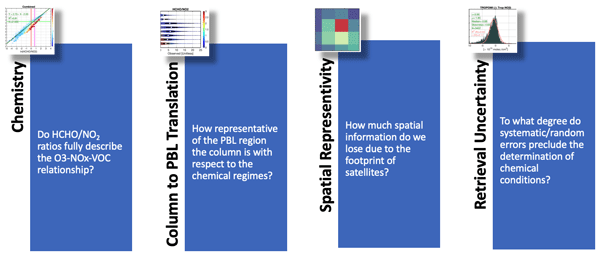
We have rigorously characterized different sources of error in satellite-based HCHO / NO2 tropospheric columns, a widely used metric for diagnosing near-surface ozone sensitivity. Specifically, the errors were categorized/quantified into (i) an inherent chemistry error, (ii) the decoupled relationship between columns and the near-surface concentration, (iii) the spatial representativeness error of ground satellite pixels, and (iv) the satellite retrieval errors.
Hao Guo, Clare M. Flynn, Michael J. Prather, Sarah A. Strode, Stephen D. Steenrod, Louisa Emmons, Forrest Lacey, Jean-Francois Lamarque, Arlene M. Fiore, Gus Correa, Lee T. Murray, Glenn M. Wolfe, Jason M. St. Clair, Michelle Kim, John Crounse, Glenn Diskin, Joshua DiGangi, Bruce C. Daube, Roisin Commane, Kathryn McKain, Jeff Peischl, Thomas B. Ryerson, Chelsea Thompson, Thomas F. Hanisco, Donald Blake, Nicola J. Blake, Eric C. Apel, Rebecca S. Hornbrook, James W. Elkins, Eric J. Hintsa, Fred L. Moore, and Steven C. Wofsy
Atmos. Chem. Phys., 23, 99–117, https://doi.org/10.5194/acp-23-99-2023, https://doi.org/10.5194/acp-23-99-2023, 2023
Short summary
Short summary
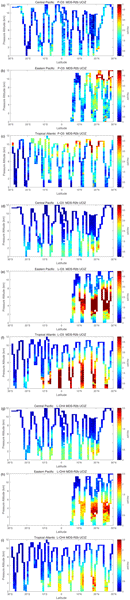
We have prepared a unique and unusual result from the recent ATom aircraft mission: a measurement-based derivation of the production and loss rates of ozone and methane over the ocean basins. These are the key products of chemistry models used in assessments but have thus far lacked observational metrics. It also shows the scales of variability of atmospheric chemical rates and provides a major challenge to the atmospheric models.
Pamela S. Rickly, Hongyu Guo, Pedro Campuzano-Jost, Jose L. Jimenez, Glenn M. Wolfe, Ryan Bennett, Ilann Bourgeois, John D. Crounse, Jack E. Dibb, Joshua P. DiGangi, Glenn S. Diskin, Maximilian Dollner, Emily M. Gargulinski, Samuel R. Hall, Hannah S. Halliday, Thomas F. Hanisco, Reem A. Hannun, Jin Liao, Richard Moore, Benjamin A. Nault, John B. Nowak, Jeff Peischl, Claire E. Robinson, Thomas Ryerson, Kevin J. Sanchez, Manuel Schöberl, Amber J. Soja, Jason M. St. Clair, Kenneth L. Thornhill, Kirk Ullmann, Paul O. Wennberg, Bernadett Weinzierl, Elizabeth B. Wiggins, Edward L. Winstead, and Andrew W. Rollins
Atmos. Chem. Phys., 22, 15603–15620, https://doi.org/10.5194/acp-22-15603-2022, https://doi.org/10.5194/acp-22-15603-2022, 2022
Short summary
Short summary
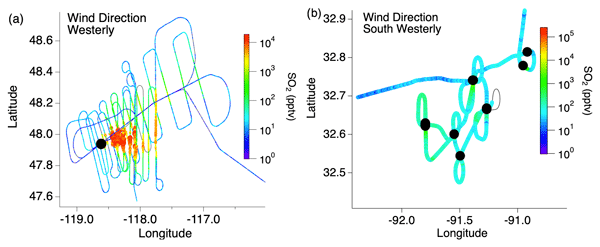
Biomass burning sulfur dioxide (SO2) emission factors range from 0.27–1.1 g kg-1 C. Biomass burning SO2 can quickly form sulfate and organosulfur, but these pathways are dependent on liquid water content and pH. Hydroxymethanesulfonate (HMS) appears to be directly emitted from some fire sources but is not the sole contributor to the organosulfur signal. It is shown that HMS and organosulfur chemistry may be an important S(IV) reservoir with the fate dependent on the surrounding conditions.
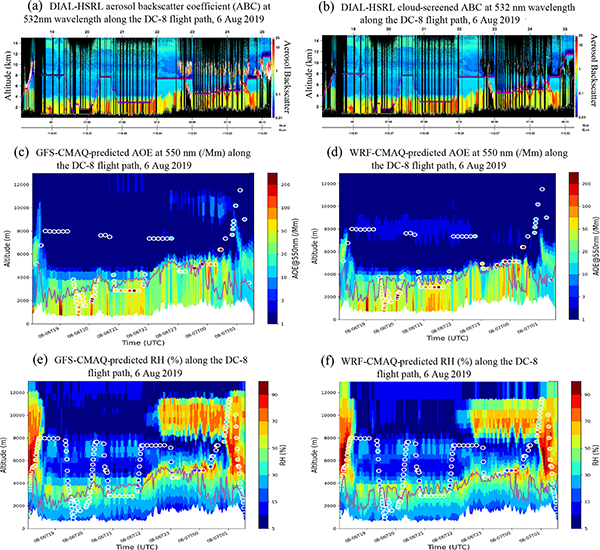
Youhua Tang, Patrick C. Campbell, Pius Lee, Rick Saylor, Fanglin Yang, Barry Baker, Daniel Tong, Ariel Stein, Jianping Huang, Ho-Chun Huang, Li Pan, Jeff McQueen, Ivanka Stajner, Jose Tirado-Delgado, Youngsun Jung, Melissa Yang, Ilann Bourgeois, Jeff Peischl, Tom Ryerson, Donald Blake, Joshua Schwarz, Jose-Luis Jimenez, James Crawford, Glenn Diskin, Richard Moore, Johnathan Hair, Greg Huey, Andrew Rollins, Jack Dibb, and Xiaoyang Zhang
Geosci. Model Dev., 15, 7977–7999, https://doi.org/10.5194/gmd-15-7977-2022, https://doi.org/10.5194/gmd-15-7977-2022, 2022
Short summary
Short summary
This paper compares two meteorological datasets for driving a regional air quality model: a regional meteorological model using WRF (WRF-CMAQ) and direct interpolation from an operational global model (GFS-CMAQ). In the comparison with surface measurements and aircraft data in summer 2019, these two methods show mixed performance depending on the corresponding meteorological settings. Direct interpolation is found to be a viable method to drive air quality models.
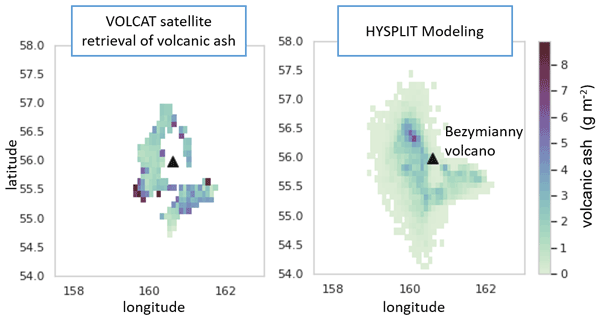
Alice Crawford, Tianfeng Chai, Binyu Wang, Allison Ring, Barbara Stunder, Christopher P. Loughner, Michael Pavolonis, and Justin Sieglaff
Atmos. Chem. Phys., 22, 13967–13996, https://doi.org/10.5194/acp-22-13967-2022, https://doi.org/10.5194/acp-22-13967-2022, 2022
Short summary
Short summary
This study describes the development of a workflow which produces probabilistic and quantitative forecasts of volcanic ash in the atmosphere. The workflow includes methods of incorporating satellite observations of the ash cloud into a modeling framework as well as verification statistics that can be used to guide further model development and provide information for risk-based approaches to flight planning.
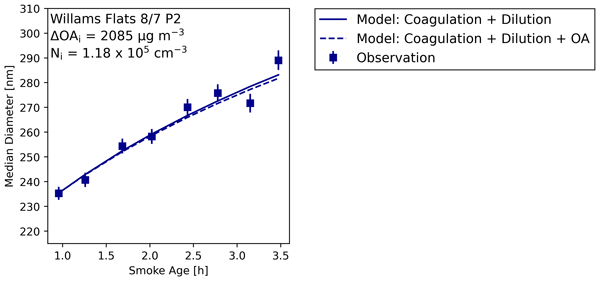
Nicole A. June, Anna L. Hodshire, Elizabeth B. Wiggins, Edward L. Winstead, Claire E. Robinson, K. Lee Thornhill, Kevin J. Sanchez, Richard H. Moore, Demetrios Pagonis, Hongyu Guo, Pedro Campuzano-Jost, Jose L. Jimenez, Matthew M. Coggon, Jonathan M. Dean-Day, T. Paul Bui, Jeff Peischl, Robert J. Yokelson, Matthew J. Alvarado, Sonia M. Kreidenweis, Shantanu H. Jathar, and Jeffrey R. Pierce
Atmos. Chem. Phys., 22, 12803–12825, https://doi.org/10.5194/acp-22-12803-2022, https://doi.org/10.5194/acp-22-12803-2022, 2022
Short summary
Short summary
The evolution of organic aerosol composition and size is uncertain due to variability within and between smoke plumes. We examine the impact of plume concentration on smoke evolution from smoke plumes sampled by the NASA DC-8 during FIREX-AQ. We find that observed organic aerosol and size distribution changes are correlated to plume aerosol mass concentrations. Additionally, coagulation explains the majority of the observed growth.

Asher P. Mouat, Clare Paton-Walsh, Jack B. Simmons, Jhonathan Ramirez-Gamboa, David W. T. Griffith, and Jennifer Kaiser
Atmos. Chem. Phys., 22, 11033–11047, https://doi.org/10.5194/acp-22-11033-2022, https://doi.org/10.5194/acp-22-11033-2022, 2022
Short summary
Short summary
We examine emissions of volatile organic compounds from 2020 wildfires in forested regions of Australia (AU). We find that biomass burning in temperate regions of the US and AU emit similar species in similar proportion, both in natural and lab settings. This suggests studies of wildfires in one region may be used to help improve air quality models in other parts of the world. We observe time series of ozone and nitrogen dioxide. Last, we look at which compounds contribute most to OH reactivity.
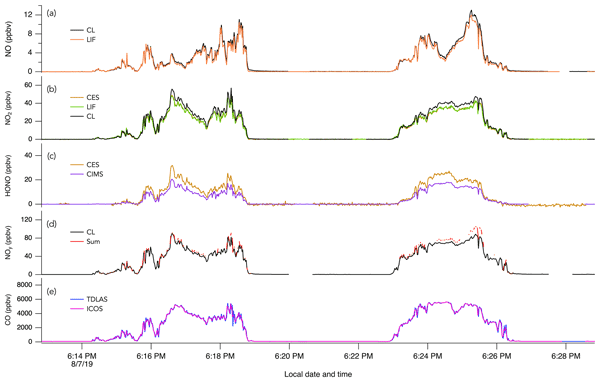
Ilann Bourgeois, Jeff Peischl, J. Andrew Neuman, Steven S. Brown, Hannah M. Allen, Pedro Campuzano-Jost, Matthew M. Coggon, Joshua P. DiGangi, Glenn S. Diskin, Jessica B. Gilman, Georgios I. Gkatzelis, Hongyu Guo, Hannah A. Halliday, Thomas F. Hanisco, Christopher D. Holmes, L. Gregory Huey, Jose L. Jimenez, Aaron D. Lamplugh, Young Ro Lee, Jakob Lindaas, Richard H. Moore, Benjamin A. Nault, John B. Nowak, Demetrios Pagonis, Pamela S. Rickly, Michael A. Robinson, Andrew W. Rollins, Vanessa Selimovic, Jason M. St. Clair, David Tanner, Krystal T. Vasquez, Patrick R. Veres, Carsten Warneke, Paul O. Wennberg, Rebecca A. Washenfelder, Elizabeth B. Wiggins, Caroline C. Womack, Lu Xu, Kyle J. Zarzana, and Thomas B. Ryerson
Atmos. Meas. Tech., 15, 4901–4930, https://doi.org/10.5194/amt-15-4901-2022, https://doi.org/10.5194/amt-15-4901-2022, 2022
Short summary
Short summary
Understanding fire emission impacts on the atmosphere is key to effective air quality management and requires accurate measurements. We present a comparison of airborne measurements of key atmospheric species in ambient air and in fire smoke. We show that most instruments performed within instrument uncertainties. In some cases, further work is needed to fully characterize instrument performance. Comparing independent measurements using different techniques is important to assess their accuracy.
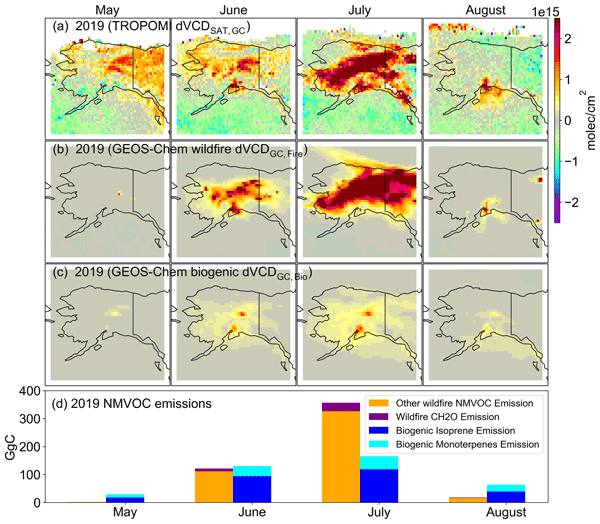
Tianlang Zhao, Jingqiu Mao, William R. Simpson, Isabelle De Smedt, Lei Zhu, Thomas F. Hanisco, Glenn M. Wolfe, Jason M. St. Clair, Gonzalo González Abad, Caroline R. Nowlan, Barbara Barletta, Simone Meinardi, Donald R. Blake, Eric C. Apel, and Rebecca S. Hornbrook
Atmos. Chem. Phys., 22, 7163–7178, https://doi.org/10.5194/acp-22-7163-2022, https://doi.org/10.5194/acp-22-7163-2022, 2022
Short summary
Short summary
Monitoring formaldehyde (HCHO) can help us understand Arctic vegetation change. Here, we compare satellite data and model and show that Alaska summertime HCHO is largely dominated by a background from methane oxidation during mild wildfire years and is dominated by wildfire (largely from direct emission of fire) during strong fire years. Consequently, it is challenging to use satellite HCHO to study vegetation change in the Arctic region.
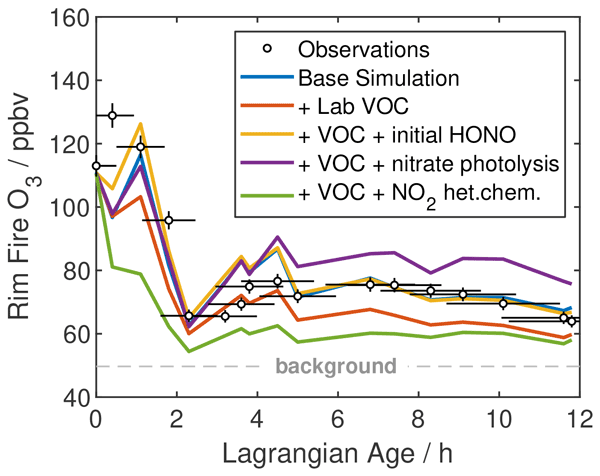
Glenn M. Wolfe, Thomas F. Hanisco, Heather L. Arkinson, Donald R. Blake, Armin Wisthaler, Tomas Mikoviny, Thomas B. Ryerson, Ilana Pollack, Jeff Peischl, Paul O. Wennberg, John D. Crounse, Jason M. St. Clair, Alex Teng, L. Gregory Huey, Xiaoxi Liu, Alan Fried, Petter Weibring, Dirk Richter, James Walega, Samuel R. Hall, Kirk Ullmann, Jose L. Jimenez, Pedro Campuzano-Jost, T. Paul Bui, Glenn Diskin, James R. Podolske, Glen Sachse, and Ronald C. Cohen
Atmos. Chem. Phys., 22, 4253–4275, https://doi.org/10.5194/acp-22-4253-2022, https://doi.org/10.5194/acp-22-4253-2022, 2022
Short summary
Short summary
Smoke plumes are chemically complex. This work combines airborne observations of smoke plume composition with a photochemical model to probe the production of ozone and the fate of reactive gases in the outflow of a large wildfire. Model–measurement comparisons illustrate how uncertain emissions and chemical processes propagate into simulated chemical evolution. Results provide insight into how this system responds to perturbations, which can help guide future observation and modeling efforts.
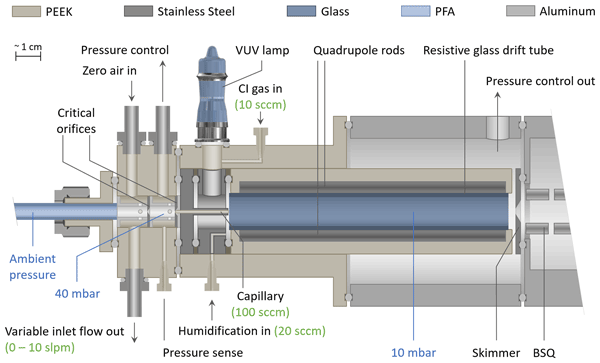
Martin Breitenlechner, Gordon A. Novak, J. Andrew Neuman, Andrew W. Rollins, and Patrick R. Veres
Atmos. Meas. Tech., 15, 1159–1169, https://doi.org/10.5194/amt-15-1159-2022, https://doi.org/10.5194/amt-15-1159-2022, 2022
Short summary
Short summary
We coupled a new ion source to a commercially available state-of-the-art trace gas analyzer. The instrument is particularly well suited for conducting high-altitude observations, addressing the challenges of low ambient pressures and a complex sample matrix. The new instrument and ion source provides significant advantages to more traditional modes of operation, without sacrificing the sensitivity and flexibility of this technique.
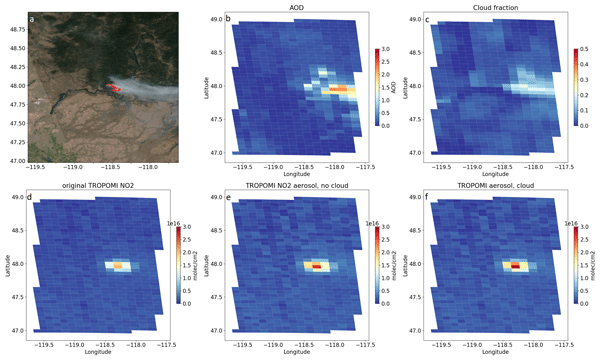
Debora Griffin, Chris A. McLinden, Enrico Dammers, Cristen Adams, Chelsea E. Stockwell, Carsten Warneke, Ilann Bourgeois, Jeff Peischl, Thomas B. Ryerson, Kyle J. Zarzana, Jake P. Rowe, Rainer Volkamer, Christoph Knote, Natalie Kille, Theodore K. Koenig, Christopher F. Lee, Drew Rollins, Pamela S. Rickly, Jack Chen, Lukas Fehr, Adam Bourassa, Doug Degenstein, Katherine Hayden, Cristian Mihele, Sumi N. Wren, John Liggio, Ayodeji Akingunola, and Paul Makar
Atmos. Meas. Tech., 14, 7929–7957, https://doi.org/10.5194/amt-14-7929-2021, https://doi.org/10.5194/amt-14-7929-2021, 2021
Short summary
Short summary
Satellite-derived NOx emissions from biomass burning are estimated with TROPOMI observations. Two common emission estimation methods are applied, and sensitivity tests with model output were performed to determine the accuracy of these methods. The effect of smoke aerosols on TROPOMI NO2 columns is estimated and compared to aircraft observations from four different aircraft campaigns measuring biomass burning plumes in 2018 and 2019 in North America.
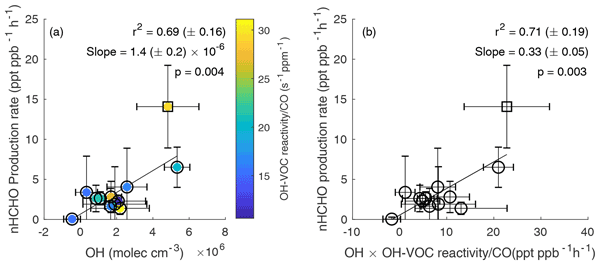
Jin Liao, Glenn M. Wolfe, Reem A. Hannun, Jason M. St. Clair, Thomas F. Hanisco, Jessica B. Gilman, Aaron Lamplugh, Vanessa Selimovic, Glenn S. Diskin, John B. Nowak, Hannah S. Halliday, Joshua P. DiGangi, Samuel R. Hall, Kirk Ullmann, Christopher D. Holmes, Charles H. Fite, Anxhelo Agastra, Thomas B. Ryerson, Jeff Peischl, Ilann Bourgeois, Carsten Warneke, Matthew M. Coggon, Georgios I. Gkatzelis, Kanako Sekimoto, Alan Fried, Dirk Richter, Petter Weibring, Eric C. Apel, Rebecca S. Hornbrook, Steven S. Brown, Caroline C. Womack, Michael A. Robinson, Rebecca A. Washenfelder, Patrick R. Veres, and J. Andrew Neuman
Atmos. Chem. Phys., 21, 18319–18331, https://doi.org/10.5194/acp-21-18319-2021, https://doi.org/10.5194/acp-21-18319-2021, 2021
Short summary
Short summary
Formaldehyde (HCHO) is an important oxidant precursor and affects the formation of O3 and other secondary pollutants in wildfire plumes. We disentangle the processes controlling HCHO evolution from wildfire plumes sampled by NASA DC-8 during FIREX-AQ. We find that OH abundance rather than normalized OH reactivity is the main driver of fire-to-fire variability in HCHO secondary production and estimate an effective HCHO yield per volatile organic compound molecule oxidized in wildfire plumes.
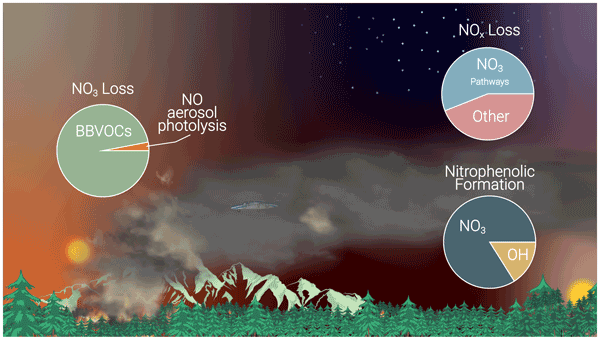
Zachary C. J. Decker, Michael A. Robinson, Kelley C. Barsanti, Ilann Bourgeois, Matthew M. Coggon, Joshua P. DiGangi, Glenn S. Diskin, Frank M. Flocke, Alessandro Franchin, Carley D. Fredrickson, Georgios I. Gkatzelis, Samuel R. Hall, Hannah Halliday, Christopher D. Holmes, L. Gregory Huey, Young Ro Lee, Jakob Lindaas, Ann M. Middlebrook, Denise D. Montzka, Richard Moore, J. Andrew Neuman, John B. Nowak, Brett B. Palm, Jeff Peischl, Felix Piel, Pamela S. Rickly, Andrew W. Rollins, Thomas B. Ryerson, Rebecca H. Schwantes, Kanako Sekimoto, Lee Thornhill, Joel A. Thornton, Geoffrey S. Tyndall, Kirk Ullmann, Paul Van Rooy, Patrick R. Veres, Carsten Warneke, Rebecca A. Washenfelder, Andrew J. Weinheimer, Elizabeth Wiggins, Edward Winstead, Armin Wisthaler, Caroline Womack, and Steven S. Brown
Atmos. Chem. Phys., 21, 16293–16317, https://doi.org/10.5194/acp-21-16293-2021, https://doi.org/10.5194/acp-21-16293-2021, 2021
Short summary
Short summary
To understand air quality impacts from wildfires, we need an accurate picture of how wildfire smoke changes chemically both day and night as sunlight changes the chemistry of smoke. We present a chemical analysis of wildfire smoke as it changes from midday through the night. We use aircraft observations from the FIREX-AQ field campaign with a chemical box model. We find that even under sunlight typical
nighttimechemistry thrives and controls the fate of key smoke plume chemical processes.
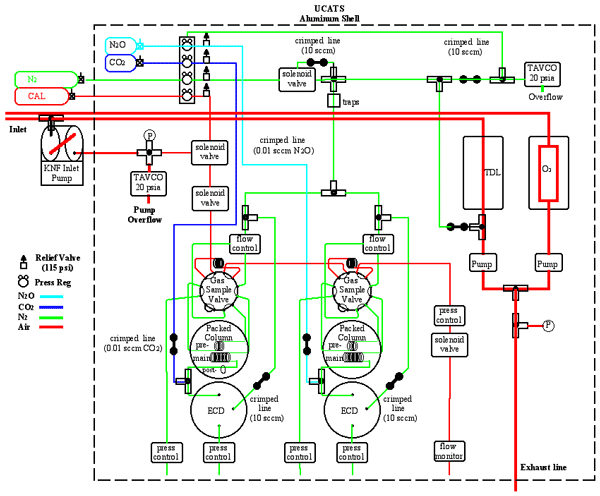
Eric J. Hintsa, Fred L. Moore, Dale F. Hurst, Geoff S. Dutton, Bradley D. Hall, J. David Nance, Ben R. Miller, Stephen A. Montzka, Laura P. Wolton, Audra McClure-Begley, James W. Elkins, Emrys G. Hall, Allen F. Jordan, Andrew W. Rollins, Troy D. Thornberry, Laurel A. Watts, Chelsea R. Thompson, Jeff Peischl, Ilann Bourgeois, Thomas B. Ryerson, Bruce C. Daube, Yenny Gonzalez Ramos, Roisin Commane, Gregory W. Santoni, Jasna V. Pittman, Steven C. Wofsy, Eric Kort, Glenn S. Diskin, and T. Paul Bui
Atmos. Meas. Tech., 14, 6795–6819, https://doi.org/10.5194/amt-14-6795-2021, https://doi.org/10.5194/amt-14-6795-2021, 2021
Short summary
Short summary
We built UCATS to study atmospheric chemistry and transport. It has measured trace gases including CFCs, N2O, SF6, CH4, CO, and H2 with gas chromatography, as well as ozone and water vapor. UCATS has been part of missions to study the tropical tropopause; transport of air into the stratosphere; greenhouse gases, transport, and chemistry in the troposphere; and ozone chemistry, on both piloted and unmanned aircraft. Its design, capabilities, and some results are shown and described here.
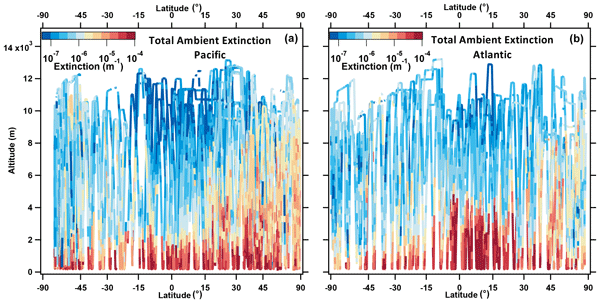
Charles A. Brock, Karl D. Froyd, Maximilian Dollner, Christina J. Williamson, Gregory Schill, Daniel M. Murphy, Nicholas J. Wagner, Agnieszka Kupc, Jose L. Jimenez, Pedro Campuzano-Jost, Benjamin A. Nault, Jason C. Schroder, Douglas A. Day, Derek J. Price, Bernadett Weinzierl, Joshua P. Schwarz, Joseph M. Katich, Siyuan Wang, Linghan Zeng, Rodney Weber, Jack Dibb, Eric Scheuer, Glenn S. Diskin, Joshua P. DiGangi, ThaoPaul Bui, Jonathan M. Dean-Day, Chelsea R. Thompson, Jeff Peischl, Thomas B. Ryerson, Ilann Bourgeois, Bruce C. Daube, Róisín Commane, and Steven C. Wofsy
Atmos. Chem. Phys., 21, 15023–15063, https://doi.org/10.5194/acp-21-15023-2021, https://doi.org/10.5194/acp-21-15023-2021, 2021
Short summary
Short summary
The Atmospheric Tomography Mission was an airborne study that mapped the chemical composition of the remote atmosphere. From this, we developed a comprehensive description of aerosol properties that provides a unique, global-scale dataset against which models can be compared. The data show the polluted nature of the remote atmosphere in the Northern Hemisphere and quantify the contributions of sea salt, dust, soot, biomass burning particles, and pollution particles to the haziness of the sky.
Cited articles
Abad, G. G., Nowlan, C. R., Liu, X., Wang, H., and Chance, K.: TEMPO Formaldehyde Retrieval Algorithm Theoretical Basis Document, https://asdc.larc.nasa.gov/documents/tempo/ATBD_TEMPO_CH2O.pdf (last access: 1 August 2025), 2025.
Bailey, S. A., Hannun, R. A., Swanson, A. K., and Hanisco, T. F.: A portable nitrogen dioxide instrument using cavity-enhanced absorption spectroscopy, Atmos. Meas. Tech., 17, 5903–5910, https://doi.org/10.5194/amt-17-5903-2024, 2024.
Brohede, S. M., Haley, C. S., McLinden, C. A., Sioris, C. E., Murtagh, D. P., Petelina, S. V., Llewellyn, E. J., Bazureau, A., Goutail, F., Randall, C. E., Lumpe, J. D., Taha, G., Thomasson, L. W., and Gordley, L. L.: Validation of Odin/OSIRIS stratospheric NO2 profiles, J. Geophys. Res.-Atmos., 112, https://doi.org/10.1029/2006JD007586, 2007.
Cazorla, M., Wolfe, G. M., Bailey, S. A., Swanson, A. K., Arkinson, H. L., and Hanisco, T. F.: A new airborne laser-induced fluorescence instrument for in situ detection of formaldehyde throughout the troposphere and lower stratosphere, Atmos. Meas. Tech., 8, 541–552, https://doi.org/10.5194/amt-8-541-2015, 2015.
Cede, A.: Manual for Blick Software Suite 1.8, https://www.pandonia-global-network.org/assets/manuals/BlickSoftwareSuite_Manual_v1-8-6.pdf (last access: 1 August 2025), 2024.
Cede, A.: Pandonia Global Network Data Products Readme Document, : https://www.pandonia-global-network.org/assets/manuals/PGN_DataProducts_Readme_v1-8-10.pdf (last access: 1 August 2025), 2025.
Cede, A., Herman, J., Richter, A., Krotkov, N., and Burrows, J.: Measurements of nitrogen dioxide total column amounts using a Brewer double spectrophotometer in direct Sun mode, J. Geophys. Res.-Atmos., 111, https://doi.org/10.1029/2005JD006585, 2006.
Herman, J., Cede, A., Spinei, E., Mount, G., Tzortziou, M., and Abuhassan, N.: NO2 column amounts from ground-based Pandora and MFDOAS spectrometers using the direct-sun DOAS technique: Intercomparisons and application to OMI validation, J. Geophys. Res.-Atmos., 114, https://doi.org/10.1029/2009jd011848, 2009.
Herman, J., Spinei, E., Fried, A., Kim, J., Kim, J., Kim, W., Cede, A., Abuhassan, N., and Segal-Rozenhaimer, M.: NO2 and HCHO measurements in Korea from 2012 to 2016 from Pandora spectrometer instruments compared with OMI retrievals and with aircraft measurements during the KORUS-AQ campaign, Atmos. Meas. Tech., 11, 4583–4603, https://doi.org/10.5194/amt-11-4583-2018, 2018.
Judd, L. M., Al-Saadi, J. A., Janz, S. J., Kowalewski, M. G., Pierce, R. B., Szykman, J. J., Valin, L. C., Swap, R., Cede, A., Mueller, M., Tiefengraber, M., Abuhassan, N., and Williams, D.: Evaluating the impact of spatial resolution on tropospheric NO2 column comparisons within urban areas using high-resolution airborne data, Atmos. Meas. Tech., 12, 6091–6111, https://doi.org/10.5194/amt-12-6091-2019, 2019. Judd, L. M., Al-Saadi, J. A., Szykman, J. J., Valin, L. C., Janz, S. J., Kowalewski, M. G., Eskes, H. J., Veefkind, J. P., Cede, A., Mueller, M., Gebetsberger, M., Swap, R., Pierce, R. B., Nowlan, C. R., Abad, G. G., Nehrir, A., and Williams, D.: Evaluating Sentinel-5P TROPOMI tropospheric NO2 column densities with airborne and Pandora spectrometers near New York City and Long Island Sound, Atmos. Meas. Tech., 13, 6113–6140, https://doi.org/10.5194/amt-13-6113-2020, 2020.
Kotsakis, A., Sullivan, J. T., Hanisco, T. F., Swap, R. J., Caicedo, V., Berkoff, T. A., Gronoff, G., Loughner, C. P., Ren, X., Luke, W. T., Kelley, P., Stratton, P. R., Delgado, R., Abuhassan, N., Shalaby, L., Santos, F. C., and Dreessen, J.: Sensitivity of total column NO2 at a marine site within the Chesapeake Bay during OWLETS-2, Atmos. Environ., 277, 119063, https://doi.org/10.1016/j.atmosenv.2022.119063, 2022.
Lin, Y. C., Schwab, J. J., Demerjian, K. L., Bae, M. S., Chen, W. N., Sun, Y., Zhang, Q., Hung, H. M., and Perry, J.: Summertime formaldehyde observations in New York City: Ambient levels, sources and its contribution to HOx radicals, J. Geophys. Res.-Atmos., 117, https://doi.org/10.1029/2011jd016504, 2012.
NASA: TEMPO formaldehyde total column V03 (PROVISIONAL), NASA Langley Research Center Atmospheric Science Data Center [data set], https://doi.org/10.5067/IS-40e/TEMPO/HCHO_L2.003, 2024.
Nowlan, C. R., Abad, G. G., Liu, X., Wang, H., and Chance, K.: TEMPO Nitrogen Dioxide Retrieval Algorithm Theoretical Basis Document, https://asdc.larc.nasa.gov/documents/tempo/ATBD_TEMPO_NO2.pdf (last access: 1 August 2025), 2025.
Rawat, P., Crawford, J. H., Travis, K. R., Judd, L. M., Demetillo, M. A. G., Valin, L. C., Szykman, J. J., Whitehill, A., Baumann, E., and Hanisco, T. F.: Maximizing the scientific application of Pandora column observations of HCHO and NO2, Atmos. Meas. Tech., 18, 2899–2917, https://doi.org/10.5194/amt-18-2899-2025, 2025.
Rawat, P., Travis, K. R., Henderson, B., Crawford, J. H., Judd, L. M., Demetillo, M. A. G., Lee, T. C., Flittner, D. E., Szykman, J. J., Valin, L. C., Whitehill, A., Baumann, E., Hanisco, T. F., Pandey, A., Abad, G. G., Nowlan, C. R., Liu, X., and Chance, K.: Spatiotemporal Assessment of the TEMPO Formaldehyde Column Retrieval Using the Pandonia Global Network, J. Geophys. Res.-Atmos., 131, e2025JD044788, https://doi.org/10.1029/2025JD044788, 2026.
Rollins, A. W., Rickly, P. S., Gao, R.-S., Ryerson, T. B., Brown, S. S., Peischl, J., and Bourgeois, I.: Single-photon laser-induced fluorescence detection of nitric oxide at sub-parts-per-trillion mixing ratios, Atmos. Meas. Tech., 13, 2425–2439, https://doi.org/10.5194/amt-13-2425-2020, 2020.
Scott, S. G., Bui, T. P., Chan, K. R., and Bowen, S. W.: The meteorological measurement system on the NASA ER-2 aircraft, J. Atmos. Ocean. Techno., 7, 525–540, 1990.
Sebol, A. E., Canty, T. P., Wolfe, G. M., Hannun, R., Ring, A. M., and Ren, X.: Exploring ozone production sensitivity to NOx and VOCs in the New York City airshed in the spring and summers of 2017–2019, Atmos. Environ., 324, 120417, https://doi.org/10.1016/j.atmosenv.2024.120417, 2024.
Singh, A., Ring, A. M., He, H., Allen, D. J., Dickerson, R. R., Salawitch, R. J., and Canty, T. P.: Inferring near-surface ozone production regimes: Insights from using satellite retrievals over the contiguous US, Atmos. Environ., 352, 121208, https://doi.org/10.1016/j.atmosenv.2025.121208, 2025.
Spinei, E., Tiefengraber, M., Müller, M., Gebetsberger, M., Cede, A., Valin, L., Szykman, J., Whitehill, A., Kotsakis, A., Santos, F., Abbuhasan, N., Zhao, X., Fioletov, V., Lee, S. C., and Swap, R.: Effect of polyoxymethylene (POM-H Delrin) off-gassing within the Pandora head sensor on direct-sun and multi-axis formaldehyde column measurements in 2016–2019, Atmos. Meas. Tech., 14, 647–663, https://doi.org/10.5194/amt-14-647-2021, 2021.
Szykman, J.: TROPOSPHERIC EMISSIONS: MONITORING OF POLLUTION (TEMPO)PROJECT Level 2 Science Data Product Validation Plan, https://tempo.si.edu/documents/SAO-DRD-11_TEMPO Science Validation_Plan_Baseline.pdf (last access: 1 August 2025), 2023.
Szykman, J., Pierce, B., Henderson, B., and Judd, L.: Validation and Quality Assessment of the TEMPO Level-2 Trace Gas Products, NASA Langley Research Center, Atmospheric Science Data Center, https://asdc.larc.nasa.gov/documents/tempo/TEMPO_validation_report_baseline_draft.pdf (last access: 1 August 2025), 2025.
Tzortziou, M., Loughner, C. P., Goldberg, D. L., Judd, L., Nauth, D., Kwong, C. F., Lin, T., Cede, A., and Abuhassan, N.: Intimately tracking NO2 pollution over the New York City – Long Island Sound land-water continuum: An integration of shipboard, airborne, satellite observations, and models, Sci. Total Environ., 897, 165144, https://doi.org/10.1016/j.scitotenv.2023.165144, 2023.
Short summary
Ground-based spectrometers measuring HCHO and NO2 were compared to airborne in situ observations in the Summer 2023. Total column HCHO is within uncertainty, but with high biases near the surface. NO2 results are highly sensitive to the viewing angle of the ground monitor which must be considered during validation studies. Spectrometers in NYC show good agreement with a geostationary satellite on clear-sky days. Further quantified uncertainty for the monitors is necessary.
Ground-based spectrometers measuring HCHO and NO2 were compared to airborne in situ observations...


