
Articles | Volume 18, issue 24
https://doi.org/10.5194/amt-18-7833-2025
© Author(s) 2025. This work is distributed under
the Creative Commons Attribution 4.0 License.
the Creative Commons Attribution 4.0 License.
https://doi.org/10.5194/amt-18-7833-2025
© Author(s) 2025. This work is distributed under
the Creative Commons Attribution 4.0 License.
the Creative Commons Attribution 4.0 License.
Research article
| 
22 Dec 2025
Research article |
| 22 Dec 2025
| 22 Dec 2025
Estimating vertical profiles of ice water content and snowfall rate from radar measurements in the G-band

Department of Meteorology, University of Reading, Reading, UK
Chris Westbrook
Department of Meteorology, University of Reading, Reading, UK
Alessandro Battaglia
University of Leicester, Leicester, UK
Politecnico of Turin, Turin, Italy
Kamil Mroz
European Centre for Medium-Range Weather Forecasts (ECMWF), Reading, UK
Benjamin M. Courtier
University of Leicester, Leicester, UK
Peter G. Huggard
RAL Space, STFC Rutherford Appleton Laboratory, Didcot, OX11 0QX, UK
Hui Wang
RAL Space, STFC Rutherford Appleton Laboratory, Didcot, OX11 0QX, UK
Richard Reeves
RAL Space, STFC Rutherford Appleton Laboratory, Didcot, OX11 0QX, UK
Christopher J. Walden
RAL Space, STFC Rutherford Appleton Laboratory, Didcot, OX11 0QX, UK
National Centre for Atmospheric Science, Leeds, UK
Richard Cotton
Met Office, FitzRoy Road, Exeter, EX1 3PB, UK
Stuart Fox
Met Office, FitzRoy Road, Exeter, EX1 3PB, UK
Anthony J. Baran
Met Office, FitzRoy Road, Exeter, EX1 3PB, UK
School of Physics, Astronomy and Mathematics, University of Hertfordshire, Hatfield, AL10 9AB, UK
Related authors
Anthony J. Baran, Stuart Fox, Richard Cotton, Julien Delanoë, Christopher J. Walden, Karina McCusker, Christopher D. Westbrook, and Peter G. Huggard
Atmos. Meas. Tech., 19, 4367–4392, https://doi.org/10.5194/amt-19-4367-2026, https://doi.org/10.5194/amt-19-4367-2026, 2026
Short summary
Short summary
We demonstrate how multi-frequency ground-based radars at 3, 35 and 94 GHz can be used to determine vertical profiles of ice-particle size spectra by combining reflectivity with machine-learning prior information on UK wintertime ice clouds. The method is validated using independent profiles from a 200 GHz radar and aircraft-based in-situ observations. It gives a consistent representation to compare with aircraft-based radiometric measurements in future radiative-transfer closure studies.
Rosie M. Mammatt, Chris Westbrook, and Karina McCusker
EGUsphere, https://doi.org/10.5194/egusphere-2026-2928, https://doi.org/10.5194/egusphere-2026-2928, 2026
Short summary
Short summary
Secondary ice production in stratiform clouds remains poorly understood. In this article, a peak finding algorithm applied to radar Doppler spectra is used to produce the first quantitative estimate of the distribution of multimodal spectra with temperature, from which ice multiplication can be inferred. Peaks in spectral reflectivity also correspond to velocities of the different populations. We show evidence that particle velocities decrease at temperatures associated with dendritic growth.
Karina McCusker, Anthony J. Baran, Chris Westbrook, Stuart Fox, Patrick Eriksson, Richard Cotton, Julien Delanoë, and Florian Ewald
Atmos. Meas. Tech., 17, 3533–3552, https://doi.org/10.5194/amt-17-3533-2024, https://doi.org/10.5194/amt-17-3533-2024, 2024
Short summary
Short summary
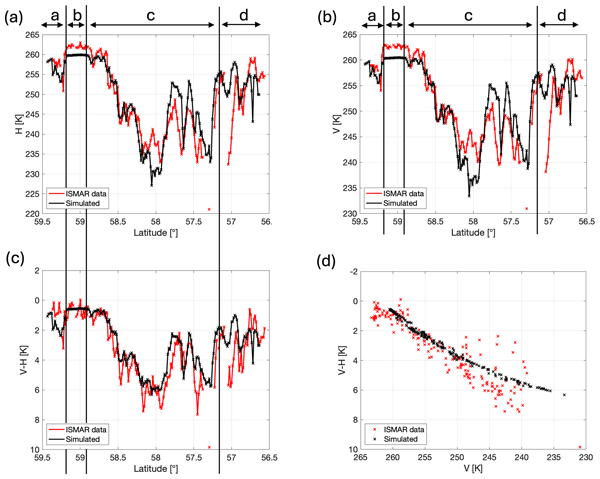
Polarised radiative transfer simulations are performed using an atmospheric model based on in situ measurements. These are compared to large polarisation measurements to explore whether such measurements can provide information on cloud ice, e.g. particle shape and orientation. We find that using oriented particle models with shapes based on imagery generally allows for accurate simulations. However, results are sensitive to shape assumptions such as the choice of single crystals or aggregates.
Claudia J. Stubenrauch, Xiaoting Chen, Laurent Li, and Anthony J. Baran
EGUsphere, https://doi.org/10.5194/egusphere-2026-5049, https://doi.org/10.5194/egusphere-2026-5049, 2026
This preprint is open for discussion and under review for Weather and Climate Dynamics (WCD).
Short summary
Short summary
Atmospheric heating gradients caused by tropical upper tropospheric ice clouds (cirrus) influence the atmospheric circulation which then affects patterns of precipitation. While their overall radiative effect leads to a strengthening of the Hadley circulation, semi-transparent cirrus weaken the circulation. This means that in a warmer climate changes in their optical depth may then counteract or enhance the weakened Hadley circulation.
Robin J. Hogan, Bernat Puigdomenech Treserras, Shannon L. Mason, Alexei Korolev, Zhipeng Qu, Kamil Mroz, David P. Donovan, Pavlos Kollias, and Mark D. Fielding
EGUsphere, https://doi.org/10.5194/egusphere-2026-5054, https://doi.org/10.5194/egusphere-2026-5054, 2026
Short summary
Short summary
The EarthCARE satellite carries advanced instruments that allow it to accurately infer vertical profiles of the properties of ice clouds, important for understanding their role in the climate system. Here we use detailed observations from meteorological research aircraft flying underneath the satellite to evaluate EarthCARE’s estimates of the mass of ice in the clouds, the average particle size, and even how fast the air is rising and falling within the cloud due to atmospheric gravity waves.
Robert J. Thompson, Thorwald H. M. Stein, Chun Hay Brian Lo, Robert Jackson, Christopher D. Westbrook, Scott Collis, Lindsay Rhodes, Timothy Darlington, Emily G. Norton, Paul A. Barrett, and Ryan R. Neely III
EGUsphere, https://doi.org/10.5194/egusphere-2026-4631, https://doi.org/10.5194/egusphere-2026-4631, 2026
Short summary
Short summary
Thunderstorms have complex flow patterns that are difficult to observe directly. Observational data is needed for robust evaluation to confirm that forecast models behave correctly. Five Doppler weather radars in Southern England, an updated 3D variational algorithm used, to generate a 3D grid of the 3 components of the wind. The dataset is verified with wind profiler, aircraft & separate radar, finding accuracy better than 2.4 ms−1. This data is valuable for evaluation of models.
Anthony J. Baran, Stuart Fox, Richard Cotton, Julien Delanoë, Christopher J. Walden, Karina McCusker, Christopher D. Westbrook, and Peter G. Huggard
Atmos. Meas. Tech., 19, 4367–4392, https://doi.org/10.5194/amt-19-4367-2026, https://doi.org/10.5194/amt-19-4367-2026, 2026
Short summary
Short summary
We demonstrate how multi-frequency ground-based radars at 3, 35 and 94 GHz can be used to determine vertical profiles of ice-particle size spectra by combining reflectivity with machine-learning prior information on UK wintertime ice clouds. The method is validated using independent profiles from a 200 GHz radar and aircraft-based in-situ observations. It gives a consistent representation to compare with aircraft-based radiometric measurements in future radiative-transfer closure studies.
Rosie M. Mammatt, Chris Westbrook, and Karina McCusker
EGUsphere, https://doi.org/10.5194/egusphere-2026-2928, https://doi.org/10.5194/egusphere-2026-2928, 2026
Short summary
Short summary
Secondary ice production in stratiform clouds remains poorly understood. In this article, a peak finding algorithm applied to radar Doppler spectra is used to produce the first quantitative estimate of the distribution of multimodal spectra with temperature, from which ice multiplication can be inferred. Peaks in spectral reflectivity also correspond to velocities of the different populations. We show evidence that particle velocities decrease at temperatures associated with dendritic growth.
Kalliopi Artemis Voudouri, Eleni Marinou, Ilianna Koutsoupi, Vassilis Spyrakos, Dimitra Karkani, Ioanna Tsikoudi, Alessandro Battaglia, Pavlos Kollias, Eleni Giannakaki, and Vassilis Amiridis
EGUsphere, https://doi.org/10.5194/egusphere-2026-2384, https://doi.org/10.5194/egusphere-2026-2384, 2026
Short summary
Short summary
Cloud observations from the CloudSat mission (2007–2017) reveal how clouds vary per altitude and season across the Mediterranean. Comparisons with ERA5 reanalysis show good overall agreement, though ice clouds are often underestimated. Early EarthCARE mission data are also presented, towards improving long-term climate records.
Susmitha Sasikumar, Alessandro Battaglia, Bernat Puigdomènech Treserras, and Pavlos Kollias
Atmos. Meas. Tech., 19, 2313–2328, https://doi.org/10.5194/amt-19-2313-2026, https://doi.org/10.5194/amt-19-2313-2026, 2026
Short summary
Short summary
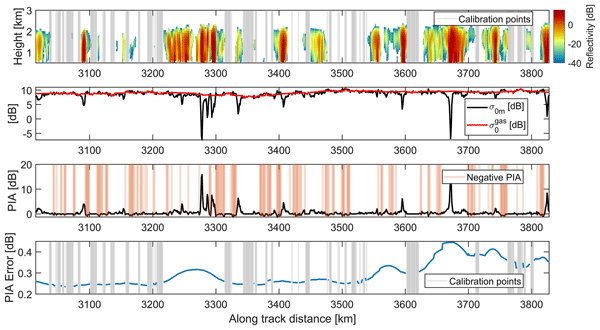
The study present a method to estimate how much the radar signal is weakened as it passes through rain or clouds, designed to implement in the new EarthCARE satellite cloud profiling radar data. The approach builds on the method used in the CloudSat mission, with key improvements that make it robust under non-ideal instrument conditions in the early mission phase. This leads to more reliable retrieval of clouds and rainfall during initial satellite operations.
Zhuocan Xu, Pavlos Kollias, Susmitha Sasikumar, Alessandro Battaglia, Bernat Puigdomènech Treserras, and Matthew L. Walker McLinden
Atmos. Chem. Phys., 26, 4619–4632, https://doi.org/10.5194/acp-26-4619-2026, https://doi.org/10.5194/acp-26-4619-2026, 2026
Short summary
Short summary
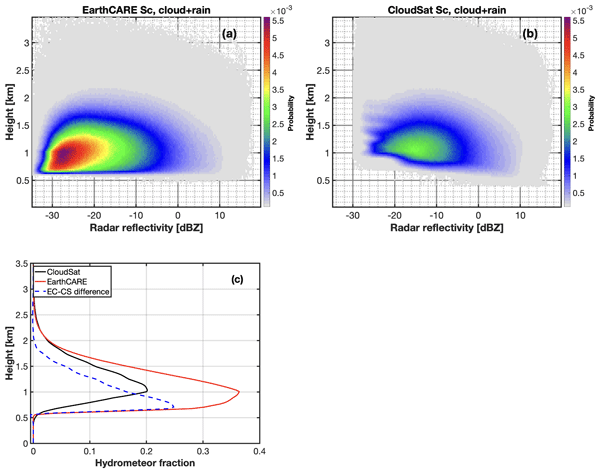
It has been a challenge to observe marine low-level clouds from space. A comparison with CloudSat climatology in this study shows a greatly improved detection of marine stratocumulus clouds and drizzle occurrence by the EarthCARE radar due to the enhanced sensitivity and full suppression of ground clutter above 0.5 km. A more accurate observational constraint on marine low clouds is now available on global scale.
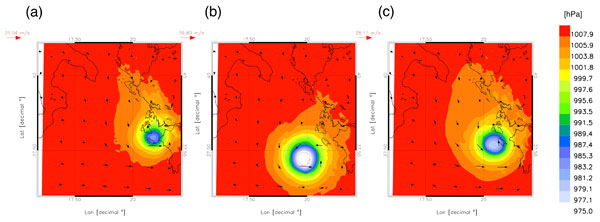
Stefano Federico, Rosa Claudia Torcasio, Claudio Transerici, Mario Montopoli, Cinzia Cambiotti, Francesco Manconi, Alessandro Battaglia, and Maryam Pourshamsi
Weather Clim. Dynam., 7, 165–183, https://doi.org/10.5194/wcd-7-165-2026, https://doi.org/10.5194/wcd-7-165-2026, 2026
Short summary
Short summary
The Wind Velocity Radar Nephoscope (WIVERN) mission will be the first space-based mission to provide global in-cloud wind, cloud and precipitation measurements. The mission is proposed as a candidate for the ESA Earth Explorer 11. Its data could be beneficial to several sectors, including numerical weather prediction performance enhancement. This paper aims to contribute to the last point by analyzing the impact that WIVERN would have in the case of a Tropical-like cyclone event.
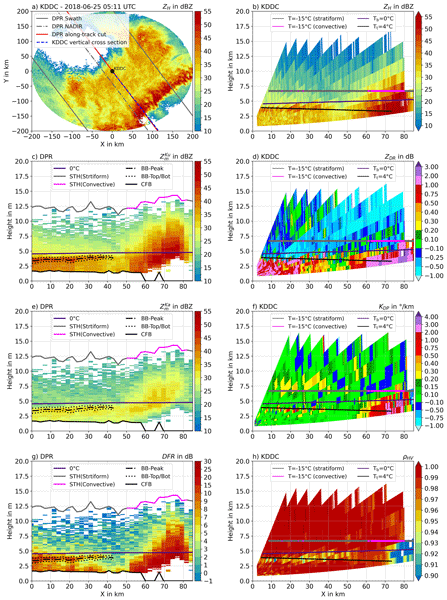
Velibor Pejcic, Kamil Mroz, Kai Mühlbauer, and Silke Trömel
Atmos. Meas. Tech., 19, 211–230, https://doi.org/10.5194/amt-19-211-2026, https://doi.org/10.5194/amt-19-211-2026, 2026
Short summary
Short summary
Estimating the proportions of individual hydrometeor types (hydrometeor partitioning ratios, HPRs) in a mixture of a resolved radar volume and their evaluation is challenging. This study has three objectives, (1) to evaluate HPR retrievals, (2) to exploit the combination of dual-frequency (DF) space-borne radar (SR) and dual-polarisation (DP) ground-based radar (GR) observations for estimating HPRs based on SR DF observations and (3) to further improve HPR estimates based on DP GR observations.
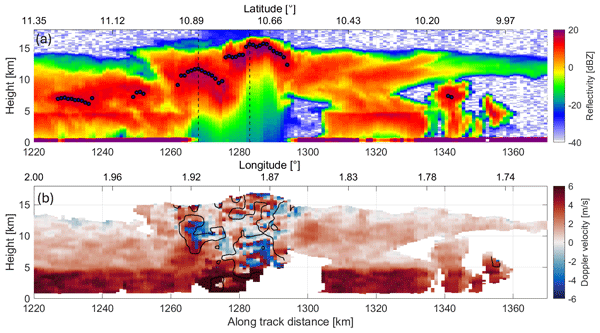
Aida Galfione, Alessandro Battaglia, Bernat Puigdomènech Treserras, and Pavlos Kollias
Atmos. Meas. Tech., 18, 6747–6763, https://doi.org/10.5194/amt-18-6747-2025, https://doi.org/10.5194/amt-18-6747-2025, 2025
Short summary
Short summary
Convection drives atmospheric circulation but is difficult to observe and model. EarthCARE's radar provides the first space-based vertical wind data, capturing updrafts and downdrafts. Combined with satellite imagery from other sensors, it offers a broader view of convective storms. While resolution limits detail, cloud-top cooling helps track storm development. This combined approach improves understanding and modeling of convection.
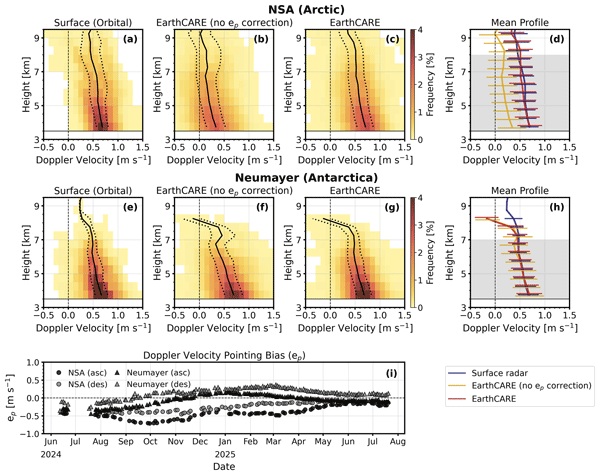
Jiseob Kim, Pavlos Kollias, Bernat Puigdomènech Treserras, Alessandro Battaglia, and Ivy Tan
Atmos. Chem. Phys., 25, 15389–15402, https://doi.org/10.5194/acp-25-15389-2025, https://doi.org/10.5194/acp-25-15389-2025, 2025
Short summary
Short summary
The EarthCARE satellite’s Cloud Profiling Radar (CPR) can now measure how fast particles fall within clouds from space. In this study, we compared these new satellite measurements with ground-based radar data and found that, after proper corrections, the CPR gives reliable results, especially in ice clouds. This means scientists can confidently use EarthCARE data to better understand clouds and improve weather and climate predictions.
Filippo Emilio Scarsi, Alessandro Battaglia, Maximilian Maahn, and Stef Lhermitte
The Cryosphere, 19, 4875–4892, https://doi.org/10.5194/tc-19-4875-2025, https://doi.org/10.5194/tc-19-4875-2025, 2025
Short summary
Short summary
Snowfall measurements at high latitudes are crucial for estimating ice sheet mass balance. Spaceborne radar and radiometer missions help estimate snowfall but face uncertainties. This work evaluates uncertainties in snowfall estimates from a fixed near-nadir radar (CloudSat-like) and a conically scanning radar (WIVERN-like), showing that a WIVERN-like radar will provide better estimates than a CloudSat-like radar at smaller spatial and temporal scales.
Bernat Puigdomènech Treserras, Pavlos Kollias, Alessandro Battaglia, Simone Tanelli, and Hirotaka Nakatsuka
Atmos. Meas. Tech., 18, 5607–5618, https://doi.org/10.5194/amt-18-5607-2025, https://doi.org/10.5194/amt-18-5607-2025, 2025
Short summary
Short summary
We investigate how seasonal solar illumination affects the pointing accuracy of EarthCARE’s cloud profile radar (CPR) antenna and introduce a correction based on surface Doppler measurements. The correction improves measurement accuracy by reducing Doppler velocity biases to within 5 and 7 cm s−1. Our results demonstrate the importance of continuous pointing characterization to maintain the scientific accuracy of EarthCARE’s CPR Doppler observations.
Marco Coppola, Alessandro Battaglia, Frederic Tridon, and Pavlos Kollias
Atmos. Meas. Tech., 18, 5071–5085, https://doi.org/10.5194/amt-18-5071-2025, https://doi.org/10.5194/amt-18-5071-2025, 2025
Short summary
Short summary
The WIVERN (WInd Velocity Radar Nephoscope) conically scanning Doppler W-band radar has the potential, for the first time, to map the mesoscale and synoptic variability of cloud dynamics and precipitation microphysics. This study shows that the oblique angle of incidence will be advantageous compared to standard nadir-looking radars due to substantial clutter suppression over the ocean surface. This feature will enable the detection and quantification of light and moderate precipitation, with improved proximity to the surface.
Ioanna Tsikoudi, Alessandro Battaglia, Christine Unal, and Eleni Marinou
Atmos. Meas. Tech., 18, 4857–4870, https://doi.org/10.5194/amt-18-4857-2025, https://doi.org/10.5194/amt-18-4857-2025, 2025
Short summary
Short summary
In the study, we simulate spectral polarimetric variables for raindrops as observed by cloud radar. Raindrops are modeled as oblate spheroids, and backscattering properties are computed via the T-matrix method, including noise, turbulence, and spectral averaging effects. When comparing simulations with measurements, differences in the amplitudes of polarimetric variables are noted. This shows the challenge of using simplified shapes to model raindrop polarimetric variables when moving to millimeter wavelengths.
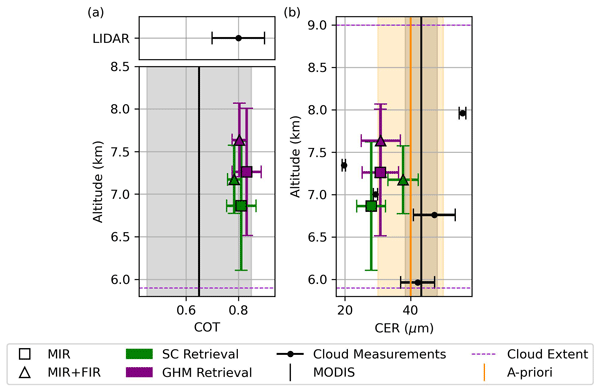
Sanjeevani Panditharatne, Caroline Cox, Rui Song, Richard Siddans, Richard Bantges, Jonathan Murray, Stuart Fox, Cathryn Fox, and Helen Brindley
Atmos. Chem. Phys., 25, 9981–9998, https://doi.org/10.5194/acp-25-9981-2025, https://doi.org/10.5194/acp-25-9981-2025, 2025
Short summary
Short summary
Upwelling radiation with wavelengths between 15 and 100 µm is theorised to be highly sensitive to the properties of ice clouds, particularly the shape of the ice crystals. We exploit this sensitivity and perform the first retrieval of ice cloud properties using these wavelengths from an observation taken on an aircraft and evaluate it against measurements of the cloud’s properties.
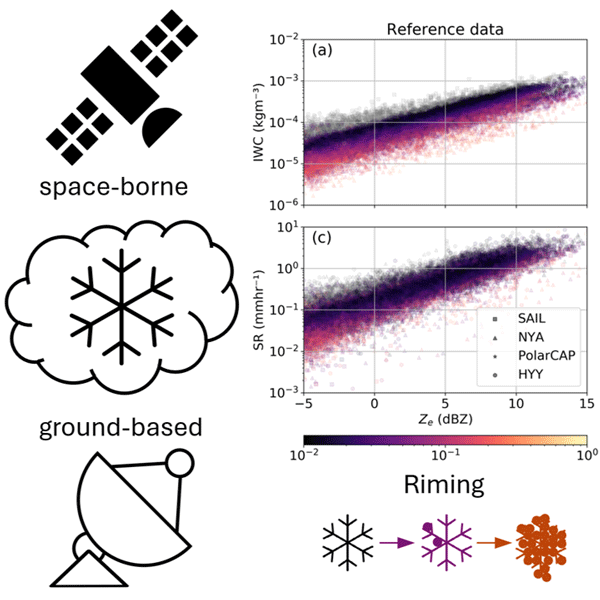
Nina Maherndl, Alessandro Battaglia, Anton Kötsche, and Maximilian Maahn
Atmos. Meas. Tech., 18, 3287–3304, https://doi.org/10.5194/amt-18-3287-2025, https://doi.org/10.5194/amt-18-3287-2025, 2025
Short summary
Short summary
Accurate measurements of ice water content (IWC) and snowfall rate (SR) are challenging due to high spatial variability and limitations of our measurement techniques. Here, we present a novel method to derive IWC and SR from W-band cloud radar observations, considering the degree of riming. We also investigate the use of the liquid water path (LWP) as a proxy for the occurrence of riming. LWP is easier to measure, so that the method can be applied to both ground-based and space-based instruments.
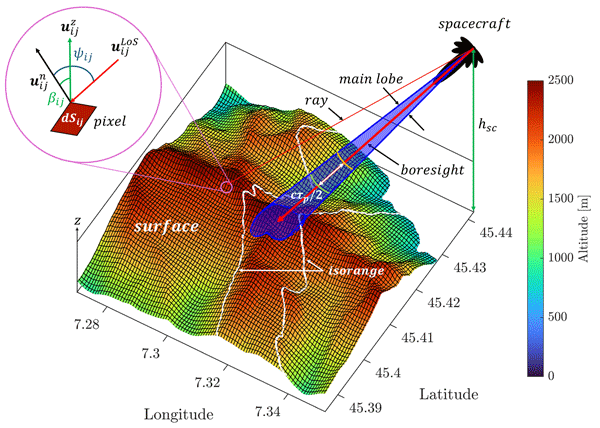
Francesco Manconi, Alessandro Battaglia, and Pavlos Kollias
Atmos. Meas. Tech., 18, 2295–2310, https://doi.org/10.5194/amt-18-2295-2025, https://doi.org/10.5194/amt-18-2295-2025, 2025
Short summary
Short summary
The paper aims to study the ground reflection, or clutter, of the signal from a spaceborne radar in the context of ESA's WIVERN (WInd VElocity Radar Nephoscop) mission, which will observe in-cloud winds. Using topography and land type data, with a model of the satellite orbit and rotating antenna, simulations of scans have been run over the Piedmont region of Italy. These measurements cover the full range of the ground clutter over land for WIVERN and have allowed for analyses of the precision and accuracy of velocity observations.
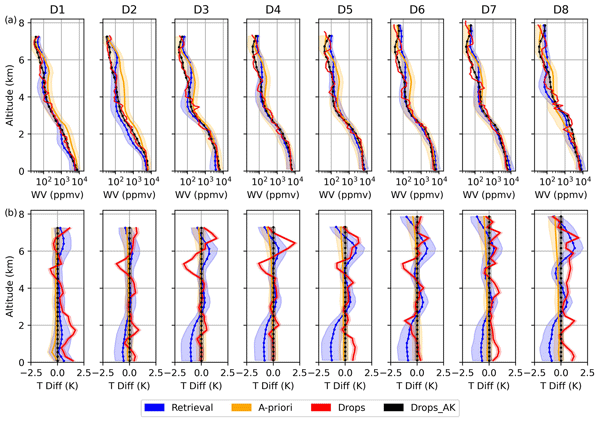
Sanjeevani Panditharatne, Helen Brindley, Caroline Cox, Richard Siddans, Jonathan Murray, Laura Warwick, and Stuart Fox
Atmos. Meas. Tech., 18, 717–735, https://doi.org/10.5194/amt-18-717-2025, https://doi.org/10.5194/amt-18-717-2025, 2025
Short summary
Short summary
Observations from the upcoming European Space Agency’s Far-Infrared Outgoing Radiation Understanding and Monitoring (FORUM) satellite are theorised to be highly sensitive to distributions of water vapour within Earth’s atmosphere. We exploit this sensitivity and extend the Infrared Microwave Sounding retrieval scheme for use on observations from FORUM. This scheme is evaluated on both simulated and observed measurements and shows good agreement with references of the atmospheric state.
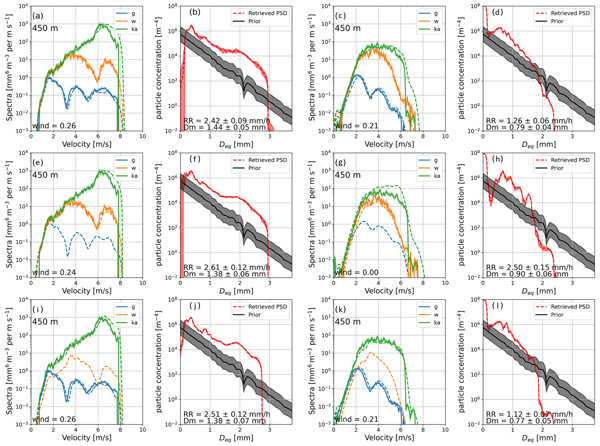
Benjamin M. Courtier, Alessandro Battaglia, and Kamil Mroz
Atmos. Meas. Tech., 17, 6875–6888, https://doi.org/10.5194/amt-17-6875-2024, https://doi.org/10.5194/amt-17-6875-2024, 2024
Short summary
Short summary
A new millimetre-wavelength radar is used to improve methods of retrieving information about the smallest droplets that exist within clouds. The radar is shown to be able to retrieve the vertical wind speed more accurately and more frequently and to retrieve the cloud properties for clouds with lower rainfall rates and smaller droplets than would be possible using longer-wavelength radars.
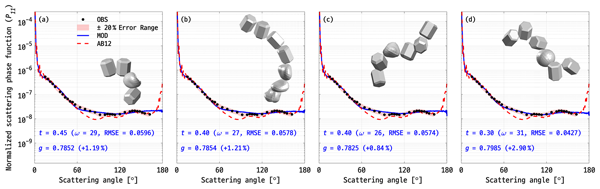
Jeonggyu Kim, Sungmin Park, Greg M. McFarquhar, Anthony J. Baran, Joo Wan Cha, Kyoungmi Lee, Seoung Soo Lee, Chang Hoon Jung, Kyo-Sun Sunny Lim, and Junshik Um
Atmos. Chem. Phys., 24, 12707–12726, https://doi.org/10.5194/acp-24-12707-2024, https://doi.org/10.5194/acp-24-12707-2024, 2024
Short summary
Short summary
We developed idealized models to represent the shapes of ice particles found in deep convective clouds and calculated their single-scattering properties. By comparing these results with in situ measurements, we discovered that a mixture of shape models matches in situ measurements more closely than single-form models or aggregate models. This finding has important implications for enhancing the simulation of single-scattering properties of ice crystals in deep convective clouds.
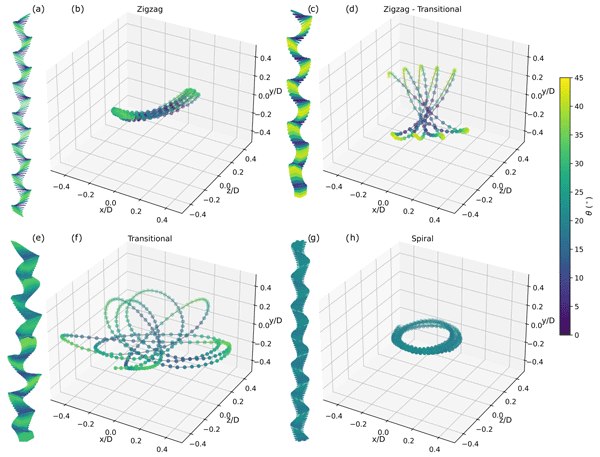
Jennifer R. Stout, Christopher D. Westbrook, Thorwald H. M. Stein, and Mark W. McCorquodale
Atmos. Chem. Phys., 24, 11133–11155, https://doi.org/10.5194/acp-24-11133-2024, https://doi.org/10.5194/acp-24-11133-2024, 2024
Short summary
Short summary
This study uses 3D-printed ice crystal analogues falling in a water–glycerine mix and observed with multi-view cameras, simulating atmospheric conditions. Four types of motion are observed: stable, zigzag, transitional, and spiralling. Particle shape strongly influences motion; complex shapes have a wider range of conditions where they fall steadily compared to simple plates. The most common orientation of unstable particles is non-horizontal, contrary to prior assumptions of always horizontal.
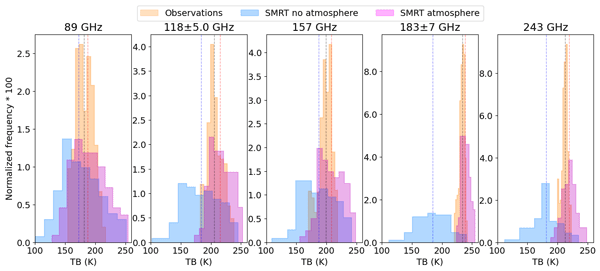
Melody Sandells, Nick Rutter, Kirsty Wivell, Richard Essery, Stuart Fox, Chawn Harlow, Ghislain Picard, Alexandre Roy, Alain Royer, and Peter Toose
The Cryosphere, 18, 3971–3990, https://doi.org/10.5194/tc-18-3971-2024, https://doi.org/10.5194/tc-18-3971-2024, 2024
Short summary
Short summary
Satellite microwave observations are used for weather forecasting. In Arctic regions this is complicated by natural emission from snow. By simulating airborne observations from in situ measurements of snow, this study shows how snow properties affect the signal within the atmosphere. Fresh snowfall between flights changed airborne measurements. Good knowledge of snow layering and structure can be used to account for the effects of snow and could unlock these data to improve forecasts.
Stuart Fox, Vinia Mattioli, Emma Turner, Alan Vance, Domenico Cimini, and Donatello Gallucci
Atmos. Meas. Tech., 17, 4957–4978, https://doi.org/10.5194/amt-17-4957-2024, https://doi.org/10.5194/amt-17-4957-2024, 2024
Short summary
Short summary
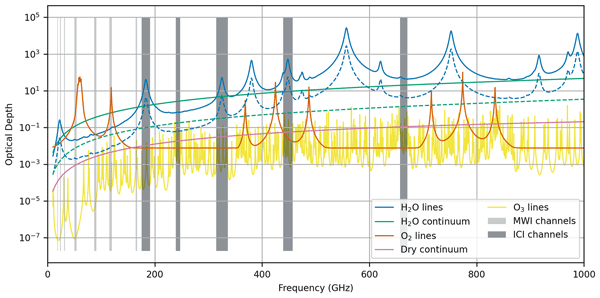
Airborne observations are used to evaluate two models for absorption and emission by atmospheric gases, including water vapour and oxygen, at microwave and sub-millimetre wavelengths. These models are needed for the Ice Cloud Imager (ICI) on the next generation of European polar-orbiting weather satellites, which measures at frequencies up to 664 GHz. Both models can provide a good match to measurements from airborne radiometers and are sufficiently accurate for use with ICI.
Donatello Gallucci, Domenico Cimini, Emma Turner, Stuart Fox, Philip W. Rosenkranz, Mikhail Y. Tretyakov, Vinia Mattioli, Salvatore Larosa, and Filomena Romano
Atmos. Chem. Phys., 24, 7283–7308, https://doi.org/10.5194/acp-24-7283-2024, https://doi.org/10.5194/acp-24-7283-2024, 2024
Short summary
Short summary
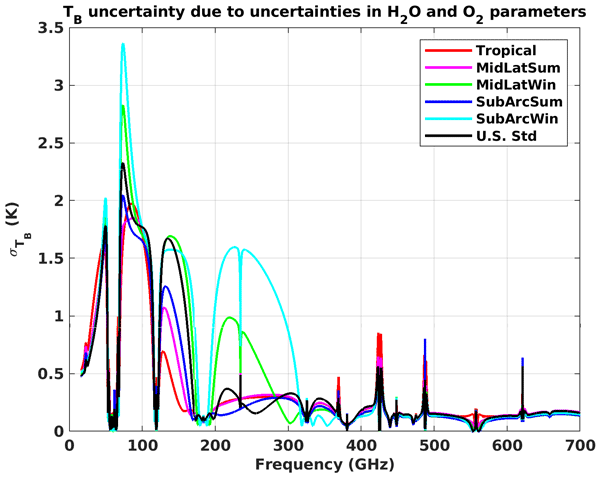
Nowadays, atmospheric radiative transfer models are widely used to simulate satellite and ground-based observations. A meaningful comparison between observations and simulations requires an estimate of the uncertainty associated with both. This work quantifies the uncertainty in atmospheric radiative transfer models in the microwave range, providing the uncertainty associated with simulations of new-generation satellite microwave sensors.
Karina McCusker, Anthony J. Baran, Chris Westbrook, Stuart Fox, Patrick Eriksson, Richard Cotton, Julien Delanoë, and Florian Ewald
Atmos. Meas. Tech., 17, 3533–3552, https://doi.org/10.5194/amt-17-3533-2024, https://doi.org/10.5194/amt-17-3533-2024, 2024
Short summary
Short summary
Polarised radiative transfer simulations are performed using an atmospheric model based on in situ measurements. These are compared to large polarisation measurements to explore whether such measurements can provide information on cloud ice, e.g. particle shape and orientation. We find that using oriented particle models with shapes based on imagery generally allows for accurate simulations. However, results are sensitive to shape assumptions such as the choice of single crystals or aggregates.
Kamil Mroz, Alessandro Battaglia, and Ann M. Fridlind
Atmos. Meas. Tech., 17, 1577–1597, https://doi.org/10.5194/amt-17-1577-2024, https://doi.org/10.5194/amt-17-1577-2024, 2024
Short summary
Short summary
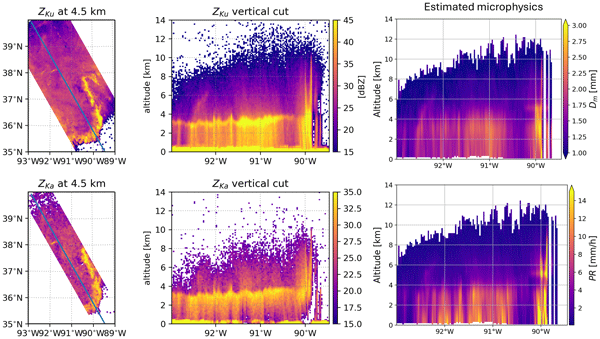
In this study, we examine the extent to which radar measurements from space can inform us about the properties of clouds and precipitation. Surprisingly, our analysis showed that the amount of ice turning into rain was lower than expected in the current product. To improve on this, we came up with a new way to extract information about the size and concentration of particles from radar data. As long as we use this method in the right conditions, we can even estimate how dense the ice is.
Filippo Emilio Scarsi, Alessandro Battaglia, Frederic Tridon, Paolo Martire, Ranvir Dhillon, and Anthony Illingworth
Atmos. Meas. Tech., 17, 499–514, https://doi.org/10.5194/amt-17-499-2024, https://doi.org/10.5194/amt-17-499-2024, 2024
Short summary
Short summary
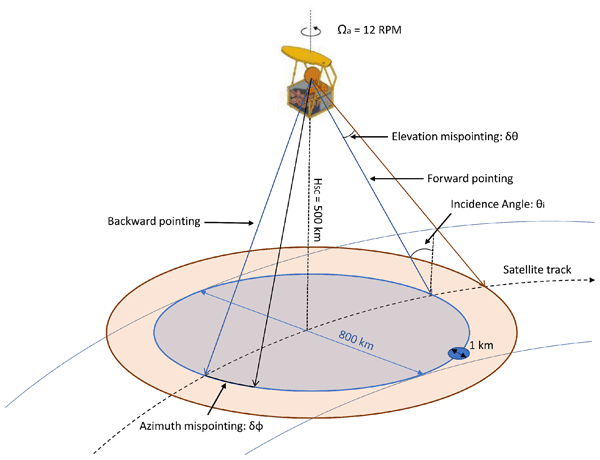
The WIVERN mission, one of the two candidates to be the ESA's Earth Explorer 11 mission, aims at providing measurements of horizontal winds in cloud and precipitation systems through a conically scanning W-band Doppler radar. This work discusses four methods that can be used to characterize and correct the Doppler velocity error induced by the antenna mispointing. The proposed methodologies can be extended to other Doppler concepts featuring conically scanning or slant viewing Doppler systems.
Kirsty Wivell, Stuart Fox, Melody Sandells, Chawn Harlow, Richard Essery, and Nick Rutter
The Cryosphere, 17, 4325–4341, https://doi.org/10.5194/tc-17-4325-2023, https://doi.org/10.5194/tc-17-4325-2023, 2023
Short summary
Short summary
Satellite microwave observations improve weather forecasts, but to use these observations in the Arctic, snow emission must be known. This study uses airborne and in situ snow observations to validate emissivity simulations for two- and three-layer snowpacks at key frequencies for weather prediction. We assess the impact of thickness, grain size and density in key snow layers, which will help inform development of physical snow models that provide snow profile input to emissivity simulations.
Alessandro Battaglia, Filippo Emilio Scarsi, Kamil Mroz, and Anthony Illingworth
Atmos. Meas. Tech., 16, 3283–3297, https://doi.org/10.5194/amt-16-3283-2023, https://doi.org/10.5194/amt-16-3283-2023, 2023
Short summary
Short summary
Some of the new generation of cloud and precipitation spaceborne radars will adopt conical scanning. This will make some of the standard calibration techniques impractical. This work presents a methodology to cross-calibrate radars in orbits by matching the reflectivity probability density function of ice clouds observed by the to-be-calibrated and by the reference radar in quasi-coincident locations. Results show that cross-calibration within 1 dB (26 %) is feasible.

Kamil Mroz, Bernat Puidgomènech Treserras, Alessandro Battaglia, Pavlos Kollias, Aleksandra Tatarevic, and Frederic Tridon
Atmos. Meas. Tech., 16, 2865–2888, https://doi.org/10.5194/amt-16-2865-2023, https://doi.org/10.5194/amt-16-2865-2023, 2023
Short summary
Short summary
We present the theoretical basis of the algorithm that estimates the amount of water and size of particles in clouds and precipitation. The algorithm uses data collected by the Cloud Profiling Radar that was developed for the upcoming Earth Clouds, Aerosols and Radiation Explorer (EarthCARE) satellite mission. After the satellite launch, the vertical distribution of cloud and precipitation properties will be delivered as the C-CLD product.
Pavlos Kollias, Bernat Puidgomènech Treserras, Alessandro Battaglia, Paloma C. Borque, and Aleksandra Tatarevic
Atmos. Meas. Tech., 16, 1901–1914, https://doi.org/10.5194/amt-16-1901-2023, https://doi.org/10.5194/amt-16-1901-2023, 2023
Short summary
Short summary
The Earth Clouds, Aerosols and Radiation (EarthCARE) satellite mission developed by the European Space Agency (ESA) and Japan Aerospace Exploration Agency (JAXA) features the first spaceborne 94 GHz Doppler cloud-profiling radar (CPR) with Doppler capability. Here, we describe the post-processing algorithms that apply quality control and corrections to CPR measurements and derive key geophysical variables such as hydrometeor locations and best estimates of particle sedimentation fall velocities.
Frederic Tridon, Israel Silber, Alessandro Battaglia, Stefan Kneifel, Ann Fridlind, Petros Kalogeras, and Ranvir Dhillon
Atmos. Chem. Phys., 22, 12467–12491, https://doi.org/10.5194/acp-22-12467-2022, https://doi.org/10.5194/acp-22-12467-2022, 2022
Short summary
Short summary
The role of ice precipitation in the Earth water budget is not well known because ice particles are complex, and their formation involves intricate processes. Riming of ice crystals by supercooled water droplets is an efficient process, but little is known about its importance at high latitudes. In this work, by exploiting the deployment of an unprecedented number of remote sensing systems in Antarctica, we find that riming occurs at much lower temperatures compared with the mid-latitudes.
Alessandro Battaglia, Paolo Martire, Eric Caubet, Laurent Phalippou, Fabrizio Stesina, Pavlos Kollias, and Anthony Illingworth
Atmos. Meas. Tech., 15, 3011–3030, https://doi.org/10.5194/amt-15-3011-2022, https://doi.org/10.5194/amt-15-3011-2022, 2022
Short summary
Short summary
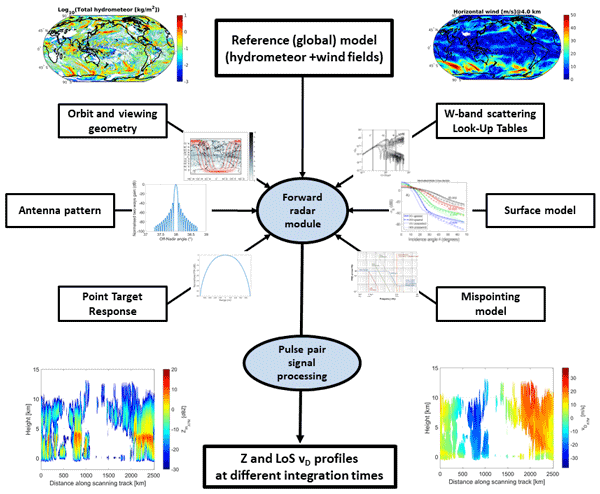
We present an instrument simulator for a new sensor, WIVERN (WInd VElocity Radar Nephoscope), a conically scanning radar payload with Doppler capabilities, recently down-selected as one of the four candidates for the European Space Agency Earth Explorer 11 program. The mission aims at measuring horizontal winds in cloudy areas. The simulator is instrumental in the definition and consolidation of the mission requirements and the evaluation of mission performances.
Ming Li, Husi Letu, Yiran Peng, Hiroshi Ishimoto, Yanluan Lin, Takashi Y. Nakajima, Anthony J. Baran, Zengyuan Guo, Yonghui Lei, and Jiancheng Shi
Atmos. Chem. Phys., 22, 4809–4825, https://doi.org/10.5194/acp-22-4809-2022, https://doi.org/10.5194/acp-22-4809-2022, 2022
Short summary
Short summary
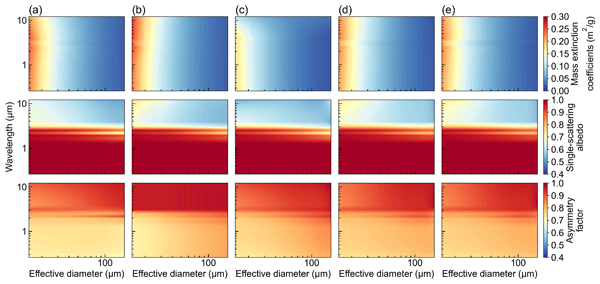
To build on the previous investigations of the Voronoi model in the remote sensing retrievals of ice cloud products, this paper developed an ice cloud parameterization scheme based on the single-scattering properties of the Voronoi model and evaluate it through simulations with the Community Integrated Earth System Model (CIESM). Compared with four representative ice cloud schemes, results show that the Voronoi model has good capabilities of ice cloud modeling in the climate model.
Simon Pfreundschuh, Stuart Fox, Patrick Eriksson, David Duncan, Stefan A. Buehler, Manfred Brath, Richard Cotton, and Florian Ewald
Atmos. Meas. Tech., 15, 677–699, https://doi.org/10.5194/amt-15-677-2022, https://doi.org/10.5194/amt-15-677-2022, 2022
Short summary
Short summary
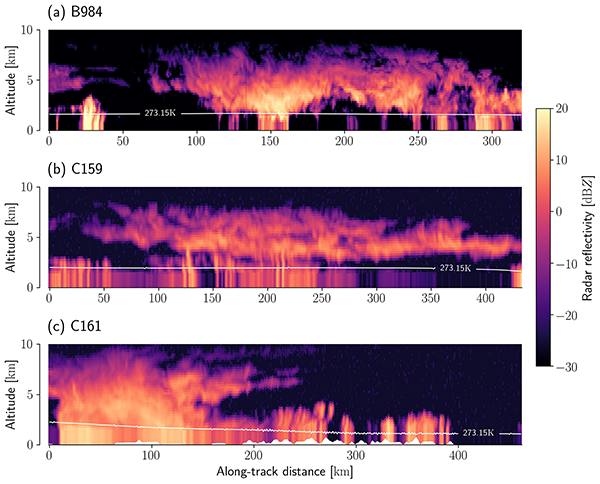
We test a novel method to remotely measure ice particles in clouds. This is important because such measurements are required to improve climate and weather models. The method combines a radar with newly developed sensors measuring microwave radiation at very short wavelengths. We use observations made from aircraft flying above the cloud and compare them to real measurements from inside the cloud. This works well given that one can model the ice particles in the cloud sufficiently well.
Alessandro Battaglia
Atmos. Meas. Tech., 14, 7809–7820, https://doi.org/10.5194/amt-14-7809-2021, https://doi.org/10.5194/amt-14-7809-2021, 2021
Short summary
Short summary
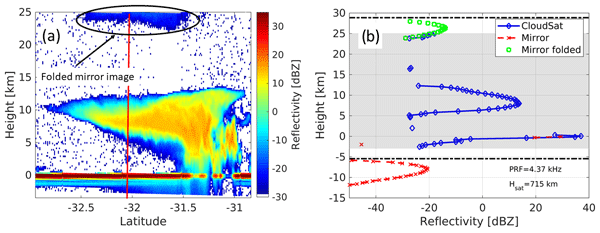
Space-borne radar returns can be contaminated by artefacts caused by radiation that undergoes multiple scattering events and appears to originate from ranges well below the surface range. While such artefacts have been rarely observed from the currently deployed systems, they may become a concern in future cloud radar systems, potentially enhancing cloud cover high up in the troposphere via ghost returns.
Kamil Mroz, Alessandro Battaglia, Cuong Nguyen, Andrew Heymsfield, Alain Protat, and Mengistu Wolde
Atmos. Meas. Tech., 14, 7243–7254, https://doi.org/10.5194/amt-14-7243-2021, https://doi.org/10.5194/amt-14-7243-2021, 2021
Short summary
Short summary
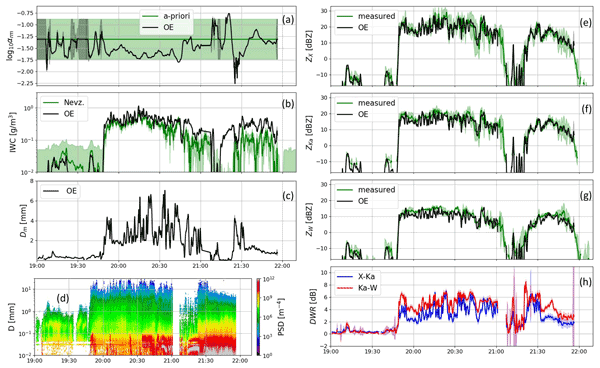
A method for estimating microphysical properties of ice clouds based on radar measurements is presented. The algorithm exploits the information provided by differences in the radar response at different frequency bands in relation to changes in the snow morphology. The inversion scheme is based on a statistical relation between the radar simulations and the properties of snow calculated from in-cloud sampling.
Nicholas J. Kedzuf, J. Christine Chiu, V. Chandrasekar, Sounak Biswas, Shashank S. Joshil, Yinghui Lu, Peter Jan van Leeuwen, Christopher Westbrook, Yann Blanchard, and Sebastian O'Shea
Atmos. Meas. Tech., 14, 6885–6904, https://doi.org/10.5194/amt-14-6885-2021, https://doi.org/10.5194/amt-14-6885-2021, 2021
Short summary
Short summary
Ice clouds play a key role in our climate system due to their strong controls on precipitation and the radiation budget. However, it is difficult to characterize co-existing ice species using radar observations. We present a new method that separates the radar signals of pristine ice embedded in snow aggregates and retrieves their respective abundances and sizes for the first time. The ability to provide their quantitative microphysical properties will open up many research opportunities.
Cited articles
Abel, S. J., Cotton, R. J., Barrett, P. A., and Vance, A. K.: A comparison of ice water content measurement techniques on the FAAM BAe-146 aircraft, Atmos. Meas. Tech., 7, 3007–3022, https://doi.org/10.5194/amt-7-3007-2014, 2014. a
Battaglia, A., Westbrook, C. D., Kneifel, S., Kollias, P., Humpage, N., Löhnert, U., Tyynelä, J., and Petty, G. W.: G band atmospheric radars: new frontiers in cloud physics, Atmos. Meas. Tech., 7, 1527–1546, https://doi.org/10.5194/amt-7-1527-2014, 2014. a, b, c
Berg, M. J.: A Microphysical model of scattering, absorption, and extinction in electromagnetic theory, PhD thesis, Kansas State University, 276 pp., https://krex.k-state.edu/items/a9f57633-8529-4e83-bc5a-ebd7ac4c81a8 (last access: 17 December 2025), 2008. a
Brown, P. R. A., Illingworth, A. J., Heymsfield, A. J., McFarquhar, G. M., Browning, K. A., and Gosset, M.: The Role of Spaceborne Millimeter-Wave Radar in the Global Monitoring of Ice Cloud, Journal of Applied Meteorology and Climatology, 34, 2346–2366, https://doi.org/10.1175/1520-0450(1995)034<2346:TROSMW>2.0.CO;2, 1995. a, b
Bühler, L., Schnitt, S., Mech, M., Rückert, J., Risse, N., Krobot, P., and Crewell, S.: Properties of Arctic mixed-phase clouds explored by multi-frequency radars, EGU General Assembly 2025, Vienna, Austria, 27 April–2 May 2025, EGU25-18624, https://doi.org/10.5194/egusphere-egu25-18624, 2025. a
Cooper, K. B., Monje, R. R., Millán, L., Lebsock, M., Tanelli, S., Siles, J. V., Lee, C., and Brown, A.: Atmospheric Humidity Sounding Using Differential Absorption Radar Near 183 GHz, IEEE Geoscience and Remote Sensing Letters, 15, 163–167, https://doi.org/10.1109/LGRS.2017.2776078, 2018. a
Cooper, K. B., Roy, R. J., Dengler, R., Monje, R. R., Alonso-Delpino, M., Siles, J. V., Yurduseven, O., Parashare, C., Millán, L., and Lebsock, M.: G-Band Radar for Humidity and Cloud Remote Sensing, IEEE Transactions on Geoscience and Remote Sensing, 59, 1106–1117, https://doi.org/10.1109/TGRS.2020.2995325, 2021. a
Courtier, B. M., Battaglia, A., Huggard, P. G., Westbrook, C., Mroz, K., Dhillon, R. S., Walden, C. J., Howells, G., Wang, H., Ellison, B. N., Reeves, R., Robertson, D. A., and Wylde, R. J.: First Observations of G-Band Radar Doppler Spectra, Geophysical Research Letters, 49, e2021GL096475, https://doi.org/10.1029/2021GL096475, 2022. a, b
Courtier, B. M., Battaglia, A., and Mroz, K.: Advantages of G-band radar in multi-frequency liquid-phase microphysical retrievals, Atmos. Meas. Tech., 17, 6875–6888, https://doi.org/10.5194/amt-17-6875-2024, 2024. a, b
Doviak, R. J. and Zrnić, D. S.: Doppler Radar and Weather Observations, Academic Press, San Diego, CA, 2nd edn., ISBN 978-0-12-221422-6, 1993. a
Ekelund, R., Eriksson, P., and Pfreundschuh, S.: Using passive and active observations at microwave and sub-millimetre wavelengths to constrain ice particle models, Atmos. Meas. Tech., 13, 501–520, https://doi.org/10.5194/amt-13-501-2020, 2020. a
Ekelund, R., Brath, M., Eriksson, P., and Mendrok, J.: ARTS Microwave Single Scattering Properties Database: Technical Report Version 1.0, Tech. rep., Chalmers University of Technology, Zenodo, https://doi.org/10.5281/zenodo.1175572, 2021. a
Eriksson, P., Ekelund, R., Mendrok, J., Brath, M., Lemke, O., and Buehler, S. A.: A general database of hydrometeor single scattering properties at microwave and sub-millimetre wavelengths, Earth Syst. Sci. Data, 10, 1301–1326, https://doi.org/10.5194/essd-10-1301-2018, 2018. a, b, c, d
Facility for Airborne Atmospheric Measurements (FAAM): FAAM Data: CCREST-M flight – C374, Centre for Environmental Data Analysis (CEDA) archive [data set], https://catalogue.ceda.ac.uk/uuid/7892db5c68104a0c9caf99bc59337647 (last access: 17 December 2025), 2024. a
Field, P. R., Hogan, R. J., Brown, P. R. A., Illingworth, A. J., Choularton, T. W., and Cotton, R. J.: Parametrization of ice-particle size distributions for mid-latitude stratiform cloud, Quarterly Journal of the Royal Meteorological Society, 131, 1997–2017, https://doi.org/10.1256/qj.04.134, 2005. a, b
Fuller, S., Marlow, S. A., Haimov, S., Burkhart, M., Shaffer, K., Morgan, A., and Snider, J. R.: W-band S–Z relationships for rimed snow particles: observational evidence from combined airborne and ground-based observations, Atmos. Meas. Tech., 16, 6123–6142, https://doi.org/10.5194/amt-16-6123-2023, 2023. a
Heymsfield, A., Schmitt, C., and Bansemer, A.: Ice Cloud Particle Size Distributions and Pressure-Dependent Terminal Velocities from In Situ Observations at Temperatures from 0° to −86 °C, Journal of the Atmospheric Sciences, 70, 4123–4154, https://doi.org/10.1175/JAS-D-12-0124.1, 2013. a
Heymsfield, A. J., Bansemer, A., Field, P. R., Durden, S. L., Stith, J. L., Dye, J. E., Hall, W., and Grainger, C. A.: Observations and Parameterizations of Particle Size Distributions in Deep Tropical Cirrus and Stratiform Precipitating Clouds: Results from In Situ Observations in TRMM Field Campaigns, Journal of the Atmospheric Sciences, 59, 3457–3491, https://doi.org/10.1175/1520-0469(2002)059<3457:OAPOPS>2.0.CO;2, 2002. a
Hiley, M. J., Kulie, M. S., and Bennartz, R.: Uncertainty Analysis for CloudSat Snowfall Retrievals, Journal of Applied Meteorology and Climatology, 50, 399–418, https://doi.org/10.1175/2010JAMC2505.1, 2011. a
Hogan, R. J., Mittermaier, M. P., and Illingworth, A. J.: The Retrieval of Ice Water Content from Radar Reflectivity Factor and Temperature and Its Use in Evaluating a Mesoscale Model, Journal of Applied Meteorology and Climatology, 45, 301–317, https://doi.org/10.1175/JAM2340.1, 2006. a, b
Hogan, R. J., Tian, L., Brown, P. R. A., Westbrook, C. D., Heymsfield, A. J., and Eastment, J. D.: Radar Scattering from Ice Aggregates Using the Horizontally Aligned Oblate Spheroid Approximation, Journal of Applied Meteorology and Climatology, 51, 655–671, https://doi.org/10.1175/JAMC-D-11-074.1, 2012. a
Hogan, R. J., Honeyager, R., Tyynelä, J., and Kneifel, S.: Calculating the millimetre-wave scattering phase function of snowflakes using the self-similar Rayleigh–Gans Approximation, Quarterly Journal of the Royal Meteorological Society, 143, 834–844, https://doi.org/10.1002/qj.2968, 2017. a, b
Illingworth, A. J., Barker, H. W., Beljaars, A., Ceccaldi, M., Chepfer, H., Clerbaux, N., Cole, J., Delanoë, J., Domenech, C., Donovan, D. P., Fukuda, S., Hirakata, M., Hogan, R. J., Huenerbein, A., Kollias, P., Kubota, T., Nakajima, T., Nakajima, T. Y., Nishizawa, T., Ohno, Y., Okamoto, H., Oki, R., Sato, K., Satoh, M., Shephard, M. W., Velázquez-Blázquez, A., Wandinger, U., Wehr, T., and van Zadelhoff, G.-J.: The EarthCARE Satellite: The Next Step Forward in Global Measurements of Clouds, Aerosols, Precipitation, and Radiation, Bulletin of the American Meteorological Society, 96, 1311–1332, https://doi.org/10.1175/BAMS-D-12-00227.1, 2015. a
Kim, J., Kollias, P., Puigdomènech Treserras, B., Battaglia, A., and Tan, I.: Evaluation of the EarthCARE Cloud Profiling Radar (CPR) Doppler velocity measurements using surface-based observations, Atmos. Chem. Phys., 25, 15389–15402, https://doi.org/10.5194/acp-25-15389-2025, 2025. a
Lamer, K., Oue, M., Battaglia, A., Roy, R. J., Cooper, K. B., Dhillon, R., and Kollias, P.: Multifrequency radar observations of clouds and precipitation including the G-band, Atmos. Meas. Tech., 14, 3615–3629, https://doi.org/10.5194/amt-14-3615-2021, 2021. a, b
Lawson, R. P., Stewart, R. E., Strapp, J. W., and Isaac, G. A.: Aircraft observations of the origin and growth of very large snowflakes, Geophysical Research Letters, 20, 53–56, https://doi.org/10.1029/92GL02917, 1993. a
Lawson, R. P., O'Connor, D., Zmarzly, P., Weaver, K., Baker, B., Mo, Q., and Jonsson, H.: The 2D-S (Stereo) Probe: Design and Preliminary Tests of a New Airborne, High-Speed, High-Resolution Particle Imaging Probe, Journal of Atmospheric and Oceanic Technology, 23, 1462–1477, https://doi.org/10.1175/JTECH1927.1, 2006. a
Leinonen, J. and Szyrmer, W.: Radar signatures of snowflake riming: A modeling study, Earth and Space Science, 2, 346–358, https://doi.org/10.1002/2015EA000102, 2015. a, b
Liebe, H. J.: MPM-An atmospheric millimeter-wave propagation model, International Journal of Infrared and Millimeter Waves, 10, 631–650, https://doi.org/10.1007/BF01009565, 1989. a, b
Locatelli, J. D. and Hobbs, P. V.: Fall speeds and masses of solid precipitation particles, Journal of Geophysical Research, 79, 2185–2197, https://doi.org/10.1029/JC079i015p02185, 1974. a
Marchand, R., Mace, G. G., Ackerman, T., and Stephens, G.: Hydrometeor Detection Using Cloudsat – An Earth-Orbiting 94-GHz Cloud Radar, Journal of Atmospheric and Oceanic Technology, 25, 519–533, https://doi.org/10.1175/2007JTECHA1006.1, 2008. a
Mason, S. L., Hogan, R. J., Westbrook, C. D., Kneifel, S., Moisseev, D., and von Terzi, L.: The importance of particle size distribution and internal structure for triple-frequency radar retrievals of the morphology of snow, Atmos. Meas. Tech., 12, 4993–5018, https://doi.org/10.5194/amt-12-4993-2019, 2019. a
Matrosov, S. Y. and Heymsfield, A. J.: Estimating ice content and extinction in precipitating cloud systems from CloudSat radar measurements, Journal of Geophysical Research: Atmospheres, 113, https://doi.org/10.1029/2007JD009633, 2008. a
McCusker, K., Westbrook, C., and Moiola, A.: Analysis of the internal electric fields of pristine ice crystals and aggregate snowflakes, and their effect on scattering, Journal of Quantitative Spectroscopy and Radiative Transfer, 230, 155–171, https://doi.org/10.1016/j.jqsrt.2019.04.019, 2019. a, b, c
McCusker, K., Westbrook, C. D., and Tyynelä, J.: An accurate and computationally cheap microwave scattering method for ice aggregates: the Independent Monomer Approximation, Quarterly Journal of the Royal Meteorological Society, 147, 1202–1224, https://doi.org/10.1002/qj.3967, 2021. a
Millán, L. F., Lebsock, M. D., Cooper, K. B., Siles, J. V., Dengler, R., Rodriguez Monje, R., Nehrir, A., Barton-Grimley, R. A., Collins, J. E., Robinson, C. E., Thornhill, K. L., and Vömel, H.: Water vapor measurements inside clouds and storms using a differential absorption radar, Atmos. Meas. Tech., 17, 539–559, https://doi.org/10.5194/amt-17-539-2024, 2024. a
Mitchell, D. L., Zhang, R., and Pitter, R. L.: Mass-Dimensional Relationships for Ice Particles and the Influence of Riming on Snowfall Rates, Journal of Applied Meteorology and Climatology, 29, 153–163, https://doi.org/10.1175/1520-0450(1990)029<0153:MDRFIP>2.0.CO;2, 1990. a
Mroz, K., Treserras, B. P., Battaglia, A., Kollias, P., Tatarevic, A., and Tridon, F.: Cloud and precipitation microphysical retrievals from the EarthCARE Cloud Profiling Radar: the C-CLD product, Atmos. Meas. Tech., 16, 2865–2888, https://doi.org/10.5194/amt-16-2865-2023, 2023. a
Norbury, J. R. and White, W. J.: A rapid-response rain gauge, Journal of Physics E: Scientific Instruments, 4, 601, https://doi.org/10.1088/0022-3735/4/8/013, 1971. a
Protat, A., Delanoë, J., Strapp, J. W., Fontaine, E., Leroy, D., Schwarzenboeck, A., Lilie, L., Davison, C., Dezitter, F., Grandin, A., and Weber, M.: The Measured Relationship between Ice Water Content and Cloud Radar Reflectivity in Tropical Convective Clouds, Journal of Applied Meteorology and Climatology, 55, 1707–1729, https://doi.org/10.1175/JAMC-D-15-0248.1, 2016. a
Roy, R. J., Lebsock, M., Millán, L., and Cooper, K. B.: Validation of a G-Band Differential Absorption Cloud Radar for Humidity Remote Sensing, Journal of Atmospheric and Oceanic Technology, 37, 1085–1102, https://doi.org/10.1175/JTECH-D-19-0122.1, 2020. a, b
Roy, R. J., Cooper, K. B., Lebsock, M., Siles, J. V., Mill'an, L., Dengler, R., Monje, R. R., Durden, S. L., Cannon, F., and Wilson, A.: First Airborne Measurements With a G-Band Differential Absorption Radar, IEEE Transactions on Geoscience and Remote Sensing, 60, 1–15, https://doi.org/10.1109/TGRS.2021.3134670, 2022. a
Sekhon, R. S. and Srivastava, R. C.: Snow Size Spectra and Radar Reflectivity, Journal of Atmospheric Sciences, 27, 299–307, https://doi.org/10.1175/1520-0469(1970)027<0299:SSSARR>2.0.CO;2, 1970. a
Socuellamos, J. M., Rodriguez Monje, R., Cooper, K. B., Lebsock, M. D., Nagaraja, S. P. M., Siles, J. V., Beauchamp, R. M., and Tanelli, S.: A G-Band Doppler Radar for Atmospheric Profiling, IEEE Transactions on Geoscience and Remote Sensing, 62, 1–8, https://doi.org/10.1109/TGRS.2024.3398616, 2024a. a
Socuellamos, J. M., Rodriguez Monje, R., Lebsock, M. D., Cooper, K. B., Beauchamp, R. M., and Umeyama, A.: Multifrequency radar observations of marine clouds during the EPCAPE campaign, Earth Syst. Sci. Data, 16, 2701–2715, https://doi.org/10.5194/essd-16-2701-2024, 2024b. a
Socuellamos, J. M., Rodriguez Monje, R., Lebsock, M. D., Cooper, K. B., and Kollias, P.: Dual-frequency (Ka-band and G-band) radar estimates of liquid water content profiles in shallow clouds, Atmos. Meas. Tech., 17, 6965–6981, https://doi.org/10.5194/amt-17-6965-2024, 2024c. a, b
Sorensen, C. M.: Light Scattering by Fractal Aggregates: A Review, Aerosol Science and Technology, 35, 648–687, https://doi.org/10.1080/02786820117868, 2001. a, b, c, d
Walden, C.: Lidar data from Chilbolton on 28 February 2024, ACTRIS Cloud remote sensing data centre unit (CLU), https://hdl.handle.net/21.12132/1.1e242f3b102f48e7 (last access: 17 December 2025), 2024c. a
Walden, C.: UKRI Copernicus, ACTRIS Cloud remote sensing data centre unit (CLU), https://hdl.handle.net/21.12132/3.c3e825b4aa71435c (last access: 22 April 2025), 2025. a
Westbrook, C. D., Hogan, R. J., Illingworth, A. J., and O'Connor, E. J.: Theory and observations of ice particle evolution in cirrus using Doppler radar: Evidence for aggregation, Geophysical Research Letters, 34, https://doi.org/10.1029/2006GL027863, 2007. a
Yurkin, M. and Hoekstra, A.: The discrete dipole approximation: An overview and recent developments, Journal of Quantitative Spectroscopy and Radiative Transfer, 106, 558–589, https://doi.org/10.1016/j.jqsrt.2007.01.034, 2007. a
Short summary
This work presents the first known retrievals of ice cloud and snowfall properties using G-band radar, representing a major step forward in the use of high-frequency radar for atmospheric remote sensing. We present theory and simulations to show that ice water content (IWC) and snowfall rate (S) can be retrieved efficiently with a single frequency G-band radar if the mass of a wavelength-sized particle is known or can be assumed, while details of the particle size distribution are not required.
This work presents the first known retrievals of ice cloud and snowfall properties using G-band...


