
Articles | Volume 19, issue 12
https://doi.org/10.5194/amt-19-4367-2026
© Author(s) 2026. This work is distributed under
the Creative Commons Attribution 4.0 License.
the Creative Commons Attribution 4.0 License.
https://doi.org/10.5194/amt-19-4367-2026
© Author(s) 2026. This work is distributed under
the Creative Commons Attribution 4.0 License.
the Creative Commons Attribution 4.0 License.
Research article
| 
01 Jul 2026
Research article |
| 01 Jul 2026
| 01 Jul 2026
An ensemble machine-learning first-guess approach for physics-based retrieval of ice particle size distributions from multi-frequency radar, validated with CCREST-M aircraft observations
Anthony J. Baran
CORRESPONDING AUTHOR

Met Office, FitzRoy Road, Exeter, EX1 3PB, UK
School of Physics, Astronomy, and Mathematics, University of Hertfordshire, Hatfield, AL10 9AB, UK
Stuart Fox
Met Office, FitzRoy Road, Exeter, EX1 3PB, UK
Richard Cotton
Met Office, FitzRoy Road, Exeter, EX1 3PB, UK
Julien Delanoë
Laboratoire Atmosphère, Milieux et Observations Spatiales, IPSL, UVSQ Université Paris-Saclay, Sorbonne Université, CNRS, Guyancourt, France
Christopher J. Walden
RAL Space, STFC Rutherford Appleton Laboratory, Didcot, OX11 OQX, UK
National Centre for Atmospheric Science, Leeds, UK
Karina McCusker
Department of Meteorology, University of Reading, Reading, UK
Christopher D. Westbrook
Department of Meteorology, University of Reading, Reading, UK
Peter G. Huggard
RAL Space, STFC Rutherford Appleton Laboratory, Didcot, OX11 OQX, UK
Related authors
Claudia J. Stubenrauch, Xiaoting Chen, Laurent Li, and Anthony J. Baran
EGUsphere, https://doi.org/10.5194/egusphere-2026-5049, https://doi.org/10.5194/egusphere-2026-5049, 2026
This preprint is open for discussion and under review for Weather and Climate Dynamics (WCD).
Short summary
Short summary
Atmospheric heating gradients caused by tropical upper tropospheric ice clouds (cirrus) influence the atmospheric circulation which then affects patterns of precipitation. While their overall radiative effect leads to a strengthening of the Hadley circulation, semi-transparent cirrus weaken the circulation. This means that in a warmer climate changes in their optical depth may then counteract or enhance the weakened Hadley circulation.
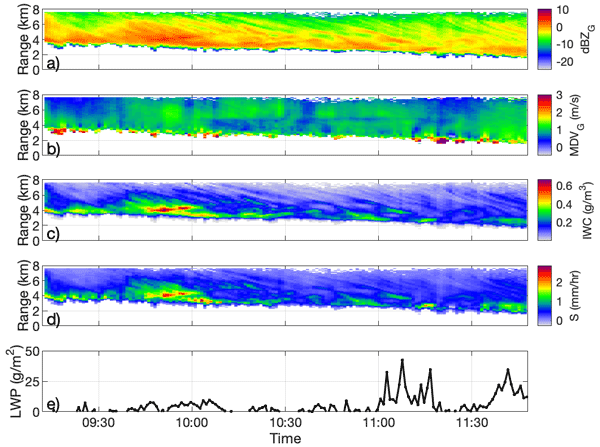
Karina McCusker, Chris Westbrook, Alessandro Battaglia, Kamil Mroz, Benjamin M. Courtier, Peter G. Huggard, Hui Wang, Richard Reeves, Christopher J. Walden, Richard Cotton, Stuart Fox, and Anthony J. Baran
Atmos. Meas. Tech., 18, 7833–7852, https://doi.org/10.5194/amt-18-7833-2025, https://doi.org/10.5194/amt-18-7833-2025, 2025
Short summary
Short summary
This work presents the first known retrievals of ice cloud and snowfall properties using G-band radar, representing a major step forward in the use of high-frequency radar for atmospheric remote sensing. We present theory and simulations to show that ice water content (IWC) and snowfall rate (S) can be retrieved efficiently with a single frequency G-band radar if the mass of a wavelength-sized particle is known or can be assumed, while details of the particle size distribution are not required.
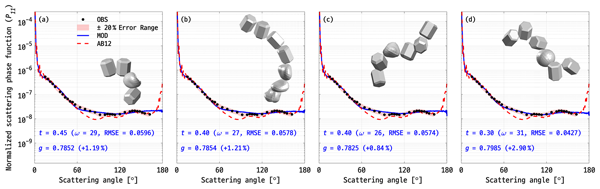
Jeonggyu Kim, Sungmin Park, Greg M. McFarquhar, Anthony J. Baran, Joo Wan Cha, Kyoungmi Lee, Seoung Soo Lee, Chang Hoon Jung, Kyo-Sun Sunny Lim, and Junshik Um
Atmos. Chem. Phys., 24, 12707–12726, https://doi.org/10.5194/acp-24-12707-2024, https://doi.org/10.5194/acp-24-12707-2024, 2024
Short summary
Short summary
We developed idealized models to represent the shapes of ice particles found in deep convective clouds and calculated their single-scattering properties. By comparing these results with in situ measurements, we discovered that a mixture of shape models matches in situ measurements more closely than single-form models or aggregate models. This finding has important implications for enhancing the simulation of single-scattering properties of ice crystals in deep convective clouds.
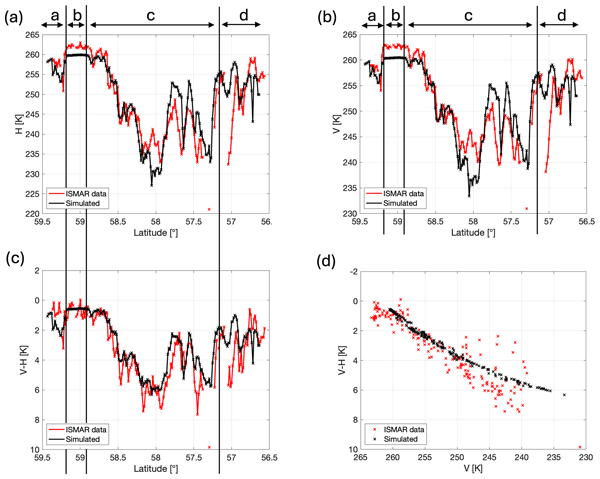
Karina McCusker, Anthony J. Baran, Chris Westbrook, Stuart Fox, Patrick Eriksson, Richard Cotton, Julien Delanoë, and Florian Ewald
Atmos. Meas. Tech., 17, 3533–3552, https://doi.org/10.5194/amt-17-3533-2024, https://doi.org/10.5194/amt-17-3533-2024, 2024
Short summary
Short summary
Polarised radiative transfer simulations are performed using an atmospheric model based on in situ measurements. These are compared to large polarisation measurements to explore whether such measurements can provide information on cloud ice, e.g. particle shape and orientation. We find that using oriented particle models with shapes based on imagery generally allows for accurate simulations. However, results are sensitive to shape assumptions such as the choice of single crystals or aggregates.
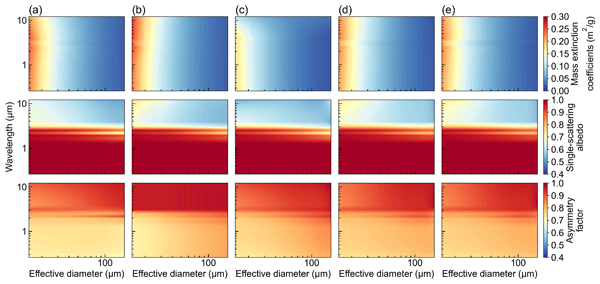
Ming Li, Husi Letu, Yiran Peng, Hiroshi Ishimoto, Yanluan Lin, Takashi Y. Nakajima, Anthony J. Baran, Zengyuan Guo, Yonghui Lei, and Jiancheng Shi
Atmos. Chem. Phys., 22, 4809–4825, https://doi.org/10.5194/acp-22-4809-2022, https://doi.org/10.5194/acp-22-4809-2022, 2022
Short summary
Short summary
To build on the previous investigations of the Voronoi model in the remote sensing retrievals of ice cloud products, this paper developed an ice cloud parameterization scheme based on the single-scattering properties of the Voronoi model and evaluate it through simulations with the Community Integrated Earth System Model (CIESM). Compared with four representative ice cloud schemes, results show that the Voronoi model has good capabilities of ice cloud modeling in the climate model.
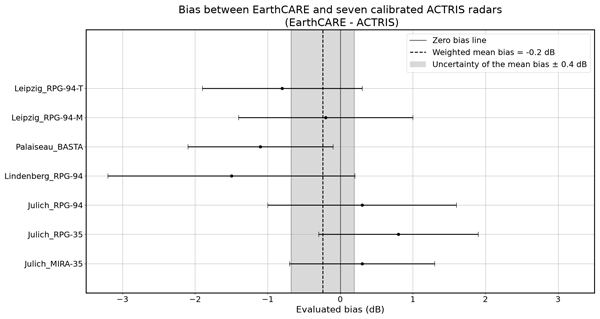
Nathan Feuillard, Felipe Toledo Bittner, Lukas Pfitzenmaier, Jean-François Ribaud, Julien Delanoë, Martial Haeffelin, and Jean-Charles Dupont
Atmos. Meas. Tech., 19, 6075–6097, https://doi.org/10.5194/amt-19-6075-2026, https://doi.org/10.5194/amt-19-6075-2026, 2026
Short summary
Short summary
The Earth Cloud, Aerosol, and Radiation Explorer (EarthCARE) satellite was recently launched and its data needs to be validated. This work focus on the comparison of the data observed from the radar of EarthCARE and from the ground radars of the European Aerosol, Clouds and Trace Gases Research Infrastructure network. We find a very small difference between the data observed by the satellite and the data from the ground, confirming the high quality of the satellite’s radar calibration.
Claudia J. Stubenrauch, Xiaoting Chen, Laurent Li, and Anthony J. Baran
EGUsphere, https://doi.org/10.5194/egusphere-2026-5049, https://doi.org/10.5194/egusphere-2026-5049, 2026
This preprint is open for discussion and under review for Weather and Climate Dynamics (WCD).
Short summary
Short summary
Atmospheric heating gradients caused by tropical upper tropospheric ice clouds (cirrus) influence the atmospheric circulation which then affects patterns of precipitation. While their overall radiative effect leads to a strengthening of the Hadley circulation, semi-transparent cirrus weaken the circulation. This means that in a warmer climate changes in their optical depth may then counteract or enhance the weakened Hadley circulation.
Robert J. Thompson, Thorwald H. M. Stein, Chun Hay Brian Lo, Robert Jackson, Christopher D. Westbrook, Scott Collis, Lindsay Rhodes, Timothy Darlington, Emily G. Norton, Paul A. Barrett, and Ryan R. Neely III
EGUsphere, https://doi.org/10.5194/egusphere-2026-4631, https://doi.org/10.5194/egusphere-2026-4631, 2026
Short summary
Short summary
Thunderstorms have complex flow patterns that are difficult to observe directly. Observational data is needed for robust evaluation to confirm that forecast models behave correctly. Five Doppler weather radars in Southern England, an updated 3D variational algorithm used, to generate a 3D grid of the 3 components of the wind. The dataset is verified with wind profiler, aircraft & separate radar, finding accuracy better than 2.4 ms−1. This data is valuable for evaluation of models.
Nicolas Chiabrando, Gwendal Rivière, Étienne Vignon, and Julien Delanoë
EGUsphere, https://doi.org/10.5194/egusphere-2026-3987, https://doi.org/10.5194/egusphere-2026-3987, 2026
Short summary
Short summary
Arctic cyclones are large-scale depressions evolving within the Arctic circle. We study a summertime Arctic cyclone that moved near Svalbard in 2022 and was well observed during the THINICE field campaign to understand what controls the intensity of a near-surface wind jet associated with the cyclone. We find that clouds and near-surface frictional effects globally strengthened the wind while the cyclone was growing, but became much less important after it evolved toward a cold-core structure.
Heather Corden, Julien Delanoë, Massimo Del Guasta, and Alexis Berne
EGUsphere, https://doi.org/10.5194/egusphere-2026-3964, https://doi.org/10.5194/egusphere-2026-3964, 2026
Short summary
Short summary
In Antarctica, intrusions of warm, moist air from the coast to the high plateau are responsible for a significant proportion of the snow accumulating on the ice sheet each year. We present a case study of an intrusion in East Antarctica in February 2025. Meteorological radars along a 1100-km transect were used to investigate the processes leading to precipitation in the intrusion. The processes vary according to the changing temperature, humidity and wind dynamics between the coast and plateau.
Aymeric Dziduch, Antoine Baudoux, Guillaume Mioche, Antoine Canzi, Benjamin Doiteau, Manuel Moser, Emma Järvinen, Étienne Vignon, Jean-Christophe Raut, Régis Dupuy, Christophe Gourbeyre, Jean-Luc Baray, Marie Monier, Frédéric Szczap, Guillaume Penide, Julien Delanoë, Odran Sourdeval, Alfons Schwarzenboeck, Stephan Mertes, Franz Martin Schnaiter, Christiane Voigt, Mario Mech, Susanne Crewell, Andreas Herber, Christof Lüpkes, André Ehrlich, Manfred Wendisch, and Olivier Jourdan
EGUsphere, https://doi.org/10.5194/egusphere-2026-3265, https://doi.org/10.5194/egusphere-2026-3265, 2026
This preprint is open for discussion and under review for Atmospheric Chemistry and Physics (ACP).
Short summary
Short summary
This study examines the microphysical properties and ice crystal habits of low-level Arctic mixed-phase clouds around Svalbard. Using airborne in situ observations from four campaigns, we show that cloud microphysical structure and ice crystal habits are influenced by weather conditions and surface type. These results provide quantitative observations to better understand low-level Arctic clouds, their ice formation processes, and their influence on the Arctic atmosphere and climate system.
Rosie M. Mammatt, Chris Westbrook, and Karina McCusker
EGUsphere, https://doi.org/10.5194/egusphere-2026-2928, https://doi.org/10.5194/egusphere-2026-2928, 2026
Short summary
Short summary
Secondary ice production in stratiform clouds remains poorly understood. In this article, a peak finding algorithm applied to radar Doppler spectra is used to produce the first quantitative estimate of the distribution of multimodal spectra with temperature, from which ice multiplication can be inferred. Peaks in spectral reflectivity also correspond to velocities of the different populations. We show evidence that particle velocities decrease at temperatures associated with dendritic growth.
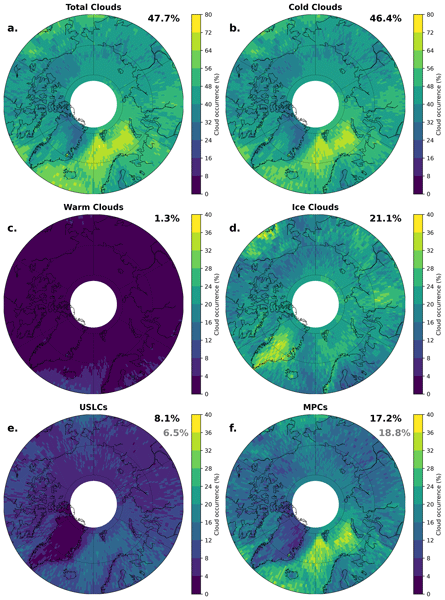
Aymeric Dziduch, Guillaume Mioche, Quentin Coopman, Clément Bazantay, Julien Delanoë, and Olivier Jourdan
Atmos. Chem. Phys., 26, 4019–4047, https://doi.org/10.5194/acp-26-4019-2026, https://doi.org/10.5194/acp-26-4019-2026, 2026
Short summary
Short summary
Low-level clouds play a central role in the Arctic climate by regulating energy exchanges between the surface and the atmosphere. Using eight years of CALIPSO–CloudSat observations, this study investigates the regional and seasonal variability of Arctic low-level cloud types. Mixed-phase and supercooled liquid clouds are frequent over oceanic regions, especially during transition seasons. Their occurrence is strongly influenced by surface coupling, temperature, stability, and cold-air outbreaks.
Romain Joseph, Jérôme Vidot, Julien Delanoë, and Emmanuel Fontaine
EGUsphere, https://doi.org/10.5194/egusphere-2026-48, https://doi.org/10.5194/egusphere-2026-48, 2026
Preprint archived
Short summary
Short summary
We used aircraft radar measurements inside tropical storm clouds to estimate their ice content, then simulated satellite observations using a radiative transfer model. By testing different assumptions about the shape and number of ice crystals, we examined how these choices influence the simulated radiances. We found that satellite information for these clouds is mainly controlled by conditions near the cloud top, while deeper layers remain largely hidden.
Karina McCusker, Chris Westbrook, Alessandro Battaglia, Kamil Mroz, Benjamin M. Courtier, Peter G. Huggard, Hui Wang, Richard Reeves, Christopher J. Walden, Richard Cotton, Stuart Fox, and Anthony J. Baran
Atmos. Meas. Tech., 18, 7833–7852, https://doi.org/10.5194/amt-18-7833-2025, https://doi.org/10.5194/amt-18-7833-2025, 2025
Short summary
Short summary
This work presents the first known retrievals of ice cloud and snowfall properties using G-band radar, representing a major step forward in the use of high-frequency radar for atmospheric remote sensing. We present theory and simulations to show that ice water content (IWC) and snowfall rate (S) can be retrieved efficiently with a single frequency G-band radar if the mass of a wavelength-sized particle is known or can be assumed, while details of the particle size distribution are not required.
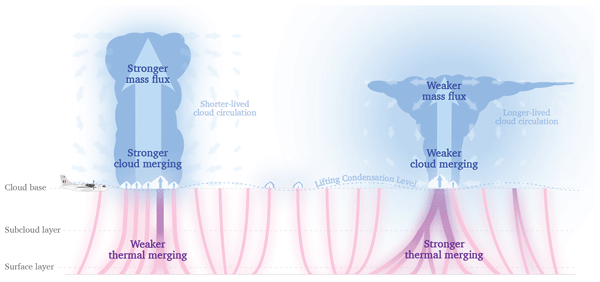
Sandrine Bony, Basile Poujol, Brett McKim, Nicolas Rochetin, Marie Lothon, Julia Windmiller, Nicolas Maury, Clarisse Dufaux, Louis Jaffeux, Patrick Chazette, and Julien Delanoë
Atmos. Chem. Phys., 25, 17331–17362, https://doi.org/10.5194/acp-25-17331-2025, https://doi.org/10.5194/acp-25-17331-2025, 2025
Short summary
Short summary
Space photographs of the Earth show that clouds form diverse, common but poorly understood cloud patterns. The analysis of observations gathered from research aircraft over the tropical ocean shows that the merging of thermals and clouds in the first kilometer of the atmosphere plays a key role in controlling the size, depth and spacing of clouds. This reveals a fundamental process through which clouds interact with each other and with their environment.
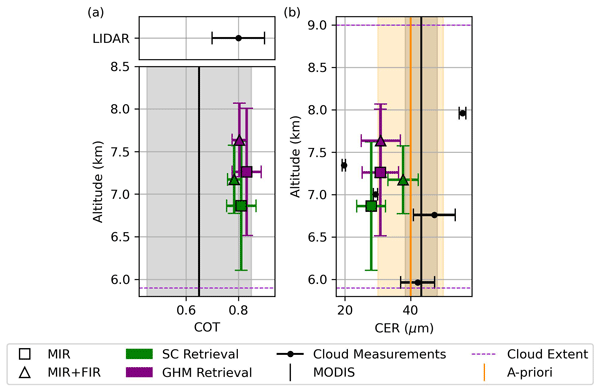
Sanjeevani Panditharatne, Caroline Cox, Rui Song, Richard Siddans, Richard Bantges, Jonathan Murray, Stuart Fox, Cathryn Fox, and Helen Brindley
Atmos. Chem. Phys., 25, 9981–9998, https://doi.org/10.5194/acp-25-9981-2025, https://doi.org/10.5194/acp-25-9981-2025, 2025
Short summary
Short summary
Upwelling radiation with wavelengths between 15 and 100 µm is theorised to be highly sensitive to the properties of ice clouds, particularly the shape of the ice crystals. We exploit this sensitivity and perform the first retrieval of ice cloud properties using these wavelengths from an observation taken on an aircraft and evaluate it against measurements of the cloud’s properties.
Guillaume Feger, Jean-Pierre Chaboureau, Thibaut Dauhut, Julien Delanoë, and Pierre Coutris
Atmos. Chem. Phys., 25, 7447–7465, https://doi.org/10.5194/acp-25-7447-2025, https://doi.org/10.5194/acp-25-7447-2025, 2025
Short summary
Short summary
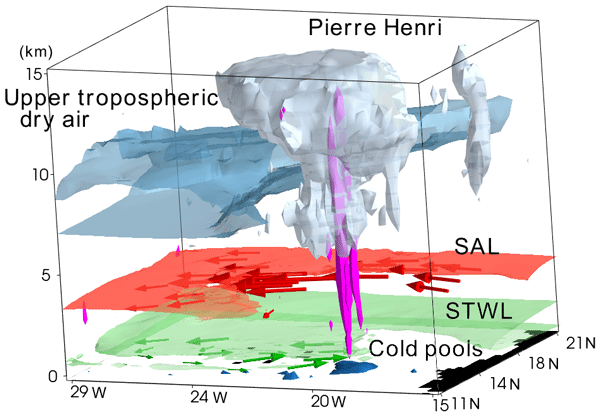
Saharan air at the trade wind layer, cold pools, and dry upper troposphere has these three main factors inhibiting the cyclogenesis of the Pierre Henri mesoscale convective system. The findings were obtained through observations made during two flights of the Clouds-Atmospheric Dynamics-Dust Interactions in West Africa (CADDIWA) campaign and a convection-permitting simulation run with the Meso-NH model. They provide new insights into the complex dynamics of cyclogenesis in the Cabo Verde region and challenge the existing model of the Saharan Air Layer (SAL).
Aymeric Dziduch, Guillaume Mioche, Quentin Coopman, Clément Bazantay, Julien Delanoë, and Olivier Jourdan
EGUsphere, https://doi.org/10.5194/egusphere-2025-2698, https://doi.org/10.5194/egusphere-2025-2698, 2025
Preprint archived
Short summary
Short summary
Low-level clouds play a central role in the Arctic climate, modulating the surface energy budget with competing warming and cooling effects. In this study, radar-lidar satellite products are used to investigate the geographical and seasonal variations of different cloud types observed over eight years. Oceanic regions are characterized by high occurrences of low-level mixed-phase clouds, which are influenced by atmospheric stability conditions, surface temperatures and cold air outbreaks.
Théophane Costabloz, Frédéric Burnet, Christine Lac, Pauline Martinet, Julien Delanoë, Susana Jorquera, and Maroua Fathalli
Atmos. Chem. Phys., 25, 6539–6573, https://doi.org/10.5194/acp-25-6539-2025, https://doi.org/10.5194/acp-25-6539-2025, 2025
Short summary
Short summary
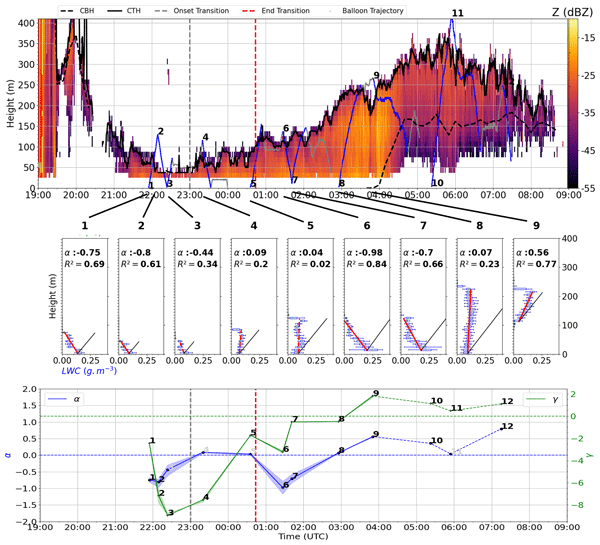
This study documents vertical profiles of liquid water content (LWC) in fogs from in situ measurements collected during the SOFOG3D field campaign in 2019–2020. The analysis of 140 vertical profiles reveals a reverse trend in LWC, maximum values at ground decreasing with height, during stable conditions in optically thin fogs, evolving towards quasi-adiabatic characteristics when fogs become thick. These results offer new perspectives for better constraining fog numerical simulations.
Sanjeevani Panditharatne, Helen Brindley, Caroline Cox, Richard Siddans, Jonathan Murray, Laura Warwick, and Stuart Fox
Atmos. Meas. Tech., 18, 717–735, https://doi.org/10.5194/amt-18-717-2025, https://doi.org/10.5194/amt-18-717-2025, 2025
Short summary
Short summary
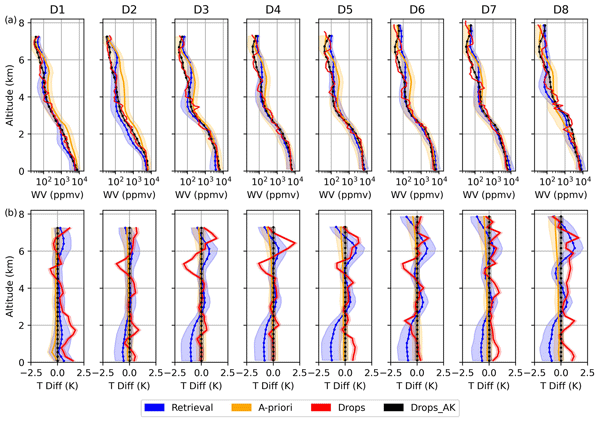
Observations from the upcoming European Space Agency’s Far-Infrared Outgoing Radiation Understanding and Monitoring (FORUM) satellite are theorised to be highly sensitive to distributions of water vapour within Earth’s atmosphere. We exploit this sensitivity and extend the Infrared Microwave Sounding retrieval scheme for use on observations from FORUM. This scheme is evaluated on both simulated and observed measurements and shows good agreement with references of the atmospheric state.
Jeonggyu Kim, Sungmin Park, Greg M. McFarquhar, Anthony J. Baran, Joo Wan Cha, Kyoungmi Lee, Seoung Soo Lee, Chang Hoon Jung, Kyo-Sun Sunny Lim, and Junshik Um
Atmos. Chem. Phys., 24, 12707–12726, https://doi.org/10.5194/acp-24-12707-2024, https://doi.org/10.5194/acp-24-12707-2024, 2024
Short summary
Short summary
We developed idealized models to represent the shapes of ice particles found in deep convective clouds and calculated their single-scattering properties. By comparing these results with in situ measurements, we discovered that a mixture of shape models matches in situ measurements more closely than single-form models or aggregate models. This finding has important implications for enhancing the simulation of single-scattering properties of ice crystals in deep convective clouds.
Jennifer R. Stout, Christopher D. Westbrook, Thorwald H. M. Stein, and Mark W. McCorquodale
Atmos. Chem. Phys., 24, 11133–11155, https://doi.org/10.5194/acp-24-11133-2024, https://doi.org/10.5194/acp-24-11133-2024, 2024
Short summary
Short summary
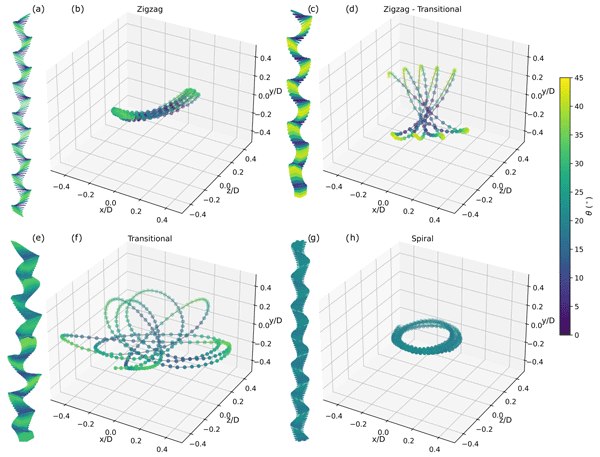
This study uses 3D-printed ice crystal analogues falling in a water–glycerine mix and observed with multi-view cameras, simulating atmospheric conditions. Four types of motion are observed: stable, zigzag, transitional, and spiralling. Particle shape strongly influences motion; complex shapes have a wider range of conditions where they fall steadily compared to simple plates. The most common orientation of unstable particles is non-horizontal, contrary to prior assumptions of always horizontal.
Melody Sandells, Nick Rutter, Kirsty Wivell, Richard Essery, Stuart Fox, Chawn Harlow, Ghislain Picard, Alexandre Roy, Alain Royer, and Peter Toose
The Cryosphere, 18, 3971–3990, https://doi.org/10.5194/tc-18-3971-2024, https://doi.org/10.5194/tc-18-3971-2024, 2024
Short summary
Short summary
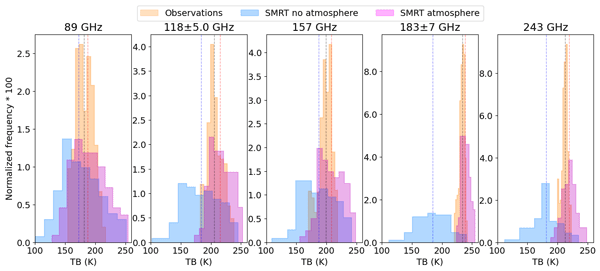
Satellite microwave observations are used for weather forecasting. In Arctic regions this is complicated by natural emission from snow. By simulating airborne observations from in situ measurements of snow, this study shows how snow properties affect the signal within the atmosphere. Fresh snowfall between flights changed airborne measurements. Good knowledge of snow layering and structure can be used to account for the effects of snow and could unlock these data to improve forecasts.
Stuart Fox, Vinia Mattioli, Emma Turner, Alan Vance, Domenico Cimini, and Donatello Gallucci
Atmos. Meas. Tech., 17, 4957–4978, https://doi.org/10.5194/amt-17-4957-2024, https://doi.org/10.5194/amt-17-4957-2024, 2024
Short summary
Short summary
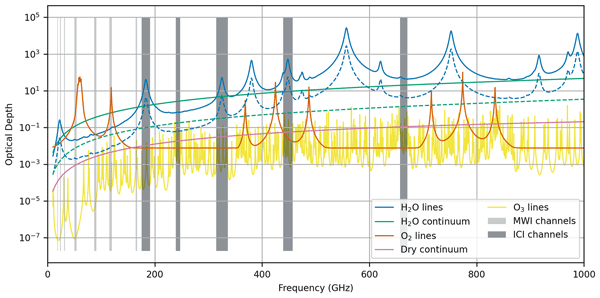
Airborne observations are used to evaluate two models for absorption and emission by atmospheric gases, including water vapour and oxygen, at microwave and sub-millimetre wavelengths. These models are needed for the Ice Cloud Imager (ICI) on the next generation of European polar-orbiting weather satellites, which measures at frequencies up to 664 GHz. Both models can provide a good match to measurements from airborne radiometers and are sufficiently accurate for use with ICI.
Manfred Wendisch, Susanne Crewell, André Ehrlich, Andreas Herber, Benjamin Kirbus, Christof Lüpkes, Mario Mech, Steven J. Abel, Elisa F. Akansu, Felix Ament, Clémantyne Aubry, Sebastian Becker, Stephan Borrmann, Heiko Bozem, Marlen Brückner, Hans-Christian Clemen, Sandro Dahlke, Georgios Dekoutsidis, Julien Delanoë, Elena De La Torre Castro, Henning Dorff, Regis Dupuy, Oliver Eppers, Florian Ewald, Geet George, Irina V. Gorodetskaya, Sarah Grawe, Silke Groß, Jörg Hartmann, Silvia Henning, Lutz Hirsch, Evelyn Jäkel, Philipp Joppe, Olivier Jourdan, Zsofia Jurányi, Michail Karalis, Mona Kellermann, Marcus Klingebiel, Michael Lonardi, Johannes Lucke, Anna E. Luebke, Maximilian Maahn, Nina Maherndl, Marion Maturilli, Bernhard Mayer, Johanna Mayer, Stephan Mertes, Janosch Michaelis, Michel Michalkov, Guillaume Mioche, Manuel Moser, Hanno Müller, Roel Neggers, Davide Ori, Daria Paul, Fiona M. Paulus, Christian Pilz, Felix Pithan, Mira Pöhlker, Veronika Pörtge, Maximilian Ringel, Nils Risse, Gregory C. Roberts, Sophie Rosenburg, Johannes Röttenbacher, Janna Rückert, Michael Schäfer, Jonas Schaefer, Vera Schemann, Imke Schirmacher, Jörg Schmidt, Sebastian Schmidt, Johannes Schneider, Sabrina Schnitt, Anja Schwarz, Holger Siebert, Harald Sodemann, Tim Sperzel, Gunnar Spreen, Bjorn Stevens, Frank Stratmann, Gunilla Svensson, Christian Tatzelt, Thomas Tuch, Timo Vihma, Christiane Voigt, Lea Volkmer, Andreas Walbröl, Anna Weber, Birgit Wehner, Bruno Wetzel, Martin Wirth, and Tobias Zinner
Atmos. Chem. Phys., 24, 8865–8892, https://doi.org/10.5194/acp-24-8865-2024, https://doi.org/10.5194/acp-24-8865-2024, 2024
Short summary
Short summary
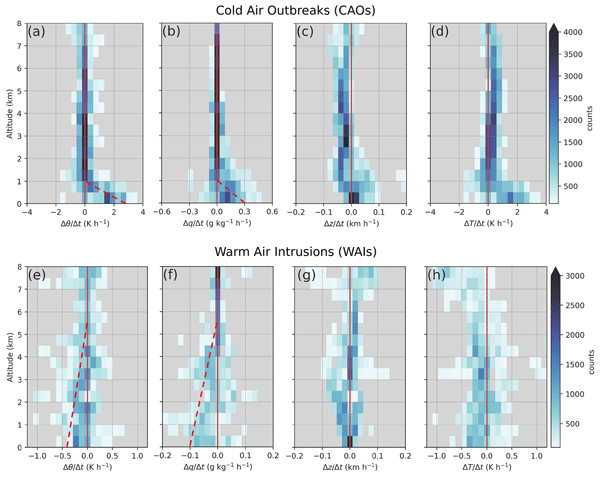
The Arctic is warming faster than the rest of the globe. Warm-air intrusions (WAIs) into the Arctic may play an important role in explaining this phenomenon. Cold-air outbreaks (CAOs) out of the Arctic may link the Arctic climate changes to mid-latitude weather. In our article, we describe how to observe air mass transformations during CAOs and WAIs using three research aircraft instrumented with state-of-the-art remote-sensing and in situ measurement devices.
Clémantyne Aubry, Julien Delanoë, Silke Groß, Florian Ewald, Frédéric Tridon, Olivier Jourdan, and Guillaume Mioche
Atmos. Meas. Tech., 17, 3863–3881, https://doi.org/10.5194/amt-17-3863-2024, https://doi.org/10.5194/amt-17-3863-2024, 2024
Short summary
Short summary
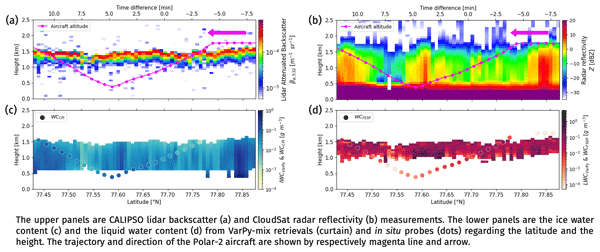
Radar–lidar synergy is used to retrieve ice, supercooled water and mixed-phase cloud properties, making the most of the radar sensitivity to ice crystals and the lidar sensitivity to supercooled droplets. A first analysis of the output of the algorithm run on the satellite data is compared with in situ data during an airborne Arctic field campaign, giving a mean percent error of 49 % for liquid water content and 75 % for ice water content.
Donatello Gallucci, Domenico Cimini, Emma Turner, Stuart Fox, Philip W. Rosenkranz, Mikhail Y. Tretyakov, Vinia Mattioli, Salvatore Larosa, and Filomena Romano
Atmos. Chem. Phys., 24, 7283–7308, https://doi.org/10.5194/acp-24-7283-2024, https://doi.org/10.5194/acp-24-7283-2024, 2024
Short summary
Short summary
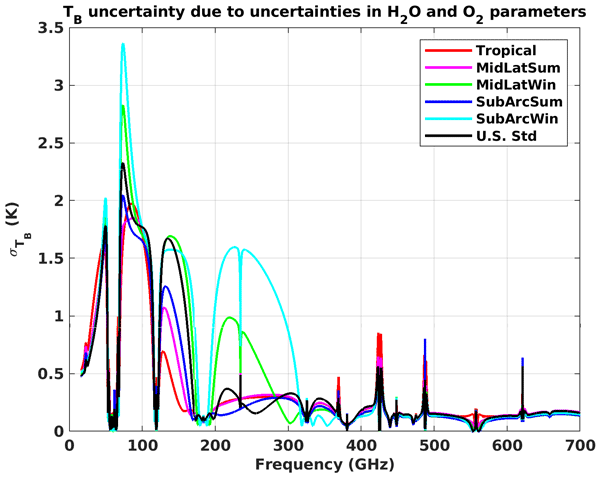
Nowadays, atmospheric radiative transfer models are widely used to simulate satellite and ground-based observations. A meaningful comparison between observations and simulations requires an estimate of the uncertainty associated with both. This work quantifies the uncertainty in atmospheric radiative transfer models in the microwave range, providing the uncertainty associated with simulations of new-generation satellite microwave sensors.
Karina McCusker, Anthony J. Baran, Chris Westbrook, Stuart Fox, Patrick Eriksson, Richard Cotton, Julien Delanoë, and Florian Ewald
Atmos. Meas. Tech., 17, 3533–3552, https://doi.org/10.5194/amt-17-3533-2024, https://doi.org/10.5194/amt-17-3533-2024, 2024
Short summary
Short summary
Polarised radiative transfer simulations are performed using an atmospheric model based on in situ measurements. These are compared to large polarisation measurements to explore whether such measurements can provide information on cloud ice, e.g. particle shape and orientation. We find that using oriented particle models with shapes based on imagery generally allows for accurate simulations. However, results are sensitive to shape assumptions such as the choice of single crystals or aggregates.
Cheikh Dione, Martial Haeffelin, Frédéric Burnet, Christine Lac, Guylaine Canut, Julien Delanoë, Jean-Charles Dupont, Susana Jorquera, Pauline Martinet, Jean-François Ribaud, and Felipe Toledo
Atmos. Chem. Phys., 23, 15711–15731, https://doi.org/10.5194/acp-23-15711-2023, https://doi.org/10.5194/acp-23-15711-2023, 2023
Short summary
Short summary
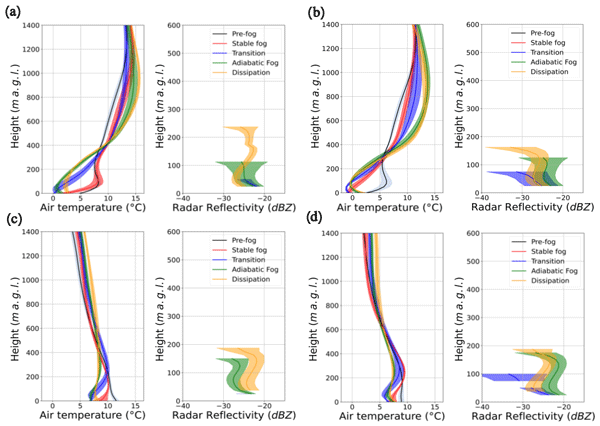
This paper documents the role of thermodynamics and turbulence in the fog life cycle over southwestern France. It is based on a unique dataset collected during the SOFOG3D field campaign in autumn and winter 2019–2020. The paper gives a threshold for turbulence driving the different phases of the fog life cycle and the role of advection in the night-time dissipation of fog. The results can be operationalised to nowcast fog and improve short-range forecasts in numerical weather prediction models.
Leonie Villiger, Marina Dütsch, Sandrine Bony, Marie Lothon, Stephan Pfahl, Heini Wernli, Pierre-Etienne Brilouet, Patrick Chazette, Pierre Coutris, Julien Delanoë, Cyrille Flamant, Alfons Schwarzenboeck, Martin Werner, and Franziska Aemisegger
Atmos. Chem. Phys., 23, 14643–14672, https://doi.org/10.5194/acp-23-14643-2023, https://doi.org/10.5194/acp-23-14643-2023, 2023
Short summary
Short summary
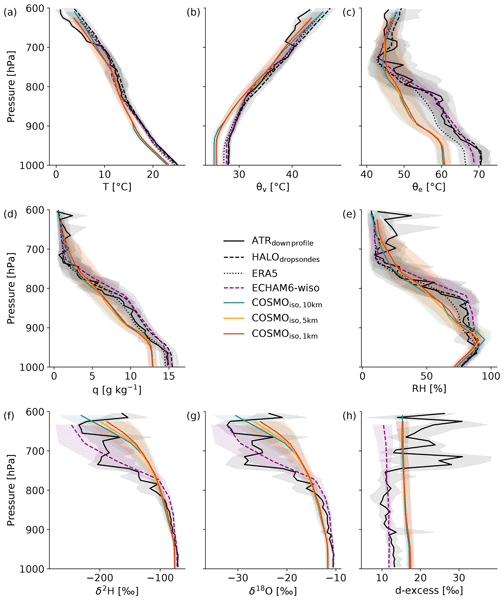
This study evaluates three numerical simulations performed with an isotope-enabled weather forecast model and investigates the coupling between shallow trade-wind cumulus clouds and atmospheric circulations on different scales. We show that the simulations reproduce key characteristics of shallow trade-wind clouds as observed during the field experiment EUREC4A and that the spatial distribution of stable-water-vapour isotopes is shaped by the overturning circulation associated with these clouds.
Kirsty Wivell, Stuart Fox, Melody Sandells, Chawn Harlow, Richard Essery, and Nick Rutter
The Cryosphere, 17, 4325–4341, https://doi.org/10.5194/tc-17-4325-2023, https://doi.org/10.5194/tc-17-4325-2023, 2023
Short summary
Short summary
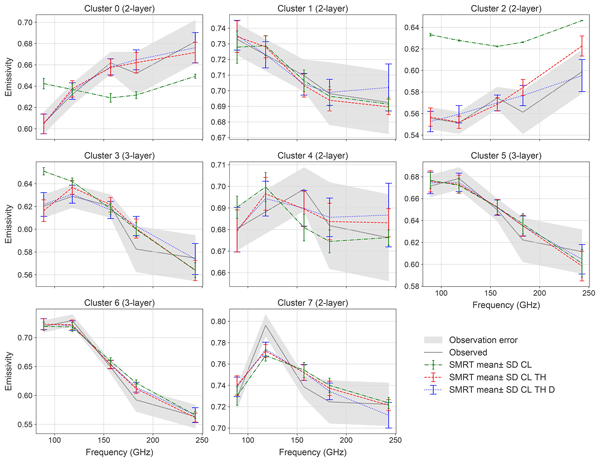
Satellite microwave observations improve weather forecasts, but to use these observations in the Arctic, snow emission must be known. This study uses airborne and in situ snow observations to validate emissivity simulations for two- and three-layer snowpacks at key frequencies for weather prediction. We assess the impact of thickness, grain size and density in key snow layers, which will help inform development of physical snow models that provide snow profile input to emissivity simulations.
Abdanour Irbah, Julien Delanoë, Gerd-Jan van Zadelhoff, David P. Donovan, Pavlos Kollias, Bernat Puigdomènech Treserras, Shannon Mason, Robin J. Hogan, and Aleksandra Tatarevic
Atmos. Meas. Tech., 16, 2795–2820, https://doi.org/10.5194/amt-16-2795-2023, https://doi.org/10.5194/amt-16-2795-2023, 2023
Short summary
Short summary
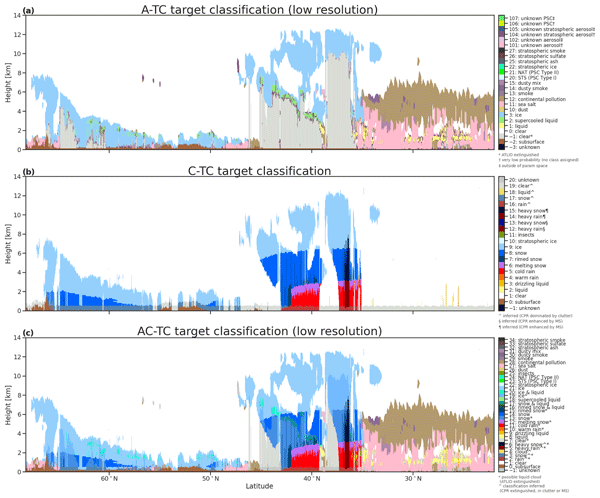
The Cloud Profiling Radar (CPR) and ATmospheric LIDar (ATLID) aboard the EarthCARE satellite are used to probe the Earth's atmosphere by measuring cloud and aerosol profiles. ATLID is sensitive to aerosols and small cloud particles and CPR to large ice particles, snowflakes and raindrops. It is the synergy of the measurements of these two instruments that allows a better classification of the atmospheric targets and the description of the associated products, which are the subject of this paper.
Pragya Vishwakarma, Julien Delanoë, Susana Jorquera, Pauline Martinet, Frederic Burnet, Alistair Bell, and Jean-Charles Dupont
Atmos. Meas. Tech., 16, 1211–1237, https://doi.org/10.5194/amt-16-1211-2023, https://doi.org/10.5194/amt-16-1211-2023, 2023
Short summary
Short summary
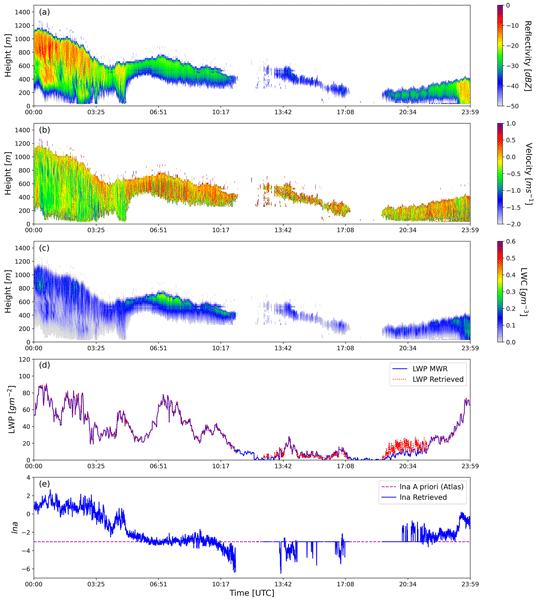
Cloud observations are necessary to characterize the cloud properties at local and global scales. The observations must be translated to cloud geophysical parameters. This paper presents the estimation of liquid water content (LWC) using radar and microwave radiometer (MWR) measurements. Liquid water path from MWR scales LWC and retrieves the scaling factor (ln a). The retrievals are compared with in situ observations. A climatology of ln a is built to estimate LWC using only radar information.
Alistair Bell, Pauline Martinet, Olivier Caumont, Frédéric Burnet, Julien Delanoë, Susana Jorquera, Yann Seity, and Vinciane Unger
Atmos. Meas. Tech., 15, 5415–5438, https://doi.org/10.5194/amt-15-5415-2022, https://doi.org/10.5194/amt-15-5415-2022, 2022
Short summary
Short summary
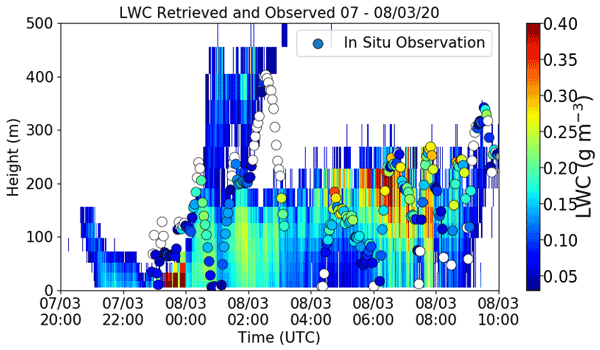
Cloud radars and microwave radiometers offer the potential to improve fog forecasts when assimilated into a high-resolution model. As this process can be complex, a retrieval of model variables is sometimes made as a first step. In this work, results from a 1D-Var algorithm for the retrieval of temperature, humidity and cloud liquid water content are presented. The algorithm is applied first to a synthetic dataset and then to a dataset of real measurements from a recent field campaign.
Meryl Wimmer, Gwendal Rivière, Philippe Arbogast, Jean-Marcel Piriou, Julien Delanoë, Carole Labadie, Quitterie Cazenave, and Jacques Pelon
Weather Clim. Dynam., 3, 863–882, https://doi.org/10.5194/wcd-3-863-2022, https://doi.org/10.5194/wcd-3-863-2022, 2022
Short summary
Short summary
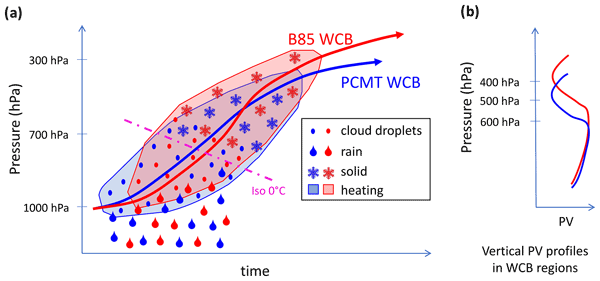
The effect of deep convection representation on the jet stream above the cold front of an extratropical cyclone is investigated in the global numerical weather prediction model ARPEGE. Two simulations using different deep convection schemes are compared with (re)analysis datasets and NAWDEX airborne observations. A deeper jet stream is observed with the less active scheme. The diabatic origin of this difference is interpreted by backward Lagrangian trajectories and potential vorticity budgets.
Sandrine Bony, Marie Lothon, Julien Delanoë, Pierre Coutris, Jean-Claude Etienne, Franziska Aemisegger, Anna Lea Albright, Thierry André, Hubert Bellec, Alexandre Baron, Jean-François Bourdinot, Pierre-Etienne Brilouet, Aurélien Bourdon, Jean-Christophe Canonici, Christophe Caudoux, Patrick Chazette, Michel Cluzeau, Céline Cornet, Jean-Philippe Desbios, Dominique Duchanoy, Cyrille Flamant, Benjamin Fildier, Christophe Gourbeyre, Laurent Guiraud, Tetyana Jiang, Claude Lainard, Christophe Le Gac, Christian Lendroit, Julien Lernould, Thierry Perrin, Frédéric Pouvesle, Pascal Richard, Nicolas Rochetin, Kevin Salaün, Alfons Schwarzenboeck, Guillaume Seurat, Bjorn Stevens, Julien Totems, Ludovic Touzé-Peiffer, Gilles Vergez, Jessica Vial, Leonie Villiger, and Raphaela Vogel
Earth Syst. Sci. Data, 14, 2021–2064, https://doi.org/10.5194/essd-14-2021-2022, https://doi.org/10.5194/essd-14-2021-2022, 2022
Short summary
Short summary
The French ATR42 research aircraft participated in the EUREC4A international field campaign that took place in 2020 over the tropical Atlantic, east of Barbados. We present the extensive instrumentation of the aircraft, the research flights and the different measurements. We show that the ATR measurements of humidity, wind, aerosols and cloudiness in the lower atmosphere are robust and consistent with each other. They will make it possible to advance understanding of cloud–climate interactions.
Ming Li, Husi Letu, Yiran Peng, Hiroshi Ishimoto, Yanluan Lin, Takashi Y. Nakajima, Anthony J. Baran, Zengyuan Guo, Yonghui Lei, and Jiancheng Shi
Atmos. Chem. Phys., 22, 4809–4825, https://doi.org/10.5194/acp-22-4809-2022, https://doi.org/10.5194/acp-22-4809-2022, 2022
Short summary
Short summary
To build on the previous investigations of the Voronoi model in the remote sensing retrievals of ice cloud products, this paper developed an ice cloud parameterization scheme based on the single-scattering properties of the Voronoi model and evaluate it through simulations with the Community Integrated Earth System Model (CIESM). Compared with four representative ice cloud schemes, results show that the Voronoi model has good capabilities of ice cloud modeling in the climate model.
Simon Pfreundschuh, Stuart Fox, Patrick Eriksson, David Duncan, Stefan A. Buehler, Manfred Brath, Richard Cotton, and Florian Ewald
Atmos. Meas. Tech., 15, 677–699, https://doi.org/10.5194/amt-15-677-2022, https://doi.org/10.5194/amt-15-677-2022, 2022
Short summary
Short summary
We test a novel method to remotely measure ice particles in clouds. This is important because such measurements are required to improve climate and weather models. The method combines a radar with newly developed sensors measuring microwave radiation at very short wavelengths. We use observations made from aircraft flying above the cloud and compare them to real measurements from inside the cloud. This works well given that one can model the ice particles in the cloud sufficiently well.
Gwendal Rivière, Meryl Wimmer, Philippe Arbogast, Jean-Marcel Piriou, Julien Delanoë, Carole Labadie, Quitterie Cazenave, and Jacques Pelon
Weather Clim. Dynam., 2, 1011–1031, https://doi.org/10.5194/wcd-2-1011-2021, https://doi.org/10.5194/wcd-2-1011-2021, 2021
Short summary
Short summary
Inacurracies in representing processes occurring at spatial scales smaller than the grid scales of the weather forecast models are important sources of forecast errors. This is the case of deep convection representation in models with 10 km grid spacing. We performed simulations of a real extratropical cyclone using a model with different representations of deep convection. These forecasts lead to different behaviors in the ascending air masses of the cyclone and the jet stream aloft.
Nicholas J. Kedzuf, J. Christine Chiu, V. Chandrasekar, Sounak Biswas, Shashank S. Joshil, Yinghui Lu, Peter Jan van Leeuwen, Christopher Westbrook, Yann Blanchard, and Sebastian O'Shea
Atmos. Meas. Tech., 14, 6885–6904, https://doi.org/10.5194/amt-14-6885-2021, https://doi.org/10.5194/amt-14-6885-2021, 2021
Short summary
Short summary
Ice clouds play a key role in our climate system due to their strong controls on precipitation and the radiation budget. However, it is difficult to characterize co-existing ice species using radar observations. We present a new method that separates the radar signals of pristine ice embedded in snow aggregates and retrieves their respective abundances and sizes for the first time. The ability to provide their quantitative microphysical properties will open up many research opportunities.
Cited articles
Abel, S. J., Cotton, R. J., Barrett, P. A., and Vance, A. K.: A comparison of ice water content measurement techniques on the FAAM BAe-146 aircraft, Atmos. Meas. Tech., 7, 3007–3022, https://doi.org/10.5194/amt-7-3007-2014, 2014.
Atlas, D., Matrosov, S. Y., Heymsfield, A. J., Chou, M., and Wolff, D. B.: Radar and Radiation Properties of Ice Clouds, J. Appl. Meteor. Climatol., 34, 2329–2345, https://doi.org/10.1175/1520-0450(1995)034<2329:RARPOI>2.0.CO;2, 1995.
Baran, A. J.: A review of the light scattering properties of cirrus, J. Quant. Spectrosc. Ra., 110, 1239–1260, https://doi.org/10.1016/j.jqsrt.2009.02.026, 2009.
Baran, A. J.: From the single-scattering properties of ice crystals to climate prediction: A way forward, Atmos. Res., 112, 45–69, https://doi.org/10.1016/j.atmosres.2012.04.010, 2012.
Baran, A. J., Bodas-Salcedo, A., Cotton, R., and Lee, C.: Simulating the equivalent radar reflectivity of cirrus at 94 GHz using an ensemble model of cirrus ice crystals: a test of the Met Office global numerical weather prediction model, Q. J. Roy. Meteor. Soc., 137, 1547–1560, https://doi.org/10.1002/qj.870, 2011.
Baran, A. J., Heymsfield, A. J., Kleanthous, A., Westbrook, C. D., Betcke, T., Hewett, D. P., Barrett, P., and Fox, S.: Testing the Consistency of the Boundary Element Method for Computing the 75 Backscattering Properties of Complex Ice Crystals at Multiple Radar Frequencies, in: IGARSS 7–12 July, 2024 – 2024 IEEE International Geoscience and Remote Sensing Symposium, Athens, Greece, 2024, 538–541, https://doi.org/10.1109/IGARSS53475.2024.10641675, 2024.
Barker, H. W., Cole, J. N. S., Villefranque, N., Qu, Z., Velázquez Blázquez, A., Domenech, C., Mason, S. L., and Hogan, R. J.: Radiative closure assessment of retrieved cloud and aerosol properties for the EarthCARE mission: the ACMB-DF product, Atmos. Meas. Tech., 18, 3095–3107, https://doi.org/10.5194/amt-18-3095-2025, 2025.
Bartolomé García, I., Sourdeval, O., Spang, R., and Krämer, M.: Technical note: Bimodal parameterizations of in situ ice cloud particle size distributions, Atmos. Chem. Phys., 24, 1699–1716, https://doi.org/10.5194/acp-24-1699-2024, 2024.
Brath, M., Ekelund, R., Eriksson, P., Lemke, O., and Buehler, S. A.: Microwave and submillimeter wave scattering of oriented ice particles, Atmos. Meas. Tech., 13, 2309–2333, https://doi.org/10.5194/amt-13-2309-2020, 2020.
Cotton, R. J., Field, P. R., Ulanowski, Z., Kaye, P. H., Hirst, E., Greenaway, R. S., Crawford, I., Crosier, J., and Dorsey, J.: The effective density of small ice particles obtained from in situ aircraft observations of mid-latitude cirrus, Q. J. Roy. Meteor. Soc., 139, 1923–1934, https://doi.org/10.1002/qj.2058, 2013.
Courtier, B. M., Battaglia, A., Huggard, P. G., Westbrook, C., Mroz, K., Dhillon, R. S., Walden, C. J., Howells, G., Wang, H., Ellison, B. N., Reeves, R., Robertson, D. A., and Wylde, R. J.: First observations of G-band radar Doppler spectra, Geophys. Res. Lett., 49, e2021GL096475, https://doi.org/10.1029/2021GL096475, 2022.
Delanoë, J., Protat, A., Vinson, J. P., Brett, W., Caudoux, C., Bertrand, F., Parent du Chatelet, J., Hallali, R., Barthes, L., Haeffelin, M., and Dupont, J. C.: BASTA: A 95 GHz FMCW Doppler Radar for Cloud and Fog Studies, J. Atmos. Ocean. Tech., 33, 1023–1038, https://doi.org/10.1175/JTECH-D-15-0104.1, 2016.
Duffy, G. and Posselt, D. J.: A Gamma Parameterization for Precipitating Particle Size Distributions Containing Snowflake Aggregates Drawn from Five Field Experiments, J. Appl. Meteorol. Clim., 61, 1077–1085, https://doi.org/10.1175/JAMC-D-21-0131.1, 2022.
Ellison, W. J.: Permittivity of pure water, at standard atmospheric pressure, over the frequency range 0–25 Hz and the temperature range 0–100 °C, J. Phys. Chem. Ref. Data, 36, https://doi.org/10.1063/1.2360986, 2007.
Eriksson, P., Ekelund, R., Mendrok, J., Brath, M., Lemke, O., and Buehler, S. A.: A general database of hydrometeor single scattering properties at microwave and sub-millimetre wavelengths, Earth Syst. Sci. Data, 10, 1301–1326, https://doi.org/10.5194/essd-10-1301-2018, 2018.
Eriksson, P., Rydberg, B., Mattioli, V., Thoss, A., Accadia, C., Klein, U., and Buehler, S. A.: Towards an operational Ice Cloud Imager (ICI) retrieval product, Atmos. Meas. Tech., 13, 53–71, https://doi.org/10.5194/amt-13-53-2020, 2020.
Facility for Airborne Atmospheric Measurements, Natural Environment Research Council: FAAM C374 CCREST-M flight: Airborne atmospheric measurements from core instrument suite on board the BAE-146 aircraft, NERC EDS Centre for Environmental Data Analysis [data set], https://catalogue.ceda.ac.uk/uuid/7892db5c68104a0c9caf99bc59337647, 2024a.
Facility for Airborne Atmospheric Measurements, Natural Environment Research Council: FAAM C374 CCREST-M flight: Airborne atmospheric measurements from core instrument suite on board the BAE-146 aircraft, NERC EDS Centre for Environmental Data Analysis [data set], https://catalogue.ceda.ac.uk/uuid/7892db5c68104a0c9caf99bc59337647, 2024b.
Facility for Airborne Atmospheric Measurements, Natural Environment Research Council: FAAM C382 CCREST-M flight: Airborne atmospheric measurements from core instrument suite on board the BAE-146 aircraft, NERC EDS Centre for Environmental Data Analysis [data set], https://catalogue.ceda.ac.uk/uuid/67911f14d0a24d7ea8866eaf4575e9f5, 2024c.
Field, P. R., Hill, A., Shipway, B., Furtado, K., Wilkinson, J., Miltenberger, A., Gordon, H., Grosvenor, D.P., Stevens, R., and Van Weverberg, K.: Implementation of a double moment cloud microphysics scheme in the UK met office regional numerical weather prediction model, Q. J. Roy. Meteor. Soc., 149, 703–739, https://doi.org/10.1002/qj.4414, 2023.
Fontaine, E., Leroy, D., Schwarzenboeck, A., Delanoë, J., Protat, A., Dezitter, F., Grandin, A., Strapp, J. W., and Lilie, L. E.: Evaluation of radar reflectivity factor simulations of ice crystal populations from in situ observations for the retrieval of condensed water content in tropical mesoscale convective systems, Atmos. Meas. Tech., 10, 2239–2252, https://doi.org/10.5194/amt-10-2239-2017, 2017.
Fox, S., Lee, C., Moyna, B., Philipp, M., Rule, I., Rogers, S., King, R., Oldfield, M., Rea, S., Henry, M., Wang, H., and Harlow, R. C.: ISMAR: an airborne submillimetre radiometer, Atmos. Meas. Tech., 10, 477–490, https://doi.org/10.5194/amt-10-477-2017, 2017.
Geer, A. J. and Baordo, F.: Improved scattering radiative transfer for frozen hydrometeors at microwave frequencies, Atmos. Meas. Tech., 7, 1839–1860, https://doi.org/10.5194/amt-7-1839-2014, 2014.
Geer, A. J., Baordo, F., Bormann, N., English, S., Kazumori, M., Lawrence, H., Lean, P., Lonitz, K., and Lupu, C.: The growing impact of satellite observations sensitive to humidity, cloud and precipitation, Q. J. Roy. Meteor. Soc., 143, 3189–3206, https://doi.org/10.1002/qj.3172, 2017.
Geer, A. J., Bauer, P., Lonitz, K., Barlakas, V., Eriksson, P., Mendrok, J., Doherty, A., Hocking, J., and Chambon, P.: Bulk hydrometeor optical properties for microwave and sub-millimetre radiative transfer in RTTOV-SCATT v13.0, Geosci. Model Dev., 14, 7497–7526, https://doi.org/10.5194/gmd-14-7497-2021, 2021.
Heymsfield, A., Bansemer, A., Heymsfield, G., Noone, D., Grecu, M., and Toohey, D.: Relationship of Multiwavelength Radar Measurements to Ice Microphysics from the IMPACTS Field Program, J. Appl. Meteorol. Clim., 62, 289–315, https://doi.org/10.1175/JAMC-D-22-0057.1, 2023.
Hogan, R. J., Illingworth, A. J., and Sauvageot, H.: Measuring Crystal Size in Cirrus Using 35- and 94-GHz Radars, J. Atmos. Ocean. Tech., 17, 27–37, https://doi.org/10.1175/1520-0426(2000)017<0027:MCSICU>2.0.CO;2, 2000.
Hogan, R. J., Mittermaier, M. P., and Illingworth, A. J.: The retrieval of ice water content from radar reflectivity factor and temperature and its use in evaluating a mesoscale model, J. Appl. Meteorol. Clim., 45, 301–317., https://doi.org/10.1175/JAM2340.1, 2006.
Hong, G., Yang, P., Baum, B. A., and Heymsfield, A. J.: Relationship between ice water content and equivalent radar reflectivity for clouds consisting of nonspherical ice particles, J. Geophys. Res., 113, D20205, https://doi.org/10.1029/2008JD009890, 2008.
Hong, Y., Meng, H., Fan, Y., Dong, J., Ren, T., and Yang, P.: The effects of ice habit models on passive snowfall rate retrievals, Geophys. Res. Lett., 52, e2025GL11685, https://doi.org/10.1029/2025GL116853, 2025.
Illingworth, A. J., Barker, H. W., Beljaars, A., Ceccaldi, M., Chepfer, H., Clerbaux, N., Cole, J., Delanoë, J., Domenech, C., Donovan, D. P., Fukuda, S., Hirakata, M., Hogan, R. J., Huenerbein, A., Kollias, P., Kubota, T., Nakajima, T., Nakajima, T. Y., Nishizawa, T., Ohno, Y., Okamoto, H., Oki, R., Sato, K., Satoh, M., Shephard, M. W., Velázquez-Blázquez, A., Wandinger, U., Wehr, T., and van Zadelhoff, G.-J.: The EarthCARE Satellite: The Next Step Forward in Global Measurements of Clouds, Aerosols, Precipitation, and Radiation, B. Am. Meteorol. Soc., 96, 1311–1332, https://doi.org/10.1175/BAMS-D-12-00227.1, 2015.
International Telecommunication Union (ITU).P.676: Attenuation by atmospheric gases and related effects, https://www.itu.int/rec/R-REC-P.676-13-202208-I/en (last access: 26 June 2026), 2022.
Janisková., M.: Assimilation of cloud information from space-borne radar and lidar: experimental study using a 1D+4D-Var technique, Q. J. Roy. Meteor. Soc., 141, 2708–2725, https://doi.org/10.1002/qj.2558, 2015.
Kleanthous, A., Betcke, T., Hewett, D. P., Escapil-Inchauspé, P., Jerez-Hanckes, C., and Baran, A. J.: Accelerated Calderón preconditioning for Maxwell transmission problems, J. Comput. Phys., 458, 111099, https://doi.org/10.1016/j.jcp.2022.111099, 2022.
Kleanthous, A., Baran, A. J., Betcke, T., Hewett, D. P., and Westbrook, C. D.: An application of the boundary element method (BEM) to the calculation of the single-scattering properties of very complex ice crystals in the microwave and sub-millimetre regions of the electromagnetic spectrum, J. Quant. Spectrosc. Ra., 312, 108793, https://doi.org/10.1016/j.jqsrt.2023.108793, 2024.
Kozu, T. and Nakamura, K.: Rainfall Parameter Estimation from Dual-Radar Measurements Combining Reflectivity Profile and Path-integrated Attenuation, J. Atmos. Ocean. Tech., 8, 259–270, https://doi.org/10.1175/1520-0426(1991)008<0259:RPEFDR>2.0.CO;2, 1991.
Krämer, M., Spelten, N., Rolf, C., and Spang, R.: A microphysics guide to cirrus – Part 3: Occurrence patterns of cloud particles, Atmos. Chem. Phys., 25, 13563–13583, https://doi.org/10.5194/acp-25-13563-2025, 2025.
Lawson, R. P., Woods, S., Jensen, E., Erfani, E., Gurganus, C., Gallagher, M., Connolly, P., Whiteway, J., Baran, A. J., May, P., Heymsfield, A., Schmitt, C. G., McFarquhar, G., Um, J., Protat, A., Bailey, M., Lance, S., Muehlbauer, A., Stith, J., Korolev, A., Toon, O. B., and Krämer, M.: A review of ice particle shapes in cirrus formed in situ and in anvils, J. Geophys. Res.-Atmos., 124, 10049–10090, https://doi.org/10.1029/2018JD030122, 2019.
Li, Q., Li, H., Sun, X., Zhang, Y., Lyu, W., Ruan, Z., Liu, L., Liu, A., and Zhang, C.: A survey of snow growth signatures from tropics to Antarctica using triple-frequency radar observations, Atmos. Chem. Phys., 26, 1249–1264, https://doi.org/10.5194/acp-26-1249-2026, 2026.
Liu, P., Gao, J., Zhang, G., Carlin, J. T.: Assimilation of radar reflectivity data using parameterized forward operators for improving short-term forecasts of high-impact convection events, J. Geophys. Res.-Atmos., 129, e2024JD041458, https://doi.org/10.1029/2024JD041458, 2024.
Liou, K.: Influence of Cirrus Clouds on Weather and Climate Processes: A Global Perspective, Mon. Weather Rev., 114, 1167–1199, https://doi.org/10.1175/1520-0493(1986)114<1167:IOCCOW>2.0.CO;2, 1986.
Liou, K. N. and Yang, P.: Light Scattering by Ice Crystals: fundamentals and applications, Cambridge University Press, Cambridge, UK, https://doi.org/10.1017/CBO9781139030052, 2016.
Mätzler, C.: Microwave dielectric properties of ice, Thermal Microwave Radiation: Applications for Remote Sensing, 52, 455–462, 2006.
Mason, S. L., Barker, H. W., Cole, J. N. S., Docter, N., Donovan, D. P., Hogan, R. J., Hünerbein, A., Kollias, P., Puigdomènech Treserras, B., Qu, Z., Wandinger, U., and van Zadelhoff, G.-J.: An intercomparison of EarthCARE cloud, aerosol, and precipitation retrieval products, Atmos. Meas. Tech., 17, 875–898, https://doi.org/10.5194/amt-17-875-2024, 2024.
May, E., Rydberg, B., Kaur, I., Mattioli, V., Hallborn, H., and Eriksson, P.: The Ice Cloud Imager: retrieval of frozen water column properties, Atmos. Meas. Tech., 17, 5957–5987, https://doi.org/10.5194/amt-17-5957-2024, 2024.
McCusker, K., Baran, A. J., Westbrook, C., Fox, S., Eriksson, P., Cotton, R., Delanoë, J, and Ewald, F.: The first microwave and submillimetre closure study using particle models of oriented ice hydrometeors to simulate polarimetric measurements of ice clouds, Atmos. Meas. Tech., 17, 3533–3552, https://doi.org/10.5194/amt-17-3533-2024, 2024.
McCusker, K., Westbrook, C., Battaglia, A., Mroz, K., Courtier, B. M., Huggard, P. G., Wang, H., Reeves, R., Walden, C. J., Cotton, R., Fox, S., and Baran, A. J.: Estimating vertical profiles of ice water content and snowfall rate from radar measurements in the G-band, Atmos. Meas. Tech., 18, 7833–7852, https://doi.org/10.5194/amt-18-7833-2025, 2025.
McFarquhar, G. M., Baumgardner, D., Bansemer, A., Abel, S. J., Crosier, J., French, J., Rosenberg, P., Korolev, A., Schwarzoen-boeck, A., Leroy, D., Um, J., Wu, W., Heymsfield, A. J., Twohy, C., Detwiler, A., Field, P., Neumann, A., Cotton, R., Axisa, D., and Dong, J.: Processing of Ice Cloud In Situ Data Collected by Bulk Water, Scattering, and Imaging Probes: Fundamentals, Uncertainties, and Efforts toward Consistency, Meteor. Mon., 58, 1.1–11.33, https://doi.org/10.1175/AMSMONOGRAPHS-D-16-0007.1, 2017.
Naud, C. M., J. Muller, E. C. Slack, C. L. Wrench, and E. E. Clothiaux.: Assessment of the Performance of the Chilbolton 3 GHz Advanced Meteorological Radar for Cloud-Top-Height Retrieval, J. Appl. Meteorol. Clim., 44, 876–887, https://doi.org/10.1175/JAM2244.1, 2005.
Nelder, J. A., Mead, R. A Simplex Method for Function Minimization, Comput. J., 7, 308–313, https://doi.org/10.1093/comjnl/7.4.308, 1965.
Pedregosa, F., Varoquaux, G., Gramfort, A., Michel, V., Thirion, B., Grisel, O., Blondel, M., Müller, A., Nothman, J., Louppe, G., Prettenhofer, P., Weiss, R., Dubourg, V., Vanderplas, J., Passos, A., Cournapeau, D., Brucher, M., Perrot, M., and Duchesnay, É.: Scikit-learn: Machine learning in Python, J. Mach. Learn. Res., 12, 2825–2830, 2011.
Schrom, R. S., Kumjian, M. R.: A Probabilistic Radar Forward Model for Branched Planar Ice Crystals, J. Appl. Meteorol. Clim., 58, 1245–1265, https://doi.org/10.1175/JAMC-D-18-0204.1, 2019.
Sephton, E.: Understanding the Origins of Ice in Mixed-Phase Layer Clouds, PhD, The University of Manchester (United Kingdom), https://search.proquest.com/openview/6bd6e902c7690c8413a32a3734738137/1?pq-origsite=gscholar&cbl=2026366&diss=y (last access: 26 June 2026), 2022.
Wagner, S. W., Schnaiter, M., Xu, G., Rogge, F., and Järvinen, E.: Light scattering and microphysical properties of atmospheric bullet rosette ice crystals, Atmos. Chem. Phys., 25, 8785–8804, https://doi.org/10.5194/acp-25-8785-2025, 2025.
Walden, C.: UL HATPRO-G5, ACTRIS Cloud remote sensing data centre unit (CLU), https://hdl.handle.net/21.12132/3.5f5640d6deb6491d, 2026a.
Walden, C.: UKRI CL51, ACTRIS Cloud remote sensing data centre unit (CLU), https://hdl.handle.net/21.12132/3.1ca2b7d6323f486b, 2026b.
Wang, S. and Liu, Z.: A radar reflectivity operator with ice-phase hydrometeors for variational data assimilation (version 1.0) and its evaluation with real radar data, Geosci. Model Dev., 12, 4031–4051, https://doi.org/10.5194/gmd-12-4031-2019, 2019.
Westbrook, C. D., Ball, R. C., Field, P. R., and Heymsfield, A. J.: A theory of growth by differential sedimentation with application to snowflake formation, Phys. Rev. E, 70, https://doi.org/10.1103/PhysRevE.70.021403, 2004.
Wood, N. B. and L'Ecuyer, T. S.: What millimeter-wavelength radar reflectivity reveals about snowfall: an information-centric analysis, Atmos. Meas. Tech., 14, 869–888, https://doi.org/10.5194/amt-14-869-2021, 2021.
Wu, B., Wang, Y., Fan, X., Liu, S., and Fu, Y.: A mixing scheme of ice particle models for global ice cloud measurements, Remote Sens. Environ., 313, 114356, https://doi.org/10.1016/j.rse.2024.114356, 2024.
Yang, P., Liou, K.-N., Bi, L., Liu, C., Yi, B., and Baum, B. A.: On the radiative properties of ice clouds: Light scattering, remote sensing, and radiation parameterization, Adv. Atmos. Sci., 32, 32–63, https://doi.org/10.1007/s00376-014-0011-z, 2015.
Short summary
We demonstrate how multi-frequency ground-based radars at 3, 35 and 94 GHz can be used to determine vertical profiles of ice-particle size spectra by combining reflectivity with machine-learning prior information on UK wintertime ice clouds. The method is validated using independent profiles from a 200 GHz radar and aircraft-based in-situ observations. It gives a consistent representation to compare with aircraft-based radiometric measurements in future radiative-transfer closure studies.
We demonstrate how multi-frequency ground-based radars at 3, 35 and 94 GHz can be used to...


