Articles | Volume 14, issue 2
https://doi.org/10.5194/amt-14-853-2021
Research article
 | 
03 Feb 2021
Research article |  | 03 Feb 2021

Generalized canonical transform method for radio occultation sounding with improved retrieval in the presence of horizontal gradients

Michael Gorbunov, Gottfried Kirchengast, and Kent B. Lauritsen

Related authors

Comparison of water vapour products retrieved from Metop-A by Radio Occultation, Infrared and Microwave systems
Vinícius Ludwig-Barbosa, Johannes Kristoffer Nielsen, Kent Bækgaard Lauritsen, Brian Kerridge, Richard Siddans, and Tim Trent
EGUsphere, https://doi.org/10.5194/egusphere-2025-5578,https://doi.org/10.5194/egusphere-2025-5578, 2025
This preprint is open for discussion and under review for Atmospheric Measurement Techniques (AMT).
Short summary
High-resolution atmospheric data cubes from the WegenerNet 3D Open-Air Laboratory for Climate Change Research
Andreas Kvas, Gottfried Kirchengast, and Jürgen Fuchsberger
Earth Syst. Sci. Data Discuss., https://doi.org/10.5194/essd-2025-176,https://doi.org/10.5194/essd-2025-176, 2025
Preprint under review for ESSD
Short summary
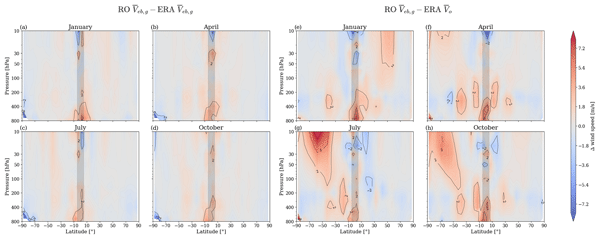
The added value and potential of long-term radio occultation data for climatological wind field monitoring
Irena Nimac, Julia Danzer, and Gottfried Kirchengast
Atmos. Meas. Tech., 18, 265–286, https://doi.org/10.5194/amt-18-265-2025,https://doi.org/10.5194/amt-18-265-2025, 2025
Short summary
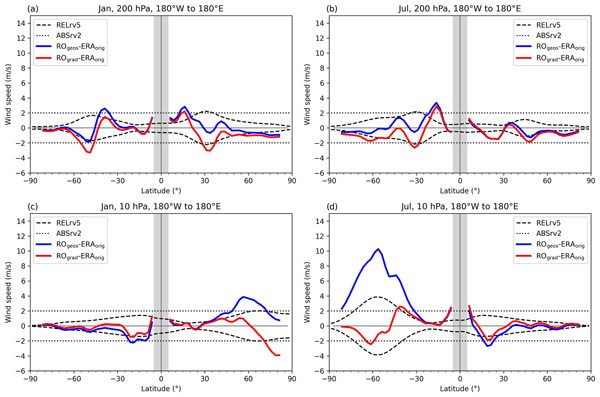
Closing the gap in the tropics: the added value of radio-occultation data for wind field monitoring across the Equator
Julia Danzer, Magdalena Pieler, and Gottfried Kirchengast
Atmos. Meas. Tech., 17, 4979–4995, https://doi.org/10.5194/amt-17-4979-2024,https://doi.org/10.5194/amt-17-4979-2024, 2024
Short summary
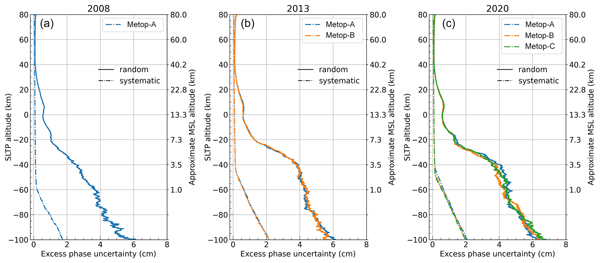
GNSS radio occultation excess-phase processing for climate applications including uncertainty estimation
Josef Innerkofler, Gottfried Kirchengast, Marc Schwärz, Christian Marquardt, and Yago Andres
Atmos. Meas. Tech., 16, 5217–5247, https://doi.org/10.5194/amt-16-5217-2023,https://doi.org/10.5194/amt-16-5217-2023, 2023
Short summary

Cited articles

Arnold, V. I.: Mathematical Methods of Classical Mechanics, Springer, New York, USA, 1978. a, b, c, d, e, f, g
Egorov, Y. V.: Lectures on Partial Differential Equations, Moscow State University Press, Moscow, Russia, 1985 (in Russian). a, b, c, d
Egorov, Y. V. and Shubin, M. A.: Partial Differential Equations IV, Springer, Berlin and Heidelberg, Germany, https://doi.org/10.1007/978-3-662-09207-1, 1993. a, b, c, d
Fock, V. A.: Fundamentals of Quantum Mechanics, Mir Publishers, available at: https://archive.org/details/FockFundamentalsOfQuantumMechanicsMir1986 (last access: 22 January 2021), 1978. a, b, c, d, e, f
Goldstein, H., Poole, C., and Safko, J.: Classical Mechanics, Pearson Education Limited, London, UK, 2014. a, b, c, d, e, f
Download
Short summary
Currently, the canonical transform (CT) approach to the processing of radio occultation observations is widely used. For the spherically symmetric atmosphere, the applicability of this method can be strictly proven. However, in the presence of horizontal gradients, this approach may not work. Here we introduce a generalization of the CT method in order to reduce the errors due to horizontal gradients.
Share