
Articles | Volume 19, issue 1
https://doi.org/10.5194/amt-19-119-2026
© Author(s) 2026. This work is distributed under
the Creative Commons Attribution 4.0 License.
the Creative Commons Attribution 4.0 License.
https://doi.org/10.5194/amt-19-119-2026
© Author(s) 2026. This work is distributed under
the Creative Commons Attribution 4.0 License.
the Creative Commons Attribution 4.0 License.
Research article
| 
06 Jan 2026
Research article |
| 06 Jan 2026
| 06 Jan 2026
GEMS ozone profile retrieval: impact and validation of version 3.0 improvements

Institute of Environmental Studies, Pusan National University, Busan 46241, Republic of Korea
Arno Keppens
Royal Belgian Institute for Space Aeronomy (BIRA-IASB), Uccle, Belgium
Daesung Choi
Department of Atmospheric Sciences, Pusan National University, Busan 46241, South Korea
Sungjae Hong
Department of Atmospheric Sciences, Pusan National University, Busan 46241, South Korea
Department of Atmospheric Sciences, Pusan National University, Busan 46241, South Korea
Cheol-Hee Kim
Department of Atmospheric Sciences, Pusan National University, Busan 46241, South Korea
Hyo-Jung Lee
Department of Atmospheric Sciences, Pusan National University, Busan 46241, South Korea
Wonbae Jeon
Department of Atmospheric Sciences, Pusan National University, Busan 46241, South Korea
Jhoon Kim
Department of Atmospheric Sciences, Yonsei University, Seoul, Republic of Korea
Ja-Ho Koo
Department of Atmospheric Sciences, Yonsei University, Seoul, Republic of Korea
Joowan Kim
Department of Atmospheric Sciences, Kongju National University, Kongju, Republic of Korea
Kanghyun Baek
NASA Goddard Space Flight Center, Greenbelt, Maryland, USA
Department of Atmospheric and Oceanic Science, University of Maryland, College Park, MD 20742, USA
Xiong Liu
Atomic and Molecular Physics Division, Smithsonian Astrophysical Observatory (SAO), Center for Astrophysics, Harvard & Smithsonian, Cambridge, MA 02138, USA
Gonzalo González Abad
Atomic and Molecular Physics Division, Smithsonian Astrophysical Observatory (SAO), Center for Astrophysics, Harvard & Smithsonian, Cambridge, MA 02138, USA
Klaus-Peter Heue
Remote Sensing Technology Institute, German Aerospace Center (DLR), Oberpfaffenhofen, Germany
Jean-Christopher Lambert
Royal Belgian Institute for Space Aeronomy (BIRA-IASB), Uccle, Belgium
Yeonjin Jung
Major of Spatial Information Engineering, Division of Earth and Environmental System Sciences, Pukyong National University, Busan, Republic of Korea
Hyunkee Hong
National Institute of Environmental Research, Incheon 22689, Republic of Korea
Won-Jin Lee
National Institute of Environmental Research, Incheon 22689, Republic of Korea
Related authors
Jeonghyeok Moon, Wonbae Jeon, Sujong Jeong, Yunsoo Choi, Hyun Cheol Kim, Soon-Young Park, Juseon Bak, Jung-Woo Yoo, Jaehyeong Park, Dongjin Kim, Hyeonsik Choe, Chae-Yeong Yang, and Min Heo
Atmos. Chem. Phys., 26, 10379–10398, https://doi.org/10.5194/acp-26-10379-2026, https://doi.org/10.5194/acp-26-10379-2026, 2026
Short summary
Short summary
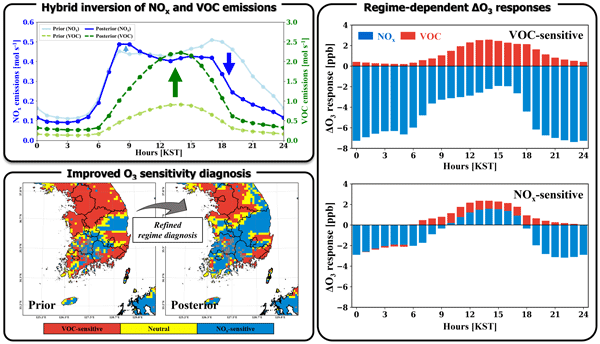
This study develops a hybrid inverse modeling framework to better estimate the spatiotemporal distributions of nitrogen oxides (NOx) and volatile organic compound (VOC) emissions over South Korea. The optimized emissions improve ozone simulations and clarify whether ozone formation is more sensitive to NOx or to VOC. By identifying when precursor emissions exert the strongest influence on ozone, this work provides time-resolved guidance for region-specific air quality strategies.
Ke Li, Rong Tan, Wenhao Qiao, Taegyung Lee, Yufen Wang, Danyuting Zhang, Minglong Tang, Wenqing Zhao, Yixuan Gu, Shaojia Fan, Jinqiang Zhang, Xiaopu Lyu, Likun Xue, Jianming Xu, Zhiqiang Ma, Mohd Talib Latif, Teerachai Amnuaylojaroen, Junsu Gil, Mee-Hye Lee, Juseon Bak, Joowan Kim, Hong Liao, Yugo Kanaya, Xiao Lu, Tatsuya Nagashima, and Ja-Ho Koo
Atmos. Chem. Phys., 25, 11575–11596, https://doi.org/10.5194/acp-25-11575-2025, https://doi.org/10.5194/acp-25-11575-2025, 2025
Short summary
Short summary
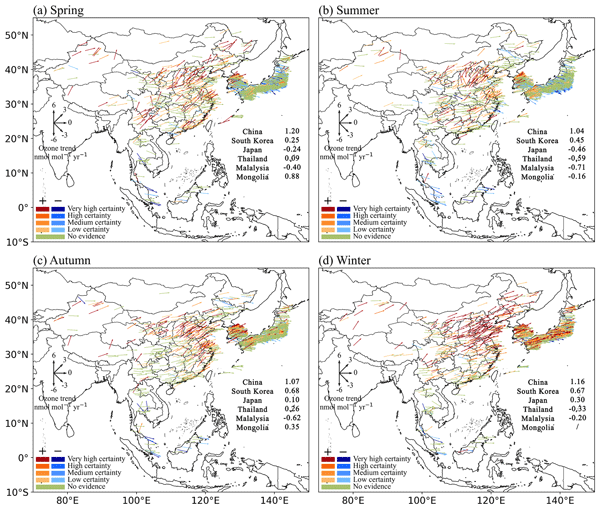
East Asia and Southeast Asia have been identified as a global hot spot, with the fastest ozone increase. This paper presents the most comprehensive observational review of ozone distributions and evolution over East Asia and Southeast Asia across different spatiotemporal scales in the past two decades, which will have important implications for assessing ozone impacts on public health and crop yields and for developing future ozone control strategies.
Juseon Bak, Xiong Liu, Kai Yang, Gonzalo Gonzalez Abad, Ewan O'Sullivan, Kelly Chance, and Cheol-Hee Kim
Atmos. Meas. Tech., 17, 1891–1911, https://doi.org/10.5194/amt-17-1891-2024, https://doi.org/10.5194/amt-17-1891-2024, 2024
Short summary
Short summary
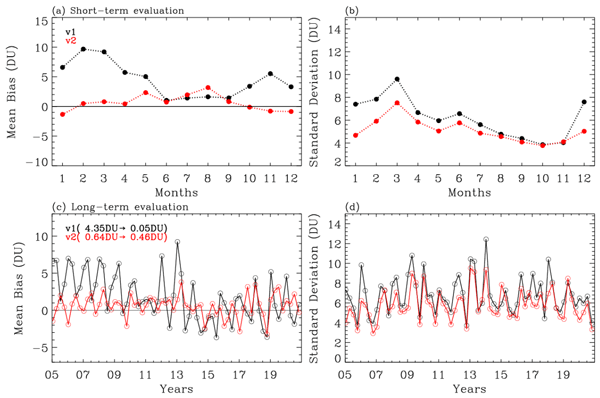
The new version (V2) of the OMI ozone profile product is introduced to improve retrieval quality and long-term consistency of tropospheric ozone by incorporating the recent collection 4 OMI L1b spectral products and refining radiometric correction, forward model calculation, and a priori ozone data.
Kanghyun Baek, Jae Hwan Kim, Juseon Bak, David P. Haffner, Mina Kang, and Hyunkee Hong
Atmos. Meas. Tech., 16, 5461–5478, https://doi.org/10.5194/amt-16-5461-2023, https://doi.org/10.5194/amt-16-5461-2023, 2023
Short summary
Short summary
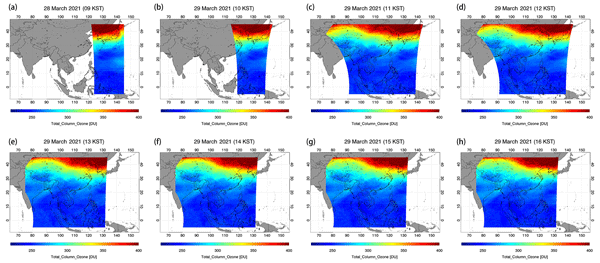
The GEMS mission was the first mission of the geostationary satellite constellation for hourly atmospheric composition monitoring. The GEMS ozone measurements were cross-compared to those of Pandora, OMPS, and TROPOMI satellite sensors and excellent agreement was found. GEMS has proven to be a powerful new instrument for monitoring and assessing the diurnal variation in atmospheric ozone. This experience can be used to advance research with future geostationary environmental satellite missions.
Lei Shu, Lei Zhu, Juseon Bak, Peter Zoogman, Han Han, Song Liu, Xicheng Li, Shuai Sun, Juan Li, Yuyang Chen, Dongchuan Pu, Xiaoxing Zuo, Weitao Fu, Xin Yang, and Tzung-May Fu
Atmos. Chem. Phys., 23, 3731–3748, https://doi.org/10.5194/acp-23-3731-2023, https://doi.org/10.5194/acp-23-3731-2023, 2023
Short summary
Short summary
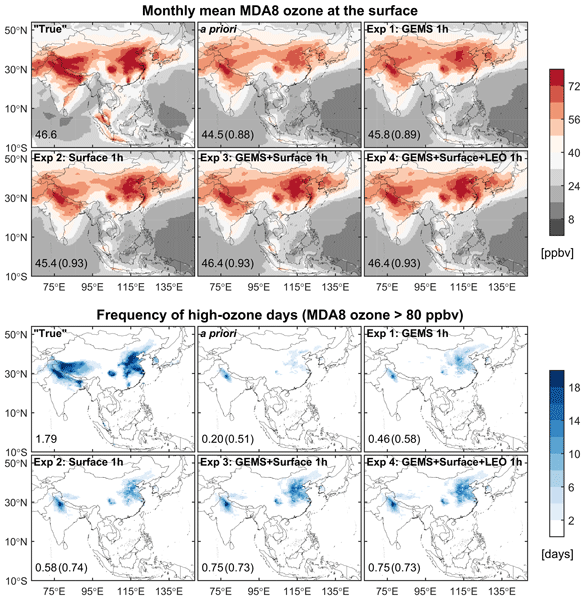
We quantify the benefit of multisource observations (GEMS, LEO satellite, and surface) on ozone simulations in Asia. Data assimilation improves the monitoring of exceedance, spatial pattern, and diurnal variation of surface ozone, with the regional mean bias reduced from −2.1 to −0.2 ppbv. Data assimilation also better represents ozone vertical distributions in the middle to upper troposphere at low latitudes. Our results offer a valuable reference for future ozone simulations.

Juseon Bak, Eun-Ji Song, Hyo-Jung Lee, Xiong Liu, Ja-Ho Koo, Joowan Kim, Wonbae Jeon, Jae-Hwan Kim, and Cheol-Hee Kim
Atmos. Chem. Phys., 22, 14177–14187, https://doi.org/10.5194/acp-22-14177-2022, https://doi.org/10.5194/acp-22-14177-2022, 2022
Short summary
Short summary
Our study investigates the temporal variations of ozone profiles at Pohang in the Korean Peninsula from multiple ozone products. We discuss the quantitative relationships between daily surface measurements and key meteorological variables, different seasonality of ozone between the troposphere and stratosphere, and interannual changes in the lower tropospheric ozone, linked by the weather pattern driven by the East Asian summer monsoon.
Amir H. Souri, Kelly Chance, Juseon Bak, Caroline R. Nowlan, Gonzalo González Abad, Yeonjin Jung, David C. Wong, Jingqiu Mao, and Xiong Liu
Atmos. Chem. Phys., 21, 18227–18245, https://doi.org/10.5194/acp-21-18227-2021, https://doi.org/10.5194/acp-21-18227-2021, 2021
Short summary
Short summary
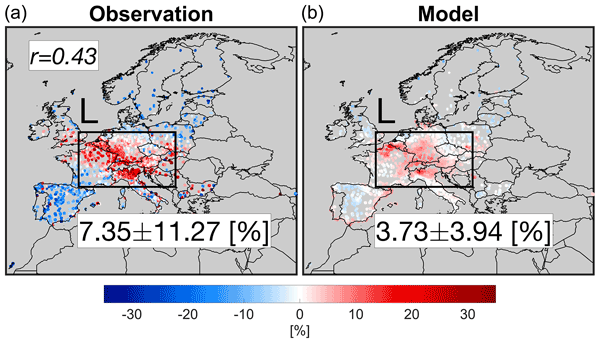
The global pandemic is believed to have an impact on emissions of air pollutants such as nitrogen dioxide (NO2) and formaldehyde (HCHO). This study quantifies the changes in the amount of NOx and VOC emissions via state-of-the-art inverse modeling technique using satellite observations during the lockdown 2020 with respect to a baseline over Europe, which in turn, it permits unraveling atmospheric processes being responsible for ozone formation in a less cloudy month.
Jeonghyeok Moon, Wonbae Jeon, Sujong Jeong, Yunsoo Choi, Hyun Cheol Kim, Soon-Young Park, Juseon Bak, Jung-Woo Yoo, Jaehyeong Park, Dongjin Kim, Hyeonsik Choe, Chae-Yeong Yang, and Min Heo
Atmos. Chem. Phys., 26, 10379–10398, https://doi.org/10.5194/acp-26-10379-2026, https://doi.org/10.5194/acp-26-10379-2026, 2026
Short summary
Short summary
This study develops a hybrid inverse modeling framework to better estimate the spatiotemporal distributions of nitrogen oxides (NOx) and volatile organic compound (VOC) emissions over South Korea. The optimized emissions improve ozone simulations and clarify whether ozone formation is more sensitive to NOx or to VOC. By identifying when precursor emissions exert the strongest influence on ozone, this work provides time-resolved guidance for region-specific air quality strategies.
Cheng Huang, Junjie Wang, Yinbao Jin, Min Min, Qi Fan, and Jhoon Kim
Atmos. Chem. Phys., 26, 10221–10240, https://doi.org/10.5194/acp-26-10221-2026, https://doi.org/10.5194/acp-26-10221-2026, 2026
Short summary
Short summary
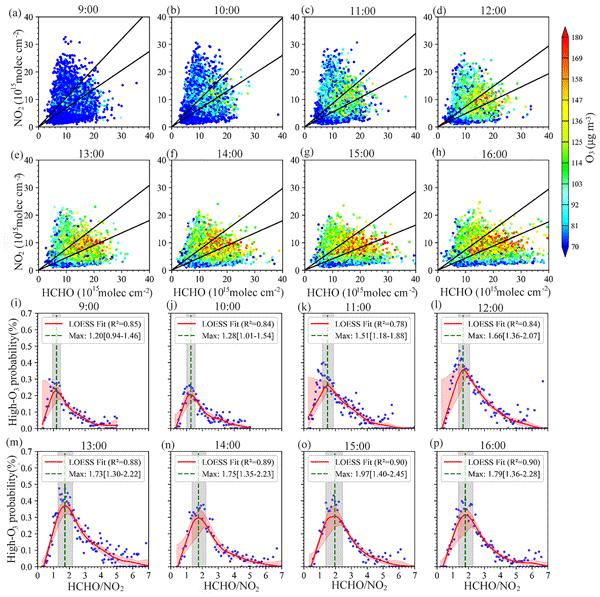
Ozone pollution is a growing issue in China, with levels increasing steadily from 2020 to 2024. This study uses satellite data to explore how different pollutants interact to form ozone. The results show that urban areas shift their pollution control strategies throughout the day. These findings suggest that targeting specific pollutants at different times could significantly improve air quality and help reduce harmful ozone pollution in China.
Zhan Zhang, Maryann Sargent, Ethan Manninen, Jack D. Warren, Apisada Chulakadabba, Marcus Russi, Sasha Ayvazov, Joshua Benmergui, Marvin Knapp, Ethan Kyzivat, Christopher C. Miller, Sébastien Roche, Bingkun Luo, David J. Miller, Maya Nasr, Manuel Perez-Carrasco, Kang Sun, James P. Williams, Katlyn MacKay, Mark Omara, Jia Chen, Luis Guanter, Ritesh Gautam, Jonathan Franklin, Xiong Liu, and Steven C. Wofsy
Atmos. Meas. Tech., 19, 4637–4651, https://doi.org/10.5194/amt-19-4637-2026, https://doi.org/10.5194/amt-19-4637-2026, 2026
Short summary
Short summary
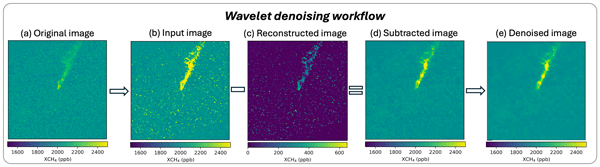
Methane released into the atmosphere is often difficult to detect in satellite imagery because the signals can be weak and hidden by background noise. We developed an automated method that improves the visibility of methane plumes while reducing false detections, decreasing the need for time-consuming manual inspection. The method identifies more small emission sources across different instruments, helping build a more complete understanding of methane emissions and their impacts.
Hyeong-Gyu Kim, Joowan Kim, Sang-Yoon Jun, Seong-Joong Kim, and Damwon So
EGUsphere, https://doi.org/10.5194/egusphere-2026-3834, https://doi.org/10.5194/egusphere-2026-3834, 2026
Short summary
Short summary
The westerly winds over the Southern Ocean influence ocean currents and the global carbon cycle, yet how they behaved during the last ice age remains uncertain. Using a global climate model, we tested how the expansion of Antarctic sea ice affected these winds. The sea ice cooled the surface, strengthening the winds and shifting them toward Antarctica, outweighing the opposite pull from a colder tropics. Our results show Antarctic sea ice is a key driver of these winds in past climates.
Christopher Chan Miller, Sébastien Roche, Jonas Wilzweski, Xiong Liu, Kelly V. Chance, Bingkun Luo, Kang Sun, Jonathan E. Franklin, Joshua S. Benmergui, Maya Nasr, David J. Miller, Sean Crowell, Nathan Leisso, Eleanor Walker, Ritesh Gautam, Nicholas LoFaso, Sasha Ayvazov, David Wells, Carlos Cervantes, Christopher Hairfield, and Steven Wofsy
EGUsphere, https://doi.org/10.5194/egusphere-2026-3365, https://doi.org/10.5194/egusphere-2026-3365, 2026
Short summary
Short summary
Reducing oil and gas methane emissions is among the fastest ways to slow near-term climate change, and satellites offer a transparent means of verifying progress. MethaneSAT fills a gap between existing instruments, which either measure methane accurately but at coarse scales, or detect large leaks at fine resolution without the accuracy to account for all sources. We present the first measurements and show they meet the accuracy requirements for regional emissions mapping at the 2–4 km2 scale.
Hongrui Gao, Qin He, Kai Qin, Jhoon Kim, Diego Loyola, Pravash Tiwari, Lingxiao Lu, and Jason Blake Cohen
Earth Syst. Sci. Data Discuss., https://doi.org/10.5194/essd-2026-443, https://doi.org/10.5194/essd-2026-443, 2026
Revised manuscript accepted for ESSD
Short summary
Short summary
There are always gaps in satellite records of air pollution because of factors such as clouds and operating conditions. We used a physics-aware deep learning method, producing a gapless 0.05° hourly dataset of tropospheric nitrogen dioxide over Asian pollution hotspots from 2019 to 2024. The dataset can capture sub-daily changes, revealing how traffic, industry, and clean-air policies shaped pollution, supporting health and environment studies.
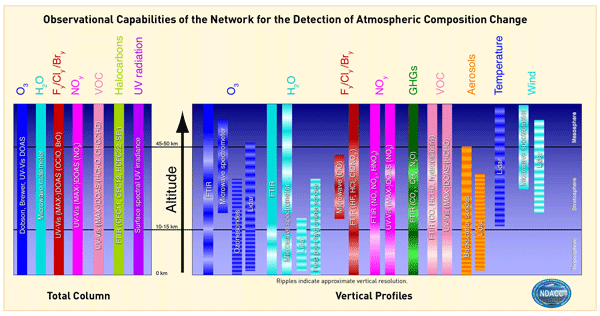
Irina Petropavlovskikh, Martine De Mazière, Anne M. Thompson, Jeannette D. Wild, James W. Hannigan, Henry B. Selkirk, Reem A. Hannun, Wolfgang Steinbrecht, Jean-Christopher Lambert, Roeland Van Malderen, Elizabeth Asher, Raul R. Cordero, Sophie Godin-Beekmann, Daan Hubert, Sergey Khaykin, Karin Kreher, Thierry Leblanc, Emmanuel Mahieu, Eliane Maillard Barras, Glen McConville, Gerald Nedoluha, Ivan Ortega, Alberto Redondas Marrero, Gunther Seckmeyer, Ryan M. Stauffer, Sarah A. Strode, Kim Strong, Takafumi Sugita, Michel Van Roozendael, Voltaire Velazco, Corinne Vigouroux, and Bärbel Vogel
Atmos. Chem. Phys., 26, 8637–8675, https://doi.org/10.5194/acp-26-8637-2026, https://doi.org/10.5194/acp-26-8637-2026, 2026
Short summary
Short summary
This introduction to the special issue "Achievements and perspectives of the Network for the Detection of Atmospheric Composition Change after 35 years of operation” provides an overview of important research findings achieved under the NDACC objectives. The future of NDACC is discussed in the light of the evolution of the scientific questions, evolving collaborations with partners and Cooperating Networks, and the current landscape of gaps in satellite and ground-based observations.
Christopher R. Oxford, Haihui Zhu, Maya Mehrotra, Xuan Liu, Yuxuan Ren, Maya Arnott, Isaac Abionum Adimula, Taiye Benjamin Ajibolataiye, Clement Akoshile, Omar Amador-Munoz, Araya Asfaw, Rachel Ying-Wen Chang, Sagnik Dey, Ann M. Dillner, David J. Diner, Connor J. Flynn, Diana Francis, Paterne Gahungu, Rebecca M. Garland, Michel Grutter, Sina Hasheminassab, Fahad Imam, Jhoon Kim, Kristy Langerman, Pei-Chen Lee, Puji Lestari, Po-Hsiung Lin, S. Marcela Loria-Salazar, Tesfaye Mamo, Olga L. Mayol-Bracero, Mogesh Naidoo, Narendra Nelli, Sang Seo Park, Abdus Salam, Bighnaraj Sarangi, Trailokya Saud, Robyn Schofield, Yoav Schechner, Sachchida N. Tripathi, Emily K. West, Eli Windwer, Ming-Tsang Wu, Qiang Zhang, Michael Brauer, Yinon Rudich, Jay R. Turner, and Randall V. Martin
EGUsphere, https://doi.org/10.5194/egusphere-2026-3224, https://doi.org/10.5194/egusphere-2026-3224, 2026
Short summary
Short summary
A high-sensitivity balance, controlled temperature and relative humidity chamber, and filter samples collected around the world were used to develop a mass as a function of relative humidity relationship. We subsequently measured the chemical composition of these same samples. A relationship between the chemical composition and water mass was created and used to calculate aerosol water content showing how composition and water content varies worldwide.
Jiajun Xiong, Yi Wang, Jun Wang, Yanyu Wang, Meng Zhou, Minghui Tao, Wenhui Dong, Jhoon Kim, and Lunche Wang
Atmos. Chem. Phys., 26, 8225–8253, https://doi.org/10.5194/acp-26-8225-2026, https://doi.org/10.5194/acp-26-8225-2026, 2026
Short summary
Short summary
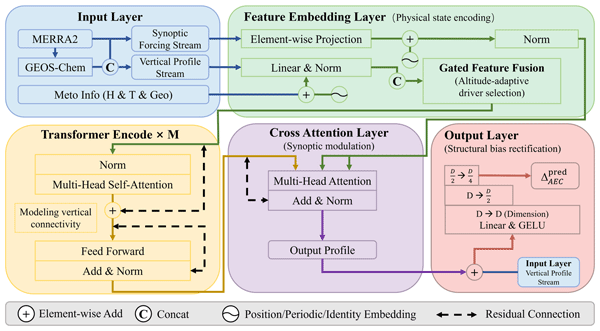
Atmospheric models struggle to accurately map suspended particles at different altitudes. We developed an artificial intelligence tool using multiple data sources to correct these errors, generating precise three-dimensional maps. This approach successfully reduces biases across Asia and North America. Beyond simply correcting data, our tool helps scientists pinpoint physical flaws in existing models, directly guiding improvements for future climate and air quality research.
Julianna A. Christopoulos, Pablo E. Saide, Manas R. Mohanty, Nattamon Maneenoi, Jhoon Kim, Laura Judd, Katherine R. Travis, Savitri Garivait, Agapol Junpen, Kazuyuki Miyazaki, Jinkyul Choi, Takashi Sekiya, David Peterson, Theodore M. McHardy, Nicholas Gapp, Jason M. St. Clair, Erin Delaria, Glenn M. Wolfe, Abby Sebol, Alessandro Franchin, Changmin Cho, Morgan L. Silverman, and James H. Crawford
Atmos. Chem. Phys., 26, 8021–8050, https://doi.org/10.5194/acp-26-8021-2026, https://doi.org/10.5194/acp-26-8021-2026, 2026
Short summary
Short summary
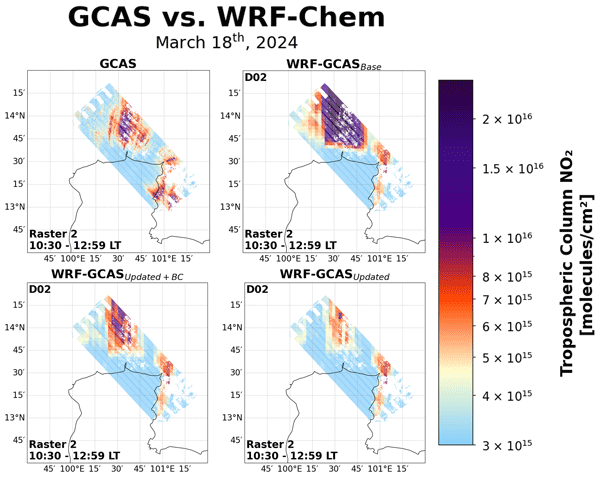
Air quality in rapidly growing cities is difficult to model because emissions vary during the day and are often poorly constrained. We demonstrate a methodology for constraining urban emissions using hourly satellite observations combined with high-resolution air quality modeling in Bangkok. We find that emissions inventories likely overestimate nitrogen dioxide emissions, and that updated emissions improve agreement between the model and independent aircraft and ground-based observations.
Caroline Jonas, Corinne Vigouroux, Bavo Langerock, Robin Björklund, Anne Boynard, Thomas Carlund, Martine De Mazière, Peter Effertz, Quentin Errera, Matthias M. Frey, José Granville, James W. Hannigan, Arno Keppens, Nis Jepsen, Rigel Kivi, Norrie Lyall, Mathias Palm, Maxime Prignon, Viktoria F. Sofieva, Kimberly Strong, Tove Svendby, David Tarasick, Laura Thölix, Roeland Van Malderen, Yana Virolainen, Sibylle von Löwis, and Xiaoyi Zhao
Atmos. Chem. Phys., 26, 8089–8124, https://doi.org/10.5194/acp-26-8089-2026, https://doi.org/10.5194/acp-26-8089-2026, 2026
Short summary
Short summary
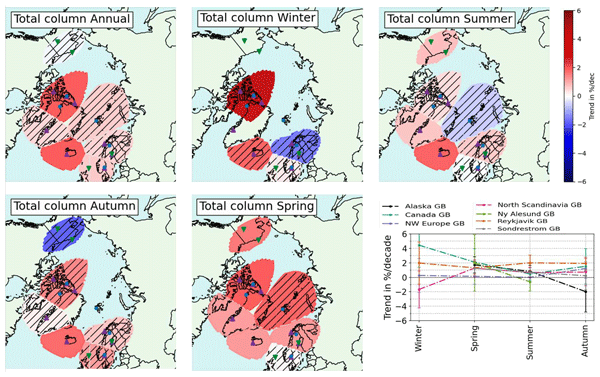
We study the evolution of ozone in the Arctic over the 2000–2024 period in the stratosphere (about 10 to 50 km) to assess the expected recovery of the ozone layer following the diminution of ozone-depleting substances. We merge ground-based data sets within spatially coherent regions to reduce uncertainties and we obtain positive trends for the total column everywhere in the Arctic and for the middle and upper stratosphere over Canada, but no significant trends in the lower stratosphere.
David J. Miller, Kang Sun, Jonathan E. Franklin, Nathan Leisso, Sébastien Roche, Bingkun Luo, Christopher Chan Miller, Sasha Ayvazov, Sean Crowell, Nick LoFaso, Tom Kampe, Peter Spuhler, Betsy Farris, Eleanor Walker, Tom Melendez, Ritesh Gautam, Xiong Liu, and Steven C. Wofsy
EGUsphere, https://doi.org/10.5194/egusphere-2026-2675, https://doi.org/10.5194/egusphere-2026-2675, 2026
This preprint is open for discussion and under review for Atmospheric Measurement Techniques (AMT).
Short summary
Short summary
With a focus on mitigating climate change, the MethaneSAT satellite mission aims to catalyze methane emission reductions. MethaneSAT has provided high-resolution emissions products across global oil and gas basins. We present novel calibration methods of MethaneSAT's instrumentation that demonstrate stable on-orbit performance compared with ground-based calibration. Our results are important for similar satellite missions focused on monitoring climate-relevant emissions.
Shangyi Liu, Yingjun Zheng, Mengya Sheng, Lu Lee, Chengli Qi, Feng Lu, Bruno Franco, Lieven Clarisse, Cathy Clerbaux, Nicolas Theys, Jhoon Kim, and Zhao-Cheng Zeng
EGUsphere, https://doi.org/10.5194/egusphere-2026-1745, https://doi.org/10.5194/egusphere-2026-1745, 2026
Short summary
Short summary
Volcanic sulfur dioxide evolves rapidly after an eruption, which makes it challenging to monitor. Taking the 2024 Kanlaon eruption as a case study, we propose using a constellation of GEO and LEO satellites to track SO2 mass and layer height at high frequency. In particular, we present the first quantitative SO2 retrieval from a GEO hyperspectral infrared sounder (FY-4B/GIIRS). This research provides a vital blueprint for the future global monitoring of volcanic events.
Serena Di Pede, Erwin Loots, Antje Ludewig, Emiel van der Plas, Edward van Amelrooy, Mirna van Hoek, Maarten Sneep, Mark ter Linden, Arno Keppens, and J. Pepijn Veefkind
Atmos. Meas. Tech., 19, 1875–1899, https://doi.org/10.5194/amt-19-1875-2026, https://doi.org/10.5194/amt-19-1875-2026, 2026
Short summary
Short summary
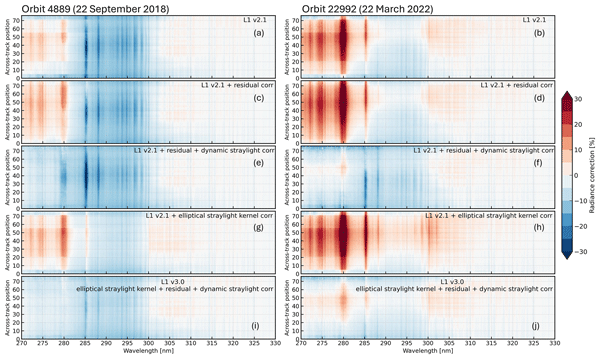
TROPOMI (TROPOspheric Monitoring Instrument) provides daily ozone profile data from ultraviolet bands 1–2. Accurate radiometric calibration is critical below 300 nm where signals are low. A Level-2 soft calibration complements L1 calibration and reveals spectral, temporal, and across-track biases. Re-analysis of calibration data enabled improved L1 corrections to address remaining straylight and residual signal effects, reducing soft calibration magnitude by ~15–20 % and associated biases in L1b v3.0 and ozone processor v2.9.0.
Ruize Sun, Xiao Lu, Haipeng Lin, Tongwen Wu, Xingpei Ye, Lu Shen, Xuan Wang, Haolin Wang, Jingyu Li, Ni Lu, Jiayin Su, Jie Zhang, Fang Zhang, Xiaoge Xin, Xiong Liu, Xiao Yang, and Lin Zhang
Geosci. Model Dev., 19, 2111–2136, https://doi.org/10.5194/gmd-19-2111-2026, https://doi.org/10.5194/gmd-19-2111-2026, 2026
Short summary
Short summary
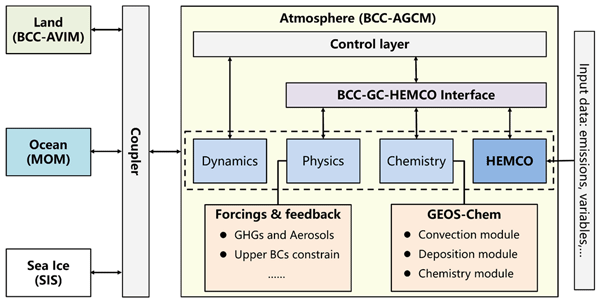
We present the development of a global chemistry-climate coupled model BCC-GEOS-Chem v2.0, with improved representation of comprehensive troposphere-stratosphere chemistry and new capability to account for radiative-cloud feedbacks from short-lived climate forcers. The development of the BCC-GEOS-Chem v2.0 provides a useful framework for investigating climate–chemistry interactions and for future projections of global atmospheric chemistry
Viktoria F. Sofieva, Alexandra Laeng, Thomas von Clarmann, Gabriele Stiller, Michael Kiefer, Johanna Tamminen, Alexey Rozanov, Carlo Arosio, Nathaniel Livesey, Robert Damadeo, Patrick Sheese, Kaley A. Walker, Doug Degenstein, Daniel Zawada, Natalya A. Kramarova, and Arno Keppens
Atmos. Meas. Tech., 19, 1837–1852, https://doi.org/10.5194/amt-19-1837-2026, https://doi.org/10.5194/amt-19-1837-2026, 2026
Short summary
Short summary
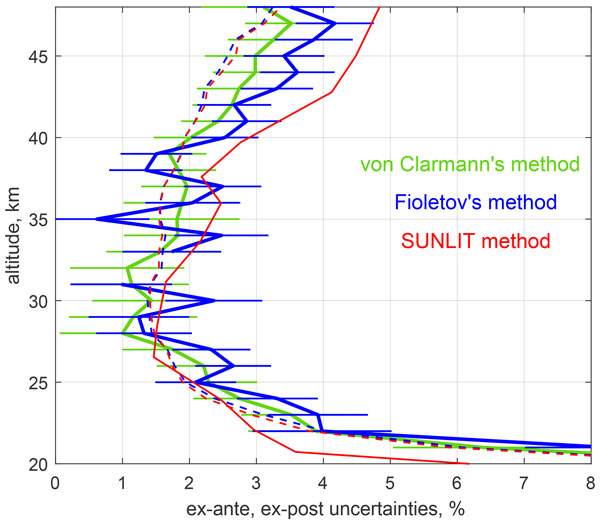
For satellite measurements of atmospheric composition, the random uncertainty estimates provided by retrieval algorithms might be imperfect due to various approximations used in the retrievals or presence of unknown error sources. This paper presents an overview of the methods used for validation of random uncertainty estimates. All methods discussed in this study are categorized, and assumptions and limitations of each method are discussed.
Ethan Manninen, Apisada Chulakadabba, Maryann Sargent, Zhan Zhang, Harshil Kamdar, Jack Warren, Sébastien Roche, Christopher Chan Miller, Ethan Kyzivat, Joshua Benmergui, Jasna Pittman, Eleanor Walker, Jacob Bushey, Jenna Samra, Jacob Hawthorne, Bingkun Luo, Maya Nasr, Kang Sun, Jonathan Franklin, Xiong Liu, Jia Chen, and Steven Wofsy
EGUsphere, https://doi.org/10.5194/egusphere-2026-115, https://doi.org/10.5194/egusphere-2026-115, 2026
Short summary
Short summary
In this work, my coauthors and I interpret methane emissions observed by remote sensing systems as plumes, or point sources. We model the probability that a general imaging spectrometer will detect a plume, and apply this framework to multiple remote sensing systems. We show how two recent systems- MethanAIR and MethaneSAT- provide enough sensitivity to facility scale point sources to effectively characterize most plume emissions in the Permian Basin.
Amir H. Souri, Gonzalo González Abad, Bryan N. Duncan, and Luke D. Oman
Atmos. Chem. Phys., 26, 809–837, https://doi.org/10.5194/acp-26-809-2026, https://doi.org/10.5194/acp-26-809-2026, 2026
Short summary
Short summary
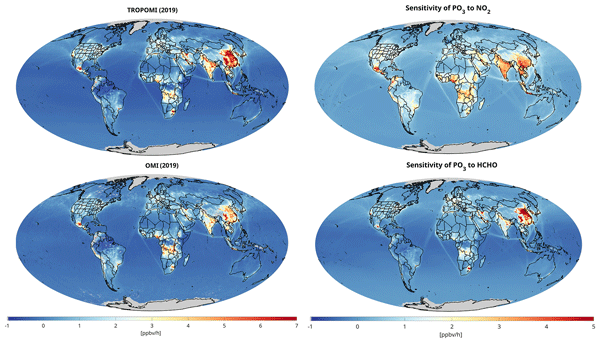
We create long-term maps of PO3 magnitudes along with their corresponding sensitivity maps. This is achieved using a deep learning parameterization method that relies on satellite data, atmospheric models, and ground-based remote sensing. Our approach provides more quantitative information than commonly used methods that depend on ratio-based indicators (such as HCHO/NO2). Additionally, our method considers light and water vapor, making it suitable for applications with GEO satellites.
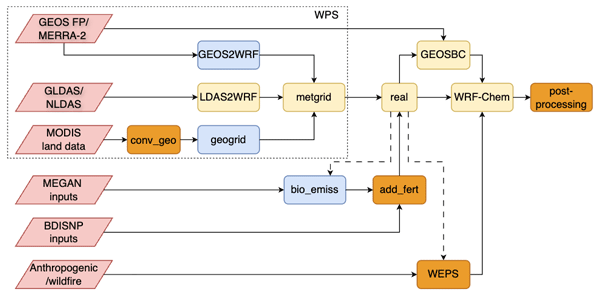
Huanxin Zhang, Jun Wang, Nathan Janechek, Cui Ge, Meng Zhou, Lorena Castro García, Tong Sha, Yanyu Wang, Weizhi Deng, Zhixin Xue, Chengzhe Li, Lakhima Chutia, Yi Wang, Sebastian Val, James L. McDuffie, Sina Hasheminassab, Scott E. Gluck, David J. Diner, Peter R. Colarco, Arlindo M. da Silva, and Jhoon Kim
Geosci. Model Dev., 18, 9061–9099, https://doi.org/10.5194/gmd-18-9061-2025, https://doi.org/10.5194/gmd-18-9061-2025, 2025
Short summary
Short summary
We present the development of the Unified Inputs (of initial and boundary conditions) for WRF (Weather Research and Forecasting)-Chem (UI-WRF-Chem) framework to support the Multi-Angle Imager for Aerosols (MAIA) satellite mission. Major updates include improving dust size distribution in the chemical boundary conditions, updating land surface properties using recent available satellite data and enhancing the representation of soil NOx emissions. We demonstrate subsequent model improvements over several of the MAIA target areas.
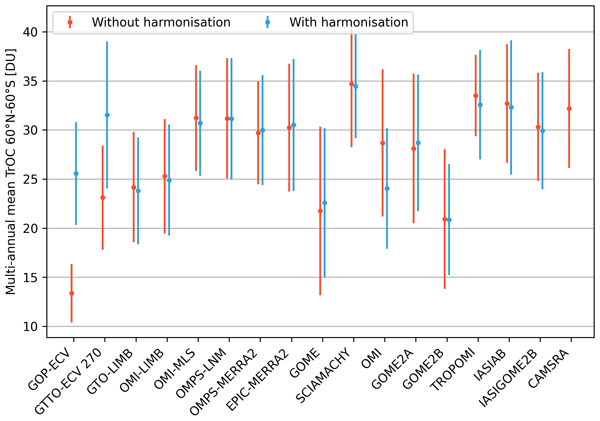
Arno Keppens, Daan Hubert, José Granville, Oindrila Nath, Jean-Christopher Lambert, Catherine Wespes, Pierre-François Coheur, Cathy Clerbaux, Anne Boynard, Richard Siddans, Barry Latter, Brian Kerridge, Serena Di Pede, Pepijn Veefkind, Juan Cuesta, Gaelle Dufour, Klaus-Peter Heue, Melanie Coldewey-Egbers, Diego Loyola, Andrea Orfanoz-Cheuquelaf, Swathi Maratt Satheesan, Kai-Uwe Eichmann, Alexei Rozanov, Viktoria F. Sofieva, Jerald R. Ziemke, Antje Inness, Roeland Van Malderen, and Lars Hoffmann
Atmos. Meas. Tech., 18, 6893–6916, https://doi.org/10.5194/amt-18-6893-2025, https://doi.org/10.5194/amt-18-6893-2025, 2025
Short summary
Short summary
The first Tropospheric Ozone Assessment Report (TOAR) encountered discrepancies between several satellite sensors’ estimates of the distribution and change of ozone in the free troposphere. Therefore, contributing to the second TOAR, we harmonise as much as possible the observational perspective of sixteen tropospheric ozone products from satellites. This only partially accounts for the observed discrepancies, with a reduction of 10–40 % of the inter-product dispersion upon harmonisation.
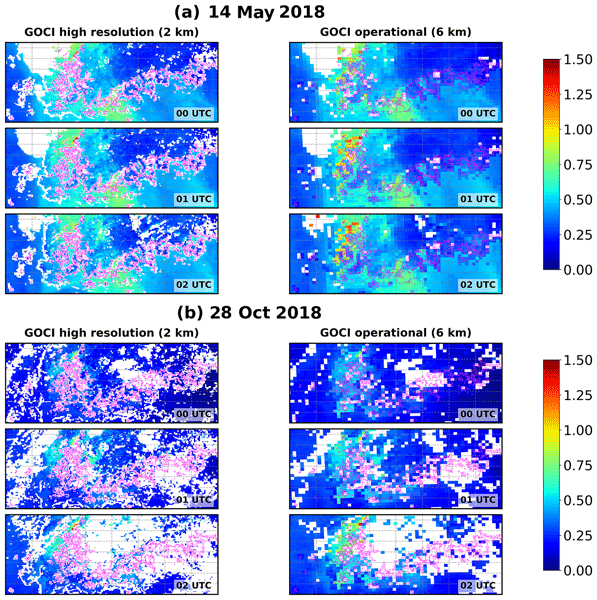
Jeewoo Lee, Jhoon Kim, Seoyoung Lee, Myungje Choi, Jaehwa Lee, Daniel J. Jacob, Su Keun Kuk, and Young-Je Park
Earth Syst. Sci. Data, 17, 5761–5782, https://doi.org/10.5194/essd-17-5761-2025, https://doi.org/10.5194/essd-17-5761-2025, 2025
Short summary
Short summary
Atmospheric aerosols adversely affect human health, with East Asia recognized as one of the most impacted regions. This study presents a long-term (2011–2021), high spatiotemporal resolution aerosol optical depth dataset retrieved from a geostationary satellite over East Asia. The high-resolution data capture subtle aerosol gradients and land-ocean boundaries, providing valuable input for various fields such as aerosol-cloud interaction, climate change, ocean optics, and air quality studies.
Ke Li, Rong Tan, Wenhao Qiao, Taegyung Lee, Yufen Wang, Danyuting Zhang, Minglong Tang, Wenqing Zhao, Yixuan Gu, Shaojia Fan, Jinqiang Zhang, Xiaopu Lyu, Likun Xue, Jianming Xu, Zhiqiang Ma, Mohd Talib Latif, Teerachai Amnuaylojaroen, Junsu Gil, Mee-Hye Lee, Juseon Bak, Joowan Kim, Hong Liao, Yugo Kanaya, Xiao Lu, Tatsuya Nagashima, and Ja-Ho Koo
Atmos. Chem. Phys., 25, 11575–11596, https://doi.org/10.5194/acp-25-11575-2025, https://doi.org/10.5194/acp-25-11575-2025, 2025
Short summary
Short summary
East Asia and Southeast Asia have been identified as a global hot spot, with the fastest ozone increase. This paper presents the most comprehensive observational review of ozone distributions and evolution over East Asia and Southeast Asia across different spatiotemporal scales in the past two decades, which will have important implications for assessing ozone impacts on public health and crop yields and for developing future ozone control strategies.
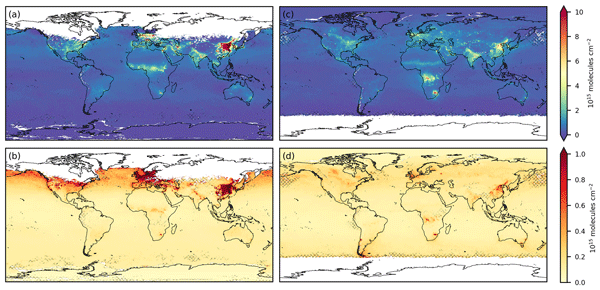
Isolde Glissenaar, Klaas Folkert Boersma, Isidora Anglou, Pieter Rijsdijk, Tijl Verhoelst, Steven Compernolle, Gaia Pinardi, Jean-Christopher Lambert, Michel Van Roozendael, and Henk Eskes
Earth Syst. Sci. Data, 17, 4627–4650, https://doi.org/10.5194/essd-17-4627-2025, https://doi.org/10.5194/essd-17-4627-2025, 2025
Short summary
Short summary
We developed a new global dataset of nitrogen dioxide (NO2) levels in the lower atmosphere, using data from TROPOMI for 2018–2021. This dataset offers improved accuracy and detail compared to earlier versions, meeting high international standards for climate data. By refining how measurement errors are calculated and reduced over time and space, we provide clearer insights into pollution patterns. This work supports better air quality monitoring and informs actions to address pollution globally.
Janek Gödeke, Andreas Richter, Kezia Lange, Peter Maaß, Hyunkee Hong, Hanlim Lee, and Junsung Park
Atmos. Meas. Tech., 18, 3747–3779, https://doi.org/10.5194/amt-18-3747-2025, https://doi.org/10.5194/amt-18-3747-2025, 2025
Short summary
Short summary
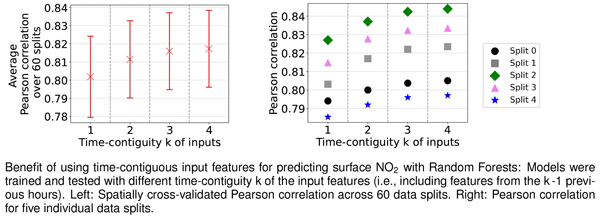
The Korean Geostationary Environmental Monitoring Spectrometer (GEMS) monitors trace gases over Asia, e.g., NO2. GEMS provides hourly data, improving the time resolution compared to the daily overpasses by other satellites. For the prediction of hourly surface NO2 over South Korea from GEMS observations and meteorological data, this study shows that machine learning models benefit from this higher time resolution. This is achieved by using observations from previous hours as additional inputs.
Xiao Lu, Yiming Liu, Jiayin Su, Xiang Weng, Tabish Ansari, Yuqiang Zhang, Guowen He, Yuqi Zhu, Haolin Wang, Ganquan Zeng, Jingyu Li, Cheng He, Shuai Li, Teerachai Amnuaylojaroen, Tim Butler, Qi Fan, Shaojia Fan, Grant L. Forster, Meng Gao, Jianlin Hu, Yugo Kanaya, Mohd Talib Latif, Keding Lu, Philippe Nédélec, Peer Nowack, Bastien Sauvage, Xiaobin Xu, Lin Zhang, Ke Li, Ja-Ho Koo, and Tatsuya Nagashima
Atmos. Chem. Phys., 25, 7991–8028, https://doi.org/10.5194/acp-25-7991-2025, https://doi.org/10.5194/acp-25-7991-2025, 2025
Short summary
Short summary
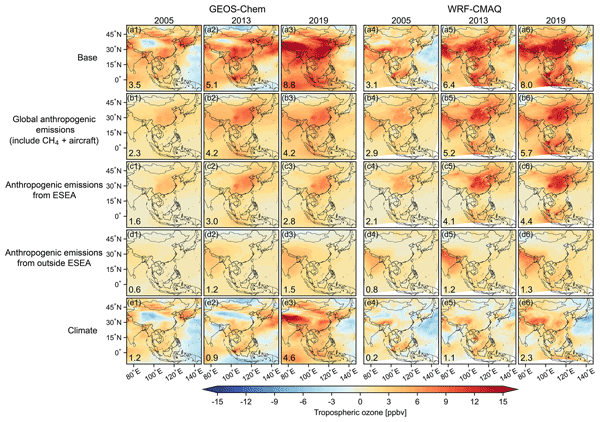
This study analyzes summertime ozone trends in East and Southeast Asia derived from a comprehensive observational database spanning from 1995 to 2019, incorporating aircraft observations, ozonesonde data, and measurements from 2500 surface sites. Multiple models are applied to attribute to changes in anthropogenic emissions and climate. The results highlight that increases in anthropogenic emissions are the primary driver of ozone increases both in the free troposphere and at the surface.
Carlo Arosio, Viktoria Sofieva, Andrea Orfanoz-Cheuquelaf, Alexei Rozanov, Klaus-Peter Heue, Diego Loyola, Edward Malina, Ryan M. Stauffer, David Tarasick, Roeland Van Malderen, Jerry R. Ziemke, and Mark Weber
Atmos. Meas. Tech., 18, 3247–3265, https://doi.org/10.5194/amt-18-3247-2025, https://doi.org/10.5194/amt-18-3247-2025, 2025
Short summary
Short summary
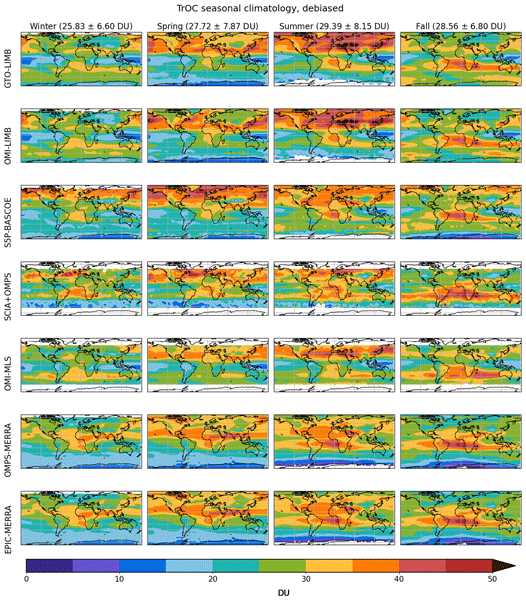
Tropospheric ozone affects air quality and climate, being a pollutant and a greenhouse gas. We analyze satellite data of tropospheric ozone columns obtained by combining two types of observations: one providing stratospheric and the other total ozone. We compare common climatological features and study the influence of the tropopause (troposphere to stratosphere boundary) on the results. We also examine trends over the last 20 years and compare satellite data with ozonesondes to identify drifts.
Sang Seo Park, Jhoon Kim, Yeseul Cho, Hanlim Lee, Junsung Park, Dong-Won Lee, Won-Jin Lee, and Deok-Rae Kim
Atmos. Meas. Tech., 18, 2241–2259, https://doi.org/10.5194/amt-18-2241-2025, https://doi.org/10.5194/amt-18-2241-2025, 2025
Short summary
Short summary
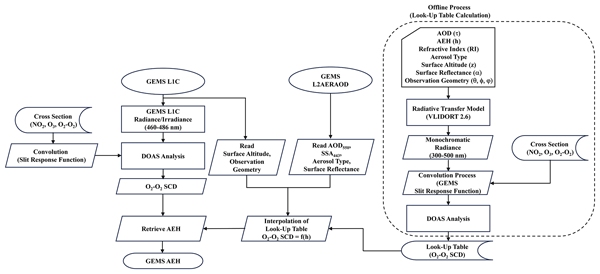
An operational aerosol effective height (AEH) retrieval algorithm for the Geostationary Environment Monitoring Spectrometer (GEMS) was developed that solely uses the O2–O2 absorption band considering aerosol and surface properties. AEH retrievals are only performed when aerosol optical depth is larger than 0.3. The retrieval results show significant estimations by comparing the aerosol height from the Cloud–Aerosol Lidar with Orthogonal Polarization and the Tropospheric Monitoring Instrument.
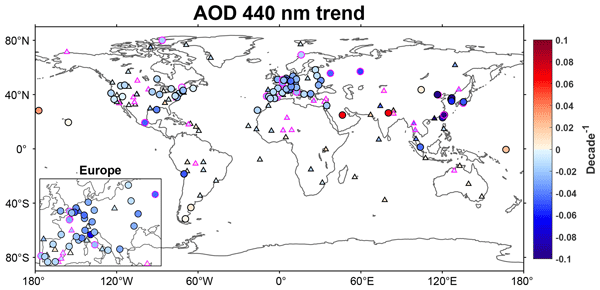
Zhenyu Zhang, Jing Li, Huizheng Che, Yueming Dong, Oleg Dubovik, Thomas Eck, Pawan Gupta, Brent Holben, Jhoon Kim, Elena Lind, Trailokya Saud, Sachchida Nand Tripathi, and Tong Ying
Atmos. Chem. Phys., 25, 4617–4637, https://doi.org/10.5194/acp-25-4617-2025, https://doi.org/10.5194/acp-25-4617-2025, 2025
Short summary
Short summary
We used ground-based remote sensing data from the Aerosol Robotic Network to examine long-term trends in aerosol characteristics. We found aerosol loadings generally decreased globally, and aerosols became more scattering. These changes are closely related to variations in aerosol compositions, such as decreased anthropogenic emissions over East Asia, Europe, and North America; increased anthropogenic sources over northern India; and increased dust activity over the Arabian Peninsula.
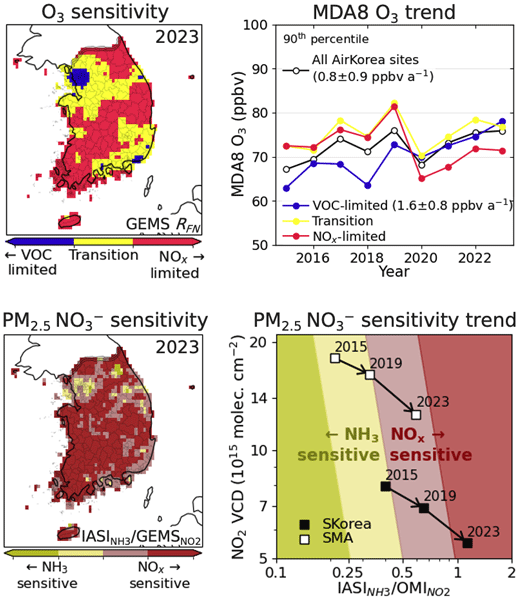
Yujin J. Oak, Daniel J. Jacob, Drew C. Pendergrass, Ruijun Dang, Nadia K. Colombi, Heesung Chong, Seoyoung Lee, Su Keun Kuk, and Jhoon Kim
Atmos. Chem. Phys., 25, 3233–3252, https://doi.org/10.5194/acp-25-3233-2025, https://doi.org/10.5194/acp-25-3233-2025, 2025
Short summary
Short summary
We analyze 2015–2023 air quality trends in South Korea using surface and satellite observations. Primary pollutants have decreased, consistent with emissions reductions. Surface O3 continues to increase and PM2.5 has decreased overall, but the nitrate component has not. O3 and PM2.5 nitrate depend on nonlinear responses from precursor emissions. Satellite data indicate a recent shift to NOx-sensitive O3 and nitrate formation, where further NOx reductions will benefit both O3 and PM2.5 pollution.
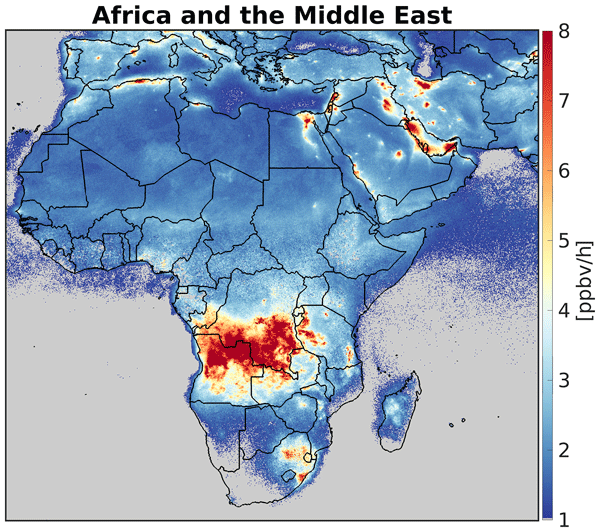
Amir H. Souri, Gonzalo González Abad, Glenn M. Wolfe, Tijl Verhoelst, Corinne Vigouroux, Gaia Pinardi, Steven Compernolle, Bavo Langerock, Bryan N. Duncan, and Matthew S. Johnson
Atmos. Chem. Phys., 25, 2061–2086, https://doi.org/10.5194/acp-25-2061-2025, https://doi.org/10.5194/acp-25-2061-2025, 2025
Short summary
Short summary
We establish a simple yet robust relationship between ozone production rates and geophysical parameters obtained from several intensive atmospheric composition campaigns. We show that satellite remote sensing data can effectively constrain these parameters, enabling us to produce the first global maps of ozone production rates with unprecedented resolution.
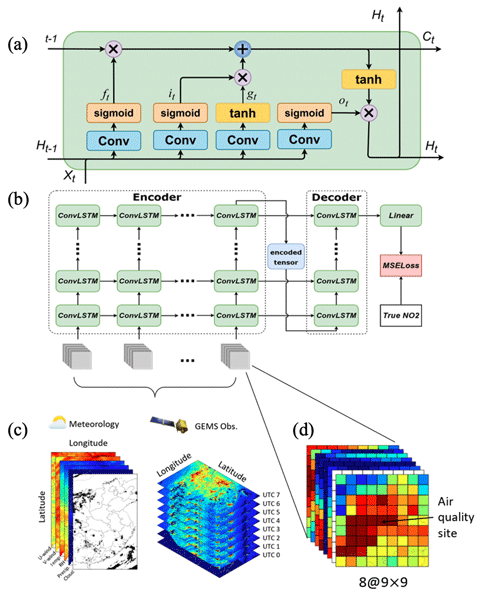
Chengxin Zhang, Xinhan Niu, Hongyu Wu, Zhipeng Ding, Ka Lok Chan, Jhoon Kim, Thomas Wagner, and Cheng Liu
Atmos. Chem. Phys., 25, 759–770, https://doi.org/10.5194/acp-25-759-2025, https://doi.org/10.5194/acp-25-759-2025, 2025
Short summary
Short summary
This research utilizes hourly air pollution observations from the world’s first geostationary satellite to develop a spatiotemporal neural network model for full-coverage surface NO2 pollution prediction over the next 24 hours, achieving outstanding forecasting performance and efficacy. These results highlight the profound impact of geostationary satellite observations in advancing air quality forecasting models, thereby contributing to future models for health exposure to air pollution.
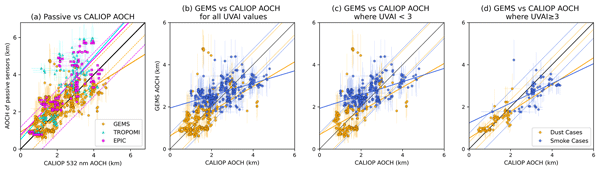
Hyerim Kim, Xi Chen, Jun Wang, Zhendong Lu, Meng Zhou, Gregory R. Carmichael, Sang Seo Park, and Jhoon Kim
Atmos. Meas. Tech., 18, 327–349, https://doi.org/10.5194/amt-18-327-2025, https://doi.org/10.5194/amt-18-327-2025, 2025
Short summary
Short summary
We compare passive aerosol layer height (ALH) retrievals from the Earth Polychromatic Imaging Camera (EPIC), TROPOspheric Monitoring Instrument (TROPOMI), and Geostationary Environment Monitoring Spectrometer (GEMS) with lidar. GEMS shows a lower correlation (R = 0.64) than EPIC and TROPOMI (R > 0.7) but with minimal bias (0.1 km vs. overestimated by ~0.8 km). GEMS performance is improved for an ultraviolet aerosol index ≥ 3. EPIC and GEMS ALH diurnal variation differs slightly.
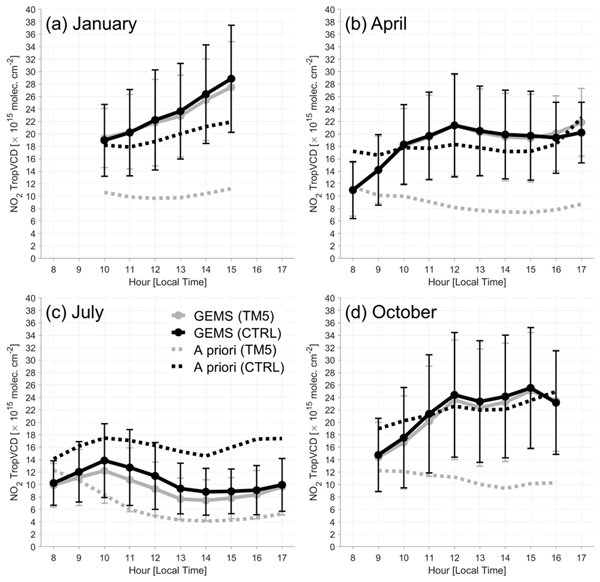
Seunghwan Seo, Si-Wan Kim, Kyoung-Min Kim, Andreas Richter, Kezia Lange, John P. Burrows, Junsung Park, Hyunkee Hong, Hanlim Lee, Ukkyo Jeong, Jung-Hun Woo, and Jhoon Kim
Atmos. Meas. Tech., 18, 115–128, https://doi.org/10.5194/amt-18-115-2025, https://doi.org/10.5194/amt-18-115-2025, 2025
Short summary
Short summary
Over the Seoul metropolitan area, tropospheric NO2 vertical column densities from the Geostationary Environment Monitoring Spectrometer show distinct seasonal features. Also, varying a priori data have substantial impacts on the observed NO2 columns. The a priori data from different chemical transport models resulted in differences of up to −18.3 %. Notably, diurnal patterns of observed NO2 columns are similar for all datasets, although their a priori data exhibit contrasting diurnal patterns.
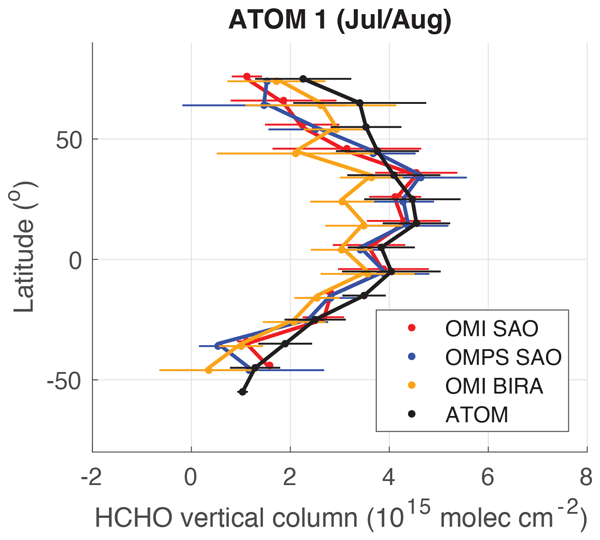
Jin Liao, Glenn M. Wolfe, Alexander E. Kotsakis, Julie M. Nicely, Jason M. St. Clair, Thomas F. Hanisco, Gonzalo González Abad, Caroline R. Nowlan, Zolal Ayazpour, Isabelle De Smedt, Eric C. Apel, and Rebecca S. Hornbrook
Atmos. Meas. Tech., 18, 1–16, https://doi.org/10.5194/amt-18-1-2025, https://doi.org/10.5194/amt-18-1-2025, 2025
Short summary
Short summary
Validation of satellite HCHO over the remote marine regions is relatively low, and modeled HCHO in these regions is usually added as a global satellite HCHO background. This paper intercompares three satellite HCHO retrievals and validates them against in situ observations from the NASA ATom mission. All retrievals are correlated with ATom-integrated columns over remote oceans, with OMI SAO (v004) showing the best agreement. A persistent low bias is found in all retrievals at high latitudes.
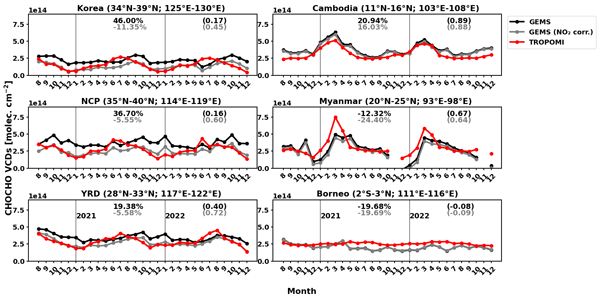
Eunjo S. Ha, Rokjin J. Park, Hyeong-Ahn Kwon, Gitaek T. Lee, Sieun D. Lee, Seunga Shin, Dong-Won Lee, Hyunkee Hong, Christophe Lerot, Isabelle De Smedt, Thomas Danckaert, Francois Hendrick, and Hitoshi Irie
Atmos. Meas. Tech., 17, 6369–6384, https://doi.org/10.5194/amt-17-6369-2024, https://doi.org/10.5194/amt-17-6369-2024, 2024
Short summary
Short summary
In this study, we evaluated the GEMS glyoxal products by comparing them with TROPOMI and MAX-DOAS measurements. GEMS and TROPOMI VCDs present similar spatial distributions. Monthly variations in GEMS VCDs and TROPOMI and MAX-DOAS VCDs differ in northeastern Asia, which we attributed to a polluted reference spectrum and high NO2 concentrations. GEMS glyoxal products with unparalleled temporal resolution would enrich our understanding of VOC emissions and diurnal variation.
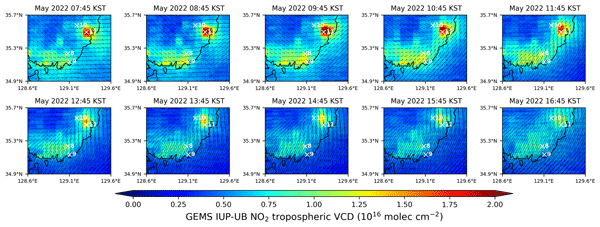
Kezia Lange, Andreas Richter, Tim Bösch, Bianca Zilker, Miriam Latsch, Lisa K. Behrens, Chisom M. Okafor, Hartmut Bösch, John P. Burrows, Alexis Merlaud, Gaia Pinardi, Caroline Fayt, Martina M. Friedrich, Ermioni Dimitropoulou, Michel Van Roozendael, Steffen Ziegler, Simona Ripperger-Lukosiunaite, Leon Kuhn, Bianca Lauster, Thomas Wagner, Hyunkee Hong, Donghee Kim, Lim-Seok Chang, Kangho Bae, Chang-Keun Song, Jong-Uk Park, and Hanlim Lee
Atmos. Meas. Tech., 17, 6315–6344, https://doi.org/10.5194/amt-17-6315-2024, https://doi.org/10.5194/amt-17-6315-2024, 2024
Short summary
Short summary
Instruments for air quality observations on geostationary satellites provide multiple observations per day and allow for the analysis of the diurnal variation of important air pollutants such as nitrogen dioxide (NO2) over large areas. The South Korean instrument GEMS, launched in February 2020, is the first instrument in geostationary orbit and covers a large part of Asia. Our investigations show the observed diurnal evolution of NO2 at different measurement sites.
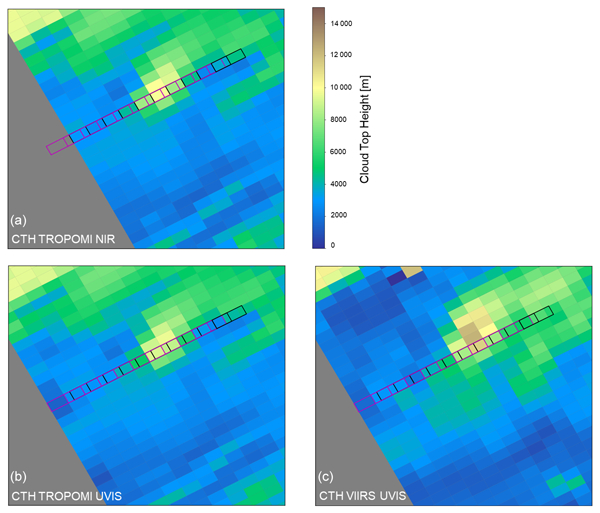
Athina Argyrouli, Diego Loyola, Fabian Romahn, Ronny Lutz, Víctor Molina García, Pascal Hedelt, Klaus-Peter Heue, and Richard Siddans
Atmos. Meas. Tech., 17, 6345–6367, https://doi.org/10.5194/amt-17-6345-2024, https://doi.org/10.5194/amt-17-6345-2024, 2024
Short summary
Short summary
This paper describes a new treatment of the spatial misregistration of cloud properties for Sentinel-5 Precursor, when the footprints of different spectral bands are not perfectly aligned. The methodology exploits synergies between spectrometers and imagers, like TROPOMI and VIIRS. The largest improvements have been identified for heterogeneous scenes at cloud edges. This approach is generic and can also be applied to future Sentinel-4 and Sentinel-5 instruments.
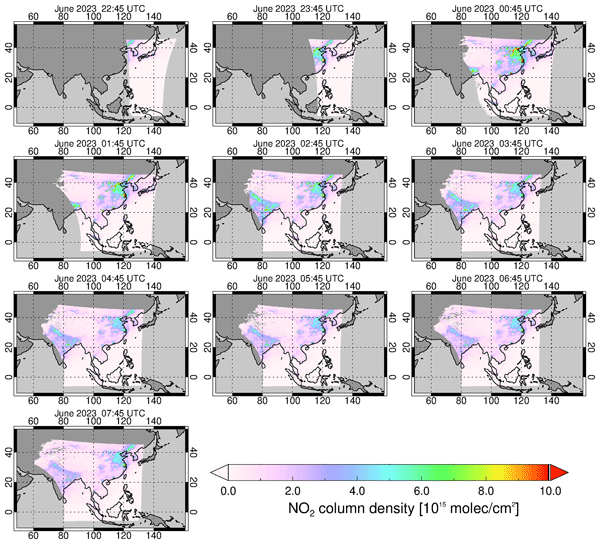
Sora Seo, Pieter Valks, Ronny Lutz, Klaus-Peter Heue, Pascal Hedelt, Víctor Molina García, Diego Loyola, Hanlim Lee, and Jhoon Kim
Atmos. Meas. Tech., 17, 6163–6191, https://doi.org/10.5194/amt-17-6163-2024, https://doi.org/10.5194/amt-17-6163-2024, 2024
Short summary
Short summary
In this study, we developed an advanced retrieval algorithm for tropospheric NO2 columns from geostationary satellite spectrometers and applied it to GEMS measurements. The DLR GEMS NO2 retrieval algorithm follows the heritage from previous and existing algorithms, but improved approaches are applied to reflect the specific features of geostationary satellites. The DLR GEMS NO2 retrievals demonstrate a good capability for monitoring diurnal variability with a high spatial resolution.
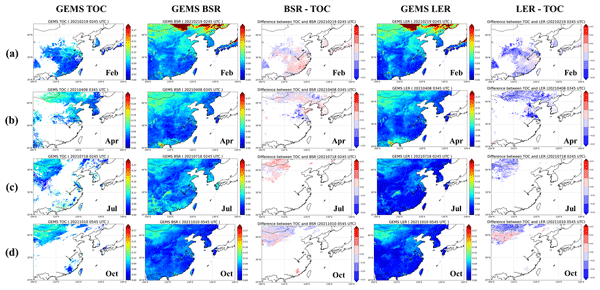
Suyoung Sim, Sungwon Choi, Daeseong Jung, Jongho Woo, Nayeon Kim, Sungwoo Park, Honghee Kim, Ukkyo Jeong, Hyunkee Hong, and Kyung-Soo Han
Atmos. Meas. Tech., 17, 5601–5618, https://doi.org/10.5194/amt-17-5601-2024, https://doi.org/10.5194/amt-17-5601-2024, 2024
Short summary
Short summary
This study evaluates the use of background surface reflectance (BSR) derived from a semi-empirical bidirectional reflectance distribution function (BRDF) model based on GEMS satellite images. Analysis shows that BSR provides improved accuracy and stability compared to Lambertian-equivalent reflectivity (LER). These results indicate that BSR can significantly enhance climate analysis and air quality monitoring, making it a promising tool for accurate environmental satellite applications.
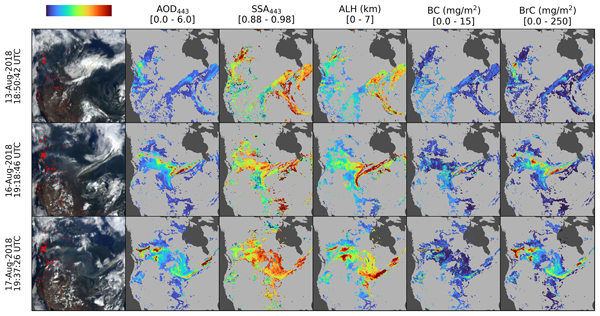
Myungje Choi, Alexei Lyapustin, Gregory L. Schuster, Sujung Go, Yujie Wang, Sergey Korkin, Ralph Kahn, Jeffrey S. Reid, Edward J. Hyer, Thomas F. Eck, Mian Chin, David J. Diner, Olga Kalashnikova, Oleg Dubovik, Jhoon Kim, and Hans Moosmüller
Atmos. Chem. Phys., 24, 10543–10565, https://doi.org/10.5194/acp-24-10543-2024, https://doi.org/10.5194/acp-24-10543-2024, 2024
Short summary
Short summary
This paper introduces a retrieval algorithm to estimate two key absorbing components in smoke (black carbon and brown carbon) using DSCOVR EPIC measurements. Our analysis reveals distinct smoke properties, including spectral absorption, layer height, and black carbon and brown carbon, over North America and central Africa. The retrieved smoke properties offer valuable observational constraints for modeling radiative forcing and informing health-related studies.
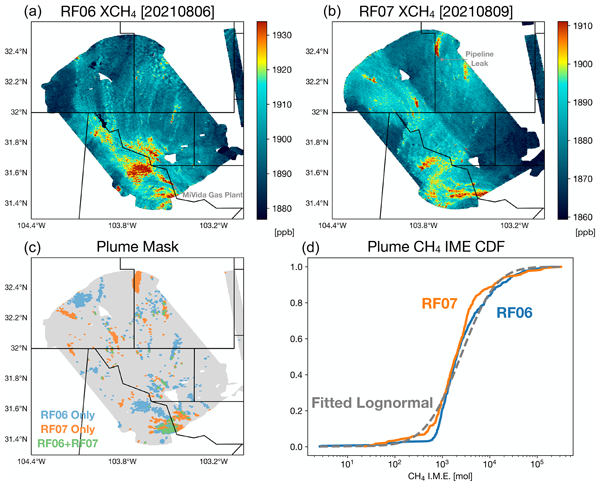
Christopher Chan Miller, Sébastien Roche, Jonas S. Wilzewski, Xiong Liu, Kelly Chance, Amir H. Souri, Eamon Conway, Bingkun Luo, Jenna Samra, Jacob Hawthorne, Kang Sun, Carly Staebell, Apisada Chulakadabba, Maryann Sargent, Joshua S. Benmergui, Jonathan E. Franklin, Bruce C. Daube, Yang Li, Joshua L. Laughner, Bianca C. Baier, Ritesh Gautam, Mark Omara, and Steven C. Wofsy
Atmos. Meas. Tech., 17, 5429–5454, https://doi.org/10.5194/amt-17-5429-2024, https://doi.org/10.5194/amt-17-5429-2024, 2024
Short summary
Short summary
MethaneSAT is an upcoming satellite mission designed to monitor methane emissions from the oil and gas (O&G) industry globally. Here, we present observations from the first flight campaign of MethaneAIR, a MethaneSAT-like instrument mounted on an aircraft. MethaneAIR can map methane with high precision and accuracy over a typically sized oil and gas basin (~200 km2) in a single flight. This paper demonstrates the capability of the upcoming satellite to routinely track global O&G emissions.
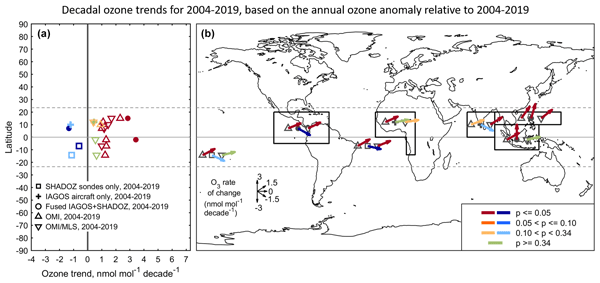
Audrey Gaudel, Ilann Bourgeois, Meng Li, Kai-Lan Chang, Jerald Ziemke, Bastien Sauvage, Ryan M. Stauffer, Anne M. Thompson, Debra E. Kollonige, Nadia Smith, Daan Hubert, Arno Keppens, Juan Cuesta, Klaus-Peter Heue, Pepijn Veefkind, Kenneth Aikin, Jeff Peischl, Chelsea R. Thompson, Thomas B. Ryerson, Gregory J. Frost, Brian C. McDonald, and Owen R. Cooper
Atmos. Chem. Phys., 24, 9975–10000, https://doi.org/10.5194/acp-24-9975-2024, https://doi.org/10.5194/acp-24-9975-2024, 2024
Short summary
Short summary
The study examines tropical tropospheric ozone changes. In situ data from 1994–2019 display increased ozone, notably over India, Southeast Asia, and Malaysia and Indonesia. Sparse in situ data limit trend detection for the 15-year period. In situ and satellite data, with limited sampling, struggle to consistently detect trends. Continuous observations are vital over the tropical Pacific Ocean, Indian Ocean, western Africa, and South Asia for accurate ozone trend estimation in these regions.
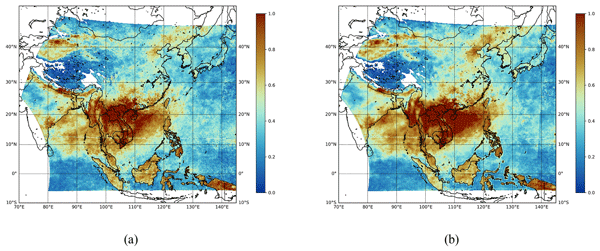
Sooyon Kim, Yeseul Cho, Hanjeong Ki, Seyoung Park, Dagun Oh, Seungjun Lee, Yeonghye Cho, Jhoon Kim, Wonjin Lee, Jaewoo Park, Ick Hoon Jin, and Sangwook Kang
Atmos. Meas. Tech., 17, 5221–5241, https://doi.org/10.5194/amt-17-5221-2024, https://doi.org/10.5194/amt-17-5221-2024, 2024
Short summary
Short summary
This paper describes new work that improves the processing of GEMS AOD data. First, we enhance the inverse-distance-weighting algorithm by incorporating quality flag information, assigning weights that are inversely proportional to the number of unreliable grids. Second, we leverage a spatiotemporal merging method to address both spatial and temporal variability. Finally, we estimate the mean field values for GEMS AOD data, enhancing our understanding of the impact of aerosols on climate change.
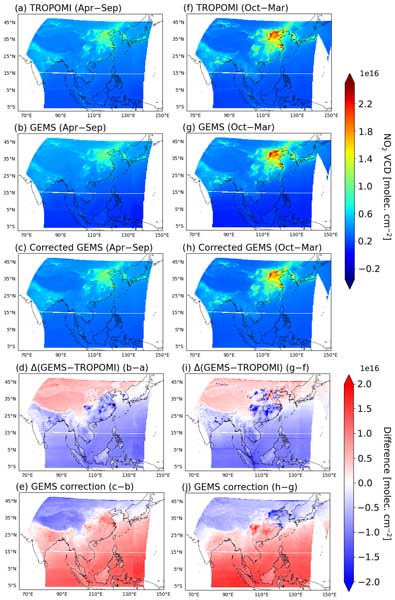
Yujin J. Oak, Daniel J. Jacob, Nicholas Balasus, Laura H. Yang, Heesung Chong, Junsung Park, Hanlim Lee, Gitaek T. Lee, Eunjo S. Ha, Rokjin J. Park, Hyeong-Ahn Kwon, and Jhoon Kim
Atmos. Meas. Tech., 17, 5147–5159, https://doi.org/10.5194/amt-17-5147-2024, https://doi.org/10.5194/amt-17-5147-2024, 2024
Short summary
Short summary
We present an improved NO2 product from GEMS by calibrating it to TROPOMI using machine learning and by reprocessing both satellite products to adopt common NO2 profiles. Our corrected GEMS product combines the high data density of GEMS with the accuracy of TROPOMI, supporting the combined use for analyses of East Asia air quality including emissions and chemistry. This method can be extended to other species and geostationary satellites including TEMPO and Sentinel-4.
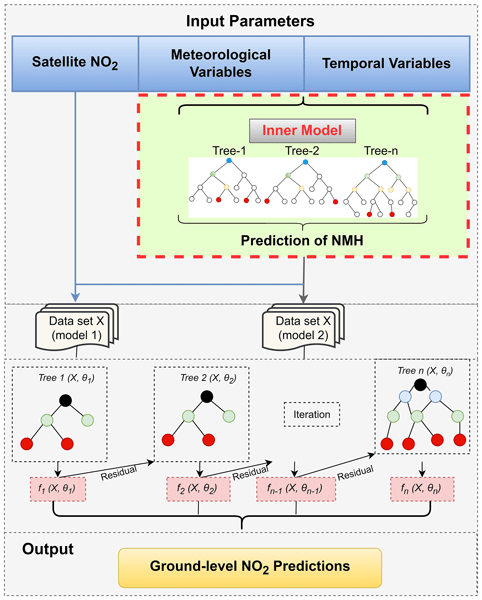
Naveed Ahmad, Changqing Lin, Alexis K. H. Lau, Jhoon Kim, Tianshu Zhang, Fangqun Yu, Chengcai Li, Ying Li, Jimmy C. H. Fung, and Xiang Qian Lao
Atmos. Chem. Phys., 24, 9645–9665, https://doi.org/10.5194/acp-24-9645-2024, https://doi.org/10.5194/acp-24-9645-2024, 2024
Short summary
Short summary
This study developed a nested machine learning model to convert the GEMS NO2 column measurements into ground-level concentrations across China. The model directly incorporates the NO2 mixing height (NMH) into the methodological framework. The study underscores the importance of considering NMH when estimating ground-level NO2 from satellite column measurements and highlights the significant advantages of new-generation geostationary satellites in air quality monitoring.
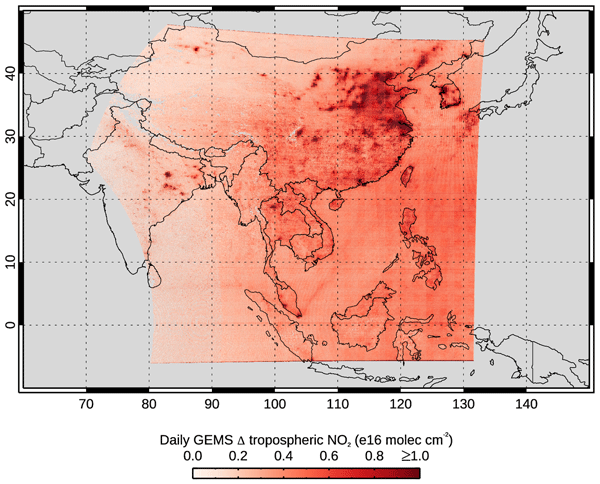
David P. Edwards, Sara Martínez-Alonso, Duseong S. Jo, Ivan Ortega, Louisa K. Emmons, John J. Orlando, Helen M. Worden, Jhoon Kim, Hanlim Lee, Junsung Park, and Hyunkee Hong
Atmos. Chem. Phys., 24, 8943–8961, https://doi.org/10.5194/acp-24-8943-2024, https://doi.org/10.5194/acp-24-8943-2024, 2024
Short summary
Short summary
Until recently, satellite observations of atmospheric pollutants at any location could only be obtained once a day. New geostationary satellites stare at a region of the Earth to make hourly measurements, and the Geostationary Environment Monitoring Spectrometer is the first looking at Asia. These data and model simulations show how the change seen for one important pollutant that determines air quality depends on a combination of pollution emissions, atmospheric chemistry, and meteorology.
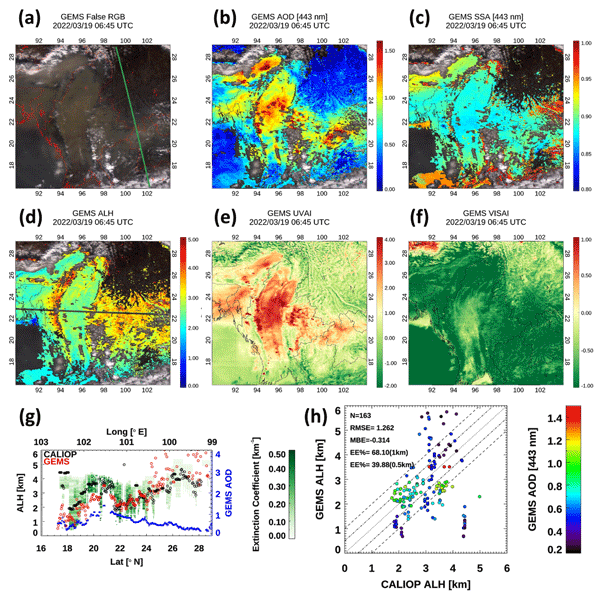
Yeseul Cho, Jhoon Kim, Sujung Go, Mijin Kim, Seoyoung Lee, Minseok Kim, Heesung Chong, Won-Jin Lee, Dong-Won Lee, Omar Torres, and Sang Seo Park
Atmos. Meas. Tech., 17, 4369–4390, https://doi.org/10.5194/amt-17-4369-2024, https://doi.org/10.5194/amt-17-4369-2024, 2024
Short summary
Short summary
Aerosol optical properties have been provided by the Geostationary Environment Monitoring Spectrometer (GEMS), the world’s first geostationary-Earth-orbit (GEO) satellite instrument designed for atmospheric environmental monitoring. This study describes improvements made to the GEMS aerosol retrieval algorithm (AERAOD) and presents its validation results. These enhancements aim to provide more accurate and reliable aerosol-monitoring results for Asia.
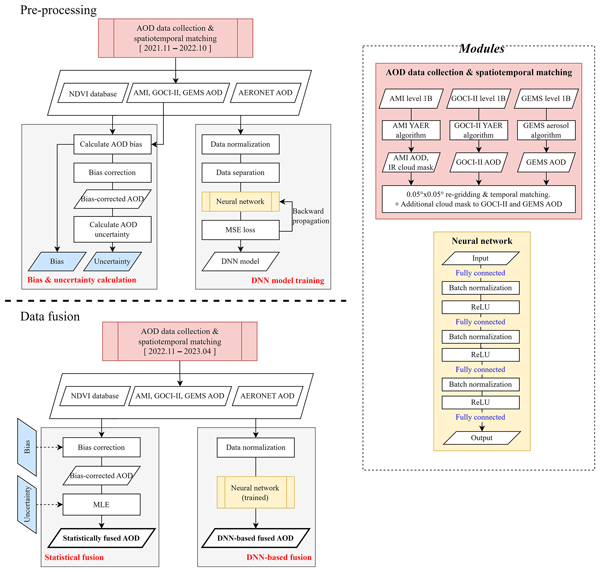
Minseok Kim, Jhoon Kim, Hyunkwang Lim, Seoyoung Lee, Yeseul Cho, Yun-Gon Lee, Sujung Go, and Kyunghwa Lee
Atmos. Meas. Tech., 17, 4317–4335, https://doi.org/10.5194/amt-17-4317-2024, https://doi.org/10.5194/amt-17-4317-2024, 2024
Short summary
Short summary
Information about aerosol loading in the atmosphere can be collected from various satellite instruments. Aerosol products from various satellite instruments have their own error characteristics. This study statistically merged aerosol optical depth datasets from multiple instruments aboard geostationary satellites considering uncertainties. Also, a deep neural network technique is adopted for aerosol data merging.
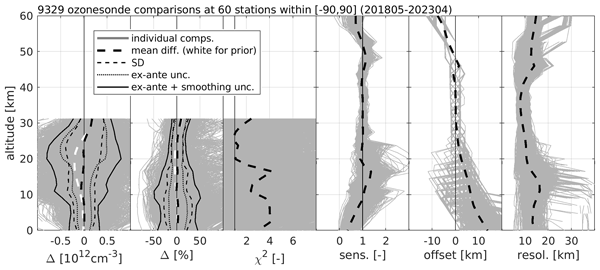
Arno Keppens, Serena Di Pede, Daan Hubert, Jean-Christopher Lambert, Pepijn Veefkind, Maarten Sneep, Johan De Haan, Mark ter Linden, Thierry Leblanc, Steven Compernolle, Tijl Verhoelst, José Granville, Oindrila Nath, Ann Mari Fjæraa, Ian Boyd, Sander Niemeijer, Roeland Van Malderen, Herman G. J. Smit, Valentin Duflot, Sophie Godin-Beekmann, Bryan J. Johnson, Wolfgang Steinbrecht, David W. Tarasick, Debra E. Kollonige, Ryan M. Stauffer, Anne M. Thompson, Angelika Dehn, and Claus Zehner
Atmos. Meas. Tech., 17, 3969–3993, https://doi.org/10.5194/amt-17-3969-2024, https://doi.org/10.5194/amt-17-3969-2024, 2024
Short summary
Short summary
The Sentinel-5P satellite operated by the European Space Agency has carried the TROPOspheric Monitoring Instrument (TROPOMI) around the Earth since October 2017. This mission also produces atmospheric ozone profile data which are described in detail for May 2018 to April 2023. Independent validation using ground-based reference measurements demonstrates that the operational ozone profile product mostly fully and at least partially complies with all mission requirements.
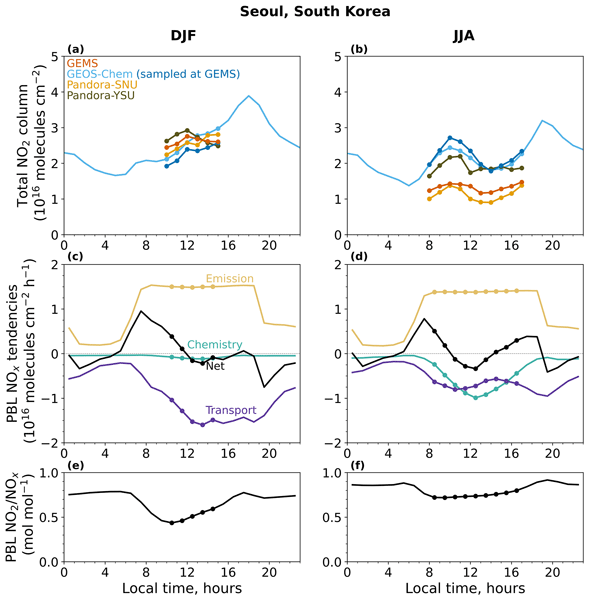
Laura Hyesung Yang, Daniel J. Jacob, Ruijun Dang, Yujin J. Oak, Haipeng Lin, Jhoon Kim, Shixian Zhai, Nadia K. Colombi, Drew C. Pendergrass, Ellie Beaudry, Viral Shah, Xu Feng, Robert M. Yantosca, Heesung Chong, Junsung Park, Hanlim Lee, Won-Jin Lee, Soontae Kim, Eunhye Kim, Katherine R. Travis, James H. Crawford, and Hong Liao
Atmos. Chem. Phys., 24, 7027–7039, https://doi.org/10.5194/acp-24-7027-2024, https://doi.org/10.5194/acp-24-7027-2024, 2024
Short summary
Short summary
The Geostationary Environment Monitoring Spectrometer (GEMS) provides hourly measurements of NO2. We use the chemical transport model to find how emissions, chemistry, and transport drive the changes in NO2 observed by GEMS at different times of the day. In winter, the chemistry plays a minor role, and high daytime emissions dominate the diurnal variation in NO2, balanced by transport. In summer, emissions, chemistry, and transport play an important role in shaping the diurnal variation in NO2.
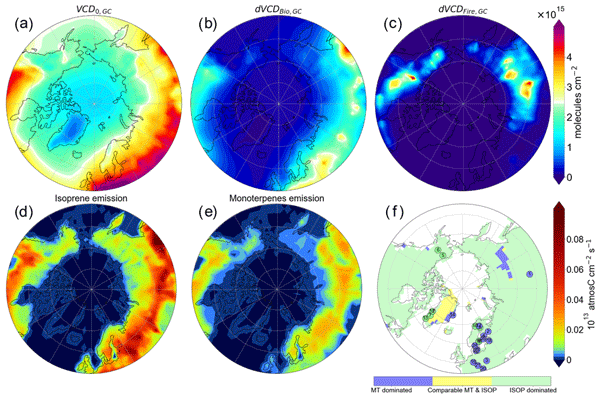
Tianlang Zhao, Jingqiu Mao, Zolal Ayazpour, Gonzalo González Abad, Caroline R. Nowlan, and Yiqi Zheng
Atmos. Chem. Phys., 24, 6105–6121, https://doi.org/10.5194/acp-24-6105-2024, https://doi.org/10.5194/acp-24-6105-2024, 2024
Short summary
Short summary
HCHO variability is a key tracer in understanding VOC emissions in response to climate change. We investigate the role of methane oxidation and biogenic and wildfire emissions in HCHO interannual variability over northern high latitudes in summer, emphasizing wildfires as a key driver of HCHO interannual variability in Alaska, Siberia and northern Canada using satellite HCHO and SIF retrievals and then GEOS-Chem model. We show SIF is a tool to understand biogenic HCHO variability in this region.
Drew C. Pendergrass, Daniel J. Jacob, Yujin J. Oak, Jeewoo Lee, Minseok Kim, Jhoon Kim, Seoyoung Lee, Shixian Zhai, Hitoshi Irie, and Hong Liao
Earth Syst. Sci. Data Discuss., https://doi.org/10.5194/essd-2024-172, https://doi.org/10.5194/essd-2024-172, 2024
Preprint withdrawn
Short summary
Short summary
Fine particles suspended in the atmosphere are a major form of air pollution and an important public health burden. However, measurements of particulate matter are sparse in space and in places like East Asia monitors are established after regulatory policies to improve pollution have changed. In this paper, we use machine learning to fill in the gaps. We train an algorithm to predict pollution at the surface from the atmosphere’s opacity, then produce high resolution maps of data without gaps.

Heesung Chong, Gonzalo González Abad, Caroline R. Nowlan, Christopher Chan Miller, Alfonso Saiz-Lopez, Rafael P. Fernandez, Hyeong-Ahn Kwon, Zolal Ayazpour, Huiqun Wang, Amir H. Souri, Xiong Liu, Kelly Chance, Ewan O'Sullivan, Jhoon Kim, Ja-Ho Koo, William R. Simpson, François Hendrick, Richard Querel, Glen Jaross, Colin Seftor, and Raid M. Suleiman
Atmos. Meas. Tech., 17, 2873–2916, https://doi.org/10.5194/amt-17-2873-2024, https://doi.org/10.5194/amt-17-2873-2024, 2024
Short summary
Short summary
We present a new bromine monoxide (BrO) product derived using radiances measured from OMPS-NM on board the Suomi-NPP satellite. This product provides nearly a decade of global stratospheric and tropospheric column retrievals, a feature that is currently rare in publicly accessible datasets. Both stratospheric and tropospheric columns from OMPS-NM demonstrate robust performance, exhibiting good agreement with ground-based observations collected at three stations (Lauder, Utqiagvik, and Harestua).
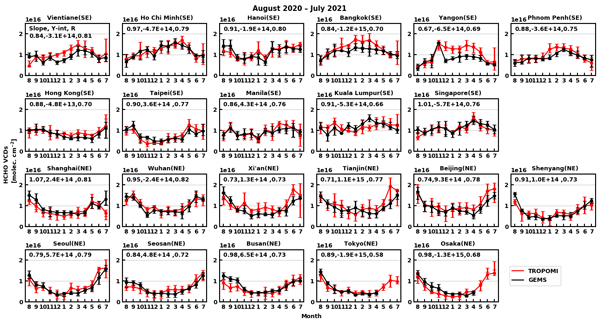
Gitaek T. Lee, Rokjin J. Park, Hyeong-Ahn Kwon, Eunjo S. Ha, Sieun D. Lee, Seunga Shin, Myoung-Hwan Ahn, Mina Kang, Yong-Sang Choi, Gyuyeon Kim, Dong-Won Lee, Deok-Rae Kim, Hyunkee Hong, Bavo Langerock, Corinne Vigouroux, Christophe Lerot, Francois Hendrick, Gaia Pinardi, Isabelle De Smedt, Michel Van Roozendael, Pucai Wang, Heesung Chong, Yeseul Cho, and Jhoon Kim
Atmos. Chem. Phys., 24, 4733–4749, https://doi.org/10.5194/acp-24-4733-2024, https://doi.org/10.5194/acp-24-4733-2024, 2024
Short summary
Short summary
This study evaluates the Geostationary Environment Monitoring Spectrometer (GEMS) HCHO product by comparing its vertical column densities (VCDs) with those of TROPOMI and ground-based observations. Based on some sensitivity tests, obtaining radiance references under clear-sky conditions significantly improves HCHO retrieval quality. GEMS HCHO VCDs captured seasonal and diurnal variations well during the first year of observation, showing consistency with TROPOMI and ground-based observations.
Juseon Bak, Xiong Liu, Kai Yang, Gonzalo Gonzalez Abad, Ewan O'Sullivan, Kelly Chance, and Cheol-Hee Kim
Atmos. Meas. Tech., 17, 1891–1911, https://doi.org/10.5194/amt-17-1891-2024, https://doi.org/10.5194/amt-17-1891-2024, 2024
Short summary
Short summary
The new version (V2) of the OMI ozone profile product is introduced to improve retrieval quality and long-term consistency of tropospheric ozone by incorporating the recent collection 4 OMI L1b spectral products and refining radiometric correction, forward model calculation, and a priori ozone data.
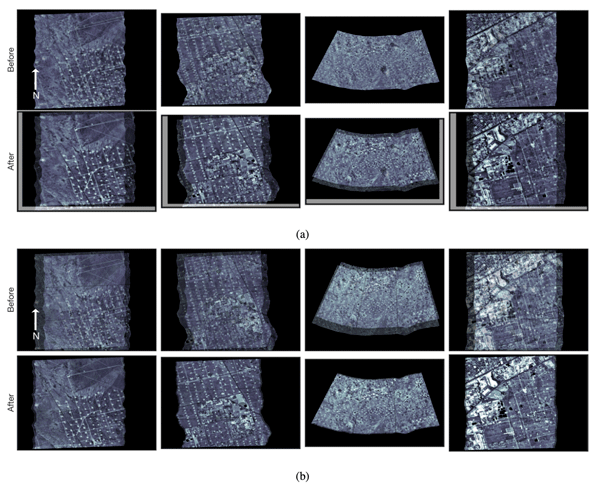
Eamon K. Conway, Amir H. Souri, Joshua Benmergui, Kang Sun, Xiong Liu, Carly Staebell, Christopher Chan Miller, Jonathan Franklin, Jenna Samra, Jonas Wilzewski, Sebastien Roche, Bingkun Luo, Apisada Chulakadabba, Maryann Sargent, Jacob Hohl, Bruce Daube, Iouli Gordon, Kelly Chance, and Steven Wofsy
Atmos. Meas. Tech., 17, 1347–1362, https://doi.org/10.5194/amt-17-1347-2024, https://doi.org/10.5194/amt-17-1347-2024, 2024
Short summary
Short summary
The work presented here describes the processes required to convert raw sensor data for the MethaneAIR instrument to geometrically calibrated data. Each algorithm is described in detail. MethaneAIR is the airborne simulator for MethaneSAT, a new satellite under development by MethaneSAT LLC, a subsidiary of the EDF. MethaneSAT's goals are to precisely map over 80 % of the production sources of methane emissions from oil and gas fields across the globe to a high degree of accuracy.
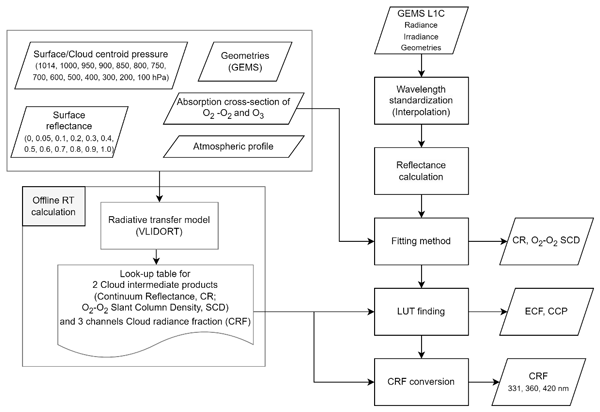
Bo-Ram Kim, Gyuyeon Kim, Minjeong Cho, Yong-Sang Choi, and Jhoon Kim
Atmos. Meas. Tech., 17, 453–470, https://doi.org/10.5194/amt-17-453-2024, https://doi.org/10.5194/amt-17-453-2024, 2024
Short summary
Short summary
This study introduces the GEMS cloud algorithm and validates its results using data from GEMS and other environmental satellites. The GEMS algorithm is able to detect the lowest cloud heights among the four satellites, and its effective cloud fraction and cloud centroid pressure are well reflected in the retrieval results. The study highlights the algorithm's usefulness in correcting errors in trace gases caused by clouds in the East Asian region.
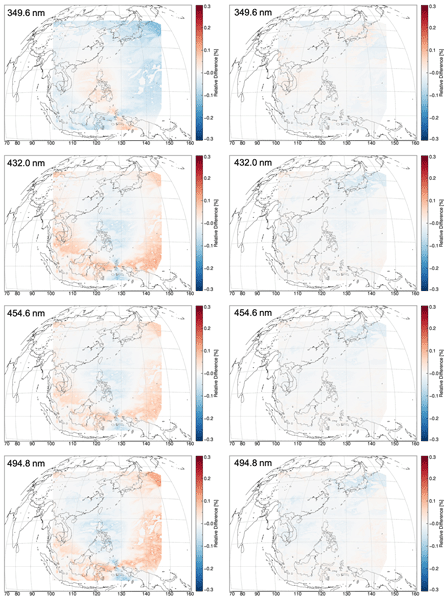
Haklim Choi, Xiong Liu, Ukkyo Jeong, Heesung Chong, Jhoon Kim, Myung Hwan Ahn, Dai Ho Ko, Dong-Won Lee, Kyung-Jung Moon, and Kwang-Mog Lee
Atmos. Meas. Tech., 17, 145–164, https://doi.org/10.5194/amt-17-145-2024, https://doi.org/10.5194/amt-17-145-2024, 2024
Short summary
Short summary
GEMS is the first geostationary satellite to measure the UV--Vis region, and this paper reports the polarization characteristics of GEMS and an algorithm. We develop a polarization correction algorithm optimized for GEMS based on a look-up-table approach that simultaneously considers the polarization of incoming light and polarization sensitivity characteristics of the instrument. Pre-launch polarization error was adjusted close to zero across the spectral range after polarization correction.
Apisada Chulakadabba, Maryann Sargent, Thomas Lauvaux, Joshua S. Benmergui, Jonathan E. Franklin, Christopher Chan Miller, Jonas S. Wilzewski, Sébastien Roche, Eamon Conway, Amir H. Souri, Kang Sun, Bingkun Luo, Jacob Hawthrone, Jenna Samra, Bruce C. Daube, Xiong Liu, Kelly Chance, Yang Li, Ritesh Gautam, Mark Omara, Jeff S. Rutherford, Evan D. Sherwin, Adam Brandt, and Steven C. Wofsy
Atmos. Meas. Tech., 16, 5771–5785, https://doi.org/10.5194/amt-16-5771-2023, https://doi.org/10.5194/amt-16-5771-2023, 2023
Short summary
Short summary
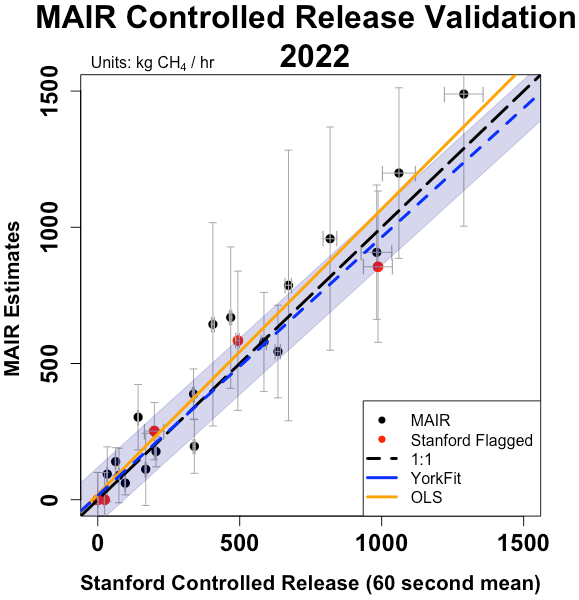
We show that MethaneAIR, a precursor to the MethaneSAT satellite, demonstrates accurate point source quantification during controlled release experiments and regional observations in 2021 and 2022. Results from our two independent quantification methods suggest the accuracy of our sensor and algorithms is better than 25 % for sources emitting 200 kg h−1 or more. Insights from these measurements help establish the capabilities of MethaneSAT and MethaneAIR.
Kanghyun Baek, Jae Hwan Kim, Juseon Bak, David P. Haffner, Mina Kang, and Hyunkee Hong
Atmos. Meas. Tech., 16, 5461–5478, https://doi.org/10.5194/amt-16-5461-2023, https://doi.org/10.5194/amt-16-5461-2023, 2023
Short summary
Short summary
The GEMS mission was the first mission of the geostationary satellite constellation for hourly atmospheric composition monitoring. The GEMS ozone measurements were cross-compared to those of Pandora, OMPS, and TROPOMI satellite sensors and excellent agreement was found. GEMS has proven to be a powerful new instrument for monitoring and assessing the diurnal variation in atmospheric ozone. This experience can be used to advance research with future geostationary environmental satellite missions.
Rui Zhu, Zhaojun Tang, Xiaokang Chen, Xiong Liu, and Zhe Jiang
Geosci. Model Dev., 16, 6337–6354, https://doi.org/10.5194/gmd-16-6337-2023, https://doi.org/10.5194/gmd-16-6337-2023, 2023
Short summary
Short summary
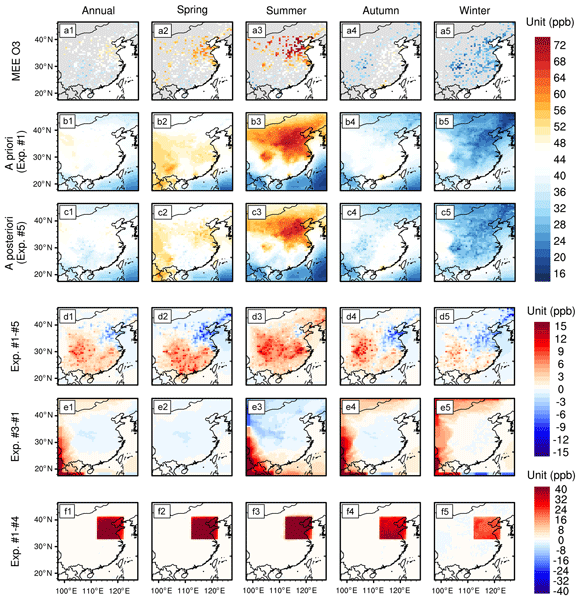
A single ozone (O3) tracer mode was developed in this work to build the capability of the GEOS-Chem model for rapid O3 simulation. It is combined with OMI and surface O3 observations to investigate the changes in tropospheric O3 in China in 2015–2020. The assimilations indicate rapid surface O3 increases that are underestimated by the a priori simulations. We find stronger increases in tropospheric O3 columns over polluted areas and a large discrepancy by assimilating different observations.
Yuhang Zhang, Jintai Lin, Jhoon Kim, Hanlim Lee, Junsung Park, Hyunkee Hong, Michel Van Roozendael, Francois Hendrick, Ting Wang, Pucai Wang, Qin He, Kai Qin, Yongjoo Choi, Yugo Kanaya, Jin Xu, Pinhua Xie, Xin Tian, Sanbao Zhang, Shanshan Wang, Siyang Cheng, Xinghong Cheng, Jianzhong Ma, Thomas Wagner, Robert Spurr, Lulu Chen, Hao Kong, and Mengyao Liu
Atmos. Meas. Tech., 16, 4643–4665, https://doi.org/10.5194/amt-16-4643-2023, https://doi.org/10.5194/amt-16-4643-2023, 2023
Short summary
Short summary
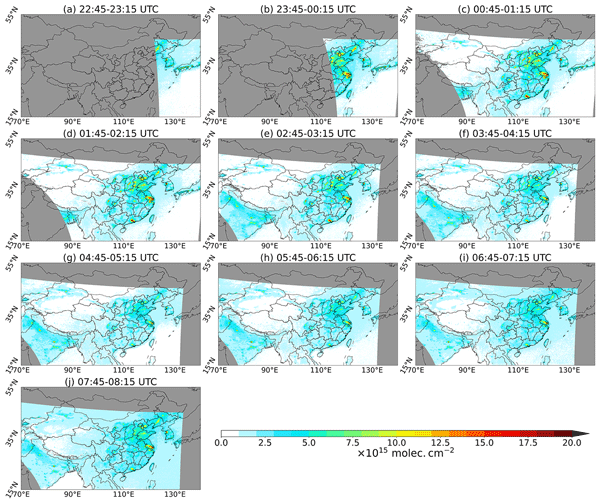
Our tropospheric NO2 vertical column density product with high spatiotemporal resolution is based on the Geostationary Environment Monitoring Spectrometer (GEMS) and named POMINO–GEMS. Strong hotspot signals and NO2 diurnal variations are clearly seen. Validations with multiple satellite products and ground-based, mobile car and surface measurements exhibit the overall great performance of the POMINO–GEMS product, indicating its capability for application in environmental studies.
Junsu Gil, Meehye Lee, Jeonghwan Kim, Gangwoong Lee, Joonyoung Ahn, and Cheol-Hee Kim
Geosci. Model Dev., 16, 5251–5263, https://doi.org/10.5194/gmd-16-5251-2023, https://doi.org/10.5194/gmd-16-5251-2023, 2023
Short summary
Short summary
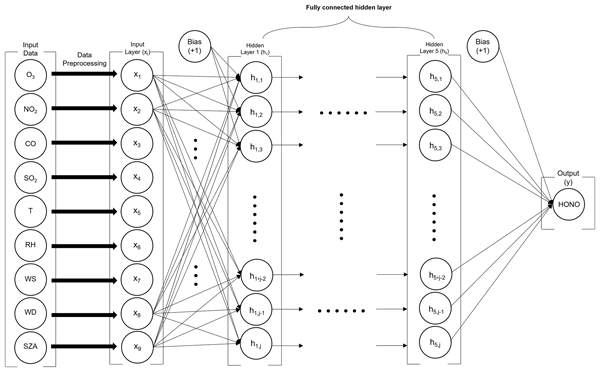
In this study, the framework for calculating reactive nitrogen species using a deep neural network (RND) was developed. It works through simple Python codes and provides high-accuracy reactive nitrogen oxide data. In the first version (RNDv1.0), the model calculates the nitrous acid (HONO) in urban areas, which has an important role in producing O3 and fine aerosol.
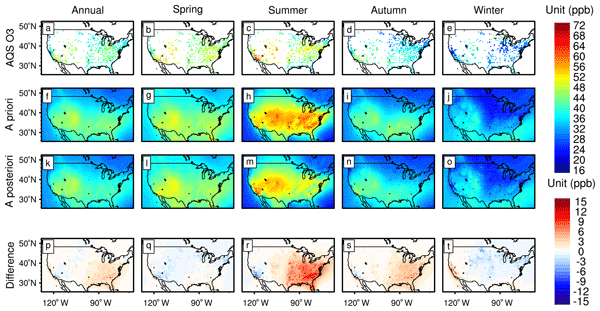
Rui Zhu, Zhaojun Tang, Xiaokang Chen, Xiong Liu, and Zhe Jiang
Atmos. Chem. Phys., 23, 9745–9763, https://doi.org/10.5194/acp-23-9745-2023, https://doi.org/10.5194/acp-23-9745-2023, 2023
Short summary
Short summary
Ozone Monitoring Instrument (OMI) and surface O3 observations are used to investigate the changes in tropospheric O3 in the USA and Europe in 2005–2020. The surface-based assimilations show limited changes in surface and tropospheric column O3. The OMI-based assimilations show larger decreases in tropospheric O3 columns in 2010–2014, related to a decline in free-tropospheric NO2. Analysis suggests limited impacts of local emissions decline on tropospheric O3 over the USA and Europe in 2005–2020.
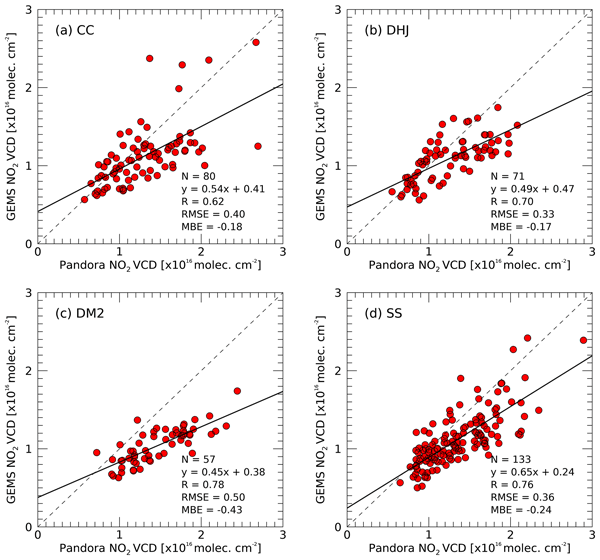
Serin Kim, Daewon Kim, Hyunkee Hong, Lim-Seok Chang, Hanlim Lee, Deok-Rae Kim, Donghee Kim, Jeong-Ah Yu, Dongwon Lee, Ukkyo Jeong, Chang-Kuen Song, Sang-Woo Kim, Sang Seo Park, Jhoon Kim, Thomas F. Hanisco, Junsung Park, Wonei Choi, and Kwangyul Lee
Atmos. Meas. Tech., 16, 3959–3972, https://doi.org/10.5194/amt-16-3959-2023, https://doi.org/10.5194/amt-16-3959-2023, 2023
Short summary
Short summary
A first evaluation of the Geostationary Environmental Monitoring Spectrometer (GEMS) NO2 was carried out via comparison with the NO2 data obtained from the ground-based Pandora direct-sun measurements at four sites in Seosan, Republic of Korea. Comparisons between GEMS NO2 and Pandora NO2 were performed according to GEMS cloud fraction. GEMS NO2 showed good agreement with that of Pandora NO2 under less cloudy conditions.
Huiqun Wang, Gonzalo González Abad, Chris Chan Miller, Hyeong-Ahn Kwon, Caroline R. Nowlan, Zolal Ayazpour, Heesung Chong, Xiong Liu, Kelly Chance, Ewan O'Sullivan, Kang Sun, Robert Spurr, and Robert J. Hargreaves
Atmos. Meas. Tech. Discuss., https://doi.org/10.5194/amt-2023-66, https://doi.org/10.5194/amt-2023-66, 2023
Preprint withdrawn
Short summary
Short summary
A pipeline for retrieving Total Column Water Vapor from satellite blue spectra is developed. New constraints are considered. Water-leaving radiance is important over the oceans. Results agree with reference datasets well under clear conditions. Due to high sensitivity to clouds, strict data filtering criteria are required. All-sky retrievals can be corrected using machine learning. GPS stations’ representation errors follow a power law relationship with grid resolutions.
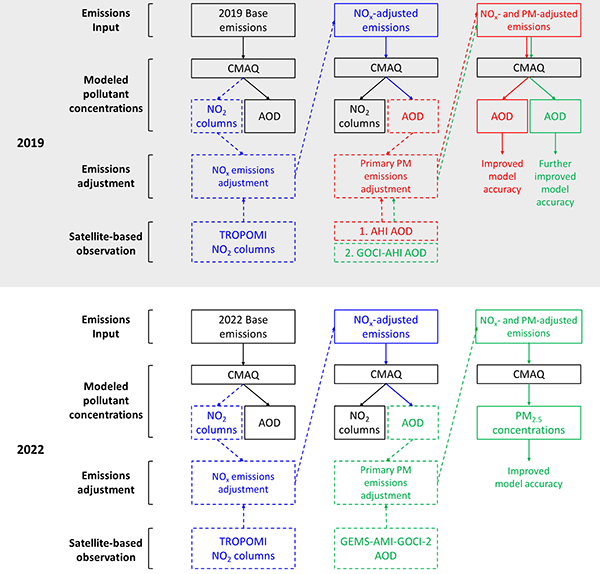
Jincheol Park, Jia Jung, Yunsoo Choi, Hyunkwang Lim, Minseok Kim, Kyunghwa Lee, Yun Gon Lee, and Jhoon Kim
Atmos. Meas. Tech., 16, 3039–3057, https://doi.org/10.5194/amt-16-3039-2023, https://doi.org/10.5194/amt-16-3039-2023, 2023
Short summary
Short summary
In response to the recent release of new geostationary platform-derived observational data generated by the Geostationary Environment Monitoring Spectrometer (GEMS) and its sister instruments, this study utilized the GEMS data fusion product and its proxy data in adjusting aerosol precursor emissions over East Asia. The use of spatiotemporally more complete observation references in updating the emissions resulted in more promising model performances in estimating aerosol loadings in East Asia.
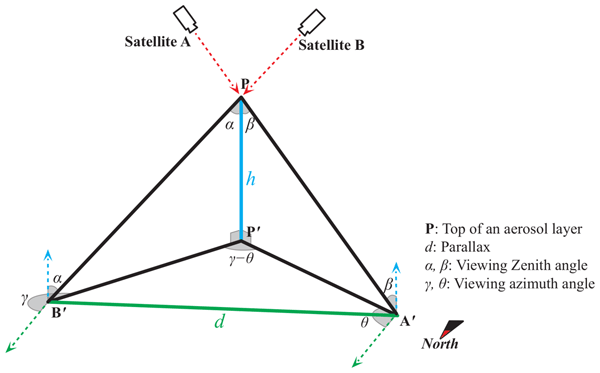
Minseok Kim, Jhoon Kim, Hyunkwang Lim, Seoyoung Lee, Yeseul Cho, Huidong Yeo, and Sang-Woo Kim
Atmos. Meas. Tech., 16, 2673–2690, https://doi.org/10.5194/amt-16-2673-2023, https://doi.org/10.5194/amt-16-2673-2023, 2023
Short summary
Short summary
Aerosol height information is important when seeking an understanding of the vertical structure of the aerosol layer and long-range transport. In this study, a geometrical aerosol top height (ATH) retrieval using a parallax of two geostationary satellites is investigated. With sufficient longitudinal separation between the two satellites, a decent ATH product could be retrieved.
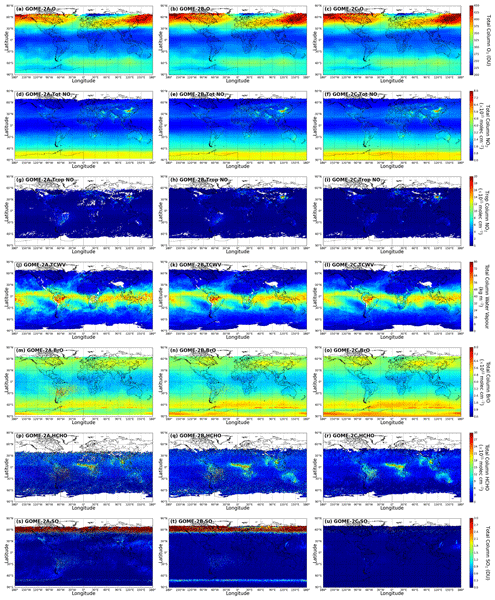
Ka Lok Chan, Pieter Valks, Klaus-Peter Heue, Ronny Lutz, Pascal Hedelt, Diego Loyola, Gaia Pinardi, Michel Van Roozendael, François Hendrick, Thomas Wagner, Vinod Kumar, Alkis Bais, Ankie Piters, Hitoshi Irie, Hisahiro Takashima, Yugo Kanaya, Yongjoo Choi, Kihong Park, Jihyo Chong, Alexander Cede, Udo Frieß, Andreas Richter, Jianzhong Ma, Nuria Benavent, Robert Holla, Oleg Postylyakov, Claudia Rivera Cárdenas, and Mark Wenig
Earth Syst. Sci. Data, 15, 1831–1870, https://doi.org/10.5194/essd-15-1831-2023, https://doi.org/10.5194/essd-15-1831-2023, 2023
Short summary
Short summary
This paper presents the theoretical basis as well as verification and validation of the Global Ozone Monitoring Experiment-2 (GOME-2) daily and monthly level-3 products.
Lei Shu, Lei Zhu, Juseon Bak, Peter Zoogman, Han Han, Song Liu, Xicheng Li, Shuai Sun, Juan Li, Yuyang Chen, Dongchuan Pu, Xiaoxing Zuo, Weitao Fu, Xin Yang, and Tzung-May Fu
Atmos. Chem. Phys., 23, 3731–3748, https://doi.org/10.5194/acp-23-3731-2023, https://doi.org/10.5194/acp-23-3731-2023, 2023
Short summary
Short summary
We quantify the benefit of multisource observations (GEMS, LEO satellite, and surface) on ozone simulations in Asia. Data assimilation improves the monitoring of exceedance, spatial pattern, and diurnal variation of surface ozone, with the regional mean bias reduced from −2.1 to −0.2 ppbv. Data assimilation also better represents ozone vertical distributions in the middle to upper troposphere at low latitudes. Our results offer a valuable reference for future ozone simulations.
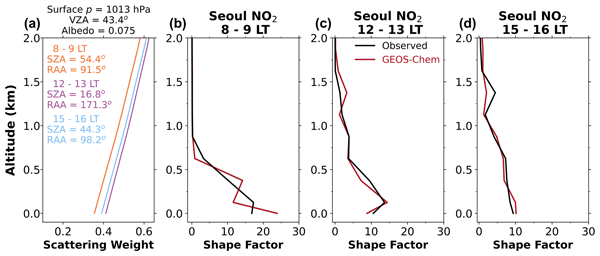
Laura Hyesung Yang, Daniel J. Jacob, Nadia K. Colombi, Shixian Zhai, Kelvin H. Bates, Viral Shah, Ellie Beaudry, Robert M. Yantosca, Haipeng Lin, Jared F. Brewer, Heesung Chong, Katherine R. Travis, James H. Crawford, Lok N. Lamsal, Ja-Ho Koo, and Jhoon Kim
Atmos. Chem. Phys., 23, 2465–2481, https://doi.org/10.5194/acp-23-2465-2023, https://doi.org/10.5194/acp-23-2465-2023, 2023
Short summary
Short summary
A geostationary satellite can now provide hourly NO2 vertical columns, and obtaining the NO2 vertical columns from space relies on NO2 vertical distribution from the chemical transport model (CTM). In this work, we update the CTM to better represent the chemistry environment so that the CTM can accurately provide NO2 vertical distribution. We also find that the changes in NO2 vertical distribution driven by a change in mixing depth play an important role in the NO2 column's diurnal variation.
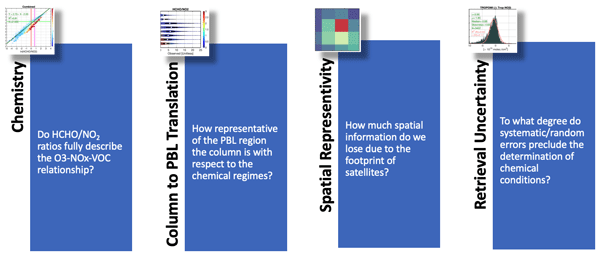
Amir H. Souri, Matthew S. Johnson, Glenn M. Wolfe, James H. Crawford, Alan Fried, Armin Wisthaler, William H. Brune, Donald R. Blake, Andrew J. Weinheimer, Tijl Verhoelst, Steven Compernolle, Gaia Pinardi, Corinne Vigouroux, Bavo Langerock, Sungyeon Choi, Lok Lamsal, Lei Zhu, Shuai Sun, Ronald C. Cohen, Kyung-Eun Min, Changmin Cho, Sajeev Philip, Xiong Liu, and Kelly Chance
Atmos. Chem. Phys., 23, 1963–1986, https://doi.org/10.5194/acp-23-1963-2023, https://doi.org/10.5194/acp-23-1963-2023, 2023
Short summary
Short summary
We have rigorously characterized different sources of error in satellite-based HCHO / NO2 tropospheric columns, a widely used metric for diagnosing near-surface ozone sensitivity. Specifically, the errors were categorized/quantified into (i) an inherent chemistry error, (ii) the decoupled relationship between columns and the near-surface concentration, (iii) the spatial representativeness error of ground satellite pixels, and (iv) the satellite retrieval errors.
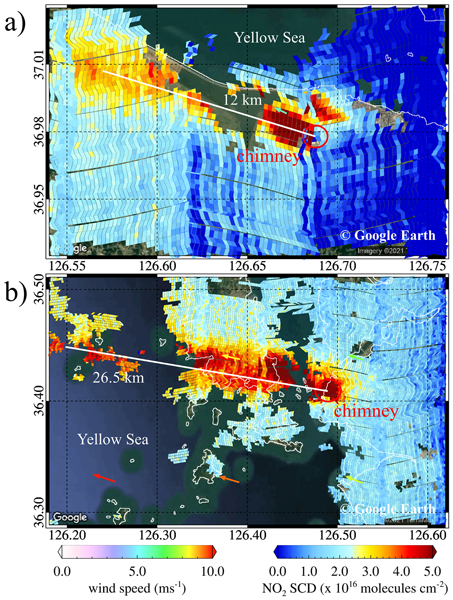
Gyo-Hwang Choo, Kyunghwa Lee, Hyunkee Hong, Ukkyo Jeong, Wonei Choi, and Scott J. Janz
Atmos. Meas. Tech., 16, 625–644, https://doi.org/10.5194/amt-16-625-2023, https://doi.org/10.5194/amt-16-625-2023, 2023
Short summary
Short summary
This study discusses the morning and afternoon distribution of NO2 emissions in large cities and industrial areas in South Korea, one of the largest NO2 emitters around the world, using GeoTASO, an airborne remote sensing instrument developed to support geostationary satellite missions. NO2 measurements from GeoTASO were compared with those from ground-based remote sensing instruments including Pandora and in situ sensors.
Juseon Bak, Eun-Ji Song, Hyo-Jung Lee, Xiong Liu, Ja-Ho Koo, Joowan Kim, Wonbae Jeon, Jae-Hwan Kim, and Cheol-Hee Kim
Atmos. Chem. Phys., 22, 14177–14187, https://doi.org/10.5194/acp-22-14177-2022, https://doi.org/10.5194/acp-22-14177-2022, 2022
Short summary
Short summary
Our study investigates the temporal variations of ozone profiles at Pohang in the Korean Peninsula from multiple ozone products. We discuss the quantitative relationships between daily surface measurements and key meteorological variables, different seasonality of ozone between the troposphere and stratosphere, and interannual changes in the lower tropospheric ozone, linked by the weather pattern driven by the East Asian summer monsoon.
Xinzhou Huang and Kai Yang
Atmos. Meas. Tech., 15, 5877–5915, https://doi.org/10.5194/amt-15-5877-2022, https://doi.org/10.5194/amt-15-5877-2022, 2022
Short summary
Short summary
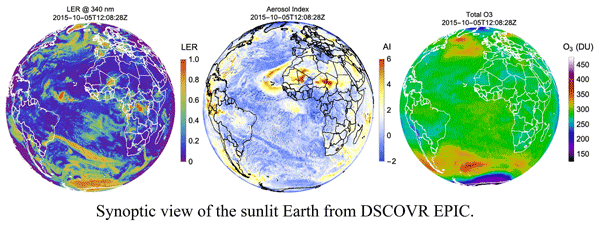
This paper describes the algorithm for O3 and SO2 retrievals from DSCOVR EPIC. Algorithm advances, including the improved O3 profile representation and the regulated direct fitting inversion technique, improve the accuracy of O3 and SO2 from the multi-channel measurements of DSCOVR EPIC. A thorough error analysis is provided to quantify O3 and SO2 retrieval uncertainties due to various error sources and simplified algorithm physics treatments.
Klaus-Peter Heue, Diego Loyola, Fabian Romahn, Walter Zimmer, Simon Chabrillat, Quentin Errera, Jerry Ziemke, and Natalya Kramarova
Atmos. Meas. Tech., 15, 5563–5579, https://doi.org/10.5194/amt-15-5563-2022, https://doi.org/10.5194/amt-15-5563-2022, 2022
Short summary
Short summary
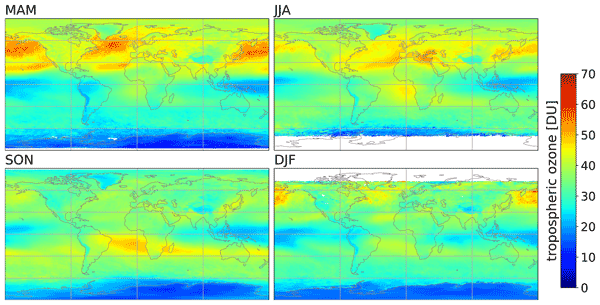
To retrieve tropospheric ozone column information, we subtract stratospheric column data of BASCOE from TROPOMI/S5P total ozone columns.
The new S5P-BASCOE data agree well with existing tropospheric data like OMPS-MERRA-2. The data are also compared to ozone soundings.
The tropospheric ozone columns show the expected temporal and spatial patterns. We will also apply the algorithm to future UV nadir missions like Sentinel 4 or 5 or to recent and ongoing missions like GOME_2 or OMI.
Ukkyo Jeong, Si-Chee Tsay, N. Christina Hsu, David M. Giles, John W. Cooper, Jaehwa Lee, Robert J. Swap, Brent N. Holben, James J. Butler, Sheng-Hsiang Wang, Somporn Chantara, Hyunkee Hong, Donghee Kim, and Jhoon Kim
Atmos. Chem. Phys., 22, 11957–11986, https://doi.org/10.5194/acp-22-11957-2022, https://doi.org/10.5194/acp-22-11957-2022, 2022
Short summary
Short summary
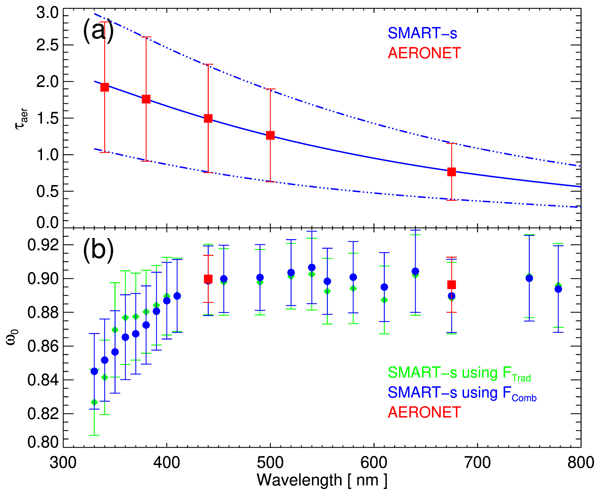
Ultraviolet (UV) measurements from satellite and ground are important for deriving information on several atmospheric trace and aerosol characteristics. Simultaneous retrievals of aerosol and trace gases in this study suggest that water uptake by aerosols is one of the important phenomena affecting aerosol properties over northern Thailand, which is important for regional air quality and climate. Obtained aerosol properties covering the UV are also important for various satellite algorithms.
Samuel E. LeBlanc, Michal Segal-Rozenhaimer, Jens Redemann, Connor Flynn, Roy R. Johnson, Stephen E. Dunagan, Robert Dahlgren, Jhoon Kim, Myungje Choi, Arlindo da Silva, Patricia Castellanos, Qian Tan, Luke Ziemba, Kenneth Lee Thornhill, and Meloë Kacenelenbogen
Atmos. Chem. Phys., 22, 11275–11304, https://doi.org/10.5194/acp-22-11275-2022, https://doi.org/10.5194/acp-22-11275-2022, 2022
Short summary
Short summary
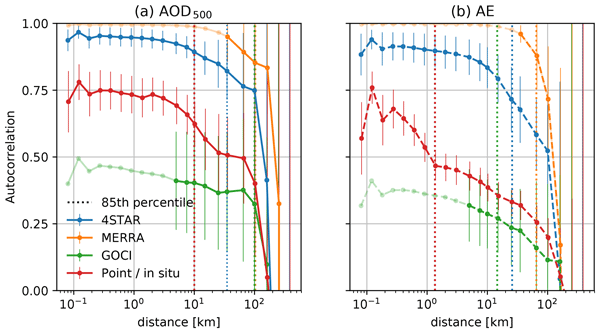
Airborne observations of atmospheric particles and pollution over Korea during a field campaign in May–June 2016 showed that the smallest atmospheric particles are present in the lowest 2 km of the atmosphere. The aerosol size is more spatially variable than optical thickness. We show this with remote sensing (4STAR), in situ (LARGE) observations, satellite measurements (GOCI), and modeled properties (MERRA-2), and it is contrary to the current understanding.

Lim-Seok Chang, Donghee Kim, Hyunkee Hong, Deok-Rae Kim, Jeong-Ah Yu, Kwangyul Lee, Hanlim Lee, Daewon Kim, Jinkyu Hong, Hyun-Young Jo, and Cheol-Hee Kim
Atmos. Chem. Phys., 22, 10703–10720, https://doi.org/10.5194/acp-22-10703-2022, https://doi.org/10.5194/acp-22-10703-2022, 2022
Short summary
Short summary
Our study explored the synergy of combined column and surface measurements during GMAP (GEMS Map of Air Pollution) campaign. It has several points to note for vertical distribution analysis. Particularly under prevailing local wind meteorological conditions, Pandora-based vertical structures sometimes showed negative correlations between column and surface measurements. Vertical analysis should be done carefully in some local meteorological conditions when employing either surface or columns.
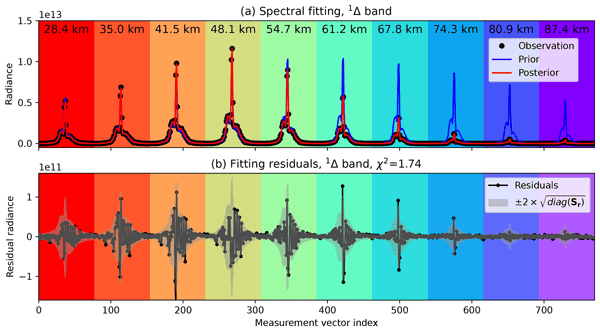
Kang Sun, Mahdi Yousefi, Christopher Chan Miller, Kelly Chance, Gonzalo González Abad, Iouli E. Gordon, Xiong Liu, Ewan O'Sullivan, Christopher E. Sioris, and Steven C. Wofsy
Atmos. Meas. Tech., 15, 3721–3745, https://doi.org/10.5194/amt-15-3721-2022, https://doi.org/10.5194/amt-15-3721-2022, 2022
Short summary
Short summary
This study of upper atmospheric airglow from oxygen is motivated by the need to measure oxygen simultaneously with methane and CO2 in satellite remote sensing. We provide an accurate understanding of the spatial, temporal, and spectral distribution of airglow emissions, which will help in the satellite remote sensing of greenhouse gases and constraining the chemical and physical processes in the upper atmosphere.
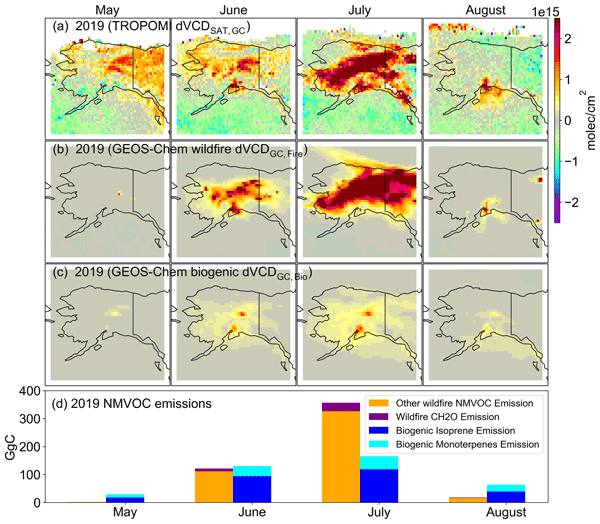
Tianlang Zhao, Jingqiu Mao, William R. Simpson, Isabelle De Smedt, Lei Zhu, Thomas F. Hanisco, Glenn M. Wolfe, Jason M. St. Clair, Gonzalo González Abad, Caroline R. Nowlan, Barbara Barletta, Simone Meinardi, Donald R. Blake, Eric C. Apel, and Rebecca S. Hornbrook
Atmos. Chem. Phys., 22, 7163–7178, https://doi.org/10.5194/acp-22-7163-2022, https://doi.org/10.5194/acp-22-7163-2022, 2022
Short summary
Short summary
Monitoring formaldehyde (HCHO) can help us understand Arctic vegetation change. Here, we compare satellite data and model and show that Alaska summertime HCHO is largely dominated by a background from methane oxidation during mild wildfire years and is dominated by wildfire (largely from direct emission of fire) during strong fire years. Consequently, it is challenging to use satellite HCHO to study vegetation change in the Arctic region.

Drew C. Pendergrass, Shixian Zhai, Jhoon Kim, Ja-Ho Koo, Seoyoung Lee, Minah Bae, Soontae Kim, Hong Liao, and Daniel J. Jacob
Atmos. Meas. Tech., 15, 1075–1091, https://doi.org/10.5194/amt-15-1075-2022, https://doi.org/10.5194/amt-15-1075-2022, 2022
Short summary
Short summary
This paper uses a machine learning algorithm to infer high-resolution maps of particulate air quality in eastern China, Japan, and the Korean peninsula, using data from a geostationary satellite along with meteorology. We then perform an extensive evaluation of this inferred air quality and use it to diagnose trends in the region. We hope this paper and the associated data will be valuable to other scientists interested in epidemiology, air quality, remote sensing, and machine learning.
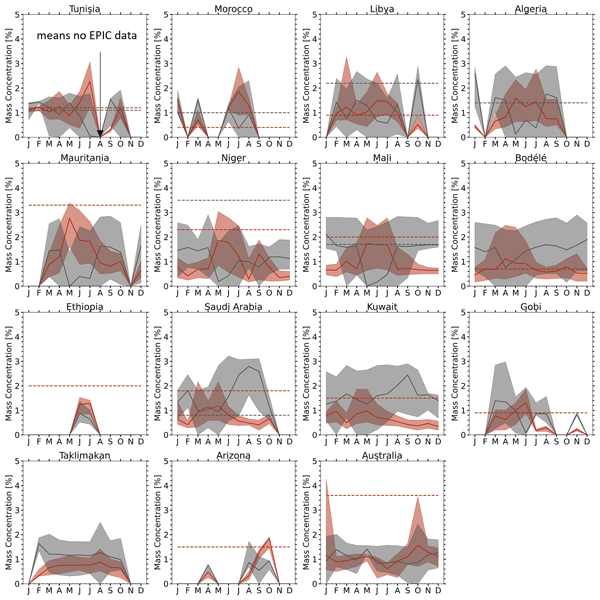
Sujung Go, Alexei Lyapustin, Gregory L. Schuster, Myungje Choi, Paul Ginoux, Mian Chin, Olga Kalashnikova, Oleg Dubovik, Jhoon Kim, Arlindo da Silva, Brent Holben, and Jeffrey S. Reid
Atmos. Chem. Phys., 22, 1395–1423, https://doi.org/10.5194/acp-22-1395-2022, https://doi.org/10.5194/acp-22-1395-2022, 2022
Short summary
Short summary
This paper presents a retrieval algorithm of iron-oxide species (hematite, goethite) content in the atmosphere from DSCOVR EPIC observations. Our results display variations within the published range of hematite and goethite over the main dust-source regions but show significant seasonal and spatial variability. This implies a single-viewing satellite instrument with UV–visible channels may provide essential information on shortwave dust direct radiative effects for climate modeling.
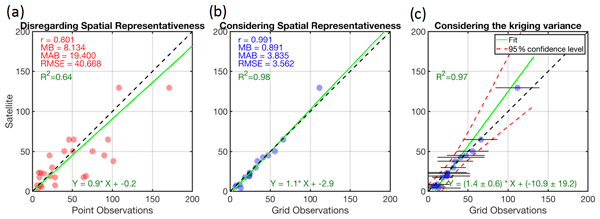
Amir H. Souri, Kelly Chance, Kang Sun, Xiong Liu, and Matthew S. Johnson
Atmos. Meas. Tech., 15, 41–59, https://doi.org/10.5194/amt-15-41-2022, https://doi.org/10.5194/amt-15-41-2022, 2022
Short summary
Short summary
The central component of satellite and model validation is pointwise measurements. A point is an element of space, whereas satellite (model) pixels represent an averaged area. These two datasets are inherently different. We leveraged some geostatistical tools to transform discrete points to gridded data with quantified uncertainty, comparable to satellite footprint (and response functions). This in part alleviated some complications concerning point–pixel comparisons.
Amir H. Souri, Kelly Chance, Juseon Bak, Caroline R. Nowlan, Gonzalo González Abad, Yeonjin Jung, David C. Wong, Jingqiu Mao, and Xiong Liu
Atmos. Chem. Phys., 21, 18227–18245, https://doi.org/10.5194/acp-21-18227-2021, https://doi.org/10.5194/acp-21-18227-2021, 2021
Short summary
Short summary
The global pandemic is believed to have an impact on emissions of air pollutants such as nitrogen dioxide (NO2) and formaldehyde (HCHO). This study quantifies the changes in the amount of NOx and VOC emissions via state-of-the-art inverse modeling technique using satellite observations during the lockdown 2020 with respect to a baseline over Europe, which in turn, it permits unraveling atmospheric processes being responsible for ozone formation in a less cloudy month.
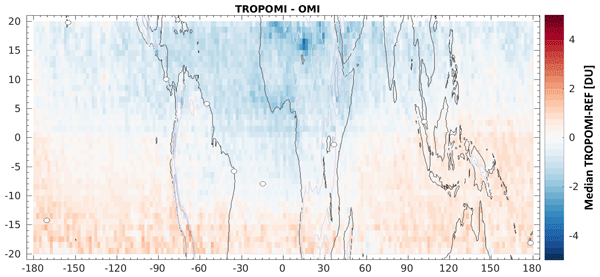
Daan Hubert, Klaus-Peter Heue, Jean-Christopher Lambert, Tijl Verhoelst, Marc Allaart, Steven Compernolle, Patrick D. Cullis, Angelika Dehn, Christian Félix, Bryan J. Johnson, Arno Keppens, Debra E. Kollonige, Christophe Lerot, Diego Loyola, Matakite Maata, Sukarni Mitro, Maznorizan Mohamad, Ankie Piters, Fabian Romahn, Henry B. Selkirk, Francisco R. da Silva, Ryan M. Stauffer, Anne M. Thompson, J. Pepijn Veefkind, Holger Vömel, Jacquelyn C. Witte, and Claus Zehner
Atmos. Meas. Tech., 14, 7405–7433, https://doi.org/10.5194/amt-14-7405-2021, https://doi.org/10.5194/amt-14-7405-2021, 2021
Short summary
Short summary
We assess the first 2 years of TROPOMI tropical tropospheric ozone column data. Comparisons to reference measurements by ozonesonde and satellite sensors show that TROPOMI bias (−0.1 to +2.3 DU) and precision (1.5 to 2.5 DU) meet mission requirements. Potential causes of bias and its spatio-temporal structure are discussed, as well as ways to identify sampling errors. Our analysis of known geophysical patterns demonstrates the improved performance of TROPOMI with respect to its predecessors.
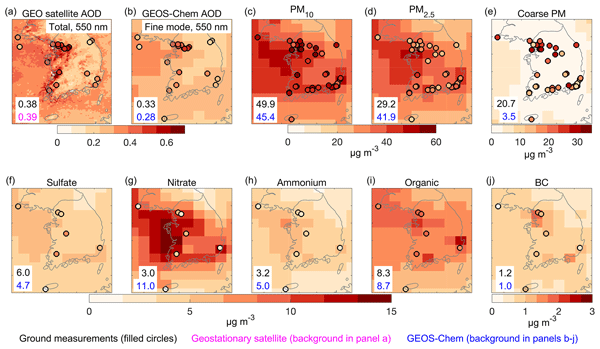
Shixian Zhai, Daniel J. Jacob, Jared F. Brewer, Ke Li, Jonathan M. Moch, Jhoon Kim, Seoyoung Lee, Hyunkwang Lim, Hyun Chul Lee, Su Keun Kuk, Rokjin J. Park, Jaein I. Jeong, Xuan Wang, Pengfei Liu, Gan Luo, Fangqun Yu, Jun Meng, Randall V. Martin, Katherine R. Travis, Johnathan W. Hair, Bruce E. Anderson, Jack E. Dibb, Jose L. Jimenez, Pedro Campuzano-Jost, Benjamin A. Nault, Jung-Hun Woo, Younha Kim, Qiang Zhang, and Hong Liao
Atmos. Chem. Phys., 21, 16775–16791, https://doi.org/10.5194/acp-21-16775-2021, https://doi.org/10.5194/acp-21-16775-2021, 2021
Short summary
Short summary
Geostationary satellite aerosol optical depth (AOD) has tremendous potential for monitoring surface fine particulate matter (PM2.5). Our study explored the physical relationship between AOD and PM2.5 by integrating data from surface networks, aircraft, and satellites with the GEOS-Chem chemical transport model. We quantitatively showed that accurate simulation of aerosol size distributions, boundary layer depths, relative humidity, coarse particles, and diurnal variations in PM2.5 are essential.
Cited articles
Baek, K., Bak, J., Kim, J. H., Park, S. S., Haffner, D. P., and Lee, W.: Validation of geostationary environment monitoring spectrometer (GEMS), TROPOspheric Monitoring Instrument (TROPOMI), and Ozone Mapping and Profiler Suite Nadir Mapper (OMPS) using pandora measurements during GEMS Map of Air Pollution (GMAP) field campaig, Atmos. Environ., 324, 120408, https://doi.org/10.1016/j.atmosenv.2024.120408, 2024.
Bak, J., Liu, X., Wei, J. C., Pan, L. L., Chance, K., and Kim, J. H.: Improvement of OMI ozone profile retrievals in the upper troposphere and lower stratosphere by the use of a tropopause-based ozone profile climatology, Atmos. Meas. Tech., 6, 2239–2254, https://doi.org/10.5194/amt-6-2239-2013, 2013.
Bak, J., Liu, X., Kim, J. H., Chance, K., and Haffner, D. P.: Validation of OMI total ozone retrievals from the SAO ozone profile algorithm and three operational algorithms with Brewer measurements, Atmos. Chem. Phys., 15, 667–683, https://doi.org/10.5194/acp-15-667-2015, 2015.
Bak, J., Liu, X., Kim, J.-H., Haffner, D. P., Chance, K., Yang, K., and Sun, K.: Characterization and correction of OMPS nadir mapper measurements for ozone profile retrievals, Atmos. Meas. Tech., 10, 4373–4388, https://doi.org/10.5194/amt-10-4373-2017, 2017.
Bak, J., Baek, K.-H., Kim, J.-H., Liu, X., Kim, J., and Chance, K.: Cross-evaluation of GEMS tropospheric ozone retrieval performance using OMI data and the use of an ozonesonde dataset over East Asia for validation, Atmos. Meas. Tech., 12, 5201–5215, https://doi.org/10.5194/amt-12-5201-2019, 2019.
Bak, J., Kim, J. H., Nam, H., Baek, K., and Shin, D.: Geostationary Environment Monitoring Spectrometer (GEMS) Algorithm Theoretical Basis Document Ozone Profile Retrieval Algorithm (April 2020), 10–11, https://nesc.nier.go.kr/ko/html/satellite/doc/doc.do (last access: 29 October 2025), 2020.
Bak, J., Liu, X., Spurr, R., Yang, K., Nowlan, C. R., Miller, C. C., Abad, G. G., and Chance, K.: Radiative transfer acceleration based on the principal component analysis and lookup table of corrections: optimization and application to UV ozone profile retrievals, Atmos. Meas. Tech., 14, 2659–2672, https://doi.org/10.5194/amt-14-2659-2021, 2021.
Bak, J., Song, E.-J., Lee, H.-J., Liu, X., Koo, J.-H., Kim, J., Jeon, W., Kim, J.-H., and Kim, C.-H.: Temporal variability of tropospheric ozone and ozone profiles in the Korean Peninsula during the East Asian summer monsoon: insights from multiple measurements and reanalysis datasets, Atmos. Chem. Phys., 22, 14177–14187, https://doi.org/10.5194/acp-22-14177-2022, 2022.
Bak, J., Liu, X., Yang, K., Gonzalez Abad, G., O'Sullivan, E., Chance, K., and Kim, C.-H.: An improved OMI ozone profile research product version 2.0 with collection 4 L1b data and algorithm updates, Atmos. Meas. Tech., 17, 1891–1911, https://doi.org/10.5194/amt-17-1891-2024, 2024.
Bak, J., Liu, X., Abad, G. G., and Yang, K.: An Extension of Ozone Profile Retrievals from TROPOMI Based on the SAO2024 Algorithm, Remote Sens., 17, https://doi.org/10.3390/rs17050779, 2025a.
Bak, J., Yang, K., Keppens, A., Kim, M., Liu, X., Kim, J. H., Kim, J., Ahn, M.-H., Chong, H., Hong, S., Lee, K., Kang, M., Lee, W.-J. and Hong, H.: Geostationary Environment Monitoring Spectrometer (GEMS): Long-term radiometric accuracy and spectral stability from 4.5 years of on-orbit solar irradiance observations, IEEE T. Geosci. Remote, 63, 1–11, https://doi.org/10.1109/TGRS.2025.3627802, 2025b.
Birk, M. and Wagner, G.: ESA SEOM-IAS – Measurement and ACS database O3 UV region, Zenodo, https://doi.org/10.5281/zenodo.1485588, 2018.
Brion, J., Chakir, A., Daumont, D., Malicet, J., and Parisse, C.: High-resolution laboratory absorption cross section of O3. Temperature effect, Chem. Phys. Lett., 213, 610–612, https://doi.org/10.1016/0009-2614(93)89169-I, 1993.
Cai, Z., Liu, Y., Liu, X., Chance, K., Nowlan, C. R., Lang, R., Munro, R., and Suleiman, R.: Characterization and correction of global ozone monitoring experiment 2 ultraviolet measurements and application to ozone profile retrievals, J. Geophys. Res.-Atmos., 117, 1–16, https://doi.org/10.1029/2011JD017096, 2012.
Chance, K. and Kurucz, R. L.: An improved high-resolution solar reference spectrum for earth's atmosphere measurements in the ultraviolet, visible, and near infrared, J. Quant. Spectrosc. Radiat. Transf., 111, 1289–1295, https://doi.org/10.1016/j.jqsrt.2010.01.036, 2010.
Coddington, O. M., Richard, E. C., Harber, D., Pilewskie, P., Woods, T. N., Chance, K., Liu, X., and Sun, K.: The TSIS-1 Hybrid Solar Reference Spectrum, Geophys. Res. Lett., 48, e2020GL091709, https://doi.org/10.1029/2020gl091709, 2021.
Copernicus Sentinel-5P (processed by ESA): TROPOMI Level 2 Ozone Total Column products, Version 02, European Space Agency [data set], https://doi.org/10.5270/S5P-ft13p57, 2020.
Daumont, D., Brion, J., Charbonnier, J., and Malicet, J.: Ozone UV spectroscopy I: Absorption cross-sections at room temperature, J. Atmos. Chem., 15, 145–155, https://doi.org/10.1007/BF00053756, 1992.
Hayashida, S., Liu, X., Ono, A., Yang, K., and Chance, K.: Observation of ozone enhancement in the lower troposphere over East Asia from a space-borne ultraviolet spectrometer, Atmos. Chem. Phys., 15, 9865–9881, https://doi.org/10.5194/acp-15-9865-2015, 2015.
Isaksen, I. S. A., Granier, C., Myhre, G., Berntsen, T. K., Dalsøren, S. B., Gauss, M., Klimont, Z., Benestad, R., Bousquet, P., Collins, W., Cox, T., Eyring, V., Fowler, D., Fuzzi, S., Jöckel, P., Laj, P., Lohmann, U., Maione, M., Monks, P., Prevot, A. S. H., Raes, F., Richter, A., Rognerud, B., Schulz, M., Shindell, D., Stevenson, D. S., Storelvmo, T., Wang, W.-C., van Weele, M., Wild, M., and Wuebbles, D.: Atmospheric composition change: Climate–Chemistry interactions, Atmos. Environ., 43, 5138–5192, https://doi.org/10.1016/j.atmosenv.2009.08.003, 2009.
Jaross, G.: OMPS-NPP L2 NM Ozone (O3) Total Column Swath Orbital V2, Goddard Earth Sciences Data and Information Services Center (GES DISC) [data set], Greenbelt, MD, USA, https://doi.org/10.5067/0WF4HAAZ0VHK, 2017.
Kang, M., Ahn, M. H., Ko, D. H., Kim, J., Nicks, D., Eo, M., Lee, Y., Moon, K. J., and Lee, D. W.: Characteristics of the Spectral Response Function of Geostationary Environment Monitoring Spectrometer Analyzed by Ground and In-Orbit Measurements, IEEE Trans. Geosci. Remote Sens., 60, 1–16, https://doi.org/10.1109/TGRS.2021.3091677, 2022.
Kang, M., Ahn, M.-H., Lee, Y., Ho Ko, D., Eo, M., Kim, J., and Moon, K.-J.: On-Orbit Correction of Bi-Directional Transmittance Distribution Function (BTDF) of Geostationary Environment Monitoring Spectrometer (GEMS), IEEE Trans. Geosci. Remote Sens., 62, 1–15, https://doi.org/10.1109/TGRS.2024.3510337, 2024.
Keppens, A., Lambert, J.-C., Granville, J., Miles, G., Siddans, R., van Peet, J. C. A., van der A, R. J., Hubert, D., Verhoelst, T., Delcloo, A., Godin-Beekmann, S., Kivi, R., Stübi, R., and Zehner, C.: Round-robin evaluation of nadir ozone profile retrievals: methodology and application to MetOp-A GOME-2, Atmos. Meas. Tech., 8, 2093–2120, https://doi.org/10.5194/amt-8-2093-2015, 2015.
Kim, J., Jeong, U., Ahn, M.-H., Kim, J. H., Park, R. J., Lee, H., Song, C. H., Choi, Y.-S., Lee, K.-H., Yoo, J.-M., Jeong, M.-J., Park, S. K., Lee, K.-M., Song, C.-K., Kim, S.-W., Kim, Y. J., Kim, S.-W., Kim, M., Go, S., Liu, X., Chance, K., Miller, C. C., Al-Saadi, J., Veihelmann, B., Bhartia, P. K., Torres, O., Abad, G. G., Haffner, D. P., Ko, D. H., Lee, S. H., Woo, J.-H., Chong, H., Park, S. S., Nicks, D., Choi, W. J., Moon, K.-J., Cho, A., Yoon, J., Kim, S., Hong, H., Lee, K., Lee, H., Lee, S., Choi, M., Veefkind, P., Levelt, P. F., Edwards, D. P., Kang, M., Eo, M., Bak, J., Baek, K., Kwon, H.-A., Yang, J., Park, J., Han, K. M., Kim, B.-R., Shin, H.-W., Choi, H., Lee, E., Chong, J., Cha, Y., Koo, J.-H., Irie, H., Hayashida, S., Kasai, Y., Kanaya, Y., Liu, C., Lin, J., Crawford, J. H., Carmichael, G. R., Newchurch, M. J., Lefer, B. L., Herman, J. R., Swap, R. J., Lau, A. K. H., Kurosu, T. P., Jaross, G., Ahlers, B., Dobber, M., McElroy, C. T., and Choi, Y.: New Era of Air Quality Monitoring from Space: Geostationary Environment Monitoring Spectrometer (GEMS), Bull. Am. Meteorol. Soc., 101, E1–E22, https://doi.org/10.1175/BAMS-D-18-0013.1, 2020.
Kim, J. H., Baek, K., and Lee, H.: Geostationary Environment Monitoring Spectrometer (GEMS) Algorithm Theoretical Basis Document Total Column Ozone Retrieval Algorithm (December 2024), https://nesc.nier.go.kr/ko/html/satellite/doc/doc.do (last access: 29 October 2025), 2024.
Kuang, S., Newchurch, M. J., Johnson, M. S., Wang, L., Burris, J., Pierce, R. B., Eloranta, E. W., Pollack, I. B., Graus, M., de Gouw, J., Warneke, C., Ryerson, T. B., Markovic, M. Z., Holloway, J. S., Pour-Biazar, A., Huang, G., Liu, X., and Feng, N.: Summertime tropospheric ozone enhancement associated with a cold front passage due to stratosphere-to-troposphere transport and biomass burning: Simultaneous ground-based lidar and airborne measurements, J. Geophys. Res.-Atmos., 122, 1293–1311, https://doi.org/10.1002/2016JD026078, 2017.
Lee, K., Lee, D.-W., Chang, L.-S., Yu, J.-A., Lee, W.-J., Kang, K.-H., and Jeong, J.: Pioneering Air Quality Monitoring over East and Southeast Asia with the Geostationary Environment Monitoring Spectrometer (GEMS), Korean J. Remote Sens., 40, 741–752, https://doi.org/10.7780/kjrs.2024.40.5.2.5, 2024.
Liu, X., Chance, K., Sioris, C. E., Spurr, R. J. D., Kurosu, T. P., Martin, R. V., and Newchurch, M. J.: Ozone profile and tropospheric ozone retrievals from the Global Ozone Monitoring Experiment: Algorithm description and validation, J. Geophys. Res., 110, D20307, https://doi.org/10.1029/2005JD006240, 2005.
Liu, X., Bhartia, P. K., Chance, K., Spurr, R. J. D., and Kurosu, T. P.: Ozone profile retrievals from the Ozone Monitoring Instrument, Atmos. Chem. Phys., 10, 2521–2537, https://doi.org/10.5194/acp-10-2521-2010, 2010.
Livesey, N. J., Read, W. G., Wagner, P. A., Froidevaux, L., Santee, M. L., Schwartz, M. J., Lambert, A., Millán Valle, L. F., Pumphrey, H. C., Manney, G. L., Fuller, R. A., Jarnot, R. F., Knosp, B. W., and Lay, R. R.: Version 5.0x Level 2 and 3 data quality and description document, Tech. Rep. JPL D-105336 Rev. B, Jet Propulsion Laboratory, California Institute of Technology, Pasadena, California, 91109-8099, 2022.
Lu, X., Zhang, L., Liu, X., Gao, M., Zhao, Y., and Shao, J.: Lower tropospheric ozone over India and its linkage to the South Asian monsoon, Atmos. Chem. Phys., 18, 3101–3118, https://doi.org/10.5194/acp-18-3101-2018, 2018.
Malicet, J., Daumont, D., Charbonnier, J., Parisse, C., Chakir, A., and Brion, J.: Ozone UV spectroscopy. II. Absorption cross-sections and temperature dependence, J. Atmos. Chem., 21, 263–273, https://doi.org/10.1007/BF00696758, 1995.
McPeters, R. D. and Labow, G. J.: Climatology 2011: An MLS and sonde derived ozone climatology for satellite retrieval algorithms, J. Geophys. Res.-Atmos., 117, https://doi.org/10.1029/2011JD017006, 2012.
Monks, P. S., Archibald, A. T., Colette, A., Cooper, O., Coyle, M., Derwent, R., Fowler, D., Granier, C., Law, K. S., Mills, G. E., Stevenson, D. S., Tarasova, O., Thouret, V., von Schneidemesser, E., Sommariva, R., Wild, O., and Williams, M. L.: Tropospheric ozone and its precursors from the urban to the global scale from air quality to short-lived climate forcer, Atmos. Chem. Phys., 15, 8889–8973, https://doi.org/10.5194/acp-15-8889-2015, 2015.
NASA: Draft Planning Document for ASIA-AQ, https://espo.nasa.gov/sites/default/files/documents/Draft%20Planning%20Document%20for%20ASIA-AQ_20230720.pdf (last access: 20 August 2025), 2023.
National Institute of Environmental Research (NIER): GEMS data, Environmental Satellite Center [data set], https://nesc.nier.go.kr/en/html/datasvc/index.do, last access: 20 August 2025.
Park, J. and Cede, A.: Pandora total ozone column data at Seosan (P164s1), Institute of Atmospheric Environment, Chungcheong Province, Republic of Korea, https://doi.org/10.48596/pgn.rout2p1-8.Seosan.P164s1, 2025.
Rodgers, C. D.: Inverse Methods for Atmospheric Sounding: Theory and Practice, World Scientific Publishing, Singapore, ISBN 981022740X, 9789810227401, 2000.
Solomon, S.: Stratospheric ozone depletion: A review of concepts and history, Rev. Geophys., 37, 275–316, https://doi.org/10.1029/1999RG900008, 1999.
Van Dingenen, R., Dentener, F. J., Raes, F., Krol, M. C., Emberson, L., and Cofala, J.: The global impact of ozone on agricultural crop yields under current and future air quality legislation, Atmos. Environ., 43, 604–618, https://doi.org/10.1016/j.atmosenv.2008.10.033, 2009.
Zhao, F., Liu, C., Cai, Z., Liu, X., Bak, J., Kim, J., Hu, Q., Xia, C., Zhang, C., Sun, Y., Wang, W., and Liu, J.: Ozone profile retrievals from TROPOMI: Implication for the variation of tropospheric ozone during the outbreak of COVID-19 in China, Sci. Total Environ., 764, 142886, https://doi.org/10.1016/j.scitotenv.2020.142886, 2021.
Short summary
This study presents the first complete description of the operational version 3 ozone profile retrieval algorithm for the Geostationary Environment Monitoring Spectrometer (GEMS) and its performance characteristics. Improvements in radiometric and wavelength calibration reduce spectral fitting uncertainties and enhance agreement with ozonesonde profiles and Pandora total ozone measurements.
This study presents the first complete description of the operational version 3 ozone profile...


