Articles | Volume 19, issue 13
https://doi.org/10.5194/amt-19-4617-2026
Research article
 | 
16 Jul 2026
Research article |  | 16 Jul 2026

TANGO CO2 and NO2 observations: synergistic usage to improve emission quantification and characterize atmospheric chemistry

Tobias Borsdorff, Maarten Krol, Pepijn Veefkind, and Jochen Landgraf

Related authors

A multi-year global methane data set obtained by merging observations from TROPOMI and IASI
Kanwal Shahzadi, Matthias Schneider, Nga Ying Lo, Frank Hase, Jörg Meyer, Ugur Cayoglu, Tobias Borsdorff, and Mari C. Martinez-Velarte
Earth Syst. Sci. Data, 18, 2153–2177, https://doi.org/10.5194/essd-18-2153-2026,https://doi.org/10.5194/essd-18-2153-2026, 2026
Short summary
Impact of Sentinel-5 SWIR Detector Persistence on Trace Gas Retrievals
Mari C. Martinez-Velarte, Jochen Landgraf, Ben Veihelmann, Bernd Sierk, and Tobias Borsdorff
EGUsphere, https://doi.org/10.5194/egusphere-2025-6328,https://doi.org/10.5194/egusphere-2025-6328, 2026
Short summary
Five years of GOSAT-2 retrievals with RemoTeC: XCO2 and XCH4 data products with quality filtering by machine learning
Andrew Gerald Barr, Jochen Landgraf, Mari Martinez-Velarte, Mihalis Vrekoussis, Ralf Sussmann, Isamu Morino, Kimberly Strong, Minqiang Zhou, Voltaire A. Velazco, Hirofumi Ohyama, Thorsten Warneke, Frank Hase, and Tobias Borsdorff
Atmos. Meas. Tech., 18, 6093–6123, https://doi.org/10.5194/amt-18-6093-2025,https://doi.org/10.5194/amt-18-6093-2025, 2025
Short summary
Can we obtain consistent estimates of the emissions in Europe from three different CH4 TROPOMI products?
Aurélien Sicsik-Paré, Audrey Fortems-Cheiney, Isabelle Pison, Grégoire Broquet, Alvin Opler, Elise Potier, Adrien Martinez, Oliver Schneising, Michael Buchwitz, Joannes D. Maasakkers, Tobias Borsdorff, and Antoine Berchet
EGUsphere, https://doi.org/10.5194/egusphere-2025-2622,https://doi.org/10.5194/egusphere-2025-2622, 2025
Short summary
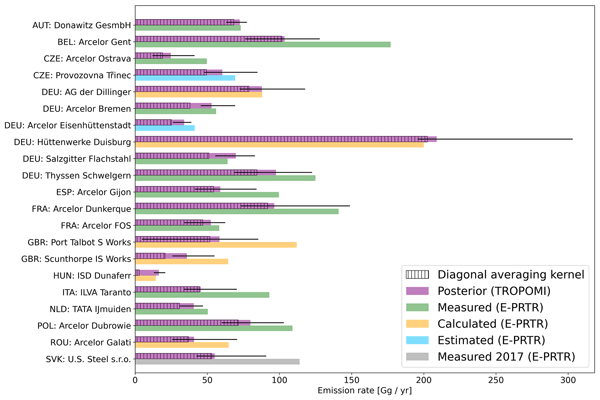
Comparing space-based to reported carbon monoxide emission estimates for Europe's iron and steel plants
Gijs Leguijt, Joannes D. Maasakkers, Hugo A. C. Denier van der Gon, Arjo J. Segers, Tobias Borsdorff, Ivar R. van der Velde, and Ilse Aben
Atmos. Chem. Phys., 25, 555–574, https://doi.org/10.5194/acp-25-555-2025,https://doi.org/10.5194/acp-25-555-2025, 2025
Short summary

Cited articles

Beirle, S., Borger, C., Dörner, S., Li, A., Hu, Z., Liu, F., Wang, Y., and Wagner, T.: Pinpointing nitrogen oxide emissions from space, Sci. Adv., 5, eaax9800, https://doi.org/10.1126/sciadv.aax9800, 2019. a
Borger, C., Beirle, S., Butz, A., Scheidweiler, L. O., and Wagner, T.: High-resolution observations of NO2 and CO2 emission plumes from EnMAP satellite measurements, Environ. Res. Lett., 20, 044034, https://doi.org/10.1088/1748-9326/adc0b1, 2025. a, b, c, d, e, f, g, h, i, j, k
Borsdorff, T., Hasekamp, O. P., Wassmann, A., and Landgraf, J.: Insights into Tikhonov regularization: application to trace gas column retrieval and the efficient calculation of total column averaging kernels, Atmos. Meas. Tech., 7, 523–535, https://doi.org/10.5194/amt-7-523-2014, 2014. a
Borsdorff, T., Krol, M., Veefkind, P., and Landgraf, J.: microHH large-eddy simulation data of reactive CO2 and NO2 plumes from an idealized industrial point source for four emission strengths (1.0), Zenodo [data set], https://doi.org/10.5281/zenodo.20624504, 2026. a
Brenny, B., Day, J., de Goeij, B., Palombo, E., Ouwerkerk, B., Koc, N. A., Bell, A., Leemhuis, A., Paskeviciute, A., Buisset, C., and Malavart, A.: Development of spectrometers for the TANGO greenhouse gas monitoring missions, in: International Conference on Space Optics – ICSO 2022, edited by: Minoglou, K., Karafolas, N., and Cugny, B., International Society for Optics and Photonics, SPIE, 12777, 127771S, https://doi.org/10.1117/12.2689936, 2023. a
Download
Short summary
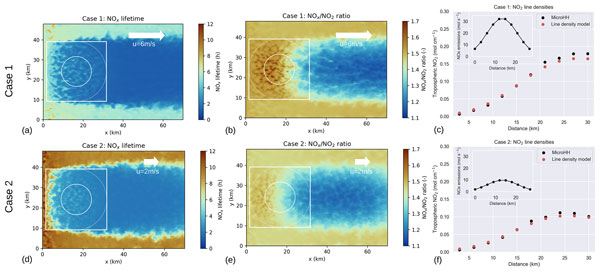
Industrial facilities release carbon dioxide and nitrogen dioxide. The Twin Anthropogenic Greenhouse Gas Observers (TANGO) mission, launching in 2028, will monitor both gases from ten thousand facilities per year using two satellites. We studied whether combining both improves carbon dioxide emission estimates and reveals plume chemistry. While this produces cleaner carbon dioxide images, precision does not improve as noise is redistributed not eliminated. Their ratio captures how nitrogen oxide converts to nitrogen dioxide within plumes.
Share