
Articles | Volume 19, issue 7
https://doi.org/10.5194/amt-19-2601-2026
© Author(s) 2026. This work is distributed under
the Creative Commons Attribution 4.0 License.
the Creative Commons Attribution 4.0 License.
https://doi.org/10.5194/amt-19-2601-2026
© Author(s) 2026. This work is distributed under
the Creative Commons Attribution 4.0 License.
the Creative Commons Attribution 4.0 License.
Research article
| 
17 Apr 2026
Research article |
| 17 Apr 2026
| 17 Apr 2026
On the capability of the Changing Atmosphere Infra-Red Tomography explorer (CAIRT) candidate mission to constrain O3 and H2O in the upper troposphere and lower stratosphere
Quentin Errera
CORRESPONDING AUTHOR

Royal Belgian Institute for Space Aeronomy (BIRA-IASB), Brussels, Belgium
Marc Op de beeck
Royal Belgian Institute for Space Aeronomy (BIRA-IASB), Brussels, Belgium
Stefan Bender
Instituto de Astrofísica de Andalucía (CSIC), Granada, Spain
Johannes Flemming
Research Department, European Centre for Medium-Range Weather Forecasts, Reading, UK
Bernd Funke
Instituto de Astrofísica de Andalucía (CSIC), Granada, Spain
Alex Hoffmann
European Space Research and Technology Centre, European Space Agency (ESA/ESTEC), Noordwijk, the Netherlands
Michael Höpfner
Institute of Meteorology and Climate Research – Atmospheric Trace Gases and Remote Sensing (IMKASF), Karlsruhe Institute of Technology (KIT), Karlsruhe, Germany
Nathaniel Livesey
Jet Propulsion Laboratory, California Institute of Technology, Pasadena, California, USA
Gabriele Poli
Instituto di Fisica Applicata “N. Carrara” (IFAC) del Consiglio Nazionale delle Ricerche (CNR), Firenze, Italy
Didier Pieroux
Royal Belgian Institute for Space Aeronomy (BIRA-IASB), Brussels, Belgium
Piera Raspollini
Instituto di Fisica Applicata “N. Carrara” (IFAC) del Consiglio Nazionale delle Ricerche (CNR), Firenze, Italy
Björn-Martin Sinnhuber
Institute of Meteorology and Climate Research – Atmospheric Trace Gases and Remote Sensing (IMKASF), Karlsruhe Institute of Technology (KIT), Karlsruhe, Germany
Related authors
Pasquale Sellitto, Mona Kosary, Michael Höpfner, Bernd Funke, Alex Hoffmann, Jörn Ungermann, Quentin Errera, Simone Tilmes, and Björn-Martin Sinnhuber
Atmos. Meas. Tech., 19, 6379–6393, https://doi.org/10.5194/amt-19-6379-2026, https://doi.org/10.5194/amt-19-6379-2026, 2026
Short summary
Short summary
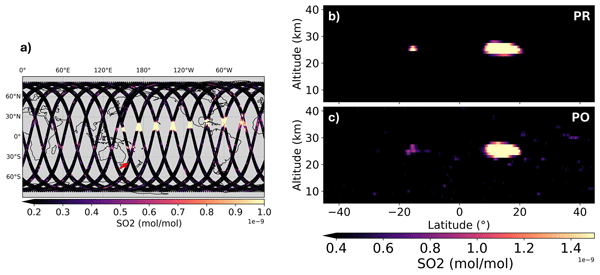
To counterbalance human-caused global warming, highly controversial geoengineering techniques, based on stratospheric aerosol injection (SAI), have been proposed as a complement to climate change mitigation. Possible unilateral SAI deployments or tests are a risk. We show that existing satellite instruments do not have the capability to detect unilateral SAI experiments and we propose a future satellite technique, infrared limb emission sounding, that can provide this missing capability.
Bernd Funke, Michael Höpfner, Stefan Bender, Quentin Errera, Udo Grabowski, Alex Hoffmann, Han-Li Liu, Nick M. Pedatella, Piera Raspollini, Jörn Ungermann, and Björn-Martin Sinnhuber
EGUsphere, https://doi.org/10.5194/egusphere-2026-3881, https://doi.org/10.5194/egusphere-2026-3881, 2026
This preprint is open for discussion and under review for Atmospheric Measurement Techniques (AMT).
Short summary
Short summary
We introduce two performance modeling tools, the Linear Performance Estimator (LPE) and the Fast L2 Simulator (FL2S), developed for CAIRT, a proposed ESA Earth Explorer mission. CAIRT aims to observe the middle atmosphere using an Imaging Fourier Transform Spectrometer. LPE quantifies spatial resolution and tomographic retrieval uncertainties, while FL2S generates synthetic data products that mimic the retrieval chain. Together, they demonstrate CAIRT's ability to meet scientific requirements.
Mona Kosary, Pasquale Sellitto, Michael Höpfner, Bernd Funke, Alex Hoffmann, Jörn Ungermann, Quentin Errera, Simone Tilmes, and Björn-Martin Sinnhuber
EGUsphere, https://doi.org/10.5194/egusphere-2026-4654, https://doi.org/10.5194/egusphere-2026-4654, 2026
Short summary
Short summary
We investigated whether future satellites could track changes in the ozone layer if reflective particles were deliberately added high in the atmosphere to cool the planet. Using climate model simulations, we created virtual satellite measurements and compared them with the original data. The method captured the key changes, especially stronger ozone loss and delayed recovery over Antarctica, while showing low artificial distortion. This suggests such satellites could provide important oversight.
Daniele Minganti, Simon Chabrillat, Sean Davis, Quentin Errera, Marc Op de beeck, Eric Ray, Sarah Vervalcke, Krzysztof Wargan, and Catherine Wespes
EGUsphere, https://doi.org/10.5194/egusphere-2026-3449, https://doi.org/10.5194/egusphere-2026-3449, 2026
Short summary
Short summary
In early 2019, an unusual increase of nitrous oxide concentrations occurred in the northern lower stratosphere (around 20 km). We show that unprecedented circulation pattern rapidly moved nitrous oxide from the tropical region to the northern mid-latitudes. This work reveals how stratospheric mid-latitudes can respond to special wind conditions in the Tropics and subtropics. Such extreme event helps improving our understanding of future changes of stratospheric transport in a warming climate.
Caroline Jonas, Corinne Vigouroux, Bavo Langerock, Robin Björklund, Anne Boynard, Thomas Carlund, Martine De Mazière, Peter Effertz, Quentin Errera, Matthias M. Frey, José Granville, James W. Hannigan, Arno Keppens, Nis Jepsen, Rigel Kivi, Norrie Lyall, Mathias Palm, Maxime Prignon, Viktoria F. Sofieva, Kimberly Strong, Tove Svendby, David Tarasick, Laura Thölix, Roeland Van Malderen, Yana Virolainen, Sibylle von Löwis, and Xiaoyi Zhao
Atmos. Chem. Phys., 26, 8089–8124, https://doi.org/10.5194/acp-26-8089-2026, https://doi.org/10.5194/acp-26-8089-2026, 2026
Short summary
Short summary
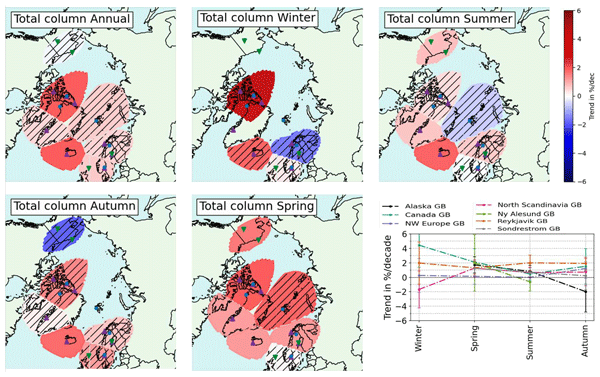
We study the evolution of ozone in the Arctic over the 2000–2024 period in the stratosphere (about 10 to 50 km) to assess the expected recovery of the ozone layer following the diminution of ozone-depleting substances. We merge ground-based data sets within spatially coherent regions to reduce uncertainties and we obtain positive trends for the total column everywhere in the Arctic and for the middle and upper stratosphere over Canada, but no significant trends in the lower stratosphere.
Sarah Vervalcke, Quentin Errera, Roland Eichinger, Thomas Reddmann, Simon Chabrillat, Marc Op de beeck, Gabriele Stiller, and Emmanuel Mahieu
Atmos. Chem. Phys., 26, 391–409, https://doi.org/10.5194/acp-26-391-2026, https://doi.org/10.5194/acp-26-391-2026, 2026
Short summary
Short summary
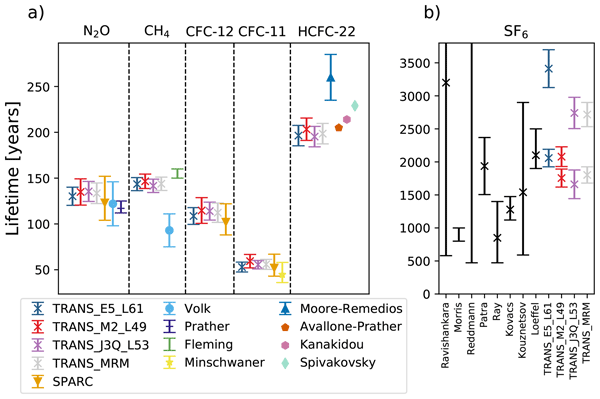
This study presents three simulations of atmospheric chemistry with the Belgian Assimilation System for Chemical Observations chemistry transport model, driven by different meteorological data sets. Newly implemented SF6 chemistry enables stratospheric transport studies. Results agree with satellite observations. The derived lifetimes of six trace gases agree with the literature, but SF6 shows larger sensitivity to the choice of meteorology. The lifetime of SF6 ranges from 1900 to 2600 years.
Simon Chabrillat, Samuel Rémy, Quentin Errera, Vincent Huijnen, Christine Bingen, Jonas Debosscher, François Hendrick, Swen Metzger, Adrien Mora, Daniele Minganti, Marc Op de beek, Léa Reisenfeld, Jason E. Williams, Henk Eskes, and Johannes Flemming
Geosci. Model Dev., 18, 8973–9014, https://doi.org/10.5194/gmd-18-8973-2025, https://doi.org/10.5194/gmd-18-8973-2025, 2025
Short summary
Short summary
We document the forecasts of the composition of the stratosphere by the Copernicus Atmosphere Monitoring Service. The model's predictions are compared with satellite measurements over a recent period, during polar ozone depletion events, and after the Mount Pinatubo volcanic eruption. The system performs well for sulfate aerosols, ozone and several other key gases but not as well for several nitrogen-containing gases. Chemical processes in aerosols and polar clouds should be improved.
Eric Sauvageat, Klemens Hocke, Eliane Maillard Barras, Shengyi Hou, Quentin Errera, Alexander Haefele, and Axel Murk
Atmos. Chem. Phys., 23, 7321–7345, https://doi.org/10.5194/acp-23-7321-2023, https://doi.org/10.5194/acp-23-7321-2023, 2023
Short summary
Short summary
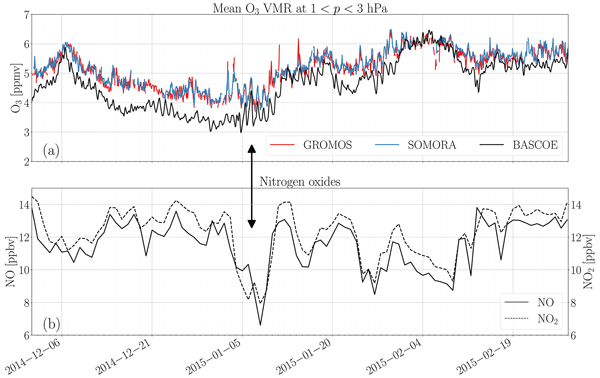
In Switzerland, two microwave radiometers can measure continuous ozone profiles in the middle atmosphere. From these instruments, we can study the diurnal variation of ozone, which is difficult to observe otherwise. It is valuable to validate the model simulations of diurnal variations in this region. We present results obtained during the last decade and compare them against various models. For the first time, we also show that the winter diurnal variations have some short-term fluctuations.
Klaus-Peter Heue, Diego Loyola, Fabian Romahn, Walter Zimmer, Simon Chabrillat, Quentin Errera, Jerry Ziemke, and Natalya Kramarova
Atmos. Meas. Tech., 15, 5563–5579, https://doi.org/10.5194/amt-15-5563-2022, https://doi.org/10.5194/amt-15-5563-2022, 2022
Short summary
Short summary
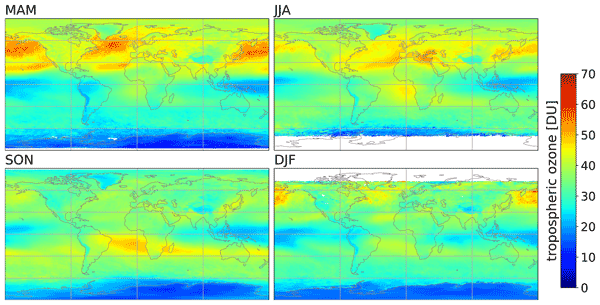
To retrieve tropospheric ozone column information, we subtract stratospheric column data of BASCOE from TROPOMI/S5P total ozone columns.
The new S5P-BASCOE data agree well with existing tropospheric data like OMPS-MERRA-2. The data are also compared to ozone soundings.
The tropospheric ozone columns show the expected temporal and spatial patterns. We will also apply the algorithm to future UV nadir missions like Sentinel 4 or 5 or to recent and ongoing missions like GOME_2 or OMI.
Vincent Huijnen, Philippe Le Sager, Marcus O. Köhler, Glenn Carver, Samuel Rémy, Johannes Flemming, Simon Chabrillat, Quentin Errera, and Twan van Noije
Geosci. Model Dev., 15, 6221–6241, https://doi.org/10.5194/gmd-15-6221-2022, https://doi.org/10.5194/gmd-15-6221-2022, 2022
Short summary
Short summary
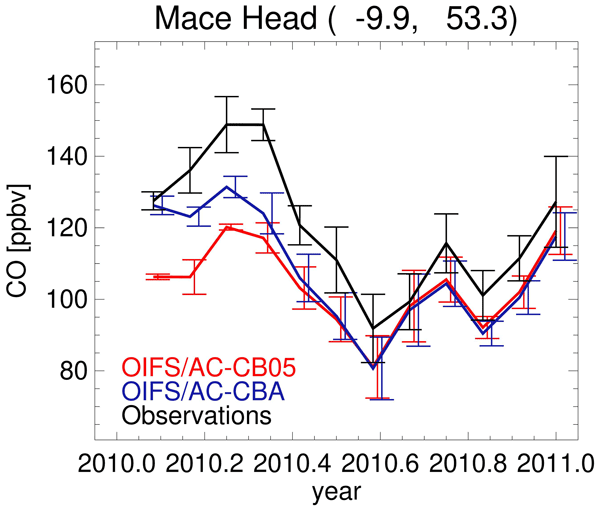
We report on the first implementation of atmospheric chemistry and aerosol as part of the OpenIFS model, based on the CAMS global model. We give an overview of the model and evaluate two reference model configurations, with and without the stratospheric chemistry extension, against a variety of observational datasets. This OpenIFS version with atmospheric composition components is open to the scientific user community under a standard OpenIFS license.

Alexandra Laeng, Thomas von Clarmann, Quentin Errera, Udo Grabowski, and Shawn Honomichl
Atmos. Meas. Tech., 15, 2407–2416, https://doi.org/10.5194/amt-15-2407-2022, https://doi.org/10.5194/amt-15-2407-2022, 2022
Short summary
Short summary
In validation exercises, a universal excuse used to explain the residual discrepancy between the data is the natural atmospheric variability due to imperfect co-locations. This work is the first attempt to quantify this atmospheric variability for a large sample of atmospheric constituents and to provide the user with a tool to substract the natural atmospheric variability portion from the residual variability.
Stefanie Falk, Hans-Werner Jacobi, Hugo El-Mansi, Patrick Ginot, and Björn-Martin Sinnhuber
EGUsphere, https://doi.org/10.5194/egusphere-2026-5627, https://doi.org/10.5194/egusphere-2026-5627, 2026
This preprint is open for discussion and under review for Atmospheric Chemistry and Physics (ACP).
Short summary
Short summary
Atmospheric bromine deposition may provide a seasonal bromide reservoir for Arctic bromine explosion events. Combining chemistry-climate model simulations, snow observations from Ny-Ålesund, and the developed snow model, we show that deposited atmospheric bromine can accumulate in snow at levels sufficient to sustain observed bromine monoxide vertical column density. The agreement between modeled and observation highlights the roles of bromine speciation, snowpack processes, and sampling biases.
Pasquale Sellitto, Mona Kosary, Michael Höpfner, Bernd Funke, Alex Hoffmann, Jörn Ungermann, Quentin Errera, Simone Tilmes, and Björn-Martin Sinnhuber
Atmos. Meas. Tech., 19, 6379–6393, https://doi.org/10.5194/amt-19-6379-2026, https://doi.org/10.5194/amt-19-6379-2026, 2026
Short summary
Short summary
To counterbalance human-caused global warming, highly controversial geoengineering techniques, based on stratospheric aerosol injection (SAI), have been proposed as a complement to climate change mitigation. Possible unilateral SAI deployments or tests are a risk. We show that existing satellite instruments do not have the capability to detect unilateral SAI experiments and we propose a future satellite technique, infrared limb emission sounding, that can provide this missing capability.
Bernd Funke, Michael Höpfner, Stefan Bender, Quentin Errera, Udo Grabowski, Alex Hoffmann, Han-Li Liu, Nick M. Pedatella, Piera Raspollini, Jörn Ungermann, and Björn-Martin Sinnhuber
EGUsphere, https://doi.org/10.5194/egusphere-2026-3881, https://doi.org/10.5194/egusphere-2026-3881, 2026
This preprint is open for discussion and under review for Atmospheric Measurement Techniques (AMT).
Short summary
Short summary
We introduce two performance modeling tools, the Linear Performance Estimator (LPE) and the Fast L2 Simulator (FL2S), developed for CAIRT, a proposed ESA Earth Explorer mission. CAIRT aims to observe the middle atmosphere using an Imaging Fourier Transform Spectrometer. LPE quantifies spatial resolution and tomographic retrieval uncertainties, while FL2S generates synthetic data products that mimic the retrieval chain. Together, they demonstrate CAIRT's ability to meet scientific requirements.
Glenn-Michael Oomen, Jean-François Müller, Trissevgeni Stavrakou, Isabelle De Smedt, Vincent Huijnen, Flora Kluge, Antje Inness, and Johannes Flemming
Geosci. Model Dev., 19, 8959–8975, https://doi.org/10.5194/gmd-19-8959-2026, https://doi.org/10.5194/gmd-19-8959-2026, 2026
Short summary
Short summary
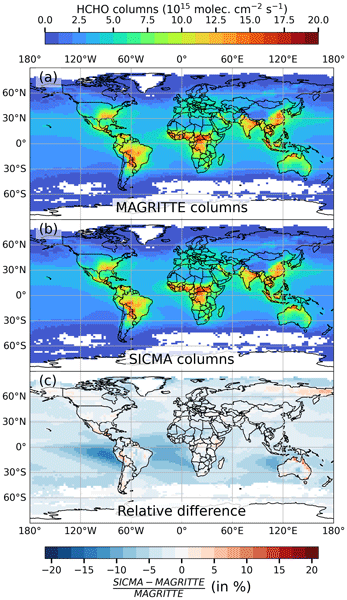
We developed a strongly simplified mechanism for isoprene oxidation that reduces the computational cost of atmospheric chemistry while retaining the key processes controlling formaldehyde formation. Its parameters were optimized using box-model simulations, and the mechanism reproduces the full chemistry well in global simulations. It also gives similar isoprene emissions when constrained by satellite formaldehyde observations, enabling faster large-scale simulations and emission inversions.
Mona Kosary, Pasquale Sellitto, Michael Höpfner, Bernd Funke, Alex Hoffmann, Jörn Ungermann, Quentin Errera, Simone Tilmes, and Björn-Martin Sinnhuber
EGUsphere, https://doi.org/10.5194/egusphere-2026-4654, https://doi.org/10.5194/egusphere-2026-4654, 2026
Short summary
Short summary
We investigated whether future satellites could track changes in the ozone layer if reflective particles were deliberately added high in the atmosphere to cool the planet. Using climate model simulations, we created virtual satellite measurements and compared them with the original data. The method captured the key changes, especially stronger ozone loss and delayed recovery over Antarctica, while showing low artificial distortion. This suggests such satellites could provide important oversight.
Laura N. Saunders, Kaley A. Walker, Gabriele P. Stiller, Piera Raspollini, Luis F. Millán, Marco Gai, Chris D. Boone, John Gille, Norbert Glatthor, Armin Kleinboehl, Anne Kleinert, Alyn Lambert, Donal Murtaugh, Patrick E. Sheese, Geoffrey C. Toon, and Gerald Wetzel
EGUsphere, https://doi.org/10.5194/egusphere-2026-4651, https://doi.org/10.5194/egusphere-2026-4651, 2026
Short summary
Short summary
We present a comprehensive evaluation of nitrous oxide (N2O) measurements taken during the 2002–2024 period from five limb-viewing satellite instruments: ACE-FTS, HIRDLS, MIPAS, Aura-MLS, and SMR. Coincident measurements are compared between satellite instruments and with independent reference data from balloon-borne instruments. We show that ACE-FTS, MIPAS, and SMR constitute an excellent 23-year record of N2O measurements that could be used to create an ESA-funded merged dataset in future.
Wolfgang Woiwode, Bärbel Vogel, Valentin Lauther, Jens-Uwe Grooß, Jeremy Harrison, Sören Johansson, Jörn Ungermann, Peter Braesicke, Markus Dick, Andreas Engel, Felix Friedl-Vallon, Norbert Glatthor, Thomas Gulde, Michael Höpfner, Markus Jesswein, Jan Kaumanns, Timo Keber, Anne Kleinert, Erik Kretschmer, Guido Maucher, Tom Neubert, Hans Nordmeyer, Christof Piesch, Felix Plöger, Peter Preusse, Markus Retzlaff, Sebastian Rhode, Heinz Rongen, Georg Schardt, Tanja Schuck, Björn-Martin Sinnhuber, Johannes Strobel, Franziska Trinkl, Ronja Van Luijt, Stefan Versick, C. Michael Volk, Gerald Wetzel, Peter Hoor, and Martin Riese
EGUsphere, https://doi.org/10.5194/egusphere-2026-3271, https://doi.org/10.5194/egusphere-2026-3271, 2026
This preprint is open for discussion and under review for Atmospheric Chemistry and Physics (ACP).
Short summary
Short summary
Filaments of CH2Cl2-rich air are revealed by airborne infrared limb-imaging observations in late summer 2023 above the North Pacific, Canada and Alaska and traced back to the Asian Summer Monsoon region. Involving new spectroscopic data, high CH2Cl2 levels were retrieved in the troposphere and moderate enhancements also in air masses with characteristics of the lowermost stratosphere. Mesoscale filaments are shown to transport substantial amounts of CH2Cl2 across the North Pacific.
Gabriele P. Stiller, Thomas von Clarmann, Stefan Bender, Bernd Funke, Maya García-Comas, Norbert Glatthor, Udo Grabowski, Sylvia Kellmann, Michael Kiefer, Alexandra Laeng, Andrea Linden, and Manuel López-Puertas
EGUsphere, https://doi.org/10.5194/egusphere-2026-4116, https://doi.org/10.5194/egusphere-2026-4116, 2026
Short summary
Short summary
We present the global distributions of the trace gases HNO3, ClONO2, HNO4, N2O5, and NOy, the total reactive nitrogen (constructed from [HNO3] + [ClONO2] + [HNO4] + 2x[N2O5] + [NO] + [NO2]), all derived from the latest spectral version, V8.03, of MIPAS/Envisat spectra. The data set covers the period of July 2002 to April 2012, with global day and night coverage from 6 to 60 km altitude. An additional data product, made for immediate comparison to atmospheric model simulations, is also presented.
Daniele Minganti, Simon Chabrillat, Sean Davis, Quentin Errera, Marc Op de beeck, Eric Ray, Sarah Vervalcke, Krzysztof Wargan, and Catherine Wespes
EGUsphere, https://doi.org/10.5194/egusphere-2026-3449, https://doi.org/10.5194/egusphere-2026-3449, 2026
Short summary
Short summary
In early 2019, an unusual increase of nitrous oxide concentrations occurred in the northern lower stratosphere (around 20 km). We show that unprecedented circulation pattern rapidly moved nitrous oxide from the tropical region to the northern mid-latitudes. This work reveals how stratospheric mid-latitudes can respond to special wind conditions in the Tropics and subtropics. Such extreme event helps improving our understanding of future changes of stratospheric transport in a warming climate.
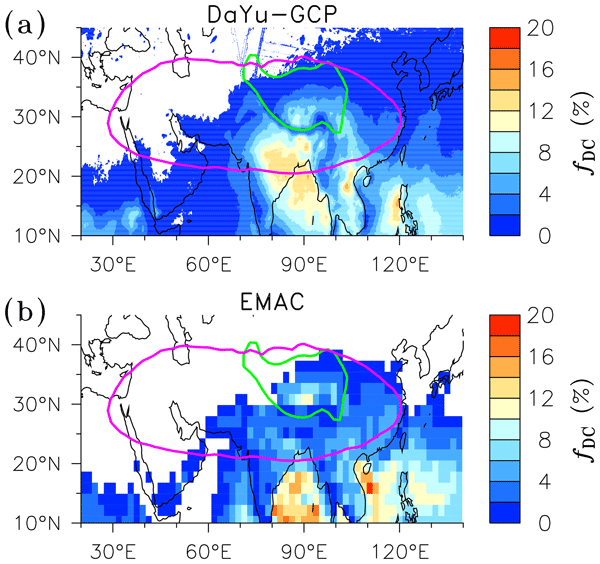
Jianzhong Ma, Bin Chen, Qianshan He, Xiaolu Yan, Gaili Wang, Siyang Cheng, Benedikt Steil, Christoph Brühl, Holger Tost, Michael Höpfner, Andrea Pozzer, and Jos Lelieveld
Atmos. Chem. Phys., 26, 8125–8144, https://doi.org/10.5194/acp-26-8125-2026, https://doi.org/10.5194/acp-26-8125-2026, 2026
Short summary
Short summary
We use a global atmospheric chemistry and climate model to study the efficiency and effectiveness of the deep convective transport of CO, NH3 and SO2 from the planetary boundary layer into the Asian summer monsoon anticyclone. We find that in contrast to CO and NH3, the SO2 enhancements within the anticyclone are very weak. The wet scavenging over South Asia is more effective for SO2 than NH3 at reducing their amounts reaching the Tibetan Plateau and the Asian summer monsoon anticyclone.
Caroline Jonas, Corinne Vigouroux, Bavo Langerock, Robin Björklund, Anne Boynard, Thomas Carlund, Martine De Mazière, Peter Effertz, Quentin Errera, Matthias M. Frey, José Granville, James W. Hannigan, Arno Keppens, Nis Jepsen, Rigel Kivi, Norrie Lyall, Mathias Palm, Maxime Prignon, Viktoria F. Sofieva, Kimberly Strong, Tove Svendby, David Tarasick, Laura Thölix, Roeland Van Malderen, Yana Virolainen, Sibylle von Löwis, and Xiaoyi Zhao
Atmos. Chem. Phys., 26, 8089–8124, https://doi.org/10.5194/acp-26-8089-2026, https://doi.org/10.5194/acp-26-8089-2026, 2026
Short summary
Short summary
We study the evolution of ozone in the Arctic over the 2000–2024 period in the stratosphere (about 10 to 50 km) to assess the expected recovery of the ozone layer following the diminution of ozone-depleting substances. We merge ground-based data sets within spatially coherent regions to reduce uncertainties and we obtain positive trends for the total column everywhere in the Arctic and for the middle and upper stratosphere over Canada, but no significant trends in the lower stratosphere.
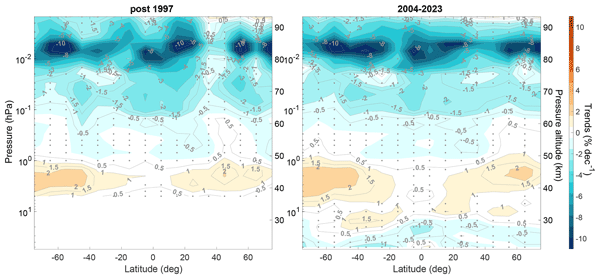
Monika E. Szelag, Viktoria F. Sofieva, Edward Malina, Pekka T. Verronen, Michelle L. Santee, Manuel López-Puertas, Bernd Funke, Gabriele Stiller, Alexandra Laeng, Kaley A. Walker, Patrick E. Sheese, Mark E. Hervig, and Benjamin T. Marshall
Atmos. Chem. Phys., 26, 7503–7522, https://doi.org/10.5194/acp-26-7503-2026, https://doi.org/10.5194/acp-26-7503-2026, 2026
Short summary
Short summary
We present a new global dataset of ozone profiles in the mesosphere and lower thermosphere, created by combining several satellite measurements covering more than three decades. Our results show that ozone is recovering in the stratosphere but decreasing in the mesosphere, with the strongest declines near the mesopause. This dataset provides a valuable resource for investigating long-term changes, improving model performance, and addressing an observational gap in the upper atmosphere.
Björn-Martin Sinnhuber
EGUsphere, https://doi.org/10.5194/egusphere-2026-2561, https://doi.org/10.5194/egusphere-2026-2561, 2026
Short summary
Short summary
Between 1937 and 1940, the Soviet ice breaker G. Sedov completed its unwilful drift across the Arctic ocean, following the transpolar drift of Nansen’s Fram expedition 44 years before. A new analysis of these historical expeditions reveals that the transpolar sea ice drift speed has already increased during the early 20th century Arctic warming period. The findings of a strong control of Arctic temperatures on sea ice drift may also help us to better understand today’s Arctic climate change.
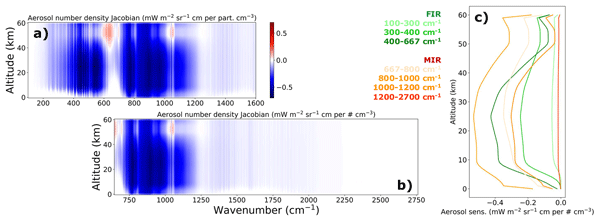
Pasquale Sellitto, Maxim Eremenko, Paola Formenti, Perla Alalam, Michael Höpfner, and Claudia Di Biagio
Atmos. Meas. Tech., 19, 2751–2762, https://doi.org/10.5194/amt-19-2751-2026, https://doi.org/10.5194/amt-19-2751-2026, 2026
Short summary
Short summary
The Far-infrared Outgoing Radiation Understanding and Monitoring (FORUM) mission will bring the first satellite instrument capable of observing the Earth's far infrared (FIR) spectra with a high spectral resolution. FORUM will crucially contribute to water vapour, clouds and surface observations. We found that FORUM will provide also a significant sensitivity to dust aerosol, especially in cases of large burdens of mid-to-long-range transported plumes of dust in the free and upper troposphere.
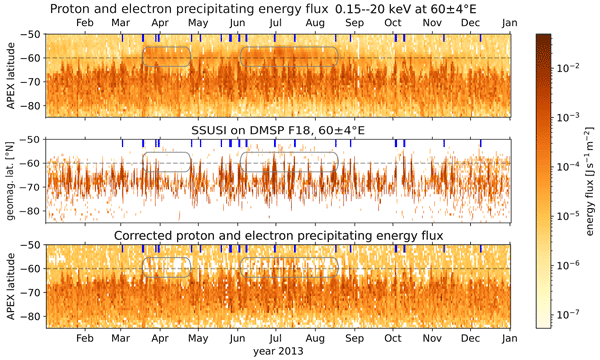
Jan Maik Wissing, Olesya Yakovchuk, Stefan Bender, and Christina Arras
Ann. Geophys., 44, 263–285, https://doi.org/10.5194/angeo-44-263-2026, https://doi.org/10.5194/angeo-44-263-2026, 2026
Short summary
Short summary
We investigate the subauroral flux maximum (at 60° N/S geomagetic) observed in low-energy particle channels. Two independent atmospheric impact measurements refute the subauroral flux under low Kp, pointing to instrumental contamination, likely from energetic electrons. We propose correction methods to mitigate contamination, ensuring accurate ionization estimates. Without correction, subauroral flux overestimates thermospheric ionization, underscoring the need for data refinement.
Tim Butler, Tabish Ansari, Claudio A. Belis, Elisa Bergas-Masso, Willem van Caspel, Hilde Fagerli, Johannes Flemming, Marta Garcia Vivanco, Paul Griffiths, Douglas S. Hamilton, Coralina Hernandez Trujillo, Lena Höglund-Isaksson, Vincent Huijnen, Matthew Kasoar, Johannes W. Kaiser, Gerbrand Koren, Zbigniew Klimont, Florian Lindl, Aura Lupascu, Mariano Mertens, Martijn Schaap, Steven T. Turnock, Oliver Wild, Philipp Weiss, Jacek Kaminski, Rosa Wu, and Terry Keating
EGUsphere, https://doi.org/10.5194/egusphere-2026-1367, https://doi.org/10.5194/egusphere-2026-1367, 2026
Short summary
Short summary
Air pollution travels across continents, meaning emissions in one region can affect air quality far away. To better understand this, scientists from many groups are planning to run coordinated computer simulations of the atmosphere. By comparing results across models and emission scenarios, the planned study will show how pollution moves between regions and which sources matter most, helping governments design more effective air quality policies.
Viktoria F. Sofieva, Alexandra Laeng, Thomas von Clarmann, Gabriele Stiller, Michael Kiefer, Johanna Tamminen, Alexey Rozanov, Carlo Arosio, Nathaniel Livesey, Robert Damadeo, Patrick Sheese, Kaley A. Walker, Doug Degenstein, Daniel Zawada, Natalya A. Kramarova, and Arno Keppens
Atmos. Meas. Tech., 19, 1837–1852, https://doi.org/10.5194/amt-19-1837-2026, https://doi.org/10.5194/amt-19-1837-2026, 2026
Short summary
Short summary
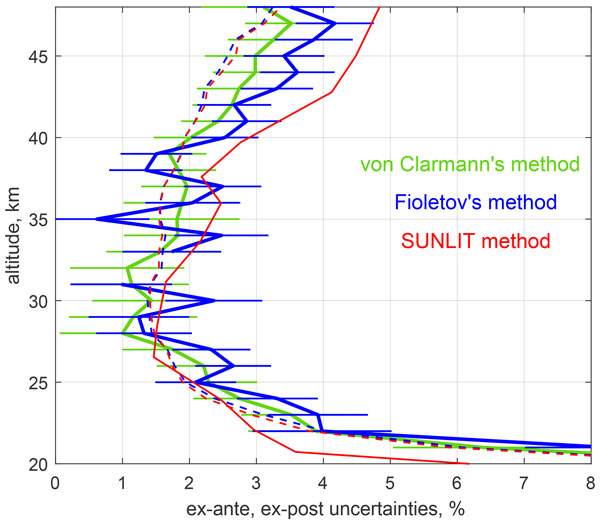
For satellite measurements of atmospheric composition, the random uncertainty estimates provided by retrieval algorithms might be imperfect due to various approximations used in the retrievals or presence of unknown error sources. This paper presents an overview of the methods used for validation of random uncertainty estimates. All methods discussed in this study are categorized, and assumptions and limitations of each method are discussed.
Michael Kahnert, Melanie Ades, Mickaël Bacles, Johannes Flemming, Vincent Guidard, Alexander Haefele, Robin J. Hogan, Samuel Rémy, and Eric Sauvageat
EGUsphere, https://doi.org/10.5194/egusphere-2025-6077, https://doi.org/10.5194/egusphere-2025-6077, 2026
Short summary
Short summary
The Copernicus Atmosphere Monitoring Service (CAMS) provides quality-controlled information related to air quality and health. We explore the possibility to constrain the CAMS global forecasting model by use of ground-based observations of laser light backscattered by particulate matter. We find that the vertical distribution of particulate matter can be predicted more faithfully with this approach, which can have implications for air quality forecasts provided by CAMS to end users.
Anna Moustaka, Antonis Gkikas, Stavros-Andreas Logothetis, Johannes Flemming, Samuel Rémy, Melanie Ades, Angela Benedetti, Kleareti Tourpali, Vassilis Amiridis, and Stelios Kazadzis
EGUsphere, https://doi.org/10.5194/egusphere-2026-1107, https://doi.org/10.5194/egusphere-2026-1107, 2026
This preprint is open for discussion and under review for Atmospheric Chemistry and Physics (ACP).
Short summary
Short summary
We examined how atmospheric aerosols have changed worldwide over the past two decades using a global atmospheric reanalysis together with ground-based observations. We found strong regional differences, with clear declines in some industrialized areas and increases in parts of South Asia and the Middle East. These long-term records help improve understanding of changes in climate and air quality.
Norbert Glatthor, Thomas von Clarmann, Udo Grabowski, Sylvia Kellmann, Michael Kiefer, Alexandra Laeng, Andrea Linden, Gabriele P. Stiller, Bernd Funke, Maya García-Comas, Manuel López-Puertas, Oliver Kirner, and Michelle L. Santee
Atmos. Meas. Tech., 19, 629–657, https://doi.org/10.5194/amt-19-629-2026, https://doi.org/10.5194/amt-19-629-2026, 2026
Short summary
Short summary
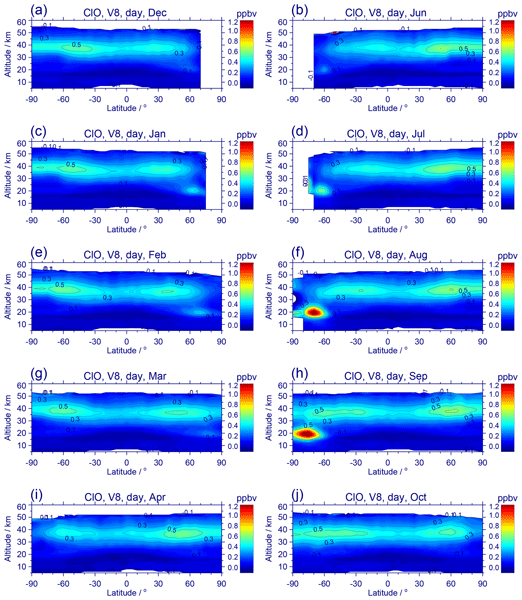
We present a global climatology of Michelson Interferometer for Passive Atmospheric Sounding (MIPAS) version 8 chlorine monoxide (ClO), retrieved from spaceborne observations between 2002 and 2012. Due to an improved retrieval setup, the high bias and poor vertical resolution of upper stratospheric ClO, which had affected the previous V5 data set, has been removed. Comparisons with ClO observations of the Microwave Limb Sounder generally show good agreement. Differences can be explained by simulations with an atmospheric chemistry model.

Liliana Guidetti, Erika Brattich, Simone Ceccherini, Michaela I. Hegglin, Piera Raspollini, Cecilia Tirelli, Nicola Zoppetti, and Ugo Cortesi
Atmos. Meas. Tech., 19, 167–184, https://doi.org/10.5194/amt-19-167-2026, https://doi.org/10.5194/amt-19-167-2026, 2026
Short summary
Short summary
The Complete Data Fusion algorithm is applied to observations from the Michelson Interferometer for Passive Atmospheric Sounding and the Infrared Atmospheric Sounding Interferometer to generate and validate a new ozone dataset against ozone soundings across multiple latitudes. The fusion propagates stratospheric limb information into the troposphere. The dataset shows increased information content and lower uncertainty, improving the study of stratosphere–troposphere ozone intrusions.
Sarah Vervalcke, Quentin Errera, Roland Eichinger, Thomas Reddmann, Simon Chabrillat, Marc Op de beeck, Gabriele Stiller, and Emmanuel Mahieu
Atmos. Chem. Phys., 26, 391–409, https://doi.org/10.5194/acp-26-391-2026, https://doi.org/10.5194/acp-26-391-2026, 2026
Short summary
Short summary
This study presents three simulations of atmospheric chemistry with the Belgian Assimilation System for Chemical Observations chemistry transport model, driven by different meteorological data sets. Newly implemented SF6 chemistry enables stratospheric transport studies. Results agree with satellite observations. The derived lifetimes of six trace gases agree with the literature, but SF6 shows larger sensitivity to the choice of meteorology. The lifetime of SF6 ranges from 1900 to 2600 years.
Jason E. Williams, Swen Metzger, Samuel Rémy, Vincent Huijnen, and Johannes Flemming
Geosci. Model Dev., 18, 9913–9943, https://doi.org/10.5194/gmd-18-9913-2025, https://doi.org/10.5194/gmd-18-9913-2025, 2025
Short summary
Short summary
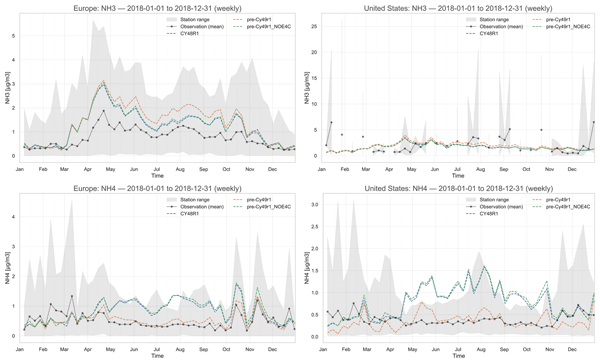
One of the main constituents of Particulate Matter at the surface are Secondary Inorganic Aerosols (SIA) which are influenced by both anthropogenic emissions and the acidity of clouds and aerosols. This study shows improvements in introduced into the IFS-COMPO (Integrated Forecast System-COMPOsition) simulating the surface concentrations of SIA and the resulting changes in the total wet deposition for Europe, the US and South-East Asia.
Simon Chabrillat, Samuel Rémy, Quentin Errera, Vincent Huijnen, Christine Bingen, Jonas Debosscher, François Hendrick, Swen Metzger, Adrien Mora, Daniele Minganti, Marc Op de beek, Léa Reisenfeld, Jason E. Williams, Henk Eskes, and Johannes Flemming
Geosci. Model Dev., 18, 8973–9014, https://doi.org/10.5194/gmd-18-8973-2025, https://doi.org/10.5194/gmd-18-8973-2025, 2025
Short summary
Short summary
We document the forecasts of the composition of the stratosphere by the Copernicus Atmosphere Monitoring Service. The model's predictions are compared with satellite measurements over a recent period, during polar ozone depletion events, and after the Mount Pinatubo volcanic eruption. The system performs well for sulfate aerosols, ozone and several other key gases but not as well for several nitrogen-containing gases. Chemical processes in aerosols and polar clouds should be improved.
Stefanie Falk, Luca Reißig, Bianca Zilker, Andreas Richter, and Björn-Martin Sinnhuber
Atmos. Chem. Phys., 25, 15653–15682, https://doi.org/10.5194/acp-25-15653-2025, https://doi.org/10.5194/acp-25-15653-2025, 2025
Short summary
Short summary
Ozone depletion events (ODEs) and bromine explosions in the Arctic were studied for 2019/20. Our model underestimated boundary layer height and showed warm biases, affecting ODE simulation. Updates improved coastal ozone agreement but failed to capture strong ODEs. Bromine monoxide (BrO) was overestimated at the surface yet underestimated in columns. Long-term data show declining strong ODEs since 2008, suggesting additional climate-driven factors beyond sea ice age.
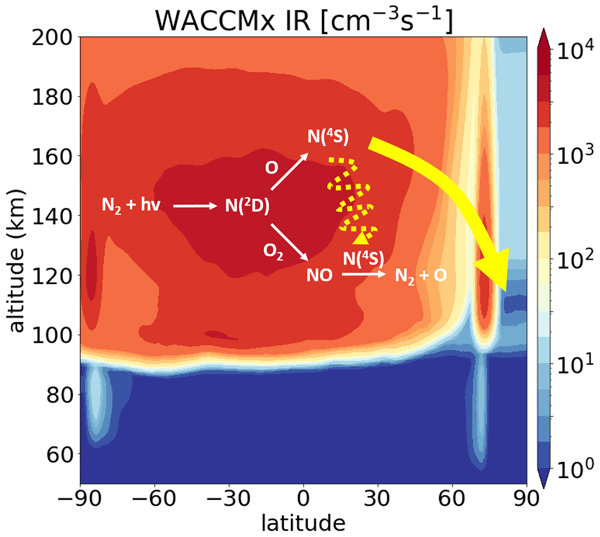
Miriam Sinnhuber, Christina Arras, Stefan Bender, Bernd Funke, Hanli Liu, Daniel R. Marsh, Thomas Reddmann, Eugene Rozanov, Timofei Sukhodolov, Monika E. Szelag, and Jan Maik Wissing
Atmos. Chem. Phys., 25, 14719–14734, https://doi.org/10.5194/acp-25-14719-2025, https://doi.org/10.5194/acp-25-14719-2025, 2025
Short summary
Short summary
Nitric oxide in the upper atmosphere varies with solar activity. Observations show that this starts a chain of processes affecting the ozone layer and climate system. This is often underestimated in models. We compare five models which show large differences in simulated NO. Analysis of these discrepancies identify two processes which interact with each other: the balance between atomic and molecular oxygen in the thermosphere, and a poleward - downward transport in the winter thermosphere.
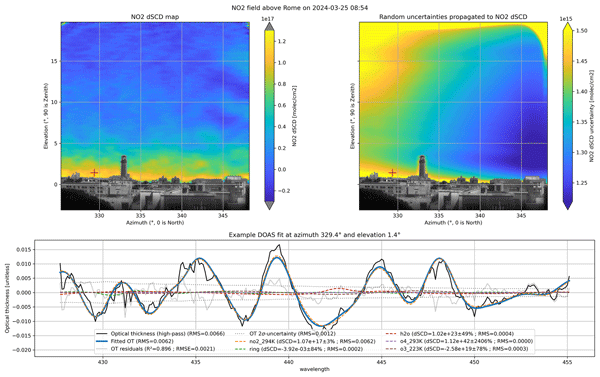
Pierre Gramme, Cedric Busschots, Emmanuel Dekemper, Didier Pieroux, Noel Baker, Stefano Casadio, Anna Maria Iannarelli, Nicola Ferrante, Annalisa Di Bernardino, Paolo Pettinari, Elisa Castelli, Luca Di Liberto, and Francesco Cairo
Atmos. Meas. Tech., 18, 6021–6037, https://doi.org/10.5194/amt-18-6021-2025, https://doi.org/10.5194/amt-18-6021-2025, 2025
Short summary
Short summary
We present a new remote sensing instrument using hyperspectral imaging to observe the variability in space and time of the nitrogen dioxide concentration. We also show the results of its validation campaign in a challenging urban setting in Rome, showing very good agreement with two reference instruments. Having an imaging instrument rather than the currently state-of-the-art unidirectional spectrometers brings promising capability in the context of satellite product validation.
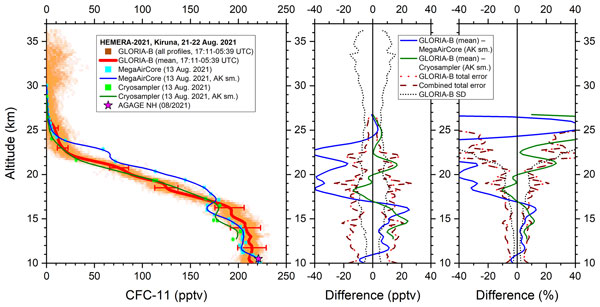
Gerald Wetzel, Anne Kleinert, Sören Johansson, Felix Friedl-Vallon, Michael Höpfner, Jörn Ungermann, Tom Neubert, Valéry Catoire, Cyril Crevoisier, Andreas Engel, Thomas Gulde, Patrick Jacquet, Oliver Kirner, Erik Kretschmer, Thomas Kulessa, Johannes C. Laube, Guido Maucher, Hans Nordmeyer, Christof Piesch, Peter Preusse, Markus Retzlaff, Georg Schardt, Johan Schillings, Herbert Schneider, Axel Schönfeld, Tanja Schuck, Wolfgang Woiwode, Martin Riese, and Peter Braesicke
Atmos. Meas. Tech., 18, 5873–5894, https://doi.org/10.5194/amt-18-5873-2025, https://doi.org/10.5194/amt-18-5873-2025, 2025
Short summary
Short summary
We present vertical trace gas profiles from the first balloon flight of the newly developed GLORIA-B limb-imaging Fourier-Transform spectrometer. Longer-lived gases are compared to external measurements to assess the quality of the GLORIA-B observations. Diurnal changes of photochemically active species are compared to model simulations. GLORIA-B demonstrates the capability of balloon-borne limb imaging to provide high-resolution vertical profiles of trace gases up to the middle stratosphere.
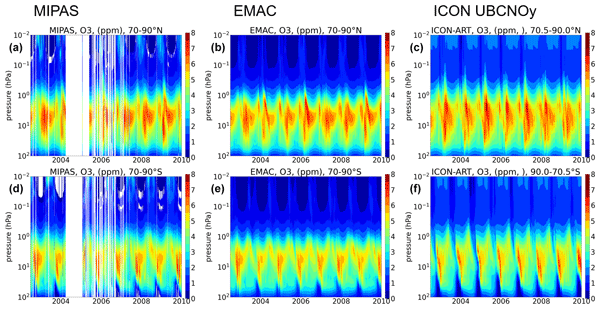
Maryam Ramezani Ziarani, Miriam Sinnhuber, Thomas Reddmann, Bernd Funke, Stefan Bender, and Michael Prather
Geosci. Model Dev., 18, 7891–7905, https://doi.org/10.5194/gmd-18-7891-2025, https://doi.org/10.5194/gmd-18-7891-2025, 2025
Short summary
Short summary
Our study aims to present a new method for incorporating top-down solar forcing into stratospheric ozone relying on linearized ozone scheme. The addition of geomagnetic forcing led to significant ozone losses in the polar upper stratosphere of both hemispheres due to the catalytic cycles involving NOy. In addition to the particle precipitation effect, accounting for solar UV variability in the ICON-ART model leads to the changes in ozone in the tropical stratosphere.
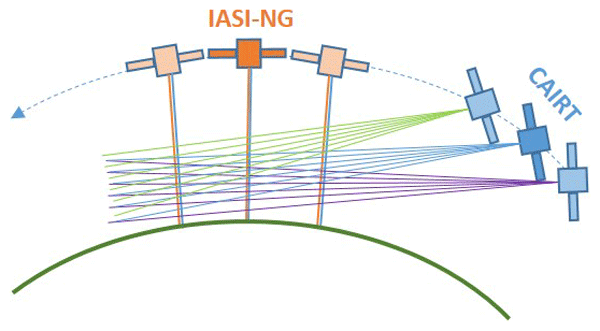
Cecilia Tirelli, Simone Ceccherini, Samuele Del Bianco, Bernd Funke, Michael Höpfner, Ugo Cortesi, and Piera Raspollini
Atmos. Meas. Tech., 18, 5619–5636, https://doi.org/10.5194/amt-18-5619-2025, https://doi.org/10.5194/amt-18-5619-2025, 2025
Short summary
Short summary
The Complete Data Fusion is an a posteriori method used to combine remote sensing products from independent observations of the same or proximate air masses. In this study, we extend the algorithm’s applicability to two-dimensional products, testing it with simulated ozone datasets from nadir and limb measurements. Our results show that the exploitation of the tomographic capabilities of future atmospheric sensors maximizes the information extracted from complementary datasets.
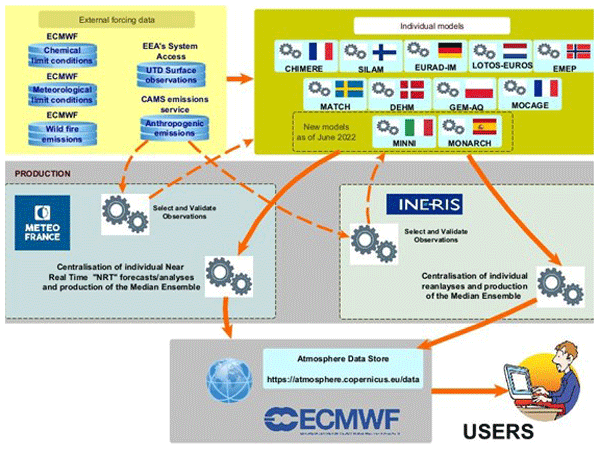
Augustin Colette, Gaëlle Collin, François Besson, Etienne Blot, Vincent Guidard, Frédérik Meleux, Adrien Royer, Valentin Petiot, Claire Miller, Oihana Fermond, Alizé Jeant, Mario Adani, Joaquim Arteta, Anna Benedictow, Robert Bergström, Dene Bowdalo, Jorgen Brandt, Gino Briganti, Ana C. Carvalho, Jesper Heile Christensen, Florian Couvidat, Ilaria D'Elia, Massimo D'Isidoro, Hugo Denier van der Gon, Gaël Descombes, Enza Di Tomaso, John Douros, Jeronimo Escribano, Henk Eskes, Hilde Fagerli, Yalda Fatahi, Johannes Flemming, Elmar Friese, Lise Frohn, Michael Gauss, Camilla Geels, Guido Guarnieri, Marc Guevara, Antoine Guion, Jonathan Guth, Risto Hänninen, Kaj Hansen, Ulas Im, Ruud Janssen, Marine Jeoffrion, Mathieu Joly, Luke Jones, Oriol Jorba, Evgeni Kadantsev, Michael Kahnert, Jacek W. Kaminski, Rostislav Kouznetsov, Richard Kranenburg, Jeroen Kuenen, Anne Caroline Lange, Joachim Langner, Victor Lannuque, Francesca Macchia, Astrid Manders, Mihaela Mircea, Agnes Nyiri, Miriam Olid, Carlos Pérez García-Pando, Yuliia Palamarchuk, Antonio Piersanti, Blandine Raux, Miha Razinger, Lennard Robertson, Arjo Segers, Martijn Schaap, Pilvi Siljamo, David Simpson, Mikhail Sofiev, Anders Stangel, Joanna Struzewska, Carles Tena, Renske Timmermans, Thanos Tsikerdekis, Svetlana Tsyro, Svyatoslav Tyuryakov, Anthony Ung, Andreas Uppstu, Alvaro Valdebenito, Peter van Velthoven, Lina Vitali, Zhuyun Ye, Vincent-Henri Peuch, and Laurence Rouïl
Geosci. Model Dev., 18, 6835–6883, https://doi.org/10.5194/gmd-18-6835-2025, https://doi.org/10.5194/gmd-18-6835-2025, 2025
Short summary
Short summary
The Copernicus Atmosphere Monitoring Service – Regional Production delivers daily forecasts, analyses, and reanalyses of air quality in Europe. The service relies on a distributed modelling production by 11 leading European modelling teams following stringent requirements with an operational design that has no equivalent in the world. All the products are free, open, and quality-assured and disseminated with a high level of reliability.
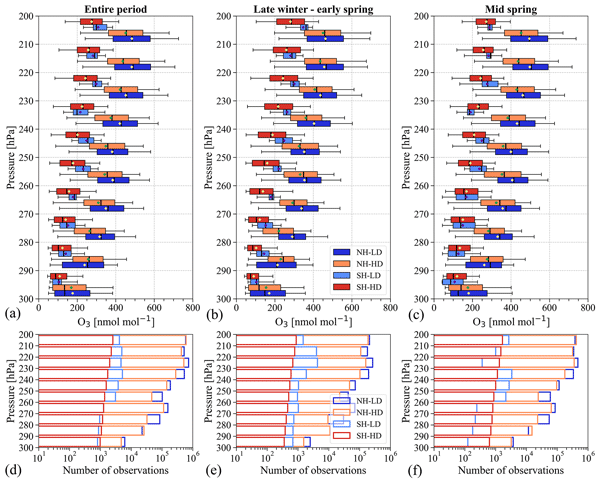
Rodrigo J. Seguel, Charlie Opazo, Yann Cohen, Owen R. Cooper, Laura Gallardo, Björn-Martin Sinnhuber, Florian Obersteiner, Andreas Zahn, Peter Hoor, Susanne Rohs, and Andreas Marsing
Atmos. Chem. Phys., 25, 8553–8573, https://doi.org/10.5194/acp-25-8553-2025, https://doi.org/10.5194/acp-25-8553-2025, 2025
Short summary
Short summary
We explored ozone differences between the Northern Hemisphere and Southern Hemispheres in the upper troposphere–lower stratosphere. We found lower ozone (with stratospheric origin) in the Southern Hemisphere, especially during years of severe ozone depletion. Sudden stratospheric warming events increased the ozone in each hemisphere, highlighting the relationship between stratospheric processes and ozone in the upper troposphere, where ozone is an important greenhouse gas.
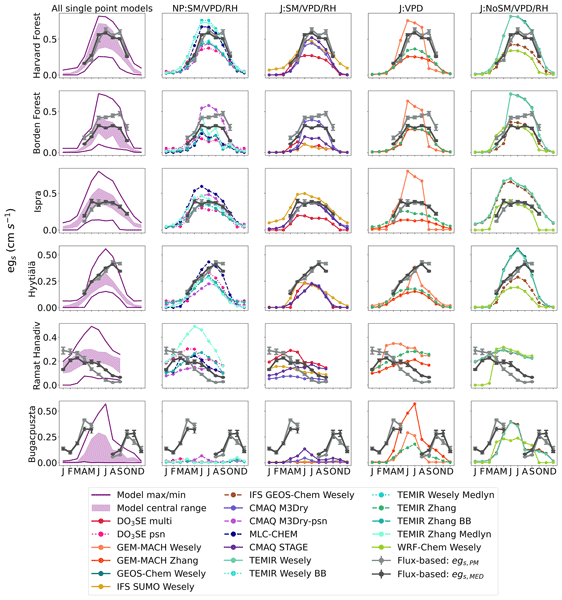
Anam M. Khan, Olivia E. Clifton, Jesse O. Bash, Sam Bland, Nathan Booth, Philip Cheung, Lisa Emberson, Johannes Flemming, Erick Fredj, Stefano Galmarini, Laurens Ganzeveld, Orestis Gazetas, Ignacio Goded, Christian Hogrefe, Christopher D. Holmes, László Horváth, Vincent Huijnen, Qian Li, Paul A. Makar, Ivan Mammarella, Giovanni Manca, J. William Munger, Juan L. Pérez-Camanyo, Jonathan Pleim, Limei Ran, Roberto San Jose, Donna Schwede, Sam J. Silva, Ralf Staebler, Shihan Sun, Amos P. K. Tai, Eran Tas, Timo Vesala, Tamás Weidinger, Zhiyong Wu, Leiming Zhang, and Paul C. Stoy
Atmos. Chem. Phys., 25, 8613–8635, https://doi.org/10.5194/acp-25-8613-2025, https://doi.org/10.5194/acp-25-8613-2025, 2025
Short summary
Short summary
Vegetation removes tropospheric ozone through stomatal uptake, and accurately modeling the stomatal uptake of ozone is important for modeling dry deposition and air quality. We evaluated the stomatal component of ozone dry deposition modeled by atmospheric chemistry models at six sites. We find that models and observation-based estimates agree at times during the growing season at all sites, but some models overestimated the stomatal component during the dry summers at a seasonally dry site.
Matthias Kohl, Christoph Brühl, Jennifer Schallock, Holger Tost, Patrick Jöckel, Adrian Jost, Steffen Beirle, Michael Höpfner, and Andrea Pozzer
Geosci. Model Dev., 18, 3985–4007, https://doi.org/10.5194/gmd-18-3985-2025, https://doi.org/10.5194/gmd-18-3985-2025, 2025
Short summary
Short summary
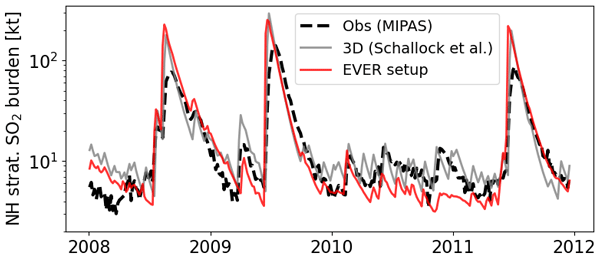
SO2 from explosive volcanic eruptions reaching the stratosphere can oxidize and form sulfur aerosols, potentially persisting for several years. We developed a new submodel, Explosive Volcanic ERuptions (EVER), that seamlessly includes stratospheric volcanic SO2 emissions in global numerical simulations based on a novel standard historical model setup, successfully evaluated with satellite observations. Sensitivity studies on the Nabro eruption in 2011 evaluate different emission methods.
Florian Voet, Felix Ploeger, Johannes Laube, Peter Preusse, Paul Konopka, Jens-Uwe Grooß, Jörn Ungermann, Björn-Martin Sinnhuber, Michael Höpfner, Bernd Funke, Gerald Wetzel, Sören Johansson, Gabriele Stiller, Eric Ray, and Michaela I. Hegglin
Atmos. Chem. Phys., 25, 3541–3565, https://doi.org/10.5194/acp-25-3541-2025, https://doi.org/10.5194/acp-25-3541-2025, 2025
Short summary
Short summary
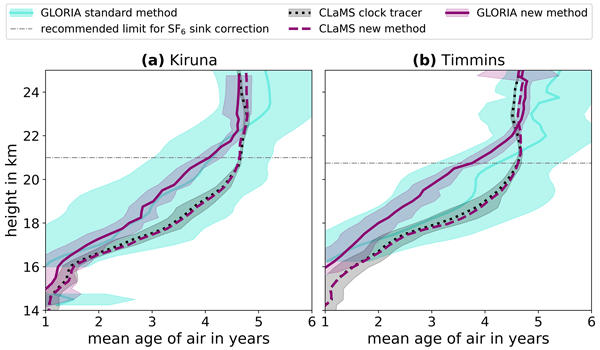
This study refines estimates of the stratospheric “age of air”, a measure of how long air circulates in the stratosphere. By analyzing correlations between trace gases measurable by satellites, the research introduces a method that reduces uncertainties and detects small-scale atmospheric features. This improved understanding of stratospheric circulation is crucial for better climate models and predictions, enhancing our ability to assess the impacts of climate change on the atmosphere.
Norbert Glatthor, Gabriele P. Stiller, Thomas von Clarmann, Bernd Funke, Sylvia Kellmann, and Andrea Linden
Atmos. Chem. Phys., 25, 1175–1208, https://doi.org/10.5194/acp-25-1175-2025, https://doi.org/10.5194/acp-25-1175-2025, 2025
Short summary
Short summary
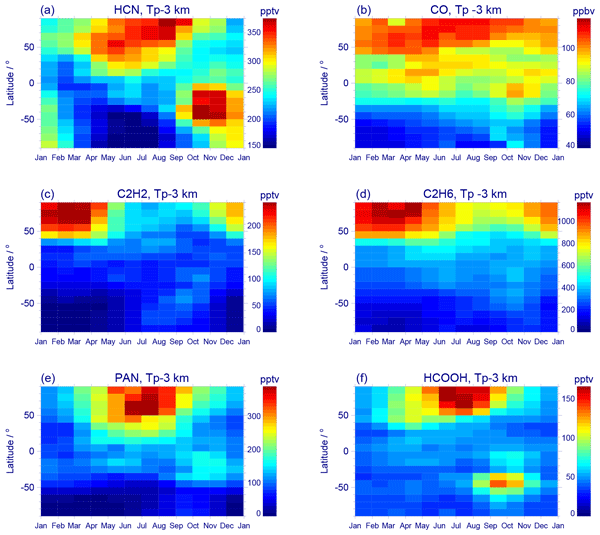
We present global upper-tropospheric distributions of the pollutants HCN, CO, C2H2, C2H6, PAN, and HCOOH, observed between 2002 and 2012 by the Michelson Interferometer for Passive Atmospheric Sounding (MIPAS) on the Environmental Satellite (Envisat). By comparing the spatial distributions of their volume mixing ratios and by global correlation and regression analyses, we draw conclusions on their sources, such as biomass burning, anthropogenic sources, and biogenic release.
Lucien Froidevaux, Douglas E. Kinnison, Benjamin Gaubert, Michael J. Schwartz, Nathaniel J. Livesey, William G. Read, Charles G. Bardeen, Jerry R. Ziemke, and Ryan A. Fuller
Atmos. Chem. Phys., 25, 597–624, https://doi.org/10.5194/acp-25-597-2025, https://doi.org/10.5194/acp-25-597-2025, 2025
Short summary
Short summary
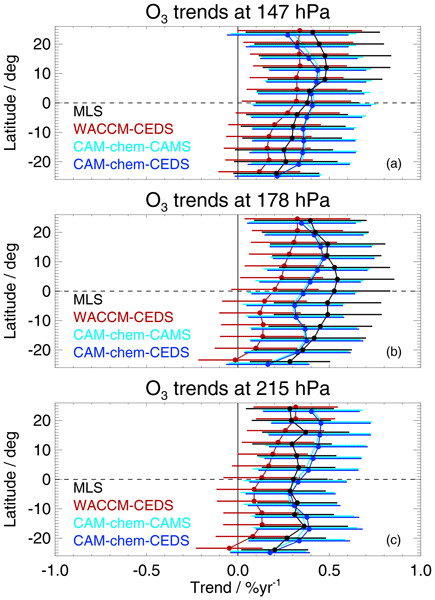
We compare observed changes in ozone (O3) and carbon monoxide (CO) in the tropical upper troposphere (10–15 km altitude) for 2005–2020 to predictions from model simulations that track the evolution of natural and industrial emissions transported to this region. An increasing trend in measured upper-tropospheric O3 is well matched by model trends. We find that changes in modeled industrial CO surface emissions lead to better model agreement with observed slight decreases in upper-tropospheric CO.
Björn-Martin Sinnhuber
Polarforschung, 92, 33–45, https://doi.org/10.5194/polf-92-33-2024, https://doi.org/10.5194/polf-92-33-2024, 2024
Short summary
Short summary
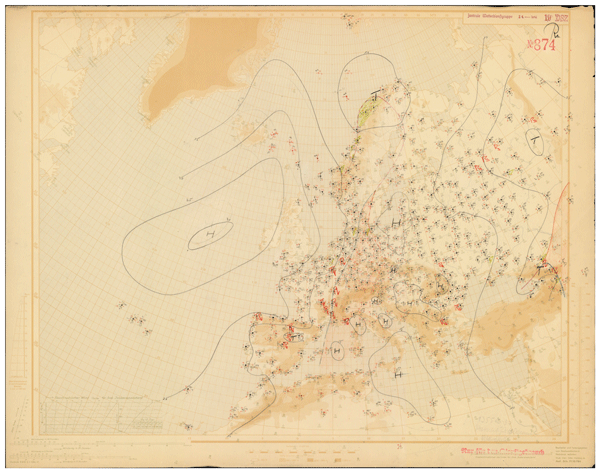
Knowledge of past climate change is essential to test our understanding of the rapidly changing Arctic. One of the longest Arctic temperature time series comes from observations in Svalbard that extend back more than 125 years but have a gap during World War II between 1941 and 1945. Observations from German military weather stations on Svalbard have now been retrieved from weather maps preserved at the Deutscher Wetterdienst (DWD), which will help close much of the existing data gap.
Kimberlee Dubé, Susann Tegtmeier, Adam Bourassa, Daniel Zawada, Douglas Degenstein, William Randel, Sean Davis, Michael Schwartz, Nathaniel Livesey, and Anne Smith
Atmos. Chem. Phys., 24, 12925–12941, https://doi.org/10.5194/acp-24-12925-2024, https://doi.org/10.5194/acp-24-12925-2024, 2024
Short summary
Short summary
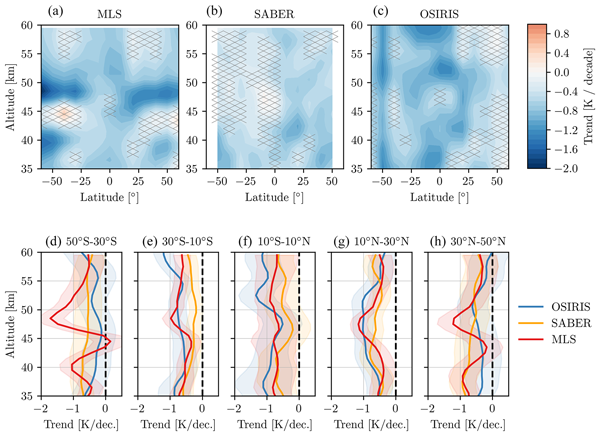
Greenhouse gas emissions that warm the troposphere also result in stratospheric cooling. The cooling rate is difficult to quantify above 35 km due to a deficit of long-term observational data with high vertical resolution in this region. We use satellite observations from several instruments, including a new temperature product from OSIRIS, to show that the upper stratosphere, from 35–60 km, cooled by 0.5 to 1 K per decade over 2005–2021 and by 0.6 K per decade over 1979–2021.
Samuel Rémy, Swen Metzger, Vincent Huijnen, Jason E. Williams, and Johannes Flemming
Geosci. Model Dev., 17, 7539–7567, https://doi.org/10.5194/gmd-17-7539-2024, https://doi.org/10.5194/gmd-17-7539-2024, 2024
Short summary
Short summary
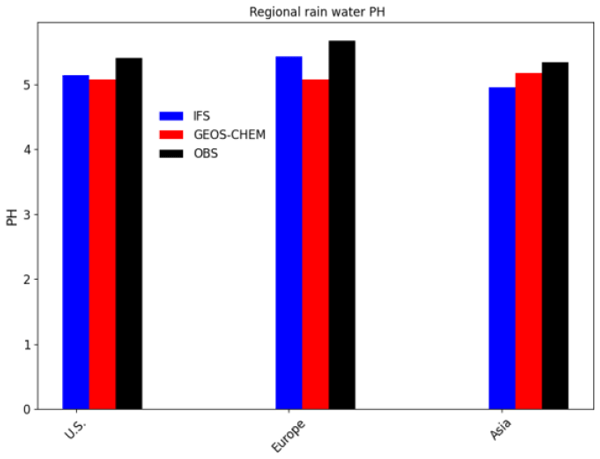
In this paper we describe the development of the future operational cycle 49R1 of the IFS-COMPO system, used for operational forecasts of atmospheric composition in the CAMS project, and focus on the implementation of the thermodynamical model EQSAM4Clim version 12. The implementation of EQSAM4Clim significantly improves the simulated secondary inorganic aerosol surface concentration. The new aerosol and precipitation acidity diagnostics showed good agreement against observational datasets.
Jorge E. Pachón, Mariel A. Opazo, Pablo Lichtig, Nicolas Huneeus, Idir Bouarar, Guy Brasseur, Cathy W. Y. Li, Johannes Flemming, Laurent Menut, Camilo Menares, Laura Gallardo, Michael Gauss, Mikhail Sofiev, Rostislav Kouznetsov, Julia Palamarchuk, Andreas Uppstu, Laura Dawidowski, Nestor Y. Rojas, María de Fátima Andrade, Mario E. Gavidia-Calderón, Alejandro H. Delgado Peralta, and Daniel Schuch
Geosci. Model Dev., 17, 7467–7512, https://doi.org/10.5194/gmd-17-7467-2024, https://doi.org/10.5194/gmd-17-7467-2024, 2024
Short summary
Short summary
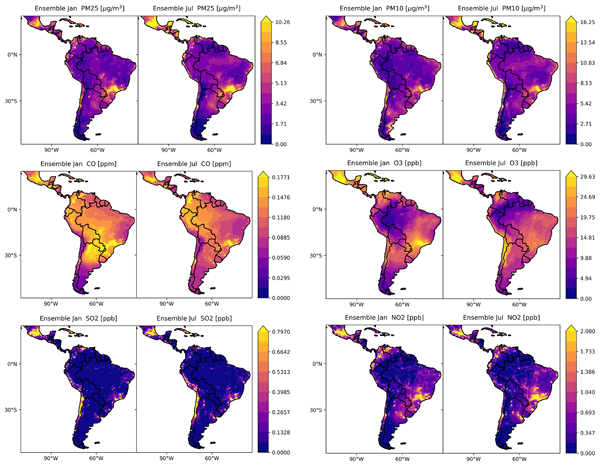
Latin America (LAC) has some of the most populated urban areas in the world, with high levels of air pollution. Air quality management in LAC has been traditionally focused on surveillance and building emission inventories. This study performed the first intercomparison and model evaluation in LAC, with interesting and insightful findings for the region. A multiscale modeling ensemble chain was assembled as a first step towards an air quality forecasting system.
Sebastian Rhode, Peter Preusse, Jörn Ungermann, Inna Polichtchouk, Kaoru Sato, Shingo Watanabe, Manfred Ern, Karlheinz Nogai, Björn-Martin Sinnhuber, and Martin Riese
Atmos. Meas. Tech., 17, 5785–5819, https://doi.org/10.5194/amt-17-5785-2024, https://doi.org/10.5194/amt-17-5785-2024, 2024
Short summary
Short summary
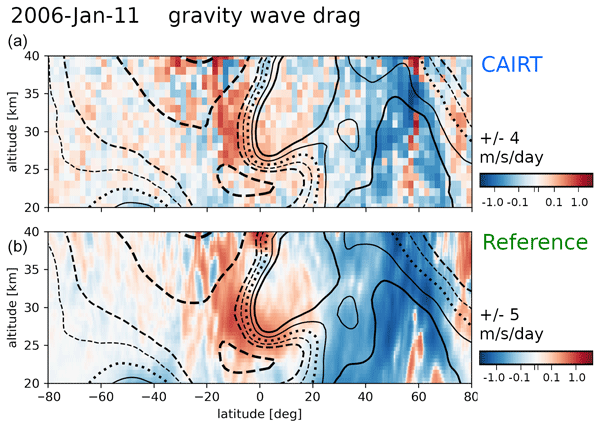
We investigate the capabilities of a proposed satellite mission, CAIRT, for observing gravity waves throughout the middle atmosphere and present the necessary methodology for in-depth wave analysis. Our findings suggest that such a satellite mission is highly capable of resolving individual wave parameters and could give new insights into the role of gravity waves in general atmospheric circulation and atmospheric processes.
Henk Eskes, Athanasios Tsikerdekis, Melanie Ades, Mihai Alexe, Anna Carlin Benedictow, Yasmine Bennouna, Lewis Blake, Idir Bouarar, Simon Chabrillat, Richard Engelen, Quentin Errera, Johannes Flemming, Sebastien Garrigues, Jan Griesfeller, Vincent Huijnen, Luka Ilić, Antje Inness, John Kapsomenakis, Zak Kipling, Bavo Langerock, Augustin Mortier, Mark Parrington, Isabelle Pison, Mikko Pitkänen, Samuel Remy, Andreas Richter, Anja Schoenhardt, Michael Schulz, Valerie Thouret, Thorsten Warneke, Christos Zerefos, and Vincent-Henri Peuch
Atmos. Chem. Phys., 24, 9475–9514, https://doi.org/10.5194/acp-24-9475-2024, https://doi.org/10.5194/acp-24-9475-2024, 2024
Short summary
Short summary
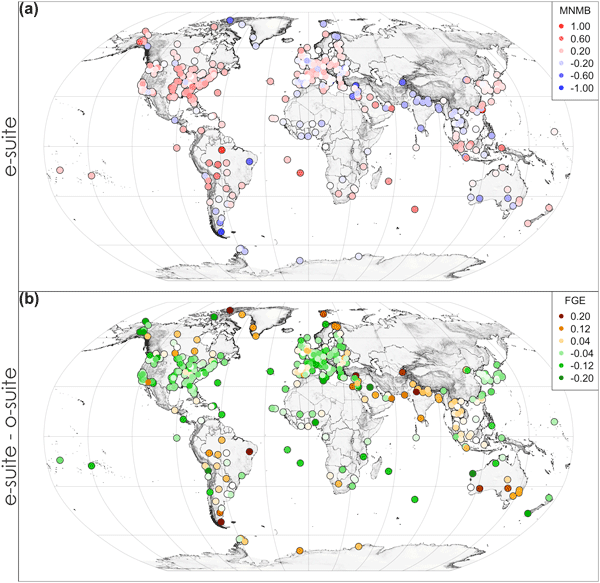
The Copernicus Atmosphere Monitoring Service (CAMS) provides global analyses and forecasts of aerosols and trace gases in the atmosphere. On 27 June 2023 a major upgrade, Cy48R1, became operational. Comparisons with in situ, surface remote sensing, aircraft, and balloon and satellite observations show that the new CAMS system is a significant improvement. The results quantify the skill of CAMS to forecast impactful events, such as wildfires, dust storms and air pollution peaks.
Karolin Voss, Philip Holzbeck, Klaus Pfeilsticker, Ralph Kleinschek, Gerald Wetzel, Blanca Fuentes Andrade, Michael Höpfner, Jörn Ungermann, Björn-Martin Sinnhuber, and André Butz
Atmos. Meas. Tech., 17, 4507–4528, https://doi.org/10.5194/amt-17-4507-2024, https://doi.org/10.5194/amt-17-4507-2024, 2024
Short summary
Short summary
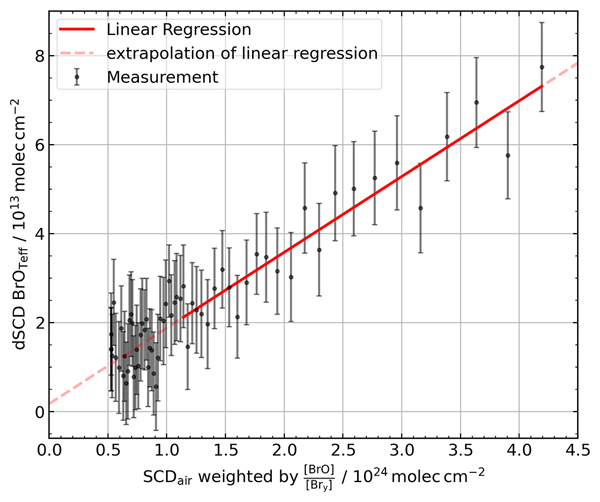
A novel balloon-borne instrument for direct sun and solar occultation measurements of several UV–Vis absorbing gases (e.g. O3, NO2, BrO, IO, and HONO) is described. Its major design features and performance during two stratospheric deployments are discussed. From the measured overhead BrO concentration and a suitable photochemical correction, total stratospheric bromine is inferred to (17.5 ± 2.2) ppt in air masses which entered the stratosphere around early 2017 ± 1 year.
Sören Johansson, Michael Höpfner, Felix Friedl-Vallon, Norbert Glatthor, Thomas Gulde, Vincent Huijnen, Anne Kleinert, Erik Kretschmer, Guido Maucher, Tom Neubert, Hans Nordmeyer, Christof Piesch, Peter Preusse, Martin Riese, Björn-Martin Sinnhuber, Jörn Ungermann, Gerald Wetzel, and Wolfgang Woiwode
Atmos. Chem. Phys., 24, 8125–8138, https://doi.org/10.5194/acp-24-8125-2024, https://doi.org/10.5194/acp-24-8125-2024, 2024
Short summary
Short summary
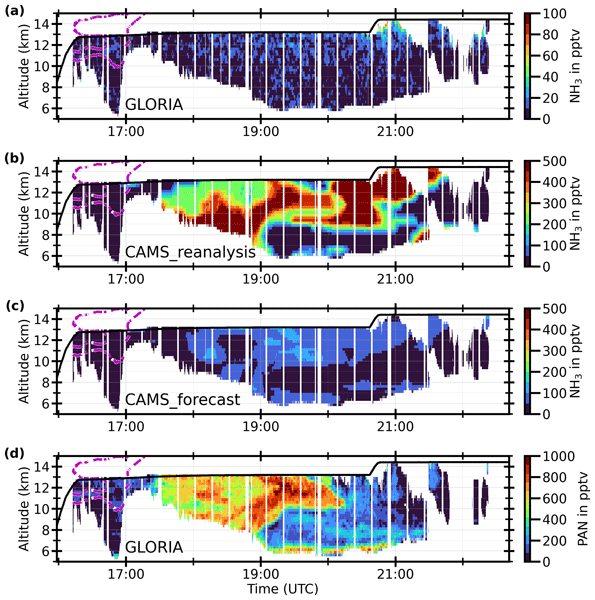
We present airborne infrared limb sounding GLORIA measurements of ammonia (NH3) in the upper troposphere of air masses within the Asian monsoon and of those connected with biomass burning. Comparing CAMS (Copernicus Atmosphere Monitoring Service) model data, we find that the model reproduces the measured enhanced NH3 within the Asian monsoon well but not that within biomass burning plumes, where no enhanced NH3 is measured in the upper troposphere but considerable amounts are simulated by CAMS.
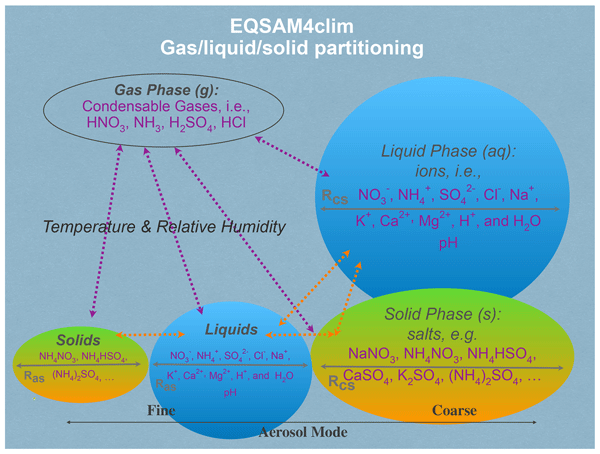
Swen Metzger, Samuel Rémy, Jason E. Williams, Vincent Huijnen, and Johannes Flemming
Geosci. Model Dev., 17, 5009–5021, https://doi.org/10.5194/gmd-17-5009-2024, https://doi.org/10.5194/gmd-17-5009-2024, 2024
Short summary
Short summary
EQSAM4Clim has recently been revised to provide an accurate and efficient method for calculating the acidity of atmospheric particles. It is based on an analytical concept that is sufficiently fast and free of numerical noise, which makes it attractive for air quality forecasting. Version 12 allows the calculation of aerosol composition based on the gas–liquid–solid and the reduced gas–liquid partitioning with the associated water uptake for both cases, including the acidity of the aerosols.
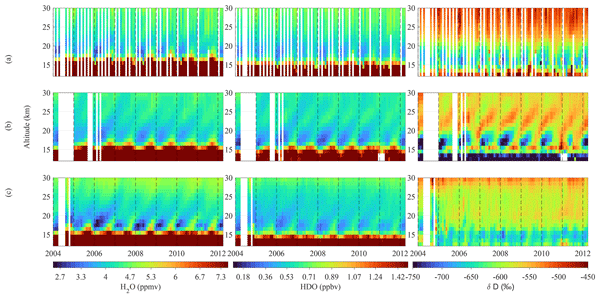
Karen De Los Ríos, Paulina Ordoñez, Gabriele P. Stiller, Piera Raspollini, Marco Gai, Kaley A. Walker, Cristina Peña-Ortiz, and Luis Acosta
Atmos. Meas. Tech., 17, 3401–3418, https://doi.org/10.5194/amt-17-3401-2024, https://doi.org/10.5194/amt-17-3401-2024, 2024
Short summary
Short summary
This study examines newer versions of H2O and HDO retrievals from Envisat/MIPAS and SCISAT/ACE-FTS. Results reveal a better agreement in stratospheric H2O profiles than in HDO profiles. The H2O tape recorder signal is consistent across databases, but δD tape recorder composites show differences that impact the interpretation of water vapour transport. These findings enhance the need for intercomparisons to refine our insights.
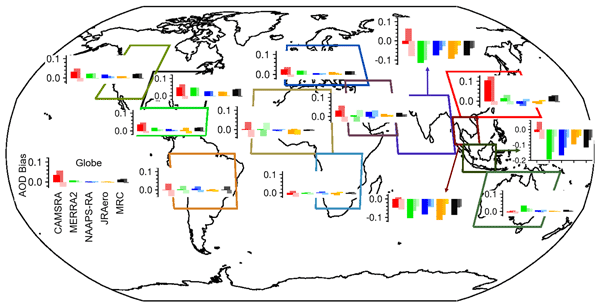
Peng Xian, Jeffrey S. Reid, Melanie Ades, Angela Benedetti, Peter R. Colarco, Arlindo da Silva, Tom F. Eck, Johannes Flemming, Edward J. Hyer, Zak Kipling, Samuel Rémy, Tsuyoshi Thomas Sekiyama, Taichu Tanaka, Keiya Yumimoto, and Jianglong Zhang
Atmos. Chem. Phys., 24, 6385–6411, https://doi.org/10.5194/acp-24-6385-2024, https://doi.org/10.5194/acp-24-6385-2024, 2024
Short summary
Short summary
The study compares and evaluates monthly AOD of four reanalyses (RA) and their consensus (i.e., ensemble mean). The basic verification characteristics of these RA versus both AERONET and MODIS retrievals are presented. The study discusses the strength of each RA and identifies regions where divergence and challenges are prominent. The RA consensus usually performs very well on a global scale in terms of how well it matches the observational data, making it a good choice for various applications.
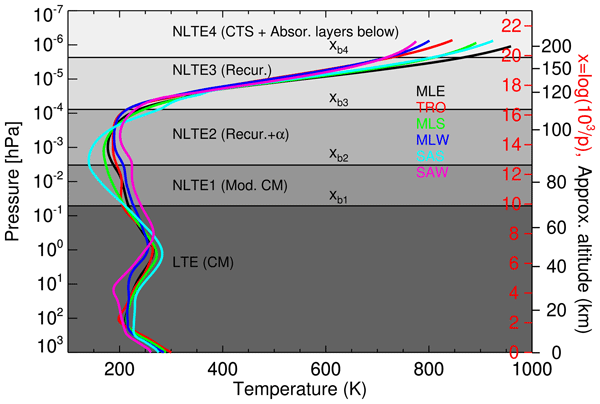
Manuel López-Puertas, Federico Fabiano, Victor Fomichev, Bernd Funke, and Daniel R. Marsh
Geosci. Model Dev., 17, 4401–4432, https://doi.org/10.5194/gmd-17-4401-2024, https://doi.org/10.5194/gmd-17-4401-2024, 2024
Short summary
Short summary
The radiative infrared cooling of CO2 in the middle atmosphere is crucial for computing its thermal structure. It requires one however to include non-local thermodynamic equilibrium processes which are computationally very expensive, which cannot be afforded by climate models. In this work, we present an updated, efficient, accurate and very fast (~50 µs) parameterization of that cooling able to cope with CO2 abundances from half the pre-industrial values to 10 times the current abundance.

Christina V. Brodowsky, Timofei Sukhodolov, Gabriel Chiodo, Valentina Aquila, Slimane Bekki, Sandip S. Dhomse, Michael Höpfner, Anton Laakso, Graham W. Mann, Ulrike Niemeier, Giovanni Pitari, Ilaria Quaglia, Eugene Rozanov, Anja Schmidt, Takashi Sekiya, Simone Tilmes, Claudia Timmreck, Sandro Vattioni, Daniele Visioni, Pengfei Yu, Yunqian Zhu, and Thomas Peter
Atmos. Chem. Phys., 24, 5513–5548, https://doi.org/10.5194/acp-24-5513-2024, https://doi.org/10.5194/acp-24-5513-2024, 2024
Short summary
Short summary
The aerosol layer is an essential part of the climate system. We characterize the sulfur budget in a volcanically quiescent (background) setting, with a special focus on the sulfate aerosol layer using, for the first time, a multi-model approach. The aim is to identify weak points in the representation of the atmospheric sulfur budget in an intercomparison of nine state-of-the-art coupled global circulation models.

Norbert Glatthor, Thomas von Clarmann, Bernd Funke, Maya García-Comas, Udo Grabowski, Michael Höpfner, Sylvia Kellmann, Michael Kiefer, Alexandra Laeng, Andrea Linden, Manuel López-Puertas, and Gabriele P. Stiller
Atmos. Meas. Tech., 17, 2849–2871, https://doi.org/10.5194/amt-17-2849-2024, https://doi.org/10.5194/amt-17-2849-2024, 2024
Short summary
Short summary
We present global atmospheric methane (CH4) and nitrous oxide (N2O) distributions retrieved from measurements of the MIPAS instrument on board the Environmental Satellite (Envisat) during 2002 to 2012. Monitoring of these gases is of scientific interest because both of them are strong greenhouse gases. We analyze the latest, improved version of calibrated MIPAS measurements. Further, we apply a new retrieval scheme leading to an improved CH4 and N2O data product .
Gabriele P. Stiller, Thomas von Clarmann, Norbert Glatthor, Udo Grabowski, Sylvia Kellmann, Michael Kiefer, Alexandra Laeng, Andrea Linden, Bernd Funke, Maya García-Comas, and Manuel López-Puertas
Atmos. Meas. Tech., 17, 1759–1789, https://doi.org/10.5194/amt-17-1759-2024, https://doi.org/10.5194/amt-17-1759-2024, 2024
Short summary
Short summary
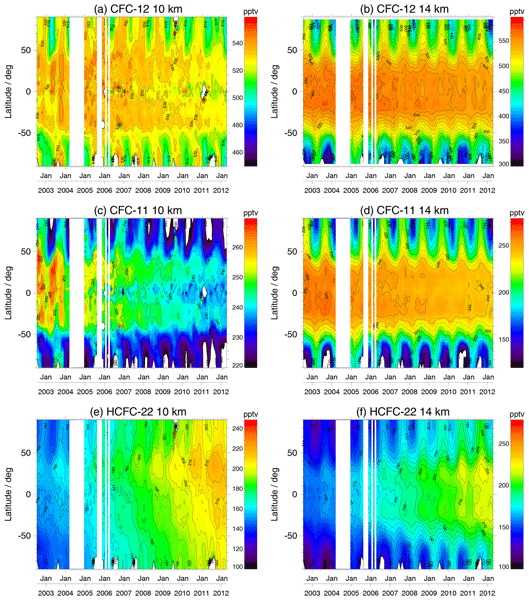
CFC-11, CFC-12, and HCFC-22 contribute to the depletion of ozone and are potent greenhouse gases. They have been banned by the Montreal protocol. With MIPAS on Envisat the atmospheric composition could be observed between 2002 and 2012. We present here the retrieval of their atmospheric distributions for the final data version 8. We characterise the derived data by their error budget and their spatial resolution. An additional representation for direct comparison to models is also provided.
Bernd Funke, Thierry Dudok de Wit, Ilaria Ermolli, Margit Haberreiter, Doug Kinnison, Daniel Marsh, Hilde Nesse, Annika Seppälä, Miriam Sinnhuber, and Ilya Usoskin
Geosci. Model Dev., 17, 1217–1227, https://doi.org/10.5194/gmd-17-1217-2024, https://doi.org/10.5194/gmd-17-1217-2024, 2024
Short summary
Short summary
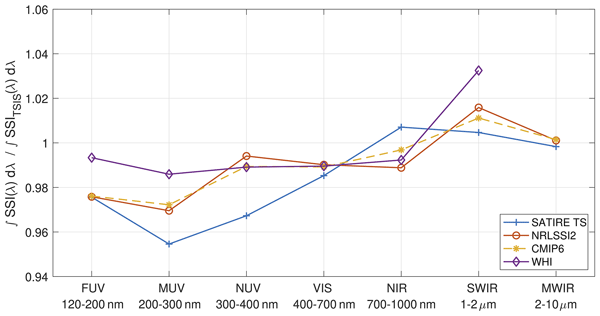
We outline a road map for the preparation of a solar forcing dataset for the upcoming Phase 7 of the Coupled Model Intercomparison Project (CMIP7), considering the latest scientific advances made in the reconstruction of solar forcing and in the understanding of climate response while also addressing the issues that were raised during CMIP6.
Manuel López-Puertas, Maya García-Comas, Bernd Funke, Thomas von Clarmann, Norbert Glatthor, Udo Grabowski, Sylvia Kellmann, Michael Kiefer, Alexandra Laeng, Andrea Linden, and Gabriele P. Stiller
Atmos. Meas. Tech., 16, 5609–5645, https://doi.org/10.5194/amt-16-5609-2023, https://doi.org/10.5194/amt-16-5609-2023, 2023
Short summary
Short summary
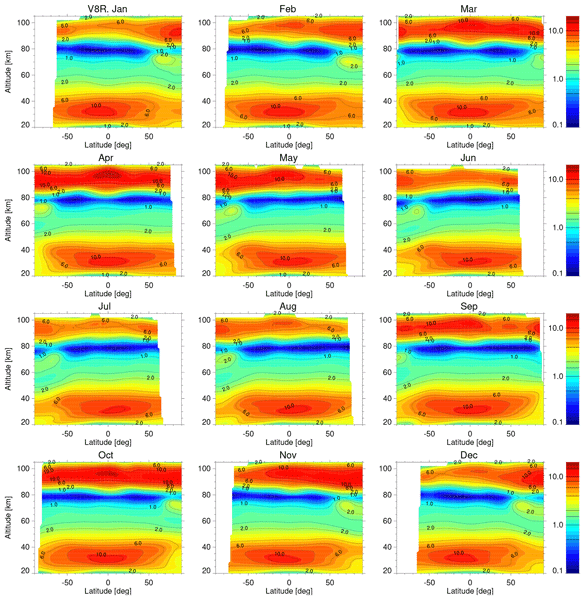
This paper describes a new version (V8) of ozone data from MIPAS middle-atmosphere spectra. The dataset comprises high-quality ozone profiles from 20 to 100 km, with pole-to-pole latitude coverage for the day- and nighttime, spanning 2005 until 2012. An exhaustive treatment of errors has been performed. Compared to other satellite instruments, MIPAS ozone shows a positive bias of 5 %–8 % below 70 km. In the upper mesosphere, this new version agrees much better than previous ones (within 10 %).
Maya García-Comas, Bernd Funke, Manuel López-Puertas, Norbert Glatthor, Udo Grabowski, Sylvia Kellmann, Michael Kiefer, Andrea Linden, Belén Martínez-Mondéjar, Gabriele P. Stiller, and Thomas von Clarmann
Atmos. Meas. Tech., 16, 5357–5386, https://doi.org/10.5194/amt-16-5357-2023, https://doi.org/10.5194/amt-16-5357-2023, 2023
Short summary
Short summary
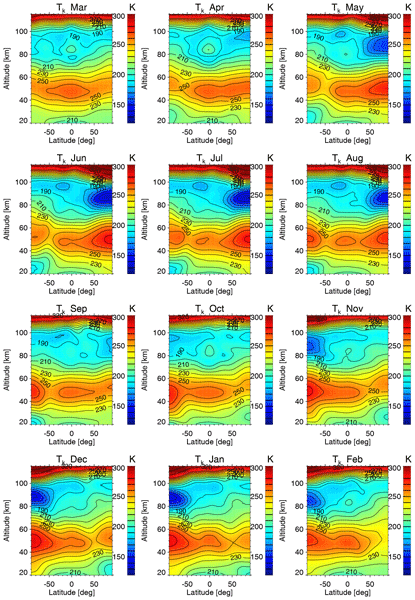
We have released version 8 of MIPAS IMK–IAA temperatures and pointing information retrieved from MIPAS Middle and Upper Atmosphere mode version 8.03 calibrated spectra, covering 20–115 km altitude. We considered non-local thermodynamic equilibrium emission explicitly for each limb scan, essential to retrieve accurate temperatures above the mid-mesosphere. Comparisons of this temperature dataset with SABER measurements show excellent agreement, improving those of previous MIPAS versions.
Monali Borthakur, Miriam Sinnhuber, Alexandra Laeng, Thomas Reddmann, Peter Braesicke, Gabriele Stiller, Thomas von Clarmann, Bernd Funke, Ilya Usoskin, Jan Maik Wissing, and Olesya Yakovchuk
Atmos. Chem. Phys., 23, 12985–13013, https://doi.org/10.5194/acp-23-12985-2023, https://doi.org/10.5194/acp-23-12985-2023, 2023
Short summary
Short summary
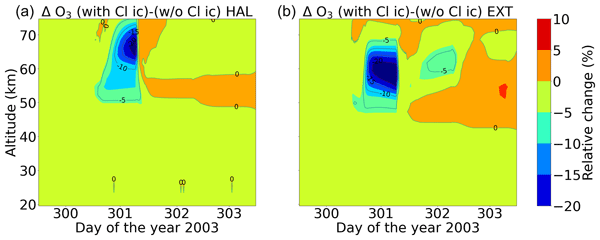
Reduced ozone levels resulting from ozone depletion mean more exposure to UV radiation, which has various effects on human health. We analysed solar events to see what influence it has on the chemistry of Earth's atmosphere and how this atmospheric chemistry change can affect the ozone. To do this, we used an atmospheric model considering only chemistry and compared it with satellite data. The focus was mainly on the contribution of chlorine, and we found about 10 %–20 % ozone loss due to that.
Michael Kiefer, Dale F. Hurst, Gabriele P. Stiller, Stefan Lossow, Holger Vömel, John Anderson, Faiza Azam, Jean-Loup Bertaux, Laurent Blanot, Klaus Bramstedt, John P. Burrows, Robert Damadeo, Bianca Maria Dinelli, Patrick Eriksson, Maya García-Comas, John C. Gille, Mark Hervig, Yasuko Kasai, Farahnaz Khosrawi, Donal Murtagh, Gerald E. Nedoluha, Stefan Noël, Piera Raspollini, William G. Read, Karen H. Rosenlof, Alexei Rozanov, Christopher E. Sioris, Takafumi Sugita, Thomas von Clarmann, Kaley A. Walker, and Katja Weigel
Atmos. Meas. Tech., 16, 4589–4642, https://doi.org/10.5194/amt-16-4589-2023, https://doi.org/10.5194/amt-16-4589-2023, 2023
Short summary
Short summary
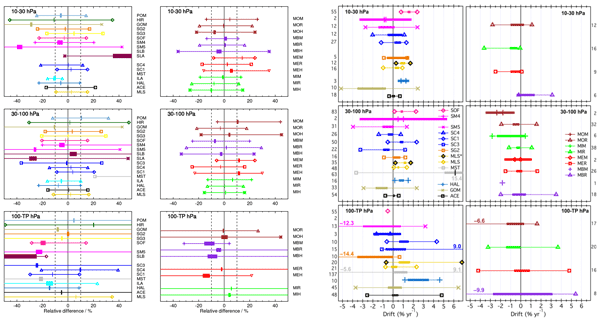
We quantify biases and drifts (and their uncertainties) between the stratospheric water vapor measurement records of 15 satellite-based instruments (SATs, with 31 different retrievals) and balloon-borne frost point hygrometers (FPs) launched at 27 globally distributed stations. These comparisons of measurements during the period 2000–2016 are made using robust, consistent statistical methods. With some exceptions, the biases and drifts determined for most SAT–FP pairs are < 10 % and < 1 % yr−1.
Sebastien Garrigues, Melanie Ades, Samuel Remy, Johannes Flemming, Zak Kipling, Istvan Laszlo, Mark Parrington, Antje Inness, Roberto Ribas, Luke Jones, Richard Engelen, and Vincent-Henri Peuch
Atmos. Chem. Phys., 23, 10473–10487, https://doi.org/10.5194/acp-23-10473-2023, https://doi.org/10.5194/acp-23-10473-2023, 2023
Short summary
Short summary
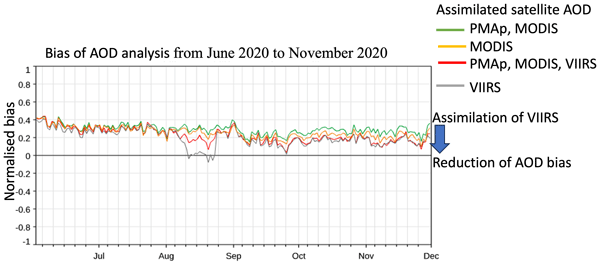
The Copernicus Atmosphere Monitoring Service (CAMS) provides global monitoring of aerosols using the ECMWF forecast model constrained by the assimilation of satellite aerosol optical depth (AOD). This work aims at evaluating the assimilation of the NOAA VIIRS AOD product in the ECMWF model. It shows that the introduction of VIIRS in the CAMS data assimilation system enhances the accuracy of the aerosol analysis, particularly over Europe and desert and maritime sites.
Olivia E. Clifton, Donna Schwede, Christian Hogrefe, Jesse O. Bash, Sam Bland, Philip Cheung, Mhairi Coyle, Lisa Emberson, Johannes Flemming, Erick Fredj, Stefano Galmarini, Laurens Ganzeveld, Orestis Gazetas, Ignacio Goded, Christopher D. Holmes, László Horváth, Vincent Huijnen, Qian Li, Paul A. Makar, Ivan Mammarella, Giovanni Manca, J. William Munger, Juan L. Pérez-Camanyo, Jonathan Pleim, Limei Ran, Roberto San Jose, Sam J. Silva, Ralf Staebler, Shihan Sun, Amos P. K. Tai, Eran Tas, Timo Vesala, Tamás Weidinger, Zhiyong Wu, and Leiming Zhang
Atmos. Chem. Phys., 23, 9911–9961, https://doi.org/10.5194/acp-23-9911-2023, https://doi.org/10.5194/acp-23-9911-2023, 2023
Short summary
Short summary
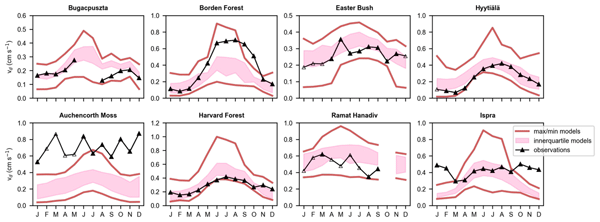
A primary sink of air pollutants is dry deposition. Dry deposition estimates differ across the models used to simulate atmospheric chemistry. Here, we introduce an effort to examine dry deposition schemes from atmospheric chemistry models. We provide our approach’s rationale, document the schemes, and describe datasets used to drive and evaluate the schemes. We also launch the analysis of results by evaluating against observations and identifying the processes leading to model–model differences.
Eric Sauvageat, Klemens Hocke, Eliane Maillard Barras, Shengyi Hou, Quentin Errera, Alexander Haefele, and Axel Murk
Atmos. Chem. Phys., 23, 7321–7345, https://doi.org/10.5194/acp-23-7321-2023, https://doi.org/10.5194/acp-23-7321-2023, 2023
Short summary
Short summary
In Switzerland, two microwave radiometers can measure continuous ozone profiles in the middle atmosphere. From these instruments, we can study the diurnal variation of ozone, which is difficult to observe otherwise. It is valuable to validate the model simulations of diurnal variations in this region. We present results obtained during the last decade and compare them against various models. For the first time, we also show that the winter diurnal variations have some short-term fluctuations.
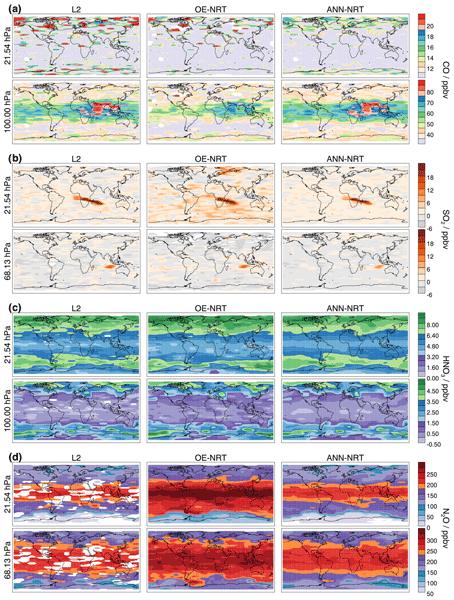
Frank Werner, Nathaniel J. Livesey, Luis F. Millán, William G. Read, Michael J. Schwartz, Paul A. Wagner, William H. Daffer, Alyn Lambert, Sasha N. Tolstoff, and Michelle L. Santee
Atmos. Meas. Tech., 16, 2733–2751, https://doi.org/10.5194/amt-16-2733-2023, https://doi.org/10.5194/amt-16-2733-2023, 2023
Short summary
Short summary
The algorithm that produces the near-real-time data products of the Aura Microwave Limb Sounder has been updated. The new algorithm is based on machine learning techniques and yields data products with much improved accuracy. It is shown that the new algorithm outperforms the previous versions, even when it is trained on only a few years of satellite observations. This confirms the potential of applying machine learning to the near-real-time efforts of other current and future mission concepts.
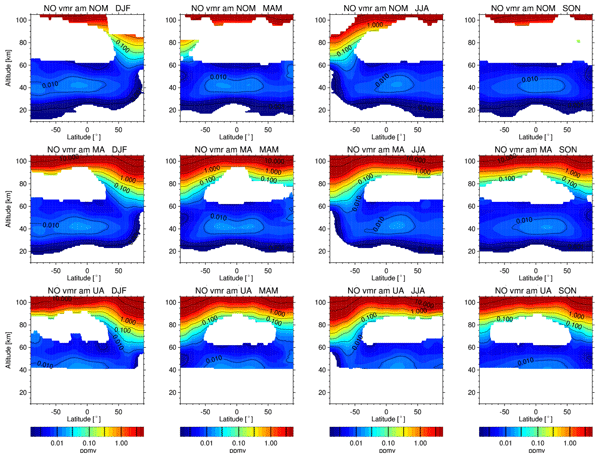
Bernd Funke, Maya García-Comas, Norbert Glatthor, Udo Grabowski, Sylvia Kellmann, Michael Kiefer, Andrea Linden, Manuel López-Puertas, Gabriele P. Stiller, and Thomas von Clarmann
Atmos. Meas. Tech., 16, 2167–2196, https://doi.org/10.5194/amt-16-2167-2023, https://doi.org/10.5194/amt-16-2167-2023, 2023
Short summary
Short summary
New global nitric oxide (NO) volume-mixing-ratio and lower-thermospheric temperature data products, retrieved from Michelson Interferometer for Passive Atmospheric Sounding (MIPAS) spectra with the IMK-IAA MIPAS data processor, have been released. The dataset covers the entire Envisat mission lifetime and includes retrieval results from all MIPAS observation modes. The data are based on ESA version 8 calibration and were processed using an improved retrieval approach.
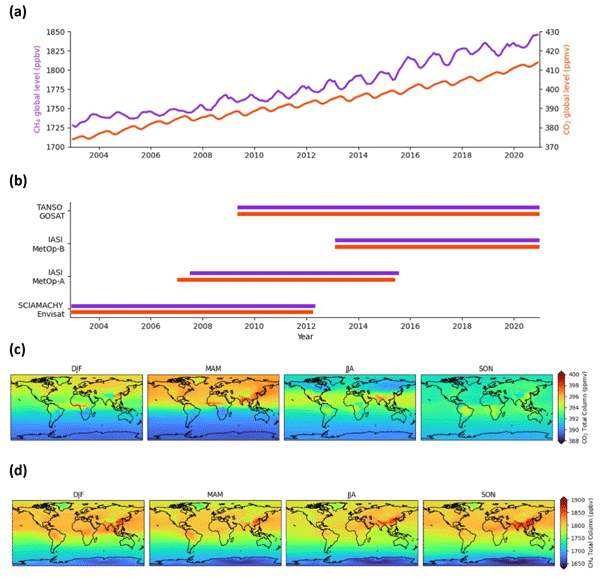
Anna Agustí-Panareda, Jérôme Barré, Sébastien Massart, Antje Inness, Ilse Aben, Melanie Ades, Bianca C. Baier, Gianpaolo Balsamo, Tobias Borsdorff, Nicolas Bousserez, Souhail Boussetta, Michael Buchwitz, Luca Cantarello, Cyril Crevoisier, Richard Engelen, Henk Eskes, Johannes Flemming, Sébastien Garrigues, Otto Hasekamp, Vincent Huijnen, Luke Jones, Zak Kipling, Bavo Langerock, Joe McNorton, Nicolas Meilhac, Stefan Noël, Mark Parrington, Vincent-Henri Peuch, Michel Ramonet, Miha Razinger, Maximilian Reuter, Roberto Ribas, Martin Suttie, Colm Sweeney, Jérôme Tarniewicz, and Lianghai Wu
Atmos. Chem. Phys., 23, 3829–3859, https://doi.org/10.5194/acp-23-3829-2023, https://doi.org/10.5194/acp-23-3829-2023, 2023
Short summary
Short summary
We present a global dataset of atmospheric CO2 and CH4, the two most important human-made greenhouse gases, which covers almost 2 decades (2003–2020). It is produced by combining satellite data of CO2 and CH4 with a weather and air composition prediction model, and it has been carefully evaluated against independent observations to ensure validity and point out deficiencies to the user. This dataset can be used for scientific studies in the field of climate change and the global carbon cycle.
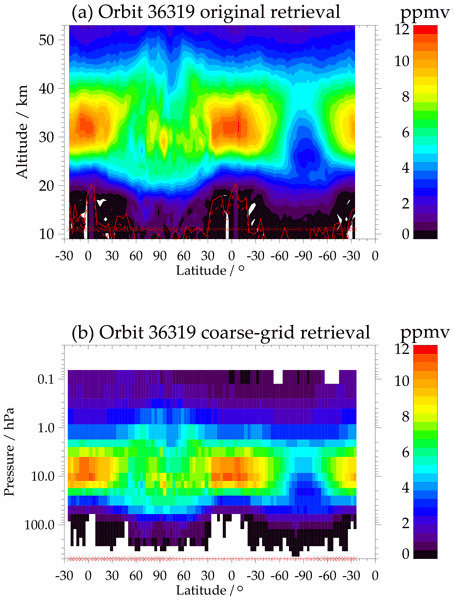
Michael Kiefer, Thomas von Clarmann, Bernd Funke, Maya García-Comas, Norbert Glatthor, Udo Grabowski, Michael Höpfner, Sylvia Kellmann, Alexandra Laeng, Andrea Linden, Manuel López-Puertas, and Gabriele P. Stiller
Atmos. Meas. Tech., 16, 1443–1460, https://doi.org/10.5194/amt-16-1443-2023, https://doi.org/10.5194/amt-16-1443-2023, 2023
Short summary
Short summary
A new ozone data set, derived from radiation measurements of the space-borne instrument MIPAS, is presented. It consists of more than 2 million single ozone profiles from 2002–2012, covering virtually all latitudes and altitudes between 5 and 70 km. Progress in data calibration and processing methods allowed for significant improvement of the data quality, compared to previous data versions. Hence, the data set will help to better understand e.g. the time evolution of ozone in the stratosphere.
Stefano Della Fera, Federico Fabiano, Piera Raspollini, Marco Ridolfi, Ugo Cortesi, Flavio Barbara, and Jost von Hardenberg
Geosci. Model Dev., 16, 1379–1394, https://doi.org/10.5194/gmd-16-1379-2023, https://doi.org/10.5194/gmd-16-1379-2023, 2023
Short summary
Short summary
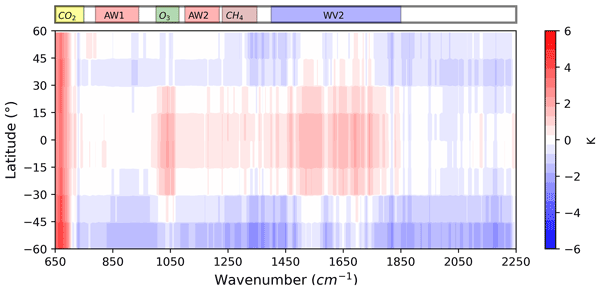
The long-term comparison between observed and simulated outgoing longwave radiances represents a strict test to evaluate climate model performance. In this work, 9 years of synthetic spectrally resolved radiances, simulated online on the basis of the atmospheric fields predicted by the EC-Earth global climate model (v3.3.3) in clear-sky conditions, are compared to IASI spectral radiance climatology in order to detect model biases in temperature and humidity at different atmospheric levels.
Jennifer Schallock, Christoph Brühl, Christine Bingen, Michael Höpfner, Landon Rieger, and Jos Lelieveld
Atmos. Chem. Phys., 23, 1169–1207, https://doi.org/10.5194/acp-23-1169-2023, https://doi.org/10.5194/acp-23-1169-2023, 2023
Short summary
Short summary
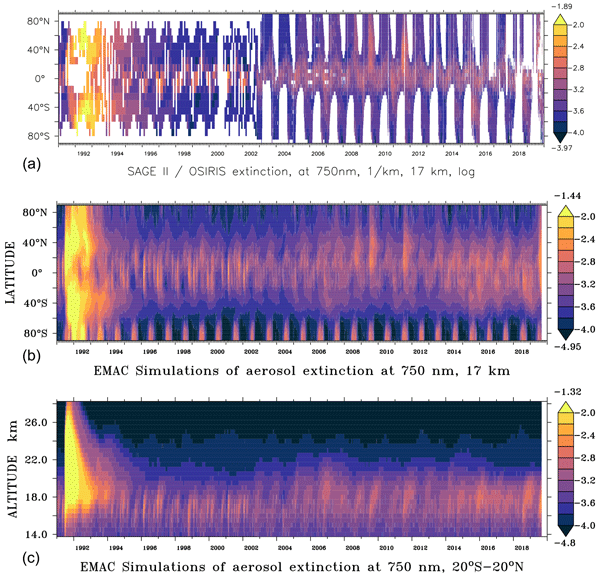
We characterized the influence of volcanic aerosols for the period 1990–2019 and established a volcanic SO2 emission inventory that includes more than 500 eruptions. From limb-based satellite observations of SO2 and extinction, we derive 3D plumes of SO2 perturbations and injected mass by a novel method. We calculate instantaneous radiative forcing with a comprehensive chemisty climate model. Our results show that smaller eruptions can also contribute to the stratospheric aerosol forcing.
Michael J. Prather, Lucien Froidevaux, and Nathaniel J. Livesey
Atmos. Chem. Phys., 23, 843–849, https://doi.org/10.5194/acp-23-843-2023, https://doi.org/10.5194/acp-23-843-2023, 2023
Short summary
Short summary
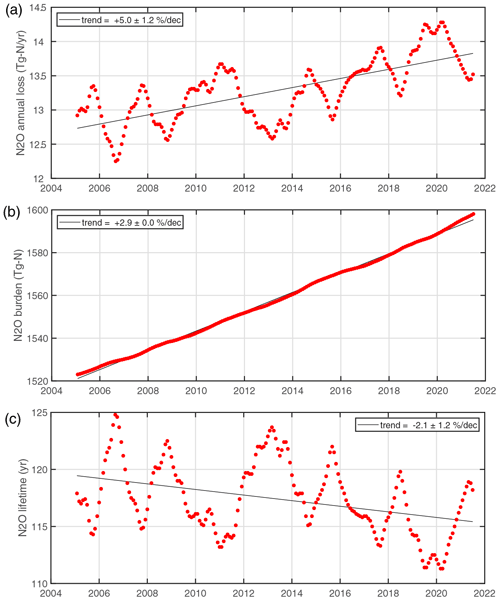
From satellite data for nitrous oxide (N2O), ozone and temperature, we calculate the monthly loss of N2O and find it is increasing faster than expected, resulting in a shorter lifetime, which reduces the impact of anthropogenic emissions. We identify the cause as enhanced vertical lofting of high-N2O air into the tropical middle stratosphere, where it is destroyed photochemically. Because global warming is due in part to N2O, this finding presents a new negative climate-chemistry feedback.
Thomas von Clarmann, Norbert Glatthor, Udo Grabowski, Bernd Funke, Michael Kiefer, Anne Kleinert, Gabriele P. Stiller, Andrea Linden, and Sylvia Kellmann
Atmos. Meas. Tech., 15, 6991–7018, https://doi.org/10.5194/amt-15-6991-2022, https://doi.org/10.5194/amt-15-6991-2022, 2022
Short summary
Short summary
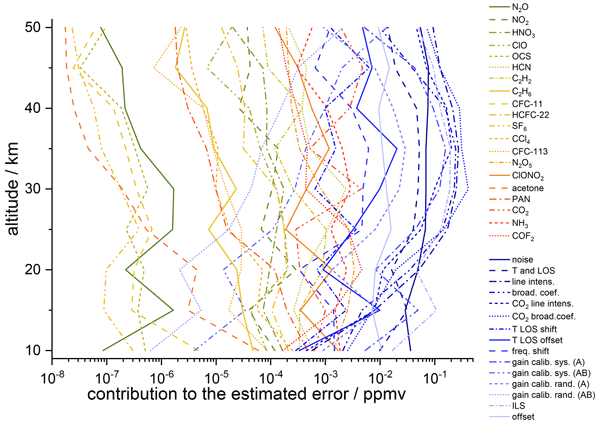
Errors of profiles of temperature and mixing ratios retrieved from spectra recorded with the Michelson Interferometer for Passive Atmospheric Sounding are estimated. All known and quantified sources of uncertainty are considered. Some ongoing uncertaities contribute to both the random and to the systematic errors. In some cases, one source of uncertainty propagates onto the error budget via multiple pathways. Problems arise when the correlations of errors to be propagated are unknown.
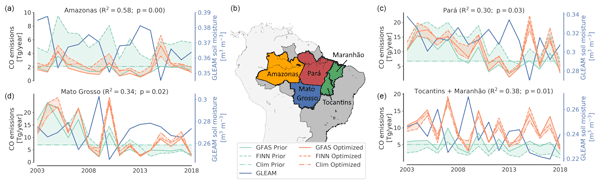
Stijn Naus, Lucas G. Domingues, Maarten Krol, Ingrid T. Luijkx, Luciana V. Gatti, John B. Miller, Emanuel Gloor, Sourish Basu, Caio Correia, Gerbrand Koren, Helen M. Worden, Johannes Flemming, Gabrielle Pétron, and Wouter Peters
Atmos. Chem. Phys., 22, 14735–14750, https://doi.org/10.5194/acp-22-14735-2022, https://doi.org/10.5194/acp-22-14735-2022, 2022
Short summary
Short summary
We assimilate MOPITT CO satellite data in the TM5-4D-Var inverse modelling framework to estimate Amazon fire CO emissions for 2003–2018. We show that fire emissions have decreased over the analysis period, coincident with a decrease in deforestation rates. However, interannual variations in fire emissions are large, and they correlate strongly with soil moisture. Our results reveal an important role for robust, top-down fire CO emissions in quantifying and attributing Amazon fire intensity.
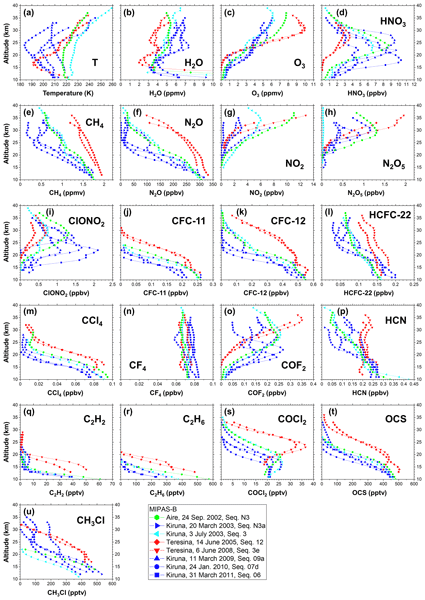
Gerald Wetzel, Michael Höpfner, Hermann Oelhaf, Felix Friedl-Vallon, Anne Kleinert, Guido Maucher, Miriam Sinnhuber, Janna Abalichin, Angelika Dehn, and Piera Raspollini
Atmos. Meas. Tech., 15, 6669–6704, https://doi.org/10.5194/amt-15-6669-2022, https://doi.org/10.5194/amt-15-6669-2022, 2022
Short summary
Short summary
Satellite measurements of stratospheric trace gases are essential for monitoring distributions and trends of these species on a global scale. Here, we compare the final MIPAS ESA Level 2 version 8 data (temperature and trace gases) with measurements obtained with the balloon version of MIPAS in terms of data agreement of both sensors, including combined errors. For most gases, we find a 5 % to 20 % agreement of the retrieved vertical profiles of both MIPAS instruments in the lower stratosphere.
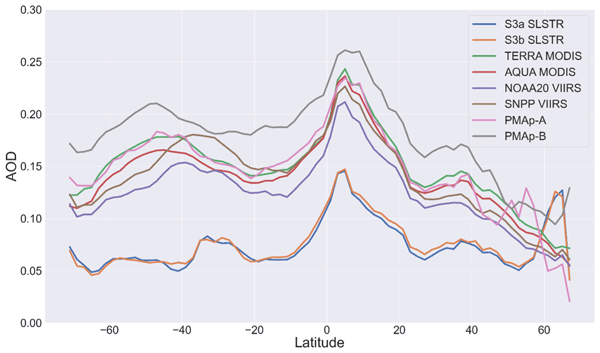
Sebastien Garrigues, Samuel Remy, Julien Chimot, Melanie Ades, Antje Inness, Johannes Flemming, Zak Kipling, Istvan Laszlo, Angela Benedetti, Roberto Ribas, Soheila Jafariserajehlou, Bertrand Fougnie, Shobha Kondragunta, Richard Engelen, Vincent-Henri Peuch, Mark Parrington, Nicolas Bousserez, Margarita Vazquez Navarro, and Anna Agusti-Panareda
Atmos. Chem. Phys., 22, 14657–14692, https://doi.org/10.5194/acp-22-14657-2022, https://doi.org/10.5194/acp-22-14657-2022, 2022
Short summary
Short summary
The Copernicus Atmosphere Monitoring Service (CAMS) provides global monitoring of aerosols using the ECMWF forecast model constrained by the assimilation of satellite aerosol optical depth (AOD). This work aims at evaluating two new satellite AODs to enhance the CAMS aerosol global forecast. It highlights the spatial and temporal differences between the satellite AOD products at the model spatial resolution, which is essential information to design multi-satellite AOD data assimilation schemes.

Antje Inness, Ilse Aben, Melanie Ades, Tobias Borsdorff, Johannes Flemming, Luke Jones, Jochen Landgraf, Bavo Langerock, Philippe Nedelec, Mark Parrington, and Roberto Ribas
Atmos. Chem. Phys., 22, 14355–14376, https://doi.org/10.5194/acp-22-14355-2022, https://doi.org/10.5194/acp-22-14355-2022, 2022
Short summary
Short summary
The Copernicus Atmosphere Monitoring Service (CAMS) provides daily global air quality forecasts to users worldwide. One of the species of interest is carbon monoxide (CO), an important trace gas in the atmosphere with anthropogenic and natural sources, produced by incomplete combustion, for example, by wildfires. This paper looks at how well CAMS can model CO in the atmosphere and shows that the fields can be improved when blending CO data from the TROPOMI instrument with the CAMS model.
Klaus-Peter Heue, Diego Loyola, Fabian Romahn, Walter Zimmer, Simon Chabrillat, Quentin Errera, Jerry Ziemke, and Natalya Kramarova
Atmos. Meas. Tech., 15, 5563–5579, https://doi.org/10.5194/amt-15-5563-2022, https://doi.org/10.5194/amt-15-5563-2022, 2022
Short summary
Short summary
To retrieve tropospheric ozone column information, we subtract stratospheric column data of BASCOE from TROPOMI/S5P total ozone columns.
The new S5P-BASCOE data agree well with existing tropospheric data like OMPS-MERRA-2. The data are also compared to ozone soundings.
The tropospheric ozone columns show the expected temporal and spatial patterns. We will also apply the algorithm to future UV nadir missions like Sentinel 4 or 5 or to recent and ongoing missions like GOME_2 or OMI.
Vincent Huijnen, Philippe Le Sager, Marcus O. Köhler, Glenn Carver, Samuel Rémy, Johannes Flemming, Simon Chabrillat, Quentin Errera, and Twan van Noije
Geosci. Model Dev., 15, 6221–6241, https://doi.org/10.5194/gmd-15-6221-2022, https://doi.org/10.5194/gmd-15-6221-2022, 2022
Short summary
Short summary
We report on the first implementation of atmospheric chemistry and aerosol as part of the OpenIFS model, based on the CAMS global model. We give an overview of the model and evaluate two reference model configurations, with and without the stratospheric chemistry extension, against a variety of observational datasets. This OpenIFS version with atmospheric composition components is open to the scientific user community under a standard OpenIFS license.
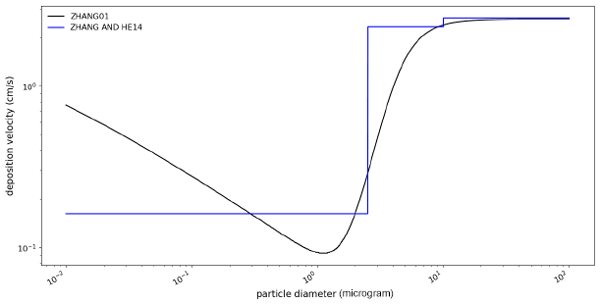
Samuel Rémy, Zak Kipling, Vincent Huijnen, Johannes Flemming, Pierre Nabat, Martine Michou, Melanie Ades, Richard Engelen, and Vincent-Henri Peuch
Geosci. Model Dev., 15, 4881–4912, https://doi.org/10.5194/gmd-15-4881-2022, https://doi.org/10.5194/gmd-15-4881-2022, 2022
Short summary
Short summary
This article describes a new version of IFS-AER, the tropospheric aerosol scheme used to provide global aerosol products within the Copernicus Atmosphere Monitoring Service (CAMS) cycle. Several components of the model have been updated, such as the dynamical dust and sea salt aerosol emission schemes. New deposition schemes have also been incorporated but are not yet used operationally. This new version of IFS-AER has been evaluated and shown to have a greater skill than previous versions.
Jason E. Williams, Vincent Huijnen, Idir Bouarar, Mehdi Meziane, Timo Schreurs, Sophie Pelletier, Virginie Marécal, Beatrice Josse, and Johannes Flemming
Geosci. Model Dev., 15, 4657–4687, https://doi.org/10.5194/gmd-15-4657-2022, https://doi.org/10.5194/gmd-15-4657-2022, 2022
Short summary
Short summary
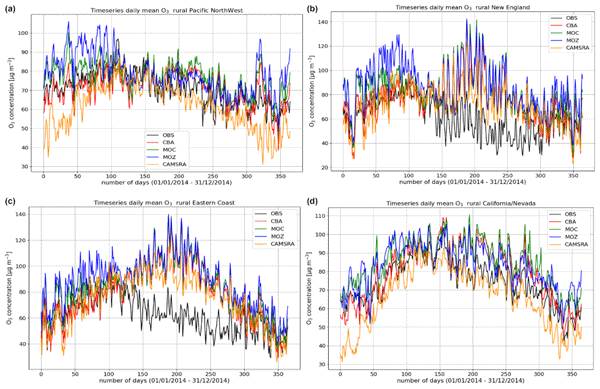
The global CAMS air quality model is used for providing tropospheric ozone information to end users. This paper updates the chemical mechanism employed (CBA) and compares it against two other mechanisms (MOCAGE, MOZART) and a multi-decadal dataset based on a previous version of CBA. We perform extensive validation for the US using multiple surface and aircraft datasets, providing an assessment of biases and the extent of correlation across different seasons during 2014.
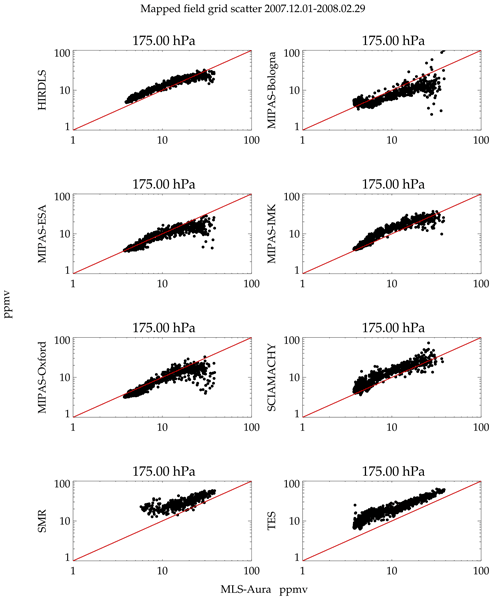
William G. Read, Gabriele Stiller, Stefan Lossow, Michael Kiefer, Farahnaz Khosrawi, Dale Hurst, Holger Vömel, Karen Rosenlof, Bianca M. Dinelli, Piera Raspollini, Gerald E. Nedoluha, John C. Gille, Yasuko Kasai, Patrick Eriksson, Christopher E. Sioris, Kaley A. Walker, Katja Weigel, John P. Burrows, and Alexei Rozanov
Atmos. Meas. Tech., 15, 3377–3400, https://doi.org/10.5194/amt-15-3377-2022, https://doi.org/10.5194/amt-15-3377-2022, 2022
Short summary
Short summary
This paper attempts to provide an assessment of the accuracy of 21 satellite-based instruments that remotely measure atmospheric humidity in the upper troposphere of the Earth's atmosphere. The instruments made their measurements from 1984 to the present time; however, most of these instruments began operations after 2000, and only a few are still operational. The objective of this study is to quantify the accuracy of each satellite humidity data set.
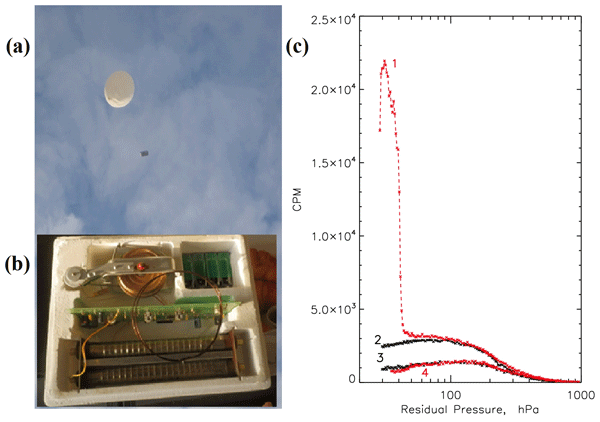
Irina Mironova, Miriam Sinnhuber, Galina Bazilevskaya, Mark Clilverd, Bernd Funke, Vladimir Makhmutov, Eugene Rozanov, Michelle L. Santee, Timofei Sukhodolov, and Thomas Ulich
Atmos. Chem. Phys., 22, 6703–6716, https://doi.org/10.5194/acp-22-6703-2022, https://doi.org/10.5194/acp-22-6703-2022, 2022
Short summary
Short summary
From balloon measurements, we detected unprecedented, extremely powerful, electron precipitation over the middle latitudes. The robustness of this event is confirmed by satellite observations of electron fluxes and chemical composition, as well as by ground-based observations of the radio signal propagation. The applied chemistry–climate model shows the almost complete destruction of ozone in the mesosphere over the region where high-energy electrons were observed.
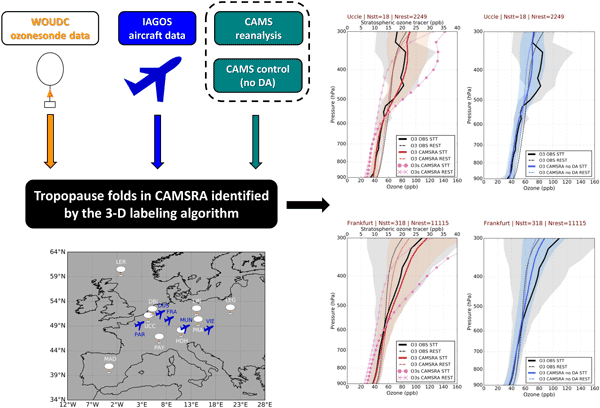
Dimitris Akritidis, Andrea Pozzer, Johannes Flemming, Antje Inness, Philippe Nédélec, and Prodromos Zanis
Atmos. Chem. Phys., 22, 6275–6289, https://doi.org/10.5194/acp-22-6275-2022, https://doi.org/10.5194/acp-22-6275-2022, 2022
Short summary
Short summary
We perform a process-oriented evaluation of Copernicus Atmosphere Monitoring Service (CAMS) reanalysis (CAMSRA) O3 over Europe using WOUDC (World Ozone and Ultraviolet Radiation Data Centre) ozonesondes and IAGOS (In-service Aircraft for a Global Observing System) aircraft measurements. Chemical data assimilation assists CAMSRA to reproduce the observed O3 increases in the troposphere during the examined folding events, but it mostly results in O3 overestimation in the upper troposphere.
Alexandra Laeng, Thomas von Clarmann, Quentin Errera, Udo Grabowski, and Shawn Honomichl
Atmos. Meas. Tech., 15, 2407–2416, https://doi.org/10.5194/amt-15-2407-2022, https://doi.org/10.5194/amt-15-2407-2022, 2022
Short summary
Short summary
In validation exercises, a universal excuse used to explain the residual discrepancy between the data is the natural atmospheric variability due to imperfect co-locations. This work is the first attempt to quantify this atmospheric variability for a large sample of atmospheric constituents and to provide the user with a tool to substract the natural atmospheric variability portion from the residual variability.
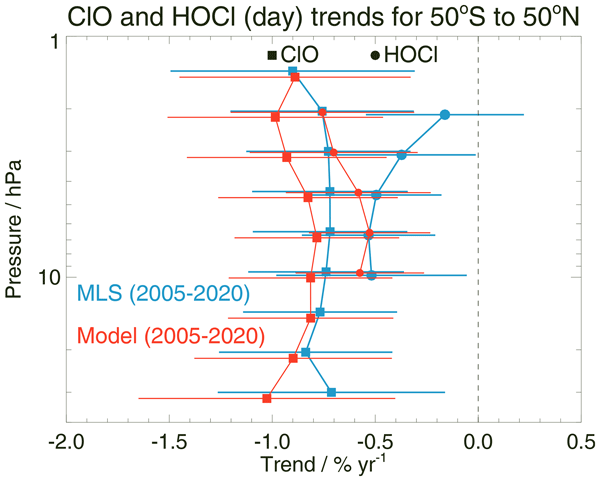
Lucien Froidevaux, Douglas E. Kinnison, Michelle L. Santee, Luis F. Millán, Nathaniel J. Livesey, William G. Read, Charles G. Bardeen, John J. Orlando, and Ryan A. Fuller
Atmos. Chem. Phys., 22, 4779–4799, https://doi.org/10.5194/acp-22-4779-2022, https://doi.org/10.5194/acp-22-4779-2022, 2022
Short summary
Short summary
We analyze satellite-derived distributions of chlorine monoxide (ClO) and hypochlorous acid (HOCl) in the upper atmosphere. For 2005–2020, from 50°S to 50°N and over ~30 to 45 km, ClO and HOCl decreased by −0.7 % and −0.4 % per year, respectively. A detailed model of chemistry and dynamics agrees with the results. These decreases confirm the effectiveness of the 1987 Montreal Protocol, which limited emissions of chlorine- and bromine-containing source gases, in order to protect the ozone layer.

Beatriz M. Monge-Sanz, Alessio Bozzo, Nicholas Byrne, Martyn P. Chipperfield, Michail Diamantakis, Johannes Flemming, Lesley J. Gray, Robin J. Hogan, Luke Jones, Linus Magnusson, Inna Polichtchouk, Theodore G. Shepherd, Nils Wedi, and Antje Weisheimer
Atmos. Chem. Phys., 22, 4277–4302, https://doi.org/10.5194/acp-22-4277-2022, https://doi.org/10.5194/acp-22-4277-2022, 2022
Short summary
Short summary
The stratosphere is emerging as one of the keys to improve tropospheric weather and climate predictions. This study provides evidence of the role the stratospheric ozone layer plays in improving weather predictions at different timescales. Using a new ozone modelling approach suitable for high-resolution global models that provide operational forecasts from days to seasons, we find significant improvements in stratospheric meteorological fields and stratosphere–troposphere coupling.
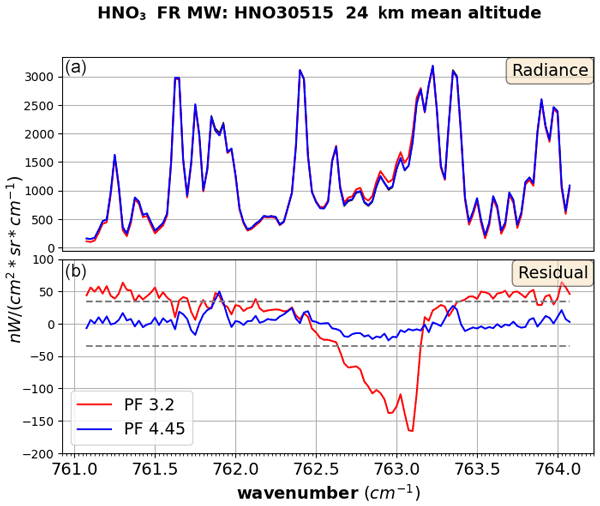
Piera Raspollini, Enrico Arnone, Flavio Barbara, Massimo Bianchini, Bruno Carli, Simone Ceccherini, Martyn P. Chipperfield, Angelika Dehn, Stefano Della Fera, Bianca Maria Dinelli, Anu Dudhia, Jean-Marie Flaud, Marco Gai, Michael Kiefer, Manuel López-Puertas, David P. Moore, Alessandro Piro, John J. Remedios, Marco Ridolfi, Harjinder Sembhi, Luca Sgheri, and Nicola Zoppetti
Atmos. Meas. Tech., 15, 1871–1901, https://doi.org/10.5194/amt-15-1871-2022, https://doi.org/10.5194/amt-15-1871-2022, 2022
Short summary
Short summary
The MIPAS instrument onboard the ENVISAT satellite provided 10 years of measurements of the atmospheric emission al limb that allow for the retrieval of latitude- and altitude-resolved atmospheric composition. We describe the improvements implemented in the retrieval algorithm used for the full mission reanalysis, which allows for the generation of the global distributions of 21 atmospheric constituents plus temperature with increased accuracy with respect to previously generated data.
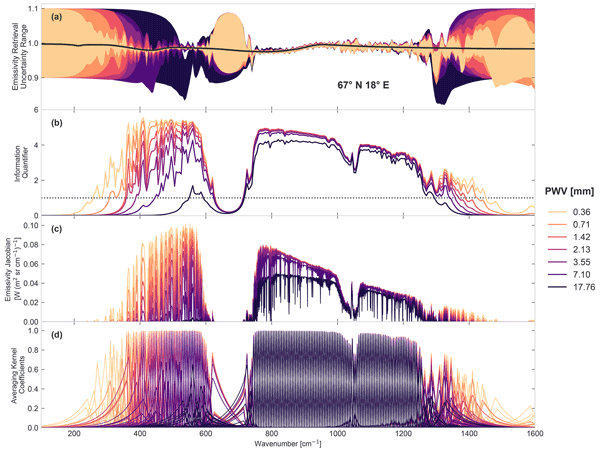
Maya Ben-Yami, Hilke Oetjen, Helen Brindley, William Cossich, Dulce Lajas, Tiziano Maestri, Davide Magurno, Piera Raspollini, Luca Sgheri, and Laura Warwick
Atmos. Meas. Tech., 15, 1755–1777, https://doi.org/10.5194/amt-15-1755-2022, https://doi.org/10.5194/amt-15-1755-2022, 2022
Short summary
Short summary
Spectral emissivity is a key property of the Earth's surface. Few measurements exist in the far-infrared, despite recent work showing that its contribution is important for accurate modelling of global climate. In preparation for ESA’s EE9 FORUM mission (launch in 2026), this study takes the first steps towards the development of an operational emissivity retrieval for FORUM by investigating the sensitivity of the emissivity product to different physical and operational parameters.
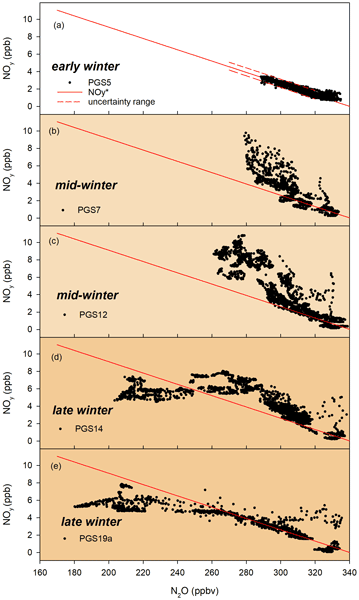
Helmut Ziereis, Peter Hoor, Jens-Uwe Grooß, Andreas Zahn, Greta Stratmann, Paul Stock, Michael Lichtenstern, Jens Krause, Vera Bense, Armin Afchine, Christian Rolf, Wolfgang Woiwode, Marleen Braun, Jörn Ungermann, Andreas Marsing, Christiane Voigt, Andreas Engel, Björn-Martin Sinnhuber, and Hermann Oelhaf
Atmos. Chem. Phys., 22, 3631–3654, https://doi.org/10.5194/acp-22-3631-2022, https://doi.org/10.5194/acp-22-3631-2022, 2022
Short summary
Short summary
Airborne observations were conducted in the lowermost Arctic stratosphere during the winter of 2015/2016. The observed distribution of reactive nitrogen shows clear indications of nitrification in mid-winter and denitrification in late winter. This was caused by the formation of polar stratospheric cloud particles, which were observed during several flights. The sedimentation and evaporation of these particles and the descent of air masses cause a redistribution of reactive nitrogen.
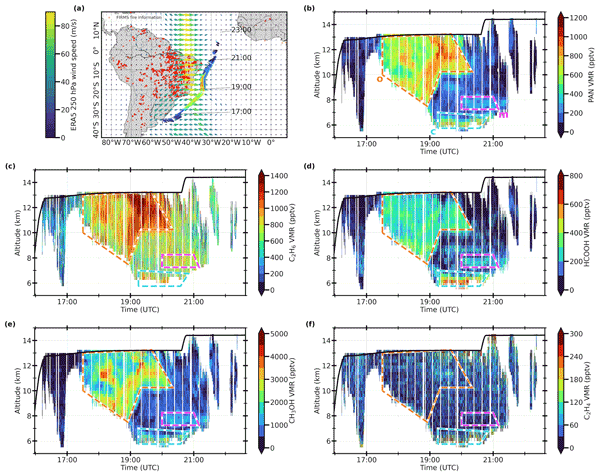
Sören Johansson, Gerald Wetzel, Felix Friedl-Vallon, Norbert Glatthor, Michael Höpfner, Anne Kleinert, Tom Neubert, Björn-Martin Sinnhuber, and Jörn Ungermann
Atmos. Chem. Phys., 22, 3675–3691, https://doi.org/10.5194/acp-22-3675-2022, https://doi.org/10.5194/acp-22-3675-2022, 2022
Short summary
Short summary
We present GLORIA airborne cross sections of PAN, C2H6, HCOOH, CH3OH, and C2H4 in the South Atlantic UTLS in September/October 2019. Filamentary structures and a large plume were observed. Backward trajectories indicate that measured pollutants come from South America and central Africa. Comparisons to CAMS show structural agreement of the measured distributions. PAN absolute VMRs agree with the GLORIA measurements, C2H6 and HCOOH are simulated too low, and CH3OH and C2H4 are too high.
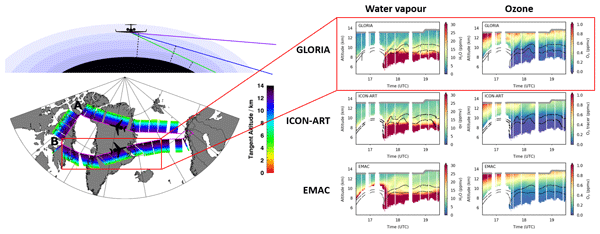
Florian Haenel, Wolfgang Woiwode, Jennifer Buchmüller, Felix Friedl-Vallon, Michael Höpfner, Sören Johansson, Farahnaz Khosrawi, Oliver Kirner, Anne Kleinert, Hermann Oelhaf, Johannes Orphal, Roland Ruhnke, Björn-Martin Sinnhuber, Jörn Ungermann, Michael Weimer, and Peter Braesicke
Atmos. Chem. Phys., 22, 2843–2870, https://doi.org/10.5194/acp-22-2843-2022, https://doi.org/10.5194/acp-22-2843-2022, 2022
Short summary
Short summary
We compare remote sensing observations of H2O, O3, HNO3 and clouds in the upper troposphere–lowermost stratosphere during an Arctic winter long-range research flight with simulations by two different state-of-the-art model systems. We find good agreement for dynamical structures, trace gas distributions and clouds. We investigate model biases and sensitivities, with the goal of aiding model development and improving our understanding of processes in the upper troposphere–lowermost stratosphere.
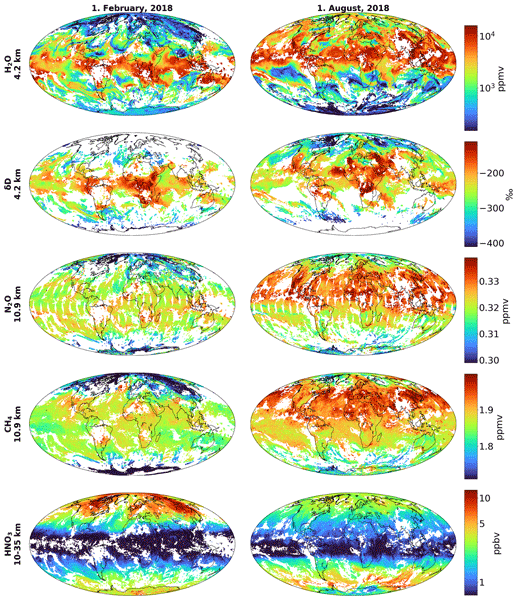
Matthias Schneider, Benjamin Ertl, Christopher J. Diekmann, Farahnaz Khosrawi, Andreas Weber, Frank Hase, Michael Höpfner, Omaira E. García, Eliezer Sepúlveda, and Douglas Kinnison
Earth Syst. Sci. Data, 14, 709–742, https://doi.org/10.5194/essd-14-709-2022, https://doi.org/10.5194/essd-14-709-2022, 2022
Short summary
Short summary
We present atmospheric H2O, HDO / H2O ratio, N2O, CH4, and HNO3 data generated by the MUSICA IASI processor using thermal nadir spectra measured by the IASI satellite instrument. The data have global daily coverage and are available for the period between October 2014 and June 2021. Multiple possibilities of data reuse are offered by providing each individual data product together with information about retrieval settings and the products' uncertainty and vertical representativeness.
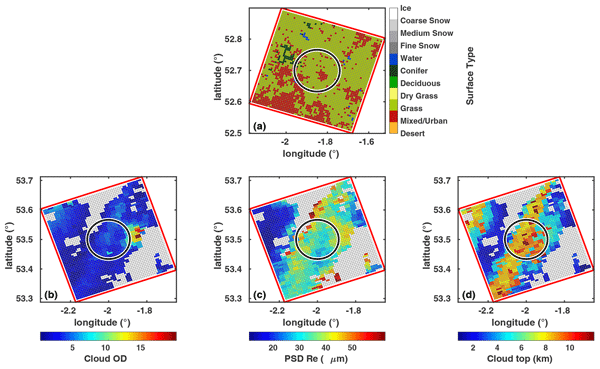
Luca Sgheri, Claudio Belotti, Maya Ben-Yami, Giovanni Bianchini, Bernardo Carnicero Dominguez, Ugo Cortesi, William Cossich, Samuele Del Bianco, Gianluca Di Natale, Tomás Guardabrazo, Dulce Lajas, Tiziano Maestri, Davide Magurno, Hilke Oetjen, Piera Raspollini, and Cristina Sgattoni
Atmos. Meas. Tech., 15, 573–604, https://doi.org/10.5194/amt-15-573-2022, https://doi.org/10.5194/amt-15-573-2022, 2022
Short summary
Short summary
The FORUM instrument will look at the Earth's atmosphere from a satellite, covering a spectral range responsible for about 95 % of the radiation lost by our planet. FORUM helps to measure the imbalance between incoming and outgoing radiation that is responsible for the increasing average temperatures on Earth. The end-to-end simulator is a chain of codes that simulates the FORUM measurement process. The goal of the project is to study how the instrument reacts to different retrieval conditions.
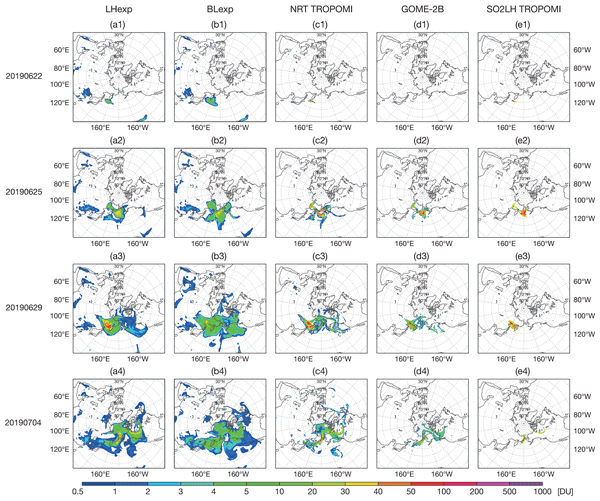
Antje Inness, Melanie Ades, Dimitris Balis, Dmitry Efremenko, Johannes Flemming, Pascal Hedelt, Maria-Elissavet Koukouli, Diego Loyola, and Roberto Ribas
Geosci. Model Dev., 15, 971–994, https://doi.org/10.5194/gmd-15-971-2022, https://doi.org/10.5194/gmd-15-971-2022, 2022
Short summary
Short summary
This paper describes the way that the Copernicus Atmosphere Monitoring Service (CAMS) produces forecasts of volcanic SO2. These forecasts are provided routinely every day. They are created by blending SO2 data from satellite instruments (TROPOMI and GOME-2) with the CAMS model. We show that the quality of the CAMS SO2 forecasts can be improved if additional information about the height of volcanic plumes is provided in the satellite data.
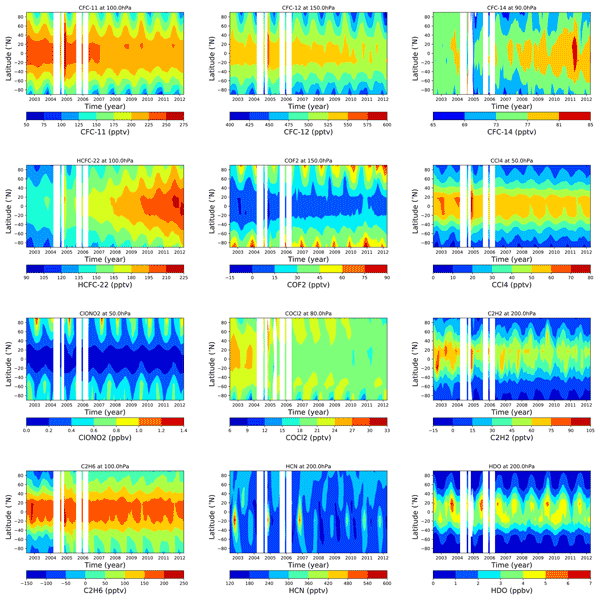
Bianca Maria Dinelli, Piera Raspollini, Marco Gai, Luca Sgheri, Marco Ridolfi, Simone Ceccherini, Flavio Barbara, Nicola Zoppetti, Elisa Castelli, Enzo Papandrea, Paolo Pettinari, Angelika Dehn, Anu Dudhia, Michael Kiefer, Alessandro Piro, Jean-Marie Flaud, Manuel López-Puertas, David Moore, John Remedios, and Massimo Bianchini
Atmos. Meas. Tech., 14, 7975–7998, https://doi.org/10.5194/amt-14-7975-2021, https://doi.org/10.5194/amt-14-7975-2021, 2021
Short summary
Short summary
The level-2 v8 database from the measurements of the Michelson Interferometer for Passive Atmospheric Sounding (MIPAS), aboard the European Space Agency Envisat satellite, containing atmospheric fields of pressure, temperature, and volume mixing ratio of 21 trace gases, is described in this paper. The database covers all the measurements acquired by MIPAS (from July 2002 to April 2012). The number of species included makes it of particular importance for the studies of stratospheric chemistry.
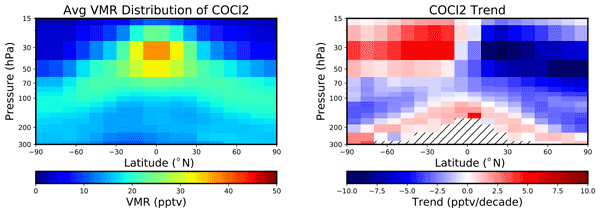
Paolo Pettinari, Flavio Barbara, Simone Ceccherini, Bianca Maria Dinelli, Marco Gai, Piera Raspollini, Luca Sgheri, Massimo Valeri, Gerald Wetzel, Nicola Zoppetti, and Marco Ridolfi
Atmos. Meas. Tech., 14, 7959–7974, https://doi.org/10.5194/amt-14-7959-2021, https://doi.org/10.5194/amt-14-7959-2021, 2021
Short summary
Short summary
Phosgene (COCl2) is a toxic gas whose presence is a consequence of human activity. Besides its direct injection in the troposphere, stratospheric COCl2 is produced from the decomposition of CCl4, an anthropogenic gas regulated by the Montreal Protocol. As a consequence, COCl2 negative trends characterize the lower and part of the middle stratosphere. However, we find positive trends in the upper troposphere, demonstrating the non-negligible role of other Cl-containing species not yet regulated.
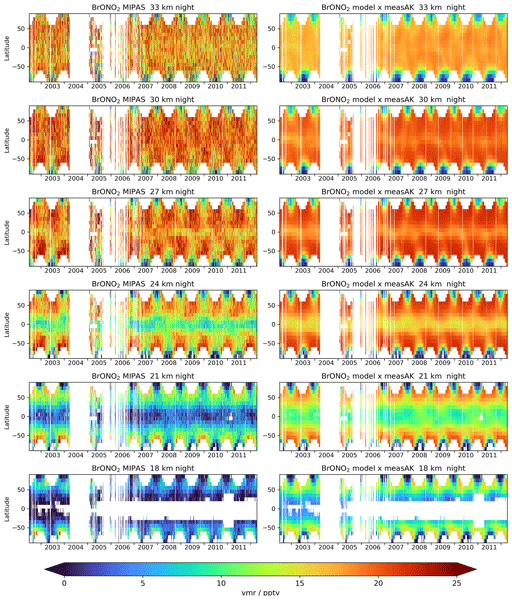
Michael Höpfner, Oliver Kirner, Gerald Wetzel, Björn-Martin Sinnhuber, Florian Haenel, Sören Johansson, Johannes Orphal, Roland Ruhnke, Gabriele Stiller, and Thomas von Clarmann
Atmos. Chem. Phys., 21, 18433–18464, https://doi.org/10.5194/acp-21-18433-2021, https://doi.org/10.5194/acp-21-18433-2021, 2021
Short summary
Short summary
BrONO2 is an important reservoir gas for inorganic stratospheric bromine linked to the chemical cycles of stratospheric ozone depletion. Presently infrared limb sounding is the only way to measure BrONO2 in the atmosphere. We provide global distributions of BrONO2 derived from MIPAS observations 2002–2012. Comparisons with EMAC atmospheric modelling show an overall agreement and enable us to derive an independent estimate of stratospheric bromine of 21.2±1.4pptv based on the BrONO2 measurements.
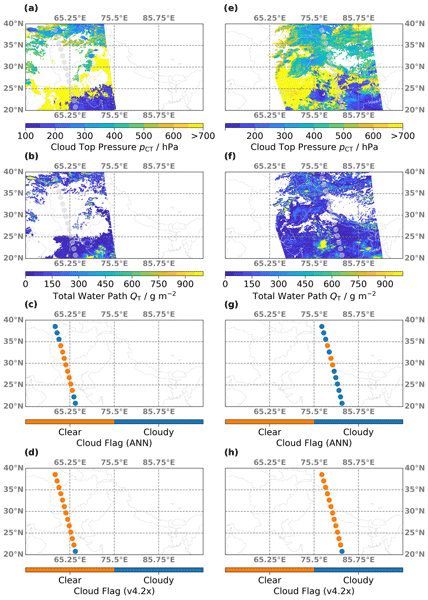
Frank Werner, Nathaniel J. Livesey, Michael J. Schwartz, William G. Read, Michelle L. Santee, and Galina Wind
Atmos. Meas. Tech., 14, 7749–7773, https://doi.org/10.5194/amt-14-7749-2021, https://doi.org/10.5194/amt-14-7749-2021, 2021
Short summary
Short summary
In this study we present an improved cloud detection scheme for the Microwave Limb Sounder, which is based on a feedforward artificial neural network. This new algorithm is shown not only to reliably detect high and mid-level convection containing even small amounts of cloud water but also to distinguish between high-reaching and mid-level to low convection.

Hugh C. Pumphrey, Michael J. Schwartz, Michelle L. Santee, George P. Kablick III, Michael D. Fromm, and Nathaniel J. Livesey
Atmos. Chem. Phys., 21, 16645–16659, https://doi.org/10.5194/acp-21-16645-2021, https://doi.org/10.5194/acp-21-16645-2021, 2021
Short summary
Short summary
Forest fires in British Columbia in August 2017 caused an unusual phenomonon: smoke and gases from the fires rose quickly to a height of 10 km. From there, the pollution continued to rise more slowly for many weeks, travelling around the world as it did so. In this paper, we describe how we used data from a satellite instrument to observe this polluted volume of air. The satellite has now been working for 16 years but has observed only three events of this type.
Cited articles
Abalos, M., Orbe, C., Kinnison, D. E., Plummer, D., Oman, L. D., Jöckel, P., Morgenstern, O., Garcia, R. R., Zeng, G., Stone, K. A., and Dameris, M.: Future trends in stratosphere-to-troposphere transport in CCMI models, Atmos. Chem. Phys., 20, 6883–6901, https://doi.org/10.5194/acp-20-6883-2020, 2020. a
Abida, R., Attié, J.-L., El Amraoui, L., Ricaud, P., Lahoz, W., Eskes, H., Segers, A., Curier, L., de Haan, J., Kujanpää, J., Nijhuis, A. O., Tamminen, J., Timmermans, R., and Veefkind, P.: Impact of spaceborne carbon monoxide observations from the S-5P platform on tropospheric composition analyses and forecasts, Atmos. Chem. Phys., 17, 1081–1103, https://doi.org/10.5194/acp-17-1081-2017, 2017. a
Arola, A., Basart, S., Benedictow, A., Bennouna, Y., Blechschmidt, A.-M., Bouarar, I., Cuevas, E., Errera, Q., Eskes, H., Griesfeller, J., Kapsomenakis, J., Langerock, B., Mortier, A., Pison, I., Pitkänen, M., Ramonet, M., Richter, A., Schulz, M., Tarniewicz, J., Thouret, V., Tsikerdekis, A., Warneke, T., and Zerefos, C.: Validation report of the CAMS near-real-time global atmospheric composition service: December 2021–February 2022, cAMS2_82 o-suite quarterly report, Copernicus atmosphere monitoring service (CAMS) report, https://doi.org/10.24380/9z4h-5niy, 2022. a, b
Bland, J., Gray, S., Methven, J., and Forbes, R.: Characterising extratropical near-tropopause analysis humidity biases and their radiative effects on temperature forecasts, Q. J. R. Meteorol. Soc., 147, 3878–3898, https://doi.org/10.1002/qj.4150, 2021. a
Boone, C., Bernath, P., and Lecours, M.: Version 5 retrievals for ACE-FTS and ACE-imagers, J. Quant. Spectrosc. Radiat. Transf., 310, 108749, https://doi.org/10.1016/j.jqsrt.2023.108749, 2023. a
Butchart, N.: The Brewer-Dobson circulation, Rev. Geophys., 52, 157–184, https://doi.org/10.1002/2013RG000448, 2014. a
Charlesworth, E., Plöger, F., Birner, T., Baikhadzhaev, R., Abalos, M., Abraham, N. L., Akiyoshi, H., Bekki, S., Dennison, F., Jöckel, P., Keeble, J., Kinnison, D., Morgenstern, O., Plummer, D., Rozanov, E., Strode, S., Zeng, G., Egorova, T., and Riese, M.: Stratospheric water vapor affecting atmospheric circulation, Nat. Commun., 14, 3925, https://doi.org/10.1038/s41467-023-39559-2, 2023. a
Claeyman, M., Attié, J.-L., Peuch, V.-H., El Amraoui, L., Lahoz, W. A., Josse, B., Joly, M., Barré, J., Ricaud, P., Massart, S., Piacentini, A., von Clarmann, T., Höpfner, M., Orphal, J., Flaud, J.-M., and Edwards, D. P.: A thermal infrared instrument onboard a geostationary platform for CO and O3 measurements in the lowermost troposphere: Observing System Simulation Experiments (OSSE), Atmos. Meas. Tech., 4, 1637–1661, https://doi.org/10.5194/amt-4-1637-2011, 2011. a
Duncan, D. I., Bormann, N., Geer, A. J., and Weston, P.: Superobbing and Thinning Scales for All-Sky Humidity Sounder Assimilation, Mon. Weather Rev., 152, 1821–1837, https://doi.org/10.1175/MWR-D-24-0020.1, 2024. a
Errera, Q., Dekemper, E., Baker, N., Debosscher, J., Demoulin, P., Mateshvili, N., Pieroux, D., Vanhellemont, F., and Fussen, D.: On the capability of the future ALTIUS ultraviolet–visible–near-infrared limb sounder to constrain modelled stratospheric ozone, Atmos. Meas. Tech., 14, 4737–4753, https://doi.org/10.5194/amt-14-4737-2021, 2021. a, b, c
Errera, Q., Funke, B., Hoffmann, A., Höpfner, M., Raspollini, P., Sinnhuber, B.-M., and Walker, K.: Extended Reference Scenarios (ERS) for the ESA Earth Explorer 11 candidate CAIRT (Changing Atmosphere Infra-Red Tomography explorer), in preparation, 2026. a
ESA: Earth Observation Mission Software File Format Specification, Reference: PE-ID-ESA-GS-584, Issue: 1, Revision: 9, https://eop-cfi.esa.int/Repo/PUBLIC/DOCUMENTATION/SYSTEM_SUPPORT_DOCS/PE-ID-ESA-GS-584-EO_Mission_SW_File_Format_Specs_latest.pdf (last access: 9 April 2026), 2024. a
ESA: ESA Mission CFI Software, https://eop-cfi.esa.int/index.php/mission-cfi-software/eocfi-software (last access: 9 April 2026), 2025b. a
ESA: Earth Observation Mission CFI Software, Quick Start Guide, Code EO-MA-DMS-GS-0009, Issue: 4.29, https://eop-cfi.esa.int/Repo/PUBLIC/DOCUMENTATION/CFI/EOCFI/BRANCH_4X/releases/4.29/QuickStartGuide_4.29.pdf (last access: 9 April 2026), 2025c. a
Eskes, H. J., van Velthoven, P. F. J., Valks, P. J. M., and Kelder, H. M.: Assimilation of GOME total-ozone satellite observations in a three-dimensional tracer-transport model, Q. J. R. Meteorol. Soc., 129, 1663–1681, https://doi.org/10.1256/qj.02.14, 2003. a
Fischer, H., Birk, M., Blom, C., Carli, B., Carlotti, M., von Clarmann, T., Delbouille, L., Dudhia, A., Ehhalt, D., Endemann, M., Flaud, J. M., Gessner, R., Kleinert, A., Koopman, R., Langen, J., López-Puertas, M., Mosner, P., Nett, H., Oelhaf, H., Perron, G., Remedios, J., Ridolfi, M., Stiller, G., and Zander, R.: MIPAS: an instrument for atmospheric and climate research, Atmos. Chem. Phys., 8, 2151–2188, https://doi.org/10.5194/acp-8-2151-2008, 2008. a
Flemming, J., Huijnen, V., Arteta, J., Bechtold, P., Beljaars, A., Blechschmidt, A.-M., Diamantakis, M., Engelen, R. J., Gaudel, A., Inness, A., Jones, L., Josse, B., Katragkou, E., Marecal, V., Peuch, V.-H., Richter, A., Schultz, M. G., Stein, O., and Tsikerdekis, A.: Tropospheric chemistry in the Integrated Forecasting System of ECMWF, Geosci. Model Dev., 8, 975–1003, https://doi.org/10.5194/gmd-8-975-2015, 2015. a
Friedl-Vallon, F., Gulde, T., Hase, F., Kleinert, A., Kulessa, T., Maucher, G., Neubert, T., Olschewski, F., Piesch, C., Preusse, P., Rongen, H., Sartorius, C., Schneider, H., Schönfeld, A., Tan, V., Bayer, N., Blank, J., Dapp, R., Ebersoldt, A., Fischer, H., Graf, F., Guggenmoser, T., Höpfner, M., Kaufmann, M., Kretschmer, E., Latzko, T., Nordmeyer, H., Oelhaf, H., Orphal, J., Riese, M., Schardt, G., Schillings, J., Sha, M. K., Suminska-Ebersoldt, O., and Ungermann, J.: Instrument concept of the imaging Fourier transform spectrometer GLORIA, Atmos. Meas. Tech., 7, 3565–3577, https://doi.org/10.5194/amt-7-3565-2014, 2014. a
Gettelman, A., Mills, M. J., Kinnison, D. E., Garcia, R. R., Smith, A. K., Marsh, D. R., Tilmes, S., Vitt, F., Bardeen, C. G., McInerny, J., Liu, H.-L., Solomon, S. C., Polvani, L. M., Emmons, L. K., Lamarque, J.-F., Richter, J. H., Glanville, A. S., Bacmeister, J. T., Phillips, A. S., Neale, R. B., Simpson, I. R., DuVivier, A. K., Hodzic, A., and Randel, W. J.: The Whole Atmosphere Community Climate Model Version 6 (WACCM6), J. Geophys. Res., 124, 12380–12403, https://doi.org/10.1029/2019JD030943, 2019. a
Hegglin, M. I. and Shepherd, T. G.: Large climate-induced changes in ultraviolet index and stratosphere-to-troposphere ozone flux, Nat. Geosci., 2, https://doi.org/10.1038/NGEO604, 2009. a
Hoffman, R. N.: The Effect of Thinning and Superobservations in a Simple One-Dimensional Data Analysis with Mischaracterized Error, Mon. Weather Rev., 146, 1181–1195, https://doi.org/10.1175/MWR-D-17-0363.1, 2018. a
Hsu, J. and Prather, M. J.: Stratospheric variability and tropospheric ozone, J. Geophys. Res., 114, https://doi.org/10.1029/2008JD010942, 2009. a
Kramarova, N. A., Xu, P., Mok, J., Bhartia, P. K., Jaross, G., Moy, L., Chen, Z., Frith, S., DeLand, M., Kahn, D., Labow, G., Li, J., Nyaku, E., Weaver, C., Ziemke, J., Davis, S., and Jia, Y.: Decade-Long Ozone Profile Record From Suomi NPP OMPS Limb Profiler: Assessment of Version 2.6 Data, Astr. Soc. P., 11, https://doi.org/10.1029/2024EA003707, 2024. a
Lacis, A. A., Wuebbles, D. J., and Logan, J. A.: Radiative forcing of climate by changes in the vertical distribution of ozone, J. Geophys. Res., 95, 9971–9981, https://doi.org/10.1029/JD095iD07p09971, 1990. a
Li, F., Waugh, D. W., Douglass, A. R., Newman, P. A., Strahan, S. E., Ma, J., Nielsen, J. E., and Liang, Q.: Long-term changes in stratospheric age spectra in the 21st century in the Goddard Earth Observing System Chemistry-Climate Model (GEOSCCM), J. Geophys. Res., 117, https://doi.org/10.1029/2012JD017905, 2012. a
Livesey, N. J., Read, W. G., Wagner, P. A., Froidevaux, L., Santee, M., Schwartz, M. J., Lambert, A., Millán Valle, L. F., Pumphrey, H. C., Manney, G. L., Fuller, R. A., Jarnot, R. F., Knosp, B. W., and Lay, R. R.: Earth Observing System (EOS) Aura Microwave Limb Sounder (MLS) Version 5.0x Level 2 and 3 data quality and description document, Tech. Rep. D-105336 Rev. B, JPL, https://mls.jpl.nasa.gov/data/v5-0_data_quality_document.pdf (last access: 9 April 2026), 2022. a, b, c
Masutani, M., Schlatter, T. W., Errico, R. M., Stoffelen, A., Andersson, E., Lahoz, W., Woollen, J. S., Emmitt, G. D., Riishøjgaard, L.-P., and Lord, S. J.: Observing System Simulation Experiments, in: Data Assimilation, edited by: Lahoz, W., Khattatov, B., and Menard, R., Springer Berlin Heidelberg, ISBN 978-3-540-74702-4, 647–679, https://doi.org/10.1007/978-3-540-74703-1_24, 2010. a
McLandress, C. and Shepherd, T. G.: Simulated Anthropogenic Changes in the Brewer–Dobson Circulation, Including Its Extension to High Latitudes, J. Climate, 22, 1516–1540, https://doi.org/10.1175/2008JCLI2679.1, 2009. a
Millán, L., Santee, M. L., Lambert, A., Livesey, N. J., Werner, F., Schwartz, M. J., Pumphrey, H. C., Manney, G. L., Wang, Y., Su, H., Wu, L., Read, W. G., and Froidevaux, L.: The Hunga Tonga-Hunga Ha'apai Hydration of the Stratosphere, Geophys. Res. Lett., 49, e2022GL099381, https://doi.org/10.1029/2022GL099381, 2022. a
Murphy, D. M. and Koop, T.: Review of the vapour pressures of ice and supercooled water for atmospheric applications, Q. J. Roy. Meteor. Soc., 131, 1539–1565, https://doi.org/10.1256/qj.04.94, 2005. a
Norton, R. H. and Beer, R.: New apodizing functions for Fourier spectrometry, J. Opt. Soc. Am., 66, 259–264, https://doi.org/10.1364/JOSA.66.000259, 1976. a
Norton, R. H. and Beer, R.: Errata: New Apodizing Functions For Fourier Spectrometry, J. Opt. Soc. Am., 67, 419–419, https://doi.org/10.1364/JOSA.67.000419, 1977. a
Poli, G. and Errera, Q.: CAIRT simulated orbit during 2020, Zenodo [data set], https://doi.org/10.5281/zenodo.10262729, 2023. a
Riese, M., Ploeger, F., Rap, A., Vogel, B., Konopka, P., Dameris, M., and Forster, P.: Impact of uncertainties in atmospheric mixing on simulated UTLS composition and related radiative effects, J. Geophys. Res., 117, https://doi.org/10.1029/2012JD017751, 2012. a, b
Riese, M., Oelhaf, H., Preusse, P., Blank, J., Ern, M., Friedl-Vallon, F., Fischer, H., Guggenmoser, T., Höpfner, M., Hoor, P., Kaufmann, M., Orphal, J., Plöger, F., Spang, R., Suminska-Ebersoldt, O., Ungermann, J., Vogel, B., and Woiwode, W.: Gimballed Limb Observer for Radiance Imaging of the Atmosphere (GLORIA) scientific objectives, Atmos. Meas. Tech., 7, 1915–1928, https://doi.org/10.5194/amt-7-1915-2014, 2014. a
Rijsdijk, P., Eskes, H., Dingemans, A., Boersma, K. F., Sekiya, T., Miyazaki, K., and Houweling, S.: Quantifying uncertainties in satellite NO2 superobservations for data assimilation and model evaluation, Geosci. Model Dev., 18, 483–509, https://doi.org/10.5194/gmd-18-483-2025, 2025. a
Semane, N. and Bonavita, M.: Reintroducing the analysis of humidity in the stratosphere, ECMWF Newsletter, 28–31, https://doi.org/10.21957/ns41h80kl3, 2025. a
Sinnhuber, B.-M., Chipperfield, M. P., Dinelli, B. M., Errera, Q., Friedl-Vallon, F., Funke, B., Godin-Beekmann, S., Hoffmann, A., Holm, E., Höpfner, M., Malavart, A., Monge-Sanz, B. M., Op de beeck, M., Osprey, S., Papandrea, E., Polichtchouk, I., Preusse, P., Raspollini, P., Rhode, S., Riese, M., Sellitto, P., Ungermann, J., Vervalcke, S., Verronen, P., Voet, F., and Walker, K. A.: The Changing-Atmosphere Infrared Tomography Explorer CAIRT – an infrared limb-imaging satellite concept to chart the middle atmosphere in the climate system, B. Am. Meteorol. Soc., accepted, 2026. a
Solomon, S., Rosenlof, K. H., Portmann, R. W., Daniel, J. S., Davis, S. M., Sanford, T. J., and Plattner, G.-K.: Contributions of Stratospheric Water Vapor to Decadal Changes in the Rate of Global Warming, Science, 327, 1219–1223, https://doi.org/10.1126/science.1182488, 2010. a
SPARC: The SPARC Data Initiative: Assessment of stratospheric trace gas and aerosol climatologies from satellite limb sounders, edited by: Hegglin, M. I. and Tegtmeier, S., SPARC Report No. 8, https://doi.org/10.3929/ethz-a-010863911, 2017. a
Steck, T., Höpfner, M., von Clarmann, T., and Grabowski, U.: Tomographic retrieval of atmospheric parameters from infrared limb emission observations, Appl. Opt., 44, 3291–3301, https://doi.org/10.1364/AO.44.003291, 2005. a
Stiller, G.: The Karlsruhe Optimized and Precise Radiative transfer Algorithm (KOPRA), Tech. rep., Froschungszentrum Karlsruhe, https://doi.org/10.5445/IR/270048971, 2000. a
Timmermans, R., Lahoz, W., Attié, J.-L., Peuch, V.-H., Curier, R., Edwards, D., Eskes, H., and Builtjes, P.: Observing System Simulation Experiments for air quality, Atmos. Environ., 115, 199–213, https://doi.org/10.1016/j.atmosenv.2015.05.032, 2015. a, b
Wang, H. J. R., Damadeo, R., Flittner, D., Kramarova, N., Taha, G., Davis, S., Thompson, A. M., Strahan, S., Wang, Y., Froidevaux, L., Degenstein, D., Bourassa, A., Steinbrecht, W., Walker, K. A., Querel, R., Leblanc, T., Godin-Beekmann, S., Hurst, D., and Hall, E.: Validation of SAGE III/ISS Solar Occultation Ozone Products With Correlative Satellite and Ground-Based Measurements, J. Geophys. Res., 125, e2020JD032430, https://doi.org/10.1029/2020JD032430, 2020. a
Short summary
The Changing Atmosphere Infra-Red Tomography Explorer (CAIRT) is a satellite mission concept developed to observe, among other, the gradient of ozone and water vapour in the upper troposphere and lower stratosphere where these species have their largest radiative impact. By simulating CAIRT observations and measuring their constrain on an atmospheric model using data assimilation, this study shows that CAIRT specifications are adequate to fulfil this objective.
The Changing Atmosphere Infra-Red Tomography Explorer (CAIRT) is a satellite mission concept...


