
Articles | Volume 19, issue 12
https://doi.org/10.5194/amt-19-4335-2026
© Author(s) 2026. This work is distributed under
the Creative Commons Attribution 4.0 License.
the Creative Commons Attribution 4.0 License.
https://doi.org/10.5194/amt-19-4335-2026
© Author(s) 2026. This work is distributed under
the Creative Commons Attribution 4.0 License.
the Creative Commons Attribution 4.0 License.
Research article
| 
01 Jul 2026
Research article |
| 01 Jul 2026
| 01 Jul 2026
Ground-based MFRSR UV-Vis spectral retrievals of Saharan dust absorption at Izaña Observatory

Morgan State University, Baltimore, MD, United States
NASA Goddard Space Flight Center, Greenbelt, MD, United States
Nickolay Krotkov
NASA Goddard Space Flight Center, Greenbelt, MD, United States
Omar Torres
NASA Goddard Space Flight Center, Greenbelt, MD, United States
Jungbin Mok
Science Systems and Applications, Inc., Lanham, MD, United States
Gordon Labow
Science Systems and Applications, Inc., Lanham, MD, United States
Elena Lind
NASA Goddard Space Flight Center, Greenbelt, MD, United States
Tom Eck
University of Maryland, Baltimore County, GESTAR-II, Baltimore, MD, United States
NASA Goddard Space Flight Center, Greenbelt, MD, United States
Wei Gao
USDA UV-B Monitoring and Research Program, Natural Resource Ecology Laboratory, Colorado State University, Fort Collins, Colorado, United States
George Janson
USDA UV-B Monitoring and Research Program, Natural Resource Ecology Laboratory, Colorado State University, Fort Collins, Colorado, United States
Scott Simpson
USDA UV-B Monitoring and Research Program, Natural Resource Ecology Laboratory, Colorado State University, Fort Collins, Colorado, United States
Darrin Sharp
USDA UV-B Monitoring and Research Program, Natural Resource Ecology Laboratory, Colorado State University, Fort Collins, Colorado, United States
Kathy Lantz
Global Monitoring Laboratory (GML), Radiation, Aerosol, and Cloud Division (GRAD), NOAA, Boulder, Colorado, United States
Charles Wilson
Global Monitoring Laboratory (GML), Radiation, Aerosol, and Cloud Division (GRAD), NOAA, Boulder, Colorado, United States
Africa Barreto
Izaña Atmospheric Research Center (IARC), State Meteorological Agency (AEMET), Santa Cruz de Tenerife, Spain
Group of Atmospheric Optics, University of Valladolid, Valladolid, Spain
Rosa García
TRAGSATEC, Madrid, Spain
Izaña Atmospheric Research Center (IARC), State Meteorological Agency (AEMET), Santa Cruz de Tenerife, Spain
Sergey Korkin
University of Maryland, Baltimore County, GESTAR-II, Baltimore, MD, United States
NASA Goddard Space Flight Center, Greenbelt, MD, United States
David Flittner
NASA Langley Atmospheric Research Center, Hampton, VA, United States
Related authors
Lorraine A. Remer, Hiren Jethva, Shana Mattoo, Omar Torres, Yingxi Rona Shi, Vinay Kayetha, Woogyung Vincent Kim, Jaehwa Lee, Robert C. Levy, and N. Christina Hsu
EGUsphere, https://doi.org/10.5194/egusphere-2026-3731, https://doi.org/10.5194/egusphere-2026-3731, 2026
Short summary
Short summary
Here we demonstrate a new method to characterize aerosols from data measured by the Ocean Color Instrument (OCI) aboard NASA's Plankton, Aerosol, Clouds, ocean Ecosystem (PACE) observatory. OCI's broad spectrum that ranges from the ultraviolet through the shortwave infrared provides more information about the aerosols than previous satellite sensors commonly used to characterize aerosol. Novel parameters include aerosol light absorption, aerosol above clouds and the height of the aerosol layer.
Hiren T. Jethva, Omar Torres, Richard A. Ferrare, Sharon P. Burton, Anthony L. Cook, David B. Harper, Chris A. Hostetler, Jens Redemann, Vinay Kayetha, Samuel LeBlanc, Kristina Pistone, Logan Mitchell, and Connor J. Flynn
Atmos. Meas. Tech., 17, 2335–2366, https://doi.org/10.5194/amt-17-2335-2024, https://doi.org/10.5194/amt-17-2335-2024, 2024
Short summary
Short summary
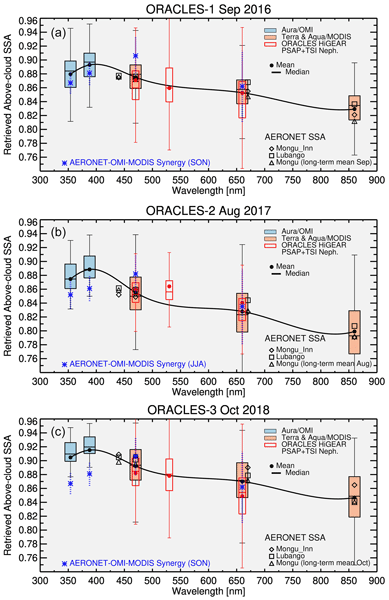
We introduce a novel synergy algorithm applied to ORALCES airborne measurements of above-cloud aerosol optical depth and UV–Vis satellite observations from OMI and MODIS to retrieve spectral aerosol single-scattering albedo of lofted layers of carbonaceous smoke aerosols over clouds. The development of the proposed aerosol–cloud algorithm implies a possible synergy of CALIOP and OMI–MODIS passive sensors to deduce a global product of AOD and SSA of absorbing aerosols above clouds.
Vinay Kayetha, Omar Torres, and Hiren Jethva
Atmos. Meas. Tech., 15, 845–877, https://doi.org/10.5194/amt-15-845-2022, https://doi.org/10.5194/amt-15-845-2022, 2022
Short summary
Short summary
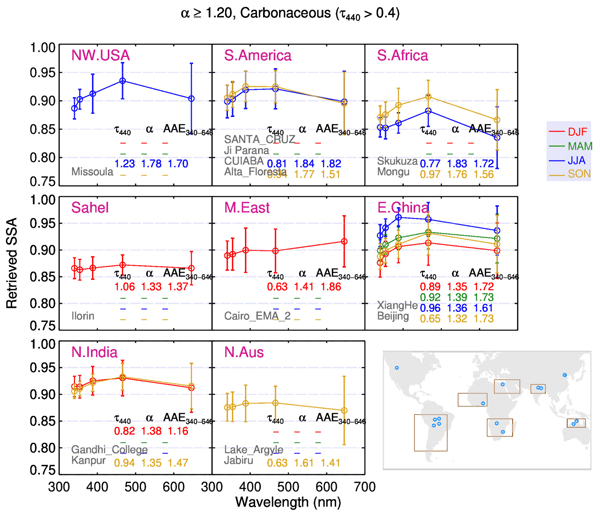
Existing measurements of spectral aerosol absorption are limited, particularly in the UV region. We use the synergy of satellite and ground measurements to derive spectral single scattering albedo of aerosols from the UV–visible spectrum. The resulting spectral SSAs are used to investigate seasonality in absorption for carbonaceous, dust, and urban aerosols. Regional aerosol absorption models that could be used to make reliable assumptions in satellite remote sensing of aerosols are derived.
Xiaoyi Zhao, Vitali Fioletov, Irina Petropavlovskikh, Voltaire Velazco, Alberto Redondas, Anna Solomatnikova, Corinne Vigouroux, Kimberly Strong, Michel Van Roozendael, Andrea Pazmino, Thomas F. Hanisco, Alexander Cede, Martin Tiefengraber, Gordon Labow, Masatomo Fujiwara, Ronald van der A, Debora Griffin, Chris McLinden, Tom Kralidis, Wolfgang Steinbrecht, and Sum Chi Lee
Atmos. Chem. Phys., 26, 13693–13720, https://doi.org/10.5194/acp-26-13693-2026, https://doi.org/10.5194/acp-26-13693-2026, 2026
Short summary
Short summary
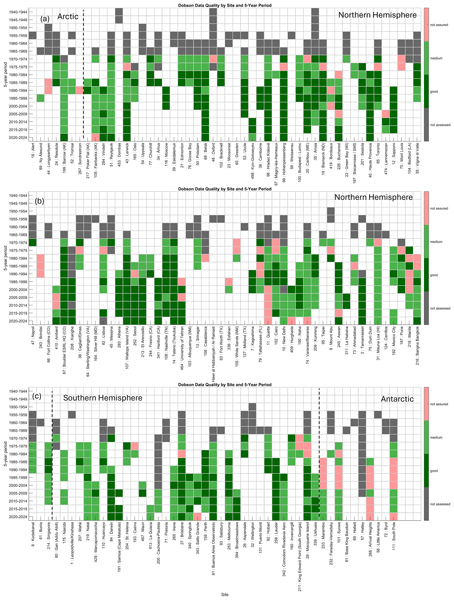
Total column ozone (TCO) records from six ground-based networks are compiled and evaluated using multiple satellites and reanalysis data. Station performance (1940–2024) is assessed using harmonized metrics. Ground-based annual means agree within ±2 %, while pre-satellite reanalyses show larger biases (up to −5 %). The resulting quality-assessed dataset supports trend analysis and satellite validation.

Alexander Sinyuk, Thomas F. Eck, Ilya Slutsker, Jasper Lewis, Petar Grigorov, Alexander Smirnov, Joel S. Schafer, Mikhail Sorokin, Elena Lind, and Pawan Gupta
Atmos. Meas. Tech., 19, 6125–6144, https://doi.org/10.5194/amt-19-6125-2026, https://doi.org/10.5194/amt-19-6125-2026, 2026
Short summary
Short summary
The new technique for the clouds screening of aerosol optical depth is presented. It employs measurements of the sky radiances at smallest scattering angle to detect cirrus clouds which otherwise are difficult to detect by other methods. The method employs the smoothness of the time series of measurements throughout a day as a criterion for cloud-free conditions. Sharp spikes in the time series are detected and associated with clouds.
Thomas F. Eck, Jeffrey S. Reid, Alexander Sinyuk, Pawan Gupta, Antti Arola, Ilya Slutsker, Brent N. Holben, Philippe Goloub, Oleg Dubovik, Joel S. Schafer, Mikhail G. Sorokin, Alexander Smirnov, Hongbin Yu, Dongchul Kim, Elena Lind, Jason Kraft, Elizabeth A. Reid, Aboubacry Diallo, Thierno Ndiaye, Africa Barreto, Sidi Baika, Lahouari Zeudmi-Sahraoui, Francisco Evora, Gael Dubois, Luc Blarel, Rachel T. Pinker, Isaac Abiodun Adimula, Jean Louis Rajot, Aliko Maman, Muguette Allegre, Cassandra Gaston, Peter Sealy, Edmund Blades, Rebecca Chewitt-Lucas, Ian Lau, David Barker, Adel Saad Alshihiween, Abdulrahman Alsaferan, Odbayar Mishigdorj, and Chogsom Jargalsaixan
EGUsphere, https://doi.org/10.5194/egusphere-2026-5531, https://doi.org/10.5194/egusphere-2026-5531, 2026
This preprint is open for discussion and under review for Atmospheric Chemistry and Physics (ACP).
Short summary
Short summary
The optical properties of airborne soil particles from major desert regions measured by ground based remote sensing retrievals are presented. The relative spectral absorption of these particles from the remote sensing data agree very well with absorption of soil dust samples measured in a laboratory. A large fraction of the optical effects were attributed to relatively small submicron sized dust particles which would also be more easily inhalable and therefore may impact human health.
Lorraine A. Remer, Hiren Jethva, Shana Mattoo, Omar Torres, Yingxi Rona Shi, Vinay Kayetha, Woogyung Vincent Kim, Jaehwa Lee, Robert C. Levy, and N. Christina Hsu
EGUsphere, https://doi.org/10.5194/egusphere-2026-3731, https://doi.org/10.5194/egusphere-2026-3731, 2026
Short summary
Short summary
Here we demonstrate a new method to characterize aerosols from data measured by the Ocean Color Instrument (OCI) aboard NASA's Plankton, Aerosol, Clouds, ocean Ecosystem (PACE) observatory. OCI's broad spectrum that ranges from the ultraviolet through the shortwave infrared provides more information about the aerosols than previous satellite sensors commonly used to characterize aerosol. Novel parameters include aerosol light absorption, aerosol above clouds and the height of the aerosol layer.
Apoorva Pandey, Bryan K. Place, Thomas F. Hanisco, Jong-Uk Park, Elena S. Lind, Jason M. St. Clair, Erin R. Delaria, Glenn M. Wolfe, Ronaldo Lopez, Paul V. Zimba, and K. Lee Thornhill
EGUsphere, https://doi.org/10.5194/egusphere-2026-3479, https://doi.org/10.5194/egusphere-2026-3479, 2026
Short summary
Short summary
The burden and vertical distribution of formaldehyde affects air quality and health. Pandora ground instruments observe formaldehyde in the lower atmosphere using scattered sunlight. The quality of these continuous daytime measurements needs evaluation. We compared these measurements with aircraft observations at four U.S. East Coast sites and found strong agreement at all comparison sites. We also improved the Pandora algorithm to better capture the vertical distribution of formaldehyde.
Rosa D. García, África Barreto, Victoria E. Cachorro, Pablo González-Sicilia, Sergio Léon-Luis, Ayoze Álvarez-Hernández, Juan José Bustos, Ramón Ramos, Fernando Almansa, Óscar Álvarez-Losada, Yenny González, Pedro Pablo Rivas, and Carlos Javier Torres
Atmos. Meas. Tech., 19, 3151–3167, https://doi.org/10.5194/amt-19-3151-2026, https://doi.org/10.5194/amt-19-3151-2026, 2026
Short summary
Short summary
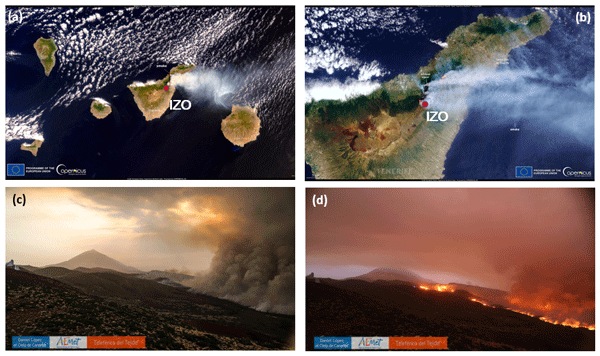
This study presents a unique near-source observational analysis of the spectral radiative effects of extreme biomass-burning aerosols during the August 2023 wildfire on Tenerife (Canary Islands, Spain). The exceptional proximity of the wildfire to the Izaña Observatory (2400 m a.s.l.) enabled a rare characterisation of aerosol optical properties, spectral solar irradiance, and surface radiative forcing under free-tropospheric conditions.
Joel Schafer, Thomas F. Eck, Ilya Slutsker, Pawan Gupta, Mikhail Sorokin, Alexander Sinyuk, and Alexander Smirnov
EGUsphere, https://doi.org/10.5194/egusphere-2026-1506, https://doi.org/10.5194/egusphere-2026-1506, 2026
Short summary
Short summary
A global network of ground-based instruments has been using moonlight to measure atmospheric aerosols at night, producing the world's largest such dataset. By developing a correction method that accounts for the Moon's complex and variable brightness, nighttime measurements now agree with daytime measurements to a high accuracy. This capability is critical because nighttime pollution can differ meaningfully from daytime levels.
África Barreto, Francisco Quirós, Omaira E. García, Jorge Pereda-de-Pablo, Daniel González-Fernández, Andrés Bedoya-Velásquez, Michael Sicard, Carmen Córdoba-Jabonero, Marco Iarlori, Vincenzo Rizi, Nickolay Krotkov, Simon Carn, Reijo Roininen, Antonio J. Molina-Arias, A. Fernando Almansa, Óscar Álvarez-Losada, Carla Aramo, Juan José Bustos, Romain Ceolato, Adolfo Comerón, Alicia Felpeto, Rosa D. García, Pablo González-Sicilia, Yenny González, Pascal Hedelt, Miguel Hernández, María-Ángeles López-Cayuela, Diego Loyola, Stavros Meletlidis, Constantino Muñoz-Porcar, Ermanno Pietropaolo, Ramón Ramos, Alejandro Rodríguez-Gómez, Roberto Román, Pedro M. Romero-Campos, Martin Stuefer, Carlos Toledano, and Ellsworth J. Welton
Atmos. Meas. Tech., 19, 1385–1406, https://doi.org/10.5194/amt-19-1385-2026, https://doi.org/10.5194/amt-19-1385-2026, 2026
Short summary
Short summary
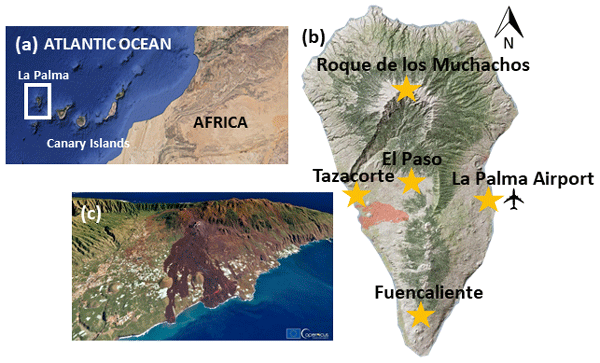
This manuscript describes the instrumental coverage deployed during the Tajogaite eruption (19 September–25 December 2021) by the Instituto Geográfico Nacional (IGN), the Spanish State Meteorological Agency (AEMET), and other Spanish members of ACTRIS (Aerosol, Clouds and Trace Gases Research Infrastructure) to monitor its atmospheric impact. Two complementary methods provide consistent plume height data for future operational surveillance.
Davis Earley, Elena Lind, James Flynn, Subin Yoon, Sergio Alvarez, and Travis Griggs
EGUsphere, https://doi.org/10.5194/egusphere-2025-5179, https://doi.org/10.5194/egusphere-2025-5179, 2026
Short summary
Short summary
This paper focuses on the relationship between concentrations of trace gases measured at the surface and path averaged concentrations, known as vertical column densities, to produce a column to surface ratio, which is an estimation of the effective height of each trace gas’s vertical profile. In addition, sensitivity studies are performed to analyze the effect of uncertain aerosol information on the estimation of air mass factors through radiative transfer simulations.

Robert J. D. Spurr, Matt Christi, Nickolay A. Krotkov, Won-Ei Choi, Simon Carn, Can Li, Natalya Kramarova, David Haffner, Eun-Su Yang, Nick Gorkavyi, Alexander Vasilkov, Krzysztof Wargan, Omar Torres, Diego Loyola, Serena Di Pede, J. Pepijn Veefkind, Parker Case, Thomas Schroeder, and Pawan K. Bhartia
Atmos. Meas. Tech., 19, 993–1021, https://doi.org/10.5194/amt-19-993-2026, https://doi.org/10.5194/amt-19-993-2026, 2026
Short summary
Short summary
The submarine eruption of the Hunga volcano released water vapor and sulfur dioxide directly into the stratosphere. The sulfur dioxide formed sulfuric acid aerosols leading to increased scattering of solar ultraviolet radiation (UV), interfering with satellite ozone retrievals. We present a new satellite technique for deriving the amount and height of Hunga aerosols from UV measurements, revealing an unusually low sulfuric acid concentration due to the water-rich conditions in the fresh plume.
Simone Pulimeno, Angelo Lupi, Vito Vitale, Claudia Frangipani, Carlos Toledano, Stelios Kazadzis, Natalia Kouremeti, Christoph Ritter, Sandra Graßl, Kerstin Stebel, Vitali Fioletov, Ihab Abboud, Sandra Blindheim, Lynn Ma, Norm O'Neill, Piotr Sobolewski, Pawan Gupta, Elena Lind, Thomas F. Eck, Antti Hyvärinen, Veijo Aaltonen, Rigel Kivi, Janae Csavina, Dmitry Kabanov, Sergey M. Sakerin, Olga R. Sidorova, Robert S. Stone, Hagen Telg, Laura Riihimaki, Raul R. Cordero, Martin Radenz, Ronny Engelmann, Michel Van Roozendal, Anatoli Chaikovsky, Philippe Goloub, Junji Hisamitsu, and Mauro Mazzola
Atmos. Chem. Phys., 26, 1809–1846, https://doi.org/10.5194/acp-26-1809-2026, https://doi.org/10.5194/acp-26-1809-2026, 2026
Short summary
Short summary
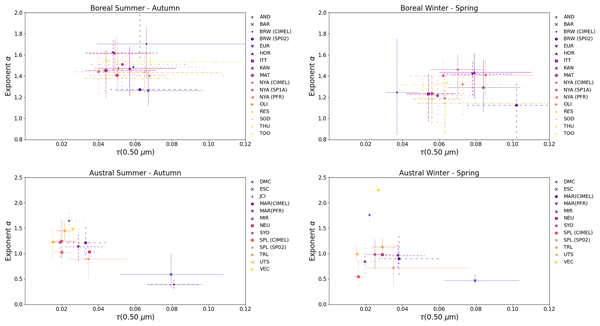
This study analyzed aerosols optical properties over the Arctic and Antarctic to measure them even during long periods of darkness. It found that pollution in the Arctic is decreasing, likely due to European emission regulations, while wildfires are becoming a more important source of particles. In Antarctica, particle levels are higher near the coast than inland, and vary by season. These results help us better understand how air pollution and climate are changing at the Earth’s poles.
Sujan Shrestha, Robert E. Holz, Willem J. Marais, Zachary Buckholtz, Ilya Razenkov, Edwin Eloranta, Jeffrey S. Reid, Hope E. Elliott, Nurun Nahar Lata, Zezhen Cheng, Swarup China, Edmund Blades, Albert D. Ortiz, Rebecca Chewitt-Lucas, Alyson Allen, Devon Blades, Ria Agrawal, Elizabeth A. Reid, Jesus Ruiz-Plancarte, Anthony Bucholtz, Ryan Yamaguchi, Qing Wang, Thomas Eck, Elena Lind, Mira L. Pöhlker, Andrew P. Ault, and Cassandra J. Gaston
Atmos. Chem. Phys., 26, 983–999, https://doi.org/10.5194/acp-26-983-2026, https://doi.org/10.5194/acp-26-983-2026, 2026
Short summary
Short summary
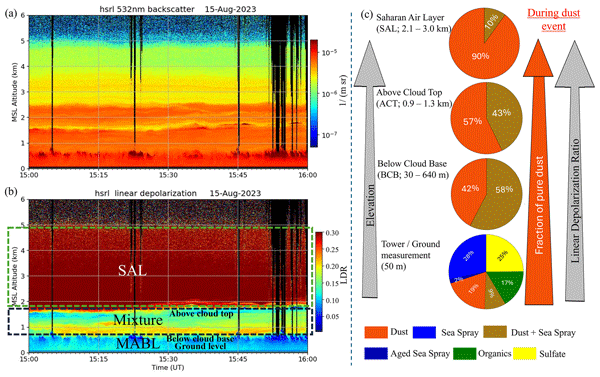
Coordinated observations from MAGPIE 2023 show that Saharan dust in the marine atmospheric boundary layer becomes internally mixed with sea spray. This mixing increases particle sphericity and hygroscopicity, likely leading to suppressed lidar linear depolarization ratios despite high dust concentrations. The findings have key implications for interpreting lidar-derived dust retrievals, estimating surface dust from satellite products, and improving dust representation in models.
Benjamin Torres, Luc Blarel, Philippe Goloub, Gaël Dubois, Maria Fernanda Sanchez-Barrero, Ioana Elisabeta Popovici, Fabrice Maupin, Elena Lind, Alexander Smirnov, Ilya Slutsker, Julien Chimot, Ramiro González, Michaël Sicard, Jean Marc Metzger, and Pierre Tulet
Atmos. Meas. Tech., 18, 4809–4838, https://doi.org/10.5194/amt-18-4809-2025, https://doi.org/10.5194/amt-18-4809-2025, 2025
Short summary
Short summary
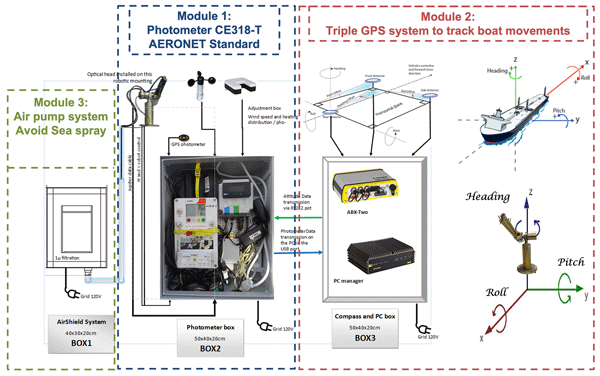
This study shows that it is possible to automatically monitor atmospheric aerosols from research vessels using automated instruments, following the same standards as AERONET (AErosol RObotic NETwork) land-based stations. By collecting 3 years of data in the Indian Ocean, we demonstrate that high-quality measurements can be made, even on a moving platform. These results open new possibilities for observing aerosols over the ocean and improving satellite data and climate studies.
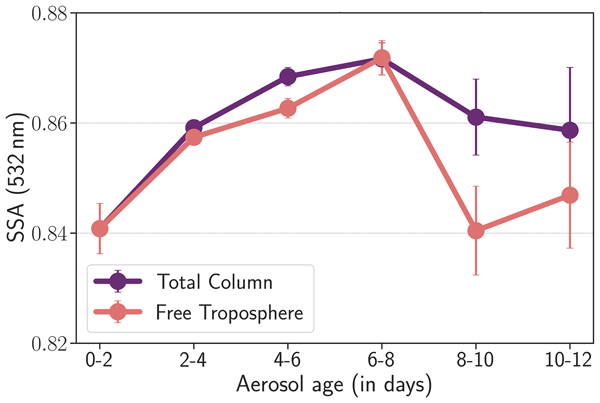
Abdulamid A. Fakoya, Jens Redemann, Pablo E. Saide, Lan Gao, Logan T. Mitchell, Calvin Howes, Amie Dobracki, Ian Chang, Gonzalo A. Ferrada, Kristina Pistone, Samuel E. Leblanc, Michal Segal-Rozenhaimer, Arthur J. Sedlacek III, Thomas Eck, Brent Holben, Pawan Gupta, Elena Lind, Paquita Zuidema, Gregory Carmichael, and Connor J. Flynn
Atmos. Chem. Phys., 25, 7879–7902, https://doi.org/10.5194/acp-25-7879-2025, https://doi.org/10.5194/acp-25-7879-2025, 2025
Short summary
Short summary
Tiny atmospheric particles from wildfire smoke impact the climate by interacting with sunlight and clouds, the extent of which is uncertain due to gaps in understanding how smoke changes over time. We developed a new method using remote sensing instruments to track how these particles evolve during atmospheric transport. Our results show that the ability of these particles to absorb sunlight increases as they travel. This discovery could help improve predictions of future climate scenarios.
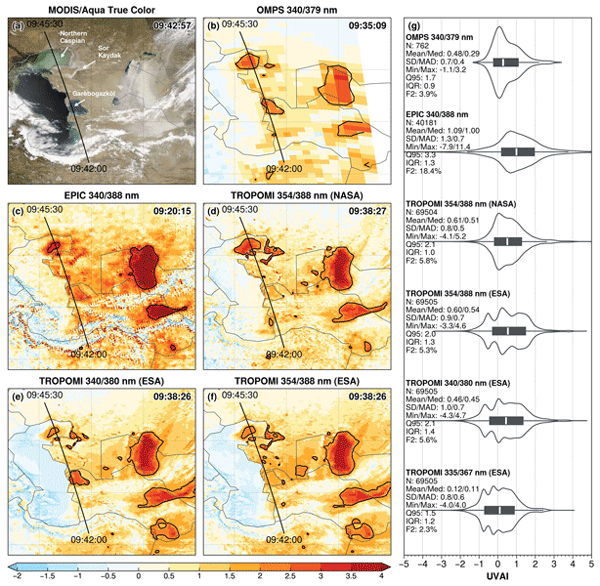
Xin Xi, Jun Wang, Zhendong Lu, Andrew M. Sayer, Jaehwa Lee, Robert C. Levy, Yujie Wang, Alexei Lyapustin, Hongqing Liu, Istvan Laszlo, Changwoo Ahn, Omar Torres, Sabur Abdullaev, James Limbacher, and Ralph A. Kahn
Atmos. Chem. Phys., 25, 7403–7429, https://doi.org/10.5194/acp-25-7403-2025, https://doi.org/10.5194/acp-25-7403-2025, 2025
Short summary
Short summary
The Aralkum Desert is challenging for aerosol retrieval due to its bright, heterogeneous, and dynamic surfaces and the lack of in situ constraints on aerosol properties. The performance and consistency of satellite algorithms in observing Aralkum-generated saline dust remain unknown. This study compares multisensor UVAI (ultraviolet aerosol index), AOD (aerosol optical depth), and ALH (aerosol layer height) products and reveals inconsistencies and potential biases over the Aral Sea basin.
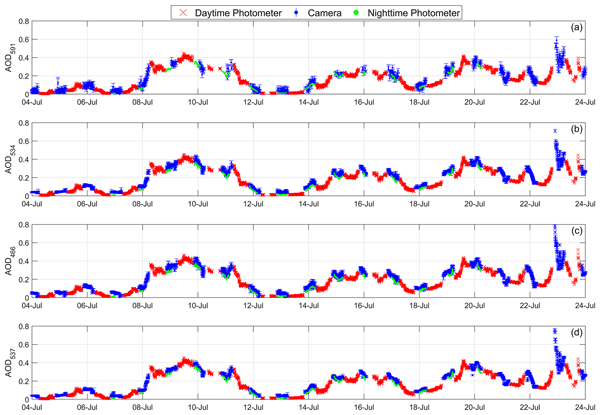
Roberto Román, Daniel González-Fernández, Juan Carlos Antuña-Sánchez, Celia Herrero del Barrio, Sara Herrero-Anta, África Barreto, Victoria E. Cachorro, Lionel Doppler, Ramiro González, Christoph Ritter, David Mateos, Natalia Kouremeti, Gustavo Copes, Abel Calle, María José Granados-Muñoz, Carlos Toledano, and Ángel M. de Frutos
Atmos. Meas. Tech., 18, 2847–2875, https://doi.org/10.5194/amt-18-2847-2025, https://doi.org/10.5194/amt-18-2847-2025, 2025
Short summary
Short summary
This paper presents a novel technique to extract starlight signals from all-sky images and retrieve aerosol optical depth (AOD). It is validated against lunar photometry, showing a strong correlation between data series. This innovative approach will expand nocturnal AOD measurements to more locations, as all-sky cameras are a simpler and more cost-effective alternative to stellar and lunar photometers.
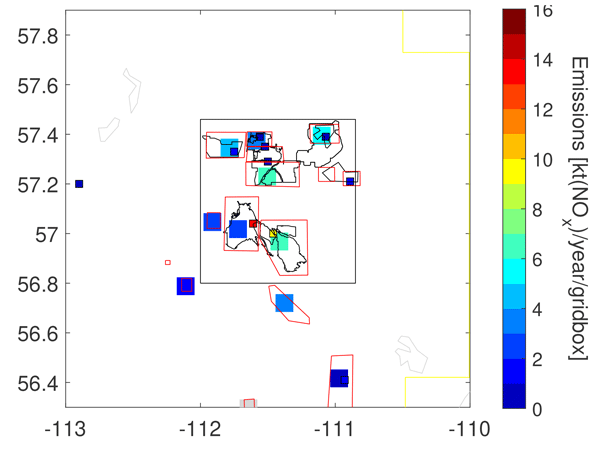
Chris A. McLinden, Debora Griffin, Vitali Fioletov, Junhua Zhang, Enrico Dammers, Cristen Adams, Mallory Loria, Nickolay Krotkov, and Lok N. Lamsal
Atmos. Chem. Phys., 25, 6093–6120, https://doi.org/10.5194/acp-25-6093-2025, https://doi.org/10.5194/acp-25-6093-2025, 2025
Short summary
Short summary
The Ozone Monitoring Instrument (OMI) was used to understand the evolution of NOx emissions from the Canadian oil sands. OMI NO2 combined with winds and reported stack emissions found emissions from the heavy-hauler mine fleet have remained flat since 2005, whereas the total oil sands mined have more than doubled. This difference is a result of emissions standards that limit NOx emissions becoming more stringent over this period, confirming the efficacy of the policy enacting these standards.
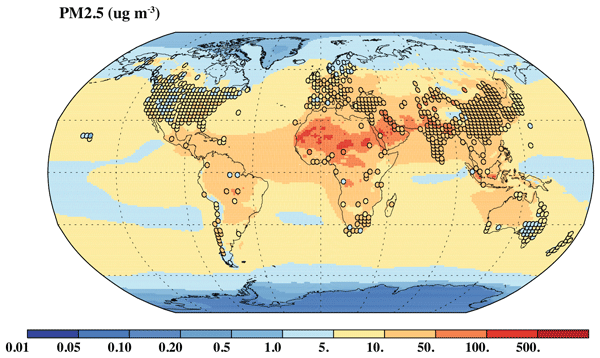
Natalie M. Mahowald, Longlei Li, Julius Vira, Marje Prank, Douglas S. Hamilton, Hitoshi Matsui, Ron L. Miller, P. Louis Lu, Ezgi Akyuz, Daphne Meidan, Peter Hess, Heikki Lihavainen, Christine Wiedinmyer, Jenny Hand, Maria Grazia Alaimo, Célia Alves, Andres Alastuey, Paulo Artaxo, Africa Barreto, Francisco Barraza, Silvia Becagli, Giulia Calzolai, Shankararaman Chellam, Ying Chen, Patrick Chuang, David D. Cohen, Cristina Colombi, Evangelia Diapouli, Gaetano Dongarra, Konstantinos Eleftheriadis, Johann Engelbrecht, Corinne Galy-Lacaux, Cassandra Gaston, Dario Gomez, Yenny González Ramos, Roy M. Harrison, Chris Heyes, Barak Herut, Philip Hopke, Christoph Hüglin, Maria Kanakidou, Zsofia Kertesz, Zbigniew Klimont, Katriina Kyllönen, Fabrice Lambert, Xiaohong Liu, Remi Losno, Franco Lucarelli, Willy Maenhaut, Beatrice Marticorena, Randall V. Martin, Nikolaos Mihalopoulos, Yasser Morera-Gómez, Adina Paytan, Joseph Prospero, Sergio Rodríguez, Patricia Smichowski, Daniela Varrica, Brenna Walsh, Crystal L. Weagle, and Xi Zhao
Atmos. Chem. Phys., 25, 4665–4702, https://doi.org/10.5194/acp-25-4665-2025, https://doi.org/10.5194/acp-25-4665-2025, 2025
Short summary
Short summary
Aerosol particles are an important part of the Earth system, but their concentrations are spatially and temporally heterogeneous, as well as being variable in size and composition. Here, we present a new compilation of PM2.5 and PM10 aerosol observations, focusing on the spatial variability across different observational stations, including composition, and demonstrate a method for comparing the data sets to model output.
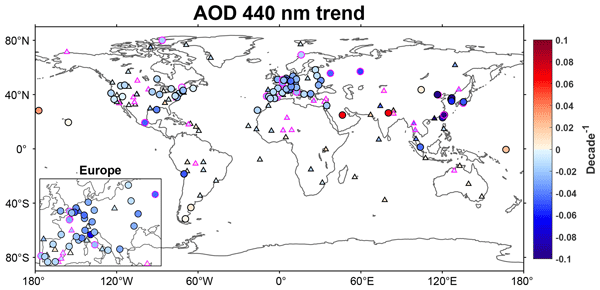
Zhenyu Zhang, Jing Li, Huizheng Che, Yueming Dong, Oleg Dubovik, Thomas Eck, Pawan Gupta, Brent Holben, Jhoon Kim, Elena Lind, Trailokya Saud, Sachchida Nand Tripathi, and Tong Ying
Atmos. Chem. Phys., 25, 4617–4637, https://doi.org/10.5194/acp-25-4617-2025, https://doi.org/10.5194/acp-25-4617-2025, 2025
Short summary
Short summary
We used ground-based remote sensing data from the Aerosol Robotic Network to examine long-term trends in aerosol characteristics. We found aerosol loadings generally decreased globally, and aerosols became more scattering. These changes are closely related to variations in aerosol compositions, such as decreased anthropogenic emissions over East Asia, Europe, and North America; increased anthropogenic sources over northern India; and increased dust activity over the Arabian Peninsula.
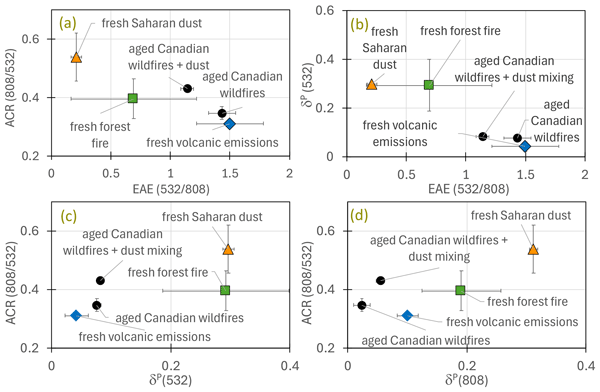
Yenny González, María F. Sánchez-Barrero, Ioana Popovici, África Barreto, Stephane Victori, Ellsworth J. Welton, Rosa D. García, Pablo G. Sicilia, Fernando A. Almansa, Carlos Torres, and Philippe Goloub
Atmos. Meas. Tech., 18, 1885–1908, https://doi.org/10.5194/amt-18-1885-2025, https://doi.org/10.5194/amt-18-1885-2025, 2025
Short summary
Short summary
We characterize the optical properties of various aerosols using a compact dual-wavelength depolarization lidar (CIMEL CE376) at 532 and 808 nm. Through a modified two-wavelength Klett inversion method, we assess the vertical distribution and temporal evolution of Saharan dust, volcanic aerosols and wildfire smoke in the subtropical North Atlantic from August 2021 to August 2023. The study confirms the CE376 lidar's effectiveness in monitoring and characterizing atmospheric aerosols over time.
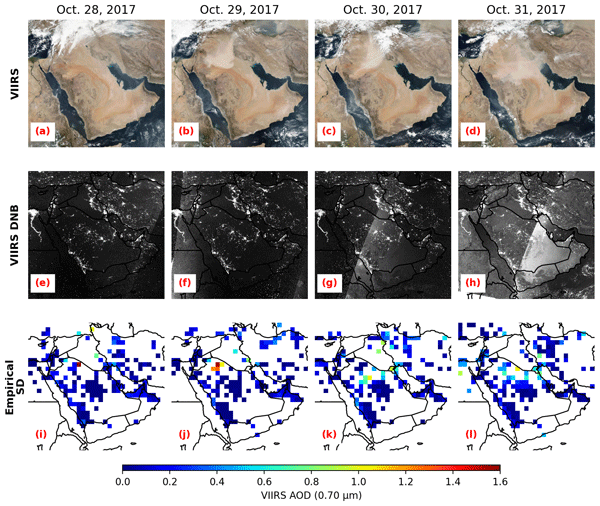
Jianglong Zhang, Jeffrey S. Reid, Blake T. Sorenson, Steven D. Miller, Miguel O. Román, Zhuosen Wang, Robert J. D. Spurr, Shawn Jaker, Thomas F. Eck, and Juli I. Rubin
Atmos. Meas. Tech., 18, 1787–1810, https://doi.org/10.5194/amt-18-1787-2025, https://doi.org/10.5194/amt-18-1787-2025, 2025
Short summary
Short summary
Using observations from the Visible Infrared Imaging Radiometer Suite day–night band, we developed a method for constructing gridded nighttime aerosol optical thickness (AOT) data based on the spatial derivative of measured top-of-atmosphere attenuated upwelling artificial lights at night. The gridded nighttime AOT retrievals, compared against Aerosol Robotic Network data, show reasonable skill levels for potential data assimilation, air quality, and climate studies of significant events.
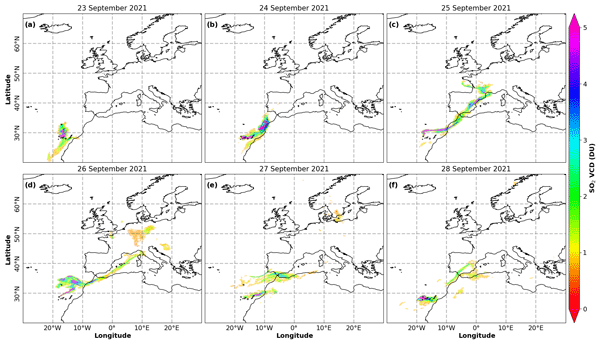
Pascal Hedelt, Jens Reichardt, Felix Lauermann, Benjamin Weiß, Nicolas Theys, Alberto Redondas, Africa Barreto, Omaira Garcia, and Diego Loyola
Atmos. Chem. Phys., 25, 1253–1272, https://doi.org/10.5194/acp-25-1253-2025, https://doi.org/10.5194/acp-25-1253-2025, 2025
Short summary
Short summary
The 2021 volcanic eruption of Tajogaite on La Palma is investigated using ground-based and satellite measurements. In addition, the atmospheric transport of the volcanic cloud towards Europe is studied in detail. The amount of SO2 released during the eruption and the height of the volcanic plume are in excellent agreement among the different measurements. Furthermore, volcanic aerosol microphysical properties could be retrieved using a new retrieval approach based on lidar measurements.
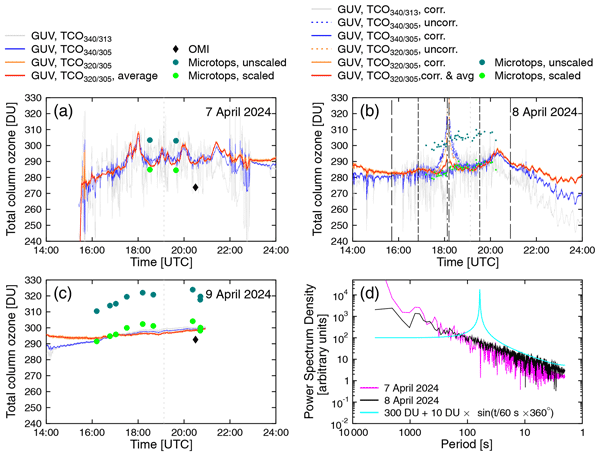
Germar H. Bernhard, George T. Janson, Scott Simpson, Raúl R. Cordero, Edgardo I. Sepúlveda Araya, Jose Jorquera, Juan A. Rayas, and Randall N. Lind
Atmos. Chem. Phys., 25, 819–841, https://doi.org/10.5194/acp-25-819-2025, https://doi.org/10.5194/acp-25-819-2025, 2025
Short summary
Short summary
Several publications have reported that total column ozone (TCO) may oscillate during solar eclipses, whereas other researchers have not seen evidence of such fluctuations. Here, we try to resolve these contradictions by measuring variations in TCO during three solar eclipses. In all instances, the variability in TCO was within natural variability. We conclude that solar eclipses do not lead to measurable variations in TCO, drawing into question reports of much larger changes found in the past.
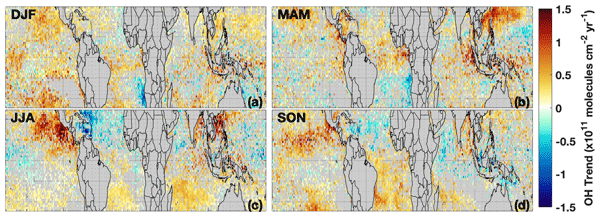
Bryan N. Duncan, Daniel C. Anderson, Arlene M. Fiore, Joanna Joiner, Nickolay A. Krotkov, Can Li, Dylan B. Millet, Julie M. Nicely, Luke D. Oman, Jason M. St. Clair, Joshua D. Shutter, Amir H. Souri, Sarah A. Strode, Brad Weir, Glenn M. Wolfe, Helen M. Worden, and Qindan Zhu
Atmos. Chem. Phys., 24, 13001–13023, https://doi.org/10.5194/acp-24-13001-2024, https://doi.org/10.5194/acp-24-13001-2024, 2024
Short summary
Short summary
Trace gases emitted to or formed within the atmosphere may be chemically or physically removed from the atmosphere. One trace gas, the hydroxyl radical (OH), is responsible for initiating the chemical removal of many trace gases, including some greenhouse gases. Despite its importance, scientists have not been able to adequately measure OH. In this opinion piece, we discuss promising new methods to indirectly constrain OH using satellite data of trace gases that control the abundance of OH.
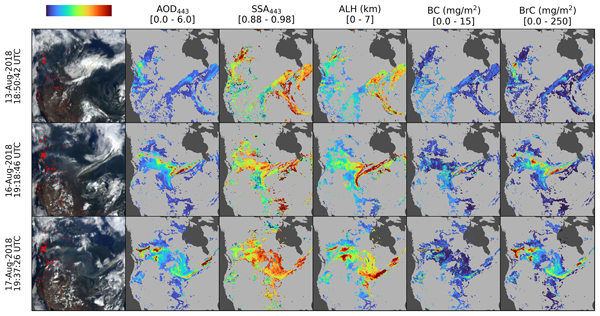
Myungje Choi, Alexei Lyapustin, Gregory L. Schuster, Sujung Go, Yujie Wang, Sergey Korkin, Ralph Kahn, Jeffrey S. Reid, Edward J. Hyer, Thomas F. Eck, Mian Chin, David J. Diner, Olga Kalashnikova, Oleg Dubovik, Jhoon Kim, and Hans Moosmüller
Atmos. Chem. Phys., 24, 10543–10565, https://doi.org/10.5194/acp-24-10543-2024, https://doi.org/10.5194/acp-24-10543-2024, 2024
Short summary
Short summary
This paper introduces a retrieval algorithm to estimate two key absorbing components in smoke (black carbon and brown carbon) using DSCOVR EPIC measurements. Our analysis reveals distinct smoke properties, including spectral absorption, layer height, and black carbon and brown carbon, over North America and central Africa. The retrieved smoke properties offer valuable observational constraints for modeling radiative forcing and informing health-related studies.
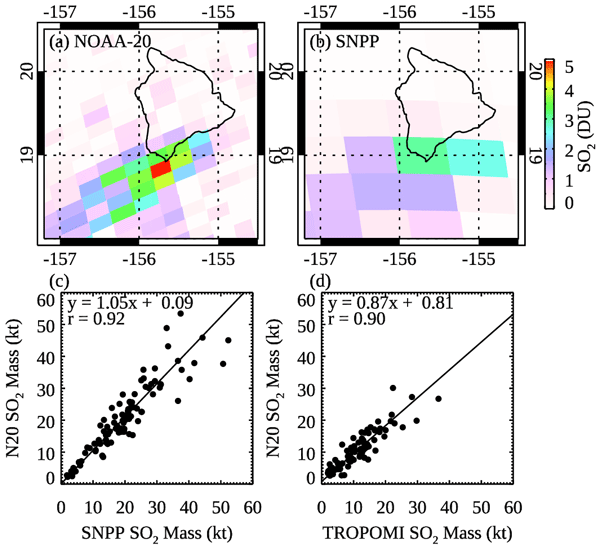
Can Li, Nickolay A. Krotkov, Joanna Joiner, Vitali Fioletov, Chris McLinden, Debora Griffin, Peter J. T. Leonard, Simon Carn, Colin Seftor, and Alexander Vasilkov
Earth Syst. Sci. Data, 16, 4291–4309, https://doi.org/10.5194/essd-16-4291-2024, https://doi.org/10.5194/essd-16-4291-2024, 2024
Short summary
Short summary
Sulfur dioxide (SO2), a poisonous gas from human activities and volcanoes, causes air pollution, acid rain, and changes to climate and the ozone layer. Satellites have been used to monitor SO2 globally, including remote areas. Here we describe a new satellite SO2 dataset from the OMPS instrument that flies on the N20 satellite. Results show that the new dataset agrees well with the existing ones from other satellites and can help to continue the global monitoring of SO2 from space.
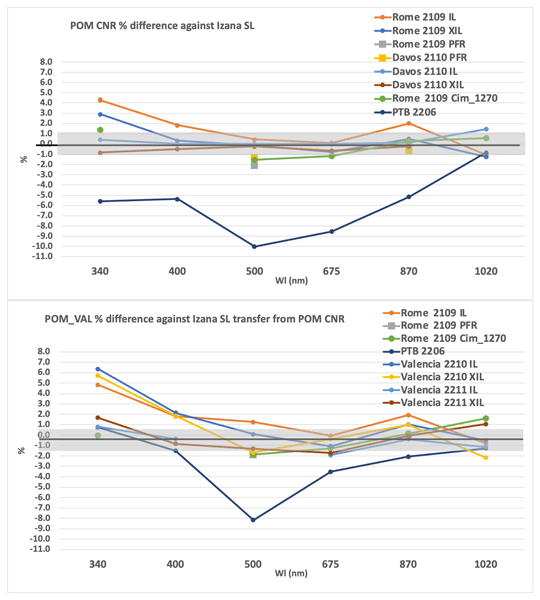
Monica Campanelli, Victor Estellés, Gaurav Kumar, Teruyuki Nakajima, Masahiro Momoi, Julian Gröbner, Stelios Kazadzis, Natalia Kouremeti, Angelos Karanikolas, Africa Barreto, Saulius Nevas, Kerstin Schwind, Philipp Schneider, Iiro Harju, Petri Kärhä, Henri Diémoz, Rei Kudo, Akihiro Uchiyama, Akihiro Yamazaki, Anna Maria Iannarelli, Gabriele Mevi, Annalisa Di Bernardino, and Stefano Casadio
Atmos. Meas. Tech., 17, 5029–5050, https://doi.org/10.5194/amt-17-5029-2024, https://doi.org/10.5194/amt-17-5029-2024, 2024
Short summary
Short summary
To retrieve columnar aerosol properties from sun photometers, some calibration factors are needed. The on-site calibrations, performed as frequently as possible to monitor changes in the machine conditions, allow operators to track and evaluate the calibration status on a continuous basis, reducing the data gaps incurred by the periodic shipments for performing centralized calibrations. The performance of the on-site calibration procedures was evaluated, providing very good results.
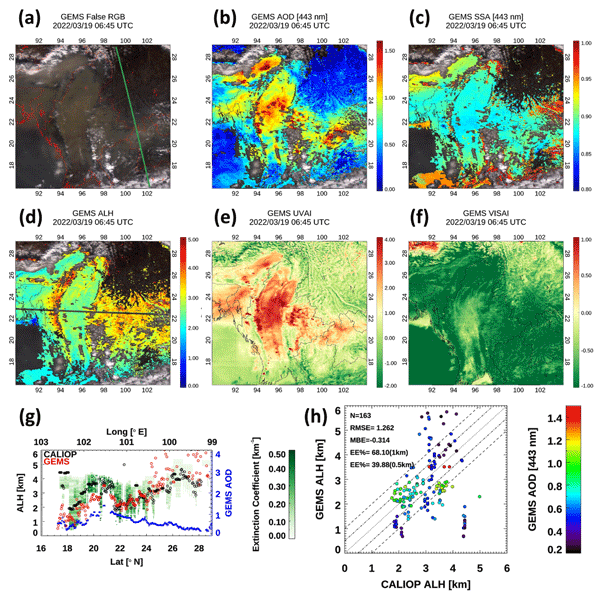
Yeseul Cho, Jhoon Kim, Sujung Go, Mijin Kim, Seoyoung Lee, Minseok Kim, Heesung Chong, Won-Jin Lee, Dong-Won Lee, Omar Torres, and Sang Seo Park
Atmos. Meas. Tech., 17, 4369–4390, https://doi.org/10.5194/amt-17-4369-2024, https://doi.org/10.5194/amt-17-4369-2024, 2024
Short summary
Short summary
Aerosol optical properties have been provided by the Geostationary Environment Monitoring Spectrometer (GEMS), the world’s first geostationary-Earth-orbit (GEO) satellite instrument designed for atmospheric environmental monitoring. This study describes improvements made to the GEMS aerosol retrieval algorithm (AERAOD) and presents its validation results. These enhancements aim to provide more accurate and reliable aerosol-monitoring results for Asia.
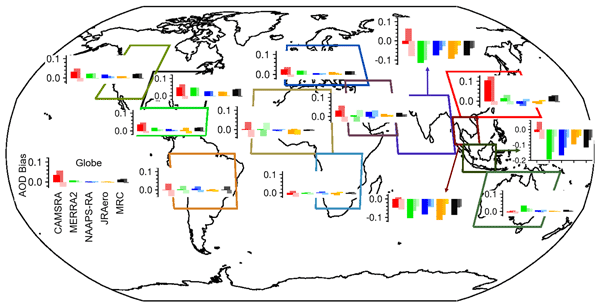
Peng Xian, Jeffrey S. Reid, Melanie Ades, Angela Benedetti, Peter R. Colarco, Arlindo da Silva, Tom F. Eck, Johannes Flemming, Edward J. Hyer, Zak Kipling, Samuel Rémy, Tsuyoshi Thomas Sekiyama, Taichu Tanaka, Keiya Yumimoto, and Jianglong Zhang
Atmos. Chem. Phys., 24, 6385–6411, https://doi.org/10.5194/acp-24-6385-2024, https://doi.org/10.5194/acp-24-6385-2024, 2024
Short summary
Short summary
The study compares and evaluates monthly AOD of four reanalyses (RA) and their consensus (i.e., ensemble mean). The basic verification characteristics of these RA versus both AERONET and MODIS retrievals are presented. The study discusses the strength of each RA and identifies regions where divergence and challenges are prominent. The RA consensus usually performs very well on a global scale in terms of how well it matches the observational data, making it a good choice for various applications.
Hiren T. Jethva, Omar Torres, Richard A. Ferrare, Sharon P. Burton, Anthony L. Cook, David B. Harper, Chris A. Hostetler, Jens Redemann, Vinay Kayetha, Samuel LeBlanc, Kristina Pistone, Logan Mitchell, and Connor J. Flynn
Atmos. Meas. Tech., 17, 2335–2366, https://doi.org/10.5194/amt-17-2335-2024, https://doi.org/10.5194/amt-17-2335-2024, 2024
Short summary
Short summary
We introduce a novel synergy algorithm applied to ORALCES airborne measurements of above-cloud aerosol optical depth and UV–Vis satellite observations from OMI and MODIS to retrieve spectral aerosol single-scattering albedo of lofted layers of carbonaceous smoke aerosols over clouds. The development of the proposed aerosol–cloud algorithm implies a possible synergy of CALIOP and OMI–MODIS passive sensors to deduce a global product of AOD and SSA of absorbing aerosols above clouds.
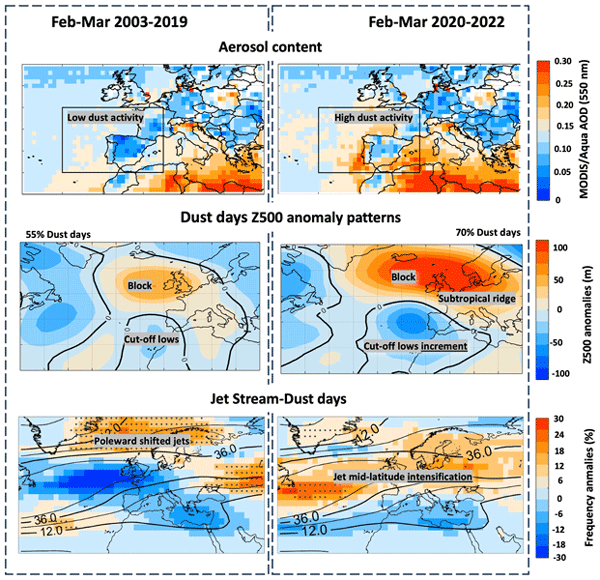
Emilio Cuevas-Agulló, David Barriopedro, Rosa Delia García, Silvia Alonso-Pérez, Juan Jesús González-Alemán, Ernest Werner, David Suárez, Juan José Bustos, Gerardo García-Castrillo, Omaira García, África Barreto, and Sara Basart
Atmos. Chem. Phys., 24, 4083–4104, https://doi.org/10.5194/acp-24-4083-2024, https://doi.org/10.5194/acp-24-4083-2024, 2024
Short summary
Short summary
During February–March (FM) 2020–2022, unusually intense dust storms from northern Africa hit the western Euro-Mediterranean (WEM). Using dust products from satellites and atmospheric reanalysis for 2003–2022, results show that cut-off lows and European blocking are key drivers of FM dust intrusions over the WEM. A higher frequency of cut-off lows associated with subtropical ridges is observed in the late 2020–2022 period.
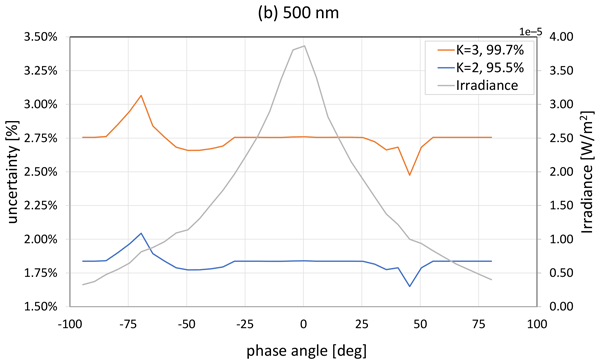
Carlos Toledano, Sarah Taylor, África Barreto, Stefan Adriaensen, Alberto Berjón, Agnieszka Bialek, Ramiro González, Emma Woolliams, and Marc Bouvet
Atmos. Chem. Phys., 24, 3649–3671, https://doi.org/10.5194/acp-24-3649-2024, https://doi.org/10.5194/acp-24-3649-2024, 2024
Short summary
Short summary
The calibration of Earth observation sensors is key to ensuring the continuity of long-term and global climate records. Satellite sensors, calibrated prior to launch, are susceptible to degradation in space. The Moon provides a stable calibration reference; however, its illumination depends on the Sun–Earth–Moon geometry and must be modelled. A new lunar irradiance model is presented, built upon observations over 5 years at a high-altitude observatory and a rigorous calibration and validation.
Natalie M. Mahowald, Longlei Li, Julius Vira, Marje Prank, Douglas S. Hamilton, Hitoshi Matsui, Ron L. Miller, Louis Lu, Ezgi Akyuz, Daphne Meidan, Peter Hess, Heikki Lihavainen, Christine Wiedinmyer, Jenny Hand, Maria Grazia Alaimo, Célia Alves, Andres Alastuey, Paulo Artaxo, Africa Barreto, Francisco Barraza, Silvia Becagli, Giulia Calzolai, Shankarararman Chellam, Ying Chen, Patrick Chuang, David D. Cohen, Cristina Colombi, Evangelia Diapouli, Gaetano Dongarra, Konstantinos Eleftheriadis, Corinne Galy-Lacaux, Cassandra Gaston, Dario Gomez, Yenny González Ramos, Hannele Hakola, Roy M. Harrison, Chris Heyes, Barak Herut, Philip Hopke, Christoph Hüglin, Maria Kanakidou, Zsofia Kertesz, Zbiginiw Klimont, Katriina Kyllönen, Fabrice Lambert, Xiaohong Liu, Remi Losno, Franco Lucarelli, Willy Maenhaut, Beatrice Marticorena, Randall V. Martin, Nikolaos Mihalopoulos, Yasser Morera-Gomez, Adina Paytan, Joseph Prospero, Sergio Rodríguez, Patricia Smichowski, Daniela Varrica, Brenna Walsh, Crystal Weagle, and Xi Zhao
Earth Syst. Sci. Data Discuss., https://doi.org/10.5194/essd-2024-1, https://doi.org/10.5194/essd-2024-1, 2024
Preprint withdrawn
Short summary
Short summary
Aerosol particles can interact with incoming solar radiation and outgoing long wave radiation, change cloud properties, affect photochemistry, impact surface air quality, and when deposited impact surface albedo of snow and ice, and modulate carbon dioxide uptake by the land and ocean. Here we present a new compilation of aerosol observations including composition, a methodology for comparing the datasets to model output, and show the implications of these results using one model.
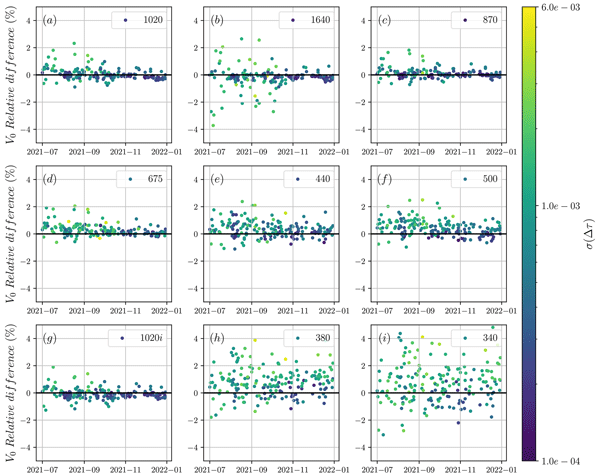
Antonio Fernando Almansa, África Barreto, Natalia Kouremeti, Ramiro González, Akriti Masoom, Carlos Toledano, Julian Gröbner, Rosa Delia García, Yenny González, Stelios Kazadzis, Stéphane Victori, Óscar Álvarez, Fabrice Maupin, Virgilio Carreño, Victoria Eugenia Cachorro, and Emilio Cuevas
Atmos. Meas. Tech., 17, 659–675, https://doi.org/10.5194/amt-17-659-2024, https://doi.org/10.5194/amt-17-659-2024, 2024
Short summary
Short summary
This paper applies sun photometer synergies to improve calibration transference between different sun photometers and also enhance their quality assurance and quality control. We have validated this technique using different instrumentation, the WMO-GAW and NASA-AERONET references, under different aerosol regimes using the standard Langley calibration method as a reference.
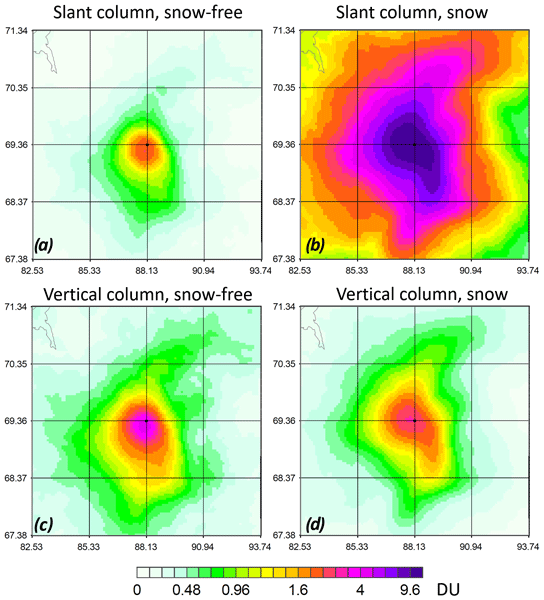
Vitali E. Fioletov, Chris A. McLinden, Debora Griffin, Nickolay A. Krotkov, Can Li, Joanna Joiner, Nicolas Theys, and Simon Carn
Atmos. Meas. Tech., 16, 5575–5592, https://doi.org/10.5194/amt-16-5575-2023, https://doi.org/10.5194/amt-16-5575-2023, 2023
Short summary
Short summary
Snow-covered terrain, with its high reflectance in the UV, typically enhances satellite sensitivity to boundary layer pollution. However, a significant fraction of high-quality cloud-free measurements over snow is currently excluded from analyses. In this study, we investigated how satellite SO2 measurements over snow-covered surfaces can be used to improve estimations of annual SO2 emissions.
Óscar Alvárez, África Barreto, Omaira E. García, Frank Hase, Rosa D. García, Julian Gröbner, Sergio F. León-Luis, Eliezer Sepúlveda, Virgilio Carreño, Antonio Alcántara, Ramón Ramos, A. Fernando Almansa, Stelios Kazadzis, Noémie Taquet, Carlos Toledano, and Emilio Cuevas
Atmos. Meas. Tech., 16, 4861–4884, https://doi.org/10.5194/amt-16-4861-2023, https://doi.org/10.5194/amt-16-4861-2023, 2023
Short summary
Short summary
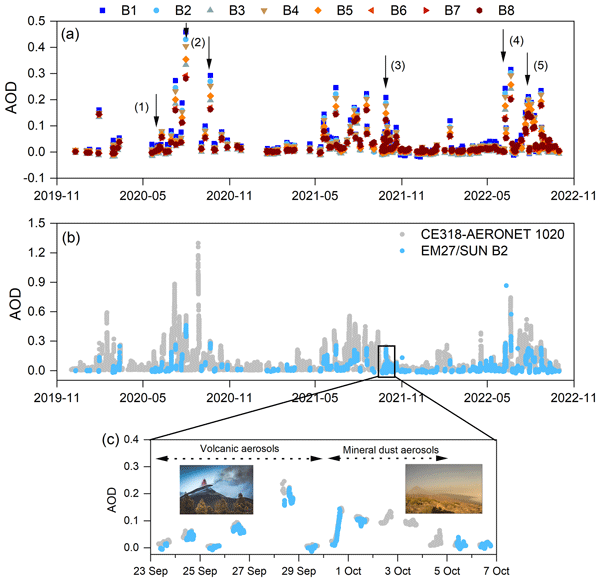
In this work, we have extended the capabilities of a portable Fourier transform infrared (FTIR) instrument, which was originally designed to provide high-quality greenhouse gas monitoring within COCCON (COllaborative Carbon Column Observing Network). The extension allows the spectrometer to now also provide coincidentally column-integrated aerosol information. This addition of a reference instrument to a global network will be utilised to enhance our understanding of atmospheric chemistry.
Julian Gröbner, Natalia Kouremeti, Gregor Hülsen, Ralf Zuber, Mario Ribnitzky, Saulius Nevas, Peter Sperfeld, Kerstin Schwind, Philipp Schneider, Stelios Kazadzis, África Barreto, Tom Gardiner, Kavitha Mottungan, David Medland, and Marc Coleman
Atmos. Meas. Tech., 16, 4667–4680, https://doi.org/10.5194/amt-16-4667-2023, https://doi.org/10.5194/amt-16-4667-2023, 2023
Short summary
Short summary
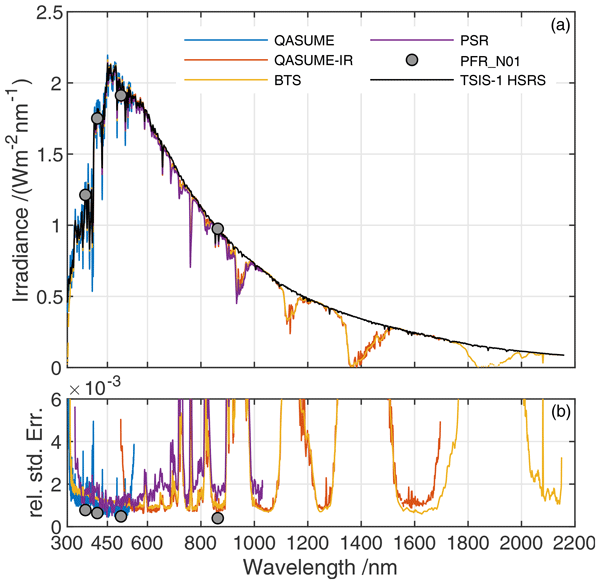
Spectral solar irradiance measurements traceable to the International System of Units (SI) allow for intercomparability between instruments and for their validation according to metrological standards. Here we also validate and reduce the uncertainties of the top-of-atmosphere TSIS-1 Hybrid Solar Reference Spectrum (HSRS). The management of large networks, e.g. AERONET or GAW-PFR, will benefit from reducing logistical overhead, improving their resilience and achieving metrological traceability.
Amanda Gumber, Jeffrey S. Reid, Robert E. Holz, Thomas F. Eck, N. Christina Hsu, Robert C. Levy, Jianglong Zhang, and Paolo Veglio
Atmos. Meas. Tech., 16, 2547–2573, https://doi.org/10.5194/amt-16-2547-2023, https://doi.org/10.5194/amt-16-2547-2023, 2023
Short summary
Short summary
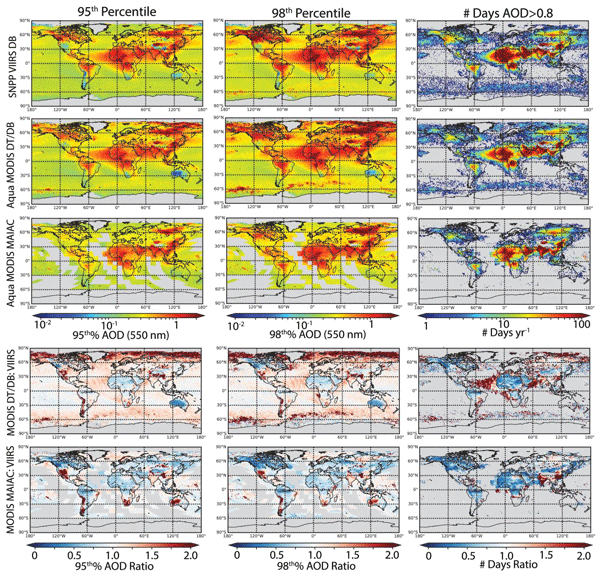
The purpose of this study is to create and evaluate a gridded dataset composed of multiple satellite instruments and algorithms to be used for data assimilation. An important part of aerosol data assimilation is having consistent measurements, especially for severe aerosol events. This study evaluates 4 years of data from MODIS, VIIRS, and AERONET with a focus on aerosol severe event detection from a regional and global perspective.
Juli I. Rubin, Jeffrey S. Reid, Peng Xian, Christopher M. Selman, and Thomas F. Eck
Atmos. Chem. Phys., 23, 4059–4090, https://doi.org/10.5194/acp-23-4059-2023, https://doi.org/10.5194/acp-23-4059-2023, 2023
Short summary
Short summary
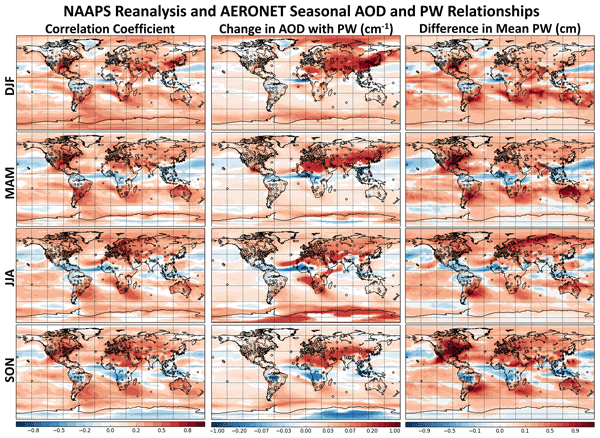
This work aims to quantify the covariability between aerosol optical depth/extinction with water vapor (PW) globally, using NASA AERONET observations and NAAPS model data. Findings are important for data assimilation and radiative transfer. The study shows statistically significant and positive AOD–PW relationships are found across the globe, varying in strength with location and season and tied to large-scale aerosol events. Hygroscopic growth was also found to be an important factor.
Nick Gorkavyi, Nickolay Krotkov, and Alexander Marshak
Atmos. Meas. Tech., 16, 1527–1537, https://doi.org/10.5194/amt-16-1527-2023, https://doi.org/10.5194/amt-16-1527-2023, 2023
Short summary
Short summary
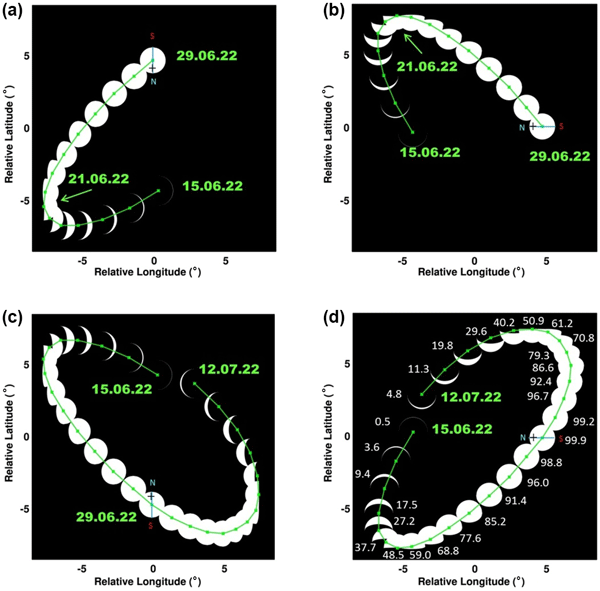
The article discusses topical issues of the visible (libration) motion of the Earth in the sky of the Moon in a rectangle measuring 13.4° × 15.8°. On the one hand, the librations of the Moon make these observations difficult. On the other hand, they can be used as a natural scanning mechanism for cameras and spectroscopes mounted on a fixed platform on the surface of the Moon.
Norman T. O'Neill, Keyvan Ranjbar, Liviu Ivănescu, Thomas F. Eck, Jeffrey S. Reid, David M. Giles, Daniel Pérez-Ramírez, and Jai Prakash Chaubey
Atmos. Meas. Tech., 16, 1103–1120, https://doi.org/10.5194/amt-16-1103-2023, https://doi.org/10.5194/amt-16-1103-2023, 2023
Short summary
Short summary
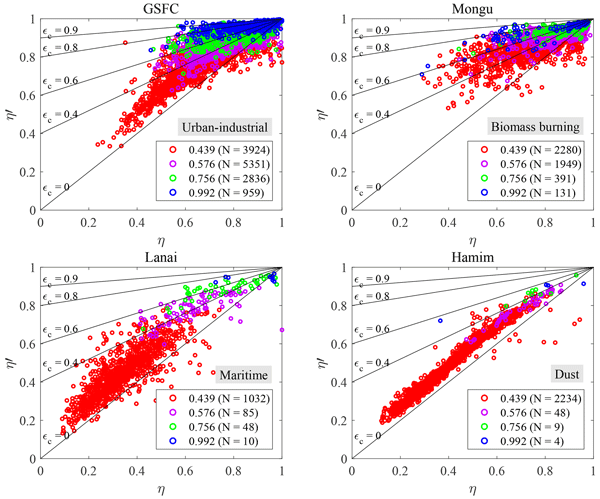
Aerosols are atmospheric particles that vary in size (radius) from a fraction of a micrometer (µm) to around 20 µm. They tend to be either smaller than 1 µm (like smoke or pollution) or larger than 1 µm (like dust or sea salt). Their optical effect (scattering and absorbing sunlight) can be divided into FM (fine-mode) and CM (coarse-mode) parts using a cutoff radius around 1 µm or a spectral (color) technique. We present and validate a theoretical link between the types of FM and CM divisions.

Andrew M. Sayer, Luca Lelli, Brian Cairns, Bastiaan van Diedenhoven, Amir Ibrahim, Kirk D. Knobelspiesse, Sergey Korkin, and P. Jeremy Werdell
Atmos. Meas. Tech., 16, 969–996, https://doi.org/10.5194/amt-16-969-2023, https://doi.org/10.5194/amt-16-969-2023, 2023
Short summary
Short summary
This paper presents a method to estimate the height of the top of clouds above Earth's surface using satellite measurements. It is based on light absorption by oxygen in Earth's atmosphere, which darkens the signal that a satellite will see at certain wavelengths of light. Clouds "shield" the satellite from some of this darkening, dependent on cloud height (and other factors), because clouds scatter light at these wavelengths. The method will be applied to the future NASA PACE mission.
Joanna Joiner, Sergey Marchenko, Zachary Fasnacht, Lok Lamsal, Can Li, Alexander Vasilkov, and Nickolay Krotkov
Atmos. Meas. Tech., 16, 481–500, https://doi.org/10.5194/amt-16-481-2023, https://doi.org/10.5194/amt-16-481-2023, 2023
Short summary
Short summary
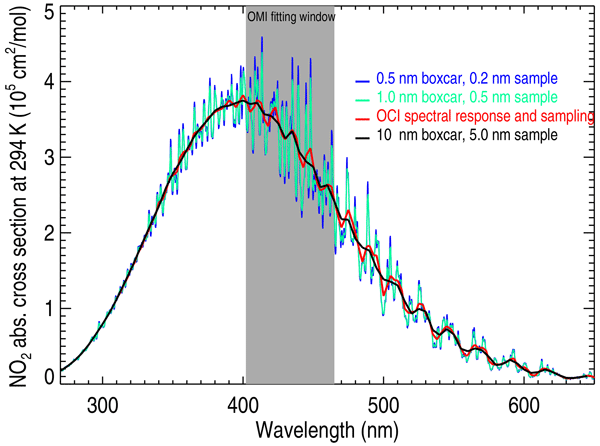
Nitrogen dioxide (NO2) is an important trace gas for both air quality and climate. NO2 affects satellite ocean color products. A new ocean color instrument – OCI (Ocean Color Instrument) – will be launched in 2024 on a NASA satellite. We show that it will be possible to measure NO2 from OCI even though it was not designed for this. The techniques developed here, based on machine learning, can also be applied to instruments already in space to speed up algorithms and reduce the effects of noise.
Murali Natarajan, Robert Damadeo, and David Flittner
Atmos. Meas. Tech., 16, 75–87, https://doi.org/10.5194/amt-16-75-2023, https://doi.org/10.5194/amt-16-75-2023, 2023
Short summary
Short summary
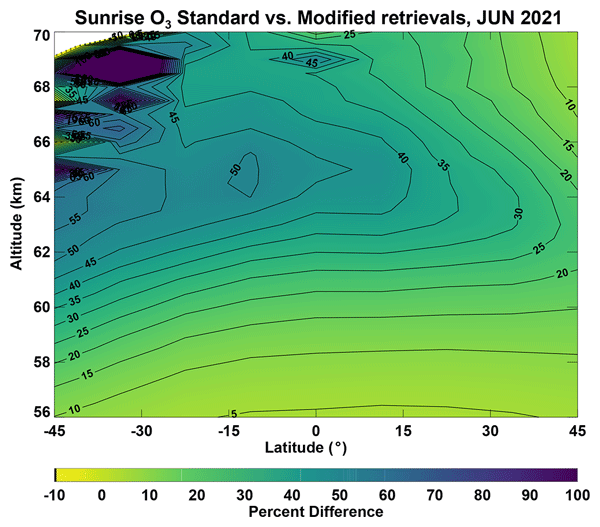
Photochemically induced changes in mesospheric O3 concentration at twilight can cause asymmetry in the distribution along the line of sight of solar occultation observations that must be considered in the retrieval algorithm. Correction factors developed from diurnal photochemical model simulations were used to modify the archived SAGE III/ISS mesospheric O3 concentrations. For June 2021 the bias caused by the neglect of diurnal variations is over 30% at 64 km altitude and low latitudes.
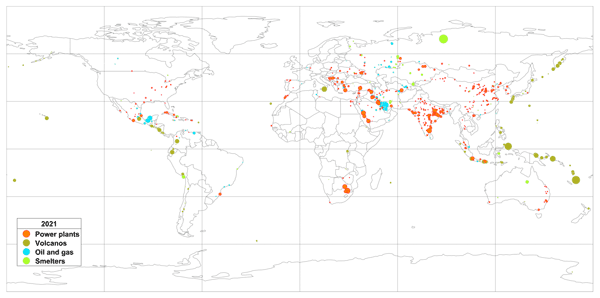
Vitali E. Fioletov, Chris A. McLinden, Debora Griffin, Ihab Abboud, Nickolay Krotkov, Peter J. T. Leonard, Can Li, Joanna Joiner, Nicolas Theys, and Simon Carn
Earth Syst. Sci. Data, 15, 75–93, https://doi.org/10.5194/essd-15-75-2023, https://doi.org/10.5194/essd-15-75-2023, 2023
Short summary
Short summary
Sulfur dioxide (SO2) measurements from three satellite instruments were used to update and extend the previously developed global catalogue of large SO2 emission sources. This version 2 of the global catalogue covers the period of 2005–2021 and includes a total of 759 continuously emitting point sources. The catalogue data show an approximate 50 % decline in global SO2 emissions between 2005 and 2021, although emissions were relatively stable during the last 3 years.
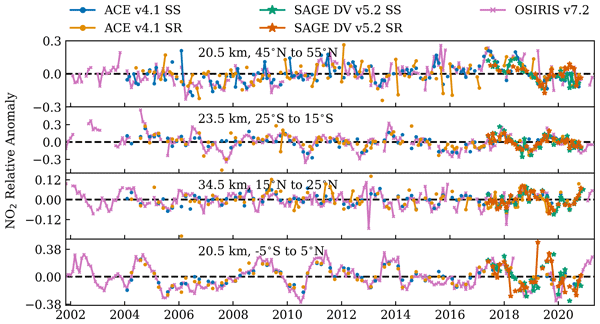
Kimberlee Dubé, Daniel Zawada, Adam Bourassa, Doug Degenstein, William Randel, David Flittner, Patrick Sheese, and Kaley Walker
Atmos. Meas. Tech., 15, 6163–6180, https://doi.org/10.5194/amt-15-6163-2022, https://doi.org/10.5194/amt-15-6163-2022, 2022
Short summary
Short summary
Satellite observations are important for monitoring changes in atmospheric composition. Here we describe an improved version of the NO2 retrieval for the Optical Spectrograph and InfraRed Imager System. The resulting NO2 profiles are compared to those from the Atmospheric Chemistry Experiment – Fourier Transform Spectrometer and the Stratospheric Aerosol and Gas Experiment III on the International Space Station. All datasets agree within 20 % throughout the stratosphere.
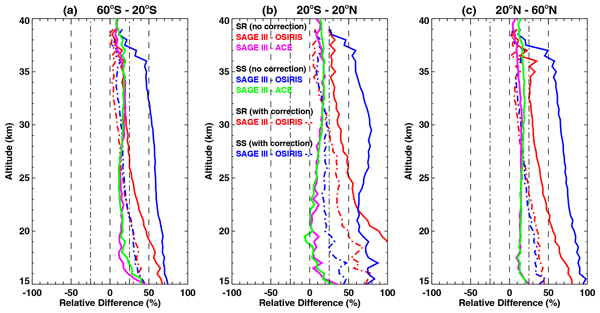
Sarah A. Strode, Ghassan Taha, Luke D. Oman, Robert Damadeo, David Flittner, Mark Schoeberl, Christopher E. Sioris, and Ryan Stauffer
Atmos. Meas. Tech., 15, 6145–6161, https://doi.org/10.5194/amt-15-6145-2022, https://doi.org/10.5194/amt-15-6145-2022, 2022
Short summary
Short summary
We use a global atmospheric chemistry model simulation to generate scaling factors that account for the daily cycle of NO2 and ozone. These factors facilitate comparisons between sunrise and sunset observations from SAGE III/ISS and observations from other instruments. We provide the scaling factors as monthly zonal means for different latitudes and altitudes. We find that applying these factors yields more consistent comparisons between observations from SAGE III/ISS and other instruments.
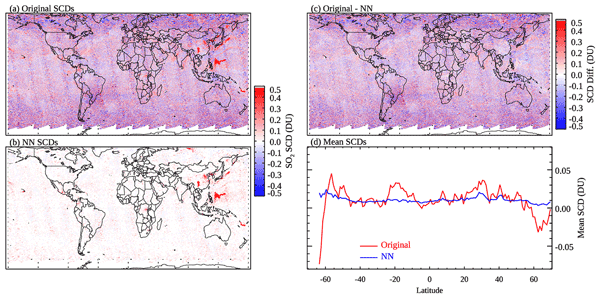
Can Li, Joanna Joiner, Fei Liu, Nickolay A. Krotkov, Vitali Fioletov, and Chris McLinden
Atmos. Meas. Tech., 15, 5497–5514, https://doi.org/10.5194/amt-15-5497-2022, https://doi.org/10.5194/amt-15-5497-2022, 2022
Short summary
Short summary
Satellite observations provide information on the sources of SO2, an important pollutant that affects both air quality and climate. However, these observations suffer from relatively poor data quality due to weak signals of SO2. Here, we use a machine learning technique to analyze satellite SO2 observations in order to reduce the noise and artifacts over relatively clean areas while keeping the signals near pollution sources. This leads to significant improvement in satellite SO2 data.
Travis N. Knepp, Larry Thomason, Mahesh Kovilakam, Jason Tackett, Jayanta Kar, Robert Damadeo, and David Flittner
Atmos. Meas. Tech., 15, 5235–5260, https://doi.org/10.5194/amt-15-5235-2022, https://doi.org/10.5194/amt-15-5235-2022, 2022
Short summary
Short summary
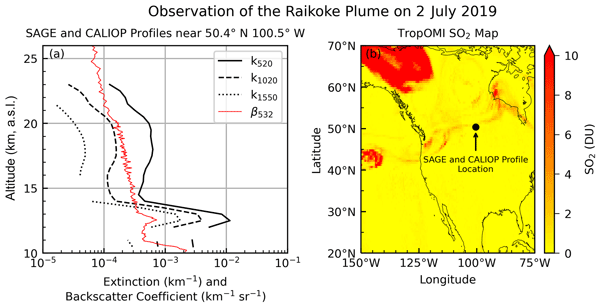
We used aerosol profiles from the SAGE III/ISS instrument to develop an aerosol classification method that was tested on four case-study events (two volcanic, two fire) and supported with CALIOP aerosol products. The method worked well in identifying smoke and volcanic aerosol in the stratosphere for these events. Raikoke is presented as a demonstration of the limitations of this method.
África Barreto, Rosa D. García, Carmen Guirado-Fuentes, Emilio Cuevas, A. Fernando Almansa, Celia Milford, Carlos Toledano, Francisco J. Expósito, Juan P. Díaz, and Sergio F. León-Luis
Atmos. Chem. Phys., 22, 11105–11124, https://doi.org/10.5194/acp-22-11105-2022, https://doi.org/10.5194/acp-22-11105-2022, 2022
Short summary
Short summary
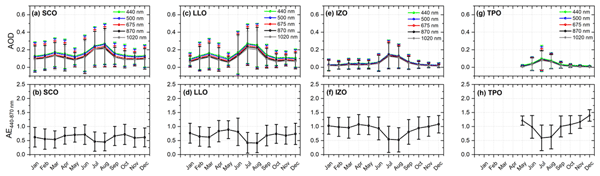
A comprehensive characterization of atmospheric aerosols in the subtropical eastern North Atlantic has been carried out in this paper using long-term ground AERONET photometric observations over the period 2005–2020 from a unique network made up of four stations strategically located from sea level to 3555 m height on the island of Tenerife. This is a region that can be considered a key location to study the seasonal dependence of dust transport from the Sahel-Sahara.

Alexander Sinyuk, Brent N. Holben, Thomas F. Eck, David M. Giles, Ilya Slutsker, Oleg Dubovik, Joel S. Schafer, Alexander Smirnov, and Mikhail Sorokin
Atmos. Meas. Tech., 15, 4135–4151, https://doi.org/10.5194/amt-15-4135-2022, https://doi.org/10.5194/amt-15-4135-2022, 2022
Short summary
Short summary
This paper describes modification of smoothness constraints on the imaginary part of the refractive index employed in the AERONET aerosol retrieval algorithm. This modification is termed relaxed due to the weaker strength of this new smoothness constraint. Applying the modified version of the smoothness constraint results in a significant reduction of retrieved light absorption by brown-carbon-containing aerosols.
Vitali Fioletov, Chris A. McLinden, Debora Griffin, Nickolay Krotkov, Fei Liu, and Henk Eskes
Atmos. Chem. Phys., 22, 4201–4236, https://doi.org/10.5194/acp-22-4201-2022, https://doi.org/10.5194/acp-22-4201-2022, 2022
Short summary
Short summary
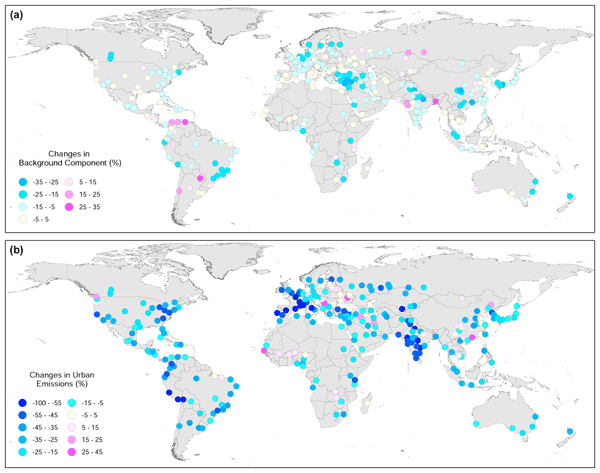
The COVID-19 lockdown had a large impact on anthropogenic emissions and particularly on nitrogen dioxide (NO2). A new method of isolation of background, urban, and industrial components in NO2 is applied to estimate the lockdown impact on each of them. From 16 March to 15 June 2020, urban NO2 declined by −18 % to −28 % in most regions of the world, while background NO2 typically declined by less than −10 %.
Vinay Kayetha, Omar Torres, and Hiren Jethva
Atmos. Meas. Tech., 15, 845–877, https://doi.org/10.5194/amt-15-845-2022, https://doi.org/10.5194/amt-15-845-2022, 2022
Short summary
Short summary
Existing measurements of spectral aerosol absorption are limited, particularly in the UV region. We use the synergy of satellite and ground measurements to derive spectral single scattering albedo of aerosols from the UV–visible spectrum. The resulting spectral SSAs are used to investigate seasonality in absorption for carbonaceous, dust, and urban aerosols. Regional aerosol absorption models that could be used to make reliable assumptions in satellite remote sensing of aerosols are derived.
África Barreto, Emilio Cuevas, Rosa D. García, Judit Carrillo, Joseph M. Prospero, Luka Ilić, Sara Basart, Alberto J. Berjón, Carlos L. Marrero, Yballa Hernández, Juan José Bustos, Slobodan Ničković, and Margarita Yela
Atmos. Chem. Phys., 22, 739–763, https://doi.org/10.5194/acp-22-739-2022, https://doi.org/10.5194/acp-22-739-2022, 2022
Short summary
Short summary
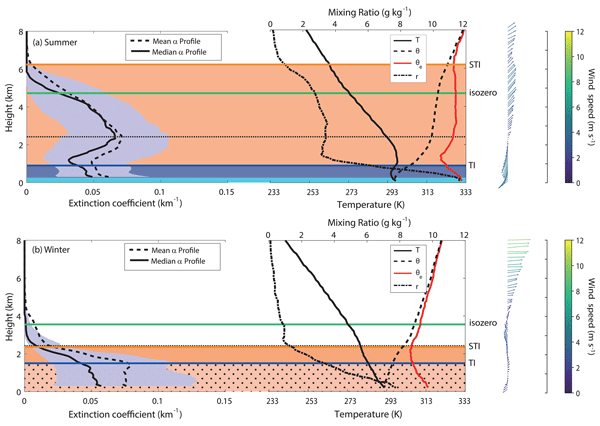
In this study, we categorise the different patterns of dust transport over the subtropical North Atlantic and for the first time robustly describe the dust vertical distribution in the Saharan Air Layer (SAL) over this region. Our results revealed the important role that both dust and water vapour play in the radiative balance in summer and winter and confirm the role of the SAL in the formation of mid-level clouds as a result of the activation of heterogeneous ice nucleation processes.
Nick Gorkavyi, Nickolay Krotkov, Can Li, Leslie Lait, Peter Colarco, Simon Carn, Matthew DeLand, Paul Newman, Mark Schoeberl, Ghassan Taha, Omar Torres, Alexander Vasilkov, and Joanna Joiner
Atmos. Meas. Tech., 14, 7545–7563, https://doi.org/10.5194/amt-14-7545-2021, https://doi.org/10.5194/amt-14-7545-2021, 2021
Short summary
Short summary
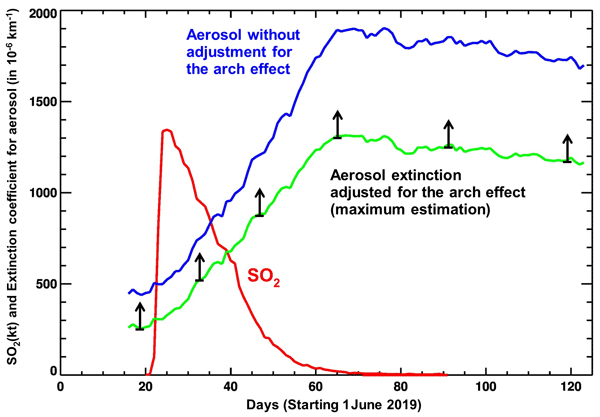
The 21 June 2019 eruption of the Raikoke volcano produced significant amounts of volcanic aerosols (sulfate and ash) and sulfur dioxide (SO2) gas that penetrated into the lower stratosphere. We showed that the amount of SO2 decreases with a characteristic period of 8–18 d and the peak of sulfate aerosol lags the initial peak of SO2 by 1.5 months. We also examined the dynamics of an unusual stratospheric coherent circular cloud of SO2 and aerosol observed from 18 July to 22 September 2019.
Nicolas Theys, Vitali Fioletov, Can Li, Isabelle De Smedt, Christophe Lerot, Chris McLinden, Nickolay Krotkov, Debora Griffin, Lieven Clarisse, Pascal Hedelt, Diego Loyola, Thomas Wagner, Vinod Kumar, Antje Innes, Roberto Ribas, François Hendrick, Jonas Vlietinck, Hugues Brenot, and Michel Van Roozendael
Atmos. Chem. Phys., 21, 16727–16744, https://doi.org/10.5194/acp-21-16727-2021, https://doi.org/10.5194/acp-21-16727-2021, 2021
Short summary
Short summary
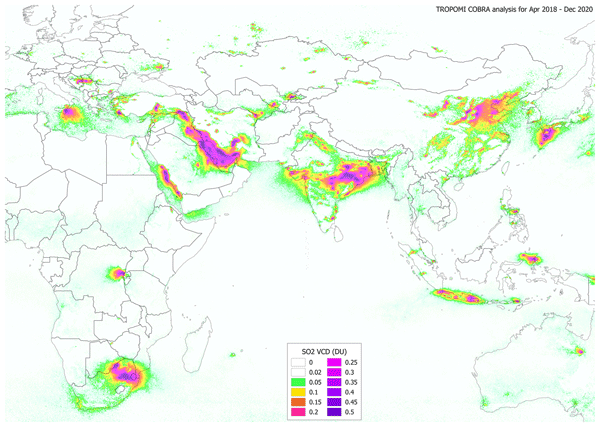
We present a new algorithm to retrieve sulfur dioxide from space UV measurements. We apply the technique to high-resolution TROPOMI measurements and demonstrate the high sensitivity of the approach to weak SO2 emissions worldwide with an unprecedented limit of detection of 8 kt yr−1. This result has broad implications for atmospheric science studies dealing with improving emission inventories and identifying and quantifying missing sources, in the context of air quality and climate.
Omaira E. García, Matthias Schneider, Eliezer Sepúlveda, Frank Hase, Thomas Blumenstock, Emilio Cuevas, Ramón Ramos, Jochen Gross, Sabine Barthlott, Amelie N. Röhling, Esther Sanromá, Yenny González, Ángel J. Gómez-Peláez, Mónica Navarro-Comas, Olga Puentedura, Margarita Yela, Alberto Redondas, Virgilio Carreño, Sergio F. León-Luis, Enrique Reyes, Rosa D. García, Pedro P. Rivas, Pedro M. Romero-Campos, Carlos Torres, Natalia Prats, Miguel Hernández, and César López
Atmos. Chem. Phys., 21, 15519–15554, https://doi.org/10.5194/acp-21-15519-2021, https://doi.org/10.5194/acp-21-15519-2021, 2021
Short summary
Short summary
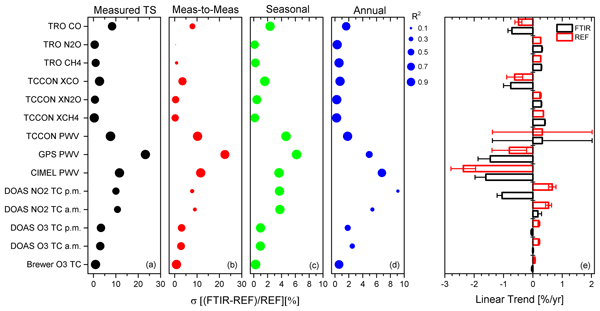
This paper analyses the potential of ground-based Fourier transform infrared (FTIR) solar observations to monitor atmospheric gaseous composition and investigate multiple climate processes. To this end, this work reviews the FTIR programme of one of most relevant ground-based FTIR stations at a global scale, the subtropical Izaña Observatory (IZO, Spain), going over its history during its first 20 years of operation (1999–2018) and exploring its great value for long-term climate research.
Jerald R. Ziemke, Gordon J. Labow, Natalya A. Kramarova, Richard D. McPeters, Pawan K. Bhartia, Luke D. Oman, Stacey M. Frith, and David P. Haffner
Atmos. Meas. Tech., 14, 6407–6418, https://doi.org/10.5194/amt-14-6407-2021, https://doi.org/10.5194/amt-14-6407-2021, 2021
Short summary
Short summary
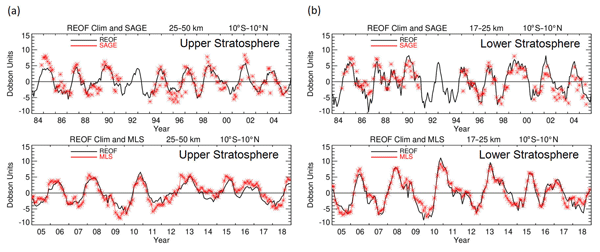
Seasonal and interannual ozone profile climatologies are produced from combined MLS and MERRA-2 GMI ozone for the general public. Both climatologies extend from pole to pole at altitudes of 0–80 km (1 km spacing) for the time record from 1970 to 2018. These climatologies are important for use as a priori information in satellite ozone retrieval algorithms, as validation of other measured and model-simulated ozone, and in radiative transfer studies of the atmosphere.
Cited articles
Ahn, C., Torres, O., Jethva, H., Tiruchirapalli, R., and Huang, L.-K.: Evaluation of aerosol properties observed by DSCOVR/EPIC instrument from the Earth-Sun Lagrange 1 Orbit, J. Geophys. Res.-Atmos., 126, e2020JD033651, https://doi.org/10.1029/2020JD033651, 2021.
Aryasree, S., Kandler, K., Benker, N., Walser, A., Tipka, A., Dollner, M., Seibert, P., and Weinzierl, B.: Vertical Variability in morphology, chemistry and optical properties of the transported Saharan air layer measured from Cape Verde and the Caribbean, Roy. Soc. Open Sci., 11, https://doi.org/10.1098/rsos.231433, 2024.
Balkanski, Y., Schulz, M., Claquin, T., and Guibert, S.: Reevaluation of Mineral aerosol radiative forcings suggests a better agreement with satellite and AERONET data, Atmos. Chem. Phys., 7, 81–95, https://doi.org/10.5194/acp-7-81-2007, 2007.
Barreto, Á., García, R. D., Guirado-Fuentes, C., Cuevas, E., Almansa, A. F., Milford, C., Toledano, C., Expósito, F. J., Díaz, J. P., and León-Luis, S. F.: Aerosol characterisation in the subtropical eastern North Atlantic region using long-term AERONET measurements, Atmos. Chem. Phys., 22, 11105–11124, https://doi.org/10.5194/acp-22-11105-2022, 2022.
Bohren, C. F. and Singham, S. B.: Backscattering by nonspherical particles: A review of methods and suggested new approaches, J. Geophys. Res., 96, 5269–5281, https://doi.org/10.1029/90JD01138, 1991.
Campanelli, M., Estellés, V., Colwell, S., Shanklin, J., and Ningombam S. S.: Analysis of aerosol optical properties from continuous sun-sky radiometer measurements at Halley and Rothera, Antarctica over seven years, EGU General Assembly, Vienna, Austria, 12–17 April 2015, Geophysical Research Abstracts, Vol. 17, EGU2015-2768, https://meetingorganizer.copernicus.org/EGU2015/EGU2015-2768.pdf (last access: 26 June 2026), 2015.
Caudill, T. R., Flittner, D. E., Herman, B. M., Torres, O., and McPeters, R. D.: Evaluation of the pseudo-spherical approximation for backscattered ultraviolet radiances and ozone retrieval, J. Geophys. Res., 102, 3881–3890, https://doi.org/10.1029/96JD03266, 1997.
Corr, C. A., Krotkov, N., Madronich, S., Slusser, J. R., Holben, B., Gao, W., Flynn, J., Lefer, B., and Kreidenweis, S. M.: Retrieval of aerosol single scattering albedo at ultraviolet wavelengths at the T1 site during MILAGRO, Atmos. Chem. Phys., 9, 5813–5827, https://doi.org/10.5194/acp-9-5813-2009, 2009.
Di Biagio, C., Formenti, P., Balkanski, Y., Caponi, L., Cazaunau, M., Pangui, E., Journet, E., Nowak, S., Andreae, M. O., Kandler, K., Saeed, T., Piketh, S., Seibert, D., Williams, E., and Doussin, J.-F.: Complex refractive indices and single-scattering albedo of global dust aerosols in the shortwave spectrum and relationship to size and iron content, Atmos. Chem. Phys., 19, 15503–15531, https://doi.org/10.5194/acp-19-15503-2019, 2019.
Dubovik, O., Holben, B. N., Eck, T. F., Smirnov, A., Kaufman, Y. J., King, M. D., Tanre, D., and Slutsker, I.: Variability of absorption and optical properties of key aerosol types observed worldwide locations, J. Atmos. Sci., 59, 590–608, https://doi.org/10.1175/1520-0469(2002)059<0590:VOAAOP>2.0.CO;2, 2002.
Dubovik, O., Sinyuk, A., Lapyonok, T., Holben, B. N., Mishcenko, M., Yang, P., Eck, T. F., Volten, H., Munoz, O., Vehelmann, B., van der Zande, W. J., Leon, J. F., Sorokin, M., and Slutsker, I.: Application of spheroid models to account for aerosol particle nonsphericity in remote sensing of desert dust, J. Geophys. Res., 111, D11208, https://doi.org/10.1029/2005JD006619, 2006.
Eck, T. F., Holben, B. N., Reid, J. S., Dubovik, O., Smirnov, A., O'Neill, N. T., Slutsker, I., and Kinne, S.: Wavelength dependence of the optical depth of biomass burning, urban, and desert dust aerosols, J. Geophys. Res., 104, 31333–31349, https://doi.org/10.1029/1999JD900923, 1999.
García, M. I., Rodríguez, S., and Alastuey, A.: Impact of North America on the aerosol composition in the North Atlantic free troposphere, Atmos. Chem. Phys., 17, 7387–7404, https://doi.org/10.5194/acp-17-7387-2017, 2017.
Go, S., Lyapustin, A., Schuster, G. L., Choi, M., Ginoux, P., Chin, M., Kalashnikova, O., Dubovik, O., Kim, J., da Silva, A., Holben, B., and Reid, J. S.: Inferring iron-oxide species content in atmospheric mineral dust from DSCOVR EPIC observations, Atmos. Chem. Phys., 22, 1395–1423, https://doi.org/10.5194/acp-22-1395-2022, 2022.
Harrison, L. and Michalsky, J.: Objective algorithms for the retrieval of optical depths from ground-based measurements, Appl. Optics, 33, 5126–5132, https://doi.org/10.1364/AO.33.005126, 1994.
Harrison, L., Michalsky, J., and Berndt, J.: Automated multifilter rotating shadow-band radiometer: an instrument for optical depth and radiation measurements, Appl. Opt., 33, 5118–5125, https://doi.org/10.1364/AO.33.005118, 1994.
Hashimoto, M., Nakajima, T., Dubovik, O., Campanelli, M., Che, H., Khatri, P., Takamura, T., and Pandithurai, G.: Development of a new data-processing method for SKYNET sky radiometer observations, Atmos. Meas. Tech., 5, 2723–2737, https://doi.org/10.5194/amt-5-2723-2012, 2012.
Herman, B. M. and Browning, S. R.: A numerical solution to the equation of radiative transfer, J. Atmos. Sci., 22, 559–566, https://doi.org/10.1175/1520-0469(1965)022<0559:ANSTTE>2.0.CO;2, 1965.
Holben, B. N., Eck, T. F., Slutsker, I., Tanre, D., Buis, J. P., Setzer A., Vermore, E., Reagan, J. A., Kaufman, Y. J., Nakajima, T., Lavenu, F., Jankowiak, I., and Smirnov, A.: AERONET – a federal instrument network and data archive for aerosol characterization, Remote Sens. Environ., 66, 1–16, 1998.
Huang, Y., Kok, J. F., Kandler, K., Lindqvist, H., Nousiainen, T., Sakai, T., Adebiyi, A., and Jokinen, O.: Climate models and remote sensing retrievals neglect substantial desert dust asphericity, Geophys. Res. Lett., 47, e2019GL086592, https://doi.org/10.1029/2019GL086592, 2020.
Intergovernmental Panel on Climate Change (IPCC): Climate Change 2021: The Physical Science Basis. Contribution of Working Group I to the Sixth Assessment Report of the Intergovernmental Panel on Climate Change, Cambridge University Press, https://www.ipcc.ch/report/ar6/wg1/ (last access: 16 June 2026), 2021.
Jethva, H. and Torres, O.: A comparative evaluation of Aura-OMI and SKYNET near-UV single-scattering albedo products, Atmos. Meas. Tech., 12, 6489–6503, https://doi.org/10.5194/amt-12-6489-2019, 2019.
Jethva, H., Torres, O., and Ahn, C.: Global assessment of OMI aerosol single-scattering albedo using ground-based AERONET inversion, J. Geophys. Res.-Atmos., 119, 9020–9040, https://doi.org/10.1002/2014JD021672, 2014.
Jethva, H., Krotkov, N., Torres, O., Mok, J., Labow, G., Lind, E., Eck, T., Gao, W., Janson, G., Simpson, S., Sharp, D., Lantz, K., Charles, W., Barreto, Á., Garcia, R., Korkin, S., and Flittner, D.: Ground-based UV-VIS MFRSR Spectral Aerosol Absorption Dataset of Saharan Dust at Izaña Observatory, in: Atmospheric Measurement Techniques, Zenodo [data set], https://doi.org/10.5281/zenodo.18112037, 2026.
Kandler, K., Benker, N., Bundke, U., Cuevas, E., Ebert, M., Knippertz, P., Rodriguez, S., Schutz, L., and Weinbruch, S.: Chemical composition and complex refractive index of Saharan Mineral Dust at Izaña, Tenerife (Spain) derived by electron microscopy, Atmos. Environ., 41, 8058–8074, https://doi.org/10.1016/j.atmosenv.2007.06.047, 2007.
Korkin, S. and Lyapustin, A.: Radiative interaction of atmosphere and surface: Write-up with elements of code, J. Quant. Spectrosc. Ra., 309, 108663, https://doi.org/10.1016/j.jqsrt.2023.108663, 2023.
Korkin, S., Lyapustin, A., and Holben, B.: AERONET Project: The Next 30 Years of Software Development, AERONET Science and Application Exchange, University of Maryland College Park MD, 17–19 September 2024, https://aeronet.gsfc.nasa.gov/new_web/AERONET_Exchange/2024/Posters/ASAE__SKorkin_ALyapustin_BHolben_Poster.pdf (last access: 23 March 2026), 2024a.
Korkin, S., Lyapustin, A., Siniuk, A., Slutsker, I., Lind, E., and Holben, B.: AERONET Scientific Software After 30 Years: Time to Re-Optimize? American Geophysical Union Fall Meeting, Washington DC, USA, 9–13 December 2024, Abstract no. A11Q-1890, https://agu.confex.com/agu/agu24/meetingapp.cgi/Paper/1577853 (last access: 23 March 2026), 2024b.
Krotkov, N., Bhartia, P. K., Herman, J., Slusser, J., Labow, G., Scott, G., Janson, G., Eck, T. F., and Holben, B.: Aerosol ultraviolet absorption experiment (2002 to 2004), part 1: ultraviolet multi-filter rotating shadowband radiometer calibration and intercomparison with CIMEL sunphotometers, Opt. Eng., 44, 041001, https://doi.org/10.1117/1.1886818, 2005a.
Krotkov, N., Bhartia, P. K., Herman, J., Slusser, J., Scott, G., Labow, G., Vasilkov, A. P., Eck, T. F., Dubovik, O., and Holben, B. N.: Aerosol ultraviolet absorption experiment (2002 to 2004), part 2: absorption optical thickness, refractive index, and single scattering albedo, Opt. Eng., 44, 041005, https://doi.org/10.1117/1.1886819, 2005b.
Lyapustin A., Go, S., Korkin, S., Wang, Y., Torres, O., Jethva, H., and Marshak, A.: Retrievals of Aerosol Optical Depth and Spectral Absorption from DSCOVR EPIC, Front. Remote Sens., 2, 645794, https://doi.org/10.3389/frsen.2021.645794, 2021.
Michalsky, J. J., Schlemmer, J. A., Berkheiser, W. E., Berndt, J. L., Harrison, L. C., Laulainen, N. S., Larson, N. R., and Barnard, J. C.: Multiyear measurements of aerosol optical depth in the Atmospheric Radiation Measurement and Quantitative Links programs, J. Geophys. Res., 106, 12099–12107, https://doi.org/10.1029/2001JD900096, 2001.
Mishchenko, M. I. and Travis, L. D.: T-matrix computations of light scattering by large spheroidal particles, Opt. Commun., 109, 16–21, https://doi.org/10.1016/0030-4018(94)90731-5, 1994.
Mishchenko, M. I., Travis, L. D., Kahn, R. A., and West, R. A.: Modeling phase functions for dustlike tropospheric aerosols using a shape mixture of randomly oriented poly- disperse spheroids, J. Geophys. Res., 102, 16831–16847, https://doi.org/10.1029/96JD02110, 1997.
Mok, J., Krotkov, N., Arola, A., Torres, O., Jethva, H., Adrade, M., Labow, G., Eck. T., Li, Z., Dickerson, R., Stenchikov, G., Osipov, S., and Ren, X.: Impacts of brown carbon from biomass burning on surface UV and ozone photochemistry in the Amazon Basin, Sci. Rep., 6, 36940, https://doi.org/10.1038/srep36940, 2016.
Mok, J., Krotkov, N. A., Torres, O., Jethva, H., Li, Z., Kim, J., Koo, J.-H., Go, S., Irie, H., Labow, G., Eck, T. F., Holben, B. N., Herman, J., Loughman, R. P., Spinei, E., Lee, S. S., Khatri, P., and Campanelli, M.: Comparisons of spectral aerosol single scattering albedo in Seoul, South Korea, Atmos. Meas. Tech., 11, 2295–2311, https://doi.org/10.5194/amt-11-2295-2018, 2018.
Nakajima, T., Tonna, G., Rao, R., Boi, P., Kaufman, Y., and Holben, B.: Use of sky brightness measurements from ground for remote sensing of particulate polydispersions, Appl. Optics, 35, 2672–2686, https://doi.org/10.1364/AO.35.002672, 1996.
Panta, A., Kandler, K., Alastuey, A., González-Flórez, C., González-Romero, A., Klose, M., Querol, X., Reche, C., Yus-Díez, J., and Pérez García-Pando, C.: Insights into the single-particle composition, size, mixing state, and aspect ratio of freshly emitted mineral dust from field measurements in the Moroccan Sahara using electron microscopy, Atmos. Chem. Phys., 23, 3861–3885, https://doi.org/10.5194/acp-23-3861-2023, 2023.
Patterson, E. M., Gillette, D. A., and Stockton, B. H.: Complex index of refraction between 300 and 700 nm for Saharan aerosols, J. Geophys. Res., 82, 3153–3160, https://doi.org/10.1029/JC082i021p03153, 1977.
Reid, E. A., Reid, J. S., Meier, M. M., Dunlap, M. R., Cliff, S. S., Broumas, A., Perry, K., and Maring, H.: Characterization of African dust transported to Puerto Rico by individual particle and size segregated bulk analysis, J. Geophys. Res., 108, 8591, https://doi.org/10.1029/2002JD002935, 2003.
Sinyuk, A., Holben, B. N., Eck, T. F., Giles, D. M., Slutsker, I., Korkin, S., Schafer, J. S., Smirnov, A., Sorokin, M., and Lyapustin, A.: The AERONET Version 3 aerosol retrieval algorithm, associated uncertainties and comparisons to Version 2, Atmos. Meas. Tech., 13, 3375–3411, https://doi.org/10.5194/amt-13-3375-2020, 2020.
Szopa, S., Naik, V., Adhikary, B., Artaxo, P., Berntsen, T., Collins, W. D., Fuzzi, S., Gallardo, L., Kiendler-Scharr, A., Klimont, Z., Liao, H., Unger, N., and Zanis, P.: Short-Lived Climate Forcers, in: Climate Change 2021: The Physical Science Basis. Contribution of Working Group I to the Sixth Assessment Report of the Intergovernmental Panel on Climate Change, edited by: Masson-Delmotte, V., Zhai, P., Pirani, A., Connors, S. L., Péan, C., Berger, S., Caud, N., Chen, Y., Goldfarb, L., Gomis, M. I., Huang, M., Leitzell, K., Lonnoy, E., Matthews, J. B. R., Maycock, T. K., Waterfield, T., Yelekçi, O., Yu, R., and Zhou, B., Cambridge University Press, Cambridge, United Kingdom and New York, NY, USA, 817–922, https://doi.org/10.1017/9781009157896.008, 2021.
Torres, O., Tanskanen, A., Veihelmann, B., Ahn, C., Braak, R., Bhartia, P. K., Veefkind, P., and Levelt, P.: Aerosols and surface UV products from Ozone Monitoring Instrument observations: An overview, J. Geophys. Res., 112, D24S47, https://doi.org/10.1029/2007JD008809, 2007.
Torres, O., Bhartia, P. K., Jethva, H., and Ahn, C.: Impact of the ozone monitoring instrument row anomaly on the long-term record of aerosol products, Atmos. Meas. Tech., 11, 2701–2715, https://doi.org/10.5194/amt-11-2701-2018, 2018.
Torres, O., Jethva, H., Ahn, C., Jaross, G., and Loyola, D. G.: TROPOMI aerosol products: evaluation and observations of synoptic-scale carbonaceous aerosol plumes during 2018–2020, Atmos. Meas. Tech., 13, 6789–6806, https://doi.org/10.5194/amt-13-6789-2020, 2020.
Wagner, R., Ajtai, T., Kandler, K., Lieke, K., Linke, C., Müller, T., Schnaiter, M., and Vragel, M.: Complex refractive indices of Saharan dust samples at visible and near UV wavelengths: a laboratory study, Atmos. Chem. Phys., 12, 2491–2512, https://doi.org/10.5194/acp-12-2491-2012, 2012.
Waterman, P. C.: Symmetry, unitarity, and geometry in electromagnetic scattering, Phys. Rev., 825–839, https://doi.org/10.1103/PhysRevD.3.825, 1971.
Yang, P. and Liou, K. N.: Geometric-optics-integral-equation method for light scattering by nonspherical ice crystals, Appl. Opt., 35, 6568–6584, https://doi.org/10.1364/AO.35.006568, 1996.
Yang, P., Liou, K. N., Mishchenko, M. I., and Gao, B. C.: Efficient finite-difference time-domain scheme for light scattering by dielectric particles: Application to aerosols, Appl. Opt., 39, 3727–3737, https://doi.org/10.1364/AO.39.003727, 2000.
Short summary
A synergistic ground-based remote sensing algorithm applied to Aerosol Robotic Network and Multifilter Rotating Shadowband Radiometer allowed retrievals of UV (ultraviolet)-Vis (visible) spectral aerosol absorption of Saharan dust at the Izaña Atmospheric Observatory. The retrieved dataset provides a valuable reference for evaluating satellite ultraviolet dust absorption inversions and further helps infer dust mineralogy to improve dust representation in Earth System Models.
A synergistic ground-based remote sensing algorithm applied to Aerosol Robotic Network and...


