
Articles | Volume 19, issue 20
https://doi.org/10.5194/amt-19-6823-2026
© Author(s) 2026. This work is distributed under
the Creative Commons Attribution 4.0 License.
the Creative Commons Attribution 4.0 License.
https://doi.org/10.5194/amt-19-6823-2026
© Author(s) 2026. This work is distributed under
the Creative Commons Attribution 4.0 License.
the Creative Commons Attribution 4.0 License.
Review article
| 
29 Oct 2026
Review article |
| 29 Oct 2026
| 29 Oct 2026
Review of the Radon Tracer Method for GHG emission estimates: development, application guidelines, improvements, and caveats

ANSTO Environment Research and Technology Group, Lucas Heights, 2234, Australia
Ute Karstens
ICOS ERIC Carbon Portal, Lund University, Lund, 22362, Sweden
Alan D. Griffiths
ANSTO Environment Research and Technology Group, Lucas Heights, 2234, Australia
Stefan Röttger
Physikalisch-Technische Bundesanstalt, Braunschweig, 38116, Germany
Arnoud Frumau
Netherlands Organisation for Applied Scientific Research (TNO), Petten, 1755 LE, the Netherlands
Christopher T. Roulston
CSIRO Environment, Aspendale, 3195, Australia
Peter Sperlich
New Zealand Institute for Earth Science Ltd., Hataitai, Wellington, 6021, New Zealand
Felix Vogel
Climate Research Division, Environment and Climate Change Canada (ECCC), Toronto, ON, M3H 5T4, Canada
Agnieszka Podstawczyńska
Department of Meteorology and Climatology, University of Lodz, Łódź, 90-139, Poland
Dafina Kikaj
National Physical Laboratory, Teddington, TW11 0LW, UK
Maksym Gachkivskyi
Institut für Umweltphysik, Heidelberg University, Heidelberg, 69120, Germany
Michel Ramonet
Laboratoire des Sciences du Climat et de l'Environnement, Université Paris-Saclay, 91191 Gif-sur-Yvette, France
Blagoj Mitrevski
CSIRO Environment, Aspendale, 3195, Australia
Janja Vaupotič
Department of Environmental Sciences, Jožef Stefan Institute, Ljubljana, 1000, Slovenia
Xuemeng Chen
Institute for Atmospheric and Earth System Research (INAR), University of Helsinki, Helsinki, 00014, Finland
Annette Röttger
Physikalisch-Technische Bundesanstalt, Braunschweig, 38116, Germany
Editorial note: please first read the author comment AC1 that was posted in the discussion of this preprint. The authors intend to make some additional changes to Section 3.8 of the manuscript as originally submitted. These changes are summarised and explained in author comment AC1.
Related authors
Annika Einbock, Franz Conen, Alan D. Griffiths, and Scott D. Chambers
Aerosol Research Discuss., https://doi.org/10.5194/ar-2026-41, https://doi.org/10.5194/ar-2026-41, 2026
Preprint under review for AR
Short summary
Short summary
Some particles emitted from the Earth’s surface can modify clouds by triggering ice formation, so called ice nucleating particles (INPs). We estimate the flux of biological INPs from the source region of a high-altitude site by applying two new implementations of a method originally developed to determine greenhouse gas fluxes. Initial estimates suggest that transport on fair-weather summer days only makes a relatively small contribution to the annual export of biological INPs above the Alps.
Dafina Kikaj, Edward Chung, Alan D. Griffiths, Scott D. Chambers, Grant Forster, Angelina Wenger, Penelope Pickers, Chris Rennick, Simon O'Doherty, Joseph Pitt, Kieran Stanley, Dickon Young, Leigh S. Fleming, Karina Adcock, Emmal Safi, and Tim Arnold
Atmos. Meas. Tech., 18, 151–175, https://doi.org/10.5194/amt-18-151-2025, https://doi.org/10.5194/amt-18-151-2025, 2025
Short summary
Short summary
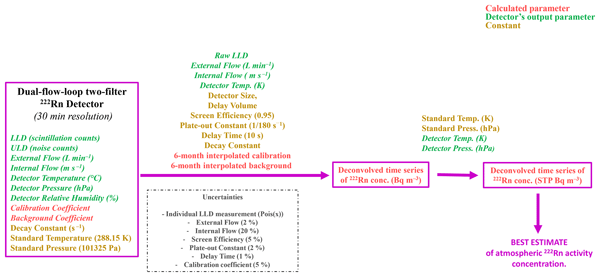
We present a protocol to improve confidence in atmospheric radon measurements, enabling site comparisons and integration with greenhouse gas data. As a natural tracer, radon provides an independent check of transport model performance. This standardized method enhances radon’s use as a metric for model evaluation. Beyond UK observatories, it can support broader networks like ICOS and WMO/GAW, advancing global atmospheric research.

Claudia Grossi, Daniel Rabago, Scott Chambers, Carlos Sáinz, Roger Curcoll, Peter P. S. Otáhal, Eliška Fialová, Luis Quindos, and Arturo Vargas
Atmos. Meas. Tech., 16, 2655–2672, https://doi.org/10.5194/amt-16-2655-2023, https://doi.org/10.5194/amt-16-2655-2023, 2023
Short summary
Short summary
The automatic and low-maintenance radon flux system Autoflux, completed with environmental soil and atmosphere sensors, has been theoretically and experimentally characterized and calibrated under laboratory conditions to be used as transfer standard for in situ measurements. It will offer for the first time long-term measurements to validate radon flux maps used by the climate and the radiation protection communities for assessing the radon gas emissions in the atmosphere.
Ruhi S. Humphries, Melita D. Keywood, Jason P. Ward, James Harnwell, Simon P. Alexander, Andrew R. Klekociuk, Keiichiro Hara, Ian M. McRobert, Alain Protat, Joel Alroe, Luke T. Cravigan, Branka Miljevic, Zoran D. Ristovski, Robyn Schofield, Stephen R. Wilson, Connor J. Flynn, Gourihar R. Kulkarni, Gerald G. Mace, Greg M. McFarquhar, Scott D. Chambers, Alastair G. Williams, and Alan D. Griffiths
Atmos. Chem. Phys., 23, 3749–3777, https://doi.org/10.5194/acp-23-3749-2023, https://doi.org/10.5194/acp-23-3749-2023, 2023
Short summary
Short summary
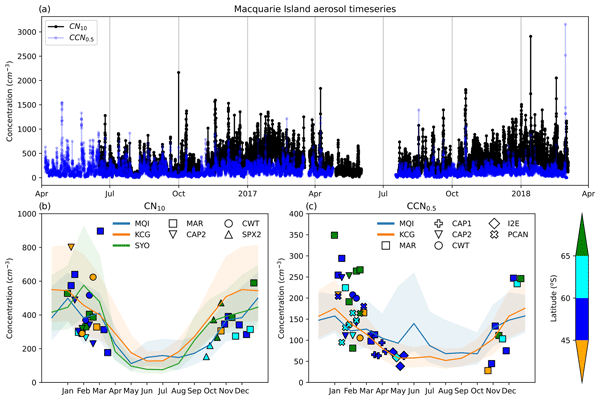
Observations of aerosols in pristine regions are rare but are vital to constraining the natural baseline from which climate simulations are calculated. Here we present recent seasonal observations of aerosols from the Southern Ocean and contrast them with measurements from Antarctica, Australia and regionally relevant voyages. Strong seasonal cycles persist, but striking differences occur at different latitudes. This study highlights the need for more long-term observations in remote regions.

Scott D. Chambers, Alan D. Griffiths, Alastair G. Williams, Ot Sisoutham, Viacheslav Morosh, Stefan Röttger, Florian Mertes, and Annette Röttger
Adv. Geosci., 57, 63–80, https://doi.org/10.5194/adgeo-57-63-2022, https://doi.org/10.5194/adgeo-57-63-2022, 2022
Short summary
Short summary
There is a growing need in health and climate research for high-quality radon observations. A variety of radon monitors, with different uncertainties, operate across global networks. Better compatibility between the measurements is required. Here we describe a novel, portable two-filter radon monitor with a calibration traceable to the International System of Units, and demonstrate the transfer of a traceable calibration from this instrument to a separate monitor under field conditions.
Sonya L. Fiddes, Matthew T. Woodhouse, Steve Utembe, Robyn Schofield, Simon P. Alexander, Joel Alroe, Scott D. Chambers, Zhenyi Chen, Luke Cravigan, Erin Dunne, Ruhi S. Humphries, Graham Johnson, Melita D. Keywood, Todd P. Lane, Branka Miljevic, Yuko Omori, Alain Protat, Zoran Ristovski, Paul Selleck, Hilton B. Swan, Hiroshi Tanimoto, Jason P. Ward, and Alastair G. Williams
Atmos. Chem. Phys., 22, 2419–2445, https://doi.org/10.5194/acp-22-2419-2022, https://doi.org/10.5194/acp-22-2419-2022, 2022
Short summary
Short summary
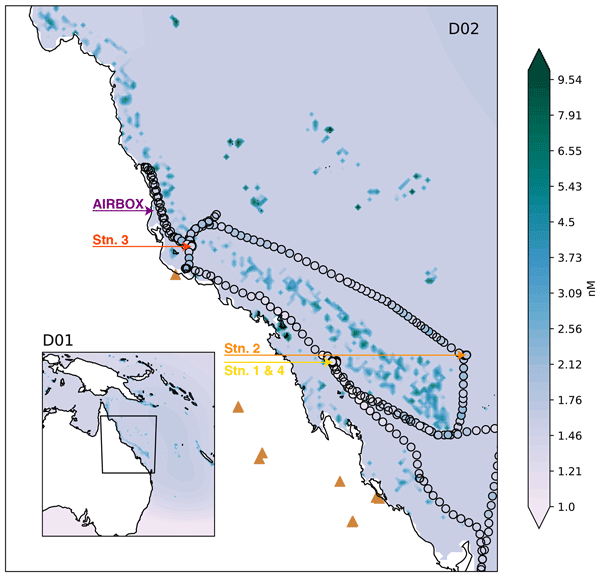
Coral reefs have been found to produce the climatically relevant chemical compound dimethyl sulfide (DMS). It has been suggested that corals can modify their environment via the production of DMS. We use an atmospheric chemistry model to test this theory at a regional scale for the first time. We find that it is unlikely that coral-reef-derived DMS has an influence over local climate, in part due to the proximity to terrestrial and anthropogenic aerosol sources.
Annika Einbock, Franz Conen, Alan D. Griffiths, and Scott D. Chambers
Aerosol Research Discuss., https://doi.org/10.5194/ar-2026-41, https://doi.org/10.5194/ar-2026-41, 2026
Preprint under review for AR
Short summary
Short summary
Some particles emitted from the Earth’s surface can modify clouds by triggering ice formation, so called ice nucleating particles (INPs). We estimate the flux of biological INPs from the source region of a high-altitude site by applying two new implementations of a method originally developed to determine greenhouse gas fluxes. Initial estimates suggest that transport on fair-weather summer days only makes a relatively small contribution to the annual export of biological INPs above the Alps.
Fabian Maier, Christian Rödenbeck, Ute Karstens, Frank-Thomas Koch, Maksym Gachkivskyi, Andrew Smerald, and Christoph Gerbig
Atmos. Chem. Phys., 26, 14699–14723, https://doi.org/10.5194/acp-26-14699-2026, https://doi.org/10.5194/acp-26-14699-2026, 2026
Short summary
Short summary
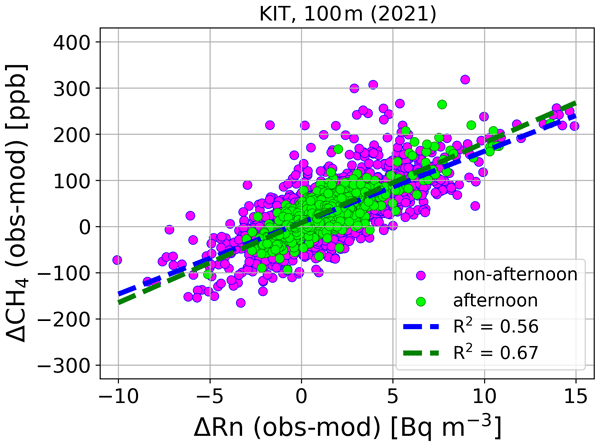
Transport model errors represent a major source of uncertainty in greenhouse gas flux estimates derived from inverse modelling, yet they remain challenging to quantify. In our study, we leverage the similarities in the atmospheric transport of methane (CH4) and radon (222Rn) by performing a dual-tracer CH4-222Rn inversion over Europe, with the goal of enhancing the reliability of CH4 flux estimates. We discuss the benefits and limitations of this dual-tracer approach.
Chloe A. Brashear, Maarten M. J. W. van Herpen, Sergey Gromov, Berend van de Kraats, Carina van der Veen, Xietiancheng Yu, Matthew S. Johnson, Helder Timas, Sönke Zaehle, Armin Jordan, Heiko Moossen, Africa Barreto, Natalia Pratts, Isabel Baños, Jesús Arrieta, Dickon Young, Peter Sealy, Hella van Asperen, Simonetta Montaguti, Peter Sperlich, Rowena Moss, Sylvia Nichol, Stephen Matthew Platt, Ove Hermansen, Cathrine Lund Myhre, Gabrielle Petron, Andy Crotwell, Isaac Vimont, and Thomas Röckmann
EGUsphere, https://doi.org/10.5194/egusphere-2026-5618, https://doi.org/10.5194/egusphere-2026-5618, 2026
This preprint is open for discussion and under review for Atmospheric Chemistry and Physics (ACP).
Short summary
Short summary
This study evaluates trends in atmospheric CO between 1995–2025 and uses the isotopic composition of CO to constrain emission shifts during this time. We find that CO from fossil fuel combustion has reduced dramatically in the Northern Hemisphere during winter, linked to global air quality regulations. Conversely, a small background rise in CO is driven by increasing atmospheric CH4 and recent extreme wildfire seasons have caused large peaks in CO, counteracting reductions from fossil emissions.
Alessandro Zanchetta, Steven van Heuven, Rigel Kivi, Michel Ramonet, Andreas Engel, Maarten Krol, and Huilin Chen
Atmos. Chem. Phys., 26, 13909–13927, https://doi.org/10.5194/acp-26-13909-2026, https://doi.org/10.5194/acp-26-13909-2026, 2026
Short summary
Short summary
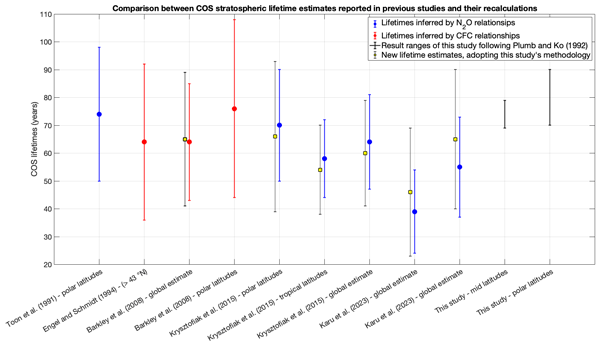
In this study, we calculate the mean lifetime of carbonyl sulfide (COS) and methane (CH4) in the stratosphere from continuous vertical profiles sampled with balloon-borne instruments. We used two methods based on the stratospheric relationship of these gas species with N2O. The estimated stratospheric lifetime range is 69–90 years for COS and 146–172 years for CH4. These results are consistent with other studies and suggest no long-term trends in the stratospheric lifetime of these gas species.
Hui Li, Philippe Ciais, Frédéric Chevallier, Bo Zheng, Paul I. Palmer, Frank Hase, Morgan Lopez, Elsa M. Ordway, Shushi Peng, Danielle Monteverde, Michel Ramonet, Jason M. St. Clair, Le Bienfaiteur Sagang, and Benjamin Poulter
Atmos. Chem. Phys., 26, 11893–11908, https://doi.org/10.5194/acp-26-11893-2026, https://doi.org/10.5194/acp-26-11893-2026, 2026
Short summary
Short summary
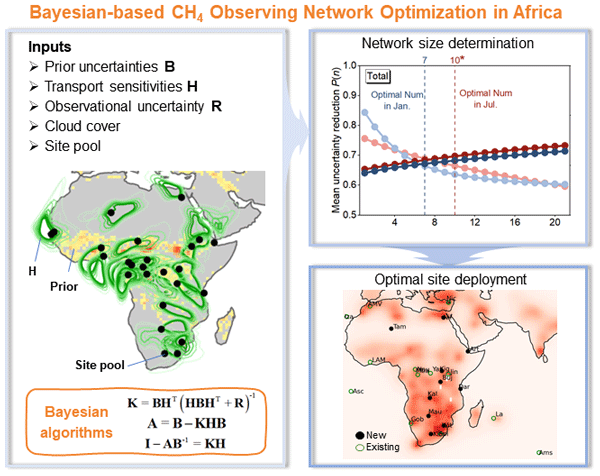
We studied how to best place methane monitoring instruments across Africa to better understand where emissions come from. Because observations can overlap in what they detect, adding more sites does not always improve results equally. Using a statistical approach, we identified both the ideal number and locations of sites (ten new sites can reduce emission uncertainty by over 65 % for total African CH4). Our results help guide cost-effective monitoring strategies in regions with limited data.
Alohotsy Rafalimanana, Thomas Lauvaux, Charbel Abdallah, Mali Chariot, Michel Ramonet, Josselin Doc, Olivier Laurent, Morgan Lopez, Anja Raznjevic, Maarten Krol, Leena Järvi, Andreas Christen, Dana Looschelders, Leslie David, Olivier Sanchez, Laura Bignotti, Benjamin Loubet, Sue Grimmond, and William Morrison
EGUsphere, https://doi.org/10.5194/egusphere-2026-2581, https://doi.org/10.5194/egusphere-2026-2581, 2026
Short summary
Short summary
Using WRF-Chem simulations over Greater Paris at resolutions from 900 m to 100 m (LES), we show that horizontal resolution critically shapes urban CO2 plume structure. Mesoscale runs underestimate spatial contrasts by a factor of 2–3, with representativeness errors of 29–61 % (near-surface) and 21–59 % (XCO2). LES improves intra-urban variability and enables more accurate spatial attribution of emissions, a key step toward reliable top-down estimates for city-scale climate mitigation.
Caleb Mynard, Emily B. Franklin, Joel Alroe, Karen Westwood, Brandon J. McNabb, Robert Strzepek, Philippe D. Tortell, Steven T. Siems, Antonio Patti, Suzie Molloy, Alan Griffiths, Branka Miljevic, Marc D. Mallet, Ruhi Humphries, and Erin Dunne
Atmos. Chem. Phys., 26, 11583–11604, https://doi.org/10.5194/acp-26-11583-2026, https://doi.org/10.5194/acp-26-11583-2026, 2026
Short summary
Short summary
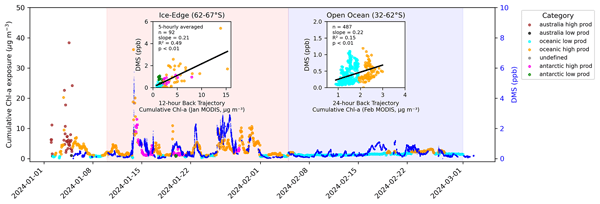
Marine sulfur gases help form climate-cooling particles, but their controls over the Southern Ocean are unclear. During a summer research voyage we measured these gases and linked them to ocean and atmospheric conditions. Near Antarctica, coastal blooms drove sharp rises in dimethyl sulfide while methanethiol remained low. Over the open ocean, both gases varied together, mainly influenced by ocean mixing and temperature, suggesting models should treat coastal and open ocean regions separately.
Matthew L. Loman, Lee T. Murray, Peter D. Ivatt, Róisín Commane, Andrew Hallward-Driemeier, Raghav Dhall, Eric M. Leibensperger, Nicholas Balasus, Lucas Estrada, Melissa P. Sulprizio, Maryann R. Sargent, and Felix Vogel
EGUsphere, https://doi.org/10.5194/egusphere-2026-3153, https://doi.org/10.5194/egusphere-2026-3153, 2026
Short summary
Short summary
We evaluate methane emissions and their trends in New York State based on observations of methane from 29 sites, including four new long-term sites. These observations are most sensitive to emissions in southeastern New York State, including New York City. We find regional trends and biases in some locations, including underestimated emissions in the New York City area. Our results also demonstrate that policy-relevant validation of methane emissions needs a combination of observation platforms.
Alice E. Ramsden, Anita L. Ganesan, Matthew Rigby, Chris Rennick, Tim Arnold, Emmal Safi, Edward Chung, Dafina Kikaj, Cameron Yeo, Dave Lowry, Pete Levy, Simon O'Doherty, Kieran M. Stanley, Dickon Young, Joe Pitt, Damien Martin, Morgan Lopez, Michel Ramonet, Grant L. Forster, Arnoud Frumau, and Alistair J. Manning
Atmos. Chem. Phys., 26, 11421–11448, https://doi.org/10.5194/acp-26-11421-2026, https://doi.org/10.5194/acp-26-11421-2026, 2026
Short summary
Short summary
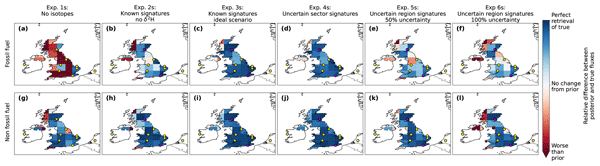
Methane is emitted from a range of anthropogenic and natural sources, each with a characteristic isotope ratio signature. We present a method for estimating emissions from multiple sources using isotopic signatures and observations of atmospheric methane isotope ratios. We show the importance of considering isotopic signature uncertainty and demonstrate how our current understanding of these signatures may be limiting this method’s ability to reduce uncertainties in emissions estimates.
Joseph R. Pitt, Dominique Rust, Anita Ganesan, Luke M. Western, Martin K. Vollmer, Jens Mühle, Tobias Bühlmann, Christina M. Harth, Stephen A. Montzka, Brad D. Hall, Isaac J. Vimont, Alistair J. Manning, Alison L. Redington, Stephan Henne, Daniela B. Melo, Saurabh Annadate, Lionel Constantin, Brendan M. Murphy, Matthew Rigby, Dickon Young, Simon O'Doherty, Angelina Wenger, Chris R. Lunder, Ove Hermansen, Thomas Wagenhäuser, Andreas Engel, Jgor Arduini, Michela Maione, Jaegeun Yun, Blagoj Mitrevski, Paul B. Krummel, Paul J. Fraser, Jooil Kim, Ray H. J. Wang, Tae Siek Rhee, Peter K. Salameh, T. Gerard Spain, Stefan Reimann, Ronald G. Prinn, Ray F. Weiss, and Kieran M. Stanley
Atmos. Chem. Phys., 26, 10167–10195, https://doi.org/10.5194/acp-26-10167-2026, https://doi.org/10.5194/acp-26-10167-2026, 2026
Short summary
Short summary
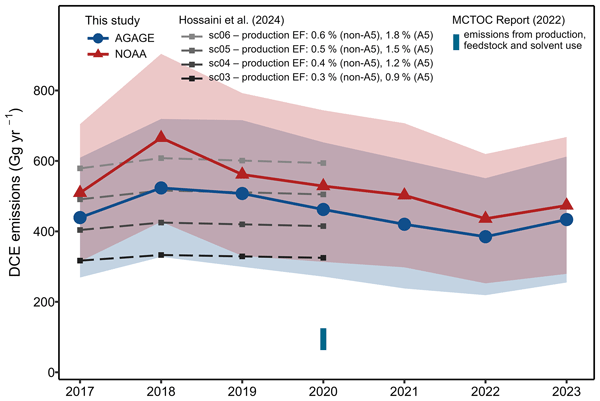
1,2‑Dichloroethane (DCE) can contribute to the depletion of the stratospheric ozone layer. Whether DCE reaches the stratosphere depends on where and when it is emitted. We present the ongoing measurements of DCE from the Advanced Global Atmospheric Gases Experiment (AGAGE) and National Oceanic and Atmospheric Administration (NOAA) global monitoring networks. For the period 2017–2023, our modelled average global emissions based on these observations align with another study, while regional estimates differ. This suggests remaining uncertainty in the geographical distribution of emissions.
Cheng Yao, Longlong Wang, Aoxiang Huang, Bin Zhang, Marija Bervida Mačak, Luka Drinovec, Asta Gregorič, Fei Gao, Janja Vaupotič, Miloš Miler, Mateja Gosar, Zhangwei Yu, Daru Chen, Griša Močnik, and Samo Stanič
EGUsphere, https://doi.org/10.5194/egusphere-2026-3471, https://doi.org/10.5194/egusphere-2026-3471, 2026
Short summary
Short summary
Aerosols affect climate by scattering and absorbing sunlight and heat. Light detection and ranging instruments can track aerosol distributions, but turning their signals into atmospheric information depends on particle size, absorption, and humidity. We developed a ground-measurement method and tested it in Slovenia. The results provide optical constraints that support more reliable retrieval of aerosol profile information when different particle types are mixed.
Alohotsy Rafalimanana, Thomas Lauvaux, Charbel Abdallah, Mali Chariot, Michel Ramonet, Josselin Doc, Olivier Laurent, Morgan Lopez, Anja Raznjevic, Maarten Krol, Leena Järvi, Andreas Christen, Dana Looschelders, Leslie David, Olivier Sanchez, Laura Bignotti, Benjamin Loubet, Sue Grimmond, and William Morrison
EGUsphere, https://doi.org/10.5194/egusphere-2026-2109, https://doi.org/10.5194/egusphere-2026-2109, 2026
Short summary
Short summary
This study explores how city design and buildings affect CO2 levels in the air over Paris. Using a transport model, we tested different urban canopy models to represent the city environment and its influence on air motion. We found that realistic descriptions of urban surfaces are crucial, especially in winter, for accurately showing how CO2 builds up and disperses, leading to better satellite monitoring of city CO2 emissions.
Josselin Doc, François-Marie Bréon, Morgan Lopez, Yao Té, Pascal Jeseck, Jinghui Lian, Guillaume Nief, Antoine Parent, Hippolyte Leuridan, and Michel Ramonet
Atmos. Chem. Phys., 26, 8937–8959, https://doi.org/10.5194/acp-26-8937-2026, https://doi.org/10.5194/acp-26-8937-2026, 2026
Short summary
Short summary
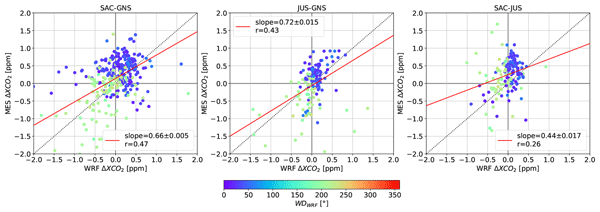
A greenhouse gas monitoring network was set up around Paris. From July 2022 to December 2024, three stations placed along the main wind direction detected differences of 0.5–1 ppm between sites. Compared with WRF-Chem (Weather Research and Forecasting model coupled with Chemistry) simulations using the Origins.earth inventory, the data suggest that emissions are overestimated by the inventory. A reduction of about 34 % would be needed, a stronger correction than indicated by surface-based studies.
Bibhasvata Dasgupta, Sudhanshu Pandey, Sander Houweling, Malika Menoud, Carina van der Veen, John Miller, Ben Riddell-Young, Sylvia Englund Michel, Peter Sperlich, Shinji Morimoto, Ryo Fujita, Stephen Platt, Christine Groot Zwaaftink, Ingeborg Levin, Cordelia Veidt, Cathrine Lund Myhre, Ceres Woolley Maisch, Rebecca Fisher, Euan G. Nisbet, James France, Rowena Moss, Nicola Warwick, and Thomas Röckmann
Atmos. Chem. Phys., 26, 8601–8616, https://doi.org/10.5194/acp-26-8601-2026, https://doi.org/10.5194/acp-26-8601-2026, 2026
Short summary
Short summary
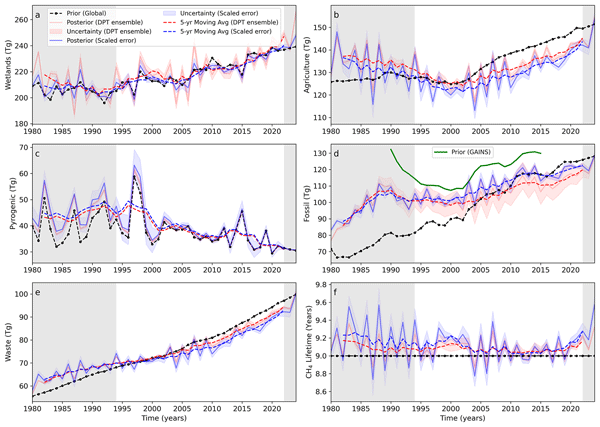
Methane is a strong greenhouse gas, and its rise since the mid-2000s is debated in terms of sources and sinks. Using top-down and bottom-up data, along with inversion models and methane isotopes (δ13C-CH4 and δD-CH4), we find that wetlands are the primary driver of post-2006 increases, followed by agriculture and fossil fuels. Methane's lifetime has decreased by about 0.1 years. We also assess how isotope signatures and sink processes influence uncertainties.
Hélène De Longueville, Daniela B. Melo, Alison L. Redington, Alice Ramsden, Alexandre Danjou, Peter Andrews, Joseph Pitt, Brendan Murphy, Lionel Constantin, Kieran M. Stanley, Simon O'Doherty, Angelina Wenger, Dickon Young, Andreas Engel, Tanja Schuck, Katharina Meixner, Thomas Wagenhaeuser, Fides Gad, Martin K. Vollmer, Stefan Reimann, Michela Maoine, Jgor Arduini, Chris Lunder, Norbert Schmidtbauer, László Haszpra, Mihály Molnár, Arnoud Frumau, Cedric Couret, Matthew Rigby, Stephan Henne, Alistair Manning, and Anita L. Ganesan
Atmos. Chem. Phys., 26, 7647–7675, https://doi.org/10.5194/acp-26-7647-2026, https://doi.org/10.5194/acp-26-7647-2026, 2026
Short summary
Short summary
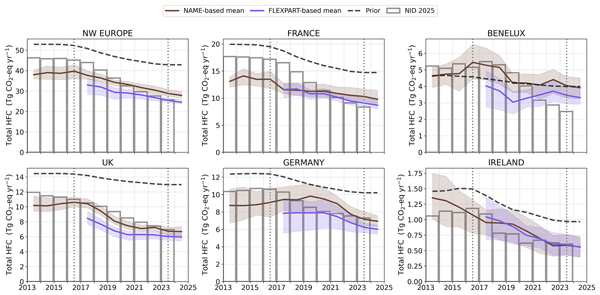
This study estimates emissions of hydrofluorocarbons, potent greenhouse gases, in north-western Europe using atmospheric observations and atmospheric modelling. The estimates are compared with nationally reported emissions submitted to the United Nations. Overall, our results are consistent with reported values, although differences are found for some gases and countries. The findings indicate that emissions in north-western Europe are declining, reflecting the effects of climate regulations.
Emmal Safi, Joe Pitt, Grant Forster, Chris Rennick, Simon O’Doherty, Dickon Young, Kanokrat Charoenpornpukdee, Nick Garrard, Dafina Kikaj, Andrew Manning, Gerard Spain, Damien Martin, Morgan Lopez, Michel Ramonet, and Kieran Stanely
EGUsphere, https://doi.org/10.5194/egusphere-2026-1802, https://doi.org/10.5194/egusphere-2026-1802, 2026
Short summary
Short summary
We compared whole and synthetic-air reference materials (RMs) for investigating offsets in greenhouse gas measurements so data from different sites/networks can be trusted when combined. By sending whole and synthetic-air (RMs) to six sites and measuring under routine field conditions, we found whole-air gives the most precise results, especially for carbon dioxide and nitrous oxide. Synthetic-air worked fairly well for methane but synthetic-air RMs needs lower uncertainty before wide use.
Martin K. Vollmer, Joseph R. Pitt, Dickon Young, Stephan Henne, Blagoj Mitrevski, Jens Mühle, Anita Ganesan, Jgor Arduini, Alistair J. Manning, Thomas Wagenhäuser, Alison L. Redington, Daniela B. Melo, Brendan Murphy, Ray Gluckmann, Kieran M. Stanley, Paul B. Krummel, Chris R. Lunder, Jaegeun Yun, Dominique Rust, Angelina Wenger, Myriam Guillevic, Jooil Kim, Ray H. J. Wang, Tae Siek Rhee, Lionel Constantin, Arnoud Frumau, Christina M. Harth, Peter K. Salameh, Ove Hermansen, Matthew Rigby, Luke M. Western, Andreas Engel, Simon O'Doherty, Sunyoung Park, Michela Maione, Paul J. Fraser, Ronald G. Prinn, Ray F. Weiss, and Stefan Reimann
Atmos. Chem. Phys., 26, 6993–7012, https://doi.org/10.5194/acp-26-6993-2026, https://doi.org/10.5194/acp-26-6993-2026, 2026
Short summary
Short summary
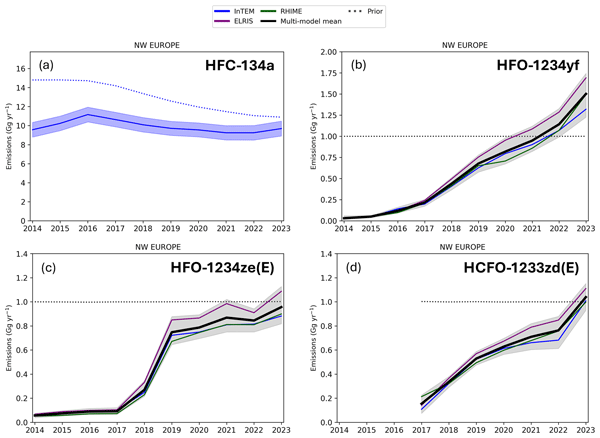
Halogenated olefins (HFOs) are newly emerging compounds in the atmosphere. They are in reach of the definition of PFAS (Per- and polyfluoroalkyl substances) and some decay to the eternal chemical trifluoroacetate (TFA). We provide atmospheric measurements of three HFOs from the large Advanced Global Atmospheric Gases Experiment (AGAGE) network and estimate emissions for Northwest Europe for the first time. We find a quasi-ubiquitous presence in the atmosphere and rapidly increasing emissions.
Ann-Kristin Kunz, Samuel Hammer, Patrick Aigner, Laura Bignotti, Lars Borchardt, Jia Chen, Julian Della Coletta, Lukas Emmenegger, Markus Eritt, Xochilt Gutiérrez, Josh Hashemi, Rainer Hilland, Christopher Holst, Armin Jordan, Natascha Kljun, Richard Kneißl, Changxing Lan, Virgile Legendre, Ingeborg Levin, Benjamin Loubet, Matthias Mauder, Betty Molinier, Susanne Preunkert, Michel Ramonet, Stavros Stagakis, and Andreas Christen
Atmos. Chem. Phys., 26, 4967–5003, https://doi.org/10.5194/acp-26-4967-2026, https://doi.org/10.5194/acp-26-4967-2026, 2026
Short summary
Short summary
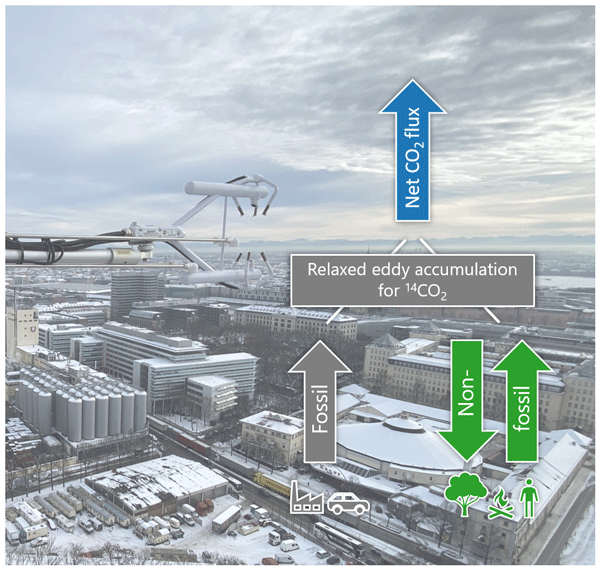
We present radiocarbon (14C)-based fossil fuel CO2 fluxes from relaxed eddy accumulation measurements on tall towers in the cities of Zurich, Paris, and Munich. By separating net CO2 fluxes into fossil and non-fossil components, these data reveal significant and variable contributions from human, plant, and soil respiration, as well as point-source emissions. These unique insights into CO2 flux composition offer crucial information for observation-based validation of urban emission estimates.
Jiaxin Wang, Sieglinde Callewaert, Minqiang Zhou, Filip Desmet, Sébastien Conil, Michel Ramonet, Pucai Wang, and Martine De Mazière
Atmos. Chem. Phys., 26, 3541–3565, https://doi.org/10.5194/acp-26-3541-2026, https://doi.org/10.5194/acp-26-3541-2026, 2026
Short summary
Short summary
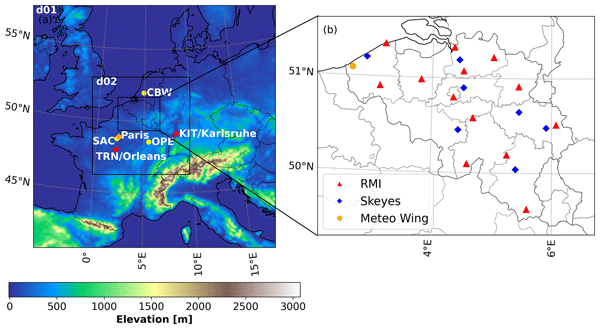
We used a regional atmospheric transport model to simulate carbon dioxide mole fractions over Western Europe. The results show the importance of anthropogenic emission configurations, particularly near large emission sources, as well as the necessity of improving biogenic flux simulations. These findings contribute to enhancing the accuracy of carbon dioxide modeling and carbon budget inversions.
Alessandro Zanchetta, Steven van Heuven, Joram Hooghiem, Rigel Kivi, Thomas Laemmel, Michel Ramonet, Markus Leuenberger, Peter Nyfeler, Sophie L. Baartman, Maarten Krol, and Huilin Chen
Atmos. Meas. Tech., 19, 1465–1486, https://doi.org/10.5194/amt-19-1465-2026, https://doi.org/10.5194/amt-19-1465-2026, 2026
Short summary
Short summary
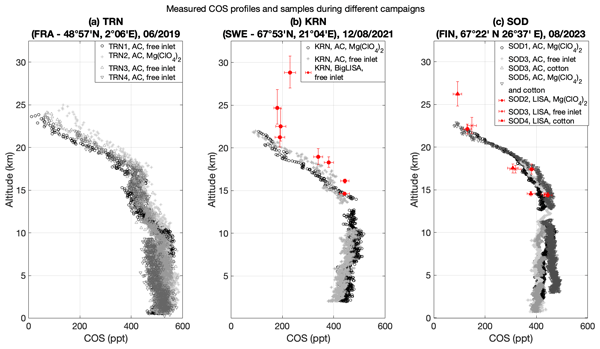
Continuous vertical profiles and discrete stratospheric samples of carbonyl sulfide (COS) were collected deploying the balloon-borne AirCore, LIghtweight Stratospheric Air (LISA) and BigLISA samplers and measured on a Quantum Cascade Laser Spectrometer (QCLS). Our measurements show good accordance with previous COS observations. Moreover, laboratory tests of ozone (O3) scrubbers proved squalene to remove O3 very efficiently without biasing the measurements of other trace gases.
Shoma Yamanouchi, Sebastien Ars, Meghan Flood, Lawson Gillespie, Jordan Stuart, Kiran Ramlogan, and Felix Vogel
EGUsphere, https://doi.org/10.5194/egusphere-2025-5086, https://doi.org/10.5194/egusphere-2025-5086, 2026
Short summary
Short summary
Methane is a potent greenhouse gas. In this study, Gaussian plume model, a simple, computationally inexpensive modeling method, was used in conjunction with measurements of atmospheric methane concentrations to estimate emissions of methane from refineries and waste treatment facilities. This study also presents novel methods to improve the model, including a method to better describe the atmosphere, as well as an algorithmic way to nudge source locations to get better emission estimates.
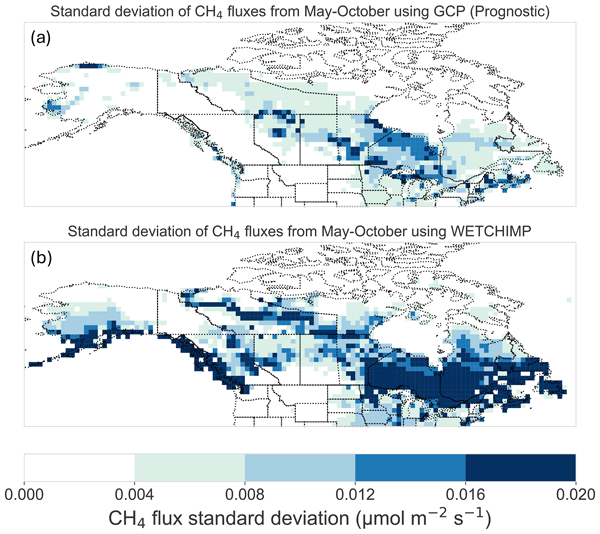
Hanyu Liu, Misa Ishizawa, Felix R. Vogel, Zhen Zhang, Benjamin Poulter, Leyang Feng, Ao Chen, Anna L. Gagné-Landmann, Deborah N. Huntzinger, Joe R. Melton, Vineet Yadav, Dylan C. Gaeta, Ziting Huang, Douglas E. J. Worthy, Douglas Chan, and Scot M. Miller
Atmos. Chem. Phys., 26, 1229–1247, https://doi.org/10.5194/acp-26-1229-2026, https://doi.org/10.5194/acp-26-1229-2026, 2026
Short summary
Short summary
We find that the state-of-the-art process-based methane flux models have both lower flux magnitude and reduced inter-model uncertainty compared to a previous model inter-comparison from over a decade ago. Despite these improvements, methane flux estimates from process-based models are still likely too high compared to atmospheric observations. We also find that models with simpler parameterizations often result in better agreement with atmospheric observations in high-latitude North America.
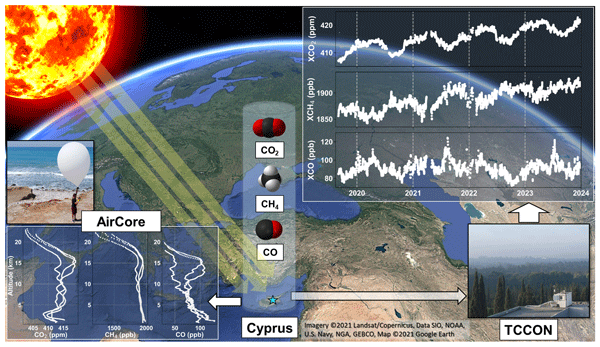
Constantina Rousogenous, Christof Petri, Pierre-Yves Quéhé, Thomas Laemmel, Joshua L. Laughner, Maximilien Desservettaz, Michael Pikridas, Michel Ramonet, Efstratios Bourtsoukidis, Matthias Buschmann, Justus Notholt, Thorsten Warneke, Jean-Daniel Paris, Jean Sciare, and Mihalis Vrekoussis
Atmos. Meas. Tech., 19, 565–581, https://doi.org/10.5194/amt-19-565-2026, https://doi.org/10.5194/amt-19-565-2026, 2026
Short summary
Short summary
The Eastern Mediterranean and Middle East is a greenhouse gas emission hotspot but lacks atmospheric monitoring. Our study introduces the first Total Carbon Column Observing Network site in this region, in Cyprus, providing high-precision columnar measurement of key greenhouse gases. This new dataset enhances global climate monitoring efforts, supports the validation of satellites, will help assess regional emission trends, filling a critical observational gap in this climate-sensitive region.
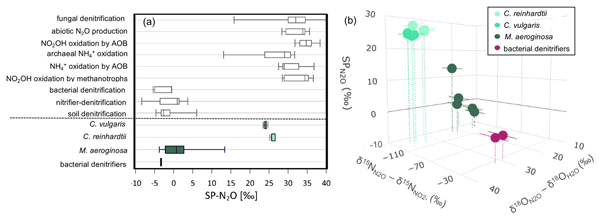
Maxence Plouviez, Peter Sperlich, Benoit Guieysse, Tim Clough, Rahul Peethambaran, and Naomi Wells
Biogeosciences, 23, 497–508, https://doi.org/10.5194/bg-23-497-2026, https://doi.org/10.5194/bg-23-497-2026, 2026
Short summary
Short summary
We present a new method for the accurate laser-based analysis of N2O isotopes. For the first time, we measured the Site Preference-N2O signatures of pure cultures of microalgae and cyanobacteria. Our study is a first step to ultimately develop process-specific N2O monitoring from aquatic ecosystems. Further research is now needed to determine the occurrence and significance of N2O emissions from microalgae and cyanobacteria from aquatic ecosystems.
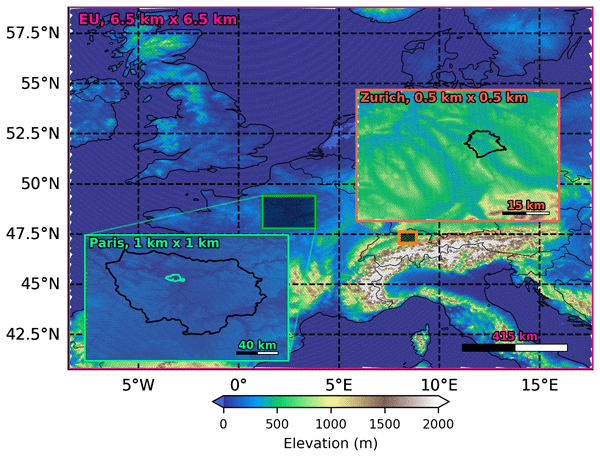
Nikolai Ponomarev, Michael Steiner, Erik Koene, Pascal Rubli, Stuart Grange, Lionel Constantin, Michel Ramonet, Leslie David, Arash Hamzehloo, Lukas Emmenegger, and Dominik Brunner
Atmos. Chem. Phys., 26, 547–570, https://doi.org/10.5194/acp-26-547-2026, https://doi.org/10.5194/acp-26-547-2026, 2026
Short summary
Short summary
Urban inversions are gaining increasing attention, as cities are major contributors to anthropogenic emissions, making accurate emission estimates at this scale essential for supporting climate action plans and verifying reported emission reductions. We estimated carbon dioxide emissions in Zurich and Paris over one year by combining atmospheric observations with mesoscale model simulations. Our study shows how factors like city size, terrain, and measurement methods affect emission estimates.
Ida Storm, Ute Karstens, Claudio D'Onofrio, Alex Vermeulen, Samuel Hammer, Ingrid Super, Theo Glauch, and Wouter Peters
Earth Syst. Sci. Data, 17, 6681–6701, https://doi.org/10.5194/essd-17-6681-2025, https://doi.org/10.5194/essd-17-6681-2025, 2025
Short summary
Short summary
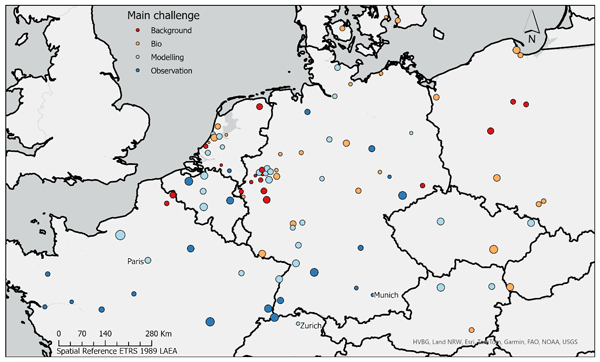
Many cities are committed to ambitious CO2 emission reduction targets, supported by climate action plans. Atmospheric measurements are essential to verify that these efforts lead to the expected reductions. Here, we characterise and compare 96 European cities across 18 metrics, linking them to four major challenges in CO2 emissions monitoring. Our framework includes a tool with additional cities and metrics, as well as "mapbooks" for the 96 cities.
Luke M. Western, Matthew Rigby, Jens Mühle, Paul B. Krummel, Chris R. Lunder, Simon O'Doherty, Stefan Reimann, Martin K. Vollmer, Dickon Young, Ben Adam, Paul J. Fraser, Anita L. Ganesan, Christina M. Harth, Ove Hermansen, Jooil Kim, Ray L. Langenfelds, Zoë M. Loh, Blagoj Mitrevski, Joseph R. Pitt, Peter K. Salameh, Roland Schmidt, Kieran Stanley, Ann R. Stavert, Hsiang-Jui Wang, Ray F. Weiss, and Ronald G. Prinn
Earth Syst. Sci. Data, 17, 6557–6582, https://doi.org/10.5194/essd-17-6557-2025, https://doi.org/10.5194/essd-17-6557-2025, 2025
Short summary
Short summary
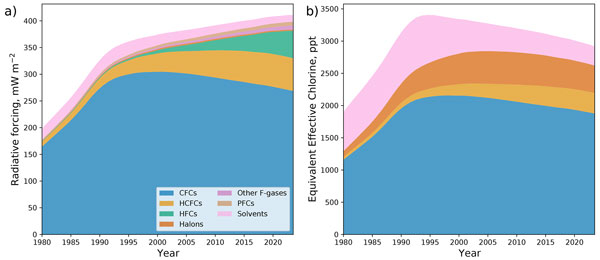
We used global measurements and an atmospheric model to estimate how emissions and abundances of 42 chemically and radiatively important trace gases have changed over time. These gases affect the Earth's radiative balance and the ozone layer. Our data sets help track progress in reducing emissions of these gases to the atmosphere. This work supports international efforts to protect the environment by providing clear, long-term, consistent data on how these gases are changing in the atmosphere.
Camille Yver-Kwok, Michel Ramonet, Leonard Rivier, Jinghui Lian, Claudia Grossi, Roger Curcoll, Dafina Kikaj, Edward Chung, and Ute Karstens
Atmos. Chem. Phys., 25, 16085–16106, https://doi.org/10.5194/acp-25-16085-2025, https://doi.org/10.5194/acp-25-16085-2025, 2025
Short summary
Short summary
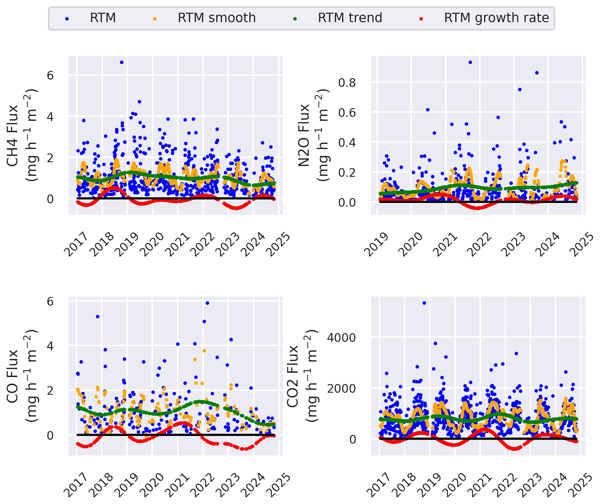
Here, we use greenhouse gas and radon data from a tall tower in France to estimate their fluxes within the station footprint from January 2017 to October 2024 using the Radon Tracer Method. Using the latest radon exhalation maps and standardized radon measurements, we found the greenhouse gas fluxes to be in agreement with the literature. Compared to inventories, there is a general agreement except for carbon dioxide where we show that the biogenic fluxes are not well represented in the model.
Laura Bouillon, Valérie Gros, Morgan Lopez, Nicolas Bonnaire, Carole Philippon, Camille Yver Kwok, Leslie David, Olivier Perrussel, Olivier Sanchez, Simone Kotthaus, Jean-Eudes Petit, Philippe Ciais, and Michel Ramonet
Earth Syst. Sci. Data Discuss., https://doi.org/10.5194/essd-2025-602, https://doi.org/10.5194/essd-2025-602, 2025
Revised manuscript accepted for ESSD
Short summary
Short summary
The Saclay observatory, 20 km southwest of Paris, monitored greenhouse and reactive gases, as well as aerosols, over 10 years to assess the impact of urban emissions. By comparing downwind and background conditions, the study revealed significant reductions in pollutants linked to traffic: -35.6 % for CO, -52.3 % for NOₓ, -56.7 % for eBC, and -15 % for CO2. These trends align with emission decrease estimates from AIRPARIF inventories over the same period.
Maksym Gachkivskyi, Ute Karstens, Bernd Fischer, Dagmar Kubistin, Jennifer Müller-Williams, Matthias Lindauer, and Ingeborg Levin
Earth Syst. Sci. Data, 17, 6173–6197, https://doi.org/10.5194/essd-17-6173-2025, https://doi.org/10.5194/essd-17-6173-2025, 2025
Short summary
Short summary
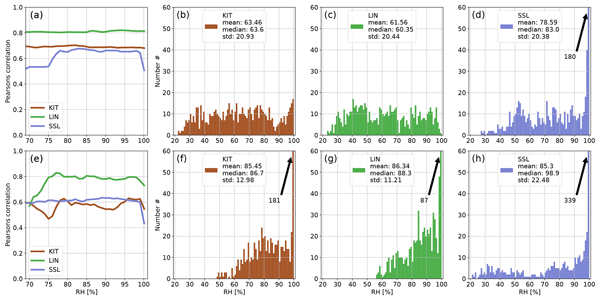
222Radon (Rn) can be used to distinguish marine and continental air masses or to validate transport models. The Heidelberg Radon Monitor (HRM) measures 214polonium (Po), a progeny of Rn. This study presents Po-based Rn activity concentrations measured with the HRM at eight stations in Germany with guidelines for estimating Rn from Po measurements. Comparison between modeled and measured activity concentrations shows that at high relative humidity Po measurements cannot be interpreted as Rn.
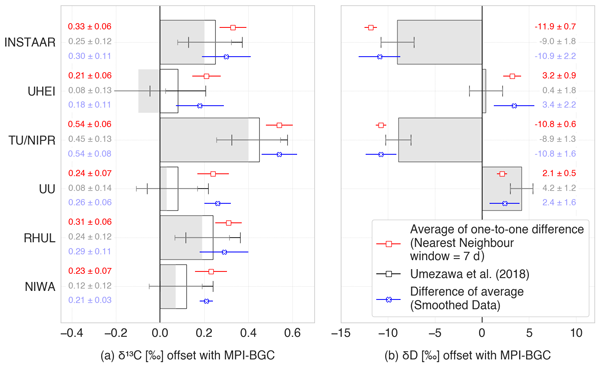
Bibhasvata Dasgupta, Malika Menoud, Carina van der Veen, Ingeborg Levin, Cordelia Veidt, Heiko Moossen, Sylvia Englund Michel, Peter Sperlich, Shinji Morimoto, Ryo Fujita, Taku Umezawa, Stephen Platt, Christine Groot Zwaaftink, Cathrine Lund Myhre, Rebecca Fisher, David Lowry, Euan G. Nisbet, James France, Ceres Woolley Maisch, Gordon Brailsford, Rowena Moss, Daisuke Goto, Sudhanshu Pandey, Sander Houweling, Nicola Warwick, and Thomas Röckmann
Atmos. Meas. Tech., 18, 6591–6607, https://doi.org/10.5194/amt-18-6591-2025, https://doi.org/10.5194/amt-18-6591-2025, 2025
Short summary
Short summary
We combined long-term methane mole fraction and isotope measurements from eight laboratories that sample high-latitude stations to compare, offset correct and harmonise the datasets into a hemisphere merged timeseries. Because each laboratory uses slightly different methods, we adjusted the data to make it directly comparable. This allowed us to create a consistent record of atmospheric methane concentration and its isotopes from 1988 to 2023.

Félix Langot, Cyril Crevoisier, Thomas Lauvaux, Charbel Abdallah, Jérôme Pernin, Xin Lin, Marielle Saunois, Axel Guedj, Thomas Ponthieu, Julien Moyé, Michel Ramonet, Anke Roiger, Klaus-Dirk Gottschaldt, and Alina Fiehn
Atmos. Meas. Tech., 18, 5955–5983, https://doi.org/10.5194/amt-18-5955-2025, https://doi.org/10.5194/amt-18-5955-2025, 2025
Short summary
Short summary
Our study compares outputs from meteorological and atmospheric composition models to data from the MAGIC2021 campaign that took place in Sweden. Our results highlight performance differences among models, revealing strengths and weaknesses of different modelling techniques. We also found that wetland emission inventories overestimated emissions in regional simulations. This work helps to refine methane emission predictions, essential for understanding climate change.
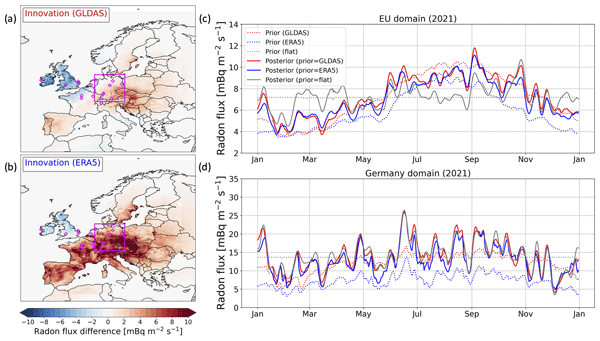
Fabian Maier, Eva Falge, Maksym Gachkivskyi, Stephan Henne, Ute Karstens, Dafina Kikaj, Ingeborg Levin, Alistair Manning, Christian Rödenbeck, and Christoph Gerbig
Atmos. Chem. Phys., 25, 12779–12809, https://doi.org/10.5194/acp-25-12779-2025, https://doi.org/10.5194/acp-25-12779-2025, 2025
Short summary
Short summary
The radioactive noble gas radon (222Rn) is a suitable natural tracer for atmospheric transport and mixing processes that can be used to validate and calibrate atmospheric transport models. However, this requires accurate estimates of the 222Rn flux from the soil into the atmosphere. In our study, we evaluate the reliability of process-based 222Rn flux maps for Europe using a 222Rn inversion. Our inversion results can give some indications on how to improve the process-based 222Rn flux maps.
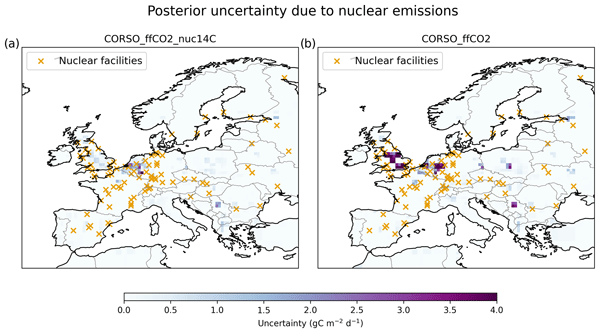
Carlos Gómez-Ortiz, Guillaume Monteil, Ute Karstens, and Marko Scholze
Atmos. Chem. Phys., 25, 10747–10771, https://doi.org/10.5194/acp-25-10747-2025, https://doi.org/10.5194/acp-25-10747-2025, 2025
Short summary
Short summary
In 2024, an intensive sampling campaign was conducted to improve fossil CO2 emission estimates in Europe using 14C measurements. By testing different strategies for selecting air samples, this study shows that increasing sample frequency and carefully choosing samples based on their fossil fuel and nuclear content leads to more accurate results, reducing the uncertainty and bias of the estimates.
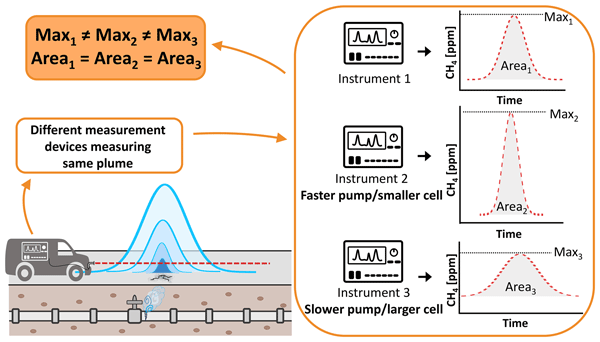
Judith Tettenborn, Daniel Zavala-Araiza, Daan Stroeken, Hossein Maazallahi, Carina van der Veen, Arjan Hensen, Ilona Velzeboer, Pim van den Bulk, Felix Vogel, Lawson Gillespie, Sebastien Ars, James France, David Lowry, Rebecca Fisher, and Thomas Röckmann
Atmos. Meas. Tech., 18, 3569–3584, https://doi.org/10.5194/amt-18-3569-2025, https://doi.org/10.5194/amt-18-3569-2025, 2025
Short summary
Short summary
Measurements of methane with vehicle-based sensors are an effective method to identify and quantify leaks from urban gas distribution systems. We deliberately released methane in different environments and calibrated the response of different methane analysers when they transected the plumes in a vehicle. We derived an improved statistical function for consistent emission estimations using different instruments. Repeated transects reduce the uncertainty in emission rate estimates.
Marielle Saunois, Adrien Martinez, Benjamin Poulter, Zhen Zhang, Peter A. Raymond, Pierre Regnier, Josep G. Canadell, Robert B. Jackson, Prabir K. Patra, Philippe Bousquet, Philippe Ciais, Edward J. Dlugokencky, Xin Lan, George H. Allen, David Bastviken, David J. Beerling, Dmitry A. Belikov, Donald R. Blake, Simona Castaldi, Monica Crippa, Bridget R. Deemer, Fraser Dennison, Giuseppe Etiope, Nicola Gedney, Lena Höglund-Isaksson, Meredith A. Holgerson, Peter O. Hopcroft, Gustaf Hugelius, Akihiko Ito, Atul K. Jain, Rajesh Janardanan, Matthew S. Johnson, Thomas Kleinen, Paul B. Krummel, Ronny Lauerwald, Tingting Li, Xiangyu Liu, Kyle C. McDonald, Joe R. Melton, Jens Mühle, Jurek Müller, Fabiola Murguia-Flores, Yosuke Niwa, Sergio Noce, Shufen Pan, Robert J. Parker, Changhui Peng, Michel Ramonet, William J. Riley, Gerard Rocher-Ros, Judith A. Rosentreter, Motoki Sasakawa, Arjo Segers, Steven J. Smith, Emily H. Stanley, Joël Thanwerdas, Hanqin Tian, Aki Tsuruta, Francesco N. Tubiello, Thomas S. Weber, Guido R. van der Werf, Douglas E. J. Worthy, Yi Xi, Yukio Yoshida, Wenxin Zhang, Bo Zheng, Qing Zhu, Qiuan Zhu, and Qianlai Zhuang
Earth Syst. Sci. Data, 17, 1873–1958, https://doi.org/10.5194/essd-17-1873-2025, https://doi.org/10.5194/essd-17-1873-2025, 2025
Short summary
Short summary
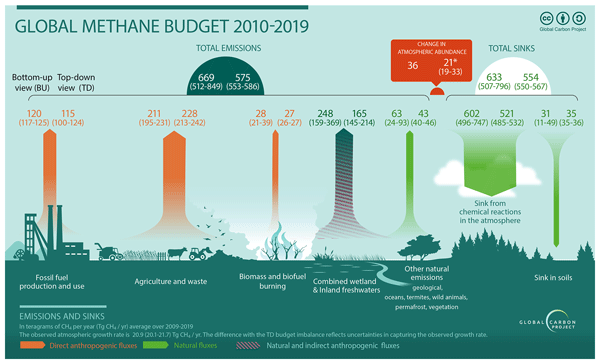
Methane (CH4) is the second most important human-influenced greenhouse gas in terms of climate forcing after carbon dioxide (CO2). A consortium of multi-disciplinary scientists synthesise and update the budget of the sources and sinks of CH4. This edition benefits from important progress in estimating emissions from lakes and ponds, reservoirs, and streams and rivers. For the 2010s decade, global CH4 emissions are estimated at 575 Tg CH4 yr-1, including ~65 % from anthropogenic sources.
Sebastien Conil, Gilles Bergametti, Laurent Langrene, Morgan Lopez, Olivier Masson, Cyril Pallares, and Michel Ramonet
EGUsphere, https://doi.org/10.5194/egusphere-2025-148, https://doi.org/10.5194/egusphere-2025-148, 2025
Preprint archived
Short summary
Short summary
From 2012 to 2023, hourly surface ozone, trace gases, meteorological parameters, and weekly beryllium-7 and sodium-22 activity were monitored at the OPE station in eastern France. While mean afternoon ozone concentrations showed no significant trend, baseline ozone increased by 0.7 µg·m⁻³ per year. Ozone anomalies were linked to pollutants (CO, NOx, CH4) from November to February, and to Stratosphere-to-Troposphere Transport proxies from April to September.
Lilian Vallet, Charbel Abdallah, Thomas Lauvaux, Lilian Joly, Michel Ramonet, Philippe Ciais, Morgan Lopez, Irène Xueref-Remy, and Florent Mouillot
Biogeosciences, 22, 213–242, https://doi.org/10.5194/bg-22-213-2025, https://doi.org/10.5194/bg-22-213-2025, 2025
Short summary
Short summary
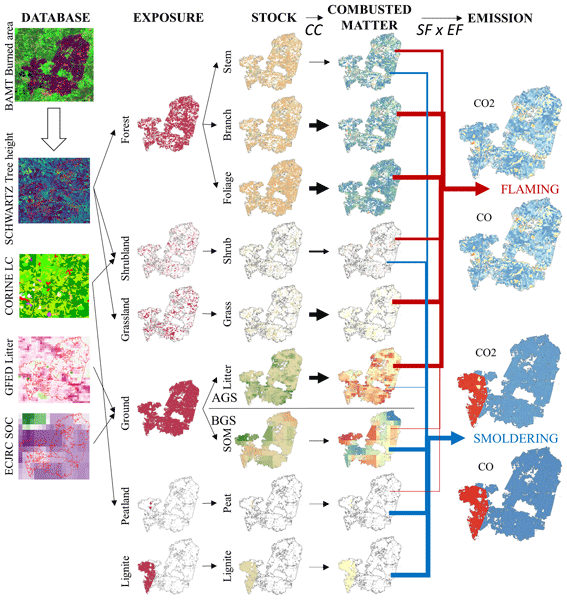
The 2022 fire season had a huge impact on European temperate forest, with several large fires exhibiting prolonged soil combustion reported. We analyzed CO and CO2 concentration recorded at nearby atmospheric towers, revealing intense smoldering combustion. We refined a fire emission model to incorporate this process. We estimated 7.95 Mteq CO2 fire emission, twice the global estimate. Fires contributed to 1.97 % of France's annual carbon footprint, reducing forest carbon sink by 30 % this year.
Dafina Kikaj, Edward Chung, Alan D. Griffiths, Scott D. Chambers, Grant Forster, Angelina Wenger, Penelope Pickers, Chris Rennick, Simon O'Doherty, Joseph Pitt, Kieran Stanley, Dickon Young, Leigh S. Fleming, Karina Adcock, Emmal Safi, and Tim Arnold
Atmos. Meas. Tech., 18, 151–175, https://doi.org/10.5194/amt-18-151-2025, https://doi.org/10.5194/amt-18-151-2025, 2025
Short summary
Short summary
We present a protocol to improve confidence in atmospheric radon measurements, enabling site comparisons and integration with greenhouse gas data. As a natural tracer, radon provides an independent check of transport model performance. This standardized method enhances radon’s use as a metric for model evaluation. Beyond UK observatories, it can support broader networks like ICOS and WMO/GAW, advancing global atmospheric research.
Pedro Henrique Herig Coimbra, Benjamin Loubet, Olivier Laurent, Laura Bignotti, Mathis Lozano, and Michel Ramonet
Atmos. Meas. Tech., 17, 6625–6645, https://doi.org/10.5194/amt-17-6625-2024, https://doi.org/10.5194/amt-17-6625-2024, 2024
Short summary
Short summary
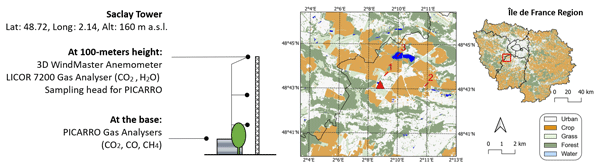
This study presents direct flux measurements in tall towers using existing slow-response analysers and adding 3D sonic anemometers. This way, we can significantly improve greenhouse gas monitoring with little extra instrumental effort. Slow-response analysers may be used here as the relevant frequency ranges depend on measuring height. Tall towers offer a large footprint, amplifying spatial coverage. The presented concept is a valuable bridge between atmospheric and ecosystem communities.
Marie Lothon, François Gheusi, Fabienne Lohou, Véronique Pont, Serge Soula, Corinne Jambert, Solène Derrien, Yannick Bezombes, Emmanuel Leclerc, Gilles Athier, Antoine Vial, Alban Philibert, Bernard Campistron, Frédérique Saïd, Jeroen Sonke, Julien Amestoy, Erwan Bargain, Pierre Bosser, Damien Boulanger, Guillaume Bret, Renaud Bodichon, Laurent Cabanas, Guylaine Canut, Jean-Bernard Estrampes, Eric Gardrat, Zaida Gomez Kuri, Jérémy Gueffier, Fabienne Guesdon, Morgan Lopez, Olivier Masson, Pierre-Yves Meslin, Yves Meyerfeld, Nicolas Pascal, Eric Pique, Michel Ramonet, Felix Starck, and Romain Vidal
Atmos. Meas. Tech., 17, 6265–6300, https://doi.org/10.5194/amt-17-6265-2024, https://doi.org/10.5194/amt-17-6265-2024, 2024
Short summary
Short summary
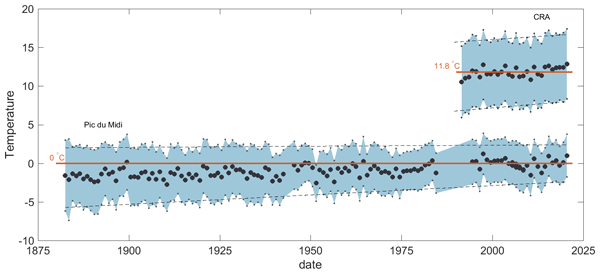
The Pyrenean Platform for Observation of the Atmosphere (P2OA) is a coupled plain–mountain instrumented platform in southwestern France for the monitoring of climate variables and the study of meteorological processes in a mountainous region. A comprehensive description of this platform is presented for the first time: its instrumentation, the associated dataset, and a meteorological characterization the site. The potential of the P2OA is illustrated through several examples of process studies.
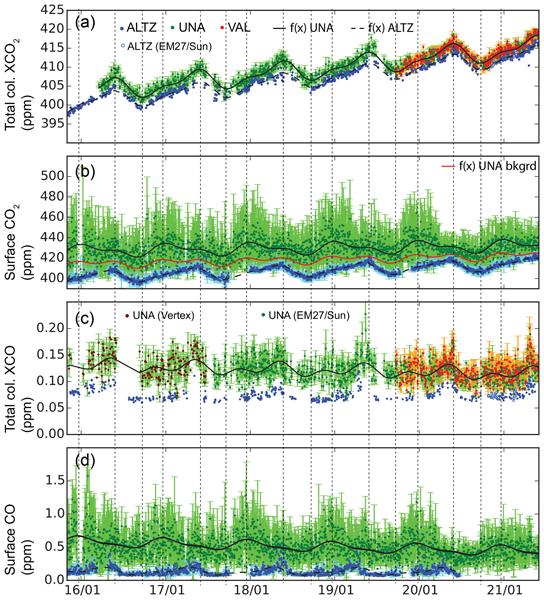
Noémie Taquet, Wolfgang Stremme, María Eugenia González del Castillo, Victor Almanza, Alejandro Bezanilla, Olivier Laurent, Carlos Alberti, Frank Hase, Michel Ramonet, Thomas Lauvaux, Ke Che, and Michel Grutter
Atmos. Chem. Phys., 24, 11823–11848, https://doi.org/10.5194/acp-24-11823-2024, https://doi.org/10.5194/acp-24-11823-2024, 2024
Short summary
Short summary
We characterize the variability in CO and CO2 emissions over Mexico City from long-term time-resolved Fourier transform infrared spectroscopy solar absorption and surface measurements from 2013 to 2021. Using the average intraday CO growth rate from total columns, the average CO / CO2 ratio and TROPOMI data, we estimate the interannual variability in the CO and CO2 anthropogenic emissions of Mexico City, highlighting the effect of an unprecedented drop in activity due to the COVID-19 lockdown.
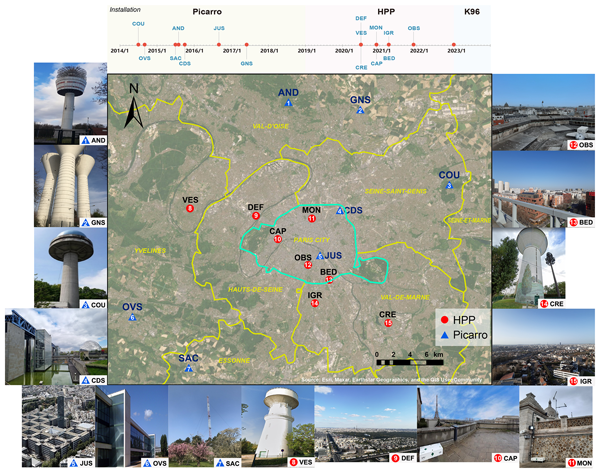
Jinghui Lian, Olivier Laurent, Mali Chariot, Luc Lienhardt, Michel Ramonet, Hervé Utard, Thomas Lauvaux, François-Marie Bréon, Grégoire Broquet, Karina Cucchi, Laurent Millair, and Philippe Ciais
Atmos. Meas. Tech., 17, 5821–5839, https://doi.org/10.5194/amt-17-5821-2024, https://doi.org/10.5194/amt-17-5821-2024, 2024
Short summary
Short summary
We have designed and deployed a mid-cost medium-precision CO2 sensor monitoring network in Paris since July 2020. The data are automatically calibrated by a newly implemented data processing system. The accuracies of the mid-cost instruments vary from 1.0 to 2.4 ppm for hourly afternoon measurements. Our model–data analyses highlight prospects for integrating mid-cost instrument data with high-precision measurements to improve fine-scale CO2 emission quantification in urban areas.
Josselin Doc, Michel Ramonet, François-Marie Bréon, Delphine Combaz, Mali Chariot, Morgan Lopez, Marc Delmotte, Cristelle Cailteau-Fischbach, Guillaume Nief, Nathanaël Laporte, Thomas Lauvaux, and Philippe Ciais
EGUsphere, https://doi.org/10.5194/egusphere-2024-2826, https://doi.org/10.5194/egusphere-2024-2826, 2024
Short summary
Short summary
Description of the network for measuring greenhouse gas concentrations in the Paris region and analysis of eight years of continuous monitoring.
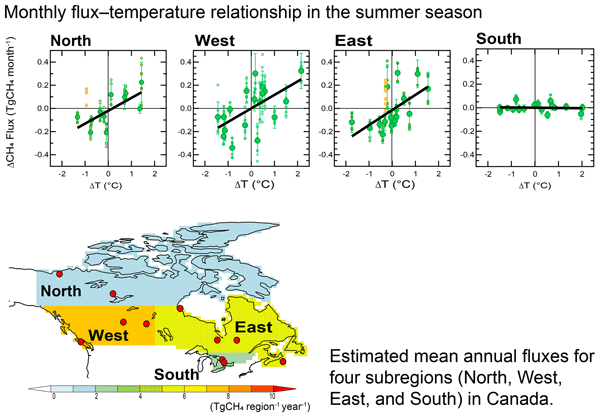
Misa Ishizawa, Douglas Chan, Doug Worthy, Elton Chan, Felix Vogel, Joe R. Melton, and Vivek K. Arora
Atmos. Chem. Phys., 24, 10013–10038, https://doi.org/10.5194/acp-24-10013-2024, https://doi.org/10.5194/acp-24-10013-2024, 2024
Short summary
Short summary
Methane (CH4) emissions in Canada for 2007–2017 were estimated using Canada’s surface greenhouse gas measurements. The estimated emissions show no significant trend, but emission uncertainty was reduced as more measurement sites became available. Notably for climate change, we find the wetland CH4 emissions show a positive correlation with surface air temperature in summer. Canada’s measurement network could monitor future CH4 emission changes and compliance with climate change mitigation goals.
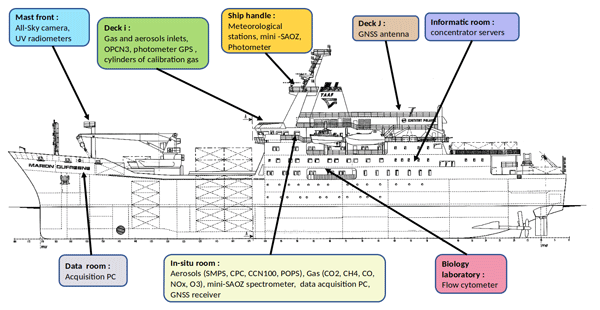
Pierre Tulet, Joel Van Baelen, Pierre Bosser, Jérome Brioude, Aurélie Colomb, Philippe Goloub, Andrea Pazmino, Thierry Portafaix, Michel Ramonet, Karine Sellegri, Melilotus Thyssen, Léa Gest, Nicolas Marquestaut, Dominique Mékiès, Jean-Marc Metzger, Gilles Athier, Luc Blarel, Marc Delmotte, Guillaume Desprairies, Mérédith Dournaux, Gaël Dubois, Valentin Duflot, Kevin Lamy, Lionel Gardes, Jean-François Guillemot, Valérie Gros, Joanna Kolasinski, Morgan Lopez, Olivier Magand, Erwan Noury, Manuel Nunes-Pinharanda, Guillaume Payen, Joris Pianezze, David Picard, Olivier Picard, Sandrine Prunier, François Rigaud-Louise, Michael Sicard, and Benjamin Torres
Earth Syst. Sci. Data, 16, 3821–3849, https://doi.org/10.5194/essd-16-3821-2024, https://doi.org/10.5194/essd-16-3821-2024, 2024
Short summary
Short summary
The MAP-IO program aims to compensate for the lack of atmospheric and oceanographic observations in the Southern Ocean by equipping the ship Marion Dufresne with a set of 17 scientific instruments. This program collected 700 d of measurements under different latitudes, seasons, sea states, and weather conditions. These new data will support the calibration and validation of numerical models and the understanding of the atmospheric composition of this region of Earth.
Fabian Maier, Christian Rödenbeck, Ingeborg Levin, Christoph Gerbig, Maksym Gachkivskyi, and Samuel Hammer
Atmos. Chem. Phys., 24, 8183–8203, https://doi.org/10.5194/acp-24-8183-2024, https://doi.org/10.5194/acp-24-8183-2024, 2024
Short summary
Short summary
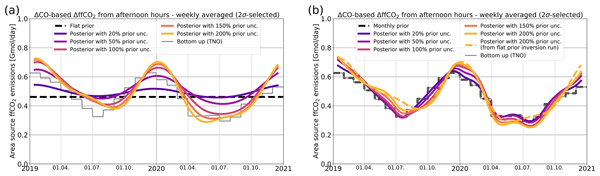
We investigate the usage of discrete radiocarbon (14C)-based fossil fuel carbon dioxide (ffCO2) concentration estimates vs. continuous carbon monoxide (CO)-based ffCO2 estimates to evaluate the seasonal cycle of ffCO2 emissions in an urban region with an inverse modeling framework. We find that the CO-based ffCO2 estimates allow us to reconstruct robust seasonal cycles, which show the distinct COVID-19 drawdown in 2020 and can be used to validate emission inventories.
Fabian Maier, Ingeborg Levin, Sébastien Conil, Maksym Gachkivskyi, Hugo Denier van der Gon, and Samuel Hammer
Atmos. Chem. Phys., 24, 8205–8223, https://doi.org/10.5194/acp-24-8205-2024, https://doi.org/10.5194/acp-24-8205-2024, 2024
Short summary
Short summary
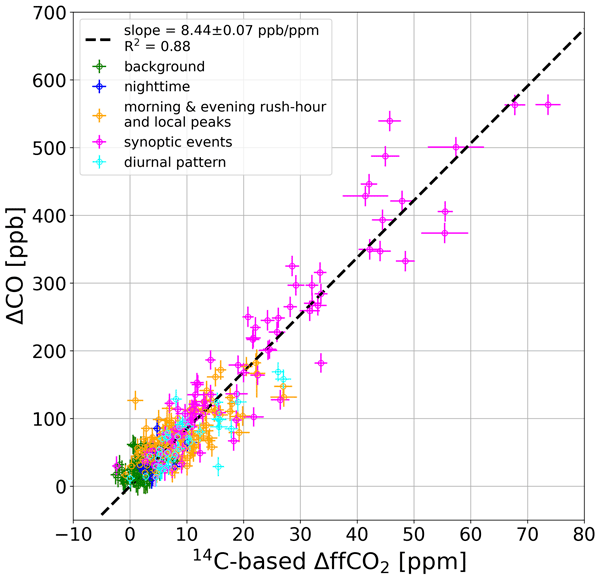
We assess the uncertainty in continuous fossil fuel carbon dioxide (ffCO2) estimates derived from carbon monoxide (CO) observations and radiocarbon (14CO2) flask measurements from an urban and a rural site. This study provides the basis for using continuous CO-based ffCO2 observations in atmospheric transport inversion frameworks to derive ffCO2 emission estimates. We also compare the flask-based CO / ffCO2 ratios with modeled ratios to validate an emission inventory for central Europe.
Rodrigo Rivera-Martinez, Pramod Kumar, Olivier Laurent, Gregoire Broquet, Christopher Caldow, Ford Cropley, Diego Santaren, Adil Shah, Cécile Mallet, Michel Ramonet, Leonard Rivier, Catherine Juery, Olivier Duclaux, Caroline Bouchet, Elisa Allegrini, Hervé Utard, and Philippe Ciais
Atmos. Meas. Tech., 17, 4257–4290, https://doi.org/10.5194/amt-17-4257-2024, https://doi.org/10.5194/amt-17-4257-2024, 2024
Short summary
Short summary
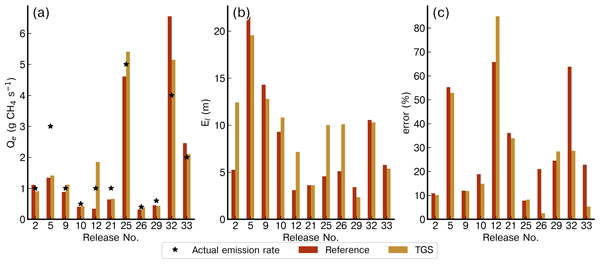
We explore the use of metal oxide semiconductors (MOSs) as a low-cost alternative for detecting and measuring CH4 emissions from industrial facilities. MOSs were exposed to several controlled releases to test their accuracy in detecting and quantifying emissions. Two reconstruction models were compared, and emission estimates were computed using a Gaussian dispersion model. Findings show that MOSs can provide accurate emission estimates with a 25 % emission rate error and a 9.5 m location error.

Roger Curcoll, Claudia Grossi, Stefan Röttger, and Arturo Vargas
Atmos. Meas. Tech., 17, 3047–3065, https://doi.org/10.5194/amt-17-3047-2024, https://doi.org/10.5194/amt-17-3047-2024, 2024
Short summary
Short summary
This paper presents a new user-friendly version of the Atmospheric Radon MONitor (ARMON). The efficiency of the instrument is of 0.0057 s-1, obtained using different techniques at Spanish and German chambers. The total calculated uncertainty of the ARMON for hourly radon concentrations above 5 Bq m-3 is lower than 10 % (k = 1). Results confirm that the ARMON is suitable to measure low-level radon activity concentrations and to be used as a transfer standard to calibrate in situ radon monitors.

Tanita J. Ballé, Stefan Röttger, Florian Mertes, Anja Honig, Petr Kovar, Petr P. S. Otáhal, and Annette Röttger
Atmos. Meas. Tech., 17, 2055–2065, https://doi.org/10.5194/amt-17-2055-2024, https://doi.org/10.5194/amt-17-2055-2024, 2024
Short summary
Short summary
Over 50 % of naturally occurring radiation exposure is due to 222Rn (progenies), but traceability of measurements to the International System of Units (SI) is lacking. To address this, two new 222Rn sources were developed to be used as calibration standards for reference instruments. These sources were investigated by comparing their estimated calibration factors for one instrument. Despite the small differences derived, all uncertainties are well within the intended target uncertainty of 10 %.
Pramod Kumar, Christopher Caldow, Grégoire Broquet, Adil Shah, Olivier Laurent, Camille Yver-Kwok, Sebastien Ars, Sara Defratyka, Susan Warao Gichuki, Luc Lienhardt, Mathis Lozano, Jean-Daniel Paris, Felix Vogel, Caroline Bouchet, Elisa Allegrini, Robert Kelly, Catherine Juery, and Philippe Ciais
Atmos. Meas. Tech., 17, 1229–1250, https://doi.org/10.5194/amt-17-1229-2024, https://doi.org/10.5194/amt-17-1229-2024, 2024
Short summary
Short summary
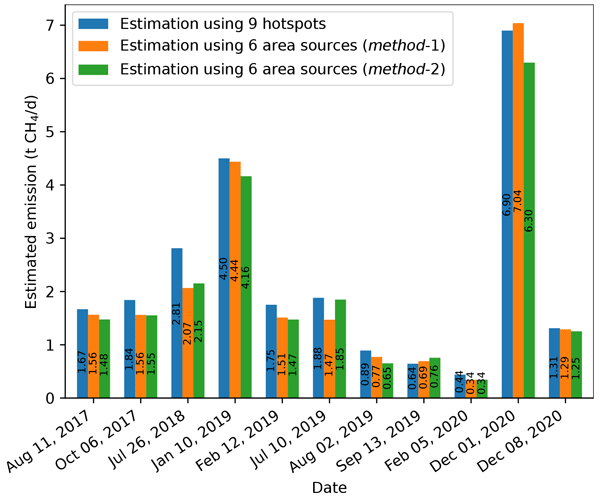
This study presents a series of mobile measurement campaigns to monitor the CH4 emissions from an active landfill. These measurements are processed using a Gaussian plume model and atmospheric inversion techniques to quantify the landfill CH4 emissions. The methane emission estimates range between ~0.4 and ~7 t CH4 per day, and their variations are analyzed. The robustness of the estimates is assessed depending on the distance of the measurements from the potential sources in the landfill.
Arto Heitto, Cheng Wu, Diego Aliaga, Luis Blacutt, Xuemeng Chen, Yvette Gramlich, Liine Heikkinen, Wei Huang, Radovan Krejci, Paolo Laj, Isabel Moreno, Karine Sellegri, Fernando Velarde, Kay Weinhold, Alfred Wiedensohler, Qiaozhi Zha, Federico Bianchi, Marcos Andrade, Kari E. J. Lehtinen, Claudia Mohr, and Taina Yli-Juuti
Atmos. Chem. Phys., 24, 1315–1328, https://doi.org/10.5194/acp-24-1315-2024, https://doi.org/10.5194/acp-24-1315-2024, 2024
Short summary
Short summary
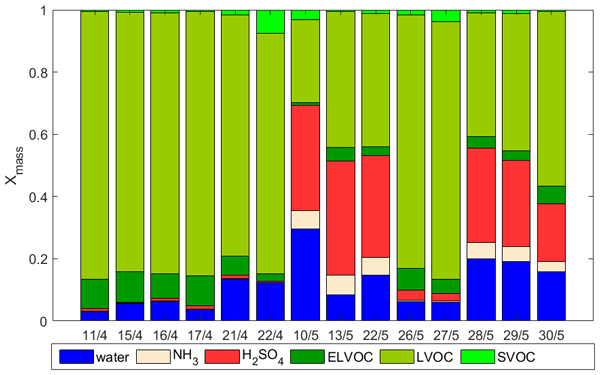
Particle growth at the Chacaltaya station in Bolivia was simulated based on measured vapor concentrations and ambient conditions. Major contributors to the simulated growth were low-volatility organic compounds (LVOCs). Also, sulfuric acid had major role when volcanic activity was occurring in the area. This study provides insight on nanoparticle growth at this high-altitude Southern Hemispheric site and hence contributes to building knowledge of early growth of atmospheric particles.
Zhendong Wu, Alex Vermeulen, Yousuke Sawa, Ute Karstens, Wouter Peters, Remco de Kok, Xin Lan, Yasuyuki Nagai, Akinori Ogi, and Oksana Tarasova
Atmos. Chem. Phys., 24, 1249–1264, https://doi.org/10.5194/acp-24-1249-2024, https://doi.org/10.5194/acp-24-1249-2024, 2024
Short summary
Short summary
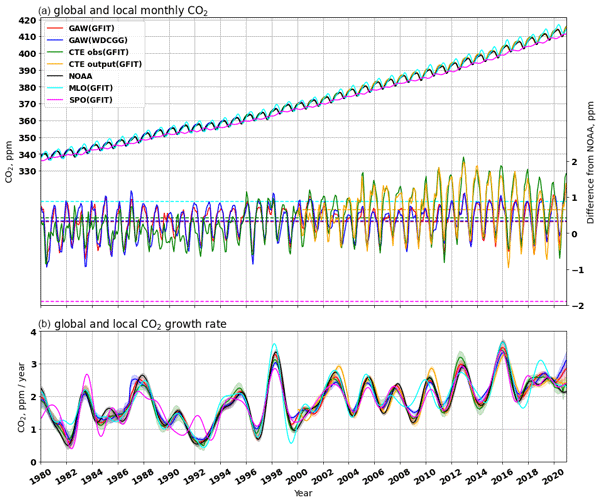
This study focuses on exploring the differences in calculating global surface CO2 and its growth rate, considering the impact of analysis methodologies and site selection. Our study reveals that the current global CO2 network has a good capacity to represent global surface CO2 and its growth rate, as well as trends in atmospheric CO2 mass changes. However, small differences exist in different analyses due to the impact of methodology and site selection.
Christian Rödenbeck, Karina E. Adcock, Markus Eritt, Maksym Gachkivskyi, Christoph Gerbig, Samuel Hammer, Armin Jordan, Ralph F. Keeling, Ingeborg Levin, Fabian Maier, Andrew C. Manning, Heiko Moossen, Saqr Munassar, Penelope A. Pickers, Michael Rothe, Yasunori Tohjima, and Sönke Zaehle
Atmos. Chem. Phys., 23, 15767–15782, https://doi.org/10.5194/acp-23-15767-2023, https://doi.org/10.5194/acp-23-15767-2023, 2023
Short summary
Short summary
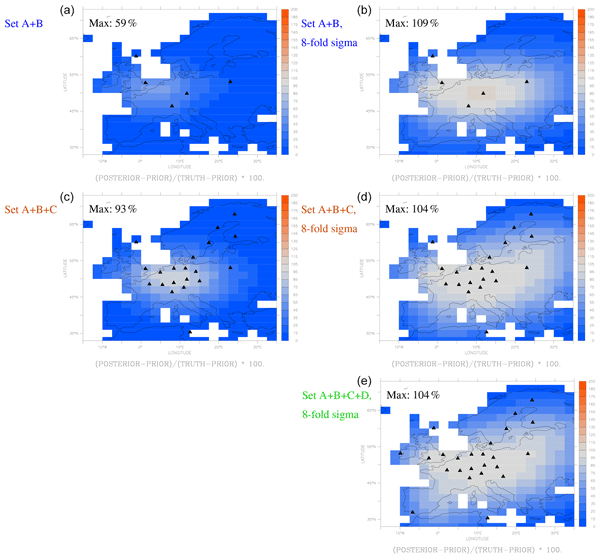
The carbon dioxide content of the Earth atmosphere is increasing due to human emissions from burning of fossil fuels, causing global climate change. The strength of the fossil-fuel emissions is estimated by inventories based on energy data, but independent validation of these inventories has been recommended by the Intergovernmental Panel on Climate Change. Here we investigate the potential to validate inventories based on measurements of small changes in the atmospheric oxygen content.
Paolo Cristofanelli, Cosimo Fratticioli, Lynn Hazan, Mali Chariot, Cedric Couret, Orestis Gazetas, Dagmar Kubistin, Antti Laitinen, Ari Leskinen, Tuomas Laurila, Matthias Lindauer, Giovanni Manca, Michel Ramonet, Pamela Trisolino, and Martin Steinbacher
Atmos. Meas. Tech., 16, 5977–5994, https://doi.org/10.5194/amt-16-5977-2023, https://doi.org/10.5194/amt-16-5977-2023, 2023
Short summary
Short summary
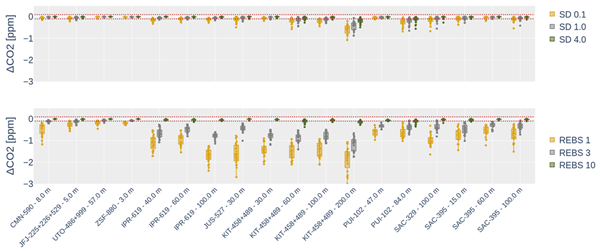
We investigated the application of two automatic methods for detecting spikes due to local emissions in greenhouse gas (GHG) observations at a subset of sites from the ICOS Atmosphere network. We analysed the sensitivity to the spike frequency of using different methods and settings. We documented the impact of the de-spiking on different temporal aggregations (i.e. hourly, monthly and seasonal averages) of CO2, CH4 and CO 1 min time series.
Douglas E. J. Worthy, Michele K. Rauh, Lin Huang, Felix R. Vogel, Alina Chivulescu, Kenneth A. Masarie, Ray L. Langenfelds, Paul B. Krummel, Colin E. Allison, Andrew M. Crotwell, Monica Madronich, Gabrielle Pétron, Ingeborg Levin, Samuel Hammer, Sylvia Michel, Michel Ramonet, Martina Schmidt, Armin Jordan, Heiko Moossen, Michael Rothe, Ralph Keeling, and Eric J. Morgan
Atmos. Meas. Tech., 16, 5909–5935, https://doi.org/10.5194/amt-16-5909-2023, https://doi.org/10.5194/amt-16-5909-2023, 2023
Short summary
Short summary
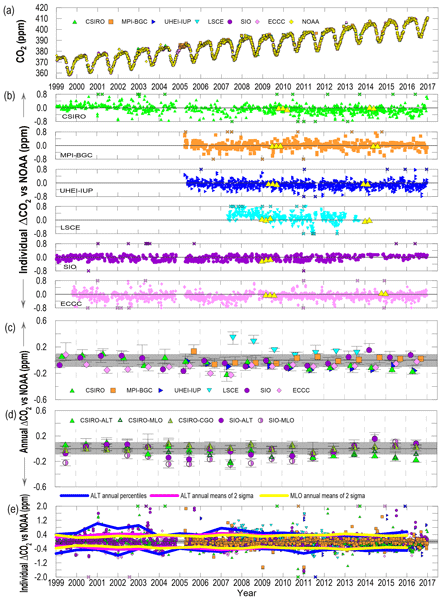
Network compatibility is important for inferring greenhouse gas fluxes at global or regional scales. This study is the first assessment of the measurement agreement among seven individual programs within the World Meteorological Organization community. It compares co-located flask air measurements at the Alert Observatory in Canada over a 17-year period. The results provide stronger confidence in the uncertainty estimation while using those datasets in various data interpretation applications.
Lawson David Gillespie, Sébastien Ars, James Phillip Williams, Louise Klotz, Tianjie Feng, Stephanie Gu, Mishaal Kandapath, Amy Mann, Michael Raczkowski, Mary Kang, Felix Vogel, and Debra Wunch
Atmos. Meas. Tech. Discuss., https://doi.org/10.5194/amt-2023-193, https://doi.org/10.5194/amt-2023-193, 2023
Preprint withdrawn
Short summary
Short summary
We investigate techniques for calculating emissions from mobile in situ gas concentrations recorded during downwind plume transects. We find that using the enhancement area to estimate emissions is the most consistent method when comparing different setups and instruments. Observations from a multi year urban methane survey and controlled release experiment are analyzed, and emissions rates for combined sewage overflow basins and a large wastewater treatment plant in Toronto are calculated.
Alessandro Zanchetta, Linda M. J. Kooijmans, Steven van Heuven, Andrea Scifo, Hubertus A. Scheeren, Ivan Mammarella, Ute Karstens, Jin Ma, Maarten Krol, and Huilin Chen
Biogeosciences, 20, 3539–3553, https://doi.org/10.5194/bg-20-3539-2023, https://doi.org/10.5194/bg-20-3539-2023, 2023
Short summary
Short summary
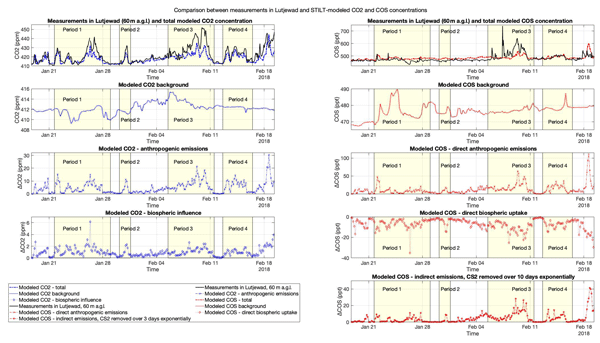
Carbonyl sulfide (COS) has been suggested as a tool to estimate carbon dioxide (CO2) uptake by plants during photosynthesis. However, understanding its sources and sinks is critical to preventing biases in this estimate. Combining observations and models, this study proves that regional sources occasionally influence the measurements at the 60 m tall Lutjewad tower (1 m a.s.l.; 53°24′ N, 6°21′ E) in the Netherlands. Moreover, it estimates nighttime COS fluxes to be −3.0 ± 2.6 pmol m−2 s−1.
Jinghui Lian, Thomas Lauvaux, Hervé Utard, François-Marie Bréon, Grégoire Broquet, Michel Ramonet, Olivier Laurent, Ivonne Albarus, Mali Chariot, Simone Kotthaus, Martial Haeffelin, Olivier Sanchez, Olivier Perrussel, Hugo Anne Denier van der Gon, Stijn Nicolaas Camiel Dellaert, and Philippe Ciais
Atmos. Chem. Phys., 23, 8823–8835, https://doi.org/10.5194/acp-23-8823-2023, https://doi.org/10.5194/acp-23-8823-2023, 2023
Short summary
Short summary
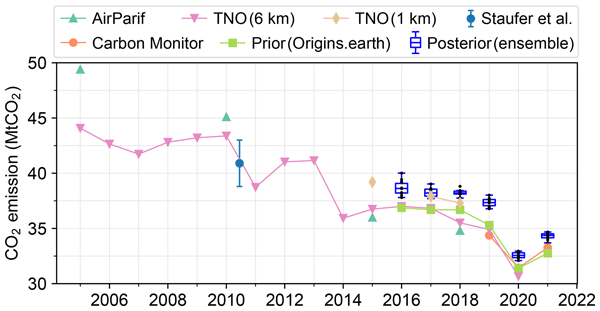
This study quantifies urban CO2 emissions via an atmospheric inversion for the Paris metropolitan area over a 6-year period from 2016 to 2021. Results show a long-term decreasing trend of about 2 % ± 0.6 % per year in the annual CO2 emissions over Paris. We conclude that our current capacity can deliver near-real-time CO2 emission estimates at the city scale in under a month, and the results agree within 10 % with independent estimates from multiple city-scale inventories.
Claudia Grossi, Daniel Rabago, Scott Chambers, Carlos Sáinz, Roger Curcoll, Peter P. S. Otáhal, Eliška Fialová, Luis Quindos, and Arturo Vargas
Atmos. Meas. Tech., 16, 2655–2672, https://doi.org/10.5194/amt-16-2655-2023, https://doi.org/10.5194/amt-16-2655-2023, 2023
Short summary
Short summary
The automatic and low-maintenance radon flux system Autoflux, completed with environmental soil and atmosphere sensors, has been theoretically and experimentally characterized and calibrated under laboratory conditions to be used as transfer standard for in situ measurements. It will offer for the first time long-term measurements to validate radon flux maps used by the climate and the radiation protection communities for assessing the radon gas emissions in the atmosphere.
Ida Storm, Ute Karstens, Claudio D'Onofrio, Alex Vermeulen, and Wouter Peters
Atmos. Chem. Phys., 23, 4993–5008, https://doi.org/10.5194/acp-23-4993-2023, https://doi.org/10.5194/acp-23-4993-2023, 2023
Short summary
Short summary
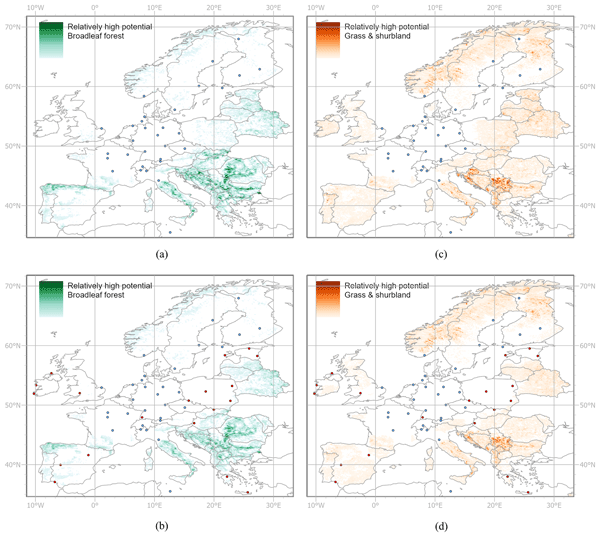
In this study, we evaluate what is in the influence regions of the ICOS atmospheric measurement stations to gain insight into what land cover types and land-cover-associated fluxes the network represents. Subsequently, insights about strengths, weaknesses, and potential gaps can assist in future network expansion decisions. The network is concentrated in central Europe, which leads to a general overrepresentation of coniferous forest and cropland and underrepresentation of grass and shrubland.

Florian Mertes, Stefan Röttger, and Annette Röttger
J. Sens. Sens. Syst., 12, 147–161, https://doi.org/10.5194/jsss-12-147-2023, https://doi.org/10.5194/jsss-12-147-2023, 2023
Short summary
Short summary
In this work, a novel approach to deduce the release of the natural radioactive noble gas 222Rn from solid sources containing the isotope 226Ra is presented. Therein, supporting radioactivity measurements of the source are used in conjunction with a theoretical description of the dynamics. For radiation protection and environmental research, reliable and comparable 222Rn measurements, and therefore reference atmospheres of 222Rn, are needed. This work improves their realization.
Rodrigo Andres Rivera Martinez, Diego Santaren, Olivier Laurent, Gregoire Broquet, Ford Cropley, Cécile Mallet, Michel Ramonet, Adil Shah, Leonard Rivier, Caroline Bouchet, Catherine Juery, Olivier Duclaux, and Philippe Ciais
Atmos. Meas. Tech., 16, 2209–2235, https://doi.org/10.5194/amt-16-2209-2023, https://doi.org/10.5194/amt-16-2209-2023, 2023
Short summary
Short summary
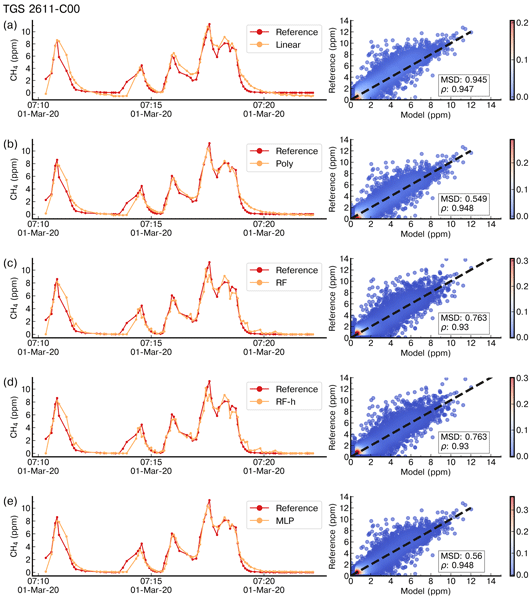
A network of low-cost sensors is a good alternative to improve the detection of fugitive CH4 emissions. We present the results of four tests conducted with two types of Figaro sensors that were assembled on four chambers in a laboratory experiment: a comparison of five models to reconstruct the CH4 signal, a strategy to reduce the training set size, a detection of age effects in the sensors and a test of the capability to transfer a model between chambers for the same type of sensor.
Anna Agustí-Panareda, Jérôme Barré, Sébastien Massart, Antje Inness, Ilse Aben, Melanie Ades, Bianca C. Baier, Gianpaolo Balsamo, Tobias Borsdorff, Nicolas Bousserez, Souhail Boussetta, Michael Buchwitz, Luca Cantarello, Cyril Crevoisier, Richard Engelen, Henk Eskes, Johannes Flemming, Sébastien Garrigues, Otto Hasekamp, Vincent Huijnen, Luke Jones, Zak Kipling, Bavo Langerock, Joe McNorton, Nicolas Meilhac, Stefan Noël, Mark Parrington, Vincent-Henri Peuch, Michel Ramonet, Miha Razinger, Maximilian Reuter, Roberto Ribas, Martin Suttie, Colm Sweeney, Jérôme Tarniewicz, and Lianghai Wu
Atmos. Chem. Phys., 23, 3829–3859, https://doi.org/10.5194/acp-23-3829-2023, https://doi.org/10.5194/acp-23-3829-2023, 2023
Short summary
Short summary
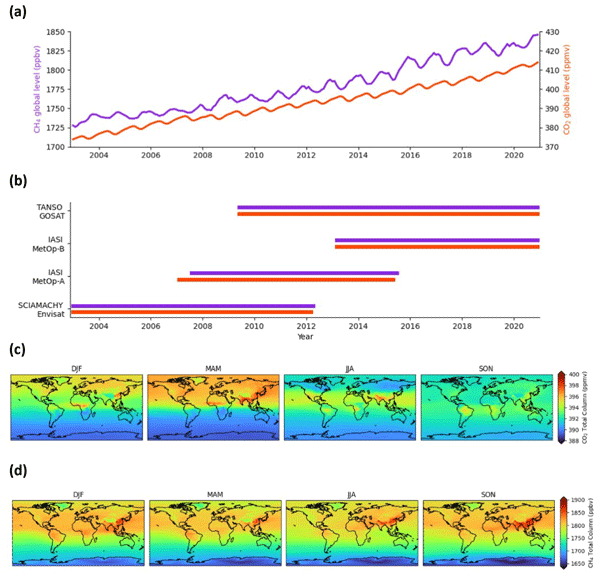
We present a global dataset of atmospheric CO2 and CH4, the two most important human-made greenhouse gases, which covers almost 2 decades (2003–2020). It is produced by combining satellite data of CO2 and CH4 with a weather and air composition prediction model, and it has been carefully evaluated against independent observations to ensure validity and point out deficiencies to the user. This dataset can be used for scientific studies in the field of climate change and the global carbon cycle.
Ruhi S. Humphries, Melita D. Keywood, Jason P. Ward, James Harnwell, Simon P. Alexander, Andrew R. Klekociuk, Keiichiro Hara, Ian M. McRobert, Alain Protat, Joel Alroe, Luke T. Cravigan, Branka Miljevic, Zoran D. Ristovski, Robyn Schofield, Stephen R. Wilson, Connor J. Flynn, Gourihar R. Kulkarni, Gerald G. Mace, Greg M. McFarquhar, Scott D. Chambers, Alastair G. Williams, and Alan D. Griffiths
Atmos. Chem. Phys., 23, 3749–3777, https://doi.org/10.5194/acp-23-3749-2023, https://doi.org/10.5194/acp-23-3749-2023, 2023
Short summary
Short summary
Observations of aerosols in pristine regions are rare but are vital to constraining the natural baseline from which climate simulations are calculated. Here we present recent seasonal observations of aerosols from the Southern Ocean and contrast them with measurements from Antarctica, Australia and regionally relevant voyages. Strong seasonal cycles persist, but striking differences occur at different latitudes. This study highlights the need for more long-term observations in remote regions.
Nasrin Mostafavi Pak, Jacob K. Hedelius, Sébastien Roche, Liz Cunningham, Bianca Baier, Colm Sweeney, Coleen Roehl, Joshua Laughner, Geoffrey Toon, Paul Wennberg, Harrison Parker, Colin Arrowsmith, Joseph Mendonca, Pierre Fogal, Tyler Wizenberg, Beatriz Herrera, Kimberly Strong, Kaley A. Walker, Felix Vogel, and Debra Wunch
Atmos. Meas. Tech., 16, 1239–1261, https://doi.org/10.5194/amt-16-1239-2023, https://doi.org/10.5194/amt-16-1239-2023, 2023
Short summary
Short summary
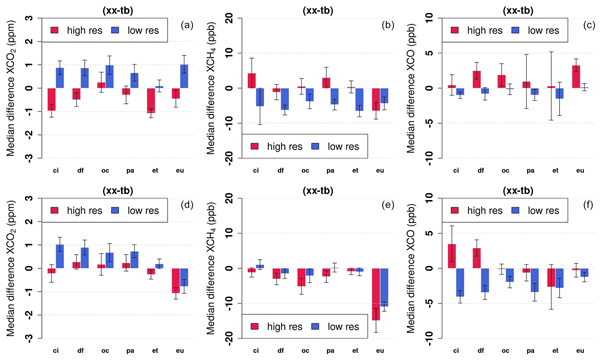
Ground-based remote sensing instruments in the Total Carbon Column Observing Network (TCCON) measure greenhouse gases in the atmosphere. Consistency between TCCON measurements is crucial to accurately infer changes in atmospheric composition. We use portable remote sensing instruments (EM27/SUN) to evaluate biases between TCCON stations in North America. We also improve the retrievals of EM27/SUN instruments and evaluate the previous (GGG2014) and newest (GGG2020) retrieval algorithms.
Saqr Munassar, Guillaume Monteil, Marko Scholze, Ute Karstens, Christian Rödenbeck, Frank-Thomas Koch, Kai U. Totsche, and Christoph Gerbig
Atmos. Chem. Phys., 23, 2813–2828, https://doi.org/10.5194/acp-23-2813-2023, https://doi.org/10.5194/acp-23-2813-2023, 2023
Short summary
Short summary
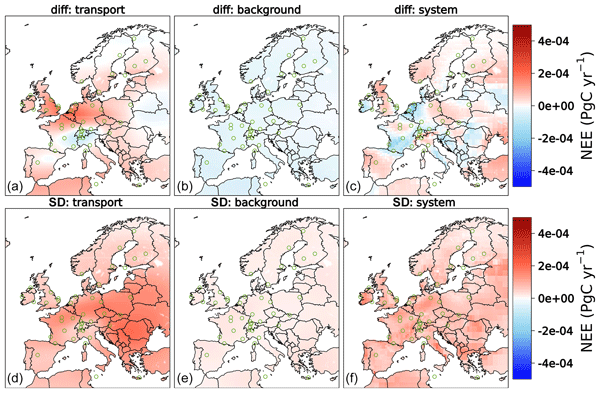
Using different transport models results in large errors in optimized fluxes in the atmospheric inversions. Boundary conditions and inversion system configurations lead to a smaller but non-negligible impact. The findings highlight the importance to validate transport models for further developments but also to properly account for such errors in inverse modelling. This will help narrow the convergence of gas estimates reported in the scientific literature from different inversion frameworks.
Auke M. van der Woude, Remco de Kok, Naomi Smith, Ingrid T. Luijkx, Santiago Botía, Ute Karstens, Linda M. J. Kooijmans, Gerbrand Koren, Harro A. J. Meijer, Gert-Jan Steeneveld, Ida Storm, Ingrid Super, Hubertus A. Scheeren, Alex Vermeulen, and Wouter Peters
Earth Syst. Sci. Data, 15, 579–605, https://doi.org/10.5194/essd-15-579-2023, https://doi.org/10.5194/essd-15-579-2023, 2023
Short summary
Short summary
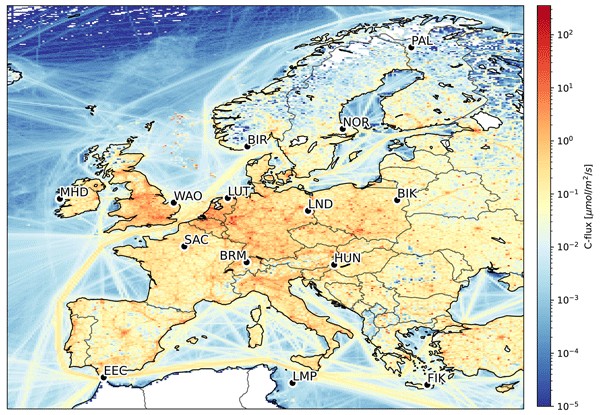
To monitor the progress towards the CO2 emission goals set out in the Paris Agreement, the European Union requires an independent validation of emitted CO2. For this validation, atmospheric measurements of CO2 can be used, together with first-guess estimates of CO2 emissions and uptake. To quickly inform end users, it is imperative that this happens in near real-time. To aid these efforts, we create estimates of European CO2 exchange at high resolution in near real time.
Daan Swart, Jun Zhang, Shelley van der Graaf, Susanna Rutledge-Jonker, Arjan Hensen, Stijn Berkhout, Pascal Wintjen, René van der Hoff, Marty Haaima, Arnoud Frumau, Pim van den Bulk, Ruben Schulte, Margreet van Zanten, and Thomas van Goethem
Atmos. Meas. Tech., 16, 529–546, https://doi.org/10.5194/amt-16-529-2023, https://doi.org/10.5194/amt-16-529-2023, 2023
Short summary
Short summary
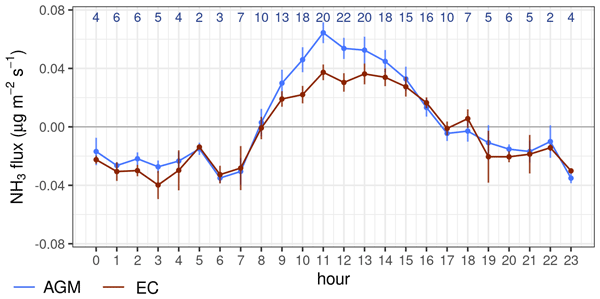
During a 5-week comparison campaign, we tested two set-ups to measure half hourly ammonia fluxes. The eddy covariance and flux gradient systems showed very similar results when the upwind terrain was both homogeneous and free of obstacles. We discuss the technical performance and practical limitations of both systems. Measurements from these instruments can facilitate the study of processes behind ammonia deposition, an important contributor to eutrophication and acidificationin natural areas.
Alkuin M. Koenig, Olivier Magand, Bert Verreyken, Jerome Brioude, Crist Amelynck, Niels Schoon, Aurélie Colomb, Beatriz Ferreira Araujo, Michel Ramonet, Mahesh K. Sha, Jean-Pierre Cammas, Jeroen E. Sonke, and Aurélien Dommergue
Atmos. Chem. Phys., 23, 1309–1328, https://doi.org/10.5194/acp-23-1309-2023, https://doi.org/10.5194/acp-23-1309-2023, 2023
Short summary
Short summary
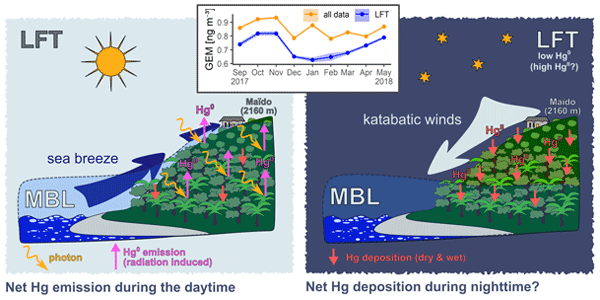
The global distribution of mercury, a potent neurotoxin, depends on atmospheric transport, chemistry, and interactions between the Earth’s surface and the air. Our understanding of these processes is still hampered by insufficient observations. Here, we present new data from a mountain observatory in the Southern Hemisphere. We give insights into mercury concentrations in air masses coming from aloft, and we show that tropical mountain vegetation may be a daytime source of mercury to the air.
Juha Sulo, Janne Lampilahti, Xuemeng Chen, Jenni Kontkanen, Tuomo Nieminen, Veli-Matti Kerminen, Tuukka Petäjä, Markku Kulmala, and Katrianne Lehtipalo
Atmos. Chem. Phys., 22, 15223–15242, https://doi.org/10.5194/acp-22-15223-2022, https://doi.org/10.5194/acp-22-15223-2022, 2022
Short summary
Short summary
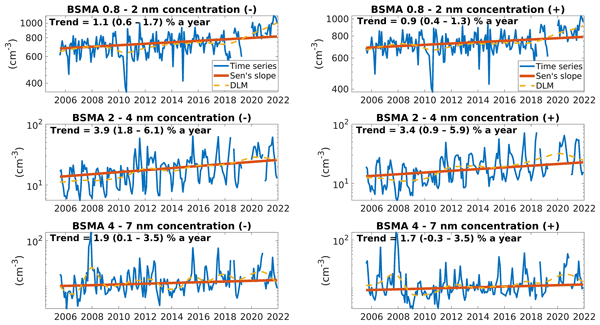
We measured atmospheric ion concentrations continuously in a boreal forest between 2005 and 2021 and observed an increasing interannual trend. The increase in cluster ion concentrations can be largely explained by an overall decreasing level of anthropogenic aerosols in the boreal forest. This suggests that the role of ions in atmospheric new particle formation may be more important in the future.
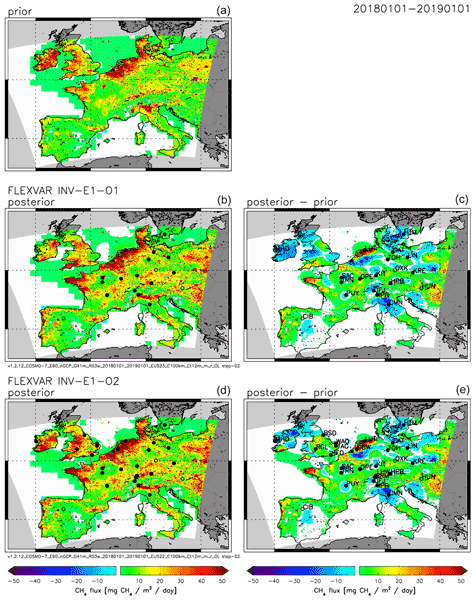
Peter Bergamaschi, Arjo Segers, Dominik Brunner, Jean-Matthieu Haussaire, Stephan Henne, Michel Ramonet, Tim Arnold, Tobias Biermann, Huilin Chen, Sebastien Conil, Marc Delmotte, Grant Forster, Arnoud Frumau, Dagmar Kubistin, Xin Lan, Markus Leuenberger, Matthias Lindauer, Morgan Lopez, Giovanni Manca, Jennifer Müller-Williams, Simon O'Doherty, Bert Scheeren, Martin Steinbacher, Pamela Trisolino, Gabriela Vítková, and Camille Yver Kwok
Atmos. Chem. Phys., 22, 13243–13268, https://doi.org/10.5194/acp-22-13243-2022, https://doi.org/10.5194/acp-22-13243-2022, 2022
Short summary
Short summary
We present a novel high-resolution inverse modelling system, "FLEXVAR", and its application for the inverse modelling of European CH4 emissions in 2018. The new system combines a high spatial resolution of 7 km x 7 km with a variational data assimilation technique, which allows CH4 emissions to be optimized from individual model grid cells. The high resolution allows the observations to be better reproduced, while the derived emissions show overall good consistency with two existing models.
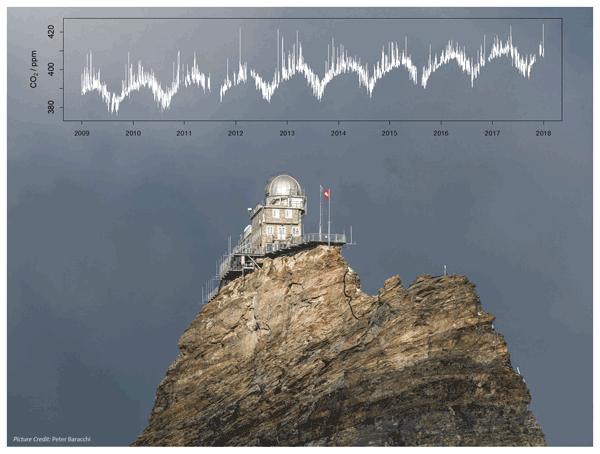
Simone M. Pieber, Béla Tuzson, Stephan Henne, Ute Karstens, Christoph Gerbig, Frank-Thomas Koch, Dominik Brunner, Martin Steinbacher, and Lukas Emmenegger
Atmos. Chem. Phys., 22, 10721–10749, https://doi.org/10.5194/acp-22-10721-2022, https://doi.org/10.5194/acp-22-10721-2022, 2022
Short summary
Short summary
Understanding regional greenhouse gas emissions into the atmosphere is a prerequisite to mitigate climate change. In this study, we investigated the regional contributions of carbon dioxide (CO2) at the location of the high Alpine observatory Jungfraujoch (JFJ, Switzerland, 3580 m a.s.l.). To this purpose, we combined receptor-oriented atmospheric transport simulations for CO2 concentration in the period 2009–2017 with stable carbon isotope (δ13C–CO2) information.
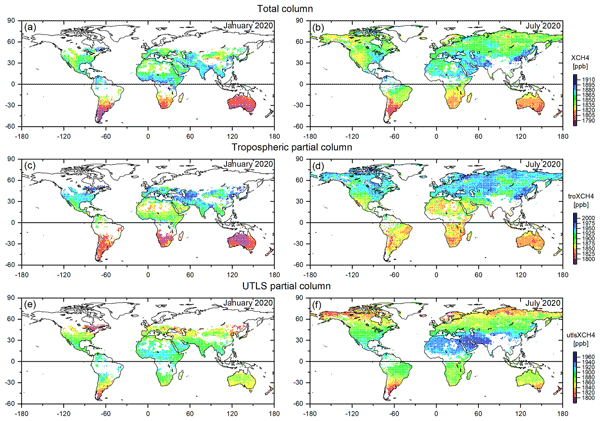
Matthias Schneider, Benjamin Ertl, Qiansi Tu, Christopher J. Diekmann, Farahnaz Khosrawi, Amelie N. Röhling, Frank Hase, Darko Dubravica, Omaira E. García, Eliezer Sepúlveda, Tobias Borsdorff, Jochen Landgraf, Alba Lorente, André Butz, Huilin Chen, Rigel Kivi, Thomas Laemmel, Michel Ramonet, Cyril Crevoisier, Jérome Pernin, Martin Steinbacher, Frank Meinhardt, Kimberly Strong, Debra Wunch, Thorsten Warneke, Coleen Roehl, Paul O. Wennberg, Isamu Morino, Laura T. Iraci, Kei Shiomi, Nicholas M. Deutscher, David W. T. Griffith, Voltaire A. Velazco, and David F. Pollard
Atmos. Meas. Tech., 15, 4339–4371, https://doi.org/10.5194/amt-15-4339-2022, https://doi.org/10.5194/amt-15-4339-2022, 2022
Short summary
Short summary
We present a computationally very efficient method for the synergetic use of level 2 remote-sensing data products. We apply the method to IASI vertical profile and TROPOMI total column space-borne methane observations and thus gain sensitivity for the tropospheric methane partial columns, which is not achievable by the individual use of TROPOMI and IASI. These synergetic effects are evaluated theoretically and empirically by inter-comparisons to independent references of TCCON, AirCore, and GAW.
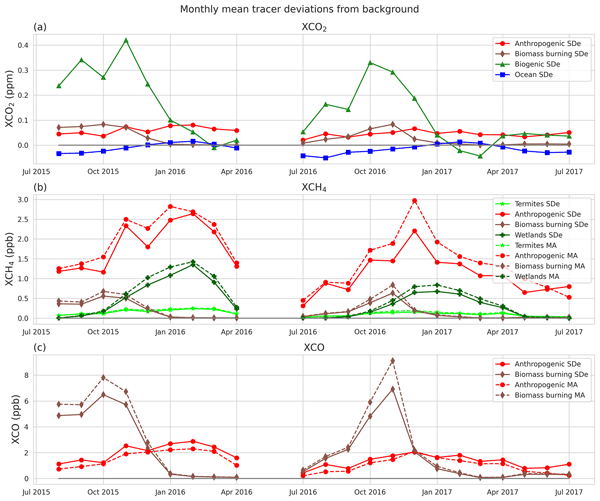
Sieglinde Callewaert, Jérôme Brioude, Bavo Langerock, Valentin Duflot, Dominique Fonteyn, Jean-François Müller, Jean-Marc Metzger, Christian Hermans, Nicolas Kumps, Michel Ramonet, Morgan Lopez, Emmanuel Mahieu, and Martine De Mazière
Atmos. Chem. Phys., 22, 7763–7792, https://doi.org/10.5194/acp-22-7763-2022, https://doi.org/10.5194/acp-22-7763-2022, 2022
Short summary
Short summary
A regional atmospheric transport model is used to analyze the factors contributing to CO2, CH4, and CO observations at Réunion Island. We show that the surface observations are dominated by local fluxes and dynamical processes, while the column data are influenced by larger-scale mechanisms such as biomass burning plumes. The model is able to capture the measured time series well; however, the results are highly dependent on accurate boundary conditions and high-resolution emission inventories.
Scott D. Chambers, Alan D. Griffiths, Alastair G. Williams, Ot Sisoutham, Viacheslav Morosh, Stefan Röttger, Florian Mertes, and Annette Röttger
Adv. Geosci., 57, 63–80, https://doi.org/10.5194/adgeo-57-63-2022, https://doi.org/10.5194/adgeo-57-63-2022, 2022
Short summary
Short summary
There is a growing need in health and climate research for high-quality radon observations. A variety of radon monitors, with different uncertainties, operate across global networks. Better compatibility between the measurements is required. Here we describe a novel, portable two-filter radon monitor with a calibration traceable to the International System of Units, and demonstrate the transfer of a traceable calibration from this instrument to a separate monitor under field conditions.
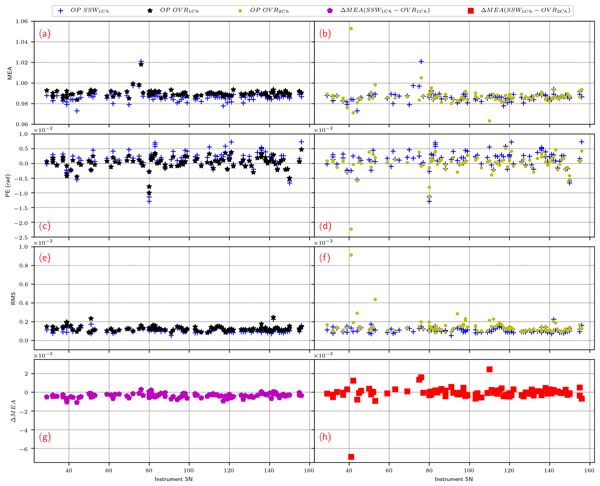
Carlos Alberti, Frank Hase, Matthias Frey, Darko Dubravica, Thomas Blumenstock, Angelika Dehn, Paolo Castracane, Gregor Surawicz, Roland Harig, Bianca C. Baier, Caroline Bès, Jianrong Bi, Hartmut Boesch, André Butz, Zhaonan Cai, Jia Chen, Sean M. Crowell, Nicholas M. Deutscher, Dragos Ene, Jonathan E. Franklin, Omaira García, David Griffith, Bruno Grouiez, Michel Grutter, Abdelhamid Hamdouni, Sander Houweling, Neil Humpage, Nicole Jacobs, Sujong Jeong, Lilian Joly, Nicholas B. Jones, Denis Jouglet, Rigel Kivi, Ralph Kleinschek, Morgan Lopez, Diogo J. Medeiros, Isamu Morino, Nasrin Mostafavipak, Astrid Müller, Hirofumi Ohyama, Paul I. Palmer, Mahesh Pathakoti, David F. Pollard, Uwe Raffalski, Michel Ramonet, Robbie Ramsay, Mahesh Kumar Sha, Kei Shiomi, William Simpson, Wolfgang Stremme, Youwen Sun, Hiroshi Tanimoto, Yao Té, Gizaw Mengistu Tsidu, Voltaire A. Velazco, Felix Vogel, Masataka Watanabe, Chong Wei, Debra Wunch, Marcia Yamasoe, Lu Zhang, and Johannes Orphal
Atmos. Meas. Tech., 15, 2433–2463, https://doi.org/10.5194/amt-15-2433-2022, https://doi.org/10.5194/amt-15-2433-2022, 2022
Short summary
Short summary
Space-borne greenhouse gas missions require ground-based validation networks capable of providing fiducial reference measurements. Here, considerable refinements of the calibration procedures for the COllaborative Carbon Column Observing Network (COCCON) are presented. Laboratory and solar side-by-side procedures for the characterization of the spectrometers have been refined and extended. Revised calibration factors for XCO2, XCO and XCH4 are provided, incorporating 47 new spectrometers.
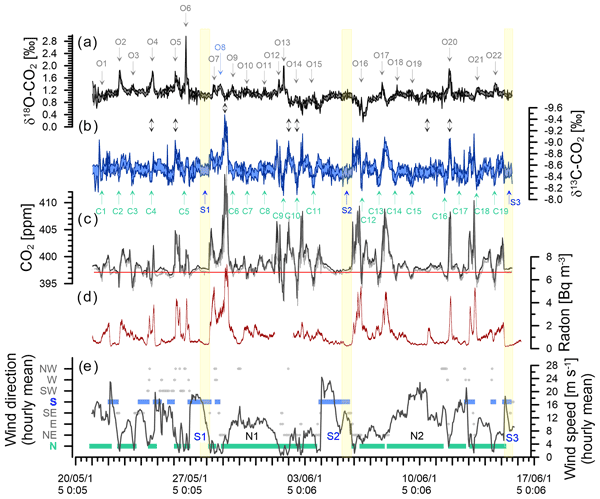
Peter Sperlich, Gordon W. Brailsford, Rowena C. Moss, John McGregor, Ross J. Martin, Sylvia Nichol, Sara Mikaloff-Fletcher, Beata Bukosa, Magda Mandic, C. Ian Schipper, Paul Krummel, and Alan D. Griffiths
Atmos. Meas. Tech., 15, 1631–1656, https://doi.org/10.5194/amt-15-1631-2022, https://doi.org/10.5194/amt-15-1631-2022, 2022
Short summary
Short summary
We tested an in situ analyser for carbon and oxygen isotopes in atmospheric CO2 at Baring Head, New Zealand’s observatory for Southern Ocean baseline air. The analyser was able to resolve regional signals of the terrestrial carbon cycle, although the analysis of small events was limited by analytical uncertainty. Further improvement of the instrument performance would be desirable for the robust analysis of distant signals and to resolve the small variability in Southern Ocean baseline air.
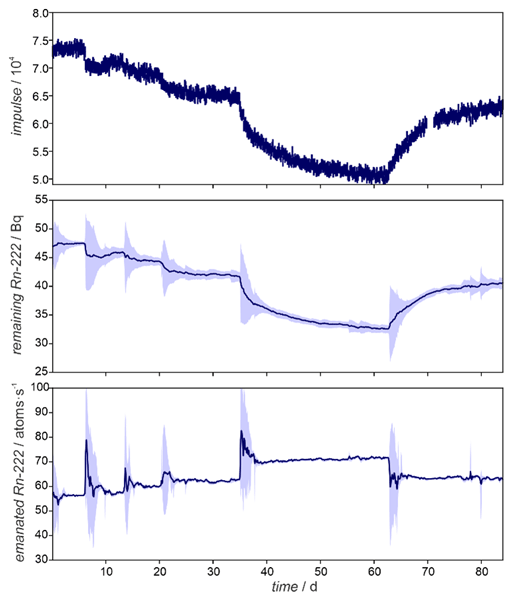
Stefan Röttger, Annette Röttger, Claudia Grossi, Arturo Vargas, Ute Karstens, Giorgia Cinelli, Edward Chung, Dafina Kikaj, Chris Rennick, Florian Mertes, and Ileana Radulescu
Adv. Geosci., 57, 37–47, https://doi.org/10.5194/adgeo-57-37-2022, https://doi.org/10.5194/adgeo-57-37-2022, 2022
Short summary
Short summary
Radon gas is the largest source of public exposure to naturally occurring radioactivity. Radon can also be used, as a tracer to improve indirectly the estimates of greenhouse gases important for supporting successful GHG mitigation strategies.
Both climate and radiation protection research communities need improved traceable low-level atmospheric radon measurements. The EMPIR project 19ENV01 traceRadon started to provide the necessary measurement infrastructure and transfer standards.
Zhenyi Chen, Robyn Schofield, Melita Keywood, Sam Cleland, Alastair G. Williams, Alan Griffiths, Stephen Wilson, Peter Rayner, and Xiaowen Shu
Atmos. Chem. Phys. Discuss., https://doi.org/10.5194/acp-2022-104, https://doi.org/10.5194/acp-2022-104, 2022
Revised manuscript not accepted
Short summary
Short summary
This study studied the marine boundary layer (MBL) process and aerosol properties in the Southern Ocean using miniMPL, ceilometer and sodar. Compared to the gradient method, the Image Edge Detection Algorithm provides more reliable boundary layer height estimations, especially when a convective MBL with stratification existed. The diurnal characteristic of BLH with the veering of the wind vector was also observed. Under the continental sources, the MBL maintained a well-mixed layer of 0.3 km.
Sonya L. Fiddes, Matthew T. Woodhouse, Steve Utembe, Robyn Schofield, Simon P. Alexander, Joel Alroe, Scott D. Chambers, Zhenyi Chen, Luke Cravigan, Erin Dunne, Ruhi S. Humphries, Graham Johnson, Melita D. Keywood, Todd P. Lane, Branka Miljevic, Yuko Omori, Alain Protat, Zoran Ristovski, Paul Selleck, Hilton B. Swan, Hiroshi Tanimoto, Jason P. Ward, and Alastair G. Williams
Atmos. Chem. Phys., 22, 2419–2445, https://doi.org/10.5194/acp-22-2419-2022, https://doi.org/10.5194/acp-22-2419-2022, 2022
Short summary
Short summary
Coral reefs have been found to produce the climatically relevant chemical compound dimethyl sulfide (DMS). It has been suggested that corals can modify their environment via the production of DMS. We use an atmospheric chemistry model to test this theory at a regional scale for the first time. We find that it is unlikely that coral-reef-derived DMS has an influence over local climate, in part due to the proximity to terrestrial and anthropogenic aerosol sources.
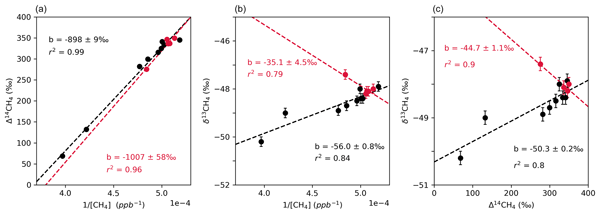
Regina Gonzalez Moguel, Felix Vogel, Sébastien Ars, Hinrich Schaefer, Jocelyn C. Turnbull, and Peter M. J. Douglas
Atmos. Chem. Phys., 22, 2121–2133, https://doi.org/10.5194/acp-22-2121-2022, https://doi.org/10.5194/acp-22-2121-2022, 2022
Short summary
Short summary
Evaluating methane (CH4) sources in the Athabasca oil sands region (AOSR) is crucial to effectively mitigate CH4 emissions. We tested the use of carbon isotopes to estimate source contributions from key CH4 sources in the AOSR and found that 56 ± 18 % of CH4 emissions originated from surface mining and processing facilities, 34 ± 18 % from tailings ponds, and 10 ± < 1 % from wetlands, confirming previous findings and showing that this method can be successfully used to partition CH4 sources.
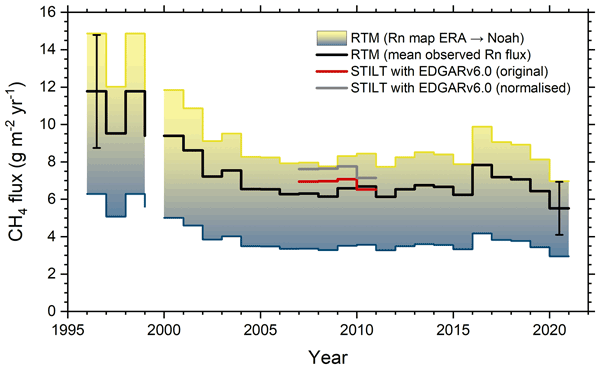
Ingeborg Levin, Ute Karstens, Samuel Hammer, Julian DellaColetta, Fabian Maier, and Maksym Gachkivskyi
Atmos. Chem. Phys., 21, 17907–17926, https://doi.org/10.5194/acp-21-17907-2021, https://doi.org/10.5194/acp-21-17907-2021, 2021
Short summary
Short summary
The radon tracer method is applied to atmospheric methane and radon observations from the upper Rhine valley to independently estimate methane emissions from the region. Comparison of our top-down results with bottom-up inventory data requires high-resolution footprint modelling and representative radon flux data. In agreement with inventories, observed emissions decreased, but only until 2005. A limitation of this method is that point-source emissions are not captured or not fully captured.

Annette Röttger, Attila Veres, Vladimir Sochor, Massimo Pinto, Michal Derlacinski, Mihail-Razvan Ioan, Amra Sabeta, Robert Bernat, Christelle Adam-Guillermin, João Henrique Gracia Alves, Denis Glavič-Cindro, Steven Bell, Britt Wens, Linda Persson, Miloš Živanović, and Reetta Nylund
Adv. Geosci., 57, 1–7, https://doi.org/10.5194/adgeo-57-1-2021, https://doi.org/10.5194/adgeo-57-1-2021, 2021
Short summary
Short summary
The goal of the EMN is a harmonized, sustainable, coordinated and intelligently specialized infrastructure to support the needs expressed in the European Radiation Protection Ordinance. Such an EMN under the umbrella of EURAMET is in the founding phase and is being prepared in parallel by the EMPIR project 19NET03 supportBSS with five technical work packages. EURAMET is the Regional Metrology Organisation (RMO) of Europe. The EMN was established by signature on 16 September 2021.
Cited articles
Allen, M. R., Dube, O. P., Solecki, W., Aragón-Durand, F., Cramer, W., Humphreys, S., Kainuma, M., Kala, J., Mahowald, N., Mulugetta, Y., Perez, R., Wairiu, M., and Zickfeld, K.: Framing and Context. In: Global Warming of 1.5 °C. An IPCC Special Report on the impacts of global warming of 1.5 °C above pre-industrial levels and related global greenhouse gas emission pathways, in the context of strengthening the global response to the threat of climate change, sustainable development, and efforts to eradicate poverty, edited by: Masson-Delmotte, V., Zhai, P., Pörtner, H.-O., Roberts, D., Skea, J., Shukla, P. R., Pirani, A., Moufouma-Okia, W., Péan, C., Pidcock, R., Connors, S. Matthews, J. B. R., Chen, Y., Zhou, X., Gomis, M. I., Lonnoy, E., Maycock, T., Tignor, M., and Waterfield, T., Cambridge University Press, Cambridge, UK and New York, NY, USA, 49–92, https://doi.org/10.1017/9781009157940.003, 2018.
Baasandorj, M., Hoch, S. W., Bares, R., Lin, J. C., Brown, S. S., Millet, D. B., Martin, R., Kelly, K., Zarzana, K. J., Whiteman, C. D., Dube, W. P., Tonnesen, G., Jaramillo, I. C., and Sohl, J.: Coupling between chemical and meteorological processes under persistent cold-air pool conditions: evolution of wintertime PM2.5 pollution events and N2O5 observations in Utah's Salt Lake Valley, Environ. Sci. Technol., 51, 5941–5950, https://doi.org/10.1021/acs.est.6b06603, 2017.
Belviso, S., Schmidt, M., Yver, C., Ramonet, M., Gros, V., and Launois, T.: Strong similarities between night-time deposition velocities of carbonyl sulphide and molecular hydrogen inferred from semi-continuous atmospheric observations in Gif-sur-Yvette, Paris region, Tellus B, 65, https://doi.org/10.3402/tellusb.v65i0.20719, 2013.
Belviso, S., Lebegue, B., Ramonet, M., Kazan, V., Pison, I., Berchet, A., Delmotte, M., Yver-Kwok, C., Montagne, D., and Ciais, P.: A top-down approach of sources and non-photosynthetic sinks of carbonyl sulfide from atmospheric measurements over multiple years in the Paris region (France), PLoS One, 15, e0228419, https://doi.org/10.1371/journal.pone.0228419, 2020.
Bergamaschi, P., Danila, A., Weiss, R., Ciais, P., Thompson, R., Brunner, D., Levin, I., Meijer, Y., Chevallier, F., Janssens-Maenhout, G., Bovensmann, H., Crisp, D., Basu, S., Dlugokencky, E., Engelen, R., Gerbig, C., Günther, D., Hammer, S., Henne, S., Houweling, S., Karstens, U., Kort, E., Maione, M., Manning, A., Miller, J., Montzka, S., Pandey, S., Peters, W., Peylin, P., Pinty, B., Ramonet, M., Reimann, S., Röckmann, T., Schmidt, M., Strogies, M., Sussams, J., Tarasova, O., Van Aardenne, J., Vermeulen, A., and Vogel, F.: Atmospheric monitoring and inverse modelling for verification of greenhouse gas inventories, JRC report, https://doi.org/10.2760/759928, 2018a.
Bergamaschi, P., Karstens, U., Manning, A. J., Saunois, M., Tsuruta, A., Berchet, A., Vermeulen, A. T., Arnold, T., Janssens-Maenhout, G., Hammer, S., and Levin, I.: Inverse modelling of European CH4 emissions during 2006–2012 using different inverse models and reassessed atmospheric observations, Atmos. Chem. Phys., 18, 901–920, https://doi.org/10.5194/acp-18-901-2018, 2018b.
Biraud, S., Ciais, P., Ramonet, M., Simmonds, P., Kazan, V., Monfray, P., O'Doherty, S., Spain, T. G., and Jennings, S. G.: European greenhouse gas emissions estimated from continuous atmospheric measurements and radon 222 at Mace Head, Ireland, J. Geophys. Res., 105, 1351–1366, https://doi.org/10.1029/1999JD900821, 2000.
Brioude, J., Arnold, D., Stohl, A., Cassiani, M., Morton, D., Seibert, P., Angevine, W., Evan, S., Dingwell, A., Fast, J. D., Easter, R. C., Pisso, I., Burkhart, J., and Wotawa, G.: The Lagrangian particle dispersion model FLEXPART-WRF version 3.1, Geosci. Model Dev., 6, 1889–1904, https://doi.org/10.5194/gmd-6-1889-2013, 2013.
Bukosa, B., Mikaloff-Fletcher, S., Brailsford, G., Smale, D., Keller, E. D., Baisden, W. T., Kirschbaum, M. U. F., Giltrap, D. L., Liáng, L., Moore, S., Moss, R., Nichol, S., Turnbull, J., Geddes, A., Kennett, D., Hidy, D., Barcza, Z., Schipper, L. A., Wall, A. M., Nakaoka, S.-I., Mukai, H., and Brandon, A.: Inverse modelling of New Zealand's carbon dioxide balance estimates a larger than expected carbon sink, Atmos. Chem. Phys., 25, 6445–6473, https://doi.org/10.5194/acp-25-6445-2025, 2025.
Butterweck, G., Reineking, A., Kesten, J., and Porstendörfer, J.: The use of the natural radioactive noble gases radon and thoron as tracers for the study of turbulent exchange in the atmospheric boundary layer – Case study in and above a wheat field, Atmos. Environ., 28, 1963–1969, https://doi.org/10.1016/1352-2310(94)90465-0, 1994.
Chambers, S.: Supporting data for Chambers et al. (2026) Radon Tracer Method Review Paper (AMT), Version 2.0, Zenodo [data set], https://doi.org/10.5281/zenodo.22768535, 2025.
Chambers, S. D., Williams, A. G., Zahorowski, W., Griffiths, A. D., and Crawford, J.: Separating remote fetch and local mixing influences on vertical radon measurements in the lower atmosphere, Tellus B, 63, 843–859, https://doi.org/10.1111/j.1600-0889.2011.00565.x, 2011.
Chambers, S. D., Hong, S.-B., Williams, A. G., Crawford, J., Griffiths, A. D., and Park, S.-J.: Characterising terrestrial influences on Antarctic air masses using Radon-222 measurements at King George Island, Atmos. Chem. Phys., 14, 9903–9916, https://doi.org/10.5194/acp-14-9903-2014, 2014.
Chambers, S. D., Williams, A. G., Crawford, J., and Griffiths, A. D.: On the use of radon for quantifying the effects of atmospheric stability on urban emissions, Atmos. Chem. Phys., 15, 1175–1190, https://doi.org/10.5194/acp-15-1175-2015, 2015.
Chambers, S. D., Podstawczyńska, A., Williams, A. G., and Pawlak, W.: Characterising the influence of atmospheric mixing state on urban heat island intensity using Radon-222, Atmos. Environ., 147, 355–368, https://doi.org/10.1016/j.atmosenv.2016.10.026, 2016a.
Chambers, S. D., Galeriu, D., Williams, A. G., Melintescu, A., Griffiths, A. D., Crawford, J., Dyer, L., Duma, M., and Zorila, B.: Atmospheric stability effects on potential radiological releases at a nuclear research facility in Romania: characterising the atmospheric mixing state, J. Env. Rad., 154, 68–82, https://doi.org/10.1016/j.jenvrad.2016.01.010, 2016b.
Chambers, S. D., Preunkert, S., Weller, R., Hong, S. B., Humphries, R. S., Tositti, L., Angot, H., Legrand, M., Williams, A. G., Griffiths, A. D., and Crawford, J.: Characterizing Atmospheric Transport Pathways to Antarctica and the Remote Southern Ocean Using Radon-222, Front. Earth Sci., 6, 190, 334 https://doi.org/10.3389/feart.2018.00190, 2018.
Chambers, S. D., Podstawczyńska, A., Pawlak, W., Fortuniak, K., Williams, A. G., and Griffiths, A. D.: Characterising the state of the urban surface layer using Radon-222, J. Geophys. Res. Atmos., 124, 770–788, https://doi.org/10.1029/2018JD029507, 2019a.
Chambers, S. D., Guérette, E. A., Monk, K., Griffiths, A. D., Zhang, Y., Duc, H., Cope, M., Emmerson, K. M., Chang, L. T., Silver, J. D., and Utembe, S.: Skill-testing chemical transport models across contrasting atmospheric mixing states using Radon-222, Atmosphere, 10, 25, https://doi.org/10.3390/atmos10010025, 2019b.
Chambers, S. D., Griffiths, A. D., Williams, A. G., Sisoutham, O., Morosh, V., Röttger, S., Mertes, F., and Röttger, A.: Portable two-filter dual-flow-loop 222Rn detector: stand-alone monitor and calibration transfer device, Adv. Geosci., 57, 63–80, https://doi.org/10.5194/adgeo-57-63-2022, 2022.
Cheewaphongphan, P., Chatani, S., and Saigusa, N.: Exploring Gaps between Bottom-Up and Top-Down Emission Estimates Based on Uncertainties in Multiple Emission Inventories: A Case Study on CH4 Emissions in China, Sustainability, 11, 2054, https://doi.org/10.3390/su11072054, 2019.
Conen, F., Neftel, A., Schmid, M., and Lehmann, B. E.: N2O/222Rn – soil flux calibration in the stable nocturnal surface layer, Geophys. Res. Lett., 29, 1025, https://doi.org/10.1029/2001GL013429, 2002.
Crawford, J., Chambers, S., Cohen, D., Williams, A., Griffiths, A., and Stelcer, E.: Assessing the impact of atmospheric stability on locally and remotely sourced aerosols at Richmond, Australia, using Radon-222, Atmos. Environ., 127, 107–117, https://doi.org/10.1016/j.atmosenv.2015.12.034, 2016.
Crawford, J., Chambers, S. D., and Williams, A. G.: Assessing the impact of synoptic weather systems on air quality in Sydney using Radon 222, Atmos. Environ. 295, 119537, https://doi.org/10.1016/j.atmosenv.2022.119537, 2023.
Crippa, M., Guizzardi, D., Pagani, F., Schiavina, M., Melchiorri, M., Pisoni, E., Graziosi, F., Muntean, M., Maes, J., Dijkstra, L., Van Damme, M., Clarisse, L., and Coheur, P.: Insights into the spatial distribution of global, national, and subnational greenhouse gas emissions in the Emissions Database for Global Atmospheric Research (EDGAR v8.0), Earth Syst. Sci. Data, 16, 2811–2830, https://doi.org/10.5194/essd-16-2811-2024, 2024.
CSIRO: State of the Climate, Commonwealth of Australia, ISBN ONLINE 978-1-4863-2124-7, https://www.csiro.au/en/research/environmental-impacts/climate-change/State-of-the-Climate (last access: 1 October 2025), 2024.
Curcoll, R., Grossi, C., Röttger, S., and Vargas, A.: Full characterization and calibration of a transfer standard monitor for atmospheric radon measurements, Atmos. Meas. Tech., 17, 3047–3065, https://doi.org/10.5194/amt-17-3047-2024, 2024.
Curcoll, R., Àgueda, A., Morguí, J.-A., Cañas, L., Borràs, S., Vargas, A., and Grossi, C.: Estimation of seasonal methane fluxes over a Mediterranean rice paddy area using the Radon Tracer Method (RTM), Atmos. Chem. Phys., 25, 6299–6323, https://doi.org/10.5194/acp-25-6299-2025, 2025.
Etheridge, D. M., Steele, L. P., Francey, R. J., and Langenfelds, R. L.: Atmospheric methane between 1000 A. D. and present: Evidence of anthropogenic emissions and climatic variability, J. Geophys. Res.-Atmos., 103, 15979–15993, https://doi.org/10.1029/98JD00923, 1998.
Fuente, M., Curcoll, R., Yver-Kwok, C., Gachkivskyi, M., Chambers, S., Levin, I., Radulescu, I., Vargas, A., Röttger, S., Röttger, A., Morosh, V., and Grossi, C.: Intercomparison of atmospheric radon monitors at Saclay (France) and Braunschweig (Germany) sites, ICOS Science Conference 2022, Utrecht, Netherlands, 13–15 September 2022, https://www.icos-cp.eu/news-and-events/science-conference/icos2022sc/all-abstracts-icos-science-conference-2022 (last access: 7 April 2026), 2022.
Frumau, A., Hensen, A., ICOS RI: ICOS Atmosphere Level 2 data, Cabauw, release 2025-1, ICOS ERIC – Carbon Portal [data set], https://doi.org/10.18160/F4VH-MH0J, 2025.
Gachkivskyi, M., Karstens, U., Fischer, B., Kubistin, D., Müller-Williams, J., Lindauer, M., and Levin, I.: Radon-222 monitoring at German ICOS atmosphere stations, Earth Syst. Sci. Data, 17, 6173–6197, https://doi.org/10.5194/essd-17-6173-2025, 2025.
Górowski, J., Fortuniak, K., Siedlecki, M., and Pawlak, W.: Long-term dynamics of PAR and CO2 exchange in a temperate wetland: vegetation development and climatic drivers, Clim. Dynam., 63, 377, https://doi.org/10.1007/s00382-025-07841-2, 2025.
Griffiths, A.: anstoradonlab/rdfix: v0.4.1, Version v0.4.1, GitHub [computer software], https://github.com/anstoradonlab/rdfix (last access: 9 September 2026), 2024.
Griffiths, A. D., Zahorowski, W., Element, A., and Werczynski, S.: A map of radon flux at the Australian land surface, Atmos. Chem. Phys., 10, 8969–8982, https://doi.org/10.5194/acp-10-8969-2010, 2010.
Griffiths, A. D., Parkes, S. D., Chambers, S. D., McCabe, M. F., and Williams, A. G.: Improved mixing height monitoring through a combination of lidar and radon measurements, Atmos. Meas. Tech., 6, 207–218, https://doi.org/10.5194/amt-6-207-2013, 2013.
Griffiths, A. D., Chambers, S. D., Williams, A. G., and Werczynski, S.: Increasing the accuracy and temporal resolution of two-filter radon-222 measurements by correcting for the instrument response, Atmos. Meas. Tech., 9, 2689–2707, https://doi.org/10.5194/amt-9-2689-2016, 2016.
Grossi, C., Vogel, F. R., Curcoll, R., Àgueda, A., Vargas, A., Rodó, X., and Morguí, J.-A.: Study of the daily and seasonal atmospheric CH4 mixing ratio variability in a rural Spanish region using 222Rn tracer, Atmos. Chem. Phys., 18, 5847–5860, https://doi.org/10.5194/acp-18-5847-2018, 2018.
Grossi, C., Chambers, S. D., Llido, O., Vogel, F. R., Kazan, V., Capuana, A., Werczynski, S., Curcoll, R., Delmotte, M., Vargas, A., Morguí, J.-A., Levin, I., and Ramonet, M.: Intercomparison study of atmospheric 222Rn and 222Rn progeny monitors, Atmos. Meas. Tech., 13, 2241–2255, https://doi.org/10.5194/amt-13-2241-2020, 2020.
Hammer, S. and Levin, I.: Seasonal variation of molecular hydrogen uptake by soils inferred from atmospheric observations in Heidelberg, south-west Germany, Tellus B, 61, 556–565, https://doi.org/10.1111/j.1600-0889.2009.00417.x, 2009.
ICOS RI, Apadula, F., Arnold, S., Bergamaschi, P., Biermann, T., Chen, H., Colomb, A., Conil, S., Couret, C., Cristofanelli, P., De Mazière, M., Delmotte, M., Di Iorio, T., Emmenegger, L., Forster, G., Frumau, A., Harris, E., Haszpra, L., Hatakka, J., Heliasz, M., Heltai, D., Hensen, A., Hermansen, O., Hoheisel, A., Kneuer, T., Komínková, K., Kubistin, D., Larmanou, E., Laurent, O., Laurila, T., Lehner, I., Lehtinen, K., Leskinen, A., Leuenberger, M., Levula, J., Lindauer, M., Lopez, M., Lund Myhre, C., Lunder, C., Mammarella, I., Manca, G., Manning, A., Marek, M. V., Marklund, P., Meinhardt, F., Miettinen, P., Molnár, M., Montaguti, S., Mölder, M., Müller-Williams, J., O'Doherty, S., Ottosson-Löfvenius, M., Piacentino, S., Pichon, J.-M., Pitt, J., Platt, S. M., Plaß-Dülmer, C., Ramonet, M., Rivas-Soriano, P., Roulet, Y.-A., Scheeren, B., Schmidt, M., Schumacher, M., Sferlazzo, D., Sha, M. K., Smith, P., Stanley, K., Steinbacher, M., Sørensen, L. L., Trisolino, P., Vítková, G., Ylisirniö, A., Yver-Kwok, C., Zazzeri, G., Zwerschke, E., di Sarra, A., ICOS ATC-Laboratoires des Sciences du Climat et de L'Environnement (LSCE), France, ICOS Central Radiocarbon Laboratory (CRL), Germany, ICOS Flask And Calibration Laboratory (FCL), Germany: ICOS Atmosphere Release 2025-1 of Level 2 Greenhouse Gas Mole Fractions of CO2, CH4, N2O, CO, meteorology and 14CO2, and flask samples analysed for CO2, CH4, N2O, CO, H2, SF6, delta 13C CO2, delta 18O CO2, delta O2N2 and 14C, https://doi.org/10.18160/PP29-9CNZ, 2025.
ICOS Research Infrastructure: ICOS Near Real-Time (Level 1) Atmospheric Greenhouse Gas Mole Fractions of CO2, CO and CH4, growing time series starting from latest Level 2 release, https://doi.org/10.18160/ATM_NRT_CO2_CH4, 2018.
Jacobi, W. and André, K.: The vertical distribution of radon-222, radon-220, and their decay products in the atmosphere, J. Geophys. Res., 68, 3799–3814, https://doi.org/10.1029/JZ068i013p03799, 1963.
Karstens, U. and Levin, I.: Update and evaluation of a process-based radon flux map for Europe (V1.0), https://hdl.handle.net/11676/Vi2OFmUZNnWtSXll-PQ4irjm (last access: 1 October 2025), 2024.
Karstens, U., Schwingshackl, C., Schmithüsen, D., and Levin, I.: A process-based 222Radon flux map for Europe and its comparison to long-term observations, Atmos. Chem. Phys., 15, 12845–12865, https://doi.org/10.5194/acp-15-12845-2015, 2015.
Kikaj, D., Vaupotič, J., and Chambers, S. D.: Identifying persistent temperature inversion events in a subalpine basin using radon-222, Atmos. Meas. Tech., 12, 4455–4477, https://doi.org/10.5194/amt-12-4455-2019, 2019.
Kikaj, D., Chambers, S. D., Kobal, M., Crawford, J., and Vaupotič, J.: Characterising atmospheric controls on winter urban pollution in a topographic basin setting using Radon-222, Atmos. Res., 237, 104838, https://doi.org/10.1016/j.atmosres.2019.104838, 2020.
Kikaj, D., Chambers, S. D., Crawford, J., Kobal, M., Gregorič, A., and Vaupotič, J.: Investigating the vertical and spatial extent of radon-based classification of the atmospheric mixing state and impacts on seasonal urban air quality, Sci. Total Environ., 872, 162126, https://doi.org/10.1016/j.scitotenv.2023.162126, 2023.
Kikaj, D., Chung, E., Griffiths, A. D., Chambers, S. D., Forster, G., Wenger, A., Pickers, P., Rennick, C., O'Doherty, S., Pitt, J., Stanley, K., Young, D., Fleming, L. S., Adcock, K., Safi, E., and Arnold, T.: Direct high-precision radon quantification for interpreting high-frequency greenhouse gas measurements, Atmos. Meas. Tech., 18, 151–175, https://doi.org/10.5194/amt-18-151-2025, 2025a.
Kikaj, D., Lils, C., Chambers, S. D., Forster, G., and Frumau, A.: Beyond Bias: Radon-Based Technique for Reducing Uncertainty in Greenhouse Gas Verification Frameworks, EGU General Assembly 2025, Vienna, Austria, 27 Apr–2 May 2025, EGU25-17412, https://doi.org/10.5194/egusphere-egu25-17412, 2025b.
Lallo, M., Aalto, T., Hatakka, J., and Laurila, T.: Hydrogen soil deposition in the northern boreal zone, Boreal Environ. Res., 14, 784–793, https://helda.helsinki.fi/bitstreams/5410ea31-a26a-4e85-b550-59bdcb7300cc/download (last access: 1 October 2025), 2009.
Levin, I.: Atmospheric CO2 in continental Europe – an alternative approach to clean air CO2 data, Tellus B, 39, 21–28, https://doi.org/10.1111/j.1600-0889.1987.tb00267.x, 1987.
Levin, I., Glatzel-Mattheier, H., Marik, T., Cuntz, M., Schmidt, M., and Worthy, D. E.: Verification of German methane emission inventories and their recent changes based on atmospheric observations, J. Geophys. Res., 104, 3447–3456, https://doi.org/10.1029/1998JD100064, 1999.
Levin, I., Born, M., Cuntz, M., Langendörfer, U., Mantsch, S., Naegler, T., Schmidt, M., Varlagin, A., Verclas, S., and Wagenbach, D.: Observations of atmospheric variability and soil exhalation rate of Radon-222 at a Russian forest site: technical approach and deployment for boundary layer studies, Tellus B, 54, 462–475, https://doi.org/10.3402/tellusb.v54i5.16681, 2002.
Levin, I., Kromer, B., Schmidt, M., and Sartorius, H.: A novel approach for independent budgeting of fossil fuel CO2 over Europe by 14CO2 observations, Geophys. Res. Lett., 30, 2194, https://doi.org/10.1029/2003GL018477, 2003.
Levin, I., Hammer, S., Eichelmann, E., and Vogel, F.: Verification of greenhouse gas emission reductions: The prospect of atmospheric monitoring in polluted areas, Philos. T. R. Soc. A, 369, 1906–1924, https://doi.org/10.1098/rsta.2010.0249, 2011.
Levin, I., Schmithüsen, D., and Vermeulen, A.: Assessment of 222Radon progeny loss in long tubing based on static filter measurements in the laboratory and in the field, Atmos. Meas. Tech., 10, 1313–1321, https://doi.org/10.5194/amt-10-1313-2017, 2017.
Levin, I., Karstens, U., Hammer, S., DellaColetta, J., Maier, F., and Gachkivskyi, M.: Limitations of the radon tracer method (RTM) to estimate regional greenhouse gas (GHG) emissions – a case study for methane in Heidelberg, Atmos. Chem. Phys., 21, 17907–17926, https://doi.org/10.5194/acp-21-17907-2021, 2021.
Lian, J., Bréon, F.-M., Broquet, G., Lauvaux, T., Zheng, B., Ramonet, M., Xueref-Remy, I., Kotthaus, S., Haeffelin, M., and Ciais, P.: Sensitivity to the sources of uncertainties in the modeling of atmospheric CO2 concentration within and in the vicinity of Paris, Atmos. Chem. Phys., 21, 10707–10726, https://doi.org/10.5194/acp-21-10707-2021, 2021.
Lin, J. C., Gerbig, C., Wofsy, S. C., Andrews, A. E., Daube, B. C., Davis, K. J., and Grainger, C. A.: A near-field tool for simulating the upstream influence of atmospheric observations: The Stochastic Time-Inverted Lagrangian Transport (STILT) model, J. Geophys. Res., 108, 4493, https://doi.org/10.1029/2002JD003161, 2003.
Lopez, M., Schmidt, M., Yver, C., Messager, C., Worthy, D., Kazan, V., Ramonet, M., Bousquet, P., and Ciais, P.: Seasonal variation of N2O emissions in France inferred from atmospheric N2O and 222Rn measurements, J. Geophys. Res., 117, https://doi.org/10.1029/2012jd017703, 2012.
López-Coto, I., Mas, J. L., and Bolivar, J. P.: A 40-year retrospective European radon flux inventory including climatological variability, Atmos. Environ., 73, 22–33, https://doi.org/10.1016/j.atmosenv.2013.02.043, 2013.
Mahrt, L.: Stratified atmospheric boundary layers and breakdown of models, Theoretical and Computational Fluid Dynamics, 11, 263–279, https://doi.org/10.1007/s001620050093, 1998.
Maier, F., Falge, E., Gachkivskyi, M., Henne, S., Karstens, U., Kikaj, D., Levin, I., Manning, A., Rödenbeck, C., and Gerbig, C.: How reliable are process-based 222radon emission maps? Results from an atmospheric 222radon inversion in Europe, Atmos. Chem. Phys., 25, 12779–12809, https://doi.org/10.5194/acp-25-12779-2025, 2025.
Manning, A. J., Redington, A. L., Say, D., O'Doherty, S., Young, D., Simmonds, P. G., Vollmer, M. K., Mühle, J., Arduini, J., Spain, G., Wisher, A., Maione, M., Schuck, T. J., Stanley, K., Reimann, S., Engel, A., Krummel, P. B., Fraser, P. J., Harth, C. M., Salameh, P. K., Weiss, R. F., Gluckman, R., Brown, P. N., Watterson, J. D., and Arnold, T.: Evidence of a recent decline in UK emissions of hydrofluorocarbons determined by the InTEM inverse model and atmospheric measurements, Atmos. Chem. Phys., 21, 12739–12755, https://doi.org/10.5194/acp-21-12739-2021, 2021.
Martens, C. S., Shay, T. J., Mendlovitz, H. P., Matross, D. M., Saleska, S. R., Wofsy, S. C., Stephen Woodward, W., Menton, M. C., De Moura, J. M., Crill, P. M., and De Moraes, O. L.: Radon fluxes in tropical forest ecosystems of Brazilian Amazonia: night-time CO2 net ecosystem exchange derived from radon and eddy covariance methods, Glob. Change Biol., 10, 618–629, https://doi.org/10.1111/j.1365-2486.2004.00764.x, 2004.
Mertes, F., Röttger, S., and Röttger, A.: Development of 222Rn emanation sources with integrated quasi 2π active monitoring, Int. J. Environ. Res. Pu., 19, 840, https://doi.org/10.3390/ijerph19020840, 2022.
Messager, C., Schmidt, M., Ramonet, M., Bousquet, P., Simmonds, P., Manning, A., Kazan, V., Spain, G., Jennings, S. G., and Ciais, P.: Ten years of CO2, CH4, CO and N2O fluxes over Western Europe inferred from atmospheric measurements at Mace Head, Ireland, Atmos. Chem. Phys. Discuss., 8, 1191–1237, https://doi.org/10.5194/acpd-8-1191-2008, 2008.
Moses, H., Stehney, A. F., and Lucas, H. F.: The effect of meteorological variables upon the vertical and temporal distributions of atmospheric radon, J. Geophys. Res., 65, 1223–1238, https://doi.org/10.1029/JZ065i004p01223, 1960.
Nazaroff, W. W.: Radon transport from soil to air, Rev. Geophys., 30, 137, https://doi.org/10.1029/92RG00055, 1992.
Neftel, A., Moor, E., Oeschger, H., and Stauffer, B.: Evidence from polar ice cores for the increase in atmospheric CO2 in the past two centuries, Nature, 315, 45–47, https://doi.org/10.1038/315045a0, 1985.
Obrist, D., Conen, F., Vogt, R., Siegwolf, R., and Alewell, C.: Estimation of Hg0 exchange between ecosystems and the atmosphere using 222Rn and Hg0 concentration changes in the stable nocturnal boundary layer, Atmos. Environ., 40, 856–866, https://doi.org/10.1016/j.atmosenv.2005.10.012, 2005.
Oke, T. R.: Boundary layer climates, Routledge, ISBN 978-1138170438, 1987.
Paatero, J., Hatakka, J., Mattsson, R., and Lehtinen, I.: A Comprehensive Station for Monitoring Atmospheric Radioactivity, Radiat. Prot. Dosim., 54, 33–39, https://doi.org/10.1093/oxfordjournals.rpd.a082313, 1994.
Pal, S., Lopez, M., Schmidt, M., Ramonet, M., Gibert, F., Xueref-Remy, I., and Ciais, P.: Investigation of the atmospheric boundary layer depth variability and its impact on the 222Rn concentration at a rural site in France, JGR Atmospheres, 120, 623–643, https://doi.org/10.1002/2014JD022322, 2015.
Pereira, E. B. and Da Silva, H. E.: Atmospheric radon measurements by electrostatic precipitation, Nucl. Instrum. Meth. A, 280, 503–505, https://doi.org/10.1016/0168-9002(89)90960-1, 1989.
Petrescu, A. M. R., Qiu, C., Ciais, P., Thompson, R. L., Peylin, P., McGrath, M. J., Solazzo, E., Janssens-Maenhout, G., Tubiello, F. N., Bergamaschi, P., Brunner, D., Peters, G. P., Höglund-Isaksson, L., Regnier, P., Lauerwald, R., Bastviken, D., Tsuruta, A., Winiwarter, W., Patra, P. K., Kuhnert, M., Oreggioni, G. D., Crippa, M., Saunois, M., Perugini, L., Markkanen, T., Aalto, T., Groot Zwaaftink, C. D., Tian, H., Yao, Y., Wilson, C., Conchedda, G., Günther, D., Leip, A., Smith, P., Haussaire, J.-M., Leppänen, A., Manning, A. J., McNorton, J., Brockmann, P., and Dolman, A. J.: The consolidated European synthesis of CH4 and N2O emissions for the European Union and United Kingdom: 1990–2017, Earth Syst. Sci. Data, 13, 2307–2362, https://doi.org/10.5194/essd-13-2307-2021, 2021.
Polian, G., Lambert, G., Ardouin, B., and Jegou, A.: Long-range transport of continental radon in subantarctic and antarctic areas, Tellus B, 38, 178–189, https://doi.org/10.3402/tellusb.v38i3-4.15126, 1986.
Porstendörfer, J.: Tutorial/Review: Properties and behaviour of Radon and Thoron and their decay products in the air, J. Aerosol Sci., 25, 219–263, https://doi.org/10.1016/0021-8502(94)90077-9, 1994.
Press, W., B. Flannery, S. Teukolsky, and W. Vetterling. Numerical Recipes in FORTRAN 77: The Art of Scientific Computing, 2nd edn., Cambridge University Press, ISBN 052143064X, 1992.
Ramonet, M., Delmotte, M., Lopez, M., ICOS RI: ICOS Atmosphere Level 2 data, Saclay, release 2025-1, https://doi.org/10.18160/10CW-DPAJ, 2025.
Redeker, K. R., Baird, A. J., and Teh, Y. A.: Quantifying wind and pressure effects on trace gas fluxes across the soil–atmosphere interface, Biogeosciences, 12, 7423–7434, https://doi.org/10.5194/bg-12-7423-2015, 2015.
Röttger, A., Röttger, S., Grossi, C., Vargas, A., Curcoll, R., Otáhal, P., Hernández-Ceballos, M.Á., Cinelli, G., Chambers, S., Barbosa, S. A., and Ioan, M. R.: New metrology for radon at the environmental level, Special Issue Article, Meas. Sci. Technol., https://doi.org/10.1088/1361-6501/ac298d, 2021.
Röttger, S., Röttger, A., Mertes, F., Chambers, S., Griffiths, A., Curcoll, R., and Grossi, C.: Traceable low activity concentration calibration of radon detectors for climate change observation networks, Measurement: Sensors, 38, 101708, https://doi.org/10.1016/j.measen.2024.101708, 2025.
Schery, S. D. and Wasiolek, M. A.: Modeling radon flux from the Earth's surface, in: Radon and Thoron in the Human Environment, World Scientific Publishing, Singapore, 207–217, ISBN 10/ISBN 13: 9810234430/9789810234430, 1998.
Schleussner, C. F., Rogelj, J., Schaeffer, M., Lissner, T., Licker, R., Fischer, E. M., Knutti, R., Levermann, A., Frieler, K., and Hare, W.: Science and policy characteristics of the Paris Agreement temperature goal, Nat. Clim. Change, 6, 827–835, https://doi.org/10.1038/nclimate3096, 2016.
Schmidt, M., Graul, R., Sartorius, H., and Levin, I.: Carbon dioxide and methane in continental Europe: a climatology, and 222Radon-based emission estimates, Tellus B, 48, 457–473, https://doi.org/10.1034/j.1600-0889.1994.t01-2-00002.x-i1, 1996.
Schmidt, M., Glatzel-Mattheier, H., Sartorius, H., Worthy, D. E., and Levin, I.: Western European N2O emissions: A top-down approach based on atmospheric observations, J. Geophys. Res., 106, 5507–5516, https://doi.org/10.1029/2000JD900701, 2001.
Schmithüsen, D., Chambers, S., Fischer, B., Gilge, S., Hatakka, J., Kazan, V., Neubert, R., Paatero, J., Ramonet, M., Schlosser, C., Schmid, S., Vermeulen, A., and Levin, I.: A European-wide 222Radon and 222Radon progeny comparison study, Atmos. Meas. Tech., 10, 1299–1312, https://doi.org/10.5194/amt-10-1299-2017, 2017.
Schuh, A. E., Jacobson, A. R., Basu, S., Weir, B., Baker, D., Bowman, K., Chevallier, F., Crowell, S., Davis, K. J., Deng, F., and Denning, S.: Quantifying the Impact of Atmospheric Transport Uncertainty on CO2 Surface Flux Estimates, Global Biogeochem. Cy., 33, 484–500, https://doi.org/10.1029/2018GB006086, 2019.
Sesana, L., Caprioli, E., and Marcazzan, G. M.: Long period study of outdoor radon concentration in Milan and correlation between its temporal variations and dispersion properties of atmosphere, J. Environ. Radioactive, 65, 147–160, https://doi.org/10.1016/S0265-931X(02)00093-0, 2003.
Stull, R.: An Introduction to Boundary Layer Meteorology, Kluwer Acad., Dordrecht, Netherlands, ISBN 978-0-88865-178-5, https://doi.org/10.1007/978-94-009-3027-8, 1988.
Szegvary, T., Conen, F., and Ciais, P.: European 222Rn inventory for applied atmospheric studies, Atmos. Environ., 43, 1536–1539, https://doi.org/10.1016/j.atmosenv.2008.11.025, 2009.
Thoning, K. W., Tans, P. P., and Komhyr, W. D.: Atmospheric carbon dioxide at Mauna Loa Observatory: 2. Analysis of the NOAA GMCC data, 1974–1985, J. Geophys. Res.-Atmos., 94, 8549–8565, https://doi.org/10.1029/JD094iD06p08549, 1989.
Tierney, J. E., Zhu, J., King, J., Malevich, S. B., Hakim, G. J., and Poulsen, C. J.: Glacial cooling and climate sensitivity revisited, Nature, 584, 569–573, https://doi.org/10.1038/s41586-020-2617-x, 2020.
Turnbull, J. C., Curras, T., Gurney, K. R., Hilton, T. W., Mueller, K. L., Vogel, F., Yao, B., Albarus, I., Ars, S., Baidar, S., Chatterjee, A., Chen, H., Chen, J., Christen, A., Davis, K. J., Hajny, K., Han, P., Karion, A., Kim, J., Lopez Coto, I., Papale, D., Ramonet, M., Sperlich, P., Vardag, S. N., Vermeulen, A., Vimont, I. J., Wu, D., Zhang, W., Augusti-Panareda, A., Ahlgren, K., Ahn, D., Boyle, T., Brewer, A., Brunner, D., Cai, Q., Chambers, S., Chen, Z., Dadheech, N., D'Onofrio, C., Dunse, B. L., Engelen, R., Fathi, S., Gioli, B., Hammer, S., Hase, F., Hong, J., Hutyra, L. R., Järvi, L., Jeong, S., Karstens, U., Kenion, H. C., Kljun, N., Laurent, O., Lauvaux, T., Lin, J. C., Liu, Z., Loh, Z., Maier, F., Matthews, B., Mauder, M., Miles, N., Mitchell, L., Monteiro, V. C., Mostafavi Pak, N., Röckmann, T., Roiger, A., Roten, D., Scheutz, C., Shahrokhi, N., Shepson, P. B., Stagakis, S., Tong, X., Trudinger, C. M., Velasco, E., Whetstone, J. R., Winbourne, J. B., Wu, J., Xueref-Remy, I., Yadav, V., Yu, L., Zazzeri, G., Zeng, N., and Zhou, M.: IG3IS Urban Greenhouse Gas Emission Observation and Monitoring Good Research Practice Guidelines WMO GAW Report 314, World Meteorological Organisation, Geneva Switzerland, https://urban-climate.org/wp-content/uploads/2024/06/GAW_275_en.pdf (last access: 9 September 2026), 2025.
van der Laan, S., van der Laan-Luijkx, I. T., Zimmermann, L., Conen, F., and Leuenberger, M.: Net CO2 surface emissions at Bern, Switzerland inferred from ambient observations of CO2,
Laan, V. D., Karstens, U., Neubert, R. E. M., Laan-Luijkx, V. D., and Meijer, H. A. J.: Observation-based estimates of fossil fuel-derived CO2 emissions in the Netherlands using 14C, CO and 222Radon, Tellus B, 62, 389–402, https://doi.org/10.1111/j.1600-0889.2010.00493.x, 2010.
Vargas, A., Ortega, X., and Martín Matarranz, J. L.: Traceability of radon-222 activity concentration in the radon chamber at the technical university of Catalonia (Spain), Nucl. Instrum. Meth. A, 526, 501–509, https://doi.org/10.1016/j.nima.2004.02.022, 2004.
Vinuesa, J.-F., Basu, S., and Galmarini, S.: The diurnal evolution of 222Rn and its progeny in the atmospheric boundary layer during the Wangara experiment, Atmos. Chem. Phys., 7, 5003–5019, https://doi.org/10.5194/acp-7-5003-2007, 2007.
Vogel, F. R., Ishizawa, M., Chan, E., Chan, D., Hammer, S., Levin, I., and Worthy, D. E. J.: Regional non-CO2 greenhouse gas fluxes inferred from atmospheric measurements in Ontario, Canada, J. Integr. Environ. Sci., 9, 45–55, https://doi.org/10.1080/1943815X.2012.691884, 2012.
Wada, A., Murayama, S., Kondo, H., Matsueda, H., Sawa, Y., and Tsuboi, K.: Development of a compact and sensitive electrostatic radon-222 measuring system for use in atmospheric observation, J. Meteorol. Soc. Jpn., 88, 123–134, https://doi.org/10.2151/jmsj.2010-202, 2010.
Whittlestone, S. and Zahorowski, W.: Baseline radon detectors for shipboard use: Development and deployment in the First Aerosol Characterization Experiment (ACE 1), J. Geophys. Res.-Atmos., 103, 16743–16751, https://doi.org/10.1029/98JD00687, 1998.
Williams, A. G., Zahorowski, W., Chambers, S., Griffiths, A., Hacker, J. M., Element, A., and Werczynski, S.: The Vertical Distribution of Radon in Clear and Cloudy Daytime Terrestrial Boundary Layers, J. Atmos. Sci., 68, 155–174, https://doi.org/10.1175/2010JAS3576.1, 2011.
Williams, A. G., Chambers, S., and Griffiths, A.: Bulk mixing and decoupling of the nocturnal stable boundary layer characterized using a ubiquitous natural tracer, Bound.-Lay. Meteorol., 149, 381–402, https://doi.org/10.1007/s10546-013-9849-3, 2013.
Williams, A. G., Chambers, S. D., Conen, F., Reimann, S., Hill, M., Griffiths, A. D., and Crawford, J.: Radon as a tracer of atmospheric influences on traffic-related air pollution in a small inland city, Tellus B, 68, 30967, https://doi.org/10.3402/tellusb.v68.30967, 2016.
Wilson, S. R., Dick, A. L., Fraser, P. J., and Whittlestone, S.: Nitrous oxide flux estimates for south-eastern Australia, J. Atmos. Chem., 26, 169–188, https://doi.org/10.1023/A:1005828617711, 1997.
Witi, J. and Romano, D.: Reporting guidance and tables, in: 2019 Refinement to the 2006 IPCC Guidelines for National Greenhouse Gas Inventories, vol. 1, edited by: Gomez, D. and Irving, W., IPCC, 8.1–8.36, http://www.ipcc-nggip.iges.or.jp/public/2019rf/pdf/1_Volume1/19R_V1_Ch08_Reporting_Guidance.pdf (last access: 1 October 2025), 2019.
Yver Kwok, C., Laurent, O., Guemri, A., Philippon, C., Wastine, B., Rella, C. W., Vuillemin, C., Truong, F., Delmotte, M., Kazan, V., Darding, M., Lebègue, B., Kaiser, C., Xueref-Rémy, I., and Ramonet, M.: Comprehensive laboratory and field testing of cavity ring-down spectroscopy analyzers measuring H2O,
CO2, CH4 and CO, Atmos. Meas. Tech., 8, 3867–3892, https://doi.org/10.5194/amt-8-3867-2015, 2015.
Yver-Kwok, C., Ramonet, M., Rivier, L., Lian, J., Grossi, C., Curcoll, R., Kikaj, D., Chung, E., and Karstens, U.: Six years of greenhouse gas fluxes at Saclay, France, estimated with the Radon Tracer Method, EGUsphere [preprint], https://doi.org/10.5194/egusphere-2024-3107, 2024.
Yver-Kwok, C., Ramonet, M., Rivier, L., Lian, J., Grossi, C., Curcoll, R., Kikaj, D., Chung, E., and Karstens, U.: Measurement report: Eight years of greenhouse gas fluxes at Saclay, France, estimated with the Radon Tracer Method, Atmos. Chem. Phys., 25, 16085–16106, https://doi.org/10.5194/acp-25-16085-2025, 2025.
Download
Please read the editorial note first before accessing the article.
- Article
(7406 KB) - Full-text XML
Short summary
The Radon Tracer Method (RTM) is a top-down approach to estimate greenhouse gas emissions. While simple in principle, incorrect use can complicate interpretation of results. Based on observations from a range of contrasting sites, this article reviews the underlying assumptions and key considerations for applying the RTM. It also introduces the concept of coupling RTM analyses with nocturnal stability classification, to reduce uncertainty of fetch estimates and improve interpretation of results.
The Radon Tracer Method (RTM) is a top-down approach to estimate greenhouse gas emissions. While...


Altmetrics
Final-revised paper
Preprint