
Articles | Volume 18, issue 24
https://doi.org/10.5194/amt-18-7735-2025
© Author(s) 2025. This work is distributed under
the Creative Commons Attribution 4.0 License.
the Creative Commons Attribution 4.0 License.
https://doi.org/10.5194/amt-18-7735-2025
© Author(s) 2025. This work is distributed under
the Creative Commons Attribution 4.0 License.
the Creative Commons Attribution 4.0 License.
Research article
| 
19 Dec 2025
Research article |
| 19 Dec 2025
| 19 Dec 2025
Particulate matter concentrations derived from airborne high spectral resolution lidar measurements using machine learning regression
Richard Ferrare
CORRESPONDING AUTHOR

NASA Langley Research Center, Hampton, VA, United States
Johnathan Hair
NASA Langley Research Center, Hampton, VA, United States
Taylor Shingler
NASA Langley Research Center, Hampton, VA, United States
Chris Hostetler
NASA Langley Research Center, Hampton, VA, United States
Amin Nehrir
NASA Langley Research Center, Hampton, VA, United States
Marta Fenn
Psionic, LLC, Hampton, VA, United States
Amy Jo Scarino
Psionic, LLC, Hampton, VA, United States
Sharon Burton
NASA Langley Research Center, Hampton, VA, United States
Marian Clayton
Psionic, LLC, Hampton, VA, United States
James Collins
Psionic, LLC, Hampton, VA, United States
Laura Judd
NASA Langley Research Center, Hampton, VA, United States
James Crawford
NASA Langley Research Center, Hampton, VA, United States
Katherine Travis
NASA Langley Research Center, Hampton, VA, United States
Travis Toth
NASA Langley Research Center, Hampton, VA, United States
Pablo Saide
Department of Atmospheric and Oceanic Sciences, University of California–Los Angeles, Los Angeles, California, United States
Institute of the Environment and Sustainability, University of California–Los Angeles, Los Angeles, California, United States
Jose Luis Jimenez
Cooperative Institute for Research in Environmental Sciences, University of Colorado Boulder, Boulder, CO, USA
Department of Chemistry, University of Colorado Boulder, Boulder, CO, United States
Pedro Campuzano-Jost
Cooperative Institute for Research in Environmental Sciences, University of Colorado Boulder, Boulder, CO, USA
Department of Chemistry, University of Colorado Boulder, Boulder, CO, United States
Guy Symonds
Cooperative Institute for Research in Environmental Sciences, University of Colorado Boulder, Boulder, CO, USA
Department of Chemistry, University of Colorado Boulder, Boulder, CO, United States
Richard Moore
NASA Langley Research Center, Hampton, VA, United States
Luke Ziemba
NASA Langley Research Center, Hampton, VA, United States
Michael Shook
NASA Langley Research Center, Hampton, VA, United States
Glenn Diskin
NASA Langley Research Center, Hampton, VA, United States
Joshua P. DiGangi
NASA Langley Research Center, Hampton, VA, United States
Ryan Bennett
Bay Area Environmental Research Institute, Newport News, Virginia, United States
Chia-Hsiang Ho
Ministry of Environment, ROC (Taiwan), Taipei City, Taiwan
Lim-Seok Chang
Air Quality Research Division, National Institute of Environmental Research, Incheon, Republic of Korea
Adisak Aiampisanuvong
Air and Noise Quality Management Division, Environment Department, Bangkok Metropolitan Administration, Bangkok, Thailand
Ittipol Pawarmart
Pollution Control Department, Bangkok, Thailand
Related authors
Emily D. Lenhardt, Lan Gao, Siddhant Gupta, Greg M. McFarquhar, Feng Xu, Richard A. Ferrare, Chris A. Hostetler, and Jens Redemann
Atmos. Chem. Phys., 26, 11709–11732, https://doi.org/10.5194/acp-26-11709-2026, https://doi.org/10.5194/acp-26-11709-2026, 2026
Short summary
Short summary
Interactions between clouds and small particles in the atmosphere can cause changes to cloud properties, such as how much of the sun's energy they reflect and whether precipitation is likely to occur. Here we use a new machine learning dataset to investigate these interactions using observations from the Southeast Atlantic. We find that smoke particles above cloud tops have a strong impact on cloud properties in stable environments. This method can also be applied to satellite data.
Jeffrey S. Reid, Robert E. Holz, Chris A. Hostetler, Richard A. Ferrare, Juli I. Rubin, Elizabeth J. Thompson, Susan C. van den Heever, Corey G. Amiot, Sharon P. Burton, Joshua P. DiGangi, Glenn S. Diskin, Joshua H. Cossuth, Daniel P. Eleuterio, Edwin W. Eloranta, Ralph Kuehn, Willem J. Marais, Hal B. Maring, Armin Sorooshian, Kenneth L. Thornhill, Charles R. Trepte, Jian Wang, Peng Xian, and Luke D. Ziemba
Atmos. Chem. Phys., 25, 18639–18673, https://doi.org/10.5194/acp-25-18639-2025, https://doi.org/10.5194/acp-25-18639-2025, 2025
Short summary
Short summary
We document air and ship born measurements of the vertical distribution of pollution and biomass burning aerosol particles transported within the Maritime Continent's monsoonal flows for 1000s of kilometers, and yet still exhibit intricate patterns around clouds near the ocean's surface. Findings demonstrate that, while aerosol transport occurs near the surface, there is heterogeneity in particle extinction that must be considered for both in situ observations and satellite retrievals.
Joseph S. Schlosser, Sanja Dmitrovic, Ryan Bennett, Brian Cairns, Gao Chen, Glenn S. Diskin, Richard A. Ferrare, Johnathan W. Hair, Michael A. Jones, Jeffrey S. Reid, Taylor J. Shingler, Michael A. Shook, Armin Sorooshian, Kenneth L. Thornhill, Luke D. Ziemba, and Snorre Stamnes
Atmos. Meas. Tech., 18, 7187–7220, https://doi.org/10.5194/amt-18-7187-2025, https://doi.org/10.5194/amt-18-7187-2025, 2025
Short summary
Short summary
This study focuses on aerosol particles, which critically influence the atmosphere by scattering and absorbing light. To understand these interactions, airborne field campaigns deploy instruments that can measure these particles’ directly or indirectly via remote sensing. We introduce the In Situ Aerosol Retrieval Algorithm (ISARA) to ensure consistency between aerosol measurements and show that the two data sets generally align, with some deviation caused by the presence of larger particles.
Travis D. Toth, Marian B. Clayton, Zhujun Li, David Painemal, Sharon D. Rodier, Jayanta Kar, Tyler J. Thorsen, Richard A. Ferrare, Mark A. Vaughan, Jason L. Tackett, Huisheng Bian, Mian Chin, Anne E. Garnier, Ellsworth J. Welton, Robert A. Ryan, Charles R. Trepte, and David M. Winker
Atmos. Meas. Tech., 18, 6765–6793, https://doi.org/10.5194/amt-18-6765-2025, https://doi.org/10.5194/amt-18-6765-2025, 2025
Short summary
Short summary
NASA's CALIPSO satellite mission observed aerosols (airborne particles) globally from 2006 to 2023. Its final data products update improves its aerosol optical parameters over oceans by adjusting for regional and seasonal differences in a new measurement-model synergistic approach. This results in a more realistic aerosol characterization, specifically near coastlines (where sea salt mixes with pollution), with potential impacts to future studies of science applications (e.g., climate effects).
Meloë S. F. Kacenelenbogen, Ralph Kuehn, Nandana D. Amarasinghe, Kerry G. Meyer, Edward P. Nowottnick, Mark A. Vaughan, Hong Chen, Sebastian Schmidt, Richard A. Ferrare, Johnathan W. Hair, Robert C. Levy, Hongbin Yu, Paquita Zuidema, Robert Holz, and Willem Marais
Atmos. Chem. Phys., 25, 15875–15911, https://doi.org/10.5194/acp-25-15875-2025, https://doi.org/10.5194/acp-25-15875-2025, 2025
Short summary
Short summary
Aerosols perturb the radiation balance of the Earth–atmosphere system. To reduce the uncertainty in quantifying present-day climate change, we combine two satellite sensors and a model to assess the aerosol effects on radiation in all-sky conditions. Satellite-based and coincident aircraft measurements of aerosol radiative effects agree well over the southeast Atlantic. This constitutes a crucial first evaluation before we apply our method to more years and more regions of the world.
Sharon P. Burton, Johnathan W. Hair, Chris A. Hostetler, Marta A. Fenn, John A. Smith, and Richard A. Ferrare
Atmos. Meas. Tech., 18, 6527–6543, https://doi.org/10.5194/amt-18-6527-2025, https://doi.org/10.5194/amt-18-6527-2025, 2025
Short summary
Short summary
Advanced lidars can retrieve atmospheric aerosol backscatter, extinction, and linear depolarization ratio. However excessive noise propagation in the traditional inversion method can make extinction unusable when the signal is weak, such as from space. Implementing a weak constraint can reduce the noise propagation while preserving accuracy. Here we also focus on fully characterizing both random and systematic uncertainties and examining the tradeoff between uncertainty and resolution.
Emily Lenhardt, Lan Gao, Chris A. Hostetler, Richard A. Ferrare, Sharon P. Burton, Richard H. Moore, Luke D. Ziemba, Ewan Crosbie, Armin Sorooshian, Cassidy Soloff, and Jens Redemann
Atmos. Chem. Phys., 25, 13747–13768, https://doi.org/10.5194/acp-25-13747-2025, https://doi.org/10.5194/acp-25-13747-2025, 2025
Short summary
Short summary
Small particles that form cloud droplets greatly impact Earth's climate but are very difficult to measure. If we can measure them using satellite-based instruments, we greatly increase the amount of available data on their concentrations. In this study, we find that including information about particle size is most important to measure them accurately from such satellite-based instruments. This can inform future studies on how to obtain more accurate information about small particles.
Corey G. Amiot, Timothy J. Lang, Susan C. van den Heever, Richard A. Ferrare, Ousmane O. Sy, Lawrence D. Carey, Sundar A. Christopher, John R. Mecikalski, Sean W. Freeman, George Alexander Sokolowsky, Chris A. Hostetler, and Simone Tanelli
Atmos. Chem. Phys., 25, 12335–12355, https://doi.org/10.5194/acp-25-12335-2025, https://doi.org/10.5194/acp-25-12335-2025, 2025
Short summary
Short summary
Decoupling aerosol and environmental impacts on convection is challenging. Using airborne data, we correlated convective metrics with aerosol concentrations in several different environments. Results were mixed, but some comparisons suggest that medium-to-high aerosol concentrations were occasionally strongly correlated with convective intensity and prevalence, especially when the atmosphere was relatively unstable. It is important to consider storm environment when evaluating aerosol effects.
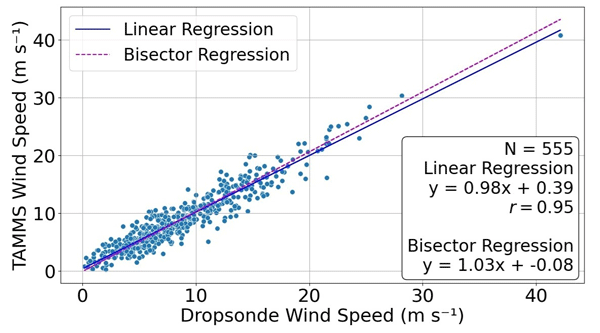
Soodabeh Namdari, Sanja Dmitrovic, Gao Chen, Yonghoon Choi, Ewan Crosbie, Joshua P. DiGangi, Glenn S. Diskin, Richard A. Ferrare, Johnathan W. Hair, Simon Kirschler, John B. Nowak, Kenneth L. Thornhill, Christiane Voigt, Holger Vömel, Xubin Zeng, and Armin Sorooshian
Atmos. Meas. Tech., 18, 4325–4345, https://doi.org/10.5194/amt-18-4325-2025, https://doi.org/10.5194/amt-18-4325-2025, 2025
Short summary
Short summary
We conducted this study to assess the accuracy of airborne measurements of wind, temperature, and humidity, essential for understanding atmospheric processes. Using data from NASA's ACTIVATE campaign, we compared measurements from the Turbulent Air Motion Measurement System (TAMMS) and diode laser hygrometer (DLH) aboard a Falcon aircraft with dropsondes from a King Air, matching data points based on location and time using statistical methods. The study showed strong agreement, confirming the reliability of these methods for advancing climate models.
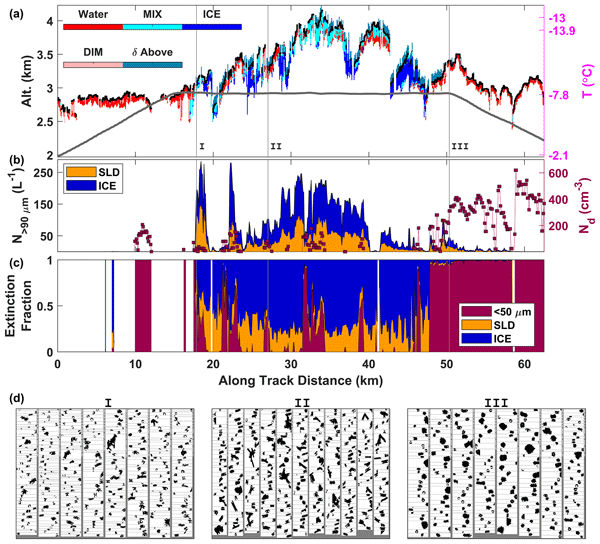
Ewan Crosbie, Johnathan W. Hair, Amin R. Nehrir, Richard A. Ferrare, Chris Hostetler, Taylor Shingler, David Harper, Marta Fenn, James Collins, Rory Barton-Grimley, Brian Collister, K. Lee Thornhill, Christiane Voigt, Simon Kirschler, and Armin Sorooshian
Atmos. Meas. Tech., 18, 2639–2658, https://doi.org/10.5194/amt-18-2639-2025, https://doi.org/10.5194/amt-18-2639-2025, 2025
Short summary
Short summary
A method was developed to extract information from airborne lidar observations about the distribution of ice and liquid water within clouds. The method specifically targets signatures of horizontal and vertical gradients in ice and water that appear in the polarization of the lidar signals. The method was tested against direct measurements of the cloud properties collected by a second aircraft.
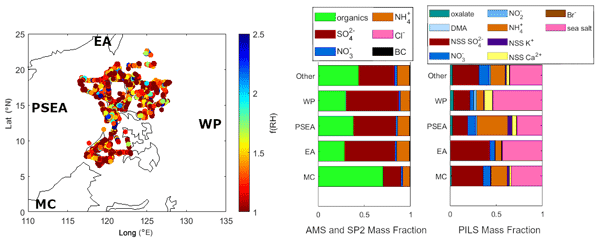
Genevieve Rose Lorenzo, Luke D. Ziemba, Avelino F. Arellano, Mary C. Barth, Ewan C. Crosbie, Joshua P. DiGangi, Glenn S. Diskin, Richard Ferrare, Miguel Ricardo A. Hilario, Michael A. Shook, Simone Tilmes, Jian Wang, Qian Xiao, Jun Zhang, and Armin Sorooshian
Atmos. Chem. Phys., 25, 5469–5495, https://doi.org/10.5194/acp-25-5469-2025, https://doi.org/10.5194/acp-25-5469-2025, 2025
Short summary
Short summary
Novel aerosol hygroscopicity analyses of CAMP2Ex (Cloud, Aerosol, and Monsoon Processes Philippines Experiment) field campaign data show low aerosol hygroscopicity values in Southeast Asia. Organic carbon from smoke decreases hygroscopicity to levels more like those in continental than in polluted marine regions. Hygroscopicity changes at cloud level demonstrate how surface particles impact clouds in the region, affecting model representation of aerosol and cloud interactions in similar polluted marine regions with high organic carbon emissions.
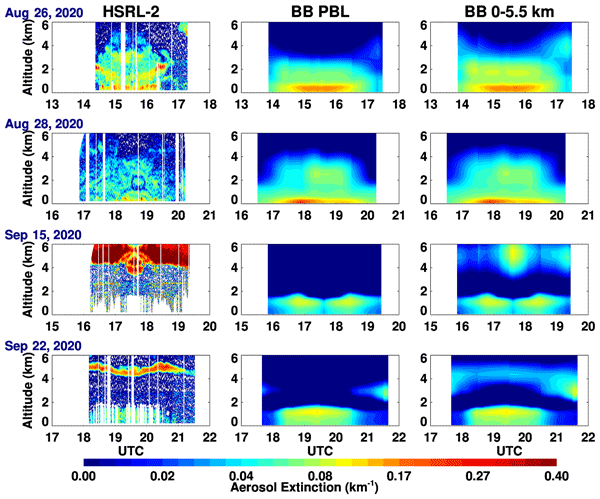
Hongyu Liu, Bo Zhang, Richard H. Moore, Luke D. Ziemba, Richard A. Ferrare, Hyundeok Choi, Armin Sorooshian, David Painemal, Hailong Wang, Michael A. Shook, Amy Jo Scarino, Johnathan W. Hair, Ewan C. Crosbie, Marta A. Fenn, Taylor J. Shingler, Chris A. Hostetler, Gao Chen, Mary M. Kleb, Gan Luo, Fangqun Yu, Mark A. Vaughan, Yongxiang Hu, Glenn S. Diskin, John B. Nowak, Joshua P. DiGangi, Yonghoon Choi, Christoph A. Keller, and Matthew S. Johnson
Atmos. Chem. Phys., 25, 2087–2121, https://doi.org/10.5194/acp-25-2087-2025, https://doi.org/10.5194/acp-25-2087-2025, 2025
Short summary
Short summary
We use the GEOS-Chem model to simulate aerosol distributions and properties over the western North Atlantic Ocean (WNAO) during the winter and summer deployments in 2020 of the NASA ACTIVATE mission. Model results are evaluated against aircraft, ground-based, and satellite observations. The improved understanding of life cycle, composition, transport pathways, and distribution of aerosols has important implications for characterizing aerosol–cloud–meteorology interactions over WNAO.
Robert A. Ryan, Mark A. Vaughan, Sharon D. Rodier, Jason L. Tackett, John A. Reagan, Richard A. Ferrare, Johnathan W. Hair, John A. Smith, and Brian J. Getzewich
Atmos. Meas. Tech., 17, 6517–6545, https://doi.org/10.5194/amt-17-6517-2024, https://doi.org/10.5194/amt-17-6517-2024, 2024
Short summary
Short summary
We introduce Ocean Derived Column Optical Depth (ODCOD), a new way to estimate column optical depths using Cloud-Aerosol Lidar with Orthogonal Polarization (CALIOP) measurements from the ocean surface. ODCOD estimates include contributions from particulates in the full column, which CALIOP estimates do not, making it a complement measurement to CALIOP’s standard estimates. We find that ODCOD compares well with other established data sets in the daytime but tends to estimate higher at night.
Cassidy Soloff, Taiwo Ajayi, Yonghoon Choi, Ewan C. Crosbie, Joshua P. DiGangi, Glenn S. Diskin, Marta A. Fenn, Richard A. Ferrare, Francesca Gallo, Johnathan W. Hair, Miguel Ricardo A. Hilario, Simon Kirschler, Richard H. Moore, Taylor J. Shingler, Michael A. Shook, Kenneth L. Thornhill, Christiane Voigt, Edward L. Winstead, Luke D. Ziemba, and Armin Sorooshian
Atmos. Chem. Phys., 24, 10385–10408, https://doi.org/10.5194/acp-24-10385-2024, https://doi.org/10.5194/acp-24-10385-2024, 2024
Short summary
Short summary
Using aircraft measurements over the northwestern Atlantic between the US East Coast and Bermuda and trajectory modeling of continental outflow, we identify trace gas and particle properties that exhibit gradients with offshore distance and quantify these changes with high-resolution measurements of concentrations and particle chemistry, size, and scattering properties. This work furthers our understanding of the complex interactions between continental and marine environments.
Taiwo Ajayi, Yonghoon Choi, Ewan C. Crosbie, Joshua P. DiGangi, Glenn S. Diskin, Marta A. Fenn, Richard A. Ferrare, Johnathan W. Hair, Miguel Ricardo A. Hilario, Chris A. Hostetler, Simon Kirschler, Richard H. Moore, Taylor J. Shingler, Michael A. Shook, Cassidy Soloff, Kenneth L. Thornhill, Christiane Voigt, Edward L. Winstead, Luke D. Ziemba, and Armin Sorooshian
Atmos. Chem. Phys., 24, 9197–9218, https://doi.org/10.5194/acp-24-9197-2024, https://doi.org/10.5194/acp-24-9197-2024, 2024
Short summary
Short summary
This study uses airborne data to examine vertical profiles of trace gases, aerosol particles, and meteorological variables over a remote marine area (Bermuda). Results show distinct differences based on both air mass source region (North America, Ocean, Caribbean/North Africa) and altitude for a given air mass type. This work highlights the sensitivity of remote marine areas to long-range transport and the importance of considering the vertical dependence of trace gas and aerosol properties.
Sanja Dmitrovic, Johnathan W. Hair, Brian L. Collister, Ewan Crosbie, Marta A. Fenn, Richard A. Ferrare, David B. Harper, Chris A. Hostetler, Yongxiang Hu, John A. Reagan, Claire E. Robinson, Shane T. Seaman, Taylor J. Shingler, Kenneth L. Thornhill, Holger Vömel, Xubin Zeng, and Armin Sorooshian
Atmos. Meas. Tech., 17, 3515–3532, https://doi.org/10.5194/amt-17-3515-2024, https://doi.org/10.5194/amt-17-3515-2024, 2024
Short summary
Short summary
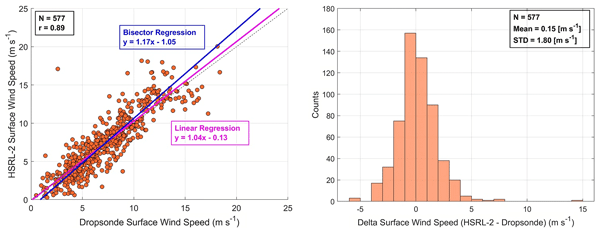
This study introduces and evaluates a new ocean surface wind speed product from the NASA Langley Research Center (LARC) airborne High-Spectral-Resolution Lidar – Generation 2 (HSRL-2) during the NASA ACTIVATE mission. We show that HSRL-2 surface wind speed data are accurate when compared to ground-truth dropsonde measurements. Therefore, the HSRL-2 instrument is able obtain accurate, high-resolution surface wind speed data in airborne field campaigns.
Ewan Crosbie, Luke D. Ziemba, Michael A. Shook, Taylor Shingler, Johnathan W. Hair, Armin Sorooshian, Richard A. Ferrare, Brian Cairns, Yonghoon Choi, Joshua DiGangi, Glenn S. Diskin, Chris Hostetler, Simon Kirschler, Richard H. Moore, David Painemal, Claire Robinson, Shane T. Seaman, K. Lee Thornhill, Christiane Voigt, and Edward Winstead
Atmos. Chem. Phys., 24, 6123–6152, https://doi.org/10.5194/acp-24-6123-2024, https://doi.org/10.5194/acp-24-6123-2024, 2024
Short summary
Short summary
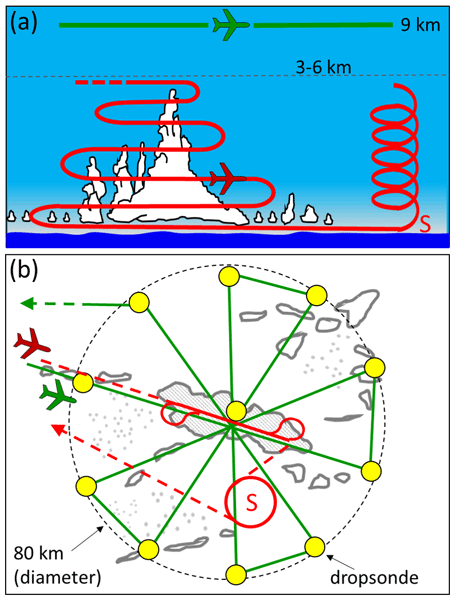
Marine clouds are found to clump together in regions or lines, readily discernible from satellite images of the ocean. While clustering is also a feature of deep storm clouds, we focus on smaller cloud systems associated with fair weather and brief localized showers. Two aircraft sampled the region around these shallow systems: one incorporated measurements taken within, adjacent to, and below the clouds, while the other provided a survey from above using remote sensing techniques.
Leong Wai Siu, Joseph S. Schlosser, David Painemal, Brian Cairns, Marta A. Fenn, Richard A. Ferrare, Johnathan W. Hair, Chris A. Hostetler, Longlei Li, Mary M. Kleb, Amy Jo Scarino, Taylor J. Shingler, Armin Sorooshian, Snorre A. Stamnes, and Xubin Zeng
Atmos. Meas. Tech., 17, 2739–2759, https://doi.org/10.5194/amt-17-2739-2024, https://doi.org/10.5194/amt-17-2739-2024, 2024
Short summary
Short summary
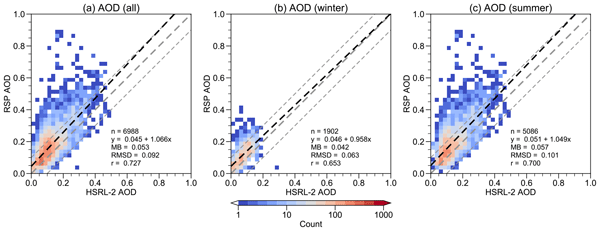
An unprecedented 3-year aerosol dataset was collected from a recent NASA field campaign over the western North Atlantic Ocean, which offers a special opportunity to evaluate two state-of-the-art remote sensing instruments, one lidar and the other polarimeter, on the same aircraft. Special attention has been paid to validate aerosol optical depth data and their uncertainties when no reference dataset is available. Physical reasons for the disagreement between two instruments are discussed.
Hiren T. Jethva, Omar Torres, Richard A. Ferrare, Sharon P. Burton, Anthony L. Cook, David B. Harper, Chris A. Hostetler, Jens Redemann, Vinay Kayetha, Samuel LeBlanc, Kristina Pistone, Logan Mitchell, and Connor J. Flynn
Atmos. Meas. Tech., 17, 2335–2366, https://doi.org/10.5194/amt-17-2335-2024, https://doi.org/10.5194/amt-17-2335-2024, 2024
Short summary
Short summary
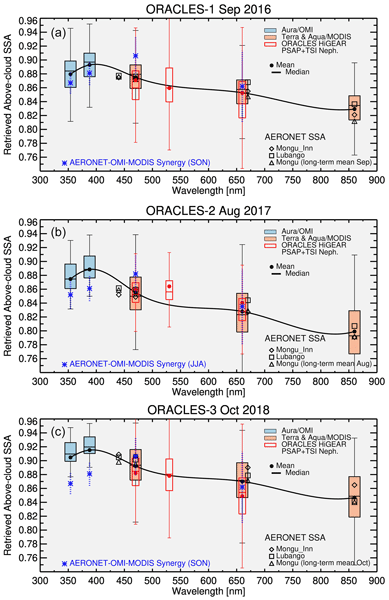
We introduce a novel synergy algorithm applied to ORALCES airborne measurements of above-cloud aerosol optical depth and UV–Vis satellite observations from OMI and MODIS to retrieve spectral aerosol single-scattering albedo of lofted layers of carbonaceous smoke aerosols over clouds. The development of the proposed aerosol–cloud algorithm implies a possible synergy of CALIOP and OMI–MODIS passive sensors to deduce a global product of AOD and SSA of absorbing aerosols above clouds.
Simon Kirschler, Christiane Voigt, Bruce E. Anderson, Gao Chen, Ewan C. Crosbie, Richard A. Ferrare, Valerian Hahn, Johnathan W. Hair, Stefan Kaufmann, Richard H. Moore, David Painemal, Claire E. Robinson, Kevin J. Sanchez, Amy J. Scarino, Taylor J. Shingler, Michael A. Shook, Kenneth L. Thornhill, Edward L. Winstead, Luke D. Ziemba, and Armin Sorooshian
Atmos. Chem. Phys., 23, 10731–10750, https://doi.org/10.5194/acp-23-10731-2023, https://doi.org/10.5194/acp-23-10731-2023, 2023
Short summary
Short summary
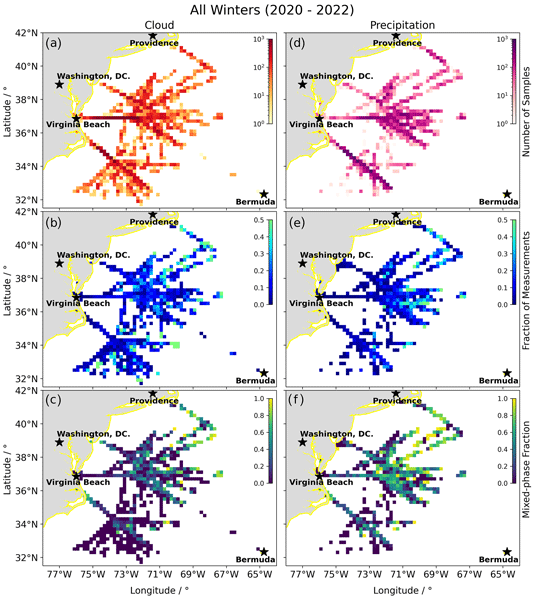
In this study we present an overview of liquid and mixed-phase clouds and precipitation in the marine boundary layer over the western North Atlantic Ocean. We compare microphysical properties of pure liquid clouds to mixed-phase clouds and show that the initiation of the ice phase in mixed-phase clouds promotes precipitation. The observational data presented in this study are well suited for investigating the processes that give rise to liquid and mixed-phase clouds, ice, and precipitation.
Armin Sorooshian, Mikhail D. Alexandrov, Adam D. Bell, Ryan Bennett, Grace Betito, Sharon P. Burton, Megan E. Buzanowicz, Brian Cairns, Eduard V. Chemyakin, Gao Chen, Yonghoon Choi, Brian L. Collister, Anthony L. Cook, Andrea F. Corral, Ewan C. Crosbie, Bastiaan van Diedenhoven, Joshua P. DiGangi, Glenn S. Diskin, Sanja Dmitrovic, Eva-Lou Edwards, Marta A. Fenn, Richard A. Ferrare, David van Gilst, Johnathan W. Hair, David B. Harper, Miguel Ricardo A. Hilario, Chris A. Hostetler, Nathan Jester, Michael Jones, Simon Kirschler, Mary M. Kleb, John M. Kusterer, Sean Leavor, Joseph W. Lee, Hongyu Liu, Kayla McCauley, Richard H. Moore, Joseph Nied, Anthony Notari, John B. Nowak, David Painemal, Kasey E. Phillips, Claire E. Robinson, Amy Jo Scarino, Joseph S. Schlosser, Shane T. Seaman, Chellappan Seethala, Taylor J. Shingler, Michael A. Shook, Kenneth A. Sinclair, William L. Smith Jr., Douglas A. Spangenberg, Snorre A. Stamnes, Kenneth L. Thornhill, Christiane Voigt, Holger Vömel, Andrzej P. Wasilewski, Hailong Wang, Edward L. Winstead, Kira Zeider, Xubin Zeng, Bo Zhang, Luke D. Ziemba, and Paquita Zuidema
Earth Syst. Sci. Data, 15, 3419–3472, https://doi.org/10.5194/essd-15-3419-2023, https://doi.org/10.5194/essd-15-3419-2023, 2023
Short summary
Short summary
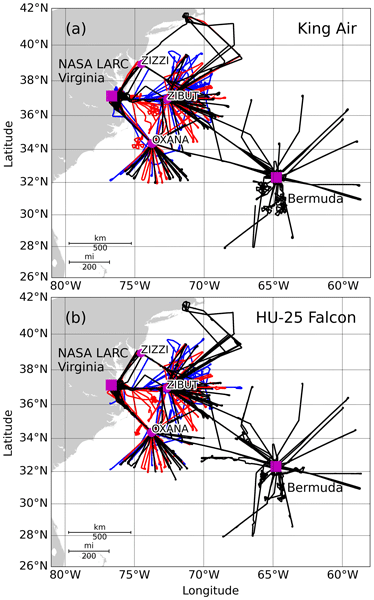
The NASA Aerosol Cloud meTeorology Interactions oVer the western ATlantic Experiment (ACTIVATE) produced a unique dataset for research into aerosol–cloud–meteorology interactions. HU-25 Falcon and King Air aircraft conducted systematic and spatially coordinated flights over the northwest Atlantic Ocean. This paper describes the ACTIVATE flight strategy, instrument and complementary dataset products, data access and usage details, and data application notes.
Haihui Zhu, Randall V. Martin, Betty Croft, Shixian Zhai, Chi Li, Liam Bindle, Jeffrey R. Pierce, Rachel Y.-W. Chang, Bruce E. Anderson, Luke D. Ziemba, Johnathan W. Hair, Richard A. Ferrare, Chris A. Hostetler, Inderjeet Singh, Deepangsu Chatterjee, Jose L. Jimenez, Pedro Campuzano-Jost, Benjamin A. Nault, Jack E. Dibb, Joshua S. Schwarz, and Andrew Weinheimer
Atmos. Chem. Phys., 23, 5023–5042, https://doi.org/10.5194/acp-23-5023-2023, https://doi.org/10.5194/acp-23-5023-2023, 2023
Short summary
Short summary
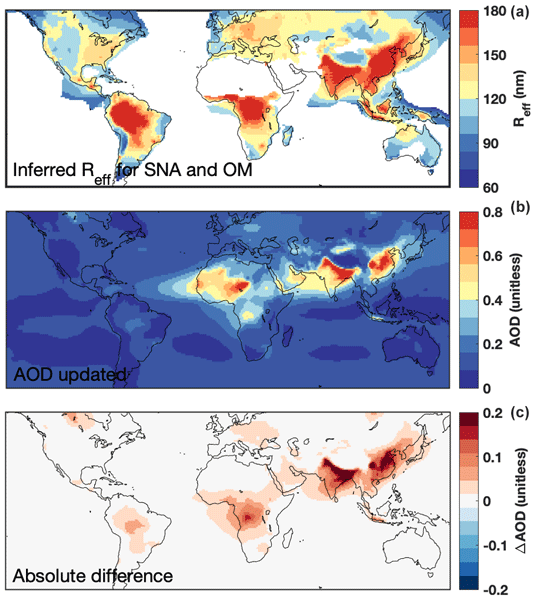
Particle size of atmospheric aerosol is important for estimating its climate and health effects, but simulating atmospheric aerosol size is computationally demanding. This study derives a simple parameterization of the size of organic and secondary inorganic ambient aerosol that can be applied to atmospheric models. Applying this parameterization allows a better representation of the global spatial pattern of aerosol size, as verified by ground and airborne measurements.
Emily D. Lenhardt, Lan Gao, Jens Redemann, Feng Xu, Sharon P. Burton, Brian Cairns, Ian Chang, Richard A. Ferrare, Chris A. Hostetler, Pablo E. Saide, Calvin Howes, Yohei Shinozuka, Snorre Stamnes, Mary Kacarab, Amie Dobracki, Jenny Wong, Steffen Freitag, and Athanasios Nenes
Atmos. Meas. Tech., 16, 2037–2054, https://doi.org/10.5194/amt-16-2037-2023, https://doi.org/10.5194/amt-16-2037-2023, 2023
Short summary
Short summary
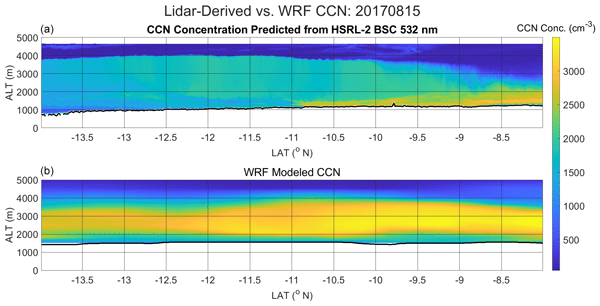
Small atmospheric particles, such as smoke from wildfires or pollutants from human activities, impact cloud properties, and clouds have a strong influence on climate. To better understand the distributions of these particles, we develop relationships to derive their concentrations from remote sensing measurements from an instrument called a lidar. Our method is reliable for smoke particles, and similar steps can be taken to develop relationships for other particle types.
Ian Chang, Lan Gao, Connor J. Flynn, Yohei Shinozuka, Sarah J. Doherty, Michael S. Diamond, Karla M. Longo, Gonzalo A. Ferrada, Gregory R. Carmichael, Patricia Castellanos, Arlindo M. da Silva, Pablo E. Saide, Calvin Howes, Zhixin Xue, Marc Mallet, Ravi Govindaraju, Qiaoqiao Wang, Yafang Cheng, Yan Feng, Sharon P. Burton, Richard A. Ferrare, Samuel E. LeBlanc, Meloë S. Kacenelenbogen, Kristina Pistone, Michal Segal-Rozenhaimer, Kerry G. Meyer, Ju-Mee Ryoo, Leonhard Pfister, Adeyemi A. Adebiyi, Robert Wood, Paquita Zuidema, Sundar A. Christopher, and Jens Redemann
Atmos. Chem. Phys., 23, 4283–4309, https://doi.org/10.5194/acp-23-4283-2023, https://doi.org/10.5194/acp-23-4283-2023, 2023
Short summary
Short summary
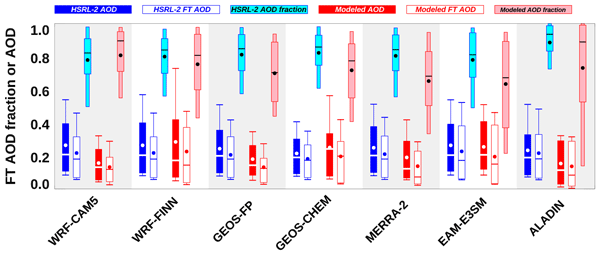
Abundant aerosols are present above low-level liquid clouds over the southeastern Atlantic during late austral spring. The model simulation differences in the proportion of aerosol residing in the planetary boundary layer and in the free troposphere can greatly affect the regional aerosol radiative effects. This study examines the aerosol loading and fractional aerosol loading in the free troposphere among various models and evaluates them against measurements from the NASA ORACLES campaign.

Allison B. Marquardt Collow, Virginie Buchard, Peter R. Colarco, Arlindo M. da Silva, Ravi Govindaraju, Edward P. Nowottnick, Sharon Burton, Richard Ferrare, Chris Hostetler, and Luke Ziemba
Atmos. Chem. Phys., 22, 16091–16109, https://doi.org/10.5194/acp-22-16091-2022, https://doi.org/10.5194/acp-22-16091-2022, 2022
Short summary
Short summary
Biomass burning aerosol impacts aspects of the atmosphere and Earth system through radiative forcing, serving as cloud condensation nuclei, and air quality. Despite its importance, the representation of biomass burning aerosol is not always accurate in models. Field campaign observations from CAMP2Ex are used to evaluate the mass and extinction of aerosols in the GEOS model. Notable biases in the model illuminate areas of future development with GEOS and the underlying GOCART aerosol module.

Eva-Lou Edwards, Jeffrey S. Reid, Peng Xian, Sharon P. Burton, Anthony L. Cook, Ewan C. Crosbie, Marta A. Fenn, Richard A. Ferrare, Sean W. Freeman, John W. Hair, David B. Harper, Chris A. Hostetler, Claire E. Robinson, Amy Jo Scarino, Michael A. Shook, G. Alexander Sokolowsky, Susan C. van den Heever, Edward L. Winstead, Sarah Woods, Luke D. Ziemba, and Armin Sorooshian
Atmos. Chem. Phys., 22, 12961–12983, https://doi.org/10.5194/acp-22-12961-2022, https://doi.org/10.5194/acp-22-12961-2022, 2022
Short summary
Short summary
This study compares NAAPS-RA model simulations of aerosol optical thickness (AOT) and extinction to those retrieved with a high spectral resolution lidar near the Philippines. Agreement for AOT was good, and extinction agreement was strongest below 1500 m. Substituting dropsonde relative humidities into NAAPS-RA did not drastically improve agreement, and we discuss potential reasons why. Accurately modeling future conditions in this region is crucial due to its susceptibility to climate change.
Harshvardhan Harshvardhan, Richard Ferrare, Sharon Burton, Johnathan Hair, Chris Hostetler, David Harper, Anthony Cook, Marta Fenn, Amy Jo Scarino, Eduard Chemyakin, and Detlef Müller
Atmos. Chem. Phys., 22, 9859–9876, https://doi.org/10.5194/acp-22-9859-2022, https://doi.org/10.5194/acp-22-9859-2022, 2022
Short summary
Short summary
The evolution of aerosol in biomass burning smoke plumes that travel over marine clouds off the Atlantic coast of central Africa was studied using measurements made by a lidar deployed on a high-altitude aircraft. The main finding was that the physical properties of aerosol do not change appreciably once the plume has left land and travels over the ocean over a timescale of 1 to 2 d. Almost all particles in the plume are of radius less than 1 micrometer and spherical in shape.

Simon Kirschler, Christiane Voigt, Bruce Anderson, Ramon Campos Braga, Gao Chen, Andrea F. Corral, Ewan Crosbie, Hossein Dadashazar, Richard A. Ferrare, Valerian Hahn, Johannes Hendricks, Stefan Kaufmann, Richard Moore, Mira L. Pöhlker, Claire Robinson, Amy J. Scarino, Dominik Schollmayer, Michael A. Shook, K. Lee Thornhill, Edward Winstead, Luke D. Ziemba, and Armin Sorooshian
Atmos. Chem. Phys., 22, 8299–8319, https://doi.org/10.5194/acp-22-8299-2022, https://doi.org/10.5194/acp-22-8299-2022, 2022
Short summary
Short summary
In this study we show that the vertical velocity dominantly impacts the cloud droplet number concentration (NC) of low-level clouds over the western North Atlantic in the winter and summer season, while the cloud condensation nuclei concentration, aerosol size distribution and chemical composition impact NC within a season. The observational data presented in this study can evaluate and improve the representation of aerosol–cloud interactions for a wide range of conditions.
Zhujun Li, David Painemal, Gregory Schuster, Marian Clayton, Richard Ferrare, Mark Vaughan, Damien Josset, Jayanta Kar, and Charles Trepte
Atmos. Meas. Tech., 15, 2745–2766, https://doi.org/10.5194/amt-15-2745-2022, https://doi.org/10.5194/amt-15-2745-2022, 2022
Short summary
Short summary
For more than 15 years, CALIPSO has revolutionized our understanding of the role of aerosols in climate. Here we evaluate CALIPSO aerosol typing over the ocean using an independent CALIPSO–CloudSat product. The analysis suggests that CALIPSO correctly categorizes clean marine aerosol over the open ocean, elevated smoke over the SE Atlantic, and dust over the tropical Atlantic. Similarities between clean and dusty marine over the open ocean implies that algorithm modifications are warranted.
Sabrina P. Cochrane, K. Sebastian Schmidt, Hong Chen, Peter Pilewskie, Scott Kittelman, Jens Redemann, Samuel LeBlanc, Kristina Pistone, Michal Segal Rozenhaimer, Meloë Kacenelenbogen, Yohei Shinozuka, Connor Flynn, Rich Ferrare, Sharon Burton, Chris Hostetler, Marc Mallet, and Paquita Zuidema
Atmos. Meas. Tech., 15, 61–77, https://doi.org/10.5194/amt-15-61-2022, https://doi.org/10.5194/amt-15-61-2022, 2022
Short summary
Short summary
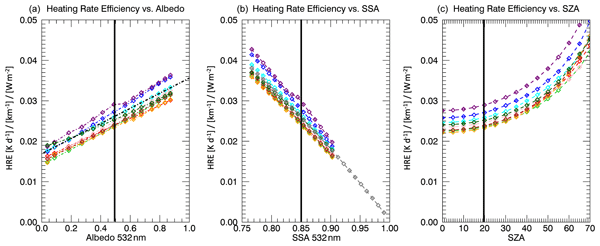
This work presents heating rates derived from aircraft observations from the 2016 and 2017 field campaigns of ORACLES (ObseRvations of Aerosols above CLouds and their intEractionS). We separate the total heating rates into aerosol and gas (primarily water vapor) absorption and explore some of the co-variability of heating rate profiles and their primary drivers, leading to the development of a new concept: the heating rate efficiency (HRE; the heating rate per unit aerosol extinction).
Sarah J. Doherty, Pablo E. Saide, Paquita Zuidema, Yohei Shinozuka, Gonzalo A. Ferrada, Hamish Gordon, Marc Mallet, Kerry Meyer, David Painemal, Steven G. Howell, Steffen Freitag, Amie Dobracki, James R. Podolske, Sharon P. Burton, Richard A. Ferrare, Calvin Howes, Pierre Nabat, Gregory R. Carmichael, Arlindo da Silva, Kristina Pistone, Ian Chang, Lan Gao, Robert Wood, and Jens Redemann
Atmos. Chem. Phys., 22, 1–46, https://doi.org/10.5194/acp-22-1-2022, https://doi.org/10.5194/acp-22-1-2022, 2022
Short summary
Short summary
Between July and October, biomass burning smoke is advected over the southeastern Atlantic Ocean, leading to climate forcing. Model calculations of forcing by this plume vary significantly in both magnitude and sign. This paper compares aerosol and cloud properties observed during three NASA ORACLES field campaigns to the same in four models. It quantifies modeled biases in properties key to aerosol direct radiative forcing and evaluates how these biases propagate to biases in forcing.
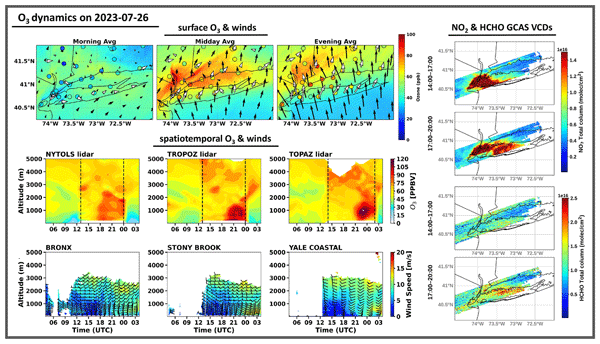
Claudia M. Bernier, Matthew S. Johnson, John Sullivan, Guillaume Gronoff, Daniel Phoenix, Fred Moshary, Raul Alvarez, Brandi McCarty, Andrew Langford, Christoph Senff, Sunil Baidar, and Laura Judd
Atmos. Chem. Phys., 26, 13795–13816, https://doi.org/10.5194/acp-26-13795-2026, https://doi.org/10.5194/acp-26-13795-2026, 2026
Short summary
Short summary
To investigate ozone pollution in a complex coastal urban environment, we combined NASA's Tropospheric Emissions: Monitoring of Pollution (TEMPO) satellite observations with aircraft, ground, and lidar measurements from the 2023 Synergistic TEMPO Air Quality Science (STAQS) campaign in the NYC–Long Island Sound region. We evaluated TEMPO's ability to capture ozone precursor variability and analyzed how meteorology and precursor transport drive day-to-day ozone changes.
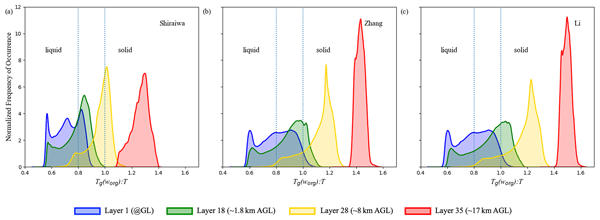
Sara L. Farrell, Quazi Z. Rasool, Havala O. T. Pye, Yue Zhang, Ying Li, Yuzhi Chen, Chi-Tsan Wang, Haofei Zhang, Ryan Schmedding, Manabu Shiraiwa, Jaime Green, Sri H. Budisulistiorini, Jose L. Jimenez, Weiwei Hu, Jason D. Surratt, and William Vizuete
Atmos. Chem. Phys., 26, 13557–13579, https://doi.org/10.5194/acp-26-13557-2026, https://doi.org/10.5194/acp-26-13557-2026, 2026
Short summary
Short summary
Fine particulate matter (PM2.5) has become increasingly important to regulate and model. In this study, we parameterize non-ideal aerosol mixing and phase state into the Community Multiscale Air Quality (CMAQ) model and analyze its impact on the formation of a globally important source of PM2.5, isoprene epoxydiol (IEPOX)-derived PM2.5. Incorporating these features furthers model bias in IEPOX-derived PM2.5, however, this work provides potential phase state bounds for future PM2.5 modeling work.
Emily D. Lenhardt, Lan Gao, Siddhant Gupta, Greg M. McFarquhar, Feng Xu, Richard A. Ferrare, Chris A. Hostetler, and Jens Redemann
Atmos. Chem. Phys., 26, 11709–11732, https://doi.org/10.5194/acp-26-11709-2026, https://doi.org/10.5194/acp-26-11709-2026, 2026
Short summary
Short summary
Interactions between clouds and small particles in the atmosphere can cause changes to cloud properties, such as how much of the sun's energy they reflect and whether precipitation is likely to occur. Here we use a new machine learning dataset to investigate these interactions using observations from the Southeast Atlantic. We find that smoke particles above cloud tops have a strong impact on cloud properties in stable environments. This method can also be applied to satellite data.
Patrick C. Taylor, Armin Sorooshian, Rei Ueyama, Sebastian Schmidt, Ihab Abboud, Quincy Allison, Kevin Barry, Sebastian Becker, Holly A. Bender, Joseph R. Bennett, James B. Blair, Niklas Bohn, Linette Boisvert, Matthew D. Brown, Roelof Bruintjes, Anthony Bucholtz, Megan Buzanowicz, Brian Cairns, Filippo Calì Quaglia, Eduard Chemyakin, Bo Chen, Gao Chen, Hong Chen, Yu-Wen Chen, Zezhen Cheng, Swarup China, Dan Chirica, Yonghoon Choi, Peter Colarco, Brian Collister, Ewan Crosbie, Maurice J. Cross, Janet Daniels, Paul DeMott, Joshua P. DiGangi, Alcide Giorgio di Sarra, Glenn S. Diskin, Erica K. Dolinar, Eva-Lou Edwards, Samuel Ephraim, Nikolaos Evangeliou, Romanos Foskinis, Francesca Gallo, Lan Gao, José Luis Gómez-Amo, Daisy Gonzalez, Christine Groot Zwaaftink, Pawan Gupta, Ivan Heckman, Michael Hendrickson, Miguel Ricardo A. Hilario, Ken Hirata, Michelle Hofton, Andrew L. Holen, Ulas Im, Alia L. Khan, Ralph Kahn, Alexei V. Korolev, Sonia Kreidenweis, Thomas Krumpen, Nathan Kurtz, Leslie Lait, Bradley Lamkin, Jack Landy, Nurun Nahar Lata, Paul Lawson, Samuel LeBlanc, Sean Leavor, Jing Li, Thorsten Markus, Hal Maring, Andreas H. Massling, Camille Mavis, Flynn McGinnity, Kerry Meyer, Gabriel Mojica, Richard H. Moore, Parker Morris, Giovanni Muscari, Vikas Nataraja, Amin R. Nehrir, Athanasios Nenes, Edward P. Nowottnick, Matteo Ottaviani, Chelsea Parker, Ryan Patnaude, Michael Perez, Russell J. Perkins, Colten Peterson, Alek Petty, Stevie Phothisane, Chris Polashenski, Kerri A. Pratt, Kayla M. Preisler, John Prytherch, David Rabine, Jens Redemann, Ju-Mee Ryoo, Joseph S. Schlosser, Vanessa Selimovic, Michael A. Shook, Morgan Silverman, Henrik Skov, Alexander Smirnov, Cassidy Soloff, Amy Solomon, Snorre Stamnes, Azusa Takeishi, David R. Thompson, K. Lee Thornhill, Rachel Tilling, Michael Tjernström, Monica Tosco, Pedro C. Valdelomar, David Van Gilst, Jian Wang, Zhien Wang, Andrzej Wasilewski, Manfred Wendisch, Brent Wilder, Edward L. Winstead, Albert Wu, Peng Xian, Lauren M. Zamora, Jiaoshi Zhang, Lei Zhang, Lu Zhang, Luke Ziemba, and Paquita Zuidema
Earth Syst. Sci. Data Discuss., https://doi.org/10.5194/essd-2026-241, https://doi.org/10.5194/essd-2026-241, 2026
Preprint under review for ESSD
Short summary
Short summary
This article summarizes the data sets collected during the Arctic Radiation Cloud aerosol Sea ice Interaction eXperiment (ARCSIX), NASA's most comprehensive Arctic field campaign to date. The overarching goal was to quantify the contributions of surface, clouds, aerosol particles, and precipitation to summer sea ice melt. This paper describes the ARCSIX implementation including the flight strategy, instruments, complementary data sets, access, and usage details.
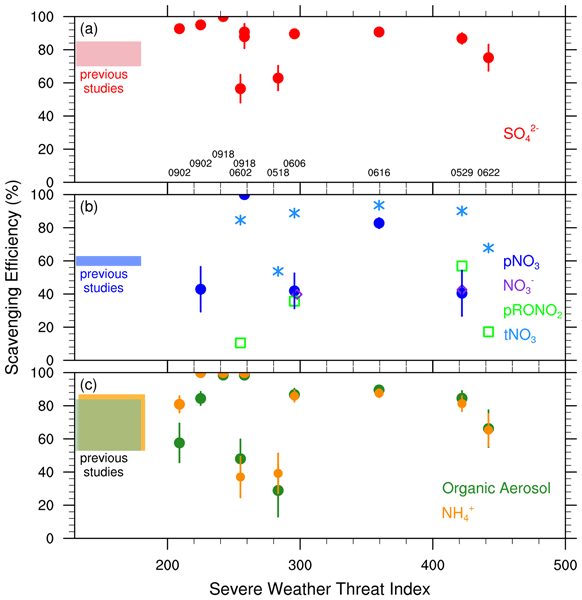
Mary C. Barth, Pedro Campuzano-Jost, Gustavo Cuchiara, Ajay Parottil, Jose L. Jimenez, Miguel Ricardo A. Hilario, Genevieve Rose Lorenzo, and Armin Sorooshian
Atmos. Chem. Phys., 26, 9907–9927, https://doi.org/10.5194/acp-26-9907-2026, https://doi.org/10.5194/acp-26-9907-2026, 2026
Short summary
Short summary
We analyze aircraft observations taken in the inflow and upper troposphere outflow regions of ten convective storms to determine aerosol mass scavenging efficiencies. More than 75 % of sulfate and ammonium in all storms and organic aerosols in severe storms are scavenged. Nitrate aerosols have more moderate scavenging efficiencies. Lightning-NOx production and aqueous-phase chemistry can affect outflow concentrations. These results are useful for evaluating chemical transport models.
Matthias Kohl, Christoph Brühl, Holger Tost, Christos Xenofontos, Theodoros Christoudias, Sergey Gromov, Oliver Appel, Stephan Borrmann, Adam Bourassa, Pedro Campunzano-Jost, Yafang Cheng, Oliver Eppers, Karl D. Froyd, Bruna A. Holanda, Jose L. Jimenez, Patrick Jöckel, Philipp Joppe, Katharina Kaiser, Joseph M. Katich, Klaus Klingmüller, Franziska Köllner, Agnieszka Kupc, Anna Martin, Christopher Pöhlker, Mira L. Pöhlker, Ulrich Pöschl, Landon Rieger, Samuel Ruhl, Gregory P. Schill, Johannes Schneider, Christiane Schulz, Joshua P. Schwarz, Alexandra P. Tsimpidi, Ryan Vella, Christina J. Williamson, Yifan Yang, Daniel Zawada, Jos Lelieveld, and Andrea Pozzer
EGUsphere, https://doi.org/10.5194/egusphere-2026-3649, https://doi.org/10.5194/egusphere-2026-3649, 2026
Short summary
Short summary
Aerosols are crucial for Earth's climate, yet their vertical distribution remains poorly understood. We present first consistent global simulations of aerosol distributions and composition from the Earth's surface to the stratosphere, validated by extensive observations. Key findings include a global minimum in aerosol mass in the free troposphere, a significant contribution of organic aerosol in the lower stratosphere, and limited transport of primary particles to the stratosphere.
Ariadne K. Papamichou, Evanthia Kallou, Richard H. Moore, Holger Pfaender, and Dimitri N. Mavris
J. Env. Com. Air Transp. Sys. Discuss., https://doi.org/10.5194/jecats-2026-11, https://doi.org/10.5194/jecats-2026-11, 2026
Preprint under review for JECATS
Short summary
Short summary
Contrails are thin ice clouds that may form behind aircraft, are responsible for about half of aviation's climate impact, and are hard to detect and predict. Using data from two flight test campaigns, we developed a tool that can be used with a camera mounted on aircraft to detect contrail formation and predict persistence in real time, with camera placement strongly affecting results. Using only this tool and onboard cameras, this lower-cost approach could help reduce aviation's climate impact.
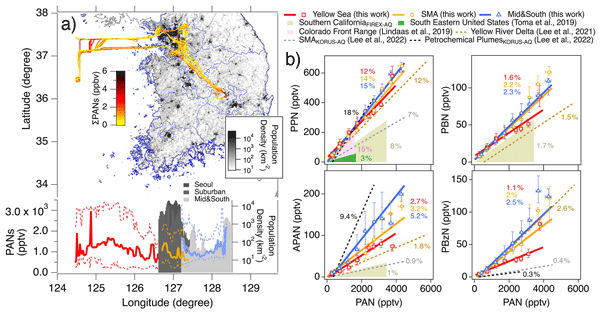
Young Ro Lee, Linda Arterburn, Masayuki Takeuchi, David J. Tanner, James M. Roberts, Behrooz Roozitalab, Daun Jeong, Alan J. Hills, Rebecca S. Hornbrook, Eric C. Apel, Simone Meinardi, Barbara Barletta, Nicola J. Blake, Donald R. Blake, Saewung Kim, Wojciech Wojnowski, Felix Piel, Armin Wisthaler, Katherine Ball, John D. Crounse, Paul O. Wennberg, Jason Miech, Yonghoon Choi, Joshua P. DiGangi, Glenn S. Diskin, Abby Sebol, Erin R. Delaria, Reem A. Hannun, Jason M. St. Clair, Glenn M. Wolfe, Changmin Cho, Courtney Owen, Kirk Lesko, Alessandro Franchin, Edward L. Winstead, Luke D. Ziemba, Richard Moore, Elizabeth B. Wiggins, Guy Symonds, Dongwook Kim, Douglas A. Day, Pedro Campuzano-Jost, Jose L. Jimenez, Kirk Ullmann, Samuel R. Hall, James H. Crawford, and L. Gregory Huey
Atmos. Chem. Phys., 26, 8695–8715, https://doi.org/10.5194/acp-26-8695-2026, https://doi.org/10.5194/acp-26-8695-2026, 2026
Short summary
Short summary
We flew a large variety of instruments on the NASA DC-8 research aircraft to measure pollution over South Korea in the winter of 2024. This works focuses on acyl peroxynitrates (PANs for short) which are formed by chemistry in air. We found high levels of PANs often associated with industrial emissions of pollutants such as ethanol and ethylene oxide. This work helps to understand how to reduce pollution of this sort.
Katherine Mifsud, Jason Barr, Robert Wood, Yonghoon Choi, Ewan Crosbie, Glenn S. Diskin, Joshua P. DiGangi, Richard H. Moore, Claire Robinson, Michael A. Shook, Armin Sorooshian, Christiane Voigt, and Luke Ziemba
EGUsphere, https://doi.org/10.5194/egusphere-2026-3027, https://doi.org/10.5194/egusphere-2026-3027, 2026
Short summary
Short summary
Salt particles from the ocean can help marine clouds precipitate more quickly, but their role is not fully understood. Using aircraft observations over the northwest Atlantic Ocean and computer simulations, we studied how these particles affect warm rain formation. We found that clouds containing more large sea salt particles, even at relatively low amounts, produce more rain. These results improve understanding of how sea salt aerosols influence clouds, rainfall, and climate.
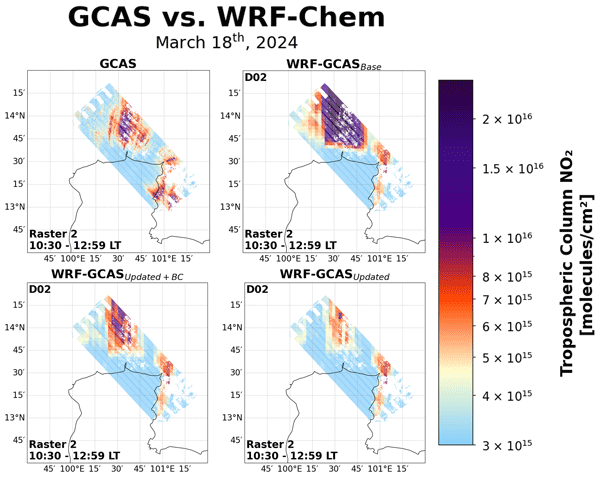
Julianna A. Christopoulos, Pablo E. Saide, Manas R. Mohanty, Nattamon Maneenoi, Jhoon Kim, Laura Judd, Katherine R. Travis, Savitri Garivait, Agapol Junpen, Kazuyuki Miyazaki, Jinkyul Choi, Takashi Sekiya, David Peterson, Theodore M. McHardy, Nicholas Gapp, Jason M. St. Clair, Erin Delaria, Glenn M. Wolfe, Abby Sebol, Alessandro Franchin, Changmin Cho, Morgan L. Silverman, and James H. Crawford
Atmos. Chem. Phys., 26, 8021–8050, https://doi.org/10.5194/acp-26-8021-2026, https://doi.org/10.5194/acp-26-8021-2026, 2026
Short summary
Short summary
Air quality in rapidly growing cities is difficult to model because emissions vary during the day and are often poorly constrained. We demonstrate a methodology for constraining urban emissions using hourly satellite observations combined with high-resolution air quality modeling in Bangkok. We find that emissions inventories likely overestimate nitrogen dioxide emissions, and that updated emissions improve agreement between the model and independent aircraft and ground-based observations.
Susan Mathai, Gregory L. Schuster, Michael A. Shook, and Luke D. Ziemba
EGUsphere, https://doi.org/10.5194/egusphere-2026-1917, https://doi.org/10.5194/egusphere-2026-1917, 2026
Short summary
Short summary
There are several organic aerosols being emitted into the atmosphere through different sources. Often, it's challenging to account for these wide variety of species in global climate models due to a lack of clarity about their classification thresholds. In this study, we define thresholds based on the imaginary refractive index to classify organic aerosols into strongly, moderately, weakly, and very weakly absorbing. The classification shows clear optical separation from 350–500 nm wavelengths.
Jinkyul Choi, Kazuyuki Miyazaki, Takashi Sekiya, Jinhyeok Yu, Shin-Ya Ogino, Henk Eskes, Pieter Rijdijk, Ryan Bennett, Anke Roiger, Leon Knez, Glenn S. Diskin, Jason A. Miech, Joshua P. DiGangi, Yonghoon Choi, Alessandro Franchin, Changmin Cho, Eric C. Apel, Louisa K. Emmons, Nattamon Maneenoi, Jason M. St. Clair, Reem A. Hannun, Glenn M. Wolfe, Erin Delaria, Abby Sebol, Donald R. Blake, Monica Crippa, Rachel M. Hoesly, Steven J. Smith, Jung-Hun Woo, Le Kuai, and Ronald Macatangay
EGUsphere, https://doi.org/10.5194/egusphere-2026-2380, https://doi.org/10.5194/egusphere-2026-2380, 2026
Short summary
Short summary
Asia produces half of the world's air pollution, yet emission estimates from different sources disagree widely. We assimilated satellite observations of six pollutant species to correct both concentrations and emissions. Aircraft measurements from a 2024 NASA campaign across four Asian countries confirmed the improvements. Our results reveal underreported emissions in some countries, overestimated vegetation emissions, unresolved fire estimates, and weather control on cross-border pollution.
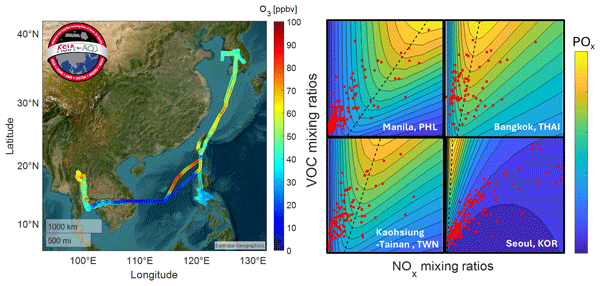
Changmin Cho, Alessandro Franchin, Frank Flocke, Kirk Lesko, Courtney Owen, Samuel R. Hall, Kirk Ullmann, Eric C. Apel, Alan J. Hills, Rebecca S. Hornbrook, Behrooz Roozitalab, Daun Jeong, Glenn S. Diskin, Yonghoon Choi, Joshua P. DiGangi, Jason Miech, Glenn M. Wolfe, Thomas F. Hanisco, Jason M. St. Clair, Jin Liao, Erin R. Delaria, Abby Sebol, Reem A. Hannun, Paul O. Wennberg, Katherine Ball, Young Ro Lee, L. Gregory Huey, David J. Tanner, Linda Arterburn, Donald R. Blake, Nicola J. Blake, Barbara Barletta, Simone Meinardi, Kyung-Eun Min, Heejoo Kang, Woohui Nam, Armin Wisthaler, Felix Piel, Wojciech Wojnowski, Jack Dibb, and James Crawford
Atmos. Chem. Phys., 26, 6097–6116, https://doi.org/10.5194/acp-26-6097-2026, https://doi.org/10.5194/acp-26-6097-2026, 2026
Short summary
Short summary
Ozone pollution is a challenge in Asian cities due to its nonlinear response to precursor controls. Using aircraft measurements, we examined how ozone production depends on nitrogen oxides and volatile organic compounds using a new isopleth-based approach. Ozone production is limited by nitrogen oxides in Metro Manila and Tainan–Kaohsiung, mixed in Bangkok, and limited by volatile organic compounds in Seoul. These results inform city-specific control strategies to reduce ozone in urban areas.
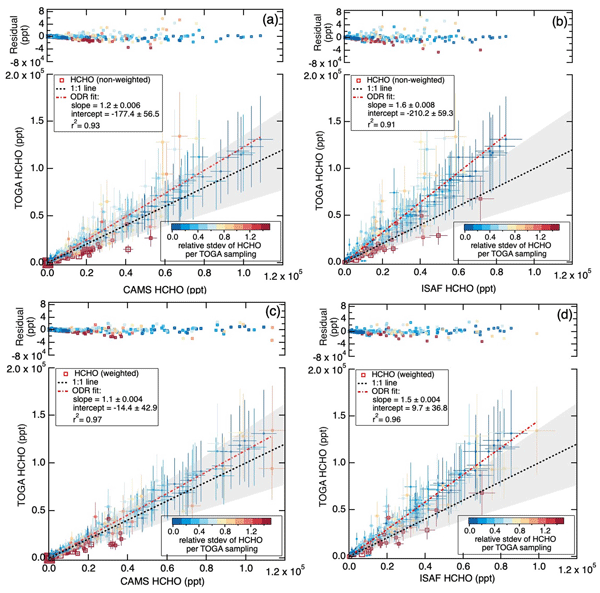
Daun Jeong, Rebecca S. Hornbrook, Alan J. Hills, Glenn Diskin, Hannah S. Halliday, Joshua P. DiGangi, Alan Fried, Dirk Richter, James Walega, Petter Weibring, Thomas F. Hanisco, Glenn M. Wolfe, Jason St. Clair, Jeff Peischl, Armin Wisthaler, Tomas Mikoviny, John B. Nowak, Felix Piel, Laura Tomsche, Christopher D. Holmes, Amber Soja, Emily Gargulinski, James H. Crawford, Jack Dibb, Carsten Warneke, Joshua Schwarz, and Eric C. Apel
Atmos. Meas. Tech., 19, 2985–3000, https://doi.org/10.5194/amt-19-2985-2026, https://doi.org/10.5194/amt-19-2985-2026, 2026
Short summary
Short summary
Formaldehyde is an important atmospheric species that is present at all times throughout the troposphere. Accurately measuring formaldehyde is necessary for understanding key atmospheric chemical cycles. We describe here the first wide-scale demonstration of the gas chromatographic mass spectrometric (GC/MS) technique (NSF NCAR TOGA-TOF (National Science Foundation - National Center for Atmospheric Research - Trace Organic Gas Analyzer with Time-of-Flight mass spectrometer)) for quantifying formaldehyde in the atmosphere and we show this technique to be highly sensitive and selective.
Andre F. Schaum, Christopher M. Kenseth, Madison Rutherford, Harald Stark, Manjula R. Canagaratna, Joost A. de Gouw, Jose L. Jimenez, and Kelvin H. Bates
Aerosol Research Discuss., https://doi.org/10.5194/ar-2026-13, https://doi.org/10.5194/ar-2026-13, 2026
Revised manuscript has not been submitted
Short summary
Short summary
Organic aerosols influence global climate though uncertainties in the magnitude of this influence remain large. A comprehensive understanding of the molecular composition of aerosols is key to minimizing these uncertainties. We present a new method for analyzing organic aerosols in real time using ion mobility mass spectrometry, enabling the separation of aerosol components with identical mass. Analysis of standards and laboratory-generated aerosols demonstrate the method’s potential.
Leon Knez, Maximilian Eckl, Paul Waldmann, Alina Fiehn, Magdalena Pühl, Oleg Aseev, Glenn S. Diskin, Joshua P. DiGangi, Yonghoon Choi, Jason A. Miech, Ryan Bennett, Charles K. Gatebe, Jonathan M. Dean-Day, Rajesh Poudyal, Gangwoong Lee, Jeonghwan Kim, and Anke Roiger
EGUsphere, https://doi.org/10.5194/egusphere-2026-1686, https://doi.org/10.5194/egusphere-2026-1686, 2026
Short summary
Short summary
To mitigate N2O emissions, the processes behind the emissions need to be well understood. Because of this, we developed a new measurement setup for precise and simultaneously fast airborne in-situ N2O measurements. We developed an empirical water vapor correction enabling measurements in regions with high humidity and found no significant influence of different flight parameters on the measurements during two campaigns. This setup can help to measure N2O in humid and undersampled regions.
Melissa A. Ehrenfels, Benjamin C. Schulze, Andrew R. Jensen, Afsara Tasnia, Douglas A. Day, Pedro Campuzano-Jost, Anne V. Handschy, Melinda K. Schueneman, Seonsik Yun, Dongwook Kim, Donna Sueper, Havala O. T. Pye, Benjamin N. Murphy, T. Nash Skipper, Kelley C. Barsanti, Joost A. de Gouw, and Jose L. Jimenez
Aerosol Research Discuss., https://doi.org/10.5194/ar-2026-12, https://doi.org/10.5194/ar-2026-12, 2026
Revised manuscript accepted for AR
Short summary
Short summary
Los Angeles, CA suffers from poor air quality, partially due to secondary aerosol formation. The identity and sources of the most important gas phase precursors is a complex and unresolved issue. For the first time, we separated ambient gas-phase species by volatility, then measured their potential to form aerosols. We found that higher-volatility emissions are responsible for 2/3 of the aerosol formation, and lower volatility ones for 1/3. We evaluate two box models against our measurements.
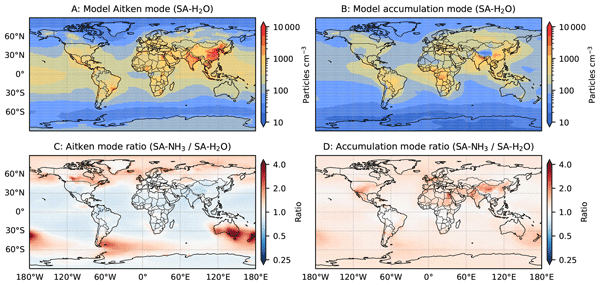
Xu-Cheng He, Nathan Luke Abraham, Han Ding, Maria R. Russo, Daniel P. Grosvenor, Yao Ge, Xuemei Wang, Anthony C. Jones, Pedro Campuzano-Jost, Benjamin Nault, Agnieszka Kupc, Donald Blake, Jose L. Jimenez, Christina J. Williamson, James Weber, Alexander T. Archibald, and Hamish Gordon
Atmos. Chem. Phys., 26, 3805–3851, https://doi.org/10.5194/acp-26-3805-2026, https://doi.org/10.5194/acp-26-3805-2026, 2026
Short summary
Short summary
Aerosols affect clouds and climate. However, current climate models still struggle to simulate them accurately. We used aircraft data from a global mission to evaluate how well the UK Earth System Model represents aerosols and their precursors. Our results show that the model misses key formation processes in clean ocean regions, suggesting that future improvements should focus on better representing how aerosols form naturally in the atmosphere.
Jan-Lukas Tirpitz, Nathaniel Brockway, Santo Fedele Colosimo, Robert Spurr, Matt Christi, Samuel Hall, Kirk Ullmann, Vijay Natraj, Nicolas Theys, Johnathan Hair, Taylor Shingler, Rodney Weber, Ruchen Zhu, Jack Dibb, Richard Moore, Elizabeth Wiggins, and Jochen Stutz
EGUsphere, https://doi.org/10.5194/egusphere-2025-5541, https://doi.org/10.5194/egusphere-2025-5541, 2026
Short summary
Short summary
This study applies a novel remote sensing algorithm to airborne radiation measurements performed in wildfire plumes, to retrieve the absorptive properties of biomass burning aerosols. The results provide new insights on the magnitude, wavelength dependence, and atmospheric aging of the imaginary refractive index, volume absorption cross-section, and single scattering albedo of the smoke particles. Furthermore, potential and limitations of the applied method are discussed.
Jeffrey S. Reid, Robert E. Holz, Chris A. Hostetler, Richard A. Ferrare, Juli I. Rubin, Elizabeth J. Thompson, Susan C. van den Heever, Corey G. Amiot, Sharon P. Burton, Joshua P. DiGangi, Glenn S. Diskin, Joshua H. Cossuth, Daniel P. Eleuterio, Edwin W. Eloranta, Ralph Kuehn, Willem J. Marais, Hal B. Maring, Armin Sorooshian, Kenneth L. Thornhill, Charles R. Trepte, Jian Wang, Peng Xian, and Luke D. Ziemba
Atmos. Chem. Phys., 25, 18639–18673, https://doi.org/10.5194/acp-25-18639-2025, https://doi.org/10.5194/acp-25-18639-2025, 2025
Short summary
Short summary
We document air and ship born measurements of the vertical distribution of pollution and biomass burning aerosol particles transported within the Maritime Continent's monsoonal flows for 1000s of kilometers, and yet still exhibit intricate patterns around clouds near the ocean's surface. Findings demonstrate that, while aerosol transport occurs near the surface, there is heterogeneity in particle extinction that must be considered for both in situ observations and satellite retrievals.
Joshua P. DiGangi, Glenn S. Diskin, Subin Yoon, Sergio L. Alvarez, James H. Flynn, Claire E. Robinson, Michael A. Shook, K. Lee Thornhill, Edward L. Winstead, Luke D. Ziemba, Maria Obiminda L. Cambaliza, James B. Simpas, Miguel Ricardo A. Hilario, and Armin Sorooshian
Atmos. Chem. Phys., 25, 17387–17397, https://doi.org/10.5194/acp-25-17387-2025, https://doi.org/10.5194/acp-25-17387-2025, 2025
Short summary
Short summary
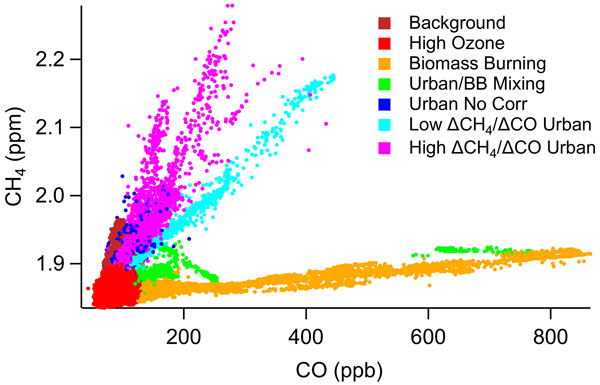
Both fire and urban emissions are major contributors to air pollution in Southeast Asia. Relative increases in measurements of methane and carbon monoxide gases during an aircraft campaign near the Philippines in 2019 were used to isolate pollution emissions from fires vs. urban sources. Results were compared to atmospheric transport models to determine the sources' regional origins, and relationships between pollution indicators relevant to poor air quality were investigated for each source.
Joseph S. Schlosser, Sanja Dmitrovic, Ryan Bennett, Brian Cairns, Gao Chen, Glenn S. Diskin, Richard A. Ferrare, Johnathan W. Hair, Michael A. Jones, Jeffrey S. Reid, Taylor J. Shingler, Michael A. Shook, Armin Sorooshian, Kenneth L. Thornhill, Luke D. Ziemba, and Snorre Stamnes
Atmos. Meas. Tech., 18, 7187–7220, https://doi.org/10.5194/amt-18-7187-2025, https://doi.org/10.5194/amt-18-7187-2025, 2025
Short summary
Short summary
This study focuses on aerosol particles, which critically influence the atmosphere by scattering and absorbing light. To understand these interactions, airborne field campaigns deploy instruments that can measure these particles’ directly or indirectly via remote sensing. We introduce the In Situ Aerosol Retrieval Algorithm (ISARA) to ensure consistency between aerosol measurements and show that the two data sets generally align, with some deviation caused by the presence of larger particles.
Joseph O. Palmo, Colette L. Heald, Donald R. Blake, Ilann Bourgeois, Matthew Coggon, Jeff Collett, Frank Flocke, Alan Fried, Georgios Gkatzelis, Samuel Hall, Lu Hu, Jose L. Jimenez, Pedro Campuzano-Jost, I-Ting Ku, Benjamin Nault, Brett Palm, Jeff Peischl, Ilana Pollack, Amy Sullivan, Joel Thornton, Carsten Warneke, Armin Wisthaler, and Lu Xu
Atmos. Chem. Phys., 25, 17107–17124, https://doi.org/10.5194/acp-25-17107-2025, https://doi.org/10.5194/acp-25-17107-2025, 2025
Short summary
Short summary
This study investigates ozone production within wildfire smoke plumes as they age, using both aircraft observations and models. We find that the chemical environment and resulting ozone production within smoke changes as plumes evolve, with implications for climate and public health.
Matthew J. Rowlinson, Lucy J. Carpenter, Mat J. Evans, James D. Lee, Simone T. Andersen, Tomas Sherwen, Anna B. Callaghan, Roberto Sommariva, William Bloss, Siqi Hou, Leigh R. Crilley, Klaus Pfeilsticker, Benjamin Weyland, Thomas B. Ryerson, Patrick R. Veres, Pedro Campuzano-Jost, Hongyu Guo, Benjamin A. Nault, Jose L. Jimenez, and Khanneh Wadinga Fomba
Atmos. Chem. Phys., 25, 16945–16968, https://doi.org/10.5194/acp-25-16945-2025, https://doi.org/10.5194/acp-25-16945-2025, 2025
Short summary
Short summary
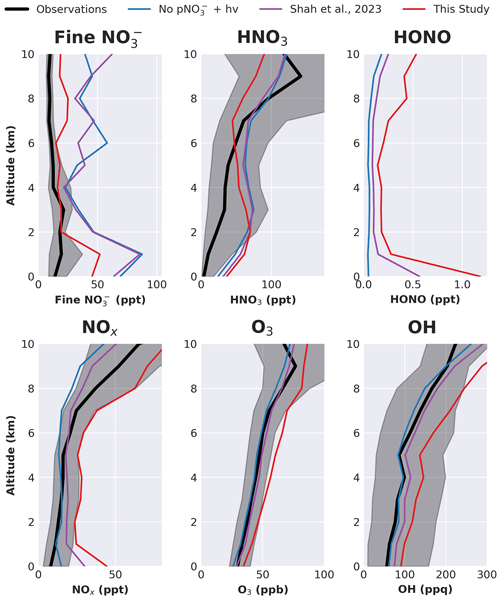
HONO is key to tropospheric chemistry. Observations show high HONO concentrations in remote air, possibly explained by nitrate aerosol photolysis. We use observations to parameterize nitrate photolysis, evaluating simulated HONO against observations from multiple sources. We show improved agreement with observed HONO, but overestimates in NOx and O3, beyond observational constraints. This implies uncertainties in the NOx budget and our understanding of atmospheric chemistry.
Travis D. Toth, Marian B. Clayton, Zhujun Li, David Painemal, Sharon D. Rodier, Jayanta Kar, Tyler J. Thorsen, Richard A. Ferrare, Mark A. Vaughan, Jason L. Tackett, Huisheng Bian, Mian Chin, Anne E. Garnier, Ellsworth J. Welton, Robert A. Ryan, Charles R. Trepte, and David M. Winker
Atmos. Meas. Tech., 18, 6765–6793, https://doi.org/10.5194/amt-18-6765-2025, https://doi.org/10.5194/amt-18-6765-2025, 2025
Short summary
Short summary
NASA's CALIPSO satellite mission observed aerosols (airborne particles) globally from 2006 to 2023. Its final data products update improves its aerosol optical parameters over oceans by adjusting for regional and seasonal differences in a new measurement-model synergistic approach. This results in a more realistic aerosol characterization, specifically near coastlines (where sea salt mixes with pollution), with potential impacts to future studies of science applications (e.g., climate effects).
Meloë S. F. Kacenelenbogen, Ralph Kuehn, Nandana D. Amarasinghe, Kerry G. Meyer, Edward P. Nowottnick, Mark A. Vaughan, Hong Chen, Sebastian Schmidt, Richard A. Ferrare, Johnathan W. Hair, Robert C. Levy, Hongbin Yu, Paquita Zuidema, Robert Holz, and Willem Marais
Atmos. Chem. Phys., 25, 15875–15911, https://doi.org/10.5194/acp-25-15875-2025, https://doi.org/10.5194/acp-25-15875-2025, 2025
Short summary
Short summary
Aerosols perturb the radiation balance of the Earth–atmosphere system. To reduce the uncertainty in quantifying present-day climate change, we combine two satellite sensors and a model to assess the aerosol effects on radiation in all-sky conditions. Satellite-based and coincident aircraft measurements of aerosol radiative effects agree well over the southeast Atlantic. This constitutes a crucial first evaluation before we apply our method to more years and more regions of the world.
Jason A. Miech, Joshua P. DiGangi, Glenn S. Diskin, Yonghoon Choi, Richard H. Moore, Luke D. Ziemba, Francesca Gallo, Carolyn E. Jordan, Michael A. Shook, Elizabeth B. Wiggins, Edward L. Winstead, Sayantee Roy, Young Ro Lee, Katherine Ball, John D. Crounse, Paul Wennberg, Felix Piel, Stefan Swift, Wojciech Wojnowski, and Armin Wisthaler
Atmos. Chem. Phys., 25, 15701–15714, https://doi.org/10.5194/acp-25-15701-2025, https://doi.org/10.5194/acp-25-15701-2025, 2025
Short summary
Short summary
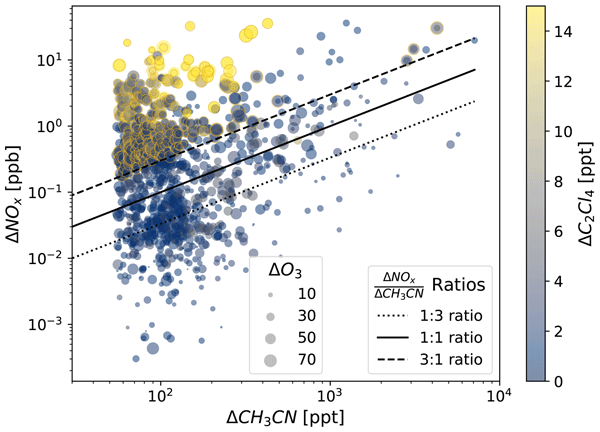
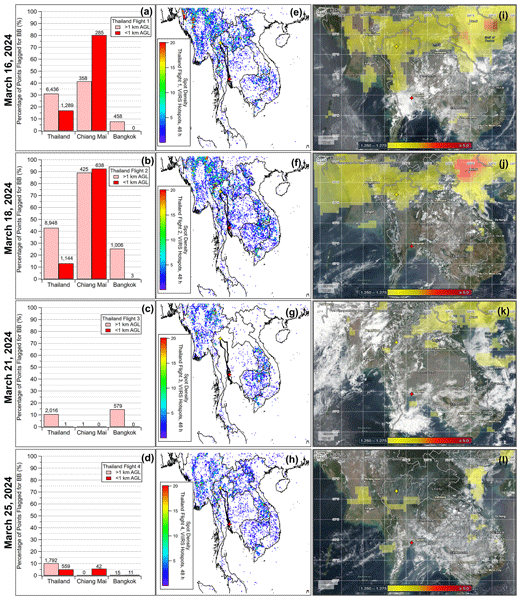
Biomass burning is a significant source of greenhouse gases and airborne pollutants in Asia. Airborne measurements of greenhouse gas enhancement ratios, trace gases, and particle scattering were used to identify air masses impacted by biomass burning over several Asian countries during February and March of 2024. Further analysis using atmospheric transport models and satellite hotspot products was performed to understand the transport history of biomass burning impacted airmasses over Thailand.
Sharon P. Burton, Johnathan W. Hair, Chris A. Hostetler, Marta A. Fenn, John A. Smith, and Richard A. Ferrare
Atmos. Meas. Tech., 18, 6527–6543, https://doi.org/10.5194/amt-18-6527-2025, https://doi.org/10.5194/amt-18-6527-2025, 2025
Short summary
Short summary
Advanced lidars can retrieve atmospheric aerosol backscatter, extinction, and linear depolarization ratio. However excessive noise propagation in the traditional inversion method can make extinction unusable when the signal is weak, such as from space. Implementing a weak constraint can reduce the noise propagation while preserving accuracy. Here we also focus on fully characterizing both random and systematic uncertainties and examining the tradeoff between uncertainty and resolution.
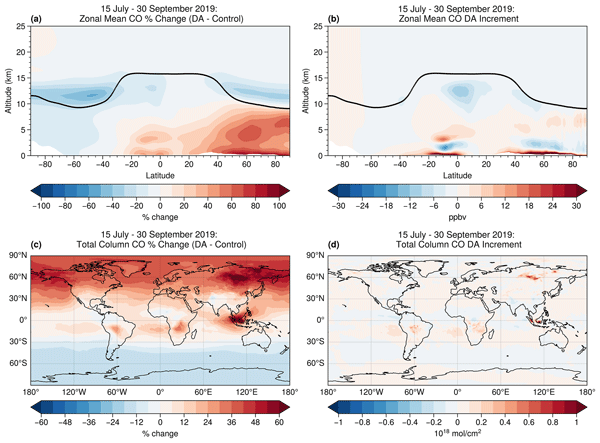
Maggie Bruckner, R. Bradley Pierce, Allen Lenzen, Glenn Diskin, Joshua P. DiGangi, Martine De Maziere, Nicholas Jones, and Maria Makarova
Geosci. Model Dev., 18, 8109–8127, https://doi.org/10.5194/gmd-18-8109-2025, https://doi.org/10.5194/gmd-18-8109-2025, 2025
Short summary
Short summary
UFS-RAQMS incorporates the Real-time Air Quality Modeling System (RAQMS) stratosphere/troposphere chemistry into the existing NOAA Global Ensemble Forecast System (GEFS-Aerosols) version of NOAA's Unified Forecast System (UFS). Chemical data assimilation using TROPOMI CO column observations is conducted during the July–August–September 2019 period. Comparison of the CO column with independent measurements shows a systematic low bias in biomass burning CO emissions without assimilation.
Emily Lenhardt, Lan Gao, Chris A. Hostetler, Richard A. Ferrare, Sharon P. Burton, Richard H. Moore, Luke D. Ziemba, Ewan Crosbie, Armin Sorooshian, Cassidy Soloff, and Jens Redemann
Atmos. Chem. Phys., 25, 13747–13768, https://doi.org/10.5194/acp-25-13747-2025, https://doi.org/10.5194/acp-25-13747-2025, 2025
Short summary
Short summary
Small particles that form cloud droplets greatly impact Earth's climate but are very difficult to measure. If we can measure them using satellite-based instruments, we greatly increase the amount of available data on their concentrations. In this study, we find that including information about particle size is most important to measure them accurately from such satellite-based instruments. This can inform future studies on how to obtain more accurate information about small particles.
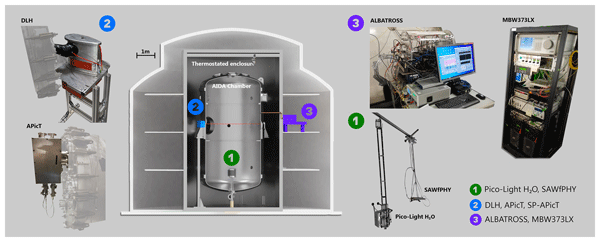
Simone Brunamonti, Harald Saathoff, Albert Hertzog, Glenn Diskin, Masatomo Fujiwara, Karen Rosenlof, Ottmar Möhler, Béla Tuzson, Lukas Emmenegger, Nadir Amarouche, Georges Durry, Fabien Frérot, Jean-Christophe Samake, Claire Cenac, Julio Lopez, Paul Monnier, and Mélanie Ghysels
Atmos. Meas. Tech., 18, 5321–5348, https://doi.org/10.5194/amt-18-5321-2025, https://doi.org/10.5194/amt-18-5321-2025, 2025
Short summary
Short summary
Water vapor is a strong greenhouse gas, and accurate measurements of its concentration in the upper atmosphere (~8–25 km altitude) are crucial for reliable climate predictions. We investigated the performance of four airborne hygrometers, deployed on aircraft or stratospheric balloon platforms and based on different techniques, in a climate simulation chamber. The results demonstrate the high accuracy and reliability of the involved sensors for atmospheric monitoring and research applications.
Corey G. Amiot, Timothy J. Lang, Susan C. van den Heever, Richard A. Ferrare, Ousmane O. Sy, Lawrence D. Carey, Sundar A. Christopher, John R. Mecikalski, Sean W. Freeman, George Alexander Sokolowsky, Chris A. Hostetler, and Simone Tanelli
Atmos. Chem. Phys., 25, 12335–12355, https://doi.org/10.5194/acp-25-12335-2025, https://doi.org/10.5194/acp-25-12335-2025, 2025
Short summary
Short summary
Decoupling aerosol and environmental impacts on convection is challenging. Using airborne data, we correlated convective metrics with aerosol concentrations in several different environments. Results were mixed, but some comparisons suggest that medium-to-high aerosol concentrations were occasionally strongly correlated with convective intensity and prevalence, especially when the atmosphere was relatively unstable. It is important to consider storm environment when evaluating aerosol effects.
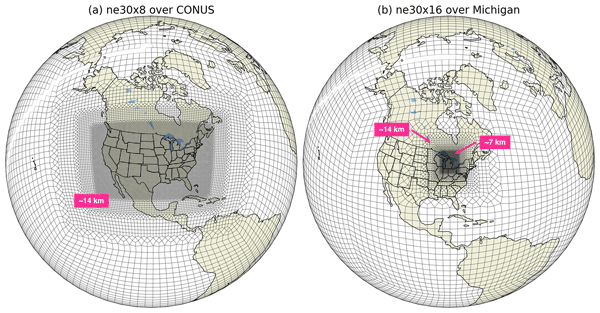
Noribeth Mariscal, Louisa K. Emmons, Duseong S. Jo, Ying Xiong, Laura M. Judd, Scott J. Janz, Jiajue Chai, and Yaoxian Huang
Geosci. Model Dev., 18, 6737–6765, https://doi.org/10.5194/gmd-18-6737-2025, https://doi.org/10.5194/gmd-18-6737-2025, 2025
Short summary
Short summary
The distribution of ozone (O3) and its precursors (NOx, VOCs) is explored using the chemistry–climate model MUSICAv0 and evaluated using measurements from the Michigan–Ontario Ozone Source Experiment. A custom grid of ~7 km was created over Michigan. A sector-based diurnal cycle for anthropogenic nitric oxide was included in the model. This work shows that grid resolution plays a more important role in relation to O3 precursors and that the diurnal cycle significantly impacts nighttime O3 formation.
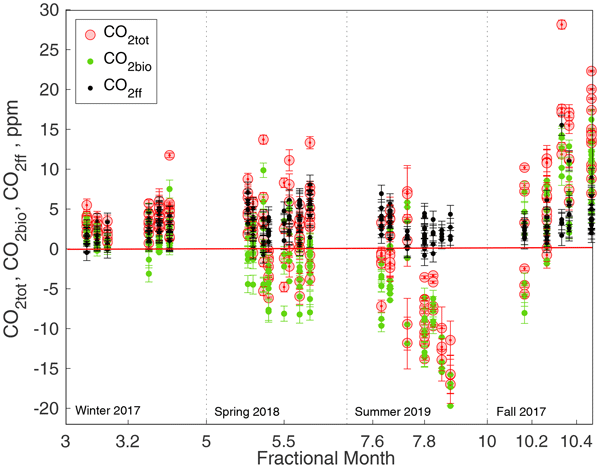
Bianca C. Baier, John B. Miller, Colm Sweeney, Scott J. Lehman, Chad Wolak, Joshua P. DiGangi, Yonghoon Choi, Kenneth Davis, Sha Feng, and Thomas Lauvaux
Atmos. Chem. Phys., 25, 10479–10497, https://doi.org/10.5194/acp-25-10479-2025, https://doi.org/10.5194/acp-25-10479-2025, 2025
Short summary
Short summary
CO2 radiocarbon content (Δ14CO2) is a unique tracer that helps to accurately quantify anthropogenic CO2 emitted into the atmosphere. Δ14CO2 measured in airborne flask samples is used to distinguish fossil versus biogenic CO2 sources. Mid-Atlantic US CO2 variability is found to be driven by the biosphere. Errors in modeled fossil fuel CO2 are evaluated using Δ14CO2 airborne data as an avenue to improving future regional models of atmospheric CO2 transport.
Soodabeh Namdari, Sanja Dmitrovic, Gao Chen, Yonghoon Choi, Ewan Crosbie, Joshua P. DiGangi, Glenn S. Diskin, Richard A. Ferrare, Johnathan W. Hair, Simon Kirschler, John B. Nowak, Kenneth L. Thornhill, Christiane Voigt, Holger Vömel, Xubin Zeng, and Armin Sorooshian
Atmos. Meas. Tech., 18, 4325–4345, https://doi.org/10.5194/amt-18-4325-2025, https://doi.org/10.5194/amt-18-4325-2025, 2025
Short summary
Short summary
We conducted this study to assess the accuracy of airborne measurements of wind, temperature, and humidity, essential for understanding atmospheric processes. Using data from NASA's ACTIVATE campaign, we compared measurements from the Turbulent Air Motion Measurement System (TAMMS) and diode laser hygrometer (DLH) aboard a Falcon aircraft with dropsondes from a King Air, matching data points based on location and time using statistical methods. The study showed strong agreement, confirming the reliability of these methods for advancing climate models.
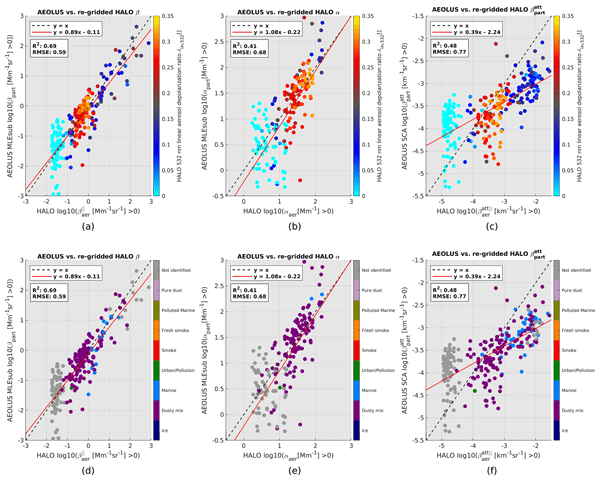
Dimitri Trapon, Holger Baars, Athena Augusta Floutsi, Sebastian Bley, Moritz Haarig, Adrien Lacour, Thomas Flament, Alain Dabas, Amin R. Nehrir, Frithjof Ehlers, and Dorit Huber
Atmos. Meas. Tech., 18, 3873–3896, https://doi.org/10.5194/amt-18-3873-2025, https://doi.org/10.5194/amt-18-3873-2025, 2025
Short summary
Short summary
The study highlights how aerosol measurements from aircraft can be used in synergy with ground-based observations to validate the European Space Agency's Aeolus satellite aerosol product above the tropical Atlantic. For the first time, collocated sections of the troposphere up to 626 km long are crossed. Combining measurements from satellite, aircraft, and ground-based instruments allows characterization of the optical properties of the observed dust particles emitted from the Sahara.
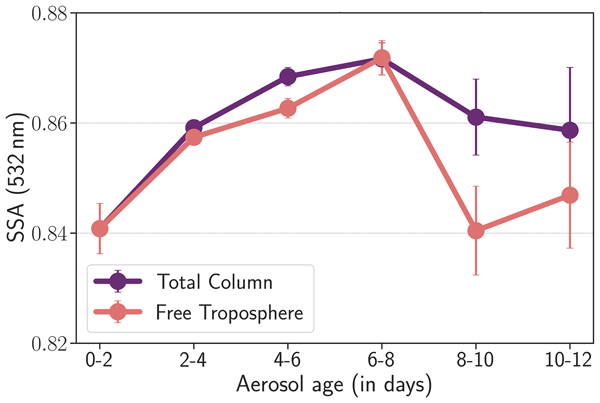
Abdulamid A. Fakoya, Jens Redemann, Pablo E. Saide, Lan Gao, Logan T. Mitchell, Calvin Howes, Amie Dobracki, Ian Chang, Gonzalo A. Ferrada, Kristina Pistone, Samuel E. Leblanc, Michal Segal-Rozenhaimer, Arthur J. Sedlacek III, Thomas Eck, Brent Holben, Pawan Gupta, Elena Lind, Paquita Zuidema, Gregory Carmichael, and Connor J. Flynn
Atmos. Chem. Phys., 25, 7879–7902, https://doi.org/10.5194/acp-25-7879-2025, https://doi.org/10.5194/acp-25-7879-2025, 2025
Short summary
Short summary
Tiny atmospheric particles from wildfire smoke impact the climate by interacting with sunlight and clouds, the extent of which is uncertain due to gaps in understanding how smoke changes over time. We developed a new method using remote sensing instruments to track how these particles evolve during atmospheric transport. Our results show that the ability of these particles to absorb sunlight increases as they travel. This discovery could help improve predictions of future climate scenarios.
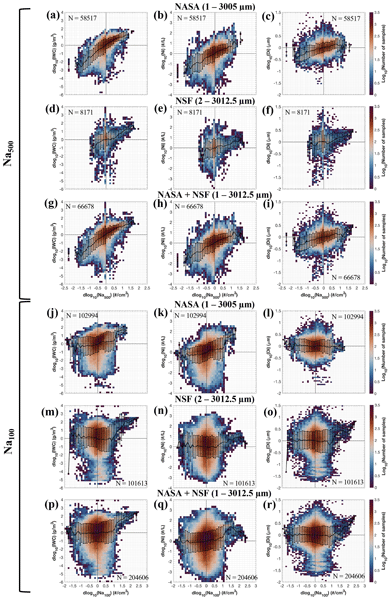
Derek Ngo, Minghui Diao, Ryan J. Patnaude, Sarah Woods, and Glenn Diskin
Atmos. Chem. Phys., 25, 7007–7036, https://doi.org/10.5194/acp-25-7007-2025, https://doi.org/10.5194/acp-25-7007-2025, 2025
Short summary
Short summary
Key controlling factors of cirrus clouds were individually quantified using machine learning models based on global-scale in situ observations from 12 campaigns at 67° S–87° N. Relative humidity shows much larger effects on cirrus occurrences and ice water content (IWC) fluctuations than vertical velocity. Aerosol–cloud interactions are seen for both large and small aerosols, with higher IWC and ice crystal number concentration under higher aerosol concentrations. Large aerosols are more impactful than small aerosols.
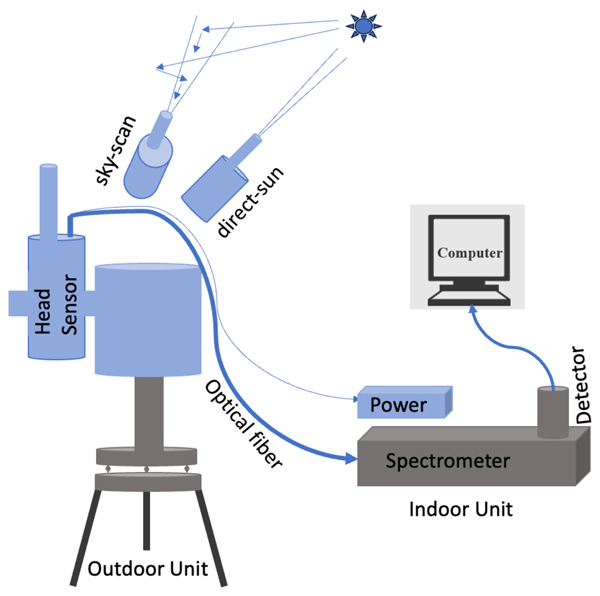
Prajjwal Rawat, James H. Crawford, Katherine R. Travis, Laura M. Judd, Mary Angelique G. Demetillo, Lukas C. Valin, James J. Szykman, Andrew Whitehill, Eric Baumann, and Thomas F. Hanisco
Atmos. Meas. Tech., 18, 2899–2917, https://doi.org/10.5194/amt-18-2899-2025, https://doi.org/10.5194/amt-18-2899-2025, 2025
Short summary
Short summary
The Pandonia Global Network (PGN) consists of Pandora spectrometers that observe trace gases at a high time resolution to validate satellite observations and understand local air quality. To aid users, PGN assigns quality flags that assure scientifically valid data but eliminate large amounts of data appropriate for scientific applications. A new method based on contemporaneous data in two independent observation modes is proven using complementary ground-based and airborne observations.

Qingqing He, Jingru Cao, Pablo E. Saide, Tong Ye, Weihang Wang, Ming Zhang, and Jiejun Huang
Atmos. Chem. Phys., 25, 6663–6677, https://doi.org/10.5194/acp-25-6663-2025, https://doi.org/10.5194/acp-25-6663-2025, 2025
Short summary
Short summary
We analyzed ground-level ozone variations and exposure hotspots across China (2000–2020) at multiple scales using daily 1 km ozone data derived from satellite-sourced land-surface temperature data via a machine-learning hindcasting model. The dataset was validated using cross-validation and external measurements. A non-monotonic trend with regional and seasonal variations emerged, with turning points around 2008 and 2015. Ozone levels >100 μg m‾³ shifted from June to May, while levels >160 μg m‾³ expanded in the North China Plain.
Dongwook Kim, Pedro Campuzano-Jost, Hongyu Guo, Douglas A. Day, Da Yang, Suresh Dhaniyala, Leah Williams, Philip Croteau, John Jayne, Douglas Worsnop, Rainer Volkamer, and Jose L. Jimenez
Aerosol Research, 3, 371–404, https://doi.org/10.5194/ar-3-371-2025, https://doi.org/10.5194/ar-3-371-2025, 2025
Short summary
Short summary
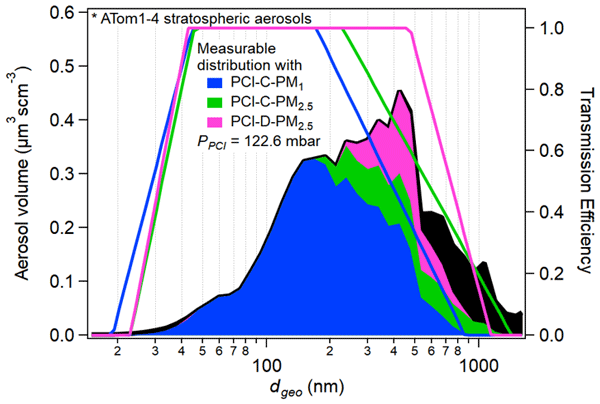
Quantitative real-time aerosol sampling on board aircraft platforms is challenging, especially at higher altitudes. Herein, we present comprehensive analyses of a new aircraft inlet system and tools for aerosol beam diagnostics for aerosol mass spectrometers (AMSs). The beam focusing of aerodynamic lenses and the thermal decomposition on the vaporizer were investigated. The new inlet system can be operated at higher altitudes while sampling aerosols over a broader size range than previous versions.
Christopher D. Holmes, Joshua P. Schwarz, Charles H. Fite, Anxhelo Agastra, Holly K. Nowell, Katherine Ball, T. Paul Bui, Johnathan Dean-Day, Zachary C. J. Decker, Joshua P. DiGagni, Glenn S. Diskin, Emily M. Gargulinski, Hannah Halliday, Shobha Kondragunta, John B. Nowak, David A. Peterson, Michael A. Robinson, Amber J. Soja, Rebecca A. Washenfelder, Chuanyu Xu, and Robert J. Yokelson
Earth Syst. Sci. Data Discuss., https://doi.org/10.5194/essd-2025-307, https://doi.org/10.5194/essd-2025-307, 2025
Revised manuscript accepted for ESSD
Short summary
Short summary
Smoke age is an important factor in the chemical and physical evolution of smoke. Two methods for determining the age of smoke are applied to the NASA-NOAA FIREX-AQ field campaign: one based on wind speed and distance, and another using an ensemble of modeled air parcel trajectories. Both methods are evaluated, with the trajectory method, which includes plume rise and uncertainty estimates, proving more accurate.
Ewan Crosbie, Johnathan W. Hair, Amin R. Nehrir, Richard A. Ferrare, Chris Hostetler, Taylor Shingler, David Harper, Marta Fenn, James Collins, Rory Barton-Grimley, Brian Collister, K. Lee Thornhill, Christiane Voigt, Simon Kirschler, and Armin Sorooshian
Atmos. Meas. Tech., 18, 2639–2658, https://doi.org/10.5194/amt-18-2639-2025, https://doi.org/10.5194/amt-18-2639-2025, 2025
Short summary
Short summary
A method was developed to extract information from airborne lidar observations about the distribution of ice and liquid water within clouds. The method specifically targets signatures of horizontal and vertical gradients in ice and water that appear in the polarization of the lidar signals. The method was tested against direct measurements of the cloud properties collected by a second aircraft.
Genevieve Rose Lorenzo, Luke D. Ziemba, Avelino F. Arellano, Mary C. Barth, Ewan C. Crosbie, Joshua P. DiGangi, Glenn S. Diskin, Richard Ferrare, Miguel Ricardo A. Hilario, Michael A. Shook, Simone Tilmes, Jian Wang, Qian Xiao, Jun Zhang, and Armin Sorooshian
Atmos. Chem. Phys., 25, 5469–5495, https://doi.org/10.5194/acp-25-5469-2025, https://doi.org/10.5194/acp-25-5469-2025, 2025
Short summary
Short summary
Novel aerosol hygroscopicity analyses of CAMP2Ex (Cloud, Aerosol, and Monsoon Processes Philippines Experiment) field campaign data show low aerosol hygroscopicity values in Southeast Asia. Organic carbon from smoke decreases hygroscopicity to levels more like those in continental than in polluted marine regions. Hygroscopicity changes at cloud level demonstrate how surface particles impact clouds in the region, affecting model representation of aerosol and cloud interactions in similar polluted marine regions with high organic carbon emissions.
Benjamin C. Sapper, Sean Youn, Daven K. Henze, Manjula Canagaratna, Harald Stark, and Jose L. Jimenez
Geosci. Model Dev., 18, 2891–2919, https://doi.org/10.5194/gmd-18-2891-2025, https://doi.org/10.5194/gmd-18-2891-2025, 2025
Short summary
Short summary
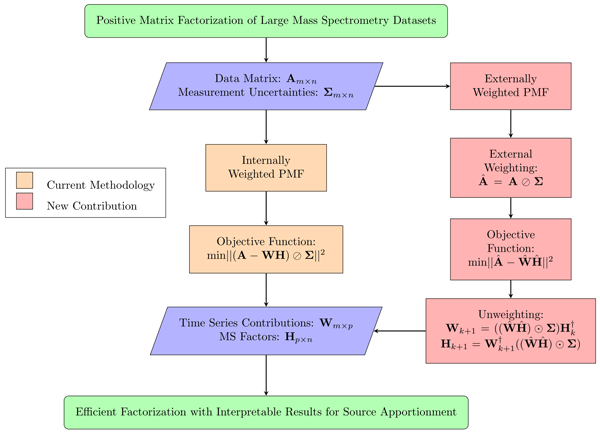
Positive matrix factorization (PMF) has been used by atmospheric scientists to extract underlying factors present in large datasets. This paper presents a new technique for error-weighted PMF that drastically reduces the computational costs of previously developed algorithms. We use this technique to deliver interpretable factors and solution diagnostics from an atmospheric chemistry dataset.
Kira Zeider, Kayla McCauley, Sanja Dmitrovic, Leong Wai Siu, Yonghoon Choi, Ewan C. Crosbie, Joshua P. DiGangi, Glenn S. Diskin, Simon Kirschler, John B. Nowak, Michael A. Shook, Kenneth L. Thornhill, Christiane Voigt, Edward L. Winstead, Luke D. Ziemba, Paquita Zuidema, and Armin Sorooshian
Atmos. Chem. Phys., 25, 2407–2422, https://doi.org/10.5194/acp-25-2407-2025, https://doi.org/10.5194/acp-25-2407-2025, 2025
Short summary
Short summary
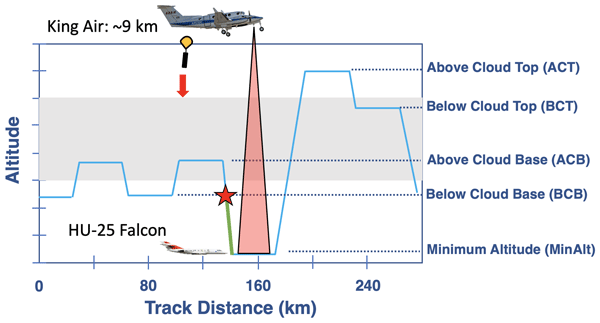
In situ aircraft data collected over the northwest Atlantic Ocean are utilized to compare aerosol conditions and turbulence between near-surface and below-cloud-base altitudes for different regimes of coupling strength between those two levels, along with how cloud microphysical properties vary across those regimes. Stronger coupling yields more homogenous aerosol structure vertically along with higher cloud drop concentrations and sea salt influence in clouds.
Hendrik Fuchs, Aaron Stainsby, Florian Berg, René Dubus, Michelle Färber, Andreas Hofzumahaus, Frank Holland, Kelvin H. Bates, Steven S. Brown, Matthew M. Coggon, Glenn S. Diskin, Georgios I. Gkatzelis, Christopher M. Jernigan, Jeff Peischl, Michael A. Robinson, Andrew W. Rollins, Nell B. Schafer, Rebecca H. Schwantes, Chelsea E. Stockwell, Patrick R. Veres, Carsten Warneke, Eleanor M. Waxman, Lu Xu, Kristen Zuraski, Andreas Wahner, and Anna Novelli
Atmos. Meas. Tech., 18, 881–895, https://doi.org/10.5194/amt-18-881-2025, https://doi.org/10.5194/amt-18-881-2025, 2025
Short summary
Short summary
Significant improvements have been made to the instruments used to measure OH reactivity, which is equivalent to the sum of air pollutant concentrations. Accurate and precise measurements with a high time resolution have been achieved, allowing use on aircraft, as demonstrated during flights in the USA.
Hongyu Liu, Bo Zhang, Richard H. Moore, Luke D. Ziemba, Richard A. Ferrare, Hyundeok Choi, Armin Sorooshian, David Painemal, Hailong Wang, Michael A. Shook, Amy Jo Scarino, Johnathan W. Hair, Ewan C. Crosbie, Marta A. Fenn, Taylor J. Shingler, Chris A. Hostetler, Gao Chen, Mary M. Kleb, Gan Luo, Fangqun Yu, Mark A. Vaughan, Yongxiang Hu, Glenn S. Diskin, John B. Nowak, Joshua P. DiGangi, Yonghoon Choi, Christoph A. Keller, and Matthew S. Johnson
Atmos. Chem. Phys., 25, 2087–2121, https://doi.org/10.5194/acp-25-2087-2025, https://doi.org/10.5194/acp-25-2087-2025, 2025
Short summary
Short summary
We use the GEOS-Chem model to simulate aerosol distributions and properties over the western North Atlantic Ocean (WNAO) during the winter and summer deployments in 2020 of the NASA ACTIVATE mission. Model results are evaluated against aircraft, ground-based, and satellite observations. The improved understanding of life cycle, composition, transport pathways, and distribution of aerosols has important implications for characterizing aerosol–cloud–meteorology interactions over WNAO.
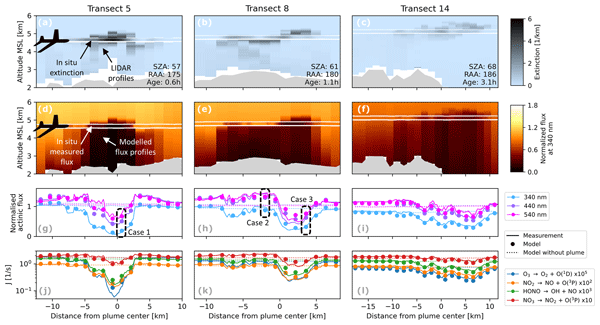
Jan-Lukas Tirpitz, Santo Fedele Colosimo, Nathaniel Brockway, Robert Spurr, Matt Christi, Samuel Hall, Kirk Ullmann, Johnathan Hair, Taylor Shingler, Rodney Weber, Jack Dibb, Richard Moore, Elizabeth Wiggins, Vijay Natraj, Nicolas Theys, and Jochen Stutz
Atmos. Chem. Phys., 25, 1989–2015, https://doi.org/10.5194/acp-25-1989-2025, https://doi.org/10.5194/acp-25-1989-2025, 2025
Short summary
Short summary
We combine plume composition data from the 2019 NASA FIREX-AQ campaign with state-of-the-art radiative transfer modeling techniques to calculate distributions of actinic flux and photolysis frequencies in a wildfire plume. Excellent agreement of the model and observations demonstrates the applicability of this approach to constrain photochemistry in such plumes. We identify limiting factors for the modeling accuracy and discuss spatial and spectral features of the distributions.
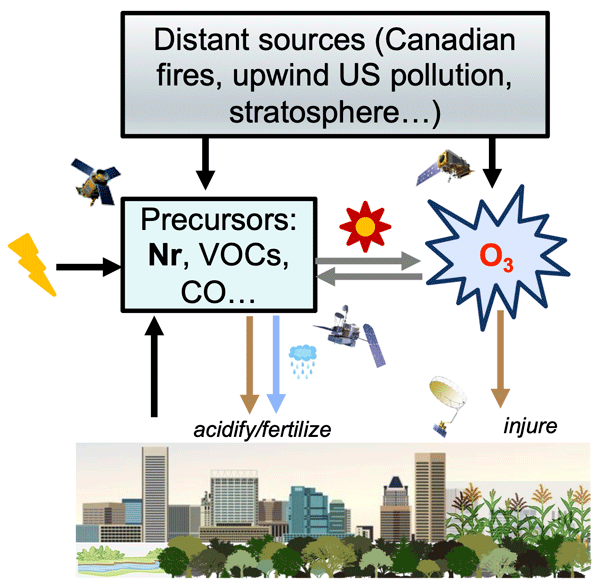
Min Huang, Gregory R. Carmichael, Kevin W. Bowman, Isabelle De Smedt, Andreas Colliander, Michael H. Cosh, Sujay V. Kumar, Alex B. Guenther, Scott J. Janz, Ryan M. Stauffer, Anne M. Thompson, Niko M. Fedkin, Robert J. Swap, John D. Bolten, and Alicia T. Joseph
Atmos. Chem. Phys., 25, 1449–1476, https://doi.org/10.5194/acp-25-1449-2025, https://doi.org/10.5194/acp-25-1449-2025, 2025
Short summary
Short summary
We use model simulations along with multiplatform, multidisciplinary observations and a range of analysis methods to estimate and understand the distributions, temporal changes, and impacts of reactive nitrogen and ozone over the most populous US region that has undergone significant environmental changes. Deposition, biogenic emissions, and extra-regional sources have been playing increasingly important roles in controlling pollutant budgets in this area as local anthropogenic emissions drop.
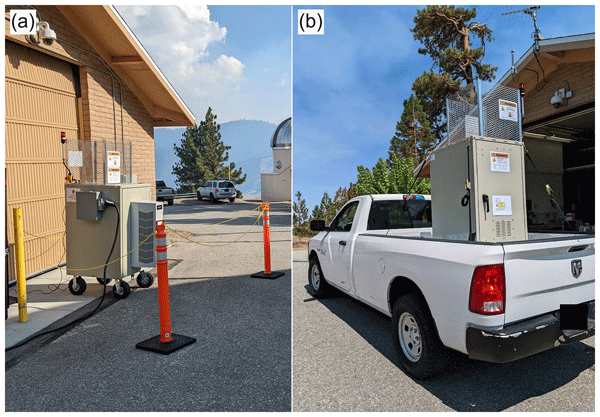
Fernando Chouza, Thierry Leblanc, Patrick Wang, Steven S. Brown, Kristen Zuraski, Wyndom Chace, Caroline C. Womack, Jeff Peischl, John Hair, Taylor Shingler, and John Sullivan
Atmos. Meas. Tech., 18, 405–419, https://doi.org/10.5194/amt-18-405-2025, https://doi.org/10.5194/amt-18-405-2025, 2025
Short summary
Short summary
The JPL lidar group developed the SMOL (Small Mobile Ozone Lidar), an affordable ozone differential absorption lidar (DIAL) system covering all altitudes from 200 m to 10 km a.g.l. The comparison with airborne in situ and lidar measurements shows very good agreement. An additional comparison with nearby surface ozone measuring instruments indicates unbiased measurements by the SMOL lidars down to 200 m a.g.l.
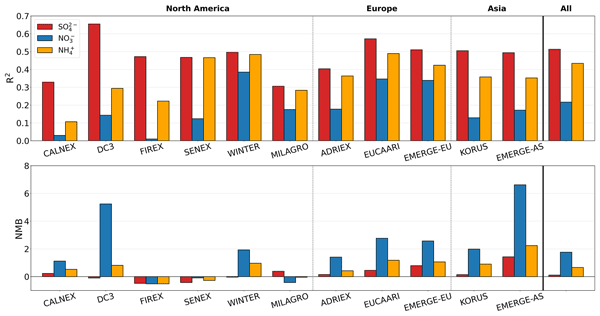
Olivia G. Norman, Colette L. Heald, Solomon Bililign, Pedro Campuzano-Jost, Hugh Coe, Marc N. Fiddler, Jaime R. Green, Jose L. Jimenez, Katharina Kaiser, Jin Liao, Ann M. Middlebrook, Benjamin A. Nault, John B. Nowak, Johannes Schneider, and André Welti
Atmos. Chem. Phys., 25, 771–795, https://doi.org/10.5194/acp-25-771-2025, https://doi.org/10.5194/acp-25-771-2025, 2025
Short summary
Short summary
This study finds that one component of secondary inorganic aerosols, nitrate, is greatly overestimated by a global atmospheric chemistry model compared to observations from 11 flight campaigns. None of the loss and production pathways explored can explain the nitrate bias alone. The model’s inability to capture the variability in the observations remains and requires future investigation to avoid biases in policy-related studies (i.e., air quality, health, climate impacts of these aerosols).
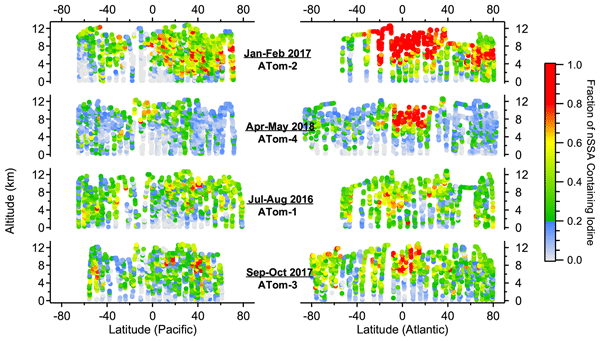
Gregory P. Schill, Karl D. Froyd, Daniel M. Murphy, Christina J. Williamson, Charles A. Brock, Tomás Sherwen, Mat J. Evans, Eric A. Ray, Eric C. Apel, Rebecca S. Hornbrook, Alan J. Hills, Jeff Peischl, Thomas B. Ryerson, Chelsea R. Thompson, Ilann Bourgeois, Donald R. Blake, Joshua P. DiGangi, and Glenn S. Diskin
Atmos. Chem. Phys., 25, 45–71, https://doi.org/10.5194/acp-25-45-2025, https://doi.org/10.5194/acp-25-45-2025, 2025
Short summary
Short summary
Using single-particle mass spectrometry, we show that trace concentrations of bromine and iodine are ubiquitous in remote tropospheric aerosol and suggest that aerosols are an important part of the global reactive iodine budget. Comparisons to a global climate model with detailed iodine chemistry are favorable in the background atmosphere; however, the model cannot replicate our measurements near the ocean surface, in biomass burning plumes, and in the stratosphere.
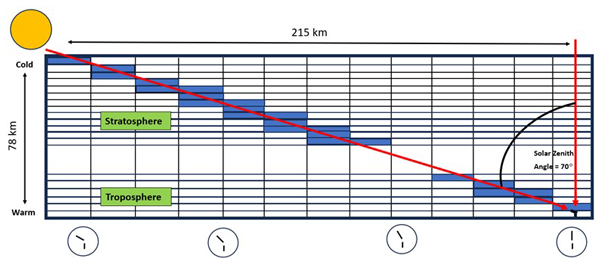
Deepangsu Chatterjee, Randall V. Martin, Chi Li, Dandan Zhang, Haihui Zhu, Daven K. Henze, James H. Crawford, Ronald C. Cohen, Lok N. Lamsal, and Alexander M. Cede
Atmos. Chem. Phys., 24, 12687–12706, https://doi.org/10.5194/acp-24-12687-2024, https://doi.org/10.5194/acp-24-12687-2024, 2024
Short summary
Short summary
We investigate the hourly variation of NO2 columns and surface concentrations by applying the GEOS-Chem model to interpret aircraft and ground-based measurements over the US and Pandora sun photometer measurements over the US, Europe, and Asia. Corrections to the Pandora columns and finer model resolution improve the modeled representation of the summertime hourly variation of total NO2 columns to explain the weaker hourly variation in NO2 columns than at the surface.
Robert A. Ryan, Mark A. Vaughan, Sharon D. Rodier, Jason L. Tackett, John A. Reagan, Richard A. Ferrare, Johnathan W. Hair, John A. Smith, and Brian J. Getzewich
Atmos. Meas. Tech., 17, 6517–6545, https://doi.org/10.5194/amt-17-6517-2024, https://doi.org/10.5194/amt-17-6517-2024, 2024
Short summary
Short summary
We introduce Ocean Derived Column Optical Depth (ODCOD), a new way to estimate column optical depths using Cloud-Aerosol Lidar with Orthogonal Polarization (CALIOP) measurements from the ocean surface. ODCOD estimates include contributions from particulates in the full column, which CALIOP estimates do not, making it a complement measurement to CALIOP’s standard estimates. We find that ODCOD compares well with other established data sets in the daytime but tends to estimate higher at night.
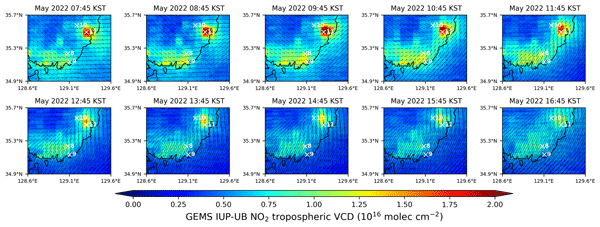
Kezia Lange, Andreas Richter, Tim Bösch, Bianca Zilker, Miriam Latsch, Lisa K. Behrens, Chisom M. Okafor, Hartmut Bösch, John P. Burrows, Alexis Merlaud, Gaia Pinardi, Caroline Fayt, Martina M. Friedrich, Ermioni Dimitropoulou, Michel Van Roozendael, Steffen Ziegler, Simona Ripperger-Lukosiunaite, Leon Kuhn, Bianca Lauster, Thomas Wagner, Hyunkee Hong, Donghee Kim, Lim-Seok Chang, Kangho Bae, Chang-Keun Song, Jong-Uk Park, and Hanlim Lee
Atmos. Meas. Tech., 17, 6315–6344, https://doi.org/10.5194/amt-17-6315-2024, https://doi.org/10.5194/amt-17-6315-2024, 2024
Short summary
Short summary
Instruments for air quality observations on geostationary satellites provide multiple observations per day and allow for the analysis of the diurnal variation of important air pollutants such as nitrogen dioxide (NO2) over large areas. The South Korean instrument GEMS, launched in February 2020, is the first instrument in geostationary orbit and covers a large part of Asia. Our investigations show the observed diurnal evolution of NO2 at different measurement sites.
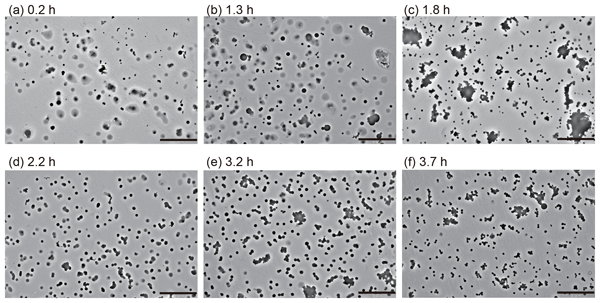
Kouji Adachi, Jack E. Dibb, Joseph M. Katich, Joshua P. Schwarz, Hongyu Guo, Pedro Campuzano-Jost, Jose L. Jimenez, Jeff Peischl, Christopher D. Holmes, and James Crawford
Atmos. Chem. Phys., 24, 10985–11004, https://doi.org/10.5194/acp-24-10985-2024, https://doi.org/10.5194/acp-24-10985-2024, 2024
Short summary
Short summary
We examined aerosol particles from wildfires and identified tarballs (TBs) from the Fire Influence on Regional to Global Environments and Air Quality (FIREX-AQ) campaign. This study reveals the compositions, abundance, sizes, and mixing states of TBs and shows that TBs formed as the smoke aged for up to 5 h. This study provides measurements of TBs from various biomass-burning events and ages, enhancing our knowledge of TB emissions and our understanding of their climate impact.
Cassidy Soloff, Taiwo Ajayi, Yonghoon Choi, Ewan C. Crosbie, Joshua P. DiGangi, Glenn S. Diskin, Marta A. Fenn, Richard A. Ferrare, Francesca Gallo, Johnathan W. Hair, Miguel Ricardo A. Hilario, Simon Kirschler, Richard H. Moore, Taylor J. Shingler, Michael A. Shook, Kenneth L. Thornhill, Christiane Voigt, Edward L. Winstead, Luke D. Ziemba, and Armin Sorooshian
Atmos. Chem. Phys., 24, 10385–10408, https://doi.org/10.5194/acp-24-10385-2024, https://doi.org/10.5194/acp-24-10385-2024, 2024
Short summary
Short summary
Using aircraft measurements over the northwestern Atlantic between the US East Coast and Bermuda and trajectory modeling of continental outflow, we identify trace gas and particle properties that exhibit gradients with offshore distance and quantify these changes with high-resolution measurements of concentrations and particle chemistry, size, and scattering properties. This work furthers our understanding of the complex interactions between continental and marine environments.
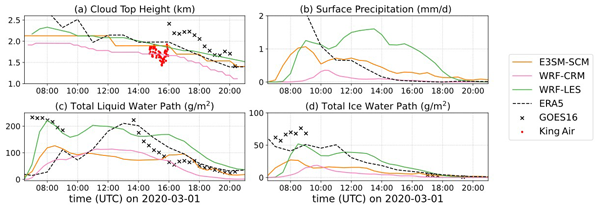
Shuaiqi Tang, Hailong Wang, Xiang-Yu Li, Jingyi Chen, Armin Sorooshian, Xubin Zeng, Ewan Crosbie, Kenneth L. Thornhill, Luke D. Ziemba, and Christiane Voigt
Atmos. Chem. Phys., 24, 10073–10092, https://doi.org/10.5194/acp-24-10073-2024, https://doi.org/10.5194/acp-24-10073-2024, 2024
Short summary
Short summary
We examined marine boundary layer clouds and their interactions with aerosols in the E3SM single-column model (SCM) for a case study. The SCM shows good agreement when simulating the clouds with high-resolution models. It reproduces the relationship between cloud droplet and aerosol particle number concentrations as produced in global models. However, the relationship between cloud liquid water and droplet number concentration is different, warranting further investigation.
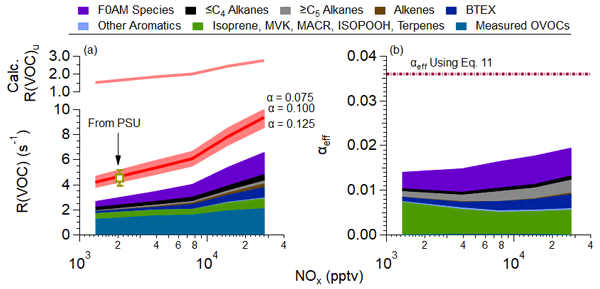
Benjamin A. Nault, Katherine R. Travis, James H. Crawford, Donald R. Blake, Pedro Campuzano-Jost, Ronald C. Cohen, Joshua P. DiGangi, Glenn S. Diskin, Samuel R. Hall, L. Gregory Huey, Jose L. Jimenez, Kyung-Eun Min, Young Ro Lee, Isobel J. Simpson, Kirk Ullmann, and Armin Wisthaler
Atmos. Chem. Phys., 24, 9573–9595, https://doi.org/10.5194/acp-24-9573-2024, https://doi.org/10.5194/acp-24-9573-2024, 2024
Short summary
Short summary
Ozone (O3) is a pollutant formed from the reactions of gases emitted from various sources. In urban areas, the density of human activities can increase the O3 formation rate (P(O3)), thus impacting air quality and health. Observations collected over Seoul, South Korea, are used to constrain P(O3). A high local P(O3) was found; however, local P(O3) was partly reduced due to compounds typically ignored. These observations also provide constraints for unmeasured compounds that will impact P(O3).
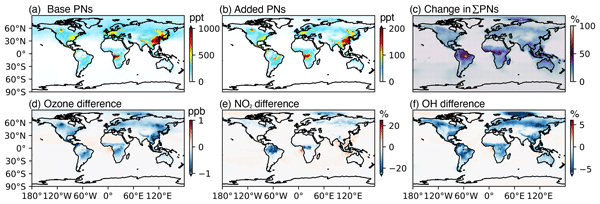
Katherine R. Travis, Benjamin A. Nault, James H. Crawford, Kelvin H. Bates, Donald R. Blake, Ronald C. Cohen, Alan Fried, Samuel R. Hall, L. Gregory Huey, Young Ro Lee, Simone Meinardi, Kyung-Eun Min, Isobel J. Simpson, and Kirk Ullman
Atmos. Chem. Phys., 24, 9555–9572, https://doi.org/10.5194/acp-24-9555-2024, https://doi.org/10.5194/acp-24-9555-2024, 2024
Short summary
Short summary
Human activities result in the emission of volatile organic compounds (VOCs) that contribute to air pollution. Detailed VOC measurements were taken during a field study in South Korea. When compared to VOC inventories, large discrepancies showed underestimates from chemical products, liquefied petroleum gas, and long-range transport. Improved emissions and chemistry of these VOCs better described urban pollution. The new chemical scheme is relevant to urban areas and other VOC sources.
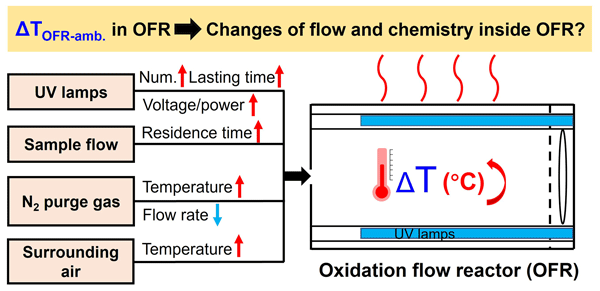
Tianle Pan, Andrew T. Lambe, Weiwei Hu, Yicong He, Minghao Hu, Huaishan Zhou, Xinming Wang, Qingqing Hu, Hui Chen, Yue Zhao, Yuanlong Huang, Doug R. Worsnop, Zhe Peng, Melissa A. Morris, Douglas A. Day, Pedro Campuzano-Jost, Jose-Luis Jimenez, and Shantanu H. Jathar
Atmos. Meas. Tech., 17, 4915–4939, https://doi.org/10.5194/amt-17-4915-2024, https://doi.org/10.5194/amt-17-4915-2024, 2024
Short summary
Short summary
This study systematically characterizes the temperature enhancement in the lamp-enclosed oxidation flow reactor (OFR). The enhancement varied multiple dimensional factors, emphasizing the complexity of temperature inside of OFR. The effects of temperature on the flow field and gas- or particle-phase reaction inside OFR were also evaluated with experiments and model simulations. Finally, multiple mitigation strategies were demonstrated to minimize this temperature increase.
Taiwo Ajayi, Yonghoon Choi, Ewan C. Crosbie, Joshua P. DiGangi, Glenn S. Diskin, Marta A. Fenn, Richard A. Ferrare, Johnathan W. Hair, Miguel Ricardo A. Hilario, Chris A. Hostetler, Simon Kirschler, Richard H. Moore, Taylor J. Shingler, Michael A. Shook, Cassidy Soloff, Kenneth L. Thornhill, Christiane Voigt, Edward L. Winstead, Luke D. Ziemba, and Armin Sorooshian
Atmos. Chem. Phys., 24, 9197–9218, https://doi.org/10.5194/acp-24-9197-2024, https://doi.org/10.5194/acp-24-9197-2024, 2024
Short summary
Short summary
This study uses airborne data to examine vertical profiles of trace gases, aerosol particles, and meteorological variables over a remote marine area (Bermuda). Results show distinct differences based on both air mass source region (North America, Ocean, Caribbean/North Africa) and altitude for a given air mass type. This work highlights the sensitivity of remote marine areas to long-range transport and the importance of considering the vertical dependence of trace gas and aerosol properties.
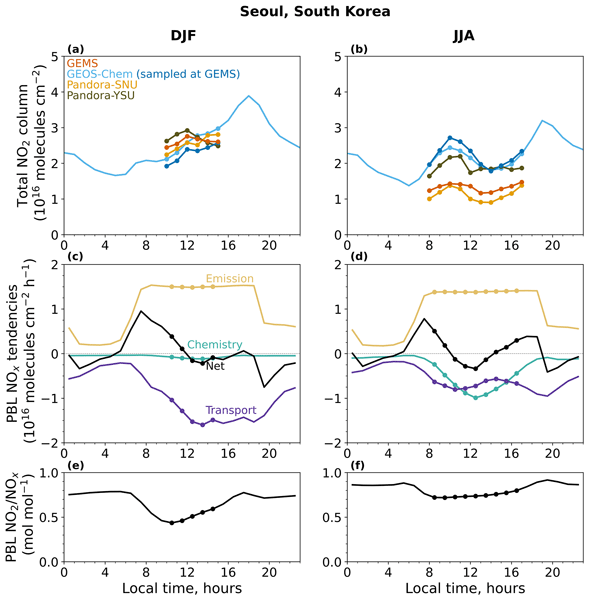
Laura Hyesung Yang, Daniel J. Jacob, Ruijun Dang, Yujin J. Oak, Haipeng Lin, Jhoon Kim, Shixian Zhai, Nadia K. Colombi, Drew C. Pendergrass, Ellie Beaudry, Viral Shah, Xu Feng, Robert M. Yantosca, Heesung Chong, Junsung Park, Hanlim Lee, Won-Jin Lee, Soontae Kim, Eunhye Kim, Katherine R. Travis, James H. Crawford, and Hong Liao
Atmos. Chem. Phys., 24, 7027–7039, https://doi.org/10.5194/acp-24-7027-2024, https://doi.org/10.5194/acp-24-7027-2024, 2024
Short summary
Short summary
The Geostationary Environment Monitoring Spectrometer (GEMS) provides hourly measurements of NO2. We use the chemical transport model to find how emissions, chemistry, and transport drive the changes in NO2 observed by GEMS at different times of the day. In winter, the chemistry plays a minor role, and high daytime emissions dominate the diurnal variation in NO2, balanced by transport. In summer, emissions, chemistry, and transport play an important role in shaping the diurnal variation in NO2.
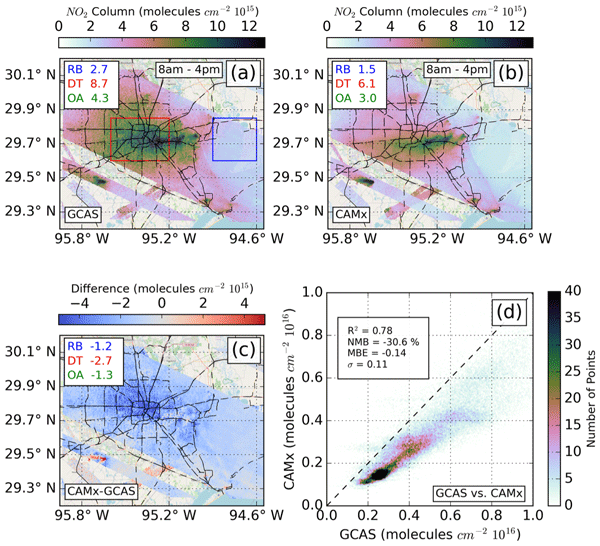
M. Omar Nawaz, Jeremiah Johnson, Greg Yarwood, Benjamin de Foy, Laura Judd, and Daniel L. Goldberg
Atmos. Chem. Phys., 24, 6719–6741, https://doi.org/10.5194/acp-24-6719-2024, https://doi.org/10.5194/acp-24-6719-2024, 2024
Short summary
Short summary
NO2 is a gas with implications for air pollution. A campaign conducted in Houston provided an opportunity to compare NO2 from different instruments and a model. Aircraft and satellite observations agreed well with measurements on the ground; however, the latter estimated lower values. We find that model-simulated NO2 was lower than observations, especially downtown, suggesting that NO2 sources associated with the urban core of Houston, such as vehicle emissions, may be underestimated.
Sanja Dmitrovic, Johnathan W. Hair, Brian L. Collister, Ewan Crosbie, Marta A. Fenn, Richard A. Ferrare, David B. Harper, Chris A. Hostetler, Yongxiang Hu, John A. Reagan, Claire E. Robinson, Shane T. Seaman, Taylor J. Shingler, Kenneth L. Thornhill, Holger Vömel, Xubin Zeng, and Armin Sorooshian
Atmos. Meas. Tech., 17, 3515–3532, https://doi.org/10.5194/amt-17-3515-2024, https://doi.org/10.5194/amt-17-3515-2024, 2024
Short summary
Short summary
This study introduces and evaluates a new ocean surface wind speed product from the NASA Langley Research Center (LARC) airborne High-Spectral-Resolution Lidar – Generation 2 (HSRL-2) during the NASA ACTIVATE mission. We show that HSRL-2 surface wind speed data are accurate when compared to ground-truth dropsonde measurements. Therefore, the HSRL-2 instrument is able obtain accurate, high-resolution surface wind speed data in airborne field campaigns.
Ewan Crosbie, Luke D. Ziemba, Michael A. Shook, Taylor Shingler, Johnathan W. Hair, Armin Sorooshian, Richard A. Ferrare, Brian Cairns, Yonghoon Choi, Joshua DiGangi, Glenn S. Diskin, Chris Hostetler, Simon Kirschler, Richard H. Moore, David Painemal, Claire Robinson, Shane T. Seaman, K. Lee Thornhill, Christiane Voigt, and Edward Winstead
Atmos. Chem. Phys., 24, 6123–6152, https://doi.org/10.5194/acp-24-6123-2024, https://doi.org/10.5194/acp-24-6123-2024, 2024
Short summary
Short summary
Marine clouds are found to clump together in regions or lines, readily discernible from satellite images of the ocean. While clustering is also a feature of deep storm clouds, we focus on smaller cloud systems associated with fair weather and brief localized showers. Two aircraft sampled the region around these shallow systems: one incorporated measurements taken within, adjacent to, and below the clouds, while the other provided a survey from above using remote sensing techniques.
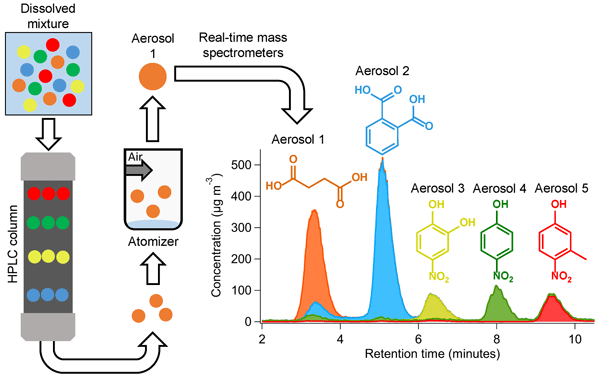
Melinda K. Schueneman, Douglas A. Day, Dongwook Kim, Pedro Campuzano-Jost, Seonsik Yun, Marla P. DeVault, Anna C. Ziola, Paul J. Ziemann, and Jose L. Jimenez
Aerosol Research, 2, 59–76, https://doi.org/10.5194/ar-2-59-2024, https://doi.org/10.5194/ar-2-59-2024, 2024
Short summary
Short summary
Our study presents a novel method for quantifying mass spectrometer responses to molecular species in organic aerosols. Traditional calibrations often fail for complex mixtures like secondary organic aerosol. We combined chromatography with statistical component analysis to improve separation and quantification, achieving promising agreement with direct calibration. Our findings offer a new approach to assess aerosol composition, especially beneficial for complex mixtures.
Leong Wai Siu, Joseph S. Schlosser, David Painemal, Brian Cairns, Marta A. Fenn, Richard A. Ferrare, Johnathan W. Hair, Chris A. Hostetler, Longlei Li, Mary M. Kleb, Amy Jo Scarino, Taylor J. Shingler, Armin Sorooshian, Snorre A. Stamnes, and Xubin Zeng
Atmos. Meas. Tech., 17, 2739–2759, https://doi.org/10.5194/amt-17-2739-2024, https://doi.org/10.5194/amt-17-2739-2024, 2024
Short summary
Short summary
An unprecedented 3-year aerosol dataset was collected from a recent NASA field campaign over the western North Atlantic Ocean, which offers a special opportunity to evaluate two state-of-the-art remote sensing instruments, one lidar and the other polarimeter, on the same aircraft. Special attention has been paid to validate aerosol optical depth data and their uncertainties when no reference dataset is available. Physical reasons for the disagreement between two instruments are discussed.
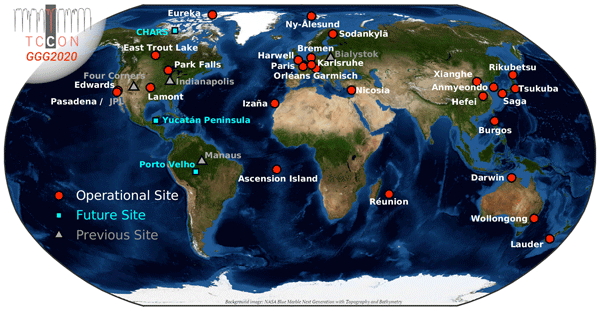
Joshua L. Laughner, Geoffrey C. Toon, Joseph Mendonca, Christof Petri, Sébastien Roche, Debra Wunch, Jean-Francois Blavier, David W. T. Griffith, Pauli Heikkinen, Ralph F. Keeling, Matthäus Kiel, Rigel Kivi, Coleen M. Roehl, Britton B. Stephens, Bianca C. Baier, Huilin Chen, Yonghoon Choi, Nicholas M. Deutscher, Joshua P. DiGangi, Jochen Gross, Benedikt Herkommer, Pascal Jeseck, Thomas Laemmel, Xin Lan, Erin McGee, Kathryn McKain, John Miller, Isamu Morino, Justus Notholt, Hirofumi Ohyama, David F. Pollard, Markus Rettinger, Haris Riris, Constantina Rousogenous, Mahesh Kumar Sha, Kei Shiomi, Kimberly Strong, Ralf Sussmann, Yao Té, Voltaire A. Velazco, Steven C. Wofsy, Minqiang Zhou, and Paul O. Wennberg
Earth Syst. Sci. Data, 16, 2197–2260, https://doi.org/10.5194/essd-16-2197-2024, https://doi.org/10.5194/essd-16-2197-2024, 2024
Short summary
Short summary
This paper describes a new version, called GGG2020, of a data set containing column-integrated observations of greenhouse and related gases (including CO2, CH4, CO, and N2O) made by ground stations located around the world. Compared to the previous version (GGG2014), improvements have been made toward site-to-site consistency. This data set plays a key role in validating space-based greenhouse gas observations and in understanding the carbon cycle.
Hiren T. Jethva, Omar Torres, Richard A. Ferrare, Sharon P. Burton, Anthony L. Cook, David B. Harper, Chris A. Hostetler, Jens Redemann, Vinay Kayetha, Samuel LeBlanc, Kristina Pistone, Logan Mitchell, and Connor J. Flynn
Atmos. Meas. Tech., 17, 2335–2366, https://doi.org/10.5194/amt-17-2335-2024, https://doi.org/10.5194/amt-17-2335-2024, 2024
Short summary
Short summary
We introduce a novel synergy algorithm applied to ORALCES airborne measurements of above-cloud aerosol optical depth and UV–Vis satellite observations from OMI and MODIS to retrieve spectral aerosol single-scattering albedo of lofted layers of carbonaceous smoke aerosols over clouds. The development of the proposed aerosol–cloud algorithm implies a possible synergy of CALIOP and OMI–MODIS passive sensors to deduce a global product of AOD and SSA of absorbing aerosols above clouds.
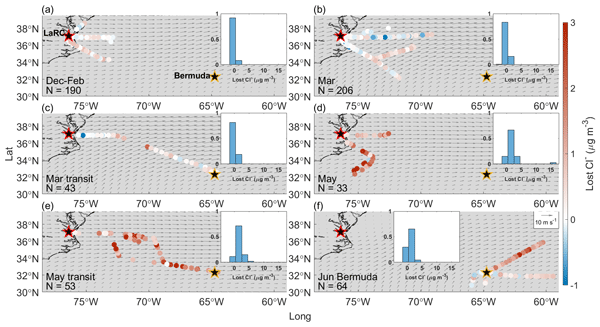
Eva-Lou Edwards, Yonghoon Choi, Ewan C. Crosbie, Joshua P. DiGangi, Glenn S. Diskin, Claire E. Robinson, Michael A. Shook, Edward L. Winstead, Luke D. Ziemba, and Armin Sorooshian
Atmos. Chem. Phys., 24, 3349–3378, https://doi.org/10.5194/acp-24-3349-2024, https://doi.org/10.5194/acp-24-3349-2024, 2024
Short summary
Short summary
We investigate Cl− depletion in sea salt particles over the northwest Atlantic from December 2021 to June 2022 using an airborne dataset. Losses of Cl− are greatest in May and least in December–February and March. Inorganic acidic species can account for all depletion observed for December–February, March, and June near Bermuda but none in May. Quantifying Cl− depletion as a percentage captures seasonal trends in depletion but fails to convey the effects it may have on atmospheric oxidation.
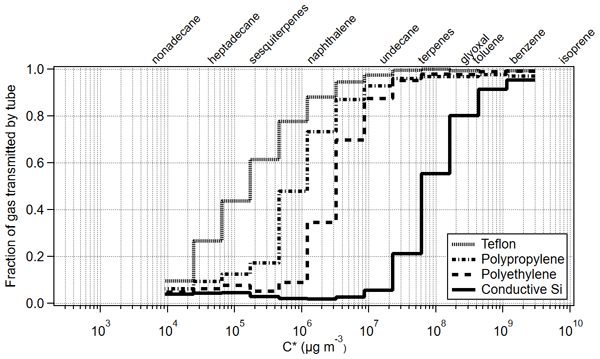
Melissa A. Morris, Demetrios Pagonis, Douglas A. Day, Joost A. de Gouw, Paul J. Ziemann, and Jose L. Jimenez
Atmos. Meas. Tech., 17, 1545–1559, https://doi.org/10.5194/amt-17-1545-2024, https://doi.org/10.5194/amt-17-1545-2024, 2024
Short summary
Short summary
Polymer absorption of volatile organic compounds (VOCs) is important to characterize for atmospheric sampling setups (as interactions cause sampling delays) and indoor air quality. Here we test different polymer materials and quantify their absorptive capacities through modeling. We found the main polymers in carpets to be highly absorptive, acting as large reservoirs for indoor pollution. We also demonstrated how polymer tubes can be used as a low-cost gas separation technique.
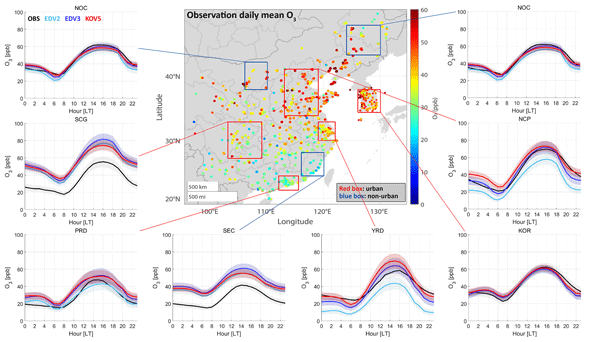
Kyoung-Min Kim, Si-Wan Kim, Seunghwan Seo, Donald R. Blake, Seogju Cho, James H. Crawford, Louisa K. Emmons, Alan Fried, Jay R. Herman, Jinkyu Hong, Jinsang Jung, Gabriele G. Pfister, Andrew J. Weinheimer, Jung-Hun Woo, and Qiang Zhang
Geosci. Model Dev., 17, 1931–1955, https://doi.org/10.5194/gmd-17-1931-2024, https://doi.org/10.5194/gmd-17-1931-2024, 2024
Short summary
Short summary
Three emission inventories were evaluated for East Asia using data acquired during a field campaign in 2016. The inventories successfully reproduced the daily variations of ozone and nitrogen dioxide. However, the spatial distributions of model ozone did not fully agree with the observations. Additionally, all simulations underestimated carbon monoxide and volatile organic compound (VOC) levels. Increasing VOC emissions over South Korea resulted in improved ozone simulations.
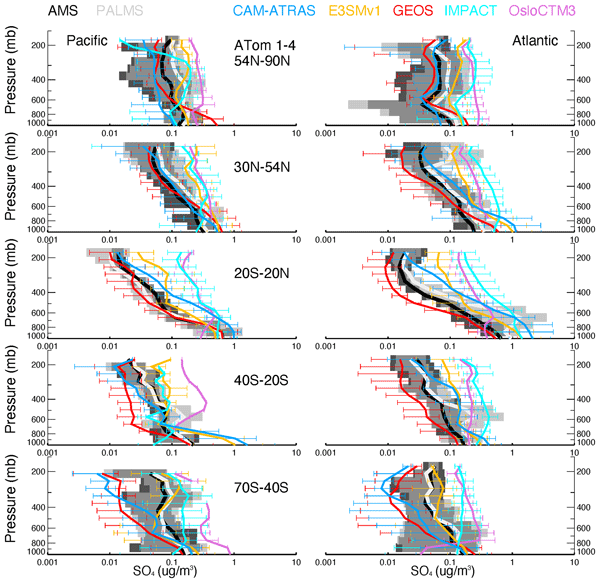
Huisheng Bian, Mian Chin, Peter R. Colarco, Eric C. Apel, Donald R. Blake, Karl Froyd, Rebecca S. Hornbrook, Jose Jimenez, Pedro Campuzano Jost, Michael Lawler, Mingxu Liu, Marianne Tronstad Lund, Hitoshi Matsui, Benjamin A. Nault, Joyce E. Penner, Andrew W. Rollins, Gregory Schill, Ragnhild B. Skeie, Hailong Wang, Lu Xu, Kai Zhang, and Jialei Zhu
Atmos. Chem. Phys., 24, 1717–1741, https://doi.org/10.5194/acp-24-1717-2024, https://doi.org/10.5194/acp-24-1717-2024, 2024
Short summary
Short summary
This work studies sulfur in the remote troposphere at global and seasonal scales using aircraft measurements and multi-model simulations. The goal is to understand the sulfur cycle over remote oceans, spread of model simulations, and observation–model discrepancies. Such an understanding and comparison with real observations are crucial to narrow down the uncertainties in model sulfur simulations and improve understanding of the sulfur cycle in atmospheric air quality, climate, and ecosystems.
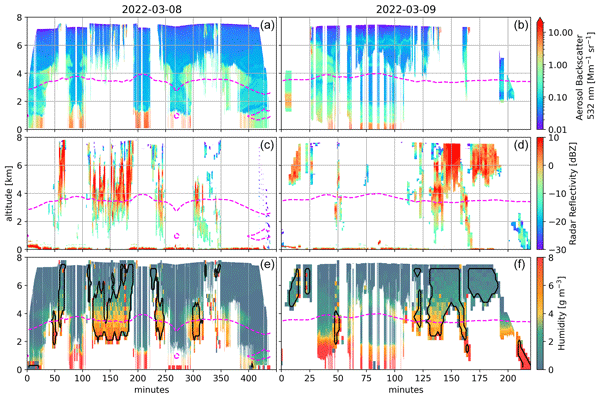
Luis F. Millán, Matthew D. Lebsock, Ken B. Cooper, Jose V. Siles, Robert Dengler, Raquel Rodriguez Monje, Amin Nehrir, Rory A. Barton-Grimley, James E. Collins, Claire E. Robinson, Kenneth L. Thornhill, and Holger Vömel
Atmos. Meas. Tech., 17, 539–559, https://doi.org/10.5194/amt-17-539-2024, https://doi.org/10.5194/amt-17-539-2024, 2024
Short summary
Short summary
In this study, we describe and validate a new technique in which three radar tones are used to estimate the water vapor inside clouds and precipitation. This instrument flew on board NASA's P-3 aircraft during the Investigation of Microphysics and Precipitation for Atlantic Coast-Threatening Snowstorms (IMPACTS) campaign and the Synergies Of Active optical and Active microwave Remote Sensing Experiment (SOA2RSE) campaign.
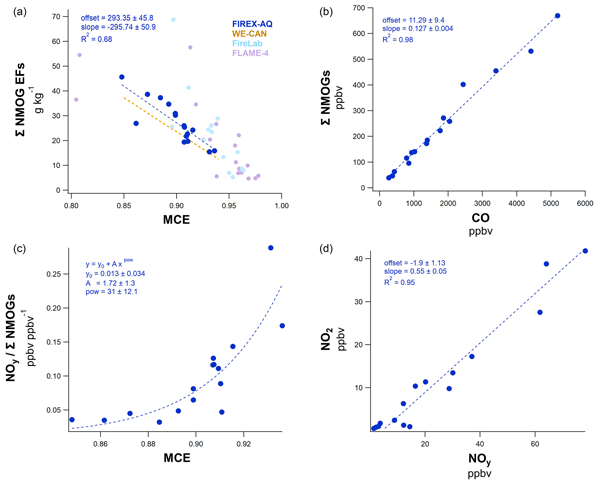
Georgios I. Gkatzelis, Matthew M. Coggon, Chelsea E. Stockwell, Rebecca S. Hornbrook, Hannah Allen, Eric C. Apel, Megan M. Bela, Donald R. Blake, Ilann Bourgeois, Steven S. Brown, Pedro Campuzano-Jost, Jason M. St. Clair, James H. Crawford, John D. Crounse, Douglas A. Day, Joshua P. DiGangi, Glenn S. Diskin, Alan Fried, Jessica B. Gilman, Hongyu Guo, Johnathan W. Hair, Hannah S. Halliday, Thomas F. Hanisco, Reem Hannun, Alan Hills, L. Gregory Huey, Jose L. Jimenez, Joseph M. Katich, Aaron Lamplugh, Young Ro Lee, Jin Liao, Jakob Lindaas, Stuart A. McKeen, Tomas Mikoviny, Benjamin A. Nault, J. Andrew Neuman, John B. Nowak, Demetrios Pagonis, Jeff Peischl, Anne E. Perring, Felix Piel, Pamela S. Rickly, Michael A. Robinson, Andrew W. Rollins, Thomas B. Ryerson, Melinda K. Schueneman, Rebecca H. Schwantes, Joshua P. Schwarz, Kanako Sekimoto, Vanessa Selimovic, Taylor Shingler, David J. Tanner, Laura Tomsche, Krystal T. Vasquez, Patrick R. Veres, Rebecca Washenfelder, Petter Weibring, Paul O. Wennberg, Armin Wisthaler, Glenn M. Wolfe, Caroline C. Womack, Lu Xu, Katherine Ball, Robert J. Yokelson, and Carsten Warneke
Atmos. Chem. Phys., 24, 929–956, https://doi.org/10.5194/acp-24-929-2024, https://doi.org/10.5194/acp-24-929-2024, 2024
Short summary
Short summary
This study reports emissions of gases and particles from wildfires. These emissions are related to chemical proxies that can be measured by satellite and incorporated into models to improve predictions of wildfire impacts on air quality and climate.
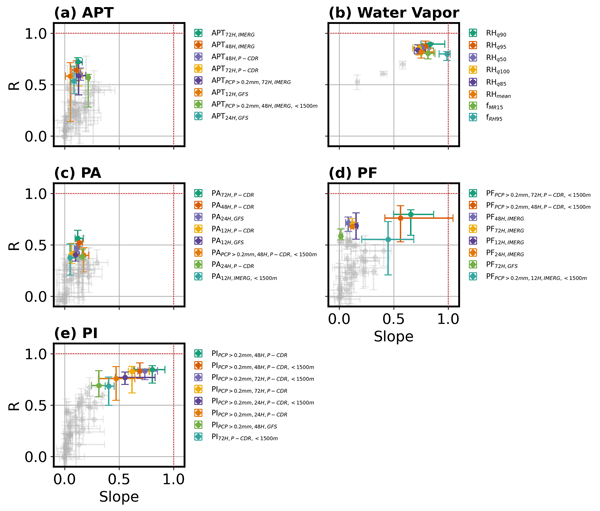
Miguel Ricardo A. Hilario, Avelino F. Arellano, Ali Behrangi, Ewan C. Crosbie, Joshua P. DiGangi, Glenn S. Diskin, Michael A. Shook, Luke D. Ziemba, and Armin Sorooshian
Atmos. Meas. Tech., 17, 37–55, https://doi.org/10.5194/amt-17-37-2024, https://doi.org/10.5194/amt-17-37-2024, 2024
Short summary
Short summary
Wet scavenging strongly influences aerosol lifetime and interactions but is a large uncertainty in global models. We present a method to identify meteorological variables relevant for estimating wet scavenging. During long-range transport over the tropical western Pacific, relative humidity and the frequency of humid conditions are better predictors of scavenging than precipitation. This method can be applied to other regions, and our findings can inform scavenging parameterizations in models.
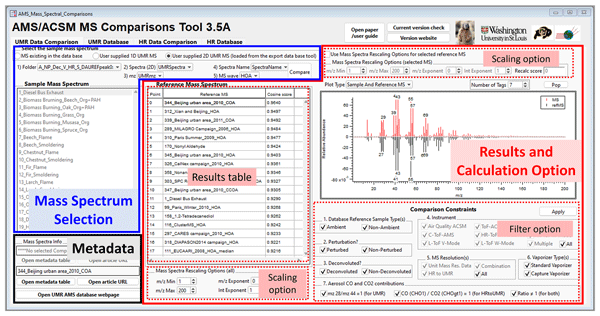
Sohyeon Jeon, Michael J. Walker, Donna T. Sueper, Douglas A. Day, Anne V. Handschy, Jose L. Jimenez, and Brent J. Williams
Atmos. Meas. Tech., 16, 6075–6095, https://doi.org/10.5194/amt-16-6075-2023, https://doi.org/10.5194/amt-16-6075-2023, 2023
Short summary
Short summary
A searchable database tool for the Aerosol Mass Spectrometer (AMS) and Aerosol Chemical Speciation Monitor (ACSM) mass spectral datasets was built to improve the efficiency of data analysis using Igor Pro. The tool incorporates the published mass spectra (MS) and sample information uploaded on the website. The tool allows users to compare their own mass spectrum with the reference MS in the database.
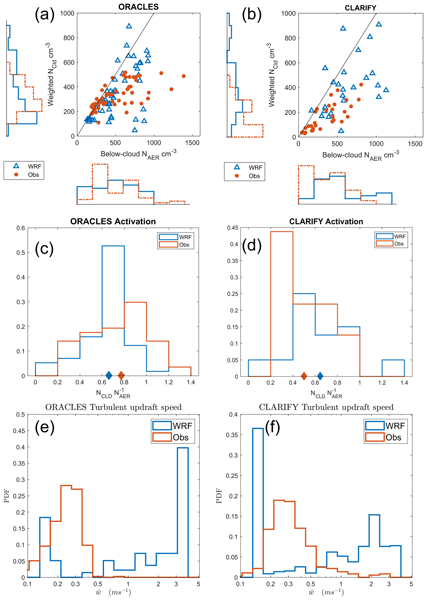
Calvin Howes, Pablo E. Saide, Hugh Coe, Amie Dobracki, Steffen Freitag, Jim M. Haywood, Steven G. Howell, Siddhant Gupta, Janek Uin, Mary Kacarab, Chongai Kuang, L. Ruby Leung, Athanasios Nenes, Greg M. McFarquhar, James Podolske, Jens Redemann, Arthur J. Sedlacek, Kenneth L. Thornhill, Jenny P. S. Wong, Robert Wood, Huihui Wu, Yang Zhang, Jianhao Zhang, and Paquita Zuidema
Atmos. Chem. Phys., 23, 13911–13940, https://doi.org/10.5194/acp-23-13911-2023, https://doi.org/10.5194/acp-23-13911-2023, 2023
Short summary
Short summary
To better understand smoke properties and its interactions with clouds, we compare the WRF-CAM5 model with observations from ORACLES, CLARIFY, and LASIC field campaigns in the southeastern Atlantic in August 2017. The model transports and mixes smoke well but does not fully capture some important processes. These include smoke chemical and physical aging over 4–12 days, smoke removal by rain, sulfate particle formation, aerosol activation into cloud droplets, and boundary layer turbulence.
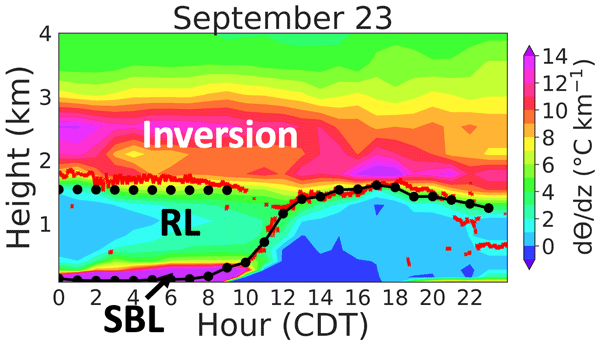
Xueying Liu, Yuxuan Wang, Shailaja Wasti, Wei Li, Ehsan Soleimanian, James Flynn, Travis Griggs, Sergio Alvarez, John T. Sullivan, Maurice Roots, Laurence Twigg, Guillaume Gronoff, Timothy Berkoff, Paul Walter, Mark Estes, Johnathan W. Hair, Taylor Shingler, Amy Jo Scarino, Marta Fenn, and Laura Judd
Geosci. Model Dev., 16, 5493–5514, https://doi.org/10.5194/gmd-16-5493-2023, https://doi.org/10.5194/gmd-16-5493-2023, 2023
Short summary
Short summary
With a comprehensive suite of ground-based and airborne remote sensing measurements during the 2021 TRacking Aerosol Convection ExpeRiment – Air Quality (TRACER-AQ) campaign in Houston, this study evaluates the simulation of the planetary boundary layer (PBL) height and the ozone vertical profile by a high-resolution (1.33 km) 3-D photochemical model Weather Research and Forecasting-driven GEOS-Chem (WRF-GC).
Simon Kirschler, Christiane Voigt, Bruce E. Anderson, Gao Chen, Ewan C. Crosbie, Richard A. Ferrare, Valerian Hahn, Johnathan W. Hair, Stefan Kaufmann, Richard H. Moore, David Painemal, Claire E. Robinson, Kevin J. Sanchez, Amy J. Scarino, Taylor J. Shingler, Michael A. Shook, Kenneth L. Thornhill, Edward L. Winstead, Luke D. Ziemba, and Armin Sorooshian
Atmos. Chem. Phys., 23, 10731–10750, https://doi.org/10.5194/acp-23-10731-2023, https://doi.org/10.5194/acp-23-10731-2023, 2023
Short summary
Short summary
In this study we present an overview of liquid and mixed-phase clouds and precipitation in the marine boundary layer over the western North Atlantic Ocean. We compare microphysical properties of pure liquid clouds to mixed-phase clouds and show that the initiation of the ice phase in mixed-phase clouds promotes precipitation. The observational data presented in this study are well suited for investigating the processes that give rise to liquid and mixed-phase clouds, ice, and precipitation.
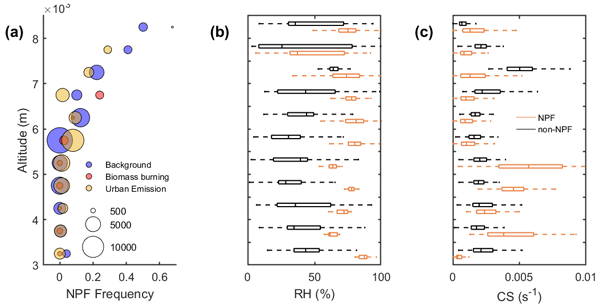
Qian Xiao, Jiaoshi Zhang, Yang Wang, Luke D. Ziemba, Ewan Crosbie, Edward L. Winstead, Claire E. Robinson, Joshua P. DiGangi, Glenn S. Diskin, Jeffrey S. Reid, K. Sebastian Schmidt, Armin Sorooshian, Miguel Ricardo A. Hilario, Sarah Woods, Paul Lawson, Snorre A. Stamnes, and Jian Wang
Atmos. Chem. Phys., 23, 9853–9871, https://doi.org/10.5194/acp-23-9853-2023, https://doi.org/10.5194/acp-23-9853-2023, 2023
Short summary
Short summary
Using recent airborne measurements, we show that the influences of anthropogenic emissions, transport, convective clouds, and meteorology lead to new particle formation (NPF) under a variety of conditions and at different altitudes in tropical marine environments. NPF is enhanced by fresh urban emissions in convective outflow but is suppressed in air masses influenced by aged urban emissions where reactive precursors are mostly consumed while particle surface area remains relatively high.
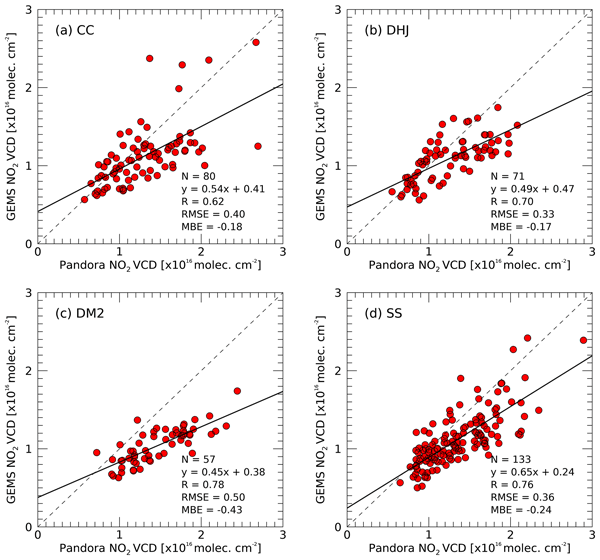
Serin Kim, Daewon Kim, Hyunkee Hong, Lim-Seok Chang, Hanlim Lee, Deok-Rae Kim, Donghee Kim, Jeong-Ah Yu, Dongwon Lee, Ukkyo Jeong, Chang-Kuen Song, Sang-Woo Kim, Sang Seo Park, Jhoon Kim, Thomas F. Hanisco, Junsung Park, Wonei Choi, and Kwangyul Lee
Atmos. Meas. Tech., 16, 3959–3972, https://doi.org/10.5194/amt-16-3959-2023, https://doi.org/10.5194/amt-16-3959-2023, 2023
Short summary
Short summary
A first evaluation of the Geostationary Environmental Monitoring Spectrometer (GEMS) NO2 was carried out via comparison with the NO2 data obtained from the ground-based Pandora direct-sun measurements at four sites in Seosan, Republic of Korea. Comparisons between GEMS NO2 and Pandora NO2 were performed according to GEMS cloud fraction. GEMS NO2 showed good agreement with that of Pandora NO2 under less cloudy conditions.
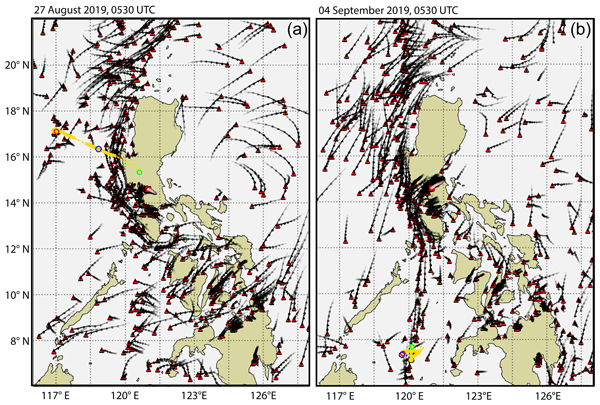
Rose Marie Miller, Robert M. Rauber, Larry Di Girolamo, Matthew Rilloraza, Dongwei Fu, Greg M. McFarquhar, Stephen W. Nesbitt, Luke D. Ziemba, Sarah Woods, and Kenneth Lee Thornhill
Atmos. Chem. Phys., 23, 8959–8977, https://doi.org/10.5194/acp-23-8959-2023, https://doi.org/10.5194/acp-23-8959-2023, 2023
Short summary
Short summary
The influence of human-produced aerosols on clouds remains one of the uncertainties in radiative forcing of Earth’s climate. Measurements of aerosol chemistry from sources around the Philippines illustrate the linkage between aerosol chemical composition and cloud droplet characteristics. Differences in aerosol chemical composition in the marine layer from biomass burning, industrial, ship-produced, and marine aerosols are shown to impact cloud microphysical structure just above cloud base.
Armin Sorooshian, Mikhail D. Alexandrov, Adam D. Bell, Ryan Bennett, Grace Betito, Sharon P. Burton, Megan E. Buzanowicz, Brian Cairns, Eduard V. Chemyakin, Gao Chen, Yonghoon Choi, Brian L. Collister, Anthony L. Cook, Andrea F. Corral, Ewan C. Crosbie, Bastiaan van Diedenhoven, Joshua P. DiGangi, Glenn S. Diskin, Sanja Dmitrovic, Eva-Lou Edwards, Marta A. Fenn, Richard A. Ferrare, David van Gilst, Johnathan W. Hair, David B. Harper, Miguel Ricardo A. Hilario, Chris A. Hostetler, Nathan Jester, Michael Jones, Simon Kirschler, Mary M. Kleb, John M. Kusterer, Sean Leavor, Joseph W. Lee, Hongyu Liu, Kayla McCauley, Richard H. Moore, Joseph Nied, Anthony Notari, John B. Nowak, David Painemal, Kasey E. Phillips, Claire E. Robinson, Amy Jo Scarino, Joseph S. Schlosser, Shane T. Seaman, Chellappan Seethala, Taylor J. Shingler, Michael A. Shook, Kenneth A. Sinclair, William L. Smith Jr., Douglas A. Spangenberg, Snorre A. Stamnes, Kenneth L. Thornhill, Christiane Voigt, Holger Vömel, Andrzej P. Wasilewski, Hailong Wang, Edward L. Winstead, Kira Zeider, Xubin Zeng, Bo Zhang, Luke D. Ziemba, and Paquita Zuidema
Earth Syst. Sci. Data, 15, 3419–3472, https://doi.org/10.5194/essd-15-3419-2023, https://doi.org/10.5194/essd-15-3419-2023, 2023
Short summary
Short summary
The NASA Aerosol Cloud meTeorology Interactions oVer the western ATlantic Experiment (ACTIVATE) produced a unique dataset for research into aerosol–cloud–meteorology interactions. HU-25 Falcon and King Air aircraft conducted systematic and spatially coordinated flights over the northwest Atlantic Ocean. This paper describes the ACTIVATE flight strategy, instrument and complementary dataset products, data access and usage details, and data application notes.
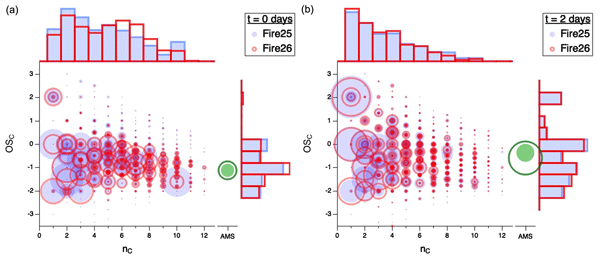
Kevin J. Nihill, Matthew M. Coggon, Christopher Y. Lim, Abigail R. Koss, Bin Yuan, Jordan E. Krechmer, Kanako Sekimoto, Jose L. Jimenez, Joost de Gouw, Christopher D. Cappa, Colette L. Heald, Carsten Warneke, and Jesse H. Kroll
Atmos. Chem. Phys., 23, 7887–7899, https://doi.org/10.5194/acp-23-7887-2023, https://doi.org/10.5194/acp-23-7887-2023, 2023
Short summary
Short summary
In this work, we collect emissions from controlled burns of biomass fuels that can be found in the western United States into an environmental chamber in order to simulate their oxidation as they pass through the atmosphere. These findings provide a detailed characterization of the composition of the atmosphere downwind of wildfires. In turn, this will help to explore the effects of these changing emissions on downwind populations and will also directly inform atmospheric and climate models.
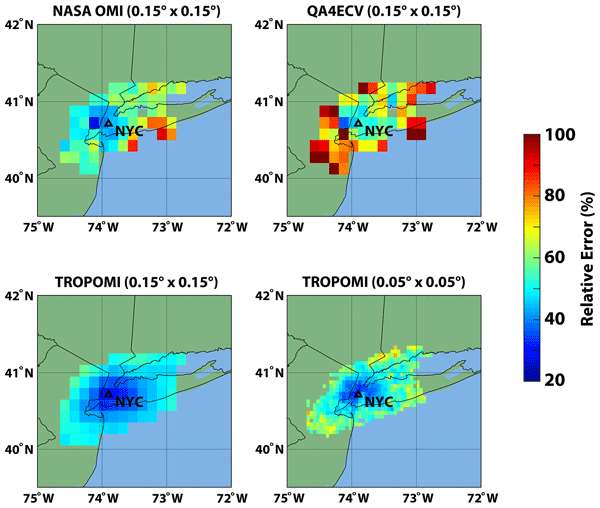
Matthew S. Johnson, Amir H. Souri, Sajeev Philip, Rajesh Kumar, Aaron Naeger, Jeffrey Geddes, Laura Judd, Scott Janz, Heesung Chong, and John Sullivan
Atmos. Meas. Tech., 16, 2431–2454, https://doi.org/10.5194/amt-16-2431-2023, https://doi.org/10.5194/amt-16-2431-2023, 2023
Short summary
Short summary
Satellites provide vital information for studying the processes controlling ozone formation. Based on the abundance of particular gases in the atmosphere, ozone formation is sensitive to specific human-induced and natural emission sources. However, errors and biases in satellite retrievals hinder this data source’s application for studying ozone formation sensitivity. We conducted a thorough statistical evaluation of two commonly applied satellites for investigating ozone formation sensitivity.
Haihui Zhu, Randall V. Martin, Betty Croft, Shixian Zhai, Chi Li, Liam Bindle, Jeffrey R. Pierce, Rachel Y.-W. Chang, Bruce E. Anderson, Luke D. Ziemba, Johnathan W. Hair, Richard A. Ferrare, Chris A. Hostetler, Inderjeet Singh, Deepangsu Chatterjee, Jose L. Jimenez, Pedro Campuzano-Jost, Benjamin A. Nault, Jack E. Dibb, Joshua S. Schwarz, and Andrew Weinheimer
Atmos. Chem. Phys., 23, 5023–5042, https://doi.org/10.5194/acp-23-5023-2023, https://doi.org/10.5194/acp-23-5023-2023, 2023
Short summary
Short summary
Particle size of atmospheric aerosol is important for estimating its climate and health effects, but simulating atmospheric aerosol size is computationally demanding. This study derives a simple parameterization of the size of organic and secondary inorganic ambient aerosol that can be applied to atmospheric models. Applying this parameterization allows a better representation of the global spatial pattern of aerosol size, as verified by ground and airborne measurements.

Amie Dobracki, Paquita Zuidema, Steven G. Howell, Pablo Saide, Steffen Freitag, Allison C. Aiken, Sharon P. Burton, Arthur J. Sedlacek III, Jens Redemann, and Robert Wood
Atmos. Chem. Phys., 23, 4775–4799, https://doi.org/10.5194/acp-23-4775-2023, https://doi.org/10.5194/acp-23-4775-2023, 2023
Short summary
Short summary
Southern Africa produces approximately one-third of the world’s carbon from fires. The thick smoke layer can flow westward, interacting with the southeastern Atlantic cloud deck. The net radiative impact can alter regional circulation patterns, impacting rainfall over Africa. We find that the smoke is highly absorbing of sunlight, mostly because it contains more black carbon than smoke over the Northern Hemisphere.
Emily D. Lenhardt, Lan Gao, Jens Redemann, Feng Xu, Sharon P. Burton, Brian Cairns, Ian Chang, Richard A. Ferrare, Chris A. Hostetler, Pablo E. Saide, Calvin Howes, Yohei Shinozuka, Snorre Stamnes, Mary Kacarab, Amie Dobracki, Jenny Wong, Steffen Freitag, and Athanasios Nenes
Atmos. Meas. Tech., 16, 2037–2054, https://doi.org/10.5194/amt-16-2037-2023, https://doi.org/10.5194/amt-16-2037-2023, 2023
Short summary
Short summary
Small atmospheric particles, such as smoke from wildfires or pollutants from human activities, impact cloud properties, and clouds have a strong influence on climate. To better understand the distributions of these particles, we develop relationships to derive their concentrations from remote sensing measurements from an instrument called a lidar. Our method is reliable for smoke particles, and similar steps can be taken to develop relationships for other particle types.
Ian Chang, Lan Gao, Connor J. Flynn, Yohei Shinozuka, Sarah J. Doherty, Michael S. Diamond, Karla M. Longo, Gonzalo A. Ferrada, Gregory R. Carmichael, Patricia Castellanos, Arlindo M. da Silva, Pablo E. Saide, Calvin Howes, Zhixin Xue, Marc Mallet, Ravi Govindaraju, Qiaoqiao Wang, Yafang Cheng, Yan Feng, Sharon P. Burton, Richard A. Ferrare, Samuel E. LeBlanc, Meloë S. Kacenelenbogen, Kristina Pistone, Michal Segal-Rozenhaimer, Kerry G. Meyer, Ju-Mee Ryoo, Leonhard Pfister, Adeyemi A. Adebiyi, Robert Wood, Paquita Zuidema, Sundar A. Christopher, and Jens Redemann
Atmos. Chem. Phys., 23, 4283–4309, https://doi.org/10.5194/acp-23-4283-2023, https://doi.org/10.5194/acp-23-4283-2023, 2023
Short summary
Short summary
Abundant aerosols are present above low-level liquid clouds over the southeastern Atlantic during late austral spring. The model simulation differences in the proportion of aerosol residing in the planetary boundary layer and in the free troposphere can greatly affect the regional aerosol radiative effects. This study examines the aerosol loading and fractional aerosol loading in the free troposphere among various models and evaluates them against measurements from the NASA ORACLES campaign.

Francesca Gallo, Janek Uin, Kevin J. Sanchez, Richard H. Moore, Jian Wang, Robert Wood, Fan Mei, Connor Flynn, Stephen Springston, Eduardo B. Azevedo, Chongai Kuang, and Allison C. Aiken
Atmos. Chem. Phys., 23, 4221–4246, https://doi.org/10.5194/acp-23-4221-2023, https://doi.org/10.5194/acp-23-4221-2023, 2023
Short summary
Short summary
This study provides a summary statistic of multiday aerosol plume transport event influences on aerosol physical properties and the cloud condensation nuclei budget at the U.S. Department of Energy Atmospheric Radiation Measurement Facility in the eastern North Atlantic (ENA). An algorithm that integrates aerosol properties is developed and applied to identify multiday aerosol transport events. The influence of the aerosol plumes on aerosol populations at the ENA is successively assessed.
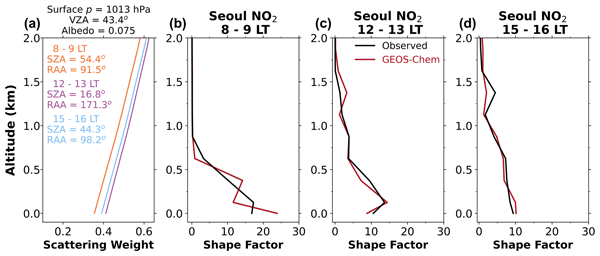
Laura Hyesung Yang, Daniel J. Jacob, Nadia K. Colombi, Shixian Zhai, Kelvin H. Bates, Viral Shah, Ellie Beaudry, Robert M. Yantosca, Haipeng Lin, Jared F. Brewer, Heesung Chong, Katherine R. Travis, James H. Crawford, Lok N. Lamsal, Ja-Ho Koo, and Jhoon Kim
Atmos. Chem. Phys., 23, 2465–2481, https://doi.org/10.5194/acp-23-2465-2023, https://doi.org/10.5194/acp-23-2465-2023, 2023
Short summary
Short summary
A geostationary satellite can now provide hourly NO2 vertical columns, and obtaining the NO2 vertical columns from space relies on NO2 vertical distribution from the chemical transport model (CTM). In this work, we update the CTM to better represent the chemistry environment so that the CTM can accurately provide NO2 vertical distribution. We also find that the changes in NO2 vertical distribution driven by a change in mixing depth play an important role in the NO2 column's diurnal variation.
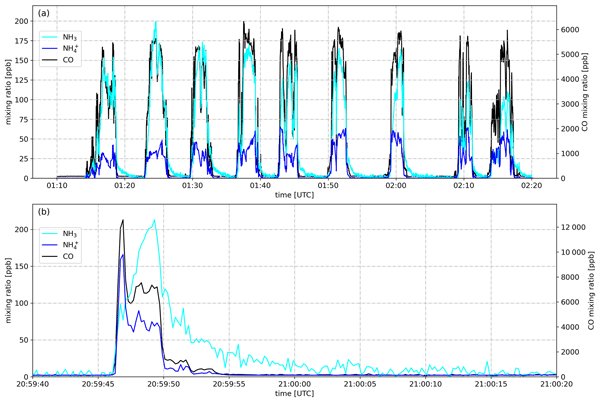
Laura Tomsche, Felix Piel, Tomas Mikoviny, Claus J. Nielsen, Hongyu Guo, Pedro Campuzano-Jost, Benjamin A. Nault, Melinda K. Schueneman, Jose L. Jimenez, Hannah Halliday, Glenn Diskin, Joshua P. DiGangi, John B. Nowak, Elizabeth B. Wiggins, Emily Gargulinski, Amber J. Soja, and Armin Wisthaler
Atmos. Chem. Phys., 23, 2331–2343, https://doi.org/10.5194/acp-23-2331-2023, https://doi.org/10.5194/acp-23-2331-2023, 2023
Short summary
Short summary
Ammonia (NH3) is an important trace gas in the atmosphere and fires are among the poorly investigated sources. During the 2019 Fire Influence on Regional to Global Environments and Air Quality (FIREX-AQ) aircraft campaign, we measured gaseous NH3 and particulate ammonium (NH4+) in smoke plumes emitted from 6 wildfires in the Western US and 66 small agricultural fires in the Southeastern US. We herein present a comprehensive set of emission factors of NH3 and NHx, where NHx = NH3 + NH4+.
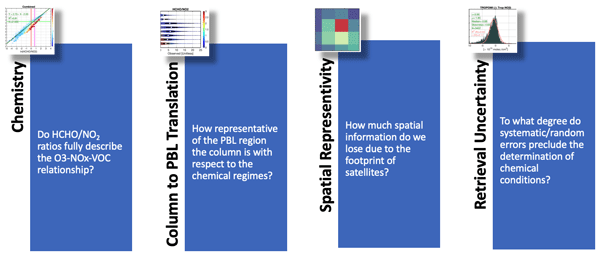
Amir H. Souri, Matthew S. Johnson, Glenn M. Wolfe, James H. Crawford, Alan Fried, Armin Wisthaler, William H. Brune, Donald R. Blake, Andrew J. Weinheimer, Tijl Verhoelst, Steven Compernolle, Gaia Pinardi, Corinne Vigouroux, Bavo Langerock, Sungyeon Choi, Lok Lamsal, Lei Zhu, Shuai Sun, Ronald C. Cohen, Kyung-Eun Min, Changmin Cho, Sajeev Philip, Xiong Liu, and Kelly Chance
Atmos. Chem. Phys., 23, 1963–1986, https://doi.org/10.5194/acp-23-1963-2023, https://doi.org/10.5194/acp-23-1963-2023, 2023
Short summary
Short summary
We have rigorously characterized different sources of error in satellite-based HCHO / NO2 tropospheric columns, a widely used metric for diagnosing near-surface ozone sensitivity. Specifically, the errors were categorized/quantified into (i) an inherent chemistry error, (ii) the decoupled relationship between columns and the near-surface concentration, (iii) the spatial representativeness error of ground satellite pixels, and (iv) the satellite retrieval errors.
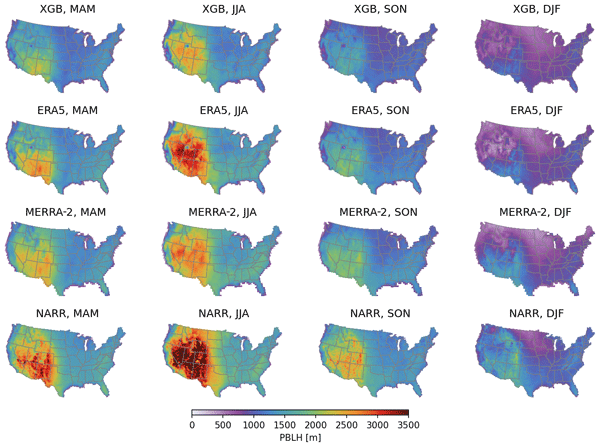
Zolal Ayazpour, Shiqi Tao, Dan Li, Amy Jo Scarino, Ralph E. Kuehn, and Kang Sun
Atmos. Meas. Tech., 16, 563–580, https://doi.org/10.5194/amt-16-563-2023, https://doi.org/10.5194/amt-16-563-2023, 2023
Short summary
Short summary
Accurate knowledge of the planetary boundary layer height (PBLH) is essential to study air pollution. However, PBLH observations are sparse in space and time, and PBLHs used in atmospheric models are often inaccurate. Using PBLH observations from the Aircraft Meteorological DAta Relay (AMDAR), we present a machine learning framework to produce a spatially complete PBLH product over the contiguous US that shows a better agreement with reference PBLH observations than commonly used PBLH products.
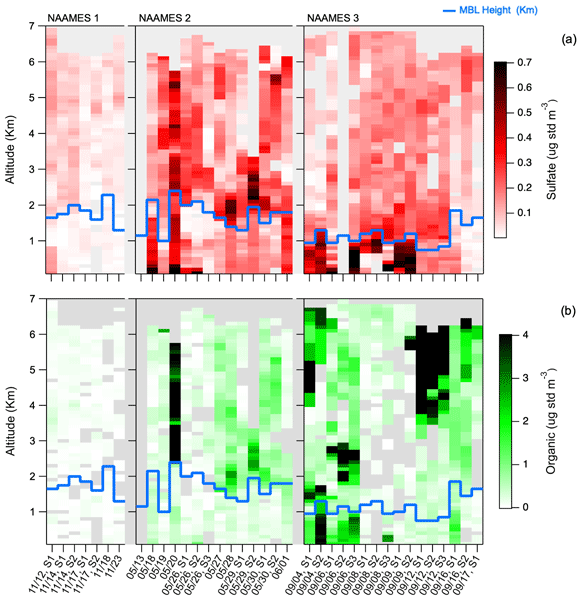
Francesca Gallo, Kevin J. Sanchez, Bruce E. Anderson, Ryan Bennett, Matthew D. Brown, Ewan C. Crosbie, Chris Hostetler, Carolyn Jordan, Melissa Yang Martin, Claire E. Robinson, Lynn M. Russell, Taylor J. Shingler, Michael A. Shook, Kenneth L. Thornhill, Elizabeth B. Wiggins, Edward L. Winstead, Armin Wisthaler, Luke D. Ziemba, and Richard H. Moore
Atmos. Chem. Phys., 23, 1465–1490, https://doi.org/10.5194/acp-23-1465-2023, https://doi.org/10.5194/acp-23-1465-2023, 2023
Short summary
Short summary
We integrate in situ ship- and aircraft-based measurements of aerosol, trace gases, and meteorological parameters collected during the NASA North Atlantic Aerosols and Marine Ecosystems Study (NAAMES) field campaigns in the western North Atlantic Ocean region. A comprehensive characterization of the vertical profiles of aerosol properties under different seasonal regimes is provided for improving the understanding of aerosol key processes and aerosol–cloud interactions in marine regions.
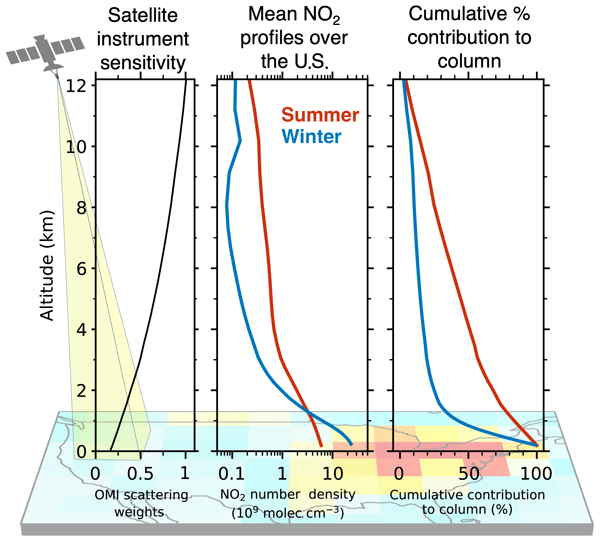
Viral Shah, Daniel J. Jacob, Ruijun Dang, Lok N. Lamsal, Sarah A. Strode, Stephen D. Steenrod, K. Folkert Boersma, Sebastian D. Eastham, Thibaud M. Fritz, Chelsea Thompson, Jeff Peischl, Ilann Bourgeois, Ilana B. Pollack, Benjamin A. Nault, Ronald C. Cohen, Pedro Campuzano-Jost, Jose L. Jimenez, Simone T. Andersen, Lucy J. Carpenter, Tomás Sherwen, and Mat J. Evans
Atmos. Chem. Phys., 23, 1227–1257, https://doi.org/10.5194/acp-23-1227-2023, https://doi.org/10.5194/acp-23-1227-2023, 2023
Short summary
Short summary
NOx in the free troposphere (above 2 km) affects global tropospheric chemistry and the retrieval and interpretation of satellite NO2 measurements. We evaluate free tropospheric NOx in global atmospheric chemistry models and find that recycling NOx from its reservoirs over the oceans is faster than that simulated in the models, resulting in increases in simulated tropospheric ozone and OH. Over the U.S., free tropospheric NO2 contributes the majority of the tropospheric NO2 column in summer.
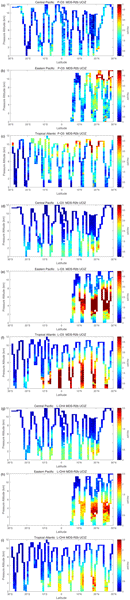
Hao Guo, Clare M. Flynn, Michael J. Prather, Sarah A. Strode, Stephen D. Steenrod, Louisa Emmons, Forrest Lacey, Jean-Francois Lamarque, Arlene M. Fiore, Gus Correa, Lee T. Murray, Glenn M. Wolfe, Jason M. St. Clair, Michelle Kim, John Crounse, Glenn Diskin, Joshua DiGangi, Bruce C. Daube, Roisin Commane, Kathryn McKain, Jeff Peischl, Thomas B. Ryerson, Chelsea Thompson, Thomas F. Hanisco, Donald Blake, Nicola J. Blake, Eric C. Apel, Rebecca S. Hornbrook, James W. Elkins, Eric J. Hintsa, Fred L. Moore, and Steven C. Wofsy
Atmos. Chem. Phys., 23, 99–117, https://doi.org/10.5194/acp-23-99-2023, https://doi.org/10.5194/acp-23-99-2023, 2023
Short summary
Short summary
We have prepared a unique and unusual result from the recent ATom aircraft mission: a measurement-based derivation of the production and loss rates of ozone and methane over the ocean basins. These are the key products of chemistry models used in assessments but have thus far lacked observational metrics. It also shows the scales of variability of atmospheric chemical rates and provides a major challenge to the atmospheric models.
Allison B. Marquardt Collow, Virginie Buchard, Peter R. Colarco, Arlindo M. da Silva, Ravi Govindaraju, Edward P. Nowottnick, Sharon Burton, Richard Ferrare, Chris Hostetler, and Luke Ziemba
Atmos. Chem. Phys., 22, 16091–16109, https://doi.org/10.5194/acp-22-16091-2022, https://doi.org/10.5194/acp-22-16091-2022, 2022
Short summary
Short summary
Biomass burning aerosol impacts aspects of the atmosphere and Earth system through radiative forcing, serving as cloud condensation nuclei, and air quality. Despite its importance, the representation of biomass burning aerosol is not always accurate in models. Field campaign observations from CAMP2Ex are used to evaluate the mass and extinction of aerosols in the GEOS model. Notable biases in the model illuminate areas of future development with GEOS and the underlying GOCART aerosol module.
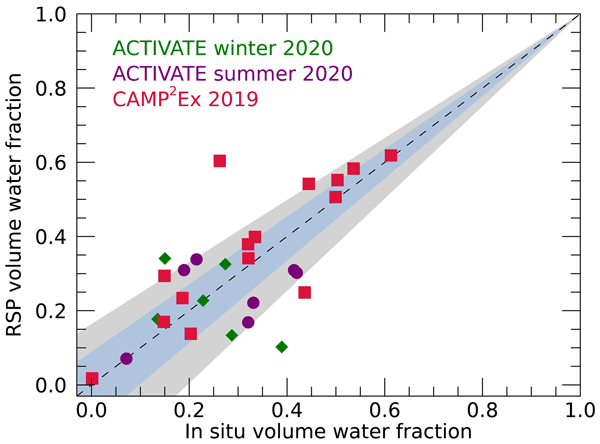
Bastiaan van Diedenhoven, Otto P. Hasekamp, Brian Cairns, Gregory L. Schuster, Snorre Stamnes, Michael Shook, and Luke Ziemba
Atmos. Meas. Tech., 15, 7411–7434, https://doi.org/10.5194/amt-15-7411-2022, https://doi.org/10.5194/amt-15-7411-2022, 2022
Short summary
Short summary
The strong variability in the chemistry of atmospheric particulate matter affects the amount of water aerosols absorb and their effect on climate. We present a remote sensing method to determine the amount of water in particulate matter. Its application to airborne instruments indicates that the observed aerosols have rather low water contents and low fractions of soluble particles. Future satellites will be able to yield global aerosol water uptake data.
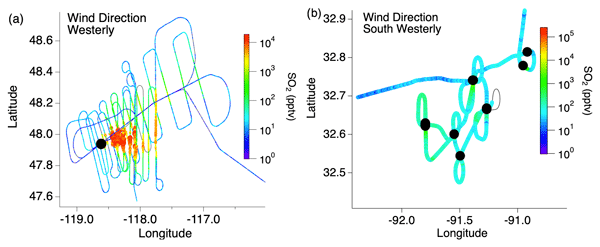
Pamela S. Rickly, Hongyu Guo, Pedro Campuzano-Jost, Jose L. Jimenez, Glenn M. Wolfe, Ryan Bennett, Ilann Bourgeois, John D. Crounse, Jack E. Dibb, Joshua P. DiGangi, Glenn S. Diskin, Maximilian Dollner, Emily M. Gargulinski, Samuel R. Hall, Hannah S. Halliday, Thomas F. Hanisco, Reem A. Hannun, Jin Liao, Richard Moore, Benjamin A. Nault, John B. Nowak, Jeff Peischl, Claire E. Robinson, Thomas Ryerson, Kevin J. Sanchez, Manuel Schöberl, Amber J. Soja, Jason M. St. Clair, Kenneth L. Thornhill, Kirk Ullmann, Paul O. Wennberg, Bernadett Weinzierl, Elizabeth B. Wiggins, Edward L. Winstead, and Andrew W. Rollins
Atmos. Chem. Phys., 22, 15603–15620, https://doi.org/10.5194/acp-22-15603-2022, https://doi.org/10.5194/acp-22-15603-2022, 2022
Short summary
Short summary
Biomass burning sulfur dioxide (SO2) emission factors range from 0.27–1.1 g kg-1 C. Biomass burning SO2 can quickly form sulfate and organosulfur, but these pathways are dependent on liquid water content and pH. Hydroxymethanesulfonate (HMS) appears to be directly emitted from some fire sources but is not the sole contributor to the organosulfur signal. It is shown that HMS and organosulfur chemistry may be an important S(IV) reservoir with the fate dependent on the surrounding conditions.

Rachel A. Bergin, Monica Harkey, Alicia Hoffman, Richard H. Moore, Bruce Anderson, Andreas Beyersdorf, Luke Ziemba, Lee Thornhill, Edward Winstead, Tracey Holloway, and Timothy H. Bertram
Atmos. Chem. Phys., 22, 15449–15468, https://doi.org/10.5194/acp-22-15449-2022, https://doi.org/10.5194/acp-22-15449-2022, 2022
Short summary
Short summary
Correctly predicting aerosol surface area concentrations is important for determining the rate of heterogeneous reactions in chemical transport models. Here, we compare aircraft measurements of aerosol surface area with a regional model. In polluted air masses, we show that the model underpredicts aerosol surface area by a factor of 2. Despite this disagreement, the representation of heterogeneous chemistry still dominates the overall uncertainty in the loss rate of molecules such as N2O5.
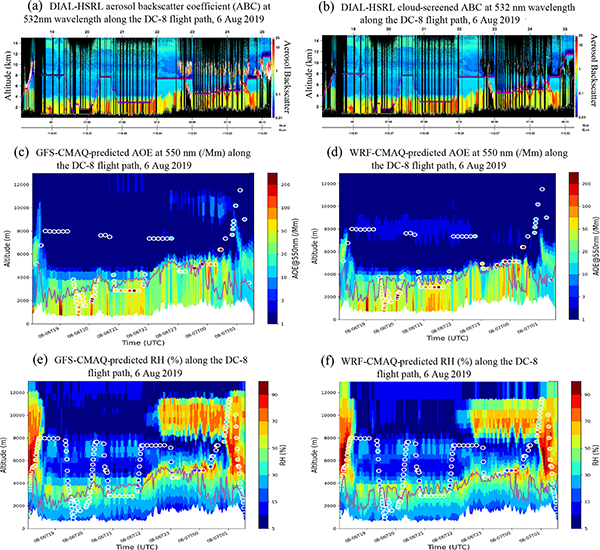
Youhua Tang, Patrick C. Campbell, Pius Lee, Rick Saylor, Fanglin Yang, Barry Baker, Daniel Tong, Ariel Stein, Jianping Huang, Ho-Chun Huang, Li Pan, Jeff McQueen, Ivanka Stajner, Jose Tirado-Delgado, Youngsun Jung, Melissa Yang, Ilann Bourgeois, Jeff Peischl, Tom Ryerson, Donald Blake, Joshua Schwarz, Jose-Luis Jimenez, James Crawford, Glenn Diskin, Richard Moore, Johnathan Hair, Greg Huey, Andrew Rollins, Jack Dibb, and Xiaoyang Zhang
Geosci. Model Dev., 15, 7977–7999, https://doi.org/10.5194/gmd-15-7977-2022, https://doi.org/10.5194/gmd-15-7977-2022, 2022
Short summary
Short summary
This paper compares two meteorological datasets for driving a regional air quality model: a regional meteorological model using WRF (WRF-CMAQ) and direct interpolation from an operational global model (GFS-CMAQ). In the comparison with surface measurements and aircraft data in summer 2019, these two methods show mixed performance depending on the corresponding meteorological settings. Direct interpolation is found to be a viable method to drive air quality models.

Hossein Dadashazar, Andrea F. Corral, Ewan Crosbie, Sanja Dmitrovic, Simon Kirschler, Kayla McCauley, Richard Moore, Claire Robinson, Joseph S. Schlosser, Michael Shook, K. Lee Thornhill, Christiane Voigt, Edward Winstead, Luke Ziemba, and Armin Sorooshian
Atmos. Chem. Phys., 22, 13897–13913, https://doi.org/10.5194/acp-22-13897-2022, https://doi.org/10.5194/acp-22-13897-2022, 2022
Short summary
Short summary
Multi-season airborne data over the northwestern Atlantic show that organic mass fraction and the relative amount of oxygenated organics within that fraction are enhanced in droplet residual particles as compared to particles below and above cloud. In-cloud aqueous processing is shown to be a potential driver of this compositional shift in cloud. This implies that aerosol–cloud interactions in the region reduce aerosol hygroscopicity due to the jump in the organic : sulfate ratio in cloud.
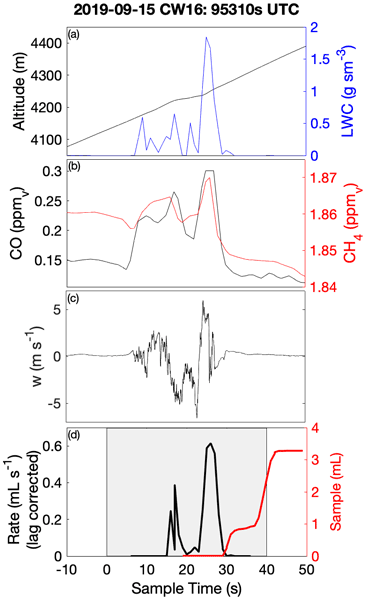
Ewan Crosbie, Luke D. Ziemba, Michael A. Shook, Claire E. Robinson, Edward L. Winstead, K. Lee Thornhill, Rachel A. Braun, Alexander B. MacDonald, Connor Stahl, Armin Sorooshian, Susan C. van den Heever, Joshua P. DiGangi, Glenn S. Diskin, Sarah Woods, Paola Bañaga, Matthew D. Brown, Francesca Gallo, Miguel Ricardo A. Hilario, Carolyn E. Jordan, Gabrielle R. Leung, Richard H. Moore, Kevin J. Sanchez, Taylor J. Shingler, and Elizabeth B. Wiggins
Atmos. Chem. Phys., 22, 13269–13302, https://doi.org/10.5194/acp-22-13269-2022, https://doi.org/10.5194/acp-22-13269-2022, 2022
Short summary
Short summary
The linkage between cloud droplet and aerosol particle chemical composition was analyzed using samples collected in a polluted tropical marine environment. Variations in the droplet composition were related to physical and dynamical processes in clouds to assess their relative significance across three cases that spanned a range of rainfall amounts. In spite of the pollution, sea salt still remained a major contributor to the droplet composition and was preferentially enhanced in rainwater.
Eva-Lou Edwards, Jeffrey S. Reid, Peng Xian, Sharon P. Burton, Anthony L. Cook, Ewan C. Crosbie, Marta A. Fenn, Richard A. Ferrare, Sean W. Freeman, John W. Hair, David B. Harper, Chris A. Hostetler, Claire E. Robinson, Amy Jo Scarino, Michael A. Shook, G. Alexander Sokolowsky, Susan C. van den Heever, Edward L. Winstead, Sarah Woods, Luke D. Ziemba, and Armin Sorooshian
Atmos. Chem. Phys., 22, 12961–12983, https://doi.org/10.5194/acp-22-12961-2022, https://doi.org/10.5194/acp-22-12961-2022, 2022
Short summary
Short summary
This study compares NAAPS-RA model simulations of aerosol optical thickness (AOT) and extinction to those retrieved with a high spectral resolution lidar near the Philippines. Agreement for AOT was good, and extinction agreement was strongest below 1500 m. Substituting dropsonde relative humidities into NAAPS-RA did not drastically improve agreement, and we discuss potential reasons why. Accurately modeling future conditions in this region is crucial due to its susceptibility to climate change.
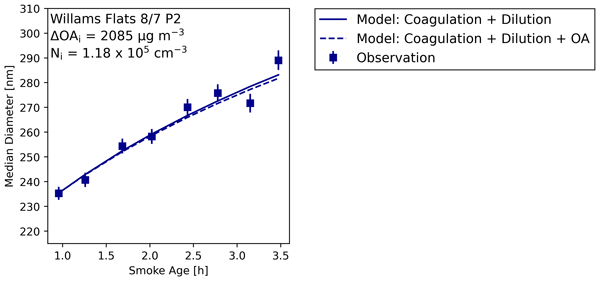
Nicole A. June, Anna L. Hodshire, Elizabeth B. Wiggins, Edward L. Winstead, Claire E. Robinson, K. Lee Thornhill, Kevin J. Sanchez, Richard H. Moore, Demetrios Pagonis, Hongyu Guo, Pedro Campuzano-Jost, Jose L. Jimenez, Matthew M. Coggon, Jonathan M. Dean-Day, T. Paul Bui, Jeff Peischl, Robert J. Yokelson, Matthew J. Alvarado, Sonia M. Kreidenweis, Shantanu H. Jathar, and Jeffrey R. Pierce
Atmos. Chem. Phys., 22, 12803–12825, https://doi.org/10.5194/acp-22-12803-2022, https://doi.org/10.5194/acp-22-12803-2022, 2022
Short summary
Short summary
The evolution of organic aerosol composition and size is uncertain due to variability within and between smoke plumes. We examine the impact of plume concentration on smoke evolution from smoke plumes sampled by the NASA DC-8 during FIREX-AQ. We find that observed organic aerosol and size distribution changes are correlated to plume aerosol mass concentrations. Additionally, coagulation explains the majority of the observed growth.
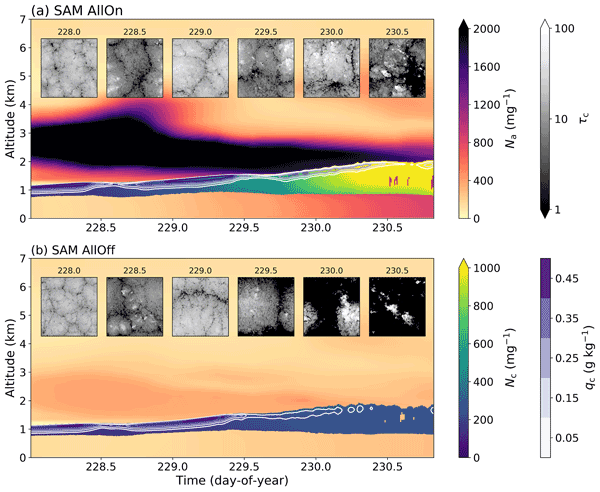
Michael S. Diamond, Pablo E. Saide, Paquita Zuidema, Andrew S. Ackerman, Sarah J. Doherty, Ann M. Fridlind, Hamish Gordon, Calvin Howes, Jan Kazil, Takanobu Yamaguchi, Jianhao Zhang, Graham Feingold, and Robert Wood
Atmos. Chem. Phys., 22, 12113–12151, https://doi.org/10.5194/acp-22-12113-2022, https://doi.org/10.5194/acp-22-12113-2022, 2022
Short summary
Short summary
Smoke from southern Africa blankets the southeast Atlantic from June-October, overlying a major transition region between overcast and scattered clouds. The smoke affects Earth's radiation budget by absorbing sunlight and changing cloud properties. We investigate these effects in regional climate and large eddy simulation models based on international field campaigns. We find that large-scale circulation changes more strongly affect cloud transitions than smoke microphysical effects in our case.
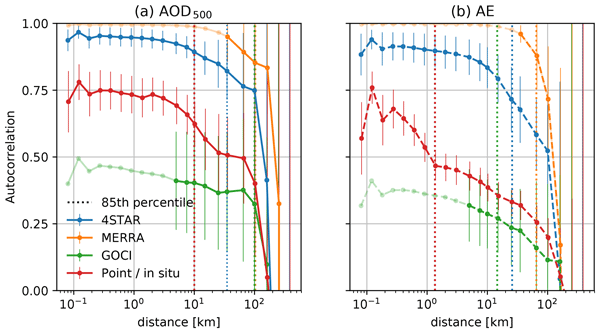
Samuel E. LeBlanc, Michal Segal-Rozenhaimer, Jens Redemann, Connor Flynn, Roy R. Johnson, Stephen E. Dunagan, Robert Dahlgren, Jhoon Kim, Myungje Choi, Arlindo da Silva, Patricia Castellanos, Qian Tan, Luke Ziemba, Kenneth Lee Thornhill, and Meloë Kacenelenbogen
Atmos. Chem. Phys., 22, 11275–11304, https://doi.org/10.5194/acp-22-11275-2022, https://doi.org/10.5194/acp-22-11275-2022, 2022
Short summary
Short summary
Airborne observations of atmospheric particles and pollution over Korea during a field campaign in May–June 2016 showed that the smallest atmospheric particles are present in the lowest 2 km of the atmosphere. The aerosol size is more spatially variable than optical thickness. We show this with remote sensing (4STAR), in situ (LARGE) observations, satellite measurements (GOCI), and modeled properties (MERRA-2), and it is contrary to the current understanding.
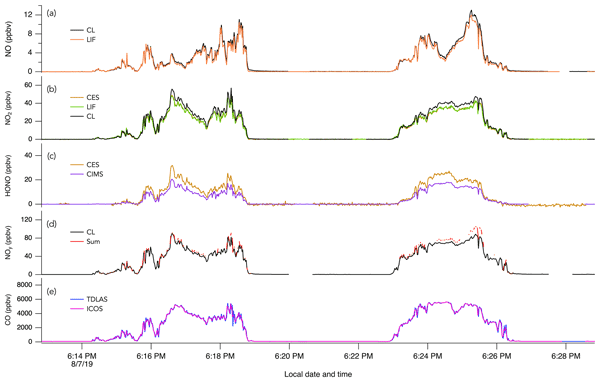
Ilann Bourgeois, Jeff Peischl, J. Andrew Neuman, Steven S. Brown, Hannah M. Allen, Pedro Campuzano-Jost, Matthew M. Coggon, Joshua P. DiGangi, Glenn S. Diskin, Jessica B. Gilman, Georgios I. Gkatzelis, Hongyu Guo, Hannah A. Halliday, Thomas F. Hanisco, Christopher D. Holmes, L. Gregory Huey, Jose L. Jimenez, Aaron D. Lamplugh, Young Ro Lee, Jakob Lindaas, Richard H. Moore, Benjamin A. Nault, John B. Nowak, Demetrios Pagonis, Pamela S. Rickly, Michael A. Robinson, Andrew W. Rollins, Vanessa Selimovic, Jason M. St. Clair, David Tanner, Krystal T. Vasquez, Patrick R. Veres, Carsten Warneke, Paul O. Wennberg, Rebecca A. Washenfelder, Elizabeth B. Wiggins, Caroline C. Womack, Lu Xu, Kyle J. Zarzana, and Thomas B. Ryerson
Atmos. Meas. Tech., 15, 4901–4930, https://doi.org/10.5194/amt-15-4901-2022, https://doi.org/10.5194/amt-15-4901-2022, 2022
Short summary
Short summary
Understanding fire emission impacts on the atmosphere is key to effective air quality management and requires accurate measurements. We present a comparison of airborne measurements of key atmospheric species in ambient air and in fire smoke. We show that most instruments performed within instrument uncertainties. In some cases, further work is needed to fully characterize instrument performance. Comparing independent measurements using different techniques is important to assess their accuracy.
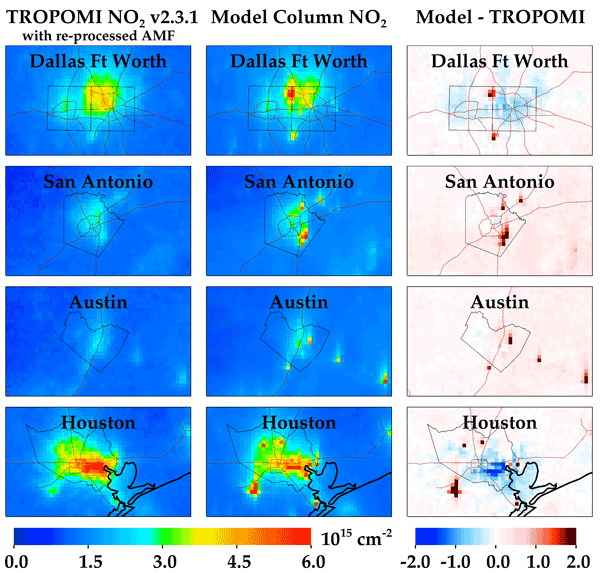
Daniel L. Goldberg, Monica Harkey, Benjamin de Foy, Laura Judd, Jeremiah Johnson, Greg Yarwood, and Tracey Holloway
Atmos. Chem. Phys., 22, 10875–10900, https://doi.org/10.5194/acp-22-10875-2022, https://doi.org/10.5194/acp-22-10875-2022, 2022
Short summary
Short summary
TROPOMI measurements offer a valuable means to validate emissions inventories and ozone formation regimes, with important limitations. Lightning NOx is important to account for in Texas and can contribute up to 24 % of the column NO2 in rural areas and 8 % in urban areas. Modeled NO2 in urban areas agrees with TROPOMI NO2 to within 20 % in most circumstances, with a small underestimate in Dallas (−13 %) and Houston (−20 %). Near Texas power plants, the satellite appears to underrepresent NO2.

Lim-Seok Chang, Donghee Kim, Hyunkee Hong, Deok-Rae Kim, Jeong-Ah Yu, Kwangyul Lee, Hanlim Lee, Daewon Kim, Jinkyu Hong, Hyun-Young Jo, and Cheol-Hee Kim
Atmos. Chem. Phys., 22, 10703–10720, https://doi.org/10.5194/acp-22-10703-2022, https://doi.org/10.5194/acp-22-10703-2022, 2022
Short summary
Short summary
Our study explored the synergy of combined column and surface measurements during GMAP (GEMS Map of Air Pollution) campaign. It has several points to note for vertical distribution analysis. Particularly under prevailing local wind meteorological conditions, Pandora-based vertical structures sometimes showed negative correlations between column and surface measurements. Vertical analysis should be done carefully in some local meteorological conditions when employing either surface or columns.
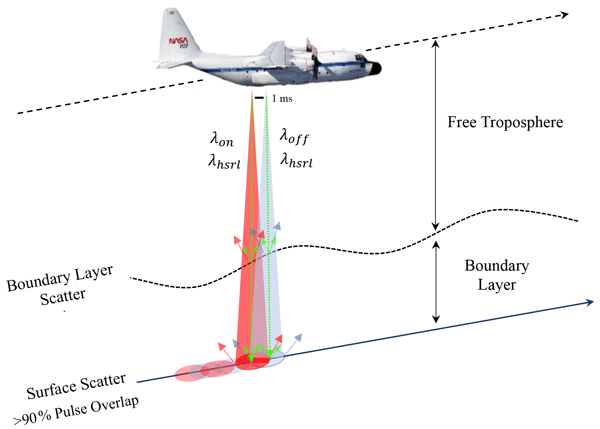
Rory A. Barton-Grimley, Amin R. Nehrir, Susan A. Kooi, James E. Collins, David B. Harper, Anthony Notari, Joseph Lee, Joshua P. DiGangi, Yonghoon Choi, and Kenneth J. Davis
Atmos. Meas. Tech., 15, 4623–4650, https://doi.org/10.5194/amt-15-4623-2022, https://doi.org/10.5194/amt-15-4623-2022, 2022
Short summary
Short summary
HALO is a multi-functional lidar that measures CH4 columns and profiles of H2O mixing ratio and aerosol/cloud optical properties. HALO supports carbon cycle, weather dynamics, and radiation science suborbital research and is a technology testbed for future space-based differential absorption lidar missions. In 2019 HALO collected CH4 columns and aerosol/cloud profiles during the ACT-America campaign. Here we assess HALO's CH4 accuracy and precision compared to co-located in situ observations.
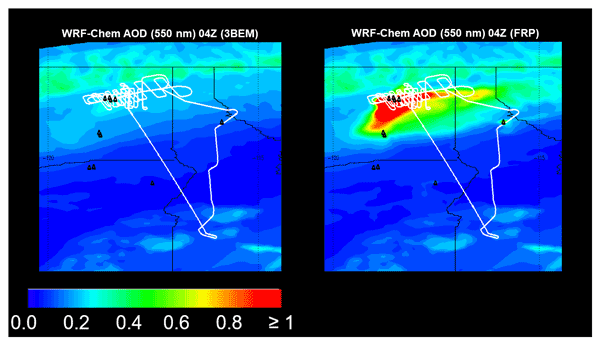
Aditya Kumar, R. Bradley Pierce, Ravan Ahmadov, Gabriel Pereira, Saulo Freitas, Georg Grell, Chris Schmidt, Allen Lenzen, Joshua P. Schwarz, Anne E. Perring, Joseph M. Katich, John Hair, Jose L. Jimenez, Pedro Campuzano-Jost, and Hongyu Guo
Atmos. Chem. Phys., 22, 10195–10219, https://doi.org/10.5194/acp-22-10195-2022, https://doi.org/10.5194/acp-22-10195-2022, 2022
Short summary
Short summary
We use the WRF-Chem model with new implementations of GOES-16 wildfire emissions and plume rise based on fire radiative power (FRP) to interpret aerosol observations during the 2019 NASA–NOAA FIREX-AQ field campaign and perform model evaluations. The model shows significant improvements in simulating the variety of aerosol loading environments sampled during FIREX-AQ. Our results also highlight the importance of accurate wildfire diurnal cycle and aerosol chemical mechanisms in models.

Peng Xian, Jianglong Zhang, Norm T. O'Neill, Jeffrey S. Reid, Travis D. Toth, Blake Sorenson, Edward J. Hyer, James R. Campbell, and Keyvan Ranjbar
Atmos. Chem. Phys., 22, 9949–9967, https://doi.org/10.5194/acp-22-9949-2022, https://doi.org/10.5194/acp-22-9949-2022, 2022
Short summary
Short summary
The study provides a baseline Arctic spring and summertime aerosol optical depth climatology, trend, and extreme event statistics from 2003 to 2019 using a combination of aerosol reanalyses, remote sensing, and ground observations. Biomass burning smoke has an overwhelming contribution to black carbon (an efficient climate forcer) compared to anthropogenic sources. Burning's large interannual variability and increasing summer trend have important implications for the Arctic climate.
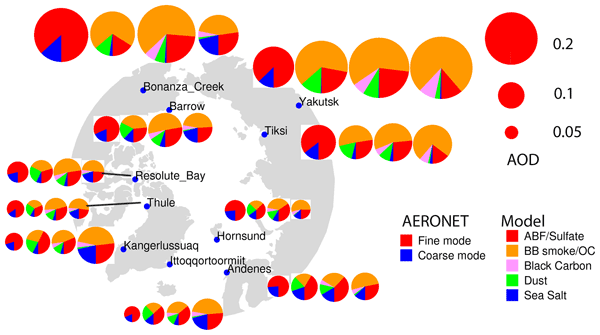
Peng Xian, Jianglong Zhang, Norm T. O'Neill, Travis D. Toth, Blake Sorenson, Peter R. Colarco, Zak Kipling, Edward J. Hyer, James R. Campbell, Jeffrey S. Reid, and Keyvan Ranjbar
Atmos. Chem. Phys., 22, 9915–9947, https://doi.org/10.5194/acp-22-9915-2022, https://doi.org/10.5194/acp-22-9915-2022, 2022
Short summary
Short summary
The study provides baseline Arctic spring and summertime aerosol optical depth climatology, trend, and extreme event statistics from 2003 to 2019 using a combination of aerosol reanalyses, remote sensing, and ground observations. Biomass burning smoke has an overwhelming contribution to black carbon (an efficient climate forcer) compared to anthropogenic sources. Burning's large interannual variability and increasing summer trend have important implications for the Arctic climate.
Harshvardhan Harshvardhan, Richard Ferrare, Sharon Burton, Johnathan Hair, Chris Hostetler, David Harper, Anthony Cook, Marta Fenn, Amy Jo Scarino, Eduard Chemyakin, and Detlef Müller
Atmos. Chem. Phys., 22, 9859–9876, https://doi.org/10.5194/acp-22-9859-2022, https://doi.org/10.5194/acp-22-9859-2022, 2022
Short summary
Short summary
The evolution of aerosol in biomass burning smoke plumes that travel over marine clouds off the Atlantic coast of central Africa was studied using measurements made by a lidar deployed on a high-altitude aircraft. The main finding was that the physical properties of aerosol do not change appreciably once the plume has left land and travels over the ocean over a timescale of 1 to 2 d. Almost all particles in the plume are of radius less than 1 micrometer and spherical in shape.
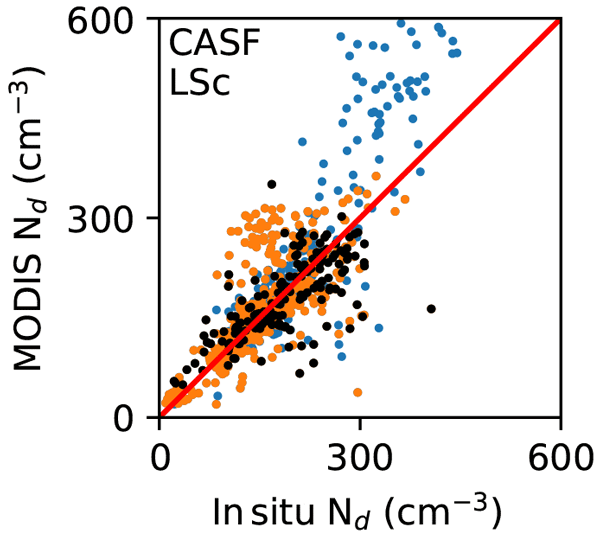
Edward Gryspeerdt, Daniel T. McCoy, Ewan Crosbie, Richard H. Moore, Graeme J. Nott, David Painemal, Jennifer Small-Griswold, Armin Sorooshian, and Luke Ziemba
Atmos. Meas. Tech., 15, 3875–3892, https://doi.org/10.5194/amt-15-3875-2022, https://doi.org/10.5194/amt-15-3875-2022, 2022
Short summary
Short summary
Droplet number concentration is a key property of clouds, influencing a variety of cloud processes. It is also used for estimating the cloud response to aerosols. The satellite retrieval depends on a number of assumptions – different sampling strategies are used to select cases where these assumptions are most likely to hold. Here we investigate the impact of these strategies on the agreement with in situ data, the droplet number climatology and estimates of the indirect radiative forcing.
Simon Kirschler, Christiane Voigt, Bruce Anderson, Ramon Campos Braga, Gao Chen, Andrea F. Corral, Ewan Crosbie, Hossein Dadashazar, Richard A. Ferrare, Valerian Hahn, Johannes Hendricks, Stefan Kaufmann, Richard Moore, Mira L. Pöhlker, Claire Robinson, Amy J. Scarino, Dominik Schollmayer, Michael A. Shook, K. Lee Thornhill, Edward Winstead, Luke D. Ziemba, and Armin Sorooshian
Atmos. Chem. Phys., 22, 8299–8319, https://doi.org/10.5194/acp-22-8299-2022, https://doi.org/10.5194/acp-22-8299-2022, 2022
Short summary
Short summary
In this study we show that the vertical velocity dominantly impacts the cloud droplet number concentration (NC) of low-level clouds over the western North Atlantic in the winter and summer season, while the cloud condensation nuclei concentration, aerosol size distribution and chemical composition impact NC within a season. The observational data presented in this study can evaluate and improve the representation of aerosol–cloud interactions for a wide range of conditions.
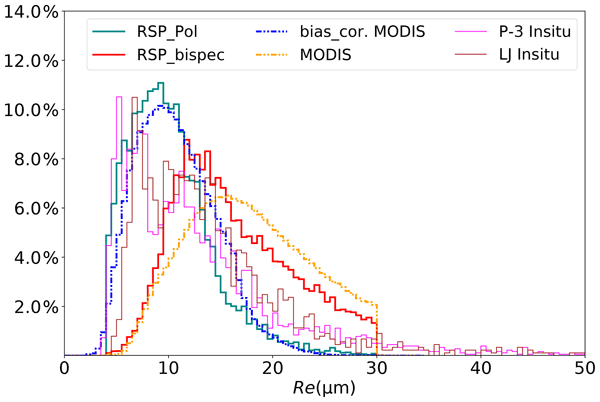
Dongwei Fu, Larry Di Girolamo, Robert M. Rauber, Greg M. McFarquhar, Stephen W. Nesbitt, Jesse Loveridge, Yulan Hong, Bastiaan van Diedenhoven, Brian Cairns, Mikhail D. Alexandrov, Paul Lawson, Sarah Woods, Simone Tanelli, Sebastian Schmidt, Chris Hostetler, and Amy Jo Scarino
Atmos. Chem. Phys., 22, 8259–8285, https://doi.org/10.5194/acp-22-8259-2022, https://doi.org/10.5194/acp-22-8259-2022, 2022
Short summary
Short summary
Satellite-retrieved cloud microphysics are widely used in climate research because of their central role in water and energy cycles. Here, we provide the first detailed investigation of retrieved cloud drop sizes from in situ and various satellite and airborne remote sensing techniques applied to real cumulus cloud fields. We conclude that the most widely used passive remote sensing method employed in climate research produces high biases of 6–8 µm (60 %–80 %) caused by 3-D radiative effects.
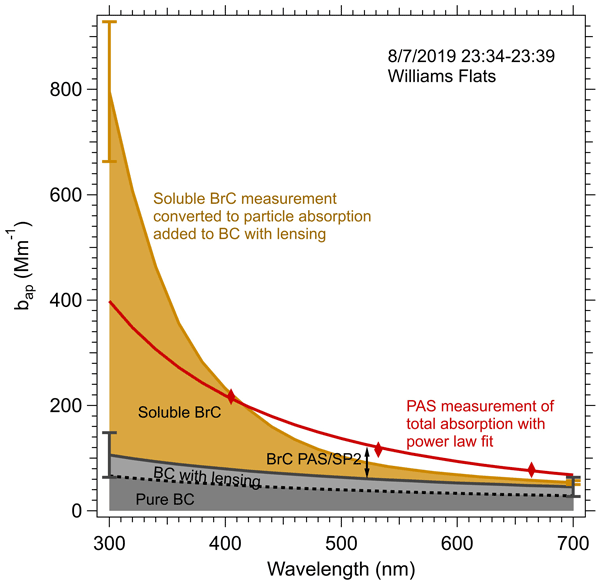
Linghan Zeng, Jack Dibb, Eric Scheuer, Joseph M. Katich, Joshua P. Schwarz, Ilann Bourgeois, Jeff Peischl, Tom Ryerson, Carsten Warneke, Anne E. Perring, Glenn S. Diskin, Joshua P. DiGangi, John B. Nowak, Richard H. Moore, Elizabeth B. Wiggins, Demetrios Pagonis, Hongyu Guo, Pedro Campuzano-Jost, Jose L. Jimenez, Lu Xu, and Rodney J. Weber
Atmos. Chem. Phys., 22, 8009–8036, https://doi.org/10.5194/acp-22-8009-2022, https://doi.org/10.5194/acp-22-8009-2022, 2022
Short summary
Short summary
Wildfires emit aerosol particles containing brown carbon material that affects visibility and global climate and is toxic. Brown carbon is poorly characterized due to measurement limitations, and its evolution in the atmosphere is not well known. We report on aircraft measurements of brown carbon from large wildfires in the western United States. We compare two methods for measuring brown carbon and study the evolution of brown carbon in the smoke as it moved away from the burning regions.
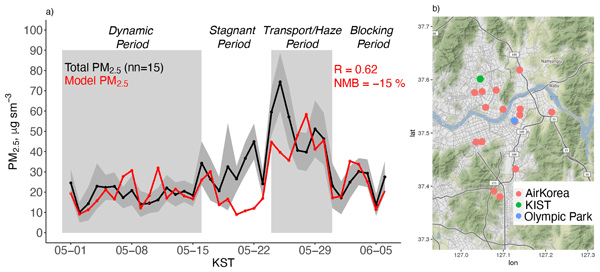
Katherine R. Travis, James H. Crawford, Gao Chen, Carolyn E. Jordan, Benjamin A. Nault, Hwajin Kim, Jose L. Jimenez, Pedro Campuzano-Jost, Jack E. Dibb, Jung-Hun Woo, Younha Kim, Shixian Zhai, Xuan Wang, Erin E. McDuffie, Gan Luo, Fangqun Yu, Saewung Kim, Isobel J. Simpson, Donald R. Blake, Limseok Chang, and Michelle J. Kim
Atmos. Chem. Phys., 22, 7933–7958, https://doi.org/10.5194/acp-22-7933-2022, https://doi.org/10.5194/acp-22-7933-2022, 2022
Short summary
Short summary
The 2016 Korea–United States Air Quality (KORUS-AQ) field campaign provided a unique set of observations to improve our understanding of PM2.5 pollution in South Korea. Models typically have errors in simulating PM2.5 in this region, which is of concern for the development of control measures. We use KORUS-AQ observations to improve our understanding of the mechanisms driving PM2.5 and the implications of model errors for determining PM2.5 that is attributable to local or foreign sources.
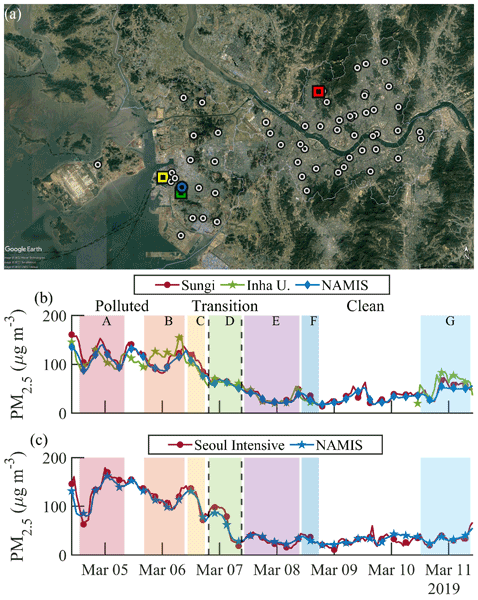
Joseph S. Schlosser, Connor Stahl, Armin Sorooshian, Yen Thi-Hoang Le, Ki-Joon Jeon, Peng Xian, Carolyn E. Jordan, Katherine R. Travis, James H. Crawford, Sung Yong Gong, Hye-Jung Shin, In-Ho Song, and Jong-sang Youn
Atmos. Chem. Phys., 22, 7505–7522, https://doi.org/10.5194/acp-22-7505-2022, https://doi.org/10.5194/acp-22-7505-2022, 2022
Short summary
Short summary
During a major haze pollution episode in March 2019, anthropogenic emissions were dominant in the boundary layer over Incheon and Seoul, South Korea. Using supermicrometer and submicrometer size- and chemistry-resolved aerosol particle measurements taken during this haze pollution period, this work shows that local emissions and a shallow boundary layer, enhanced humidity, and low temperature promoted local heterogeneous formation of secondary inorganic and organic aerosol species.
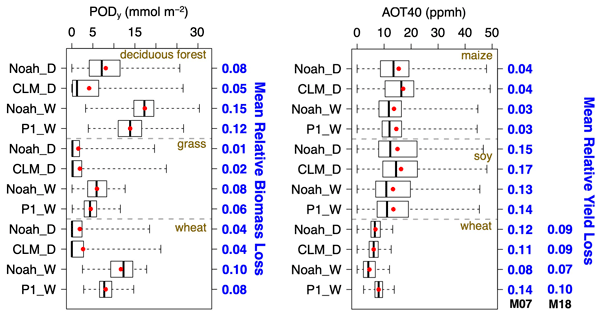
Min Huang, James H. Crawford, Gregory R. Carmichael, Kevin W. Bowman, Sujay V. Kumar, and Colm Sweeney
Atmos. Chem. Phys., 22, 7461–7487, https://doi.org/10.5194/acp-22-7461-2022, https://doi.org/10.5194/acp-22-7461-2022, 2022
Short summary
Short summary
This study demonstrates that ozone dry-deposition modeling can be improved by revising the model's dry-deposition parameterizations to better represent the effects of environmental conditions including the soil moisture fields. Applying satellite soil moisture data assimilation is shown to also have added value. Such advancements in coupled modeling and data assimilation can benefit the assessments of ozone impacts on human and vegetation health.
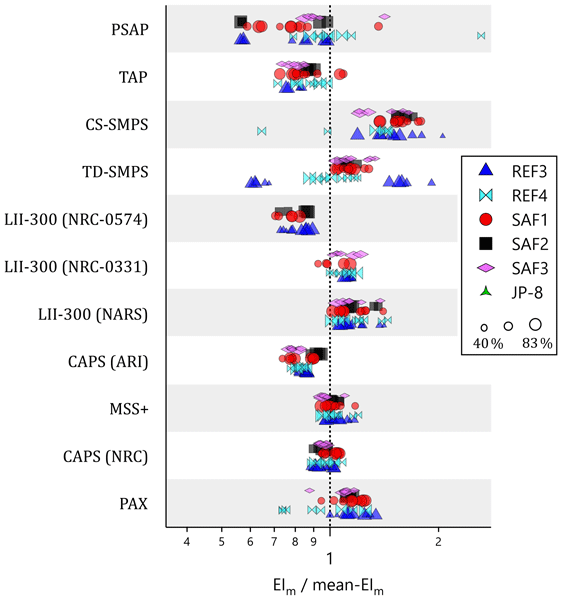
Joel C. Corbin, Tobias Schripp, Bruce E. Anderson, Greg J. Smallwood, Patrick LeClercq, Ewan C. Crosbie, Steven Achterberg, Philip D. Whitefield, Richard C. Miake-Lye, Zhenhong Yu, Andrew Freedman, Max Trueblood, David Satterfield, Wenyan Liu, Patrick Oßwald, Claire Robinson, Michael A. Shook, Richard H. Moore, and Prem Lobo
Atmos. Meas. Tech., 15, 3223–3242, https://doi.org/10.5194/amt-15-3223-2022, https://doi.org/10.5194/amt-15-3223-2022, 2022
Short summary
Short summary
The combustion of sustainable aviation fuels in aircraft engines produces particulate matter (PM) emissions with different properties than conventional fuels due to changes in fuel composition. Consequently, the response of various diagnostic instruments to PM emissions may be impacted. We found no significant instrument biases in terms of particle mass, number, and size measurements for conventional and sustainable aviation fuel blends despite large differences in the magnitude of emissions.
Zhujun Li, David Painemal, Gregory Schuster, Marian Clayton, Richard Ferrare, Mark Vaughan, Damien Josset, Jayanta Kar, and Charles Trepte
Atmos. Meas. Tech., 15, 2745–2766, https://doi.org/10.5194/amt-15-2745-2022, https://doi.org/10.5194/amt-15-2745-2022, 2022
Short summary
Short summary
For more than 15 years, CALIPSO has revolutionized our understanding of the role of aerosols in climate. Here we evaluate CALIPSO aerosol typing over the ocean using an independent CALIPSO–CloudSat product. The analysis suggests that CALIPSO correctly categorizes clean marine aerosol over the open ocean, elevated smoke over the SE Atlantic, and dust over the tropical Atlantic. Similarities between clean and dusty marine over the open ocean implies that algorithm modifications are warranted.
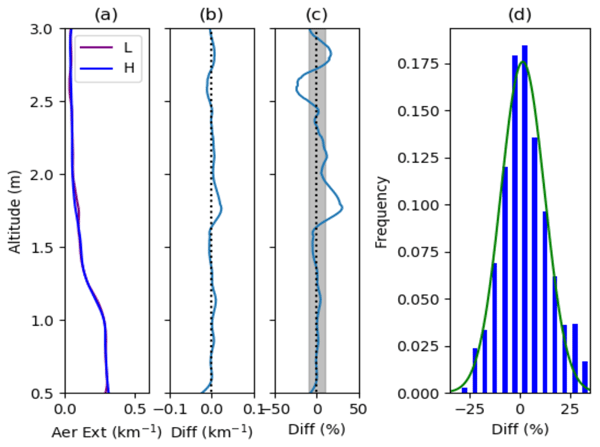
Liqiao Lei, Timothy A. Berkoff, Guillaume Gronoff, Jia Su, Amin R. Nehrir, Yonghua Wu, Fred Moshary, and Shi Kuang
Atmos. Meas. Tech., 15, 2465–2478, https://doi.org/10.5194/amt-15-2465-2022, https://doi.org/10.5194/amt-15-2465-2022, 2022
Short summary
Short summary
Aerosol extinction in the UVB (280–315 nm) is difficult to retrieve using simple lidar techniques due to the lack of lidar ratios at those wavelengths. The 2018 Long Island Sound Tropospheric Ozone Study (LISTOS) in the New York City region provided the opportunity to characterize the lidar ratio for UVB aerosol retrieval for the Langley Mobile Ozone Lidar (LMOL). A 292 nm aerosol product comparison between the NASA Langley High Altitude Lidar Observatory (HALO) and LMOL was also carried out.
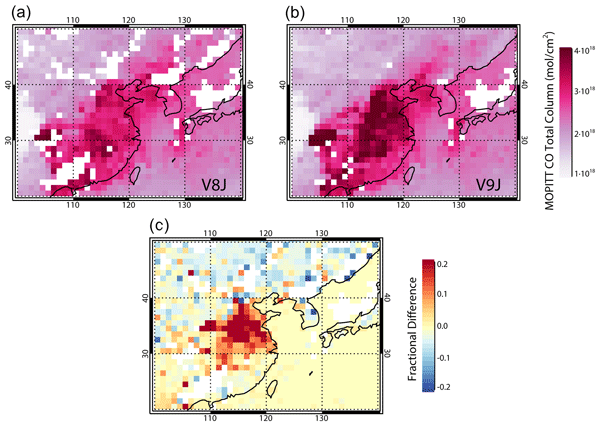
Merritt Deeter, Gene Francis, John Gille, Debbie Mao, Sara Martínez-Alonso, Helen Worden, Dan Ziskin, James Drummond, Róisín Commane, Glenn Diskin, and Kathryn McKain
Atmos. Meas. Tech., 15, 2325–2344, https://doi.org/10.5194/amt-15-2325-2022, https://doi.org/10.5194/amt-15-2325-2022, 2022
Short summary
Short summary
The MOPITT (Measurements of Pollution in the Troposphere) satellite instrument uses remote sensing to obtain retrievals (measurements) of carbon monoxide (CO) in the atmosphere. This paper describes the latest MOPITT data product, Version 9. Globally, the number of daytime MOPITT retrievals over land has increased by 30 %–40 % compared to the previous product. The reported improvements in the MOPITT product should benefit a wide variety of applications including studies of pollution sources.
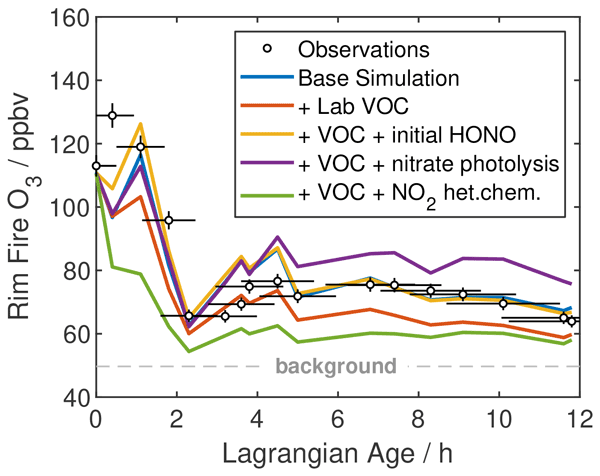
Glenn M. Wolfe, Thomas F. Hanisco, Heather L. Arkinson, Donald R. Blake, Armin Wisthaler, Tomas Mikoviny, Thomas B. Ryerson, Ilana Pollack, Jeff Peischl, Paul O. Wennberg, John D. Crounse, Jason M. St. Clair, Alex Teng, L. Gregory Huey, Xiaoxi Liu, Alan Fried, Petter Weibring, Dirk Richter, James Walega, Samuel R. Hall, Kirk Ullmann, Jose L. Jimenez, Pedro Campuzano-Jost, T. Paul Bui, Glenn Diskin, James R. Podolske, Glen Sachse, and Ronald C. Cohen
Atmos. Chem. Phys., 22, 4253–4275, https://doi.org/10.5194/acp-22-4253-2022, https://doi.org/10.5194/acp-22-4253-2022, 2022
Short summary
Short summary
Smoke plumes are chemically complex. This work combines airborne observations of smoke plume composition with a photochemical model to probe the production of ozone and the fate of reactive gases in the outflow of a large wildfire. Model–measurement comparisons illustrate how uncertain emissions and chemical processes propagate into simulated chemical evolution. Results provide insight into how this system responds to perturbations, which can help guide future observation and modeling efforts.
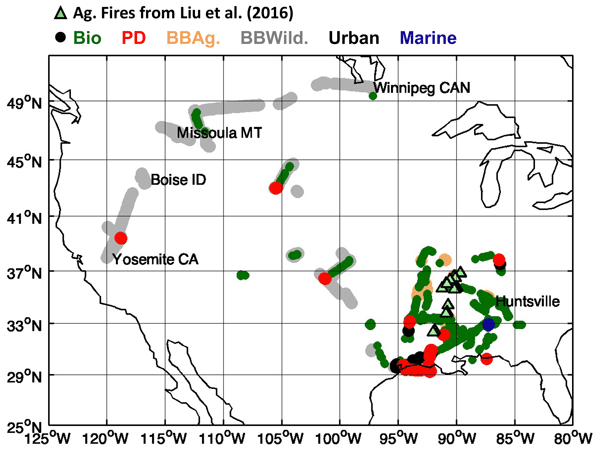
Meloë S. F. Kacenelenbogen, Qian Tan, Sharon P. Burton, Otto P. Hasekamp, Karl D. Froyd, Yohei Shinozuka, Andreas J. Beyersdorf, Luke Ziemba, Kenneth L. Thornhill, Jack E. Dibb, Taylor Shingler, Armin Sorooshian, Reed W. Espinosa, Vanderlei Martins, Jose L. Jimenez, Pedro Campuzano-Jost, Joshua P. Schwarz, Matthew S. Johnson, Jens Redemann, and Gregory L. Schuster
Atmos. Chem. Phys., 22, 3713–3742, https://doi.org/10.5194/acp-22-3713-2022, https://doi.org/10.5194/acp-22-3713-2022, 2022
Short summary
Short summary
The impact of aerosols on Earth's radiation budget and human health is important and strongly depends on their composition. One desire of our scientific community is to derive the composition of the aerosol from satellite sensors. However, satellites observe aerosol optical properties (and not aerosol composition) based on remote sensing instrumentation. This study assesses how much aerosol optical properties can tell us about aerosol composition.
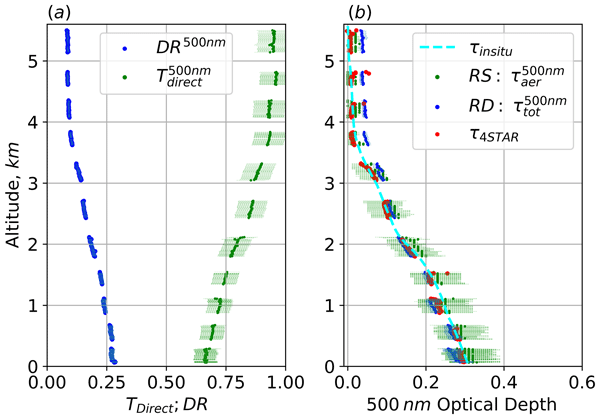
Matthew S. Norgren, John Wood, K. Sebastian Schmidt, Bastiaan van Diedenhoven, Snorre A. Stamnes, Luke D. Ziemba, Ewan C. Crosbie, Michael A. Shook, A. Scott Kittelman, Samuel E. LeBlanc, Stephen Broccardo, Steffen Freitag, and Jeffrey S. Reid
Atmos. Meas. Tech., 15, 1373–1394, https://doi.org/10.5194/amt-15-1373-2022, https://doi.org/10.5194/amt-15-1373-2022, 2022
Short summary
Short summary
A new spectral instrument (SPN-S), with the ability to partition solar radiation into direct and diffuse components, is used in airborne settings to study the optical properties of aerosols and cirrus. It is a low-cost and mechanically simple system but has higher measurement uncertainty than existing standards. This challenge is overcome by utilizing the unique measurement capabilities to develop new retrieval techniques. Validation is done with data from two NASA airborne research campaigns.

Adam T. Ahern, Frank Erdesz, Nicholas L. Wagner, Charles A. Brock, Ming Lyu, Kyra Slovacek, Richard H. Moore, Elizabeth B. Wiggins, and Daniel M. Murphy
Atmos. Meas. Tech., 15, 1093–1105, https://doi.org/10.5194/amt-15-1093-2022, https://doi.org/10.5194/amt-15-1093-2022, 2022
Short summary
Short summary
Particles in the atmosphere play a significant role in climate change by scattering light back into space, reducing the amount of energy available to be absorbed by greenhouse gases. We built a new instrument to measure what direction light is scattered by particles, e.g., wildfire smoke. This is important because, depending on the angle of the sun, some particles scatter light into space (cooling the planet), but some light is also scattered towards the Earth (not cooling the planet).
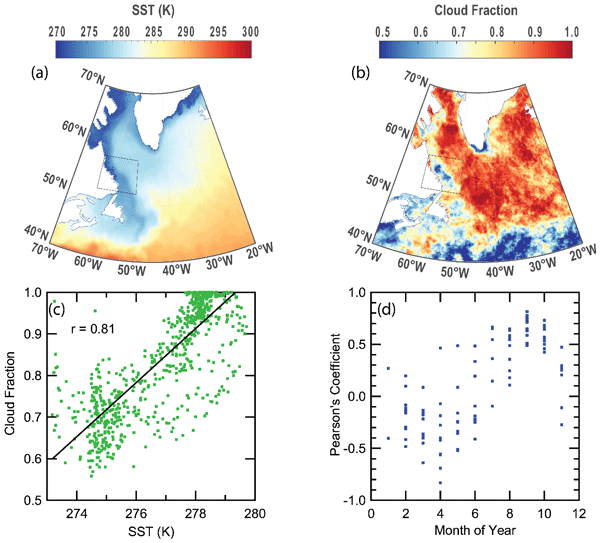
Kevin J. Sanchez, Bo Zhang, Hongyu Liu, Matthew D. Brown, Ewan C. Crosbie, Francesca Gallo, Johnathan W. Hair, Chris A. Hostetler, Carolyn E. Jordan, Claire E. Robinson, Amy Jo Scarino, Taylor J. Shingler, Michael A. Shook, Kenneth L. Thornhill, Elizabeth B. Wiggins, Edward L. Winstead, Luke D. Ziemba, Georges Saliba, Savannah L. Lewis, Lynn M. Russell, Patricia K. Quinn, Timothy S. Bates, Jack Porter, Thomas G. Bell, Peter Gaube, Eric S. Saltzman, Michael J. Behrenfeld, and Richard H. Moore
Atmos. Chem. Phys., 22, 2795–2815, https://doi.org/10.5194/acp-22-2795-2022, https://doi.org/10.5194/acp-22-2795-2022, 2022
Short summary
Short summary
Atmospheric particle concentrations impact clouds, which strongly impact the amount of sunlight reflected back into space and the overall climate. Measurements of particles over the ocean are rare and expensive to collect, so models are necessary to fill in the gaps by simulating both particle and clouds. However, some measurements are needed to test the accuracy of the models. Here, we measure changes in particles in different weather conditions, which are ideal for comparison with models.
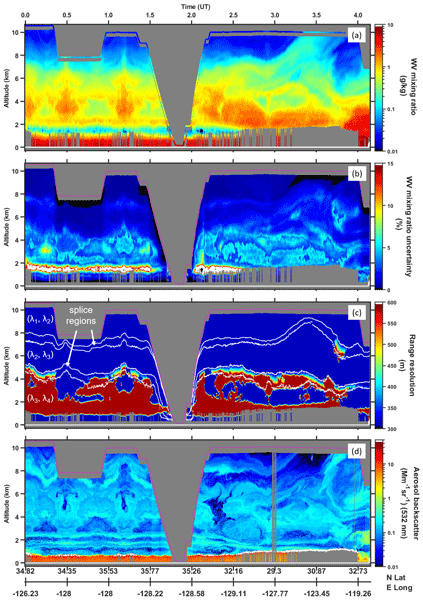
Brian J. Carroll, Amin R. Nehrir, Susan A. Kooi, James E. Collins, Rory A. Barton-Grimley, Anthony Notari, David B. Harper, and Joseph Lee
Atmos. Meas. Tech., 15, 605–626, https://doi.org/10.5194/amt-15-605-2022, https://doi.org/10.5194/amt-15-605-2022, 2022
Short summary
Short summary
HALO is a recently developed lidar system that demonstrates new technologies and advanced algorithms for profiling water vapor as well as aerosol and cloud properties. The high-resolution, high-accuracy measurements have unique advantages within the suite of atmospheric instrumentation, such as directly trading water vapor measurement resolution for precision. This paper provides the methodology and first water vapor results, showing agreement with in situ and spaceborne sounder measurements.
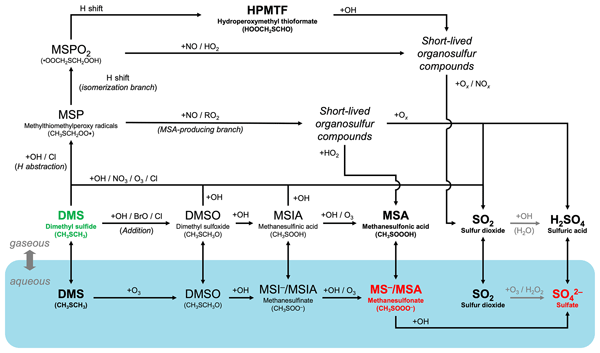
Ka Ming Fung, Colette L. Heald, Jesse H. Kroll, Siyuan Wang, Duseong S. Jo, Andrew Gettelman, Zheng Lu, Xiaohong Liu, Rahul A. Zaveri, Eric C. Apel, Donald R. Blake, Jose-Luis Jimenez, Pedro Campuzano-Jost, Patrick R. Veres, Timothy S. Bates, John E. Shilling, and Maria Zawadowicz
Atmos. Chem. Phys., 22, 1549–1573, https://doi.org/10.5194/acp-22-1549-2022, https://doi.org/10.5194/acp-22-1549-2022, 2022
Short summary
Short summary
Understanding the natural aerosol burden in the preindustrial era is crucial for us to assess how atmospheric aerosols affect the Earth's radiative budgets. Our study explores how a detailed description of dimethyl sulfide (DMS) oxidation (implemented in the Community Atmospheric Model version 6 with chemistry, CAM6-chem) could help us better estimate the present-day and preindustrial concentrations of sulfate and other relevant chemicals, as well as the resulting aerosol radiative impacts.
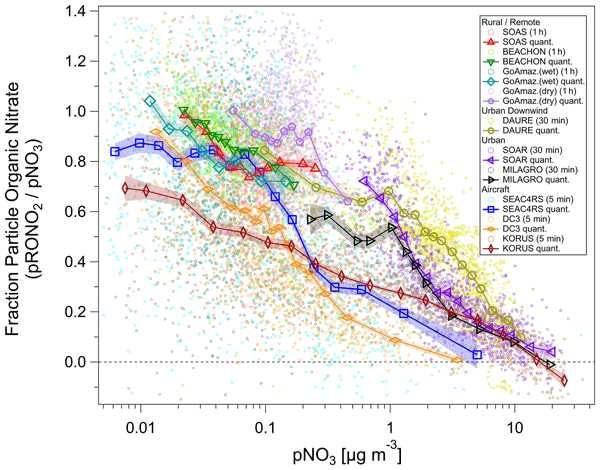
Douglas A. Day, Pedro Campuzano-Jost, Benjamin A. Nault, Brett B. Palm, Weiwei Hu, Hongyu Guo, Paul J. Wooldridge, Ronald C. Cohen, Kenneth S. Docherty, J. Alex Huffman, Suzane S. de Sá, Scot T. Martin, and Jose L. Jimenez
Atmos. Meas. Tech., 15, 459–483, https://doi.org/10.5194/amt-15-459-2022, https://doi.org/10.5194/amt-15-459-2022, 2022
Short summary
Short summary
Particle-phase nitrates are an important component of atmospheric aerosols and chemistry. In this paper, we systematically explore the application of aerosol mass spectrometry (AMS) to quantify the organic and inorganic nitrate fractions of aerosols in the atmosphere. While AMS has been used for a decade to quantify nitrates, methods are not standardized. We make recommendations for a more universal approach based on this analysis of a large range of field and laboratory observations.
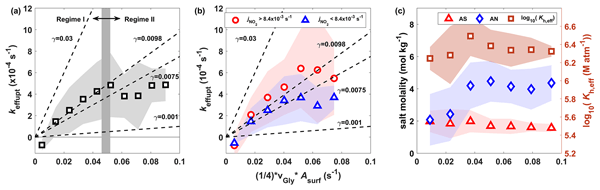
Dongwook Kim, Changmin Cho, Seokhan Jeong, Soojin Lee, Benjamin A. Nault, Pedro Campuzano-Jost, Douglas A. Day, Jason C. Schroder, Jose L. Jimenez, Rainer Volkamer, Donald R. Blake, Armin Wisthaler, Alan Fried, Joshua P. DiGangi, Glenn S. Diskin, Sally E. Pusede, Samuel R. Hall, Kirk Ullmann, L. Gregory Huey, David J. Tanner, Jack Dibb, Christoph J. Knote, and Kyung-Eun Min
Atmos. Chem. Phys., 22, 805–821, https://doi.org/10.5194/acp-22-805-2022, https://doi.org/10.5194/acp-22-805-2022, 2022
Short summary
Short summary
CHOCHO was simulated using a 0-D box model constrained by measurements during the KORUS-AQ mission. CHOCHO concentration was high in large cities, aromatics being the most important precursors. Loss path to aerosol was the highest sink, contributing to ~ 20 % of secondary organic aerosol formation. Our work highlights that simple CHOCHO surface uptake approach is valid only for low aerosol conditions and more work is required to understand CHOCHO solubility in high-aerosol conditions.
Sabrina P. Cochrane, K. Sebastian Schmidt, Hong Chen, Peter Pilewskie, Scott Kittelman, Jens Redemann, Samuel LeBlanc, Kristina Pistone, Michal Segal Rozenhaimer, Meloë Kacenelenbogen, Yohei Shinozuka, Connor Flynn, Rich Ferrare, Sharon Burton, Chris Hostetler, Marc Mallet, and Paquita Zuidema
Atmos. Meas. Tech., 15, 61–77, https://doi.org/10.5194/amt-15-61-2022, https://doi.org/10.5194/amt-15-61-2022, 2022
Short summary
Short summary
This work presents heating rates derived from aircraft observations from the 2016 and 2017 field campaigns of ORACLES (ObseRvations of Aerosols above CLouds and their intEractionS). We separate the total heating rates into aerosol and gas (primarily water vapor) absorption and explore some of the co-variability of heating rate profiles and their primary drivers, leading to the development of a new concept: the heating rate efficiency (HRE; the heating rate per unit aerosol extinction).
Amie Dobracki, Paquita Zuidema, Steve Howell, Pablo Saide, Steffen Freitag, Allison C. Aiken, Sharon P. Burton, Arthur J. Sedlacek III, Jens Redemann, and Robert Wood
Atmos. Chem. Phys. Discuss., https://doi.org/10.5194/acp-2021-1081, https://doi.org/10.5194/acp-2021-1081, 2022
Preprint withdrawn
Short summary
Short summary
The global maximum of shortwave-absorbing aerosol above cloud occurs above the southeast Atlantic, where the biomass-burning aerosol provides a distinct aerosol radiative warming of regional climate. The smoke aerosols are unusually highly absorbing of sunlight. This study seeks to understand the cause. We conclude the aerosol is already strongly absorbing at the fire emission source, but that chemical aging, through encouraging a net loss of organic aerosol, also contributes.
Sarah J. Doherty, Pablo E. Saide, Paquita Zuidema, Yohei Shinozuka, Gonzalo A. Ferrada, Hamish Gordon, Marc Mallet, Kerry Meyer, David Painemal, Steven G. Howell, Steffen Freitag, Amie Dobracki, James R. Podolske, Sharon P. Burton, Richard A. Ferrare, Calvin Howes, Pierre Nabat, Gregory R. Carmichael, Arlindo da Silva, Kristina Pistone, Ian Chang, Lan Gao, Robert Wood, and Jens Redemann
Atmos. Chem. Phys., 22, 1–46, https://doi.org/10.5194/acp-22-1-2022, https://doi.org/10.5194/acp-22-1-2022, 2022
Short summary
Short summary
Between July and October, biomass burning smoke is advected over the southeastern Atlantic Ocean, leading to climate forcing. Model calculations of forcing by this plume vary significantly in both magnitude and sign. This paper compares aerosol and cloud properties observed during three NASA ORACLES field campaigns to the same in four models. It quantifies modeled biases in properties key to aerosol direct radiative forcing and evaluates how these biases propagate to biases in forcing.
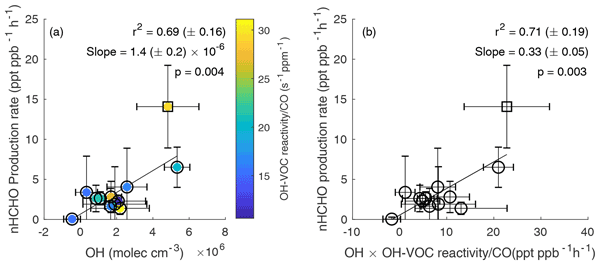
Jin Liao, Glenn M. Wolfe, Reem A. Hannun, Jason M. St. Clair, Thomas F. Hanisco, Jessica B. Gilman, Aaron Lamplugh, Vanessa Selimovic, Glenn S. Diskin, John B. Nowak, Hannah S. Halliday, Joshua P. DiGangi, Samuel R. Hall, Kirk Ullmann, Christopher D. Holmes, Charles H. Fite, Anxhelo Agastra, Thomas B. Ryerson, Jeff Peischl, Ilann Bourgeois, Carsten Warneke, Matthew M. Coggon, Georgios I. Gkatzelis, Kanako Sekimoto, Alan Fried, Dirk Richter, Petter Weibring, Eric C. Apel, Rebecca S. Hornbrook, Steven S. Brown, Caroline C. Womack, Michael A. Robinson, Rebecca A. Washenfelder, Patrick R. Veres, and J. Andrew Neuman
Atmos. Chem. Phys., 21, 18319–18331, https://doi.org/10.5194/acp-21-18319-2021, https://doi.org/10.5194/acp-21-18319-2021, 2021
Short summary
Short summary
Formaldehyde (HCHO) is an important oxidant precursor and affects the formation of O3 and other secondary pollutants in wildfire plumes. We disentangle the processes controlling HCHO evolution from wildfire plumes sampled by NASA DC-8 during FIREX-AQ. We find that OH abundance rather than normalized OH reactivity is the main driver of fire-to-fire variability in HCHO secondary production and estimate an effective HCHO yield per volatile organic compound molecule oxidized in wildfire plumes.

Tiziana Bräuer, Christiane Voigt, Daniel Sauer, Stefan Kaufmann, Valerian Hahn, Monika Scheibe, Hans Schlager, Felix Huber, Patrick Le Clercq, Richard H. Moore, and Bruce E. Anderson
Atmos. Chem. Phys., 21, 16817–16826, https://doi.org/10.5194/acp-21-16817-2021, https://doi.org/10.5194/acp-21-16817-2021, 2021
Short summary
Short summary
Over half of aviation climate impact is caused by contrails. Biofuels can reduce the ice crystal numbers in contrails and mitigate the climate impact. The experiment ECLIF II/NDMAX in 2018 assessed the effects of biofuels on contrails and aviation emissions. The NASA DC-8 aircraft performed measurements inside the contrail of the DLR A320. One reference fuel and two blends of the biofuel HEFA and kerosene are analysed. We find a max reduction of contrail ice numbers through biofuel use of 40 %.
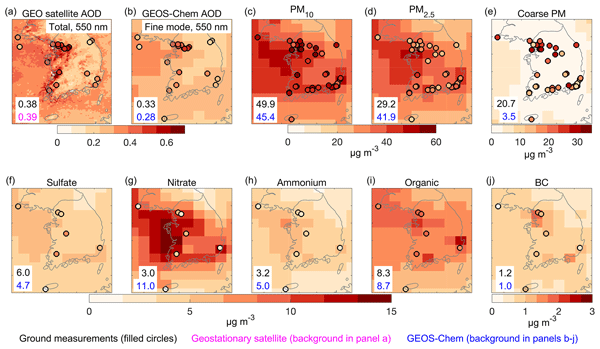
Shixian Zhai, Daniel J. Jacob, Jared F. Brewer, Ke Li, Jonathan M. Moch, Jhoon Kim, Seoyoung Lee, Hyunkwang Lim, Hyun Chul Lee, Su Keun Kuk, Rokjin J. Park, Jaein I. Jeong, Xuan Wang, Pengfei Liu, Gan Luo, Fangqun Yu, Jun Meng, Randall V. Martin, Katherine R. Travis, Johnathan W. Hair, Bruce E. Anderson, Jack E. Dibb, Jose L. Jimenez, Pedro Campuzano-Jost, Benjamin A. Nault, Jung-Hun Woo, Younha Kim, Qiang Zhang, and Hong Liao
Atmos. Chem. Phys., 21, 16775–16791, https://doi.org/10.5194/acp-21-16775-2021, https://doi.org/10.5194/acp-21-16775-2021, 2021
Short summary
Short summary
Geostationary satellite aerosol optical depth (AOD) has tremendous potential for monitoring surface fine particulate matter (PM2.5). Our study explored the physical relationship between AOD and PM2.5 by integrating data from surface networks, aircraft, and satellites with the GEOS-Chem chemical transport model. We quantitatively showed that accurate simulation of aerosol size distributions, boundary layer depths, relative humidity, coarse particles, and diurnal variations in PM2.5 are essential.
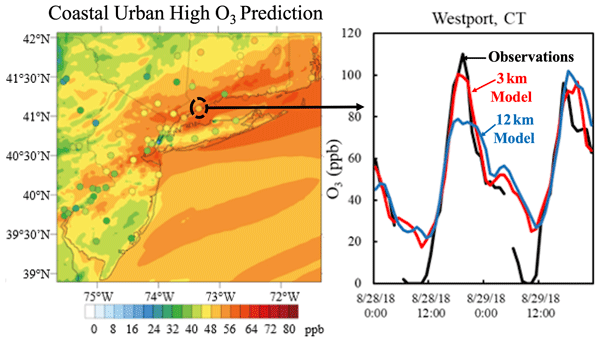
Siqi Ma, Daniel Tong, Lok Lamsal, Julian Wang, Xuelei Zhang, Youhua Tang, Rick Saylor, Tianfeng Chai, Pius Lee, Patrick Campbell, Barry Baker, Shobha Kondragunta, Laura Judd, Timothy A. Berkoff, Scott J. Janz, and Ivanka Stajner
Atmos. Chem. Phys., 21, 16531–16553, https://doi.org/10.5194/acp-21-16531-2021, https://doi.org/10.5194/acp-21-16531-2021, 2021
Short summary
Short summary
Predicting high ozone gets more challenging as urban emissions decrease. How can different techniques be used to foretell the quality of air to better protect human health? We tested four techniques with the CMAQ model against observations during a field campaign over New York City. The new system proves to better predict the magnitude and timing of high ozone. These approaches can be extended to other regions to improve the predictability of high-O3 episodes in contemporary urban environments.
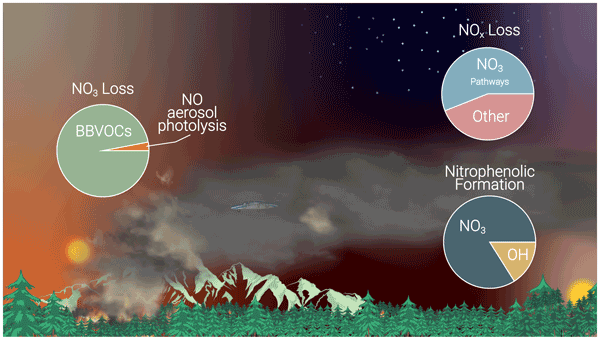
Zachary C. J. Decker, Michael A. Robinson, Kelley C. Barsanti, Ilann Bourgeois, Matthew M. Coggon, Joshua P. DiGangi, Glenn S. Diskin, Frank M. Flocke, Alessandro Franchin, Carley D. Fredrickson, Georgios I. Gkatzelis, Samuel R. Hall, Hannah Halliday, Christopher D. Holmes, L. Gregory Huey, Young Ro Lee, Jakob Lindaas, Ann M. Middlebrook, Denise D. Montzka, Richard Moore, J. Andrew Neuman, John B. Nowak, Brett B. Palm, Jeff Peischl, Felix Piel, Pamela S. Rickly, Andrew W. Rollins, Thomas B. Ryerson, Rebecca H. Schwantes, Kanako Sekimoto, Lee Thornhill, Joel A. Thornton, Geoffrey S. Tyndall, Kirk Ullmann, Paul Van Rooy, Patrick R. Veres, Carsten Warneke, Rebecca A. Washenfelder, Andrew J. Weinheimer, Elizabeth Wiggins, Edward Winstead, Armin Wisthaler, Caroline Womack, and Steven S. Brown
Atmos. Chem. Phys., 21, 16293–16317, https://doi.org/10.5194/acp-21-16293-2021, https://doi.org/10.5194/acp-21-16293-2021, 2021
Short summary
Short summary
To understand air quality impacts from wildfires, we need an accurate picture of how wildfire smoke changes chemically both day and night as sunlight changes the chemistry of smoke. We present a chemical analysis of wildfire smoke as it changes from midday through the night. We use aircraft observations from the FIREX-AQ field campaign with a chemical box model. We find that even under sunlight typical
nighttimechemistry thrives and controls the fate of key smoke plume chemical processes.

Hossein Dadashazar, Majid Alipanah, Miguel Ricardo A. Hilario, Ewan Crosbie, Simon Kirschler, Hongyu Liu, Richard H. Moore, Andrew J. Peters, Amy Jo Scarino, Michael Shook, K. Lee Thornhill, Christiane Voigt, Hailong Wang, Edward Winstead, Bo Zhang, Luke Ziemba, and Armin Sorooshian
Atmos. Chem. Phys., 21, 16121–16141, https://doi.org/10.5194/acp-21-16121-2021, https://doi.org/10.5194/acp-21-16121-2021, 2021
Short summary
Short summary
This study investigates precipitation impacts on long-range transport of North American outflow over the western North Atlantic Ocean (WNAO). Results demonstrate that precipitation scavenging plays a significant role in modifying surface aerosol concentrations over the WNAO, especially in winter and spring due to large-scale scavenging processes. This study highlights how precipitation impacts surface aerosol properties with relevance for other marine regions vulnerable to continental outflow.
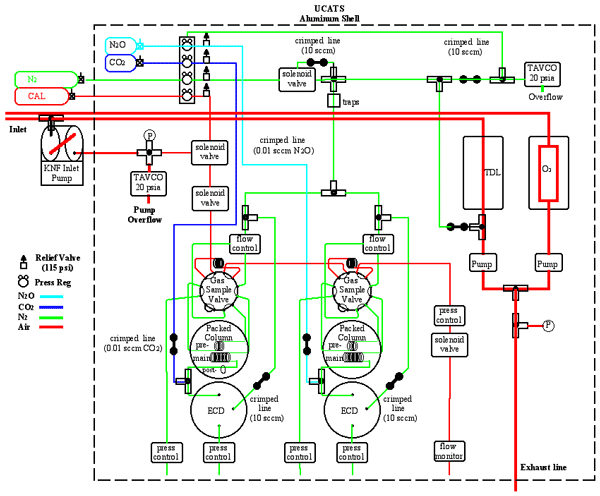
Eric J. Hintsa, Fred L. Moore, Dale F. Hurst, Geoff S. Dutton, Bradley D. Hall, J. David Nance, Ben R. Miller, Stephen A. Montzka, Laura P. Wolton, Audra McClure-Begley, James W. Elkins, Emrys G. Hall, Allen F. Jordan, Andrew W. Rollins, Troy D. Thornberry, Laurel A. Watts, Chelsea R. Thompson, Jeff Peischl, Ilann Bourgeois, Thomas B. Ryerson, Bruce C. Daube, Yenny Gonzalez Ramos, Roisin Commane, Gregory W. Santoni, Jasna V. Pittman, Steven C. Wofsy, Eric Kort, Glenn S. Diskin, and T. Paul Bui
Atmos. Meas. Tech., 14, 6795–6819, https://doi.org/10.5194/amt-14-6795-2021, https://doi.org/10.5194/amt-14-6795-2021, 2021
Short summary
Short summary
We built UCATS to study atmospheric chemistry and transport. It has measured trace gases including CFCs, N2O, SF6, CH4, CO, and H2 with gas chromatography, as well as ozone and water vapor. UCATS has been part of missions to study the tropical tropopause; transport of air into the stratosphere; greenhouse gases, transport, and chemistry in the troposphere; and ozone chemistry, on both piloted and unmanned aircraft. Its design, capabilities, and some results are shown and described here.
Cited articles
Aguilera, R., Corringham, T., Gershunov, A., and Benmarhnia, T.: Wildfire smoke impacts respiratory health more than fine particles from other sources: observational evidence from Southern California, Nat. Commun., 12, 1493, https://doi.org/10.1038/s41467-021-21708-0, 2021.
Al-Saadi, J. A., Rosen, R., Bohnenkamp, C., Szykman, J., Chu, D. A., Hair, J., Hostetler, C., Ferrare, R., Arcemont, G., Kittaka, C., and Lewis, L.: Application of Satellite Aerosol Optical Depth and Airborne Lidar Data for Monitoring Fine Particulate Formation and Transport in San Joaquin Valley, California, 10th Conference on Atmospheric Chemistry, American Meteorological Society, Boston, MA, https://ams.confex.com/ams/88Annual/techprogram/paper_134260.htm (last access: 14 August 2025), 2008.
Barton-Grimley, R. A., Nehrir, A. R., Kooi, S. A., Collins, J. E., Harper, D. B., Notari, A., Lee, J., DiGangi, J. P., Choi, Y., and Davis, K. J.: Evaluation of the High Altitude Lidar Observatory (HALO) methane retrievals during the summer 2019 ACT-America campaign, Atmos. Meas. Tech., 15, 4623–4650, https://doi.org/10.5194/amt-15-4623-2022, 2022.
Browell, E. V.: Differential absorption lidar sensing of ozone, Proceedings of the IEEE, 77, 419–432, 1989.
Burton, S., Hostetler, C., Cook, A., Hair, J., Seaman, S., Scola, S., Harper, D., Smith, J., Fenn, M., and Ferrare, R. A.: Calibration of a high spectral resolution lidar using a Michelson interferometer, with data examples from ORACLES, Applied Optics, 57, 6061–6075, 2018.
Burton, S. P., Ferrare, R. A., Hostetler, C. A., Hair, J. W., Kittaka, C., Vaughan, M. A., Obland, M. D., Rogers, R. R., Cook, A. L., Harper, D. B., and Remer, L. A.: Using airborne high spectral resolution lidar data to evaluate combined active plus passive retrievals of aerosol extinction profiles, J. Geophys. Res.-Atmospheres, https://doi.org/10.1029/2009jd012130, 2010.
Burton, S. P., Ferrare, R. A., Hostetler, C. A., Hair, J. W., Rogers, R. R., Obland, M. D., Butler, C. F., Cook, A. L., Harper, D. B., and Froyd, K. D.: Aerosol classification using airborne High Spectral Resolution Lidar measurements – methodology and examples, Atmos. Meas. Tech., 5, 73–98, https://doi.org/10.5194/amt-5-73-2012, 2012.
Burton, S. P., Hair, J. W., Kahnert, M., Ferrare, R. A., Hostetler, C. A., Cook, A. L., Harper, D. B., Berkoff, T. A., Seaman, S. T., Collins, J. E., Fenn, M. A., and Rogers, R. R.: Observations of the spectral dependence of linear particle depolarization ratio of aerosols using NASA Langley airborne High Spectral Resolution Lidar, Atmos. Chem. Phys., 15, 13453–13473, https://doi.org/10.5194/acp-15-13453-2015, 2015.
Carroll, B. J., Nehrir, A. R., Kooi, S. A., Collins, J. E., Barton-Grimley, R. A., Notari, A., Harper, D. B., and Lee, J.: Differential absorption lidar measurements of water vapor by the High Altitude Lidar Observatory (HALO): retrieval framework and first results, Atmos. Meas. Tech., 15, 605–626, https://doi.org/10.5194/amt-15-605-2022, 2022.
Chen, B., Song, Z., Pan, F., and Huang, Y.: Obtaining vertical distribution of PM2.5 from CALIOP data and machine learning algorithms, Science of The Total Environment, 805, 150338, https://doi.org/10.1016/j.scitotenv.2021.150338, 2022.
Chen, Q.-X., Yuan, Y., Huang, X., Jiang, Y.-Q., and Tan, H.-P.: Estimation of surface-level PM2.5 concentration using aerosol optical thickness through aerosol type analysis method, Atmospheric Environment, 159, 26–33, https://doi.org/10.1016/j.atmosenv.2017.03.050, 2017.
Cheng, Z., Ma, X., He, Y., Jiang, J., Wang, X., Wang, Y., Sheng, L., Hu, J., and Yan, N.: Mass extinction efficiency and extinction hygroscopicity of ambient PM2.5 in urban China, Environmental Research, 156, 239–246, https://doi.org/10.1016/j.envres.2017.03.022, 2017.
Chu, D. A., Kaufman, Y., Zibordi, G., Chern, J., Mao, J., Li, C., and Holben, B.: Global monitoring of air pollution over land from the Earth Observing System-Terra Moderate Resolution Imaging Spectroradiometer (MODIS), Journal of Geophysical Research: Atmospheres, 108, https://doi.org/10.1029/2002JD003179, 2003.
Chu, D. A., Tsai, T.-C., Chen, J.-P., Chang, S.-C., Jeng, Y.-J., Chiang, W.-L., and Lin, N.-H.: Interpreting aerosol lidar profiles to better estimate surface PM2.5 for columnar AOD measurements, Atmospheric Environment, 79, 172–187, 2013.
Chu, D. A., Ferrare, R., Szykman, J., Lewis, J., Scarino, A., Hains, J., Burton, S., Chen, G., Tsai, T., and Hostetler, C.: Regional characteristics of the relationship between columnar AOD and surface PM2.5: Application of lidar aerosol extinction profiles over Baltimore–Washington Corridor during DISCOVER-AQ, Atmospheric Environment, 101, 338–349, 2015.
Copernicus Climate Change Service, Climate Data Store: ERA5 hourly data on single levels from 1940 to present, Copernicus Climate Change Service (C3S) Climate Data Store (CDS) [data set], https://doi.org/10.24381/cds.adbb2d47, 2023.
Crawford, J. H., Travis, K. R., Judd, L. M., Lefer, B. L., Dibb, J. E., Kim, J., Park, R., Lee, G., Chang, L., and Simpas, J. B. B.: The Airborne and Satellite Investigation of Asian Air Quality (Asia-Aq): An Opportunity for International Collaboration, IGARSS 2022 – 2022 IEEE International Geoscience and Remote Sensing Symposium, 6506–6509, https://doi.org/10.1109/IGARSS46834.2022.9883819, 2022.
Dawson, K. W., Meskhidze, N., Burton, S. P., Johnson, M. S., Kacenelenbogen, M. S., Hostetler, C. A., and Hu, Y.: Creating Aerosol Types from CHemistry (CATCH): A New Algorithm to Extend the Link Between Remote Sensing and Models, Journal of Geophysical Research: Atmospheres, 122, 12366–12392, https://doi.org/10.1002/2017JD026913, 2017.
Diao, M., Holloway, T., Choi, S., O'Neill, S. M., Al-Hamdan, M. Z., Van Donkelaar, A., Martin, R. V., Jin, X., Fiore, A. M., Henze, D. K., Lacey, F., Kinney, P. L., Freedman, F., Larkin, N. K., Zou, Y., Kelly, J. T., and Vaidyanathan, A.: Methods, availability, and applications of PM(2.5) exposure estimates derived from ground measurements, satellite, and atmospheric models, J. Air Waste Manag. Assoc., 69, 1391–1414, https://doi.org/10.1080/10962247.2019.1668498, 2019.
Fang, Z., Yang, H., Li, C., Cheng, L., Zhao, M., and Xie, C.: Prediction of PM2.5 hourly concentrations in Beijing based on machine learning algorithm and ground-based LiDAR, Archives of Environmental Protection, 47, https://doi.org/10.24425/aep.2021.138468, 2021.
Fast, J. D., Gustafson Jr., W. I., Chapman, E. G., Easter, R. C., Rishel, J. P., Zaveri, R. A., Grell, G. A., and Barth, M. C.: The Aerosol Modeling Testbed: A community tool to objectively evaluate aerosol process modules, Bulletin of the American Meteorological Society, 92, 343–360, 2011.
Fast, J. D., Allan, J., Bahreini, R., Craven, J., Emmons, L., Ferrare, R., Hayes, P. L., Hodzic, A., Holloway, J., Hostetler, C., Jimenez, J. L., Jonsson, H., Liu, S., Liu, Y., Metcalf, A., Middlebrook, A., Nowak, J., Pekour, M., Perring, A., Russell, L., Sedlacek, A., Seinfeld, J., Setyan, A., Shilling, J., Shrivastava, M., Springston, S., Song, C., Subramanian, R., Taylor, J. W., Vinoj, V., Yang, Q., Zaveri, R. A., and Zhang, Q.: Modeling regional aerosol and aerosol precursor variability over California and its sensitivity to emissions and long-range transport during the 2010 CalNex and CARES campaigns, Atmos. Chem. Phys., 14, 10013–10060, https://doi.org/10.5194/acp-14-10013-2014, 2014.
Federal Register: National ambient air quality standards for particulate matter, Proposed Rule 10, Environmental Protection Agency, 40 CFR Part 81 [EPA-HQ-OAR-2007-0562; FRL-8969-2] RIN-2060-AP27, https://www.federalregister.gov/d/E9-25711 (last access: 17 July 2025), 2009.
Ferrare, R., Hostetler, C., Burton, S., Fenn, M., Harper, D., Cook, T., Scarino, A. J., Clayton, M., Hair, J., and Lee, J.: Airborne High Spectral Resolution Lidar Measurements of Aerosol Distributions and Properties during the NASA CAMP2Ex Mission, American Meteorological Society Annual Meeting, 10–15 January 2021, https://ams.confex.com/ams/101ANNUAL/meetingapp.cgi/Paper/380263 (last access: 14 August 2025), 2021.
Ferrare, R., Hair, J., Hostetler, C., Shingler, T., Burton, S. P., Fenn, M., Clayton, M., Scarino, A. J., Harper, D., and Seaman, S.: Airborne HSRL-2 measurements of elevated aerosol depolarization associated with non-spherical sea salt, Frontiers in Remote Sensing, 4, 1143944, https://doi.org/10.3389/frsen.2023.1143944, 2023.
Floutsi, A. A., Baars, H., and Wandinger, U.: HETEAC-Flex: an optimal estimation method for aerosol typing based on lidar-derived intensive optical properties, Atmos. Meas. Tech., 17, 693–714, https://doi.org/10.5194/amt-17-693-2024, 2024.
Gliß, J., Mortier, A., Schulz, M., Andrews, E., Balkanski, Y., Bauer, S. E., Benedictow, A. M. K., Bian, H., Checa-Garcia, R., Chin, M., Ginoux, P., Griesfeller, J. J., Heckel, A., Kipling, Z., Kirkevåg, A., Kokkola, H., Laj, P., Le Sager, P., Lund, M. T., Lund Myhre, C., Matsui, H., Myhre, G., Neubauer, D., van Noije, T., North, P., Olivié, D. J. L., Rémy, S., Sogacheva, L., Takemura, T., Tsigaridis, K., and Tsyro, S. G.: AeroCom phase III multi-model evaluation of the aerosol life cycle and optical properties using ground- and space-based remote sensing as well as surface in situ observations, Atmos. Chem. Phys., 21, 87–128, https://doi.org/10.5194/acp-21-87-2021, 2021.
Greenstone, M.: The impacts of environmental regulations on industrial activity: Evidence from the 1970 and 1977 clean air act amendments and the census of manufactures, Journal of Political Economy, 110, 1175–1219, 2002.
Groß, S., Esselborn, M., Abicht, F., Wirth, M., Fix, A., and Minikin, A.: Airborne high spectral resolution lidar observation of pollution aerosol during EUCAARI-LONGREX, Atmos. Chem. Phys., 13, 2435–2444, https://doi.org/10.5194/acp-13-2435-2013, 2013.
Grund, C. J. and Eloranta, E. W.: University-of-Wisconsin High Spectral Resolution Lidar, Optical Engineering, 30, 6–12, 1991.
Guo, H., Campuzano-Jost, P., Nault, B. A., Day, D. A., Schroder, J. C., Kim, D., Dibb, J. E., Dollner, M., Weinzierl, B., and Jimenez, J. L.: The importance of size ranges in aerosol instrument intercomparisons: a case study for the Atmospheric Tomography Mission, Atmos. Meas. Tech., 14, 3631–3655, https://doi.org/10.5194/amt-14-3631-2021, 2021.
Hair, J. W., Hostetler, C. A., Cook, A. L., Harper, D. B., Ferrare, R. A., Mack, T. L., Welch, W., Izquierdo, L. R., and Hovis, F. E.: Airborne High Spectral Resolution Lidar for profiling aerosol optical properties, Applied Optics, https://doi.org/10.1364/AO.47.006734, 2008.
Hand, J. L. and Malm, W. C.: Review of aerosol mass scattering efficiencies from ground-based measurements since 1990, Journal of Geophysical Research: Atmospheres, 112, https://doi.org/10.1029/2007JD008484, 2007.
Handschuh, J., Erbertseder, T., Schaap, M., and Baier, F.: Estimating PM2.5 surface concentrations from AOD: A combination of SLSTR and MODIS, Remote Sensing Applications: Society and Environment, 26, 100716, https://doi.org/10.1016/j.rsase.2022.100716, 2022.
Hänel, G.: The properties of atmospheric aerosol particles as functions of the relative humidity at thermodynamic equilibrium with the surrounding moist air, in: Advances in geophysics, Elsevier, 73–188, https://doi.org/10.1016/S0065-2687(08)60142-9, 1976.
Harshvardhan, H., Ferrare, R., Burton, S., Hair, J., Hostetler, C., Harper, D., Cook, A., Fenn, M., Scarino, A. J., Chemyakin, E., and Müller, D.: Vertical structure of biomass burning aerosol transported over the southeast Atlantic Ocean, Atmos. Chem. Phys., 22, 9859–9876, https://doi.org/10.5194/acp-22-9859-2022, 2022.
Hasheminassab, S., Pakbin, P., Delfino, R. J., Schauer, J. J., and Sioutas, C.: Diurnal and seasonal trends in the apparent density of ambient fine and coarse particles in Los Angeles, Environ. Pollut., 187, 1–9, https://doi.org/10.1016/j.envpol.2013.12.015, 2014.
Hersbach, H., Bell, B., Berrisford, P., Hirahara, S., Horányi, A., Muñoz-Sabater, J., Nicolas, J., Peubey, C., Radu, R., and Schepers, D.: The ERA5 global reanalysis, Quarterly Journal of the Royal Meteorological Society, 146, 1999–2049, 2020.
Hoff, R. M. and Christopher, S. A.: Remote Sensing of Particulate Pollution from Space: Have We Reached the Promised Land?, Journal of the Air & Waste Management Association, 59, 645–675, https://doi.org/10.3155/1047-3289.59.6.645, 2009.
Josset, D., Rogers, R., Pelon, J., Hu, Y. X., Liu, Z. Y., Omar, A., and Zhai, P. W.: CALIPSO lidar ratio retrieval over the ocean, Opt. Express, 19, 18696–18706, 2011.
Judd, L., Sullivan, J., Crawford, J., Lefer, B., Martin, M. Y., Travis, K., Chance, K., Liu, X., Janz, S., and Hair, J.: Accelerating TEMPO Air Quality Science Through STAQS, AGU Fall Meeting, Chicago, IL, USA, 12–16 December 2022, https://agu.confex.com/agu/fm22/meetingapp.cgi/Paper/1072074 (last access: 14 September 2025), 2022.
Jung, C. H., Um, J., Bae, S. Y., Yoon, Y. J., Lee, S. S., Lee, J. Y., and Kim, Y. P.: Analytic expression for the aerosol mass efficiencies for polydispersed accumulation mode, Aerosol and Air Quality Research, 18, 1503–1514, 2018.
Kahn, R. A.: Reducing the Uncertainties in Direct Aerosol Radiative Forcing, Surveys in Geophysics, 33, 701–721, https://doi.org/10.1007/s10712-011-9153-z, 2012.
Kahn, R. A., Berkoff, T. A., Brock, C., Chen, G., Ferrare, R. A., Ghan, S., Hansico, T. F., Hegg, D. A., Martins, J. V., McNaughton, C. S., Murphy, D. M., Ogren, J. A., Penner, J. E., Pilewskie, P., Seinfeld, J. H., and Worsnop, D. R.: SAM-CAAM: A Concept for Acquiring Systematic Aircraft Measurements to Characterize Aerosol Air Masses, Bulletin of the American Meteorological Society, 98, 2215–2228, https://doi.org/10.1175/BAMS-D-16-0003.1, 2017.
Kahn, R. A., Andrews, E., Brock, C. A., Chin, M., Feingold, G., Gettelman, A., Levy, R. C., Murphy, D. M., Nenes, A., Pierce, J. R., Popp, T., Redemann, J., Sayer, A. M., da Silva, A. M., Sogacheva, L., and Stier, P.: Reducing Aerosol Forcing Uncertainty by Combining Models With Satellite and Within-The-Atmosphere Observations: A Three-Way Street, Reviews of Geophysics, 61, e2022RG000796, https://doi.org/10.1029/2022RG000796, 2023.
Kassianov, E., Ovchinnikov, M., Berg, L. K., McFarlane, S. A., Flynn, C., Ferrare, R., Hostetler, C., and Alexandrov, M.: Retrieval of aerosol optical depth in vicinity of broken clouds from reflectance ratios: case study, Atmos. Meas. Tech., 3, 1333–1349, https://doi.org/10.5194/amt-3-1333-2010, 2010.
Kim, D., Campuzano-Jost, P., Guo, H., Day, D. A., Yang, D., Dhaniyala, S., Williams, L., Croteau, P., Jayne, J., Worsnop, D., Volkamer, R., and Jimenez, J. L.: Development and characterization of an aircraft inlet system for broader quantitative particle sampling at higher altitudes: aerodynamic lenses, beam and vaporizer diagnostics, and pressure-controlled inlets, Aerosol Research, 3, 371–404, https://doi.org/10.5194/ar-3-371-2025, 2025.
Kim, Y. H., Warren, S. H., Krantz, Q. T., King, C., Jaskot, R., Preston, W. T., George, B. J., Hays, M. D., Landis, M. S., Higuchi, M., DeMarini, D. M., and Gilmour, M. I.: Mutagenicity and Lung Toxicity of Smoldering vs. Flaming Emissions from Various Biomass Fuels: Implications for Health Effects from Wildland Fires, Environ. Health Perspect., 126, 017011, https://doi.org/10.1289/EHP2200, 2018.
Kleinman, L. I., Sedlacek III, A. J., Adachi, K., Buseck, P. R., Collier, S., Dubey, M. K., Hodshire, A. L., Lewis, E., Onasch, T. B., Pierce, J. R., Shilling, J., Springston, S. R., Wang, J., Zhang, Q., Zhou, S., and Yokelson, R. J.: Rapid evolution of aerosol particles and their optical properties downwind of wildfires in the western US, Atmos. Chem. Phys., 20, 13319–13341, https://doi.org/10.5194/acp-20-13319-2020, 2020.
Knobelspiesse, K., Cairns, B., Ottaviani, M., Ferrare, R., Hair, J., Hostetler, C., Obland, M., Rogers, R., Redemann, J., Shinozuka, Y., Clarke, A., Freitag, S., Howell, S., Kapustin, V., and McNaughton, C.: Combined retrievals of boreal forest fire aerosol properties with a polarimeter and lidar, Atmos. Chem. Phys., 11, 7045–7067, https://doi.org/10.5194/acp-11-7045-2011, 2011.
Kuwata, M., Zorn, S. R., and Martin, S. T.: Using elemental ratios to predict the density of organic material composed of carbon, hydrogen, and oxygen, Environmental Science & Technology, 46, 787–794, 2012.
Lary, D. J., Lary, T., and Sattler, B.: Using Machine Learning to Estimate Global PM2.5 for Environmental Health Studies, Environmental Health Insights, 9s1, EHI.S15664, https://doi.org/10.4137/ehi.s15664, 2015.
Law, B. E., Abatzoglou, J. T., Schwalm, C. R., Byrne, D., Fann, N., and Nassikas, N. J.: Anthropogenic climate change contributes to wildfire particulate matter and related mortality in the United States, Communications Earth & Environment, 6, 336, https://doi.org/10.1038/s43247-025-02314-0, 2025.
Lee, A., Jeong, S., Joo, J., Park, C.-R., Kim, J., and Kim, S.: Potential role of urban forest in removing PM2.5: A case study in Seoul by deep learning with satellite data, Urban Climate, 36, 100795, https://doi.org/10.1016/j.uclim.2021.100795, 2021.
Lee, H. J., Coull, B. A., Bell, M. L., and Koutrakis, P.: Use of satellite-based aerosol optical depth and spatial clustering to predict ambient PM2.5 concentrations, Environ. Res., 118, 8–15, https://doi.org/10.1016/j.envres.2012.06.011, 2012.
Li, S., Joseph, E., Min, Q., Yin, B., Sakai, R., and Payne, M. K.: Remote sensing of PM2.5 during cloudy and nighttime periods using ceilometer backscatter, Atmos. Meas. Tech., 10, 2093–2104, https://doi.org/10.5194/amt-10-2093-2017, 2017.
Liu, Y., Sarnat, J. A., Kilaru, V., Jacob, D. J., and Koutrakis, P.: Estimating ground-level PM2.5 in the eastern United States using satellite remote sensing, Environ. Sci. Technol., 39, 3269–3278, https://doi.org/10.1021/es049352m, 2005.
Liu, Y., Li, C., Liu, D., Tang, Y., Seyler, B. C., Zhou, Z., Hu, X., Yang, F., and Zhan, Y.: Deriving hourly full-coverage PM2.5 concentrations across China's Sichuan Basin by fusing multisource satellite retrievals: A machine-learning approach, Atmospheric Environment, 271, 118930, https://doi.org/10.1016/j.atmosenv.2021.118930, 2022.
Lynch, P., Reid, J. S., Westphal, D. L., Zhang, J., Hogan, T. F., Hyer, E. J., Curtis, C. A., Hegg, D. A., Shi, Y., Campbell, J. R., Rubin, J. I., Sessions, W. R., Turk, F. J., and Walker, A. L.: An 11-year global gridded aerosol optical thickness reanalysis (v1.0) for atmospheric and climate sciences, Geosci. Model Dev., 9, 1489–1522, https://doi.org/10.5194/gmd-9-1489-2016, 2016.
Ma, X., Huang, Z., Qi, S., Huang, J., Zhang, S., Dong, Q., and Wang, X.: Ten-year global particulate mass concentration derived from space-borne CALIPSO lidar observations, Science of the Total Environment, 721, 137699, https://doi.org/10.1016/j.scitotenv.2020.137699, 2020.
Ma, Y., Zhu, Y., Liu, B., Li, H., Jin, S., Zhang, Y., Fan, R., and Gong, W.: Estimation of the vertical distribution of particle matter (PM2.5) concentration and its transport flux from lidar measurements based on machine learning algorithms, Atmos. Chem. Phys., 21, 17003–17016, https://doi.org/10.5194/acp-21-17003-2021, 2021.
Matus, A. V., Nowottnick, E. P., Yorks, J. E., and da Silva, A. M.: Enhancing Surface PM2.5 Air Quality Estimates in GEOS Using CATS Lidar Data, Earth and Space Science, 12, e2024EA004078, https://doi.org/10.1029/2024EA004078, 2025.
McPherson, C. J., Reagan, J. A., Schafer, J., Giles, D., Ferrare, R., Hair, J., and Hostetler, C.: AERONET, airborne HSRL, and CALIPSO aerosol retrievals compared and combined: A case study, J. Geophys. Res.-Atmospheres, https://doi.org/10.1029/2009jd012389, 2010.
Meskhidze, N., Sutherland, B., Ling, X., Dawson, K., Johnson, M. S., Henderson, B., Hostetler, C. A., and Ferrare, R. A.: Improving estimates of PM2.5 concentration and chemical composition by application of High Spectral Resolution Lidar (HSRL) and Creating Aerosol Types from chemistry (CATCH) algorithm, Atmospheric Environment, 250, 118250, https://doi.org/10.1016/j.atmosenv.2021.118250, 2021.
Moore, R. H., Thornhill, K. L., Weinzierl, B., Sauer, D., D'Ascoli, E., Kim, J., Lichtenstern, M., Scheibe, M., Beaton, B., and Beyersdorf, A. J.: Biofuel blending reduces particle emissions from aircraft engines at cruise conditions, Nature, 543, 411–415, 2017.
Moore, R. H., Wiggins, E. B., Ahern, A. T., Zimmerman, S., Montgomery, L., Campuzano Jost, P., Robinson, C. E., Ziemba, L. D., Winstead, E. L., Anderson, B. E., Brock, C. A., Brown, M. D., Chen, G., Crosbie, E. C., Guo, H., Jimenez, J. L., Jordan, C. E., Lyu, M., Nault, B. A., Rothfuss, N. E., Sanchez, K. J., Schueneman, M., Shingler, T. J., Shook, M. A., Thornhill, K. L., Wagner, N. L., and Wang, J.: Sizing response of the Ultra-High Sensitivity Aerosol Spectrometer (UHSAS) and Laser Aerosol Spectrometer (LAS) to changes in submicron aerosol composition and refractive index, Atmos. Meas. Tech., 14, 4517–4542, https://doi.org/10.5194/amt-14-4517-2021, 2021.
Müller, D., Hostetler, C. A., Ferrare, R. A., Burton, S. P., Chemyakin, E., Kolgotin, A., Hair, J. W., Cook, A. L., Harper, D. B., Rogers, R. R., Hare, R. W., Cleckner, C. S., Obland, M. D., Tomlinson, J., Berg, L. K., and Schmid, B.: Airborne Multiwavelength High Spectral Resolution Lidar (HSRL-2) observations during TCAP 2012: vertical profiles of optical and microphysical properties of a smoke/urban haze plume over the northeastern coast of the US, Atmos. Meas. Tech., 7, 3487–3496, https://doi.org/10.5194/amt-7-3487-2014, 2014.
Müller, H. and Quenzel, H.: Information content of multispectral lidar measurements with respect to the aerosol size distribution, Applied Optics, 24, 648–654, https://doi.org/10.1364/AO.24.000648, 1985.
Munchak, L. A., Levy, R. C., Mattoo, S., Remer, L. A., Holben, B. N., Schafer, J. S., Hostetler, C. A., and Ferrare, R. A.: MODIS 3 km aerosol product: applications over land in an urban/suburban region, Atmos. Meas. Tech., 6, 1747–1759, https://doi.org/10.5194/amt-6-1747-2013, 2013.
NASA/LARC/SD/ASDC: STAQS JSC GV High Spectral Resolution Lidar-2 Data, NASA Langley Atmospheric Science Data Center DAAC [data set], https://doi.org/10.5067/ASDC/SUBORBITAL/STAQS/DATA001/GV/AircraftRemoteSensing/HSRL2_1, 2024.
NASA/LARC/SD/ASDC: ASIA-AQ LaRC G-III High Spectral Resolution Lidar-2 Data, NASA Langley Atmospheric Science Data Center DAAC [data set], https://doi.org/10.5067/ASDC/SUBORBITAL/ASIA-AQ/DATA001/G3/AircraftRemoteSensing/HSRL2_1, 2025a.
NASA/LARC/SD/ASDC: ASIA-AQ Analysis Data, NASA Langley Atmospheric Science Data Center DAAC [data set], https://doi.org/10.5067/SUBORBITAL/ASIA-AQ/DATA001/DC8/Analysis_1, 2025b.
Nessler, R., Weingartner, E., and Baltensperger, U.: Effect of humidity on aerosol light absorption and its implications for extinction and the single scattering albedo illustrated for a site in the lower free troposphere, Journal of Aerosol Science, 36, 958–972, 2005.
Noble, C. A., Vanderpool, R. W., Peters, T. M., McElroy, F. F., Gemmill, D. B., and Wiener, R. W.: Federal reference and equivalent methods for measuring fine particulate matter, Aerosol Science & Technology, 34, 457–464, 2001.
Omar, A. H., Winker, D. M., Kittaka, C., Vaughan, M. A., Liu, Z. Y., Hu, Y. X., Trepte, C. R., Rogers, R. R., Ferrare, R. A., Lee, K. P., Kuehn, R. E., and Hostetler, C. A.: The CALIPSO Automated Aerosol Classification and Lidar Ratio Selection Algorithm, Journal of Atmospheric and Oceanic Technology, https://doi.org/10.1175/2009jtecha1231.1, 2009.
Pappalardo, G., Amodeo, A., Apituley, A., Comeron, A., Freudenthaler, V., Linné, H., Ansmann, A., Bösenberg, J., D'Amico, G., Mattis, I., Mona, L., Wandinger, U., Amiridis, V., Alados-Arboledas, L., Nicolae, D., and Wiegner, M.: EARLINET: towards an advanced sustainable European aerosol lidar network, Atmos. Meas. Tech., 7, 2389–2409, https://doi.org/10.5194/amt-7-2389-2014, 2014.
Pitz, M., Schmid, O., Heinrich, J., Birmili, W., Maguhn, J., Zimmermann, R., Wichmann, H. E., Peters, A., and Cyrys, J.: Seasonal and diurnal variation of PM2.5 apparent particle density in urban air in Augsburg, Germany, Environ. Sci. Technol., 42, 5087–5093, https://doi.org/10.1021/es7028735, 2008.
Pokhariyal, J., Mandal, A., and Aggarwal, S. G.: Uncertainty Estimation in PM10 Mass Measurements, MAPAN, 34, 129–133, https://doi.org/10.1007/s12647-018-0285-1, 2019.
Redemann, J. and Gao, L.: A machine learning paradigm for necessary observations to reduce uncertainties in aerosol climate forcing, Nature Communications, 15, 8343, https://doi.org/10.1038/s41467-024-52747-y, 2024.
Reid, J. S., Eck, T. F., Christopher, S. A., Koppmann, R., Dubovik, O., Eleuterio, D. P., Holben, B. N., Reid, E. A., and Zhang, J.: A review of biomass burning emissions part III: intensive optical properties of biomass burning particles, Atmos. Chem. Phys., 5, 827–849, https://doi.org/10.5194/acp-5-827-2005, 2005.
Reid, J. S., Kaku, K., Xian, P., Benedetti, A., Colarco, P. R., da Silva Jr., A. M., Holben, B. N., Rubin, J., Tanaka, T. Y., and Zhang, J.: Skill of Operational Aerosol Forecast Models in Predicting Aerosol Events and Trends of the Eastern United States, Fall AGU, San Francisco, CA, USA, 12–16 December 2016, 2016AGUFM.A11B0011R, https://ui.adsabs.harvard.edu/abs/2016AGUFM.A11B0011R/abstract (last access: 17 July 2025), 2016.
Rogers, R. R., Hair, J. W., Hostetler, C. A., Ferrare, R. A., Obland, M. D., Cook, A. L., Harper, D. B., Burton, S. P., Shinozuka, Y., McNaughton, C. S., Clarke, A. D., Redemann, J., Russell, P. B., Livingston, J. M., and Kleinman, L. I.: NASA LaRC airborne high spectral resolution lidar aerosol measurements during MILAGRO: observations and validation, Atmos. Chem. Phys., 9, 4811–4826, https://doi.org/10.5194/acp-9-4811-2009, 2009.
Rogers, R. R., Hostetler, C. A., Hair, J. W., Ferrare, R. A., Liu, Z., Obland, M. D., Harper, D. B., Cook, A. L., Powell, K. A., Vaughan, M. A., and Winker, D. M.: Assessment of the CALIPSO Lidar 532 nm attenuated backscatter calibration using the NASA LaRC airborne High Spectral Resolution Lidar, Atmos. Chem. Phys., 11, 1295–1311, https://doi.org/10.5194/acp-11-1295-2011, 2011.
Rogers, R. R., Vaughan, M. A., Hostetler, C. A., Burton, S. P., Ferrare, R. A., Young, S. A., Hair, J. W., Obland, M. D., Harper, D. B., Cook, A. L., and Winker, D. M.: Looking through the haze: evaluating the CALIPSO level 2 aerosol optical depth using airborne high spectral resolution lidar data, Atmos. Meas. Tech., 7, 4317–4340, https://doi.org/10.5194/amt-7-4317-2014, 2014.
Saide, P. E., Thapa, L. H., Ye, X., Pagonis, D., Campuzano-Jost, P., Guo, H., Schueneman, M. K., Jimenez, J.-L., Moore, R., Wiggins, E., Winstead, E., Robinson, C., Thornhill, L., Sanchez, K., Wagner, N. L., Ahern, A., Katich, J. M., Perring, A. E., Schwarz, J. P., Lyu, M., Holmes, C. D., Hair, J. W., Fenn, M. A., and Shingler, T. J.: Understanding the Evolution of Smoke Mass Extinction Efficiency Using Field Campaign Measurements, Geophysical Research Letters, 49, e2022GL099175, https://doi.org/10.1029/2022GL099175, 2022.
Salcedo, D., Onasch, T. B., Dzepina, K., Canagaratna, M. R., Zhang, Q., Huffman, J. A., DeCarlo, P. F., Jayne, J. T., Mortimer, P., Worsnop, D. R., Kolb, C. E., Johnson, K. S., Zuberi, B., Marr, L. C., Volkamer, R., Molina, L. T., Molina, M. J., Cardenas, B., Bernabé, R. M., Márquez, C., Gaffney, J. S., Marley, N. A., Laskin, A., Shutthanandan, V., Xie, Y., Brune, W., Lesher, R., Shirley, T., and Jimenez, J. L.: Characterization of ambient aerosols in Mexico City during the MCMA-2003 campaign with Aerosol Mass Spectrometry: results from the CENICA Supersite, Atmos. Chem. Phys., 6, 925–946, https://doi.org/10.5194/acp-6-925-2006, 2006.
Sawamura, P., Moore, R. H., Burton, S. P., Chemyakin, E., Müller, D., Kolgotin, A., Ferrare, R. A., Hostetler, C. A., Ziemba, L. D., Beyersdorf, A. J., and Anderson, B. E.: HSRL-2 aerosol optical measurements and microphysical retrievals vs. airborne in situ measurements during DISCOVER-AQ 2013: an intercomparison study, Atmos. Chem. Phys., 17, 7229–7243, https://doi.org/10.5194/acp-17-7229-2017, 2017.
Scarino, A. J., Obland, M. D., Fast, J. D., Burton, S. P., Ferrare, R. A., Hostetler, C. A., Berg, L. K., Lefer, B., Haman, C., Hair, J. W., Rogers, R. R., Butler, C., Cook, A. L., and Harper, D. B.: Comparison of mixed layer heights from airborne high spectral resolution lidar, ground-based measurements, and the WRF-Chem model during CalNex and CARES, Atmos. Chem. Phys., 14, 5547–5560, https://doi.org/10.5194/acp-14-5547-2014, 2014.
Schlosser, J. S., Bennett, R., Cairns, B., Chen, G., Collister, B. L., Hair, J. W., Jones, M., Shook, M. A., Sorooshian, A., and Thornhill, K. L.: Maximizing the Volume of Collocated Data from Two Coordinated Suborbital Platforms, Journal of Atmospheric and Oceanic Technology, 41, 189–201, 2024.
Schmid, B., Ferrare, R., Flynn, C., Elleman, R., Covert, D., Strawa, A., Welton, E., Turner, D., Jonsson, H., Redemann, J., Eilers, J., Ricci, K., Hallar, A. G., Clayton, M., Michalsky, J., Smirnov, A., Holben, B., and Barnard, J.: How well do state-of-the-art techniques measuring the vertical profile of tropospheric aerosol extinction compare?, J. Geophys. Res.-Atmospheres, https://doi.org/10.1029/2005jd005837, 2006.
Schuster, G. L., Vaughan, M., MacDonnell, D., Su, W., Winker, D., Dubovik, O., Lapyonok, T., and Trepte, C.: Comparison of CALIPSO aerosol optical depth retrievals to AERONET measurements, and a climatology for the lidar ratio of dust, Atmos. Chem. Phys., 12, 7431–7452, https://doi.org/10.5194/acp-12-7431-2012, 2012.
Sessions, W. R., Reid, J. S., Benedetti, A., Colarco, P. R., da Silva, A., Lu, S., Sekiyama, T., Tanaka, T. Y., Baldasano, J. M., Basart, S., Brooks, M. E., Eck, T. F., Iredell, M., Hansen, J. A., Jorba, O. C., Juang, H.-M. H., Lynch, P., Morcrette, J.-J., Moorthi, S., Mulcahy, J., Pradhan, Y., Razinger, M., Sampson, C. B., Wang, J., and Westphal, D. L.: Development towards a global operational aerosol consensus: basic climatological characteristics of the International Cooperative for Aerosol Prediction Multi-Model Ensemble (ICAP-MME), Atmos. Chem. Phys., 15, 335–362, https://doi.org/10.5194/acp-15-335-2015, 2015.
She, C. Y., Alvarez, R. J., Caldwell, L. M., and Krueger, D. A.: High-Spectral-Resolution Rayleigh-Mie Lidar Measurement of Vertical Aerosol and Atmospheric Profiles, Applied Physics B-Photophysics and Laser Chemistry, 55, 154–158, 1992a.
She, C. Y., Alvarez, R. J., Caldwell, L. M., and Krueger, D. A.: High-Spectral-Resolution Rayleigh-Mie Lidar Measurement of Aerosol and Atmospheric Profiles, Opt. Lett., 17, 541-543, 1992b.
Shin, S.-K., Müller, D., Lee, C., Lee, K. H., Shin, D., Kim, Y. J., and Noh, Y. M.: Vertical variation of optical properties of mixed Asian dust/pollution plumes according to pathway of air mass transport over East Asia, Atmos. Chem. Phys., 15, 6707–6720, https://doi.org/10.5194/acp-15-6707-2015, 2015.
Shinozuka, Y., Johnson, R. R., Flynn, C. J., Russell, P. B., Schmid, B., Redemann, J., Dunagan, S. E., Kluzek, C. D., Hubbe, J. M., Segal-Rosenheimer, M., Livingston, J. M., Eck, T. F., Wagener, R., Gregory, L., Chand, D., Berg, L. K., Rogers, R. R., Ferrare, R. A., Hair, J. W., Hostetler, C. A., and Burton, S. P.: Hyperspectral aerosol optical depths from TCAP flights, Journal of Geophysical Research: Atmospheres, 118, 12180–12194, https://doi.org/10.1002/2013jd020596, 2013.
Shipley, S. T., Tracy, D. H., Eloranta, E. W., Trauger, J. T., Sroga, J. T., Roesler, F. L., and Weinman, J. A.: High Spectral Resolution Lidar to Measure Optical-Scattering Properties of Atmospheric Aerosols. 1. Theory and Instrumentation, Applied Optics, 22, 3716–3724, 1983.
Silva, R. A., West, J. J., Zhang, Y., Anenberg, S. C., Lamarque, J.-F., Shindell, D. T., Collins, W. J., Dalsoren, S., Faluvegi, G., and Folberth, G.: Global premature mortality due to anthropogenic outdoor air pollution and the contribution of past climate change, Environmental Research Letters, 8, 034005, https://doi.org/10.1088/1748-9326/8/3/034005, 2013.
Soloff, C., Ajayi, T., Choi, Y., Crosbie, E. C., DiGangi, J. P., Diskin, G. S., Fenn, M. A., Ferrare, R. A., Gallo, F., Hair, J. W., Hilario, M. R. A., Kirschler, S., Moore, R. H., Shingler, T. J., Shook, M. A., Thornhill, K. L., Voigt, C., Winstead, E. L., Ziemba, L. D., and Sorooshian, A.: Bridging gas and aerosol properties between the northeastern US and Bermuda: analysis of eight transit flights, Atmos. Chem. Phys., 24, 10385–10408, https://doi.org/10.5194/acp-24-10385-2024, 2024.
Strosnider, H. M., Chang, H. H., Darrow, L. A., Liu, Y., Vaidyanathan, A., and Strickland, M. J.: Age-Specific Associations of Ozone and Fine Particulate Matter with Respiratory Emergency Department Visits in the United States, Am. J. Respir. Crit. Care Med., 199, 882–890, https://doi.org/10.1164/rccm.201806-1147OC, 2019.
Su, W. Y., Schuster, G. L., Loeb, N. G., Rogers, R. R., Ferrare, R. A., Hostetler, C. A., Hair, J. W., and Obland, M. D.: Aerosol and cloud interaction observed from high spectral resolution lidar data, J. Geophys. Res.-Atmospheres, https://doi.org/10.1029/2008jd010588, 2008.
Sugimoto, N., Nishizawa, T., Shimizu, A., and Jin, Y.: The Asian Dust and Aerosol Lidar Observation Network (AD-Net), Light, Energy and the Environment, Leipzig, 2016/11/14, EW2A.1, https://doi.org/10.1364/EE.2016.EW2A.1, 2016.
Sutherland, B. and Meskhidze, N.: Assessment of High Spectral Resolution Lidar-derived PM2.5 concentration from SEAC4RS, ACEPOL, and three DISCOVER-AQ campaigns, Environmental Science: Atmospheres, https://doi.org/10.1039/d4ea00143e, 2025.
Sutherland, B., Burton, S., Hostetler, C. A., Ferrare, R. A., Hair, J., Park, R. J., Oak, Y. J., and Meskhidze, N.: Application of DIAL/HSRL and CATCH algorithm-based methodologies for surface PM2.5 concentrations during the KORUS-AQ campaign, Atmospheric Environment, 301, 119719, https://doi.org/10.1016/j.atmosenv.2023.119719, 2023.
Tang, D., Liu, D., Tang, Y., Seyler, B. C., Deng, X., and Zhan, Y.: Comparison of GOCI and Himawari-8 aerosol optical depth for deriving full-coverage hourly PM2.5 across the Yangtze River Delta, Atmospheric Environment, 217, 116973, https://doi.org/10.1016/j.atmosenv.2019.116973, 2019.
Toth, T. D., Zhang, J., Campbell, J. R., Hyer, E. J., Reid, J. S., Shi, Y., and Westphal, D. L.: Impact of data quality and surface-to-column representativeness on the PM2.5
Toth, T. D., Zhang, J., Reid, J. S., and Vaughan, M. A.: A bulk-mass-modeling-based method for retrieving particulate matter pollution using CALIOP observations, Atmos. Meas. Tech., 12, 1739–1754, https://doi.org/10.5194/amt-12-1739-2019, 2019.
Toth, T. D., Zhang, J., Vaughan, M. A., Reid, J. S., and Campbell, J. R.: Retrieving particulate matter concentrations over the contiguous United States using CALIOP observations, Atmospheric Environment, 274, 118979, https://doi.org/10.1016/j.atmosenv.2022.118979, 2022.
U.S. Environmental Protection Agency: National ambient air quality standards for particulate matter: Final rule, Federal Register, 62, 38651–38701, https://www.federalregister.gov/d/97-18577 (last access: 14 August 2025), 1997.
U.S. Environmental Protection Agency: Reviewing National Ambient Air Quality Standards (NAAQS): scientific and technical information, https://19january2017snapshot.epa.gov/naaqs_.html (last access: 14 August 2025), 2017.
Van Donkelaar, A., Martin, R. V., and Park, R. J.: Estimating ground-level PM2.5 using aerosol optical depth determined from satellite remote sensing, Journal of Geophysical Research: Atmospheres, 111, https://doi.org/10.1029/2005JD006996, 2006.
Van Donkelaar, A., Martin, R. V., Spurr, R. J., and Burnett, R. T.: High-resolution satellite-derived PM2.5 from optimal estimation and geographically weighted regression over North America, Environmental Science & Technology, 49, 10482–10491, 2015.
Van Donkelaar, A., Martin, R. V., Brauer, M., Hsu, N. C., Kahn, R. A., Levy, R. C., Lyapustin, A., Sayer, A. M., and Winker, D. M.: Global estimates of fine particulate matter using a combined geophysical-statistical method with information from satellites, models, and monitors, Environmental Science & Technology, 50, 3762–3772, 2016.
Veselovskii, I., Kolgotin, A., Griaznov, V., Müller, D., Franke, K., and Whiteman, D. N.: Inversion of multiwavelength Raman lidar data for retrieval of bimodal aerosol size distribution, Applied Optics, 43, 1180–1195, 2004.
Wang, C., Jia, M., Xia, H., Wu, Y., Wei, T., Shang, X., Yang, C., Xue, X., and Dou, X.: Relationship analysis of PM2.5 and boundary layer height using an aerosol and turbulence detection lidar, Atmos. Meas. Tech., 12, 3303–3315, https://doi.org/10.5194/amt-12-3303-2019, 2019.
Wang, J. and Christopher, S. A.: Intercomparison between satellite-derived aerosol optical thickness and PM2.5 mass: Implications for air quality studies, Geophysical Research Letters, 30, https://doi.org/10.1029/2003GL018174, 2003.
Wang, J., Gao, K., Hu, X., Zhang, X., Wang, H., Hu, Z., Yang, Z., and Zhang, P.: PM2.5 Estimation in Day/Night-Time from Himawari-8 Infrared Bands via a Deep Learning Neural Network, Remote Sensing, 15, 4905, https://doi.org/10.3390/rs15204905, 2023.
Wang, N., Xiao, D., Veselovskii, I., Wang, Y., Russell, L. M., Zhao, C., Guo, J., Li, C., Gross, S., Liu, X., Ni, X., Tan, L., Liu, Y., Zhang, K., Tong, Y., Wu, L., Chen, F., Wang, B., Liu, C., Chen, W., and Liu, D.: This is FAST: multivariate Full-permutAtion based Stochastic foresT method—improving the retrieval of fine-mode aerosol microphysical properties with multi-wavelength lidar, Remote Sensing of Environment, 280, 113226, https://doi.org/10.1016/j.rse.2022.113226, 2022.
Wegesser, T. C., Pinkerton, K. E., and Last, J. A.: California wildfires of 2008: coarse and fine particulate matter toxicity, Environ. Health Perspect., 117, 893–897, https://doi.org/10.1289/ehp.0800166, 2009.
Wehr, T., Kubota, T., Tzeremes, G., Wallace, K., Nakatsuka, H., Ohno, Y., Koopman, R., Rusli, S., Kikuchi, M., Eisinger, M., Tanaka, T., Taga, M., Deghaye, P., Tomita, E., and Bernaerts, D.: The EarthCARE mission – science and system overview, Atmos. Meas. Tech., 16, 3581–3608, https://doi.org/10.5194/amt-16-3581-2023, 2023.
Welton, E. J., Stewart, S. A., Lewis, J. R., Belcher, L. R., Campbell, J. R., and Lolli, S.: Status of the NASA Micro Pulse Lidar Network (MPLNET): Overview of the network and future plans, new version 3 data products, and the polarized MPL, EPJ Web of Conferences, 09003, https://doi.org/10.1051/epjconf/201817609003, 2018.
Williams, C. K. and Rasmussen, C. E.: Gaussian processes for machine learning, 3, MIT press Cambridge, MA, ISBN 9780262256834, https://doi.org/10.7551/mitpress/3206.001.0001, 2006.
Winker, D. M., Vaughan, M. A., Omar, A., Hu, Y. X., Powell, K. A., Liu, Z. Y., Hunt, W. H., and Young, S. A.: Overview of the CALIPSO Mission and CALIOP Data Processing Algorithms, Journal of Atmospheric and Oceanic Technology, https://doi.org/10.1175/2009jtecha1281.1, 2009.
Xiang, Y., Lv, L., Chai, W., Zhang, T., Liu, J., and Liu, W.: Using Lidar technology to assess regional air pollution and improve estimates of PM2.5 transport in the North China Plain, Environmental Research Letters, 15, 094071, https://doi.org/10.1088/1748-9326/ab9cfd, 2020.
Xie, Y., Wang, Y., Zhang, K., Dong, W., Lv, B., and Bai, Y.: Daily Estimation of Ground-Level PM2.5 Concentrations over Beijing Using 3 km Resolution MODIS AOD, Environ. Sci. Technol., 49, 12280-12288, https://doi.org/10.1021/acs.est.5b01413, 2015.
Young, S. A.: Analysis of lidar backscatter profiles in optically thin clouds, Appl. Opt., 34, 7019–7031, https://doi.org/10.1364/AO.34.007019, 1995.
Zhang, D., Wang, W., Xi, Y., Bi, J., Hang, Y., Zhu, Q., Pu, Q., Chang, H., and Liu, Y.: Wildland Fires Worsened Population Exposure to PM(2.5) Pollution in the Contiguous United States, Environ. Sci. Technol., 57, 19990–19998, https://doi.org/10.1021/acs.est.3c05143, 2023.
Zhang, J., Campbell, J. R., Hyer, E. J., Reid, J. S., Westphal, D. L., and Johnson, R. S.: Evaluating the impact of multisensor data assimilation on a global aerosol particle transport model, Journal of Geophysical Research: Atmospheres, 119, 4674–4689, 2014.
Zhou, Z., Ma, Y., Yin, Z., Jin, S., and Gong, W.: The Profiles of Aerosol Microphysical Properties and PM2.5 Mass Concentration Retrieve Based on HSRL, Journal of Physics: Conference Series, 3055, 012040, https://doi.org/10.1088/1742-6596/3055/1/012040, 2025.
Ziemba, L. D., Thornhill, K. L., Ferrare, R., Barrick, J., Beyersdorf, A. J., Chen, G., Crumeyrolle, S. N., Hair, J., Hostetler, C., Hudgins, C., Obland, M., Rogers, R., Scarino, A. J., Winstead, E. L., and Anderson, B. E.: Airborne observations of aerosol extinction by in situ and remote-sensing techniques: Evaluation of particle hygroscopicity, Geophys. Res. Lett., 40, 417–422, https://doi.org/10.1029/2012gl054428, 2013.
Short summary
We present a new method to retrieve atmospheric particulate matter concentrations using only airborne High Spectral Resolution Lidar measurements in machine learning algorithms. Retrieved concentrations agree well with surface measurements. These concentrations and our estimates of the particle mass extinction efficiency are also consistent with those retrieved from airborne in situ measurements. This methodology can also be applied to the Atmosphere Lidar on the EarthCARE satellite.
We present a new method to retrieve atmospheric particulate matter concentrations using only...


