
Articles | Volume 19, issue 11
https://doi.org/10.5194/amt-19-3933-2026
© Author(s) 2026. This work is distributed under
the Creative Commons Attribution 4.0 License.
the Creative Commons Attribution 4.0 License.
Special issue:
https://doi.org/10.5194/amt-19-3933-2026
© Author(s) 2026. This work is distributed under
the Creative Commons Attribution 4.0 License.
the Creative Commons Attribution 4.0 License.
Research article
| 
16 Jun 2026
Research article |
| 16 Jun 2026
| 16 Jun 2026
Persistent EarthCARE underflight studies of the ITCZ and organized convection (PERCUSION): contribution to EarthCARE validation

Institue of Atmospheric Physics (PA), German Aerospace Center (DLR), Oberpfaffenhofen, Germany
Florian Ewald
Institue of Atmospheric Physics (PA), German Aerospace Center (DLR), Oberpfaffenhofen, Germany
Bjorn Stevens
Max Planck Institute for Meteorology (MPI-M), Hamburg, Germany
Martin Wirth
Institue of Atmospheric Physics (PA), German Aerospace Center (DLR), Oberpfaffenhofen, Germany
Georgios Dekoutsidis
Institue of Atmospheric Physics (PA), German Aerospace Center (DLR), Oberpfaffenhofen, Germany
André Ehrlich
Leipzig Institute for Meteorology (LIM), Leipzig University, Leipzig, Germany
Dimitra Kouklaki
National Observatory of Athens (NOA), Athens, Greece
Konstantin Krüger
Institue of Atmospheric Physics (PA), German Aerospace Center (DLR), Oberpfaffenhofen, Germany
Sophie Rosenburg
Leipzig Institute for Meteorology (LIM), Leipzig University, Leipzig, Germany
Lea Volkmer
Ludwig-Maximilians-Universität München (LMU), Munich, Germany
Jonas von Bismark
European Space Agency (ESA), Noordwijk, the Netherlands
Lutz Hirsch
Max Planck Institute for Meteorology (MPI-M), Hamburg, Germany
Anna E. Luebke
Leipzig Institute for Meteorology (LIM), Leipzig University, Leipzig, Germany
Eleni Marinou
National Observatory of Athens (NOA), Athens, Greece
Bernhard Mayer
Ludwig-Maximilians-Universität München (LMU), Munich, Germany
Montserrat Pinol Sole
European Space Agency (ESA), Noordwijk, the Netherlands
Manfred Wendisch
Leipzig Institute for Meteorology (LIM), Leipzig University, Leipzig, Germany
Julia Windmiller
Max Planck Institute for Meteorology (MPI-M), Hamburg, Germany
Vassilis Amiridis
National Observatory of Athens (NOA), Athens, Greece
Rob Koopman
European Space Agency (ESA), Noordwijk, the Netherlands
Takuji Kubota
Earth Observation Research Center, Japan Aerospace Exploration Agency (JAXA), Tsukuba-city, Japan
Markus Rapp
Institue of Atmospheric Physics (PA), German Aerospace Center (DLR), Oberpfaffenhofen, Germany
Related authors
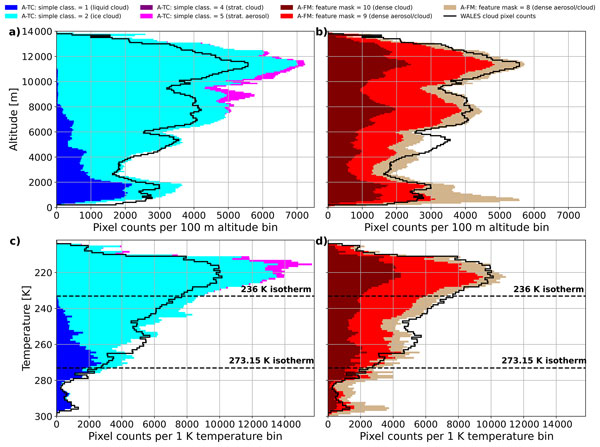
Konstantin Krüger, Martin Wirth, Athena Augusta Floutsi, David Patrick Donovan, Gerd-Jan van Zadelhoff, and Silke Martha Groß
Atmos. Meas. Tech., 19, 5923–5950, https://doi.org/10.5194/amt-19-5923-2026, https://doi.org/10.5194/amt-19-5923-2026, 2026
Short summary
Short summary
Cloud properties from three ATLID Level 2 products (A-TC, A-FM, A-CTH) of the EarthCARE satellite mission are validated using independent airborne lidar observations collected during satellite underflights in the tropics and extratropics. The products reliably represent cloud pixel distribution and cloud top height; though ice cloud pixels and cloud top height are slightly overestimated. Comparison with a more recent baseline shows improvements, supporting their use for cloud property studies.
Georgios Dekoutsidis, Silke Groß, Florian Ewald, Martina Krämer, Christian Rolf, Andreas Schäfler, and Martin Wirth
EGUsphere, https://doi.org/10.5194/egusphere-2026-3788, https://doi.org/10.5194/egusphere-2026-3788, 2026
Short summary
Short summary
Cirrus clouds interact with radiation, but their exact effects are not well-defined and depend on their properties, formation process and the ambient conditions. We used airborne lidar and radar measurements and models in order to compare cirrus that formed in undisturbed conditions and during Warm Air intrusions (WAI). We found that WAIs cause a change in the formation and their properties. Our findings can improve the representation of cirrus in models and the estimation of their impact.
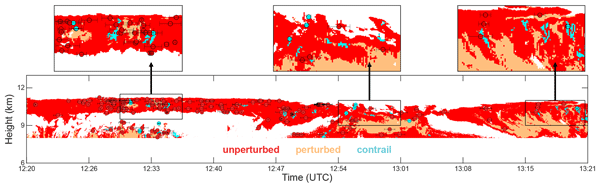
Mahshad Soleimanpour, Torsten Seelig, Silke Groß, and Matthias Tesche
Atmos. Meas. Tech., 19, 3291–3308, https://doi.org/10.5194/amt-19-3291-2026, https://doi.org/10.5194/amt-19-3291-2026, 2026
Short summary
Short summary
Aviation affects the climate not only through carbon dioxide emissions but also by producing contrails that can alter the properties of natural cirrus clouds and influence the Earth's energy balance. In this study, we used detailed airborne laser measurements to detect contrails forming inside these clouds. We developed an automated method to identify and measure them, showing where they occur and providing a reliable way to monitor their climate impact without requiring flight data.
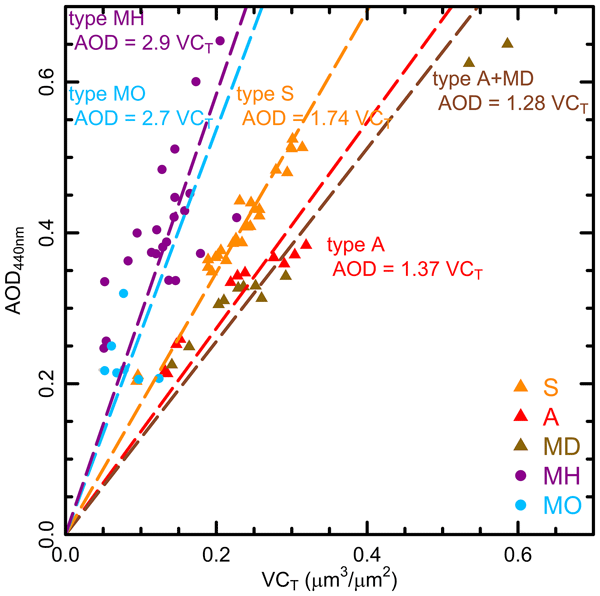
David Mateos, Carlos Toledano, Abel Calle, Roberto Román, Marcos Herreras-Giralda, Ramiro González, Sara Herrero-Anta, Daniel González-Fernández, Celia Herrero-del Barrio, Argyro Nisantzi, Rodanthi E. Mamouri, Silke Groß, Victoria E. Cachorro, Ángel M. de Frutos, and Bernadett Weinzierl
Atmos. Chem. Phys., 26, 1993–2005, https://doi.org/10.5194/acp-26-1993-2026, https://doi.org/10.5194/acp-26-1993-2026, 2026
Short summary
Short summary
A field experiment deployed in Cyprus included two sun photometers of Aerosol Robotic Network in two different sites. Mineral dust was predominant during the experiment, with Saharan and Arabian dust showing distinct optical properties, in particular, the Angstrom Exponent in the near-infrarred range and Volume Efficiency factor. Both magnitudes can served as a reliable proxy for mineral dust typing. No significant black carbon presence was detected.
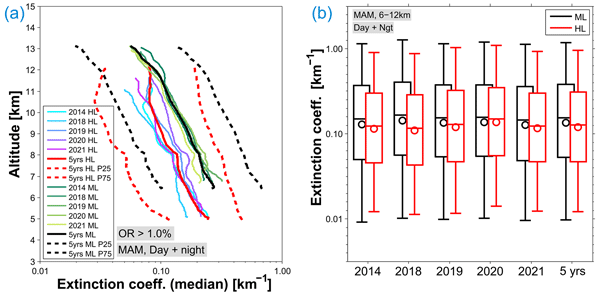
Qiang Li and Silke Groß
Atmos. Chem. Phys., 25, 16657–16677, https://doi.org/10.5194/acp-25-16657-2025, https://doi.org/10.5194/acp-25-16657-2025, 2025
Short summary
Short summary
This study presents the cirrus occurrence and optical properties at high- and midlatitudes using the satellite lidar measurements. The results indicate the differences in cirrus occurrence and optical properties across latitudes. Besides seasonality, the cirrus extinction and depolarization show a consistent decrease with increasing latitude. The potential causes are discussed and it turns out that aerosol particles show much larger concentrations at midlatitudes than at high-latitudes.
Christian Heske, Florian Ewald, and Silke Groß
Atmos. Meas. Tech., 18, 5177–5198, https://doi.org/10.5194/amt-18-5177-2025, https://doi.org/10.5194/amt-18-5177-2025, 2025
Short summary
Short summary
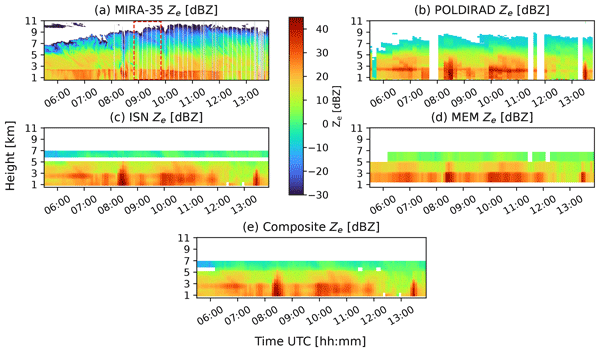
This study proposes a new technique to augment polarimetric radar measurements of the national German operational radar network with vertically looking cloud radars. The method is tested in two different case studies by comparison to dedicated scanning radars revealing promising results. Future usage of the method is motivated by analyzing the coverage of the operational radar network finding advantageous locations with good radar coverage.
Silke Groß, Volker Freudenthaler, Moritz Haarig, Albert Ansmann, Carlos Toledano, David Mateos, Petra Seibert, Rodanthi-Elisavet Mamouri, Argyro Nisantzi, Josef Gasteiger, Maximilian Dollner, Anne Tipka, Manuel Schöberl, Marilena Teri, and Bernadett Weinzierl
Atmos. Chem. Phys., 25, 3191–3211, https://doi.org/10.5194/acp-25-3191-2025, https://doi.org/10.5194/acp-25-3191-2025, 2025
Short summary
Short summary
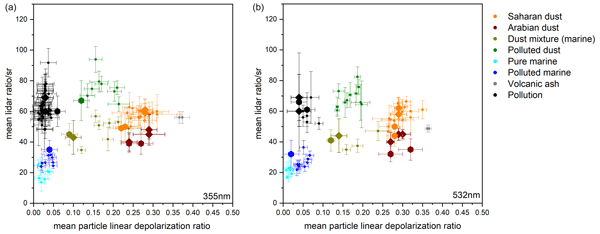
Aerosols contribute to the largest uncertainties in climate change predictions. The eastern Mediterranean is a hotspot for aerosols with natural and anthropogenic contributions. We present lidar measurements performed during A-LIFE (Absorbing aerosol layers in a changing climate: aging, lifetime and dynamics) to characterize aerosols and aerosol mixtures. We extend current lidar classification and separation schemes and compare them to classification schemes using different methods.
Manfred Wendisch, Susanne Crewell, André Ehrlich, Andreas Herber, Benjamin Kirbus, Christof Lüpkes, Mario Mech, Steven J. Abel, Elisa F. Akansu, Felix Ament, Clémantyne Aubry, Sebastian Becker, Stephan Borrmann, Heiko Bozem, Marlen Brückner, Hans-Christian Clemen, Sandro Dahlke, Georgios Dekoutsidis, Julien Delanoë, Elena De La Torre Castro, Henning Dorff, Regis Dupuy, Oliver Eppers, Florian Ewald, Geet George, Irina V. Gorodetskaya, Sarah Grawe, Silke Groß, Jörg Hartmann, Silvia Henning, Lutz Hirsch, Evelyn Jäkel, Philipp Joppe, Olivier Jourdan, Zsofia Jurányi, Michail Karalis, Mona Kellermann, Marcus Klingebiel, Michael Lonardi, Johannes Lucke, Anna E. Luebke, Maximilian Maahn, Nina Maherndl, Marion Maturilli, Bernhard Mayer, Johanna Mayer, Stephan Mertes, Janosch Michaelis, Michel Michalkov, Guillaume Mioche, Manuel Moser, Hanno Müller, Roel Neggers, Davide Ori, Daria Paul, Fiona M. Paulus, Christian Pilz, Felix Pithan, Mira Pöhlker, Veronika Pörtge, Maximilian Ringel, Nils Risse, Gregory C. Roberts, Sophie Rosenburg, Johannes Röttenbacher, Janna Rückert, Michael Schäfer, Jonas Schaefer, Vera Schemann, Imke Schirmacher, Jörg Schmidt, Sebastian Schmidt, Johannes Schneider, Sabrina Schnitt, Anja Schwarz, Holger Siebert, Harald Sodemann, Tim Sperzel, Gunnar Spreen, Bjorn Stevens, Frank Stratmann, Gunilla Svensson, Christian Tatzelt, Thomas Tuch, Timo Vihma, Christiane Voigt, Lea Volkmer, Andreas Walbröl, Anna Weber, Birgit Wehner, Bruno Wetzel, Martin Wirth, and Tobias Zinner
Atmos. Chem. Phys., 24, 8865–8892, https://doi.org/10.5194/acp-24-8865-2024, https://doi.org/10.5194/acp-24-8865-2024, 2024
Short summary
Short summary
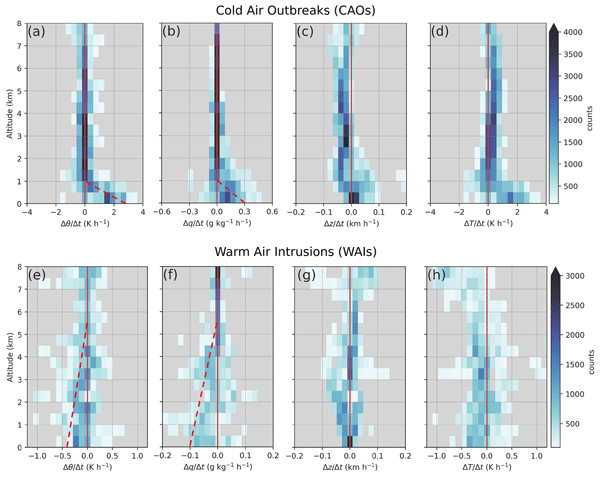
The Arctic is warming faster than the rest of the globe. Warm-air intrusions (WAIs) into the Arctic may play an important role in explaining this phenomenon. Cold-air outbreaks (CAOs) out of the Arctic may link the Arctic climate changes to mid-latitude weather. In our article, we describe how to observe air mass transformations during CAOs and WAIs using three research aircraft instrumented with state-of-the-art remote-sensing and in situ measurement devices.
Clémantyne Aubry, Julien Delanoë, Silke Groß, Florian Ewald, Frédéric Tridon, Olivier Jourdan, and Guillaume Mioche
Atmos. Meas. Tech., 17, 3863–3881, https://doi.org/10.5194/amt-17-3863-2024, https://doi.org/10.5194/amt-17-3863-2024, 2024
Short summary
Short summary
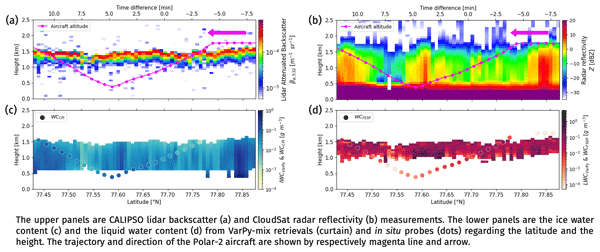
Radar–lidar synergy is used to retrieve ice, supercooled water and mixed-phase cloud properties, making the most of the radar sensitivity to ice crystals and the lidar sensitivity to supercooled droplets. A first analysis of the output of the algorithm run on the satellite data is compared with in situ data during an airborne Arctic field campaign, giving a mean percent error of 49 % for liquid water content and 75 % for ice water content.

Georgios Dekoutsidis, Martin Wirth, and Silke Groß
Atmos. Chem. Phys., 24, 5971–5987, https://doi.org/10.5194/acp-24-5971-2024, https://doi.org/10.5194/acp-24-5971-2024, 2024
Short summary
Short summary
For decades the earth's temperature has been rising. The Arctic regions are warming faster. Cirrus clouds can contribute to this phenomenon. During warm-air intrusions, air masses are transported into the Arctic from the mid-latitudes. The HALO-(AC)3 campaign took place to measure cirrus during intrusion events and under normal conditions. We study the two cloud types based on these measurements and find differences in their geometry, relative humidity distribution and vertical structure.
Silke Groß, Tina Jurkat-Witschas, Qiang Li, Martin Wirth, Benedikt Urbanek, Martina Krämer, Ralf Weigel, and Christiane Voigt
Atmos. Chem. Phys., 23, 8369–8381, https://doi.org/10.5194/acp-23-8369-2023, https://doi.org/10.5194/acp-23-8369-2023, 2023
Short summary
Short summary
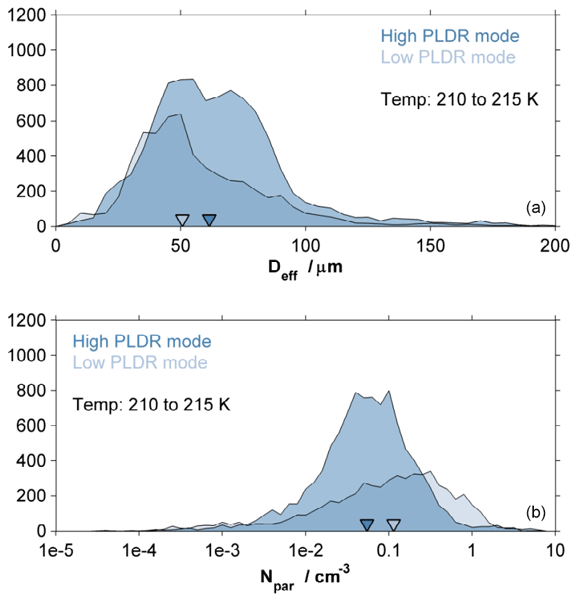
Aviation-emitted aerosol can have an impact on cirrus clouds. We present optical and microphysical properties of mid-latitude cirrus clouds which were formed under the influence of aviation-emitted aerosol or which were formed under rather pristine conditions. We find that cirrus clouds affected by aviation-emitted aerosol show larger values of the particle linear depolarization ratio, larger mean effective ice particle diameters and decreased ice particle number concentrations.
Georgios Dekoutsidis, Silke Groß, Martin Wirth, Martina Krämer, and Christian Rolf
Atmos. Chem. Phys., 23, 3103–3117, https://doi.org/10.5194/acp-23-3103-2023, https://doi.org/10.5194/acp-23-3103-2023, 2023
Short summary
Short summary
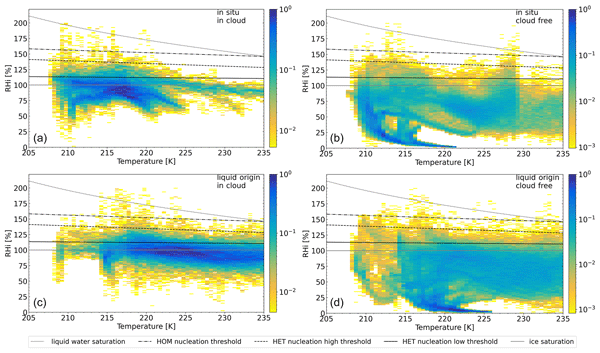
Cirrus clouds affect Earth's atmosphere, deeming our study important. Here we use water vapor measurements by lidar and study the relative humidity (RHi) within and around midlatitude cirrus clouds. We find high supersaturations in the cloud-free air and within the clouds, especially near the cloud top. We study two cloud types with different formation processes. Finally, we conclude that the shape of the distribution of RHi can be used as an indicator of different cloud evolutionary stages.
Yun Li, Christoph Mahnke, Susanne Rohs, Ulrich Bundke, Nicole Spelten, Georgios Dekoutsidis, Silke Groß, Christiane Voigt, Ulrich Schumann, Andreas Petzold, and Martina Krämer
Atmos. Chem. Phys., 23, 2251–2271, https://doi.org/10.5194/acp-23-2251-2023, https://doi.org/10.5194/acp-23-2251-2023, 2023
Short summary
Short summary
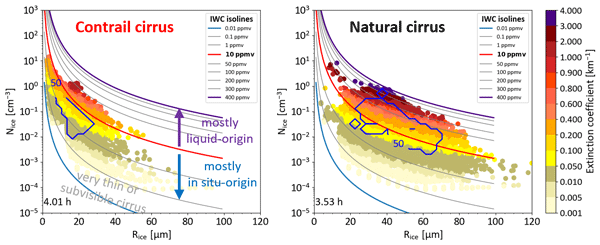
The radiative effect of aviation-induced cirrus is closely related to ambient conditions and its microphysical properties. Our study investigated the occurrence of contrail and natural cirrus measured above central Europe in spring 2014. It finds that contrail cirrus appears frequently in the pressure range 200 to 245 hPa and occurs more often in slightly ice-subsaturated environments than expected. Avoiding slightly ice-subsaturated regions by aviation might help mitigate contrail cirrus.
Ziming Wang, Luca Bugliaro, Tina Jurkat-Witschas, Romy Heller, Ulrike Burkhardt, Helmut Ziereis, Georgios Dekoutsidis, Martin Wirth, Silke Groß, Simon Kirschler, Stefan Kaufmann, and Christiane Voigt
Atmos. Chem. Phys., 23, 1941–1961, https://doi.org/10.5194/acp-23-1941-2023, https://doi.org/10.5194/acp-23-1941-2023, 2023
Short summary
Short summary
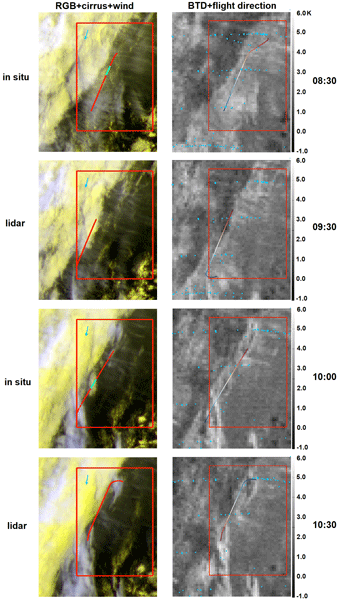
Differences in the microphysical properties of contrail cirrus and natural cirrus in a contrail outbreak situation during the ML-CIRRUS campaign over the North Atlantic flight corridor can be observed from in situ measurements. The cirrus radiative effect in the area of the outbreak, derived from satellite observation-based radiative transfer modeling, is warming in the early morning and cooling during the day.
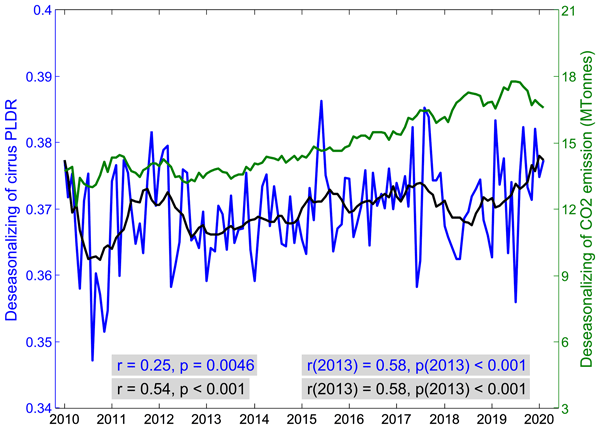
Qiang Li and Silke Groß
Atmos. Chem. Phys., 22, 15963–15980, https://doi.org/10.5194/acp-22-15963-2022, https://doi.org/10.5194/acp-22-15963-2022, 2022
Short summary
Short summary
The IPCC report identified that cirrus clouds have a significant impact on the radiation balance comparable to the CO2 effects, which, however, is still hard to parameterize. The current study investigates the possible impact of aviation on cirrus properties based on the analysis of 10-year lidar measurements of CALIPSO. The results reveal that there is a significant positive trend in cirrus depolarization ratio in the last 10 years before COVID-19, which is strongly correlated with aviation.
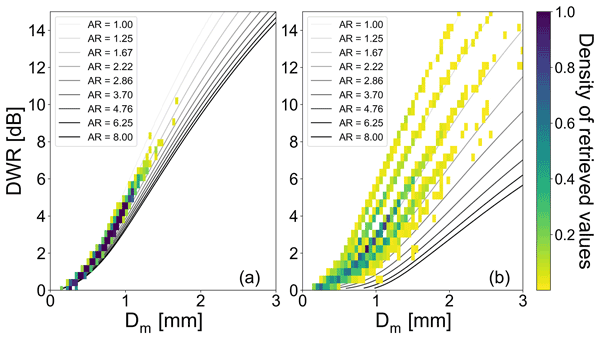
Eleni Tetoni, Florian Ewald, Martin Hagen, Gregor Köcher, Tobias Zinner, and Silke Groß
Atmos. Meas. Tech., 15, 3969–3999, https://doi.org/10.5194/amt-15-3969-2022, https://doi.org/10.5194/amt-15-3969-2022, 2022
Short summary
Short summary
We use the C-band POLDIRAD and the Ka-band MIRA-35 to perform snowfall dual-wavelength polarimetric radar measurements. We develop an ice microphysics retrieval for mass, apparent shape, and median size of the particle size distribution by comparing observations to T-matrix ice spheroid simulations while varying the mass–size relationship. We furthermore show how the polarimetric measurements from POLDIRAD help to narrow down ambiguities between ice particle shape and size.
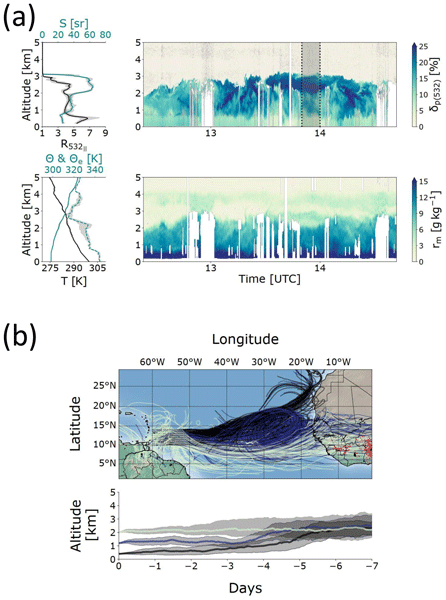
Manuel Gutleben, Silke Groß, Christian Heske, and Martin Wirth
Atmos. Chem. Phys., 22, 7319–7330, https://doi.org/10.5194/acp-22-7319-2022, https://doi.org/10.5194/acp-22-7319-2022, 2022
Short summary
Short summary
The main transportation route of Saharan mineral dust particles leads over the subtropical Atlantic Ocean and is subject to a seasonal variation. This study investigates the characteristics of wintertime transatlantic dust transport towards the Caribbean by means of airborne lidar measurements. It is found that dust particles are transported at low atmospheric altitudes (<3.5 km) embedded in a relatively moist mixture with two other particle types, namely marine and biomass-burning particles.
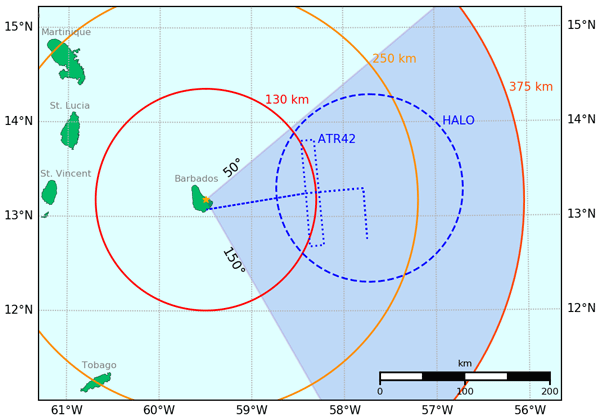
Martin Hagen, Florian Ewald, Silke Groß, Lothar Oswald, David A. Farrell, Marvin Forde, Manuel Gutleben, Johann Heumos, Jens Reimann, Eleni Tetoni, Gregor Köcher, Eleni Marinou, Christoph Kiemle, Qiang Li, Rebecca Chewitt-Lucas, Alton Daley, Delando Grant, and Kashawn Hall
Earth Syst. Sci. Data, 13, 5899–5914, https://doi.org/10.5194/essd-13-5899-2021, https://doi.org/10.5194/essd-13-5899-2021, 2021
Short summary
Short summary
The German polarimetric weather radar Poldirad was deployed for the international campaign EUREC4A on Barbados. The focus was monitoring clouds and precipitation in the trade wind region east of Barbados. Observations were with a temporal sequence of 5 min and a maximum range of 375 km. Examples of mesoscale precipitation patterns, rain rate accumulation, diurnal cycle, and vertical distribution show the potential for further studies on the life cycle of precipitating shallow cumulus clouds.
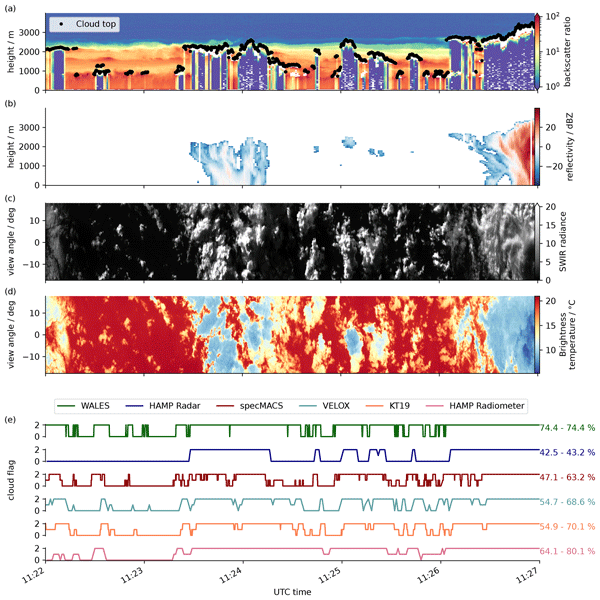
Heike Konow, Florian Ewald, Geet George, Marek Jacob, Marcus Klingebiel, Tobias Kölling, Anna E. Luebke, Theresa Mieslinger, Veronika Pörtge, Jule Radtke, Michael Schäfer, Hauke Schulz, Raphaela Vogel, Martin Wirth, Sandrine Bony, Susanne Crewell, André Ehrlich, Linda Forster, Andreas Giez, Felix Gödde, Silke Groß, Manuel Gutleben, Martin Hagen, Lutz Hirsch, Friedhelm Jansen, Theresa Lang, Bernhard Mayer, Mario Mech, Marc Prange, Sabrina Schnitt, Jessica Vial, Andreas Walbröl, Manfred Wendisch, Kevin Wolf, Tobias Zinner, Martin Zöger, Felix Ament, and Bjorn Stevens
Earth Syst. Sci. Data, 13, 5545–5563, https://doi.org/10.5194/essd-13-5545-2021, https://doi.org/10.5194/essd-13-5545-2021, 2021
Short summary
Short summary
The German research aircraft HALO took part in the research campaign EUREC4A in January and February 2020. The focus area was the tropical Atlantic east of the island of Barbados. We describe the characteristics of the 15 research flights, provide auxiliary information, derive combined cloud mask products from all instruments that observe clouds on board the aircraft, and provide code examples that help new users of the data to get started.
Theano Drosoglou, Athanasios Natsis, Dimitris Dimitriadis, Kyriakoula Papachristopoulou, Stelios Kazadzis, Angelos Georgakis, Kevin Kilchhofer, Grigorios Tsoumakas, and Vassilis Amiridis
EGUsphere, https://doi.org/10.5194/egusphere-2026-5862, https://doi.org/10.5194/egusphere-2026-5862, 2026
This preprint is open for discussion and under review for Atmospheric Measurement Techniques (AMT).
Short summary
Short summary
Better short-term forecasts of clouds can help improve solar energy planning, as clouds can change sunlight rapidly. We developed a deep learning model that learns how cloud patterns evolve from satellite images and compared it with established forecasting methods. The model produced more accurate forecasts, especially for changing cloud conditions, and remained useful for longer forecast periods. The results show its potential for improving short-term cloud and solar radiation forecasting.
Kalliopi Artemis Voudouri, Andreas Karipis, Alexandra Tsekeri, Otto Hasekamp, Kirk Knobelspiesse, Meng Gao, Santiago Gasso, Gerd-jan van Zadelhoff, Athanasios Tsikerdekis, Guangliang Fu, Anton Lopatin, Oleg Dubovik, Edward Malina, Eleni Marinou, and Vassilis Amiridis
EGUsphere, https://doi.org/10.5194/egusphere-2026-5990, https://doi.org/10.5194/egusphere-2026-5990, 2026
This preprint is open for discussion and under review for Atmospheric Measurement Techniques (AMT).
Short summary
Short summary
This study evaluates two satellite-based methods for retrieving aerosol layer height using observations from the PACE and EarthCARE missions. We assess the consistency of their retrievals under different atmospheric conditions and across diverse regions, identifying when they agree best and highlighting the strengths and limitations of each approach. The results support the validation of these missions, which are expected to provide long-term observations for reliable climate data records.
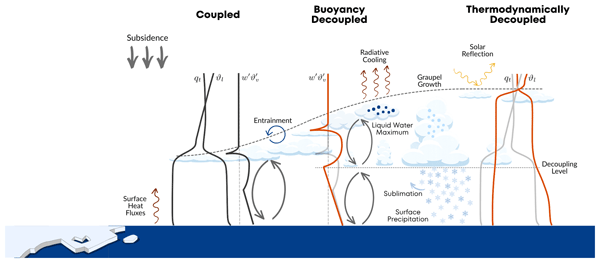
Fiona Paulus, Joshua J. Müller, Benjamin Kirbus, Harald Sodemann, Lars van Gelder, Andreas Walbröl, Manfred Wendisch, and Roel A. J. Neggers
Atmos. Chem. Phys., 26, 13983–14014, https://doi.org/10.5194/acp-26-13983-2026, https://doi.org/10.5194/acp-26-13983-2026, 2026
Short summary
Short summary
Cold Arctic air flowing from sea ice onto the warmer ocean waters rapidly warms, moistens, and forms clouds and precipitation. These events shape the Arctic climate but are difficult to observe and model. Particularly the role of large-scale sinking motion during these events is not fully understood. Using rare aircraft data and simulations to track an air mass for two days, we show that strong downward motion suppresses cloud growth, limits and delays precipitation, and reduces cloud lifetimes.
Anna Weber and Bernhard Mayer
EGUsphere, https://doi.org/10.5194/egusphere-2026-4833, https://doi.org/10.5194/egusphere-2026-4833, 2026
This preprint is open for discussion and under review for Geoscientific Model Development (GMD).
Short summary
Short summary
A new parameterization of horizontally oriented ice crystals for polarized Monte Carlo radiative transfer simulations of the cloudglint is introduced, which is based on the treatment of reflection by a statistically rough ocean surface. The parameterization accounts for multiple scattering and allows for fast simulations of the cloudglint without having to store large, multi-dimensional tables of scattering phase functions. It was validated against the raytracing algorithm CrystalTrace.
Haruka Hotta, Kentaroh Suzuki, Maki Kikuchi, Shunsuke Aoki, and Takuji Kubota
EGUsphere, https://doi.org/10.5194/egusphere-2026-5649, https://doi.org/10.5194/egusphere-2026-5649, 2026
This preprint is open for discussion and under review for Atmospheric Chemistry and Physics (ACP).
Short summary
Short summary
Vertical motion within clouds links cloud microphysics and dynamics. Using EarthCARE’s Cloud Profiling Radar, we establish a global climatology of cloud-radar Doppler velocity. Doppler velocity varies with temperature, precipitation intensity, and region, with differences persisting even at comparable reflectivity. These statistics provide information on sedimentation and precipitation pathways and offer a new observational benchmark for evaluating cloud processes in global models.
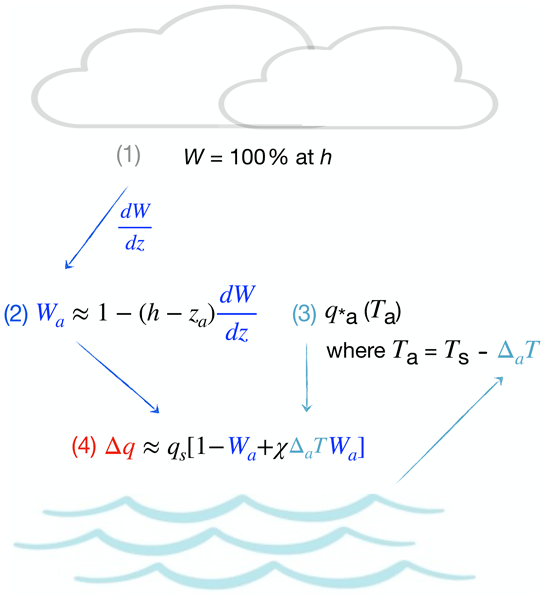
Anna Lea Albright, Bjorn Stevens, and Martin Wirth
Atmos. Meas. Tech., 19, 5973–5987, https://doi.org/10.5194/amt-19-5973-2026, https://doi.org/10.5194/amt-19-5973-2026, 2026
Short summary
Short summary
Ocean evaporation transfers heat and moisture to the atmosphere, shaping our weather and climate. Yet humidity just above the ocean is difficult to measure from space. Here we show that lasers measuring low cloud base height can infer near-surface humidity. Measurements from ships, aircraft, and weather balloons are used to validate the method. Applied to satellites, this method could help fill gaps in humidity measurements over the ocean.
Konstantin Krüger, Martin Wirth, Athena Augusta Floutsi, David Patrick Donovan, Gerd-Jan van Zadelhoff, and Silke Martha Groß
Atmos. Meas. Tech., 19, 5923–5950, https://doi.org/10.5194/amt-19-5923-2026, https://doi.org/10.5194/amt-19-5923-2026, 2026
Short summary
Short summary
Cloud properties from three ATLID Level 2 products (A-TC, A-FM, A-CTH) of the EarthCARE satellite mission are validated using independent airborne lidar observations collected during satellite underflights in the tropics and extratropics. The products reliably represent cloud pixel distribution and cloud top height; though ice cloud pixels and cloud top height are slightly overestimated. Comparison with a more recent baseline shows improvements, supporting their use for cloud property studies.
Woosub Roh, Masaki Satoh, Romain Fiévet, Mark D. Fielding, Robin J. Hogan, Bjorn Stevens, Takuji Kubota, and Hajime Okamoto
EGUsphere, https://doi.org/10.5194/egusphere-2026-3606, https://doi.org/10.5194/egusphere-2026-3606, 2026
This preprint is open for discussion and under review for Geoscientific Model Development (GMD).
Short summary
Short summary
Clouds and rainfall are still difficult to represent accurately in weather and climate models. We introduce a new project called the EarthCARE–ORCESTRA Model Intercomparison Project (ECOMIP), which uses observations from the new Earth Cloud, Aerosol and Radiation Explorer (EarthCARE) satellite and a tropical field campaign to compare and improve atmospheric models. Initial results show that different models can reproduce the same storm system but differ in its size and structure.

Richard Maier, Fabian Jakub, Fabian Hoffmann, and Bernhard Mayer
Atmos. Chem. Phys., 26, 12771–12791, https://doi.org/10.5194/acp-26-12771-2026, https://doi.org/10.5194/acp-26-12771-2026, 2026
Short summary
Short summary
Most atmospheric models only use 1D radiation, neglecting any 3D radiative effects. Here, we show that the dynamic TenStream solver provides a computationally efficient way to represent these effects. Like full 3D radiation, it causes daytime clouds to organize into streets, grow larger, and contain more liquid water. We show that this occurs because 3D radiation does not shade cloud updrafts and modifies the surface energy balance, resulting in an increased latent heat flux into the atmosphere.
Zhipeng Qu, Cuong Nguyen, Paloma Borque, Alexei Korolev, Howard W. Barker, Keyvan Ranjbar, Lei Liu, Zen Mariani, Meriem Kacimi, Melissa Cholette, Ivan Heckman, Kenny Bala, Natalia Bliankinshtein, Leonid Nichman, Benjamin Riot-Bretêcher, Yi Huang, Jason N. S. Cole, Raphaël Peroni, Stephen Holden, Robert Reed, Robert Crawford, Daniel Michelson, Eve Bigras, Michael Wheeler, John Gyakum, Jason A. Milbrandt, Julie M. Thériault, Kaley A. Walker, Mengistu Wolde, Jean-Pierre Blanchet, Yann Blanchard, Jonas von Bismark, Rob Koopman, Montserrat Piñol Solé, Bernat Puigdomènech Treserras, Robin J. Hogan, and Shannon L. Mason
EGUsphere, https://doi.org/10.5194/egusphere-2026-5347, https://doi.org/10.5194/egusphere-2026-5347, 2026
This preprint is open for discussion and under review for Atmospheric Measurement Techniques (AMT).
Short summary
Short summary
The ECALOT campaign brought together aircraft and ground-based observations in the Ottawa–Montreal region to help evaluate the European Space Agency’s EarthCARE satellite, which studies clouds, aerosols, radiation, and their interactions. By comparing satellite measurements with multi-platform remote-sensing and in situ observations collected during the campaign, ECALOT provides an integrated approach to evaluating EarthCARE products at different stages of the data processing chain.
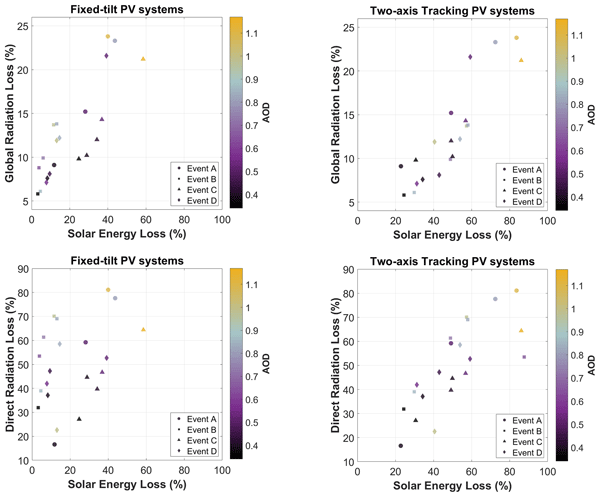
Dimitra Kouklaki, Georgia Charalampous, Anna Moustaka, Alkistis Papetta, Celia Herrero del Barrio, Rizos-Theodoros Chadoulis, S. Yeşer Aslanoğlu, Sara Herrero-Anta, Michail Mytilinaios, Nikolaos Papadimitriou, Katerina Anyfanti, Christos Spyrou, Daniela Meloni, Konstantinos Fragkos, Yevgeny Derimian, Tatiana Di Iorio, Rodanthi-Elisavet Mamouri, Vassilis Amiridis, Stavros Solomos, Stelios Kazadzis, and Ilias Fountoulakis
Atmos. Meas. Tech., 19, 5633–5657, https://doi.org/10.5194/amt-19-5633-2026, https://doi.org/10.5194/amt-19-5633-2026, 2026
Short summary
Short summary
In the present study we investigated how aerosols, and specifically dust, affect solar radiation and energy production by investigating several dust events across multiple sites in the Mediterranean Basin between 2021 and 2022 through ground-based observations and model simulations. The results revealed that dust can significantly attenuate solar radiation and, therefore, lead to considerable losses in solar power generation, specifically in the case of solar tracking systems.
Yuki Imura, Shunsuke Aoki, Takuji Kubota, Hirotaka Nakatsuka, Yuichi Ohno, and Hajime Okamoto
Atmos. Meas. Tech., 19, 5617–5631, https://doi.org/10.5194/amt-19-5617-2026, https://doi.org/10.5194/amt-19-5617-2026, 2026
Short summary
Short summary
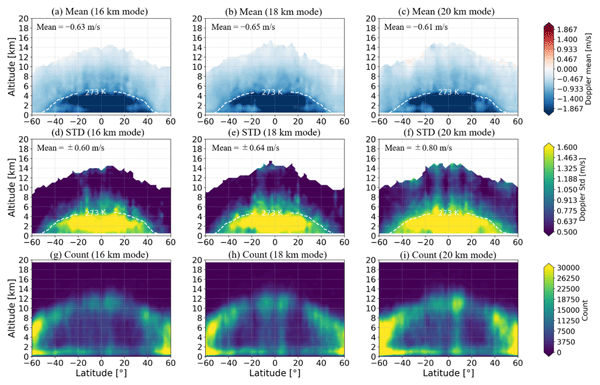
Understanding air motion within clouds is essential for weather and climate research. A new satellite launched in 2024 can observe how clouds move around the world for the first time. In this study, we compare three observation modes using real satellite data. We find that some modes provide more accurate measurements but reduce the ability to observe very high clouds and increase the risk of false signals. Our results show which observation modes work best in different regions of the world.
Alkistis Papetta, Celia Herrero del Barrio, S. Yeşer Aslanoğlu, Rizos-Theodoros Chadoulis, Georgia Charalampous, Sara Herrero-Anta, Dimitra Kouklaki, Michail Mytilinaios, Anna Moustaka, Emmanouil Proestakis, Vassilis Amiridis, Christos Spyrou, Antonis Gkikas, Michael Pikridas, Maria Kezoudi, Franco Marenco, Jean Sciare, Sophie Vandenbussche, Stavros Solomos, Stelios Kazadzis, and Ilias Fountoulakis
Atmos. Chem. Phys., 26, 12395–12434, https://doi.org/10.5194/acp-26-12395-2026, https://doi.org/10.5194/acp-26-12395-2026, 2026
Short summary
Short summary
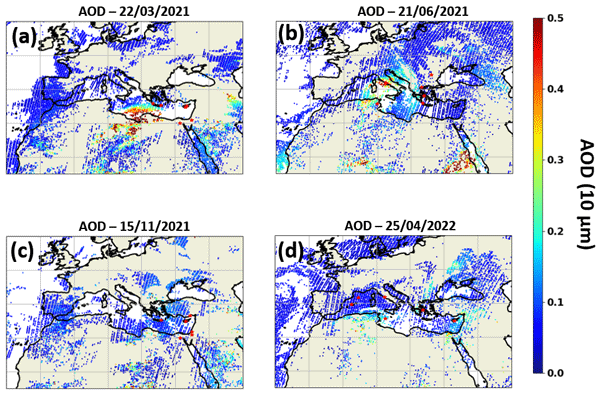
We studied four major dust events from the Sahara and the Middle East over the Mediterranean. Saharan dust events exhibited coarser and more scattering particles, while Middle Eastern dust was finer and mixed with pollution. Differences in absorption could not be explained by mineralogy and are attributed to mixing.
Lea Volkmer, Leandro Dörfer, and Bernhard Mayer
EGUsphere, https://doi.org/10.5194/egusphere-2026-4795, https://doi.org/10.5194/egusphere-2026-4795, 2026
Short summary
Short summary
While cloud droplet size distributions (CDSDs) of shallow cumulus or stratiform clouds are often well described under the assumption of single mode (gamma) distributions, CDSDs exhibit a multimodal structure in the presence of drizzle or rain leading to biases in passive remote sensing retrievals. Here, we present a new approach to derive multimodal droplet size distributions from aircraft-based polarized measurements of the cloud-/rainbow using a superposition of multiple gamma distributions.
Haruka Hotta, Kentaroh Suzuki, Maki Kikuchi, Shunsuke Aoki, and Takuji Kubota
Atmos. Chem. Phys., 26, 11605–11626, https://doi.org/10.5194/acp-26-11605-2026, https://doi.org/10.5194/acp-26-11605-2026, 2026
Short summary
Short summary
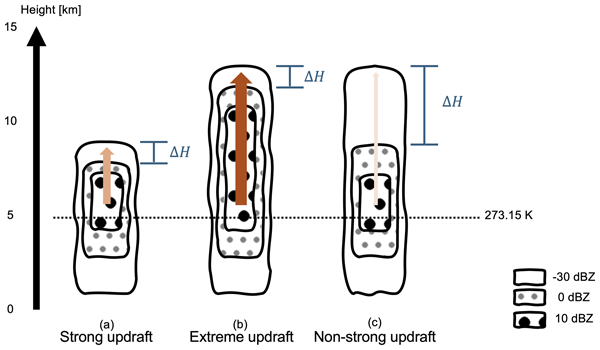
Cloud updrafts play a key role in the climate system, but global assessments remain indirect. Doppler velocities from EarthCARE (Earth Cloud, Aerosol and Radiation Explorer) Cloud Profiling Radar revealed that strong updrafts in tropical convections were most likely when radar echoes reached close to the cloud top, even in moderately tall storms, and they were more frequent over land in the early afternoon. These results provide new benchmarks to improve how numerical models represent convection and cloud microphysics.
Christian Fruck, Sebastian Wolff, Sven Krautwurst, Christoph Kiemle, Mathieu Quatrevalet, Martin Wirth, Jakob Borchardt, Oke Huhs, Konstantin Gerilowski, Michał Gałkowski, Christoph Gerbig, John P. Burrows, Heinrich Bovensmann, and Andreas Fix
EGUsphere, https://doi.org/10.5194/egusphere-2026-4578, https://doi.org/10.5194/egusphere-2026-4578, 2026
This preprint is open for discussion and under review for Atmospheric Measurement Techniques (AMT).
Short summary
Short summary
Waste sites near Madrid, Spain, release large amounts of methane, a powerful greenhouse gas. Using passive, active, and in situ instruments aboard the HALO aircraft, we measured methane concentrations near these sites. By combining these complementary measurements with an atmospheric transport simulation, we account for shifting winds that complicated earlier emission estimates, yielding a more accurate and robust method. We find a combined emission rate of 8.7 ± 1.5 t h-1.
Georgios Dekoutsidis, Silke Groß, Florian Ewald, Martina Krämer, Christian Rolf, Andreas Schäfler, and Martin Wirth
EGUsphere, https://doi.org/10.5194/egusphere-2026-3788, https://doi.org/10.5194/egusphere-2026-3788, 2026
Short summary
Short summary
Cirrus clouds interact with radiation, but their exact effects are not well-defined and depend on their properties, formation process and the ambient conditions. We used airborne lidar and radar measurements and models in order to compare cirrus that formed in undisturbed conditions and during Warm Air intrusions (WAI). We found that WAIs cause a change in the formation and their properties. Our findings can improve the representation of cirrus in models and the estimation of their impact.
Patrick C. Taylor, Armin Sorooshian, Rei Ueyama, Sebastian Schmidt, Ihab Abboud, Quincy Allison, Kevin Barry, Sebastian Becker, Holly A. Bender, Joseph R. Bennett, James B. Blair, Niklas Bohn, Linette Boisvert, Matthew D. Brown, Roelof Bruintjes, Anthony Bucholtz, Megan Buzanowicz, Brian Cairns, Filippo Calì Quaglia, Eduard Chemyakin, Bo Chen, Gao Chen, Hong Chen, Yu-Wen Chen, Zezhen Cheng, Swarup China, Dan Chirica, Yonghoon Choi, Peter Colarco, Brian Collister, Ewan Crosbie, Maurice J. Cross, Janet Daniels, Paul DeMott, Joshua P. DiGangi, Alcide Giorgio di Sarra, Glenn S. Diskin, Erica K. Dolinar, Eva-Lou Edwards, Samuel Ephraim, Nikolaos Evangeliou, Romanos Foskinis, Francesca Gallo, Lan Gao, José Luis Gómez-Amo, Daisy Gonzalez, Christine Groot Zwaaftink, Pawan Gupta, Ivan Heckman, Michael Hendrickson, Miguel Ricardo A. Hilario, Ken Hirata, Michelle Hofton, Andrew L. Holen, Ulas Im, Alia L. Khan, Ralph Kahn, Alexei V. Korolev, Sonia Kreidenweis, Thomas Krumpen, Nathan Kurtz, Leslie Lait, Bradley Lamkin, Jack Landy, Nurun Nahar Lata, Paul Lawson, Samuel LeBlanc, Sean Leavor, Jing Li, Thorsten Markus, Hal Maring, Andreas H. Massling, Camille Mavis, Flynn McGinnity, Kerry Meyer, Gabriel Mojica, Richard H. Moore, Parker Morris, Giovanni Muscari, Vikas Nataraja, Amin R. Nehrir, Athanasios Nenes, Edward P. Nowottnick, Matteo Ottaviani, Chelsea Parker, Ryan Patnaude, Michael Perez, Russell J. Perkins, Colten Peterson, Alek Petty, Stevie Phothisane, Chris Polashenski, Kerri A. Pratt, Kayla M. Preisler, John Prytherch, David Rabine, Jens Redemann, Ju-Mee Ryoo, Joseph S. Schlosser, Vanessa Selimovic, Michael A. Shook, Morgan Silverman, Henrik Skov, Alexander Smirnov, Cassidy Soloff, Amy Solomon, Snorre Stamnes, Azusa Takeishi, David R. Thompson, K. Lee Thornhill, Rachel Tilling, Michael Tjernström, Monica Tosco, Pedro C. Valdelomar, David Van Gilst, Jian Wang, Zhien Wang, Andrzej Wasilewski, Manfred Wendisch, Brent Wilder, Edward L. Winstead, Albert Wu, Peng Xian, Lauren M. Zamora, Jiaoshi Zhang, Lei Zhang, Lu Zhang, Luke Ziemba, and Paquita Zuidema
Earth Syst. Sci. Data Discuss., https://doi.org/10.5194/essd-2026-241, https://doi.org/10.5194/essd-2026-241, 2026
Preprint under review for ESSD
Short summary
Short summary
This article summarizes the data sets collected during the Arctic Radiation Cloud aerosol Sea ice Interaction eXperiment (ARCSIX), NASA's most comprehensive Arctic field campaign to date. The overarching goal was to quantify the contributions of surface, clouds, aerosol particles, and precipitation to summer sea ice melt. This paper describes the ARCSIX implementation including the flight strategy, instruments, complementary data sets, access, and usage details.
Clara J. A. Bayley, Tobias Kölling, Ann Kristin Naumann, Raphaela Vogel, and Bjorn Stevens
Geosci. Model Dev., 19, 6099–6120, https://doi.org/10.5194/gmd-19-6099-2026, https://doi.org/10.5194/gmd-19-6099-2026, 2026
Short summary
Short summary
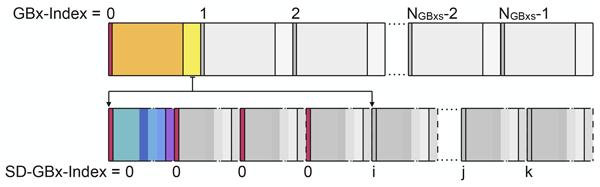
Cloud microphysics is a leading source of error in both regional and global climate models and this limits our ability to understand the Earth’s climate and how it is changing. However a fairly new type of model called a Superdroplet Model (SDM) may improve both regional and global models if it can be made cost-efficient enough. Hence we are introducing a novel version of SDM, called CLEO, and it's key features that make it efficient, especially on very high performance,
exascale, computers.
Clara J. A. Bayley, Ann Kristin Naumann, Florian Poydenot, Raphaela Vogel, Bjorn Stevens, and Shin-Ichiro Shima
Geosci. Model Dev., 19, 6121–6142, https://doi.org/10.5194/gmd-19-6121-2026, https://doi.org/10.5194/gmd-19-6121-2026, 2026
Short summary
Short summary
We are developing a model called CLEO, a type of “Superdroplet Model” (SDM) for cloud microphysics, to try to overcome some of the issues faced by climate models which are caused by errors in cloud modelling. Here we describe the equations for cloud microphysics CLEO uses and how we solve them, such as to see how water-droplets move around and grow/shrink in the atmosphere. We also provide some demonstrations of the microphysical processes we model to show that CLEO works as intended.
Shunsuke Aoki, Takuji Kubota, Hiroaki Horie, and Yuichi Ohno
EGUsphere, https://doi.org/10.5194/egusphere-2026-3256, https://doi.org/10.5194/egusphere-2026-3256, 2026
Short summary
Short summary
The EarthCARE Cloud Profiling Radar (CPR) observations can be contaminated by spurious cloud signals from multiple-trip echoes, including mirror images, multiple scattering (MS) tails, and satellite mirror images (SMIs). Distinguishing and removing them is essential for scientific analyses using CPR. This study characterizes their global occurrence and properties, and evaluates identification methods developed from CloudSat heritage and newly enhanced using CPR Doppler velocity measurements.
Helene Marie Gloeckner, Theresa Mieslinger, Nina Robbins-Blanch, Geet George, Lukas Kluft, Tobias Kölling, Sandrine Bony, Julia Miriam Windmiller, and Bjorn Stevens
Earth Syst. Sci. Data, 18, 4425–4450, https://doi.org/10.5194/essd-18-4425-2026, https://doi.org/10.5194/essd-18-4425-2026, 2026
Short summary
Short summary
As part of the ORCESTRA (Organized Convection and EarthCARE Studies over the Tropical Atlantic) measurement field campaign in August and September 2024, 1191 dropsondes were deployed over the tropical Atlantic. They measure temperature, humidity, and horizontal winds throughout the atmosphere. Here, we present the resulting datasets, which contain different levels of quality controls as well as derived vertical winds. The data will help to understand processes within the tropical rain belt in the Atlantic.
Aymeric Dziduch, Antoine Baudoux, Guillaume Mioche, Antoine Canzi, Benjamin Doiteau, Manuel Moser, Emma Järvinen, Étienne Vignon, Jean-Christophe Raut, Régis Dupuy, Christophe Gourbeyre, Jean-Luc Baray, Marie Monier, Frédéric Szczap, Guillaume Penide, Julien Delanoë, Odran Sourdeval, Alfons Schwarzenboeck, Stephan Mertes, Franz Martin Schnaiter, Christiane Voigt, Mario Mech, Susanne Crewell, Andreas Herber, Christof Lüpkes, André Ehrlich, Manfred Wendisch, and Olivier Jourdan
EGUsphere, https://doi.org/10.5194/egusphere-2026-3265, https://doi.org/10.5194/egusphere-2026-3265, 2026
This preprint is open for discussion and under review for Atmospheric Chemistry and Physics (ACP).
Short summary
Short summary
This study examines the microphysical properties and ice crystal habits of low-level Arctic mixed-phase clouds around Svalbard. Using airborne in situ observations from four campaigns, we show that cloud microphysical structure and ice crystal habits are influenced by weather conditions and surface type. These results provide quantitative observations to better understand low-level Arctic clouds, their ice formation processes, and their influence on the Arctic atmosphere and climate system.
Lukas Pieper, Patric Seifert, Hannes Griesche, Albert Ansmann, George McCosh, Florian Ewald, and Stefan Kneifel
EGUsphere, https://doi.org/10.5194/egusphere-2026-3092, https://doi.org/10.5194/egusphere-2026-3092, 2026
This preprint is open for discussion and under review for Atmospheric Chemistry and Physics (ACP).
Short summary
Short summary
Using ground-based cloud Doppler radar observations and aerosol model data, a strong relationship between Saharan dust and enhanced turbulence in cirrus clouds over Europe was identified. Dust-infused cirrus formed mainly within moist, dust-laden air masses and showed strong correlation with in-cloud turbulence. The results provide a baseline observational overview on dust-turbulence-cirrus interactions, informing weather and climate models regarding possible methodological improvements.
Hairu Ding, Bjorn Stevens, Frank Lunkeit, and Nedjeljka Žagar
EGUsphere, https://doi.org/10.5194/egusphere-2026-2787, https://doi.org/10.5194/egusphere-2026-2787, 2026
Short summary
Short summary
Stratocumulus cover large areas of the low-latitude oceans and influence Earth’s solar radiation. This work investigates the relationship between large-scale circulation and stratocumulus variability across timescales. The results help explain inconsistencies in previously proposed large-scale mechanisms and highlight that stratocumulus are not controlled by a single factor (lower-tropospheric stability), although they correlate strongly on long timescales.
Anna Weber, Fabian Hoffmann, and Bernhard Mayer
Atmos. Chem. Phys., 26, 8001–8020, https://doi.org/10.5194/acp-26-8001-2026, https://doi.org/10.5194/acp-26-8001-2026, 2026
Short summary
Short summary
The vertical evolution of microphysical cloud properties in low-level mixed-phase clouds during a marine cold air outbreak in the Arctic is analyzed based on measurements collected during the HALO–(𝒜𝒞)3 campaign. In particular, pseudo-vertical profiles of cloud thermodynamic phase and the cloud droplet size are constructed. The measured vertical profiles are compared to predictions from an entraining parcel model to investigate the influence of ice processes on supercooled liquid water droplets.
John E. Yorks, Edward P. Nowottnick, Steven Platnick, Kerry G. Meyer, Matthew Walker McLinden, Meloe S. F. Kacenelenbogen, Kenneth E. Christian, Joseph A. Finlon, Natalie A. Midzak, Natalia Roldán-Henao, Patrick A. Selmer, Matthew J. McGill, Erica K. Dolinar, Charles N. Helms, Robert Koopman, Jonas von Bismark, and Montserrat Pińol Solé
Earth Syst. Sci. Data, 18, 3833–3852, https://doi.org/10.5194/essd-18-3833-2026, https://doi.org/10.5194/essd-18-3833-2026, 2026
Short summary
Short summary
The Goddard Space Flight Center's Lidar Observation and Validation Experiment (GLOVE) was a NASA field campaign from January–February 2025 that used a special airplane with scientific instruments to check if satellites measuring Earth's atmosphere were working correctly. The plane flew under two key satellites to compare measurements of clouds, dust, and other particles in the air. Data from 8 flights help scientists better understand how well these space-based instruments perform, especially for detecting different types of clouds and atmospheric conditions.
Mahshad Soleimanpour, Torsten Seelig, Silke Groß, and Matthias Tesche
Atmos. Meas. Tech., 19, 3291–3308, https://doi.org/10.5194/amt-19-3291-2026, https://doi.org/10.5194/amt-19-3291-2026, 2026
Short summary
Short summary
Aviation affects the climate not only through carbon dioxide emissions but also by producing contrails that can alter the properties of natural cirrus clouds and influence the Earth's energy balance. In this study, we used detailed airborne laser measurements to detect contrails forming inside these clouds. We developed an automated method to identify and measure them, showing where they occur and providing a reliable way to monitor their climate impact without requiring flight data.
Maria Tsichla, Konrad Kandler, Sudharaj Aryasree, Stavros Solomos, Christos Spyrou, Alexandra Tsekeri, Anna Kampouri, Anna Gialitaki, Eleni Drakaki, Thanasis Natsis, Maria Kezoudi, Alkistis Papetta, Franco Marenco, Jean Sciare, Eleni Marinou, Kalliopi Artemis Voudouri, Nikos Mihalopoulos, and Vassilis Amiridis
EGUsphere, https://doi.org/10.5194/egusphere-2026-921, https://doi.org/10.5194/egusphere-2026-921, 2026
Short summary
Short summary
Desert dust plays an important role in the Earth–atmosphere system by affecting clouds, radiation, and ocean processes. Here, we determine the composition of desert dust over Cabo Verde using drones and microscopy analysis, and compare the measurements with model simulations. We find that the main dust mineral is illite, while the dominant element is silicon. Our results highlight the value of airborne in-situ observations for improving dust models and understanding dust–climate interactions.
David J. Simon, Jonas Schaefer, Jörg Hartmann, Benjamin Kirbus, Joshua Müller, Markus Hartmann, Bruno Wetzel, Laura Köhler, Anna-Marie Jörss, Kay Weinhold, Andreas Herber, Zsófia Jurányi, Silvia Henning, Gregory C. Roberts, Manfred Wendisch, Mira L. Pöhlker, and Frank Stratmann
EGUsphere, https://doi.org/10.5194/egusphere-2026-2215, https://doi.org/10.5194/egusphere-2026-2215, 2026
Short summary
Short summary
We investigate the occurrence of newly formed aerosol particles in the Arctic atmosphere by analyzing aerosol particle measurements conducted aboard a research aircraft in April 2024. We frequently detected newly formed particles at altitudes of up to 4 km, while many previous studies had predominantly found such particles close to the surface. Newly formed particles were associated with air mass transport from lower latitudes, the occurrence of clouds, as well as the presence of sea ice.
Sebastian Becker, Konrad Sebastian Schmidt, Hong Chen, Yu-Wen Chen, Kerry G. Meyer, Colten A. Peterson, and Manfred Wendisch
EGUsphere, https://doi.org/10.5194/egusphere-2026-2210, https://doi.org/10.5194/egusphere-2026-2210, 2026
Short summary
Short summary
The melt of Arctic sea ice depends on the radiation budget at the surface, which is largely controlled by the presence of clouds. This cloud radiative effect depends on both cloud properties and surface reflection. Comparing cloud properties from a satellite retrieval and surface reflection data assumed for this retrieval to aircraft measurements, it is found that the assumed surface reflection is too low, leading to a cooling effect of clouds on the surface although a warming effect is present.
Kalliopi Artemis Voudouri, Eleni Marinou, Ilianna Koutsoupi, Vassilis Spyrakos, Dimitra Karkani, Ioanna Tsikoudi, Alessandro Battaglia, Pavlos Kollias, Eleni Giannakaki, and Vassilis Amiridis
EGUsphere, https://doi.org/10.5194/egusphere-2026-2384, https://doi.org/10.5194/egusphere-2026-2384, 2026
Short summary
Short summary
Cloud observations from the CloudSat mission (2007–2017) reveal how clouds vary per altitude and season across the Mediterranean. Comparisons with ERA5 reanalysis show good overall agreement, though ice clouds are often underestimated. Early EarthCARE mission data are also presented, towards improving long-term climate records.
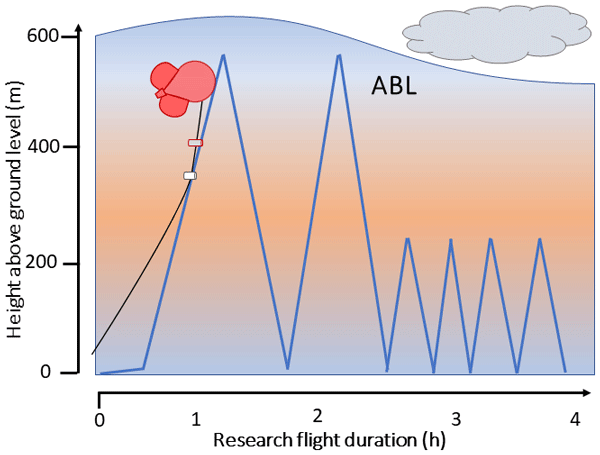
Henning Dorff, Holger Siebert, Komal Navale, André Ehrlich, Joshua Müller, Michael Schäfer, Fan Wu, and Manfred Wendisch
Earth Syst. Sci. Data, 18, 2799–2817, https://doi.org/10.5194/essd-18-2799-2026, https://doi.org/10.5194/essd-18-2799-2026, 2026
Short summary
Short summary
We present tethered-balloon measurements from BELUGA (Balloon-bornE moduLar Utility for profilinG the lower Atmosphere) at Villum Research Station (spring 2024), detailing instrumentation, data processing, and environmental conditions. The data stored in the PANGAEA database include instrument-separated subsets with frequent in situ profiling of thermodynamic, turbulence conditions, and thermal-infrared irradiances across the Arctic atmospheric boundary layer (ABL), supplemented by radiosondes. The data help examine transition events between Arctic ABL states.
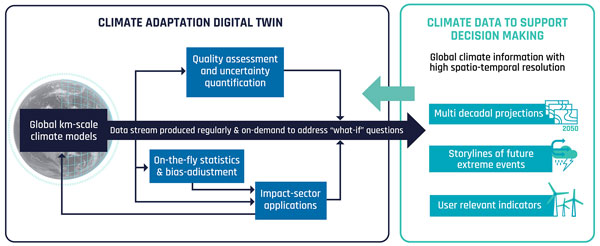
Francisco J. Doblas-Reyes, Jenni Kontkanen, Irina Sandu, Mario Acosta, Mohammed Hussam Al Turjmam, Ivan Alsina-Ferrer, Miguel Andrés-Martínez, Costanza Anerdi, Leo Arriola, Marvin Axness, Marc Batlle Martín, Peter Bauer, Tobias Becker, Daniel Beltrán, Sebastian Beyer, Hendryk Bockelmann, Pierre-Antoine Bretonnière, Sebastien Cabaniols, Silvia Caprioli, Miguel Castrillo, Aparna Chandrasekar, Suvarchal Cheedela, Victor Correal, Emanuele Danovaro, Paolo Davini, Jussi Enkovaara, Claudia Frauen, Barbara Früh, Aina Gaya Àvila, Paolo Ghinassi, Rohit Ghosh, Supriyo Ghosh, Iker González, Katherine Grayson, Matthew Griffith, Ioan Hadade, Christopher Haine, Carl Hartick, Utz-Uwe Haus, Shane Hearne, Heikki Järvinen, Bernat Jiménez, Amal John, Marlin Juchem, Thomas Jung, Jessica Kegel, Matthias Kelbling, Kai Keller, Bruno Kinoshita, Theresa Kiszler, Daniel Klocke, Lukas Kluft, Nikolay Koldunov, Tobias Kölling, Joonas Kolstela, Luis Kornblueh, Sergey Kosukhin, Aleksander Lacima-Nadolnik, Jeisson Javier Leal Rojas, Jonni Lehtiranta, Tuomas Lunttila, Anna Luoma, Pekka Manninen, Alexey Medvedev, Sebastian Milinski, Ali Mohammed, Sebastian Müller, Devaraju Naryanappa, Natalia Nazarova, Sami Niemelä, Bimochan Niraula, Henrik Nortamo, Aleksi Nummelin, Matteo Nurisso, Pablo Ortega, Stella Paronuzzi, Xabier Pedruzo-Bagazgoitia, Charles Pelletier, Carlos Peña, Suraj Polade, Himansu Kesari Pradhan, Rommel Quintanilla, Tiago Quintino, Thomas Rackow, Jouni Räisänen, Maqsood Mubarak Rajput, René Redler, Balthasar Reuter, Nuno Rocha Monteiro, Francesc Roura-Adserias, Silva Ruppert, Susan Sayed, Reiner Schnur, Tanvi Sharma, Dmitry Sidorenko, Outi Sievi-Korte, Albert Soret, Christian Steger, Bjorn Stevens, Jan Streffing, Jaleena Sunny, Luiggi Tenorio, Stephan Thober, Ulf Tigerstedt, Oriol Tinto, Juha Tonttila, Heikki Tuomenvirta, Lauri Tuppi, Ginka Van Thielen, Emanuele Vitali, Jost von Hardenberg, Ingo Wagner, Nils Wedi, Jan Wehner, Sven Willner, Xavier Yepes-Arbós, Florian Ziemen, and Janos Zimmermann
Geosci. Model Dev., 19, 2821–2848, https://doi.org/10.5194/gmd-19-2821-2026, https://doi.org/10.5194/gmd-19-2821-2026, 2026
Short summary
Short summary
The Climate Change Adaptation Digital Twin (Climate DT) pioneers the operationalisation of global climate projections. It produces global simulations with local granularity for adaptation decision-making. Applications are embedded to generate tailored indicators. A unified workflow orchestrates all components in several supercomputers. Data management ensures consistency and streaming enables real-time use. It is a complementary innovation to initiatives like CMIP, CORDEX, and climate services.
Minrui Wang, Takashi Y. Nakajima, Jiaqi Wu, Yamato Ogura, Mayumi Yoshida, Masataka Muto, and Takuji Kubota
EGUsphere, https://doi.org/10.5194/egusphere-2026-1679, https://doi.org/10.5194/egusphere-2026-1679, 2026
Short summary
Short summary
This paper describes a scientific method of vicarious calibration to obtain the calibration coefficient, which will be used for Multi-Spectial Imager level 2 cloud and aerosol products. In the case of cloud product, slight overestimation was found for the visible band, and almost no overestimation or underestimation for near-infrared band. On the other side, slight overestimation for the visible band and slight underestimation for near-infrared band was found for aerosol product.
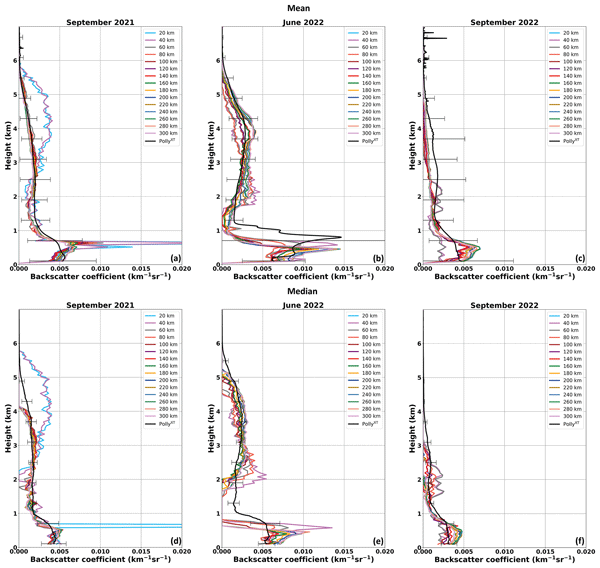
Athena Augusta Floutsi, Konstantinos Rizos, Dimitri Trapon, Ronny Engelmann, Dietrich Althausen, Eleni Marinou, Peristera Paschou, Julian Hofer, Emmanouil Proestakis, Henriette Gebauer, Annett Skupin, Albert Ansmann, Thorsten Fehr, Timon Hummel, Rob Koopman, Vassilis Amiridis, Ulla Wandinger, and Holger Baars
Atmos. Meas. Tech., 19, 1901–1925, https://doi.org/10.5194/amt-19-1901-2026, https://doi.org/10.5194/amt-19-1901-2026, 2026
Short summary
Short summary
We assess the representativeness of a remote ground-based station in Mindelo, Cabo Verde by utilizing continuous observations of a ground-based multiwavelength polarization Raman lidar and the LIdar climatology of Vertical Aerosol Structure (LIVAS) products. Based on a statistical analysis of the optical properties at different radii around Mindelo and case studies, we conclude that overall, the ground-based station in Mindelo can be considered conditionally representative.
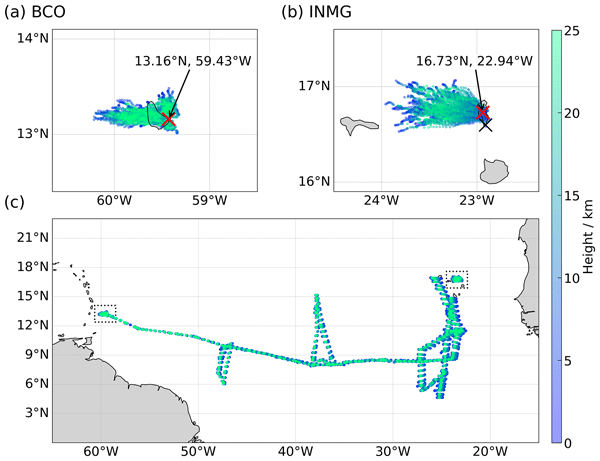
Marius Winkler, Marius Rixen, Florent Beucher, Fleur Couvreux, Chaehyeon C. Nam, Philippe Peyrillé, Hauke Schmidt, Hans Segura, Karl-Hermann Wieners, Ezri Alkilani-Brown, Abdou Aziz Coly, Giovanni Biagioli, Michael M. Bell, Ester Brito, Emma Chauvin, Julie Capo, Delián Colón-Burgos, Akeem Dawes, Jose Carlos da Luz, Zekican Demiralay, Vincent Douet, Vincent Ducastin, Clarisse Dufaux, Jean-Louis Dufresne, Florence Favot, Thomas Fiolleau, Emilie Fons, Geet George, Helene M. Gloeckner, Suelly Gonçalves, Laurent Gouttesoulard, Lennéa Hayo, Wei-Ting Hsiao, Sarah Kennison, Michael Kopelman, Tsung-Yung Lee, Enora Le Gall, Mateo Lovato, Emily Luschen, Nicolas Maury, Brett McKim, Louis Netz, Diouf Ousseynou, Karsten Peters-von Gehlen, Chavez Pope, Basile Poujol, Niwde Rivera Maldonado, Nina Robbins-Blanch, Nicolas Rochetin, Daniel Rowe, Paula Romero Jure, James H. Ruppert Jr., Jairo Segura Bermudez, Jarrett C. Starr, Martin Stelzner, Connor Stoll, Macintyre Syrett, Abraham Tekoe, Jeremie Trules, Colin Welty, Daniel Klocke, Raphaela Vogel, Sandrine Bony, Allison A. Wing, and Bjorn Stevens
Earth Syst. Sci. Data, 18, 1833–1854, https://doi.org/10.5194/essd-18-1833-2026, https://doi.org/10.5194/essd-18-1833-2026, 2026
Short summary
Short summary
The RAPSODI dataset compiles 624 radiosonde profiles collected during the 2024 ORCESTRA campaign across the tropical Atlantic: from Cape Verde (INMG), the R/V Meteor, and the Barbados Cloud Observatory. It provides high-resolution temperature, humidity, wind, and pressure data to study convection, tropical waves, and ITCZ dynamics. Data are quality-controlled and openly available in Zarr format via IPFS.

Anna Weber, Benjamin Kirbus, Manfred Wendisch, and Bernhard Mayer
Atmos. Chem. Phys., 26, 3521–3540, https://doi.org/10.5194/acp-26-3521-2026, https://doi.org/10.5194/acp-26-3521-2026, 2026
Short summary
Short summary
Macrophysical and microphysical properties of clouds and their evolution during the initial phase of marine cold air outbreaks in the Arctic are studied with a focus on cloud thermodynamic phase partitioning and phase transitions. To this end, high-resolution quasi-Lagrangian observations of the hyperspectral and polarized imaging system specMACS during the HALO-(AC)3 campaign are combined with backward trajectories. Six cold air outbreaks with varying strengths are analyzed and compared.
Anna Moustaka, Antonis Gkikas, Stavros-Andreas Logothetis, Johannes Flemming, Samuel Rémy, Melanie Ades, Angela Benedetti, Kleareti Tourpali, Vassilis Amiridis, and Stelios Kazadzis
EGUsphere, https://doi.org/10.5194/egusphere-2026-1107, https://doi.org/10.5194/egusphere-2026-1107, 2026
This preprint is open for discussion and under review for Atmospheric Chemistry and Physics (ACP).
Short summary
Short summary
We examined how atmospheric aerosols have changed worldwide over the past two decades using a global atmospheric reanalysis together with ground-based observations. We found strong regional differences, with clear declines in some industrialized areas and increases in parts of South Asia and the Middle East. These long-term records help improve understanding of changes in climate and air quality.
Anna Moustaka, Nikolaos Siomos, Stelios Kazadzis, Emmanouil Proestakis, Kalliopi Artemis Voudouri, Anton Lopatin, Oleg Dubovik, Kleareti Tourpali, Christos Zerefos, Vassilis Amiridis, and Antonis Gkikas
Atmos. Meas. Tech., 19, 1201–1225, https://doi.org/10.5194/amt-19-1201-2026, https://doi.org/10.5194/amt-19-1201-2026, 2026
Short summary
Short summary
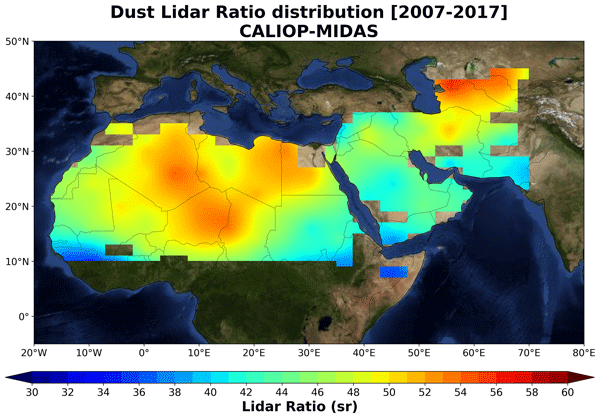
North Africa and the Middle East are home to the world’s most active dust sources, but accurately monitoring airborne dust remains challenging. We combine active and passive satellite aerosol products to dynamically estimate dust lidar ratios over a 12-year period. The results reveal pronounced and physically meaningful regional variability, improving aerosol characterization and supporting climate and air-quality applications.
Ramon Campos Braga, Daniel Harrison, Manfred Wendisch, and Rachel Albrecht
EGUsphere, https://doi.org/10.5194/egusphere-2026-795, https://doi.org/10.5194/egusphere-2026-795, 2026
Short summary
Short summary
We introduce a new thermodynamic method to quantify water vapor supersaturation (Sv) at warm cloud bases by describing the ascent of a cloudy air parcel as a reversible cloud-adiabatic process. This approach enables the calculation of cloud-base droplet number concentration spectra from in situ airborne measurements without reliance on prescribed updraft velocities or empirical parameterizations. The method is validated using CCN measurements from airborne observations over the Amazon Basin.
Alkistis Papetta, Maria Kezoudi, Holger Baars, Athina Floutsi, Eleni Drakaki, Konrad Kandler, Sudharaj Aryasree, Elena Louca, Theodoros Christoudias, Eleni Marinou, Chris Stopford, Troy Thornberry, Vassilis Amiridis, Jean Sciare, and Franco Marenco
Atmos. Chem. Phys., 26, 2055–2082, https://doi.org/10.5194/acp-26-2055-2026, https://doi.org/10.5194/acp-26-2055-2026, 2026
Short summary
Short summary
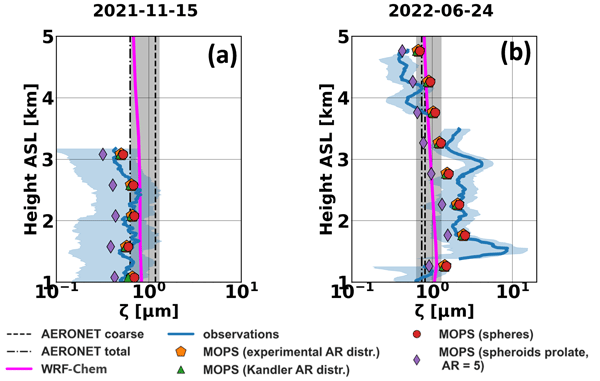
Dust in the atmosphere affects air quality, weather, and climate, but measuring it is challenging. We used drones and ground-based instruments to study how dust particles interact with light and relate this to their mass. Current methods often underestimate large dust particles, leading to errors in dust quantity. Our results show that regional differences in dust must be considered to improve climate models and satellite observations.
David Mateos, Carlos Toledano, Abel Calle, Roberto Román, Marcos Herreras-Giralda, Ramiro González, Sara Herrero-Anta, Daniel González-Fernández, Celia Herrero-del Barrio, Argyro Nisantzi, Rodanthi E. Mamouri, Silke Groß, Victoria E. Cachorro, Ángel M. de Frutos, and Bernadett Weinzierl
Atmos. Chem. Phys., 26, 1993–2005, https://doi.org/10.5194/acp-26-1993-2026, https://doi.org/10.5194/acp-26-1993-2026, 2026
Short summary
Short summary
A field experiment deployed in Cyprus included two sun photometers of Aerosol Robotic Network in two different sites. Mineral dust was predominant during the experiment, with Saharan and Arabian dust showing distinct optical properties, in particular, the Angstrom Exponent in the near-infrarred range and Volume Efficiency factor. Both magnitudes can served as a reliable proxy for mineral dust typing. No significant black carbon presence was detected.
Manuel Moser, Christiane Voigt, Oliver Eppers, Johannes Lucke, Elena De La Torre Castro, Johanna Mayer, Regis Dupuy, Guillaume Mioche, Olivier Jourdan, Hans-Christian Clemen, Johannes Schneider, Philipp Joppe, Stephan Mertes, Bruno Wetzel, Stephan Borrmann, Marcus Klingebiel, Mario Mech, Christof Lüpkes, Susanne Crewell, André Ehrlich, Andreas Herber, and Manfred Wendisch
Atmos. Chem. Phys., 26, 1867–1887, https://doi.org/10.5194/acp-26-1867-2026, https://doi.org/10.5194/acp-26-1867-2026, 2026
Short summary
Short summary
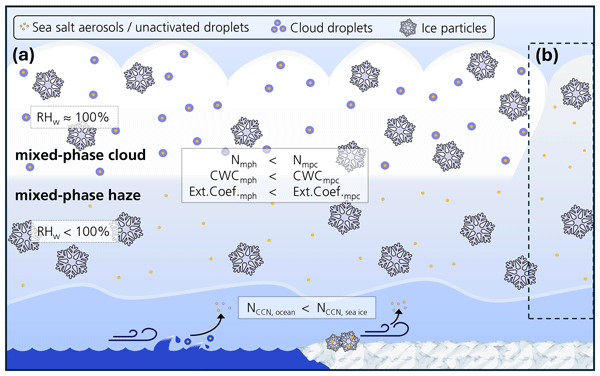
In this study we analyzed Arctic mixed-phase clouds using airborne in-situ measurements in spring 2022. Based on microphysical properties, we show that within these clouds a distinction must be made between classic mixed-phase clouds and a mixed-phase haze regime. Instead of supercooled droplets, the haze regime contains large wet sea salt aerosols. These findings improve our understanding of Arctic low-level cloud processes.
Konstantinos Rizos, Emmanouil Proestakis, Thanasis Georgiou, Antonis Gkikas, Eleni Marinou, Peristera Paschou, Kalliopi Artemis Voudouri, Athanasios Tsikerdekis, David P. Donovan, Gerd-Jan van Zadelhoff, Angela Benedetti, Holger Baars, Athena Augusta Floutsi, Nikos Benas, Martin Stengel, Christian Retscher, Edward Malina, and Vassilis Amiridis
Atmos. Meas. Tech., 19, 699–728, https://doi.org/10.5194/amt-19-699-2026, https://doi.org/10.5194/amt-19-699-2026, 2026
Short summary
Short summary
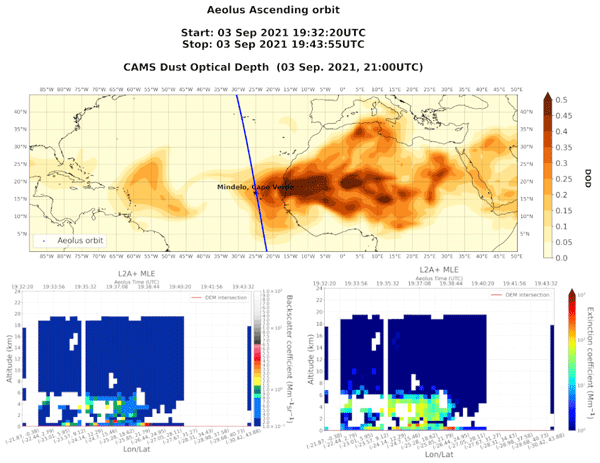
The Aeolus satellite's lidar system had limitations in detecting certain atmospheric layers and distinguishing between aerosol and cloud types. To improve accuracy, a new dust detection product was developed. By combining data from various sources and validating it with ground-based measurements, this enhanced product performs better than the original. It helps improve dust transport models and weather predictions, making it a valuable tool for atmospheric monitoring and forecasting.
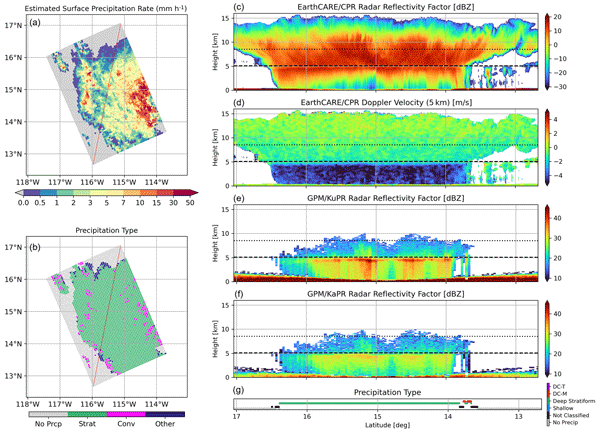
Shunsuke Aoki, Takuji Kubota, and F. Joseph Turk
Atmos. Meas. Tech., 19, 79–100, https://doi.org/10.5194/amt-19-79-2026, https://doi.org/10.5194/amt-19-79-2026, 2026
Short summary
Short summary
Using coincident observations from the EarthCARE Cloud Profiling Radar with Doppler velocity measurement capability and the Dual-Frequency Precipitation Radar on the Global Precipitation Measurement, vertical motions in stratiform and convective precipitation systems are examined, providing insights into the dynamical and microphysical processes inside deep clouds. This enables a more comprehensive understanding of hydrometeor fall speeds and vertical air motions in precipitation systems.
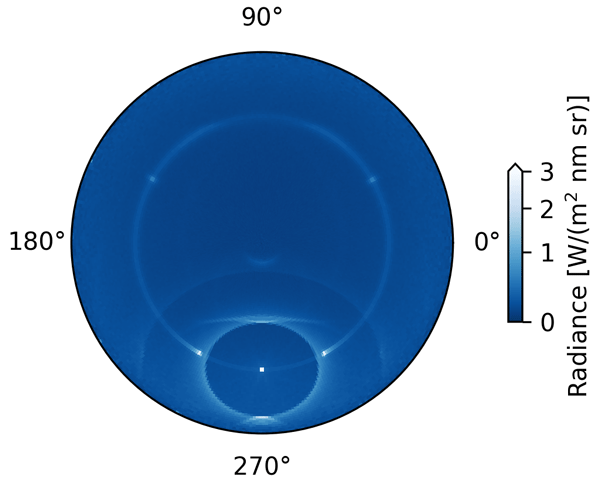
Linda Forster, Anna Weber, and Bernhard Mayer
Atmos. Meas. Tech., 18, 7853–7863, https://doi.org/10.5194/amt-18-7853-2025, https://doi.org/10.5194/amt-18-7853-2025, 2025
Short summary
Short summary
CrystalTrace is a Monte Carlo raytracing algorithm for simulating radiative transfer in ice clouds with different crystal shapes and orientations. Integrated into libradtran's MYSTIC solver, it enables efficient, realistic simulations of ice alongside water clouds. By computing single-scattering properties online at the crystal scale, it eliminates the need for precomputed lookup tables, improving efficiency and angular resolution for satellite, airborne, and ground-based observation retrievals.
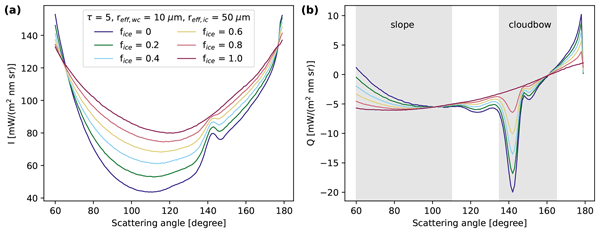
Anna Weber, Veronika Pörtge, Claudia Emde, and Bernhard Mayer
Atmos. Meas. Tech., 18, 7581–7601, https://doi.org/10.5194/amt-18-7581-2025, https://doi.org/10.5194/amt-18-7581-2025, 2025
Short summary
Short summary
In this work, a new quantitative retrieval of cloud thermodynamic phase partitioning based on multi-angle polarimetric imaging is presented. The retrieval is validated using synthetic data for idealized and realistic cloud cases and applied to measurements of the airborne specMACS instrument during the HALO-(AC)3 campaign. It provides high spatial resolution information about phase partitioning at cloud top and allows for example to study phase transitions in Arctic mixed-phase clouds.
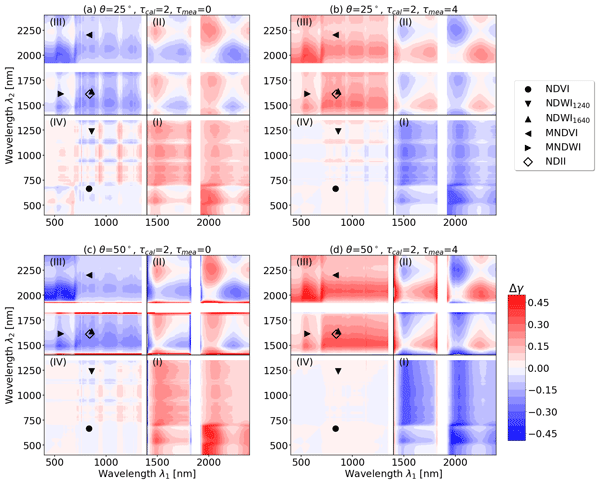
Kevin Wolf, Evelyn Jäkel, André Ehrlich, Michael Schäfer, Hannes Feilhauer, Andreas Huth, and Manfred Wendisch
Biogeosciences, 22, 7797–7817, https://doi.org/10.5194/bg-22-7797-2025, https://doi.org/10.5194/bg-22-7797-2025, 2025
Short summary
Short summary
This paper presents combined atmosphere-vegetation radiative transfer simulations to systematically investigate cloud-induced biases in remotely sensed vegetation indices (VIs) derived from below-cloud measurements. The biases in VIs have been investigated for the general case of two-band VIs, and for the special cases of the normalized difference vegetation index (NDVI), the normalized difference water index (NDWI), and the enhanced vegetation index (EVI).
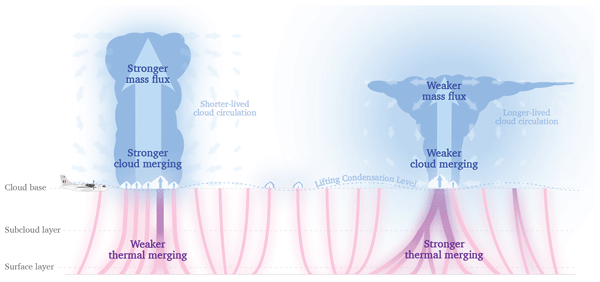
Sandrine Bony, Basile Poujol, Brett McKim, Nicolas Rochetin, Marie Lothon, Julia Windmiller, Nicolas Maury, Clarisse Dufaux, Louis Jaffeux, Patrick Chazette, and Julien Delanoë
Atmos. Chem. Phys., 25, 17331–17362, https://doi.org/10.5194/acp-25-17331-2025, https://doi.org/10.5194/acp-25-17331-2025, 2025
Short summary
Short summary
Space photographs of the Earth show that clouds form diverse, common but poorly understood cloud patterns. The analysis of observations gathered from research aircraft over the tropical ocean shows that the merging of thermals and clouds in the first kilometer of the atmosphere plays a key role in controlling the size, depth and spacing of clouds. This reveals a fundamental process through which clouds interact with each other and with their environment.
Qiang Li and Silke Groß
Atmos. Chem. Phys., 25, 16657–16677, https://doi.org/10.5194/acp-25-16657-2025, https://doi.org/10.5194/acp-25-16657-2025, 2025
Short summary
Short summary
This study presents the cirrus occurrence and optical properties at high- and midlatitudes using the satellite lidar measurements. The results indicate the differences in cirrus occurrence and optical properties across latitudes. Besides seasonality, the cirrus extinction and depolarization show a consistent decrease with increasing latitude. The potential causes are discussed and it turns out that aerosol particles show much larger concentrations at midlatitudes than at high-latitudes.
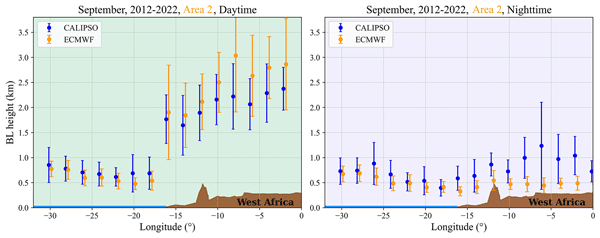
Ioanna Tsikoudi, Eleni Marinou, Maria Tombrou, Eleni Giannakaki, Emmanouil Proestakis, Konstantinos Rizos, Ville Vakkari, Holger Baars, Annett Skupin, Ronny Engelmann, Zhenping Yin, and Vassilis Amiridis
Atmos. Chem. Phys., 25, 16491–16510, https://doi.org/10.5194/acp-25-16491-2025, https://doi.org/10.5194/acp-25-16491-2025, 2025
Short summary
Short summary
We study the characteristics of the boundary layer over three areas: the tropical Atlantic, the tropical West African continent, and near Cabo Verde using PollyXT and CALIPSO (Cloud-Aerosol Lidar and Infrared Pathfinder Satellite Observations) lidar measurements, as well as ECMWF (European Centre for Medium-Range Weather Forecasts) data. The findings underline the strengths and limitations of different observational and modeling approaches, and emphasizes on the importance of considering aerosol conditions and local meteorology when interpreting boundary layer dynamics.
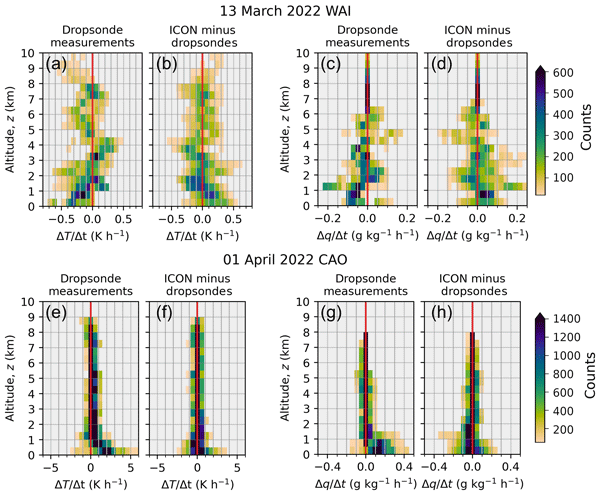
Manfred Wendisch, Benjamin Kirbus, Davide Ori, Matthew D. Shupe, Susanne Crewell, Harald Sodemann, and Vera Schemann
Atmos. Chem. Phys., 25, 15047–15076, https://doi.org/10.5194/acp-25-15047-2025, https://doi.org/10.5194/acp-25-15047-2025, 2025
Short summary
Short summary
Aircraft observations of air parcels moving into and out of the Arctic are reported. From the data, heating and cooling as well as drying and moistening of the air masses along their way into and out of the Arctic could be measured for the first time. These data are used to evaluate if weather prediction models are able to accurately represent these air mass transformations. This work helps to model the future Arctic climate changes, which may have an impact for mid-latitude weather as well.
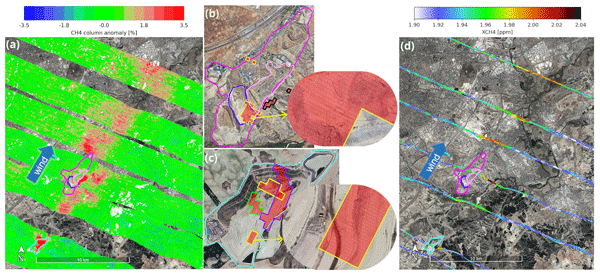
Sven Krautwurst, Christian Fruck, Sebastian Wolff, Jakob Borchardt, Oke Huhs, Konstantin Gerilowski, Michał Gałkowski, Christoph Kiemle, Mathieu Quatrevalet, Martin Wirth, Christian Mallaun, John P. Burrows, Christoph Gerbig, Andreas Fix, Hartmut Bösch, and Heinrich Bovensmann
Atmos. Chem. Phys., 25, 14669–14702, https://doi.org/10.5194/acp-25-14669-2025, https://doi.org/10.5194/acp-25-14669-2025, 2025
Short summary
Short summary
Anomalously high CH4 emissions from landfills in Madrid, Spain, have been observed by satellite measurements in recent years. Our investigations of these waste facilities, using passive and active airborne remote sensing measurements, confirm these high emission rates with values of up to 13 th−1 during the overflight and show excellent agreement between the two techniques. A large fraction of the emissions is attributed to active landfill sites.
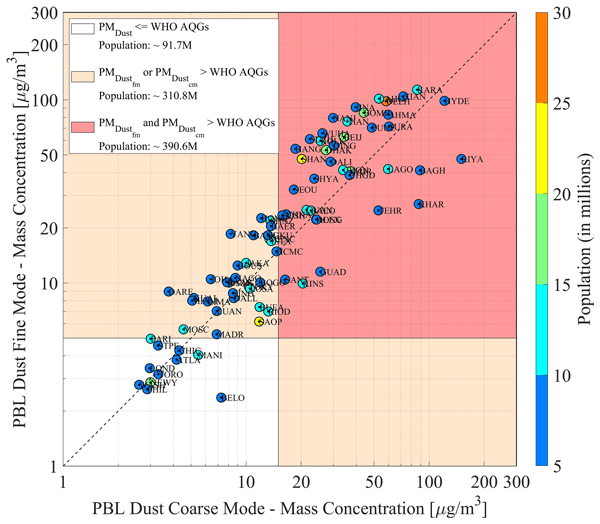
Emmanouil Proestakis, Kyriakoula Papachristopoulou, Thanasis Georgiou, Sofia Eirini Chatoutsidou, Mihalis Lazaridis, Antonis Gkikas, Ilias Fountoulakis, Ioanna Tsikoudi, Manolis P. Petrakis, and Vassilis Amiridis
Atmos. Chem. Phys., 25, 14777–14823, https://doi.org/10.5194/acp-25-14777-2025, https://doi.org/10.5194/acp-25-14777-2025, 2025
Short summary
Short summary
Based on Earth observations of dust the study addresses the questions: To what extent have the fine and coarse modes of atmospheric dust within the planetary boundary layer (PBL) changed over major cities worldwide? Which areas experience fine-mode and coarse-mode dust mass concentrations within the PBL that exceed World Health Organization air quality guidelines, and which areas are projected to exceed these guidelines in the near future? Can we quantify associated impacts on human health?
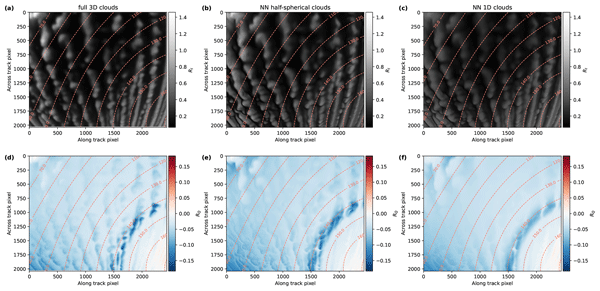
Anna Weber, Gregor Köcher, and Bernhard Mayer
Atmos. Meas. Tech., 18, 5805–5821, https://doi.org/10.5194/amt-18-5805-2025, https://doi.org/10.5194/amt-18-5805-2025, 2025
Short summary
Short summary
A neural-network-based fast forward operator for polarized 3D radiative transfer is presented. The forward operator uses the new InDEpendent column local halF-sphere ApproXimation (IDEFAX). Polarized radiances simulated with IDEFAX and the forward operator were validated against full 3D radiative transfer simulations with MYSTIC and show a significantly improved representation of 3D radiative effects compared to the plane-parallel independent column approximation at comparable computation times.
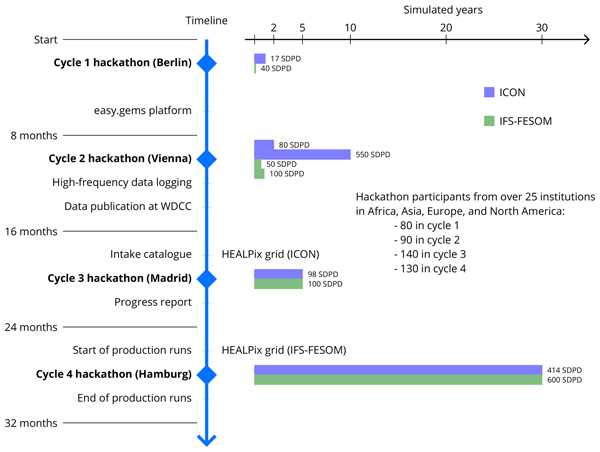
Hans Segura, Xabier Pedruzo-Bagazgoitia, Philipp Weiss, Sebastian K. Müller, Thomas Rackow, Junhong Lee, Edgar Dolores-Tesillos, Imme Benedict, Matthias Aengenheyster, Razvan Aguridan, Gabriele Arduini, Alexander J. Baker, Jiawei Bao, Swantje Bastin, Eulàlia Baulenas, Tobias Becker, Sebastian Beyer, Hendryk Bockelmann, Nils Brüggemann, Lukas Brunner, Suvarchal K. Cheedela, Sushant Das, Jasper Denissen, Ian Dragaud, Piotr Dziekan, Madeleine Ekblom, Jan Frederik Engels, Monika Esch, Richard Forbes, Claudia Frauen, Lilli Freischem, Diego García-Maroto, Philipp Geier, Paul Gierz, Álvaro González-Cervera, Katherine Grayson, Matthew Griffith, Oliver Gutjahr, Helmuth Haak, Ioan Hadade, Kerstin Haslehner, Shabeh ul Hasson, Jan Hegewald, Lukas Kluft, Aleksei Koldunov, Nikolay Koldunov, Tobias Kölling, Shunya Koseki, Sergey Kosukhin, Josh Kousal, Peter Kuma, Arjun U. Kumar, Rumeng Li, Nicolas Maury, Maximilian Meindl, Sebastian Milinski, Kristian Mogensen, Bimochan Niraula, Jakub Nowak, Divya Sri Praturi, Ulrike Proske, Dian Putrasahan, René Redler, David Santuy, Domokos Sármány, Reiner Schnur, Patrick Scholz, Dmitry Sidorenko, Dorian Spät, Birgit Sützl, Daisuke Takasuka, Adrian Tompkins, Alejandro Uribe, Mirco Valentini, Menno Veerman, Aiko Voigt, Sarah Warnau, Fabian Wachsmann, Marta Wacławczyk, Nils Wedi, Karl-Hermann Wieners, Jonathan Wille, Marius Winkler, Yuting Wu, Florian Ziemen, Janos Zimmermann, Frida A.-M. Bender, Dragana Bojovic, Sandrine Bony, Simona Bordoni, Patrice Brehmer, Marcus Dengler, Emanuel Dutra, Saliou Faye, Erich Fischer, Chiel van Heerwaarden, Cathy Hohenegger, Heikki Järvinen, Markus Jochum, Thomas Jung, Johann H. Jungclaus, Noel S. Keenlyside, Daniel Klocke, Heike Konow, Martina Klose, Szymon Malinowski, Olivia Martius, Thorsten Mauritsen, Juan Pedro Mellado, Theresa Mieslinger, Elsa Mohino, Hanna Pawłowska, Karsten Peters-von Gehlen, Abdoulaye Sarré, Pajam Sobhani, Philip Stier, Lauri Tuppi, Pier Luigi Vidale, Irina Sandu, and Bjorn Stevens
Geosci. Model Dev., 18, 7735–7761, https://doi.org/10.5194/gmd-18-7735-2025, https://doi.org/10.5194/gmd-18-7735-2025, 2025
Short summary
Short summary
The Next Generation of Earth Modeling Systems project (nextGEMS) developed two Earth system models that use horizontal grid spacing of 10 km and finer, giving more fidelity to the representation of local phenomena, globally. In its fourth cycle, nextGEMS simulated the Earth System climate over the 2020–2049 period under the SSP3-7.0 scenario. Here, we provide an overview of nextGEMS, insights into the model development, and the realism of multi-decadal, kilometer-scale simulations.

Ilias Fountoulakis, Kyriaki Papachristopoulou, Stelios Kazadzis, Gregor Hülsen, Julian Gröbner, Ioannis-Panagiotis Raptis, Dimitra Kouklaki, Akriti Masoom, Natalia Kouremeti, Charalampos Kontoes, and Christos S. Zerefos
Geosci. Model Dev., 18, 7451–7473, https://doi.org/10.5194/gmd-18-7451-2025, https://doi.org/10.5194/gmd-18-7451-2025, 2025
Short summary
Short summary
The UVIOS2 model has been evaluated at Davos, Switzerland during the UVCIII campaign. The accuracy in the modelled UV indices has been assessed for different combinations of model inputs. A good overall agreement between UVIOS2 and the world reference spectroradiometer QASUME was found (average ratio of ~ 1 between the modelled and measured UV index), although the variability in the ratio can be large under cloudy conditions.
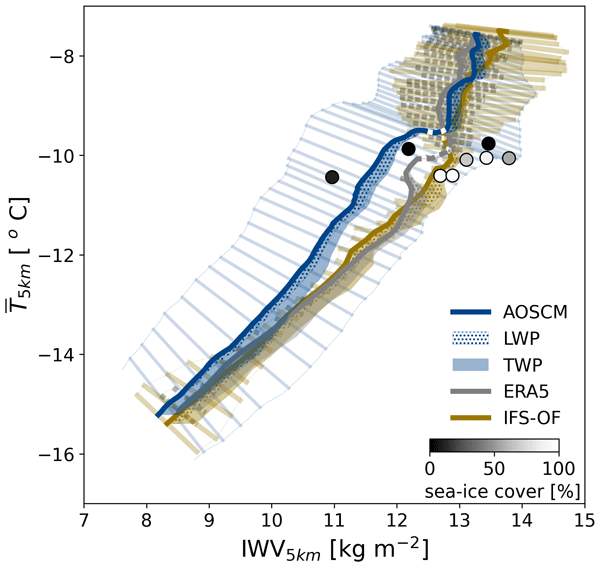
Michail Karalis, Gunilla Svensson, Manfred Wendisch, and Michael Tjernström
Atmos. Chem. Phys., 25, 13177–13198, https://doi.org/10.5194/acp-25-13177-2025, https://doi.org/10.5194/acp-25-13177-2025, 2025
Short summary
Short summary
During the spring warm-air intrusion captured by HALO-(𝒜𝒞)3, the air mass demonstrated a column-like structure. We built a Lagrangian modeling framework using a single-column model (AOSCM) to simulate the air mass transformation. Comparing to observations, reanalysis, and forecast data, we found that the Lagrangian AOSCM can successfully reproduce the main features of the transformation. The Lagrangian AOSCM can be used for future model development to improve Arctic weather and climate prediction.
Sebastian Becker, André Ehrlich, Michael Schäfer, and Manfred Wendisch
Atmos. Chem. Phys., 25, 12831–12842, https://doi.org/10.5194/acp-25-12831-2025, https://doi.org/10.5194/acp-25-12831-2025, 2025
Short summary
Short summary
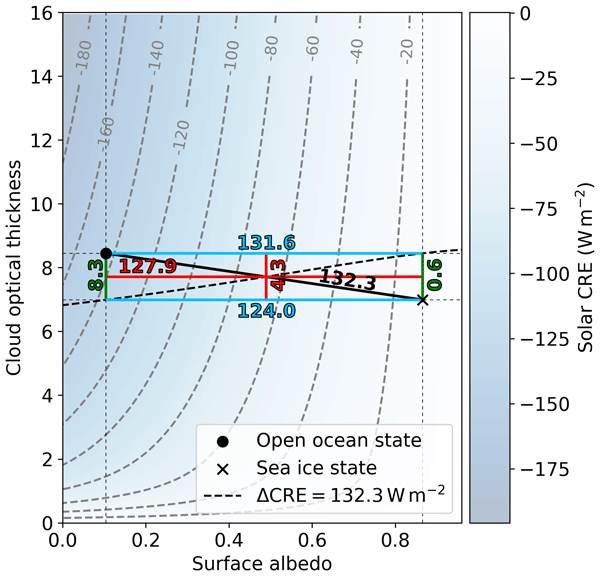
Clouds interact with solar radiation and can alter the surface temperature. The strength of this cloud impact is driven by cloud properties as well as solar elevation and surface reflection. As these dependencies are poorly represented in climate models, cloud, surface, and radiation observations are used to quantify the contributions of the drivers in the Arctic. It is shown that the weaker surface reflection dominates the stronger cooling effect of clouds over open ocean compared to sea ice.
Christian Heske, Florian Ewald, and Silke Groß
Atmos. Meas. Tech., 18, 5177–5198, https://doi.org/10.5194/amt-18-5177-2025, https://doi.org/10.5194/amt-18-5177-2025, 2025
Short summary
Short summary
This study proposes a new technique to augment polarimetric radar measurements of the national German operational radar network with vertically looking cloud radars. The method is tested in two different case studies by comparison to dedicated scanning radars revealing promising results. Future usage of the method is motivated by analyzing the coverage of the operational radar network finding advantageous locations with good radar coverage.
Ioanna Tsikoudi, Alessandro Battaglia, Christine Unal, and Eleni Marinou
Atmos. Meas. Tech., 18, 4857–4870, https://doi.org/10.5194/amt-18-4857-2025, https://doi.org/10.5194/amt-18-4857-2025, 2025
Short summary
Short summary
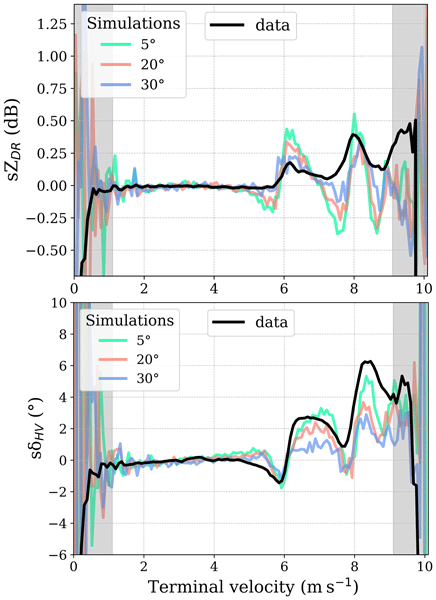
In the study, we simulate spectral polarimetric variables for raindrops as observed by cloud radar. Raindrops are modeled as oblate spheroids, and backscattering properties are computed via the T-matrix method, including noise, turbulence, and spectral averaging effects. When comparing simulations with measurements, differences in the amplitudes of polarimetric variables are noted. This shows the challenge of using simplified shapes to model raindrop polarimetric variables when moving to millimeter wavelengths.
Joshua J. Müller, Michael Schäfer, Sophie Rosenburg, André Ehrlich, and Manfred Wendisch
Atmos. Meas. Tech., 18, 4695–4708, https://doi.org/10.5194/amt-18-4695-2025, https://doi.org/10.5194/amt-18-4695-2025, 2025
Short summary
Short summary
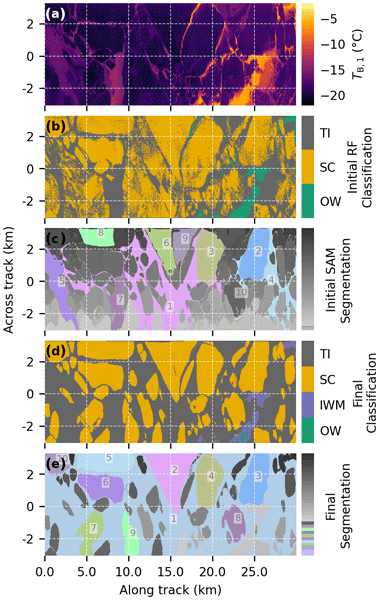
We retrieved high-resolution maps of Arctic surface temperature and type using an airborne thermal infrared imager during an Arctic aircraft campaign. Our study highlights small-scale surface variability, complementing satellite observations. Surface temperature was retrieved via radiative transfer simulations, while surface type was classified using machine learning. Additionally, we analysed segment sizes of each surface type, presenting results based on their distance from the sea-ice edge.
Peristera Paschou, Nikolaos Siomos, Eleni Marinou, Antonis Gkikas, Samira M. Idrissa, Daniel T. Quaye, Désiré D. Fiogbe Attannon, Kalliopi Artemis Voudouri, Charikleia Meleti, David P. Donovan, George Georgoussis, Tommaso Parrinello, Thorsten Fehr, Jonas von Bismarck, and Vassilis Amiridis
Atmos. Meas. Tech., 18, 4731–4754, https://doi.org/10.5194/amt-18-4731-2025, https://doi.org/10.5194/amt-18-4731-2025, 2025
Short summary
Short summary
This study presents the results from a validation study on the Level 2A products (aerosol optical properties) of the ESA's (European Space Agency) Aeolus mission. Measurements from the eVe lidar, a combined linear/circular polarization and Raman lidar and ESA's ground reference system, that have been collected during the Joint Aeolus Tropical Atlantic Campaign are compared with collocated Aeolus Level 2A profiles obtained from the latest version (Baseline 16) of the Aeolus algorithms.
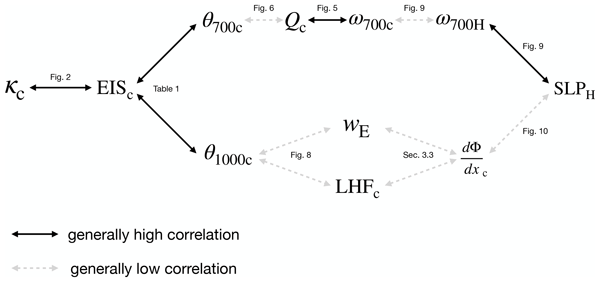
Hairu Ding, Bjorn Stevens, and Hauke Schmidt
Atmos. Chem. Phys., 25, 10511–10521, https://doi.org/10.5194/acp-25-10511-2025, https://doi.org/10.5194/acp-25-10511-2025, 2025
Short summary
Short summary
This study examines the physical link between subtropical highs and stratocumulus variability. Using reanalysis data, we test two proposed pathways – one at the surface and one in the free troposphere – but find that neither is a dominant mechanism for stratocumulus variability on seasonal and interannual timescales. These results challenge the assumed influence of subtropical highs on stratocumulus and highlight the need for further research into lower-tropospheric stability dynamics.

Emmanouil Proestakis, Vassilis Amiridis, Carlos Pérez García-Pando, Svetlana Tsyro, Jan Griesfeller, Antonis Gkikas, Thanasis Georgiou, María Gonçalves Ageitos, Jeronimo Escribano, Stelios Myriokefalitakis, Elisa Bergas Masso, Enza Di Tomaso, Sara Basart, Jan-Berend W. Stuut, and Angela Benedetti
Earth Syst. Sci. Data, 17, 4351–4395, https://doi.org/10.5194/essd-17-4351-2025, https://doi.org/10.5194/essd-17-4351-2025, 2025
Short summary
Short summary
Quantification of dust deposition into the broader Atlantic Ocean is provided, with the estimates established based on Earth observations. The dataset is considered unique with respect to a range of applications, including compensating for spatiotemporal gaps of sediment-trap measurements, assessments of model simulations, shedding light on physical processes related to the dust cycle, and improving the understanding of dust biogeochemical impacts on oceanic ecosystems, weather, and climate.
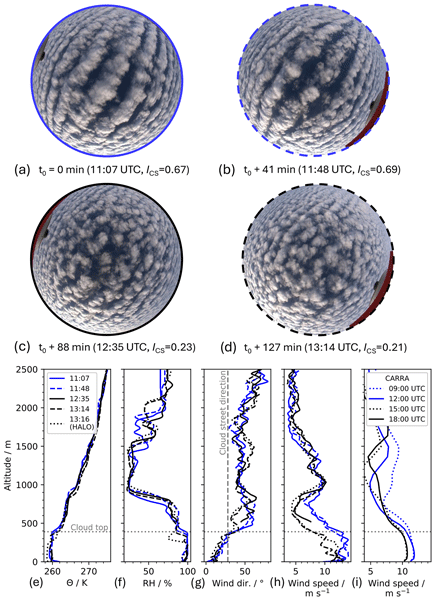
Marcus Klingebiel, André Ehrlich, Micha Gryschka, Nils Risse, Nina Maherndl, Imke Schirmacher, Sophie Rosenburg, Sabine Hörnig, Manuel Moser, Evelyn Jäkel, Michael Schäfer, Hartwig Deneke, Mario Mech, Christiane Voigt, and Manfred Wendisch
Atmos. Chem. Phys., 25, 9787–9801, https://doi.org/10.5194/acp-25-9787-2025, https://doi.org/10.5194/acp-25-9787-2025, 2025
Short summary
Short summary
Our study is using aircraft measurements from the HALO-(𝒜𝒞)³ campaign to investigate the transition from organized Arctic cloud street structures to more scattered clouds, which we call isotropic cloud patterns. We show that lower wind speeds cause this transition. In addition, we look at the changes in the cloud coverage, the height of the clouds, the cloud particles, and the radiative properties.
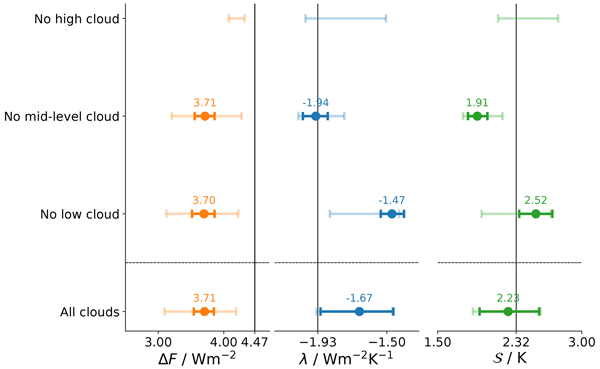
Lukas Kluft, Bjorn Stevens, Manfred Brath, and Stefan A. Buehler
Atmos. Chem. Phys., 25, 9075–9084, https://doi.org/10.5194/acp-25-9075-2025, https://doi.org/10.5194/acp-25-9075-2025, 2025
Short summary
Short summary
Using a single-column model, we investigate the effect of the vertical distribution of clouds on climate sensitivity. We show that, depending on their height, clouds can mask or unmask the radiative response of the clear-sky atmosphere. Our single-column model yields an all-sky climate sensitivity of 2.2 K, slightly less than the clear-sky value. This value can be interpreted as a baseline to which changes in surface albedo and an assumed reduction in cloud albedo would add.
Anna Lea Albright, Bjorn Stevens, and Martin Wirth
EGUsphere, https://doi.org/10.5194/egusphere-2025-3551, https://doi.org/10.5194/egusphere-2025-3551, 2025
Preprint archived
Short summary
Short summary
Ocean evaporation transfers heat and moisture into the atmosphere, shaping our weather and climate, yet humidity just above the ocean is hard to measure from space. We show that lasers measuring low cloud height can accurately infer near-surface humidity. Tests on ships, aircraft, and with weather balloons are used to validate the method. Applied to satellites, this method could help fill gaps in humidity measurements over the ocean.
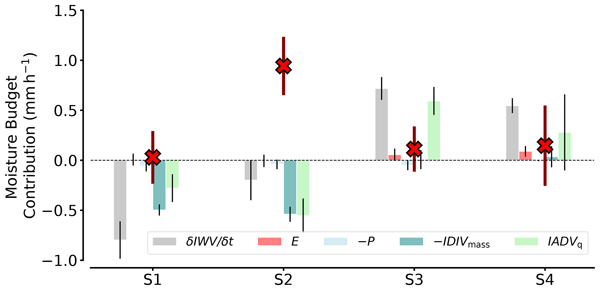
Henning Dorff, Florian Ewald, Heike Konow, Mario Mech, Davide Ori, Vera Schemann, Andreas Walbröl, Manfred Wendisch, and Felix Ament
Atmos. Chem. Phys., 25, 8329–8354, https://doi.org/10.5194/acp-25-8329-2025, https://doi.org/10.5194/acp-25-8329-2025, 2025
Short summary
Short summary
Using observations of an Arctic atmospheric river (AR) from a long-range research aircraft, we analyse how moisture transported into the Arctic by the AR is transformed and how it interacts with the Arctic environment. The moisture transport divergence is the main driver of local moisture change over time. Surface precipitation and evaporation are rather weak when averaged over extended AR sectors, although considerable heterogeneity of precipitation within the AR is observed.
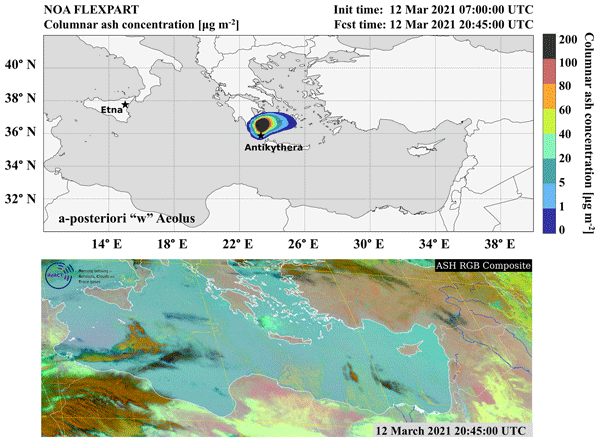
Anna Kampouri, Vassilis Amiridis, Thanasis Georgiou, Stavros Solomos, Anna Gialitaki, Maria Tsichla, Michael Rennie, Simona Scollo, and Prodromos Zanis
Atmos. Chem. Phys., 25, 7343–7368, https://doi.org/10.5194/acp-25-7343-2025, https://doi.org/10.5194/acp-25-7343-2025, 2025
Short summary
Short summary
This study proposes a novel inverse modeling framework coupled with remote sensing data for improving volcanic ash dispersion forecasts, essential for aviation safety. By integrating FLEXPART dispersion model outputs with ground-based ACTRIS lidar observations, the approach estimates Etna's volcanic particle emissions and highlights a significant enhancement in the forecast accuracy.
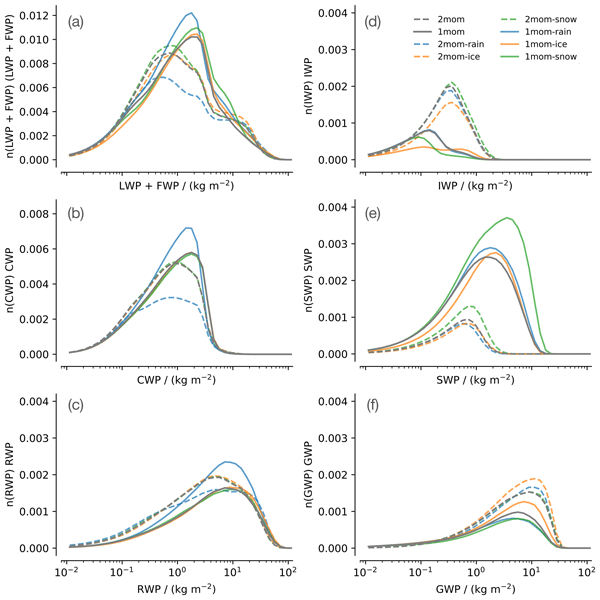
Ann Kristin Naumann, Monika Esch, and Bjorn Stevens
Atmos. Chem. Phys., 25, 6429–6444, https://doi.org/10.5194/acp-25-6429-2025, https://doi.org/10.5194/acp-25-6429-2025, 2025
Short summary
Short summary
This study explores how uncertainties in the representation of microphysical processes affect the tropical condensate distribution in the global storm-resolving model ICON. The results point to the importance of the fall speed of hydrometeor particles and to a simple relationship: the faster a condensate falls, the less there is of it. Implications for the energy balance and precipitation properties are discussed.
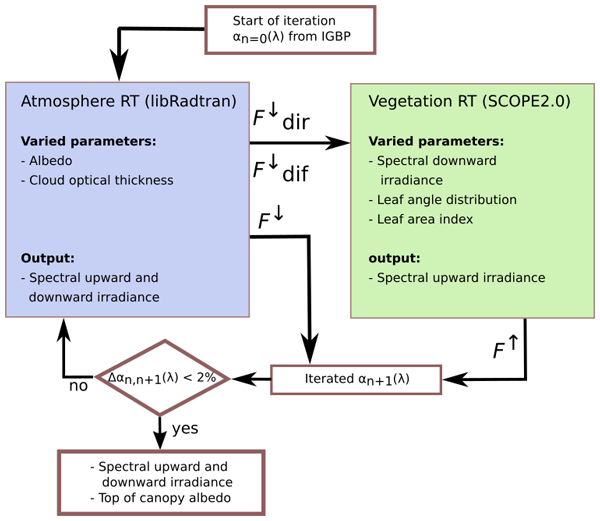
Kevin Wolf, Evelyn Jäkel, André Ehrlich, Michael Schäfer, Hannes Feilhauer, Andreas Huth, Alexandra Weigelt, and Manfred Wendisch
Biogeosciences, 22, 2909–2933, https://doi.org/10.5194/bg-22-2909-2025, https://doi.org/10.5194/bg-22-2909-2025, 2025
Short summary
Short summary
This paper reports an investigation of the influence of clouds on vegetation albedo using a coupled atmosphere–vegetation radiative transfer model. Both models are iteratively linked to simulate cloud–vegetation–radiation interactions over canopies more realistically. Solar, spectral, and broadband irradiances have been simulated under varying cloud conditions. The simulated irradiances were used to investigate the spectral and broadband effect of clouds on vegetation albedo.
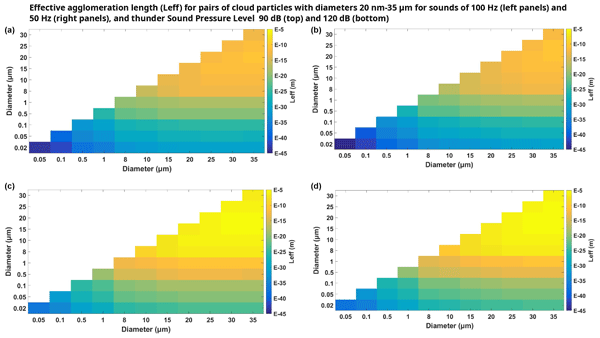
Konstantinos Kourtidis, Stavros Stathopoulos, and Vassilis Amiridis
Atmos. Chem. Phys., 25, 5935–5946, https://doi.org/10.5194/acp-25-5935-2025, https://doi.org/10.5194/acp-25-5935-2025, 2025
Short summary
Short summary
The sound of thunder induces mechanical effects on cloud droplets and ice particles, causing changes in their size distribution. A shock wave near the lightning channel causes extensive shattering of cloud particles. At a distance, the audio wave will cause agglomeration of particles. So, thunder may influence the rain generation process and the radiative properties of clouds. As global warming may influence the occurrence rate of lightning, a climate feedback may be induced by these mechanisms.

André Ehrlich, Susanne Crewell, Andreas Herber, Marcus Klingebiel, Christof Lüpkes, Mario Mech, Sebastian Becker, Stephan Borrmann, Heiko Bozem, Matthias Buschmann, Hans-Christian Clemen, Elena De La Torre Castro, Henning Dorff, Regis Dupuy, Oliver Eppers, Florian Ewald, Geet George, Andreas Giez, Sarah Grawe, Christophe Gourbeyre, Jörg Hartmann, Evelyn Jäkel, Philipp Joppe, Olivier Jourdan, Zsófia Jurányi, Benjamin Kirbus, Johannes Lucke, Anna E. Luebke, Maximilian Maahn, Nina Maherndl, Christian Mallaun, Johanna Mayer, Stephan Mertes, Guillaume Mioche, Manuel Moser, Hanno Müller, Veronika Pörtge, Nils Risse, Greg Roberts, Sophie Rosenburg, Johannes Röttenbacher, Michael Schäfer, Jonas Schaefer, Andreas Schäfler, Imke Schirmacher, Johannes Schneider, Sabrina Schnitt, Frank Stratmann, Christian Tatzelt, Christiane Voigt, Andreas Walbröl, Anna Weber, Bruno Wetzel, Martin Wirth, and Manfred Wendisch
Earth Syst. Sci. Data, 17, 1295–1328, https://doi.org/10.5194/essd-17-1295-2025, https://doi.org/10.5194/essd-17-1295-2025, 2025
Short summary
Short summary
This paper provides an overview of the HALO–(AC)3 aircraft campaign data sets, the campaign-specific instrument operation, data processing, and data quality. The data set comprises in situ and remote sensing observations from three research aircraft: HALO, Polar 5, and Polar 6. All data are published in the PANGAEA database by instrument-separated data subsets. It is highlighted how the scientific analysis of the HALO–(AC)3 data benefits from the coordinated operation of three aircraft.
Silke Groß, Volker Freudenthaler, Moritz Haarig, Albert Ansmann, Carlos Toledano, David Mateos, Petra Seibert, Rodanthi-Elisavet Mamouri, Argyro Nisantzi, Josef Gasteiger, Maximilian Dollner, Anne Tipka, Manuel Schöberl, Marilena Teri, and Bernadett Weinzierl
Atmos. Chem. Phys., 25, 3191–3211, https://doi.org/10.5194/acp-25-3191-2025, https://doi.org/10.5194/acp-25-3191-2025, 2025
Short summary
Short summary
Aerosols contribute to the largest uncertainties in climate change predictions. The eastern Mediterranean is a hotspot for aerosols with natural and anthropogenic contributions. We present lidar measurements performed during A-LIFE (Absorbing aerosol layers in a changing climate: aging, lifetime and dynamics) to characterize aerosols and aerosol mixtures. We extend current lidar classification and separation schemes and compare them to classification schemes using different methods.
Birte Klug, Ralf Weigel, Konrad Kandler, Markus Rapp, Manuel Baumgartner, Thomas Böttger, Klaus Dieter Wilhelm, Harald Rott, Thomas Kenntner, Oliver Drescher, and Anna Hundertmark
EGUsphere, https://doi.org/10.5194/egusphere-2025-510, https://doi.org/10.5194/egusphere-2025-510, 2025
Short summary
Short summary
The nuclei onto which noctilucent clouds (NLC) form are largely unknown. We investigated the development of an inertia-based particle collector allowing for sampling NLC particles during a sounding rocket flight for off-line single particle physico-chemical analyzes. Computational fluid dynamics simulations (for Mach numbers 1.31 and 1.75) support the design and development process in reference to a basic mechanical concept of particle sampling and sample storage, which is also presented here.
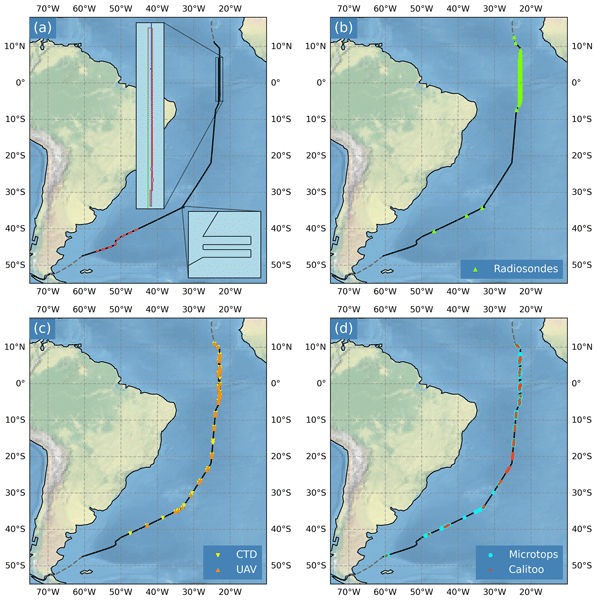
Laura Köhler, Julia Windmiller, Dariusz Baranowski, Michał Brennek, Michał Ciuryło, Lennéa Hayo, Daniel Kȩpski, Stefan Kinne, Beata Latos, Bertrand Lobo, Tobias Marke, Timo Nischik, Daria Paul, Piet Stammes, Artur Szkop, and Olaf Tuinder
Earth Syst. Sci. Data, 17, 633–659, https://doi.org/10.5194/essd-17-633-2025, https://doi.org/10.5194/essd-17-633-2025, 2025
Short summary
Short summary
We present atmospheric and oceanic data from the Atlantic References and Convection ship campaign with the Maria S. Merian from Mindelo to Punta Arenas observed with the integrated ship sensors; humidity and temperature profiler; ceilometer; aerosol instruments (Calitoo, Microtops, and DustTrak); radiosondes; uncrewed aircraft vehicles; and conductivity, temperature, and depth scans. The data include three complete profiles of the Intertropical Convergence Zone and a storm in the South Atlantic.
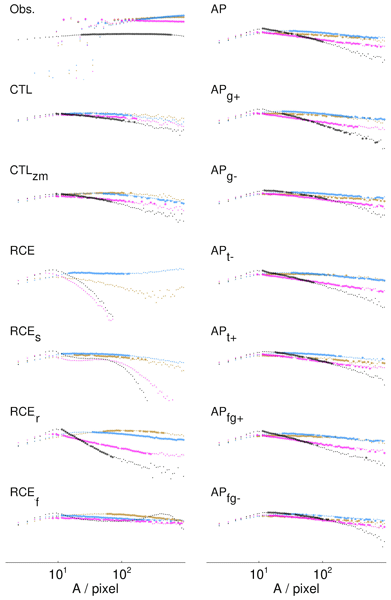
Claudia Christine Stephan and Bjorn Stevens
Atmos. Chem. Phys., 25, 1209–1226, https://doi.org/10.5194/acp-25-1209-2025, https://doi.org/10.5194/acp-25-1209-2025, 2025
Short summary
Short summary
Tropical precipitation cluster area and intensity distributions follow power laws, but the physical processes responsible for this behavior remain unknown. We analyze global simulations that realistically represent precipitation processes. We consider Earth-like planets as well as virtual planets to realize different types of large-scale dynamics. Our finding is that power laws in Earth’s precipitation cluster statistics stem from the robust power laws in Earth’s atmospheric wind field.
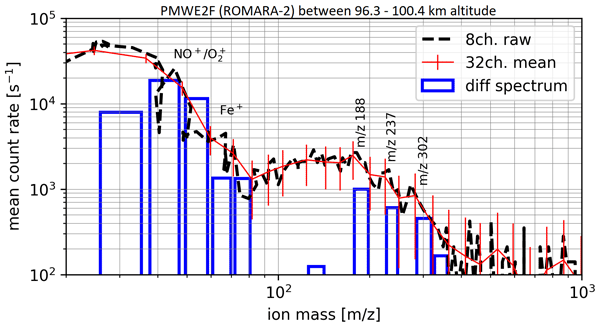
Joan Stude, Heinfried Aufmhoff, Hans Schlager, Markus Rapp, Carsten Baumann, Frank Arnold, and Boris Strelnikov
Atmos. Chem. Phys., 25, 383–396, https://doi.org/10.5194/acp-25-383-2025, https://doi.org/10.5194/acp-25-383-2025, 2025
Short summary
Short summary
We used a mass spectrometer on a rocket to analyze natural ions at altitudes between 60 and 120 km. Our instrument was launched in 2018 and 2021 from Norway. The heaviest particles were detected around 80 km, while medium particles could be found even above 100 km. Our measurements show that different particles are formed and not just one predominating compound. The most likely compounds that form meteor smoke particles in our measurements are made up of oxides of iron, magnesium and silicon.
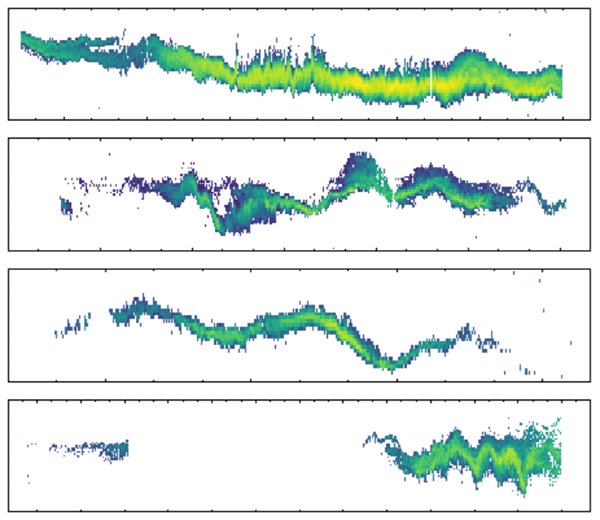
Natalie Kaifler, Bernd Kaifler, Markus Rapp, Guiping Liu, Diego Janches, Gerd Baumgarten, and Jose-Luis Hormaechea
Atmos. Chem. Phys., 24, 14029–14044, https://doi.org/10.5194/acp-24-14029-2024, https://doi.org/10.5194/acp-24-14029-2024, 2024
Short summary
Short summary
Noctilucent clouds (NLCs) are silvery clouds that can be viewed during twilight and indicate atmospheric conditions like temperature and water vapor in the upper mesosphere. High-resolution measurements from a remote sensing laser instrument provide NLC height, brightness, and occurrence rate since 2017. Most observations occur in the morning hours, likely caused by strong tidal winds, and NLC ice particles are thus transported from elsewhere to the observing location in the Southern Hemisphere.
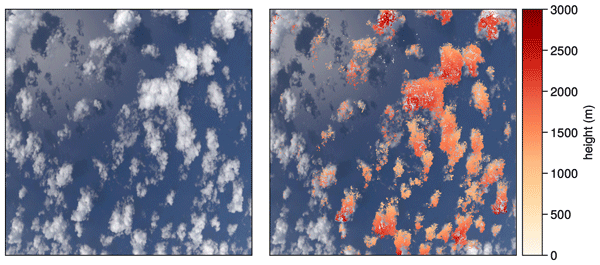
Lea Volkmer, Tobias Kölling, Tobias Zinner, and Bernhard Mayer
Atmos. Meas. Tech., 17, 6807–6817, https://doi.org/10.5194/amt-17-6807-2024, https://doi.org/10.5194/amt-17-6807-2024, 2024
Short summary
Short summary
The importance of the consideration of cloud motion for the stereographic determination of cloud top height from aircraft observations is demonstrated using measurements of the airborne spectrometer of the Munich Aerosol Cloud Scanner (specMACS). A method for cloud motion correction using model winds from the European Centre for Medium-Range Weather Forecasts is presented and validated using both real measurements and realistic radiative transfer simulations.

Claudia Emde, Veronika Pörtge, Mihail Manev, and Bernhard Mayer
Atmos. Meas. Tech., 17, 6769–6789, https://doi.org/10.5194/amt-17-6769-2024, https://doi.org/10.5194/amt-17-6769-2024, 2024
Short summary
Short summary
We introduce an innovative method to retrieve the cloud fraction and optical thickness of liquid water clouds over the ocean based on polarimetry. This is well suited for satellite observations providing multi-angle polarization measurements. Cloud fraction and cloud optical thickness can be derived from measurements at two viewing angles: one within the cloudbow and one in the sun glint region.
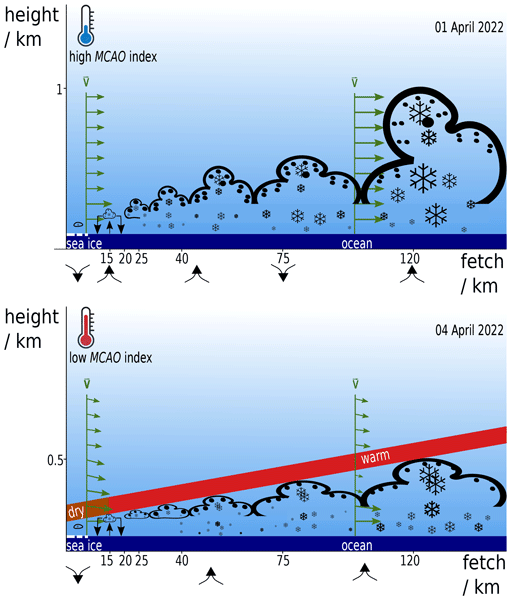
Imke Schirmacher, Sabrina Schnitt, Marcus Klingebiel, Nina Maherndl, Benjamin Kirbus, André Ehrlich, Mario Mech, and Susanne Crewell
Atmos. Chem. Phys., 24, 12823–12842, https://doi.org/10.5194/acp-24-12823-2024, https://doi.org/10.5194/acp-24-12823-2024, 2024
Short summary
Short summary
During Arctic marine cold-air outbreaks, cold air flows from sea ice over open water. Roll circulations evolve, forming cloud streets. We investigate the initial circulation and cloud development using high-resolution airborne measurements. We compute the distance an air mass traveled over water (fetch) from back trajectories. Cloud streets form at 15 km fetch, cloud cover strongly increases at around 20 km, and precipitation forms at around 30 km.
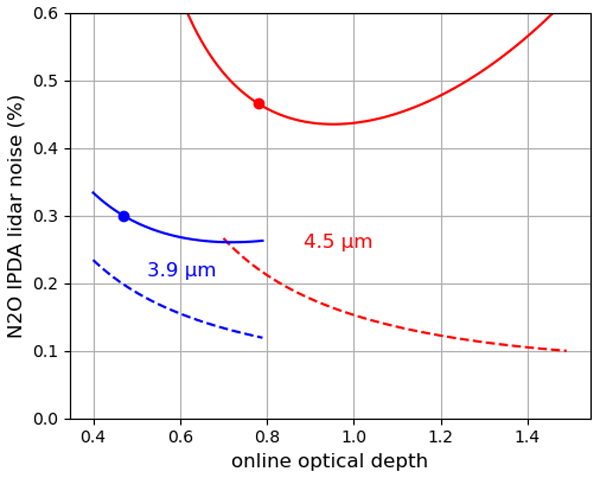
Christoph Kiemle, Andreas Fix, Christian Fruck, Gerhard Ehret, and Martin Wirth
Atmos. Meas. Tech., 17, 6569–6578, https://doi.org/10.5194/amt-17-6569-2024, https://doi.org/10.5194/amt-17-6569-2024, 2024
Short summary
Short summary
Nitrous oxide is the third most important greenhouse gas modified by human activities after carbon dioxide and methane. This study examines the feasibility of airborne differential absorption lidar to quantify emissions from agriculture, fossil fuel combustion, industry, and biomass burning. Simulations show that a technically realizable and affordable mid-infrared lidar system will be able to measure the nitrous oxide column concentration enhancements with sufficient precision.
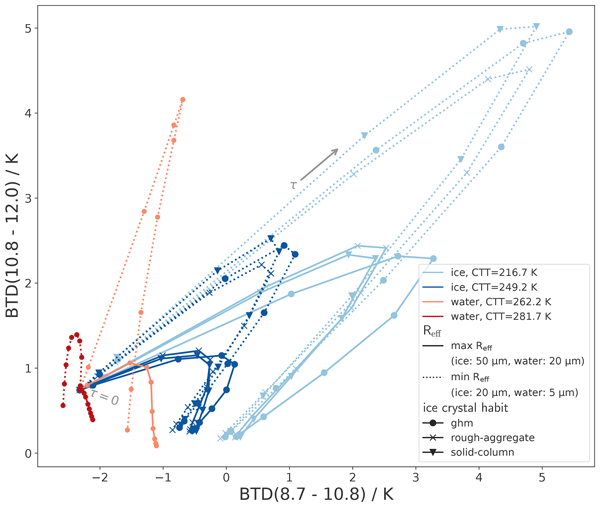
Johanna Mayer, Bernhard Mayer, Luca Bugliaro, Ralf Meerkötter, and Christiane Voigt
Atmos. Meas. Tech., 17, 5161–5185, https://doi.org/10.5194/amt-17-5161-2024, https://doi.org/10.5194/amt-17-5161-2024, 2024
Short summary
Short summary
This study uses radiative transfer calculations to characterize the relation of two satellite channel combinations (namely infrared window brightness temperature differences – BTDs – of SEVIRI) to the thermodynamic cloud phase. A sensitivity analysis reveals the complex interplay of cloud parameters and their contribution to the observed phase dependence of BTDs. This knowledge helps to design optimal cloud-phase retrievals and to understand their potential and limitations.
Manfred Wendisch, Susanne Crewell, André Ehrlich, Andreas Herber, Benjamin Kirbus, Christof Lüpkes, Mario Mech, Steven J. Abel, Elisa F. Akansu, Felix Ament, Clémantyne Aubry, Sebastian Becker, Stephan Borrmann, Heiko Bozem, Marlen Brückner, Hans-Christian Clemen, Sandro Dahlke, Georgios Dekoutsidis, Julien Delanoë, Elena De La Torre Castro, Henning Dorff, Regis Dupuy, Oliver Eppers, Florian Ewald, Geet George, Irina V. Gorodetskaya, Sarah Grawe, Silke Groß, Jörg Hartmann, Silvia Henning, Lutz Hirsch, Evelyn Jäkel, Philipp Joppe, Olivier Jourdan, Zsofia Jurányi, Michail Karalis, Mona Kellermann, Marcus Klingebiel, Michael Lonardi, Johannes Lucke, Anna E. Luebke, Maximilian Maahn, Nina Maherndl, Marion Maturilli, Bernhard Mayer, Johanna Mayer, Stephan Mertes, Janosch Michaelis, Michel Michalkov, Guillaume Mioche, Manuel Moser, Hanno Müller, Roel Neggers, Davide Ori, Daria Paul, Fiona M. Paulus, Christian Pilz, Felix Pithan, Mira Pöhlker, Veronika Pörtge, Maximilian Ringel, Nils Risse, Gregory C. Roberts, Sophie Rosenburg, Johannes Röttenbacher, Janna Rückert, Michael Schäfer, Jonas Schaefer, Vera Schemann, Imke Schirmacher, Jörg Schmidt, Sebastian Schmidt, Johannes Schneider, Sabrina Schnitt, Anja Schwarz, Holger Siebert, Harald Sodemann, Tim Sperzel, Gunnar Spreen, Bjorn Stevens, Frank Stratmann, Gunilla Svensson, Christian Tatzelt, Thomas Tuch, Timo Vihma, Christiane Voigt, Lea Volkmer, Andreas Walbröl, Anna Weber, Birgit Wehner, Bruno Wetzel, Martin Wirth, and Tobias Zinner
Atmos. Chem. Phys., 24, 8865–8892, https://doi.org/10.5194/acp-24-8865-2024, https://doi.org/10.5194/acp-24-8865-2024, 2024
Short summary
Short summary
The Arctic is warming faster than the rest of the globe. Warm-air intrusions (WAIs) into the Arctic may play an important role in explaining this phenomenon. Cold-air outbreaks (CAOs) out of the Arctic may link the Arctic climate changes to mid-latitude weather. In our article, we describe how to observe air mass transformations during CAOs and WAIs using three research aircraft instrumented with state-of-the-art remote-sensing and in situ measurement devices.
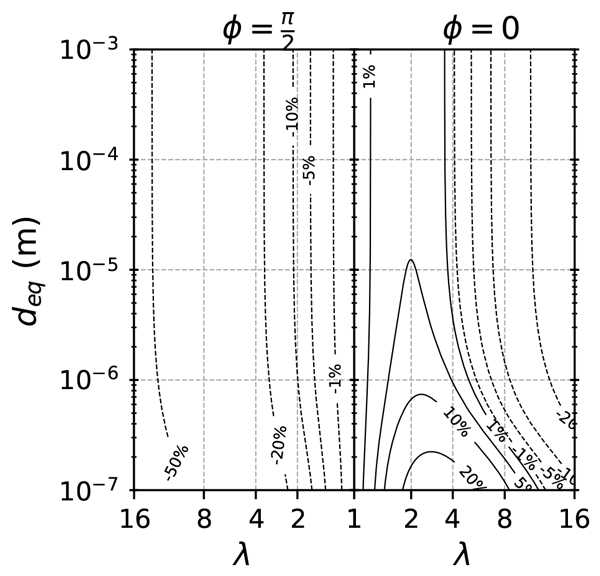
Sylvain Mailler, Sotirios Mallios, Arineh Cholakian, Vassilis Amiridis, Laurent Menut, and Romain Pennel
Geosci. Model Dev., 17, 5641–5655, https://doi.org/10.5194/gmd-17-5641-2024, https://doi.org/10.5194/gmd-17-5641-2024, 2024
Short summary
Short summary
We propose two explicit expressions to calculate the settling speed of solid atmospheric particles with prolate spheroidal shapes. The first formulation is based on theoretical arguments only, while the second one is based on computational fluid dynamics calculations. We show that the first method is suitable for virtually all atmospheric aerosols, provided their shape can be adequately described as a prolate spheroid, and we provide an implementation of the first method in AerSett v2.0.2.
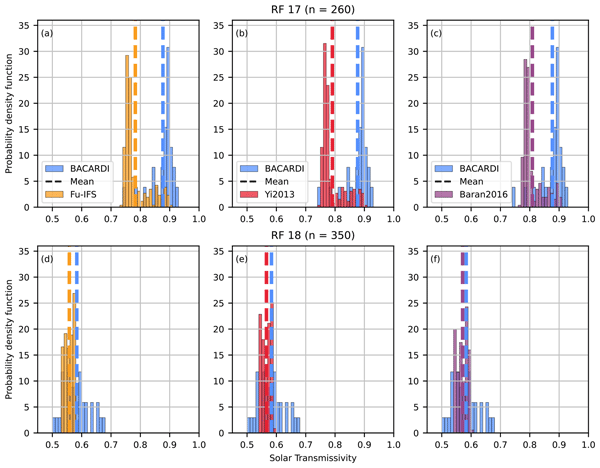
Johannes Röttenbacher, André Ehrlich, Hanno Müller, Florian Ewald, Anna E. Luebke, Benjamin Kirbus, Robin J. Hogan, and Manfred Wendisch
Atmos. Chem. Phys., 24, 8085–8104, https://doi.org/10.5194/acp-24-8085-2024, https://doi.org/10.5194/acp-24-8085-2024, 2024
Short summary
Short summary
Weather prediction models simplify the physical processes related to light scattering by clouds consisting of complex ice crystals. Whether these simplifications are the cause for uncertainties in their prediction can be evaluated by comparing them with measurement data. Here we do this for Arctic ice clouds over sea ice using airborne measurements from two case studies. The model performs well for thick ice clouds but not so well for thin ones. This work can be used to improve the model.
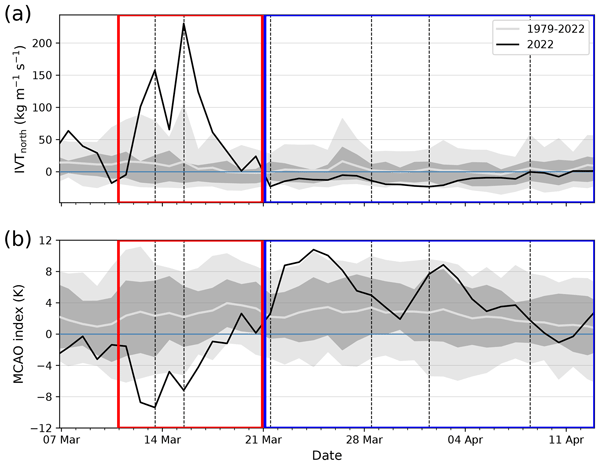
Andreas Walbröl, Janosch Michaelis, Sebastian Becker, Henning Dorff, Kerstin Ebell, Irina Gorodetskaya, Bernd Heinold, Benjamin Kirbus, Melanie Lauer, Nina Maherndl, Marion Maturilli, Johanna Mayer, Hanno Müller, Roel A. J. Neggers, Fiona M. Paulus, Johannes Röttenbacher, Janna E. Rückert, Imke Schirmacher, Nils Slättberg, André Ehrlich, Manfred Wendisch, and Susanne Crewell
Atmos. Chem. Phys., 24, 8007–8029, https://doi.org/10.5194/acp-24-8007-2024, https://doi.org/10.5194/acp-24-8007-2024, 2024
Short summary
Short summary
To support the interpretation of the data collected during the HALO-(AC)3 campaign, which took place in the North Atlantic sector of the Arctic from 7 March to 12 April 2022, we analyze how unusual the weather and sea ice conditions were with respect to the long-term climatology. From observations and ERA5 reanalysis, we found record-breaking warm air intrusions and a large variety of marine cold air outbreaks. Sea ice concentration was mostly within the climatological interquartile range.
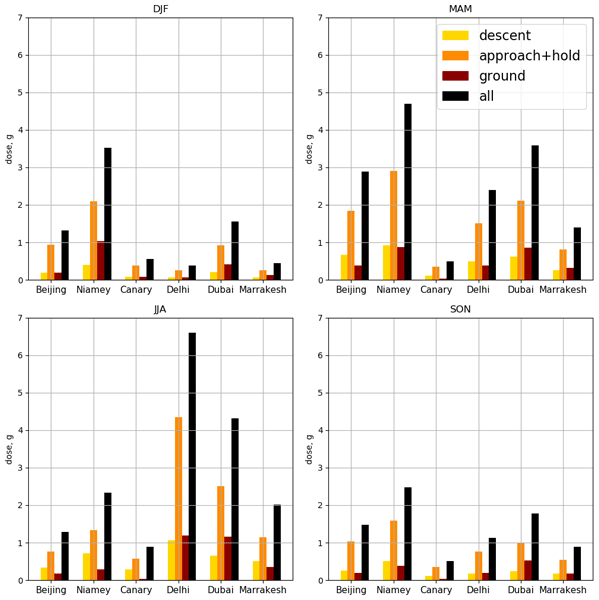
Claire L. Ryder, Clément Bézier, Helen F. Dacre, Rory Clarkson, Vassilis Amiridis, Eleni Marinou, Emmanouil Proestakis, Zak Kipling, Angela Benedetti, Mark Parrington, Samuel Rémy, and Mark Vaughan
Nat. Hazards Earth Syst. Sci., 24, 2263–2284, https://doi.org/10.5194/nhess-24-2263-2024, https://doi.org/10.5194/nhess-24-2263-2024, 2024
Short summary
Short summary
Desert dust poses a hazard to aircraft via degradation of engine components. This has financial implications for the aviation industry and results in increased fuel burn with climate impacts. Here we quantify dust ingestion by aircraft engines at airports worldwide. We find Dubai and Delhi in summer are among the dustiest airports, where substantial engine degradation would occur after 1000 flights. Dust ingestion can be reduced by changing take-off times and the altitude of holding patterns.
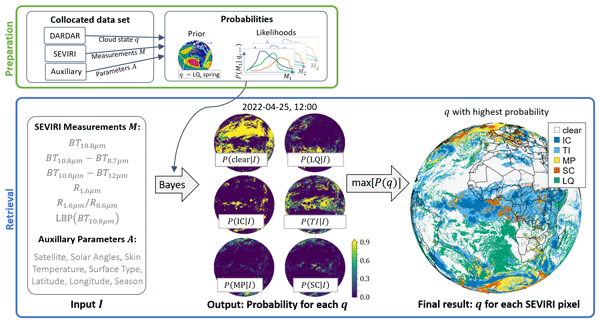
Johanna Mayer, Luca Bugliaro, Bernhard Mayer, Dennis Piontek, and Christiane Voigt
Atmos. Meas. Tech., 17, 4015–4039, https://doi.org/10.5194/amt-17-4015-2024, https://doi.org/10.5194/amt-17-4015-2024, 2024
Short summary
Short summary
ProPS (PRObabilistic cloud top Phase retrieval for SEVIRI) is a method to detect clouds and their thermodynamic phase with a geostationary satellite, distinguishing between clear sky and ice, mixed-phase, supercooled and warm liquid clouds. It uses a Bayesian approach based on the lidar–radar product DARDAR. The method allows studying cloud phases, especially mixed-phase and supercooled clouds, rarely observed from geostationary satellites. This can be used for comparison with climate models.
Hajime Okamoto, Kaori Sato, Tomoaki Nishizawa, Yoshitaka Jin, Takashi Nakajima, Minrui Wang, Masaki Satoh, Kentaroh Suzuki, Woosub Roh, Akira Yamauchi, Hiroaki Horie, Yuichi Ohno, Yuichiro Hagihara, Hiroshi Ishimoto, Rei Kudo, Takuji Kubota, and Toshiyuki Tanaka
Atmos. Meas. Tech. Discuss., https://doi.org/10.5194/amt-2024-101, https://doi.org/10.5194/amt-2024-101, 2024
Publication in AMT not foreseen
Short summary
Short summary
This article gives overviews of the JAXA L2 algorithms and products by Japanese science teams for EarthCARE. The algorithms provide corrected Doppler velocity, cloud particle shape and orientations, microphysics of clouds and aerosols, and radiative fluxes and heating rate. The retrievals by the algorithms are demonstrated and evaluated using NICAM/J-simulator outputs. The JAXA EarthCARE L2 products will bring new scientific knowledge about the clouds, aerosols, radiation and convections.
Clémantyne Aubry, Julien Delanoë, Silke Groß, Florian Ewald, Frédéric Tridon, Olivier Jourdan, and Guillaume Mioche
Atmos. Meas. Tech., 17, 3863–3881, https://doi.org/10.5194/amt-17-3863-2024, https://doi.org/10.5194/amt-17-3863-2024, 2024
Short summary
Short summary
Radar–lidar synergy is used to retrieve ice, supercooled water and mixed-phase cloud properties, making the most of the radar sensitivity to ice crystals and the lidar sensitivity to supercooled droplets. A first analysis of the output of the algorithm run on the satellite data is compared with in situ data during an airborne Arctic field campaign, giving a mean percent error of 49 % for liquid water content and 75 % for ice water content.
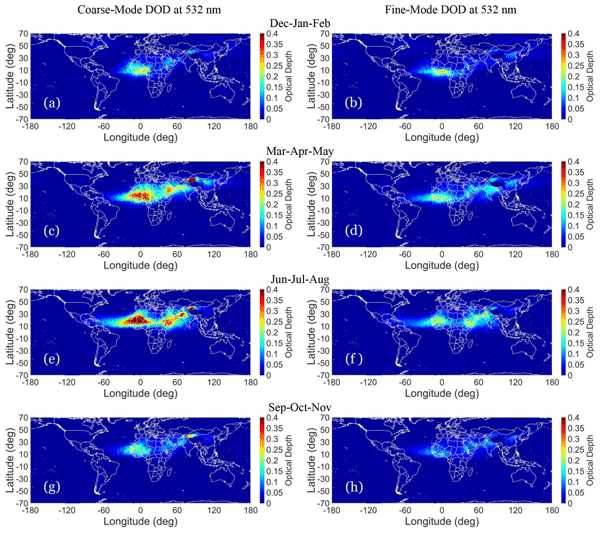
Emmanouil Proestakis, Antonis Gkikas, Thanasis Georgiou, Anna Kampouri, Eleni Drakaki, Claire L. Ryder, Franco Marenco, Eleni Marinou, and Vassilis Amiridis
Atmos. Meas. Tech., 17, 3625–3667, https://doi.org/10.5194/amt-17-3625-2024, https://doi.org/10.5194/amt-17-3625-2024, 2024
Short summary
Short summary
A new four-dimensional, multiyear, and near-global climate data record of the fine-mode (submicrometer diameter) and coarse-mode (supermicrometer diameter) components of atmospheric pure dust is presented. The dataset is considered unique with respect to a wide range of potential applications, including climatological, time series, and trend analysis over extensive geographical domains and temporal periods, validation of atmospheric dust models and datasets, and air quality.
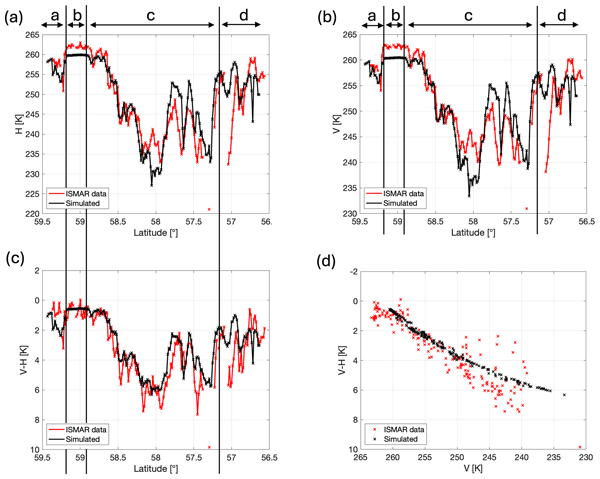
Karina McCusker, Anthony J. Baran, Chris Westbrook, Stuart Fox, Patrick Eriksson, Richard Cotton, Julien Delanoë, and Florian Ewald
Atmos. Meas. Tech., 17, 3533–3552, https://doi.org/10.5194/amt-17-3533-2024, https://doi.org/10.5194/amt-17-3533-2024, 2024
Short summary
Short summary
Polarised radiative transfer simulations are performed using an atmospheric model based on in situ measurements. These are compared to large polarisation measurements to explore whether such measurements can provide information on cloud ice, e.g. particle shape and orientation. We find that using oriented particle models with shapes based on imagery generally allows for accurate simulations. However, results are sensitive to shape assumptions such as the choice of single crystals or aggregates.
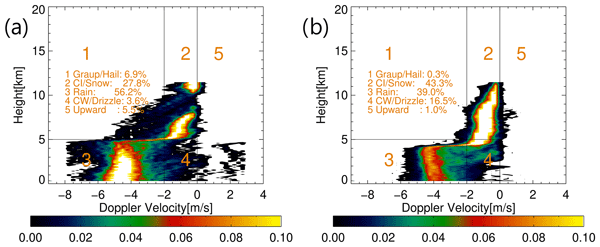
Woosub Roh, Masaki Satoh, Yuichiro Hagihara, Hiroaki Horie, Yuichi Ohno, and Takuji Kubota
Atmos. Meas. Tech., 17, 3455–3466, https://doi.org/10.5194/amt-17-3455-2024, https://doi.org/10.5194/amt-17-3455-2024, 2024
Short summary
Short summary
The advantage of the use of Doppler velocity in the categorization of the hydrometeors is that Doppler velocities suffer less impact from the attenuation of rain and wet attenuation on an antenna. The ground Cloud Profiling Radar observation of the radar reflectivity for the precipitation case is limited because of wet attenuation on an antenna. We found the main contribution to Doppler velocities is the terminal velocity of hydrometeors by analysis of simulation results.
Georgios Dekoutsidis, Martin Wirth, and Silke Groß
Atmos. Chem. Phys., 24, 5971–5987, https://doi.org/10.5194/acp-24-5971-2024, https://doi.org/10.5194/acp-24-5971-2024, 2024
Short summary
Short summary
For decades the earth's temperature has been rising. The Arctic regions are warming faster. Cirrus clouds can contribute to this phenomenon. During warm-air intrusions, air masses are transported into the Arctic from the mid-latitudes. The HALO-(AC)3 campaign took place to measure cirrus during intrusion events and under normal conditions. We study the two cloud types based on these measurements and find differences in their geometry, relative humidity distribution and vertical structure.
Bjorn Stevens, Stefan Adami, Tariq Ali, Hartwig Anzt, Zafer Aslan, Sabine Attinger, Jaana Bäck, Johanna Baehr, Peter Bauer, Natacha Bernier, Bob Bishop, Hendryk Bockelmann, Sandrine Bony, Guy Brasseur, David N. Bresch, Sean Breyer, Gilbert Brunet, Pier Luigi Buttigieg, Junji Cao, Christelle Castet, Yafang Cheng, Ayantika Dey Choudhury, Deborah Coen, Susanne Crewell, Atish Dabholkar, Qing Dai, Francisco Doblas-Reyes, Dale Durran, Ayoub El Gaidi, Charlie Ewen, Eleftheria Exarchou, Veronika Eyring, Florencia Falkinhoff, David Farrell, Piers M. Forster, Ariane Frassoni, Claudia Frauen, Oliver Fuhrer, Shahzad Gani, Edwin Gerber, Debra Goldfarb, Jens Grieger, Nicolas Gruber, Wilco Hazeleger, Rolf Herken, Chris Hewitt, Torsten Hoefler, Huang-Hsiung Hsu, Daniela Jacob, Alexandra Jahn, Christian Jakob, Thomas Jung, Christopher Kadow, In-Sik Kang, Sarah Kang, Karthik Kashinath, Katharina Kleinen-von Königslöw, Daniel Klocke, Uta Kloenne, Milan Klöwer, Chihiro Kodama, Stefan Kollet, Tobias Kölling, Jenni Kontkanen, Steve Kopp, Michal Koran, Markku Kulmala, Hanna Lappalainen, Fakhria Latifi, Bryan Lawrence, June Yi Lee, Quentin Lejeun, Christian Lessig, Chao Li, Thomas Lippert, Jürg Luterbacher, Pekka Manninen, Jochem Marotzke, Satoshi Matsouoka, Charlotte Merchant, Peter Messmer, Gero Michel, Kristel Michielsen, Tomoki Miyakawa, Jens Müller, Ramsha Munir, Sandeep Narayanasetti, Ousmane Ndiaye, Carlos Nobre, Achim Oberg, Riko Oki, Tuba Özkan-Haller, Tim Palmer, Stan Posey, Andreas Prein, Odessa Primus, Mike Pritchard, Julie Pullen, Dian Putrasahan, Johannes Quaas, Krishnan Raghavan, Venkatachalam Ramaswamy, Markus Rapp, Florian Rauser, Markus Reichstein, Aromar Revi, Sonakshi Saluja, Masaki Satoh, Vera Schemann, Sebastian Schemm, Christina Schnadt Poberaj, Thomas Schulthess, Cath Senior, Jagadish Shukla, Manmeet Singh, Julia Slingo, Adam Sobel, Silvina Solman, Jenna Spitzer, Philip Stier, Thomas Stocker, Sarah Strock, Hang Su, Petteri Taalas, John Taylor, Susann Tegtmeier, Georg Teutsch, Adrian Tompkins, Uwe Ulbrich, Pier-Luigi Vidale, Chien-Ming Wu, Hao Xu, Najibullah Zaki, Laure Zanna, Tianjun Zhou, and Florian Ziemen
Earth Syst. Sci. Data, 16, 2113–2122, https://doi.org/10.5194/essd-16-2113-2024, https://doi.org/10.5194/essd-16-2113-2024, 2024
Short summary
Short summary
To manage Earth in the Anthropocene, new tools, new institutions, and new forms of international cooperation will be required. Earth Virtualization Engines is proposed as an international federation of centers of excellence to empower all people to respond to the immense and urgent challenges posed by climate change.
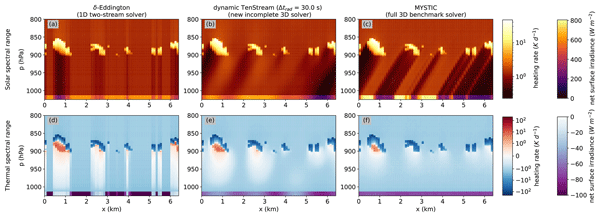
Richard Maier, Fabian Jakub, Claudia Emde, Mihail Manev, Aiko Voigt, and Bernhard Mayer
Geosci. Model Dev., 17, 3357–3383, https://doi.org/10.5194/gmd-17-3357-2024, https://doi.org/10.5194/gmd-17-3357-2024, 2024
Short summary
Short summary
Based on the TenStream solver, we present a new method to accelerate 3D radiative transfer towards the speed of currently used 1D solvers. Using a shallow-cumulus-cloud time series, we evaluate the performance of this new solver in terms of both speed and accuracy. Compared to a 3D benchmark simulation, we show that our new solver is able to determine much more accurate irradiances and heating rates than a 1D δ-Eddington solver, even when operated with a similar computational demand.
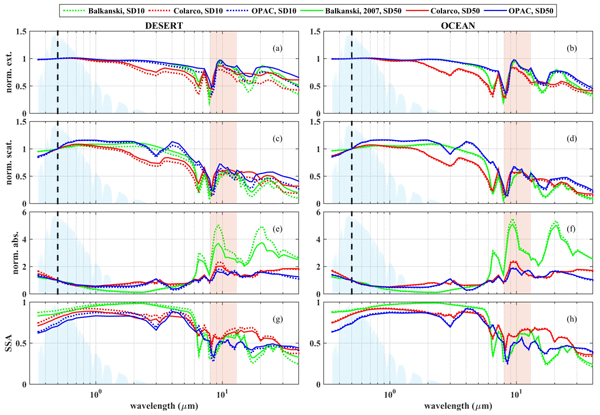
Ilias Fountoulakis, Alexandra Tsekeri, Stelios Kazadzis, Vassilis Amiridis, Angelos Nersesian, Maria Tsichla, Emmanouil Proestakis, Antonis Gkikas, Kyriakoula Papachristopoulou, Vasileios Barlakas, Claudia Emde, and Bernhard Mayer
Atmos. Chem. Phys., 24, 4915–4948, https://doi.org/10.5194/acp-24-4915-2024, https://doi.org/10.5194/acp-24-4915-2024, 2024
Short summary
Short summary
In our study we provide an assessment, through a sensitivity study, of the limitations of models to calculate the dust direct radiative effect (DRE) due to the underrepresentation of its size, refractive index (RI), and shape. Our results indicate the necessity of including more realistic sizes and RIs for dust particles in dust models, in order to derive better estimations of the dust direct radiative effects.
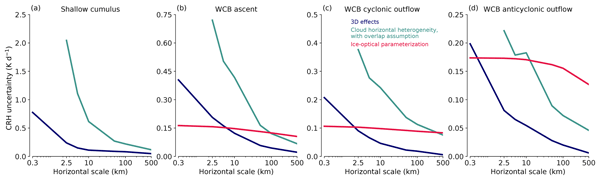
Behrooz Keshtgar, Aiko Voigt, Bernhard Mayer, and Corinna Hoose
Atmos. Chem. Phys., 24, 4751–4769, https://doi.org/10.5194/acp-24-4751-2024, https://doi.org/10.5194/acp-24-4751-2024, 2024
Short summary
Short summary
Cloud-radiative heating (CRH) affects extratropical cyclones but is uncertain in weather and climate models. We provide a framework to quantify uncertainties in CRH within an extratropical cyclone due to four factors and show that the parameterization of ice optical properties contributes significantly to uncertainty in CRH. We also argue that ice optical properties, by affecting CRH on spatial scales of 100 km, are relevant for the large-scale dynamics of extratropical cyclones.
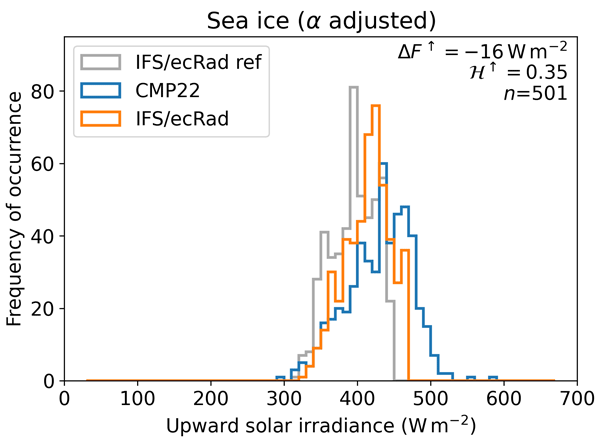
Hanno Müller, André Ehrlich, Evelyn Jäkel, Johannes Röttenbacher, Benjamin Kirbus, Michael Schäfer, Robin J. Hogan, and Manfred Wendisch
Atmos. Chem. Phys., 24, 4157–4175, https://doi.org/10.5194/acp-24-4157-2024, https://doi.org/10.5194/acp-24-4157-2024, 2024
Short summary
Short summary
A weather model is used to compare solar radiation with measurements from an aircraft campaign in the Arctic. Model and observations agree on the downward radiation but show differences in the radiation reflected by the surface and the clouds, which in the model is too low above sea ice and too high above open ocean. The model–observation bias is reduced above open ocean by a realistic fraction of clouds and less cloud liquid water and above sea ice by less dark sea ice and more cloud droplets.
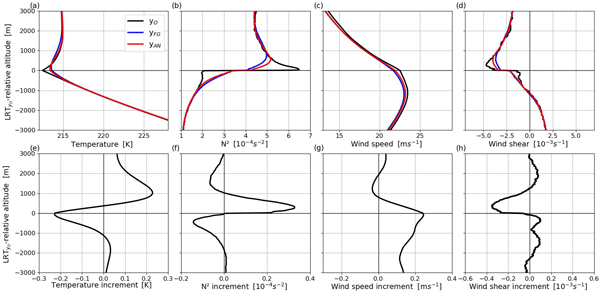
Konstantin Krüger, Andreas Schäfler, Martin Weissmann, and George C. Craig
Weather Clim. Dynam., 5, 491–509, https://doi.org/10.5194/wcd-5-491-2024, https://doi.org/10.5194/wcd-5-491-2024, 2024
Short summary
Short summary
Initial conditions of current numerical weather prediction models insufficiently represent the sharp vertical gradients across the midlatitude tropopause. Observation-space data assimilation output is used to study the influence of assimilated radiosondes on the tropopause. The radiosondes reduce systematic biases of the model background and sharpen temperature and wind gradients in the analysis. Tropopause sharpness is still underestimated in the analysis, which may impact weather forecasts.
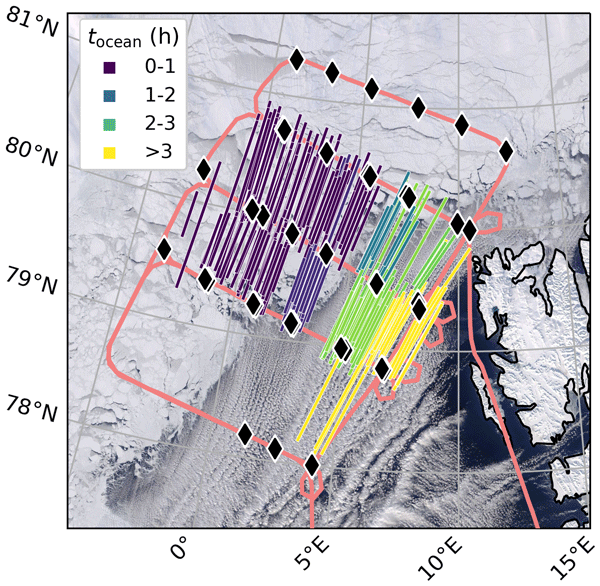
Benjamin Kirbus, Imke Schirmacher, Marcus Klingebiel, Michael Schäfer, André Ehrlich, Nils Slättberg, Johannes Lucke, Manuel Moser, Hanno Müller, and Manfred Wendisch
Atmos. Chem. Phys., 24, 3883–3904, https://doi.org/10.5194/acp-24-3883-2024, https://doi.org/10.5194/acp-24-3883-2024, 2024
Short summary
Short summary
A research aircraft is used to track the changes in air temperature, moisture, and cloud properties for air that moves from cold Arctic sea ice onto warmer oceanic waters. The measurements are compared to two reanalysis models named ERA5 and CARRA. The biggest differences are found for air temperature over the sea ice and moisture over the ocean. CARRA data are more accurate than ERA5 because they better simulate the sea ice, the transition from sea ice to open ocean, and the forming clouds.
Lea Volkmer, Veronika Pörtge, Fabian Jakub, and Bernhard Mayer
Atmos. Meas. Tech., 17, 1703–1719, https://doi.org/10.5194/amt-17-1703-2024, https://doi.org/10.5194/amt-17-1703-2024, 2024
Short summary
Short summary
Three-dimensional radiative transfer simulations are used to evaluate the performance of retrieval algorithms in the derivation of cloud geometry (cloud top heights) and cloud droplet size distributions from two-dimensional polarized radiance measurements of the airborne spectrometer of the Munich Aerosol Cloud Scanner. The cloud droplet size distributions are derived for the effective radius and variance. The simulations are based on cloud data from highly resolved large-eddy simulations.
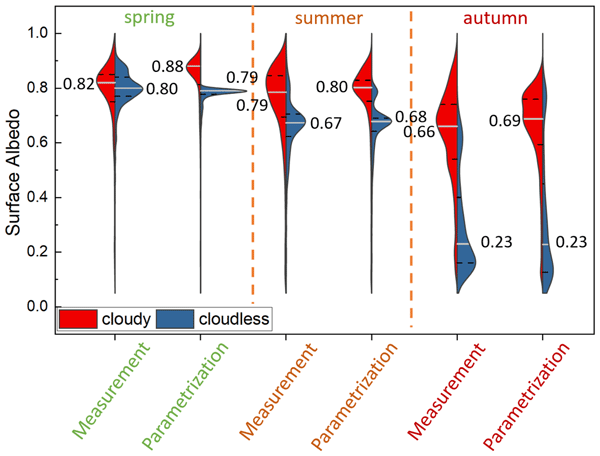
Evelyn Jäkel, Sebastian Becker, Tim R. Sperzel, Hannah Niehaus, Gunnar Spreen, Ran Tao, Marcel Nicolaus, Wolfgang Dorn, Annette Rinke, Jörg Brauchle, and Manfred Wendisch
The Cryosphere, 18, 1185–1205, https://doi.org/10.5194/tc-18-1185-2024, https://doi.org/10.5194/tc-18-1185-2024, 2024
Short summary
Short summary
The results of the surface albedo scheme of a coupled regional climate model were evaluated against airborne and ground-based measurements conducted in the European Arctic in different seasons between 2017 and 2022. We found a seasonally dependent bias between measured and modeled surface albedo for cloudless and cloudy situations. The strongest effects of the albedo model bias on the net irradiance were most apparent in the presence of optically thin clouds.
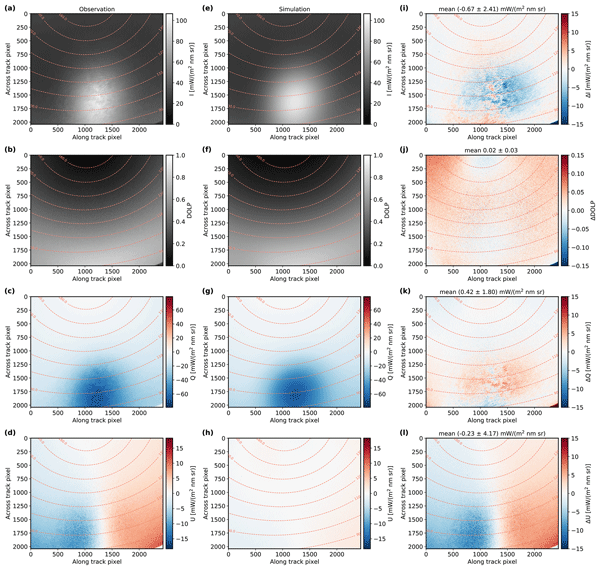
Anna Weber, Tobias Kölling, Veronika Pörtge, Andreas Baumgartner, Clemens Rammeloo, Tobias Zinner, and Bernhard Mayer
Atmos. Meas. Tech., 17, 1419–1439, https://doi.org/10.5194/amt-17-1419-2024, https://doi.org/10.5194/amt-17-1419-2024, 2024
Short summary
Short summary
In this work, we introduce the 2D RGB polarization-resolving cameras of the airborne hyperspectral and polarized imaging system specMACS. A full characterization and calibration of the cameras including a geometric calibration as well as a radiometric characterization is provided, allowing for the computation of absolute calibrated, georeferenced Stokes vectors rotated into the scattering plane. We validate the calibration by comparing sunglint measurements to radiative transfer simulations.
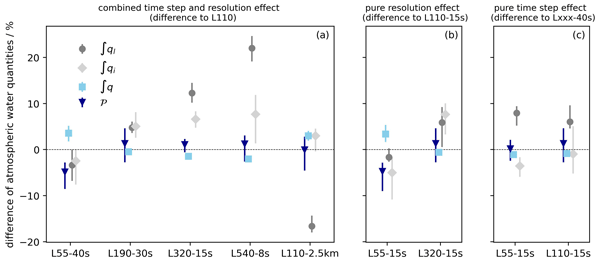
Hauke Schmidt, Sebastian Rast, Jiawei Bao, Amrit Cassim, Shih-Wei Fang, Diego Jimenez-de la Cuesta, Paul Keil, Lukas Kluft, Clarissa Kroll, Theresa Lang, Ulrike Niemeier, Andrea Schneidereit, Andrew I. L. Williams, and Bjorn Stevens
Geosci. Model Dev., 17, 1563–1584, https://doi.org/10.5194/gmd-17-1563-2024, https://doi.org/10.5194/gmd-17-1563-2024, 2024
Short summary
Short summary
A recent development in numerical simulations of the global atmosphere is the increase in horizontal resolution to grid spacings of a few kilometers. However, the vertical grid spacing of these models has not been reduced at the same rate as the horizontal grid spacing. Here, we assess the effects of much finer vertical grid spacings, in particular the impacts on cloud quantities and the atmospheric energy balance.
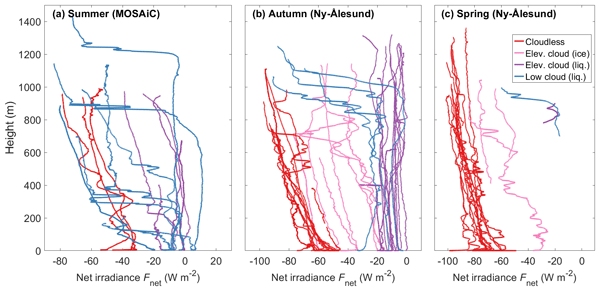
Michael Lonardi, Elisa F. Akansu, André Ehrlich, Mauro Mazzola, Christian Pilz, Matthew D. Shupe, Holger Siebert, and Manfred Wendisch
Atmos. Chem. Phys., 24, 1961–1978, https://doi.org/10.5194/acp-24-1961-2024, https://doi.org/10.5194/acp-24-1961-2024, 2024
Short summary
Short summary
Profiles of thermal-infrared irradiance were measured at two Arctic sites. The presence or lack of clouds influences the vertical structure of these observations. In particular, the cloud top region is a source of radiative energy that can promote cooling and mixing in the cloud layer. Simulations are used to further characterize how the amount of water in the cloud modifies this forcing. A case study additionally showcases the evolution of the radiation profiles in a dynamic atmosphere.
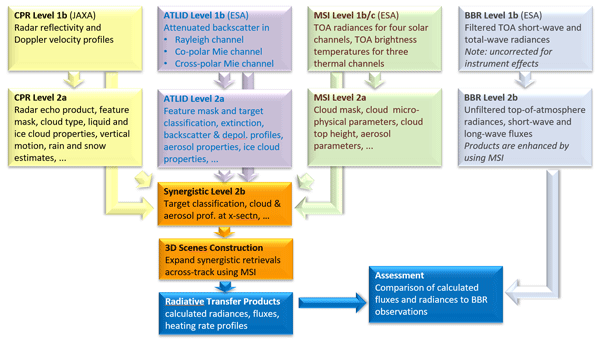
Michael Eisinger, Fabien Marnas, Kotska Wallace, Takuji Kubota, Nobuhiro Tomiyama, Yuichi Ohno, Toshiyuki Tanaka, Eichi Tomita, Tobias Wehr, and Dirk Bernaerts
Atmos. Meas. Tech., 17, 839–862, https://doi.org/10.5194/amt-17-839-2024, https://doi.org/10.5194/amt-17-839-2024, 2024
Short summary
Short summary
The Earth Cloud Aerosol and Radiation Explorer (EarthCARE) is an ESA–JAXA satellite mission to be launched in 2024. We presented an overview of the EarthCARE processors' development, with processors developed by teams in Europe, Japan, and Canada. EarthCARE will allow scientists to evaluate the representation of cloud, aerosol, precipitation, and radiative flux in weather forecast and climate models, with the objective to better understand cloud processes and improve weather and climate models.
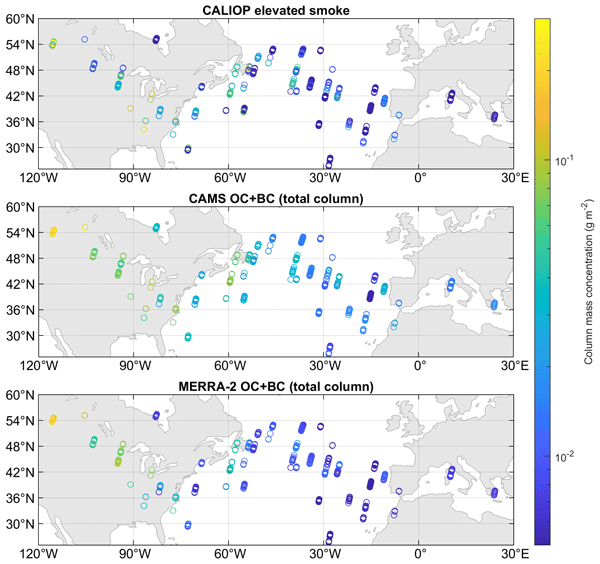
Xiaoxia Shang, Antti Lipponen, Maria Filioglou, Anu-Maija Sundström, Mark Parrington, Virginie Buchard, Anton S. Darmenov, Ellsworth J. Welton, Eleni Marinou, Vassilis Amiridis, Michael Sicard, Alejandro Rodríguez-Gómez, Mika Komppula, and Tero Mielonen
Atmos. Chem. Phys., 24, 1329–1344, https://doi.org/10.5194/acp-24-1329-2024, https://doi.org/10.5194/acp-24-1329-2024, 2024
Short summary
Short summary
In June 2019, smoke particles from a Canadian wildfire event were transported to Europe. The long-range-transported smoke plumes were monitored with a spaceborne lidar and reanalysis models. Based on the aerosol mass concentrations estimated from the observations, the reanalysis models had difficulties in reproducing the amount and location of the smoke aerosols during the transport event. Consequently, more spaceborne lidar missions are needed for reliable monitoring of aerosol plumes.
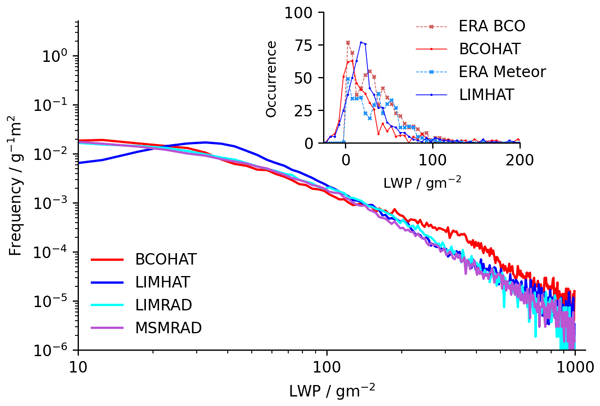
Sabrina Schnitt, Andreas Foth, Heike Kalesse-Los, Mario Mech, Claudia Acquistapace, Friedhelm Jansen, Ulrich Löhnert, Bernhard Pospichal, Johannes Röttenbacher, Susanne Crewell, and Bjorn Stevens
Earth Syst. Sci. Data, 16, 681–700, https://doi.org/10.5194/essd-16-681-2024, https://doi.org/10.5194/essd-16-681-2024, 2024
Short summary
Short summary
This publication describes the microwave radiometric measurements performed during the EUREC4A campaign at Barbados Cloud Observatory (BCO) and aboard RV Meteor and RV Maria S Merian. We present retrieved integrated water vapor (IWV), liquid water path (LWP), and temperature and humidity profiles as a unified, quality-controlled, multi-site data set on a 3 s temporal resolution for a core period between 19 January 2020 and 14 February 2020.
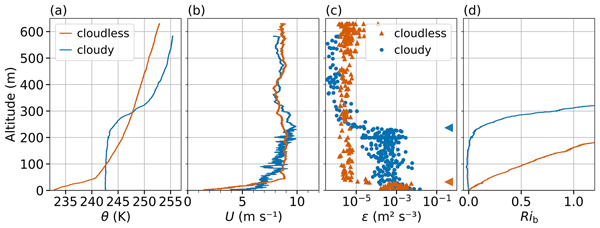
Elisa F. Akansu, Sandro Dahlke, Holger Siebert, and Manfred Wendisch
Atmos. Chem. Phys., 23, 15473–15489, https://doi.org/10.5194/acp-23-15473-2023, https://doi.org/10.5194/acp-23-15473-2023, 2023
Short summary
Short summary
The height of the mixing layer is an important measure of the surface-level distribution of energy or other substances. The experimental determination of this height is associated with large uncertainties, particularly under stable conditions that we often find during the polar night or in the presence of clouds. We present a reference method using turbulence measurements on a tethered balloon, which allows us to evaluate approaches based on radiosondes or surface observations.
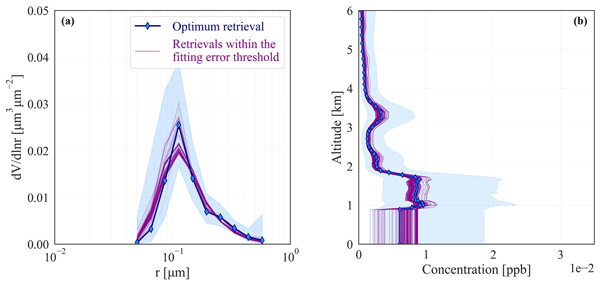
Alexandra Tsekeri, Anna Gialitaki, Marco Di Paolantonio, Davide Dionisi, Gian Luigi Liberti, Alnilam Fernandes, Artur Szkop, Aleksander Pietruczuk, Daniel Pérez-Ramírez, Maria J. Granados Muñoz, Juan Luis Guerrero-Rascado, Lucas Alados-Arboledas, Diego Bermejo Pantaleón, Juan Antonio Bravo-Aranda, Anna Kampouri, Eleni Marinou, Vassilis Amiridis, Michael Sicard, Adolfo Comerón, Constantino Muñoz-Porcar, Alejandro Rodríguez-Gómez, Salvatore Romano, Maria Rita Perrone, Xiaoxia Shang, Mika Komppula, Rodanthi-Elisavet Mamouri, Argyro Nisantzi, Diofantos Hadjimitsis, Francisco Navas-Guzmán, Alexander Haefele, Dominika Szczepanik, Artur Tomczak, Iwona S. Stachlewska, Livio Belegante, Doina Nicolae, Kalliopi Artemis Voudouri, Dimitris Balis, Athena A. Floutsi, Holger Baars, Linda Miladi, Nicolas Pascal, Oleg Dubovik, and Anton Lopatin
Atmos. Meas. Tech., 16, 6025–6050, https://doi.org/10.5194/amt-16-6025-2023, https://doi.org/10.5194/amt-16-6025-2023, 2023
Short summary
Short summary
EARLINET/ACTRIS organized an intensive observational campaign in May 2020, with the objective of monitoring the atmospheric state over Europe during the COVID-19 lockdown and relaxation period. The work presented herein focuses on deriving a common methodology for applying a synergistic retrieval that utilizes the network's ground-based passive and active remote sensing measurements and deriving the aerosols from anthropogenic activities over Europe.
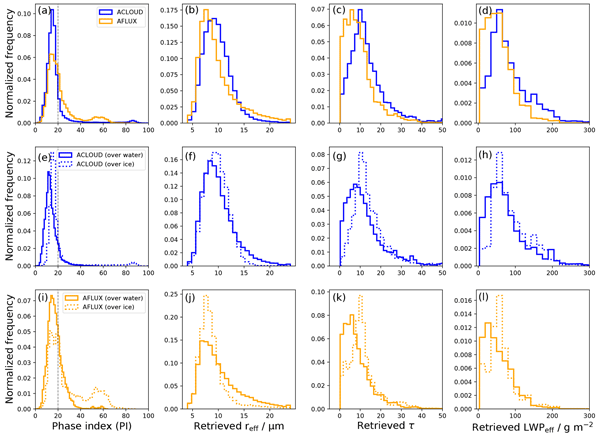
Marcus Klingebiel, André Ehrlich, Elena Ruiz-Donoso, Nils Risse, Imke Schirmacher, Evelyn Jäkel, Michael Schäfer, Kevin Wolf, Mario Mech, Manuel Moser, Christiane Voigt, and Manfred Wendisch
Atmos. Chem. Phys., 23, 15289–15304, https://doi.org/10.5194/acp-23-15289-2023, https://doi.org/10.5194/acp-23-15289-2023, 2023
Short summary
Short summary
In this study we explain how we use aircraft measurements from two Arctic research campaigns to identify cloud properties (like droplet size) over sea-ice and ice-free ocean. To make sure that our measurements make sense, we compare them with other observations. Our results show, e.g., larger cloud droplets in early summer than in spring. Moreover, the cloud droplets are also larger over ice-free ocean than compared to sea ice. In the future, our data can be used to improve climate models.
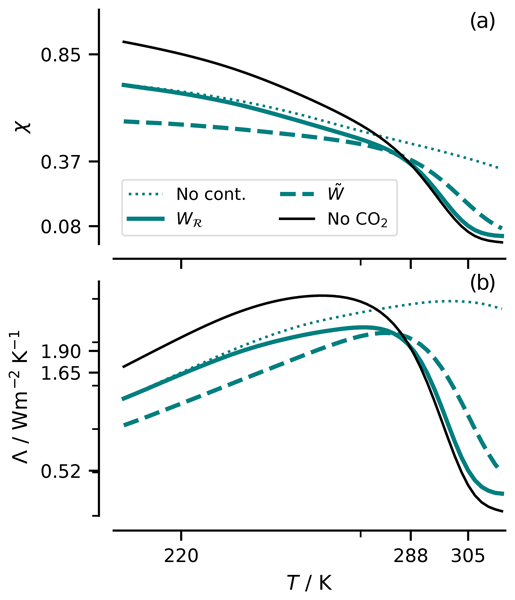
Bjorn Stevens and Lukas Kluft
Atmos. Chem. Phys., 23, 14673–14689, https://doi.org/10.5194/acp-23-14673-2023, https://doi.org/10.5194/acp-23-14673-2023, 2023
Short summary
Short summary
A simple model is introduced to account for the spectral diversity of radiant energy transfer. It provides an improved basis for assessing the different ways in which clouds influence Earth’s climate sensitivity, demonstrating how many cloud effects depend on the existing cloud climatology. Given existing assessments of changes in cloud albedo with warming, it is determined that clouds reduce Earth's climate sensitivity as compared to what it would be in a counterfactual world without clouds.
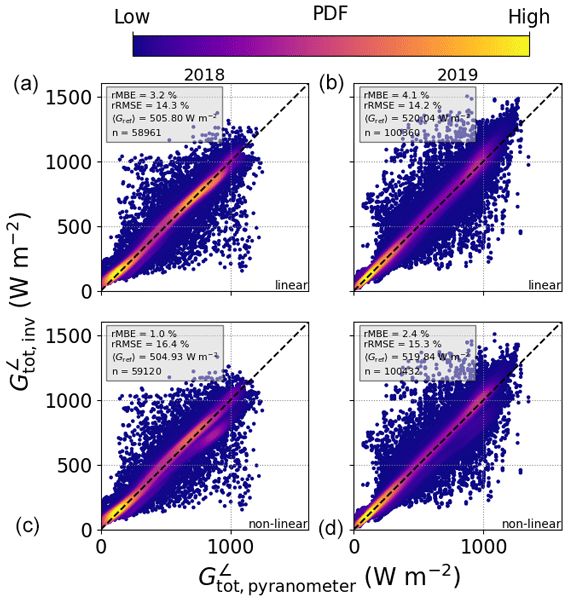
James Barry, Stefanie Meilinger, Klaus Pfeilsticker, Anna Herman-Czezuch, Nicola Kimiaie, Christopher Schirrmeister, Rone Yousif, Tina Buchmann, Johannes Grabenstein, Hartwig Deneke, Jonas Witthuhn, Claudia Emde, Felix Gödde, Bernhard Mayer, Leonhard Scheck, Marion Schroedter-Homscheidt, Philipp Hofbauer, and Matthias Struck
Atmos. Meas. Tech., 16, 4975–5007, https://doi.org/10.5194/amt-16-4975-2023, https://doi.org/10.5194/amt-16-4975-2023, 2023
Short summary
Short summary
Measured power data from solar photovoltaic (PV) systems contain information about the state of the atmosphere. In this work, power data from PV systems in the Allgäu region in Germany were used to determine the solar irradiance at each location, using state-of-the-art simulation and modelling. The results were validated using concurrent measurements of the incoming solar radiation in each case. If applied on a wider scale, this algorithm could help improve weather and climate models.
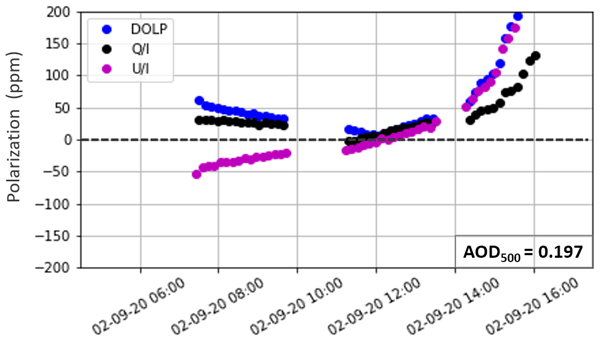
Vasiliki Daskalopoulou, Panagiotis I. Raptis, Alexandra Tsekeri, Vassilis Amiridis, Stelios Kazadzis, Zbigniew Ulanowski, Vassilis Charmandaris, Konstantinos Tassis, and William Martin
Atmos. Meas. Tech., 16, 4529–4550, https://doi.org/10.5194/amt-16-4529-2023, https://doi.org/10.5194/amt-16-4529-2023, 2023
Short summary
Short summary
Atmospheric dust particles may present a preferential alignment due to their shape on long range transport. Since dust is abundant and plays a key role to global climate, the elusive observation of orientation will be a game changer to existing measurement techniques and the representation of particles in climate models. We utilize a specifically designed instrument, SolPol, and target the Sun from the ground for large polarization values under dusty conditions, a clear sign of orientation.
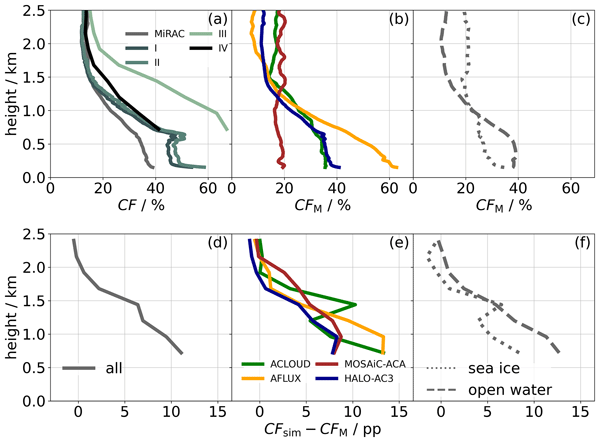
Imke Schirmacher, Pavlos Kollias, Katia Lamer, Mario Mech, Lukas Pfitzenmaier, Manfred Wendisch, and Susanne Crewell
Atmos. Meas. Tech., 16, 4081–4100, https://doi.org/10.5194/amt-16-4081-2023, https://doi.org/10.5194/amt-16-4081-2023, 2023
Short summary
Short summary
CloudSat’s relatively coarse spatial resolution, low sensitivity, and blind zone limit its assessment of Arctic low-level clouds, which affect the surface energy balance. We compare cloud fractions from CloudSat and finely resolved airborne radar observations to determine CloudSat’s limitations. Cloudsat overestimates cloud fractions above its blind zone, especially during cold-air outbreaks over open water, and misses a cloud fraction of 32 % and half of the precipitation inside its blind zone.
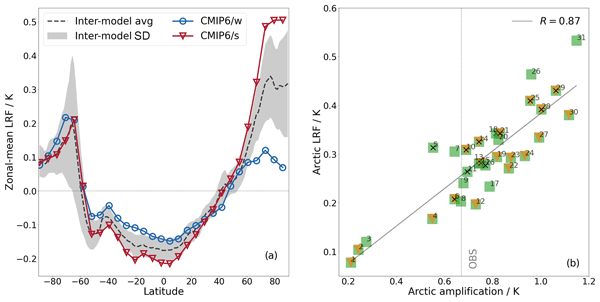
Olivia Linke, Johannes Quaas, Finja Baumer, Sebastian Becker, Jan Chylik, Sandro Dahlke, André Ehrlich, Dörthe Handorf, Christoph Jacobi, Heike Kalesse-Los, Luca Lelli, Sina Mehrdad, Roel A. J. Neggers, Johannes Riebold, Pablo Saavedra Garfias, Niklas Schnierstein, Matthew D. Shupe, Chris Smith, Gunnar Spreen, Baptiste Verneuil, Kameswara S. Vinjamuri, Marco Vountas, and Manfred Wendisch
Atmos. Chem. Phys., 23, 9963–9992, https://doi.org/10.5194/acp-23-9963-2023, https://doi.org/10.5194/acp-23-9963-2023, 2023
Short summary
Short summary
Lapse rate feedback (LRF) is a major driver of the Arctic amplification (AA) of climate change. It arises because the warming is stronger at the surface than aloft. Several processes can affect the LRF in the Arctic, such as the omnipresent temperature inversion. Here, we compare multimodel climate simulations to Arctic-based observations from a large research consortium to broaden our understanding of these processes, find synergy among them, and constrain the Arctic LRF and AA.
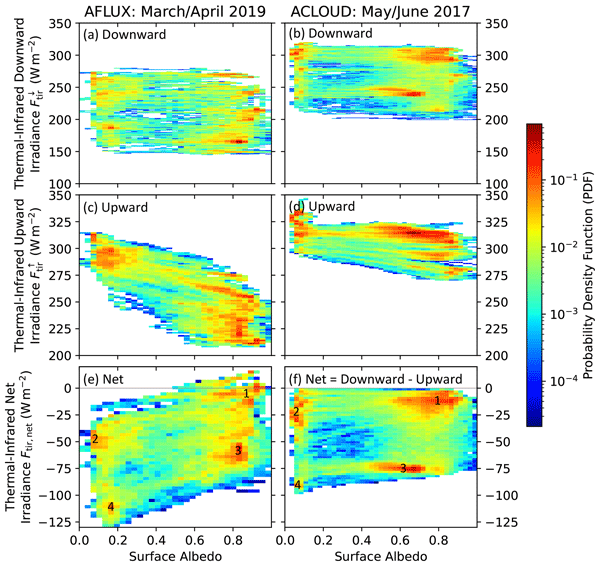
Manfred Wendisch, Johannes Stapf, Sebastian Becker, André Ehrlich, Evelyn Jäkel, Marcus Klingebiel, Christof Lüpkes, Michael Schäfer, and Matthew D. Shupe
Atmos. Chem. Phys., 23, 9647–9667, https://doi.org/10.5194/acp-23-9647-2023, https://doi.org/10.5194/acp-23-9647-2023, 2023
Short summary
Short summary
Atmospheric radiation measurements have been conducted during two field campaigns using research aircraft. The data are analyzed to see if the near-surface air in the Arctic is warmed or cooled if warm–humid air masses from the south enter the Arctic or cold–dry air moves from the north from the Arctic to mid-latitude areas. It is important to study these processes and to check if climate models represent them well. Otherwise it is not possible to reliably forecast the future Arctic climate.
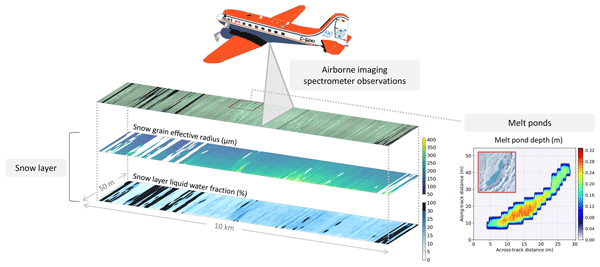
Sophie Rosenburg, Charlotte Lange, Evelyn Jäkel, Michael Schäfer, André Ehrlich, and Manfred Wendisch
Atmos. Meas. Tech., 16, 3915–3930, https://doi.org/10.5194/amt-16-3915-2023, https://doi.org/10.5194/amt-16-3915-2023, 2023
Short summary
Short summary
Snow layer melting and melt pond formation on Arctic sea ice are important seasonal processes affecting the surface reflection and energy budget. Sea ice reflectivity was surveyed by airborne imaging spectrometers in May–June 2017. Adapted retrieval approaches were applied to find snow layer liquid water fraction, snow grain effective radius, and melt pond depth. The retrievals show the potential and limitations of spectral airborne imaging to map melting snow layer and melt pond properties.
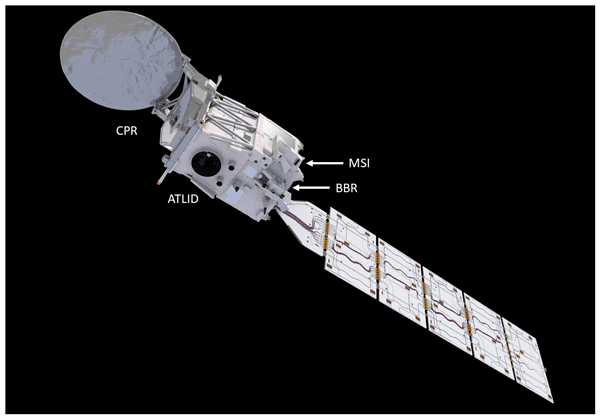
Tobias Wehr, Takuji Kubota, Georgios Tzeremes, Kotska Wallace, Hirotaka Nakatsuka, Yuichi Ohno, Rob Koopman, Stephanie Rusli, Maki Kikuchi, Michael Eisinger, Toshiyuki Tanaka, Masatoshi Taga, Patrick Deghaye, Eichi Tomita, and Dirk Bernaerts
Atmos. Meas. Tech., 16, 3581–3608, https://doi.org/10.5194/amt-16-3581-2023, https://doi.org/10.5194/amt-16-3581-2023, 2023
Short summary
Short summary
The EarthCARE satellite is due for launch in 2024. It includes four scientific instruments to measure global vertical profiles of aerosols, clouds and precipitation properties together with radiative fluxes and derived heating rates. The mission's scientific requirements, the satellite and the ground segment are described. In particular, the four scientific instruments and their performance are described at the level of detail required by mission data users.
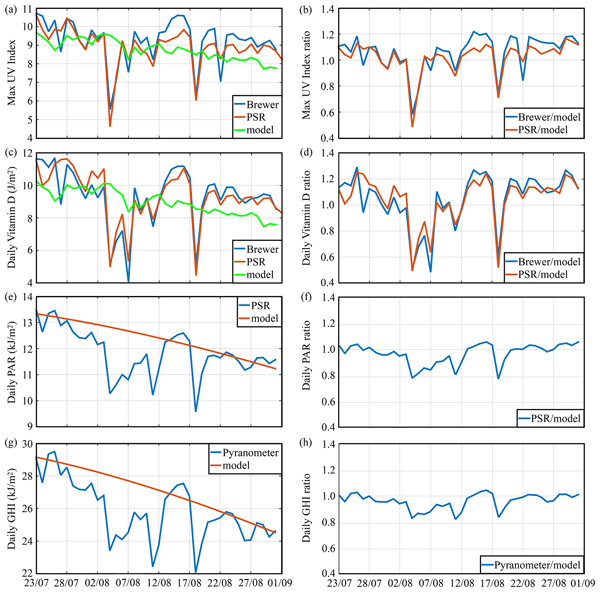
Akriti Masoom, Ilias Fountoulakis, Stelios Kazadzis, Ioannis-Panagiotis Raptis, Anna Kampouri, Basil E. Psiloglou, Dimitra Kouklaki, Kyriakoula Papachristopoulou, Eleni Marinou, Stavros Solomos, Anna Gialitaki, Dimitra Founda, Vasileios Salamalikis, Dimitris Kaskaoutis, Natalia Kouremeti, Nikolaos Mihalopoulos, Vassilis Amiridis, Andreas Kazantzidis, Alexandros Papayannis, Christos S. Zerefos, and Kostas Eleftheratos
Atmos. Chem. Phys., 23, 8487–8514, https://doi.org/10.5194/acp-23-8487-2023, https://doi.org/10.5194/acp-23-8487-2023, 2023
Short summary
Short summary
We analyse the spatial and temporal aerosol spectral optical properties during the extreme wildfires of August 2021 in Greece and assess their effects on air quality and solar radiation quantities related to health, agriculture, and energy. Different aerosol conditions are identified (pure smoke, pure dust, dust–smoke together); the largest impact on solar radiation quantities is found for cases with mixed dust–smoke aerosols. Such situations are expected to occur more frequently in the future.
Silke Groß, Tina Jurkat-Witschas, Qiang Li, Martin Wirth, Benedikt Urbanek, Martina Krämer, Ralf Weigel, and Christiane Voigt
Atmos. Chem. Phys., 23, 8369–8381, https://doi.org/10.5194/acp-23-8369-2023, https://doi.org/10.5194/acp-23-8369-2023, 2023
Short summary
Short summary
Aviation-emitted aerosol can have an impact on cirrus clouds. We present optical and microphysical properties of mid-latitude cirrus clouds which were formed under the influence of aviation-emitted aerosol or which were formed under rather pristine conditions. We find that cirrus clouds affected by aviation-emitted aerosol show larger values of the particle linear depolarization ratio, larger mean effective ice particle diameters and decreased ice particle number concentrations.
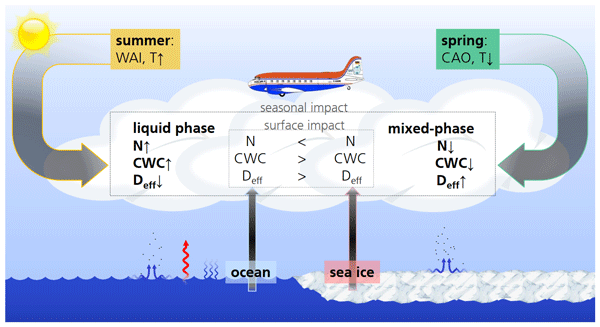
Manuel Moser, Christiane Voigt, Tina Jurkat-Witschas, Valerian Hahn, Guillaume Mioche, Olivier Jourdan, Régis Dupuy, Christophe Gourbeyre, Alfons Schwarzenboeck, Johannes Lucke, Yvonne Boose, Mario Mech, Stephan Borrmann, André Ehrlich, Andreas Herber, Christof Lüpkes, and Manfred Wendisch
Atmos. Chem. Phys., 23, 7257–7280, https://doi.org/10.5194/acp-23-7257-2023, https://doi.org/10.5194/acp-23-7257-2023, 2023
Short summary
Short summary
This study provides a comprehensive microphysical and thermodynamic phase analysis of low-level clouds in the northern Fram Strait, above the sea ice and the open ocean, during spring and summer. Using airborne in situ cloud data, we show that the properties of Arctic low-level clouds vary significantly with seasonal meteorological situations and surface conditions. The observations presented in this study can help one to assess the role of clouds in the Arctic climate system.
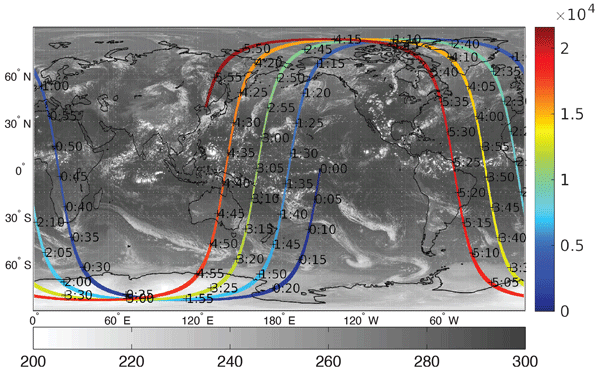
Woosub Roh, Masaki Satoh, Tempei Hashino, Shuhei Matsugishi, Tomoe Nasuno, and Takuji Kubota
Atmos. Meas. Tech., 16, 3331–3344, https://doi.org/10.5194/amt-16-3331-2023, https://doi.org/10.5194/amt-16-3331-2023, 2023
Short summary
Short summary
JAXA EarthCARE synthetic data (JAXA L1 data) were compiled using the global storm-resolving model (GSRM) NICAM (Nonhydrostatic ICosahedral
Atmospheric Model) simulation with 3.5 km horizontal resolution and the Joint-Simulator. JAXA L1 data are intended to support the development of JAXA retrieval algorithms for the EarthCARE sensor before launch of the satellite. The expected orbit of EarthCARE and horizontal sampling of each sensor were used to simulate the signals.
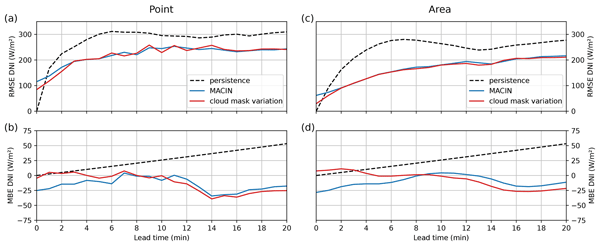
Philipp Gregor, Tobias Zinner, Fabian Jakub, and Bernhard Mayer
Atmos. Meas. Tech., 16, 3257–3271, https://doi.org/10.5194/amt-16-3257-2023, https://doi.org/10.5194/amt-16-3257-2023, 2023
Short summary
Short summary
This work introduces MACIN, a model for short-term forecasting of direct irradiance for solar energy applications. MACIN exploits cloud images of multiple cameras to predict irradiance. The model is applied to artificial images of clouds from a weather model. The artificial cloud data allow for a more in-depth evaluation and attribution of errors compared with real data. Good performance of derived cloud information and significant forecast improvements over a baseline forecast were found.
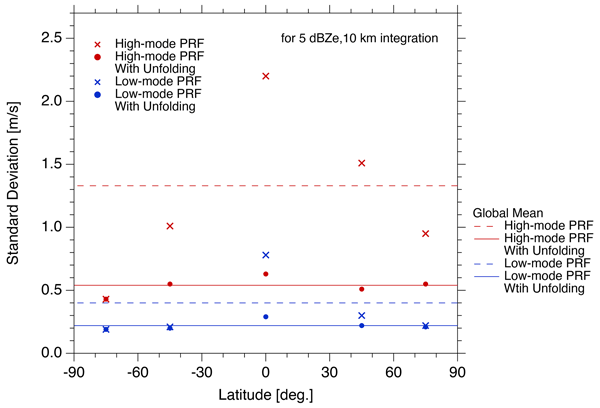
Yuichiro Hagihara, Yuichi Ohno, Hiroaki Horie, Woosub Roh, Masaki Satoh, and Takuji Kubota
Atmos. Meas. Tech., 16, 3211–3219, https://doi.org/10.5194/amt-16-3211-2023, https://doi.org/10.5194/amt-16-3211-2023, 2023
Short summary
Short summary
The CPR on the EarthCARE satellite is the first satellite-borne Doppler radar. We evaluated the effectiveness of horizontal integration and the unfolding method for the reduction of the Doppler error (the standard deviation of the random error) in the CPR_ECO product. The error was higher in the tropics than in the other latitudes due to frequent rain echo occurrence and limitation of its unfolding correction. If we use low-mode operation (high PRF), the errors become small enough.
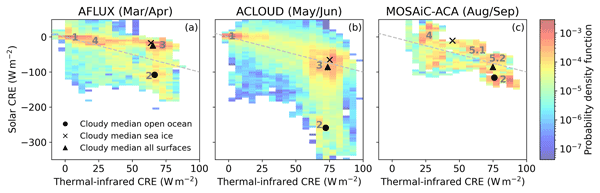
Sebastian Becker, André Ehrlich, Michael Schäfer, and Manfred Wendisch
Atmos. Chem. Phys., 23, 7015–7031, https://doi.org/10.5194/acp-23-7015-2023, https://doi.org/10.5194/acp-23-7015-2023, 2023
Short summary
Short summary
This study analyses the variability of the warming or cooling effect of clouds on the Arctic surface. Therefore, aircraft radiation measurements were performed over sea ice and open ocean during three seasonally different campaigns. It is found that clouds cool the open-ocean surface most strongly in summer. Over sea ice, clouds warm the surface in spring but have a neutral effect in summer. Due to the variable sea ice extent, clouds warm the surface during spring but cool it during late summer.
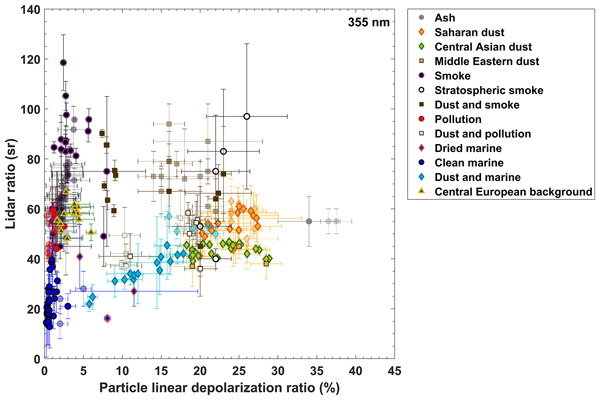
Athena Augusta Floutsi, Holger Baars, Ronny Engelmann, Dietrich Althausen, Albert Ansmann, Stephanie Bohlmann, Birgit Heese, Julian Hofer, Thomas Kanitz, Moritz Haarig, Kevin Ohneiser, Martin Radenz, Patric Seifert, Annett Skupin, Zhenping Yin, Sabur F. Abdullaev, Mika Komppula, Maria Filioglou, Elina Giannakaki, Iwona S. Stachlewska, Lucja Janicka, Daniele Bortoli, Eleni Marinou, Vassilis Amiridis, Anna Gialitaki, Rodanthi-Elisavet Mamouri, Boris Barja, and Ulla Wandinger
Atmos. Meas. Tech., 16, 2353–2379, https://doi.org/10.5194/amt-16-2353-2023, https://doi.org/10.5194/amt-16-2353-2023, 2023
Short summary
Short summary
DeLiAn is a collection of lidar-derived aerosol intensive optical properties for several aerosol types, namely the particle linear depolarization ratio, the extinction-to-backscatter ratio (lidar ratio) and the Ångström exponent. The data collection is based on globally distributed, long-term, ground-based, multiwavelength, Raman and polarization lidar measurements and currently covers two wavelengths, 355 and 532 nm, for 13 aerosol categories ranging from basic aerosol types to mixtures.
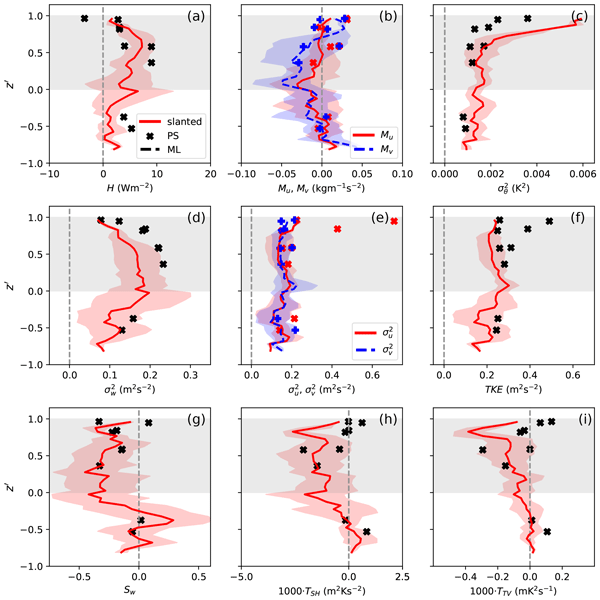
Dmitry G. Chechin, Christof Lüpkes, Jörg Hartmann, André Ehrlich, and Manfred Wendisch
Atmos. Chem. Phys., 23, 4685–4707, https://doi.org/10.5194/acp-23-4685-2023, https://doi.org/10.5194/acp-23-4685-2023, 2023
Short summary
Short summary
Clouds represent a very important component of the Arctic climate system, as they strongly reduce the amount of heat lost to space from the sea ice surface. Properties of clouds, as well as their persistence, strongly depend on the complex interaction of such small-scale properties as phase transitions, radiative transfer and turbulence. In this study we use airborne observations to learn more about the effect of clouds and radiative cooling on turbulence in comparison with other factors.
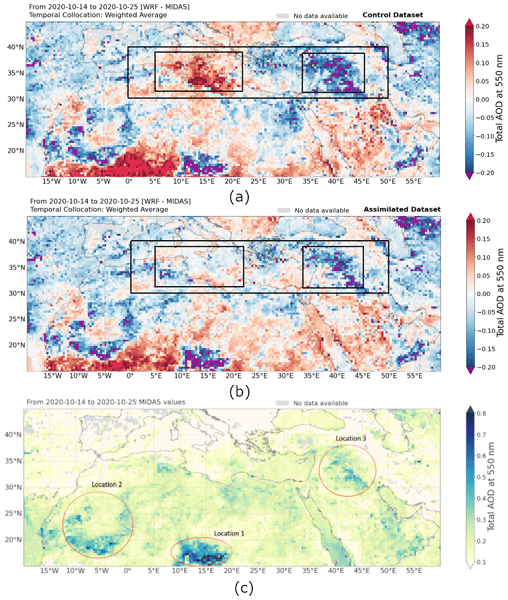
Pantelis Kiriakidis, Antonis Gkikas, Georgios Papangelis, Theodoros Christoudias, Jonilda Kushta, Emmanouil Proestakis, Anna Kampouri, Eleni Marinou, Eleni Drakaki, Angela Benedetti, Michael Rennie, Christian Retscher, Anne Grete Straume, Alexandru Dandocsi, Jean Sciare, and Vasilis Amiridis
Atmos. Chem. Phys., 23, 4391–4417, https://doi.org/10.5194/acp-23-4391-2023, https://doi.org/10.5194/acp-23-4391-2023, 2023
Short summary
Short summary
With the launch of the Aeolus satellite, higher-accuracy wind products became available. This research was carried out to validate the assimilated wind products by testing their effect on the WRF-Chem model predictive ability of dust processes. This was carried out for the eastern Mediterranean and Middle East region for two 2-month periods in autumn and spring 2020. The use of the assimilated products improved the dust forecasts of the autumn season (both quantitatively and qualitatively).
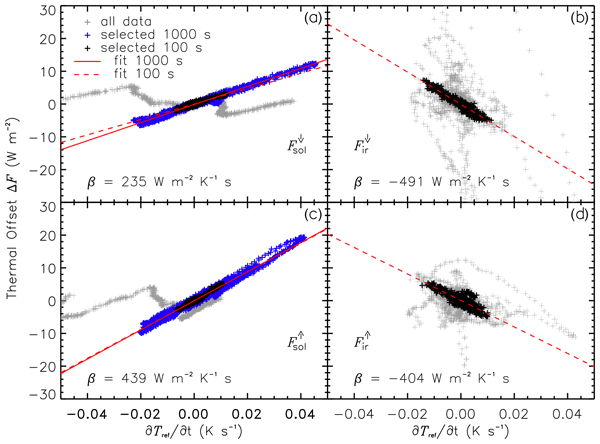
André Ehrlich, Martin Zöger, Andreas Giez, Vladyslav Nenakhov, Christian Mallaun, Rolf Maser, Timo Röschenthaler, Anna E. Luebke, Kevin Wolf, Bjorn Stevens, and Manfred Wendisch
Atmos. Meas. Tech., 16, 1563–1581, https://doi.org/10.5194/amt-16-1563-2023, https://doi.org/10.5194/amt-16-1563-2023, 2023
Short summary
Short summary
Measurements of the broadband radiative energy budget from aircraft are needed to study the effect of clouds, aerosol particles, and surface conditions on the Earth's energy budget. However, the moving aircraft introduces challenges to the instrument performance and post-processing of the data. This study introduces a new radiometer package, outlines a greatly simplifying method to correct thermal offsets, and provides exemplary measurements of solar and thermal–infrared irradiance.
Georgios Dekoutsidis, Silke Groß, Martin Wirth, Martina Krämer, and Christian Rolf
Atmos. Chem. Phys., 23, 3103–3117, https://doi.org/10.5194/acp-23-3103-2023, https://doi.org/10.5194/acp-23-3103-2023, 2023
Short summary
Short summary
Cirrus clouds affect Earth's atmosphere, deeming our study important. Here we use water vapor measurements by lidar and study the relative humidity (RHi) within and around midlatitude cirrus clouds. We find high supersaturations in the cloud-free air and within the clouds, especially near the cloud top. We study two cloud types with different formation processes. Finally, we conclude that the shape of the distribution of RHi can be used as an indicator of different cloud evolutionary stages.
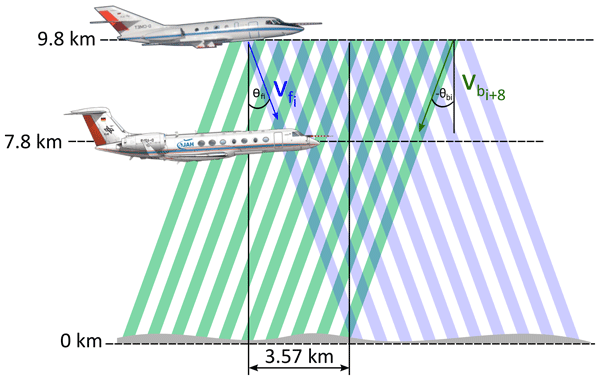
Benjamin Witschas, Sonja Gisinger, Stephan Rahm, Andreas Dörnbrack, David C. Fritts, and Markus Rapp
Atmos. Meas. Tech., 16, 1087–1101, https://doi.org/10.5194/amt-16-1087-2023, https://doi.org/10.5194/amt-16-1087-2023, 2023
Short summary
Short summary
In this paper, a novel scan technique is applied to an airborne coherent Doppler wind lidar, enabling us to measure the vertical wind speed and the horizontal wind speed along flight direction simultaneously with a horizontal resolution of about 800 m and a vertical resolution of 100 m. The performed observations are valuable for gravity wave characterization as they allow us to calculate the leg-averaged momentum flux profile and, with that, the propagation direction of excited gravity waves.
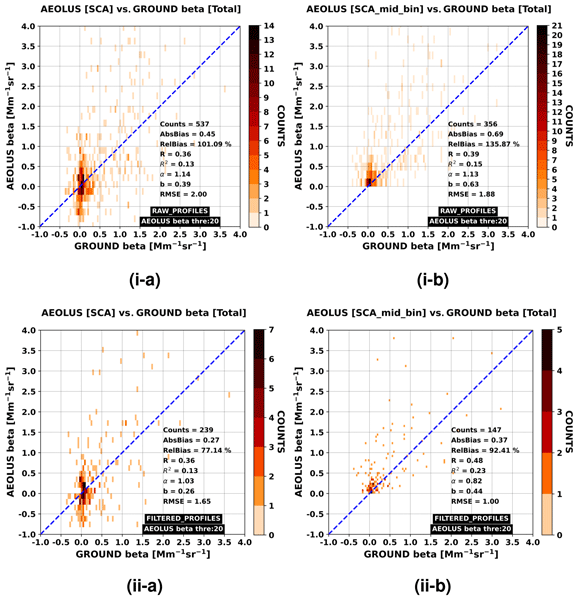
Antonis Gkikas, Anna Gialitaki, Ioannis Binietoglou, Eleni Marinou, Maria Tsichla, Nikolaos Siomos, Peristera Paschou, Anna Kampouri, Kalliopi Artemis Voudouri, Emmanouil Proestakis, Maria Mylonaki, Christina-Anna Papanikolaou, Konstantinos Michailidis, Holger Baars, Anne Grete Straume, Dimitris Balis, Alexandros Papayannis, Tomasso Parrinello, and Vassilis Amiridis
Atmos. Meas. Tech., 16, 1017–1042, https://doi.org/10.5194/amt-16-1017-2023, https://doi.org/10.5194/amt-16-1017-2023, 2023
Short summary
Short summary
We perform an assessment analysis of the Aeolus Standard Correct Algorithm (SCA) backscatter coefficient retrievals against reference observations acquired at three Greek lidar stations (Athens, Thessaloniki and Antikythera) of the PANACEA network. Overall, 43 cases are analysed, whereas specific aerosol scenarios in the vicinity of Antikythera island (SW Greece) are emphasised. All key Cal/Val aspects and recommendations, and the ongoing related activities, are thoroughly discussed.
Yun Li, Christoph Mahnke, Susanne Rohs, Ulrich Bundke, Nicole Spelten, Georgios Dekoutsidis, Silke Groß, Christiane Voigt, Ulrich Schumann, Andreas Petzold, and Martina Krämer
Atmos. Chem. Phys., 23, 2251–2271, https://doi.org/10.5194/acp-23-2251-2023, https://doi.org/10.5194/acp-23-2251-2023, 2023
Short summary
Short summary
The radiative effect of aviation-induced cirrus is closely related to ambient conditions and its microphysical properties. Our study investigated the occurrence of contrail and natural cirrus measured above central Europe in spring 2014. It finds that contrail cirrus appears frequently in the pressure range 200 to 245 hPa and occurs more often in slightly ice-subsaturated environments than expected. Avoiding slightly ice-subsaturated regions by aviation might help mitigate contrail cirrus.
Ziming Wang, Luca Bugliaro, Tina Jurkat-Witschas, Romy Heller, Ulrike Burkhardt, Helmut Ziereis, Georgios Dekoutsidis, Martin Wirth, Silke Groß, Simon Kirschler, Stefan Kaufmann, and Christiane Voigt
Atmos. Chem. Phys., 23, 1941–1961, https://doi.org/10.5194/acp-23-1941-2023, https://doi.org/10.5194/acp-23-1941-2023, 2023
Short summary
Short summary
Differences in the microphysical properties of contrail cirrus and natural cirrus in a contrail outbreak situation during the ML-CIRRUS campaign over the North Atlantic flight corridor can be observed from in situ measurements. The cirrus radiative effect in the area of the outbreak, derived from satellite observation-based radiative transfer modeling, is warming in the early morning and cooling during the day.
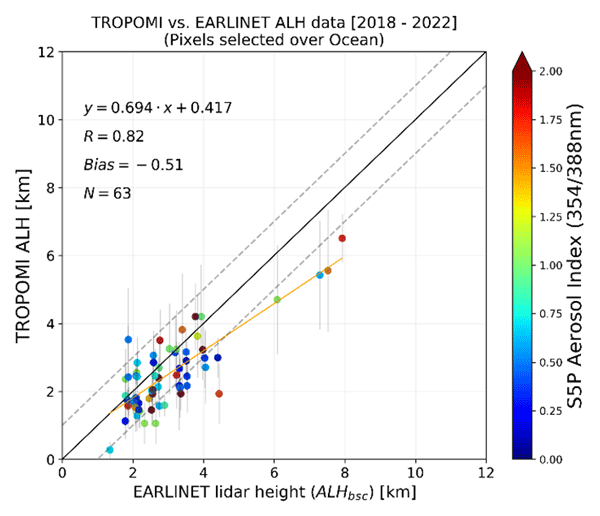
Konstantinos Michailidis, Maria-Elissavet Koukouli, Dimitris Balis, J. Pepijn Veefkind, Martin de Graaf, Lucia Mona, Nikolaos Papagianopoulos, Gesolmina Pappalardo, Ioanna Tsikoudi, Vassilis Amiridis, Eleni Marinou, Anna Gialitaki, Rodanthi-Elisavet Mamouri, Argyro Nisantzi, Daniele Bortoli, Maria João Costa, Vanda Salgueiro, Alexandros Papayannis, Maria Mylonaki, Lucas Alados-Arboledas, Salvatore Romano, Maria Rita Perrone, and Holger Baars
Atmos. Chem. Phys., 23, 1919–1940, https://doi.org/10.5194/acp-23-1919-2023, https://doi.org/10.5194/acp-23-1919-2023, 2023
Short summary
Short summary
Comparisons with ground-based correlative lidar measurements constitute a key component in the validation of satellite aerosol products. This paper presents the validation of the TROPOMI aerosol layer height (ALH) product, using archived quality assured ground-based data from lidar stations that belong to the EARLINET network. Comparisons between the TROPOMI ALH and co-located EARLINET measurements show good agreement over the ocean.
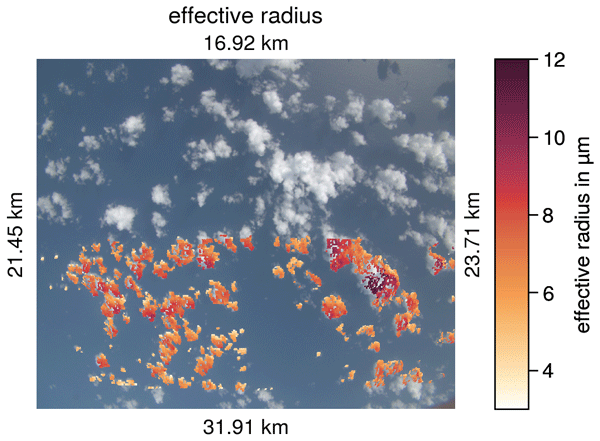
Veronika Pörtge, Tobias Kölling, Anna Weber, Lea Volkmer, Claudia Emde, Tobias Zinner, Linda Forster, and Bernhard Mayer
Atmos. Meas. Tech., 16, 645–667, https://doi.org/10.5194/amt-16-645-2023, https://doi.org/10.5194/amt-16-645-2023, 2023
Short summary
Short summary
In this work, we analyze polarized cloudbow observations by the airborne camera system specMACS to retrieve the cloud droplet size distribution defined by the effective radius (reff) and the effective variance (veff). Two case studies of trade-wind cumulus clouds observed during the EUREC4A field campaign are presented. The results are combined into maps of reff and veff with a very high spatial resolution (100 m × 100 m) that allow new insights into cloud microphysics.
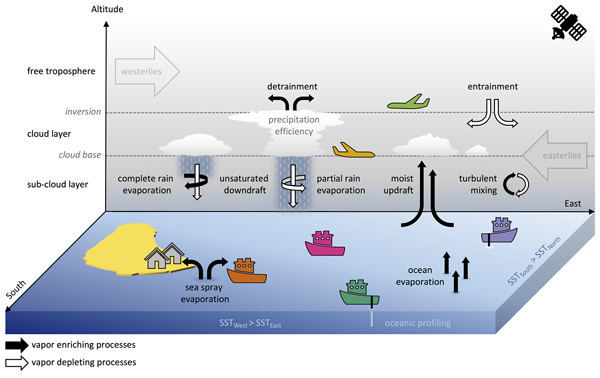
Adriana Bailey, Franziska Aemisegger, Leonie Villiger, Sebastian A. Los, Gilles Reverdin, Estefanía Quiñones Meléndez, Claudia Acquistapace, Dariusz B. Baranowski, Tobias Böck, Sandrine Bony, Tobias Bordsdorff, Derek Coffman, Simon P. de Szoeke, Christopher J. Diekmann, Marina Dütsch, Benjamin Ertl, Joseph Galewsky, Dean Henze, Przemyslaw Makuch, David Noone, Patricia K. Quinn, Michael Rösch, Andreas Schneider, Matthias Schneider, Sabrina Speich, Bjorn Stevens, and Elizabeth J. Thompson
Earth Syst. Sci. Data, 15, 465–495, https://doi.org/10.5194/essd-15-465-2023, https://doi.org/10.5194/essd-15-465-2023, 2023
Short summary
Short summary
One of the novel ways EUREC4A set out to investigate trade wind clouds and their coupling to the large-scale circulation was through an extensive network of isotopic measurements in water vapor, precipitation, and seawater. Samples were taken from the island of Barbados, from aboard two aircraft, and from aboard four ships. This paper describes the full collection of EUREC4A isotopic in situ data and guides readers to complementary remotely sensed water vapor isotope ratios.

Minrui Wang, Takashi Y. Nakajima, Woosub Roh, Masaki Satoh, Kentaroh Suzuki, Takuji Kubota, and Mayumi Yoshida
Atmos. Meas. Tech., 16, 603–623, https://doi.org/10.5194/amt-16-603-2023, https://doi.org/10.5194/amt-16-603-2023, 2023
Short summary
Short summary
SMILE (a spectral misalignment in which a shift in the center wavelength appears as a distortion in the spectral image) was detected during our recent work. To evaluate how it affects the cloud retrieval products, we did a simulation of EarthCARE-MSI forward radiation, evaluating the error in simulated scenes from a global cloud system-resolving model and a satellite simulator. Our results indicated that the error from SMILE was generally small and negligible for oceanic scenes.
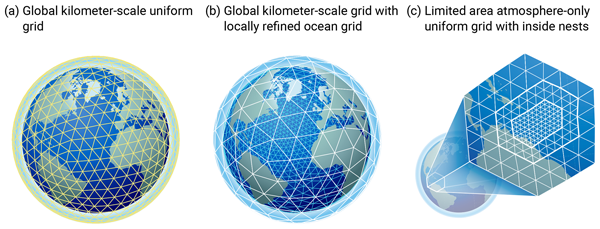
Cathy Hohenegger, Peter Korn, Leonidas Linardakis, René Redler, Reiner Schnur, Panagiotis Adamidis, Jiawei Bao, Swantje Bastin, Milad Behravesh, Martin Bergemann, Joachim Biercamp, Hendryk Bockelmann, Renate Brokopf, Nils Brüggemann, Lucas Casaroli, Fatemeh Chegini, George Datseris, Monika Esch, Geet George, Marco Giorgetta, Oliver Gutjahr, Helmuth Haak, Moritz Hanke, Tatiana Ilyina, Thomas Jahns, Johann Jungclaus, Marcel Kern, Daniel Klocke, Lukas Kluft, Tobias Kölling, Luis Kornblueh, Sergey Kosukhin, Clarissa Kroll, Junhong Lee, Thorsten Mauritsen, Carolin Mehlmann, Theresa Mieslinger, Ann Kristin Naumann, Laura Paccini, Angel Peinado, Divya Sri Praturi, Dian Putrasahan, Sebastian Rast, Thomas Riddick, Niklas Roeber, Hauke Schmidt, Uwe Schulzweida, Florian Schütte, Hans Segura, Radomyra Shevchenko, Vikram Singh, Mia Specht, Claudia Christine Stephan, Jin-Song von Storch, Raphaela Vogel, Christian Wengel, Marius Winkler, Florian Ziemen, Jochem Marotzke, and Bjorn Stevens
Geosci. Model Dev., 16, 779–811, https://doi.org/10.5194/gmd-16-779-2023, https://doi.org/10.5194/gmd-16-779-2023, 2023
Short summary
Short summary
Models of the Earth system used to understand climate and predict its change typically employ a grid spacing of about 100 km. Yet, many atmospheric and oceanic processes occur on much smaller scales. In this study, we present a new model configuration designed for the simulation of the components of the Earth system and their interactions at kilometer and smaller scales, allowing an explicit representation of the main drivers of the flow of energy and matter by solving the underlying equations.
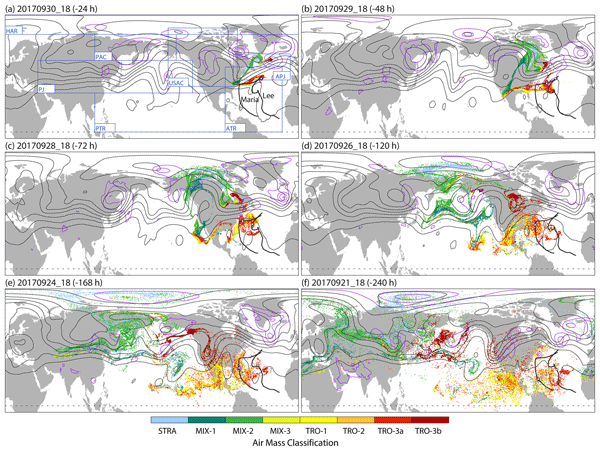
Andreas Schäfler, Michael Sprenger, Heini Wernli, Andreas Fix, and Martin Wirth
Atmos. Chem. Phys., 23, 999–1018, https://doi.org/10.5194/acp-23-999-2023, https://doi.org/10.5194/acp-23-999-2023, 2023
Short summary
Short summary
In this study, airborne lidar profile measurements of H2O and O3 across a midlatitude jet stream are combined with analyses in tracer–trace space and backward trajectories. We highlight that transport and mixing processes in the history of the observed air masses are governed by interacting tropospheric weather systems on synoptic timescales. We show that these weather systems play a key role in the high variability of the paired H2O and O3 distributions near the tropopause.
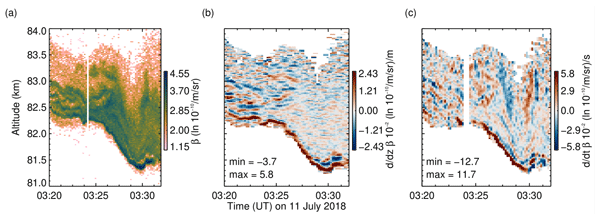
Natalie Kaifler, Bernd Kaifler, Markus Rapp, and David C. Fritts
Atmos. Chem. Phys., 23, 949–961, https://doi.org/10.5194/acp-23-949-2023, https://doi.org/10.5194/acp-23-949-2023, 2023
Short summary
Short summary
We used a lidar to measure polar mesospheric clouds from a balloon floating in the upper stratosphere. The thin-layered ice clouds at 83 km altitude are perturbed by waves. The high-resolution lidar soundings reveal small-scale structures induced by the breaking of those waves. We study these patterns and find that they occur very often. We show their morphology and discuss associated dynamical physical processes, which help to interpret case studies and to guide modelling.
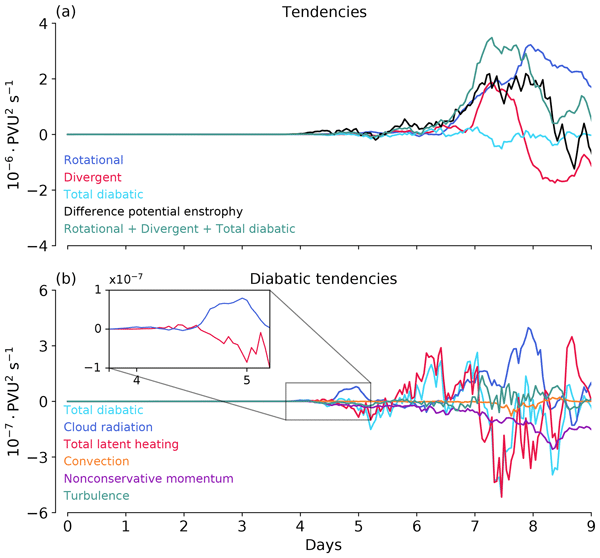
Behrooz Keshtgar, Aiko Voigt, Corinna Hoose, Michael Riemer, and Bernhard Mayer
Weather Clim. Dynam., 4, 115–132, https://doi.org/10.5194/wcd-4-115-2023, https://doi.org/10.5194/wcd-4-115-2023, 2023
Short summary
Short summary
Forecasting extratropical cyclones is challenging due to many physical factors influencing their behavior. One such factor is the impact of heating and cooling of the atmosphere by the interaction between clouds and radiation. In this study, we show that cloud-radiative heating (CRH) increases the intensity of an idealized cyclone and affects its predictability. We find that CRH affects the cyclone mostly via increasing latent heat release and subsequent changes in the synoptic circulation.
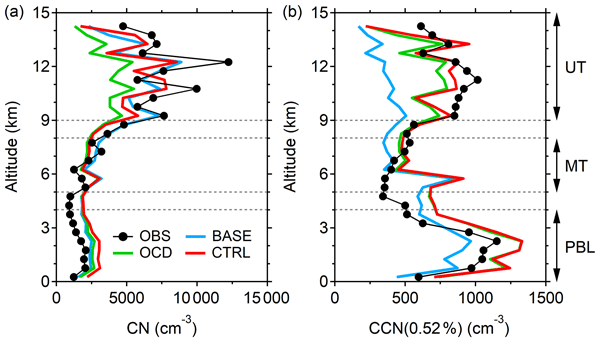
Yunfan Liu, Hang Su, Siwen Wang, Chao Wei, Wei Tao, Mira L. Pöhlker, Christopher Pöhlker, Bruna A. Holanda, Ovid O. Krüger, Thorsten Hoffmann, Manfred Wendisch, Paulo Artaxo, Ulrich Pöschl, Meinrat O. Andreae, and Yafang Cheng
Atmos. Chem. Phys., 23, 251–272, https://doi.org/10.5194/acp-23-251-2023, https://doi.org/10.5194/acp-23-251-2023, 2023
Short summary
Short summary
The origins of the abundant cloud condensation nuclei (CCN) in the upper troposphere (UT) of the Amazon remain unclear. With model developments of new secondary organic aerosol schemes and constrained by observation, we show that strong aerosol nucleation and condensation in the UT is triggered by biogenic organics, and organic condensation is key for UT CCN production. This UT CCN-producing mechanism may prevail over broader vegetation canopies and deserves emphasis in aerosol–climate feedback.
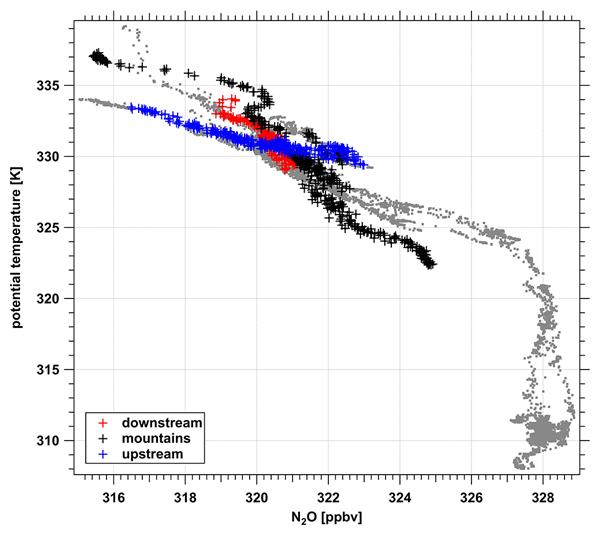
Hans-Christoph Lachnitt, Peter Hoor, Daniel Kunkel, Martina Bramberger, Andreas Dörnbrack, Stefan Müller, Philipp Reutter, Andreas Giez, Thorsten Kaluza, and Markus Rapp
Atmos. Chem. Phys., 23, 355–373, https://doi.org/10.5194/acp-23-355-2023, https://doi.org/10.5194/acp-23-355-2023, 2023
Short summary
Short summary
We present an analysis of high-resolution airborne measurements during a flight of the DEEPWAVE 2014 campaign in New Zealand. The focus of this flight was to study the effects of enhanced mountain wave activity over the Southern Alps. We discuss changes in the upstream and downstream distributions of N2O and CO and show that these changes are related to turbulence-induced trace gas fluxes which have persistent effects on the trace gas composition in the lower stratosphere.
Qiang Li and Silke Groß
Atmos. Chem. Phys., 22, 15963–15980, https://doi.org/10.5194/acp-22-15963-2022, https://doi.org/10.5194/acp-22-15963-2022, 2022
Short summary
Short summary
The IPCC report identified that cirrus clouds have a significant impact on the radiation balance comparable to the CO2 effects, which, however, is still hard to parameterize. The current study investigates the possible impact of aviation on cirrus properties based on the analysis of 10-year lidar measurements of CALIPSO. The results reveal that there is a significant positive trend in cirrus depolarization ratio in the last 10 years before COVID-19, which is strongly correlated with aviation.
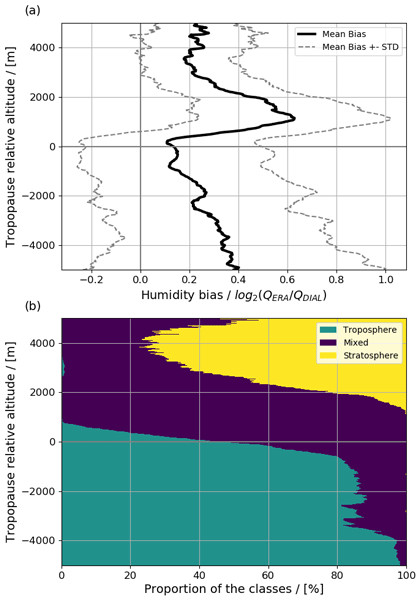
Konstantin Krüger, Andreas Schäfler, Martin Wirth, Martin Weissmann, and George C. Craig
Atmos. Chem. Phys., 22, 15559–15577, https://doi.org/10.5194/acp-22-15559-2022, https://doi.org/10.5194/acp-22-15559-2022, 2022
Short summary
Short summary
A comprehensive data set of airborne lidar water vapour profiles is compared with ERA5 reanalyses for a robust characterization of the vertical structure of the mid-latitude lower-stratospheric moist bias. We confirm a moist bias of up to 55 % at 1.3 km altitude above the tropopause and uncover a decreasing bias beyond. Collocated O3 and H2O observations reveal a particularly strong bias in the mixing layer, indicating insufficiently modelled transport processes fostering the bias.
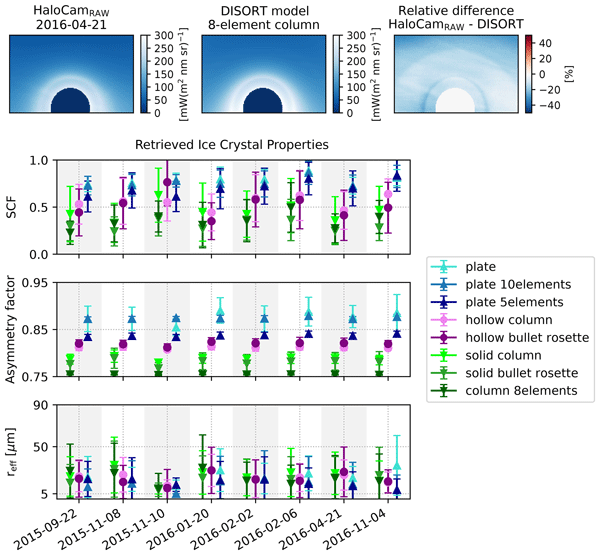
Linda Forster and Bernhard Mayer
Atmos. Chem. Phys., 22, 15179–15205, https://doi.org/10.5194/acp-22-15179-2022, https://doi.org/10.5194/acp-22-15179-2022, 2022
Short summary
Short summary
We present a novel retrieval using ground-based imaging observations of halo displays together with radiative transfer simulations to help improve our understanding of ice crystal properties representative of cirrus clouds. Analysis of 4400 calibrated HaloCam images featuring a 22° halo revealed aggregates of hexagonal columns of 20 µm effective radius with a mixture of about 37 % smooth and 63% severely roughened surfaces as the best match in general.

Natalie Kaifler, Bernd Kaifler, Markus Rapp, and David C. Fritts
Earth Syst. Sci. Data, 14, 4923–4934, https://doi.org/10.5194/essd-14-4923-2022, https://doi.org/10.5194/essd-14-4923-2022, 2022
Short summary
Short summary
We measured polar mesospheric clouds (PMCs), our Earth’s highest clouds at the edge of space, with a Rayleigh lidar from a stratospheric balloon. We describe how we derive the cloud’s brightness and discuss the stability of the gondola pointing and the sensitivity of our measurements. We present our high-resolution PMC dataset that is used to study dynamical processes in the upper mesosphere, e.g. regarding gravity waves, mesospheric bores, vortex rings, and Kelvin–Helmholtz instabilities.
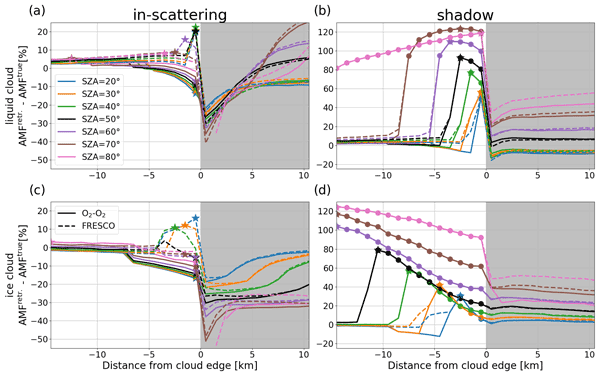
Huan Yu, Claudia Emde, Arve Kylling, Ben Veihelmann, Bernhard Mayer, Kerstin Stebel, and Michel Van Roozendael
Atmos. Meas. Tech., 15, 5743–5768, https://doi.org/10.5194/amt-15-5743-2022, https://doi.org/10.5194/amt-15-5743-2022, 2022
Short summary
Short summary
In this study, we have investigated the impact of 3D clouds on the tropospheric NO2 retrieval from UV–visible sensors. We applied standard NO2 retrieval methods including cloud corrections to synthetic data generated by the 3D radiative transfer model. A sensitivity study was done for synthetic data, and dependencies on various parameters were investigated. Possible mitigation strategies were investigated and compared based on 3D simulations and observed data.
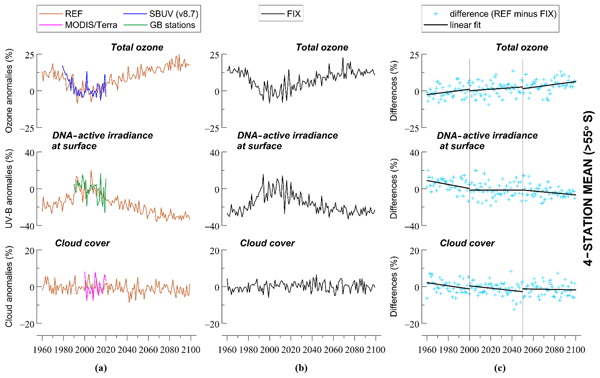
Kostas Eleftheratos, John Kapsomenakis, Ilias Fountoulakis, Christos S. Zerefos, Patrick Jöckel, Martin Dameris, Alkiviadis F. Bais, Germar Bernhard, Dimitra Kouklaki, Kleareti Tourpali, Scott Stierle, J. Ben Liley, Colette Brogniez, Frédérique Auriol, Henri Diémoz, Stana Simic, Irina Petropavlovskikh, Kaisa Lakkala, and Kostas Douvis
Atmos. Chem. Phys., 22, 12827–12855, https://doi.org/10.5194/acp-22-12827-2022, https://doi.org/10.5194/acp-22-12827-2022, 2022
Short summary
Short summary
We present the future evolution of DNA-active ultraviolet (UV) radiation in view of increasing greenhouse gases (GHGs) and decreasing ozone depleting substances (ODSs). It is shown that DNA-active UV radiation might increase after 2050 between 50° N–50° S due to GHG-induced reductions in clouds and ozone, something that is likely not to happen at high latitudes, where DNA-active UV radiation will continue its downward trend mainly due to stratospheric ozone recovery from the reduction in ODSs.

Eleni Drakaki, Vassilis Amiridis, Alexandra Tsekeri, Antonis Gkikas, Emmanouil Proestakis, Sotirios Mallios, Stavros Solomos, Christos Spyrou, Eleni Marinou, Claire L. Ryder, Demetri Bouris, and Petros Katsafados
Atmos. Chem. Phys., 22, 12727–12748, https://doi.org/10.5194/acp-22-12727-2022, https://doi.org/10.5194/acp-22-12727-2022, 2022
Short summary
Short summary
State-of-the-art atmospheric dust models have limitations in accounting for a realistic dust size distribution (emission, transport). We modify the parameterization of the mineral dust cycle by including particles with diameter >20 μm, as indicated by observations over deserts. Moreover, we investigate the effects of reduced settling velocities of dust particles. Model results are evaluated using airborne and spaceborne dust measurements above Cabo Verde.
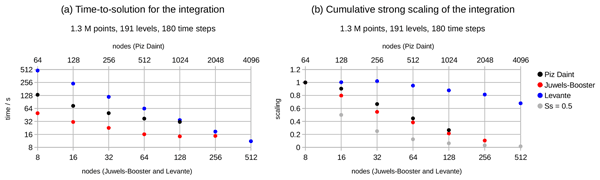
Marco A. Giorgetta, William Sawyer, Xavier Lapillonne, Panagiotis Adamidis, Dmitry Alexeev, Valentin Clément, Remo Dietlicher, Jan Frederik Engels, Monika Esch, Henning Franke, Claudia Frauen, Walter M. Hannah, Benjamin R. Hillman, Luis Kornblueh, Philippe Marti, Matthew R. Norman, Robert Pincus, Sebastian Rast, Daniel Reinert, Reiner Schnur, Uwe Schulzweida, and Bjorn Stevens
Geosci. Model Dev., 15, 6985–7016, https://doi.org/10.5194/gmd-15-6985-2022, https://doi.org/10.5194/gmd-15-6985-2022, 2022
Short summary
Short summary
This work presents a first version of the ICON atmosphere model that works not only on CPUs, but also on GPUs. This GPU-enabled ICON version is benchmarked on two GPU machines and a CPU machine. While the weak scaling is very good on CPUs and GPUs, the strong scaling is poor on GPUs. But the high performance of GPU machines allowed for first simulations of a short period of the quasi-biennial oscillation at very high resolution with explicit convection and gravity wave forcing.
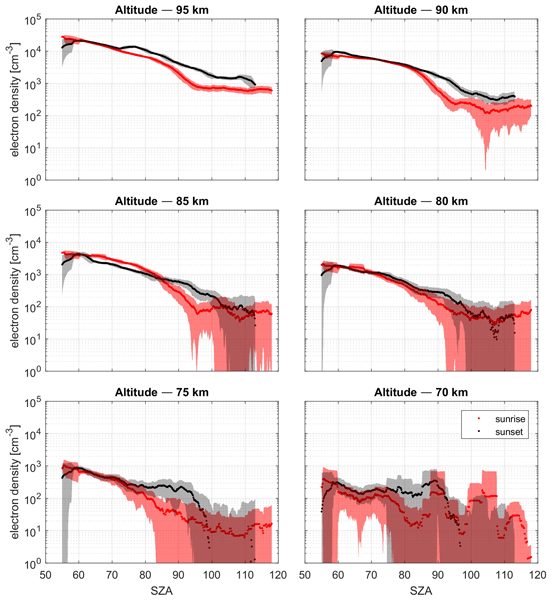
Carsten Baumann, Antti Kero, Shikha Raizada, Markus Rapp, Michael P. Sulzer, Pekka T. Verronen, and Juha Vierinen
Ann. Geophys., 40, 519–530, https://doi.org/10.5194/angeo-40-519-2022, https://doi.org/10.5194/angeo-40-519-2022, 2022
Short summary
Short summary
The Arecibo radar was used to probe free electrons of the ionized atmosphere between 70 and 100 km altitude. This is also the altitude region were meteors evaporate and form secondary particulate matter, the so-called meteor smoke particles (MSPs). Free electrons attach to these MSPs when the sun is below the horizon and cause a drop in the number of free electrons, which are the subject of these measurements. We also identified a different number of free electrons during sunset and sunrise.
Stergios Misios, Ioannis Logothetis, Mads F. Knudsen, Christoffer Karoff, Vassilis Amiridis, and Kleareti Tourpali
Weather Clim. Dynam., 3, 811–823, https://doi.org/10.5194/wcd-3-811-2022, https://doi.org/10.5194/wcd-3-811-2022, 2022
Short summary
Short summary
We investigate the impact of strong volcanic eruptions on the northerly Etesian winds blowing in the eastern Mediterranean. Μodel simulations of the last millennium demonstrate a robust reduction in the total number of days with Etesian winds in the post-eruption summers. The decline in the Etesian winds is attributed to a weakened Indian summer monsoon in the post-eruption summer. These findings could improve seasonal predictions of the wind circulation in the eastern Mediterranean.
Eleni Tetoni, Florian Ewald, Martin Hagen, Gregor Köcher, Tobias Zinner, and Silke Groß
Atmos. Meas. Tech., 15, 3969–3999, https://doi.org/10.5194/amt-15-3969-2022, https://doi.org/10.5194/amt-15-3969-2022, 2022
Short summary
Short summary
We use the C-band POLDIRAD and the Ka-band MIRA-35 to perform snowfall dual-wavelength polarimetric radar measurements. We develop an ice microphysics retrieval for mass, apparent shape, and median size of the particle size distribution by comparing observations to T-matrix ice spheroid simulations while varying the mass–size relationship. We furthermore show how the polarimetric measurements from POLDIRAD help to narrow down ambiguities between ice particle shape and size.

Arve Kylling, Claudia Emde, Huan Yu, Michel van Roozendael, Kerstin Stebel, Ben Veihelmann, and Bernhard Mayer
Atmos. Meas. Tech., 15, 3481–3495, https://doi.org/10.5194/amt-15-3481-2022, https://doi.org/10.5194/amt-15-3481-2022, 2022
Short summary
Short summary
Atmospheric trace gases such as nitrogen dioxide (NO2) may be measured by satellite instruments sensitive to solar ultraviolet–visible radiation reflected from Earth and its atmosphere. For a single pixel, clouds in neighbouring pixels may affect the radiation and hence the retrieved trace gas amount. We found that for a solar zenith angle less than about 40° this cloud-related NO2 bias is typically below 10 %, while for larger solar zenith angles the NO2 bias is on the order of tens of percent.
Manuel Gutleben, Silke Groß, Christian Heske, and Martin Wirth
Atmos. Chem. Phys., 22, 7319–7330, https://doi.org/10.5194/acp-22-7319-2022, https://doi.org/10.5194/acp-22-7319-2022, 2022
Short summary
Short summary
The main transportation route of Saharan mineral dust particles leads over the subtropical Atlantic Ocean and is subject to a seasonal variation. This study investigates the characteristics of wintertime transatlantic dust transport towards the Caribbean by means of airborne lidar measurements. It is found that dust particles are transported at low atmospheric altitudes (<3.5 km) embedded in a relatively moist mixture with two other particle types, namely marine and biomass-burning particles.
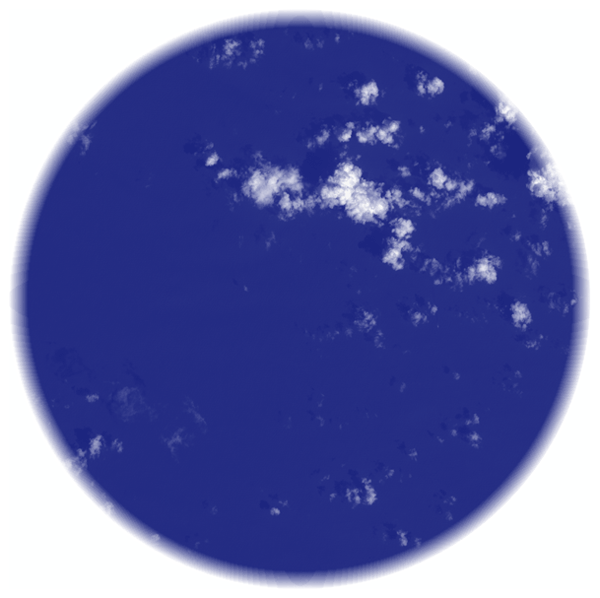
Theresa Mieslinger, Bjorn Stevens, Tobias Kölling, Manfred Brath, Martin Wirth, and Stefan A. Buehler
Atmos. Chem. Phys., 22, 6879–6898, https://doi.org/10.5194/acp-22-6879-2022, https://doi.org/10.5194/acp-22-6879-2022, 2022
Short summary
Short summary
The trades are home to a plethora of small cumulus clouds that are often barely visible to the human eye and difficult to detect with active and passive remote sensing methods. With the help of a new method and by means of high-resolution data we can detect small and particularly thin clouds. We find that optically thin clouds are a common phenomenon in the trades, covering a large area and influencing the radiative effect of clouds if they are undetected and contaminate the cloud-free signal.
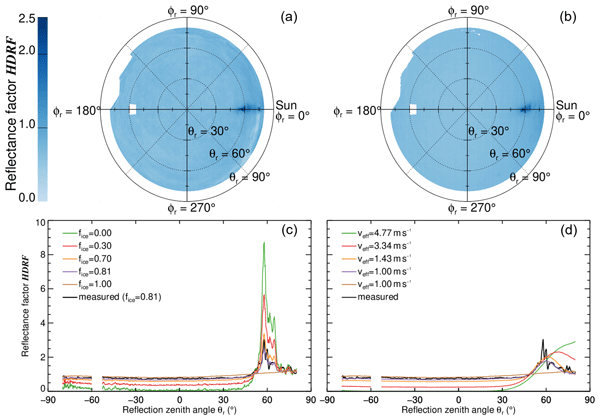
Sebastian Becker, André Ehrlich, Evelyn Jäkel, Tim Carlsen, Michael Schäfer, and Manfred Wendisch
Atmos. Meas. Tech., 15, 2939–2953, https://doi.org/10.5194/amt-15-2939-2022, https://doi.org/10.5194/amt-15-2939-2022, 2022
Short summary
Short summary
Airborne radiation measurements are used to characterize the solar directional reflection of a mixture of Arctic sea ice and open-ocean surfaces in the transition zone between both surface types. The mixture reveals reflection properties of both surface types. It is shown that the directional reflection of the mixture can be reconstructed from the directional reflection of the individual surfaces, accounting for the special conditions present in the transition zone.
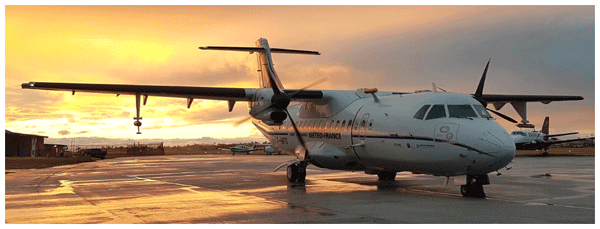
Sandrine Bony, Marie Lothon, Julien Delanoë, Pierre Coutris, Jean-Claude Etienne, Franziska Aemisegger, Anna Lea Albright, Thierry André, Hubert Bellec, Alexandre Baron, Jean-François Bourdinot, Pierre-Etienne Brilouet, Aurélien Bourdon, Jean-Christophe Canonici, Christophe Caudoux, Patrick Chazette, Michel Cluzeau, Céline Cornet, Jean-Philippe Desbios, Dominique Duchanoy, Cyrille Flamant, Benjamin Fildier, Christophe Gourbeyre, Laurent Guiraud, Tetyana Jiang, Claude Lainard, Christophe Le Gac, Christian Lendroit, Julien Lernould, Thierry Perrin, Frédéric Pouvesle, Pascal Richard, Nicolas Rochetin, Kevin Salaün, Alfons Schwarzenboeck, Guillaume Seurat, Bjorn Stevens, Julien Totems, Ludovic Touzé-Peiffer, Gilles Vergez, Jessica Vial, Leonie Villiger, and Raphaela Vogel
Earth Syst. Sci. Data, 14, 2021–2064, https://doi.org/10.5194/essd-14-2021-2022, https://doi.org/10.5194/essd-14-2021-2022, 2022
Short summary
Short summary
The French ATR42 research aircraft participated in the EUREC4A international field campaign that took place in 2020 over the tropical Atlantic, east of Barbados. We present the extensive instrumentation of the aircraft, the research flights and the different measurements. We show that the ATR measurements of humidity, wind, aerosols and cloudiness in the lower atmosphere are robust and consistent with each other. They will make it possible to advance understanding of cloud–climate interactions.
Mireia Papke Chica, Valerian Hahn, Tiziana Braeuer, Elena de la Torre Castro, Florian Ewald, Mathias Gergely, Simon Kirschler, Luca Bugliaro Goggia, Stefanie Knobloch, Martina Kraemer, Johannes Lucke, Johanna Mayer, Raphael Maerkl, Manuel Moser, Laura Tomsche, Tina Jurkat-Witschas, Martin Zoeger, Christian von Savigny, and Christiane Voigt
Atmos. Chem. Phys. Discuss., https://doi.org/10.5194/acp-2022-255, https://doi.org/10.5194/acp-2022-255, 2022
Preprint withdrawn
Short summary
Short summary
The mixed-phase temperature regime in convective clouds challenges our understanding of microphysical and radiative cloud properties. We provide a rare and unique dataset of aircraft in situ measurements in a strong mid-latitude convective system. We find that mechanisms initiating ice nucleation and growth strongly depend on temperature, relative humidity, and vertical velocity and variate within the measured system, resulting in altitude dependent changes of the cloud liquid and ice fraction.

Peristera Paschou, Nikolaos Siomos, Alexandra Tsekeri, Alexandros Louridas, George Georgoussis, Volker Freudenthaler, Ioannis Binietoglou, George Tsaknakis, Alexandros Tavernarakis, Christos Evangelatos, Jonas von Bismarck, Thomas Kanitz, Charikleia Meleti, Eleni Marinou, and Vassilis Amiridis
Atmos. Meas. Tech., 15, 2299–2323, https://doi.org/10.5194/amt-15-2299-2022, https://doi.org/10.5194/amt-15-2299-2022, 2022
Short summary
Short summary
The eVe lidar delivers quality-assured aerosol and cloud optical properties according to the standards of ACTRIS. It is a mobile reference system for the validation of the ESA's Aeolus satellite mission (L2 aerosol and cloud products). eVe provides linear and circular polarisation measurements with Raman capabilities. Here, we describe the system design, the polarisation calibration techniques, and the software for the retrieval of the optical products.
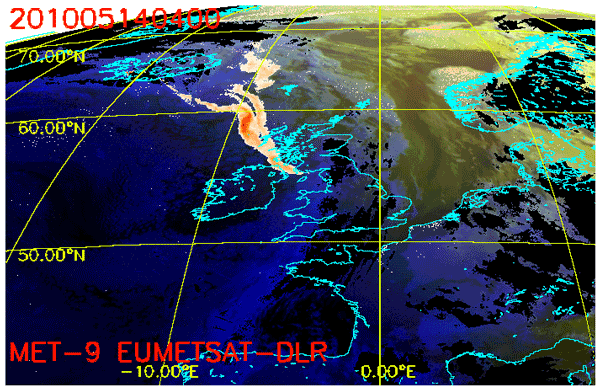
Luca Bugliaro, Dennis Piontek, Stephan Kox, Marius Schmidl, Bernhard Mayer, Richard Müller, Margarita Vázquez-Navarro, Daniel M. Peters, Roy G. Grainger, Josef Gasteiger, and Jayanta Kar
Nat. Hazards Earth Syst. Sci., 22, 1029–1054, https://doi.org/10.5194/nhess-22-1029-2022, https://doi.org/10.5194/nhess-22-1029-2022, 2022
Short summary
Short summary
The monitoring of ash dispersion in the atmosphere is an important task for satellite remote sensing since ash represents a threat to air traffic. We present an AI-based method that retrieves the spatial extension and properties of volcanic ash clouds with high temporal resolution during day and night by means of geostationary satellite measurements. This algorithm, trained on realistic observations simulated with a radiative transfer model, runs operationally at the German Weather Service.
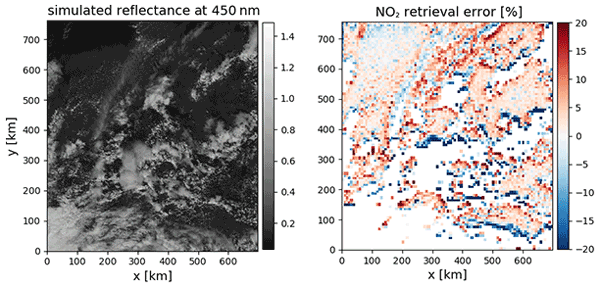
Claudia Emde, Huan Yu, Arve Kylling, Michel van Roozendael, Kerstin Stebel, Ben Veihelmann, and Bernhard Mayer
Atmos. Meas. Tech., 15, 1587–1608, https://doi.org/10.5194/amt-15-1587-2022, https://doi.org/10.5194/amt-15-1587-2022, 2022
Short summary
Short summary
Retrievals of trace gas concentrations from satellite observations can be affected by clouds in the vicinity, either by shadowing or by scattering of radiation from clouds in the clear region. We used a Monte Carlo radiative transfer model to generate synthetic satellite observations, which we used to test retrieval algorithms and to quantify the error of retrieved NO2 vertical column density due to cloud scattering.
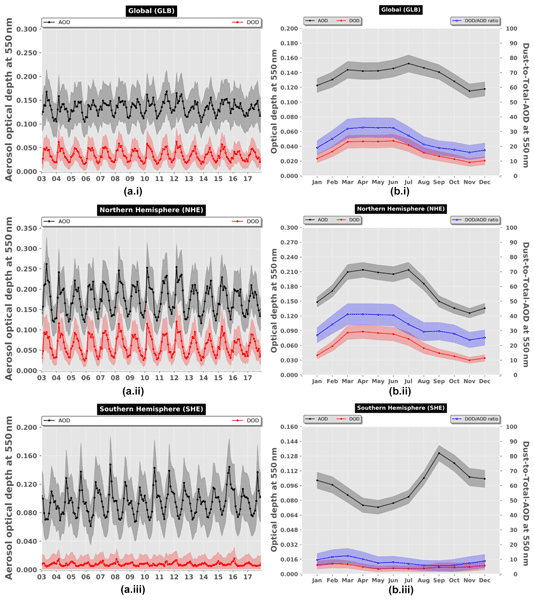
Antonis Gkikas, Emmanouil Proestakis, Vassilis Amiridis, Stelios Kazadzis, Enza Di Tomaso, Eleni Marinou, Nikos Hatzianastassiou, Jasper F. Kok, and Carlos Pérez García-Pando
Atmos. Chem. Phys., 22, 3553–3578, https://doi.org/10.5194/acp-22-3553-2022, https://doi.org/10.5194/acp-22-3553-2022, 2022
Short summary
Short summary
We present a comprehensive climatological analysis of dust optical depth (DOD) relying on the MIDAS dataset. MIDAS provides columnar mid-visible (550 nm) DOD at fine spatial resolution (0.1° × 0.1°) over a 15-year period (2003–2017). In the current study, the analysis is performed at various spatial (from regional to global) and temporal (from months to years) scales. More specifically, focus is given to specific regions hosting the major dust sources as well as downwind areas of the planet.

Michael Schäfer, Kevin Wolf, André Ehrlich, Christoph Hallbauer, Evelyn Jäkel, Friedhelm Jansen, Anna Elizabeth Luebke, Joshua Müller, Jakob Thoböll, Timo Röschenthaler, Bjorn Stevens, and Manfred Wendisch
Atmos. Meas. Tech., 15, 1491–1509, https://doi.org/10.5194/amt-15-1491-2022, https://doi.org/10.5194/amt-15-1491-2022, 2022
Short summary
Short summary
The new airborne thermal infrared imager VELOX is introduced. It measures two-dimensional fields of spectral thermal infrared radiance or brightness temperature within the large atmospheric window. The technical specifications as well as necessary calibration and correction procedures are presented. Example measurements from the first field deployment are analysed with respect to cloud coverage and cloud top altitude.
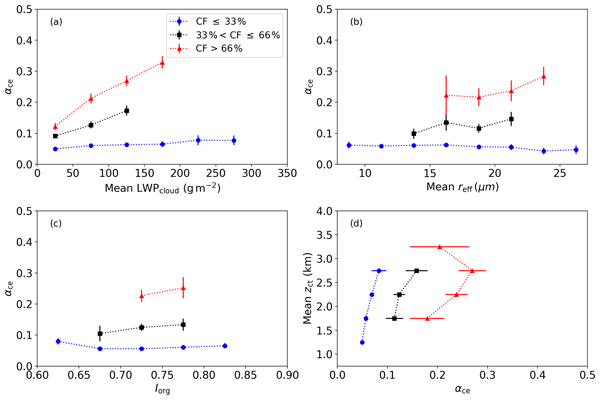
Anna E. Luebke, André Ehrlich, Michael Schäfer, Kevin Wolf, and Manfred Wendisch
Atmos. Chem. Phys., 22, 2727–2744, https://doi.org/10.5194/acp-22-2727-2022, https://doi.org/10.5194/acp-22-2727-2022, 2022
Short summary
Short summary
A combination of aircraft and satellite observations is used to show how the characteristics of tropical shallow clouds interact with incoming and outgoing energy. A complete depiction of these clouds is challenging to obtain, but such data are useful for understanding how models can correctly represent them. The amount of cloud is found to be the most important factor, while other cloud characteristics become increasingly impactful when more cloud is present.
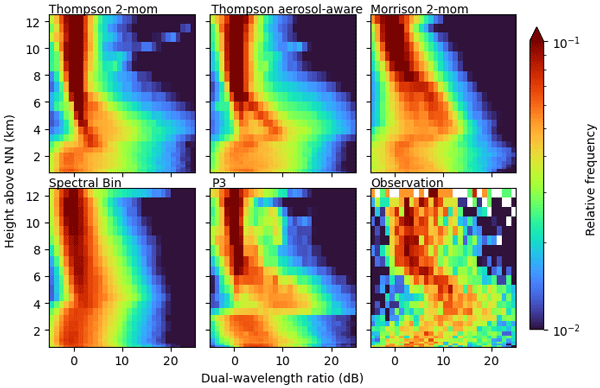
Gregor Köcher, Tobias Zinner, Christoph Knote, Eleni Tetoni, Florian Ewald, and Martin Hagen
Atmos. Meas. Tech., 15, 1033–1054, https://doi.org/10.5194/amt-15-1033-2022, https://doi.org/10.5194/amt-15-1033-2022, 2022
Short summary
Short summary
We present a setup for systematic characterization of differences between numerical weather models and radar observations for convective weather situations. Radar observations providing dual-wavelength and polarimetric variables to infer information about hydrometeor shapes and sizes are compared against simulations using microphysics schemes of varying complexity. Differences are found in ice and liquid phase, pointing towards issues of some schemes in reproducing particle size distributions.
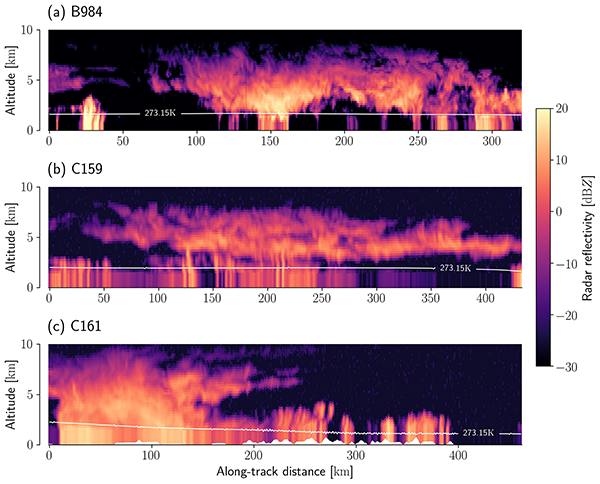
Simon Pfreundschuh, Stuart Fox, Patrick Eriksson, David Duncan, Stefan A. Buehler, Manfred Brath, Richard Cotton, and Florian Ewald
Atmos. Meas. Tech., 15, 677–699, https://doi.org/10.5194/amt-15-677-2022, https://doi.org/10.5194/amt-15-677-2022, 2022
Short summary
Short summary
We test a novel method to remotely measure ice particles in clouds. This is important because such measurements are required to improve climate and weather models. The method combines a radar with newly developed sensors measuring microwave radiation at very short wavelengths. We use observations made from aircraft flying above the cloud and compare them to real measurements from inside the cloud. This works well given that one can model the ice particles in the cloud sufficiently well.
Stefanie Knobloch, Bernd Kaifler, and Markus Rapp
Atmos. Meas. Tech. Discuss., https://doi.org/10.5194/amt-2021-310, https://doi.org/10.5194/amt-2021-310, 2022
Preprint withdrawn
Short summary
Short summary
The study tests the quality of temperature measurements from the airborne Rayleigh lidar ALIMA. The ALIMA system was first used during the SouthTRAC campaign in September 2019 in the vicinity of the Southern Andes, Drake Passage and Antarctic Peninsula. The raw lidar measurements are additionally simulated based on reanalysis data for one research flight. Different types of uncertainty influencing the accuracy of the temperature measurements are studied, e.g. atmospheric and technical sources.
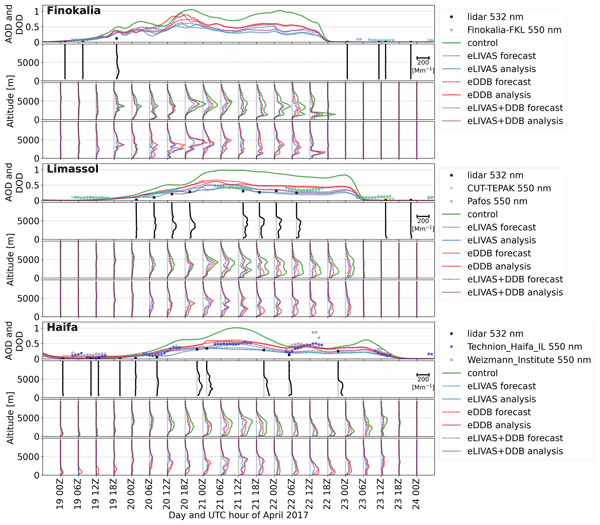
Jerónimo Escribano, Enza Di Tomaso, Oriol Jorba, Martina Klose, Maria Gonçalves Ageitos, Francesca Macchia, Vassilis Amiridis, Holger Baars, Eleni Marinou, Emmanouil Proestakis, Claudia Urbanneck, Dietrich Althausen, Johannes Bühl, Rodanthi-Elisavet Mamouri, and Carlos Pérez García-Pando
Atmos. Chem. Phys., 22, 535–560, https://doi.org/10.5194/acp-22-535-2022, https://doi.org/10.5194/acp-22-535-2022, 2022
Short summary
Short summary
We explore the benefits and consistency in adding lidar dust observations in a dust optical depth assimilation. We show that adding lidar data to a dust optical depth assimilation has valuable benefits and the dust analysis improves. We discuss the impact of the narrow satellite footprint of the lidar dust observations on the assimilation.
Martin Hagen, Florian Ewald, Silke Groß, Lothar Oswald, David A. Farrell, Marvin Forde, Manuel Gutleben, Johann Heumos, Jens Reimann, Eleni Tetoni, Gregor Köcher, Eleni Marinou, Christoph Kiemle, Qiang Li, Rebecca Chewitt-Lucas, Alton Daley, Delando Grant, and Kashawn Hall
Earth Syst. Sci. Data, 13, 5899–5914, https://doi.org/10.5194/essd-13-5899-2021, https://doi.org/10.5194/essd-13-5899-2021, 2021
Short summary
Short summary
The German polarimetric weather radar Poldirad was deployed for the international campaign EUREC4A on Barbados. The focus was monitoring clouds and precipitation in the trade wind region east of Barbados. Observations were with a temporal sequence of 5 min and a maximum range of 375 km. Examples of mesoscale precipitation patterns, rain rate accumulation, diurnal cycle, and vertical distribution show the potential for further studies on the life cycle of precipitating shallow cumulus clouds.
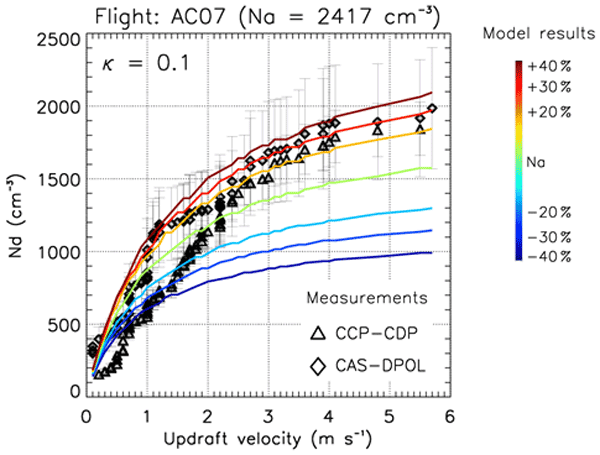
Ramon Campos Braga, Barbara Ervens, Daniel Rosenfeld, Meinrat O. Andreae, Jan-David Förster, Daniel Fütterer, Lianet Hernández Pardo, Bruna A. Holanda, Tina Jurkat-Witschas, Ovid O. Krüger, Oliver Lauer, Luiz A. T. Machado, Christopher Pöhlker, Daniel Sauer, Christiane Voigt, Adrian Walser, Manfred Wendisch, Ulrich Pöschl, and Mira L. Pöhlker
Atmos. Chem. Phys., 21, 17513–17528, https://doi.org/10.5194/acp-21-17513-2021, https://doi.org/10.5194/acp-21-17513-2021, 2021
Short summary
Short summary
Interactions of aerosol particles with clouds represent a large uncertainty in estimates of climate change. Properties of aerosol particles control their ability to act as cloud condensation nuclei. Using aerosol measurements in the Amazon, we performed model studies to compare predicted and measured cloud droplet number concentrations at cloud bases. Our results confirm previous estimates of particle hygroscopicity in this region.
Heike Konow, Florian Ewald, Geet George, Marek Jacob, Marcus Klingebiel, Tobias Kölling, Anna E. Luebke, Theresa Mieslinger, Veronika Pörtge, Jule Radtke, Michael Schäfer, Hauke Schulz, Raphaela Vogel, Martin Wirth, Sandrine Bony, Susanne Crewell, André Ehrlich, Linda Forster, Andreas Giez, Felix Gödde, Silke Groß, Manuel Gutleben, Martin Hagen, Lutz Hirsch, Friedhelm Jansen, Theresa Lang, Bernhard Mayer, Mario Mech, Marc Prange, Sabrina Schnitt, Jessica Vial, Andreas Walbröl, Manfred Wendisch, Kevin Wolf, Tobias Zinner, Martin Zöger, Felix Ament, and Bjorn Stevens
Earth Syst. Sci. Data, 13, 5545–5563, https://doi.org/10.5194/essd-13-5545-2021, https://doi.org/10.5194/essd-13-5545-2021, 2021
Short summary
Short summary
The German research aircraft HALO took part in the research campaign EUREC4A in January and February 2020. The focus area was the tropical Atlantic east of the island of Barbados. We describe the characteristics of the 15 research flights, provide auxiliary information, derive combined cloud mask products from all instruments that observe clouds on board the aircraft, and provide code examples that help new users of the data to get started.
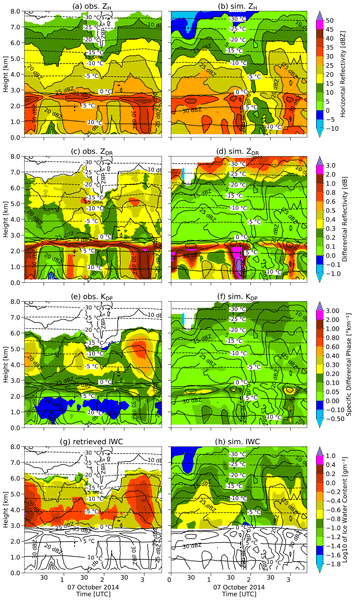
Silke Trömel, Clemens Simmer, Ulrich Blahak, Armin Blanke, Sabine Doktorowski, Florian Ewald, Michael Frech, Mathias Gergely, Martin Hagen, Tijana Janjic, Heike Kalesse-Los, Stefan Kneifel, Christoph Knote, Jana Mendrok, Manuel Moser, Gregor Köcher, Kai Mühlbauer, Alexander Myagkov, Velibor Pejcic, Patric Seifert, Prabhakar Shrestha, Audrey Teisseire, Leonie von Terzi, Eleni Tetoni, Teresa Vogl, Christiane Voigt, Yuefei Zeng, Tobias Zinner, and Johannes Quaas
Atmos. Chem. Phys., 21, 17291–17314, https://doi.org/10.5194/acp-21-17291-2021, https://doi.org/10.5194/acp-21-17291-2021, 2021
Short summary
Short summary
The article introduces the ACP readership to ongoing research in Germany on cloud- and precipitation-related process information inherent in polarimetric radar measurements, outlines pathways to inform atmospheric models with radar-based information, and points to remaining challenges towards an improved fusion of radar polarimetry and atmospheric modelling.
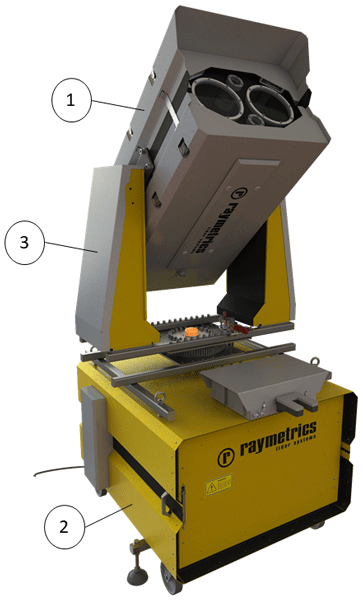
Alexandra Tsekeri, Vassilis Amiridis, Alexandros Louridas, George Georgoussis, Volker Freudenthaler, Spiros Metallinos, George Doxastakis, Josef Gasteiger, Nikolaos Siomos, Peristera Paschou, Thanasis Georgiou, George Tsaknakis, Christos Evangelatos, and Ioannis Binietoglou
Atmos. Meas. Tech., 14, 7453–7474, https://doi.org/10.5194/amt-14-7453-2021, https://doi.org/10.5194/amt-14-7453-2021, 2021
Short summary
Short summary
Dust orientation in the Earth's atmosphere has been an ongoing investigation in recent years, and its potential proof will be a paradigm shift for dust remote sensing. We have designed and developed a polarization lidar that provides direct measurements of dust orientation, as well as more detailed information of the particle microphysics. We provide a description of its design as well as its first measurements.

Stavros-Andreas Logothetis, Vasileios Salamalikis, Antonis Gkikas, Stelios Kazadzis, Vassilis Amiridis, and Andreas Kazantzidis
Atmos. Chem. Phys., 21, 16499–16529, https://doi.org/10.5194/acp-21-16499-2021, https://doi.org/10.5194/acp-21-16499-2021, 2021
Short summary
Short summary
This study investigates the temporal trends of dust optical depth (DOD; 550 nm) on global, regional and seasonal scales over a 15-year period (2003–2017) using the MIDAS (ModIs Dust AeroSol) dataset. The findings of this study revealed that the DOD was increased across the central Sahara and the Arabian Peninsula, with opposite trends over the eastern and western Sahara, the Thar and Gobi deserts, in the Bodélé Depression, and in the southern Mediterranean.
Geet George, Bjorn Stevens, Sandrine Bony, Robert Pincus, Chris Fairall, Hauke Schulz, Tobias Kölling, Quinn T. Kalen, Marcus Klingebiel, Heike Konow, Ashley Lundry, Marc Prange, and Jule Radtke
Earth Syst. Sci. Data, 13, 5253–5272, https://doi.org/10.5194/essd-13-5253-2021, https://doi.org/10.5194/essd-13-5253-2021, 2021
Short summary
Short summary
Dropsondes measure atmospheric parameters such as temperature, pressure, humidity and horizontal winds. The EUREC4A field campaign deployed 1215 dropsondes during January–February 2020 in the north Atlantic trade-wind region in order to characterize the thermodynamic and the dynamic structure of the atmosphere, primarily at horizontal scales of ~ 200 km. We present JOANNE, the dataset that provides these dropsonde measurements and thereby a rich characterization of the trade-wind atmosphere.
Cited articles
Amiridis, V., Marinou, E., Hostetler, C., Koopman, R., Cecil, D. J., Moisseev, D., Tackett, J., Groß, S., Baars, H., Redemann, J., Marenco, F., Baldini, L., Tanelli, S., Fielding, M., Janiskova, M., Tanaka, T., O'Connor, E., Fjaeraa, A. M., Raschou, P. Voudouri, K. A., Ferrare, R., Burton, S., Schuster, G., Kato, S., Winker, D., Shook, M., Bley, S., Haarig, M., Floutsi, A. A., Wandinger, U., Trapon, D., Pfitzenmeier, L., Papagiannopoulos, N., Mona. L., Posselt, D., Mason, S., Rennie, M., Benedetti, A., Hogan, R., Sogacheva, L., Balis, D., Michailidis, K., van Zadelhoff, G.-J., Nowottnick, E., Yorks, J., Mroz, K., Donovan, D., L'Ecuyer, T., Okamoto, H., Sato, K., Henderson, D., Nishikawa, T., Barker, H., Cole, J., Qu, Z., Clerbaux, N., Nakajima, T., Chase, R., Wolff, D., Landulfo, E., Kirstetter, P.E., Materh, J., Ohigashi, T., Ryder, C., Tzallas, V., Tsikoudi, I., Tsekeri, A., Tsichla, M., Koutsoupi, I., Kubota, T., Siomos, N., Takahashi, N., Horie, H., Suzuki, K., Mace, J., McLean, W., Suzuki, Kn., Mace, J., McLean, W., Borderies, M., Mangla, R., Escribano, J., Moradi, I., Zhang, J., Juli, R., Ikuta, Y., Marback, T., Bojkov, B., Accadia, C., Fougnie, B., Spezzi, L., Bozzo, A., Chimot, J., Jafariserajehlou, S., Fament, T., Mattioli, V., Strandgren, J., Barlakas, V., and Kollias: Best practices for the validation of Aerosol, Cloud, and Precipitation Profiles (ACPPV), Zenodo, https://doi.org/10.5281/zenodo.15025627, 2025.
Aubry, C., Delanoë, J., Groß, S., Ewald, F., Tridon, F., Jourdan, O., and Mioche, G.: Lidar–radar synergistic method to retrieve ice, supercooled water and mixed-phase cloud properties, Atmos. Meas. Tech., 17, 3863–3881, https://doi.org/10.5194/amt-17-3863-2024, 2024.
Barker, H., Korolev, A., Hudak, D., Strapp, J., Strawbridge, K., and Wolde, M.: A comparison between CloudSat and aircraft data for a multilayer, mixed phase cloud system during the Canadian CloudSat-CALIPSO validation project, J. Geophys. Res., 113, D00A16, https://doi.org/10.1029/2008JD009971, 2008.
Bedka, K. M., Nehrir, A. R., Kavaya, M., Barton-Grimley, R., Beaubien, M., Carroll, B., Collins, J., Cooney, J., Emmitt, G. D., Greco, S., Kooi, S., Lee, T., Liu, Z., Rodier, S., and Skofronick-Jackson, G.: Airborne lidar observations of wind, water vapor, and aerosol profiles during the NASA Aeolus calibration and validation (Cal/Val) test flight campaign, Atmos. Meas. Tech., 14, 4305–4334, https://doi.org/10.5194/amt-14-4305-2021, 2021.
Bony, S. and Stevens, B.: Measuring Area-Averaged Vertical Motions with Dropsondes, J. Atmos. Sci., 76, 767–783, https://doi.org/10.1175/JAS-D-18-0141.1, 2019.
Burton, S. P., Ferrare, R. A., Vaughan, M. A., Omar, A. H., Rogers, R. R., Hostetler, C. A., and Hair, J. W.: Aerosol classification from airborne HSRL and comparisons with the CALIPSO vertical feature mask, Atmos. Meas. Tech., 6, 1397–1412, https://doi.org/10.5194/amt-6-1397-2013, 2013.
Burton, S. P., Hair, J. W., Kahnert, M., Ferrare, R. A., Hostetler, C. A., Cook, A. L., Harper, D. B., Berkoff, T. A., Seaman, S. T., Collins, J. E., Fenn, M. A., and Rogers, R. R.: Observations of the spectral dependence of linear particle depolarization ratio of aerosols using NASA Langley airborne High Spectral Resolution Lidar, Atmos. Chem. Phys., 15, 13453–13473, https://doi.org/10.5194/acp-15-13453-2015, 2015.
Cazenave, Q., Ceccaldi, M., Delanoë, J., Pelon, J., Groß, S., and Heymsfield, A.: Evolution of DARDAR-CLOUD ice cloud retrievals: new parameters and impacts on the retrieved microphysical properties, Atmos. Meas. Tech., 12, 2819–2835, https://doi.org/10.5194/amt-12-2819-2019, 2019.
Dekoutsidis, G., Wirth, M., and Groß, S.: The effects of warm-air intrusions in the high Arctic on cirrus clouds, Atmos. Chem. Phys., 24, 5971–5987, https://doi.org/10.5194/acp-24-5971-2024, 2024.
Delanoë, J. and Hogan, R.: A variational scheme for retrieving ice cloud properties from combined radar, lidar, and infrared radiomete r, J. Geophys. Res., 113, D07204, https://doi.org/10.1029/2007JD009000, 2008.
Delanoe, J., Ament, F., Ceccaldi, M., Groß, S., Hagen, M., Hirsch, L., Pelon, J., Protat, A., Rapp, M., Schwarzenboeck, A., Stevens, B., Brett, D., Bruneau, D., Caudoux, C., and Vinson, J.-P.: Airborne EarthCare Preparation, Calibration and Validation Tandem System, EarthCARE Workshop, Tokyo, https://elib.dlr.de/90952/ (last access: 3 June 2026), 2014.
Delanoë, J., Groß, S., Ewald, F., Cazenave, Q., Pelon, J., Marinou, E., and Ibrah, A.: EPATAN project, ESA, https://doi.org/10.5270/ESA-a346352, 2020.
Donovan, D. P., van Zadelhoff, G.-J., and Wang, P.: The EarthCARE lidar cloud and aerosol profile processor (A-PRO): the A-AER, A-EBD, A-TC, and A-ICE products, Atmos. Meas. Tech., 17, 5301–5340, https://doi.org/10.5194/amt-17-5301-2024, 2024.
Ehrlich, A., Bierwirth, E., Wendisch, M., Gayet, J.-F., Mioche, G., Lampert, A., and Heintzenberg, J.: Cloud phase identification of Arctic boundary-layer clouds from airborne spectral reflection measurements: test of three approaches, Atmos. Chem. Phys., 8, 7493–7505, https://doi.org/10.5194/acp-8-7493-2008, 2008.
Ehrlich, A., Zöger, M., Giez, A., Nenakhov, V., Mallaun, C., Maser, R., Röschenthaler, T., Luebke, A. E., Wolf, K., Stevens, B., and Wendisch, M.: A new airborne broadband radiometer system and an efficient method to correct dynamic thermal offsets, Atmos. Meas. Tech., 16, 1563–1581, https://doi.org/10.5194/amt-16-1563-2023, 2023.
Eisinger, M., Marnas, F., Wallace, K., Kubota, T., Tomiyama, N., Ohno, Y., Tanaka, T., Tomita, E., Wehr, T., and Bernaerts, D.: The EarthCARE mission: science data processing chain overview, Atmos. Meas. Tech., 17, 839–862, https://doi.org/10.5194/amt-17-839-2024, 2024.
Emde, C., Buras-Schnell, R., Kylling, A., Mayer, B., Gasteiger, J., Hamann, U., Kylling, J., Richter, B., Pause, C., Dowling, T., and Bugliaro, L.: The libRadtran software package for radiative transfer calculations (version 2.0.1), Geosci. Model Dev., 9, 1647–1672, https://doi.org/10.5194/gmd-9-1647-2016, 2016.
ESA: Validation Needs, https://earth.esa.int/eogateway/missions/earthcare/data/calibration-validation/validation-needs (last access: 3 June 2026), 2023.
ESA: Introducing EarthCARE's Data, Innovation and Science Cluster, https://earth.esa.int/eogateway/news/introducing-earthcare-s-data-innovation-and-science-cluster (last access: 3 June 2026), 2024.
Ewald, F.: MIRA cloud radar data from A-Train underflights with HALO (Radar reflectivity), Zenodo [data set], https://doi.org/10.5281/zenodo.19317830, 2026.
Ewald, F. and Groß, S.: MIRA cloud radar data from the PERCUSION field campaign (Level 2) (1.0), Zenodo [data set], https://doi.org/10.5281/zenodo.17910007, 2025.
Ewald, F. and Wirth, M: WALES lidar data from A-Train underflights with HALO (Backscatter coefficient), Zenodo [data set], https://doi.org/10.5281/zenodo.19318124, 2026.
Ewald, F., Kölling, T., Baumgartner, A., Zinner, T., and Mayer, B.: Design and characterization of specMACS, a multipurpose hyperspectral cloud and sky imager, Atmos. Meas. Tech., 9, 2015–2042, https://doi.org/10.5194/amt-9-2015-2016, 2016.
Ewald, F., Groß, S., Hagen, M., Hirsch, L., Delanoë, J., and Bauer-Pfundstein, M.: Calibration of a 35 GHz airborne cloud radar: lessons learned and intercomparisons with 94 GHz cloud radars, Atmos. Meas. Tech., 12, 1815–1839, https://doi.org/10.5194/amt-12-1815-2019, 2019.
Ewald, F., Groß, S., Wirth, M., Delanoë, J., Fox, S., and Mayer, B.: Why we need radar, lidar, and solar radiance observations to constrain ice cloud microphysics, Atmos. Meas. Tech., 14, 5029–5047, https://doi.org/10.5194/amt-14-5029-2021, 2021.
Fix, A., Amediek, A., Ehret, G., Groß, S., Kiemle, C., Reitebuch, O., and Wirth, M.:. On the Benefit of airborne emonstrators or space borne lidar missions, Proc. SPIE, 10562, https://doi.org/10.1117/12.2296197, 2016.
Freudenthaler, V., Esselborn, M., Wiegner, M., Heese, B., Tesche, M., Ansmann, A., Müller, D., Althausen, D., Wirth, M., Fix, A., Ehret, G., Knippertz, P., Toledano, C., Gasteiger, J., Garhammer, M., and Seefeldner, M.: Depolarization ratio profiling at several wavelengths in pure Saharan dust during SAMUM 2006, Tellus B, 61, 165–179, https://doi.org/10.1111/j.1600-0889.2008.00396.x, 2009.
Gasteiger, J. and Wiegner, M.: MOPSMAP v1.0: a versatile tool for the modeling of aerosol optical properties, Geosci. Model Dev., 11, 2739–2762, https://doi.org/10.5194/gmd-11-2739-2018, 2018.
Gasteiger, J., Wiegner, M., Groß, S., Freudenthaler, V., Toledano, C., Tesche, M., and Kandler, K.: Modelling lidar-relevant optical properties of complex mineral dust aerosols, Tellus B, 63, 725–741, https://doi.org/10.1111/j.1600-0889.2011.00559.x, 2011, 2011.
Getzewich, B. J., Vaughan, M. A., Hunt, W. H., Avery, M. A., Powell, K. A., Tackett, J. L., Winker, D. M., Kar, J., Lee, K.-P., and Toth, T. D.: CALIPSO lidar calibration at 532 nm: version 4 daytime algorithm, Atmos. Meas. Tech., 11, 6309–6326, https://doi.org/10.5194/amt-11-6309-2018, 2018.
Giez, A. Z., Mallaun, C., Nenakhov, V., Schimpf, M., Grad, C., Numberger, A., and Raynor, K.: Determination of the Measurement Errors for the HALO Basic Data System BAHAMAS by Means of Error Propagation, DLR-Forschungsbericht, https://doi.org/10.57676/5rdc-q708, 2023.
Gimmestad, G., Forrister, H., Grigas, T., and O'Dowd C.: Comparisons of aerosol backscatter using satellite and ground lidars: implications for calibrating and validating spaceborne lidar, Sci. Rep., 7, 42337, https://doi.org/10.1038/srep42337, 2017.
Gloeckner, H. M., Mieslinger, T., Robbins-Blanch, N., George, G., Kluft, L., Kölling, T., Bony, S., Windmiller, J., and Stevens, B.: BEACH: Barbados and Eastern Atlantic Combined High-altitude dropsonde datasets, Earth Syst. Sci. Data Discuss. [preprint], https://doi.org/10.5194/essd-2025-647, in review, 2025.
Groß, S. and Ewald, F.: NARPEX project – Final Report, DLR, https://elib.dlr.de/216858/ (last access: 3 June 2026), 2018.
Groß, S., Tesche, M., Freudenthaler, V., Toledano, C., Wiegner, M., Ansmann, A., Althausen, D., and Seefeldner, M.: Characterization of Saharan dust, marine aerosols and mixtures of biomass-burning aerosols and dust by means of multi-wavelength depolarization and Raman lidar measurements during SAMUM-2, Tellus B, 63, 706–724, https://doi.org/10.1111/j.1600-0889.2011.00556.x, 2011.
Groß, S., Esselborn, M., Weinzierl, B., Wirth, M., Fix, A., and Petzold, A.: Aerosol classification by airborne high spectral resolution lidar observations, Atmos. Chem. Phys., 13, 2487–2505, https://doi.org/10.5194/acp-13-2487-2013, 2013.
Groß, S., Wirth, M., Schäfler, A., Fix, A., Kaufmann, S., and Voigt, C.: Potential of airborne lidar measurements for cirrus cloud studies, Atmos. Meas. Tech., 7, 2745–2755, https://doi.org/10.5194/amt-7-2745-2014, 2014.
Groß, S., Freudenthaler, V., Schepanski, K., Toledano, C., Schäfler, A., Ansmann, A., and Weinzierl, B.: Optical properties of long-range transported Saharan dust over Barbados as measured by dual-wavelength depolarization Raman lidar measurements, Atmos. Chem. Phys., 15, 11067–11080, https://doi.org/10.5194/acp-15-11067-2015, 2015a.
Groß, S., Freudenthaler, V., Wirth, M., and Weinzierl, B.: Towards an aerosol classification scheme for future EarthCARE lidar observations and implications for research needs, Atmos. Sci. Lett., 16, 77–82, https://doi.org/10.1002/asl2.524, 2015b.
Groß, S., Freudenthaler, V., Haarig, M., Ansmann, A., Toledano, C., Mateos, D., Seibert, P., Mamouri, R.-E., Nisantzi, A., Gasteiger, J., Dollner, M., Tipka, A., Schöberl, M., Teri, M., and Weinzierl, B.: Characterization of aerosol over the eastern Mediterranean by polarization-sensitive Raman lidar measurements during A-LIFE – aerosol type classification and type separation, Atmos. Chem. Phys., 25, 3191–3211, https://doi.org/10.5194/acp-25-3191-2025, 2025.
Gutleben, M., Groß, S., and Wirth, M.: Cloud macro-physical properties in Saharan-dust-laden and dust-free North Atlantic trade wind regimes: a lidar case study, Atmos. Chem. Phys., 19, 10659–10673, https://doi.org/10.5194/acp-19-10659-2019, 2019a.
Gutleben, M., Groß, S., Wirth, M., Emde, C., and Mayer, B.: Impacts of water vapor on Saharan air layer radiative heating, Geophys. Res. Lett., 46, 14854–14862, https://doi.org/10.1029/2019GL085344, 2019b.
Gutleben, M., Groß, S., Wirth, M., and Mayer, B.: Radiative effects of long-range-transported Saharan air layers as determined from airborne lidar measurements, Atmos. Chem. Phys., 20, 12313–12327, https://doi.org/10.5194/acp-20-12313-2020, 2020.
Gutleben, M., Groß, S., Heske, C., and Wirth, M.: Wintertime Saharan dust transport towards the Caribbean: an airborne lidar case study during EUREC4A, Atmos. Chem. Phys., 22, 7319–7330, https://doi.org/10.5194/acp-22-7319-2022, 2022.
Haarig, M., Ansmann, A., Engelmann, R., Baars, H., Toledano, C., Torres, B., Althausen, D., Radenz, M., and Wandinger, U.: First triple-wavelength lidar observations of depolarization and extinction-to-backscatter ratios of Saharan dust, Atmos. Chem. Phys., 22, 355–369, https://doi.org/10.5194/acp-22-355-2022, 2022.
Hair, J. W., Hostetler, C. A., Ferrare, R. A., Cook, A. L., and Harper, D. B.: The NASA Langley airborne high spectral resolution lidar for measurements of aerosols and clouds, Reviewed and Revised Papers Presented at the 23rd International Laser Radar Conference, Tokyo, Tokyo Metropolitan University, 411–414, https://laser-sensing.jp/ilrc23_CD1a2b3c/ILRC23/3P-5.pdf (last access: 3 June 2026), 2006.
Hair, J. W., Hostetler, C. A., Cook, A. L., Harper, D. B., Ferrare, R. A., Mack, T. L., Welch, W., Izquierdo, L. R., and Hovis, F. E.: Airborne High Spectral Resolution Lidar for profiling aerosol optical properties, Appl. Opt., 47, 6734–6752, 2008.
Hall, A.: EarthCARE Validation – Level 2 Algorithm Developer Needs, https://earth.esa.int/eogateway/documents/d/earth-online/earthcare-validation-l2-algorithm-developer-needs-table (last access: 3 June 2026), 2025.
Irbah, A., Delanoë, J., van Zadelhoff, G.-J., Donovan, D. P., Kollias, P., Puigdomènech Treserras, B., Mason, S., Hogan, R. J., and Tatarevic, A.: The classification of atmospheric hydrometeors and aerosols from the EarthCARE radar and lidar: the A-TC, C-TC and AC-TC products, Atmos. Meas. Tech., 16, 2795–2820, https://doi.org/10.5194/amt-16-2795-2023, 2023.
IPCC: Climate Change 2021 – The Physical Science Basis, Cambridge University Press, https://doi.org/10.1017/9781009157896, 2023.
Kacenelenbogen, M., Redemann, J., Vaughan, M. A., Omar, A. H., Russell, P. B., Burton, S., Rogers, R. R., Ferrare, R. A., and Hostetler, C. A.: An evaluation of CALIOP/CALIPSO's aerosol-above-cloud (AAC) detection and retrieval capability over North America, J. Geophys. Res., 119, 230–244, https://doi.org/10.1002/2013JD020178, 2014.
Kar, J., Vaughan, M. A., Lee, K.-P., Tackett, J. L., Avery, M. A., Garnier, A., Getzewich, B. J., Hunt, W. H., Josset, D., Liu, Z., Lucker, P. L., Magill, B., Omar, A. H., Pelon, J., Rogers, R. R., Toth, T. D., Trepte, C. R., Vernier, J.-P., Winker, D. M., and Young, S. A.: CALIPSO lidar calibration at 532 nm: version 4 nighttime algorithm, Atmos. Meas. Tech., 11, 1459–1479, https://doi.org/10.5194/amt-11-1459-2018, 2018.
King, M. D., Menzel, W. P., Grant, P. S., Myers, J. S., Arnold, G. T., Platnick, S. E., Gumley, L. E., Tsay, S. C., Moeller, C. C., Fitzgerald, M., Brown, K. S., and Osterwisch, F. G.: Airborne scanning spectrometer for remote sensing of cloud, aerosol, water vapor and surface properties, J. Atmos. Ocean. Tech., 13, 777–794, 1996.
Klocke, D., Wing, A. A., Segura, H., Dengler, M., Bell, M. M., Ruppert Jr., J. H., George, G., Kalesse-Los, H., Nuijens, L., Möller, K. O., Kiko, R., Mohr, W., Kidane, A. T., Trosits, A., Mertz, C., Imker, C., Begler, C., Bladfort, D., Colón-Burgos, D., Austen, D., Junyent, F., Schmidt, H., Habib, J., van der Giessen, J., Wieners, K.-H., Hayo, L., Stelzner, M., Lovato, M., O'Driscoll, O., Paschou, P., Henning, P., Mackenzie, R., Wimmer, W., Serikov, I., Brügemann, B., Wu, Y., Stevens, B., and Windmiller, J.: 40 days and nights in the Rains: The inner life of the Atlantic ITCZ during BOWTIE, B. Am. Meteor. Soc., BAMS-D-25-0166.1, https://doi.org/10.1175/BAMS-D-25-0166.1, 2026.
Kölling, T., Zinner, T., and Mayer, B.: Aircraft-based stereographic reconstruction of 3-D cloud geometry, Atmos. Meas. Tech., 12, 1155–1166, https://doi.org/10.5194/amt-12-1155-2019, 2019.
Koopmann, R.: Scientific Validation Implementation Plan, https://earth.esa.int/eogateway/documents/d/earth-online/earthcare-scientific-validation-implementation-plan (last access: 3 June 2026), 2024
Krautstrunk, M. and Giez, A.: The Transition From FALCON to HALO Era Airborne Atmospheric Research, Atmospheric Physics: Background-Methods-Trends, 609–624, https://doi.org/10.1007/978-3-642-30183-4_37, 2012.
Krüger, K., Groß, S., and Wirth, M.: Validation of cloud macrophysical properties from the ATLID Level 2a products A-TC, A-FM, A-CTH using airborne lidar observations during the HALO missions PERCUSION, ASCCI and NAWDIC, submitted, 2026.
Langsdale, M., Verhoelst, T., Povey, A., Schutgens, N., Dowling, T., Lambert, J.-C., Compernolle, S., and Kern, S.: The Challenges and Limitations of Validating Satellite-Derived Datasets Using Independent Measurements: Lessons Learned from Essential Climate Variables, Surv. Geophys., 1–38, https://doi.org/10.1007/s10712-025-09898-4, 2025.
Lemmerz, C., Lux, O., Witschas, B., Rahm, S., Marksteiner, U., Geiß, A., Weiler, F., and Reitebuch, O.: Airborne Doppler wind LIDAR technology demonstration for Aeolus: from pre-launch campaigns to mission performance validation, Proc. SPIE 12777, International Conference on Space Optics – ICSO 2022, 1277707, https://doi.org/10.1117/12.2688591, 2023.
Luebke, A. E., Ehrlich, A., Wolf, K., Giez, A., Zöger, M., Mallaun, C., Nenakhov, V., Eirenschmalz, L., Pasternak, D., Rosenburg, S., Schäfer, M., Schoch, P., and Wendisch, M.: Broadband solar and thermal-infrared, upward and downward irradiance measured by BACARDI during the PERCUSION field campaign, Zenodo [data set], https://doi.org/10.5281/zenodo.18999496, 2026.
Lux, O., Lemmerz, C., Weiler, F., Marksteiner, U., Witschas, B., Rahm, S., Schäfler, A., and Reitebuch, O.: Airborne wind lidar observations over the North Atlantic in 2016 for the pre-launch validation of the satellite mission Aeolus, Atmos. Meas. Tech., 11, 3297–3322, https://doi.org/10.5194/amt-11-3297-2018, 2018.
Lux, O., Lemmerz, C., Weiler, F., Marksteiner, U., Witschas, B., Rahm, S., Geiß, A., Schäfler, A., and Reitebuch, O.: Retrieval improvements for the ALADIN Airborne Demonstrator in support of the Aeolus wind product validation, Atmos. Meas. Tech., 15, 1303–1331, https://doi.org/10.5194/amt-15-1303-2022, 2022.
Marinou, E., Ewald, F., Gross, S., Wirth, M. S., Cazenave, Q., and Delanoe, J.: Aerosol-Cloud Target Classification in HALO Lidar/Radar Collocated Measurements, EPJ Web of Conferences, 237, 08002, https://doi.org/10.1051/epjconf/202023708002, 2020.
Mayer, B. and Kylling, A.: Technical note: The libRadtran software package for radiative transfer calculations - description and examples of use, Atmos. Chem. Phys., 5, 1855–1877, https://doi.org/10.5194/acp-5-1855-2005, 2005.
McGill, M. J., Vaughan, M. A., Trepte, C. R., Hart, W. D., Hlavka, D. L., Winker, D. M., and Kuehn, R.: Airborne validation of spatial properties measured by the CALIPSO lidar, J. Geophys. Res., 112, D20201, https://doi.org/10.1029/2007JD008768, 2007.
Mech, M., Orlandi, E., Crewell, S., Ament, F., Hirsch, L., Hagen, M., Peters, G., and Stevens, B.: HAMP – the microwave package on the High Altitude and LOng range research aircraft (HALO), Atmos. Meas. Tech., 7, 4539–4553, https://doi.org/10.5194/amt-7-4539-2014, 2014.
Mieslinger, T., Stevens, B., Kölling, T., Brath, M., Wirth, M., and Buehler, S. A.: Optically thin clouds in the trades, Atmos. Chem. Phys., 22, 6879–6898, https://doi.org/10.5194/acp-22-6879-2022, 2022.
Okamoto, H., Sato, K., Nishizawa, T., Jin, Y., Nakajima, T., Wang, M., Satoh, M., Suzuki, K., Roh, W., Yamauchi, A., Horie, H., Ohno, Y., Hagihara, Y., Ishimoto, H., Kudo, R., Kubota, T., and Tanaka, T.: JAXA Level2 algorithms for EarthCARE mission from single to four sensors: new perspective of cloud, aerosol, radiation and dynamics, Atmos. Meas. Tech. Discuss. [preprint], https://doi.org/10.5194/amt-2024-101, 2024.
Paffrath, U., Lemmerz, C., Reitebuch, O., Witschas, B., Nikolaus, I., and Freudenthaler, V.: The Airborne Demonstrator for the Direct-Detection Doppler Wind Lidar ALADIN on ADM-Aeolus. Part II: Simulations and Rayleigh Receiver Radiometric Performance, J. Atmos. Ocean. Tech., 26, 2516–2530, https://doi.org/10.1175/2009JTECHA1314.1, 2009.
Pörtge, V., Kölling, T., Weber, A., Volkmer, L., Emde, C., Zinner, T., Forster, L., and Mayer, B.: High-spatial-resolution retrieval of cloud droplet size distribution from polarized observations of the cloudbow, Atmos. Meas. Tech., 16, 645–667, https://doi.org/10.5194/amt-16-645-2023, 2023.
Puigdomènech Treserras, B., Kollias, P., Battaglia, A., Tanelli, S., and Nakatsuka, H.: EarthCARE's cloud profiling radar antenna pointing correction using surface Doppler measurements, Atmos. Meas. Tech., 18, 5607–5618, https://doi.org/10.5194/amt-18-5607-2025, 2025.
Reitebuch, O., Lemmerz, C., Nagel, E., Paffrath, U., Durand, Y., Endemann, M., Fabre, F., and Chaloupy, M.: The airborne demonstrator for the direct-detection doppler wind lidar aladin on ADM-Aeolus. Part I: Instrument design and comparison to satellite instrument, J. Atmos. Ocean. Tech., 26, 2501–2515, https://doi.org/10.1175/2009JTECHA1309.1, 2009.
Rogers, R. R., Hostetler, C. A., Hair, J. W., Ferrare, R. A., Liu, Z., Obland, M. D., Harper, D. B., Cook, A. L., Powell, K. A., Vaughan, M. A., and Winker, D. M.: Assessment of the CALIPSO Lidar 532 nm attenuated backscatter calibration using the NASA LaRC airborne High Spectral Resolution Lidar, Atmos. Chem. Phys., 11, 1295–1311, https://doi.org/10.5194/acp-11-1295-2011, 2011.
Rogers, R. R., Vaughan, M. A., Hostetler, C. A., Burton, S. P., Ferrare, R. A., Young, S. A., Hair, J. W., Obland, M. D., Harper, D. B., Cook, A. L., and Winker, D. M.: Looking through the haze: evaluating the CALIPSO level 2 aerosol optical depth using airborne high spectral resolution lidar data, Atmos. Meas. Tech., 7, 4317–4340, https://doi.org/10.5194/amt-7-4317-2014, 2014.
Röttenbacher, J., Ehrlich, A., Müller, H., Ewald, F., Luebke, A. E., Kirbus, B., Hogan, R. J., and Wendisch, M.: Evaluating the representation of Arctic cirrus solar radiative effects in the Integrated Forecasting System with airborne measurements, Atmos. Chem. Phys., 24, 8085–8104, https://doi.org/10.5194/acp-24-8085-2024, 2024.
Schäfer, M., Wolf, K., Ehrlich, A., Hallbauer, C., Jäkel, E., Jansen, F., Luebke, A. E., Müller, J., Thoböll, J., Röschenthaler, T., Stevens, B., and Wendisch, M.: VELOX – a new thermal infrared imager for airborne remote sensing of cloud and surface properties, Atmos. Meas. Tech., 15, 1491–1509, https://doi.org/10.5194/amt-15-1491-2022, 2022.
Schäfler, A., Craig, G., Wernli, H., Arbogast, P., Doyle, J. D., McTaggart-Cowan, R., Methven, J., Riverière, G., Ament, F., Boettcher, M., Bramberger, M., Cazenave, Q., Cotton, R., Crewell, S., Delanoe, J., Dörnbrack, A., Ehrlich, A., Ewald, F., Fix, A., Grams, C. M., Gray, S. L., Grob, H., Groß, S., Hagen, M., Harvey, B., Hirsch, L., Jacob, M., Kölling, T., Konow, H., Lemmerz, C., Lux, O., Magnusson, L., Mayer, B., Mech, M., Moore, R., Pelon, J., Qinting, J., Rahm, S., Rapp, M., Rautenhaus, M., Reitebuch, O., Reynolds, C. A., Sodemann, H., Spengler, T., Vaughan, G., Wendisch, M., Wirth, M., Withschas, B., Wolf, K., and Zinner, T.: The North Atlantic waveguide and downstream impact experiment, B. Am. Meteor. Soc., 99, 1607–1637, 2018.
Stephens, G. L., Vane, D. G., Tanelli, S., Im, E., Durden, S., Rokey, M., Reinke, D., Partain, P., Mace, G. G., Austin, R., L'Ecuyer, T., Haynes, J., Lebsock, M., Suzuki, K., Waliser, D., Wu, D., Kay, J., Gettelman, A., Wang, Z., and Marchand, R.: CloudSat mission: Performance and early science after the first year of operation, J. Geophys. Res.-Atmos., 113, D8, https://doi.org/10.1029/2008JD009982, 2008.
Stevens, B., Farrell, D., Hirsch, L., Jansen, F., Nuijens, L., Serikov, I., Brügmann, B., Forde, M., Linné, H., Lonitz, K., and Prospero, J. M.: The Barbados Cloud Observatory: anchoring investigations of clouds and circulation on the edge of the ITCZ, B. Am. Meteor. Soc., 97, 787–801, 2016.
Stephens, G., Winker, D., Pelon, J., Trepte, C., Vane, D., Yuhas, C., L'Ecuyer, T., and Lebsock, M.: CloudSat and CALIPSO within the A-Train: Ten Years of Actively Observing the Earth System, B. Am. Meteor. Soc., 99, 569–581, https://doi.org/10.1175/BAMS-D-16-0324.1, 2018.
Stevens, B., Ament, F., Bony, S., Crewell, S., Ewald, F., Gross, S., Hansen, A., Hirsch, L., Jacob, M., Kölling, T., Konow, H., Mayer, B., Wendisch, M., Wirth, M., Wolf, K., Bakan, S., Bauer-Pfundstein, M., Brueck, M., Delanoë, J., Ehrlich, A., Farrell, D., Forde, M., Gödde, F., Grob, H., Hagen, M., Jäkel, E., Jansen, F., Klepp, C., Klingebiel, M., Mech, M., Peters, G., Rapp, M., Wing, A. A., and Zinner, T.: A High-Altitude Long-Range Aircraft Configured as a Cloud Observatory: The NARVAL Expeditions, B. Am. Meteor. Soc., 100, 1061–1077, 2019.
Stevens, B., Bony, S., Gross, S., Klocke, D., Windmiller, J., Wing, A. A., von Bismarck, J., Brito, E., Davis, R. O., Delanoë, J., Farrell, D., and Wu, Y.: ORCESTRA: Organized Convection and EarthCARE Studies over the Tropical Atlantic, Tellus, 79, 1, 35-52, https://doi.org/10.16993/tellus.4123, 2026.
Urbanek, B., Groß, S., Schäfler, A., and Wirth, M.: Determining stages of cirrus evolution: a cloud classification scheme, Atmos. Meas. Tech., 10, 1653–1664, https://doi.org/10.5194/amt-10-1653-2017, 2017.
Volkmer, L., Kölling, T., Zinner, T., and Mayer, B.: Consideration of the cloud motion for aircraft-based stereographically derived cloud geometry and cloud top heights, Atmos. Meas. Tech., 17, 6807–6817, https://doi.org/10.5194/amt-17-6807-2024, 2024.
Wandinger, U., Floutsi, A. A., Baars, H., Haarig, M., Ansmann, A., Hünerbein, A., Docter, N., Donovan, D., van Zadelhoff, G.-J., Mason, S., and Cole, J.: HETEAC – the Hybrid End-To-End Aerosol Classification model for EarthCARE, Atmos. Meas. Tech., 16, 2485–2510, https://doi.org/10.5194/amt-16-2485-2023, 2023a.
Wandinger, U., Haarig, M., Baars, H., Donovan, D., and van Zadelhoff, G.-J.: Cloud top heights and aerosol layer properties from EarthCARE lidar observations: the A-CTH and A-ALD products, Atmos. Meas. Tech., 16, 4031–4052, https://doi.org/10.5194/amt-16-4031-2023, 2023b.
Weber, A., Kölling, T., Pörtge, V., Baumgartner, A., Rammeloo, C., Zinner, T., and Mayer, B.: Polarization upgrade of specMACS: calibration and characterization of the 2D RGB polarization-resolving cameras, Atmos. Meas. Tech., 17, 1419–1439, https://doi.org/10.5194/amt-17-1419-2024, 2024.
Weber, A., Pörtge, V., Emde, C., and Mayer, B.: Retrieval of cloud thermodynamic phase partitioning from multi-angle polarimetric imaging of Arctic mixed-phase clouds, Atmos. Meas. Tech., 18, 7581–7601, https://doi.org/10.5194/amt-18-7581-2025, 2025.
Wehr, T., Kubota, T., Tzeremes, G., Wallace, K., Nakatsuka, H., Ohno, Y., Koopman, R., Rusli, S., Kikuchi, M., Eisinger, M., Tanaka, T., Taga, M., Deghaye, P., Tomita, E., and Bernaerts, D.: The EarthCARE mission – science and system overview, Atmos. Meas. Tech., 16, 3581–3608, https://doi.org/10.5194/amt-16-3581-2023, 2023.
Weinzierl, B., Sauer, D., Esselborn, M., Petzold, A., Veira, A., Rose, M., Mund, S., Wirth, M., Ansmann, A., Tesche, M., Gross, S., and Freuntenthaler, V.: Microphysical and optical properties of dust and tropical biomass burning aerosol layers in the Cape Verde region—an overview of the airborne in situ and lidar measurements during SAMUM-2, Tellus B, 4, 589–618, https://doi.org/10.1111/j.1600-0889.2011.00566.x, 2011.
Winker, D. M., Pelon, J., Coakley, J. A., Ackerman, S. A., Charlson, R. J., Colarco, P. R., Flamant, P., Fu, Q., Hoff, R. M., Kittaka, C., Kubar, T. L., Le Treut, H., McCormick, M. P., Mégie, G., Poole, L., Powell, K., Trepte, C., Vaughan, M. A., and Wielicki, B., A.: The Calipso Mission: A Global 3D View of Aerosols and Clouds, B. Am. Meteor. Soc., 91, 1211–1230, https://doi.org/10.1175/2010BAMS3009.1, 2010.
Wirth, M.: WALES lidar data from the PERCUSION field campaign for the Sal period Version 1.2 (v1.2), Zenodo [data set], https://doi.org/10.5281/zenodo.15527243, 2025.
Wirth, M. and Groß, S.: WALES lidar data from the PERCUSION field campaign for the Barbados period Version 1.2 (v1.2), Zenodo [data set], https://doi.org/10.5281/zenodo.17153149, 2025a.
Wirth, M. and Groß, S.: WALES lidar data from the PERCUSION field campaign for the Oberpfaffenhofen period Version 1.2 (v1.2), Zenodo [data set], https://doi.org/10.5281/zenodo.17153626, 2025b.
Wirth, M., Fix, A., Mahnke, P., Schwarzer, H., Schrandt, F., and Ehret, G.: The airborne multi-wavelength water vapor differential absorption lidar WALES: system design and performance, Appl. Phys. B, 96, 201–213, https://doi.org/10.1007/s00340-009-3365-7, 2009.
Witschas, B., Lemmerz, C., Geiß, A., Lux, O., Marksteiner, U., Rahm, S., Reitebuch, O., and Weiler, F.: First validation of Aeolus wind observations by airborne Doppler wind lidar measurements, Atmos. Meas. Tech., 13, 2381–2396, https://doi.org/10.5194/amt-13-2381-2020, 2020.
Witschas, B., Lemmerz, C., Geiß, A., Lux, O., Marksteiner, U., Rahm, S., Reitebuch, O., Schäfler, A., and Weiler, F.: Validation of the Aeolus L2B wind product with airborne wind lidar measurements in the polar North Atlantic region and in the tropics, Atmos. Meas. Tech., 15, 7049–7070, https://doi.org/10.5194/amt-15-7049-2022, 2022.
Wolf, K., Ehrlich, A., Mech, M., Hogan, R. J., and Wendisch, M.: Evaluation of ECMWF Radiation Scheme Using Aircraft Observations of Spectral Irradiance above Clouds, J. Atmos. Sci., 77, 2665–2685, https://doi.org/10.1175/jas-d-19-0333.1, 2020.
Short summary
In May 2024 the joint European Space Agency (ESA) and the Japan Aerospace Exploration Agency (JAXA) mission EarthCARE was launched. A similar payload as on the satellite was set up on the German research aircraft HALO, and deployed during an extensive measurement campaign to validated the satellite. We present our instrumentation, the measurements, and its potential for the validation of EarthCARE. We show first validation results and assessments of the EarthCARE data quality.
In May 2024 the joint European Space Agency (ESA) and the Japan Aerospace Exploration Agency...


