
Articles | Volume 19, issue 12
https://doi.org/10.5194/amt-19-4165-2026
© Author(s) 2026. This work is distributed under
the Creative Commons Attribution 4.0 License.
the Creative Commons Attribution 4.0 License.
https://doi.org/10.5194/amt-19-4165-2026
© Author(s) 2026. This work is distributed under
the Creative Commons Attribution 4.0 License.
the Creative Commons Attribution 4.0 License.
Research article
| 
25 Jun 2026
Research article |
| 25 Jun 2026
| 25 Jun 2026
Atmospheric Simulation Chambers in the ACTRIS Research Infrastructure

Institute of Climate and Energy Systems ICE-3: Troposphere, Forschungszentrum Jülich, Jülich, Germany
Department of Physics, University of Cologne, Cologne, Germany
Niklas Illmann
Institute for Atmospheric and Environmental Research, University of Wuppertal, Wuppertal, Germany
Amalia Muñoz
EUPHORE Labs., Mediterranean Center for Environmental Studies (F. CEAM), Paterna, Valencia, Spain
Mila Ródenas
EUPHORE Labs., Mediterranean Center for Environmental Studies (F. CEAM), Paterna, Valencia, Spain
Bénédicte Picquet-Varrault
Univ Paris Est Creteil and Université Paris Cité, CNRS, LISA, 94010 Créteil, France
M. Rami Alfarra
School of Earth, Atmospheric and Environmental Science, University of Manchester, Manchester, UK
now at: Qatar Environment and Energy Research Institute, Hamad Bin Khalifa University, Doha, Qatar
Cecilia Arsene
Faculty of Chemistry, Alexandru Ioan Cuza University of Iasi, Iasi, Romania
Research Center with Integrated Techniques for Atmospheric Aerosol Investigation in Romania (RECENT-AIR), Alexandru Ioan Cuza University of Iasi, Iasi, Romania
Integrated Centre of Environmental Science Studies in the North Eastern Region (CERNESIM), Alexandru Ioan Cuza University of Iasi, Iasi, Romania
Iustinian G. Bejan
Faculty of Chemistry, Alexandru Ioan Cuza University of Iasi, Iasi, Romania
Integrated Centre of Environmental Science Studies in the North Eastern Region (CERNESIM), Alexandru Ioan Cuza University of Iasi, Iasi, Romania
David M. Bell
PSI Center for Energy and Environmental Sciences, Paul Scherrer Institute (PSI), Villigen, Switzerland
Merete Bilde
Department of Chemistry, Aarhus University, Aarhus, Denmark
Alexander Böhmländer
Institute of Meteorology and Climate Research Atmospheric Aerosol Research, Karlsruhe Institute of Technology, Karlsruhe, Germany
Mixtli Campos-Pineda
School of Physics and Sustainability Institute, University College Cork, Cork, Ireland
Mathieu Cazaunau
Univ Paris Est Creteil and Université Paris Cité, CNRS, LISA, 94010 Créteil, France
Patrice Coll
Université Paris Cité and Univ Paris Est Creteil, CNRS, LISA, 75013 Paris, France
Véronique Daële
Institut de Combustion, Aérothermique, Réactivité et Environnement (ICARE), CNRS Orléans, Orléans, France
Claudia Di Biagio
Université Paris Cité and Univ Paris Est Creteil, CNRS, LISA, 75013 Paris, France
Michael Flynn
Department of Earth and Environmental Science, University of Manchester, Manchester, UK
Paola Formenti
Université Paris Cité and Univ Paris Est Creteil, CNRS, LISA, 75013 Paris, France
Hartmut Herrmann
Leibniz Institute for Tropospheric Research e.V. (TROPOS), Atmospheric Chemistry Department (ACD), Leipzig, Germany
Kristina Höhler
Institute of Meteorology and Climate Research Atmospheric Aerosol Research, Karlsruhe Institute of Technology, Karlsruhe, Germany
Thorsten Hohaus
Institute of Climate and Energy Systems ICE-3: Troposphere, Forschungszentrum Jülich, Jülich, Germany
Matthew S. Johnson
Copenhagen Center for Atmospheric Research, Department of Chemistry, University of Copenhagen, Copenhagen, Denmark
Eija Juurola
ACTRIS ERIC, Helsinki, Finland
Niku Kivekäs
ACTRIS ERIC, Helsinki, Finland
Jan Kaiser
Centre for Ocean and Atmospheric Sciences, School of Environmental Sciences, University of East Anglia, Norwich, UK
Christos Kaltsonoudis
Institute of Chemical Engineering Sciences, FORTH, Patras, Greece
Paolo Laj
Université Grenoble-Alpes, CNRS, IRD, IRSTEA, Grenoble-INP, IGE, Grenoble, France
Institute for Atmospheric and Earth System Research/Physics, Faculty of Science, University of Helsinki, Helsinki, Finland
now at: World Meteorological Organization, Geneva, Switzerland
Dario Massabò
Istituto Nazionale di Fisica Nucleare (INFN) – Sezione di Genova, Genoa, Italy
Dipartimento di Fisica – Università degli studi di Genova, Genoa, Italy
Federico Mazzei
Istituto Nazionale di Fisica Nucleare (INFN) – Sezione di Genova, Genoa, Italy
Dipartimento di Fisica – Università degli studi di Genova, Genoa, Italy
Gordon McFiggans
School of Earth, Atmospheric and Environmental Science, University of Manchester, Manchester, UK
Max R. McGillen
Institut de Combustion, Aérothermique, Réactivité et Environnement (ICARE), CNRS Orléans, Orléans, France
Abdelwahid Mellouki
Institut de Combustion, Aérothermique, Réactivité et Environnement (ICARE), CNRS Orléans, Orléans, France
now at: Mohammed VI Polytechnic University, Ben Guerir, Morocco
Peter Mettke
Leibniz Institute for Tropospheric Research e.V. (TROPOS), Atmospheric Chemistry Department (ACD), Leipzig, Germany
Ottmar Möhler
Institute of Meteorology and Climate Research Atmospheric Aerosol Research, Karlsruhe Institute of Technology, Karlsruhe, Germany
Falk Mothes
Leibniz Institute for Tropospheric Research e.V. (TROPOS), Atmospheric Chemistry Department (ACD), Leipzig, Germany
Dennis Niedermeier
Leibniz Institute for Tropospheric Research e.V. (TROPOS), Atmospheric Microphysics Department (AMD), Leipzig, Germany
Anna Novelli
Institute of Climate and Energy Systems ICE-3: Troposphere, Forschungszentrum Jülich, Jülich, Germany
Romeo I. Olariu
Faculty of Chemistry, Alexandru Ioan Cuza University of Iasi, Iasi, Romania
Research Center with Integrated Techniques for Atmospheric Aerosol Investigation in Romania (RECENT-AIR), Alexandru Ioan Cuza University of Iasi, Iasi, Romania
Integrated Centre of Environmental Science Studies in the North Eastern Region (CERNESIM), Alexandru Ioan Cuza University of Iasi, Iasi, Romania
Spyros N. Pandis
Institute of Chemical Engineering Sciences, FORTH, Patras, Greece
Department of Chemical Engineering, University of Patras, Patras, Greece
Iulia Patroescu-Klotz
Institute for Atmospheric and Environmental Research, University of Wuppertal, Wuppertal, Germany
Rosa Maria Petracca Altieri
Consiglio Nazionale delle Ricerche – Istituto di Metodologie per l'Analisi Ambientale, Tito Scalo, Italy
Paolo Prati
Istituto Nazionale di Fisica Nucleare (INFN) – Sezione di Genova, Genoa, Italy
Dipartimento di Fisica – Università degli studi di Genova, Genoa, Italy
Claudiu Roman
Research Center with Integrated Techniques for Atmospheric Aerosol Investigation in Romania (RECENT-AIR), Alexandru Ioan Cuza University of Iasi, Iasi, Romania
Integrated Centre of Environmental Science Studies in the North Eastern Region (CERNESIM), Alexandru Ioan Cuza University of Iasi, Iasi, Romania
Albert A. Ruth
School of Physics and Sustainability Institute, University College Cork, Cork, Ireland
Harald Saathoff
Institute of Meteorology and Climate Research Atmospheric Aerosol Research, Karlsruhe Institute of Technology, Karlsruhe, Germany
Silvio Schmalfuß
Leibniz Institute for Tropospheric Research e.V. (TROPOS), Atmospheric Microphysics Department (AMD), Leipzig, Germany
Frank Stratmann
Leibniz Institute for Tropospheric Research e.V. (TROPOS), Atmospheric Microphysics Department (AMD), Leipzig, Germany
Virginia Vernocchi
Istituto Nazionale di Fisica Nucleare (INFN) – Sezione di Genova, Genoa, Italy
Aristeidis Voliotis
School of Earth, Atmospheric and Environmental Science, University of Manchester, Manchester, UK
Jens Voigtländer
Leibniz Institute for Tropospheric Research e.V. (TROPOS), Atmospheric Microphysics Department (AMD), Leipzig, Germany
Annele Virtanen
Department of Technical Physics, University of Eastern Finland, Kuopio, Finland
Andreas Wahner
Institute of Climate and Energy Systems ICE-3: Troposphere, Forschungszentrum Jülich, Jülich, Germany
Robert Wagner
Institute of Meteorology and Climate Research Atmospheric Aerosol Research, Karlsruhe Institute of Technology, Karlsruhe, Germany
John Wenger
School of Chemistry and Sustainability Institute, University College Cork, Cork, Ireland
Sören Zorn
Institute of Climate and Energy Systems ICE-3: Troposphere, Forschungszentrum Jülich, Jülich, Germany
Peter Wiesen
Institute for Atmospheric and Environmental Research, University of Wuppertal, Wuppertal, Germany
Jean-Francois Doussin
Univ Paris Est Creteil and Université Paris Cité, CNRS, LISA, 94010 Créteil, France
Related authors
Duong H. Do, Astrid Kerkweg, Yarê Baker, Birger Bohn, Hendrik Fuchs, Quanfu He, Thorsten Hohaus, Sungah Kang, Timo Kirfel, Finja Löher, Niklas Diepenthal, Anke C. Nölscher, Anna Novelli, Alexander Pschera, Felix Wieser, Sören R. Zorn, Andreas Wahner, and Domenico Taraborrelli
EGUsphere, https://doi.org/10.5194/egusphere-2026-4522, https://doi.org/10.5194/egusphere-2026-4522, 2026
Short summary
Short summary
This work builds a chamber simulation tool that mimics how air chemistry changes inside laboratory reactors, including injected gases, changing light, gas and liquid reactions, wall effects, and dilution. Tests in several chambers reproduced measured changes in reactive species, nitrogen compounds, and ozone, and helped capture how organic particles form. The same chemistry can be reused in larger, global air simulations to assess real-world impact.
Farhan R. Nursanto, Quanfu He, Sophia van de Wouw, Annika Zanders, Thorsten Hohaus, Willem S. J. Kroese, Robert Wegener, Max Gerrit Adam, Benjamin Winter, René Dubus, Lukas Kesper, Franz Rohrer, Yuwei Wang, Emily Matthews, Aristeidis Voliotis, Thomas J. Bannan, Gordon McFiggans, Hugh Coe, Yizhen Wu, Milan Roska, Manjula Canagaratna, Mitch Alton, Matthew M. Coggon, Chelsea E. Stockwell, Kelvin H. Bates, Eva Y. Pfannerstill, Sören R. Zorn, Hui Wang, Matthieu Riva, Sebastien Perrier, Boxing Yang, Lu Liu, Anna Novelli, Michelle Färber, Hendrik Fuchs, Andrea Carolina Marcillo Lara, Achim Grasse, Christian Wesolek, Ralf Tillmann, Rupert Holzinger, Maarten C. Krol, Georgios I. Gkatzelis, and Juliane L. Fry
Atmos. Chem. Phys., 26, 8425–8453, https://doi.org/10.5194/acp-26-8425-2026, https://doi.org/10.5194/acp-26-8425-2026, 2026
Short summary
Short summary
Urban air contains reactive gases that can form organic nitrate particles and carry nitrogen oxides pollution far from cities. We recreated urban emissions in a large atmospheric chamber and observed their reactions under day and night conditions. We found that these emissions form organic nitrate particles similar to those from natural sources, with higher amounts and heavier particles at night, making nitrogen pollution longer lived and likely to travel further before depositing on ecosystems.

Alexandros Milousis, Susanne M. C. Scholz, Hendrik Fuchs, Alexandra P. Tsimpidi, and Vlassis A. Karydis
Atmos. Chem. Phys., 26, 571–605, https://doi.org/10.5194/acp-26-571-2026, https://doi.org/10.5194/acp-26-571-2026, 2026
Short summary
Short summary
Nitrate aerosol has become a dominant atmospheric component, surpassing sulfate in aerosol composition. However, its simulation remains challenging due to complex formation processes and regional variability. We use the EMAC model to assess key factors in nitrate predictions. Increasing grid resolution, reducing dinitrogen pentoxide hydrolysis uptake, and refining emissions improve model performance, although seasonal and diurnal discrepancies persist, requiring further refinement.
Susanne M. C. Scholz, Vlassis A. Karydis, Georgios I. Gkatzelis, Hendrik Fuchs, Spyros N. Pandis, and Alexandra P. Tsimpidi
Geosci. Model Dev., 18, 10119–10142, https://doi.org/10.5194/gmd-18-10119-2025, https://doi.org/10.5194/gmd-18-10119-2025, 2025
Short summary
Short summary
We studied how pollution from cars and trucks contributes to tiny airborne particles that affect air quality and climate. These particles, called secondary organic aerosols, were often underestimated in global models. By improving how certain overlooked emissions from fuel use are represented in our model, we found that their impact is much larger than previously thought. Our results suggest that road traffic plays a far greater role in global air pollution than earlier estimates showed.
Alexander Hermanns, Anne Caroline Lange, Julia Kowalski, Hendrik Fuchs, and Philipp Franke
Geosci. Model Dev., 18, 9417–9432, https://doi.org/10.5194/gmd-18-9417-2025, https://doi.org/10.5194/gmd-18-9417-2025, 2025
Short summary
Short summary
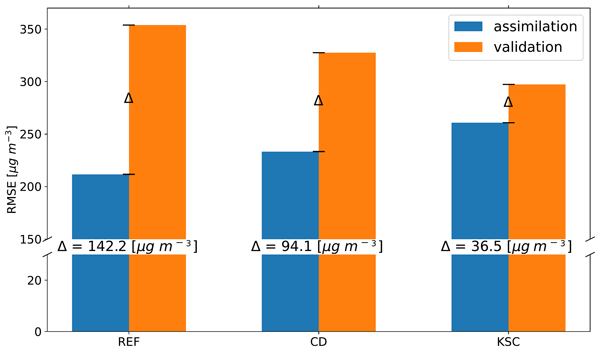
For air quality analyses, data assimilation models split available data into assimilation and validation data sets. The former is used to generate the analysis, the latter to verify the simulations. A preprocessor classifying the observations by the data characteristics is developed based on clustering algorithms. The assimilation and validation data sets are compiled by equally allocating data of each cluster. The resulting improvement of the analysis is evaluated with an air quality model.
Lu Liu, Thorsten Hohaus, Andreas Hofzumahaus, Frank Holland, Hendrik Fuchs, Ralf Tillmann, Birger Bohn, Stefanie Andres, Zhaofeng Tan, Franz Rohrer, Vlassis A. Karydis, Vaishali Vardhan, Philipp Franke, Anne C. Lange, Anna Novelli, Benjamin Winter, Changmin Cho, Iulia Gensch, Sergej Wedel, Andreas Wahner, and Astrid Kiendler-Scharr
Atmos. Chem. Phys., 25, 16189–16213, https://doi.org/10.5194/acp-25-16189-2025, https://doi.org/10.5194/acp-25-16189-2025, 2025
Short summary
Short summary
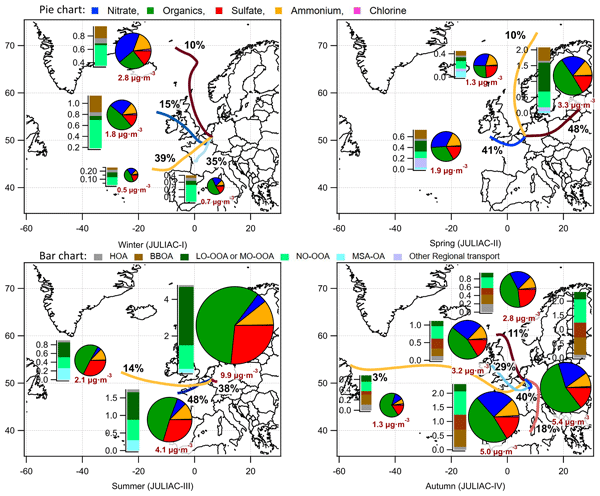
We measured air particles at a rural site in Germany over a year to understand how their sources and properties change with the seasons. Particles from natural sources peaked in summer, especially during heatwaves, while those from burning activities like residential heating and wildfires dominated in colder months. Winds carrying air from other regions also influenced particle levels. These findings link air quality to climate change and energy transitions.
Michael Rolletter, Andreas Hofzumahaus, Anna Novelli, Andreas Wahner, and Hendrik Fuchs
Atmos. Chem. Phys., 25, 3481–3502, https://doi.org/10.5194/acp-25-3481-2025, https://doi.org/10.5194/acp-25-3481-2025, 2025
Short summary
Short summary
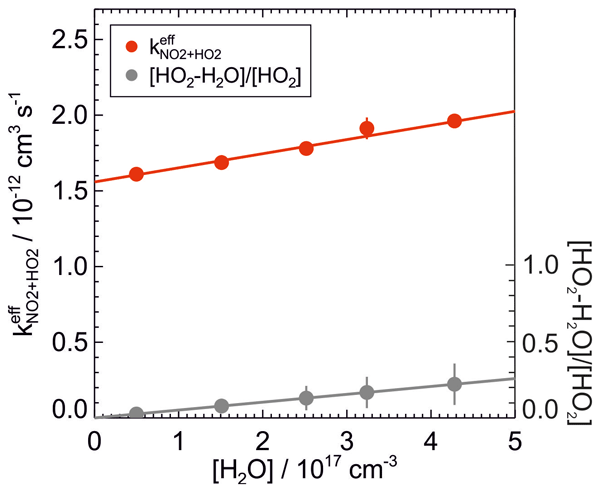
Highly accurate rate coefficients of termolecular reactions between OH and HO2 radicals and reactive nitrogen oxides were measured for conditions in the lower troposphere, providing improved constraints on recommended values. No dependence on water vapour was found except for the HO2+NO2 reaction, which can be explained by an enhanced rate coefficient of the NO2 reaction with the water complex of the HO2 radical.
Hendrik Fuchs, Aaron Stainsby, Florian Berg, René Dubus, Michelle Färber, Andreas Hofzumahaus, Frank Holland, Kelvin H. Bates, Steven S. Brown, Matthew M. Coggon, Glenn S. Diskin, Georgios I. Gkatzelis, Christopher M. Jernigan, Jeff Peischl, Michael A. Robinson, Andrew W. Rollins, Nell B. Schafer, Rebecca H. Schwantes, Chelsea E. Stockwell, Patrick R. Veres, Carsten Warneke, Eleanor M. Waxman, Lu Xu, Kristen Zuraski, Andreas Wahner, and Anna Novelli
Atmos. Meas. Tech., 18, 881–895, https://doi.org/10.5194/amt-18-881-2025, https://doi.org/10.5194/amt-18-881-2025, 2025
Short summary
Short summary
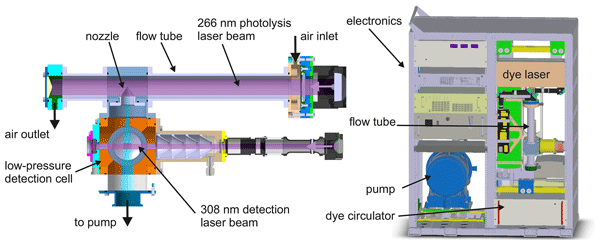
Significant improvements have been made to the instruments used to measure OH reactivity, which is equivalent to the sum of air pollutant concentrations. Accurate and precise measurements with a high time resolution have been achieved, allowing use on aircraft, as demonstrated during flights in the USA.
Florian Berg, Anna Novelli, René Dubus, Andreas Hofzumahaus, Frank Holland, Andreas Wahner, and Hendrik Fuchs
Atmos. Chem. Phys., 24, 13715–13731, https://doi.org/10.5194/acp-24-13715-2024, https://doi.org/10.5194/acp-24-13715-2024, 2024
Short summary
Short summary
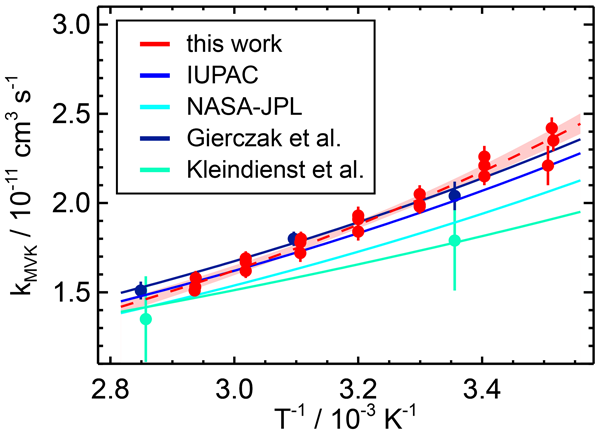
This study reports temperature-dependent rate coefficients of the reaction of atmospherically relevant hydrocarbons from biogenic sources (methyl vinyl ketones and monoterpenes) and anthropogenic sources (alkanes and aromatics). Measurements were done at atmospheric conditions (ambient pressure and temperature range) in air.
Felix Wieser, Rolf Sander, Changmin Cho, Hendrik Fuchs, Thorsten Hohaus, Anna Novelli, Ralf Tillmann, and Domenico Taraborrelli
Geosci. Model Dev., 17, 4311–4330, https://doi.org/10.5194/gmd-17-4311-2024, https://doi.org/10.5194/gmd-17-4311-2024, 2024
Short summary
Short summary
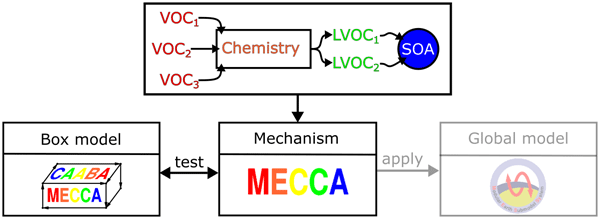
The chemistry scheme of the atmospheric box model CAABA/MECCA is expanded to achieve an improved aerosol formation from emitted organic compounds. In addition to newly added reactions, temperature-dependent partitioning of all new species between the gas and aqueous phases is estimated and included in the pre-existing scheme. Sensitivity runs show an overestimation of key compounds from isoprene, which can be explained by a lack of aqueous-phase degradation reactions and box model limitations.
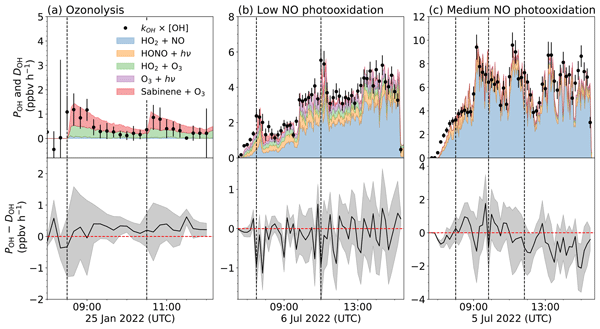
Jacky Y. S. Pang, Florian Berg, Anna Novelli, Birger Bohn, Michelle Färber, Philip T. M. Carlsson, René Dubus, Georgios I. Gkatzelis, Franz Rohrer, Sergej Wedel, Andreas Wahner, and Hendrik Fuchs
Atmos. Chem. Phys., 23, 12631–12649, https://doi.org/10.5194/acp-23-12631-2023, https://doi.org/10.5194/acp-23-12631-2023, 2023
Short summary
Short summary
In this study, the oxidations of sabinene by OH radicals and ozone were investigated with an atmospheric simulation chamber. Reaction rate coefficients of the OH-oxidation reaction at temperatures between 284 to 340 K were determined for the first time in the laboratory by measuring the OH reactivity. Product yields determined in chamber experiments had good agreement with literature values, but discrepancies were found between experimental yields and expected yields from oxidation mechanisms.
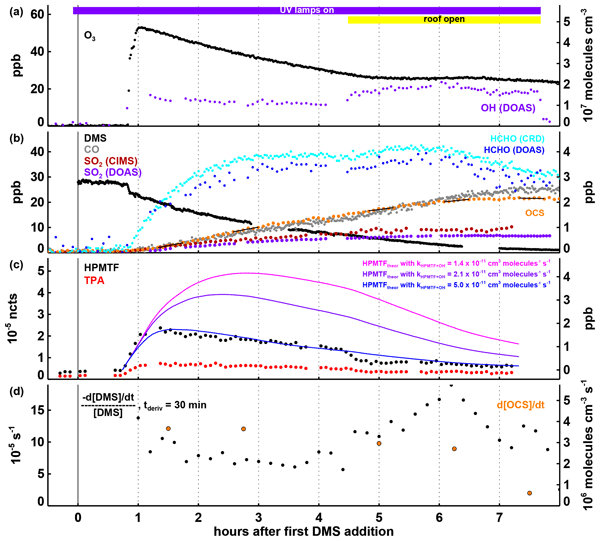
Marc von Hobe, Domenico Taraborrelli, Sascha Alber, Birger Bohn, Hans-Peter Dorn, Hendrik Fuchs, Yun Li, Chenxi Qiu, Franz Rohrer, Roberto Sommariva, Fred Stroh, Zhaofeng Tan, Sergej Wedel, and Anna Novelli
Atmos. Chem. Phys., 23, 10609–10623, https://doi.org/10.5194/acp-23-10609-2023, https://doi.org/10.5194/acp-23-10609-2023, 2023
Short summary
Short summary
The trace gas carbonyl sulfide (OCS) transports sulfur from the troposphere to the stratosphere, where sulfate aerosols are formed that influence climate and stratospheric chemistry. An uncertain OCS source in the troposphere is chemical production form dimethyl sulfide (DMS), a gas released in large quantities from the oceans. We carried out experiments in a large atmospheric simulation chamber to further elucidate the chemical mechanism of OCS production from DMS.
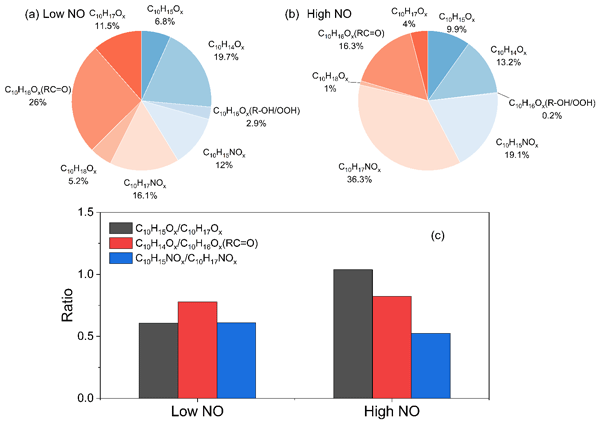
Hao Luo, Luc Vereecken, Hongru Shen, Sungah Kang, Iida Pullinen, Mattias Hallquist, Hendrik Fuchs, Andreas Wahner, Astrid Kiendler-Scharr, Thomas F. Mentel, and Defeng Zhao
Atmos. Chem. Phys., 23, 7297–7319, https://doi.org/10.5194/acp-23-7297-2023, https://doi.org/10.5194/acp-23-7297-2023, 2023
Short summary
Short summary
Oxidation of limonene, an element emitted by trees and chemical products, by OH, a daytime oxidant, forms many highly oxygenated organic molecules (HOMs), including C10-20 compounds. HOMs play an important role in new particle formation and growth. HOM formation can be explained by the chemistry of peroxy radicals. We found that a minor branching ratio initial pathway plays an unexpected, significant role. Considering this pathway enables accurate simulations of HOMs and other concentrations.
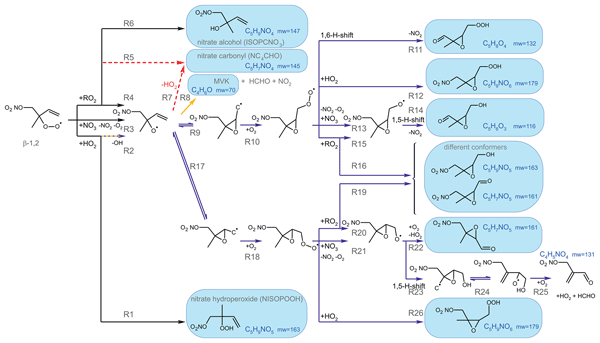
Philip T. M. Carlsson, Luc Vereecken, Anna Novelli, François Bernard, Steven S. Brown, Bellamy Brownwood, Changmin Cho, John N. Crowley, Patrick Dewald, Peter M. Edwards, Nils Friedrich, Juliane L. Fry, Mattias Hallquist, Luisa Hantschke, Thorsten Hohaus, Sungah Kang, Jonathan Liebmann, Alfred W. Mayhew, Thomas Mentel, David Reimer, Franz Rohrer, Justin Shenolikar, Ralf Tillmann, Epameinondas Tsiligiannis, Rongrong Wu, Andreas Wahner, Astrid Kiendler-Scharr, and Hendrik Fuchs
Atmos. Chem. Phys., 23, 3147–3180, https://doi.org/10.5194/acp-23-3147-2023, https://doi.org/10.5194/acp-23-3147-2023, 2023
Short summary
Short summary
The investigation of the night-time oxidation of the most abundant hydrocarbon, isoprene, in chamber experiments shows the importance of reaction pathways leading to epoxy products, which could enhance particle formation, that have so far not been accounted for. The chemical lifetime of organic nitrates from isoprene is long enough for the majority to be further oxidized the next day by daytime oxidants.
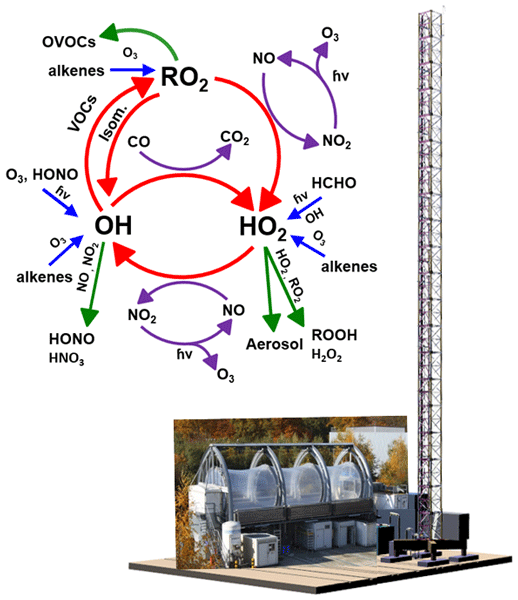
Changmin Cho, Hendrik Fuchs, Andreas Hofzumahaus, Frank Holland, William J. Bloss, Birger Bohn, Hans-Peter Dorn, Marvin Glowania, Thorsten Hohaus, Lu Liu, Paul S. Monks, Doreen Niether, Franz Rohrer, Roberto Sommariva, Zhaofeng Tan, Ralf Tillmann, Astrid Kiendler-Scharr, Andreas Wahner, and Anna Novelli
Atmos. Chem. Phys., 23, 2003–2033, https://doi.org/10.5194/acp-23-2003-2023, https://doi.org/10.5194/acp-23-2003-2023, 2023
Short summary
Short summary
With this study, we investigated the processes leading to the formation, destruction, and recycling of radicals for four seasons in a rural environment. Complete knowledge of their chemistry is needed if we are to predict the formation of secondary pollutants from primary emissions. The results highlight a still incomplete understanding of the paths leading to the formation of the OH radical, which has been observed in several other environments as well and needs to be further investigated.

Zhaofeng Tan, Hendrik Fuchs, Andreas Hofzumahaus, William J. Bloss, Birger Bohn, Changmin Cho, Thorsten Hohaus, Frank Holland, Chandrakiran Lakshmisha, Lu Liu, Paul S. Monks, Anna Novelli, Doreen Niether, Franz Rohrer, Ralf Tillmann, Thalassa S. E. Valkenburg, Vaishali Vardhan, Astrid Kiendler-Scharr, Andreas Wahner, and Roberto Sommariva
Atmos. Chem. Phys., 22, 13137–13152, https://doi.org/10.5194/acp-22-13137-2022, https://doi.org/10.5194/acp-22-13137-2022, 2022
Short summary
Short summary
During the 2019 JULIAC campaign, ClNO2 was measured at a rural site in Germany in different seasons. The highest ClNO2 level was 1.6 ppbv in September. ClNO2 production was more sensitive to the availability of NO2 than O3. The average ClNO2 production efficiency was up to 18 % in February and September and down to 3 % in December. These numbers are at the high end of the values reported in the literature, indicating the importance of ClNO2 chemistry in rural environments in midwestern Europe.
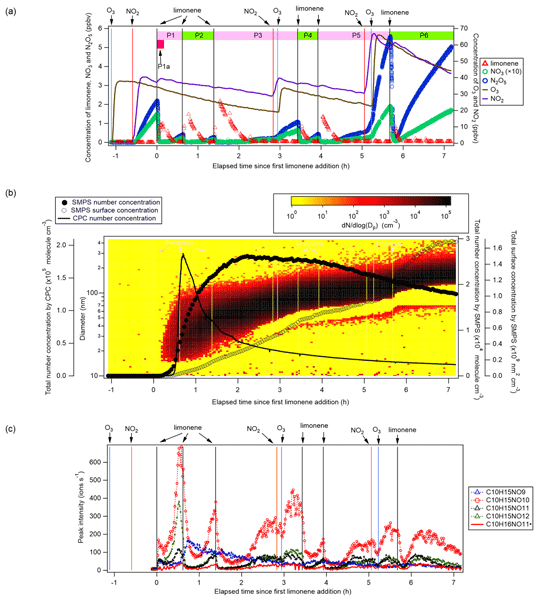
Yindong Guo, Hongru Shen, Iida Pullinen, Hao Luo, Sungah Kang, Luc Vereecken, Hendrik Fuchs, Mattias Hallquist, Ismail-Hakki Acir, Ralf Tillmann, Franz Rohrer, Jürgen Wildt, Astrid Kiendler-Scharr, Andreas Wahner, Defeng Zhao, and Thomas F. Mentel
Atmos. Chem. Phys., 22, 11323–11346, https://doi.org/10.5194/acp-22-11323-2022, https://doi.org/10.5194/acp-22-11323-2022, 2022
Short summary
Short summary
The oxidation of limonene, a common volatile emitted by trees and chemical products, by NO3, a nighttime oxidant, forms many highly oxygenated organic molecules (HOM), including C10-30 compounds. Most of the HOM are second-generation organic nitrates, in which carbonyl-substituted C10 nitrates accounted for a major fraction. Their formation can be explained by chemistry of peroxy radicals. HOM, especially low-volatile ones, play an important role in nighttime new particle formation and growth.
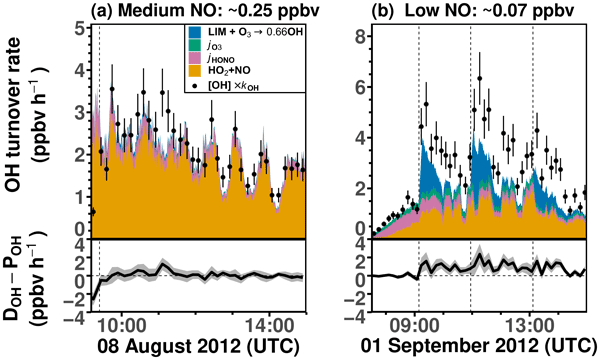
Jacky Yat Sing Pang, Anna Novelli, Martin Kaminski, Ismail-Hakki Acir, Birger Bohn, Philip T. M. Carlsson, Changmin Cho, Hans-Peter Dorn, Andreas Hofzumahaus, Xin Li, Anna Lutz, Sascha Nehr, David Reimer, Franz Rohrer, Ralf Tillmann, Robert Wegener, Astrid Kiendler-Scharr, Andreas Wahner, and Hendrik Fuchs
Atmos. Chem. Phys., 22, 8497–8527, https://doi.org/10.5194/acp-22-8497-2022, https://doi.org/10.5194/acp-22-8497-2022, 2022
Short summary
Short summary
This study investigates the radical chemical budget during the limonene oxidation at different atmospheric-relevant NO concentrations in chamber experiments under atmospheric conditions. It is found that the model–measurement discrepancies of HO2 and RO2 are very large at low NO concentrations that are typical for forested environments. Possible additional processes impacting HO2 and RO2 concentrations are discussed.
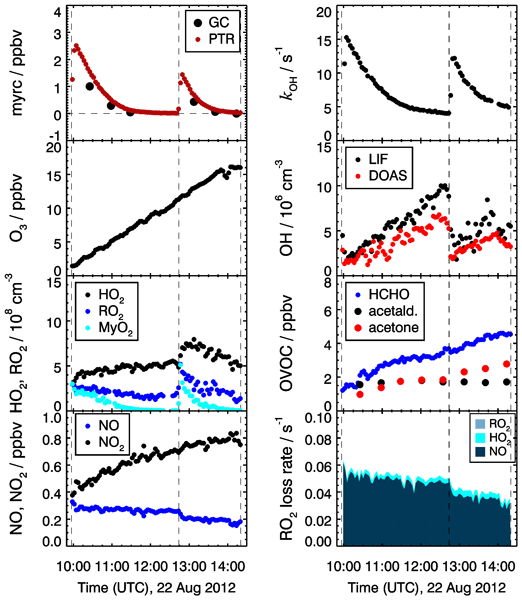
Zhaofeng Tan, Luisa Hantschke, Martin Kaminski, Ismail-Hakki Acir, Birger Bohn, Changmin Cho, Hans-Peter Dorn, Xin Li, Anna Novelli, Sascha Nehr, Franz Rohrer, Ralf Tillmann, Robert Wegener, Andreas Hofzumahaus, Astrid Kiendler-Scharr, Andreas Wahner, and Hendrik Fuchs
Atmos. Chem. Phys., 21, 16067–16091, https://doi.org/10.5194/acp-21-16067-2021, https://doi.org/10.5194/acp-21-16067-2021, 2021
Short summary
Short summary
The photo-oxidation of myrcene, a monoterpene species emitted by plants, was investigated at atmospheric conditions in the outdoor simulation chamber SAPHIR. The chemical structure of myrcene is partly similar to isoprene. Therefore, it can be expected that hydrogen shift reactions could play a role as observed for isoprene. In this work, their potential impact on the regeneration efficiency of hydroxyl radicals is investigated.
Dongchul Kim, Mian Chin, Hongbin Yu, Peter R. Colarco, Toshihiko Takemura, Paolo Tuccella, Paul Ginoux, Xiaohong Liu, Yang Shi, Hitoshi Matsui, Zhibo Zhang, Jianyu Zheng, Jasper F. Kok, Sophie Vandenbussche, Lieven Clarisse, Simon Whitburn, Virginie Capelle, Claudia Di Biagio, Paola Formenti, and Michael Schulz
EGUsphere, https://doi.org/10.5194/egusphere-2026-5264, https://doi.org/10.5194/egusphere-2026-5264, 2026
This preprint is open for discussion and under review for Atmospheric Chemistry and Physics (ACP).
Short summary
Short summary
The present AeroCom–AeroSat study addresses the gaps in the current state of DOD10 using satellite products, model simulations, an observation-constrained database. The analysis reveals substantial differences in DOD10 across satellite products and models, sometimes exceeding a factor of ten. Analysis with the laboratory measurements highlight the potential of combining shortwave and longwave remote sensing to advance dust compositions analysis through their distinct spectral sensitivities.
Chloe A. Brashear, Maarten M. J. W. van Herpen, Sergey Gromov, Berend van de Kraats, Carina van der Veen, Xietiancheng Yu, Matthew S. Johnson, Helder Timas, Sönke Zaehle, Armin Jordan, Heiko Moossen, Africa Barreto, Natalia Pratts, Isabel Baños, Jesús Arrieta, Dickon Young, Peter Sealy, Hella van Asperen, Simonetta Montaguti, Peter Sperlich, Rowena Moss, Sylvia Nichol, Stephen Matthew Platt, Ove Hermansen, Cathrine Lund Myhre, Gabrielle Petron, Andy Crotwell, Isaac Vimont, and Thomas Röckmann
EGUsphere, https://doi.org/10.5194/egusphere-2026-5618, https://doi.org/10.5194/egusphere-2026-5618, 2026
This preprint is open for discussion and under review for Atmospheric Chemistry and Physics (ACP).
Short summary
Short summary
This study evaluates trends in atmospheric CO between 1995–2025 and uses the isotopic composition of CO to constrain emission shifts during this time. We find that CO from fossil fuel combustion has reduced dramatically in the Northern Hemisphere during winter, linked to global air quality regulations. Conversely, a small background rise in CO is driven by increasing atmospheric CH4 and recent extreme wildfire seasons have caused large peaks in CO, counteracting reductions from fossil emissions.
Cuiqi Zhang, Xiaoli Shen, Justin Jacquot, Larissa Lacher, Selvakumar Vishnupriya, Benjamin T. Brem, Robin L. Modini, Nora Nowak, Michael Sprenger, Martin Steinbacher, Stephan Henne, Martine Collaud Coen, Franz Conen, Kristina Höhler, Ottmar Möhler, Martin Gysel-Beer, Daniel J. Cziczo, and Zamin A. Kanji
EGUsphere, https://doi.org/10.5194/egusphere-2026-5645, https://doi.org/10.5194/egusphere-2026-5645, 2026
This preprint is open for discussion and under review for Atmospheric Chemistry and Physics (ACP).
Short summary
Short summary
Clouds play a key role in weather and climate, but the particles that trigger cloud ice formation are difficult to identify directly. By simulating clouds in a cloud chamber and particle measurements at a mountain station, we found that mineral dust was the main trigger of cloud ice formation. Dust from local construction and transported from higher atmospheric layers both contributed. The study shows that both human activities and atmospheric processes can influence cloud formation.
Stefanos Papagiannis, Evangelia Diapouli, Vasiliki Vasilatou, Maria Gini, Konstantinos Kourtidis, Christos Kaltsonoudis, Maria Tsagkaraki, Georgios Grivas, Eleni Liakakou, Αikaterini Bougiatioti, Nikolaos Mihalopoulos, and Konstantinos Eleftheriadis
Aerosol Research Discuss., https://doi.org/10.5194/ar-2026-35, https://doi.org/10.5194/ar-2026-35, 2026
Preprint under review for AR
Short summary
Short summary
This study investigated fine particulate air pollution across five Greek cities to identify its primary sources. By chemically analyzing over 545 24-hour air filter samples, we mapped seasonal patterns and identified seven major emission sources. Marked differences show that while regional background pollution strongly affects PM2.5 levels, local activities, particularly winter wood burning for residential heating, remain a primary cause of urban air degradation in Greece.
Cecilia Righi, Mihai Ciobanu, Neha Deot, Tuija Jokinen, Chengfeng Liu, Qi Yuan, Lauriane L. J. Quéléver, Spiro Jorga, Veronika Pospisilova, Lisa J. Beck, Mario Simon, Marcel Zauner-Wieczorek, Andreas Kürten, Ruben Soler, Teresa Vera, Amalia Muñoz, Lauri R. Ahonen, Chao Yan, Tuukka Petäjä, and Nina Sarnela
Atmos. Meas. Tech., 19, 6357–6378, https://doi.org/10.5194/amt-19-6357-2026, https://doi.org/10.5194/amt-19-6357-2026, 2026
Short summary
Short summary
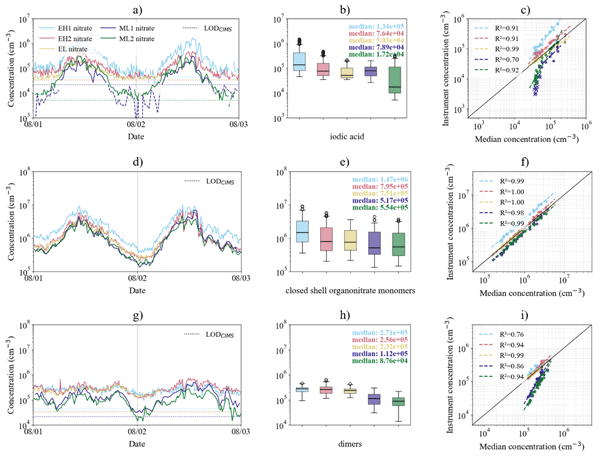
Chemical ionization mass spectrometry is widely used to detect condensable vapors as sulfuric acid and highly oxygenated organic molecules, but results across studies are not always comparable. In summer 2024, an intercomparison campaign involving six instruments was conducted at a boreal forest site. Comparable measurements were achievable when all calibration and correction factors were applied. Instrument behavior depended more on inlet design and operating conditions than reagent ion choice.
Daniel P. Johnson and Matthew S. Johnson
Atmos. Meas. Tech., 19, 6293–6309, https://doi.org/10.5194/amt-19-6293-2026, https://doi.org/10.5194/amt-19-6293-2026, 2026
Short summary
Short summary
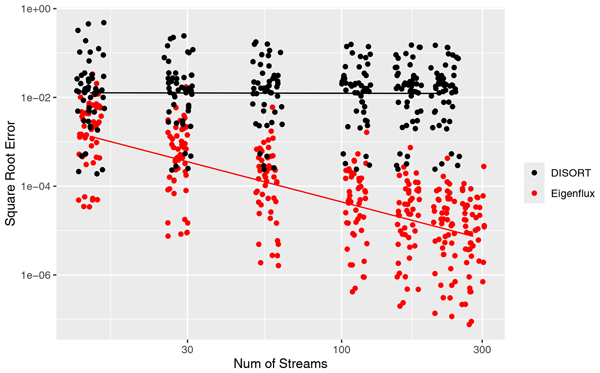
Light scattering is important in the atmosphere, oceans, snow, ice, paints, and many other materials. We developed EigenFlux, a new open-source method for simulating how light moves through complex materials. It remains accurate, stable, and efficient even when scattering is extremely strong or highly directional, conditions that can challenge existing methods. This broadens the range of systems that can be modeled reliably.
Elie Al Marj, Ambre Delater, Aline Gratien, Marie Line Torrijos, Juan Camilo Macias Rodriguez, Mathieu Cazaunau, Edouard Pangui, Antonin Bergé, Cécile Gaimoz, Thomas Bertin, Emmanuelle Mebold, Bénédicte Picquet-Varrault, Jean-François Doussin, Clément Buissot, Sophie Lanone, and Patrice Coll
Atmos. Chem. Phys., 26, 13645–13660, https://doi.org/10.5194/acp-26-13645-2026, https://doi.org/10.5194/acp-26-13645-2026, 2026
Short summary
Short summary
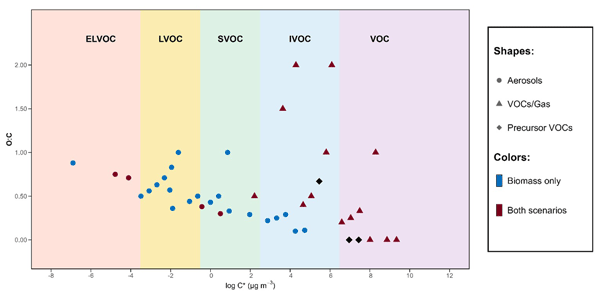
The "PolluRisk" platform simulated two urban scenarios: standard traffic and biomass burning. Using a smog chamber, the study showed that wood heating significantly modified aerosol chemistry, with organic fractions reaching 40 % of PM1 mass. Advanced mass spectrometry identified specific tracers of oxidation and combustion. These results provide a chemical framework for separate biological exposure experiments.
Jenine McCutcheon, James B. McQuaid, Helen Freeman, Jeffrey Paulo H. Perez, Jon Hawkings, Stefanie Lutz, Lou-Anne Chevrollier, Paola Formenti, Servanne Chevaillier, Martyn Tranter, and Liane G. Benning
EGUsphere, https://doi.org/10.5194/egusphere-2026-5031, https://doi.org/10.5194/egusphere-2026-5031, 2026
This preprint is open for discussion and under review for The Cryosphere (TC).
Short summary
Short summary
Soot can travel long distances and settle on snow and ice, where it absorbs light and promotes melting. We examined the size and shape of soot particles deposited on the Greenland Ice Sheet. By combining aerosol and geochemical methods, we show that the soot particles accumulate on the ice sheet surface, especially alongside dense glacier ice algal blooms. Soot accounts for ~15% of the combined darkening effect of algae and soot, highlighting the role of soot in ice albedo reduction and melting.
Johannes Heuser, Claudia Di Biagio, Jérôme Yon, Mathieu Cazaunau, Antonin Bergé, Edouard Pangui, Marco Zanatta, Laura Renzi, Angela Marinoni, Chenjie Yu, Servanne Chevaillier, Daniel Ferry, Michel Maillé, Paola Formenti, Benedicte Picquet-Varrault, and Jean-François Doussin
Aerosol Research Discuss., https://doi.org/10.5194/ar-2026-31, https://doi.org/10.5194/ar-2026-31, 2026
Preprint under review for AR
Short summary
Short summary
We retrieve refractive indices of laboratory-generated soot from measured particle properties using Mie and RDG-FA optical calculations, and quantify uncertainties via Monte Carlo simulations. The inferred refractive indices strongly depend on the theory employed, highlighting the need for consistency between optical theory and refractive index. Mie retrievals are sensitive to coagulation and size growth, while RDG-FA retrievals depend strongly on the uncertainty of assumed particle morphology.
Paola Formenti and Claudia Di Biagio
Aerosol Research, 4, 429–440, https://doi.org/10.5194/ar-4-429-2026, https://doi.org/10.5194/ar-4-429-2026, 2026
Short summary
Short summary
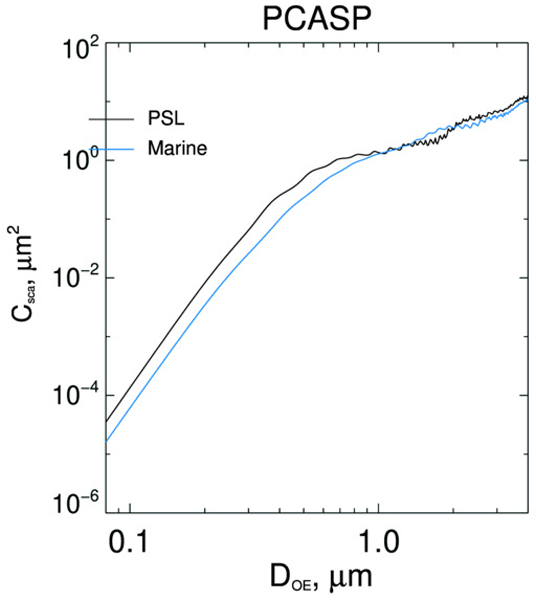
This study improves the accuracy of optical particle counters (OPCs), instruments used to measure airborne particles important for air quality and climate research. Because OPC measurements depend not only on particle size but also on composition and shape, results can be uncertain. The paper provides a standardized database of correction factors for five commercial OPCs, helping researchers produce more reliable and consistent aerosol measurements across a wide range of atmospheric conditions.
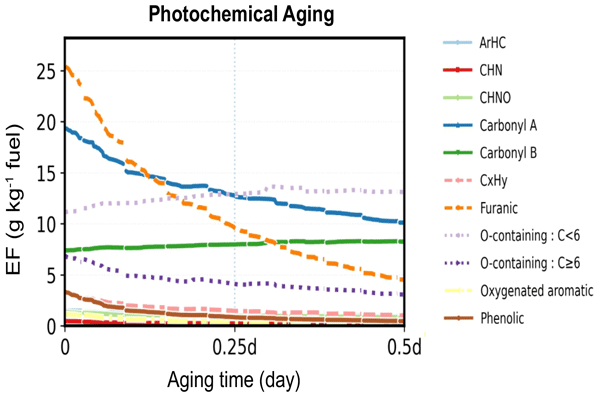
Deeksha Shukla, Lejish Vettikkat, Mika Ihalainen, Markus Somero, Hendryk Czech, Siegfried Schobesberger, Angela Buchholz, Iida Pullinen, Kerneels Jaars, Kajar Köster, Viet Le, Pasi Yli-Pirilä, Stefan J. Siebert, Pieter G. van Zyl, Annele Virtanen, Ville Vakkari, Olli Sippula, and Ralf Zimmermann
Atmos. Chem. Phys., 26, 12977–13000, https://doi.org/10.5194/acp-26-12977-2026, https://doi.org/10.5194/acp-26-12977-2026, 2026
Short summary
Short summary
Biomass burning emits large amounts of pollutants that undergo atmospheric transformation. This study examined organic vapor emissions from three biomass fuels and their transformation under different oxidation regimes in a smog chamber by real-time mass spectrometry. OH-driven oxidation rapidly altered organic vapor composition than dark oxidation, eliminating differences in chemical vapor composition arising from fuel types or combustion conditions.
Sara Aisyah Syafira, Aristeidis Voliotis, Dawei Hu, Osayomwanbor Oghama, Huihui Wu, Yunqi Shao, Rhianna Evans, Jie Chen, Yu Wang, Peter Gallimore, James Allan, Hugh Coe, and Gordon McFiggans
EGUsphere, https://doi.org/10.5194/egusphere-2026-4932, https://doi.org/10.5194/egusphere-2026-4932, 2026
This preprint is open for discussion and under review for Atmospheric Measurement Techniques (AMT).
Short summary
Short summary
This current work describes a biomass burning (BB) aerosol facility at the University of Manchester that provides a repeatable, flexible system and platform for mechanistic and multiparameter investigation of fresh and aged BB aerosol. The characteristics, as well as those capabilities of the facility across fuel types and combustions were demonstrated here.
Patrick Dewald, Sergio Harb, Bénédicte Picquet-Varrault, Mathieu Cazaunau, Maxime Feingesicht, Lucas Beltran, Vincent Michoud, Xavier Landsheere, Edouard Pangui, Antonin Bergé, Christopher Cantrell, and Manuela Cirtog
EGUsphere, https://doi.org/10.5194/egusphere-2026-5307, https://doi.org/10.5194/egusphere-2026-5307, 2026
Short summary
Short summary
We built an instrument to measure reactive nitrogen compounds in the atmosphere with a focus on the detection of nitrate radicals. They are formed by pollutants such as ozone and nitrogen oxides and are an important nocturnal oxidant of trace gases, thereby indirectly impacting the interconversion of reactive nitrogen and air quality. The instrument’s characterization, performance assessment and the first field deployment are presented.
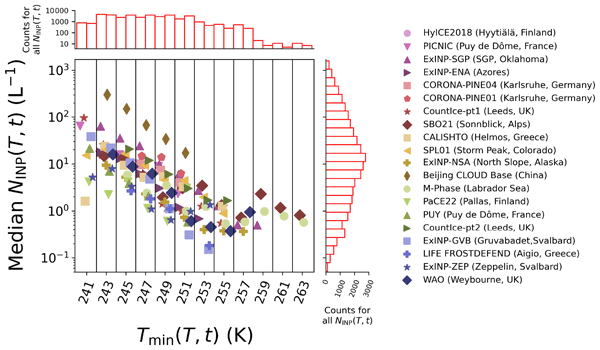
Ross J. Herbert, Larissa Lacher, Alexander Böhmländer, Mark D. Tarn, Antoine Canzi, Aidan Pantoya, Evelyn Freney, Kristina Höhler, Pia Bogert, Céline Planche, Ping Tian, Michael Adams, Sarah Barr, David Brus, Nicole Büttner, Martin Daily, Konstantinos Doulgeris, Konstantinos Eleftheriadis, Grant Forster, Romy Fösig, Dimitrios G. Georgakopoulos, Maria I. Gini, A. Gannet Hallar, Radovan Krejci, Elke Ludewig, Mauro Mazzola, Ian B. McCubbin, Athanasios Nenes, Tuukka Petäjä, Joseph Robinson, Franziska Vogel, Paul Zieger, Stephen Arnold, Kenneth S. Carslaw, Naruki Hiranuma, Ottmar Möhler, and Benjamin J. Murray
Earth Syst. Sci. Data, 18, 6465–6483, https://doi.org/10.5194/essd-18-6465-2026, https://doi.org/10.5194/essd-18-6465-2026, 2026
Short summary
Short summary
Ice formation in sub-zero clouds is influenced by airborne particles called ice-nucleating particles (INPs), whose concentrations vary substantially over short time and spatial scales. To assess the role of INPs in our climate, a comprehensive and consistent global dataset is essential. Our GloPINE model-ready dataset is a major step in this direction, comprising 36,000 measurements made using a single instrument design (PINE) over 70,000 hours of operation at 20 Northern Hemisphere sites.
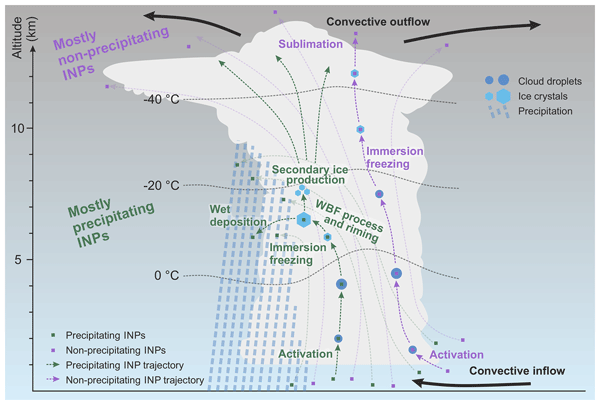
Jonas Schaefer, Sarah Grawe, Hans-Christian Clemen, Stephan Mertes, Johannes Schneider, Bruno Wetzel, Daniel Sauer, Jennifer Wolf, Laura Tomsche, Johanna Mayer, Roland Schrödner, Silvia Henning, Tina Jurkat-Witschas, Christiane Voigt, Helmut Ziereis, Theresa Harlaß, Mira Pöhlker, and Frank Stratmann
Atmos. Chem. Phys., 26, 12505–12520, https://doi.org/10.5194/acp-26-12505-2026, https://doi.org/10.5194/acp-26-12505-2026, 2026
Short summary
Short summary
Ice-nucleating particles (INP) are aerosol particles important for ice formation in clouds droplets and thereby influence climate. This study uses airborne measurements over Europe to show how INP are transported through thunderstorms. We show which particles are washed out and which are are transported into the higher troposphere, where they can again affect cloud ice formation. The findings improve understanding of atmospheric particle distribution and help refine climate models.
Magesh Mohan, Amy Sullivan, Emily Lill, Ilana Pollack, Alison Piasecki, Sarah Albertin, Ann Middlebrook, Wyndom Chace, Andrew Rollins, Carsten Warneke, Steven Brown, Lu Xu, Katherine Ball, John Crounse, Paul Wennberg, Stelios Kakavas, Spyros Pandis, Athanasios Nenes, and Rodney Weber
EGUsphere, https://doi.org/10.5194/egusphere-2026-4960, https://doi.org/10.5194/egusphere-2026-4960, 2026
This preprint is open for discussion and under review for Atmospheric Chemistry and Physics (ACP).
Short summary
Short summary
Atmospheric fine particles contain liquid water and can be highly acidic. The amount of water and the acidity affect how these particles impact human health, ecosystems, and climate. Flying an aircraft across the continental United States in summer 2023, with a focus on four North American cities, we measured the properties needed to model particle water and acidity. We found the particles were consistently strongly acidic, even within wildfire smoke, and verified the model against observations.
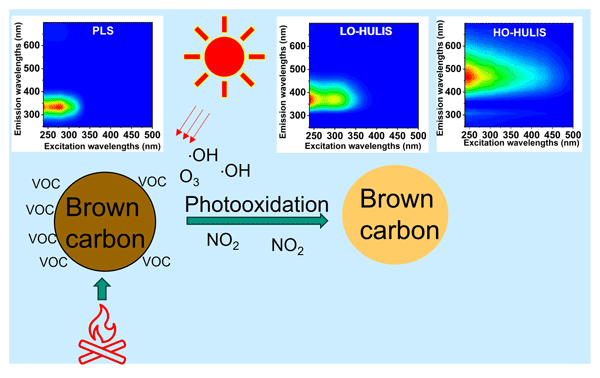
Feng Jiang, Jun Zhang, David M. Bell, Kun Li, Nadine Borduas-Dedekind, Andre S. H. Prevot, Hongbiao Cui, Harald Saathoff, and Thomas Leisner
Atmos. Chem. Phys., 26, 11733–11746, https://doi.org/10.5194/acp-26-11733-2026, https://doi.org/10.5194/acp-26-11733-2026, 2026
Short summary
Short summary
We studied chemical compositions and chromophores of brown carbon aerosol from combustion emission before and after photooxidation using an oxidative flow reactor. The chromophore and chemical composition of brown carbon were determined by excitation-emission spectroscopy and mass spectrometry. This work helps to get a better understanding of evolution process of the chromophores from primary combustion emissions during the real atmospheric transportation.
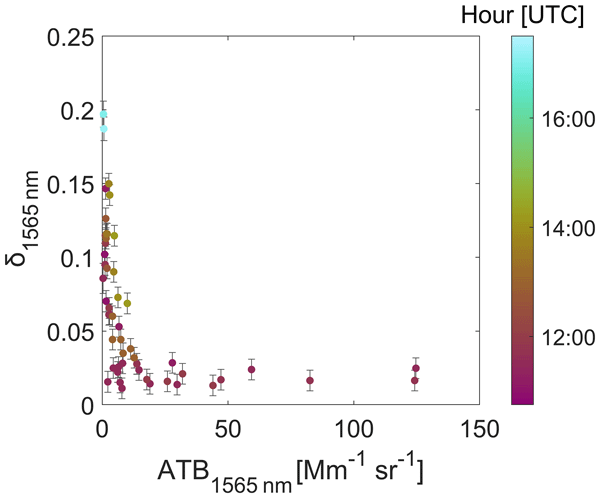
Maria Filioglou, Krista Luoma, Eija Asmi, Viet Le, Klaus Haikarainen, David Brus, Tero Mielonen, Mika Komppula, Annele Virtanen, Olli Sippula, Iida Pullinen, Angela Buchholz, Pasi Miettinen, Snehitha Kommula, Saara Peltokorpi, Liqing Hao, Kajar Köster, Annika Saarto, Sanna Pätsi, Pieter G. van Zyl, Liezl Bredenkamp, and Ville Vakkari
Atmos. Chem. Phys., 26, 11525–11542, https://doi.org/10.5194/acp-26-11525-2026, https://doi.org/10.5194/acp-26-11525-2026, 2026
Short summary
Short summary
This study explores how smoke and volcanic ash particles, alter the way light is scattered in the atmosphere. By using a ground‑based HALO Doppler lidar system, we observed clear differences in the depolarization ratio, a shape-relevant optical parameter, between fresh smoke, aged smoke, and volcanic ash. These findings show that HALO Doppler lidars can help identify particle types in the air and even provide estimates of smoke mass concentrations, improving assessments of air quality.
Duong H. Do, Astrid Kerkweg, Yarê Baker, Birger Bohn, Hendrik Fuchs, Quanfu He, Thorsten Hohaus, Sungah Kang, Timo Kirfel, Finja Löher, Niklas Diepenthal, Anke C. Nölscher, Anna Novelli, Alexander Pschera, Felix Wieser, Sören R. Zorn, Andreas Wahner, and Domenico Taraborrelli
EGUsphere, https://doi.org/10.5194/egusphere-2026-4522, https://doi.org/10.5194/egusphere-2026-4522, 2026
Short summary
Short summary
This work builds a chamber simulation tool that mimics how air chemistry changes inside laboratory reactors, including injected gases, changing light, gas and liquid reactions, wall effects, and dilution. Tests in several chambers reproduced measured changes in reactive species, nitrogen compounds, and ozone, and helped capture how organic particles form. The same chemistry can be reused in larger, global air simulations to assess real-world impact.
Yarê Baker, Veronica Geretti, Sungah Kang, Rongrong Wu, Hui Wang, Quanfu He, Thorsten Hohaus, Annika Zanders, Mathias Bachner, Cheng Wu, Thomas J. Bannan, Simon P. O'Meara, Aristeides Voliotis, Mattias Hallquist, Gordon McFiggans, Sören R. Zorn, and Thomas F. Mentel
EGUsphere, https://doi.org/10.5194/egusphere-2026-4788, https://doi.org/10.5194/egusphere-2026-4788, 2026
Short summary
Short summary
Highly oxygenated molecules (HOMs) are important contributors to global organic aerosol production. The production of HOMs is based on the reaction pathways of peroxy radicals (RO2). In this work we systematically varied available RO2 reaction partners in a-pinene photooxidation experiments in an atmospheric simulation chamber. The results show which factors impact HOM formation and volatility and offer a mechanistic framework for interpreting laboratory and atmospheric observations.
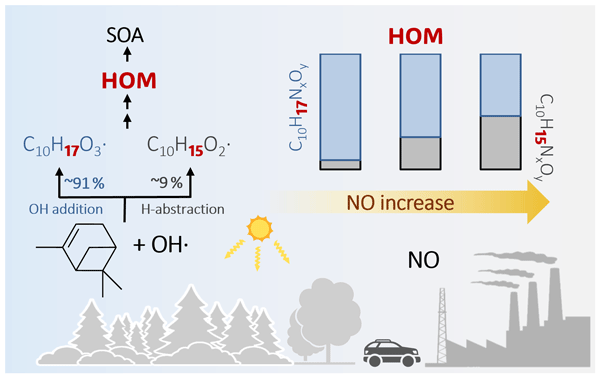
Hui Wang, Hongru Shen, Defeng Zhao, Sungah Kang, Rongrong Wu, Yarê Baker, Quanfu He, Annika Zanders, Mathias Bachner, Douglas R. Worsnop, Thorsten Hohaus, Thomas F. Mentel, and Sören R. Zorn
Atmos. Chem. Phys., 26, 11153–11169, https://doi.org/10.5194/acp-26-11153-2026, https://doi.org/10.5194/acp-26-11153-2026, 2026
Short summary
Short summary
Chamber simulations were conducted to investigate formation of highly oxygenated organic molecules (HOM) from OH-initiated α-pinene oxidation under varying NO levels, with emphasis on the hydrogen-abstraction pathway. Without NO, C10H17Oₓ· species dominated. With NO, C10H15Oₓ· products became more abundant, accounting for ~34 % at high NO levels. Clustering results and comparison with α-pinene and pinonaldehyde systems show that hydrogen-abstraction is likely the source of C10H15Oₓ·-related HOM.
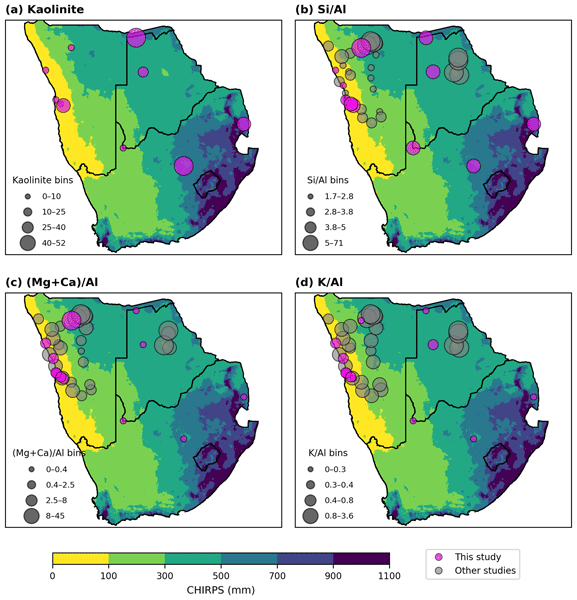
Clarissa Baldo, Servanne Chevaillier, Sophie Nowak, Gael Noyalet, Sandra Lafon, Claudia Di Biagio, Amelie Chaput, James King, Mathieu Cazaunau, Edouard Pangui, Jean-Francois Doussin, Remi Stanus, Nadine Mattielli, Heleen C. Vos, Gregory S. Okin, Brigitte Language, Tjaart Van Der Walt, Stuart Piketh, Karine Desboeufs, Akinori Ito, Silvia Becagli, Eugene Marais, Laurie Barrier, Stéphane Jacquemoud, and Paola Formenti
Atmos. Chem. Phys., 26, 10727–10749, https://doi.org/10.5194/acp-26-10727-2026, https://doi.org/10.5194/acp-26-10727-2026, 2026
Short summary
Short summary
Our results show that crustal element ratios and clay contents distinguish dust aerosols from arid western coastal areas and humid eastern inland regions in Southern Africa. This dust contains key micronutrients that can become bioaccessible during atmospheric transport to nearby and remote marine ecosystems. It is also enriched in carbonates and K-feldspar, serving as a source of cloud condensation and ice nuclei, with potential implications ranging from regional to sub-hemispheric scales.
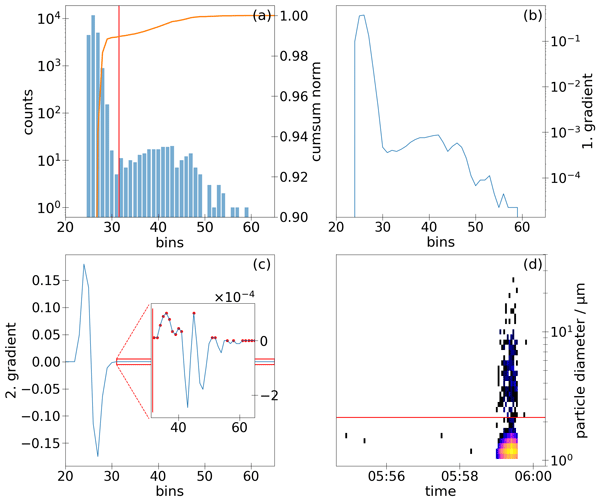
Nicole Büttner, Romy Fösig, Alexander Böhmländer, Larissa Lacher, Franziska Vogel, Mark Tarn, Pia Bogert, Jens Nadolny, Benjamin Murray, and Ottmar Möhler
Atmos. Meas. Tech., 19, 5007–5026, https://doi.org/10.5194/amt-19-5007-2026, https://doi.org/10.5194/amt-19-5007-2026, 2026
Short summary
Short summary
We developed a new Python software tool that standardises and automates the analysis of data from a cloud simulation chamber. It identifies ice-forming particles in the atmosphere and ensures consistent data quality through built-in checks, making results more comparable across studies. We also analysed measurement data to provide recommendations for improving instrument reliability and long-term monitoring of atmospheric ice-forming particles. This helps to better understand how clouds behave.
Anouk Marsal, Fabrizia Cavalli, Elise Di Antonio, Stephan Houdier, Pamela Dominutti, Sophie Darfeuil, Jean-Luc Jaffrezo, Stéphane Sauvage, Jean-Philippe Putaud, Ian S. Mudway, Athanasios Nenes, Aikaterini Bougiatioti, Nikolaos Mihalopoulos, André S. H. Prévôt, Despina Paraskevopoulou, Ana Cvitešić Kušan, Sanja Frka, Ana Kroflič, Ajda Delić, Blanka Tariba Lovaković, Andreja Jurič, Carolina Molina, Daniele Contini, Maria Rachele Guascito, Mathilde Lintz, Davy Rousset, Hartmut Herrmann, Eduardo J. d. S. Souza, Frédéric Ledoux, Marc Fadel, Haoran Yu, Jianzhen Yu, Maria Teresa Baeza Romero, Maria Cerrato-Alvarez, Marloes F. van Os, Mathilde N. Delaval, Yamaris Mercedes Mena Cabrera, Nicole Trieu, Greg Evans, Nuria Galindo, Noelia Gómez-Sanchez, Hana Hlaváčková, Pavel Mikuška, Shrutika Kadam, Pourya Shahpoury, Purificación López-Mahía, Jorge Moreda-Piñeiro, Rico K. Y. Cheung, Markus Kalberer, Micol Introna, Sarah S. Steimer, Zhuoying Lin, Suzanne E. Paulson, Saima Iram, Svetlana Stevanovic, Thomas Audoux, Laurent Y. Alleman, Jianing Liu, Ting Fang, P. S. Ganesh Subramanian, Vishal Verma, Tuukka Petäjä, Xavier Querol, Gerard Hoek, Roy M. Harrison, and Gaëlle Uzu
EGUsphere, https://doi.org/10.5194/egusphere-2026-3918, https://doi.org/10.5194/egusphere-2026-3918, 2026
Short summary
Short summary
This collaborative work from 26 worldwide laboratories assessed the measurement of atmospheric particles' oxidative potential (OP) using a common protocol. OP is a metric designed to inform on particles’ harmful effects. Over half of the laboratories obtained satisfactory results, and some critical steps such as liquid handling and OP mathematical determination were identified. Recommendations for future measurements and interlaboratory comparisons are also provided.
Thomas Audoux, Ambre Delater, Manuella Ghanem, Jean-Baptiste Lily, Mathieu Cazaunau, Edouard Pangui, Benedicte Picquet-Varrault, Patrice Coll, Esperanza Perdrix, Laurent Alleman, and Davy Rousset
EGUsphere, https://doi.org/10.5194/egusphere-2026-4293, https://doi.org/10.5194/egusphere-2026-4293, 2026
This preprint is open for discussion and under review for Atmospheric Measurement Techniques (AMT).
Short summary
Short summary
Air pollution can affect human health, but not all particles are equally harmful. We developed a new instrument that measure the oxidative properties of the atmosphere continuously. Laboratory experiments showed that pollutants formed through sunlight-driven chemical reactions have a greater oxidative potential than particles containing higher levels of metals under night-time conditions. This will help us to better understand how rapid changes in air pollution may affect health.
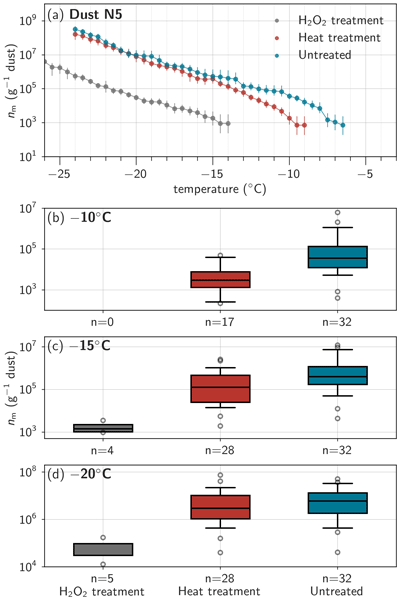
Nora Bergner, Grace Marsh, Kevin Barry, Larissa Lacher, Alexander Böhmländer, Joanna Alden, Carina Ahlqvist, Ianina Altshuler, Lisa Bröder, Daniel Farinotti, Lionel Favre, Coline Guillosson, Benjamin Heutte, Kristina Höhler, Roman Pohorsky, Julian Weng, and Julia Schmale
Atmos. Chem. Phys., 26, 10557–10585, https://doi.org/10.5194/acp-26-10557-2026, https://doi.org/10.5194/acp-26-10557-2026, 2026
Short summary
Short summary
Dust from Greenlandic glacial outwash plains can form ice in clouds, a process relevant for climate. Its ice-nucleating activity varies strongly and is largely controlled by small amounts of biological material. During summer, the influence on atmospheric ice-nucleating particles is mostly local. Lower activity compared to other high-latitude dust sources highlights the need to account for regional differences in Arctic dust.
Alejandra Velazquez-Garcia, Chenjie Yu, Sarah Tinorua, Hichem Bouzidi, Eleonora Aruffo, Piero Di Carlo, Peter DeCarlo, Benjamin A. Nault, Thierry Bourrianne, Kevin Tu, Edouard Pangui, Diana L. Pereira, Mathieu Cazaunau, Ludovico Di Antonio, Guillaume Siour, Matthias Beekmann, Astrid Bauville, Christopher Cantrell, Paola Formenti, Vincent Michoud, and Cyrielle Denjean
EGUsphere, https://doi.org/10.5194/egusphere-2026-4423, https://doi.org/10.5194/egusphere-2026-4423, 2026
Short summary
Short summary
As city air pollution travels downwind, its climate impact evolves. Using a research aircraft, we tracked the Paris pollution plume and found that sunlight rapidly transforms urban emissions, forming secondary organic particles that absorb more sunlight within six hours. These findings show that urban pollution changes chemically during transport, providing key constraints to improve future climate models.
Samuel Ruhl, Matthias Kohl, Rima Baalbaki, Christos Xenofontos, Ryan Vella, Sergey Gromov, Xu-Cheng He, Jiali Shen, Dina Alfaouri, Samira Atabakhsh, Lubna Dada, Jenna DeVivo, Jonathan Duplissy, Imad El Haddad, Hartwig Harder, Tuija Jokinen, Heikki Junninen, Vijay P. Kanawade, Milin K. Sebastian, Hannah Klebach, Markku Kulmala, Felix Kunkler, Jos Lelieveld, Katrianne Lehtipalo, Clara J. Lietzke, Lu Liu, Roy Mauldin, Bernhard Mentler, Ottmar Möhler, Tuukka Petäjä, Douglas M. Russell, Mario Simon, Roseline C. Thakur, Wenjuan Yu, Jiangyi Zhang, Zhensen Zheng, Jasper Kirkby, Holger Tost, Theodoros Christoudias, Rolf Sander, and Andrea Pozzer
EGUsphere, https://doi.org/10.5194/egusphere-2026-4020, https://doi.org/10.5194/egusphere-2026-4020, 2026
This preprint is open for discussion and under review for Atmospheric Chemistry and Physics (ACP).
Short summary
Short summary
Marine microbes release sulfur gases that form tiny particles able to seed clouds. Using a global chemistry-climate model, we compare four schemes for how these gases oxidise and test them against ship and ground measurements. We find that methanesulfonic acid can drive new particle formation as strongly as sulfuric acid over the cold Southern Ocean, supplying around 25 % of the cloud-forming particles there, a natural, climate-relevant source that models often overlook.
Shubhi Arora, Laurent Poulain, Radek Lhotka, Petr Vodička, Saliou Mbengue, Petra Pokorná, Jaroslav Schwarz, Naděžda Zíková, Jakub Ondráček, Vladimír Ždímal, and Hartmut Herrmann
EGUsphere, https://doi.org/10.5194/egusphere-2026-2028, https://doi.org/10.5194/egusphere-2026-2028, 2026
Short summary
Short summary
Accurate air pollution data is essential for effective policy, yet this study shows that common measurement methods can disagree under real-world conditions. Across three European sites, results matched in summer but diverged in winter, especially during combustion related pollution. The findings identify when measurements are reliable and provide practical guidance to improve monitoring, ensuring more robust data for air quality regulation and public health protection.
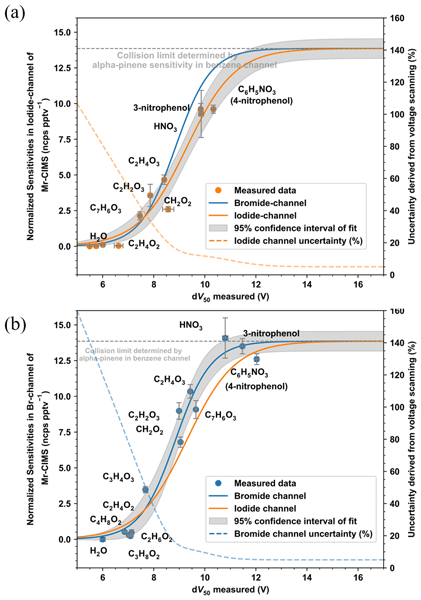
Yuwei Wang, Aristeidis Voliotis, Emily Matthews, Rongrong Wu, Milan Roska, Max Gerrit Adam, René Dubus, Lukas Kesper, Franz Rohrer, Robert Wegener, Benjamin Winter, Kelvin H. Bates, Quanfu He, Thorsten Hohaus, Achim Grasse, Ralf Tillmann, Andreas Wahner, Hui Wang, Christian Wesolek, Sergej Wedel, Yizhen Wu, Sören R. Zorn, Manjula Canagaratna, Douglas Worsnop, Felipe Lopez-Hilfiker, Georgios I. Gkatzelis, Hugh Coe, and Thomas J. Bannan
Atmos. Meas. Tech., 19, 4583–4599, https://doi.org/10.5194/amt-19-4583-2026, https://doi.org/10.5194/amt-19-4583-2026, 2026
Short summary
Short summary
This work developed voltage scanning based calibration approach for a multi-reagent chemical ionization mass spectrometry. This approach improves sensitivity determination for gas-phase compounds. It does not require a calibrant for the target analyte and can estimate sensitivity with acceptable uncertainty based on the experimentally established relationship between binding energies and measured sensitivities. This work is broadly relevant to mass-spectrometric calibration strategies.
Gabriella Wallentin, Alexander Böhmländer, Ross Herbert, Heike Wex, Charlotte M. Beall, Pia Bogert, Zoé Brasseur, Jie Chen, Jessie M. Creamean, Paul J. DeMott, Oliver Eckermann, Kunfeng Gao, Xianda Gong, Silvia Henning, Naruki Hiranuma, Christina S. McCluskey, Christos Mitsios, Ottmar Möhler, Athanasios Nenes, Mark D. Tarn, Christian Tatzelt, Ping Tian, Yutaka Tobo, Franziska Vogel, André Welti, Elise Wilbourn, Jennifer Winstone, and Corinna Hoose
EGUsphere, https://doi.org/10.5194/egusphere-2026-4134, https://doi.org/10.5194/egusphere-2026-4134, 2026
This preprint is open for discussion and under review for Atmospheric Measurement Techniques (AMT).
Short summary
Short summary
Ice nucleating particles (INPs) are aerosols essential for cloud ice formation in the temperature range -38 °C and 0 °C. Due to measurement challenges, the availability of observations of INPs remains scarce. This study applies machine learning to predict a global INP distribution using aerosol mass concentration reanalysis and observed INPs. This manuscript demonstrates that even with limited measurements, the occurrence of INPs can be estimated, following the spatial pattern of key aerosols.
Sara Aisyah Syafira, Dawei Hu, Aristeidis Voliotis, Huihui Wu, Osayomwanbor Ebenezer Oghama, Yunqi Shao, Sri Hapsari Budisulistiorini, Yu Wang, Michael Flynn, Peter James Gallimore, Hugh Coe, James Allan, and Gordon McFiggans
EGUsphere, https://doi.org/10.5194/egusphere-2026-2723, https://doi.org/10.5194/egusphere-2026-2723, 2026
Short summary
Short summary
The variability in hygroscopicity of biomass-burning aerosol particles, both fresh and aged, was measured using three methods across different fuel types and burn phases. Several inter-method discrepancy factors were tested. Substantial discrepancies remained after applying improvements that mitigated the tested factors: size-related factors and organic hygroscopicity assumption factor, highlighting the need for regime-aware κ parameterizations in atmospheric and climate models.
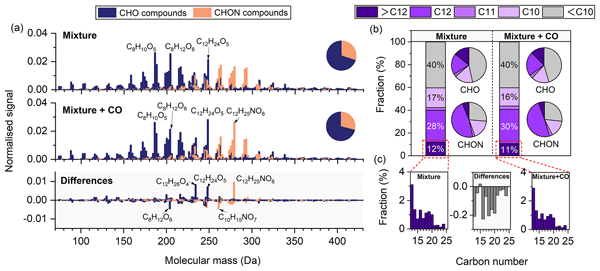
Guangzhao Xie, Aristeidis Voliotis, Thomas J. Bannan, Yunqi Shao, Huihui Wu, Dawei Hu, and Gordon McFiggans
Atmos. Chem. Phys., 26, 9679–9696, https://doi.org/10.5194/acp-26-9679-2026, https://doi.org/10.5194/acp-26-9679-2026, 2026
Short summary
Short summary
Achieving atmospheric relevance in chamber experiments is essential for improving our understanding of secondary organic aerosol (SOA) formation. We employed a photochemical system including mixtures of biogenic and anthropogenic precursors with inorganic trace gases. The results show that CO affected SOA particle mass yields and chemical composition differently in single- and mixed-precursor systems, highlighting the importance of accounting for atmospheric complexity in laboratory studies.
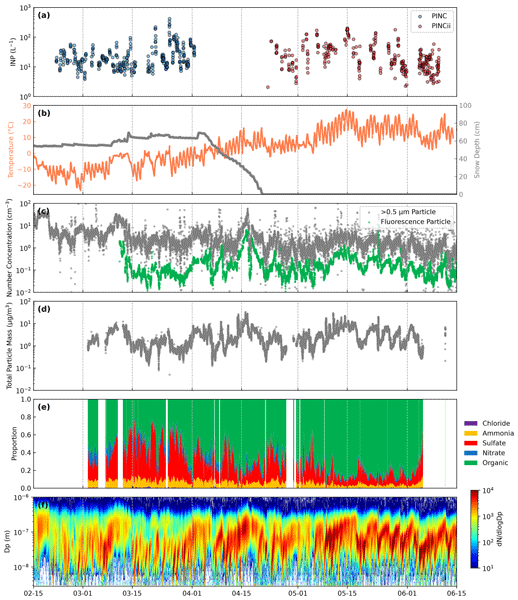
Yusheng Wu, Zoé Brasseur, Dimitri Castarède, Paavo Heikkilä, Jorma Keskinen, Ottmar Möhler, Markku Kulmala, Tuukka Petäjä, Erik S. Thomson, and Jonathan Duplissy
Aerosol Research, 4, 293–309, https://doi.org/10.5194/ar-4-293-2026, https://doi.org/10.5194/ar-4-293-2026, 2026
Short summary
Short summary
Clouds in cold regions affect climate and precipitation, but their behavior depends on rare airborne particles that help ice form. We measured these particles over several months in a Finnish forest and compared them with many environmental observations. We found that ice formation in winter was largely unpredictable, while in spring and summer it was more strongly linked to particle amount and composition. This shows that local conditions are needed to better represent clouds in climate models.
Zixuan Cheng, Doğuşhan Kılıç, Daniel Wilson, Amanda Lea-Langton, Michael Flynn, Leonard Kirago, Marvin Shaw, Andrew Rickard, Jim R. Hopkins, Daniel Bryant, Gordon McFiggans, Jacqueline F. Hamilton, Hugh Coe, and James Allan
Aerosol Research Discuss., https://doi.org/10.5194/ar-2026-24, https://doi.org/10.5194/ar-2026-24, 2026
Revised manuscript accepted for AR
Short summary
Short summary
Wood burning is seen as cleaner in modern stoves, but user behaviour can change this when burning dry wood. We burned dry ash wood in a UK modern stove with six common operations and measured the wood smoke. Reloading while hot, using too much or too little wood, or opening the stove door increased small particels and harmful smoke emissions. We found a burning stage that helps explain these emissions. Using big pieces of wood and following guidance can reduce pollution and health risks.
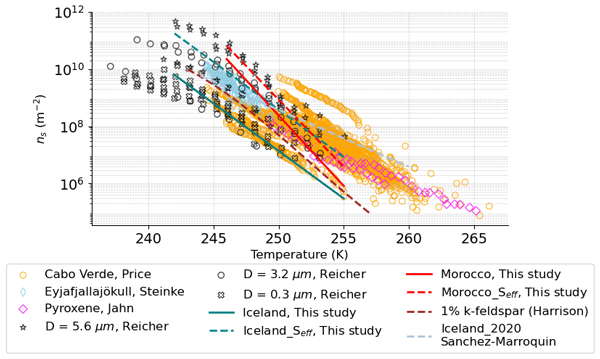
Sebastian Vergara-Palacio, Alexei Kiselev, Franziska Vogel, Adolfo González-Romero, Romy Fösig, Xavier Querol, Corinna Hoose, Nsikanabasi Silas Umo, Ottmar Möhler, Konrad Kandler, Carlos Pérez García-Pando, and Martina Klose
Atmos. Chem. Phys., 26, 9113–9147, https://doi.org/10.5194/acp-26-9113-2026, https://doi.org/10.5194/acp-26-9113-2026, 2026
Short summary
Short summary
Atmospheric mineral dust can help clouds form ice, changing cloud properties and affecting weather and climate. We tested dust from Morocco and Iceland in more than 300 controlled laboratory experiments. Icelandic samples were up to 100 times less able to promote ice formation than Moroccan samples, and showed mineral-composition dependence. The results show the role of larger dust particles in ice nucleation and their relationship with mineralogy and size for low- and high-latitude sources.
Chenjie Yu, Ludovico Di Antonio, Peter F. DeCarlo, Benjamin A. Nault, Alejandra Velazquez-Garcia, Eleonora Aruffo, Piero Di Carlo, Cyrielle Denjean, Sarah Tinorua, Thierry Bourrianne, Diana L. Pereira, Kevin Tu, Edouard Pangui, Mathieu Cazaunau, Astrid Bauville, Noël Grand, Antonin Bergé, Claudia Di Biagio, Aline Gratien, Matthias Beekmann, Guillaume Siour, Gilles Foret, Barbara D'Anna, Julien Kammer, Huihui Wu, Christopher Cantrell, Paola Formenti, and Vincent Michoud
EGUsphere, https://doi.org/10.5194/egusphere-2026-3147, https://doi.org/10.5194/egusphere-2026-3147, 2026
Short summary
Short summary
This study used coordinated airborne and ground-based measurements in Paris and its downwind regions to quantify the effects of 2–6 h of urban plume aging on aerosol properties. Aging enhanced secondary organic aerosol production and PM1 mass and shifted optical properties toward higher SSA, higher real and lower imaginary refractive indices, and stronger brown carbon absorption. These results highlight the need to account for aerosol aging in atmospheric models and remote-sensing retrievals.
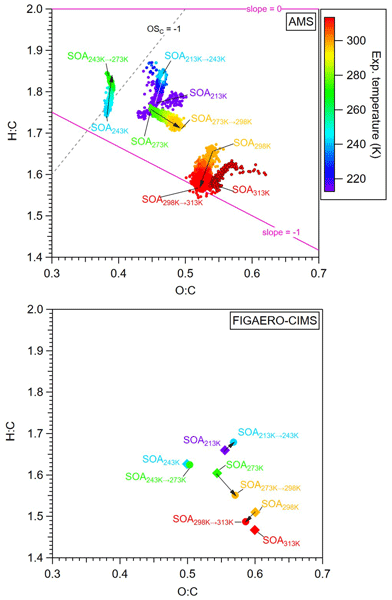
Linyu Gao, Stella E. I. Manavi, Claudia Mohr, Junwei Song, Cheng Wu, Thomas Leisner, Spyros N. Pandis, and Harald Saathoff
Atmos. Chem. Phys., 26, 8875–8892, https://doi.org/10.5194/acp-26-8875-2026, https://doi.org/10.5194/acp-26-8875-2026, 2026
Short summary
Short summary
We investigate how temperature (213–313K) affects secondary organic aerosol (SOA) particles derived from isoprene and α-pinene mixtures. Isoprene's suppression on α-pinene dimer formation varied with temperatures. Particles formed at higher temperatures are more oxidized yet more volatile than those formed at lower temperatures and then warmed. This work highlights the need to consider both temperature and biogenic vapor interaction to accurately describe SOA formation, aging, and global burden.
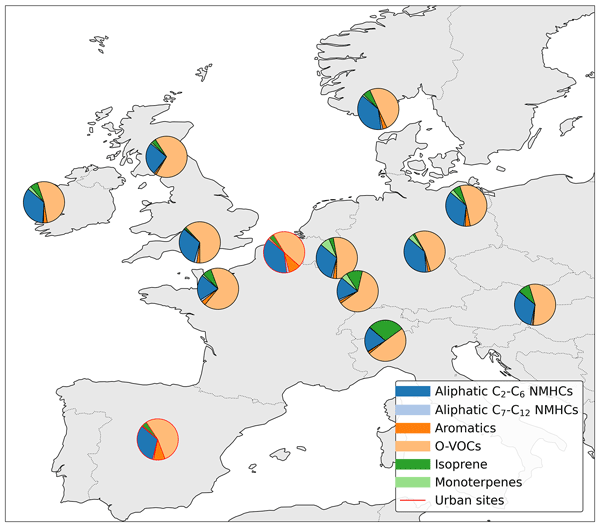
Wenche Aas, Thérèse Salameh, Robert Wegener, Heidi Hellén, Jean-Luc Jaffrezo, Pontus Roldin, Elisabeth Alonso-Blanco, Andres Alastuey, Crist Amelynck, Jgor Arduini, Benjamin Bergmans, Marie Bertrand, Agnes Borbon, Efstratios Bourtsoukidis, Laetitia Bouvier, David Butterfield, Iris Buxbaum, Darius Ceburnis, Anja Claude, Augustin Colette, Aurélie Colomb, Sophie Darfeuil, James Dernie, Maximilien Desservettaz, Elías Díaz-Ramiro, Marvin Dufresne, René Dubus, Mario Duval, Marie Dury, Anna Font, Kirsten N. Fossum, Evelyn Freney, Gotzon Gangoiti, Yao Ge, Maria Carmen Gomez, Francisco J. Gómez-Moreno, Marie Gohy, Valérie Gros, Paul Hamer, Bryan Hellack, Hartmut Herrmann, Robert Holla, Adéla Holubová, Niels R. Jensen, Tuija Jokinen, Matthew Jones, Uwe Käfer, Lukas Kesper, Dieter Klemp, Dagmar Kubistin, Angela Marinoni, Martina Mazzini, Vy Ngoc Thuy Dinh, Jurgita Ovadnevaite, Tuukka Petäjä, Miguel Portillo-Estrada, Jitka Přívozníková, Jean-Philippe Putaud, Stefan Reimann, Laura Renzi, Veronique Riffault, Stuart Ritchie, Chris Robins, Begoña Artíñano Rodríguez de Torres, Laurent Poulain, Julian Rüdiger, Agnieszka Sanocka, Estibaliz Saez de Camara Oleaga, Niels Schoon, Roger Seco, Ivan Simmons, Leïla Simon, David Simpson, Sverre Solberg, Emmanuel Tison, August Thomasson, Svetlana Tsyro, Marsailidh Twigg, Toni Tykkä, Bert Verreyken, Ågot Watne, Katie Williams, Ana Maria Yáñez-Serrano, Karen Yeung, Ilona Ylivinkka, and Karl Espen Yttri
Atmos. Chem. Phys., 26, 8717–8751, https://doi.org/10.5194/acp-26-8717-2026, https://doi.org/10.5194/acp-26-8717-2026, 2026
Short summary
Short summary
A one-week intensive measurement campaign during the 2022 European heatwave included monitoring of ozone, volatile organic compounds, aerosol chemical composition, and organic tracers to investigate air pollution sources. Results showed that emissions from vegetation and human activities contributed to peaks in ozone and secondary organic aerosol particles. Differences between measurements and model simulations underline the need for better characterization of sources and formation pathways.
Farhan R. Nursanto, Quanfu He, Sophia van de Wouw, Annika Zanders, Thorsten Hohaus, Willem S. J. Kroese, Robert Wegener, Max Gerrit Adam, Benjamin Winter, René Dubus, Lukas Kesper, Franz Rohrer, Yuwei Wang, Emily Matthews, Aristeidis Voliotis, Thomas J. Bannan, Gordon McFiggans, Hugh Coe, Yizhen Wu, Milan Roska, Manjula Canagaratna, Mitch Alton, Matthew M. Coggon, Chelsea E. Stockwell, Kelvin H. Bates, Eva Y. Pfannerstill, Sören R. Zorn, Hui Wang, Matthieu Riva, Sebastien Perrier, Boxing Yang, Lu Liu, Anna Novelli, Michelle Färber, Hendrik Fuchs, Andrea Carolina Marcillo Lara, Achim Grasse, Christian Wesolek, Ralf Tillmann, Rupert Holzinger, Maarten C. Krol, Georgios I. Gkatzelis, and Juliane L. Fry
Atmos. Chem. Phys., 26, 8425–8453, https://doi.org/10.5194/acp-26-8425-2026, https://doi.org/10.5194/acp-26-8425-2026, 2026
Short summary
Short summary
Urban air contains reactive gases that can form organic nitrate particles and carry nitrogen oxides pollution far from cities. We recreated urban emissions in a large atmospheric chamber and observed their reactions under day and night conditions. We found that these emissions form organic nitrate particles similar to those from natural sources, with higher amounts and heavier particles at night, making nitrogen pollution longer lived and likely to travel further before depositing on ecosystems.
Guangzhao Xie, Aristeidis Voliotis, Thomas J. Bannan, Yunqi Shao, Huihui Wu, Dawei Hu, and Gordon McFiggans
EGUsphere, https://doi.org/10.5194/egusphere-2026-2826, https://doi.org/10.5194/egusphere-2026-2826, 2026
Short summary
Short summary
NOx plays a crucial role in secondary organic aerosol (SOA) formation. However, most studies have focused on its effects on individual SOA precursors. This study investigated the effects of NOx on SOA particle mass yields and chemical composition from a biogenic-anthropogenic mixture. The results reveal that the effects of NOx in the mixed-precursor systems cannot be interpreted as a simple combination of behaviours observed in individual precursor systems.
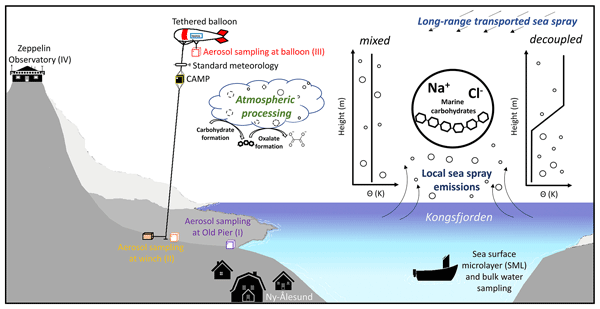
Sebastian Zeppenfeld, Jonas Schaefer, Christian Pilz, Kerstin Ebell, Moritz Zeising, Frank Stratmann, Holger Siebert, Birgit Wehner, Matthias Wietz, Astrid Bracher, and Manuela van Pinxteren
Atmos. Chem. Phys., 26, 7235–7260, https://doi.org/10.5194/acp-26-7235-2026, https://doi.org/10.5194/acp-26-7235-2026, 2026
Short summary
Short summary
Sea spray aerosol transports inorganic salts and carbohydrates from the ocean into the atmosphere. In this field study conducted in Svalbard, we found that carbohydrates reach elevated altitudes that are relevant for cloud formation and properties.
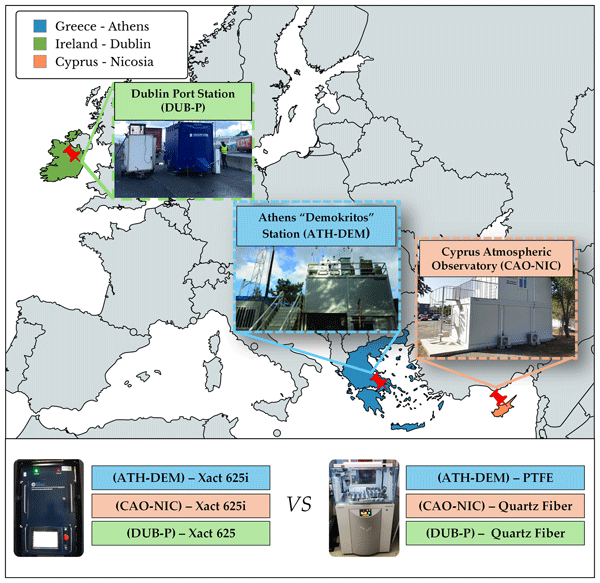
Stefanos Papagiannis, Manousos I. Manousakas, Dimitrios F. Anagnostopoulos, Michael Pikridas, Rima Baalbaki, Jean Sciare, Niall O'Sullivan, Stig Hellebust, John Wenger, Kirsten N. Fossum, Jurgita Ovadnevaite, Anja Tremper, David Green, Konstantinos Eleftheriadis, and Evangelia Diapouli
Atmos. Meas. Tech., 19, 3491–3509, https://doi.org/10.5194/amt-19-3491-2026, https://doi.org/10.5194/amt-19-3491-2026, 2026
Short summary
Short summary
We compared near real-time and benchtop XRF spectrometers measuring trace elements in airborne particles across three European cities. Results show filter material dictates accuracy: Teflon yielded strong inter-instrument agreement, while quartz caused systematic attenuation errors for light elements. Because empirical corrections left residual biases, using optimal substrates—preferably Teflon—is essential for accurately tracking pollution sources.
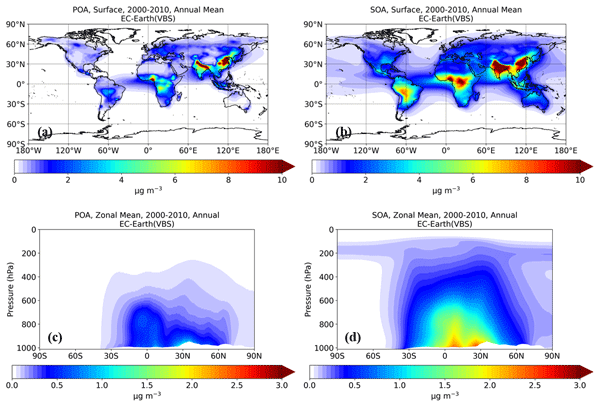
Stylianos Kakavas, Stelios Myriokefalitakis, Alexandra P. Tsimpidi, Vlassis A. Karydis, and Spyros N. Pandis
Geosci. Model Dev., 19, 4271–4288, https://doi.org/10.5194/gmd-19-4271-2026, https://doi.org/10.5194/gmd-19-4271-2026, 2026
Short summary
Short summary
The computationally efficient configuration of the ORACLE v1.0 module (ORACLE-lite) is implemented into the TM5-MP global chemical transport model, which represents the chemistry-transport component of the EC-Earth3-AerChem model. The models bias is reduced by approximately half in the standalone TM5-MP simulation and by a factor of three in EC-Earth3-AerChem when ORACLE-lite is implemented.
Yanxia Li, Hengheng Zhang, Xuefeng Shi, Yaowei Li, Sophie Abou-Rizk, Jessica B. Smith, Zhaojin An, Adrian Wenzel, Junwei Song, Thomas Leisner, Frank Keutsch, Jia Chen, and Harald Saathoff
EGUsphere, https://doi.org/10.5194/egusphere-2026-2195, https://doi.org/10.5194/egusphere-2026-2195, 2026
Short summary
Short summary
Urban ultrafine particles (<100 nm) sources and growth mechanisms remain poorly constrained. Measurements in a Munich street canyon reveal that UFP number concentrations peak at night due to traffic and cooking emissions trapped under a shallow boundary layer. Particle growth is instead driven by condensation of organic vapours with strong seasonal shifts: biogenic and barbeque charcoal biomass-burning compounds dominate in summer, while combustion-related organics control winter growth.
Timothy J. Wallington, Markus Ammann, John N. Crowley, Hartmut Herrmann, Michael E. Jenkin, V. Faye McNeill, Abdelwahid Mellouki, and Jürgen Troe
Atmos. Chem. Phys., 26, 6579–6592, https://doi.org/10.5194/acp-26-6579-2026, https://doi.org/10.5194/acp-26-6579-2026, 2026
Short summary
Short summary
Halogenated alkanes, alkenes, and oxygenated compounds play an important role in atmospheric chemistry. This article, the ninth in the series, presents kinetic and photochemical data sheets evaluated by the International Union of Pure and Applied Chemistry (IUPAC) Task Group on Atmospheric Chemical Kinetic Data Evaluation. It covers the gas-phase reactions (with HO radicals, NO3 radicals, and ozone) and photolysis of halogenated organic compounds. These data are important for atmospheric models.
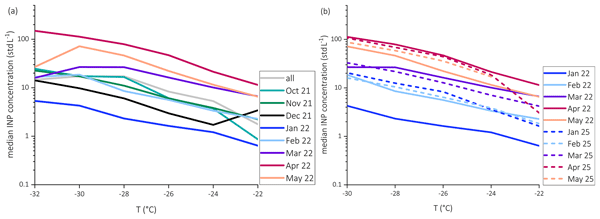
Larissa Lacher, A. Gannet Hallar, Ian B. McCubbin, Joey Bail, Karl D. Froyd, Justin Jacquot, Xiaoli Shen, Christopher Rapp, Ottmar Möhler, and Daniel Cziczo
Atmos. Chem. Phys., 26, 6703–6726, https://doi.org/10.5194/acp-26-6703-2026, https://doi.org/10.5194/acp-26-6703-2026, 2026
Short summary
Short summary
We observe a trend of increasing ice-nucleating particle (INP) concentration in spring in the Rocky Mountains, related to regional dust emissions that may intensify with climate change. Additionally, super-micrometer particles were found as the most important contributors to the INP population. This finding was partly enabled by a novel setup of the Portable Ice Nucleation Experiment (PINE), coupled with a pumped-counterflow virtual impactor allowing for direct analysis of INP properties.
David J. Simon, Jonas Schaefer, Jörg Hartmann, Benjamin Kirbus, Joshua Müller, Markus Hartmann, Bruno Wetzel, Laura Köhler, Anna-Marie Jörss, Kay Weinhold, Andreas Herber, Zsófia Jurányi, Silvia Henning, Gregory C. Roberts, Manfred Wendisch, Mira L. Pöhlker, and Frank Stratmann
EGUsphere, https://doi.org/10.5194/egusphere-2026-2215, https://doi.org/10.5194/egusphere-2026-2215, 2026
Short summary
Short summary
We investigate the occurrence of newly formed aerosol particles in the Arctic atmosphere by analyzing aerosol particle measurements conducted aboard a research aircraft in April 2024. We frequently detected newly formed particles at altitudes of up to 4 km, while many previous studies had predominantly found such particles close to the surface. Newly formed particles were associated with air mass transport from lower latitudes, the occurrence of clouds, as well as the presence of sea ice.
Jian Xu, Junteng Wu, Mayur Gajanan Sapkal, Jim Grisillon, Shravan Deshmukh, Brice Temime Roussel, Julien Kammer, Nicolas Brun, Fabien Robert-Peillard, Beiping Luo, Judith Kleinheins, Silvia Henning, Bénédicte Picquet-Varrault, Edouard Pangui, Mathieu Cazaunau, Zamin A. Kanji, Claudia Marcolli, and Anne Monod
Aerosol Research Discuss., https://doi.org/10.5194/ar-2026-14, https://doi.org/10.5194/ar-2026-14, 2026
Revised manuscript under review for AR
Short summary
Short summary
The study aimed to mimic the atmospheric behaviour of a semi-volatile organic compound in the presence of fine particles and at various relative humidities. The objective was to determine the influence of organic matter on humid particle growth. These results are essential for improving our understanding of cloud formation.
Shravan Deshmukh, Laurent Poulain, Birgit Wehner, Silvia Henning, Hartmut Herrmann, and Mira Pöhlker
EGUsphere, https://doi.org/10.5194/egusphere-2026-1992, https://doi.org/10.5194/egusphere-2026-1992, 2026
Short summary
Short summary
Improved representation of aerosol hygroscopicity is critical for understanding how atmospheric particles influence cloud formation, climate, air quality, and human health. This work advances understanding of aerosol hygroscopicity by connecting laboratory measurements of organic aerosol properties with ambient observations through an explainable machine learning framework.
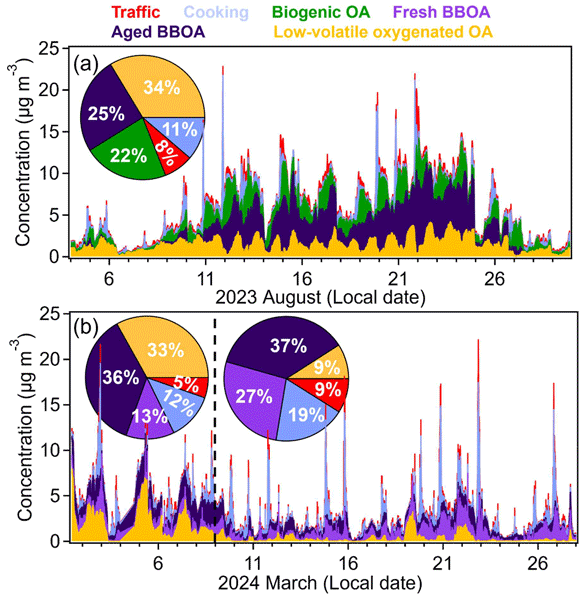
Yanxia Li, Hengheng Zhang, Xuefeng Shi, Yaowei Li, Sophie Abou-Rizk, Jessica B. Smith, Zhaojin An, Adrian Wenzel, Junwei Song, Thomas Leisner, Frank Keutsch, Jia Chen, and Harald Saathoff
Atmos. Chem. Phys., 26, 5813–5837, https://doi.org/10.5194/acp-26-5813-2026, https://doi.org/10.5194/acp-26-5813-2026, 2026
Short summary
Short summary
We analyzed Munich air samples across seasons to identify pollution sources. Traffic contributes less to particles than expected, while biomass burning dominates year-round. Summer barbecuing and winter heating release significant pollution. Monoterpene emissions from plants produce particles at night. Effective air quality improvement requires year-round strategies targeting biomass burning, not just vehicles. Understanding each city's pollution patterns is essential for public health.
Paola Formenti, Danitza Klopper, Anais Feron, Mathieu Cazaunau, Servanne Chevaillier, Karine Desboeufs, Claudia Di Biagio, Clarissa Baldo, Cécile Gaimoz, Vincent Michoud, Cécile Mirande-Bret, Sylvain Triquet, François Hemeret, Richard Valorso, Stephen Broccardo, Andreas Namwoonde, Mattheus Hanghome, Chiara Giorio, and Stuart J. Piketh
Earth Syst. Sci. Data Discuss., https://doi.org/10.5194/essd-2026-95, https://doi.org/10.5194/essd-2026-95, 2026
Revised manuscript under review for ESSD
Short summary
Short summary
The southern African west coast is highly impacted by climate change and aerosols from natural and human sources, yet observations are scarce. We present measurements (2014–2019) from the Henties Bay Aerosol Observatory in Namibia, including aerosol properties, ozone and meteorology. This unique dataset will support process studies and improve regional climate modelling.
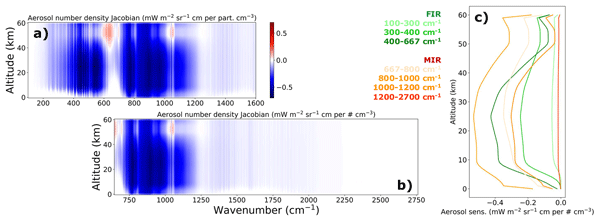
Pasquale Sellitto, Maxim Eremenko, Paola Formenti, Perla Alalam, Michael Höpfner, and Claudia Di Biagio
Atmos. Meas. Tech., 19, 2751–2762, https://doi.org/10.5194/amt-19-2751-2026, https://doi.org/10.5194/amt-19-2751-2026, 2026
Short summary
Short summary
The Far-infrared Outgoing Radiation Understanding and Monitoring (FORUM) mission will bring the first satellite instrument capable of observing the Earth's far infrared (FIR) spectra with a high spectral resolution. FORUM will crucially contribute to water vapour, clouds and surface observations. We found that FORUM will provide also a significant sensitivity to dust aerosol, especially in cases of large burdens of mid-to-long-range transported plumes of dust in the free and upper troposphere.
Johannes Heuser, Claudia Di Biagio, Jérôme Yon, Mathieu Cazaunau, Antonin Bergé, Edouard Pangui, Marco Zanatta, Laura Renzi, Angela Marinoni, Chenjie Yu, Servanne Chevaillier, Daniel Ferry, Paolo Laj, Michel Maillé, Paola Formenti, Benedicte Picquet-Varrault, and Jean-Francois Doussin
EGUsphere, https://doi.org/10.5194/egusphere-2026-1867, https://doi.org/10.5194/egusphere-2026-1867, 2026
Short summary
Short summary
Large simulation chamber experiments were performed to investigate the impact of non-absorbing coating on the absorption of fractal BC-containing soot. Results show the strong and combined effect of morphological modifications and mixing state heterogeneity on BC absorption, both depending on the reaction dynamics of coating formation and ageing of the coated soot. The range of measured absorption cannot be captured by common model approximations, highlighting the need for new formalisms.
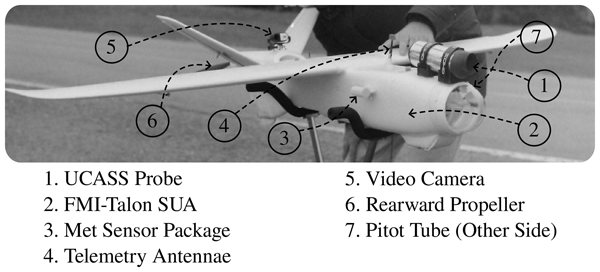
Jessica Girdwood, David Brus, Konstantinos-Matthaios Doulgeris, and Alexander Böhmländer
Earth Syst. Sci. Data, 18, 2819–2828, https://doi.org/10.5194/essd-18-2819-2026, https://doi.org/10.5194/essd-18-2819-2026, 2026
Short summary
Short summary
In-situ data of cloud microphysics is essential for targeted studies of cloud processes, validating remote sensing, and both assessing and improving the accuracy of weather and climate models. In this work we adopt a novel technique using a small uncrewed aircraft (SUA) and a bespoke sensor to produce vertical profiles of cloud microphysical parameters. The data are publicly available from https://zenodo.org/records/14756233.
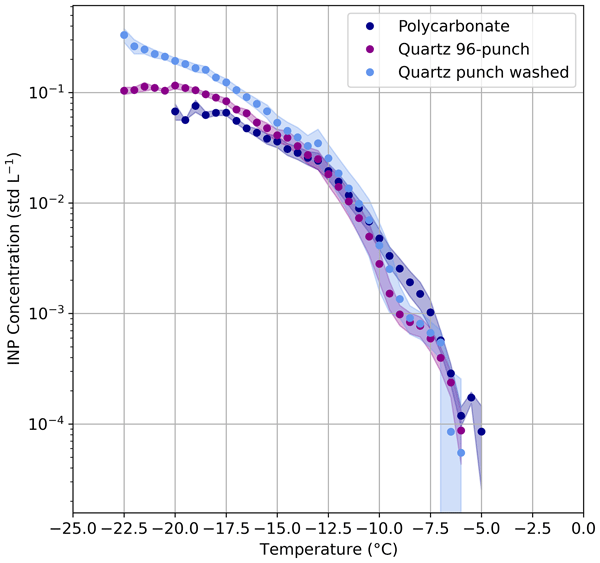
Elena Bazo, Olga Ruiz-Galera, Lucas Alados-Arboledas, Alexander Böhmländer, Kristina Höhler, Najin Kim, Larissa Lacher, Ottmar Möhler, Frascisco José Olmo, German Perez Fogwill, Ana A. Piedehierro, Nsikanabasi Silas Umo, André Welti, Gloria Titos, and Alberto Cazorla
Atmos. Meas. Tech., 19, 2695–2713, https://doi.org/10.5194/amt-19-2695-2026, https://doi.org/10.5194/amt-19-2695-2026, 2026
Short summary
Short summary
We evaluated different methods to obtain the ice nucleating particle (INP) concentration from ambient filters using GRAINS (GRAnada Ice Nuclei Spectrometer), the INP spectrometer at the Andalusian ObseRvatory of the Atmosphere (AGORA). We first characterized GRAINS and compared it to other INP devices. Then, we sampled polycarbonate and quartz filters for three months and tested three different particle extraction methods, finding general good agreement but that the INP concentration is systematically higher when using quartz filters.
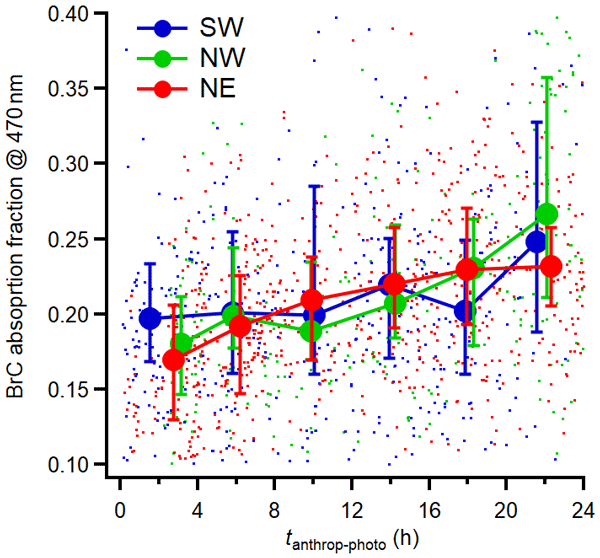
Chenjie Yu, Paola Formenti, Joel F. de Brito, Astrid Bauville, Antonin Bergé, Hichem Bouzidi, Mathieu Cazaunau, Manuela Cirtog, Claudia Di Biagio, Ludovico Di Antonio, Cécile Gaimoz, Franck Maisonneuve, Pascal Zapf, Tobias Seubert, Simone T. Andersen, Patrick Dewald, Gunther N. T. E. Türk, John N. Crowley, Alexandre Kukui, Chaoyang Xue, Cyrielle Denjean, Olivier Garrouste, Jean-Claude Etienne, Huihui Wu, James D. Allan, Dantong Liu, Yangzhou Wu, Christopher Cantrell, and Vincent Michoud
Atmos. Chem. Phys., 26, 5313–5332, https://doi.org/10.5194/acp-26-5313-2026, https://doi.org/10.5194/acp-26-5313-2026, 2026
Short summary
Short summary
We presented a field measurement in a Paris suburban forest region to characterise the impacts of photochemical aging process on aerosol physical chemical properties. Photochemical production of organic aerosols increased forest fine particle mass and significantly enhanced absorption of short-wavelength sunlight. This study highlights the critical need to incorporate light absorbing carbonaceous particles formation mechanisms into models to accurately simulate their direct radiative impacts.
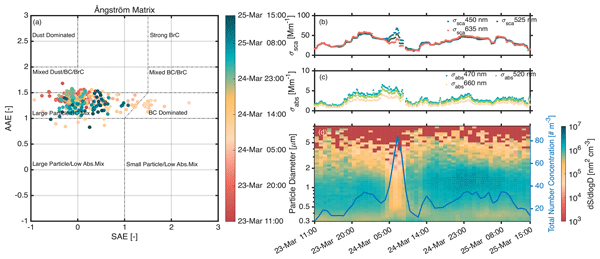
Zihui Teng, Jane Tygesen Skønager, Andreas Massling, Henrik Skov, Nikolaos Evangeliou, Sabine Eckhardt, Merete Bilde, and Bernadette Rosati
Aerosol Research, 4, 169–187, https://doi.org/10.5194/ar-4-169-2026, https://doi.org/10.5194/ar-4-169-2026, 2026
Short summary
Short summary
Coastal aerosols in Scandinavian urban areas remain understudied. We examined aerosol optical properties and size distributions along Denmark's coastline. Combining in situ data with dispersion modelling, we identified two main aerosol types: carbonaceous aerosols from fossil fuel and biomass burning and large, highly scattering aerosols (potentially sea salt). Black carbon from in situ data and dispersion modelling correlated well, while FLEXPART underestimated the concentration.
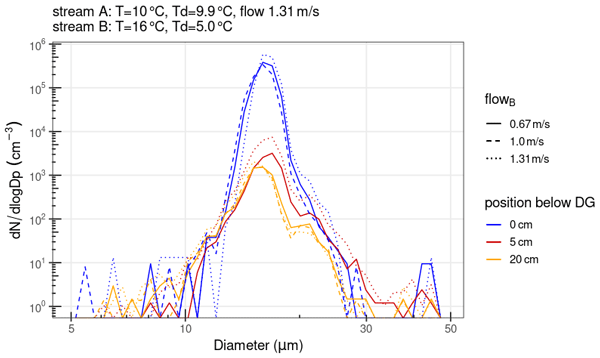
Wiebke Frey, Silvio Schmalfuß, Frank Stratmann, and Dennis Niedermeier
Earth Syst. Sci. Data, 18, 2305–2318, https://doi.org/10.5194/essd-18-2305-2026, https://doi.org/10.5194/essd-18-2305-2026, 2026
Short summary
Short summary
In order to gain a better understanding on the impact of entrainment on cloud droplet size distributions, water droplets were sprayed into the mixing plane of a turbulent wind tunnel, where two separately conditioned air streams are combined. One air stream resembling 'in cloud' conditions (with relative humidity close to saturation) and one air stream resembling 'out of cloud' conditions, which are dryer and warmer. The paper describes the data set and outlines future use examples.
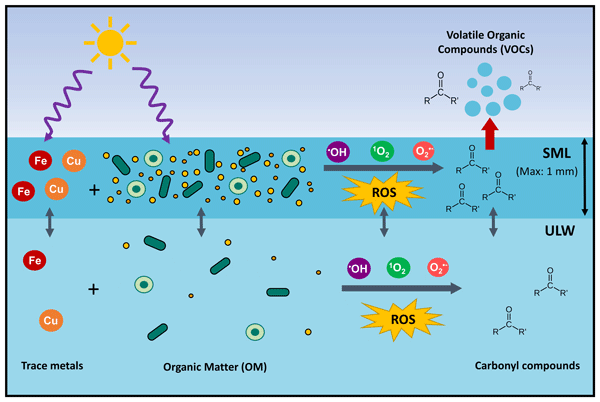
Olenka Jibaja Valderrama, Daniele Scheres Firak, Thomas Schaefer, Manuela van Pinxteren, Khanneh Wadinga Fomba, and Hartmut Herrmann
Biogeosciences, 23, 1965–1985, https://doi.org/10.5194/bg-23-1965-2026, https://doi.org/10.5194/bg-23-1965-2026, 2026
Short summary
Short summary
The present study explores the influence of biological activity in the photochemistry of the sea-surface microlayer (SML) and its implications for the emission of volatile organic compounds (VOCs) to the marine atmosphere. Experimental evidence of enhanced photochemical activity of carbonyl compounds in the SML is provided, particularly in periods of higher biological productivity, thereby offering new insights to integrate biological processes and photochemistry in the air-sea boundary.
Marije van den Born, Hengjia J. Ou, Jan Mulder, Jinglan Fu, Harald Saathof, and Ulrike Dusek
Aerosol Research Discuss., https://doi.org/10.5194/ar-2026-8, https://doi.org/10.5194/ar-2026-8, 2026
Revised manuscript accepted for AR
Short summary
Short summary
Sea spray aerosol plays an important role in climate and atmospheric chemistry, yet sea salt is rarely quantified by online mass spectrometers due to its refractory nature. This study shows that a Capture Vaporizer Time-of-Flight Aerosol Chemical Speciation Monitor can detect sea salt aerosol using Na and NaCl fragments. Laboratory and field results demonstrate robust real-time measurements of NaCl surface area, while accurate mass concentrations require particle size information.
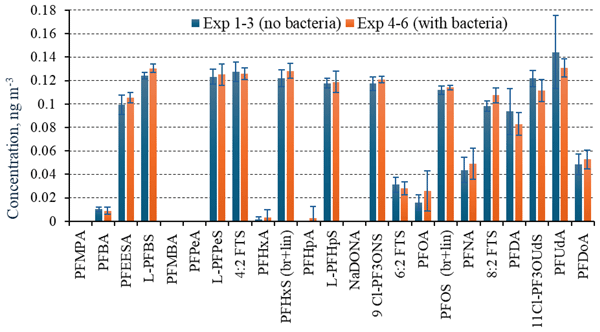
Ivan Kourtchev, Steve Coupe, Alison Buckley, Jishnu Pandamkulangara Kizhakkethil, Elena Gatta, Dario Massabò, Paolo Prati, Virginia Vernocchi, and Federico Mazzei
Atmos. Chem. Phys., 26, 3237–3252, https://doi.org/10.5194/acp-26-3237-2026, https://doi.org/10.5194/acp-26-3237-2026, 2026
Short summary
Short summary
This study examined how a range of forever chemicals enter the air when aerosolised from contaminated solutions, with & without bacteria-seed (bioaerosol). The way these chemicals were aerosolised was key to their behaviour in air and their inhalation relevance, as they mainly formed tiny particles that reach deep in the lungs. The bacterium had little effect, suggesting the chemicals are unlikely to be removed by bioaerosol, enabling long range transport and contributing to inhalation exposure.

Amavi Silva, Surandokht Nikzad, Theresa Barthelmeß, Anja Engel, Hartmut Herrmann, Manuela van Pinxteren, Kai Wirtz, Oliver Wurl, and Markus Schartau
Biogeosciences, 23, 1697–1718, https://doi.org/10.5194/bg-23-1697-2026, https://doi.org/10.5194/bg-23-1697-2026, 2026
Short summary
Short summary
We conducted the first meta-analysis combining marine and freshwater studies to understand organic matter enrichment in the surface microlayer. Nitrogen-rich, particulate compounds are often enriched, with patterns varying by multiple factors. We recommend tracking both absolute concentrations and normalized enrichment patterns to better assess ecological conditions. Our study also introduces improved statistical methods for analyzing and comparing surface microlayer data.
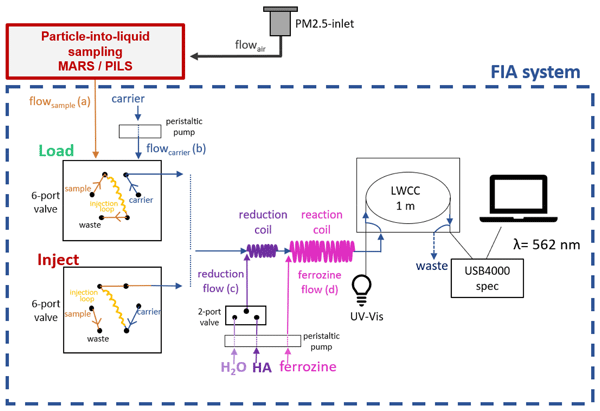
Sabine Lüchtrath, Sven Klemer, Florian Fröhlich, Darius Ceburnis, Dominik van Pinxteren, Hartmut Herrmann, Wolfgang Frenzel, and Andreas Held
Aerosol Research, 4, 81–101, https://doi.org/10.5194/ar-4-81-2026, https://doi.org/10.5194/ar-4-81-2026, 2026
Short summary
Short summary
The first online instrument for the speciation of water‑soluble iron in ambient aerosols is presented. The system combines flow injection analysis with spectrophotometric detection using a liquid waveguide capillary cell. Sensitive iron speciation will help to better describe tropospheric aqueous-phase reactions driven by soluble iron, e.g. hydroxyl radical formation through Fenton chemistry. In first measurements in Berlin, ambient water-soluble-iron concentrations reached up to 47 ng m-3.
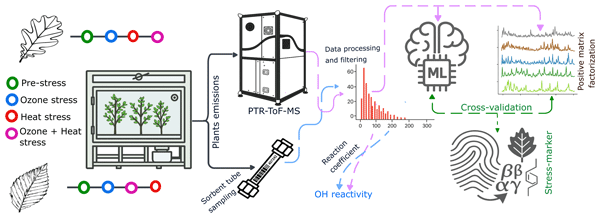
Biplob Dey, Toke Due Sjøgren, Peeyush Khare, Georgios I. Gkatzelis, Yizhen Wu, Sindhu Vasireddy, Martin Schultz, Alexander Knohl, Riikka Rinnan, Thorsten Hohaus, and Eva Y. Pfannerstill
Biogeosciences, 23, 1423–1457, https://doi.org/10.5194/bg-23-1423-2026, https://doi.org/10.5194/bg-23-1423-2026, 2026
Short summary
Short summary
Trees release reactive gases that affect air quality and climate. We studied how these emissions from European beech and English oak change under realistic scenarios of combined and single heat and ozone stress. Heat increased emissions, while ozone reduced most of them. When stressors were combined, the effects were complex and varied by species. Machine learning identified key stress-related compounds. Our findings show that future tree stress may alter air quality and climate interactions.
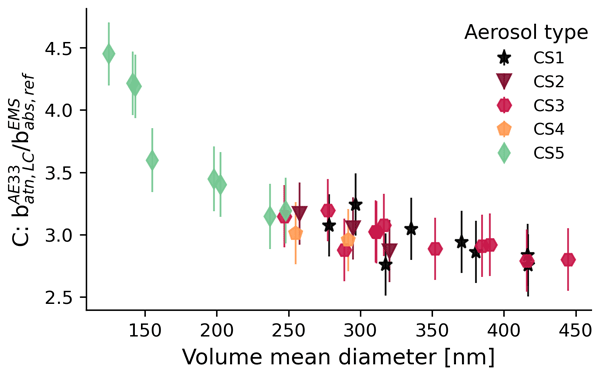
Laura Renzi, Claudia Di Biagio, Johannes Heuser, Marco Zanatta, Mathieu Cazaunau, Antonin Bergé, Edouard Pangui, Jérôme Yon, Tommaso Isolabella, Dario Massabò, Virginia Vernocchi, Martina Mazzini, Franziska Vogel, Chenjie Yu, Paola Formenti, Benedicte Picquet-Varrault, Jean-Francois Doussin, and Angela Marinoni
Atmos. Meas. Tech., 19, 1365–1383, https://doi.org/10.5194/amt-19-1365-2026, https://doi.org/10.5194/amt-19-1365-2026, 2026
Short summary
Short summary
This study investigates how particle properties affect the accuracy of a common air pollution instrument, the dual-spot aethalometer. By combining lab experiments with real-world data from a mountain site in Italy, we found that the correction factor for this instrument varies mainly due to particle size and measurement conditions. Understanding these influences helps improve air quality monitoring, which is important for assessing pollution impacts on health and climate.
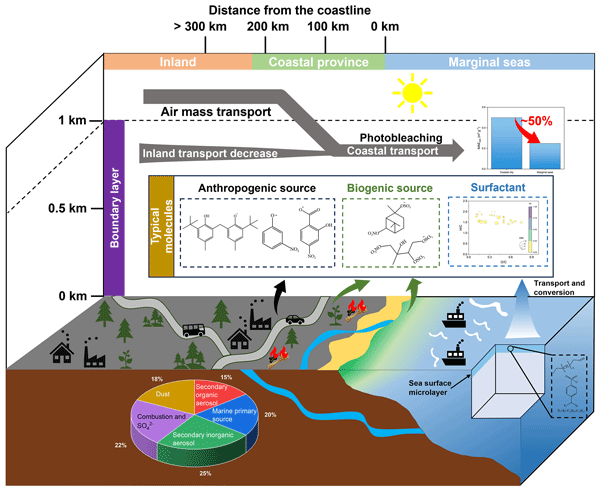
Kuanyun Hu, Narcisse Tsona Tchinda, Kun Li, Hartmut Herrmann, Jianlong Li, and Lin Du
Atmos. Chem. Phys., 26, 2225–2240, https://doi.org/10.5194/acp-26-2225-2026, https://doi.org/10.5194/acp-26-2225-2026, 2026
Short summary
Short summary
This study reveals that summer aerosols over the Bohai and Yellow Seas are mainly influenced by coastal emissions. Despite a high proportion of marine air masses, molecular and isotopic analyses of aerosols show strong terrestrial characteristics. Biomass burning contributes 60–80 % of carbonaceous aerosols, while marine sources account for only ~ 20 %. The findings highlight that controlling coastal emissions within ~ 260 km is crucial for mitigating marginal sea pollution.
Hengheng Zhang, Gholam Ali Hoshyaripour, Heike Vogel, Frank Wagner, Thomas Leisner, Jochen Förstner, and Harald Saathoff
EGUsphere, https://doi.org/10.5194/egusphere-2025-5980, https://doi.org/10.5194/egusphere-2025-5980, 2026
Short summary
Short summary
We studied several major dust storms that traveled from the Sahara to Europe using ground-based light measurements, sunlight sensors, particle counters, and a modern weather and dust model. We reveal when the dust arrived, how it moved and mixed in the air, and why each event behaved differently. Our results help improve forecasts of dust episodes that influence air quality, visibility, and solar energy across Europe.
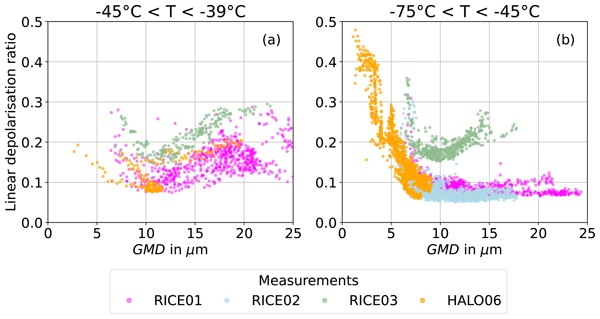
Adrian Hamel, Martin Schnaiter, Masanori Saito, Robert Wagner, and Emma Järvinen
Atmos. Chem. Phys., 26, 1277–1300, https://doi.org/10.5194/acp-26-1277-2026, https://doi.org/10.5194/acp-26-1277-2026, 2026
Short summary
Short summary
The depolarisation ratio of ice clouds is commonly measured by satellites and ground-based instruments to learn about ice particle shapes. In our cloud chamber experiments, we found that for small ice crystals, the depolarisation ratio is more strongly influenced by particle size than by nano-scale structure. The measured trends could be reproduced with numerical simulations. This result helps improve the interpretation of remote sensing data and the accuracy of light scattering models.
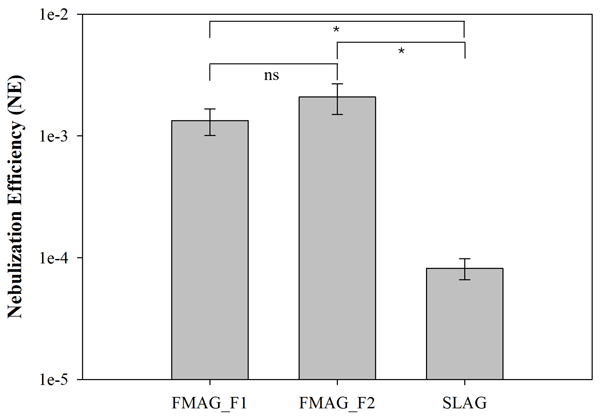
Federico Mazzei, Marco Brunoldi, Elena Gatta, Franco Parodi, Paolo Prati, Virginia Vernocchi, and Dario Massabò
Atmos. Chem. Phys., 26, 1265–1275, https://doi.org/10.5194/acp-26-1265-2026, https://doi.org/10.5194/acp-26-1265-2026, 2026
Short summary
Short summary
The goal of this study was to compare the performance of two aerosol generators in terms of nebulization efficiency, size distribution, bacterial fragmentation, and the stresses produced on bacteria during nebulization, including loss of viability and culturability. Our findings indicated that bacterial viability is significantly influenced by nebulization procedures, and nebulization efficiency varies among different nebulizers.
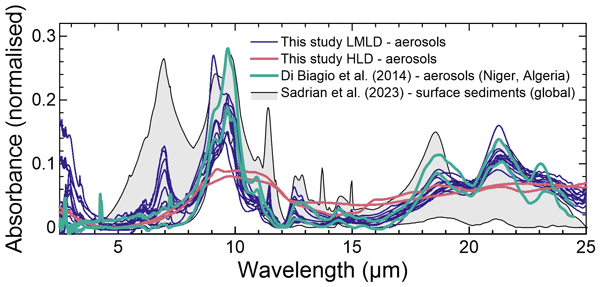
Claudia Di Biagio, Elisa Bru, Avila Orta, Servanne Chevaillier, Clarissa Baldo, Antonin Bergé, Mathieu Cazaunau, Sandra Lafon, Sophie Nowak, Edouard Pangui, Meinrat O. Andreae, Pavla Dagsson-Waldhauserova, Kebonyethata Dintwe, Konrad Kandler, James S. King, Amelie Chaput, Gregory S. Okin, Stuart Piketh, Thuraya Saeed, David Seibert, Zongbo Shi, Earle Williams, Pasquale Sellitto, and Paola Formenti
Atmos. Chem. Phys., 26, 1079–1091, https://doi.org/10.5194/acp-26-1079-2026, https://doi.org/10.5194/acp-26-1079-2026, 2026
Short summary
Short summary
Spectroscopy measurements show that the absorbance of dust in the far-infrared up to 25 µm is comparable in intensity to that in the mid-infrared (3–15 µm) suggesting possible relevance for its direct radiative effect. Absorption signatures differ between Icelandic and low/mid-latitude dust due to differences in mineralogical composition. Spectral differences could be used to characterise the mineralogy and trace the origin of airborne dust based on infrared remote sensing observations.
Alexandros Milousis, Susanne M. C. Scholz, Hendrik Fuchs, Alexandra P. Tsimpidi, and Vlassis A. Karydis
Atmos. Chem. Phys., 26, 571–605, https://doi.org/10.5194/acp-26-571-2026, https://doi.org/10.5194/acp-26-571-2026, 2026
Short summary
Short summary
Nitrate aerosol has become a dominant atmospheric component, surpassing sulfate in aerosol composition. However, its simulation remains challenging due to complex formation processes and regional variability. We use the EMAC model to assess key factors in nitrate predictions. Increasing grid resolution, reducing dinitrogen pentoxide hydrolysis uptake, and refining emissions improve model performance, although seasonal and diurnal discrepancies persist, requiring further refinement.
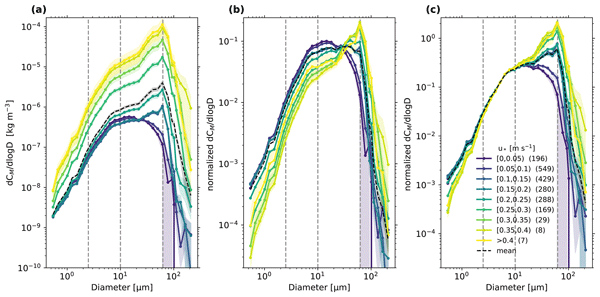
Hannah Meyer, Konrad Kandler, Sylvain Dupont, Jerónimo Escribano, Jessica Girdwood, George Nikolich, Andrés Alastuey, Vicken Etyemezian, Cristina González-Flórez, Adolfo González-Romero, Tareq Hussein, Mark Irvine, Peter Knippertz, Ottmar Möhler, Xavier Querol, Chris Stopford, Franziska Vogel, Frederik Weis, Andreas Wieser, Carlos Pérez García-Pando, and Martina Klose
Atmos. Meas. Tech., 19, 21–61, https://doi.org/10.5194/amt-19-21-2026, https://doi.org/10.5194/amt-19-21-2026, 2026
Short summary
Short summary
Mineral dust particles emitted from dry soils are of various sizes, yet the abundance of very large particles is not well understood. Here we measured the dust size distribution from fine to giant particles at an emission source during a field campaign in Jordan (J-WADI) using multiple instruments. Our findings show that large particles make up a significant part of the total dust mass. This knowledge is essential to improve climate models and to predict dust impacts on climate and environment.
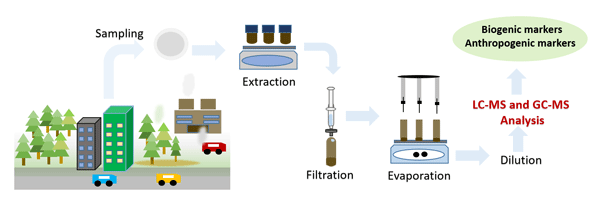
Diana L. Pereira, Aline Gratien, Chiara Giorio, Emmanuelle Mebold, Thomas Bertin, Cécile Gaimoz, Jean-François Doussin, and Paola Formenti
Atmos. Meas. Tech., 19, 1–19, https://doi.org/10.5194/amt-19-1-2026, https://doi.org/10.5194/amt-19-1-2026, 2026
Short summary
Short summary
This study provides two methods for the quantification of molecular markers to improve the description of secondary organic aerosols using chromatographic techniques coupled with mass spectrometry. Compounds from various chemical functionalities (alcohols, acids, aldehydes), from biogenic and anthropogenic origin, were identified. Improved method performance was observed for nitro compounds, which have been associated with anthropogenic activities.
Susanne M. C. Scholz, Vlassis A. Karydis, Georgios I. Gkatzelis, Hendrik Fuchs, Spyros N. Pandis, and Alexandra P. Tsimpidi
Geosci. Model Dev., 18, 10119–10142, https://doi.org/10.5194/gmd-18-10119-2025, https://doi.org/10.5194/gmd-18-10119-2025, 2025
Short summary
Short summary
We studied how pollution from cars and trucks contributes to tiny airborne particles that affect air quality and climate. These particles, called secondary organic aerosols, were often underestimated in global models. By improving how certain overlooked emissions from fuel use are represented in our model, we found that their impact is much larger than previously thought. Our results suggest that road traffic plays a far greater role in global air pollution than earlier estimates showed.
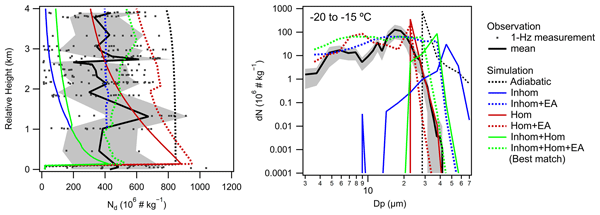
Huihui Wu, Nicholas Marsden, Paul Connolly, Michael Flynn, Paul I. Williams, Declan Finney, Kezhen Hu, Graeme J. Nott, Navaneeth M. Thamban, Keith Bower, Alan Blyth, Martin Gallagher, and Hugh Coe
Atmos. Chem. Phys., 25, 18409–18429, https://doi.org/10.5194/acp-25-18409-2025, https://doi.org/10.5194/acp-25-18409-2025, 2025
Short summary
Short summary
Airborne observations over the Magdalena Mountains in New Mexico underscore the combined influence of meteorological conditions and aerosol characteristics on the development of deep-convective clouds under different flow regimes. Model-observation comparisons emphasize the critical role of aerosol entrainment in reproducing the observed broad cloud droplet spectra. This study provides valuable constraints for improving parameterizations of aerosol-cloud interactions in deep convective systems.
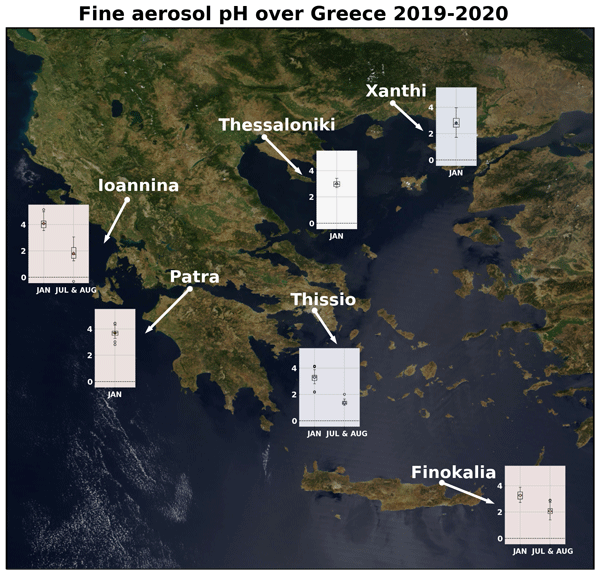
Anna Maria Neroladaki, Maria Tsagkaraki, Kyriaki Papoutsidaki, Kalliopi Tavernaraki, Filothei Boufidou, Pavlos Zarmpas, Irini Tsiodra, Eleni Liakakou, Aikaterini Bougiatioti, Giorgos Kouvarakis, Nikos Kalivitis, Christos Kaltsonoudis, Athanasios Karagioras, Dimitrios Balis, Konstantinos Michailidis, Konstantinos Kourtidis, Stelios Myriokefalitakis, Nikos Hatzianastassiou, Spyros N. Pandis, Athanasios Nenes, Nikolaos Mihalopoulos, and Maria Kanakidou
Atmos. Chem. Phys., 25, 17953–17971, https://doi.org/10.5194/acp-25-17953-2025, https://doi.org/10.5194/acp-25-17953-2025, 2025
Short summary
Short summary
Aerosol acidity affects aerosol composition and properties, and therefore climate, human health and ecosystems. We use summer and winter fine aerosol observations at 6 sites across Greece, and a thermodynamic model to calculate the spatial and seasonal variability of aerosol acidity. Aerosols were acidic to moderately acidic and more acidic during summer than winter. The importance of organics for aerosol acidity was small. Depending on location different factors controlled aerosol acidity.
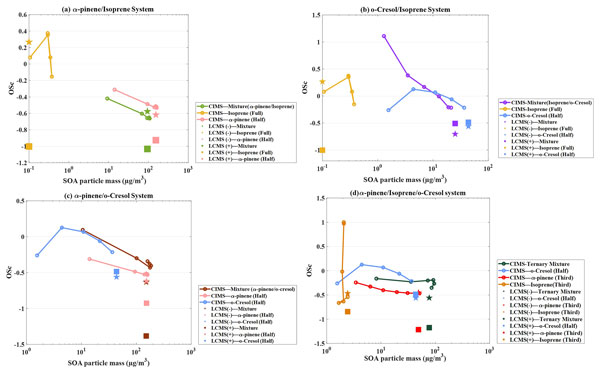
Yunqi Shao, Aristeidis Voliotis, Mao Du, Yu Wang, Thomas J. Bannan, Jacqueline F. Hamilton, M. Rami Alfarra, and Gordon McFiggans
Aerosol Research, 3, 619–636, https://doi.org/10.5194/ar-3-619-2025, https://doi.org/10.5194/ar-3-619-2025, 2025
Short summary
Short summary
This study analysed the average carbon oxidation state (OSc) during secondary organic aerosol formation from mixed volatile organic compounds (VOCs) using three mass spectrometry techniques. Notable discrepancies in OSc were observed across the techniques, with FIGAERO-CIMS reporting higher values. The results also show that OSc in mixed-VOC systems is influenced not only by products from individual precursors but also by accretion products formed through interactions between VOC products.
Alexander Hermanns, Anne Caroline Lange, Julia Kowalski, Hendrik Fuchs, and Philipp Franke
Geosci. Model Dev., 18, 9417–9432, https://doi.org/10.5194/gmd-18-9417-2025, https://doi.org/10.5194/gmd-18-9417-2025, 2025
Short summary
Short summary
For air quality analyses, data assimilation models split available data into assimilation and validation data sets. The former is used to generate the analysis, the latter to verify the simulations. A preprocessor classifying the observations by the data characteristics is developed based on clustering algorithms. The assimilation and validation data sets are compiled by equally allocating data of each cluster. The resulting improvement of the analysis is evaluated with an air quality model.
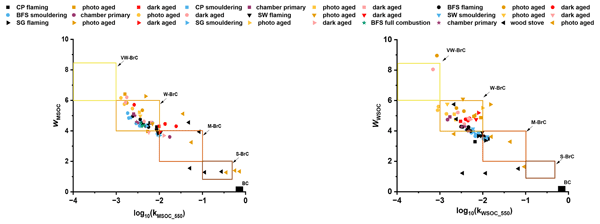
Arya Mukherjee, Anni Hartikainen, Markus Somero, Viljami Luostari, Mika Ihalainen, Christopher P. Rüger, Timo Kekäläinen, Ville H. Nissinen, Luis M. F. Barreira, Hanna Koponen, Tuukka Kokkola, Delun Li, Lejish Vettikkat, Pasi Yli-Pirilä, Muhammad Shahzaib, Meri M. Ruppel, Ville Vakkari, Kerneels Jaars, Stefan J. Siebert, Angela Buchholz, Kajar Köster, Pieter G. van Zyl, Hilkka Timonen, Niko Kinnunen, Janne Jänis, Annele Virtanen, Aki Virkkula, and Olli Sippula
Atmos. Chem. Phys., 25, 16747–16774, https://doi.org/10.5194/acp-25-16747-2025, https://doi.org/10.5194/acp-25-16747-2025, 2025
Short summary
Short summary
Warming climate is predicted to increase boreal and peatland fires in Northern Eurasia. Limited studies have characterized light absorbing aerosol emissions from these biomasses, thus necessitating this work. Brown carbon (BrC) emitted from laboratory-scale biomass burning had weak light absorptivities based on their complex refractive index values. A combustion temperature dependent light absorptivity continuum existed for emitted BrC. Photochemical aging decreased BrC light absorptivity.
Vanessa Engelhardt, Dominik van Pinxteren, and Hartmut Herrmann
EGUsphere, https://doi.org/10.5194/egusphere-2025-5542, https://doi.org/10.5194/egusphere-2025-5542, 2025
Preprint archived
Short summary
Short summary
We analysed 15 years of air pollution and drought data in Saxony, Germany, to understand how ozone in the lower atmosphere harms forests, grasslands, and crops. The study shows that mountain forests continue to absorb ozone even in dry years, while grasslands and wheat lose productivity. These results reveal how climate stress and air pollution together threaten vegetation and crop yields.
Lu Liu, Thorsten Hohaus, Andreas Hofzumahaus, Frank Holland, Hendrik Fuchs, Ralf Tillmann, Birger Bohn, Stefanie Andres, Zhaofeng Tan, Franz Rohrer, Vlassis A. Karydis, Vaishali Vardhan, Philipp Franke, Anne C. Lange, Anna Novelli, Benjamin Winter, Changmin Cho, Iulia Gensch, Sergej Wedel, Andreas Wahner, and Astrid Kiendler-Scharr
Atmos. Chem. Phys., 25, 16189–16213, https://doi.org/10.5194/acp-25-16189-2025, https://doi.org/10.5194/acp-25-16189-2025, 2025
Short summary
Short summary
We measured air particles at a rural site in Germany over a year to understand how their sources and properties change with the seasons. Particles from natural sources peaked in summer, especially during heatwaves, while those from burning activities like residential heating and wildfires dominated in colder months. Winds carrying air from other regions also influenced particle levels. These findings link air quality to climate change and energy transitions.
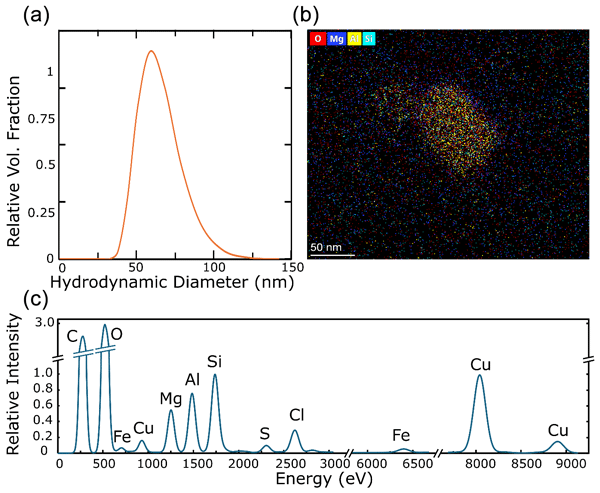
Chiara Giorio, Anne Monod, Valerio Di Marco, Pierre Herckes, Denise Napolitano, Amy Sullivan, Gautier Landrot, Daniel Warnes, Marika Nasti, Sara D'Aronco, Agathe Gérardin, Nicolas Brun, Karine Desboeufs, Sylvain Triquet, Servanne Chevaillier, Claudia Di Biagio, Francesco Battaglia, Frédéric Burnet, Stuart J. Piketh, Andreas Namwoonde, Jean-François Doussin, and Paola Formenti
Atmos. Chem. Phys., 25, 16107–16125, https://doi.org/10.5194/acp-25-16107-2025, https://doi.org/10.5194/acp-25-16107-2025, 2025
Short summary
Short summary
We present a comparison between concentrations of dissolved trace metals in pairs of total suspended particulate (TSP) and fog samples collected in Henties Bay, Namibia, during the AErosols, Radiation and CLOuds in southern Africa (AEROCLO-sA) field campaign. We found enhanced concentrations of dissolved metals in fog samples, which we attributed to metal–ligand complex formation in the early stages of particle activation into droplets that can then remain in a kinetically stable form in fog or lead to the formation of colloidal nanoparticles.
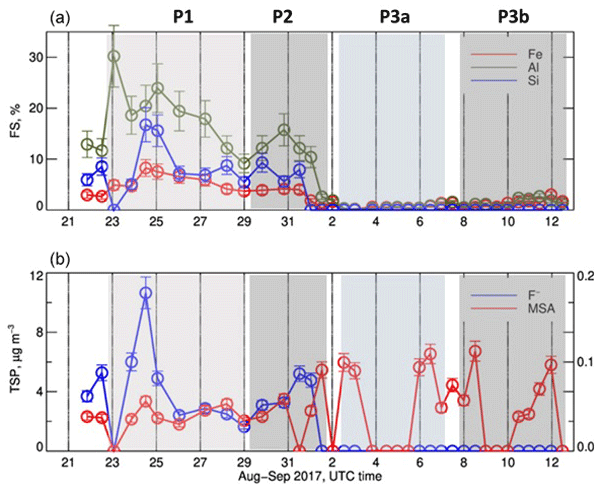
Paola Formenti, Chiara Giorio, Karine Desboeufs, Alexander Zherebker, Marco Gaetani, Clarissa Baldo, Gautier Landrot, Simona Montebello, Servanne Chevaillier, Sylvain Triquet, Guillaume Siour, Claudia Di Biagio, Francesco Battaglia, Jean-François Doussin, Anais Feron, Andreas Namwoonde, and Stuart John Piketh
Atmos. Chem. Phys., 25, 16127–16145, https://doi.org/10.5194/acp-25-16127-2025, https://doi.org/10.5194/acp-25-16127-2025, 2025
Short summary
Short summary
The elemental composition and solubility of several metals, including iron, at a coastal site in Namibia in August–September 2017, indicate that natural and anthropogenic dust had different solubility depending on mineralogy but mostly on the processing by fluoride ions from marine emissions, pointing to the complexity of atmospheric--oceanic interactions in this region of the world influenced by the Benguela current and significant aerosol load.
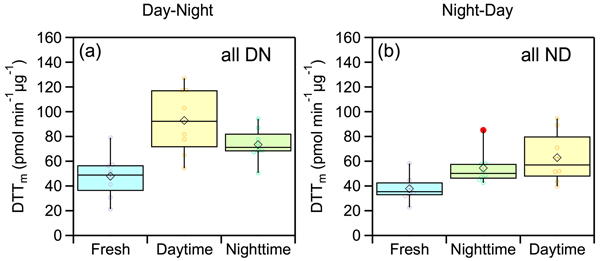
Maria P. Georgopoulou, Kalliopi Florou, Angeliki Matrali, Georgia Starida, Christos Kaltsonoudis, Athanasios Nenes, and Spyros N. Pandis
Atmos. Chem. Phys., 25, 15835–15855, https://doi.org/10.5194/acp-25-15835-2025, https://doi.org/10.5194/acp-25-15835-2025, 2025
Short summary
Short summary
Residential biomass burning is an important wintertime source of aerosols. This study examined the complex diurnal aging cycles on biomass burning aerosol composition and oxidative potential, a key toxicity metric. Additional organic aerosol (OA) mass was produced after the two (day/night and night/day) cycles, varying from 35 to 90 % of the initial OA. The aging of the emissions led to a final oxidative potential increase of 60 % for both cycles.
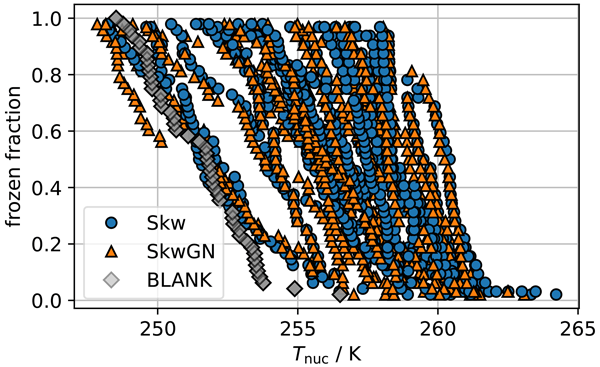
Alexander Böhmländer, Larissa Lacher, Kristina Höhler, David Brus, Konstantinos-Matthaios Doulgeris, Jessica Girdwood, Thomas Leisner, and Ottmar Möhler
Earth Syst. Sci. Data, 17, 6157–6164, https://doi.org/10.5194/essd-17-6157-2025, https://doi.org/10.5194/essd-17-6157-2025, 2025
Short summary
Short summary
Clouds play a key role in weather and climate. Pure liquid water droplets are liquid until about −35 °C without the presence of a small subset of aerosols, ice-nucleating particles (INPs). These INPs lead to primary ice formation and therefore impact the phase of clouds. The dataset described herein provides INP concentration measurements at two altitudes. Connecting this data to synoptic conditions and ambient data might provide a better understanding of INPs in Finnish Lapland.
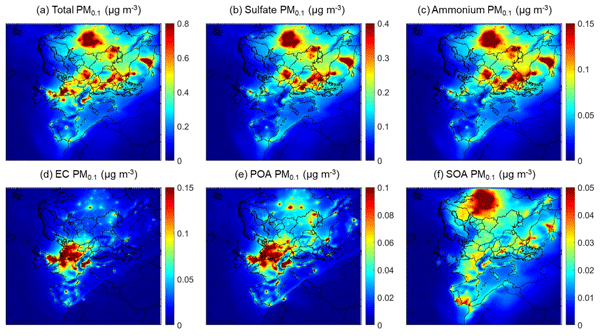
Konstantinos Mataras, Evangelia Siouti, David Patoulias, and Spyros N. Pandis
Atmos. Chem. Phys., 25, 15785–15799, https://doi.org/10.5194/acp-25-15785-2025, https://doi.org/10.5194/acp-25-15785-2025, 2025
Short summary
Short summary
Predicted levels of ultrafine particle mass (PM0.1) vary substantially over Europe with higher values in the summer than in the winter. In summer, PM0.1 was mostly comprised of sulfate (38 %) and secondary organics (32 %). During winter the sulfate fraction increased to 47 % and primary organics contributed 23 %. Correlations between PM0.1 and the regulated PM2.5 were low. This suggests that there are significant differences between the dominant sources and processes of PM0.1 and PM2.5.
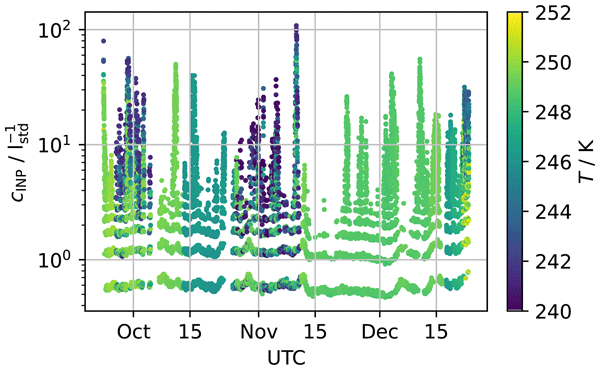
Alexander Böhmländer, Larissa Lacher, Romy Fösig, Nicole Büttner, Jens Nadolny, David Brus, Konstantinos-Matthaios Doulgeris, and Ottmar Möhler
Earth Syst. Sci. Data, 17, 6165–6171, https://doi.org/10.5194/essd-17-6165-2025, https://doi.org/10.5194/essd-17-6165-2025, 2025
Short summary
Short summary
Cloud-aerosol interactions lead to a phase change of water droplets inside the atmosphere. One of these interactions happens due to a small subset of aerosols, ice-nucleating particles (INPs). These INPs lead to the freezing of pure water droplets above −35 °C, which otherwise would stay liquid. This has impacts on the weather and climate. The present data set presents a unique data set with a high temporal resolution.
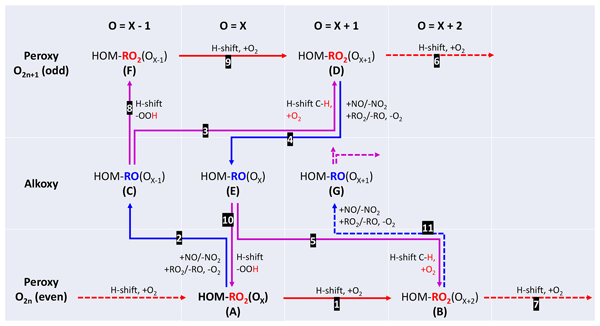
Sungah Kang, Jürgen Wildt, Iida Pullinen, Luc Vereecken, Cheng Wu, Andreas Wahner, Sören R. Zorn, and Thomas F. Mentel
Atmos. Chem. Phys., 25, 15715–15740, https://doi.org/10.5194/acp-25-15715-2025, https://doi.org/10.5194/acp-25-15715-2025, 2025
Short summary
Short summary
Highly oxygenated organic molecules by atmospheric oxidation of plant emitted monoterpenes are important components in secondary organic aerosol formation. Autoxidation of organic peroxy radicals is one important pathway of their formation. We show that isomerization of highly oxygenated alkoxy radicals leads to highly oxygenated peroxy radicals that continue the autoxidation chain. Alkoxy-peroxy steps may dominate the formation of highly oxygenated molecules at high nitrogen oxide levels.
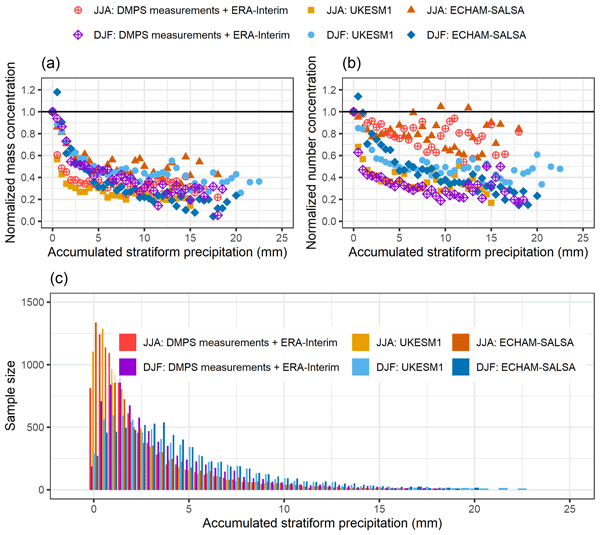
Sini Talvinen, Paul Kim, Emanuele Tovazzi, Eemeli Holopainen, Roxana Cremer, Thomas Kühn, Harri Kokkola, Zak Kipling, David Neubauer, João C. Teixeira, Alistair Sellar, Duncan Watson-Parris, Yang Yang, Jialei Zhu, Srinath Krishnan, Annele Virtanen, and Daniel G. Partridge
Atmos. Chem. Phys., 25, 14449–14478, https://doi.org/10.5194/acp-25-14449-2025, https://doi.org/10.5194/acp-25-14449-2025, 2025
Short summary
Short summary
Climate models struggle to predict how clouds and aerosols interact, affecting Earth’s energy balance. This study compares models to observations to see how they describe effects of clouds and rain on aerosols. While both models show similar overall trends, seasonal differences emerged. These, however, align with differences in key variables participating in cloud formation. The study provides insights on how to improve the representation of aerosol-cloud interactions in climate models.
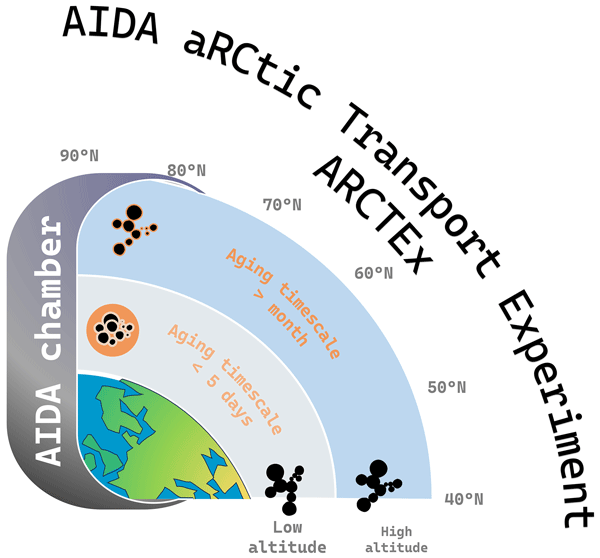
Marco Zanatta, Pia Bogert, Patrick Ginot, Yiwei Gong, Gholam Ali Hoshyaripour, Yaqiong Hu, Feng Jiang, Paolo Laj, Yanxia Li, Claudia Linke, Ottmar Möhler, Harald Saathoff, Martin Schnaiter, Nsikanabasi Silas Umo, Franziska Vogel, and Robert Wagner
Aerosol Research, 3, 477–502, https://doi.org/10.5194/ar-3-477-2025, https://doi.org/10.5194/ar-3-477-2025, 2025
Short summary
Short summary
Back carbon is an atmospheric pollutant from combustion and contributes to the Arctic warming. However, its properties change as it travels through the atmosphere, affecting its impact. We recreated Arctic transport conditions in a laboratory to study how black carbon evolves over time. Our findings show that temperature and altitude strongly influence its transformation, providing key insights for improving climate models and understanding Arctic pollution.
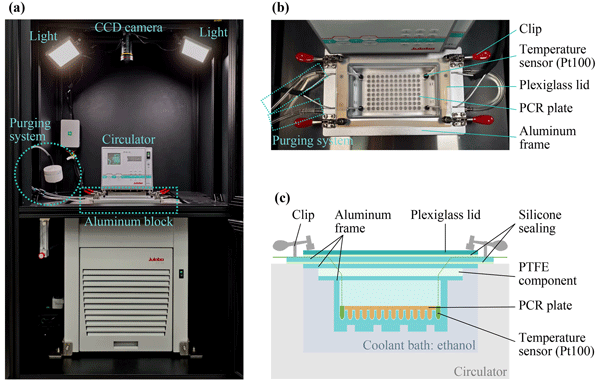
Kaiqi Wang, Kai Bi, Shuling Chen, Markus Hartmann, Zhijun Wu, Jiyu Gao, Xiaoyu Xu, Yuhan Cheng, Mengyu Huang, Yunbo Chen, Huiwen Xue, Bingbing Wang, Yaqiong Hu, Xiongying Zhang, Xincheng Ma, Ruijie Li, Ping Tian, Ottmar Möhler, Heike Wex, Frank Stratmann, Jie Chen, and Xianda Gong
Atmos. Meas. Tech., 18, 5823–5840, https://doi.org/10.5194/amt-18-5823-2025, https://doi.org/10.5194/amt-18-5823-2025, 2025
Short summary
Short summary
Understanding how ice forms in clouds is crucial for predicting weather and climate; however, accurately measuring the ice-nucleating particles that trigger ice formation remains challenging. We developed an advanced instrument called the Freezing Ice Nucleation Detection Analyzer. By refining temperature control, automating freezing detection, and rigorously testing, we demonstrated that this instrument can reliably measure immersion mode ice-nucleating particles across diverse conditions.
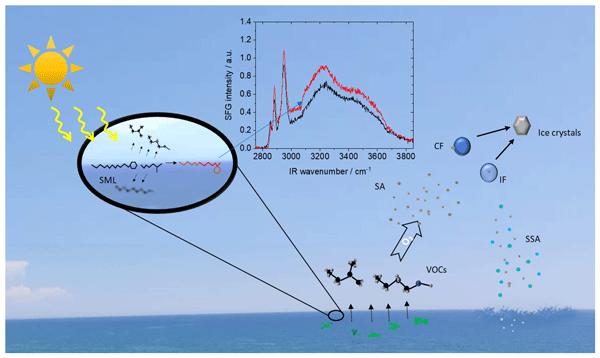
Ahmed Abdelmonem, Dana Glikman, Yiwei Gong, Björn Braunschweig, Harald Saathoff, Johannes Lützenkirchen, and Mohammed H. Fawey
Atmos. Chem. Phys., 25, 13019–13035, https://doi.org/10.5194/acp-25-13019-2025, https://doi.org/10.5194/acp-25-13019-2025, 2025
Short summary
Short summary
This study examines how environmental factors (sunlight, pH, salinity, and surface chemistry) affect air–water interface reactions. Using a surface-specific technique, sum-frequency generation (SFG) spectroscopy, we found that compounds like 4-benzoylbenzoic acid (4-BBA) not only act as photosensitizers but also generate new surface-active products under UV light. These reactions have implications for oceans, lakes, and clouds, providing crucial insights for modeling natural processes.
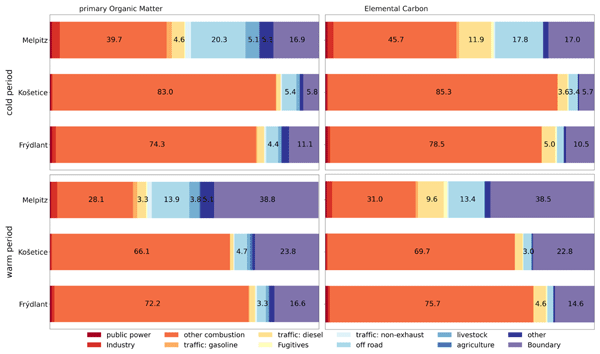
Hanna Wiedenhaus, Roland Schrödner, Ralf Wolke, Marie L. Luttkus, Shubhi Arora, Laurent Poulain, Radek Lhotka, Petr Vodička, Jaroslav Schwarz, Petra Pokorna, Jakub Ondráček, Vladimir Ždímal, Hartmut Herrmann, and Ina Tegen
Atmos. Chem. Phys., 25, 12893–12922, https://doi.org/10.5194/acp-25-12893-2025, https://doi.org/10.5194/acp-25-12893-2025, 2025
Short summary
Short summary
This study examines winter air quality in central Europe, focusing on the impact of domestic heating. Using a chemical transport model and measurements, it was found that the model underestimated organic particle concentrations. This was due to an underestimation of gases from domestic heating that form secondary organic particles. Improving the model by increasing these emissions and the particle formation led to better results, demonstrating the important role of heating emissions in winter.
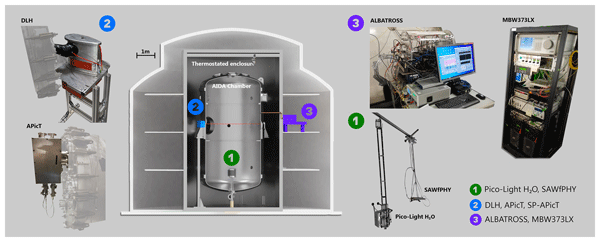
Simone Brunamonti, Harald Saathoff, Albert Hertzog, Glenn Diskin, Masatomo Fujiwara, Karen Rosenlof, Ottmar Möhler, Béla Tuzson, Lukas Emmenegger, Nadir Amarouche, Georges Durry, Fabien Frérot, Jean-Christophe Samake, Claire Cenac, Julio Lopez, Paul Monnier, and Mélanie Ghysels
Atmos. Meas. Tech., 18, 5321–5348, https://doi.org/10.5194/amt-18-5321-2025, https://doi.org/10.5194/amt-18-5321-2025, 2025
Short summary
Short summary
Water vapor is a strong greenhouse gas, and accurate measurements of its concentration in the upper atmosphere (~8–25 km altitude) are crucial for reliable climate predictions. We investigated the performance of four airborne hygrometers, deployed on aircraft or stratospheric balloon platforms and based on different techniques, in a climate simulation chamber. The results demonstrate the high accuracy and reliability of the involved sensors for atmospheric monitoring and research applications.
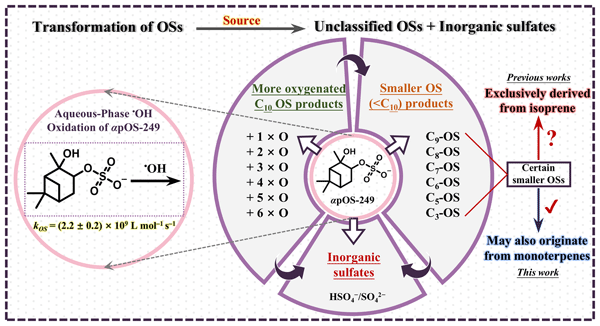
Donger Lai, Yanxin Bai, Zijing Zhang, Pui-Kin So, Yong Jie Li, Ying-Lung Steve Tse, Ying-Yeung Yeung, Thomas Schaefer, Hartmut Herrmann, Jian Zhen Yu, Yuchen Wang, and Man Nin Chan
Atmos. Chem. Phys., 25, 12569–12584, https://doi.org/10.5194/acp-25-12569-2025, https://doi.org/10.5194/acp-25-12569-2025, 2025
Short summary
Short summary
Aqueous-phase •OH oxidation can potentially act as an important atmospheric sink for α-pinene-derived organosulfates (OSs). Such oxidation can also generate a variety of new OS products, and can be as a potential source for some atmospheric OSs with previously unknown origins.
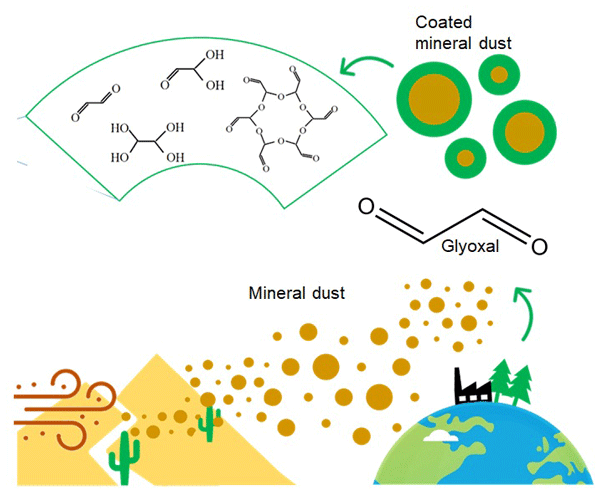
Francesco Battaglia, Paola Formenti, Chiara Giorio, Mathieu Cazaunau, Edouard Pangui, Antonin Bergé, Aline Gratien, Diana L. Pereira, Thomas Bertin, Joel F. de Brito, Manolis N. Romanias, Vincent Michoud, Clarissa Baldo, Servanne Chevaillier, Gael Noyalet, Philippe Decorse, Bénédicte Picquet-Varrault, and Jean-François Doussin
Atmos. Chem. Phys., 25, 12409–12431, https://doi.org/10.5194/acp-25-12409-2025, https://doi.org/10.5194/acp-25-12409-2025, 2025
Short summary
Short summary
This paper presents an experimental investigation of the interactions between glyoxal, an important volatile organic compound, and mineral dust particles of size and composition typical of natural conditions. We show that their interactions modify, in a definitive way, the concentrations of the gas phase and the surface properties of the dust, which could have important implications for the atmospheric composition and the Earth's climate.
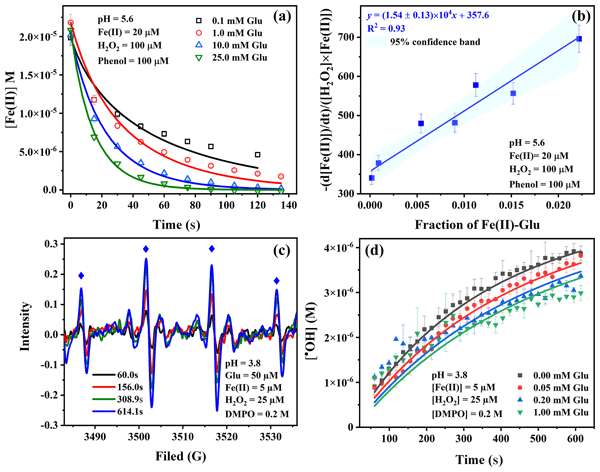
Peng Cheng, Gilles Mailhot, Mohamed Sarakha, Guillaume Voyard, Daniele Scheres Firak, Thomas Schaefer, Hartmut Herrmann, and Marcello Brigante
Atmos. Chem. Phys., 25, 12087–12100, https://doi.org/10.5194/acp-25-12087-2025, https://doi.org/10.5194/acp-25-12087-2025, 2025
Short summary
Short summary
This study investigates the complexation of Fe(II) and Fe(III) with glutamic acid under cloud water conditions and the effect on Fenton and photo-Fenton reactions and hydroxyl radical formation and their impact on amino acid oxidation.
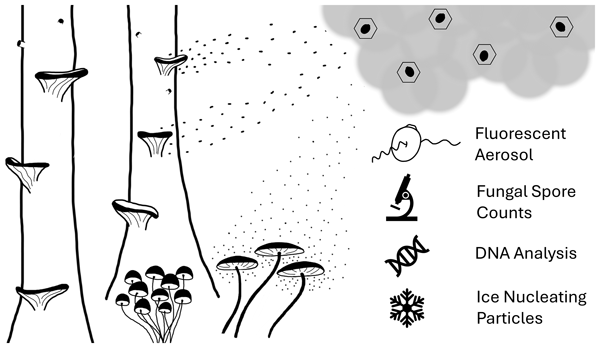
Jürgen Gratzl, Alexander Böhmländer, Sanna Pätsi, Clara-E. Pogner, Markus Gorfer, David Brus, Konstantinos Matthaios Doulgeris, Florian Wieland, Eija Asmi, Annika Saarto, Ottmar Möhler, Dominik Stolzenburg, and Hinrich Grothe
Atmos. Chem. Phys., 25, 12007–12035, https://doi.org/10.5194/acp-25-12007-2025, https://doi.org/10.5194/acp-25-12007-2025, 2025
Short summary
Short summary
We studied particles in the air over 1 year in the Finnish sub-Arctic to understand how biological particles affect ice formation in clouds. We found that fungal spores are the main contributors to ice formation at warmer temperatures. These particles are released locally and vary with the weather. Our results also show that we know very little about which fungi can form ice in the atmosphere, highlighting a major gap in our understanding of how nature influences weather and climate.
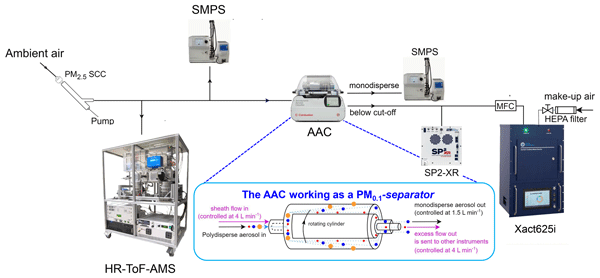
Georgia A. Argyropoulou, Kalliopi Florou, and Spyros N. Pandis
Atmos. Meas. Tech., 18, 4969–4983, https://doi.org/10.5194/amt-18-4969-2025, https://doi.org/10.5194/amt-18-4969-2025, 2025
Short summary
Short summary
Ultrafine particles (diameter of less than 100 nm) are suspected to cause significant health effects. Accurately measuring their chemical composition and physical properties in real time is challenging due to their low mass and interference from larger particles. This study proposes a method for the continuous, automated measurement of their composition, tested in a pilot field study to explore their chemical characteristics, physical properties, and sources.
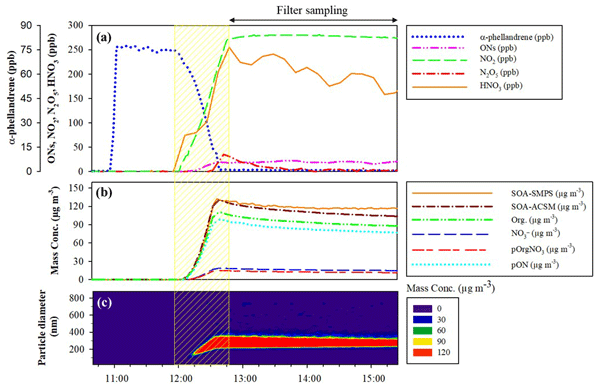
Sergio Harb, Manuela Cirtog, Stéphanie Alage, Christopher Cantrell, Mathieu Cazaunau, Vincent Michoud, Edouard Pangui, Antonin Bergé, Chiara Giorio, Francesco Battaglia, and Bénédicte Picquet-Varrault
Atmos. Chem. Phys., 25, 11003–11024, https://doi.org/10.5194/acp-25-11003-2025, https://doi.org/10.5194/acp-25-11003-2025, 2025
Short summary
Short summary
We investigated the reactions of α- and β-phellandrenes (from vegetation emissions) with NO3 radicals, a major nighttime oxidant from human activities. Using lab-based simulations, we examined these reactions and measured particle formation and by-products. Our findings reveal that α- and β-phellandrenes are efficient particle sources and enhance our understanding of biogenic–anthropogenic interactions and their contributions to atmospheric changes affecting climate and health.
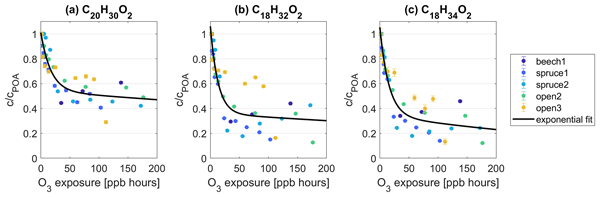
Sophie Bogler, Jun Zhang, Rico K. Y. Cheung, Kun Li, André S. H. Prévôt, Imad El Haddad, and David M. Bell
Atmos. Chem. Phys., 25, 10229–10243, https://doi.org/10.5194/acp-25-10229-2025, https://doi.org/10.5194/acp-25-10229-2025, 2025
Short summary
Short summary
Authentic aerosols emitted from residential wood stoves and open burning processes are only slightly oxidized by ozone in the atmosphere. Under dry conditions, the reaction does not proceed to completion, while under high humidity conditions, the reactivity proceeds further. These results indicate that the reactivity with ozone is likely impacted by aerosol phase state (e.g., aerosol viscosity).
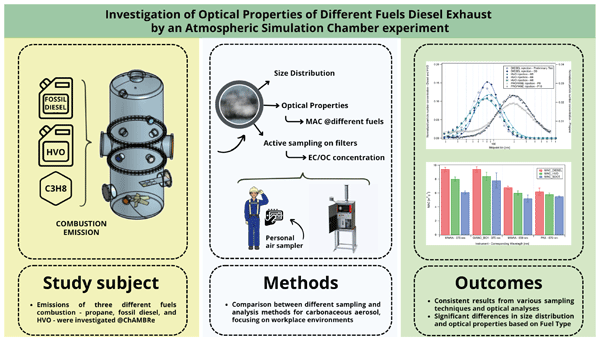
Silvia G. Danelli, Lorenzo Caponi, Marco Brunoldi, Matilde De Camillis, Dario Massabò, Federico Mazzei, Tommaso Isolabella, Annalisa Pascarella, Paolo Prati, Matteo Santostefano, Francesca Tarchino, Virginia Vernocchi, and Paolo Brotto
Atmos. Chem. Phys., 25, 9387–9401, https://doi.org/10.5194/acp-25-9387-2025, https://doi.org/10.5194/acp-25-9387-2025, 2025
Short summary
Short summary
This study examines optical properties and the variability of the mass absorption coefficient of carbonaceous aerosols produced by the combustion of different fuels. Experiments, conducted in an atmospheric simulation chamber, tested different methods of sampling and analyzing carbonaceous aerosols, with a focus on workplace environments. Results highlight the need to understand the variability in aerosol optical properties for accurate monitoring and health and environmental impact assessments.
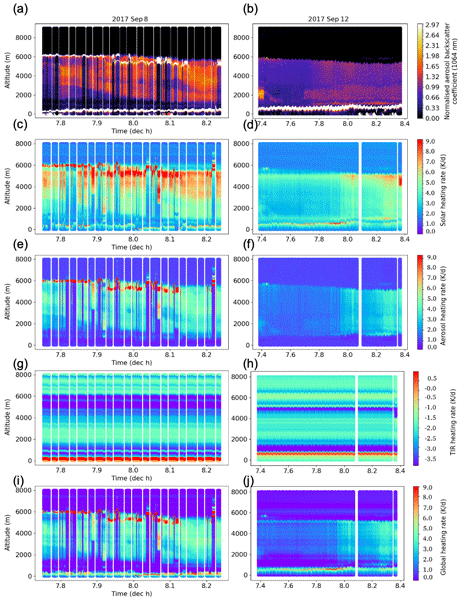
Mégane Ventura, Fabien Waquet, Isabelle Chiapello, Gérard Brogniez, Frédéric Parol, Frédérique Auriol, Rodrigue Loisil, Cyril Delegove, Luc Blarel, Oleg Dubovik, Marc Mallet, Cyrille Flamant, and Paola Formenti
Atmos. Meas. Tech., 18, 4005–4024, https://doi.org/10.5194/amt-18-4005-2025, https://doi.org/10.5194/amt-18-4005-2025, 2025
Short summary
Short summary
Biomass-burning aerosols (BBAs) from Central Africa are transported above stratocumulus clouds. The absorption of solar energy by aerosols induces warming, altering the cloud dynamics. We developed an approach that combines polarimeter and lidar to quantify this. This methodology is assessed during the AEROCLO-sA (AErosol RadiatiOn and CLOud in Southern Africa) campaign. To validate it, we used irradiance measurements acquired during aircraft spiral descents. A major perspective is the generalization of this method to the global level.
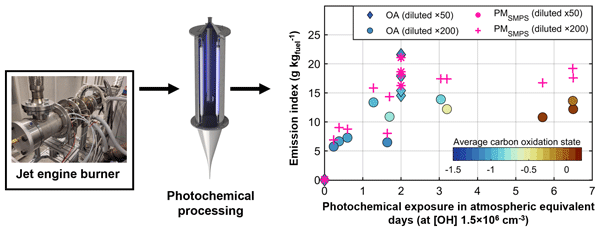
Anni Hartikainen, Mika Ihalainen, Deeksha Shukla, Marius Rohkamp, Arya Mukherjee, Quanfu He, Sandra Piel, Aki Virkkula, Delun Li, Tuukka Kokkola, Seongho Jeong, Hanna Koponen, Uwe Etzien, Anusmita Das, Krista Luoma, Lukas Schwalb, Thomas Gröger, Alexandre Barth, Martin Sklorz, Thorsten Streibel, Hendryk Czech, Benedikt Gündling, Markus Kalberer, Bert Buchholz, Andreas Hupfer, Thomas Adam, Thorsten Hohaus, Johan Øvrevik, Ralf Zimmermann, and Olli Sippula
Atmos. Chem. Phys., 25, 9275–9294, https://doi.org/10.5194/acp-25-9275-2025, https://doi.org/10.5194/acp-25-9275-2025, 2025
Short summary
Short summary
Photochemical reactions altered the properties of kerosene-operated jet engine burner exhaust emissions, which were studied in a laboratory using an oxidation flow reactor. Particle mass increased 300-fold as particles and gases became more oxidized. Light absorption increased, but the total direct radiative forcing efficiency was estimated to have shifted from positive to negative. The results highlight the importance of considering secondary aerosol formation when assessing the impacts of aviation.
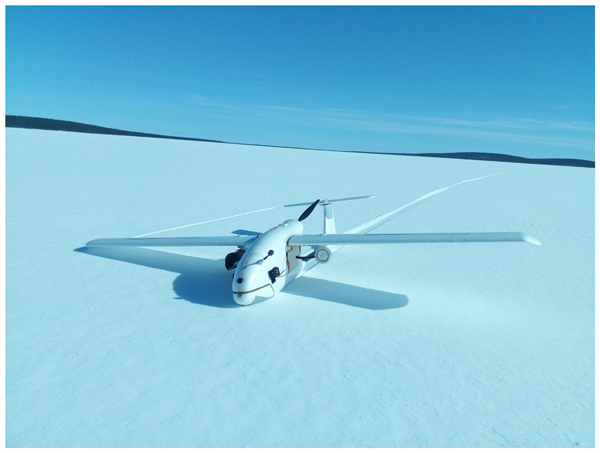
Alexander Böhmländer, Larissa Lacher, David Brus, Konstantinos-Matthaios Doulgeris, Zoé Brasseur, Matthew Boyer, Joel Kuula, Thomas Leisner, and Ottmar Möhler
Atmos. Meas. Tech., 18, 3959–3971, https://doi.org/10.5194/amt-18-3959-2025, https://doi.org/10.5194/amt-18-3959-2025, 2025
Short summary
Short summary
Clouds and aerosol are important for weather and climate. Typically, pure water cloud droplets stay liquid until around −35 °C, unless they come into contact with ice-nucleating particles (INPs). INPs are a rare subset of aerosol particles. Using uncrewed aerial vehicles (UAVs), it is possible to collect aerosol particles and analyse their ice-nucleating ability. This study describes the test and validation of a sampling set-up that can be used to collect aerosol particles onto a filter.
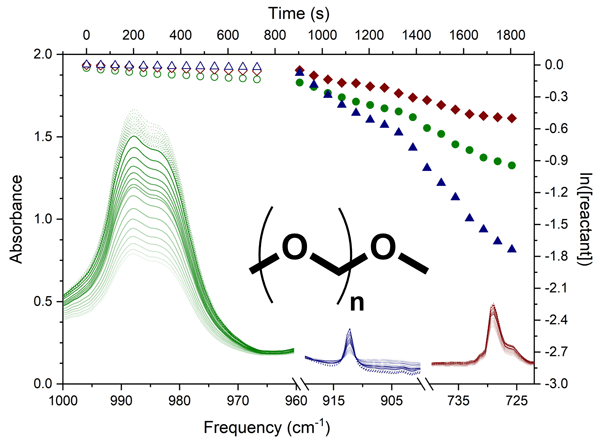
James D'Souza Metcalf, Ruth K. Winkless, Caterina Mapelli, C. Rob McElroy, Claudiu Roman, Cecilia Arsene, Romeo I. Olariu, Iustinian G. Bejan, and Terry J. Dillon
Atmos. Chem. Phys., 25, 9169–9181, https://doi.org/10.5194/acp-25-9169-2025, https://doi.org/10.5194/acp-25-9169-2025, 2025
Short summary
Short summary
Oxymethylene ethers are a class of sustainable compounds that could be used to replace harmful organic solvents in a range of applications. In this work, we use lab-based experiments to identify the main breakdown routes of these compounds in the atmosphere. We have determined that they likely contribute less to air pollution than the compounds that they replace.
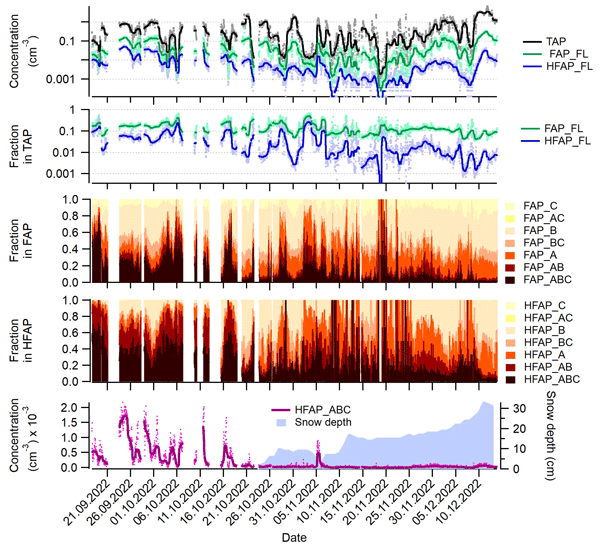
Jürgen Gratzl, David Brus, Konstantinos Doulgeris, Alexander Böhmländer, Ottmar Möhler, and Hinrich Grothe
Earth Syst. Sci. Data, 17, 3975–3985, https://doi.org/10.5194/essd-17-3975-2025, https://doi.org/10.5194/essd-17-3975-2025, 2025
Short summary
Short summary
Near-real time monitoring of airborne biological particles like fungal spores or pollen grains is of great interest for two main reasons: to improve atmospheric allergen forecasts and to deepen the understanding of how bio-aerosols influence cloud formation. Here, we measured fluorescent bio-aerosols in the Finnish sub-Arctic with a high time resolution. A data set that might improve our understanding of biosphere–cloud interactions and the dynamics of bio-aerosols in the atmosphere.
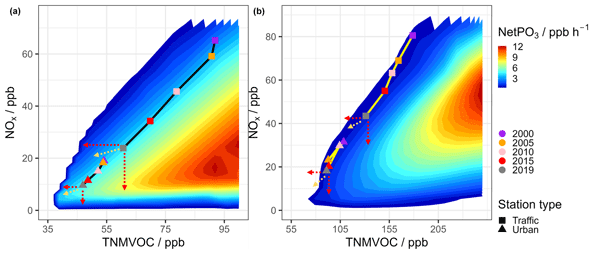
Yaru Wang, Dominik van Pinxteren, Andreas Tilgner, Erik Hans Hoffmann, Max Hell, Susanne Bastian, and Hartmut Herrmann
Atmos. Chem. Phys., 25, 8907–8927, https://doi.org/10.5194/acp-25-8907-2025, https://doi.org/10.5194/acp-25-8907-2025, 2025
Short summary
Short summary
Tropospheric ground-level ozone (O3) is a global air quality pollutant and greenhouse gas. Long-term O3 trends from 16 stations in Saxony, Germany, were compared over three periods, revealing worsened O3 pollution over the last decade. O3 formation has been volatile organic compound (VOC)-limited at traffic and urban sites for the past 20 years. To mitigate O3 pollution, moderate nitrogen oxides and additional VOC controls, particularly in solvent use, should be prioritized in the coming years.
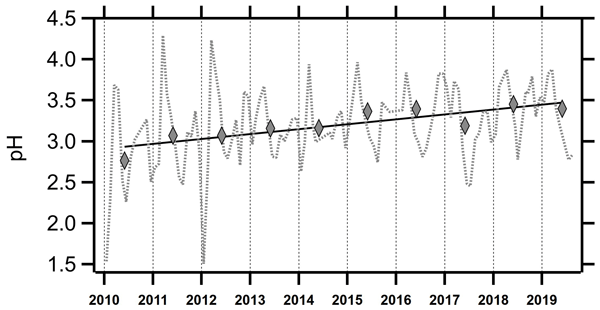
Vikram Pratap, Christopher J. Hennigan, Bastian Stieger, Andreas Tilgner, Laurent Poulain, Dominik van Pinxteren, Gerald Spindler, and Hartmut Herrmann
Atmos. Chem. Phys., 25, 8871–8889, https://doi.org/10.5194/acp-25-8871-2025, https://doi.org/10.5194/acp-25-8871-2025, 2025
Short summary
Short summary
In this work, we characterize trends in aerosol pH and its controlling factors during the period 2010–2019 at the Melpitz research station in eastern Germany. We find strong trends in aerosol pH and major inorganic species in response to changing emissions. We conduct a detailed thermodynamic analysis of the aerosol system and discuss implications for controlling particulate matter in the region.
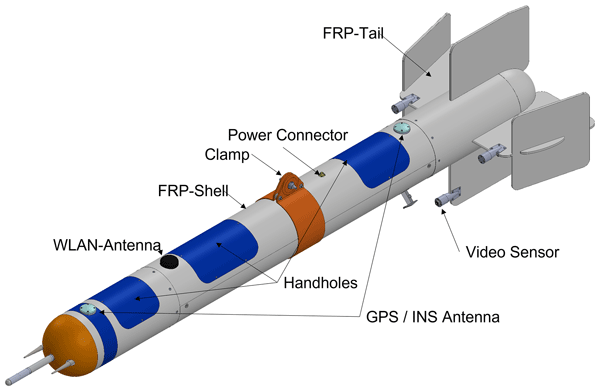
Zsófia Jurányi, Christof Lüpkes, Frank Stratmann, Jörg Hartmann, Jonas Schaefer, Anna-Marie Jörss, Alexander Schulz, Bruno Wetzel, David Simon, Eduard Gebhard, Maximilian Stöhr, Paula Hofmann, Dirk Kalmbach, Sarah Grawe, Manfred Wendisch, and Andreas Herber
Atmos. Meas. Tech., 18, 3477–3494, https://doi.org/10.5194/amt-18-3477-2025, https://doi.org/10.5194/amt-18-3477-2025, 2025
Short summary
Short summary
Understanding the lowest layers of the atmosphere is crucial for climate research, especially in the Arctic. Our study introduces the T-Bird, an aircraft-towed platform designed to measure turbulence and aerosol properties at extremely low altitudes. Traditional aircraft cannot access this region, making the T-Bird a breakthrough for capturing critical atmospheric data. Its first deployment over the Arctic demonstrated its potential to improve our understanding of polar processes.
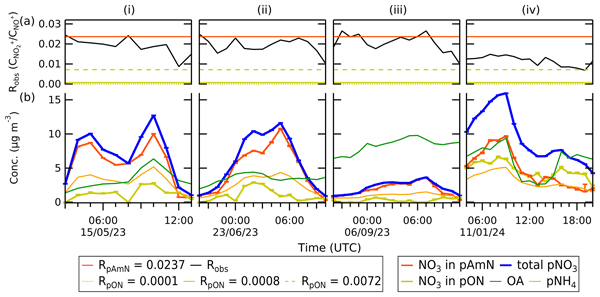
Farhan R. Nursanto, Douglas A. Day, Roy Meinen, Rupert Holzinger, Harald Saathoff, Jinglan Fu, Jan Mulder, Ulrike Dusek, and Juliane L. Fry
Atmos. Meas. Tech., 18, 3051–3072, https://doi.org/10.5194/amt-18-3051-2025, https://doi.org/10.5194/amt-18-3051-2025, 2025
Short summary
Short summary
It is of increasing importance to monitor nitrate pollution that can harm ecosystems. However, commonly used aerosol monitoring equipment cannot distinguish inorganic from organic forms of nitrate, which may have different consequences for the environment. We describe a method to differentiate types of nitrates that can be applied to ambient monitoring to improve understanding of its formation and impact.
Abdulaziz T. Yakubu, Danitza Klopper, Henno Havenga, Roelof Burger, Paola Formenti, and Stuart J. Piketh
EGUsphere, https://doi.org/10.5194/egusphere-2025-1827, https://doi.org/10.5194/egusphere-2025-1827, 2025
Preprint archived
Short summary
Short summary
Low-level inversions experienced along the Namibia coast and adjacent ocean have implications for air pollutant dispersion and low clouds. These affect air quality, human health, radiative forcing and climate change. We used reanalysis and satellite datasets to understand inversion properties over the region. The result shows inversion prominence at night and in winter, seasonally influences pollutant trapping and initiates stratocumulus clouds formation, but is not liable for their extent.
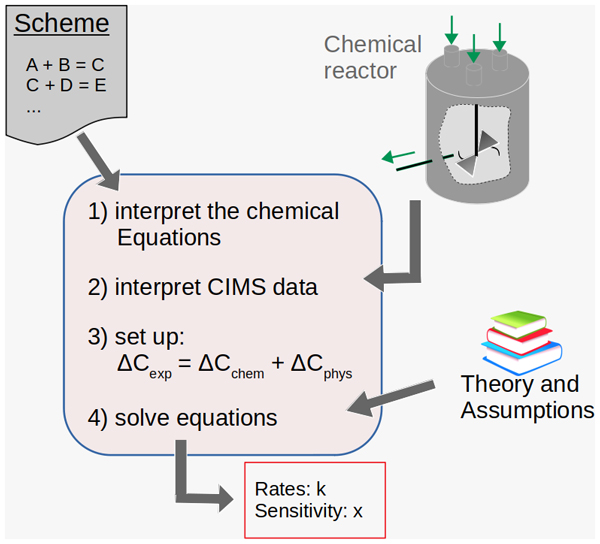
Lukas Pichelstorfer, Simon P. O'Meara, and Gordon McFiggans
Aerosol Research, 3, 417–428, https://doi.org/10.5194/ar-3-417-2025, https://doi.org/10.5194/ar-3-417-2025, 2025
Short summary
Short summary
Quantification of autoxidation chemistry is a complex task essential to our understanding of atmospheric secondary aerosol formation and its impact on climate. In this work, we introduce the autoCONSTRAINT module, a semi-empirical method for deducing reaction rate coefficients for lumped autoxidation chemistry schemes based on experimental data. The theoretical approach is analytical and provides mathematically correct though non-unique solutions with low computational cost.
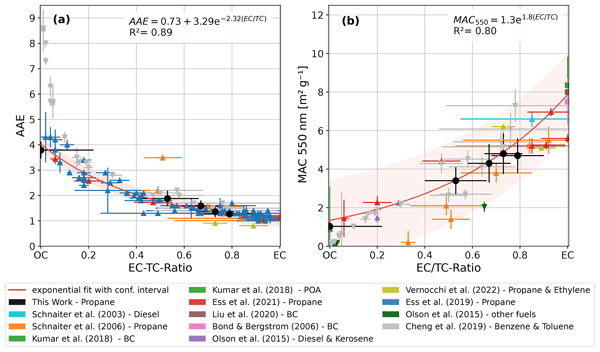
Johannes Heuser, Claudia Di Biagio, Jérôme Yon, Mathieu Cazaunau, Antonin Bergé, Edouard Pangui, Marco Zanatta, Laura Renzi, Angela Marinoni, Satoshi Inomata, Chenjie Yu, Vera Bernardoni, Servanne Chevaillier, Daniel Ferry, Paolo Laj, Michel Maillé, Dario Massabò, Federico Mazzei, Gael Noyalet, Hiroshi Tanimoto, Brice Temime-Roussel, Roberta Vecchi, Virginia Vernocchi, Paola Formenti, Bénédicte Picquet-Varrault, and Jean-François Doussin
Atmos. Chem. Phys., 25, 6407–6428, https://doi.org/10.5194/acp-25-6407-2025, https://doi.org/10.5194/acp-25-6407-2025, 2025
Short summary
Short summary
The spectral optical properties of combustion soot aerosols with varying black (BC) and brown carbon (BrC) content were studied in an atmospheric simulation chamber. Measurements of the mass spectral absorption cross section (MAC), supplemented by literature data, allowed us to establish a generalised exponential relationship between the spectral absorption and the elemental-to-total-carbon ratio (EC / TC) in soot. This relationship can provide a useful tool for modelling the properties of soot.
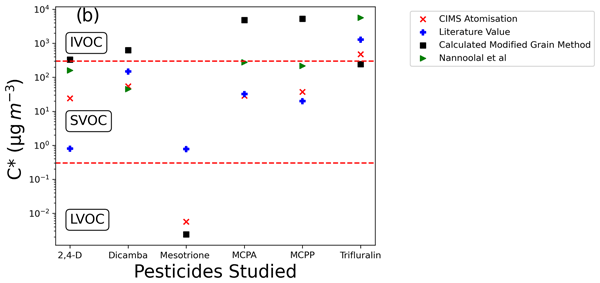
Olivia M. Jackson, Aristeidis Voliotis, Thomas J. Bannan, Simon P. O'Meara, Gordon McFiggans, Dave Johnson, and Hugh Coe
Atmos. Chem. Phys., 25, 6257–6272, https://doi.org/10.5194/acp-25-6257-2025, https://doi.org/10.5194/acp-25-6257-2025, 2025
Short summary
Short summary
This paper details a novel method of measuring the volatility of pesticides using the Filter Inlet for Gases and AEROsols coupled with a chemical ionisation mass spectrometer (FIGAERO-CIMS) calibrated using a set of poly(ethylene) glycols. This is compared to literature values and common models. The results show that the method used primarily matches current literature values. Additionally, a pesticide’s volatility as an indicator of the likelihood of atmospheric transport occurring is explored.
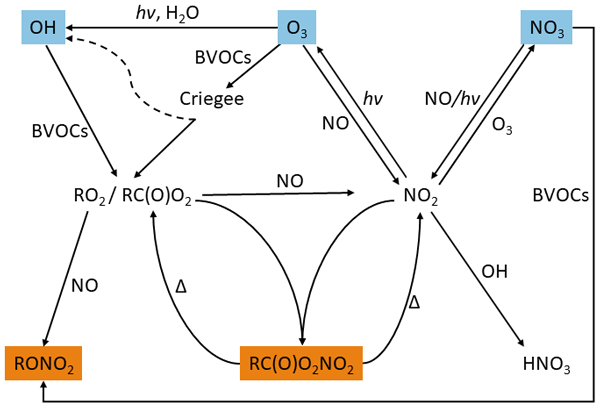
Simone T. Andersen, Rolf Sander, Patrick Dewald, Laura Wüst, Tobias Seubert, Gunther N. T. E. Türk, Jan Schuladen, Max R. McGillen, Chaoyang Xue, Abdelwahid Mellouki, Alexandre Kukui, Vincent Michoud, Manuela Cirtog, Mathieu Cazaunau, Astrid Bauville, Hichem Bouzidi, Paola Formenti, Cyrielle Denjean, Jean-Claude Etienne, Olivier Garrouste, Christopher Cantrell, Jos Lelieveld, and John N. Crowley
Atmos. Chem. Phys., 25, 5893–5909, https://doi.org/10.5194/acp-25-5893-2025, https://doi.org/10.5194/acp-25-5893-2025, 2025
Short summary
Short summary
Measurements and modelling of reactive nitrogen gases observed in a suburban temperate forest in Rambouillet, France, circa 50 km southwest of Paris in 2022 indicate that the biosphere rapidly scavenges organic nitrates of mixed biogenic and anthropogenic origin, resulting in short lifetimes for, for example, alkyl nitrates and peroxy nitrates.
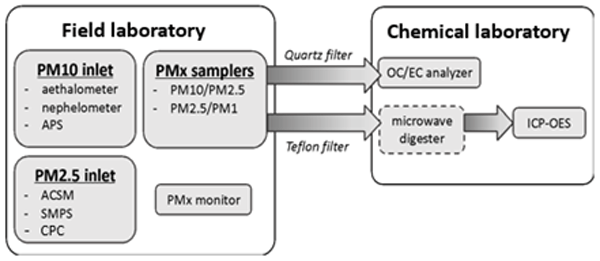
Teresa Laurita, Alessandro Mauceri, Francesco Cardellicchio, Emilio Lapenna, Benedetto De Rosa, Serena Trippetta, Michail Mytilinaios, Davide Amodio, Aldo Giunta, Ermann Ripepi, Canio Colangelo, Nikolaos Papagiannopoulos, Francesca Morrongiello, Claudio Dema, Simone Gagliardi, Carmela Cornacchia, Rosa Maria Petracca Altieri, Aldo Amodeo, Marco Rosoldi, Donato Summa, Gelsomina Pappalardo, and Lucia Mona
Atmos. Meas. Tech., 18, 2373–2396, https://doi.org/10.5194/amt-18-2373-2025, https://doi.org/10.5194/amt-18-2373-2025, 2025
Short summary
Short summary
This paper provides an overview of the CIAO Observatory in southern Italy, focusing on the upgrade of its aerosol in situ laboratory in compliance with ACTRIS standard operating procedures. The aim is to provide the aerosol research community with technical details and practical guidance for establishing an in situ aerosol observational site. The paper also discusses the importance of combining in situ and remote sensing measurements for a comprehensive understanding of atmospheric processes.
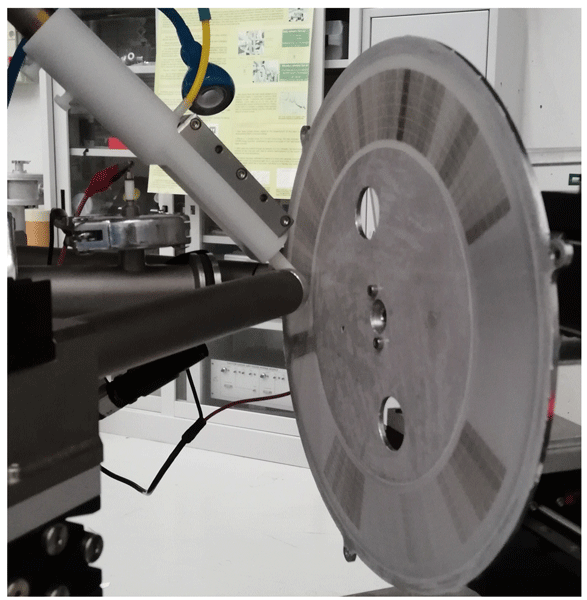
Silvia Nava, Roberta Vecchi, Paolo Prati, Vera Bernardoni, Laura Cadeo, Giulia Calzolai, Luca Carraresi, Carlo Cialdai, Massimo Chiari, Federica Crova, Alice Forello, Cosimo Fratticioli, Fabio Giardi, Marco Manetti, Dario Massabò, Federico Mazzei, Luca Repetto, Gianluigi Valli, Virginia Vernocchi, and Franco Lucarelli
Atmos. Meas. Tech., 18, 2137–2147, https://doi.org/10.5194/amt-18-2137-2025, https://doi.org/10.5194/amt-18-2137-2025, 2025
Short summary
Short summary
The new high-time-resolution sampler STRAS has been designed, developed and tested. It enables automatic sequential sampling of up to 168 hourly samples of PM10, PM2.5 or PM1. It has been conceived for subsequent elemental composition analysis (from Na to Pb) by particle-induced X-ray emission (PIXE), but optical techniques may also be applied to measure black and brown carbon. Its use combined with other high-temporal-resolution instrumentation can provide complete chemical speciation of aerosols on an hourly basis.
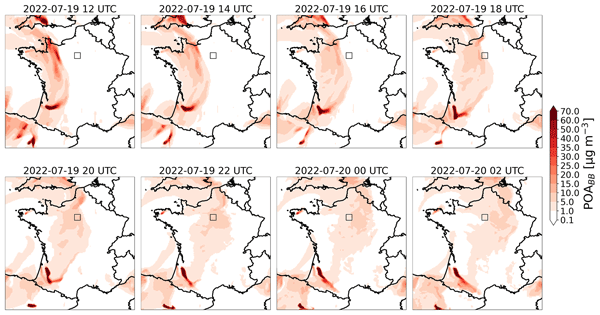
Ludovico Di Antonio, Matthias Beekmann, Guillaume Siour, Vincent Michoud, Christopher Cantrell, Astrid Bauville, Antonin Bergé, Mathieu Cazaunau, Servanne Chevaillier, Manuela Cirtog, Joel F. de Brito, Paola Formenti, Cecile Gaimoz, Olivier Garret, Aline Gratien, Valérie Gros, Martial Haeffelin, Lelia N. Hawkins, Simone Kotthaus, Gael Noyalet, Diana L. Pereira, Jean-Eudes Petit, Eva Drew Pronovost, Véronique Riffault, Chenjie Yu, Gilles Foret, Jean-François Doussin, and Claudia Di Biagio
Atmos. Chem. Phys., 25, 4803–4831, https://doi.org/10.5194/acp-25-4803-2025, https://doi.org/10.5194/acp-25-4803-2025, 2025
Short summary
Short summary
The summer of 2022 has been considered a proxy for future climate scenarios due to its hot and dry conditions. In this paper, we use the measurements from the Atmospheric Chemistry of the Suburban Forest (ACROSS) campaign, conducted in the Paris area in June–July 2022, along with observations from existing networks, to evaluate a 3D chemistry transport model (WRF–CHIMERE) simulation. Results are shown to be satisfactory, allowing us to explain the gas and aerosol variability at the campaign sites.
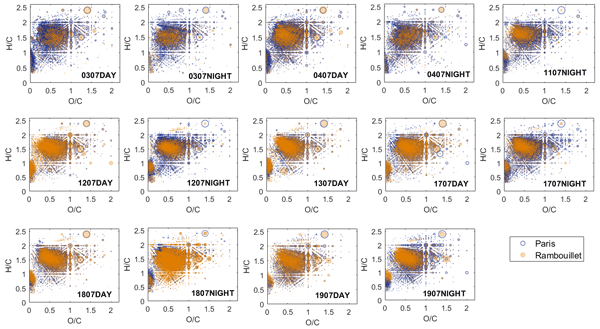
Diana L. Pereira, Chiara Giorio, Aline Gratien, Alexander Zherebker, Gael Noyalet, Servanne Chevaillier, Stéphanie Alage, Elie Almarj, Antonin Bergé, Thomas Bertin, Mathieu Cazaunau, Patrice Coll, Ludovico Di Antonio, Sergio Harb, Johannes Heuser, Cécile Gaimoz, Oscar Guillemant, Brigitte Language, Olivier Lauret, Camilo Macias, Franck Maisonneuve, Bénédicte Picquet-Varrault, Raquel Torres, Sylvain Triquet, Pascal Zapf, Lelia Hawkins, Drew Pronovost, Sydney Riley, Pierre-Marie Flaud, Emilie Perraudin, Pauline Pouyes, Eric Villenave, Alexandre Albinet, Olivier Favez, Robin Aujay-Plouzeau, Vincent Michoud, Christopher Cantrell, Manuela Cirtog, Claudia Di Biagio, Jean-François Doussin, and Paola Formenti
Atmos. Chem. Phys., 25, 4885–4905, https://doi.org/10.5194/acp-25-4885-2025, https://doi.org/10.5194/acp-25-4885-2025, 2025
Short summary
Short summary
In order to study aerosols in environments influenced by anthropogenic and biogenic emissions, we performed analyses of samples collected during the ACROSS (Atmospheric Chemistry Of the Suburban Forest) campaign in summer 2022 in the greater Paris area. After analysis of the chemical composition by means of total carbon determination and high-resolution mass spectrometry, this work highlights the influence of anthropogenic inputs on the chemical composition of both urban and forested areas.
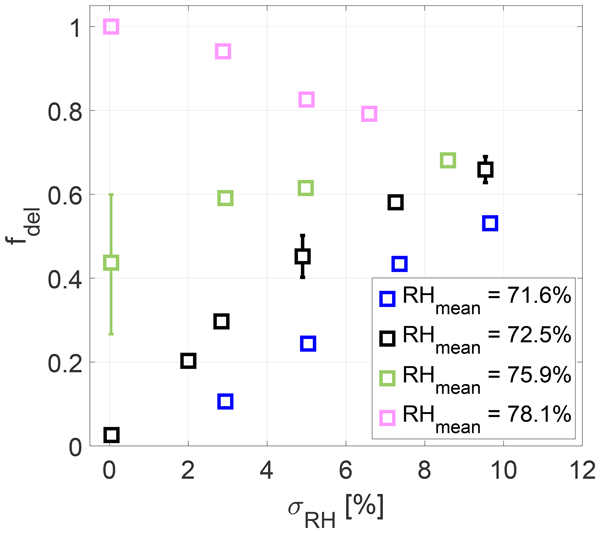
Dennis Niedermeier, Rasmus Hoffmann, Silvio Schmalfuss, Wiebke Frey, Fabian Senf, Olaf Hellmuth, Mira Pöhlker, and Frank Stratmann
Aerosol Research, 3, 219–230, https://doi.org/10.5194/ar-3-219-2025, https://doi.org/10.5194/ar-3-219-2025, 2025
Short summary
Short summary
This study examines the deliquescence behavior of NaCl particles in a turbulent humidity field using the wind tunnel LACIS-T (Turbulent Leipzig Aerosol Cloud Interaction Simulator). The results show that turbulent relative humidity (RH) fluctuations affect the number of deliquesced particles, depending on the mean RH, strength of humidity fluctuations, and particle residence time. It turns out that, in addition to the mean RH, it is essential to consider humidity fluctuations and particle history when determining the phase state of the deliquescent particles.
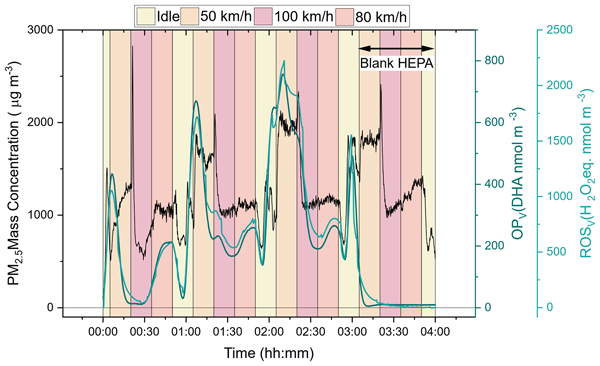
Battist Utinger, Alexandre Barth, Andreas Paul, Arya Mukherjee, Steven John Campbell, Christa-Maria Müller, Mika Ihalainen, Pasi Yli-Pirilä, Miika Kortelainen, Zheng Fang, Patrick Martens, Markus Somero, Juho Louhisalmi, Thorsten Hohaus, Hendryk Czech, Olli Sippula, Yinon Rudich, Ralf Zimmermann, and Markus Kalberer
Aerosol Research, 3, 205–218, https://doi.org/10.5194/ar-3-205-2025, https://doi.org/10.5194/ar-3-205-2025, 2025
Short summary
Short summary
The oxidative potential (OP) of air pollution particles might be a metric explaining particle toxicity. This study quantifies the OP of fresh and aged car and wood burning emission particles and explores how the OP changes over time, using novel high-temporal-resolution instruments. We show that emissions from wood burning are more toxic than car exhaust per unit particle mass, especially as they age in the atmosphere. We also calculate emission factors for the OP, which could help to improve air pollution policies.
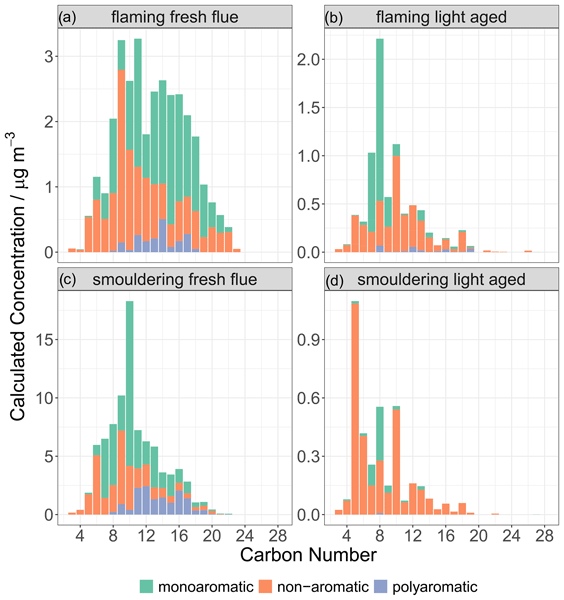
Rhianna L. Evans, Daniel J. Bryant, Aristeidis Voliotis, Dawei Hu, Huihui Wu, Sara Aisyah Syafira, Osayomwanbor E. Oghama, Gordon McFiggans, Jacqueline F. Hamilton, and Andrew R. Rickard
Atmos. Chem. Phys., 25, 4367–4389, https://doi.org/10.5194/acp-25-4367-2025, https://doi.org/10.5194/acp-25-4367-2025, 2025
Short summary
Short summary
The chemical composition of organic aerosol derived from wood-burning emissions under different burning conditions was characterised. Fresh emissions from flaming and smouldering were largely aromatic in nature, whereas upon aging the aromatic content decreased. This decrease was greater for smouldering due to the loss of toxic polyaromatic species, whereas under flaming conditions highly toxic polyaromatic species were produced. These differences present an important challenge for future policy.

André Ehrlich, Susanne Crewell, Andreas Herber, Marcus Klingebiel, Christof Lüpkes, Mario Mech, Sebastian Becker, Stephan Borrmann, Heiko Bozem, Matthias Buschmann, Hans-Christian Clemen, Elena De La Torre Castro, Henning Dorff, Regis Dupuy, Oliver Eppers, Florian Ewald, Geet George, Andreas Giez, Sarah Grawe, Christophe Gourbeyre, Jörg Hartmann, Evelyn Jäkel, Philipp Joppe, Olivier Jourdan, Zsófia Jurányi, Benjamin Kirbus, Johannes Lucke, Anna E. Luebke, Maximilian Maahn, Nina Maherndl, Christian Mallaun, Johanna Mayer, Stephan Mertes, Guillaume Mioche, Manuel Moser, Hanno Müller, Veronika Pörtge, Nils Risse, Greg Roberts, Sophie Rosenburg, Johannes Röttenbacher, Michael Schäfer, Jonas Schaefer, Andreas Schäfler, Imke Schirmacher, Johannes Schneider, Sabrina Schnitt, Frank Stratmann, Christian Tatzelt, Christiane Voigt, Andreas Walbröl, Anna Weber, Bruno Wetzel, Martin Wirth, and Manfred Wendisch
Earth Syst. Sci. Data, 17, 1295–1328, https://doi.org/10.5194/essd-17-1295-2025, https://doi.org/10.5194/essd-17-1295-2025, 2025
Short summary
Short summary
This paper provides an overview of the HALO–(AC)3 aircraft campaign data sets, the campaign-specific instrument operation, data processing, and data quality. The data set comprises in situ and remote sensing observations from three research aircraft: HALO, Polar 5, and Polar 6. All data are published in the PANGAEA database by instrument-separated data subsets. It is highlighted how the scientific analysis of the HALO–(AC)3 data benefits from the coordinated operation of three aircraft.
Michael Rolletter, Andreas Hofzumahaus, Anna Novelli, Andreas Wahner, and Hendrik Fuchs
Atmos. Chem. Phys., 25, 3481–3502, https://doi.org/10.5194/acp-25-3481-2025, https://doi.org/10.5194/acp-25-3481-2025, 2025
Short summary
Short summary
Highly accurate rate coefficients of termolecular reactions between OH and HO2 radicals and reactive nitrogen oxides were measured for conditions in the lower troposphere, providing improved constraints on recommended values. No dependence on water vapour was found except for the HO2+NO2 reaction, which can be explained by an enhanced rate coefficient of the NO2 reaction with the water complex of the HO2 radical.
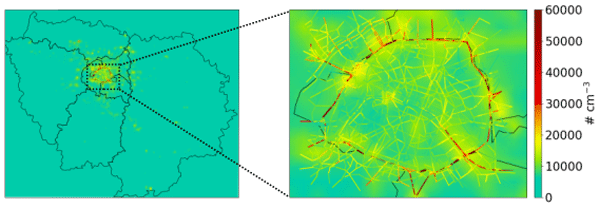
Soo-Jin Park, Lya Lugon, Oscar Jacquot, Youngseob Kim, Alexia Baudic, Barbara D'Anna, Ludovico Di Antonio, Claudia Di Biagio, Fabrice Dugay, Olivier Favez, Véronique Ghersi, Aline Gratien, Julien Kammer, Jean-Eudes Petit, Olivier Sanchez, Myrto Valari, Jérémy Vigneron, and Karine Sartelet
Atmos. Chem. Phys., 25, 3363–3387, https://doi.org/10.5194/acp-25-3363-2025, https://doi.org/10.5194/acp-25-3363-2025, 2025
Short summary
Short summary
To accurately represent the population exposure to outdoor concentrations of pollutants of interest to health (NO2, PM2.5, black carbon, and ultrafine particles), multi-scale modelling down to the street scale is set up and evaluated using measurements from field campaigns. An exposure scaling factor is defined, allowing regional-scale simulations to be corrected to evaluate population exposure. Urban heterogeneities strongly influence NO2, black carbon, and ultrafine particles but less strongly PM2.5.
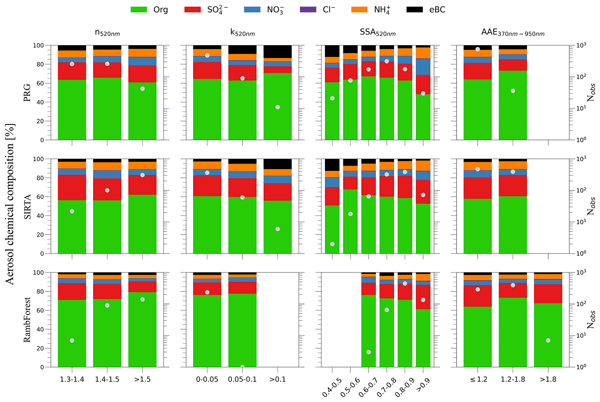
Ludovico Di Antonio, Claudia Di Biagio, Paola Formenti, Aline Gratien, Vincent Michoud, Christopher Cantrell, Astrid Bauville, Antonin Bergé, Mathieu Cazaunau, Servanne Chevaillier, Manuela Cirtog, Patrice Coll, Barbara D'Anna, Joel F. de Brito, David O. De Haan, Juliette R. Dignum, Shravan Deshmukh, Olivier Favez, Pierre-Marie Flaud, Cecile Gaimoz, Lelia N. Hawkins, Julien Kammer, Brigitte Language, Franck Maisonneuve, Griša Močnik, Emilie Perraudin, Jean-Eudes Petit, Prodip Acharja, Laurent Poulain, Pauline Pouyes, Eva Drew Pronovost, Véronique Riffault, Kanuri I. Roundtree, Marwa Shahin, Guillaume Siour, Eric Villenave, Pascal Zapf, Gilles Foret, Jean-François Doussin, and Matthias Beekmann
Atmos. Chem. Phys., 25, 3161–3189, https://doi.org/10.5194/acp-25-3161-2025, https://doi.org/10.5194/acp-25-3161-2025, 2025
Short summary
Short summary
The spectral complex refractive index (CRI) and single scattering albedo were retrieved from submicron aerosol measurements at three sites within the greater Paris area during the ACROSS field campaign (June–July 2022). Measurements revealed urban emission impact on surrounding areas. CRI full period averages at 520 nm were 1.41 – 0.037i (urban), 1.52 – 0.038i (peri-urban), and 1.50 – 0.025i (rural). Organic aerosols dominated the aerosol mass and contributed up to 22 % of absorption at 370 nm.
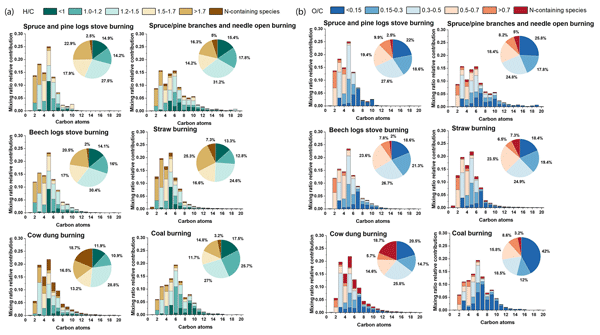
Tiantian Wang, Jun Zhang, Houssni Lamkaddam, Kun Li, Ka Yuen Cheung, Lisa Kattner, Erlend Gammelsæter, Michael Bauer, Zachary C. J. Decker, Deepika Bhattu, Rujin Huang, Rob L. Modini, Jay G. Slowik, Imad El Haddad, Andre S. H. Prevot, and David M. Bell
Atmos. Chem. Phys., 25, 2707–2724, https://doi.org/10.5194/acp-25-2707-2025, https://doi.org/10.5194/acp-25-2707-2025, 2025
Short summary
Short summary
Our study analyzes real-time emissions of organic vapors from solid fuel combustion. Using the mass spectrometer, we tested various fuels, finding higher emission factors for organic vapors from wood burning. Intermediate-volatility organic compounds constituted a significant fraction of emissions in solid fuel combustion. Statistical tests identified unique potential markers. Our insights benefit air quality, climate, and health, aiding accurate emission assessments.
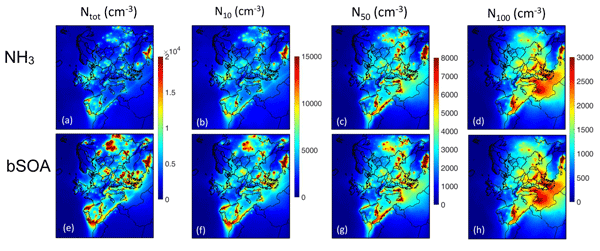
David Patoulias, Kalliopi Florou, and Spyros N. Pandis
Geosci. Model Dev., 18, 1103–1118, https://doi.org/10.5194/gmd-18-1103-2025, https://doi.org/10.5194/gmd-18-1103-2025, 2025
Short summary
Short summary
The effect of the assumed atmospheric nucleation mechanism on particle number concentrations and size distribution was investigated. Two quite different mechanisms involving sulfuric acid and ammonia or a biogenic organic vapor gave quite similar results which were consistent with measurements at 26 measurement stations across Europe. The number of larger particles that serve as cloud condensation nuclei showed little sensitivity to the assumed nucleation mechanism.
Hendrik Fuchs, Aaron Stainsby, Florian Berg, René Dubus, Michelle Färber, Andreas Hofzumahaus, Frank Holland, Kelvin H. Bates, Steven S. Brown, Matthew M. Coggon, Glenn S. Diskin, Georgios I. Gkatzelis, Christopher M. Jernigan, Jeff Peischl, Michael A. Robinson, Andrew W. Rollins, Nell B. Schafer, Rebecca H. Schwantes, Chelsea E. Stockwell, Patrick R. Veres, Carsten Warneke, Eleanor M. Waxman, Lu Xu, Kristen Zuraski, Andreas Wahner, and Anna Novelli
Atmos. Meas. Tech., 18, 881–895, https://doi.org/10.5194/amt-18-881-2025, https://doi.org/10.5194/amt-18-881-2025, 2025
Short summary
Short summary
Significant improvements have been made to the instruments used to measure OH reactivity, which is equivalent to the sum of air pollutant concentrations. Accurate and precise measurements with a high time resolution have been achieved, allowing use on aircraft, as demonstrated during flights in the USA.
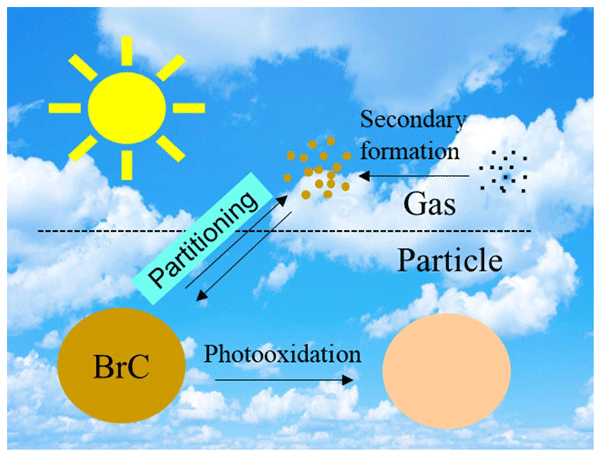
Feng Jiang, Harald Saathoff, Uzoamaka Ezenobi, Junwei Song, Hengheng Zhang, Linyu Gao, and Thomas Leisner
Atmos. Chem. Phys., 25, 1917–1930, https://doi.org/10.5194/acp-25-1917-2025, https://doi.org/10.5194/acp-25-1917-2025, 2025
Short summary
Short summary
The chemical composition of brown carbon in the particle and gas phase was determined by mass spectrometry. BrC in the gas phase was mainly controlled by secondary formation and particle-to-gas partitioning. BrC in the particle phase was mainly from secondary formation. This work helps to get a better understanding of diurnal variations and the sources of brown carbon aerosol at a rural location in central Europe.
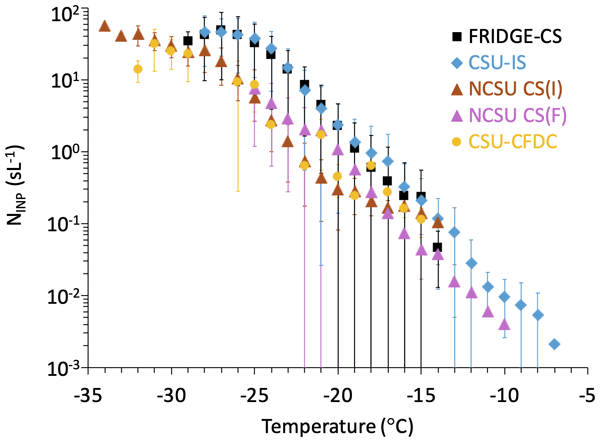
Paul J. DeMott, Jessica A. Mirrielees, Sarah Suda Petters, Daniel J. Cziczo, Markus D. Petters, Heinz G. Bingemer, Thomas C. J. Hill, Karl Froyd, Sarvesh Garimella, A. Gannet Hallar, Ezra J. T. Levin, Ian B. McCubbin, Anne E. Perring, Christopher N. Rapp, Thea Schiebel, Jann Schrod, Kaitlyn J. Suski, Daniel Weber, Martin J. Wolf, Maria Zawadowicz, Jake Zenker, Ottmar Möhler, and Sarah D. Brooks
Atmos. Meas. Tech., 18, 639–672, https://doi.org/10.5194/amt-18-639-2025, https://doi.org/10.5194/amt-18-639-2025, 2025
Short summary
Short summary
The Fifth International Ice Nucleation Workshop Phase 3 (FIN-03) compared the ambient atmospheric performance of ice-nucleating particle (INP) measuring systems and explored general methods for discerning atmospheric INP compositions. Mirroring laboratory results, INP concentrations agreed within 5–10 factors. Measurements of total aerosol properties and investigations of INP compositions supported a dominant role of soil and plant organic aerosol elements as INPs during the study.
Svend L. Bager, Luna Zamok, Stephan P. A. Sauer, and Matthew S. Johnson
EGUsphere, https://doi.org/10.48550/arXiv.2401.10053, https://doi.org/10.48550/arXiv.2401.10053, 2025
Preprint archived
Short summary
Short summary
In this work we have studied by means of quantum chemical calculations at the CCSD(T) or CASPT2 level the kinetics of reactions of both bromine and iodine compounds with Hg, which are discussed to lead to the atmospheric oxidation of Hg. The particular interest is in the question whether the reactions with iodine compounds are as fast as the corresponding reactions with bromine compounds and therefore could also contribute to mercury depletion events.
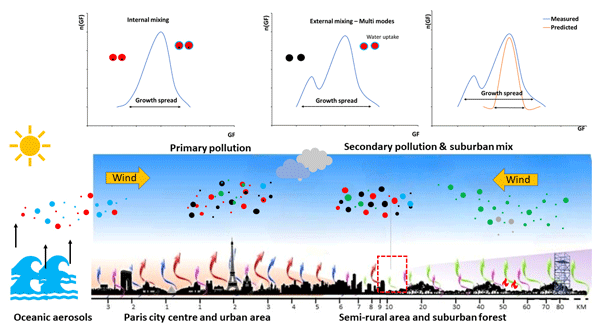
Shravan Deshmukh, Laurent Poulain, Birgit Wehner, Silvia Henning, Jean-Eudes Petit, Pauline Fombelle, Olivier Favez, Hartmut Herrmann, and Mira Pöhlker
Atmos. Chem. Phys., 25, 741–758, https://doi.org/10.5194/acp-25-741-2025, https://doi.org/10.5194/acp-25-741-2025, 2025
Short summary
Short summary
Aerosol hygroscopicity has been investigated at a sub-urban site in Paris; analysis shows the sub-saturated regime's measured hygroscopicity and the chemically derived hygroscopic growth, shedding light on the large effect of external particle mixing and its influence on predicting hygroscopicity.
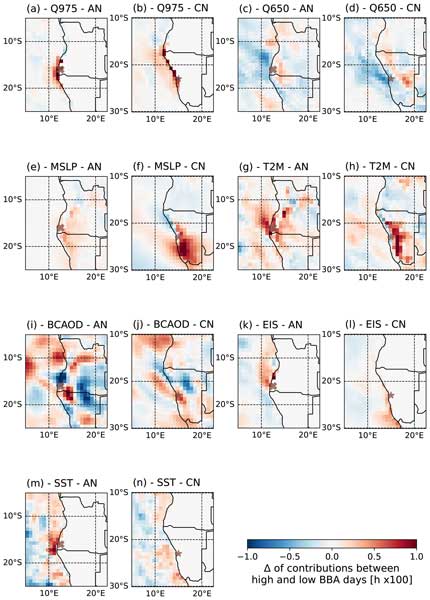
Alexandre Mass, Hendrik Andersen, Jan Cermak, Paola Formenti, Eva Pauli, and Julian Quinting
Atmos. Chem. Phys., 25, 491–510, https://doi.org/10.5194/acp-25-491-2025, https://doi.org/10.5194/acp-25-491-2025, 2025
Short summary
Short summary
This study investigates the interaction between smoke aerosols and fog and low clouds (FLCs) in the Namib Desert between June and October. Here, a satellite-based dataset of FLCs, reanalysis data and machine learning are used to systematically analyze FLC persistence under different aerosol loadings. Aerosol plumes are shown to modify local thermodynamics, which increase FLC persistence. But fully disentangling aerosol effects from meteorological ones remains a challenge.
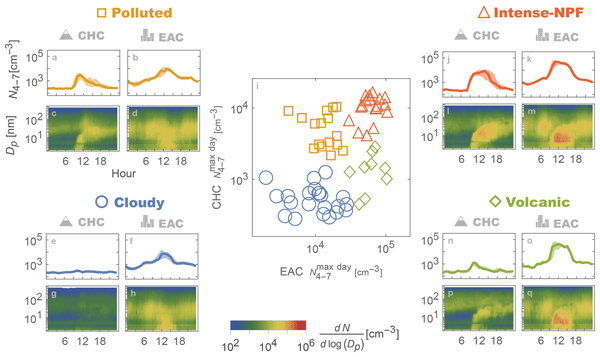
Diego Aliaga, Victoria A. Sinclair, Radovan Krejci, Marcos Andrade, Paulo Artaxo, Luis Blacutt, Runlong Cai, Samara Carbone, Yvette Gramlich, Liine Heikkinen, Dominic Heslin-Rees, Wei Huang, Veli-Matti Kerminen, Alkuin Maximilian Koenig, Markku Kulmala, Paolo Laj, Valeria Mardoñez-Balderrama, Claudia Mohr, Isabel Moreno, Pauli Paasonen, Wiebke Scholz, Karine Sellegri, Laura Ticona, Gaëlle Uzu, Fernando Velarde, Alfred Wiedensohler, Doug Worsnop, Cheng Wu, Chen Xuemeng, Qiaozhi Zha, and Federico Bianchi
Aerosol Research, 3, 15–44, https://doi.org/10.5194/ar-3-15-2025, https://doi.org/10.5194/ar-3-15-2025, 2025
Short summary
Short summary
This study examines new particle formation (NPF) in the Bolivian Andes at Chacaltaya mountain (CHC) and the urban El Alto–La Paz area (EAC). Days are clustered into four categories based on NPF intensity. Differences in particle size, precursor gases, and pollution levels are found. High NPF intensities increased Aitken mode particle concentrations at both sites, while volcanic influence selectively diminished NPF intensity at CHC but not EAC. This study highlights NPF dynamics in the Andes.
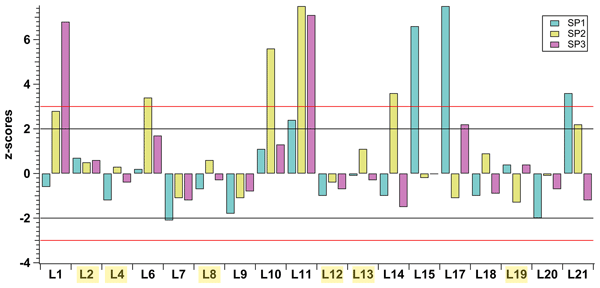
Pamela A. Dominutti, Jean-Luc Jaffrezo, Anouk Marsal, Takoua Mhadhbi, Rhabira Elazzouzi, Camille Rak, Fabrizia Cavalli, Jean-Philippe Putaud, Aikaterini Bougiatioti, Nikolaos Mihalopoulos, Despina Paraskevopoulou, Ian Mudway, Athanasios Nenes, Kaspar R. Daellenbach, Catherine Banach, Steven J. Campbell, Hana Cigánková, Daniele Contini, Greg Evans, Maria Georgopoulou, Manuella Ghanem, Drew A. Glencross, Maria Rachele Guascito, Hartmut Herrmann, Saima Iram, Maja Jovanović, Milena Jovašević-Stojanović, Markus Kalberer, Ingeborg M. Kooter, Suzanne E. Paulson, Anil Patel, Esperanza Perdrix, Maria Chiara Pietrogrande, Pavel Mikuška, Jean-Jacques Sauvain, Katerina Seitanidi, Pourya Shahpoury, Eduardo J. d. S. Souza, Sarah Steimer, Svetlana Stevanovic, Guillaume Suarez, P. S. Ganesh Subramanian, Battist Utinger, Marloes F. van Os, Vishal Verma, Xing Wang, Rodney J. Weber, Yuhan Yang, Xavier Querol, Gerard Hoek, Roy M. Harrison, and Gaëlle Uzu
Atmos. Meas. Tech., 18, 177–195, https://doi.org/10.5194/amt-18-177-2025, https://doi.org/10.5194/amt-18-177-2025, 2025
Short summary
Short summary
In this work, 20 labs worldwide collaborated to evaluate the measurement of air pollution's oxidative potential (OP), a key indicator of its harmful effects. The study aimed to identify disparities in the widely used OP dithiothreitol assay and assess the consistency of OP among labs using the same protocol. The results showed that half of the labs achieved acceptable results. However, variability was also found, highlighting the need for standardisation in OP procedures.
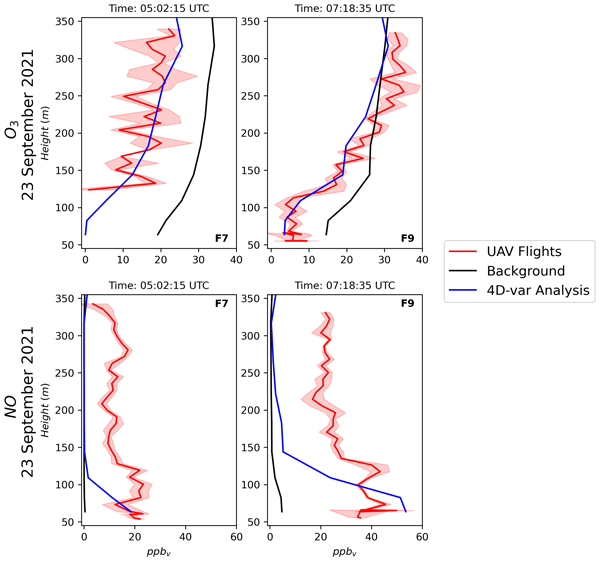
Hassnae Erraji, Philipp Franke, Astrid Lampert, Tobias Schuldt, Ralf Tillmann, Andreas Wahner, and Anne Caroline Lange
Atmos. Chem. Phys., 24, 13913–13934, https://doi.org/10.5194/acp-24-13913-2024, https://doi.org/10.5194/acp-24-13913-2024, 2024
Short summary
Short summary
Four-dimensional variational data assimilation allows for the simultaneous optimisation of initial values and emission rates by using trace-gas profiles from drone observations in a regional air quality model. Assimilated profiles positively impact the representation of air pollutants in the model by improving their vertical distribution and ground-level concentrations. This case study highlights the potential of drone data to enhance air quality analyses including local emission evaluation.
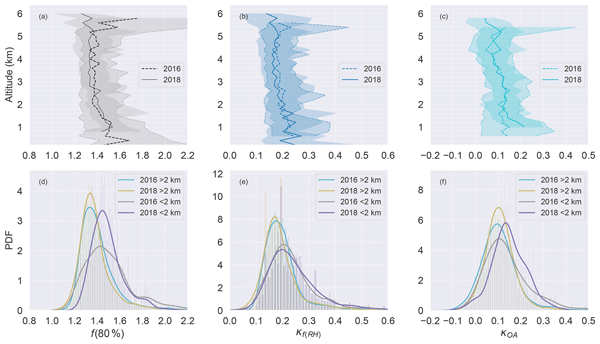
Lu Zhang, Michal Segal-Rozenhaimer, Haochi Che, Caroline Dang, Junying Sun, Ye Kuang, Paola Formenti, and Steven G. Howell
Atmos. Chem. Phys., 24, 13849–13864, https://doi.org/10.5194/acp-24-13849-2024, https://doi.org/10.5194/acp-24-13849-2024, 2024
Short summary
Short summary
Using airborne measurements over the southeast Atlantic Ocean, we examined how much moisture aerosols take up during Africa’s biomass burning season. Our study revealed the important role of organic aerosols and introduced a predictive model for moisture uptake, accounting for organics, sulfate, and black carbon, summarizing results from various campaigns. These findings improve our understanding of aerosol–moisture interactions and their radiative effects in this climatically critical region.
Florian Berg, Anna Novelli, René Dubus, Andreas Hofzumahaus, Frank Holland, Andreas Wahner, and Hendrik Fuchs
Atmos. Chem. Phys., 24, 13715–13731, https://doi.org/10.5194/acp-24-13715-2024, https://doi.org/10.5194/acp-24-13715-2024, 2024
Short summary
Short summary
This study reports temperature-dependent rate coefficients of the reaction of atmospherically relevant hydrocarbons from biogenic sources (methyl vinyl ketones and monoterpenes) and anthropogenic sources (alkanes and aromatics). Measurements were done at atmospheric conditions (ambient pressure and temperature range) in air.
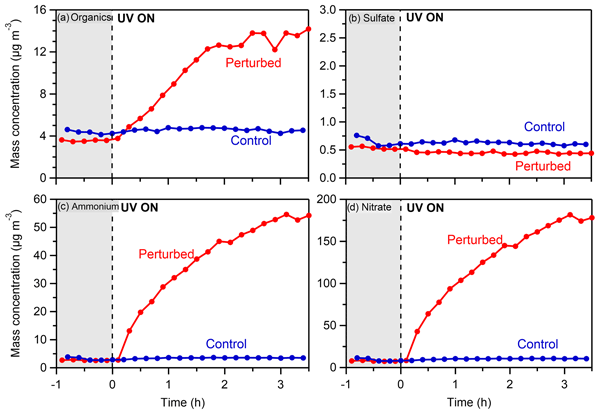
Andreas Aktypis, Dontavious J. Sippial, Christina N. Vasilakopoulou, Angeliki Matrali, Christos Kaltsonoudis, Andrea Simonati, Marco Paglione, Matteo Rinaldi, Stefano Decesari, and Spyros N. Pandis
Atmos. Chem. Phys., 24, 13769–13791, https://doi.org/10.5194/acp-24-13769-2024, https://doi.org/10.5194/acp-24-13769-2024, 2024
Short summary
Short summary
A dual-chamber system was deployed in two different environments (Po Valley, Italy, and Pertouli forest, Greece) to study the potential of ambient air directly injected into the chambers, to form secondary organic aerosol (SOA). In the Po Valley, the system reacts rapidly, forming large amounts of SOA, while in Pertouli the SOA formation chemistry appears to have been practically terminated before the beginning of most experiments, so there is little additional SOA formation potential left.
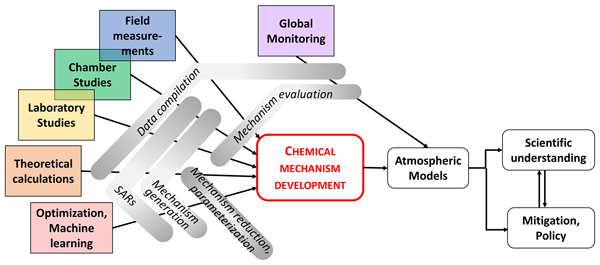
Barbara Ervens, Andrew Rickard, Bernard Aumont, William P. L. Carter, Max McGillen, Abdelwahid Mellouki, John Orlando, Bénédicte Picquet-Varrault, Paul Seakins, William R. Stockwell, Luc Vereecken, and Timothy J. Wallington
Atmos. Chem. Phys., 24, 13317–13339, https://doi.org/10.5194/acp-24-13317-2024, https://doi.org/10.5194/acp-24-13317-2024, 2024
Short summary
Short summary
Chemical mechanisms describe the chemical processes in atmospheric models that are used to describe the changes in the atmospheric composition. Therefore, accurate chemical mechanisms are necessary to predict the evolution of air pollution and climate change. The article describes all steps that are needed to build chemical mechanisms and discusses the advances and needs of experimental and theoretical research activities needed to build reliable chemical mechanisms.
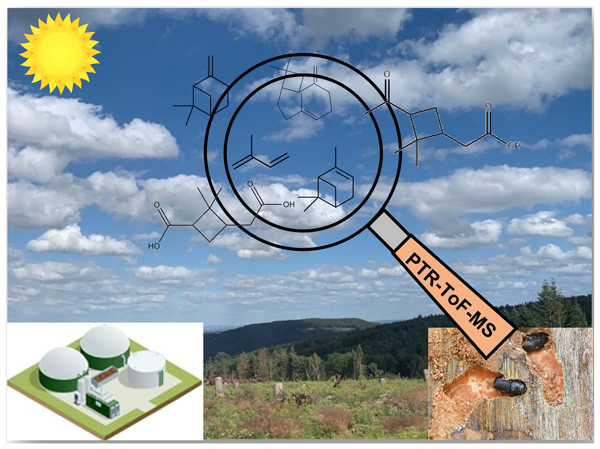
Junwei Song, Georgios I. Gkatzelis, Ralf Tillmann, Nicolas Brüggemann, Thomas Leisner, and Harald Saathoff
Atmos. Chem. Phys., 24, 13199–13217, https://doi.org/10.5194/acp-24-13199-2024, https://doi.org/10.5194/acp-24-13199-2024, 2024
Short summary
Short summary
Biogenic volatile organic compounds (BVOCs) and organic aerosol (OA) particles were measured online in a stressed spruce-dominated forest. OA was mainly attributed to the monoterpene oxidation products. The mixing ratios of BVOCs were higher than the values previously measured in other temperate forests. The results demonstrate that BVOCs are influenced not only by meteorology and biogenic emissions but also by local anthropogenic emissions and subsequent chemical transformation processes.
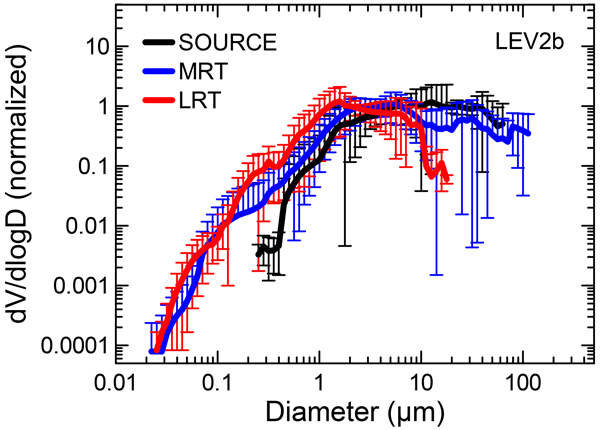
Paola Formenti and Claudia Di Biagio
Earth Syst. Sci. Data, 16, 4995–5007, https://doi.org/10.5194/essd-16-4995-2024, https://doi.org/10.5194/essd-16-4995-2024, 2024
Short summary
Short summary
Particles from deserts and semi-vegetated areas (mineral dust) are important for Earth's climate and human health, notably depending on their size. In this paper we collect and make a synthesis of a body of these observations since 1972 in order to provide researchers modeling Earth's climate and developing satellite observations from space with a simple way of confronting their results and understanding their validity.
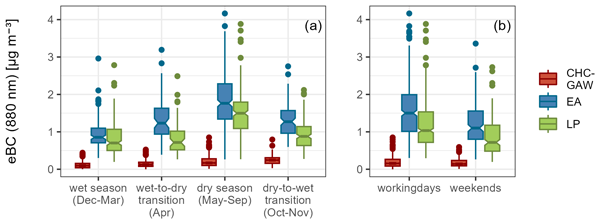
Valeria Mardoñez-Balderrama, Griša Močnik, Marco Pandolfi, Robin L. Modini, Fernando Velarde, Laura Renzi, Angela Marinoni, Jean-Luc Jaffrezo, Isabel Moreno R., Diego Aliaga, Federico Bianchi, Claudia Mohr, Martin Gysel-Beer, Patrick Ginot, Radovan Krejci, Alfred Wiedensohler, Gaëlle Uzu, Marcos Andrade, and Paolo Laj
Atmos. Chem. Phys., 24, 12055–12077, https://doi.org/10.5194/acp-24-12055-2024, https://doi.org/10.5194/acp-24-12055-2024, 2024
Short summary
Short summary
Levels of black carbon (BC) are scarcely reported in the Southern Hemisphere, especially in high-altitude conditions. This study provides insight into the concentration level, variability, and optical properties of BC in La Paz and El Alto and at the Chacaltaya Global Atmosphere Watch Station. Two methods of source apportionment of absorption were tested and compared showing traffic as the main contributor to absorption in the urban area, in addition to biomass and open waste burning.
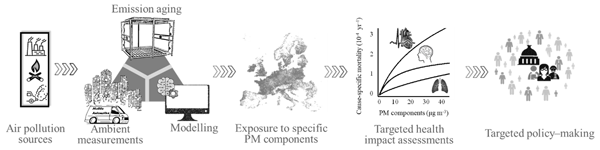
Imad El Haddad, Danielle Vienneau, Kaspar R. Daellenbach, Robin Modini, Jay G. Slowik, Abhishek Upadhyay, Petros N. Vasilakos, David Bell, Kees de Hoogh, and Andre S. H. Prevot
Atmos. Chem. Phys., 24, 11981–12011, https://doi.org/10.5194/acp-24-11981-2024, https://doi.org/10.5194/acp-24-11981-2024, 2024
Short summary
Short summary
This opinion paper explores how advances in aerosol science inform our understanding of the health impacts of outdoor particulate pollution. We advocate for a shift in the way we target PM pollution, focusing on the most harmful anthropogenic emissions. We highlight key observations, modelling developments, and emission measurements needed to achieve this shift.
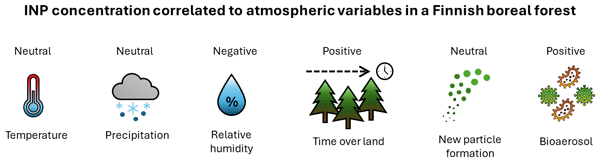
Franziska Vogel, Michael P. Adams, Larissa Lacher, Polly B. Foster, Grace C. E. Porter, Barbara Bertozzi, Kristina Höhler, Julia Schneider, Tobias Schorr, Nsikanabasi S. Umo, Jens Nadolny, Zoé Brasseur, Paavo Heikkilä, Erik S. Thomson, Nicole Büttner, Martin I. Daily, Romy Fösig, Alexander D. Harrison, Jorma Keskinen, Ulrike Proske, Jonathan Duplissy, Markku Kulmala, Tuukka Petäjä, Ottmar Möhler, and Benjamin J. Murray
Atmos. Chem. Phys., 24, 11737–11757, https://doi.org/10.5194/acp-24-11737-2024, https://doi.org/10.5194/acp-24-11737-2024, 2024
Short summary
Short summary
Primary ice formation in clouds strongly influences their properties; hence, it is important to understand the sources of ice-nucleating particles (INPs) and their variability. We present 2 months of INP measurements in a Finnish boreal forest using a new semi-autonomous INP counting device based on gas expansion. These results show strong variability in INP concentrations, and we present a case that the INPs we observe are, at least some of the time, of biological origin.
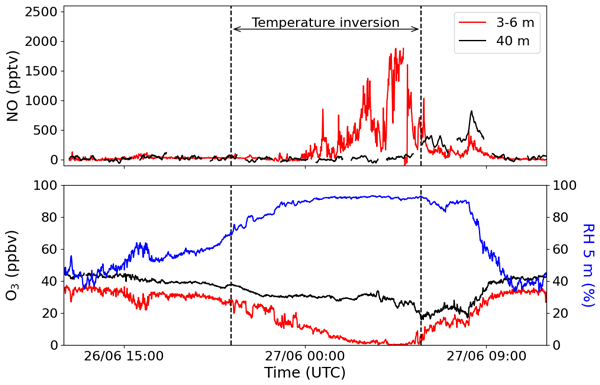
Simone T. Andersen, Max R. McGillen, Chaoyang Xue, Tobias Seubert, Patrick Dewald, Gunther N. T. E. Türk, Jan Schuladen, Cyrielle Denjean, Jean-Claude Etienne, Olivier Garrouste, Marina Jamar, Sergio Harb, Manuela Cirtog, Vincent Michoud, Mathieu Cazaunau, Antonin Bergé, Christopher Cantrell, Sebastien Dusanter, Bénédicte Picquet-Varrault, Alexandre Kukui, Abdelwahid Mellouki, Lucy J. Carpenter, Jos Lelieveld, and John N. Crowley
Atmos. Chem. Phys., 24, 11603–11618, https://doi.org/10.5194/acp-24-11603-2024, https://doi.org/10.5194/acp-24-11603-2024, 2024
Short summary
Short summary
Using measurements of various trace gases in a suburban forest near Paris in the summer of 2022, we were able to gain insight into the sources and sinks of NOx (NO+NO2) with a special focus on their nighttime chemical and physical loss processes. NO was observed as a result of nighttime soil emissions when O3 levels were strongly depleted by deposition. NO oxidation products were not observed at night, indicating that soil and/or foliar surfaces are an efficient sink of reactive N.
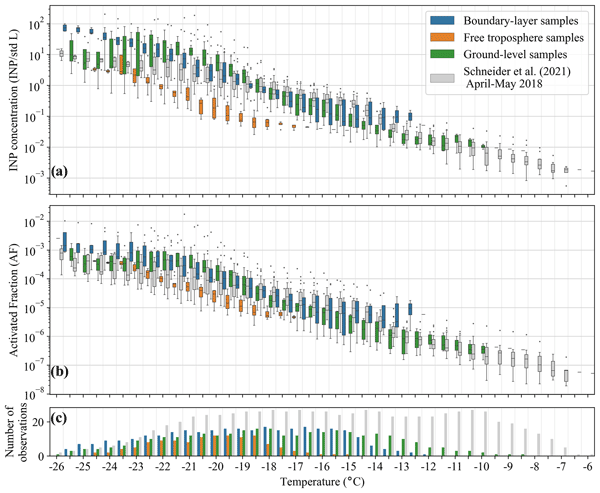
Zoé Brasseur, Julia Schneider, Janne Lampilahti, Ville Vakkari, Victoria A. Sinclair, Christina J. Williamson, Carlton Xavier, Dmitri Moisseev, Markus Hartmann, Pyry Poutanen, Markus Lampimäki, Markku Kulmala, Tuukka Petäjä, Katrianne Lehtipalo, Erik S. Thomson, Kristina Höhler, Ottmar Möhler, and Jonathan Duplissy
Atmos. Chem. Phys., 24, 11305–11332, https://doi.org/10.5194/acp-24-11305-2024, https://doi.org/10.5194/acp-24-11305-2024, 2024
Short summary
Short summary
Ice-nucleating particles (INPs) strongly influence the formation of clouds by initiating the formation of ice crystals. However, very little is known about the vertical distribution of INPs in the atmosphere. Here, we present aircraft measurements of INP concentrations above the Finnish boreal forest. Results show that near-surface INPs are efficiently transported and mixed within the boundary layer and occasionally reach the free troposphere.
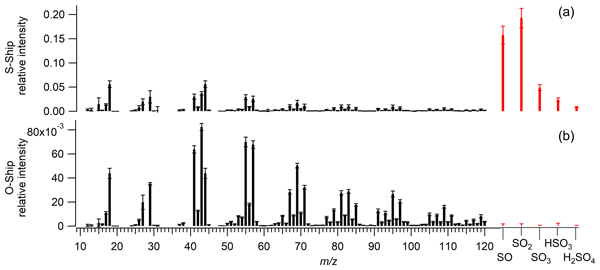
Kirsten N. Fossum, Chunshui Lin, Niall O'Sullivan, Lu Lei, Stig Hellebust, Darius Ceburnis, Aqeel Afzal, Anja Tremper, David Green, Srishti Jain, Steigvilė Byčenkienė, Colin O'Dowd, John Wenger, and Jurgita Ovadnevaite
Atmos. Chem. Phys., 24, 10815–10831, https://doi.org/10.5194/acp-24-10815-2024, https://doi.org/10.5194/acp-24-10815-2024, 2024
Short summary
Short summary
The chemical composition and sources of submicron aerosol in the Dublin Port area were investigated over a month-long campaign. Two distinct types of ship emissions were identified and characterised: sulfate-rich plumes from the use of heavy fuel oil with scrubbers and organic-rich plumes from the use of low-sulfur fuels. The latter were more frequent, emitting double the particle number and having a typical V / Ni ratio for ship emission.
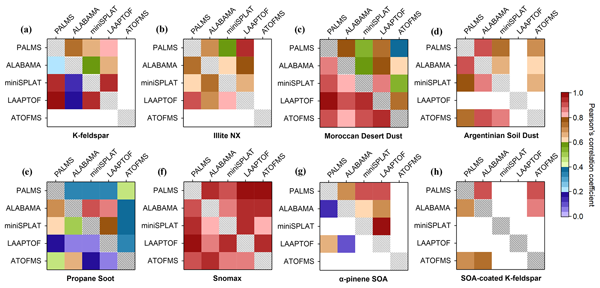
Xiaoli Shen, David M. Bell, Hugh Coe, Naruki Hiranuma, Fabian Mahrt, Nicholas A. Marsden, Claudia Mohr, Daniel M. Murphy, Harald Saathoff, Johannes Schneider, Jacqueline Wilson, Maria A. Zawadowicz, Alla Zelenyuk, Paul J. DeMott, Ottmar Möhler, and Daniel J. Cziczo
Atmos. Chem. Phys., 24, 10869–10891, https://doi.org/10.5194/acp-24-10869-2024, https://doi.org/10.5194/acp-24-10869-2024, 2024
Short summary
Short summary
Single-particle mass spectrometry (SPMS) is commonly used to measure the chemical composition and mixing state of aerosol particles. Intercomparison of SPMS instruments was conducted. All instruments reported similar size ranges and common spectral features. The instrument-specific detection efficiency was found to be more dependent on particle size than type. All differentiated secondary organic aerosol, soot, and soil dust but had difficulties differentiating among minerals and dusts.
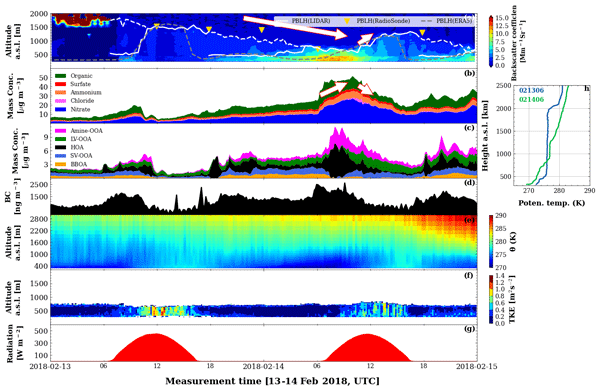
Hengheng Zhang, Wei Huang, Xiaoli Shen, Ramakrishna Ramisetty, Junwei Song, Olga Kiseleva, Christopher Claus Holst, Basit Khan, Thomas Leisner, and Harald Saathoff
Atmos. Chem. Phys., 24, 10617–10637, https://doi.org/10.5194/acp-24-10617-2024, https://doi.org/10.5194/acp-24-10617-2024, 2024
Short summary
Short summary
Our study unravels how stagnant winter conditions elevate aerosol levels in Stuttgart. Cloud cover at night plays a pivotal role, impacting morning air quality. Validating a key model, our findings aid accurate air quality predictions, crucial for effective pollution mitigation in urban areas.
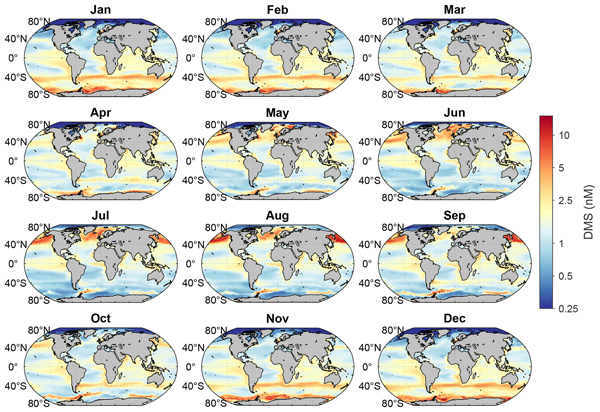
Shengqian Zhou, Ying Chen, Shan Huang, Xianda Gong, Guipeng Yang, Honghai Zhang, Hartmut Herrmann, Alfred Wiedensohler, Laurent Poulain, Yan Zhang, Fanghui Wang, Zongjun Xu, and Ke Yan
Earth Syst. Sci. Data, 16, 4267–4290, https://doi.org/10.5194/essd-16-4267-2024, https://doi.org/10.5194/essd-16-4267-2024, 2024
Short summary
Short summary
Dimethyl sulfide (DMS) is a crucial natural reactive gas in the global climate system due to its great contribution to aerosols and subsequent impact on clouds over remote oceans. Leveraging machine learning techniques, we constructed a long-term global sea surface DMS gridded dataset with daily resolution. Compared to previous datasets, our new dataset holds promise for improving atmospheric chemistry modeling and advancing our comprehension of the climate effects associated with oceanic DMS.
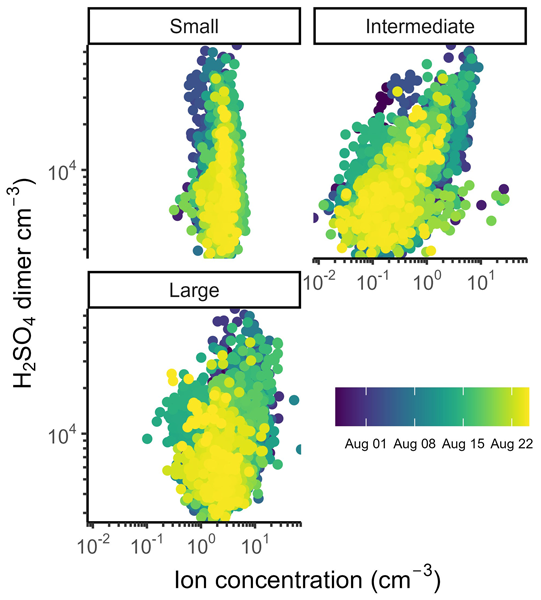
Alex Rowell, James Brean, David C. S. Beddows, Zongbo Shi, Avinash Kumar, Matti Rissanen, Miikka Dal Maso, Peter Mettke, Kay Weinhold, Maik Merkel, and Roy M. Harrison
Atmos. Chem. Phys., 24, 10349–10361, https://doi.org/10.5194/acp-24-10349-2024, https://doi.org/10.5194/acp-24-10349-2024, 2024
Short summary
Short summary
Ions enhance the formation and growth rates of new particles, affecting the Earth's radiation budget. Despite these effects, there is little published data exploring the sources of ions in the urban environment and their role in new particle formation (NPF). Here we show that natural ion sources dominate in urban environments, while traffic is a secondary source. Ions contribute up to 12.7 % of the formation rate of particles, indicating that they are important for forming urban PM.
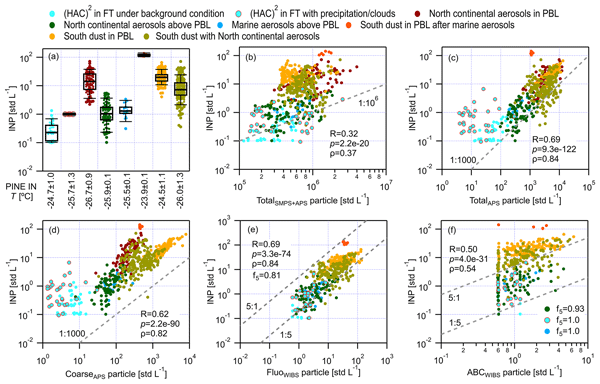
Kunfeng Gao, Franziska Vogel, Romanos Foskinis, Stergios Vratolis, Maria I. Gini, Konstantinos Granakis, Anne-Claire Billault-Roux, Paraskevi Georgakaki, Olga Zografou, Prodromos Fetfatzis, Alexis Berne, Alexandros Papayannis, Konstantinos Eleftheridadis, Ottmar Möhler, and Athanasios Nenes
Atmos. Chem. Phys., 24, 9939–9974, https://doi.org/10.5194/acp-24-9939-2024, https://doi.org/10.5194/acp-24-9939-2024, 2024
Short summary
Short summary
Ice nucleating particle (INP) concentrations are required for correct predictions of clouds and precipitation in a changing climate, but they are poorly constrained in climate models. We unravel source contributions to INPs in the eastern Mediterranean and find that biological particles are important, regardless of their origin. The parameterizations developed exhibit superior performance and enable models to consider biological-particle effects on INPs.
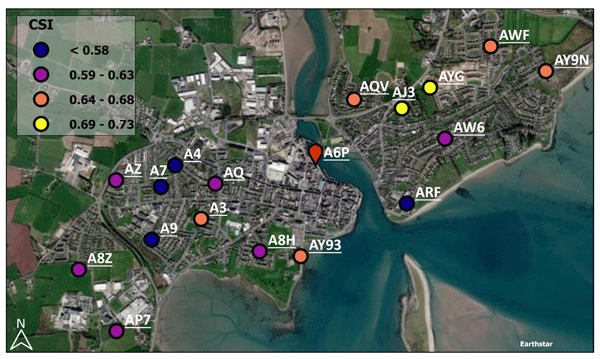
Rósín Byrne, John C. Wenger, and Stig Hellebust
Atmos. Meas. Tech., 17, 5129–5146, https://doi.org/10.5194/amt-17-5129-2024, https://doi.org/10.5194/amt-17-5129-2024, 2024
Short summary
Short summary
This study presents the concentration similarity index (CSI) for a quantitative and robust comparison of PM2.5 measurements within air quality sensor networks. Developed and tested on two Irish sensor networks, the CSI revealed real spatial variations in PM2.5 and enables assessment of the representativeness of regulatory monitoring locations. It underscores the impact of solid fuel combustion on PM2.5 and highlights the importance of wintertime data for accurate exposure assessments.
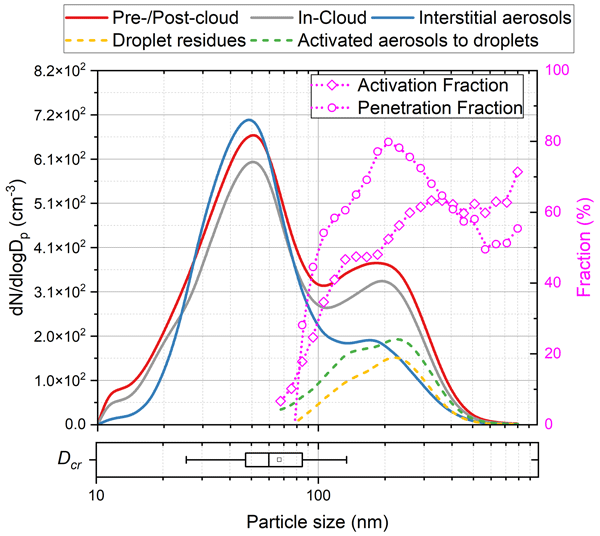
Romanos Foskinis, Ghislain Motos, Maria I. Gini, Olga Zografou, Kunfeng Gao, Stergios Vratolis, Konstantinos Granakis, Ville Vakkari, Kalliopi Violaki, Andreas Aktypis, Christos Kaltsonoudis, Zongbo Shi, Mika Komppula, Spyros N. Pandis, Konstantinos Eleftheriadis, Alexandros Papayannis, and Athanasios Nenes
Atmos. Chem. Phys., 24, 9827–9842, https://doi.org/10.5194/acp-24-9827-2024, https://doi.org/10.5194/acp-24-9827-2024, 2024
Short summary
Short summary
Analysis of modeling, in situ, and remote sensing measurements reveals the microphysical state of orographic clouds and their response to aerosol from the boundary layer and free troposphere. We show that cloud response to aerosol is robust, as predicted supersaturation and cloud droplet number levels agree with those determined from in-cloud measurements. The ability to determine if clouds are velocity- or aerosol-limited allows for novel model constraints and remote sensing products.
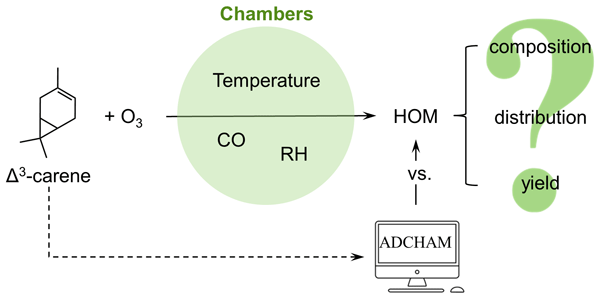
Yuanyuan Luo, Ditte Thomsen, Emil Mark Iversen, Pontus Roldin, Jane Tygesen Skønager, Linjie Li, Michael Priestley, Henrik B. Pedersen, Mattias Hallquist, Merete Bilde, Marianne Glasius, and Mikael Ehn
Atmos. Chem. Phys., 24, 9459–9473, https://doi.org/10.5194/acp-24-9459-2024, https://doi.org/10.5194/acp-24-9459-2024, 2024
Short summary
Short summary
∆3-carene is abundantly emitted from vegetation, but its atmospheric oxidation chemistry has received limited attention. We explored highly oxygenated organic molecule (HOM) formation from ∆3-carene ozonolysis in chambers and investigated the impact of temperature and relative humidity on HOM formation. Our findings provide new insights into ∆3-carene oxidation pathways and their potential to impact atmospheric aerosols.
Kuo-Ying Wang, Philippe Nedelec, Valerie Thouret, Hannah Clark, Andreas Wahner, and Andreas Petzold
EGUsphere, https://doi.org/10.5194/egusphere-2024-2414, https://doi.org/10.5194/egusphere-2024-2414, 2024
Preprint archived
Short summary
Short summary
We use routine in-service commercial passenger airplanes Airbus A340 and A330 to collect air pollutants in the upper troposphere. The beauty in using commercial airplanes is that these commercial airplanes, like taxi on the ground, keep flying all the time. We find that short-lived air pollutants are very sensitive to ground-level emissions. Effective regulation in ground-level emissions can help to reduce air pollution in the upper troposphere.
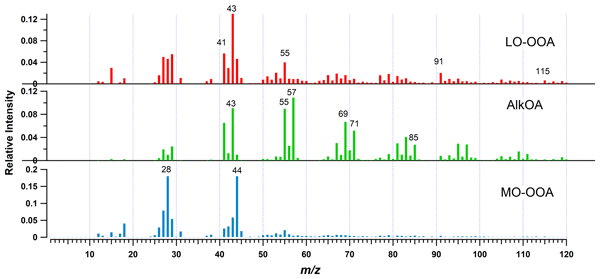
Saleh Alzahrani, Doğuşhan Kılıç, Michael Flynn, Paul I. Williams, and James Allan
Atmos. Chem. Phys., 24, 9045–9058, https://doi.org/10.5194/acp-24-9045-2024, https://doi.org/10.5194/acp-24-9045-2024, 2024
Short summary
Short summary
This paper investigates emissions from aviation activities at an international airport to evaluate their impact on local air quality. The study provides detailed insights into the chemical composition of aerosols and key pollutants in the airport environment. Source apportionment analysis using positive matrix factorisation (PMF) identified three significant sources: less oxidised oxygenated organic aerosol, alkane organic aerosol, and more oxidised oxygenated organic aerosol.
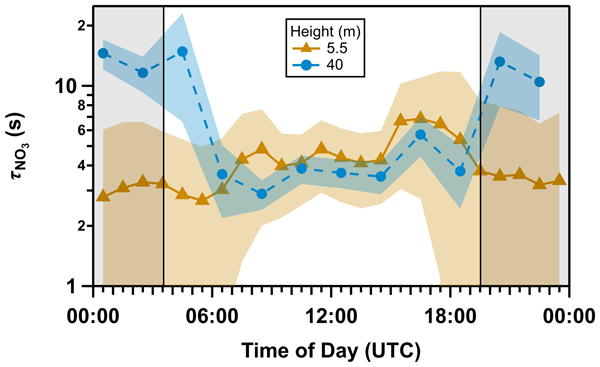
Patrick Dewald, Tobias Seubert, Simone T. Andersen, Gunther N. T. E. Türk, Jan Schuladen, Max R. McGillen, Cyrielle Denjean, Jean-Claude Etienne, Olivier Garrouste, Marina Jamar, Sergio Harb, Manuela Cirtog, Vincent Michoud, Mathieu Cazaunau, Antonin Bergé, Christopher Cantrell, Sebastien Dusanter, Bénédicte Picquet-Varrault, Alexandre Kukui, Chaoyang Xue, Abdelwahid Mellouki, Jos Lelieveld, and John N. Crowley
Atmos. Chem. Phys., 24, 8983–8997, https://doi.org/10.5194/acp-24-8983-2024, https://doi.org/10.5194/acp-24-8983-2024, 2024
Short summary
Short summary
In the scope of a field campaign in a suburban forest near Paris in the summer of 2022, we measured the reactivity of the nitrate radical NO3 towards biogenic volatile organic compounds (BVOCs; e.g. monoterpenes) mainly below but also above the canopy. NO3 reactivity was the highest during nights with strong temperature inversions and decreased strongly with height. Reactions with BVOCs were the main removal process of NO3 throughout the diel cycle below the canopy.
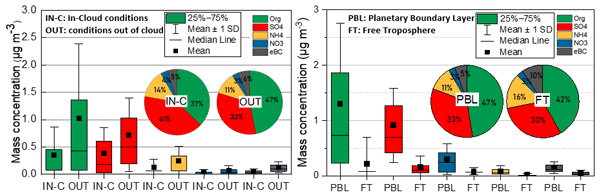
Olga Zografou, Maria Gini, Prodromos Fetfatzis, Konstantinos Granakis, Romanos Foskinis, Manousos Ioannis Manousakas, Fotios Tsopelas, Evangelia Diapouli, Eleni Dovrou, Christina N. Vasilakopoulou, Alexandros Papayannis, Spyros N. Pandis, Athanasios Nenes, and Konstantinos Eleftheriadis
Atmos. Chem. Phys., 24, 8911–8926, https://doi.org/10.5194/acp-24-8911-2024, https://doi.org/10.5194/acp-24-8911-2024, 2024
Short summary
Short summary
Characterization of PM1 and positive matrix factorization (PMF) source apportionment of organic and inorganic fractions were conducted at the high-altitude station (HAC)2. Cloud presence reduced PM1, affecting sulfate more than organics. Free-troposphere (FT) conditions showed more black carbon (eBC) than planetary boundary layer (PBL) conditions.
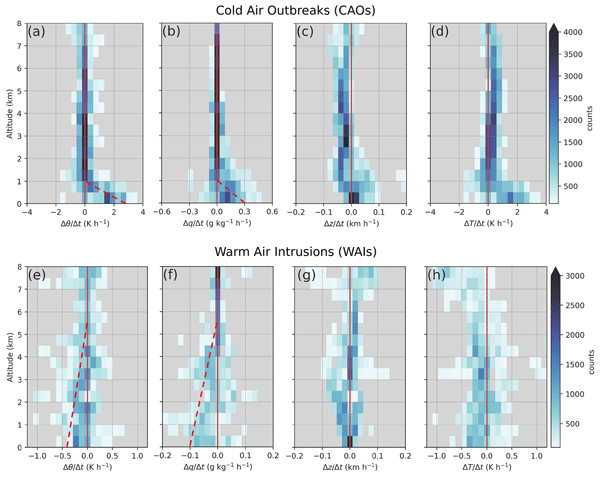
Manfred Wendisch, Susanne Crewell, André Ehrlich, Andreas Herber, Benjamin Kirbus, Christof Lüpkes, Mario Mech, Steven J. Abel, Elisa F. Akansu, Felix Ament, Clémantyne Aubry, Sebastian Becker, Stephan Borrmann, Heiko Bozem, Marlen Brückner, Hans-Christian Clemen, Sandro Dahlke, Georgios Dekoutsidis, Julien Delanoë, Elena De La Torre Castro, Henning Dorff, Regis Dupuy, Oliver Eppers, Florian Ewald, Geet George, Irina V. Gorodetskaya, Sarah Grawe, Silke Groß, Jörg Hartmann, Silvia Henning, Lutz Hirsch, Evelyn Jäkel, Philipp Joppe, Olivier Jourdan, Zsofia Jurányi, Michail Karalis, Mona Kellermann, Marcus Klingebiel, Michael Lonardi, Johannes Lucke, Anna E. Luebke, Maximilian Maahn, Nina Maherndl, Marion Maturilli, Bernhard Mayer, Johanna Mayer, Stephan Mertes, Janosch Michaelis, Michel Michalkov, Guillaume Mioche, Manuel Moser, Hanno Müller, Roel Neggers, Davide Ori, Daria Paul, Fiona M. Paulus, Christian Pilz, Felix Pithan, Mira Pöhlker, Veronika Pörtge, Maximilian Ringel, Nils Risse, Gregory C. Roberts, Sophie Rosenburg, Johannes Röttenbacher, Janna Rückert, Michael Schäfer, Jonas Schaefer, Vera Schemann, Imke Schirmacher, Jörg Schmidt, Sebastian Schmidt, Johannes Schneider, Sabrina Schnitt, Anja Schwarz, Holger Siebert, Harald Sodemann, Tim Sperzel, Gunnar Spreen, Bjorn Stevens, Frank Stratmann, Gunilla Svensson, Christian Tatzelt, Thomas Tuch, Timo Vihma, Christiane Voigt, Lea Volkmer, Andreas Walbröl, Anna Weber, Birgit Wehner, Bruno Wetzel, Martin Wirth, and Tobias Zinner
Atmos. Chem. Phys., 24, 8865–8892, https://doi.org/10.5194/acp-24-8865-2024, https://doi.org/10.5194/acp-24-8865-2024, 2024
Short summary
Short summary
The Arctic is warming faster than the rest of the globe. Warm-air intrusions (WAIs) into the Arctic may play an important role in explaining this phenomenon. Cold-air outbreaks (CAOs) out of the Arctic may link the Arctic climate changes to mid-latitude weather. In our article, we describe how to observe air mass transformations during CAOs and WAIs using three research aircraft instrumented with state-of-the-art remote-sensing and in situ measurement devices.
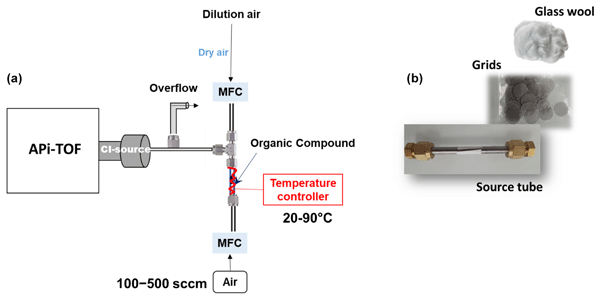
Stéphanie Alage, Vincent Michoud, Sergio Harb, Bénédicte Picquet-Varrault, Manuela Cirtog, Avinash Kumar, Matti Rissanen, and Christopher Cantrell
Atmos. Meas. Tech., 17, 4709–4724, https://doi.org/10.5194/amt-17-4709-2024, https://doi.org/10.5194/amt-17-4709-2024, 2024
Short summary
Short summary
Calibration exercises are essential for determining the accuracy of instruments. We performed calibrations on a NO3¯ ToFCIMS instrument to determine its sensitivity and linearity for detecting various organic compounds. Our findings revealed significant variability, over several orders of magnitude, in the calibration factors obtained. The results suggest that relying on a single calibration factor from H2SO4 for the quantification of all compounds detected by this technique is not appropriate.
Olga Zografou, Christos Kaltsonoudis, Maria Gini, Angeliki Matrali, Elias Panagiotopoulos, Alexandros Lekkas, Dimitris Papanastasiou, Spyros N. Pandis, and Konstantinos Eleftheriadis
EGUsphere, https://doi.org/10.5194/egusphere-2024-2126, https://doi.org/10.5194/egusphere-2024-2126, 2024
Preprint archived
Short summary
Short summary
A novel charge transfer ionization orthogonal Time-of-Flight Mass Spectrometer (oToF-MS) was field evaluated for the first time during a field campaign at the suburban DEM station in Athens, Greece from May to August 2023 focusing on key ambient Volatile Organic Compounds (VOCs). The results demonstrate the strengths of the new instrument in performing online, real time measurements of ambient VOCs.
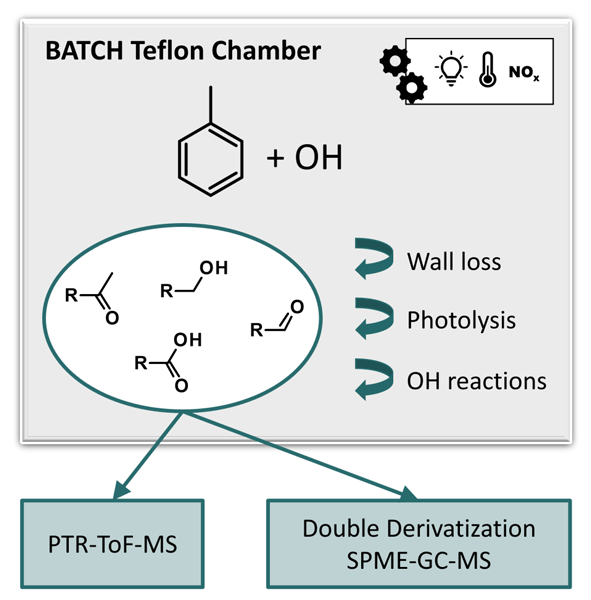
Finja Löher, Esther Borrás, Amalia Muñoz, and Anke Christine Nölscher
Atmos. Meas. Tech., 17, 4553–4579, https://doi.org/10.5194/amt-17-4553-2024, https://doi.org/10.5194/amt-17-4553-2024, 2024
Short summary
Short summary
We constructed and characterized a new indoor Teflon atmospheric simulation chamber. We evaluated wall losses, photolysis rates, and secondary reactions of multifunctional photooxidation products in the chamber. To measure these products on-line, we combined chromatographic and mass spectrometric analyses to obtain both isomeric information and a high temporal resolution. For method validation, we studied the formation yields of the main ring-retaining products of toluene.
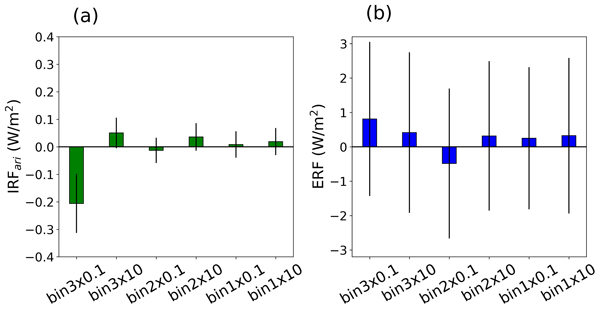
Muhammed Irfan, Thomas Kühn, Taina Yli-Juuti, Anton Laakso, Eemeli Holopainen, Douglas R. Worsnop, Annele Virtanen, and Harri Kokkola
Atmos. Chem. Phys., 24, 8489–8506, https://doi.org/10.5194/acp-24-8489-2024, https://doi.org/10.5194/acp-24-8489-2024, 2024
Short summary
Short summary
The study examines how the volatility of semi-volatile organic compounds affects secondary organic aerosol (SOA) formation and climate. Our simulations show that uncertainties in these volatilities influence aerosol mass and climate impacts. Accurate representation of these compounds in climate models is crucial for predicting global climate patterns.
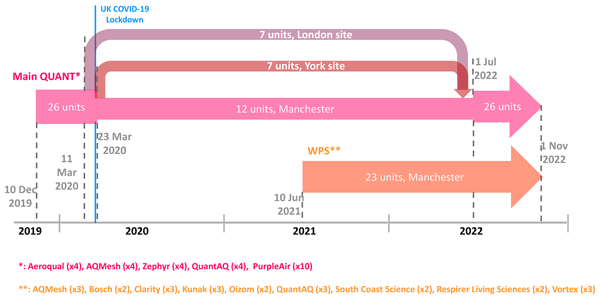
Sebastian Diez, Stuart Lacy, Hugh Coe, Josefina Urquiza, Max Priestman, Michael Flynn, Nicholas Marsden, Nicholas A. Martin, Stefan Gillott, Thomas Bannan, and Pete M. Edwards
Atmos. Meas. Tech., 17, 3809–3827, https://doi.org/10.5194/amt-17-3809-2024, https://doi.org/10.5194/amt-17-3809-2024, 2024
Short summary
Short summary
In this paper we present an overview of the QUANT project, which to our knowledge is one of the largest evaluations of commercial sensors to date. The objective was to evaluate the performance of a range of commercial products and also to nourish the different applications in which these technologies can offer relevant information.
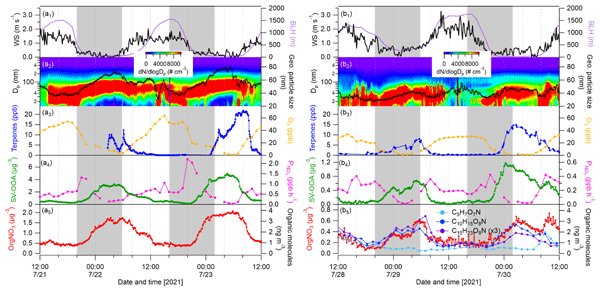
Junwei Song, Harald Saathoff, Feng Jiang, Linyu Gao, Hengheng Zhang, and Thomas Leisner
Atmos. Chem. Phys., 24, 6699–6717, https://doi.org/10.5194/acp-24-6699-2024, https://doi.org/10.5194/acp-24-6699-2024, 2024
Short summary
Short summary
This study presents concurrent online measurements of organic gas and particles (VOCs and OA) at a forested site in summer. Both VOCs and OA were largely contributed by oxygenated organic compounds. Semi-volatile oxygenated OA and organic nitrate formed from monoterpenes and sesquiterpenes contributed significantly to nighttime particle growth. The results help us to understand the causes of nighttime particle growth regularly observed in summer in central European rural forested environments.
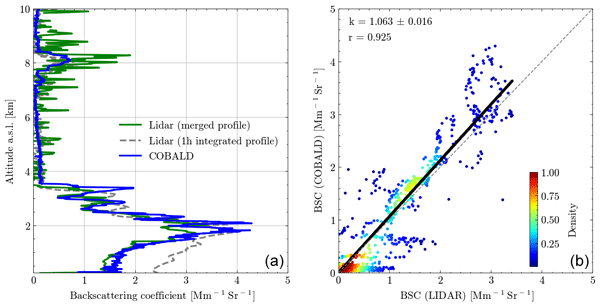
Hengheng Zhang, Christian Rolf, Ralf Tillmann, Christian Wesolek, Frank Gunther Wienhold, Thomas Leisner, and Harald Saathoff
Aerosol Research, 2, 135–151, https://doi.org/10.5194/ar-2-135-2024, https://doi.org/10.5194/ar-2-135-2024, 2024
Short summary
Short summary
Our study employs advanced tools, including scanning lidar, balloons, and UAVs, to explore aerosol particles in the atmosphere. The scanning lidar offers distinctive near-ground-level insights, enriching our comprehension of aerosol distribution from ground level to the free troposphere. This research provides valuable data for comparing remote sensing and in situ aerosol measurements, advancing our understanding of aerosol impacts on radiative transfer, clouds, and air quality.
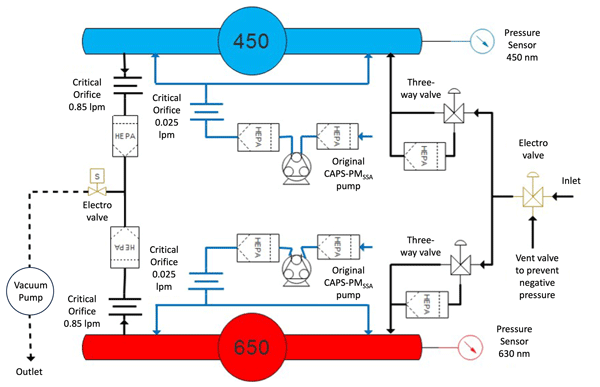
Chenjie Yu, Edouard Pangui, Kevin Tu, Mathieu Cazaunau, Maxime Feingesicht, Landsheere Xavier, Thierry Bourrianne, Vincent Michoud, Christopher Cantrell, Timothy B. Onasch, Andrew Freedman, and Paola Formenti
Atmos. Meas. Tech., 17, 3419–3437, https://doi.org/10.5194/amt-17-3419-2024, https://doi.org/10.5194/amt-17-3419-2024, 2024
Short summary
Short summary
To meet the requirements for measuring aerosol optical properties on airborne platforms and conducting dual-wavelength measurements, we introduced A2S2, an airborne dual-wavelength cavity-attenuated phase-shift single monitor. This study reports the results in the laboratory and an aircraft campaign over Paris and its surrounding regions. The results demonstrate A2S2's reliability in measuring aerosol optical properties at both wavelengths and its suitability for future aircraft campaigns.
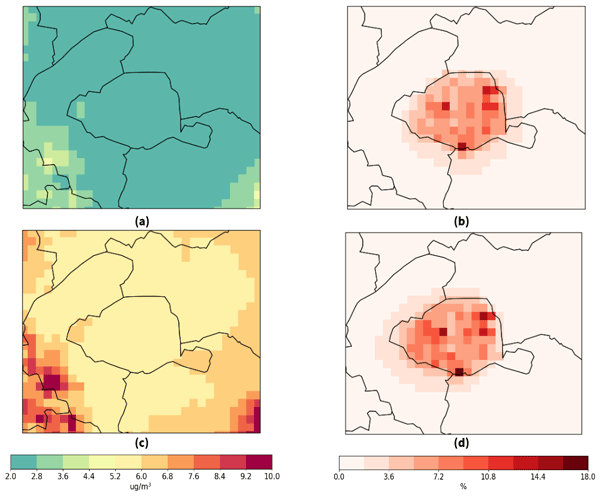
Alice Maison, Lya Lugon, Soo-Jin Park, Alexia Baudic, Christopher Cantrell, Florian Couvidat, Barbara D'Anna, Claudia Di Biagio, Aline Gratien, Valérie Gros, Carmen Kalalian, Julien Kammer, Vincent Michoud, Jean-Eudes Petit, Marwa Shahin, Leila Simon, Myrto Valari, Jérémy Vigneron, Andrée Tuzet, and Karine Sartelet
Atmos. Chem. Phys., 24, 6011–6046, https://doi.org/10.5194/acp-24-6011-2024, https://doi.org/10.5194/acp-24-6011-2024, 2024
Short summary
Short summary
This study presents the development of a bottom-up inventory of urban tree biogenic emissions. Emissions are computed for each tree based on their location and characteristics and are integrated in the regional air quality model WRF-CHIMERE. The impact of these biogenic emissions on air quality is quantified for June–July 2022. Over Paris city, urban trees increase the concentrations of particulate organic matter by 4.6 %, of PM2.5 by 0.6 %, and of ozone by 1.0 % on average over 2 months.
Felix Wieser, Rolf Sander, Changmin Cho, Hendrik Fuchs, Thorsten Hohaus, Anna Novelli, Ralf Tillmann, and Domenico Taraborrelli
Geosci. Model Dev., 17, 4311–4330, https://doi.org/10.5194/gmd-17-4311-2024, https://doi.org/10.5194/gmd-17-4311-2024, 2024
Short summary
Short summary
The chemistry scheme of the atmospheric box model CAABA/MECCA is expanded to achieve an improved aerosol formation from emitted organic compounds. In addition to newly added reactions, temperature-dependent partitioning of all new species between the gas and aqueous phases is estimated and included in the pre-existing scheme. Sensitivity runs show an overestimation of key compounds from isoprene, which can be explained by a lack of aqueous-phase degradation reactions and box model limitations.
Gary Lloyd, Alan Blyth, Zhiqiang Cui, Thomas Choularton, Keith Bower, Martin Gallagher, Michael Flynn, Nicholas Marsden, Leif Denby, and Peter Gallimore
EGUsphere, https://doi.org/10.5194/egusphere-2024-142, https://doi.org/10.5194/egusphere-2024-142, 2024
Preprint archived
Short summary
Short summary
Clouds that develop in the tropical trade-wind regions are extensive and persistent in nature. They are important for understanding how the magnitude of warming by these cloud systems might change in a warming climate. This paper describes measurements of common cloud types in these regions (shallow cumulus clouds) and the way in which they produce rainfall. During different periods, with different amounts of particulate in the air, the characteristics of the clouds were very different.
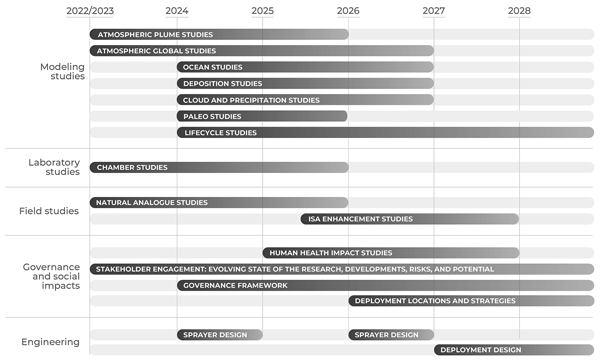
Katrine A. Gorham, Sam Abernethy, Tyler R. Jones, Peter Hess, Natalie M. Mahowald, Daphne Meidan, Matthew S. Johnson, Maarten M. J. W. van Herpen, Yangyang Xu, Alfonso Saiz-Lopez, Thomas Röckmann, Chloe A. Brashear, Erika Reinhardt, and David Mann
Atmos. Chem. Phys., 24, 5659–5670, https://doi.org/10.5194/acp-24-5659-2024, https://doi.org/10.5194/acp-24-5659-2024, 2024
Short summary
Short summary
Rapid reduction in atmospheric methane is needed to slow the rate of global warming. Reducing anthropogenic methane emissions is a top priority. However, atmospheric methane is also impacted by rising natural emissions and changing sinks. Studies of possible atmospheric methane removal approaches, such as iron salt aerosols to increase the chlorine radical sink, benefit from a roadmapped approach to understand if there may be viable and socially acceptable ways to decrease future risk.
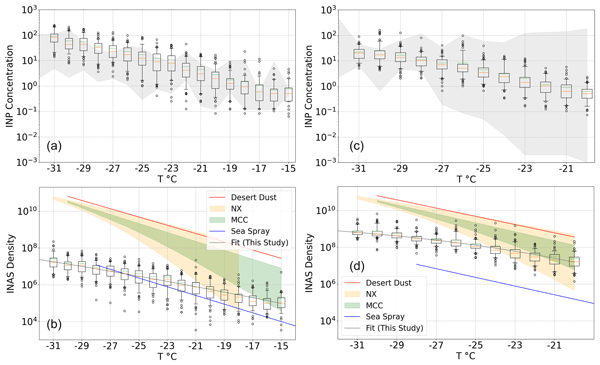
Elise K. Wilbourn, Larissa Lacher, Carlos Guerrero, Hemanth S. K. Vepuri, Kristina Höhler, Jens Nadolny, Aidan D. Pantoya, Ottmar Möhler, and Naruki Hiranuma
Atmos. Chem. Phys., 24, 5433–5456, https://doi.org/10.5194/acp-24-5433-2024, https://doi.org/10.5194/acp-24-5433-2024, 2024
Short summary
Short summary
Ambient ice particles were measured at terrestrial and temperate marine sites. Ice particles were more abundant in the former site, while the fraction of ice particles relative to total ambient particles, representing atmospheric ice nucleation efficiency, was higher in the latter site. Ice nucleation parameterizations were developed as a function of examined freezing temperatures from two sites for our study periods (autumn).
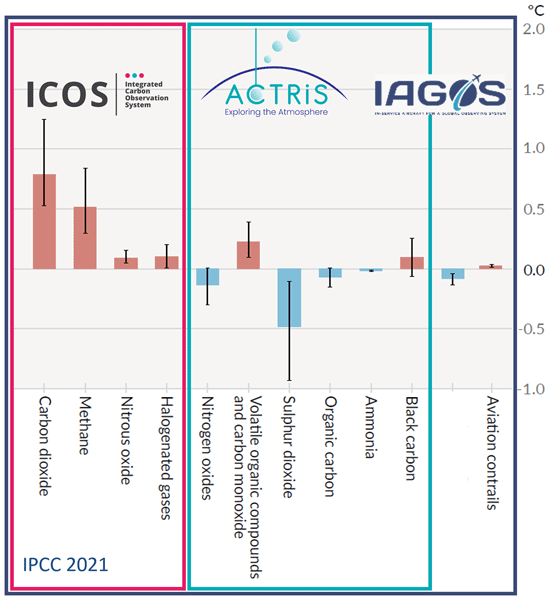
Andreas Petzold, Ulrich Bundke, Anca Hienola, Paolo Laj, Cathrine Lund Myhre, Alex Vermeulen, Angeliki Adamaki, Werner Kutsch, Valerie Thouret, Damien Boulanger, Markus Fiebig, Markus Stocker, Zhiming Zhao, and Ari Asmi
Atmos. Chem. Phys., 24, 5369–5388, https://doi.org/10.5194/acp-24-5369-2024, https://doi.org/10.5194/acp-24-5369-2024, 2024
Short summary
Short summary
Easy and fast access to long-term and high-quality observational data is recognised as fundamental to environmental research and the development of climate forecasting and assessment services. We discuss the potential new directions in atmospheric sciences offered by the atmosphere-centric European research infrastructures ACTRIS, IAGOS, and ICOS, building on their capabilities for standardised provision of data through open access combined with tools and methods of data-intensive science.
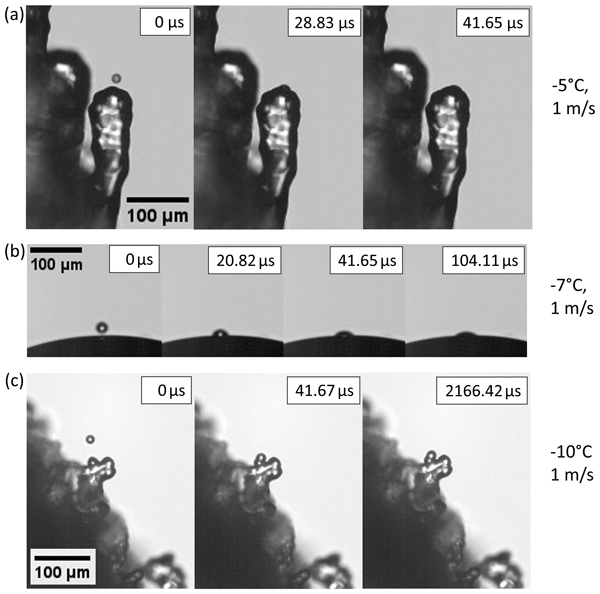
Johanna S. Seidel, Alexei A. Kiselev, Alice Keinert, Frank Stratmann, Thomas Leisner, and Susan Hartmann
Atmos. Chem. Phys., 24, 5247–5263, https://doi.org/10.5194/acp-24-5247-2024, https://doi.org/10.5194/acp-24-5247-2024, 2024
Short summary
Short summary
Clouds often contain several thousand times more ice crystals than aerosol particles catalyzing ice formation. This phenomenon, commonly known as ice multiplication, is often explained by secondary ice formation due to the collisions between falling ice particles and droplets. In this study, we mimic this riming process. Contrary to earlier experiments, we found no efficient ice multiplication, which fundamentally questions the importance of the rime-splintering mechanism.
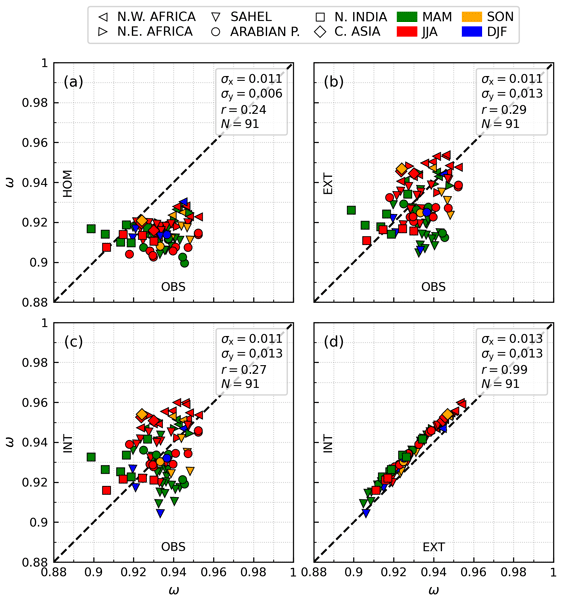
Vincenzo Obiso, María Gonçalves Ageitos, Carlos Pérez García-Pando, Jan P. Perlwitz, Gregory L. Schuster, Susanne E. Bauer, Claudia Di Biagio, Paola Formenti, Kostas Tsigaridis, and Ron L. Miller
Atmos. Chem. Phys., 24, 5337–5367, https://doi.org/10.5194/acp-24-5337-2024, https://doi.org/10.5194/acp-24-5337-2024, 2024
Short summary
Short summary
We calculate the dust direct radiative effect (DRE) in an Earth system model accounting for regionally varying soil mineralogy through a new observationally constrained method. Linking dust absorption at solar wavelengths to the varying amount of specific minerals (i.e., iron oxides) improves the modeled range of dust single scattering albedo compared to observations and increases the global cooling by dust. Our results may contribute to improved estimates of the dust DRE and its climate impact.
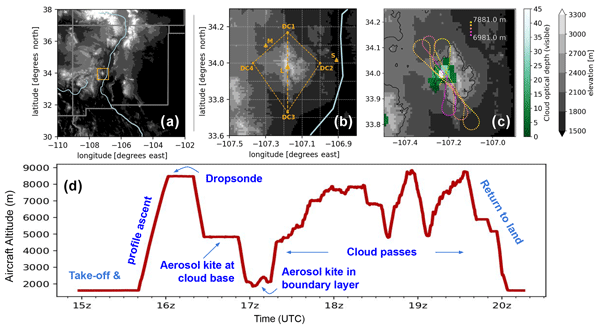
Declan L. Finney, Alan M. Blyth, Martin Gallagher, Huihui Wu, Graeme J. Nott, Michael I. Biggerstaff, Richard G. Sonnenfeld, Martin Daily, Dan Walker, David Dufton, Keith Bower, Steven Böing, Thomas Choularton, Jonathan Crosier, James Groves, Paul R. Field, Hugh Coe, Benjamin J. Murray, Gary Lloyd, Nicholas A. Marsden, Michael Flynn, Kezhen Hu, Navaneeth M. Thamban, Paul I. Williams, Paul J. Connolly, James B. McQuaid, Joseph Robinson, Zhiqiang Cui, Ralph R. Burton, Gordon Carrie, Robert Moore, Steven J. Abel, Dave Tiddeman, and Graydon Aulich
Earth Syst. Sci. Data, 16, 2141–2163, https://doi.org/10.5194/essd-16-2141-2024, https://doi.org/10.5194/essd-16-2141-2024, 2024
Short summary
Short summary
The DCMEX (Deep Convective Microphysics Experiment) project undertook an aircraft- and ground-based measurement campaign of New Mexico deep convective clouds during July–August 2022. The campaign coordinated a broad range of instrumentation measuring aerosol, cloud physics, radar signals, thermodynamics, dynamics, electric fields, and weather. The project's objectives included the utilisation of these data with satellite observations to study the anvil cloud radiative effect.
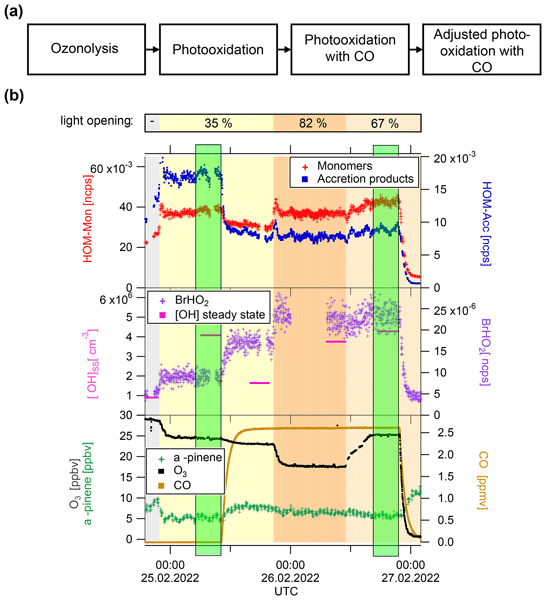
Yarê Baker, Sungah Kang, Hui Wang, Rongrong Wu, Jian Xu, Annika Zanders, Quanfu He, Thorsten Hohaus, Till Ziehm, Veronica Geretti, Thomas J. Bannan, Simon P. O'Meara, Aristeidis Voliotis, Mattias Hallquist, Gordon McFiggans, Sören R. Zorn, Andreas Wahner, and Thomas F. Mentel
Atmos. Chem. Phys., 24, 4789–4807, https://doi.org/10.5194/acp-24-4789-2024, https://doi.org/10.5194/acp-24-4789-2024, 2024
Short summary
Short summary
Highly oxygenated organic molecules are important contributors to secondary organic aerosol. Their yield depends on detailed atmospheric chemical composition. One important parameter is the ratio of hydroperoxy radicals to organic peroxy radicals (HO2/RO2), and we show that higher HO2/RO2 ratios lower the secondary organic aerosol yield. This is of importance as laboratory studies are often biased towards organic peroxy radicals.
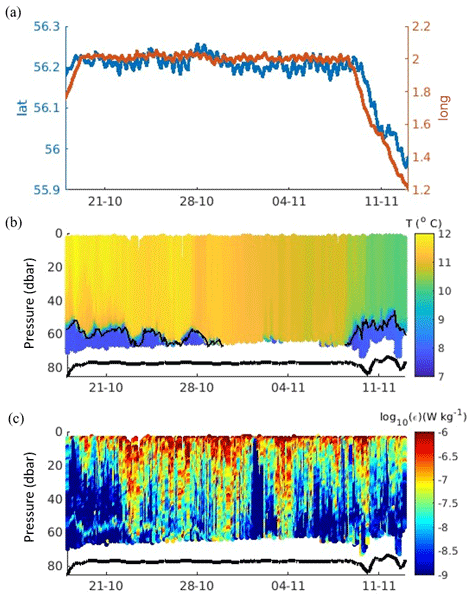
Charlotte A. J. Williams, Tom Hull, Jan Kaiser, Claire Mahaffey, Naomi Greenwood, Matthew Toberman, and Matthew R. Palmer
Biogeosciences, 21, 1961–1971, https://doi.org/10.5194/bg-21-1961-2024, https://doi.org/10.5194/bg-21-1961-2024, 2024
Short summary
Short summary
Oxygen (O2) is a key indicator of ocean health. The risk of O2 loss in the productive coastal/continental slope regions is increasing. Autonomous underwater vehicles equipped with O2 optodes provide lots of data but have problems resolving strong vertical O2 changes. Here we show how to overcome this and calculate how much O2 is supplied to the low-O2 bottom waters via mixing. Bursts in mixing supply nearly all of the O2 to bottom waters in autumn, stopping them reaching ecologically low levels.
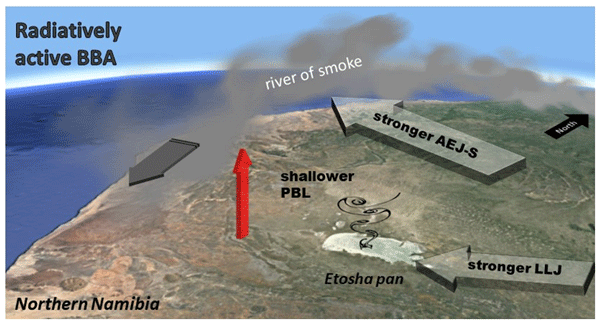
Cyrille Flamant, Jean-Pierre Chaboureau, Marco Gaetani, Kerstin Schepanski, and Paola Formenti
Atmos. Chem. Phys., 24, 4265–4288, https://doi.org/10.5194/acp-24-4265-2024, https://doi.org/10.5194/acp-24-4265-2024, 2024
Short summary
Short summary
In the austral dry season, the atmospheric composition over southern Africa is dominated by biomass burning aerosols and terrigenous aerosols (so-called mineral dust). This study suggests that the radiative effect of biomass burning aerosols needs to be taken into account to properly forecast dust emissions in Namibia.
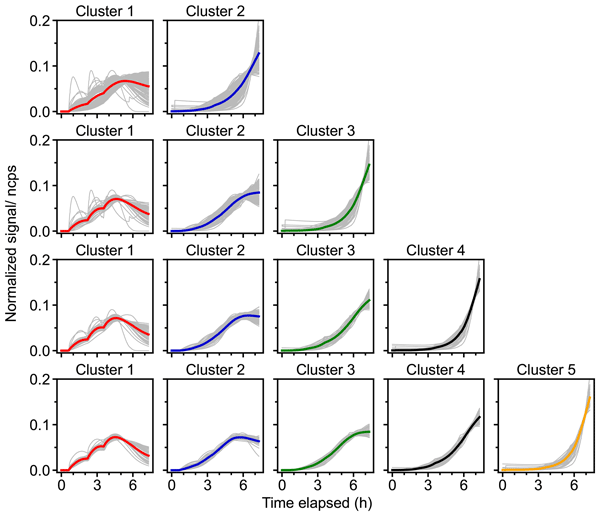
Rongrong Wu, Sören R. Zorn, Sungah Kang, Astrid Kiendler-Scharr, Andreas Wahner, and Thomas F. Mentel
Atmos. Meas. Tech., 17, 1811–1835, https://doi.org/10.5194/amt-17-1811-2024, https://doi.org/10.5194/amt-17-1811-2024, 2024
Short summary
Short summary
Recent advances in high-resolution time-of-flight chemical ionization mass spectrometry (CIMS) enable the detection of highly oxygenated organic molecules, which efficiently contribute to secondary organic aerosol. Here we present an application of fuzzy c-means (FCM) clustering to deconvolve CIMS data. FCM not only reduces the complexity of mass spectrometric data but also the chemical and kinetic information retrieved by clustering gives insights into the chemical processes involved.
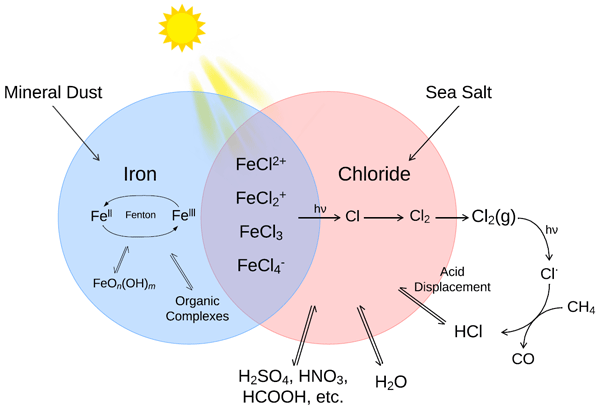
Marie K. Mikkelsen, Jesper B. Liisberg, Maarten M. J. W. van Herpen, Kurt V. Mikkelsen, and Matthew S. Johnson
Aerosol Research, 2, 31–47, https://doi.org/10.5194/ar-2-31-2024, https://doi.org/10.5194/ar-2-31-2024, 2024
Short summary
Short summary
We analyze the mechanism whereby sunlight and iron catalyze the production of chlorine from chloride in sea spray aerosol. This process occurs naturally over the North Atlantic and is the single most important source of chlorine. We investigate the mechanism using quantum chemistry, laboratory experiments, and aqueous chemistry modelling. The process will change depending on competing ions, light distribution, acidity, and chloride concentration.
Anil Kumar Mandariya, Junteng Wu, Anne Monod, Paola Formenti, Bénédicte Picquet-Varrault, Mathieu Cazaunau, Stephan Mertes, Laurent Poulain, Antonin Berge, Edouard Pangui, Andreas Tilgner, Thomas Schaefer, Liang Wen, Hartmut Herrmann, and Jean-François Doussin
Atmos. Meas. Tech. Discuss., https://doi.org/10.5194/amt-2023-206, https://doi.org/10.5194/amt-2023-206, 2024
Publication in AMT not foreseen
Short summary
Short summary
An optimized and controlled protocol for generating quasi-adiabatic expansion clouds under simulated dark and light conditions was presented. The irradiated clouds clearly showed a gradual activation of seed particles into droplets. In contrast, non-irradiated clouds faced a flash activation. This paper will lay the foundation for multiphase photochemical studies implying water-soluble volatile organic compounds and particulate matter formation during cloud formation-evaporation cycles.
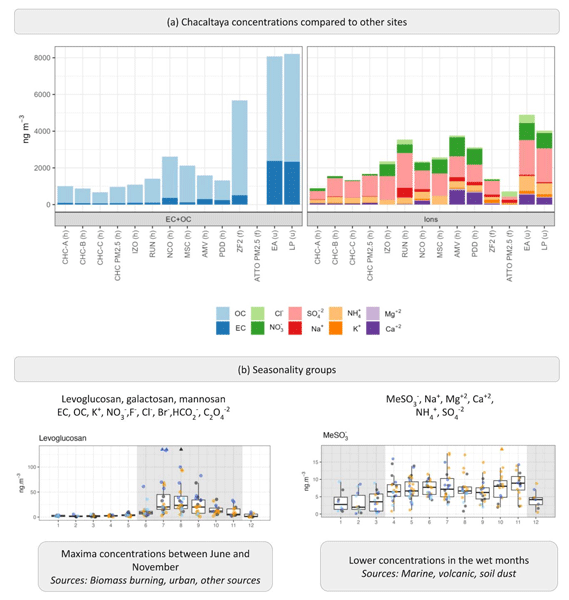
C. Isabel Moreno, Radovan Krejci, Jean-Luc Jaffrezo, Gaëlle Uzu, Andrés Alastuey, Marcos F. Andrade, Valeria Mardóñez, Alkuin Maximilian Koenig, Diego Aliaga, Claudia Mohr, Laura Ticona, Fernando Velarde, Luis Blacutt, Ricardo Forno, David N. Whiteman, Alfred Wiedensohler, Patrick Ginot, and Paolo Laj
Atmos. Chem. Phys., 24, 2837–2860, https://doi.org/10.5194/acp-24-2837-2024, https://doi.org/10.5194/acp-24-2837-2024, 2024
Short summary
Short summary
Aerosol chemical composition (ions, sugars, carbonaceous matter) from 2011 to 2020 was studied at Mt. Chacaltaya (5380 m a.s.l., Bolivian Andes). Minimum concentrations occur in the rainy season with maxima in the dry and transition seasons. The origins of the aerosol are located in a radius of hundreds of kilometers: nearby urban and rural areas, natural biogenic emissions, vegetation burning from Amazonia and Chaco, Pacific Ocean emissions, soil dust, and Peruvian volcanism.
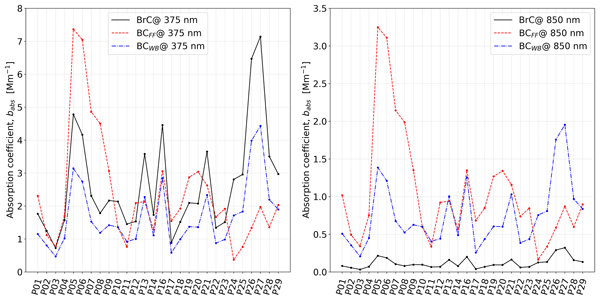
Tommaso Isolabella, Vera Bernardoni, Alessandro Bigi, Marco Brunoldi, Federico Mazzei, Franco Parodi, Paolo Prati, Virginia Vernocchi, and Dario Massabò
Atmos. Meas. Tech., 17, 1363–1373, https://doi.org/10.5194/amt-17-1363-2024, https://doi.org/10.5194/amt-17-1363-2024, 2024
Short summary
Short summary
We present an innovative software toolkit to differentiate sources of carbonaceous aerosol in the atmosphere. Our toolkit implements an upgraded mathematical model which allows for determination of fundamental optical properties of the aerosol, its sources, and the mass concentration of different carbonaceous species of particulate matter. We have tested the functionality of the software by re-analysing published data, and we obtained a compatible results with additional information.
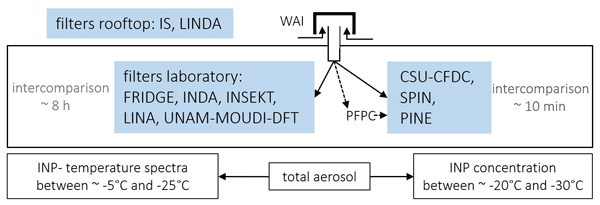
Larissa Lacher, Michael P. Adams, Kevin Barry, Barbara Bertozzi, Heinz Bingemer, Cristian Boffo, Yannick Bras, Nicole Büttner, Dimitri Castarede, Daniel J. Cziczo, Paul J. DeMott, Romy Fösig, Megan Goodell, Kristina Höhler, Thomas C. J. Hill, Conrad Jentzsch, Luis A. Ladino, Ezra J. T. Levin, Stephan Mertes, Ottmar Möhler, Kathryn A. Moore, Benjamin J. Murray, Jens Nadolny, Tatjana Pfeuffer, David Picard, Carolina Ramírez-Romero, Mickael Ribeiro, Sarah Richter, Jann Schrod, Karine Sellegri, Frank Stratmann, Benjamin E. Swanson, Erik S. Thomson, Heike Wex, Martin J. Wolf, and Evelyn Freney
Atmos. Chem. Phys., 24, 2651–2678, https://doi.org/10.5194/acp-24-2651-2024, https://doi.org/10.5194/acp-24-2651-2024, 2024
Short summary
Short summary
Aerosol particles that trigger ice formation in clouds are important for the climate system but are very rare in the atmosphere, challenging measurement techniques. Here we compare three cloud chambers and seven methods for collecting aerosol particles on filters for offline analysis at a mountaintop station. A general good agreement of the methods was found when sampling aerosol particles behind a whole air inlet, supporting their use for obtaining data that can be implemented in models.
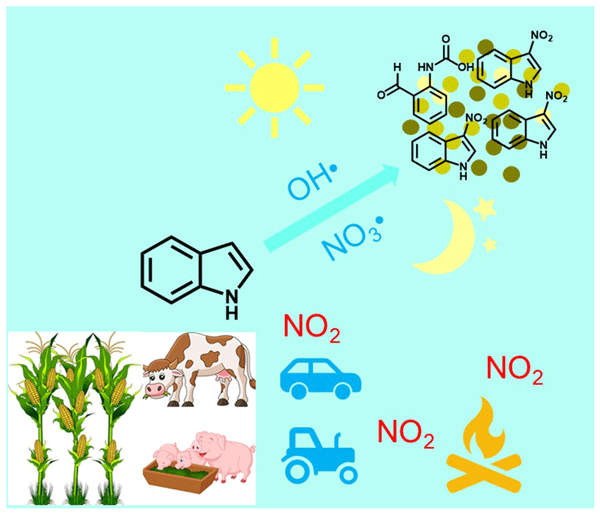
Feng Jiang, Kyla Siemens, Claudia Linke, Yanxia Li, Yiwei Gong, Thomas Leisner, Alexander Laskin, and Harald Saathoff
Atmos. Chem. Phys., 24, 2639–2649, https://doi.org/10.5194/acp-24-2639-2024, https://doi.org/10.5194/acp-24-2639-2024, 2024
Short summary
Short summary
We investigated the optical properties, chemical composition, and formation mechanisms of secondary organic aerosol (SOA) and brown carbon (BrC) from the oxidation of indole with and without NO2 in the Aerosol Interaction and Dynamics in the Atmosphere (AIDA) simulation chamber. This work is one of the very few to link the optical properties and chemical composition of indole SOA with and without NO2 by simulation chamber experiments.
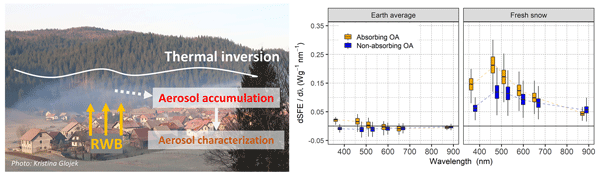
Andrea Cuesta-Mosquera, Kristina Glojek, Griša Močnik, Luka Drinovec, Asta Gregorič, Martin Rigler, Matej Ogrin, Baseerat Romshoo, Kay Weinhold, Maik Merkel, Dominik van Pinxteren, Hartmut Herrmann, Alfred Wiedensohler, Mira Pöhlker, and Thomas Müller
Atmos. Chem. Phys., 24, 2583–2605, https://doi.org/10.5194/acp-24-2583-2024, https://doi.org/10.5194/acp-24-2583-2024, 2024
Short summary
Short summary
This study evaluated the air pollution and climate impacts of residential-wood-burning particle emissions from a rural European site. The authors investigate the optical and physical properties that connect the aerosol emissions with climate by evaluating atmospheric radiative impacts via simple-forcing calculations. The study contributes to reducing the lack of information on the understanding of the optical properties of air pollution from anthropogenic sources.
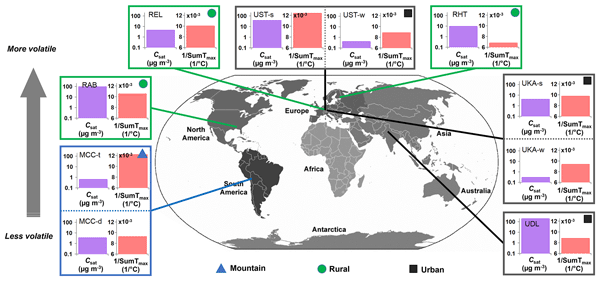
Wei Huang, Cheng Wu, Linyu Gao, Yvette Gramlich, Sophie L. Haslett, Joel Thornton, Felipe D. Lopez-Hilfiker, Ben H. Lee, Junwei Song, Harald Saathoff, Xiaoli Shen, Ramakrishna Ramisetty, Sachchida N. Tripathi, Dilip Ganguly, Feng Jiang, Magdalena Vallon, Siegfried Schobesberger, Taina Yli-Juuti, and Claudia Mohr
Atmos. Chem. Phys., 24, 2607–2624, https://doi.org/10.5194/acp-24-2607-2024, https://doi.org/10.5194/acp-24-2607-2024, 2024
Short summary
Short summary
We present distinct molecular composition and volatility of oxygenated organic aerosol particles in different rural, urban, and mountain environments. We do a comprehensive investigation of the relationship between the chemical composition and volatility of oxygenated organic aerosol particles across different systems and environments. This study provides implications for volatility descriptions of oxygenated organic aerosol particles in different model frameworks.
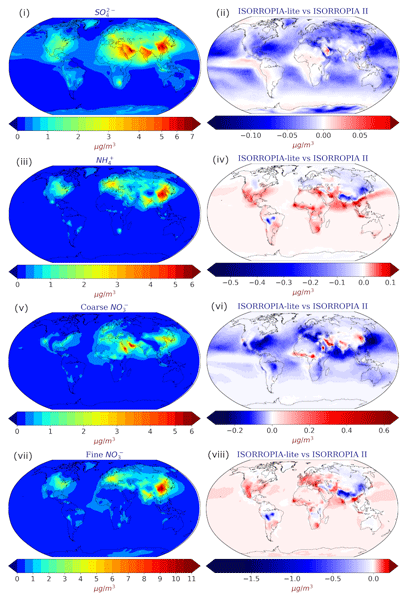
Alexandros Milousis, Alexandra P. Tsimpidi, Holger Tost, Spyros N. Pandis, Athanasios Nenes, Astrid Kiendler-Scharr, and Vlassis A. Karydis
Geosci. Model Dev., 17, 1111–1131, https://doi.org/10.5194/gmd-17-1111-2024, https://doi.org/10.5194/gmd-17-1111-2024, 2024
Short summary
Short summary
This study aims to evaluate the newly developed ISORROPIA-lite aerosol thermodynamic module within the EMAC model and explore discrepancies in global atmospheric simulations of aerosol composition and acidity by utilizing different aerosol phase states. Even though local differences were found in regions where the RH ranged from 20 % to 60 %, on a global scale the results are similar. Therefore, ISORROPIA-lite can be a reliable and computationally effective alternative to ISORROPIA II in EMAC.
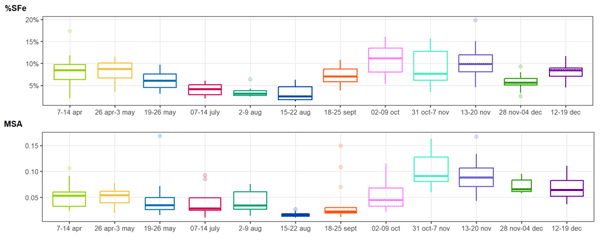
Karine Desboeufs, Paola Formenti, Raquel Torres-Sánchez, Kerstin Schepanski, Jean-Pierre Chaboureau, Hendrik Andersen, Jan Cermak, Stefanie Feuerstein, Benoit Laurent, Danitza Klopper, Andreas Namwoonde, Mathieu Cazaunau, Servanne Chevaillier, Anaïs Feron, Cécile Mirande-Bret, Sylvain Triquet, and Stuart J. Piketh
Atmos. Chem. Phys., 24, 1525–1541, https://doi.org/10.5194/acp-24-1525-2024, https://doi.org/10.5194/acp-24-1525-2024, 2024
Short summary
Short summary
This study investigates the fractional solubility of iron (Fe) in dust particles along the coast of Namibia, a critical region for the atmospheric Fe supply of the South Atlantic Ocean. Our results suggest a possible two-way interplay whereby marine biogenic emissions from the coastal marine ecosystems into the atmosphere would increase the solubility of Fe-bearing dust by photo-reduction processes. The subsequent deposition of soluble Fe could act to further enhance marine biogenic emissions.
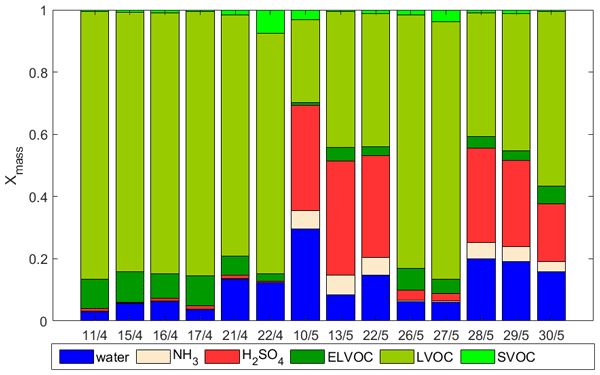
Arto Heitto, Cheng Wu, Diego Aliaga, Luis Blacutt, Xuemeng Chen, Yvette Gramlich, Liine Heikkinen, Wei Huang, Radovan Krejci, Paolo Laj, Isabel Moreno, Karine Sellegri, Fernando Velarde, Kay Weinhold, Alfred Wiedensohler, Qiaozhi Zha, Federico Bianchi, Marcos Andrade, Kari E. J. Lehtinen, Claudia Mohr, and Taina Yli-Juuti
Atmos. Chem. Phys., 24, 1315–1328, https://doi.org/10.5194/acp-24-1315-2024, https://doi.org/10.5194/acp-24-1315-2024, 2024
Short summary
Short summary
Particle growth at the Chacaltaya station in Bolivia was simulated based on measured vapor concentrations and ambient conditions. Major contributors to the simulated growth were low-volatility organic compounds (LVOCs). Also, sulfuric acid had major role when volcanic activity was occurring in the area. This study provides insight on nanoparticle growth at this high-altitude Southern Hemispheric site and hence contributes to building knowledge of early growth of atmospheric particles.
Hayley Furnell, John Wenger, Astrid Wingler, Kieran N. Kilcawley, David T. Mannion, Iwona Skibinska, and Julien Kammer
EGUsphere, https://doi.org/10.5194/egusphere-2024-154, https://doi.org/10.5194/egusphere-2024-154, 2024
Preprint archived
Short summary
Short summary
The BVOCs emitted by Sitka spruce (picea sitchensis), the most commonly planted tree species in Ireland and the UK were characterised, their temperature and PPFD dependences determined and standardised emission fluxes calculated. The majority of the 74 detected BVOCs were oxygenated, with piperitone, isoprene and monoterpenes dominating. At standardised conditions piperitone is the main emission. However, at the current climate conditions in Ireland and UK, the emission of isoprene dominates.
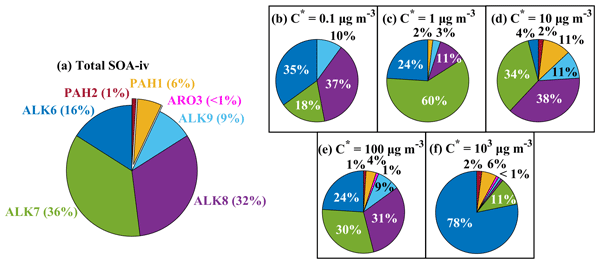
Stella E. I. Manavi and Spyros N. Pandis
Atmos. Chem. Phys., 24, 891–909, https://doi.org/10.5194/acp-24-891-2024, https://doi.org/10.5194/acp-24-891-2024, 2024
Short summary
Short summary
Organic vapors of intermediate volatility have often been neglected as sources of atmospheric organic aerosol. In this work we use a new approach for their simulation and quantify the contribution of these compounds emitted by transportation sources (gasoline and diesel vehicles) to particulate matter over Europe. The estimated secondary organic aerosol levels are on average 60 % higher than predicted by previous approaches. However, these estimates are probably lower limits.
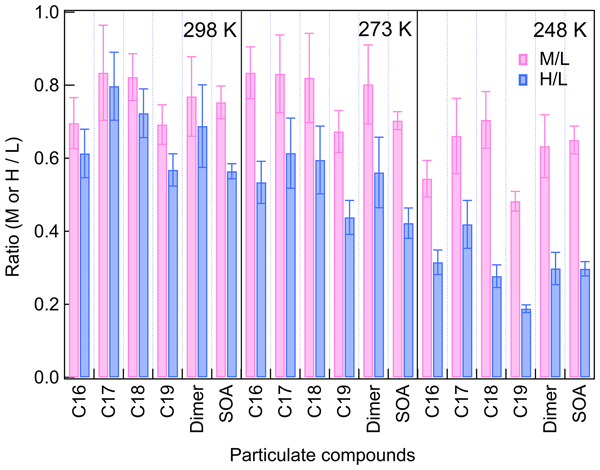
Yiwei Gong, Feng Jiang, Yanxia Li, Thomas Leisner, and Harald Saathoff
Atmos. Chem. Phys., 24, 167–184, https://doi.org/10.5194/acp-24-167-2024, https://doi.org/10.5194/acp-24-167-2024, 2024
Short summary
Short summary
This study investigates the role of the important atmospheric reactive intermediates in the formation of dimers and aerosol in monoterpene ozonolysis at different temperatures. Through conducting a series of chamber experiments and utilizing chemical kinetic and aerosol dynamic models, the SOA formation processes are better described, especially for colder regions. The results can be used to improve the chemical mechanism modeling of monoterpenes and SOA parameterization in transport models.
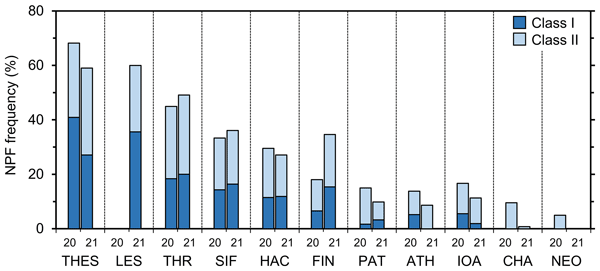
Andreas Aktypis, Christos Kaltsonoudis, David Patoulias, Panayiotis Kalkavouras, Angeliki Matrali, Christina N. Vasilakopoulou, Evangelia Kostenidou, Kalliopi Florou, Nikos Kalivitis, Aikaterini Bougiatioti, Konstantinos Eleftheriadis, Stergios Vratolis, Maria I. Gini, Athanasios Kouras, Constantini Samara, Mihalis Lazaridis, Sofia-Eirini Chatoutsidou, Nikolaos Mihalopoulos, and Spyros N. Pandis
Atmos. Chem. Phys., 24, 65–84, https://doi.org/10.5194/acp-24-65-2024, https://doi.org/10.5194/acp-24-65-2024, 2024
Short summary
Short summary
Extensive continuous particle number size distribution measurements took place during two summers (2020 and 2021) at 11 sites in Greece for the investigation of the frequency and the spatial extent of new particle formation. The frequency during summer varied from close to zero in southwestern Greece to more than 60 % in the northern, central, and eastern regions. The spatial variability can be explained by the proximity of the sites to coal-fired power plants and agricultural areas.
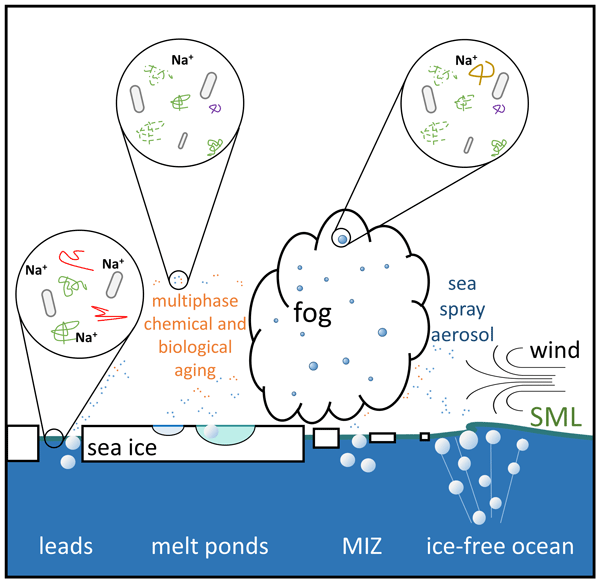
Sebastian Zeppenfeld, Manuela van Pinxteren, Markus Hartmann, Moritz Zeising, Astrid Bracher, and Hartmut Herrmann
Atmos. Chem. Phys., 23, 15561–15587, https://doi.org/10.5194/acp-23-15561-2023, https://doi.org/10.5194/acp-23-15561-2023, 2023
Short summary
Short summary
Marine carbohydrates are produced in the surface of the ocean, enter the atmophere as part of sea spray aerosol particles, and potentially contribute to the formation of fog and clouds. Here, we present the results of a sea–air transfer study of marine carbohydrates conducted in the high Arctic. Besides a chemo-selective transfer, we observed a quick atmospheric aging of carbohydrates, possibly as a result of both biotic and abiotic processes.
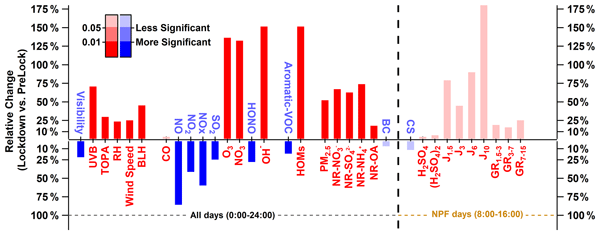
Markku Kulmala, Anna Lintunen, Hanna Lappalainen, Annele Virtanen, Chao Yan, Ekaterina Ezhova, Tuomo Nieminen, Ilona Riipinen, Risto Makkonen, Johanna Tamminen, Anu-Maija Sundström, Antti Arola, Armin Hansel, Kari Lehtinen, Timo Vesala, Tuukka Petäjä, Jaana Bäck, Tom Kokkonen, and Veli-Matti Kerminen
Atmos. Chem. Phys., 23, 14949–14971, https://doi.org/10.5194/acp-23-14949-2023, https://doi.org/10.5194/acp-23-14949-2023, 2023
Short summary
Short summary
To be able to meet global grand challenges, we need comprehensive open data with proper metadata. In this opinion paper, we describe the SMEAR (Station for Measuring Earth surface – Atmosphere Relations) concept and include several examples (cases), such as new particle formation and growth, feedback loops and the effect of COVID-19, and what has been learned from these investigations. The future needs and the potential of comprehensive observations of the environment are summarized.
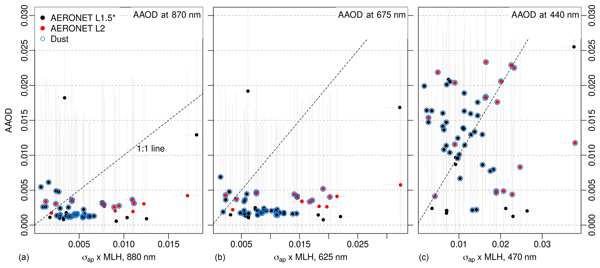
Alessandro Bigi, Giorgio Veratti, Elisabeth Andrews, Martine Collaud Coen, Lorenzo Guerrieri, Vera Bernardoni, Dario Massabò, Luca Ferrero, Sergio Teggi, and Grazia Ghermandi
Atmos. Chem. Phys., 23, 14841–14869, https://doi.org/10.5194/acp-23-14841-2023, https://doi.org/10.5194/acp-23-14841-2023, 2023
Short summary
Short summary
Atmospheric particles include compounds that play a key role in the greenhouse effect and air toxicity. Concurrent observations of these compounds by multiple instruments are presented, following deployment within an urban environment in the Po Valley, one of Europe's pollution hotspots. The study compares these data, highlighting the impact of ground emissions, mainly vehicular traffic and biomass burning, on the absorption of sun radiation and, ultimately, on climate change and air quality.
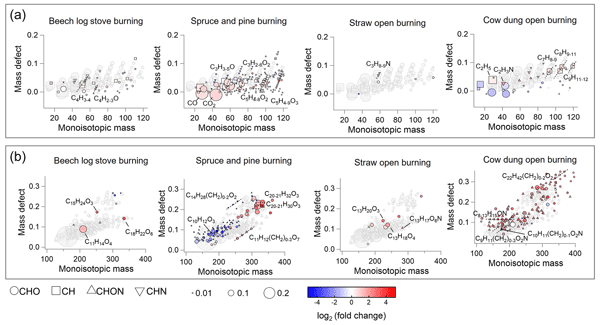
Jun Zhang, Kun Li, Tiantian Wang, Erlend Gammelsæter, Rico K. Y. Cheung, Mihnea Surdu, Sophie Bogler, Deepika Bhattu, Dongyu S. Wang, Tianqu Cui, Lu Qi, Houssni Lamkaddam, Imad El Haddad, Jay G. Slowik, Andre S. H. Prevot, and David M. Bell
Atmos. Chem. Phys., 23, 14561–14576, https://doi.org/10.5194/acp-23-14561-2023, https://doi.org/10.5194/acp-23-14561-2023, 2023
Short summary
Short summary
We conducted burning experiments to simulate various types of solid fuel combustion, including residential burning, wildfires, agricultural burning, cow dung, and plastic bag burning. The chemical composition of the particles was characterized using mass spectrometers, and new potential markers for different fuels were identified using statistical analysis. This work improves our understanding of emissions from solid fuel burning and offers support for refined source apportionment.
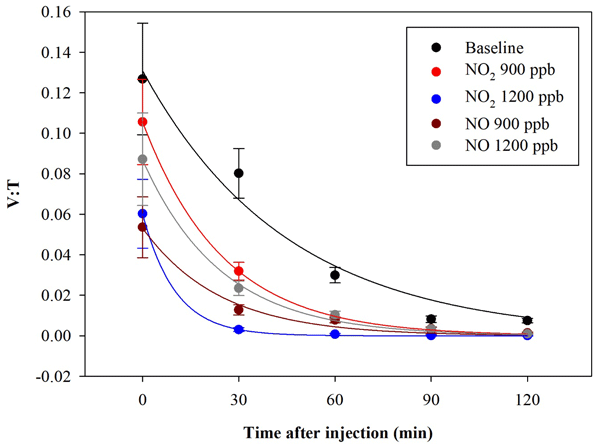
Virginia Vernocchi, Elena Abd El, Marco Brunoldi, Silvia Giulia Danelli, Elena Gatta, Tommaso Isolabella, Federico Mazzei, Franco Parodi, Paolo Prati, and Dario Massabò
Atmos. Meas. Tech., 16, 5479–5493, https://doi.org/10.5194/amt-16-5479-2023, https://doi.org/10.5194/amt-16-5479-2023, 2023
Short summary
Short summary
Bioaerosol are airborne particles or droplets that contain living organisms or biological materials, such as bacteria, viruses, fungi, pollen, or other organic matter. The study of the relationship between bioaerosol viability and air quality or meteorological conditions is an open field, and running experiments of the bioareosol viability in an atmospheric simulation chamber gives the possibility to set up well-defined conditions to evaluate the interaction between bioaerosol and pollutants.
Lu Zhang, Michal Segal-Rozenhaimer, Haochi Che, Caroline Dang, Junying Sun, Ye Kuang, and Paola Formenti
EGUsphere, https://doi.org/10.5194/egusphere-2023-2319, https://doi.org/10.5194/egusphere-2023-2319, 2023
Preprint archived
Short summary
Short summary
Our study examined the interaction between atmospheric particles and moisture over the south-eastern Atlantic Ocean during the biomass burning seasons in Africa. We found that organic components of these particles play a more important role in aerosol-moisture interactions than previously expected. This discovery is important as such interactions impact radiation and climate. Current climate models might need better representations of the moisture-absorbing properties of organic aerosols.
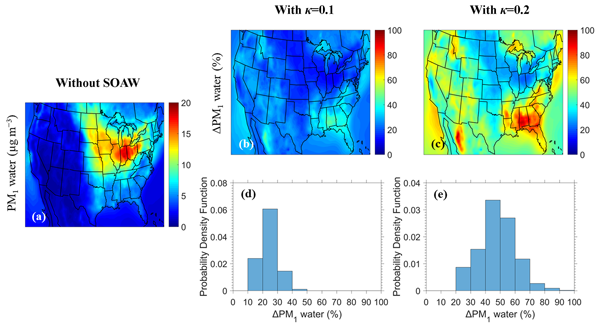
Stylianos Kakavas, Spyros N. Pandis, and Athanasios Nenes
Atmos. Chem. Phys., 23, 13555–13564, https://doi.org/10.5194/acp-23-13555-2023, https://doi.org/10.5194/acp-23-13555-2023, 2023
Short summary
Short summary
Water uptake from organic species in aerosol can affect the partitioning of semi-volatile inorganic compounds but are not considered in global and chemical transport models. We address this with a version of the PM-CAMx model that considers such organic water effects and use it to carry out 1-year aerosol simulations over the continental US. We show that such organic water impacts can increase dry PM1 levels by up to 2 μg m-3 when RH levels and PM1 concentrations are high.
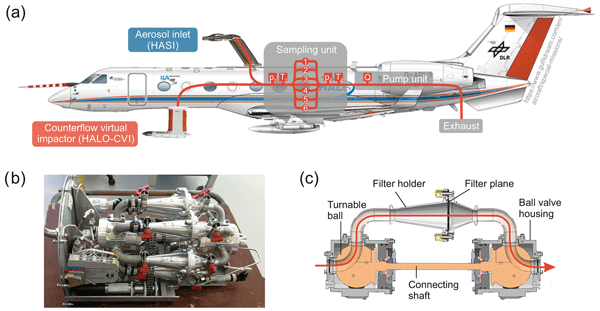
Sarah Grawe, Conrad Jentzsch, Jonas Schaefer, Heike Wex, Stephan Mertes, and Frank Stratmann
Atmos. Meas. Tech., 16, 4551–4570, https://doi.org/10.5194/amt-16-4551-2023, https://doi.org/10.5194/amt-16-4551-2023, 2023
Short summary
Short summary
Measurements of ice-nucleating particle (INP) concentrations are valuable for the simulation of cloud properties. In recent years, filter sampling in combination with offline INP measurements has become increasingly popular. However, most sampling is ground-based, and the vertical transport of INPs is not well quantified. The High-volume flow aERosol particle filter sAmpler (HERA) for applications on board aircraft was developed to expand the sparse dataset of INP concentrations at cloud level.
Jacky Y. S. Pang, Florian Berg, Anna Novelli, Birger Bohn, Michelle Färber, Philip T. M. Carlsson, René Dubus, Georgios I. Gkatzelis, Franz Rohrer, Sergej Wedel, Andreas Wahner, and Hendrik Fuchs
Atmos. Chem. Phys., 23, 12631–12649, https://doi.org/10.5194/acp-23-12631-2023, https://doi.org/10.5194/acp-23-12631-2023, 2023
Short summary
Short summary
In this study, the oxidations of sabinene by OH radicals and ozone were investigated with an atmospheric simulation chamber. Reaction rate coefficients of the OH-oxidation reaction at temperatures between 284 to 340 K were determined for the first time in the laboratory by measuring the OH reactivity. Product yields determined in chamber experiments had good agreement with literature values, but discrepancies were found between experimental yields and expected yields from oxidation mechanisms.
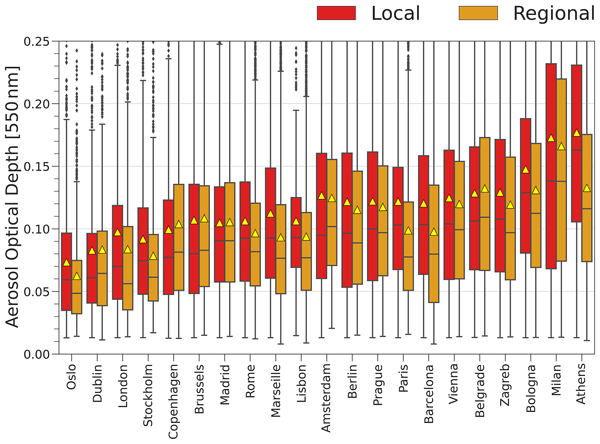
Ludovico Di Antonio, Claudia Di Biagio, Gilles Foret, Paola Formenti, Guillaume Siour, Jean-François Doussin, and Matthias Beekmann
Atmos. Chem. Phys., 23, 12455–12475, https://doi.org/10.5194/acp-23-12455-2023, https://doi.org/10.5194/acp-23-12455-2023, 2023
Short summary
Short summary
Long-term (2000–2021) 1 km resolution satellite data have been used to investigate the climatological aerosol optical depth (AOD) variability and trends at different scales in Europe. Average enhancements of the local-to-regional AOD ratio at 550 nm of 57 %, 55 %, 39 % and 32 % are found for large metropolitan areas such as Barcelona, Lisbon, Paris and Athens, respectively, suggesting a non-negligible enhancement of the aerosol burden through local emissions.
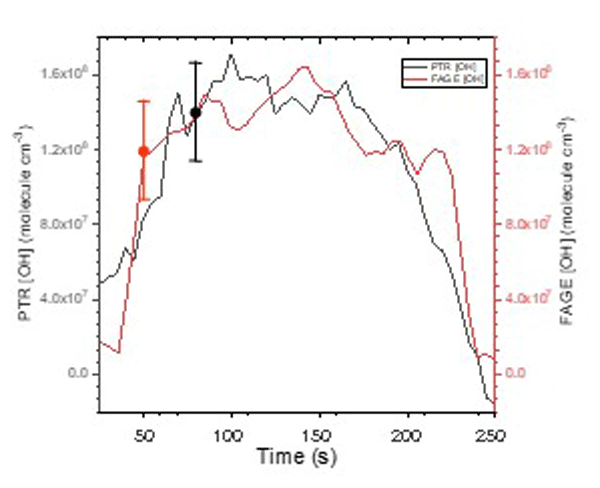
Frank A. F. Winiberg, William J. Warman, Charlotte A. Brumby, Graham Boustead, Iustinian G. Bejan, Thomas H. Speak, Dwayne E. Heard, Daniel Stone, and Paul W. Seakins
Atmos. Meas. Tech., 16, 4375–4390, https://doi.org/10.5194/amt-16-4375-2023, https://doi.org/10.5194/amt-16-4375-2023, 2023
Short summary
Short summary
OH and HO2 are key reactive intermediates in the Earth's atmosphere. Accurate measurements in either the field or simulation chambers provide a good test for chemical mechanisms. Fluorescence techniques have the appropriate sensitivity for detection but require calibration. This paper compares different methods of calibration and specifically how calibration factors vary across a temperature range relevant to atmospheric and chamber determinations.
Marc von Hobe, Domenico Taraborrelli, Sascha Alber, Birger Bohn, Hans-Peter Dorn, Hendrik Fuchs, Yun Li, Chenxi Qiu, Franz Rohrer, Roberto Sommariva, Fred Stroh, Zhaofeng Tan, Sergej Wedel, and Anna Novelli
Atmos. Chem. Phys., 23, 10609–10623, https://doi.org/10.5194/acp-23-10609-2023, https://doi.org/10.5194/acp-23-10609-2023, 2023
Short summary
Short summary
The trace gas carbonyl sulfide (OCS) transports sulfur from the troposphere to the stratosphere, where sulfate aerosols are formed that influence climate and stratospheric chemistry. An uncertain OCS source in the troposphere is chemical production form dimethyl sulfide (DMS), a gas released in large quantities from the oceans. We carried out experiments in a large atmospheric simulation chamber to further elucidate the chemical mechanism of OCS production from DMS.
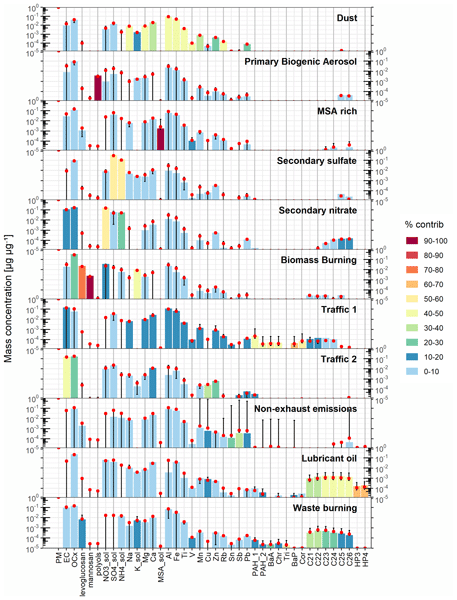
Valeria Mardoñez, Marco Pandolfi, Lucille Joanna S. Borlaza, Jean-Luc Jaffrezo, Andrés Alastuey, Jean-Luc Besombes, Isabel Moreno R., Noemi Perez, Griša Močnik, Patrick Ginot, Radovan Krejci, Vladislav Chrastny, Alfred Wiedensohler, Paolo Laj, Marcos Andrade, and Gaëlle Uzu
Atmos. Chem. Phys., 23, 10325–10347, https://doi.org/10.5194/acp-23-10325-2023, https://doi.org/10.5194/acp-23-10325-2023, 2023
Short summary
Short summary
La Paz and El Alto are two fast-growing, high-altitude Bolivian cities forming the second-largest metropolitan area in the country. The sources of particulate matter (PM) in this conurbation were not previously investigated. This study identified 11 main sources of PM, of which dust and vehicular emissions stand out as the main ones. The influence of regional biomass combustion and local waste combustion was also observed, with the latter being a major source of hazardous compounds.
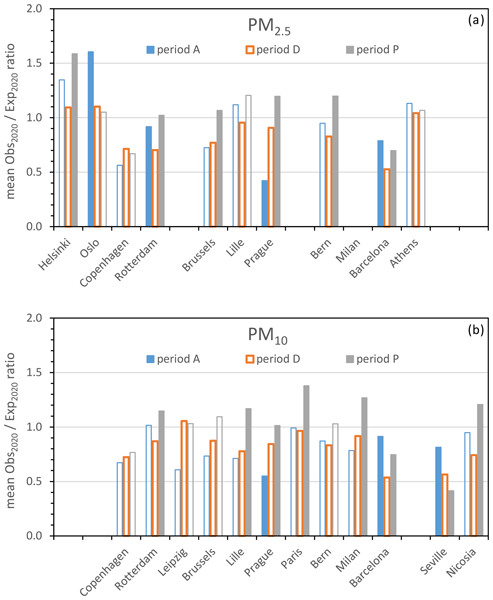
Jean-Philippe Putaud, Enrico Pisoni, Alexander Mangold, Christoph Hueglin, Jean Sciare, Michael Pikridas, Chrysanthos Savvides, Jakub Ondracek, Saliou Mbengue, Alfred Wiedensohler, Kay Weinhold, Maik Merkel, Laurent Poulain, Dominik van Pinxteren, Hartmut Herrmann, Andreas Massling, Claus Nordstroem, Andrés Alastuey, Cristina Reche, Noemí Pérez, Sonia Castillo, Mar Sorribas, Jose Antonio Adame, Tuukka Petaja, Katrianne Lehtipalo, Jarkko Niemi, Véronique Riffault, Joel F. de Brito, Augustin Colette, Olivier Favez, Jean-Eudes Petit, Valérie Gros, Maria I. Gini, Stergios Vratolis, Konstantinos Eleftheriadis, Evangelia Diapouli, Hugo Denier van der Gon, Karl Espen Yttri, and Wenche Aas
Atmos. Chem. Phys., 23, 10145–10161, https://doi.org/10.5194/acp-23-10145-2023, https://doi.org/10.5194/acp-23-10145-2023, 2023
Short summary
Short summary
Many European people are still exposed to levels of air pollution that can affect their health. COVID-19 lockdowns in 2020 were used to assess the impact of the reduction in human mobility on air pollution across Europe by comparing measurement data with values that would be expected if no lockdown had occurred. We show that lockdown measures did not lead to consistent decreases in the concentrations of fine particulate matter suspended in the air, and we investigate why.
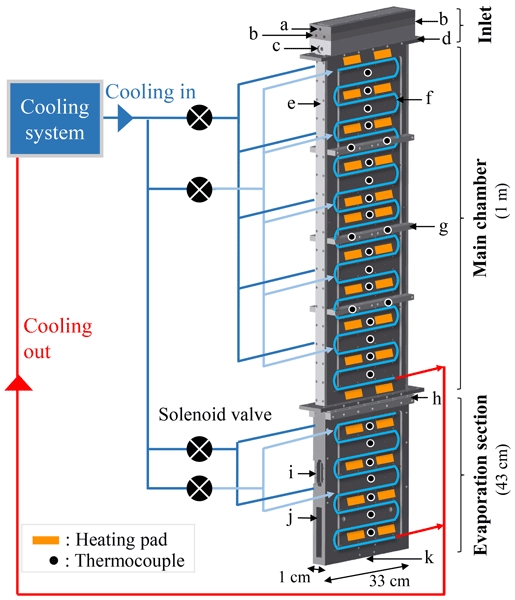
Dimitri Castarède, Zoé Brasseur, Yusheng Wu, Zamin A. Kanji, Markus Hartmann, Lauri Ahonen, Merete Bilde, Markku Kulmala, Tuukka Petäjä, Jan B. C. Pettersson, Berko Sierau, Olaf Stetzer, Frank Stratmann, Birgitta Svenningsson, Erik Swietlicki, Quynh Thu Nguyen, Jonathan Duplissy, and Erik S. Thomson
Atmos. Meas. Tech., 16, 3881–3899, https://doi.org/10.5194/amt-16-3881-2023, https://doi.org/10.5194/amt-16-3881-2023, 2023
Short summary
Short summary
Clouds play a key role in Earth’s climate by influencing the surface energy budget. Certain types of atmospheric aerosols, called ice-nucleating particles (INPs), induce the formation of ice in clouds and, thus, often initiate precipitation formation. The Portable Ice Nucleation Chamber 2 (PINCii) is a new instrument developed to study ice formation and to conduct ambient measurements of INPs, allowing us to investigate the sources and properties of the atmospheric aerosols that can act as INPs.
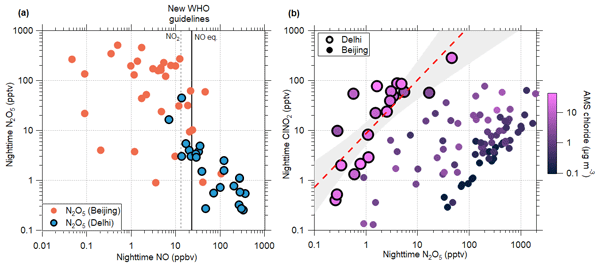
Sophie L. Haslett, David M. Bell, Varun Kumar, Jay G. Slowik, Dongyu S. Wang, Suneeti Mishra, Neeraj Rastogi, Atinderpal Singh, Dilip Ganguly, Joel Thornton, Feixue Zheng, Yuanyuan Li, Wei Nie, Yongchun Liu, Wei Ma, Chao Yan, Markku Kulmala, Kaspar R. Daellenbach, David Hadden, Urs Baltensperger, Andre S. H. Prevot, Sachchida N. Tripathi, and Claudia Mohr
Atmos. Chem. Phys., 23, 9023–9036, https://doi.org/10.5194/acp-23-9023-2023, https://doi.org/10.5194/acp-23-9023-2023, 2023
Short summary
Short summary
In Delhi, some aspects of daytime and nighttime atmospheric chemistry are inverted, and parodoxically, vehicle emissions may be limiting other forms of particle production. This is because the nighttime emissions of nitrogen oxide (NO) by traffic and biomass burning prevent some chemical processes that would otherwise create even more particles and worsen the urban haze.
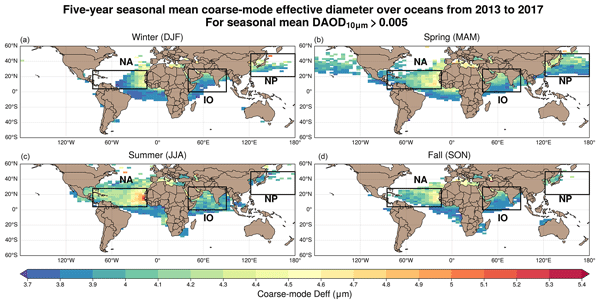
Jianyu Zheng, Zhibo Zhang, Hongbin Yu, Anne Garnier, Qianqian Song, Chenxi Wang, Claudia Di Biagio, Jasper F. Kok, Yevgeny Derimian, and Claire Ryder
Atmos. Chem. Phys., 23, 8271–8304, https://doi.org/10.5194/acp-23-8271-2023, https://doi.org/10.5194/acp-23-8271-2023, 2023
Short summary
Short summary
We developed a multi-year satellite-based retrieval of dust optical depth at 10 µm and the coarse-mode dust effective diameter over global oceans. It reveals climatological coarse-mode dust transport patterns and regional differences over the North Atlantic, the Indian Ocean and the North Pacific.
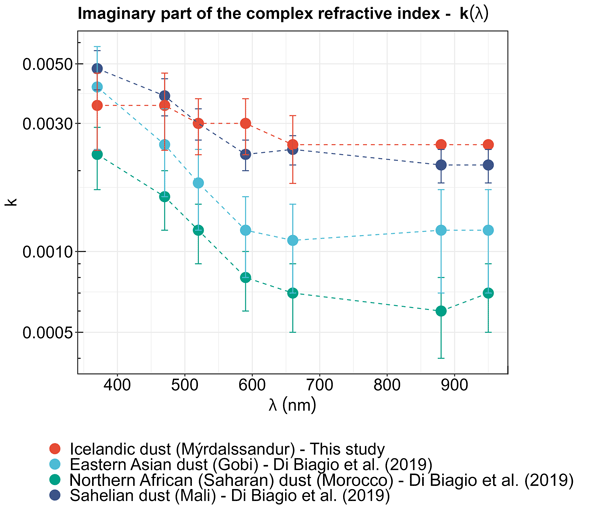
Clarissa Baldo, Paola Formenti, Claudia Di Biagio, Gongda Lu, Congbo Song, Mathieu Cazaunau, Edouard Pangui, Jean-Francois Doussin, Pavla Dagsson-Waldhauserova, Olafur Arnalds, David Beddows, A. Robert MacKenzie, and Zongbo Shi
Atmos. Chem. Phys., 23, 7975–8000, https://doi.org/10.5194/acp-23-7975-2023, https://doi.org/10.5194/acp-23-7975-2023, 2023
Short summary
Short summary
This paper presents new shortwave spectral complex refractive index and single scattering albedo data for Icelandic dust. Our results show that the imaginary part of the complex refractive index of Icelandic dust is at the upper end of the range of low-latitude dust. Furthermore, we observed that Icelandic dust is more absorbing towards the near-infrared, which we attribute to its high magnetite content. These findings are important for modeling dust aerosol radiative effects in the Arctic.
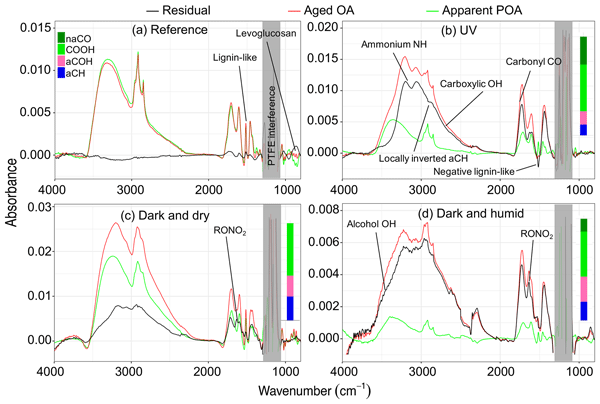
Amir Yazdani, Satoshi Takahama, John K. Kodros, Marco Paglione, Mauro Masiol, Stefania Squizzato, Kalliopi Florou, Christos Kaltsonoudis, Spiro D. Jorga, Spyros N. Pandis, and Athanasios Nenes
Atmos. Chem. Phys., 23, 7461–7477, https://doi.org/10.5194/acp-23-7461-2023, https://doi.org/10.5194/acp-23-7461-2023, 2023
Short summary
Short summary
Organic aerosols directly emitted from wood and pellet stove combustion are found to chemically transform (approximately 15 %–35 % by mass) under daytime aging conditions simulated in an environmental chamber. A new marker for lignin-like compounds is found to degrade at a different rate than previously identified biomass burning markers and can potentially provide indication of aging time in ambient samples.
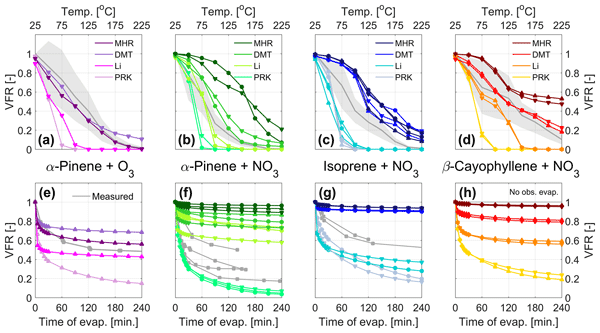
Emelie L. Graham, Cheng Wu, David M. Bell, Amelie Bertrand, Sophie L. Haslett, Urs Baltensperger, Imad El Haddad, Radovan Krejci, Ilona Riipinen, and Claudia Mohr
Atmos. Chem. Phys., 23, 7347–7362, https://doi.org/10.5194/acp-23-7347-2023, https://doi.org/10.5194/acp-23-7347-2023, 2023
Short summary
Short summary
The volatility of an aerosol particle is an important parameter for describing its atmospheric lifetime. We studied the volatility of secondary organic aerosols from nitrate-initiated oxidation of three biogenic precursors with experimental methods and model simulations. We saw higher volatility than for the corresponding ozone system, and our simulations produced variable results with different parameterizations which warrant a re-evaluation of the treatment of the nitrate functional group.

Jonas Elm, Aladár Czitrovszky, Andreas Held, Annele Virtanen, Astrid Kiendler-Scharr, Benjamin J. Murray, Daniel McCluskey, Daniele Contini, David Broday, Eirini Goudeli, Hilkka Timonen, Joan Rosell-Llompart, Jose L. Castillo, Evangelia Diapouli, Mar Viana, Maria E. Messing, Markku Kulmala, Naděžda Zíková, and Sebastian H. Schmitt
Aerosol Research, 1, 13–16, https://doi.org/10.5194/ar-1-13-2023, https://doi.org/10.5194/ar-1-13-2023, 2023
Hao Luo, Luc Vereecken, Hongru Shen, Sungah Kang, Iida Pullinen, Mattias Hallquist, Hendrik Fuchs, Andreas Wahner, Astrid Kiendler-Scharr, Thomas F. Mentel, and Defeng Zhao
Atmos. Chem. Phys., 23, 7297–7319, https://doi.org/10.5194/acp-23-7297-2023, https://doi.org/10.5194/acp-23-7297-2023, 2023
Short summary
Short summary
Oxidation of limonene, an element emitted by trees and chemical products, by OH, a daytime oxidant, forms many highly oxygenated organic molecules (HOMs), including C10-20 compounds. HOMs play an important role in new particle formation and growth. HOM formation can be explained by the chemistry of peroxy radicals. We found that a minor branching ratio initial pathway plays an unexpected, significant role. Considering this pathway enables accurate simulations of HOMs and other concentrations.
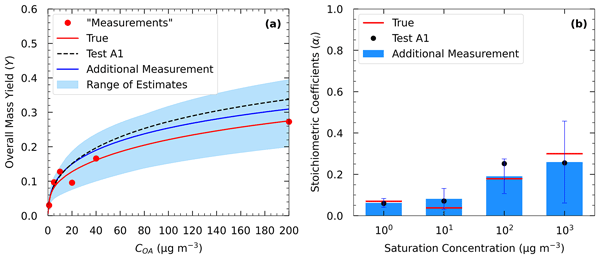
Petro Uruci, Dontavious Sippial, Anthoula Drosatou, and Spyros N. Pandis
Atmos. Meas. Tech., 16, 3155–3172, https://doi.org/10.5194/amt-16-3155-2023, https://doi.org/10.5194/amt-16-3155-2023, 2023
Short summary
Short summary
In this work we develop an algorithm for the synthesis of the measurements performed in atmospheric simulation chambers regarding the formation of secondary organic aerosol (SOA). Novel features of the algorithm are its ability to use measurements of SOA yields, thermodenuders, and isothermal dilution; its estimation of parameters that can be used directly in atmospheric chemical transport models; and finally its estimates of the uncertainty in SOA formation yields.
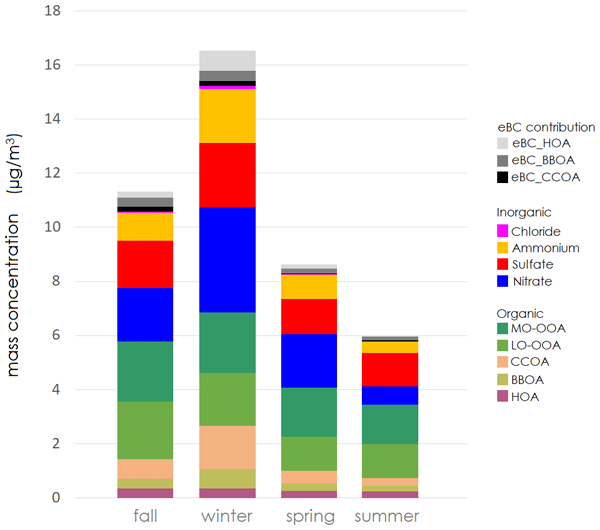
Samira Atabakhsh, Laurent Poulain, Gang Chen, Francesco Canonaco, André S. H. Prévôt, Mira Pöhlker, Alfred Wiedensohler, and Hartmut Herrmann
Atmos. Chem. Phys., 23, 6963–6988, https://doi.org/10.5194/acp-23-6963-2023, https://doi.org/10.5194/acp-23-6963-2023, 2023
Short summary
Short summary
The study focuses on the aerosol chemical variations found in the rural-background station of Melpitz based on ACSM and MAAP measurements. Source apportionment on both organic aerosol (OA) and black carbon (eBC) was performed, and source seasonality was also linked to air mass trajectories. Overall, three anthropogenic sources were identified in OA and eBC plus two additional aged OA. Our results demonstrate the influence of transported coal-combustion-related OA even during summer time.
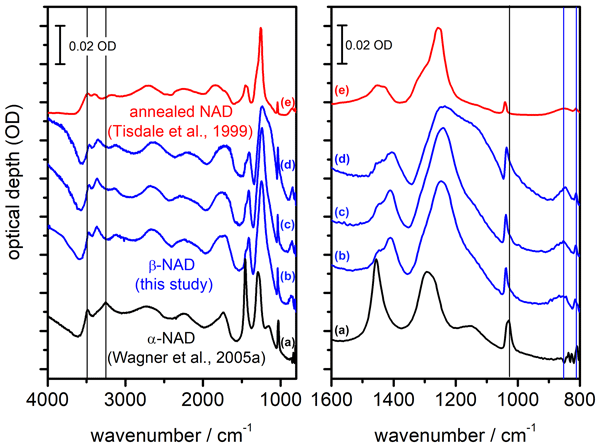
Robert Wagner, Alexander D. James, Victoria L. Frankland, Ottmar Möhler, Benjamin J. Murray, John M. C. Plane, Harald Saathoff, Ralf Weigel, and Martin Schnaiter
Atmos. Chem. Phys., 23, 6789–6811, https://doi.org/10.5194/acp-23-6789-2023, https://doi.org/10.5194/acp-23-6789-2023, 2023
Short summary
Short summary
Polar stratospheric clouds (PSCs) play an important role in the depletion of stratospheric ozone. They can consist of different chemical species, including crystalline nitric acid hydrates. We found that mineral dust or meteoric ablation material can efficiently catalyse the formation of a specific phase of nitric acid dihydrate crystals. We determined predominant particle shapes and infrared optical properties of these crystals, which are important inputs for remote sensing detection of PSCs.
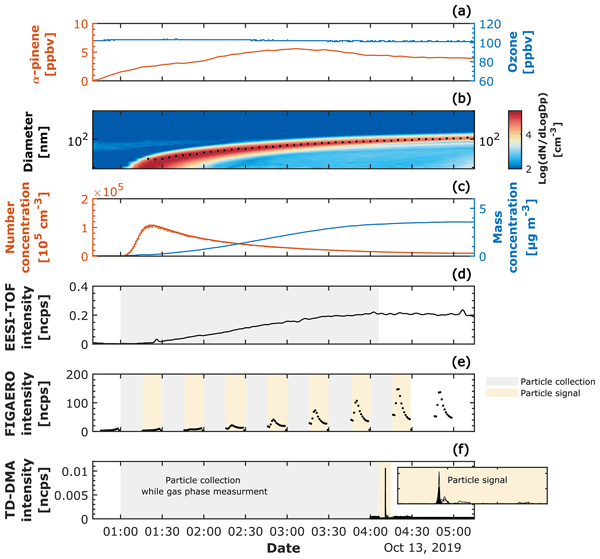
Lucía Caudillo, Mihnea Surdu, Brandon Lopez, Mingyi Wang, Markus Thoma, Steffen Bräkling, Angela Buchholz, Mario Simon, Andrea C. Wagner, Tatjana Müller, Manuel Granzin, Martin Heinritzi, Antonio Amorim, David M. Bell, Zoé Brasseur, Lubna Dada, Jonathan Duplissy, Henning Finkenzeller, Xu-Cheng He, Houssni Lamkaddam, Naser G. A. Mahfouz, Vladimir Makhmutov, Hanna E. Manninen, Guillaume Marie, Ruby Marten, Roy L. Mauldin, Bernhard Mentler, Antti Onnela, Tuukka Petäjä, Joschka Pfeifer, Maxim Philippov, Ana A. Piedehierro, Birte Rörup, Wiebke Scholz, Jiali Shen, Dominik Stolzenburg, Christian Tauber, Ping Tian, António Tomé, Nsikanabasi Silas Umo, Dongyu S. Wang, Yonghong Wang, Stefan K. Weber, André Welti, Marcel Zauner-Wieczorek, Urs Baltensperger, Richard C. Flagan, Armin Hansel, Jasper Kirkby, Markku Kulmala, Katrianne Lehtipalo, Douglas R. Worsnop, Imad El Haddad, Neil M. Donahue, Alexander L. Vogel, Andreas Kürten, and Joachim Curtius
Atmos. Chem. Phys., 23, 6613–6631, https://doi.org/10.5194/acp-23-6613-2023, https://doi.org/10.5194/acp-23-6613-2023, 2023
Short summary
Short summary
In this study, we present an intercomparison of four different techniques for measuring the chemical composition of nanoparticles. The intercomparison was performed based on the observed chemical composition, calculated volatility, and analysis of the thermograms. We found that the methods generally agree on the most important compounds that are found in the nanoparticles. However, they do see different parts of the organic spectrum. We suggest potential explanations for these differences.
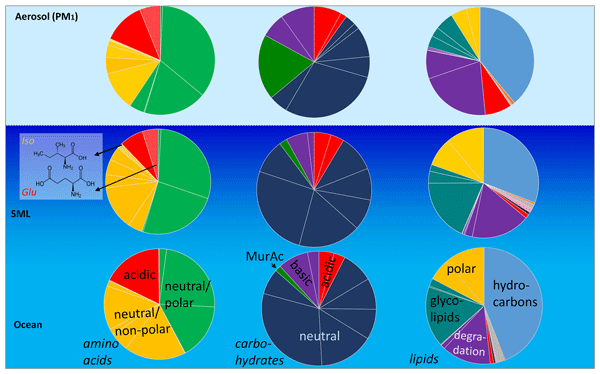
Manuela van Pinxteren, Sebastian Zeppenfeld, Khanneh Wadinga Fomba, Nadja Triesch, Sanja Frka, and Hartmut Herrmann
Atmos. Chem. Phys., 23, 6571–6590, https://doi.org/10.5194/acp-23-6571-2023, https://doi.org/10.5194/acp-23-6571-2023, 2023
Short summary
Short summary
Important marine organic carbon compounds were identified in the Atlantic Ocean and marine aerosol particles. These compounds were strongly enriched in the atmosphere. Their enrichment was, however, not solely explained via sea-to-air transfer but also via atmospheric in situ formation. The identified compounds constituted about 50 % of the organic carbon on the aerosol particles, and a pronounced coupling between ocean and atmosphere for this oligotrophic region could be concluded.
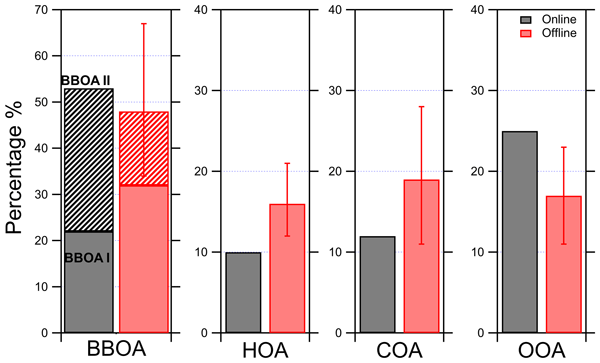
Christina N. Vasilakopoulou, Kalliopi Florou, Christos Kaltsonoudis, Iasonas Stavroulas, Nikolaos Mihalopoulos, and Spyros N. Pandis
Atmos. Meas. Tech., 16, 2837–2850, https://doi.org/10.5194/amt-16-2837-2023, https://doi.org/10.5194/amt-16-2837-2023, 2023
Short summary
Short summary
The offline aerosol mass spectrometry technique is a useful tool for the source apportionment of organic aerosol in areas and periods during which an aerosol mass spectrometer is not available. In this work, an improved offline technique was developed and evaluated in an effort to capture most of the partially soluble and insoluble organic aerosol material, reducing the uncertainty of the corresponding source apportionment significantly.
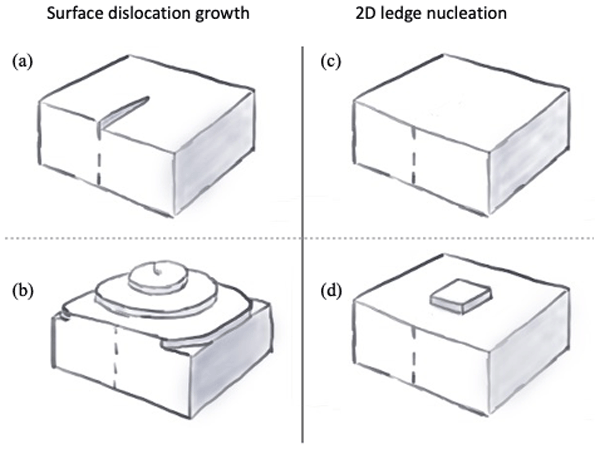
Kara D. Lamb, Jerry Y. Harrington, Benjamin W. Clouser, Elisabeth J. Moyer, Laszlo Sarkozy, Volker Ebert, Ottmar Möhler, and Harald Saathoff
Atmos. Chem. Phys., 23, 6043–6064, https://doi.org/10.5194/acp-23-6043-2023, https://doi.org/10.5194/acp-23-6043-2023, 2023
Short summary
Short summary
This study investigates how ice grows directly from vapor in cirrus clouds by comparing observations of populations of ice crystals growing in a cloud chamber against models developed in the context of single-crystal laboratory studies. We demonstrate that previous discrepancies between different experimental measurements do not necessarily point to different physical interpretations but are rather due to assumptions that were made in terms of how experiments were modeled in previous studies.
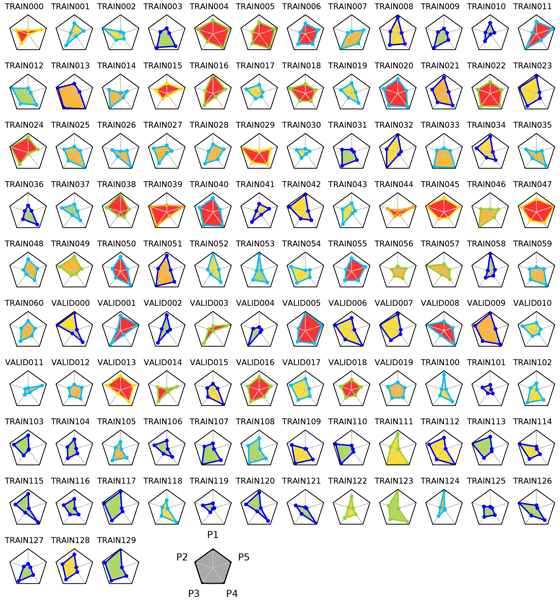
Ernesto Reyes-Villegas, Douglas Lowe, Jill S. Johnson, Kenneth S. Carslaw, Eoghan Darbyshire, Michael Flynn, James D. Allan, Hugh Coe, Ying Chen, Oliver Wild, Scott Archer-Nicholls, Alex Archibald, Siddhartha Singh, Manish Shrivastava, Rahul A. Zaveri, Vikas Singh, Gufran Beig, Ranjeet Sokhi, and Gordon McFiggans
Atmos. Chem. Phys., 23, 5763–5782, https://doi.org/10.5194/acp-23-5763-2023, https://doi.org/10.5194/acp-23-5763-2023, 2023
Short summary
Short summary
Organic aerosols (OAs), their sources and their processes remain poorly understood. The volatility basis set (VBS) approach, implemented in air quality models such as WRF-Chem, can be a useful tool to describe primary OA (POA) production and aging. However, the main disadvantage is its complexity. We used a Gaussian process simulator to reproduce model results and to estimate the sources of model uncertainty. We do this by comparing the outputs with OA observations made at Delhi, India, in 2018.
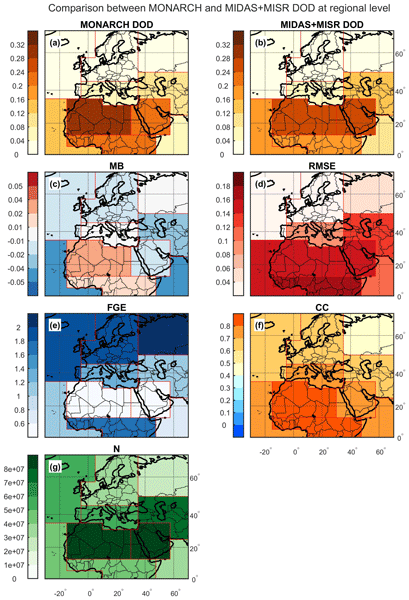
Michail Mytilinaios, Sara Basart, Sergio Ciamprone, Juan Cuesta, Claudio Dema, Enza Di Tomaso, Paola Formenti, Antonis Gkikas, Oriol Jorba, Ralph Kahn, Carlos Pérez García-Pando, Serena Trippetta, and Lucia Mona
Atmos. Chem. Phys., 23, 5487–5516, https://doi.org/10.5194/acp-23-5487-2023, https://doi.org/10.5194/acp-23-5487-2023, 2023
Short summary
Short summary
Multiscale Online Non-hydrostatic AtmospheRe CHemistry model (MONARCH) dust reanalysis provides a high-resolution 3D reconstruction of past dust conditions, allowing better quantification of climate and socioeconomic dust impacts. We assess the performance of the reanalysis needed to reproduce dust optical depth using dust-related products retrieved from satellite and ground-based observations and show that it reproduces the spatial distribution and seasonal variability of atmospheric dust well.
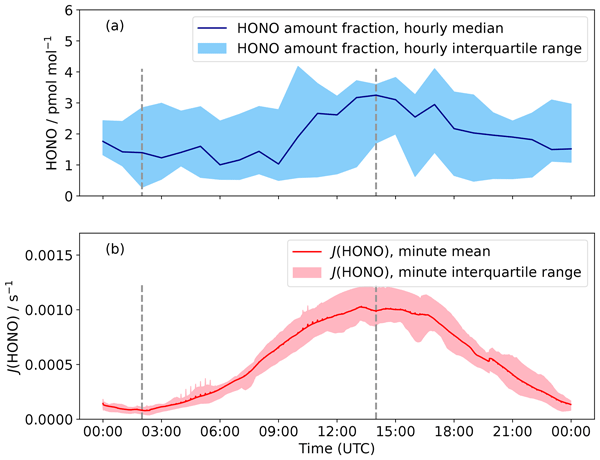
Amelia M. H. Bond, Markus M. Frey, Jan Kaiser, Jörg Kleffmann, Anna E. Jones, and Freya A. Squires
Atmos. Chem. Phys., 23, 5533–5550, https://doi.org/10.5194/acp-23-5533-2023, https://doi.org/10.5194/acp-23-5533-2023, 2023
Short summary
Short summary
Atmospheric nitrous acid (HONO) amount fractions measured at Halley Research Station, Antarctica, were found to be low. Vertical fluxes of HONO from the snow were also measured and agree with the estimated HONO production rate from photolysis of snow nitrate. In a simple box model of HONO sources and sinks, there was good agreement between the measured flux and amount fraction. HONO was found to be an important OH radical source at Halley.

Kevin C. H. Sze, Heike Wex, Markus Hartmann, Henrik Skov, Andreas Massling, Diego Villanueva, and Frank Stratmann
Atmos. Chem. Phys., 23, 4741–4761, https://doi.org/10.5194/acp-23-4741-2023, https://doi.org/10.5194/acp-23-4741-2023, 2023
Short summary
Short summary
Ice-nucleating particles (INPs) play an important role in cloud formation and thus in our climate. But little is known about the abundance and properties of INPs, especially in the Arctic, where the temperature increases almost 4 times as fast as that of the rest of the globe. We observe higher INP concentrations and more biological INPs in summer than in winter, likely from local sources. We also provide three equations for estimating INP concentrations in models at different times of the year.
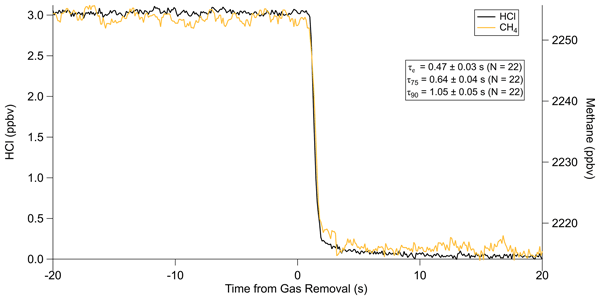
John W. Halfacre, Jordan Stewart, Scott C. Herndon, Joseph R. Roscioli, Christoph Dyroff, Tara I. Yacovitch, Michael Flynn, Stephen J. Andrews, Steven S. Brown, Patrick R. Veres, and Pete M. Edwards
Atmos. Meas. Tech., 16, 1407–1429, https://doi.org/10.5194/amt-16-1407-2023, https://doi.org/10.5194/amt-16-1407-2023, 2023
Short summary
Short summary
This study details a new sampling method for the optical detection of hydrogen chloride (HCl). HCl is an important atmospheric reservoir for chlorine atoms, which can affect nitrogen oxide cycling and the lifetimes of volatile organic compounds and ozone. However, HCl has a high affinity for interacting with surfaces, thereby preventing fast, quantitative measurements. The sampling technique in this study minimizes these surface interactions and provides a high-quality measurement of HCl.
Philip T. M. Carlsson, Luc Vereecken, Anna Novelli, François Bernard, Steven S. Brown, Bellamy Brownwood, Changmin Cho, John N. Crowley, Patrick Dewald, Peter M. Edwards, Nils Friedrich, Juliane L. Fry, Mattias Hallquist, Luisa Hantschke, Thorsten Hohaus, Sungah Kang, Jonathan Liebmann, Alfred W. Mayhew, Thomas Mentel, David Reimer, Franz Rohrer, Justin Shenolikar, Ralf Tillmann, Epameinondas Tsiligiannis, Rongrong Wu, Andreas Wahner, Astrid Kiendler-Scharr, and Hendrik Fuchs
Atmos. Chem. Phys., 23, 3147–3180, https://doi.org/10.5194/acp-23-3147-2023, https://doi.org/10.5194/acp-23-3147-2023, 2023
Short summary
Short summary
The investigation of the night-time oxidation of the most abundant hydrocarbon, isoprene, in chamber experiments shows the importance of reaction pathways leading to epoxy products, which could enhance particle formation, that have so far not been accounted for. The chemical lifetime of organic nitrates from isoprene is long enough for the majority to be further oxidized the next day by daytime oxidants.
Changmin Cho, Hendrik Fuchs, Andreas Hofzumahaus, Frank Holland, William J. Bloss, Birger Bohn, Hans-Peter Dorn, Marvin Glowania, Thorsten Hohaus, Lu Liu, Paul S. Monks, Doreen Niether, Franz Rohrer, Roberto Sommariva, Zhaofeng Tan, Ralf Tillmann, Astrid Kiendler-Scharr, Andreas Wahner, and Anna Novelli
Atmos. Chem. Phys., 23, 2003–2033, https://doi.org/10.5194/acp-23-2003-2023, https://doi.org/10.5194/acp-23-2003-2023, 2023
Short summary
Short summary
With this study, we investigated the processes leading to the formation, destruction, and recycling of radicals for four seasons in a rural environment. Complete knowledge of their chemistry is needed if we are to predict the formation of secondary pollutants from primary emissions. The results highlight a still incomplete understanding of the paths leading to the formation of the OH radical, which has been observed in several other environments as well and needs to be further investigated.
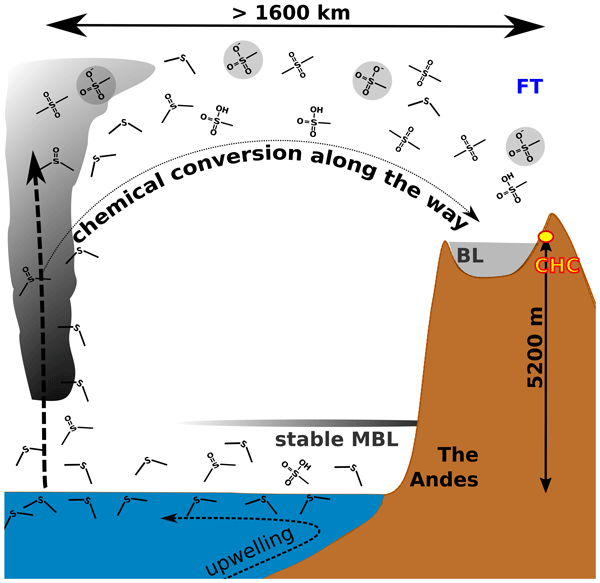
Wiebke Scholz, Jiali Shen, Diego Aliaga, Cheng Wu, Samara Carbone, Isabel Moreno, Qiaozhi Zha, Wei Huang, Liine Heikkinen, Jean Luc Jaffrezo, Gaelle Uzu, Eva Partoll, Markus Leiminger, Fernando Velarde, Paolo Laj, Patrick Ginot, Paolo Artaxo, Alfred Wiedensohler, Markku Kulmala, Claudia Mohr, Marcos Andrade, Victoria Sinclair, Federico Bianchi, and Armin Hansel
Atmos. Chem. Phys., 23, 895–920, https://doi.org/10.5194/acp-23-895-2023, https://doi.org/10.5194/acp-23-895-2023, 2023
Short summary
Short summary
Dimethyl sulfide (DMS), emitted from the ocean, is the most abundant biogenic sulfur emission into the atmosphere. OH radicals, among others, can oxidize DMS to sulfuric and methanesulfonic acid, which are relevant for aerosol formation. We quantified DMS and nearly all DMS oxidation products with novel mass spectrometric instruments for gas and particle phase at the high mountain station Chacaltaya (5240 m a.s.l.) in the Bolivian Andes in free tropospheric air after long-range transport.
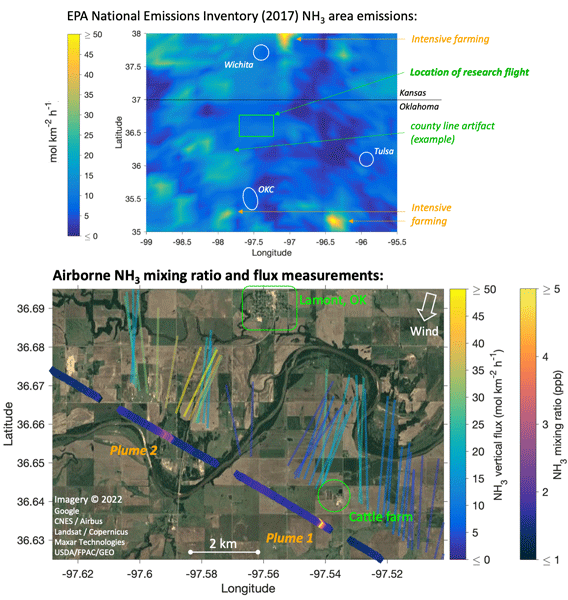
Siegfried Schobesberger, Emma L. D'Ambro, Lejish Vettikkat, Ben H. Lee, Qiaoyun Peng, David M. Bell, John E. Shilling, Manish Shrivastava, Mikhail Pekour, Jerome Fast, and Joel A. Thornton
Atmos. Meas. Tech., 16, 247–271, https://doi.org/10.5194/amt-16-247-2023, https://doi.org/10.5194/amt-16-247-2023, 2023
Short summary
Short summary
We present a new, highly sensitive technique for measuring atmospheric ammonia, an important trace gas that is emitted mainly by agriculture. We deployed the instrument on an aircraft during research flights over rural Oklahoma. Due to its fast response, we could analyze correlations with turbulent winds and calculate ammonia emissions from nearby areas at 1 to 2 km resolution. We observed high spatial variability and point sources that are not resolved in the US National Emissions Inventory.
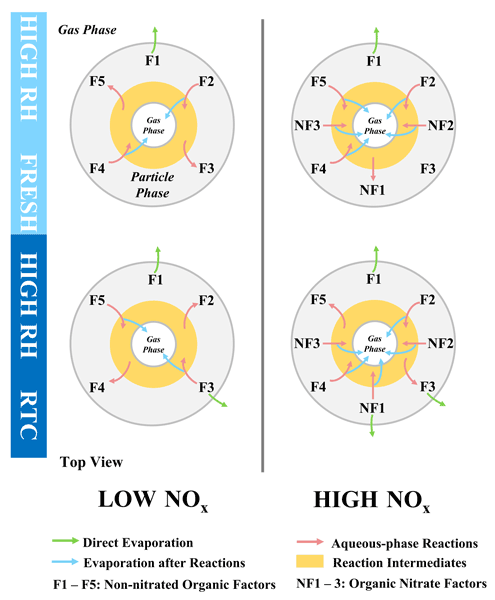
Zijun Li, Angela Buchholz, Luis M. F. Barreira, Arttu Ylisirniö, Liqing Hao, Iida Pullinen, Siegfried Schobesberger, and Annele Virtanen
Atmos. Chem. Phys., 23, 203–220, https://doi.org/10.5194/acp-23-203-2023, https://doi.org/10.5194/acp-23-203-2023, 2023
Short summary
Short summary
Interaction between NOx and biogenic emissions can be important in suburban areas. Our study showed that the addition of NOx during α-pinene SOA formation produced considerable amounts of organic nitrates and affected the composition of non-nitrated organic compounds. The compositional difference consequently altered the primary type of aqueous-phase processes during the isothermal particle evaporation.

Spiro D. Jorga, Kalliopi Florou, David Patoulias, and Spyros N. Pandis
Atmos. Chem. Phys., 23, 85–97, https://doi.org/10.5194/acp-23-85-2023, https://doi.org/10.5194/acp-23-85-2023, 2023
Short summary
Short summary
We take advantage of this unexpected low, new particle formation frequency in Greece and use a dual atmospheric simulation chamber system with starting point ambient air in an effort to gain insight about the chemical species that is limiting nucleation in this area. A potential nucleation precursor, ammonia, was added in one of the chambers while the other one was used as a reference. The addition of ammonia assisted new particle formation in almost 50 % of the experiments conducted.
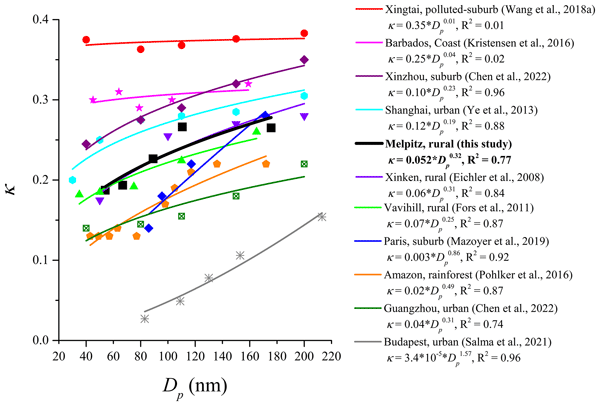
Yuan Wang, Silvia Henning, Laurent Poulain, Chunsong Lu, Frank Stratmann, Yuying Wang, Shengjie Niu, Mira L. Pöhlker, Hartmut Herrmann, and Alfred Wiedensohler
Atmos. Chem. Phys., 22, 15943–15962, https://doi.org/10.5194/acp-22-15943-2022, https://doi.org/10.5194/acp-22-15943-2022, 2022
Short summary
Short summary
Aerosol particle activation affects cloud, precipitation, radiation, and thus the global climate. Its long-term measurements are important but still scarce. In this study, more than 4 years of measurements at a central European station were analyzed. The overall characteristics and seasonal changes of aerosol particle activation are summarized. The power-law fit between particle hygroscopicity factor and diameter was recommended for predicting cloud
condensation nuclei number concentration.
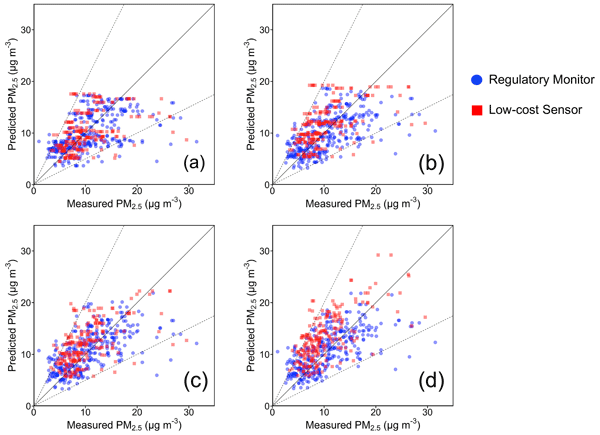
Brian T. Dinkelacker, Pablo Garcia Rivera, Ioannis Kioutsioukis, Peter J. Adams, and Spyros N. Pandis
Geosci. Model Dev., 15, 8899–8912, https://doi.org/10.5194/gmd-15-8899-2022, https://doi.org/10.5194/gmd-15-8899-2022, 2022
Short summary
Short summary
The performance of a chemical transport model in reproducing PM2.5 concentrations and composition was evaluated at the finest scale using measurements from regulatory sites as well as a network of low-cost monitors. Total PM2.5 mass is reproduced well by the model during the winter when compared to regulatory measurements, but in the summer PM2.5 is underpredicted, mainly due to difficulties in reproducing regional secondary organic aerosol levels.
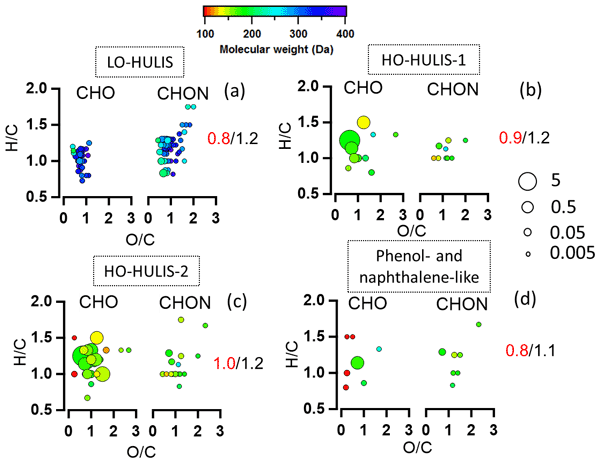
Feng Jiang, Junwei Song, Jonas Bauer, Linyu Gao, Magdalena Vallon, Reiner Gebhardt, Thomas Leisner, Stefan Norra, and Harald Saathoff
Atmos. Chem. Phys., 22, 14971–14986, https://doi.org/10.5194/acp-22-14971-2022, https://doi.org/10.5194/acp-22-14971-2022, 2022
Short summary
Short summary
We studied brown carbon aerosol during typical summer and winter periods in downtown Karlsruhe in southwestern Germany. The chromophore and chemical composition of brown carbon was determined by excitation–emission spectroscopy and mass spectrometry. The chromophore types and sources were substantially different in winter and summer. Humic-like chromophores of different degrees of oxidation dominated and were associated with molecules of different molecular weight and nitrogen content.
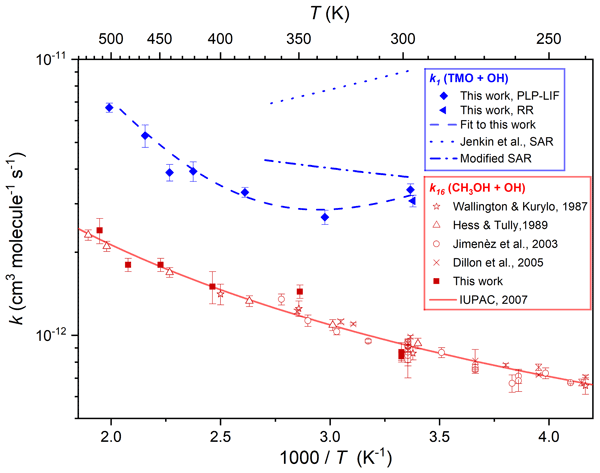
Caterina Mapelli, Juliette V. Schleicher, Alex Hawtin, Conor D. Rankine, Fiona C. Whiting, Fergal Byrne, C. Rob McElroy, Claudiu Roman, Cecilia Arsene, Romeo I. Olariu, Iustinian G. Bejan, and Terry J. Dillon
Atmos. Chem. Phys., 22, 14589–14602, https://doi.org/10.5194/acp-22-14589-2022, https://doi.org/10.5194/acp-22-14589-2022, 2022
Short summary
Short summary
Solvents represent an important source of pollution from the chemical industry. New "green" solvents aim to replace toxic solvents with new molecules made from renewable sources and designed to be less harmful. Whilst these new molecules are selected according to toxicity and other characteristics, no consideration has yet been included on air quality. Studying the solvent breakdown in air, we found that TMO has a lower impact on air quality than traditional solvents with similar properties.
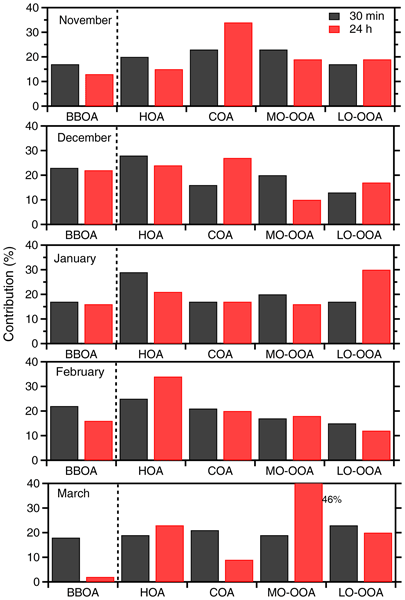
Christina Vasilakopoulou, Iasonas Stavroulas, Nikolaos Mihalopoulos, and Spyros N. Pandis
Atmos. Meas. Tech., 15, 6419–6431, https://doi.org/10.5194/amt-15-6419-2022, https://doi.org/10.5194/amt-15-6419-2022, 2022
Short summary
Short summary
Offline aerosol mass spectrometer (AMS) measurements can provide valuable information about ambient organic aerosols when online AMS measurements are not available. In this study, we examine whether and how the low time resolution (usually 24 h) of the offline technique affects source apportionment results. We concluded that use of the daily averages resulted in estimated average contributions that were within 8 % of the total OA compared with the high-resolution analysis.
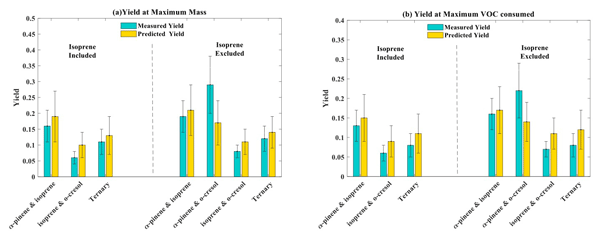
Aristeidis Voliotis, Mao Du, Yu Wang, Yunqi Shao, M. Rami Alfarra, Thomas J. Bannan, Dawei Hu, Kelly L. Pereira, Jaqueline F. Hamilton, Mattias Hallquist, Thomas F. Mentel, and Gordon McFiggans
Atmos. Chem. Phys., 22, 14147–14175, https://doi.org/10.5194/acp-22-14147-2022, https://doi.org/10.5194/acp-22-14147-2022, 2022
Short summary
Short summary
Mixing experiments are crucial and highly beneficial for our understanding of atmospheric chemical interactions. However, interpretation quickly becomes complex, and both the experimental design and evaluation need to be scrutinised carefully. Advanced online and offline compositional measurements can reveal substantial additional information to aid in the interpretation of yield data, including components uniquely found in mixtures and property changes in SOA formed from mixtures of VOCs.
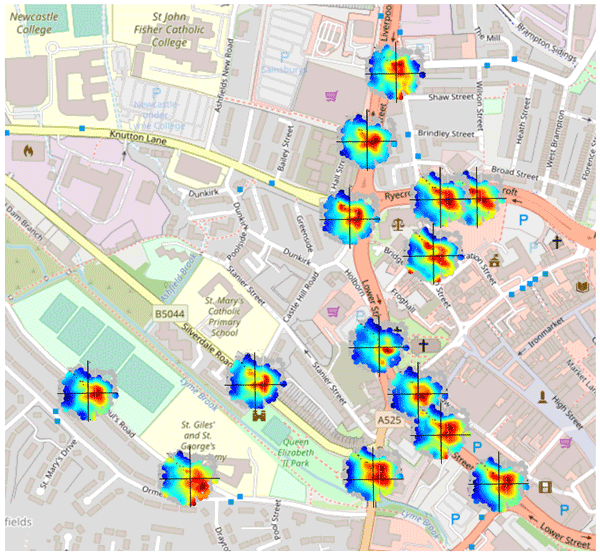
Louise Bøge Frederickson, Ruta Sidaraviciute, Johan Albrecht Schmidt, Ole Hertel, and Matthew Stanley Johnson
Atmos. Chem. Phys., 22, 13949–13965, https://doi.org/10.5194/acp-22-13949-2022, https://doi.org/10.5194/acp-22-13949-2022, 2022
Short summary
Short summary
Low-cost sensors see additional pollution that is not seen with traditional regional air quality monitoring stations. This additional local pollution is sufficient to cause exceedance of the World Health Organization exposure thresholds. Analysis shows that a significant amount of the NO2 pollution we observe is local, mainly due to road traffic. This article demonstrates how networks of nodes containing low-cost pollution sensors can powerfully extend existing monitoring programmes.
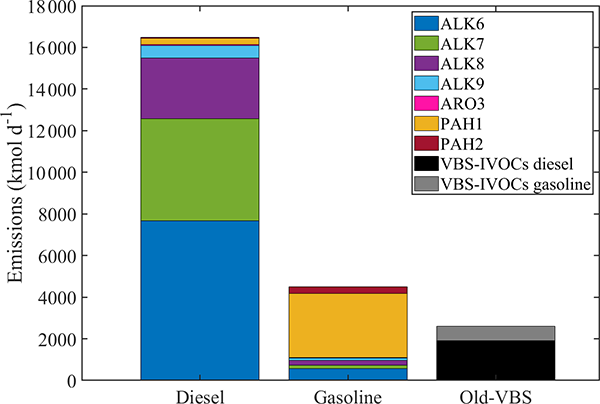
Stella E. I. Manavi and Spyros N. Pandis
Geosci. Model Dev., 15, 7731–7749, https://doi.org/10.5194/gmd-15-7731-2022, https://doi.org/10.5194/gmd-15-7731-2022, 2022
Short summary
Short summary
The paper describes the first step towards the development of a simulation framework for the chemistry and secondary organic aerosol production of intermediate-volatility organic compounds (IVOCs). These compounds can be a significant source of organic particulate matter. Our approach treats IVOCs as lumped compounds that retain their chemical characteristics. Estimated IVOC emissions from road transport were a factor of 8 higher than emissions used in previous applications.
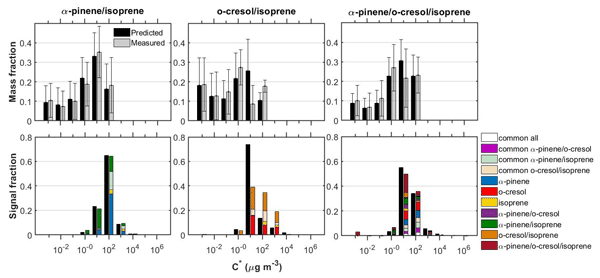
Aristeidis Voliotis, Mao Du, Yu Wang, Yunqi Shao, Thomas J. Bannan, Michael Flynn, Spyros N. Pandis, Carl J. Percival, M. Rami Alfarra, and Gordon McFiggans
Atmos. Chem. Phys., 22, 13677–13693, https://doi.org/10.5194/acp-22-13677-2022, https://doi.org/10.5194/acp-22-13677-2022, 2022
Short summary
Short summary
The addition of a low-yield precursor to the reactive mixture of aVOC and bVOC can increase or decrease the SOA volatility that is system-dependent. Therefore, the SOA volatility of the mixtures cannot always be predicted based on the additivity. In complex mixtures the formation of lower-volatility products likely outweighs the formation of products with higher volatility. The unique products of each mixture contribute significantly to the signal, suggesting interactions can be important.
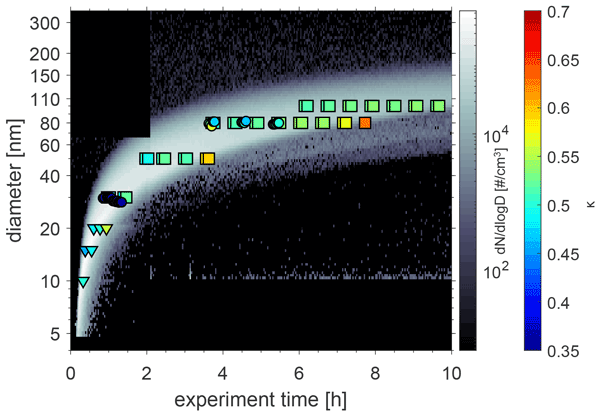
Bernadette Rosati, Sini Isokääntä, Sigurd Christiansen, Mads Mørk Jensen, Shamjad P. Moosakutty, Robin Wollesen de Jonge, Andreas Massling, Marianne Glasius, Jonas Elm, Annele Virtanen, and Merete Bilde
Atmos. Chem. Phys., 22, 13449–13466, https://doi.org/10.5194/acp-22-13449-2022, https://doi.org/10.5194/acp-22-13449-2022, 2022
Short summary
Short summary
Sulfate aerosols have a strong influence on climate. Due to the reduction in sulfur-based fossil fuels, natural sulfur emissions play an increasingly important role. Studies investigating the climate relevance of natural sulfur aerosols are scarce. We study the water uptake of such particles in the laboratory, demonstrating a high potential to take up water and form cloud droplets. During atmospheric transit, chemical processing affects the particles’ composition and thus their water uptake.
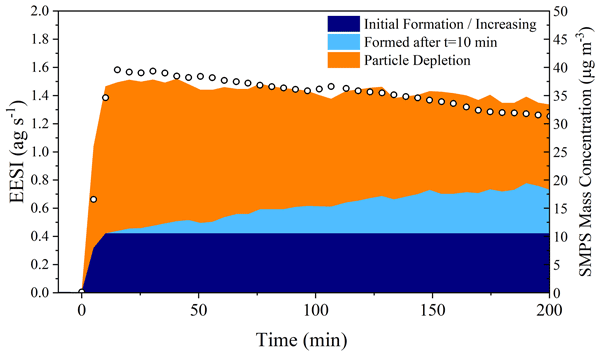
David M. Bell, Cheng Wu, Amelie Bertrand, Emelie Graham, Janne Schoonbaert, Stamatios Giannoukos, Urs Baltensperger, Andre S. H. Prevot, Ilona Riipinen, Imad El Haddad, and Claudia Mohr
Atmos. Chem. Phys., 22, 13167–13182, https://doi.org/10.5194/acp-22-13167-2022, https://doi.org/10.5194/acp-22-13167-2022, 2022
Short summary
Short summary
A series of studies designed to investigate the evolution of organic aerosol were performed in an atmospheric simulation chamber, using a common oxidant found at night (NO3). The chemical composition steadily changed from its initial composition via different chemical reactions that were taking place inside of the aerosol particle. These results show that the composition of organic aerosol steadily changes during its lifetime in the atmosphere.
Zhaofeng Tan, Hendrik Fuchs, Andreas Hofzumahaus, William J. Bloss, Birger Bohn, Changmin Cho, Thorsten Hohaus, Frank Holland, Chandrakiran Lakshmisha, Lu Liu, Paul S. Monks, Anna Novelli, Doreen Niether, Franz Rohrer, Ralf Tillmann, Thalassa S. E. Valkenburg, Vaishali Vardhan, Astrid Kiendler-Scharr, Andreas Wahner, and Roberto Sommariva
Atmos. Chem. Phys., 22, 13137–13152, https://doi.org/10.5194/acp-22-13137-2022, https://doi.org/10.5194/acp-22-13137-2022, 2022
Short summary
Short summary
During the 2019 JULIAC campaign, ClNO2 was measured at a rural site in Germany in different seasons. The highest ClNO2 level was 1.6 ppbv in September. ClNO2 production was more sensitive to the availability of NO2 than O3. The average ClNO2 production efficiency was up to 18 % in February and September and down to 3 % in December. These numbers are at the high end of the values reported in the literature, indicating the importance of ClNO2 chemistry in rural environments in midwestern Europe.
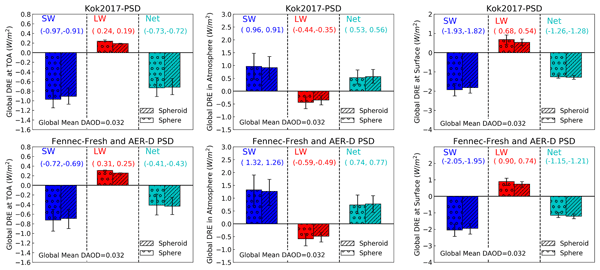
Qianqian Song, Zhibo Zhang, Hongbin Yu, Jasper F. Kok, Claudia Di Biagio, Samuel Albani, Jianyu Zheng, and Jiachen Ding
Atmos. Chem. Phys., 22, 13115–13135, https://doi.org/10.5194/acp-22-13115-2022, https://doi.org/10.5194/acp-22-13115-2022, 2022
Short summary
Short summary
This study developed a dataset that enables us to efficiently calculate dust direct radiative effect (DRE, i.e., cooling or warming our planet) for any given dust size distribution in addition to three sets of dust mineral components and two dust shapes. We demonstrate and validate the method of using this dataset to calculate dust DRE. Moreover, using this dataset we found that dust mineral composition is a more important factor in determining dust DRE than dust size and shape.
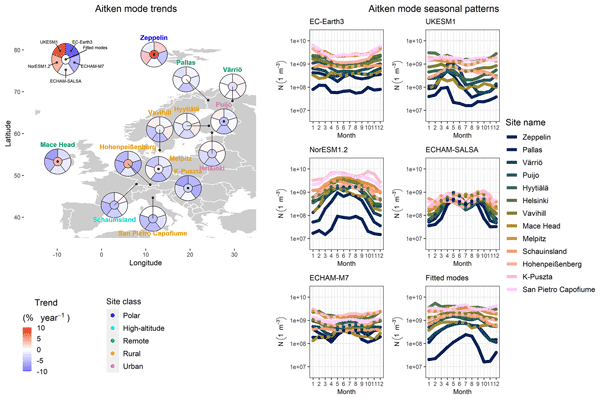
Ville Leinonen, Harri Kokkola, Taina Yli-Juuti, Tero Mielonen, Thomas Kühn, Tuomo Nieminen, Simo Heikkinen, Tuuli Miinalainen, Tommi Bergman, Ken Carslaw, Stefano Decesari, Markus Fiebig, Tareq Hussein, Niku Kivekäs, Radovan Krejci, Markku Kulmala, Ari Leskinen, Andreas Massling, Nikos Mihalopoulos, Jane P. Mulcahy, Steffen M. Noe, Twan van Noije, Fiona M. O'Connor, Colin O'Dowd, Dirk Olivie, Jakob B. Pernov, Tuukka Petäjä, Øyvind Seland, Michael Schulz, Catherine E. Scott, Henrik Skov, Erik Swietlicki, Thomas Tuch, Alfred Wiedensohler, Annele Virtanen, and Santtu Mikkonen
Atmos. Chem. Phys., 22, 12873–12905, https://doi.org/10.5194/acp-22-12873-2022, https://doi.org/10.5194/acp-22-12873-2022, 2022
Short summary
Short summary
We provide the first extensive comparison of detailed aerosol size distribution trends between in situ observations from Europe and five different earth system models. We investigated aerosol modes (nucleation, Aitken, and accumulation) separately and were able to show the differences between measured and modeled trends and especially their seasonal patterns. The differences in model results are likely due to complex effects of several processes instead of certain specific model features.
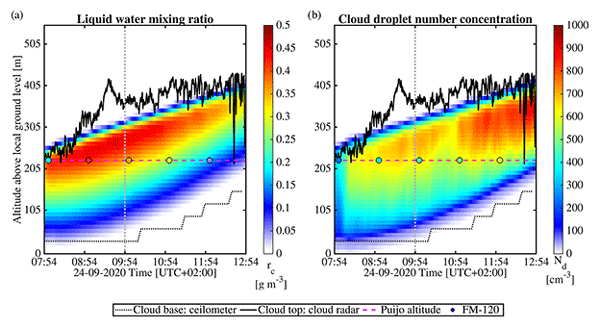
Silvia M. Calderón, Juha Tonttila, Angela Buchholz, Jorma Joutsensaari, Mika Komppula, Ari Leskinen, Liqing Hao, Dmitri Moisseev, Iida Pullinen, Petri Tiitta, Jian Xu, Annele Virtanen, Harri Kokkola, and Sami Romakkaniemi
Atmos. Chem. Phys., 22, 12417–12441, https://doi.org/10.5194/acp-22-12417-2022, https://doi.org/10.5194/acp-22-12417-2022, 2022
Short summary
Short summary
The spatial and temporal restrictions of observations and oversimplified aerosol representation in large eddy simulations (LES) limit our understanding of aerosol–stratocumulus interactions. In this closure study of in situ and remote sensing observations and outputs from UCLALES–SALSA, we have assessed the role of convective overturning and aerosol effects in two cloud events observed at the Puijo SMEAR IV station, Finland, a diurnal-high aerosol case and a nocturnal-low aerosol case.
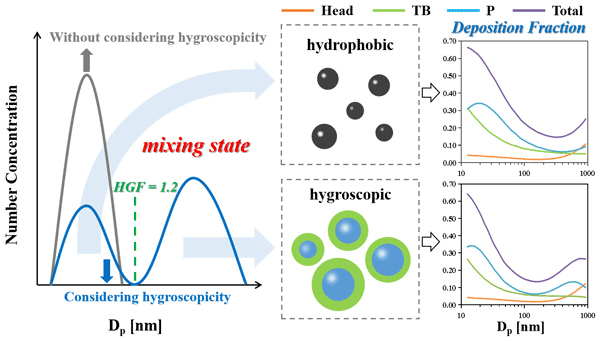
Ruiqi Man, Zhijun Wu, Taomou Zong, Aristeidis Voliotis, Yanting Qiu, Johannes Größ, Dominik van Pinxteren, Limin Zeng, Hartmut Herrmann, Alfred Wiedensohler, and Min Hu
Atmos. Chem. Phys., 22, 12387–12399, https://doi.org/10.5194/acp-22-12387-2022, https://doi.org/10.5194/acp-22-12387-2022, 2022
Short summary
Short summary
Regional and total deposition doses for different age groups were quantified based on explicit hygroscopicity measurements. We found that particle hygroscopic growth led to a reduction (~24 %) in the total dose. The deposition rate of hygroscopic particles was higher in the daytime, while hydrophobic particles exhibited a higher rate at night and during rush hours. The results will deepen the understanding of the impact of hygroscopicity and the mixing state on deposition patterns in the lungs.
Brian T. Dinkelacker, Pablo Garcia Rivera, Ksakousti Skyllakou, Peter J. Adams, and Spyros N. Pandis
Atmos. Chem. Phys. Discuss., https://doi.org/10.5194/acp-2022-648, https://doi.org/10.5194/acp-2022-648, 2022
Revised manuscript not accepted
Short summary
Short summary
A number of factors have influenced the biogenic secondary organic aerosol (SOA) levels in the southeastern US from 2001 to 2010. The increases in temperature have led to an increase of the emissions of biogenic volatile organic compounds by trees and a corresponding increase of the SOA. However, this increase has been balanced by the reductions in the anthropogenic emissions of organic gases and particulate matter as well as of the oxides of nitrogen keeping the biogenic SOA roughly constant.
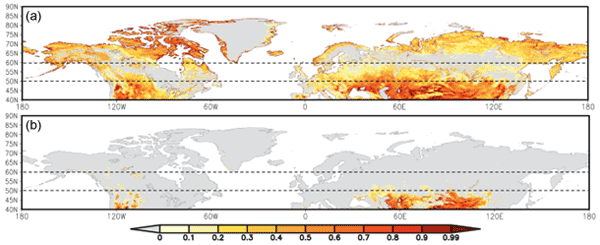
Outi Meinander, Pavla Dagsson-Waldhauserova, Pavel Amosov, Elena Aseyeva, Cliff Atkins, Alexander Baklanov, Clarissa Baldo, Sarah L. Barr, Barbara Barzycka, Liane G. Benning, Bojan Cvetkovic, Polina Enchilik, Denis Frolov, Santiago Gassó, Konrad Kandler, Nikolay Kasimov, Jan Kavan, James King, Tatyana Koroleva, Viktoria Krupskaya, Markku Kulmala, Monika Kusiak, Hanna K. Lappalainen, Michał Laska, Jerome Lasne, Marek Lewandowski, Bartłomiej Luks, James B. McQuaid, Beatrice Moroni, Benjamin Murray, Ottmar Möhler, Adam Nawrot, Slobodan Nickovic, Norman T. O’Neill, Goran Pejanovic, Olga Popovicheva, Keyvan Ranjbar, Manolis Romanias, Olga Samonova, Alberto Sanchez-Marroquin, Kerstin Schepanski, Ivan Semenkov, Anna Sharapova, Elena Shevnina, Zongbo Shi, Mikhail Sofiev, Frédéric Thevenet, Throstur Thorsteinsson, Mikhail Timofeev, Nsikanabasi Silas Umo, Andreas Uppstu, Darya Urupina, György Varga, Tomasz Werner, Olafur Arnalds, and Ana Vukovic Vimic
Atmos. Chem. Phys., 22, 11889–11930, https://doi.org/10.5194/acp-22-11889-2022, https://doi.org/10.5194/acp-22-11889-2022, 2022
Short summary
Short summary
High-latitude dust (HLD) is a short-lived climate forcer, air pollutant, and nutrient source. Our results suggest a northern HLD belt at 50–58° N in Eurasia and 50–55° N in Canada and at >60° N in Eurasia and >58° N in Canada. Our addition to the previously identified global dust belt (GDB) provides crucially needed information on the extent of active HLD sources with both direct and indirect impacts on climate and environment in remote regions, which are often poorly understood and predicted.
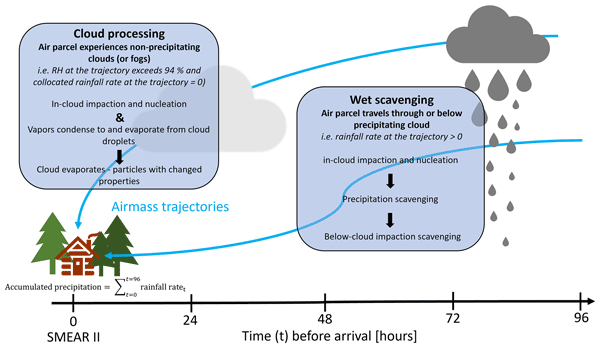
Sini Isokääntä, Paul Kim, Santtu Mikkonen, Thomas Kühn, Harri Kokkola, Taina Yli-Juuti, Liine Heikkinen, Krista Luoma, Tuukka Petäjä, Zak Kipling, Daniel Partridge, and Annele Virtanen
Atmos. Chem. Phys., 22, 11823–11843, https://doi.org/10.5194/acp-22-11823-2022, https://doi.org/10.5194/acp-22-11823-2022, 2022
Short summary
Short summary
This research employs air mass history analysis and observations to study how clouds and precipitation affect atmospheric aerosols during transport to a boreal forest site. The mass concentrations of studied chemical species showed exponential decrease as a function of accumulated rain along the air mass route. Our analysis revealed in-cloud sulfate formation, while no major changes in organic mass were seen. Most of the in-cloud-formed sulfate could be assigned to particle sizes above 200 nm.
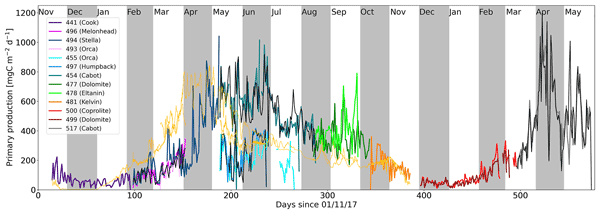
Benjamin R. Loveday, Timothy Smyth, Anıl Akpinar, Tom Hull, Mark E. Inall, Jan Kaiser, Bastien Y. Queste, Matt Tobermann, Charlotte A. J. Williams, and Matthew R. Palmer
Earth Syst. Sci. Data, 14, 3997–4016, https://doi.org/10.5194/essd-14-3997-2022, https://doi.org/10.5194/essd-14-3997-2022, 2022
Short summary
Short summary
Using a new approach to combine autonomous underwater glider data and satellite Earth observations, we have generated a 19-month time series of North Sea net primary productivity – the rate at which phytoplankton absorbs carbon dioxide minus that lost through respiration. This time series, which spans 13 gliders, allows for new investigations into small-scale, high-frequency variability in the biogeochemical processes that underpin the carbon cycle and coastal marine ecosystems in shelf seas.

Jerome D. Fast, David M. Bell, Gourihar Kulkarni, Jiumeng Liu, Fan Mei, Georges Saliba, John E. Shilling, Kaitlyn Suski, Jason Tomlinson, Jian Wang, Rahul Zaveri, and Alla Zelenyuk
Atmos. Chem. Phys., 22, 11217–11238, https://doi.org/10.5194/acp-22-11217-2022, https://doi.org/10.5194/acp-22-11217-2022, 2022
Short summary
Short summary
Recent aircraft measurements from the HI-SCALE campaign conducted over the Southern Great Plains (SGP) site in Oklahoma are used to quantify spatial variability of aerosol properties in terms of grid spacings typically used by weather and climate models. Surprisingly large horizontal gradients in aerosol properties were frequently observed in this rural area. This spatial variability can be used as an uncertainty range when comparing surface point measurements with model predictions.
Yindong Guo, Hongru Shen, Iida Pullinen, Hao Luo, Sungah Kang, Luc Vereecken, Hendrik Fuchs, Mattias Hallquist, Ismail-Hakki Acir, Ralf Tillmann, Franz Rohrer, Jürgen Wildt, Astrid Kiendler-Scharr, Andreas Wahner, Defeng Zhao, and Thomas F. Mentel
Atmos. Chem. Phys., 22, 11323–11346, https://doi.org/10.5194/acp-22-11323-2022, https://doi.org/10.5194/acp-22-11323-2022, 2022
Short summary
Short summary
The oxidation of limonene, a common volatile emitted by trees and chemical products, by NO3, a nighttime oxidant, forms many highly oxygenated organic molecules (HOM), including C10-30 compounds. Most of the HOM are second-generation organic nitrates, in which carbonyl-substituted C10 nitrates accounted for a major fraction. Their formation can be explained by chemistry of peroxy radicals. HOM, especially low-volatile ones, play an important role in nighttime new particle formation and growth.
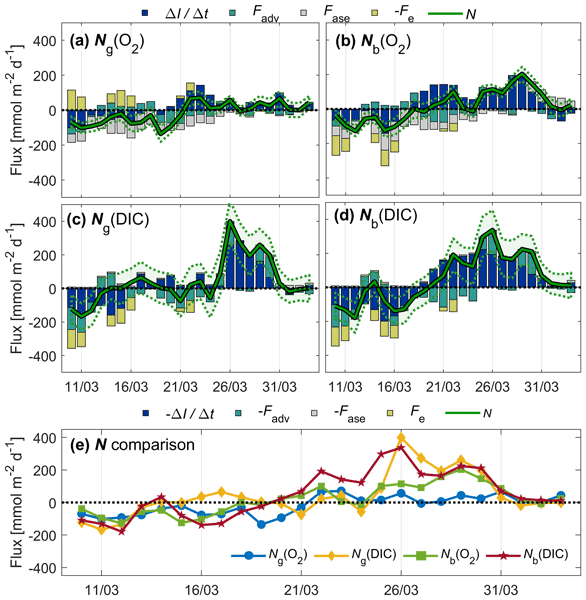
Michael P. Hemming, Jan Kaiser, Jacqueline Boutin, Liliane Merlivat, Karen J. Heywood, Dorothee C. E. Bakker, Gareth A. Lee, Marcos Cobas García, David Antoine, and Kiminori Shitashima
Ocean Sci., 18, 1245–1262, https://doi.org/10.5194/os-18-1245-2022, https://doi.org/10.5194/os-18-1245-2022, 2022
Short summary
Short summary
An underwater glider mission was carried out in spring 2016 near a mooring in the northwestern Mediterranean Sea. The glider deployment served as a test of a prototype ion-sensitive field-effect transistor pH sensor. Mean net community production rates were estimated from glider and buoy measurements of dissolved oxygen and inorganic carbon concentrations before and during the spring bloom. Incorporating advection is important for accurate mass budgets. Unexpected metabolic quotients were found.
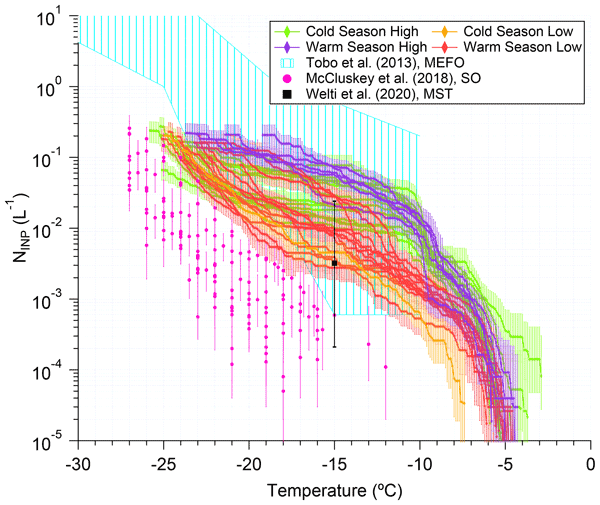
Xianda Gong, Martin Radenz, Heike Wex, Patric Seifert, Farnoush Ataei, Silvia Henning, Holger Baars, Boris Barja, Albert Ansmann, and Frank Stratmann
Atmos. Chem. Phys., 22, 10505–10525, https://doi.org/10.5194/acp-22-10505-2022, https://doi.org/10.5194/acp-22-10505-2022, 2022
Short summary
Short summary
The sources of ice-nucleating particles (INPs) are poorly understood in the Southern Hemisphere (SH). We studied INPs in the boundary layer in the southern Patagonia region. No seasonal cycle of INP concentrations was observed. The majority of INPs are biogenic particles, likely from local continental sources. The INP concentrations are higher when strong precipitation occurs. While previous studies focused on marine INP sources in SH, we point out the importance of continental sources of INPs.
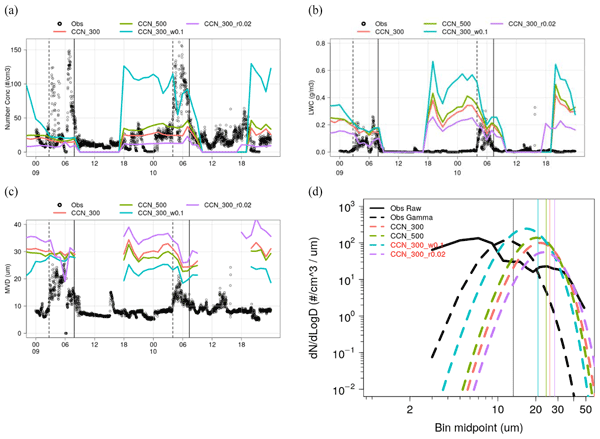
Michael John Weston, Stuart John Piketh, Frédéric Burnet, Stephen Broccardo, Cyrielle Denjean, Thierry Bourrianne, and Paola Formenti
Atmos. Chem. Phys., 22, 10221–10245, https://doi.org/10.5194/acp-22-10221-2022, https://doi.org/10.5194/acp-22-10221-2022, 2022
Short summary
Short summary
An aerosol-aware microphysics scheme is evaluated for fog cases in Namibia. AEROCLO-sA campaign observations are used to access and parameterise the model. The model cloud condensation nuclei activation is lower than the observations. The scheme is designed for clouds with updrafts, while fog typically forms in stable conditions. A pseudo updraft speed assigned to the lowest model levels helps achieve more realistic cloud droplet number concentration and size distribution in the model.

Yunqi Shao, Aristeidis Voliotis, Mao Du, Yu Wang, Kelly Pereira, Jacqueline Hamilton, M. Rami Alfarra, and Gordon McFiggans
Atmos. Chem. Phys., 22, 9799–9826, https://doi.org/10.5194/acp-22-9799-2022, https://doi.org/10.5194/acp-22-9799-2022, 2022
Short summary
Short summary
This study explored the chemical properties of secondary organic aerosol (SOA) that formed from photo-oxidation of single and mixed biogenic and anthropogenic precursors. We showed that SOA chemical properties in a mixed vapour system are mainly affected by the
higher-yield precursor's oxidation products and products from
cross-product formation. This study also identifies potential tracer compounds in a mixed vapour system that might be used in SOA source attribution in future ambient studies.
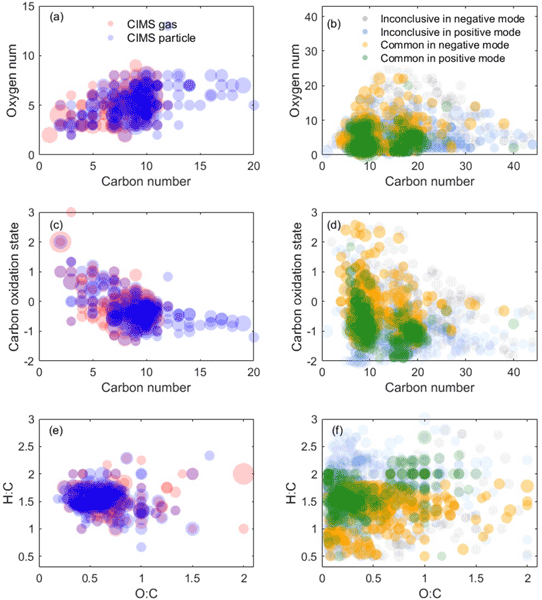
Mao Du, Aristeidis Voliotis, Yunqi Shao, Yu Wang, Thomas J. Bannan, Kelly L. Pereira, Jacqueline F. Hamilton, Carl J. Percival, M. Rami Alfarra, and Gordon McFiggans
Atmos. Meas. Tech., 15, 4385–4406, https://doi.org/10.5194/amt-15-4385-2022, https://doi.org/10.5194/amt-15-4385-2022, 2022
Short summary
Short summary
Atmospheric chemistry plays a key role in the understanding of aerosol formation and air pollution. We designed chamber experiments for the characterization of secondary organic aerosol (SOA) from a biogenic precursor with inorganic seed. Our results highlight the advantages of a combination of online FIGAERO-CIMS and offline LC-Orbitrap MS analytical techniques to characterize the chemical composition of SOA in chamber studies.
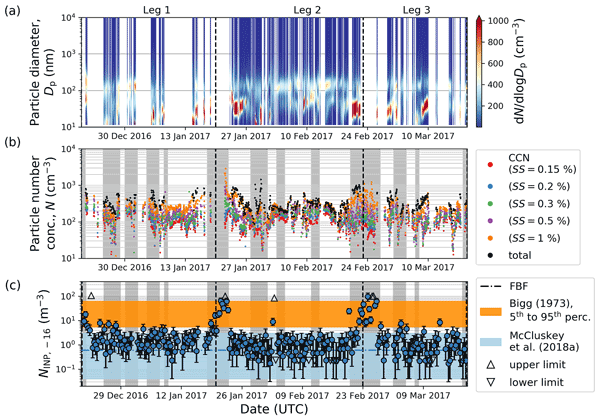
Christian Tatzelt, Silvia Henning, André Welti, Andrea Baccarini, Markus Hartmann, Martin Gysel-Beer, Manuela van Pinxteren, Robin L. Modini, Julia Schmale, and Frank Stratmann
Atmos. Chem. Phys., 22, 9721–9745, https://doi.org/10.5194/acp-22-9721-2022, https://doi.org/10.5194/acp-22-9721-2022, 2022
Short summary
Short summary
We present the abundance and origin of cloud-relevant aerosol particles in the preindustral-like conditions of the Southern Ocean (SO) during austral summer. Cloud condensation nuclei (CCN) and ice-nucleating particles (INP) were measured during a circum-Antarctic scientific cruise with in situ instrumentation and offline filter measurements, respectively. Transport processes were found to play an equally important role as local sources for both the CCN and INP population of the SO.
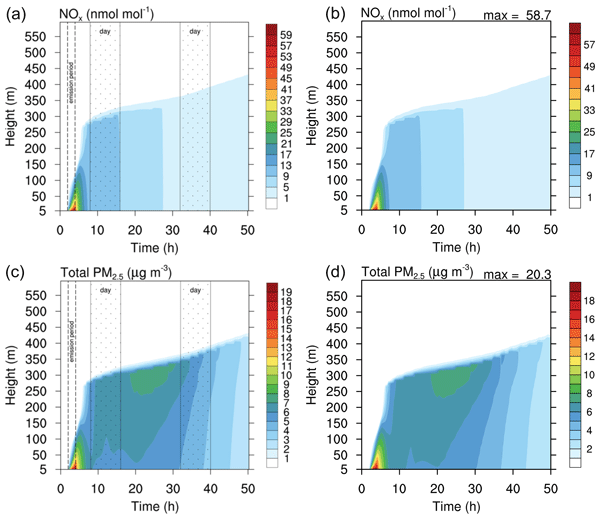
Josué Bock, Jan Kaiser, Max Thomas, Andreas Bott, and Roland von Glasow
Geosci. Model Dev., 15, 5807–5828, https://doi.org/10.5194/gmd-15-5807-2022, https://doi.org/10.5194/gmd-15-5807-2022, 2022
Short summary
Short summary
MISTRA-v9.0 is an atmospheric boundary layer chemistry model. The model includes a detailed particle description with regards to the microphysics, gas–particle interactions, and liquid phase chemistry within particles. Version 9.0 is the first release of MISTRA as an open-source community model. This paper presents a thorough description of the model characteristics and components. We show some examples of simulations reproducing previous studies with MISTRA with good consistency.
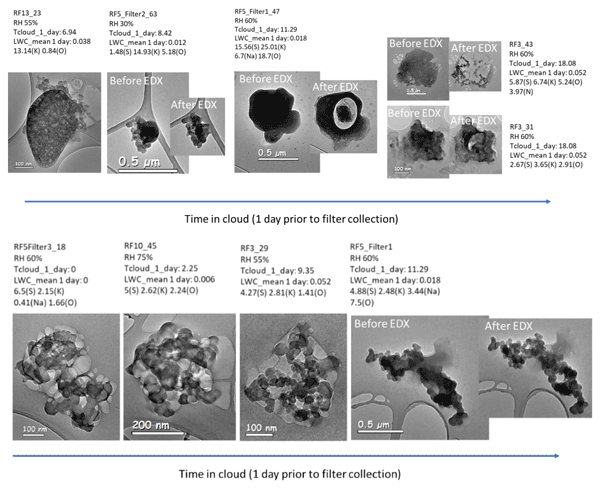
Caroline Dang, Michal Segal-Rozenhaimer, Haochi Che, Lu Zhang, Paola Formenti, Jonathan Taylor, Amie Dobracki, Sara Purdue, Pui-Shan Wong, Athanasios Nenes, Arthur Sedlacek III, Hugh Coe, Jens Redemann, Paquita Zuidema, Steven Howell, and James Haywood
Atmos. Chem. Phys., 22, 9389–9412, https://doi.org/10.5194/acp-22-9389-2022, https://doi.org/10.5194/acp-22-9389-2022, 2022
Short summary
Short summary
Transmission electron microscopy was used to analyze aged African smoke particles and how the smoke interacts with the marine atmosphere. We found that the volatility of organic aerosol increases with biomass burning plume age, that black carbon is often mixed with potassium salts and that the marine atmosphere can incorporate Na and Cl into smoke particles. Marine salts are more processed when mixed with smoke plumes, and there are interesting Cl-rich yet Na-absent marine particles.
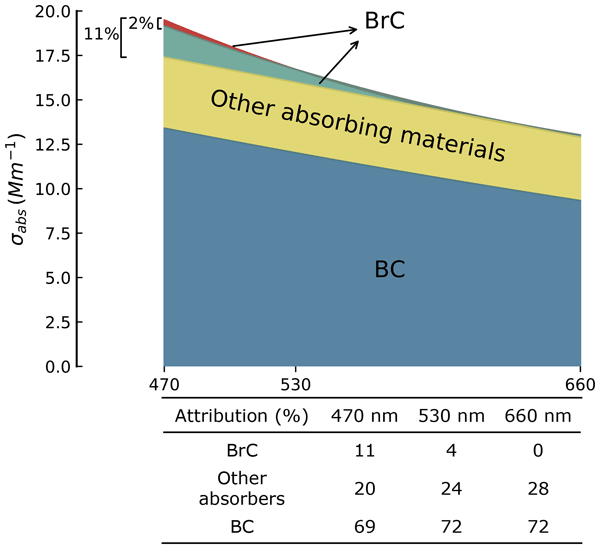
Lu Zhang, Michal Segal-Rozenhaimer, Haochi Che, Caroline Dang, Arthur J. Sedlacek III, Ernie R. Lewis, Amie Dobracki, Jenny P. S. Wong, Paola Formenti, Steven G. Howell, and Athanasios Nenes
Atmos. Chem. Phys., 22, 9199–9213, https://doi.org/10.5194/acp-22-9199-2022, https://doi.org/10.5194/acp-22-9199-2022, 2022
Short summary
Short summary
Widespread biomass burning (BB) events occur annually in Africa and contribute ~ 1 / 3 of global BB emissions, which contain a large family of light-absorbing organics, known as brown carbon (BrC), whose absorption of incident radiation is difficult to estimate, leading to large uncertainties in the global radiative forcing estimation. This study quantifies the BrC absorption of aged BB particles and highlights the potential presence of absorbing iron oxides in this climatically important region.
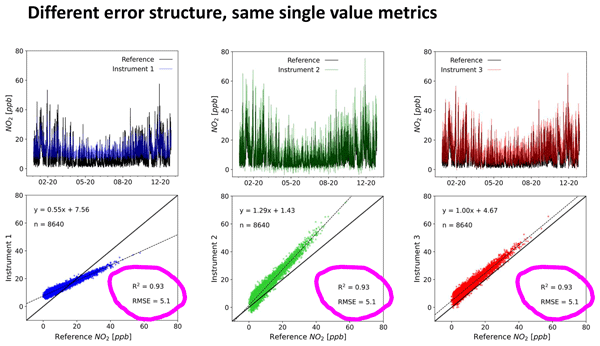
Sebastian Diez, Stuart E. Lacy, Thomas J. Bannan, Michael Flynn, Tom Gardiner, David Harrison, Nicholas Marsden, Nicholas A. Martin, Katie Read, and Pete M. Edwards
Atmos. Meas. Tech., 15, 4091–4105, https://doi.org/10.5194/amt-15-4091-2022, https://doi.org/10.5194/amt-15-4091-2022, 2022
Short summary
Short summary
Regardless of the cost of the measuring instrument, there are no perfect measurements. For this reason, we compare the quality of the information provided by cheap devices when they are used to measure air pollutants and we try to emphasise that before judging the potential usefulness of the devices, the user must specify his own needs. Since commonly used performance indices/metrics can be misleading in qualifying this, we propose complementary visual analysis to the more commonly used metrics.

Jakub L. Nowak, Robert Grosz, Wiebke Frey, Dennis Niedermeier, Jędrzej Mijas, Szymon P. Malinowski, Linda Ort, Silvio Schmalfuß, Frank Stratmann, Jens Voigtländer, and Tadeusz Stacewicz
Atmos. Meas. Tech., 15, 4075–4089, https://doi.org/10.5194/amt-15-4075-2022, https://doi.org/10.5194/amt-15-4075-2022, 2022
Short summary
Short summary
A high-resolution infrared hygrometer (FIRH) was adapted to measure humidity and its rapid fluctuations in turbulence inside a moist-air wind tunnel LACIS-T where two air streams of different temperature and humidity are mixed. The measurement was achieved from outside the tunnel through its glass windows and provided an agreement with a reference dew-point hygrometer placed inside. The characterization of humidity complements previous investigations of velocity and temperature fields.

Lady Mateus-Fontecha, Angela Vargas-Burbano, Rodrigo Jimenez, Nestor Y. Rojas, German Rueda-Saa, Dominik van Pinxteren, Manuela van Pinxteren, Khanneh Wadinga Fomba, and Hartmut Herrmann
Atmos. Chem. Phys., 22, 8473–8495, https://doi.org/10.5194/acp-22-8473-2022, https://doi.org/10.5194/acp-22-8473-2022, 2022
Short summary
Short summary
This study reports the chemical composition of regionally representative PM2.5 in an area densely populated and substantially industrialized, located in the inter-Andean valley, with the highest sugarcane yield in the world and where sugarcane is burned and harvested year round. We found that sugarcane burning is not portrayed as a distinguishable sample composition component. Instead, the composition analysis revealed multiple associations among sugarcane burning components and other sources.
Jacky Yat Sing Pang, Anna Novelli, Martin Kaminski, Ismail-Hakki Acir, Birger Bohn, Philip T. M. Carlsson, Changmin Cho, Hans-Peter Dorn, Andreas Hofzumahaus, Xin Li, Anna Lutz, Sascha Nehr, David Reimer, Franz Rohrer, Ralf Tillmann, Robert Wegener, Astrid Kiendler-Scharr, Andreas Wahner, and Hendrik Fuchs
Atmos. Chem. Phys., 22, 8497–8527, https://doi.org/10.5194/acp-22-8497-2022, https://doi.org/10.5194/acp-22-8497-2022, 2022
Short summary
Short summary
This study investigates the radical chemical budget during the limonene oxidation at different atmospheric-relevant NO concentrations in chamber experiments under atmospheric conditions. It is found that the model–measurement discrepancies of HO2 and RO2 are very large at low NO concentrations that are typical for forested environments. Possible additional processes impacting HO2 and RO2 concentrations are discussed.
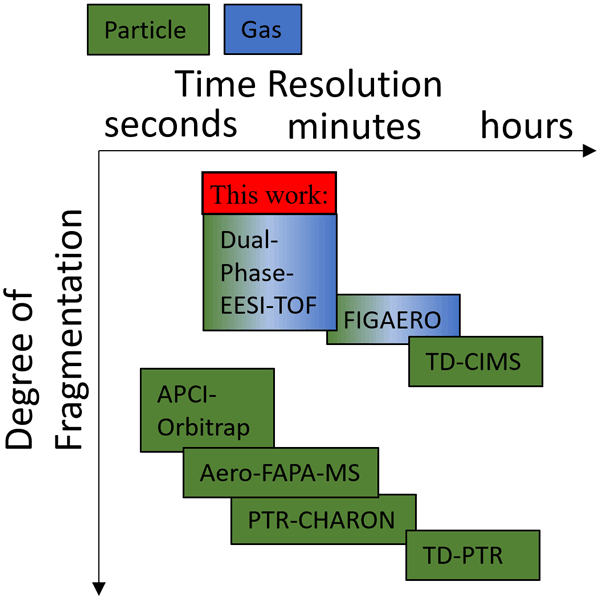
Chuan Ping Lee, Mihnea Surdu, David M. Bell, Josef Dommen, Mao Xiao, Xueqin Zhou, Andrea Baccarini, Stamatios Giannoukos, Günther Wehrle, Pascal André Schneider, Andre S. H. Prevot, Jay G. Slowik, Houssni Lamkaddam, Dongyu Wang, Urs Baltensperger, and Imad El Haddad
Atmos. Meas. Tech., 15, 3747–3760, https://doi.org/10.5194/amt-15-3747-2022, https://doi.org/10.5194/amt-15-3747-2022, 2022
Short summary
Short summary
Real-time detection of both the gas and particle phase is needed to elucidate the sources and chemical reaction pathways of organic vapors and particulate matter. The Dual-EESI was developed to measure gas- and particle-phase species to provide new insights into aerosol sources or formation mechanisms. After characterizing the relative gas and particle response factors of EESI via organic aerosol uptake experiments, the Dual-EESI is more sensitive toward gas-phase analyes.
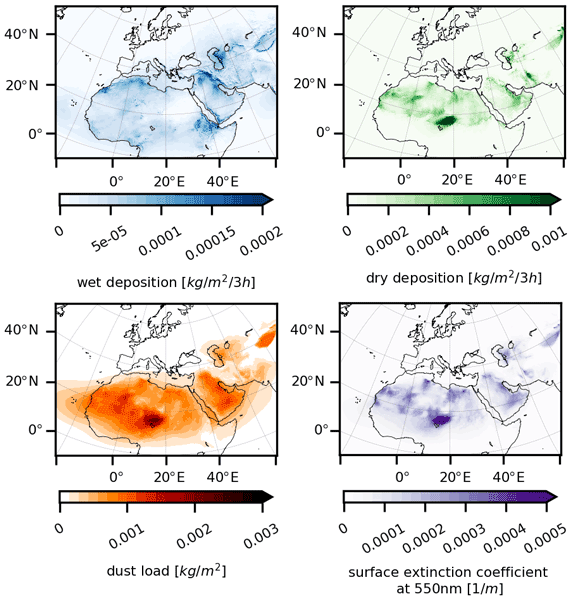
Enza Di Tomaso, Jerónimo Escribano, Sara Basart, Paul Ginoux, Francesca Macchia, Francesca Barnaba, Francesco Benincasa, Pierre-Antoine Bretonnière, Arnau Buñuel, Miguel Castrillo, Emilio Cuevas, Paola Formenti, María Gonçalves, Oriol Jorba, Martina Klose, Lucia Mona, Gilbert Montané Pinto, Michail Mytilinaios, Vincenzo Obiso, Miriam Olid, Nick Schutgens, Athanasios Votsis, Ernest Werner, and Carlos Pérez García-Pando
Earth Syst. Sci. Data, 14, 2785–2816, https://doi.org/10.5194/essd-14-2785-2022, https://doi.org/10.5194/essd-14-2785-2022, 2022
Short summary
Short summary
MONARCH reanalysis of desert dust aerosols extends the existing observation-based information for mineral dust monitoring by providing 3-hourly upper-air, surface and total column key geophysical variables of the dust cycle over Northern Africa, the Middle East and Europe, at a 0.1° horizontal resolution in a rotated grid, from 2007 to 2016. This work provides evidence of the high accuracy of this data set and its suitability for air quality and health and climate service applications.

Varun Kumar, Stamatios Giannoukos, Sophie L. Haslett, Yandong Tong, Atinderpal Singh, Amelie Bertrand, Chuan Ping Lee, Dongyu S. Wang, Deepika Bhattu, Giulia Stefenelli, Jay S. Dave, Joseph V. Puthussery, Lu Qi, Pawan Vats, Pragati Rai, Roberto Casotto, Rangu Satish, Suneeti Mishra, Veronika Pospisilova, Claudia Mohr, David M. Bell, Dilip Ganguly, Vishal Verma, Neeraj Rastogi, Urs Baltensperger, Sachchida N. Tripathi, André S. H. Prévôt, and Jay G. Slowik
Atmos. Chem. Phys., 22, 7739–7761, https://doi.org/10.5194/acp-22-7739-2022, https://doi.org/10.5194/acp-22-7739-2022, 2022
Short summary
Short summary
Here we present source apportionment results from the first field deployment in Delhi of an extractive electrospray ionization time-of-flight mass spectrometer (EESI-TOF). The EESI-TOF is a recently developed instrument capable of providing uniquely detailed online chemical characterization of organic aerosol (OA), in particular the secondary OA (SOA) fraction. Here, we are able to apportion not only primary OA but also SOA to specific sources, which is performed for the first time in Delhi.

Carmen Maria Tovar, Ian Barnes, Iustinian Gabriel Bejan, and Peter Wiesen
Atmos. Chem. Phys., 22, 6989–7004, https://doi.org/10.5194/acp-22-6989-2022, https://doi.org/10.5194/acp-22-6989-2022, 2022
Short summary
Short summary
This work explores the kinetics and reactivity of epoxides towards the OH radical using two different simulation chambers. Estimation of the rate coefficients has also been made using different structure–activity relationship (SAR) approaches. The results indicate a direct influence of the structural and geometric properties of the epoxides not considered in SAR estimations, influencing the reactivity of these compounds. The outcomes of this work are in very good agreement with previous studies.
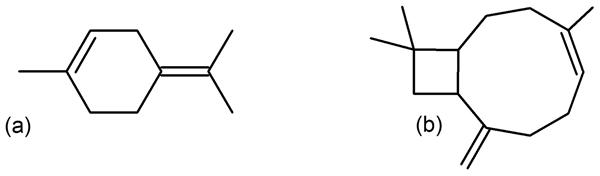
Axel Fouqueau, Manuela Cirtog, Mathieu Cazaunau, Edouard Pangui, Jean-François Doussin, and Bénédicte Picquet-Varrault
Atmos. Chem. Phys., 22, 6411–6434, https://doi.org/10.5194/acp-22-6411-2022, https://doi.org/10.5194/acp-22-6411-2022, 2022
Short summary
Short summary
Biogenic volatile organic compounds are intensely emitted by forests and crops and react with the nitrate radical during the nighttime to form functionalized products. The purpose of this study is to furnish kinetic and mechanistic data for terpinolene and β-caryophyllene, using simulation chamber experiments. Rate constants have been measured using both relative and absolute methods, and mechanistic studies have been conducted in order to identify and quantify the main reaction products.
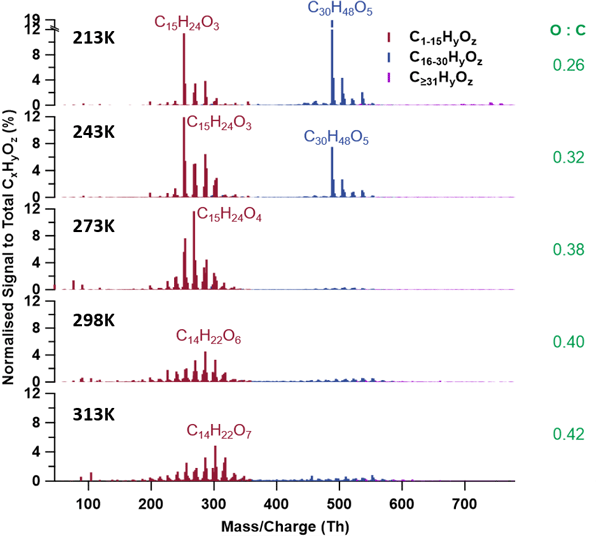
Linyu Gao, Junwei Song, Claudia Mohr, Wei Huang, Magdalena Vallon, Feng Jiang, Thomas Leisner, and Harald Saathoff
Atmos. Chem. Phys., 22, 6001–6020, https://doi.org/10.5194/acp-22-6001-2022, https://doi.org/10.5194/acp-22-6001-2022, 2022
Short summary
Short summary
We study secondary organic aerosol (SOA) from β-caryophyllene (BCP) ozonolysis with and without nitrogen oxides over 213–313 K in the simulation chamber. The yields and the rate constants were determined at 243–313 K. Chemical compositions varied at different temperatures, indicating a strong impact on the BCP ozonolysis pathways. This work helps to better understand the SOA from BCP ozonolysis for conditions representative of the real atmosphere from the boundary layer to the upper troposphere.
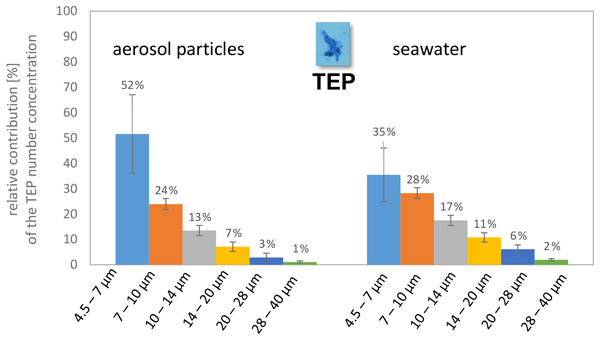
Manuela van Pinxteren, Tiera-Brandy Robinson, Sebastian Zeppenfeld, Xianda Gong, Enno Bahlmann, Khanneh Wadinga Fomba, Nadja Triesch, Frank Stratmann, Oliver Wurl, Anja Engel, Heike Wex, and Hartmut Herrmann
Atmos. Chem. Phys., 22, 5725–5742, https://doi.org/10.5194/acp-22-5725-2022, https://doi.org/10.5194/acp-22-5725-2022, 2022
Short summary
Short summary
A class of marine particles (transparent exopolymer particles, TEPs) that is ubiquitously found in the world oceans was measured for the first time in ambient marine aerosol particles and marine cloud waters in the tropical Atlantic Ocean. TEPs are likely to have good properties for influencing clouds. We show that TEPs are transferred from the ocean to the marine atmosphere via sea-spray formation and our results suggest that they can also form directly in aerosol particles and in cloud water.
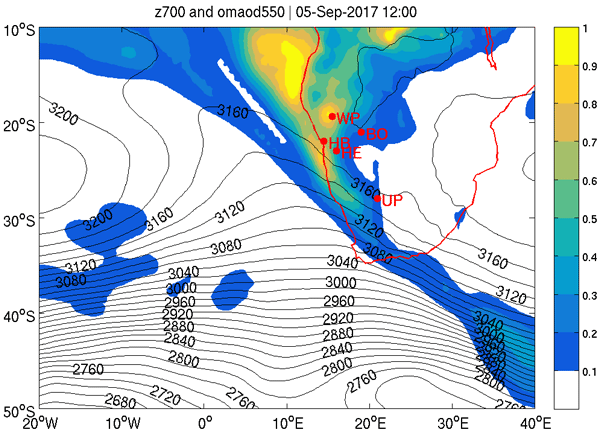
Cyrille Flamant, Marco Gaetani, Jean-Pierre Chaboureau, Patrick Chazette, Juan Cuesta, Stuart John Piketh, and Paola Formenti
Atmos. Chem. Phys., 22, 5701–5724, https://doi.org/10.5194/acp-22-5701-2022, https://doi.org/10.5194/acp-22-5701-2022, 2022
Short summary
Short summary
Rivers of smoke extend from tropical southern Africa towards the Indian Ocean during the winter fire season, controlled by the interaction of tropical easterly waves, and westerly waves at mid latitudes. During the AEROCLO-sA field campaign in 2017, a river of smoke was directly observed over Namibia. In this paper, the evolution and atmospheric drivers of the river of smoke are described, and the role of a mid-latitude cut-off low in lifting the smoke to the upper troposphere is highlighted.

Kristina Glojek, Griša Močnik, Honey Dawn C. Alas, Andrea Cuesta-Mosquera, Luka Drinovec, Asta Gregorič, Matej Ogrin, Kay Weinhold, Irena Ježek, Thomas Müller, Martin Rigler, Maja Remškar, Dominik van Pinxteren, Hartmut Herrmann, Martina Ristorini, Maik Merkel, Miha Markelj, and Alfred Wiedensohler
Atmos. Chem. Phys., 22, 5577–5601, https://doi.org/10.5194/acp-22-5577-2022, https://doi.org/10.5194/acp-22-5577-2022, 2022
Short summary
Short summary
A pilot study to determine the emissions of wood burning under
real-world laboratoryconditions was conducted. We found that measured black carbon (eBC) and particulate matter (PM) in rural shallow terrain depressions with residential wood burning could be much greater than predicted by models. The exceeding levels are a cause for concern since similar conditions can be expected in numerous hilly and mountainous regions across Europe, where approximately 20 % of the total population lives.
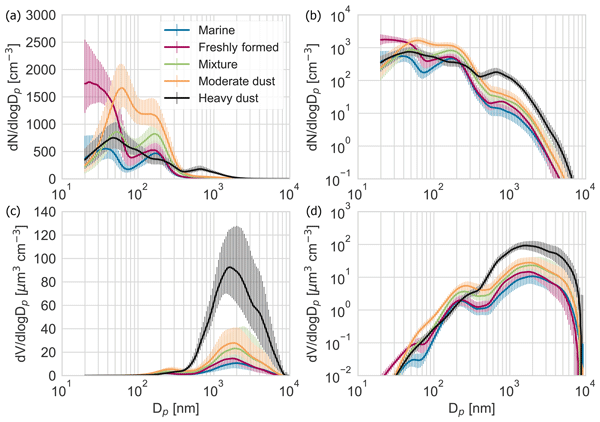
Xianda Gong, Heike Wex, Thomas Müller, Silvia Henning, Jens Voigtländer, Alfred Wiedensohler, and Frank Stratmann
Atmos. Chem. Phys., 22, 5175–5194, https://doi.org/10.5194/acp-22-5175-2022, https://doi.org/10.5194/acp-22-5175-2022, 2022
Short summary
Short summary
We conducted 10 yr measurements to characterize the atmospheric aerosol at Cabo Verde. An unsupervised machine learning algorithm, K-means, was implemented to study the aerosol types. Cloud condensation nuclei number concentrations during dust periods were 2.5 times higher than marine periods. The long-term data sets, together with the aerosol classification, can be used as a basis to improve understanding of annual cycles of aerosol, and aerosol-cloud interactions in the North Atlantic.

Zoé Brasseur, Dimitri Castarède, Erik S. Thomson, Michael P. Adams, Saskia Drossaart van Dusseldorp, Paavo Heikkilä, Kimmo Korhonen, Janne Lampilahti, Mikhail Paramonov, Julia Schneider, Franziska Vogel, Yusheng Wu, Jonathan P. D. Abbatt, Nina S. Atanasova, Dennis H. Bamford, Barbara Bertozzi, Matthew Boyer, David Brus, Martin I. Daily, Romy Fösig, Ellen Gute, Alexander D. Harrison, Paula Hietala, Kristina Höhler, Zamin A. Kanji, Jorma Keskinen, Larissa Lacher, Markus Lampimäki, Janne Levula, Antti Manninen, Jens Nadolny, Maija Peltola, Grace C. E. Porter, Pyry Poutanen, Ulrike Proske, Tobias Schorr, Nsikanabasi Silas Umo, János Stenszky, Annele Virtanen, Dmitri Moisseev, Markku Kulmala, Benjamin J. Murray, Tuukka Petäjä, Ottmar Möhler, and Jonathan Duplissy
Atmos. Chem. Phys., 22, 5117–5145, https://doi.org/10.5194/acp-22-5117-2022, https://doi.org/10.5194/acp-22-5117-2022, 2022
Short summary
Short summary
The present measurement report introduces the ice nucleation campaign organized in Hyytiälä, Finland, in 2018 (HyICE-2018). We provide an overview of the campaign settings, and we describe the measurement infrastructure and operating procedures used. In addition, we use results from ice nucleation instrument inter-comparison to show that the suite of these instruments deployed during the campaign reports consistent results.

Saehee Lim, Meehye Lee, Joel Savarino, and Paolo Laj
Atmos. Chem. Phys., 22, 5099–5115, https://doi.org/10.5194/acp-22-5099-2022, https://doi.org/10.5194/acp-22-5099-2022, 2022
Short summary
Short summary
We determined δ15N(NO3−) and Δ17O(NO3−) of PM2.5 in Seoul during 2018–2019 and estimated quantitatively the contribution of oxidation pathways to NO3− formation and NOx emission sources. The nighttime pathway played a significant role in NO3− formation during the winter, and its contribution further increased up to 70 % on haze days when PM2.5 was greater than 75 µg m−3. Vehicle emissions were confirmed as a main NO3− source with an increasing contribution from coal combustion in winter.
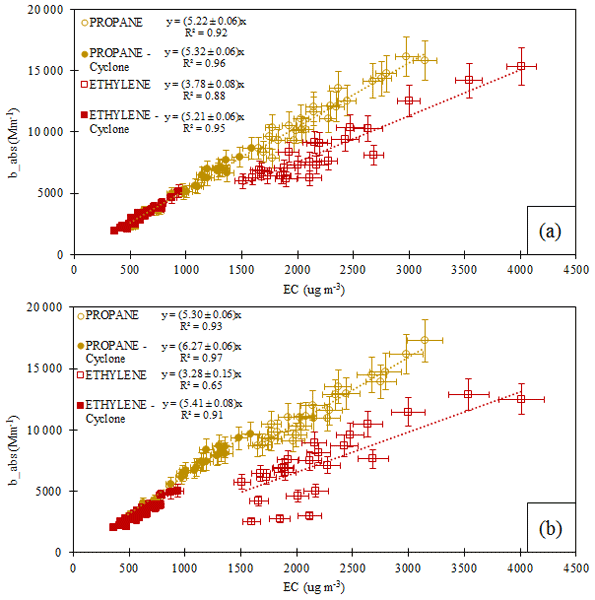
Virginia Vernocchi, Marco Brunoldi, Silvia G. Danelli, Franco Parodi, Paolo Prati, and Dario Massabò
Atmos. Meas. Tech., 15, 2159–2175, https://doi.org/10.5194/amt-15-2159-2022, https://doi.org/10.5194/amt-15-2159-2022, 2022
Short summary
Short summary
The performance of a mini inverted soot generator was investigated at a simulation chamber facility by studying the soot generated by ethylene and propane combustion, together with the number, size, optical properties, and EC / OC concentrations. Mass absorption coefficients and Ångström absorption exponents are compatible with the literature, with some differences. The characterization of MISG soot particles is fundamental to design and perform experiments in atmospheric simulation chambers.
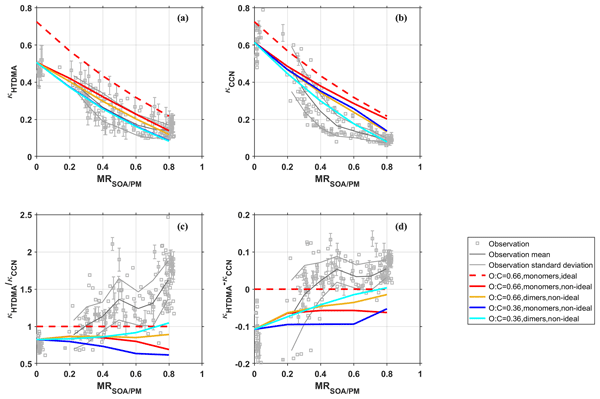
Yu Wang, Aristeidis Voliotis, Dawei Hu, Yunqi Shao, Mao Du, Ying Chen, Judith Kleinheins, Claudia Marcolli, M. Rami Alfarra, and Gordon McFiggans
Atmos. Chem. Phys., 22, 4149–4166, https://doi.org/10.5194/acp-22-4149-2022, https://doi.org/10.5194/acp-22-4149-2022, 2022
Short summary
Short summary
Aerosol water uptake plays a key role in atmospheric physicochemical processes. We designed chamber experiments on aerosol water uptake of secondary organic aerosol (SOA) from mixed biogenic and anthropogenic precursors with inorganic seed. Our results highlight this chemical composition influences the reconciliation of the sub- and super-saturated water uptake, providing laboratory evidence for understanding the chemical controls of water uptake of the multi-component aerosol.
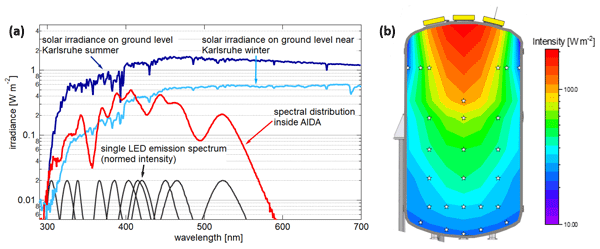
Magdalena Vallon, Linyu Gao, Feng Jiang, Bianca Krumm, Jens Nadolny, Junwei Song, Thomas Leisner, and Harald Saathoff
Atmos. Meas. Tech., 15, 1795–1810, https://doi.org/10.5194/amt-15-1795-2022, https://doi.org/10.5194/amt-15-1795-2022, 2022
Short summary
Short summary
A LED-based light source has been constructed for the AIDA simulation chamber at the Karlsruhe Institute of Technology. It allows aerosol formation and ageing studies under atmospherically relevant illumination intensities and spectral characteristics at temperatures from –90 °C to 30 °C with the possibility of changing the photon flux and irradiation spectrum at any point. The first results of photolysis experiments with 2,3-pentanedione, iron oxalate and a brown carbon component are shown.
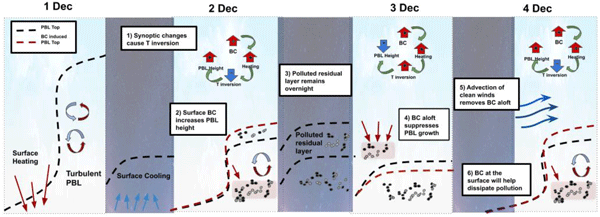
Jessica Slater, Hugh Coe, Gordon McFiggans, Juha Tonttila, and Sami Romakkaniemi
Atmos. Chem. Phys., 22, 2937–2953, https://doi.org/10.5194/acp-22-2937-2022, https://doi.org/10.5194/acp-22-2937-2022, 2022
Short summary
Short summary
This paper shows the specific impact of black carbon (BC) on the aerosol–planetary boundary layer (PBL) feedback and its influence on a Beijing haze episode. Overall, this paper shows that strong temperature inversions prevent BC heating within the PBL from significantly increasing PBL height, while BC above the PBL suppresses PBL development significantly through the day. From this we suggest a method by which both locally and regionally emitted BC may impact urban pollution episodes.
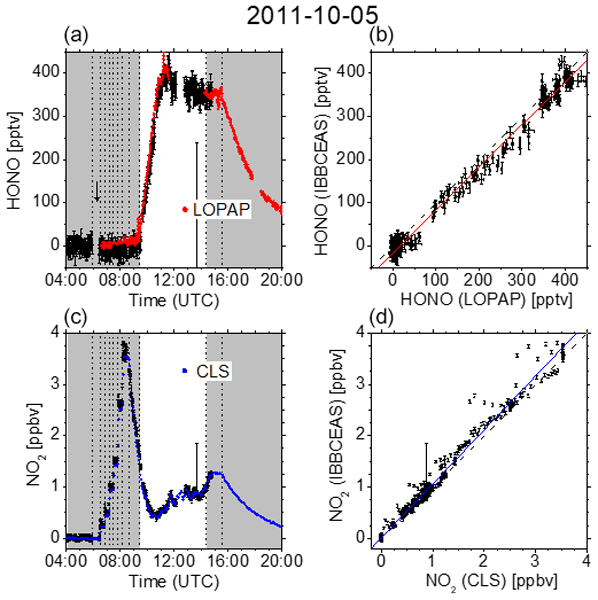
Sophie Dixneuf, Albert A. Ruth, Rolf Häseler, Theo Brauers, Franz Rohrer, and Hans-Peter Dorn
Atmos. Meas. Tech., 15, 945–964, https://doi.org/10.5194/amt-15-945-2022, https://doi.org/10.5194/amt-15-945-2022, 2022
Short summary
Short summary
Atmospheric chambers, like SAPHIR in Jülich (Germany), are used to experimentally simulate specific atmospheric scenarios to improve our understanding of the complex chemical reactions occurring in our atmospheres. These facilities hence require cutting-edge gas-sensing capabilities to detect trace gases at the lowest level and in a short time. One important trace gas is HONO, for which we custom-built an optical sensing setup, capable of detecting one HONO molecule in ~40 billion in 1 min.
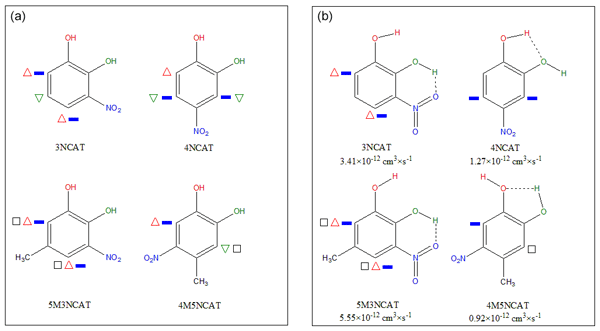
Claudiu Roman, Cecilia Arsene, Iustinian Gabriel Bejan, and Romeo Iulian Olariu
Atmos. Chem. Phys., 22, 2203–2219, https://doi.org/10.5194/acp-22-2203-2022, https://doi.org/10.5194/acp-22-2203-2022, 2022
Short summary
Short summary
Gas-phase reaction rate coefficients of OH radicals with four nitrocatechols have been investigated for the first time by using ESC-Q-UAIC chamber facilities. The reactivity of all investigated nitrocatechols is influenced by the formation of the intramolecular H-bonds that are connected to the deactivating electromeric effect of the NO2 group. For the 3-nitrocatechol compounds, the electromeric effect of the
freeOH group is diminished by the deactivating E-effect of the NO2 group.
Rupert Holzinger, Oliver Eppers, Kouji Adachi, Heiko Bozem, Markus Hartmann, Andreas Herber, Makoto Koike, Dylan B. Millet, Nobuhiro Moteki, Sho Ohata, Frank Stratmann, and Atsushi Yoshida
Atmos. Chem. Phys. Discuss., https://doi.org/10.5194/acp-2022-95, https://doi.org/10.5194/acp-2022-95, 2022
Revised manuscript not accepted
Short summary
Short summary
In spring 2018 the research aircraft Polar 5 conducted flights in the Arctic atmosphere. The flight operation was from Station Nord in Greenland, 1700 km north of the Arctic Circle (81°43'N, 17°47'W). Using a mass spectrometer we measured more than 100 organic compounds in the air. We found a clear signature of natural organic compounds that are transported from forests to the high Arctic. These compounds have the potential to change the cloud cover and energy budget of the Arctic region.
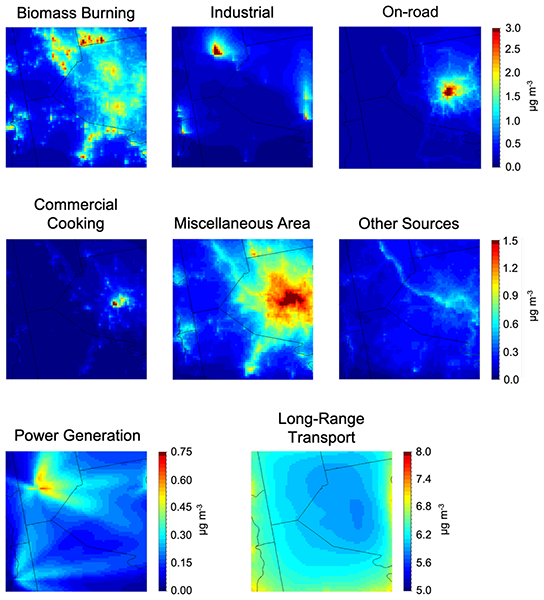
Pablo Garcia Rivera, Brian T. Dinkelacker, Ioannis Kioutsioukis, Peter J. Adams, and Spyros N. Pandis
Atmos. Chem. Phys., 22, 2011–2027, https://doi.org/10.5194/acp-22-2011-2022, https://doi.org/10.5194/acp-22-2011-2022, 2022
Short summary
Short summary
The contribution of various pollution sources to the variability of fine PM in an urban area was examined using as an example the city of Pittsburgh. Biomass burning aerosol shows the largest variability during the winter with local maxima within the city and in the suburbs. During both periods the largest contributing source to the average PM2.5 is particles from outside the modeling domain. The average population-weighted PM2.5 concentration does not change significantly with resolution.
Waldemar Schledewitch, Gary Lloyd, Keith Bower, Thomas Choularton, Michael Flynn, and Martin Gallagher
Atmos. Chem. Phys. Discuss., https://doi.org/10.5194/acp-2022-69, https://doi.org/10.5194/acp-2022-69, 2022
Publication in ACP not foreseen
Short summary
Short summary
Ice crystals on the surface of ice and snow covered terrain are thought to be transported into clouds that cover the surface. This has important implications for the properties of clouds in these regions. This research measured the potential transport of surface based ice crystals into the surrounding clouds at a mountain top site.
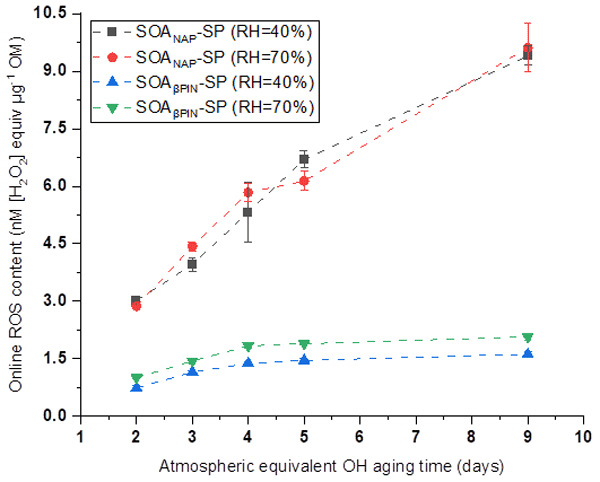
Zhi-Hui Zhang, Elena Hartner, Battist Utinger, Benjamin Gfeller, Andreas Paul, Martin Sklorz, Hendryk Czech, Bin Xia Yang, Xin Yi Su, Gert Jakobi, Jürgen Orasche, Jürgen Schnelle-Kreis, Seongho Jeong, Thomas Gröger, Michal Pardo, Thorsten Hohaus, Thomas Adam, Astrid Kiendler-Scharr, Yinon Rudich, Ralf Zimmermann, and Markus Kalberer
Atmos. Chem. Phys., 22, 1793–1809, https://doi.org/10.5194/acp-22-1793-2022, https://doi.org/10.5194/acp-22-1793-2022, 2022
Short summary
Short summary
Using a novel setup, we comprehensively characterized the formation of particle-bound reactive oxygen species (ROS) in anthropogenic and biogenic secondary organic aerosols (SOAs). We found that more than 90 % of all ROS components in both SOA types have a short lifetime. Our results also show that photochemical aging promotes particle-bound ROS production and enhances the oxidative potential of the aerosols. We found consistent results between chemical-based and biological-based ROS analyses.
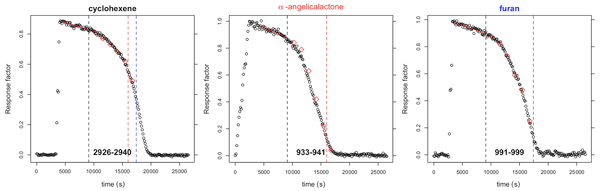
Mike J. Newland, Yangang Ren, Max R. McGillen, Lisa Michelat, Véronique Daële, and Abdelwahid Mellouki
Atmos. Chem. Phys., 22, 1761–1772, https://doi.org/10.5194/acp-22-1761-2022, https://doi.org/10.5194/acp-22-1761-2022, 2022
Short summary
Short summary
Wildfires are increasing in extent and severity, driven by climate change. Such fires emit large amounts of volatile organic compounds (VOCs) to the atmosphere. Many of these, such as the furans studied here, are very reactive and are rapidly converted to other VOCs, which are expected to have negative health effects and to further impact the climate. Here, we establish the importance of the nitrate radical for removing these compounds both during the night and during the day.
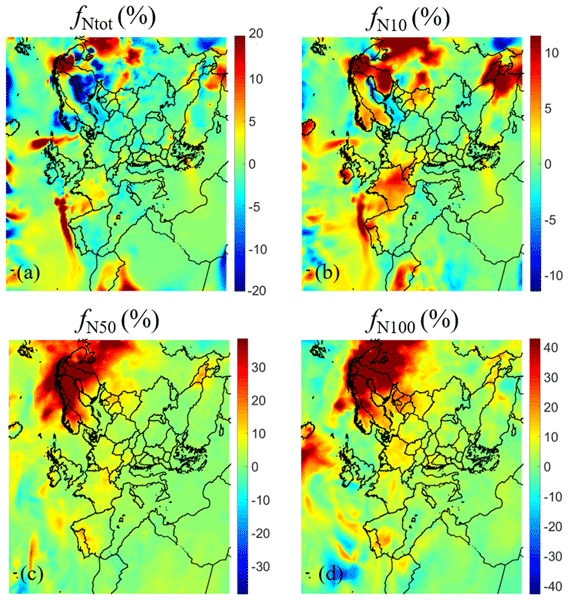
David Patoulias and Spyros N. Pandis
Atmos. Chem. Phys., 22, 1689–1706, https://doi.org/10.5194/acp-22-1689-2022, https://doi.org/10.5194/acp-22-1689-2022, 2022
Short summary
Short summary
Our simulations indicate that the recently identified production and subsequent condensation effect of extremely low-volatility organic compounds have a smaller-than-expected effect on the total concentration of atmospheric particles. On the other hand, the oxidation of intermediate-volatility organic compounds leads to decreases in the ultrafine-particle concentrations. These results improve our understanding of the links between secondary organic aerosol formation and ultrafine particles.
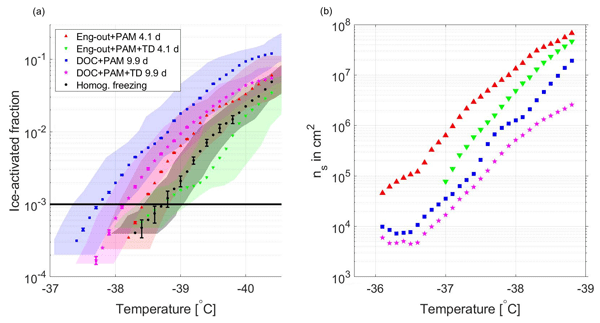
Kimmo Korhonen, Thomas Bjerring Kristensen, John Falk, Vilhelm B. Malmborg, Axel Eriksson, Louise Gren, Maja Novakovic, Sam Shamun, Panu Karjalainen, Lassi Markkula, Joakim Pagels, Birgitta Svenningsson, Martin Tunér, Mika Komppula, Ari Laaksonen, and Annele Virtanen
Atmos. Chem. Phys., 22, 1615–1631, https://doi.org/10.5194/acp-22-1615-2022, https://doi.org/10.5194/acp-22-1615-2022, 2022
Short summary
Short summary
We investigated the ice-nucleating abilities of particulate emissions from a modern diesel engine using the portable ice-nuclei counter SPIN, a continuous-flow diffusion chamber instrument. Three different fuels were studied without blending, including fossil diesel and two renewable fuels, testing different emission aftertreatment systems and photochemical aging. We found that the diesel emissions were inefficient ice nuclei, and aging had no or little effect on their ice-nucleating abilities.
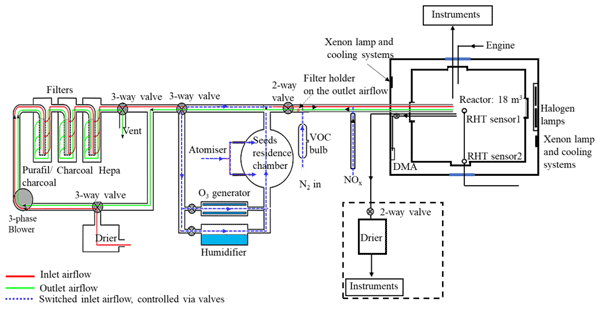
Yunqi Shao, Yu Wang, Mao Du, Aristeidis Voliotis, M. Rami Alfarra, Simon P. O'Meara, S. Fiona Turner, and Gordon McFiggans
Atmos. Meas. Tech., 15, 539–559, https://doi.org/10.5194/amt-15-539-2022, https://doi.org/10.5194/amt-15-539-2022, 2022
Short summary
Short summary
A comprehensive description and characterisation of the Manchester Aerosol Chamber (MAC) was conducted. The MAC has good temperature and relative humidity homogeneity, fast mixing times, and comparable losses of gases and particles with other chambers. The MAC's bespoke control system allows improved duty cycles and repeatable experiments. Moreover, the effect of contamination on performance was also investigated. It is highly recommended to regularly track the chamber's performance.
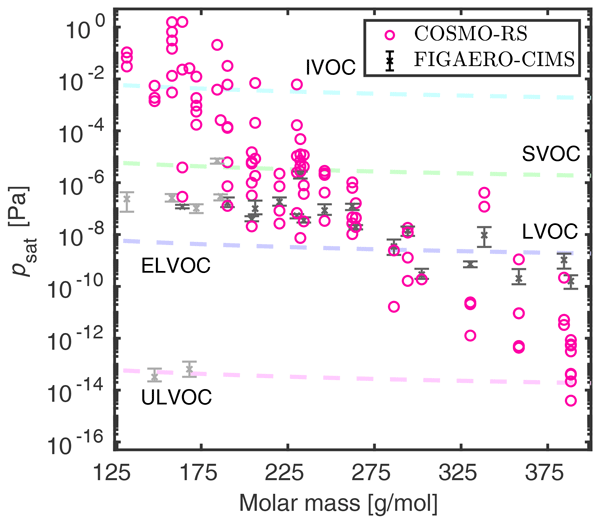
Noora Hyttinen, Iida Pullinen, Aki Nissinen, Siegfried Schobesberger, Annele Virtanen, and Taina Yli-Juuti
Atmos. Chem. Phys., 22, 1195–1208, https://doi.org/10.5194/acp-22-1195-2022, https://doi.org/10.5194/acp-22-1195-2022, 2022
Short summary
Short summary
Accurate saturation vapor pressure estimates of atmospherically relevant organic compounds are critical for modeling secondary organic aerosol (SOA) formation. We investigated vapor pressures of highly oxygenated SOA constituents using state-of-the-art computational and experimental methods. We found a good agreement between low and extremely low vapor pressures estimated using the two methods, and the smallest molecules detected in our experiment were likely products of thermal decomposition.
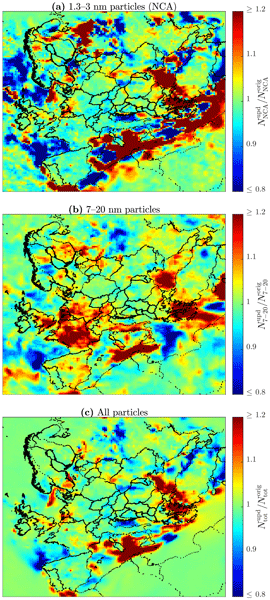
Miska Olin, David Patoulias, Heino Kuuluvainen, Jarkko V. Niemi, Topi Rönkkö, Spyros N. Pandis, Ilona Riipinen, and Miikka Dal Maso
Atmos. Chem. Phys., 22, 1131–1148, https://doi.org/10.5194/acp-22-1131-2022, https://doi.org/10.5194/acp-22-1131-2022, 2022
Short summary
Short summary
An emission factor particle size distribution was determined from the measurements at an urban traffic site. It was used in updating a pre-existing emission inventory, and regional modeling was performed after the update. Emission inventories typically underestimate nanoparticle emissions due to challenges in determining them with high certainty. This update reveals that the simulated aerosol levels have previously been underestimated especially for urban areas and for sub-50 nm particles.
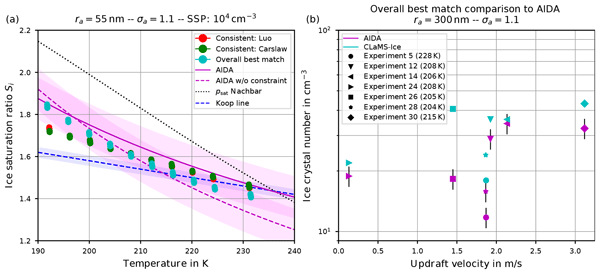
Manuel Baumgartner, Christian Rolf, Jens-Uwe Grooß, Julia Schneider, Tobias Schorr, Ottmar Möhler, Peter Spichtinger, and Martina Krämer
Atmos. Chem. Phys., 22, 65–91, https://doi.org/10.5194/acp-22-65-2022, https://doi.org/10.5194/acp-22-65-2022, 2022
Short summary
Short summary
An important mechanism for the appearance of ice particles in the upper troposphere at low temperatures is homogeneous nucleation. This process is commonly described by the
Koop line, predicting the humidity at freezing. However, laboratory measurements suggest that the freezing humidities are above the Koop line, motivating the present study to investigate the influence of different physical parameterizations on the homogeneous freezing with the help of a detailed numerical model.
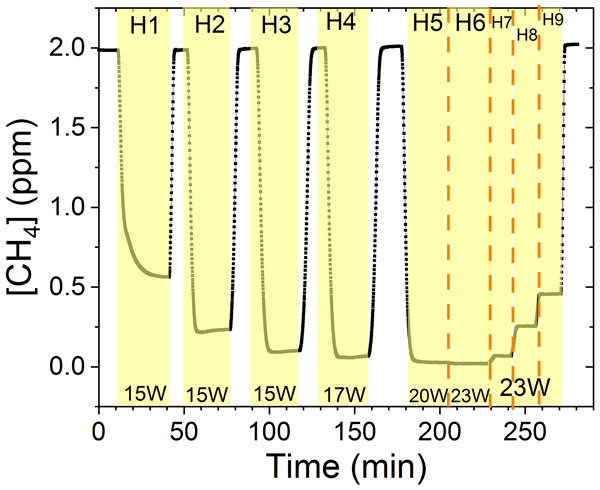
Merve Polat, Jesper Baldtzer Liisberg, Morten Krogsbøll, Thomas Blunier, and Matthew S. Johnson
Atmos. Meas. Tech., 14, 8041–8067, https://doi.org/10.5194/amt-14-8041-2021, https://doi.org/10.5194/amt-14-8041-2021, 2021
Short summary
Short summary
We have designed a process for removing methane from a gas stream so that nitrous oxide can be measured without interference. These are both key long-lived greenhouse gases frequently studied in relation to ice cores, plants, water treatment and so on. However, many researchers are not aware of the problem of methane interference, and in addition there have not been good methods available for solving the problem. Here we present and evaluate such a method.
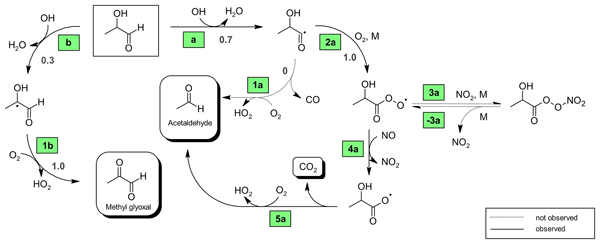
Niklas Illmann, Iulia Patroescu-Klotz, and Peter Wiesen
Atmos. Chem. Phys., 21, 18557–18572, https://doi.org/10.5194/acp-21-18557-2021, https://doi.org/10.5194/acp-21-18557-2021, 2021
Short summary
Short summary
Understanding the chemistry of biomass burning plumes is of global interest. Within this work we investigated the OH radical reaction of 3-penten-2-one, which has been identified in biomass burning emissions. We observed the primary formation of peroxyacetyl nitrate (PAN), a key NOx reservoir species. Besides, PAN precursors were also identified as main oxidation products. 3-Penten-2-one is shown to be an example explaining rapid PAN formation within young biomass burning plumes.

Clara M. Nussbaumer, John N. Crowley, Jan Schuladen, Jonathan Williams, Sascha Hafermann, Andreas Reiffs, Raoul Axinte, Hartwig Harder, Cheryl Ernest, Anna Novelli, Katrin Sala, Monica Martinez, Chinmay Mallik, Laura Tomsche, Christian Plass-Dülmer, Birger Bohn, Jos Lelieveld, and Horst Fischer
Atmos. Chem. Phys., 21, 18413–18432, https://doi.org/10.5194/acp-21-18413-2021, https://doi.org/10.5194/acp-21-18413-2021, 2021
Short summary
Short summary
HCHO is an important atmospheric trace gas influencing the photochemical processes in the Earth’s atmosphere, including the budget of HOx and the abundance of tropospheric O3. This research presents the photochemical calculations of HCHO and O3 based on three field campaigns across Europe. We show that HCHO production via the oxidation of only four volatile organic compound precursors, i.e., CH4, CH3CHO, C5H8 and CH3OH, can balance the observed loss at all sites well.
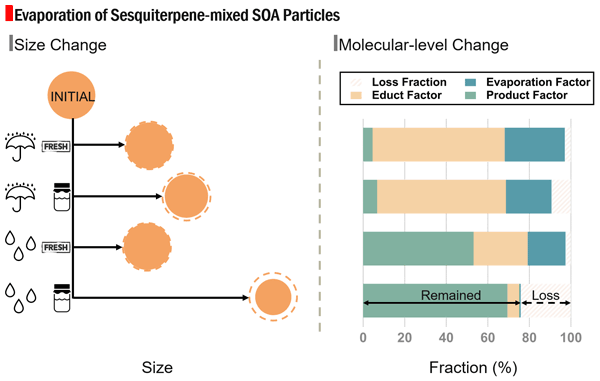
Zijun Li, Angela Buchholz, Arttu Ylisirniö, Luis Barreira, Liqing Hao, Siegfried Schobesberger, Taina Yli-Juuti, and Annele Virtanen
Atmos. Chem. Phys., 21, 18283–18302, https://doi.org/10.5194/acp-21-18283-2021, https://doi.org/10.5194/acp-21-18283-2021, 2021
Short summary
Short summary
We compared the evolution of two types of secondary organic aerosol (SOA) particles during isothermal evaporation. The sesquiterpene SOA particles demonstrated higher resilience to evaporation than α-pinene SOA particles generated under comparable conditions. In-depth analysis showed that under high-relative-humidity conditions, particulate water drove the evolution of particulate constituents by reducing the particle viscosity and initiating chemical aqueous-phase processes.
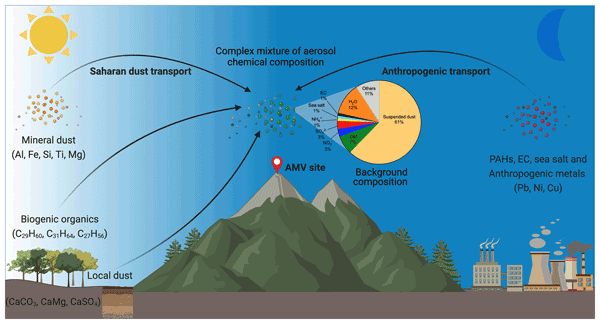
Nabil Deabji, Khanneh Wadinga Fomba, Souad El Hajjaji, Abdelwahid Mellouki, Laurent Poulain, Sebastian Zeppenfeld, and Hartmut Herrmann
Atmos. Chem. Phys., 21, 18147–18174, https://doi.org/10.5194/acp-21-18147-2021, https://doi.org/10.5194/acp-21-18147-2021, 2021
Short summary
Short summary
Mountain and high-altitude sites provide representative data for the lower free troposphere, various pathways for aerosol interactions, and changing boundary layer heights useful in understanding atmospheric composition. However, only few studies exist in African regions despite diversity in both natural and anthropogenic emissions. This study provides detailed atmospheric studies in the northern African high-altitude region.
Paola Formenti, Claudia Di Biagio, Yue Huang, Jasper Kok, Marc Daniel Mallet, Damien Boulanger, and Mathieu Cazaunau
Atmos. Meas. Tech. Discuss., https://doi.org/10.5194/amt-2021-403, https://doi.org/10.5194/amt-2021-403, 2021
Publication in AMT not foreseen
Short summary
Short summary
This paper provides with standardized correction factors for the measurements of the most common instruments used in the atmosphere to measure the concentration per size of aerosol particles. These correction factors are provided to users with supplementary information for their use.
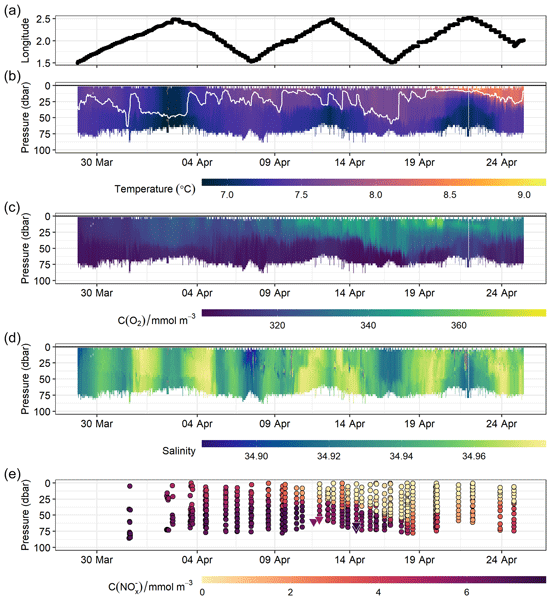
Tom Hull, Naomi Greenwood, Antony Birchill, Alexander Beaton, Matthew Palmer, and Jan Kaiser
Biogeosciences, 18, 6167–6180, https://doi.org/10.5194/bg-18-6167-2021, https://doi.org/10.5194/bg-18-6167-2021, 2021
Short summary
Short summary
The shallow shelf seas play a large role in the global cycling of CO2 and also support large fisheries. We use an autonomous underwater vehicle in the central North Sea to measure the rates of change in oxygen and nutrients.
Using these data we determine the amount of carbon dioxide taken out of the atmosphere by the sea and measure how productive the region is.
These observations will be useful for improving our predictive models and help us predict and adapt to a changing ocean.
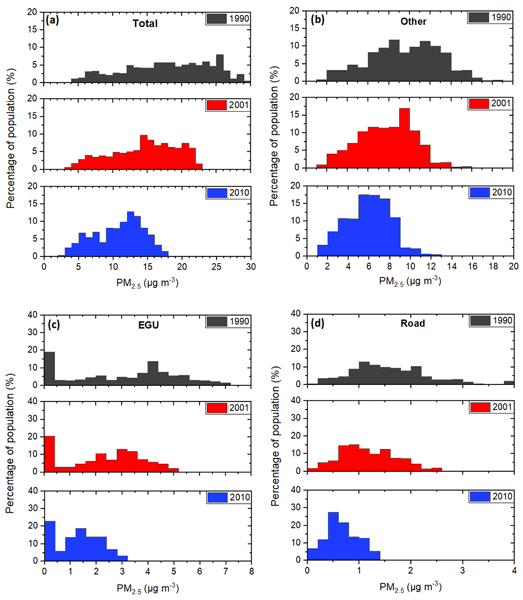
Ksakousti Skyllakou, Pablo Garcia Rivera, Brian Dinkelacker, Eleni Karnezi, Ioannis Kioutsioukis, Carlos Hernandez, Peter J. Adams, and Spyros N. Pandis
Atmos. Chem. Phys., 21, 17115–17132, https://doi.org/10.5194/acp-21-17115-2021, https://doi.org/10.5194/acp-21-17115-2021, 2021
Short summary
Short summary
Significant reductions in pollutant emissions took place in the US from 1990 to 2010. The reductions in sulfur dioxide emissions from electric-generating units have dominated the reductions in fine particle mass. The reductions in transportation emissions have led to a 30 % reduction of elemental concentrations and of organic particulate matter by a factor of 3. On the other hand, changes in biomass burning and biogenic secondary organic aerosol have been modest.
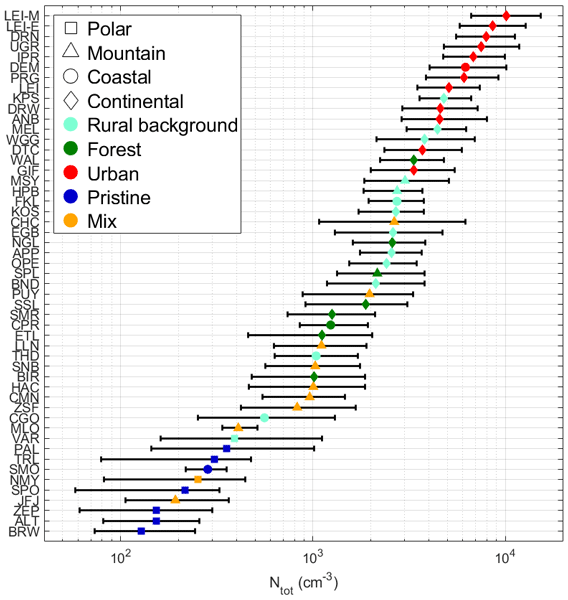
Clémence Rose, Martine Collaud Coen, Elisabeth Andrews, Yong Lin, Isaline Bossert, Cathrine Lund Myhre, Thomas Tuch, Alfred Wiedensohler, Markus Fiebig, Pasi Aalto, Andrés Alastuey, Elisabeth Alonso-Blanco, Marcos Andrade, Begoña Artíñano, Todor Arsov, Urs Baltensperger, Susanne Bastian, Olaf Bath, Johan Paul Beukes, Benjamin T. Brem, Nicolas Bukowiecki, Juan Andrés Casquero-Vera, Sébastien Conil, Konstantinos Eleftheriadis, Olivier Favez, Harald Flentje, Maria I. Gini, Francisco Javier Gómez-Moreno, Martin Gysel-Beer, Anna Gannet Hallar, Ivo Kalapov, Nikos Kalivitis, Anne Kasper-Giebl, Melita Keywood, Jeong Eun Kim, Sang-Woo Kim, Adam Kristensson, Markku Kulmala, Heikki Lihavainen, Neng-Huei Lin, Hassan Lyamani, Angela Marinoni, Sebastiao Martins Dos Santos, Olga L. Mayol-Bracero, Frank Meinhardt, Maik Merkel, Jean-Marc Metzger, Nikolaos Mihalopoulos, Jakub Ondracek, Marco Pandolfi, Noemi Pérez, Tuukka Petäjä, Jean-Eudes Petit, David Picard, Jean-Marc Pichon, Veronique Pont, Jean-Philippe Putaud, Fabienne Reisen, Karine Sellegri, Sangeeta Sharma, Gerhard Schauer, Patrick Sheridan, James Patrick Sherman, Andreas Schwerin, Ralf Sohmer, Mar Sorribas, Junying Sun, Pierre Tulet, Ville Vakkari, Pieter Gideon van Zyl, Fernando Velarde, Paolo Villani, Stergios Vratolis, Zdenek Wagner, Sheng-Hsiang Wang, Kay Weinhold, Rolf Weller, Margarita Yela, Vladimir Zdimal, and Paolo Laj
Atmos. Chem. Phys., 21, 17185–17223, https://doi.org/10.5194/acp-21-17185-2021, https://doi.org/10.5194/acp-21-17185-2021, 2021
Short summary
Short summary
Aerosol particles are a complex component of the atmospheric system the effects of which are among the most uncertain in climate change projections. Using data collected at 62 stations, this study provides the most up-to-date picture of the spatial distribution of particle number concentration and size distribution worldwide, with the aim of contributing to better representation of aerosols and their interactions with clouds in models and, therefore, better evaluation of their impact on climate.
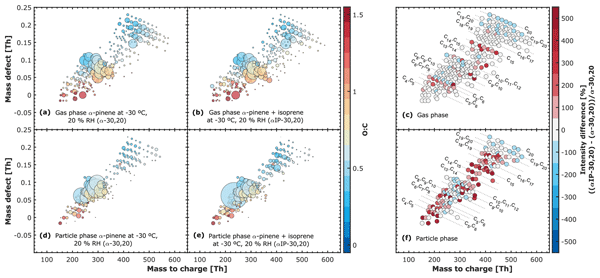
Lucía Caudillo, Birte Rörup, Martin Heinritzi, Guillaume Marie, Mario Simon, Andrea C. Wagner, Tatjana Müller, Manuel Granzin, Antonio Amorim, Farnoush Ataei, Rima Baalbaki, Barbara Bertozzi, Zoé Brasseur, Randall Chiu, Biwu Chu, Lubna Dada, Jonathan Duplissy, Henning Finkenzeller, Loïc Gonzalez Carracedo, Xu-Cheng He, Victoria Hofbauer, Weimeng Kong, Houssni Lamkaddam, Chuan P. Lee, Brandon Lopez, Naser G. A. Mahfouz, Vladimir Makhmutov, Hanna E. Manninen, Ruby Marten, Dario Massabò, Roy L. Mauldin, Bernhard Mentler, Ugo Molteni, Antti Onnela, Joschka Pfeifer, Maxim Philippov, Ana A. Piedehierro, Meredith Schervish, Wiebke Scholz, Benjamin Schulze, Jiali Shen, Dominik Stolzenburg, Yuri Stozhkov, Mihnea Surdu, Christian Tauber, Yee Jun Tham, Ping Tian, António Tomé, Steffen Vogt, Mingyi Wang, Dongyu S. Wang, Stefan K. Weber, André Welti, Wang Yonghong, Wu Yusheng, Marcel Zauner-Wieczorek, Urs Baltensperger, Imad El Haddad, Richard C. Flagan, Armin Hansel, Kristina Höhler, Jasper Kirkby, Markku Kulmala, Katrianne Lehtipalo, Ottmar Möhler, Harald Saathoff, Rainer Volkamer, Paul M. Winkler, Neil M. Donahue, Andreas Kürten, and Joachim Curtius
Atmos. Chem. Phys., 21, 17099–17114, https://doi.org/10.5194/acp-21-17099-2021, https://doi.org/10.5194/acp-21-17099-2021, 2021
Short summary
Short summary
We performed experiments in the CLOUD chamber at CERN at low temperatures to simulate new particle formation in the upper free troposphere (at −30 ºC and −50 ºC). We measured the particle and gas phase and found that most of the compounds present in the gas phase are detected as well in the particle phase. The major compounds in the particles are C8–10 and C18–20. Specifically, we showed that C5 and C15 compounds are detected in a mixed system with isoprene and α-pinene at −30 ºC, 20 % RH.
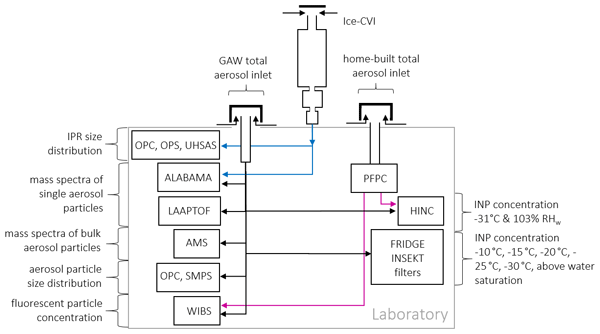
Larissa Lacher, Hans-Christian Clemen, Xiaoli Shen, Stephan Mertes, Martin Gysel-Beer, Alireza Moallemi, Martin Steinbacher, Stephan Henne, Harald Saathoff, Ottmar Möhler, Kristina Höhler, Thea Schiebel, Daniel Weber, Jann Schrod, Johannes Schneider, and Zamin A. Kanji
Atmos. Chem. Phys., 21, 16925–16953, https://doi.org/10.5194/acp-21-16925-2021, https://doi.org/10.5194/acp-21-16925-2021, 2021
Short summary
Short summary
We investigate ice-nucleating particle properties at Jungfraujoch during the 2017 joint INUIT/CLACE field campaign, to improve the knowledge about those rare particles in a cloud-relevant environment. By quantifying ice-nucleating particles in parallel to single-particle mass spectrometry measurements, we find that mineral dust and aged sea spray particles are potential candidates for ice-nucleating particles. Our findings are supported by ice residual analysis and source region modeling.

Marco Gaetani, Benjamin Pohl, Maria del Carmen Alvarez Castro, Cyrille Flamant, and Paola Formenti
Atmos. Chem. Phys., 21, 16575–16591, https://doi.org/10.5194/acp-21-16575-2021, https://doi.org/10.5194/acp-21-16575-2021, 2021
Short summary
Short summary
During the dry austral winter, biomass fires in tropical Africa emit large amounts of smoke in the atmosphere, with large impacts on climate and air quality. The study of the relationship between atmospheric circulation and smoke transport shows that midlatitude atmospheric disturbances may deflect the smoke from tropical Africa towards southern Africa. Understanding the distribution of the smoke in the region is crucial for climate modelling and air quality monitoring.
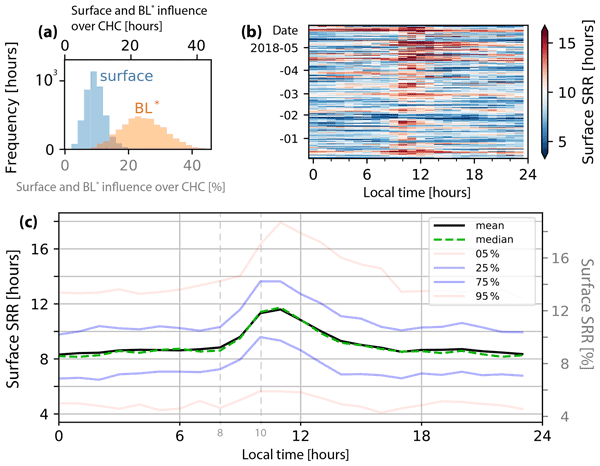
Diego Aliaga, Victoria A. Sinclair, Marcos Andrade, Paulo Artaxo, Samara Carbone, Evgeny Kadantsev, Paolo Laj, Alfred Wiedensohler, Radovan Krejci, and Federico Bianchi
Atmos. Chem. Phys., 21, 16453–16477, https://doi.org/10.5194/acp-21-16453-2021, https://doi.org/10.5194/acp-21-16453-2021, 2021
Short summary
Short summary
We investigate the origin of air masses sampled at Mount Chacaltaya, Bolivia. Three-quarters of the measured air has not been influenced by the surface in the previous 4 d. However, it is rare that, at any given time, the sampled air has not been influenced at all by the surface, and often the sampled air has multiple origins. The influence of the surface is more prevalent during day than night. Furthermore, during the 6-month study, one-third of the air masses originated from Amazonia.
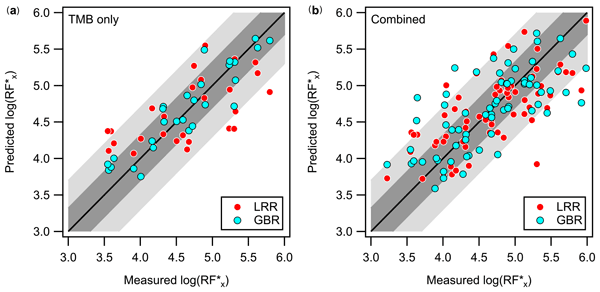
Dongyu S. Wang, Chuan Ping Lee, Jordan E. Krechmer, Francesca Majluf, Yandong Tong, Manjula R. Canagaratna, Julia Schmale, André S. H. Prévôt, Urs Baltensperger, Josef Dommen, Imad El Haddad, Jay G. Slowik, and David M. Bell
Atmos. Meas. Tech., 14, 6955–6972, https://doi.org/10.5194/amt-14-6955-2021, https://doi.org/10.5194/amt-14-6955-2021, 2021
Short summary
Short summary
To understand the sources and fate of particulate matter in the atmosphere, the ability to quantitatively describe its chemical composition is essential. In this work, we developed a calibration method for a state-of-the-art measurement technique without the need for chemical standards. Statistical analyses identified the driving factors behind instrument sensitivity variability towards individual components of particulate matter.
Lilian Loyer, Jean-Christophe Raut, Claudia Di Biagio, Julia Maillard, Vincent Mariage, and Jacques Pelon
Atmos. Meas. Tech. Discuss., https://doi.org/10.5194/amt-2021-326, https://doi.org/10.5194/amt-2021-326, 2021
Revised manuscript not accepted
Short summary
Short summary
The Arctic is facing drastic climate changes, and more observations are needed to better understand what is happening. Unfortunately observations are limited in the High Arctic. To obtain more observations, multiples buoys equipped with lidar, have been deployed in this region. This paper presents an approach to estimate the optical properties of clouds, and solar plus terrestrial energies from lidar measurements in the Arctic.
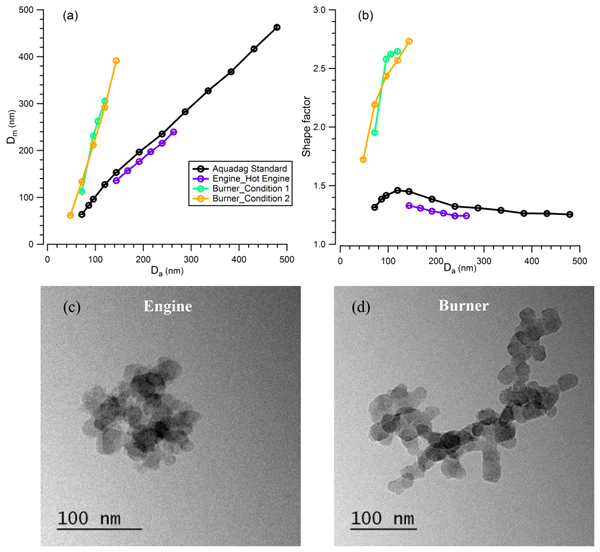
Dawei Hu, M. Rami Alfarra, Kate Szpek, Justin M. Langridge, Michael I. Cotterell, Claire Belcher, Ian Rule, Zixia Liu, Chenjie Yu, Yunqi Shao, Aristeidis Voliotis, Mao Du, Brett Smith, Greg Smallwood, Prem Lobo, Dantong Liu, Jim M. Haywood, Hugh Coe, and James D. Allan
Atmos. Chem. Phys., 21, 16161–16182, https://doi.org/10.5194/acp-21-16161-2021, https://doi.org/10.5194/acp-21-16161-2021, 2021
Short summary
Short summary
Here, we developed new techniques for investigating these properties in the laboratory and applied these to BC and BrC from different sources, including diesel exhaust, inverted propane flame and wood combustion. These have allowed us to quantify the changes in shape and chemical composition of different soots according to source and variables such as the moisture content of wood.
Zhaofeng Tan, Luisa Hantschke, Martin Kaminski, Ismail-Hakki Acir, Birger Bohn, Changmin Cho, Hans-Peter Dorn, Xin Li, Anna Novelli, Sascha Nehr, Franz Rohrer, Ralf Tillmann, Robert Wegener, Andreas Hofzumahaus, Astrid Kiendler-Scharr, Andreas Wahner, and Hendrik Fuchs
Atmos. Chem. Phys., 21, 16067–16091, https://doi.org/10.5194/acp-21-16067-2021, https://doi.org/10.5194/acp-21-16067-2021, 2021
Short summary
Short summary
The photo-oxidation of myrcene, a monoterpene species emitted by plants, was investigated at atmospheric conditions in the outdoor simulation chamber SAPHIR. The chemical structure of myrcene is partly similar to isoprene. Therefore, it can be expected that hydrogen shift reactions could play a role as observed for isoprene. In this work, their potential impact on the regeneration efficiency of hydroxyl radicals is investigated.

Chunshui Lin, Darius Ceburnis, Anna Trubetskaya, Wei Xu, William Smith, Stig Hellebust, John Wenger, Colin O'Dowd, and Jurgita Ovadnevaite
Atmos. Meas. Tech., 14, 6905–6916, https://doi.org/10.5194/amt-14-6905-2021, https://doi.org/10.5194/amt-14-6905-2021, 2021
Short summary
Short summary
Source apportionment of solid-fuel-burning emissions can be complicated by the use of different fuels, stoves, and burning conditions. Here, the organic aerosol mass spectra produced from burning a range of solid fuels in several stoves were compared. This study accounts for the source variability and provides better constraints on the primary factor contributions to the ambient organic aerosol estimations, holding significant implications for public health and policymakers.
Cited articles
Abd El, E., Brunoldi, M., Gatta, E., Irfan, M., Isolabella, T., Massabò, D., Mazzei, F., Vernocchi, V., Parodi, F., and Prati, P.: Bacterial viability and air quality: Experimental approach and results at the atmospheric simulation chamber ChAMBRe, Nuovo Cimento C, 139, 1–4, https://doi.org/10.1393/ncc/i2024-24319-1, 2023. a
Agarwal, V., Abd El, E., Danelli, S. G., Gatta, E., Massabò, D., Mazzei, F., Meier, B., Prati, P., Vernocchi, V., and Wang, J.: Influence of CO2 and dust on the survival of non-resistant and multi-resistant airborne E. coli strains, Antibiotics, 13, 558, https://doi.org/10.3390/antibiotics13060558, 2024. a
Alam, M. S., Crilley, L. R., Lee, J. D., Kramer, L. J., Pfrang, C., Vázquez-Moreno, M., Ródenas, M., Muñoz, A., and Bloss, W. J.: Interference from alkenes in chemiluminescent NOx measurements, Atmos. Meas. Tech., 13, 5977–5991, https://doi.org/10.5194/amt-13-5977-2020, 2020. a
Baker, Y., Kang, S., Wang, H., Wu, R., Xu, J., Zanders, A., He, Q., Hohaus, T., Ziehm, T., Geretti, V., Bannan, T. J., O'Meara, S. P., Voliotis, A., Hallquist, M., McFiggans, G., Zorn, S. R., Wahner, A., and Mentel, T. F.: Impact of
Baldo, C., Formenti, P., Di Biagio, C., Lu, G., Song, C., Cazaunau, M., Pangui, E., Doussin, J.-F., Dagsson-Waldhauserova, P., Arnalds, O., Beddows, D., MacKenzie, A. R., and Shi, Z.: Complex refractive index and single scattering albedo of Icelandic dust in the shortwave part of the spectrum, Atmos. Chem. Phys., 23, 7975–8000, https://doi.org/10.5194/acp-23-7975-2023, 2023. a, b, c
Barnes, I., Becker, K. H., and Mihalopoulos, N.: An FTIR product study of the photooxidation of dimethyl disulfide, J. Atmos. Chem., 18, 267–289, https://doi.org/10.1007/BF00696783, 1994. a
Bates, K. H., Burke, G. J. P., Cope, J. D., and Nguyen, T. B.: Secondary organic aerosol and organic nitrogen yields from the nitrate radical (NO3) oxidation of alpha-pinene from various RO2 fates, Atmos. Chem. Phys., 22, 1467–1482, https://doi.org/10.5194/acp-22-1467-2022, 2022. a
Battaglia, F., Formenti, P., Giorio, C., Cazaunau, M., Pangui, E., Bergé, A., Gratien, A., Pereira, D. L., Bertin, T., de Brito, J. F., Romanias, M. N., Michoud, V., Baldo, C., Chevaillier, S., Noyalet, G., Decorse, P., Picquet-Varrault, B., and Doussin, J.-F.: Formation and composition of organic aerosols from the uptake of glyoxal on natural mineral dust aerosols: a laboratory study, Atmos. Chem. Phys., 25, 12409–12431, https://doi.org/10.5194/acp-25-12409-2025, 2025. a, b, c, d, e
Becker, K. H.: EUPHORE, The European Photoreactor. The construction and operation of an outdoor smog chamber in Valencia for studying mechanisms of photochemical processes and their modelling in the polluted air of different European regions. Design and technical development of the European photoreactor and first experimental results, Report, European Community, 1986. a
Bejan, I., Barnes, I., Wiesen, P., and Wenger, J. C.: Temperature dependent rate coefficients for the reaction of OH radicals with dimethylbenzoquinones, Chem. Phys. Lett., 639, 145–150, https://doi.org/10.1016/j.cplett.2015.09.010, 2015. a
Bell, D. M., Pospisilova, V., Lopez-Hilfiker, F., Bertrand, A., Xiao, M., Zhou, X., Huang, W., Wang, D. S., Lee, C. P., Dommen, J., Baltensperger, U., Prevot, A. S. H., El Haddad, I., and Slowik, J. G.: Effect of OH scavengers on the chemical composition of α-pinene secondary organic aerosol, Environ. Sci. Atmos., 3, 115–123, https://doi.org/10.1039/D2EA00105E, 2023. a
Bernard, F., Eyglunent, G., Daële, V., and Mellouki, A.: Kinetics and products of gas-phase reactions of ozone with methyl methacrylate, methyl acrylate, and ethyl acrylate, J. Phys. Chem. A, 114, 8376–8383, https://doi.org/10.1021/jp104451v, 2010. a
Berndt, T., Mentler, B., Scholz, W., Fischer, L., Herrmann, H., Kulmala, M., and Hansel, A.: Accretion product formation from ozonolysis and OH radical reaction of α-pinene: Mechanistic insight and the influence of isoprene and ethylene, Environ. Sci. Technol., 52, 11069–11077, https://doi.org/10.1021/acs.est.8b02210, 2018. a
Bertrand, A., Stefenelli, G., Pieber, S. M., Bruns, E. A., Temime-Roussel, B., Slowik, J. G., Wortham, H., Prévôt, A. S. H., El Haddad, I., and Marchand, N.: Influence of the vapor wall loss on the degradation rate constants in chamber experiments of levoglucosan and other biomass burning markers, Atmos. Chem. Phys., 18, 10915–10930, https://doi.org/10.5194/acp-18-10915-2018, 2018. a
Bianchi, F., Kurten, T., Riva, M., Mohr, C., Rissanen, M. P., Roldin, P., Berndt, T., Crounse, J. D., Wennberg, P. O., Mentel, T. F., Wildt, J., Junninen, H., Jokinen, T., Kulmala, M., Worsnop, D. R., Thornton, J. A., Donahue, N., Kjaergaard, H. G., and Ehn, M.: Highly oxygenated organic molecules (HOM) from gas-phase autoxidation involving peroxy radicals: A key contributor to atmospheric aerosol, Chem. Rev., 119, 3472–3509, https://doi.org/10.1021/acs.chemrev.8b00395, 2019. a
Bloss, C., Wagner, V., Jenkin, M. E., Volkamer, R., Bloss, W. J., Lee, J. D., Heard, D. E., Wirtz, K., Martin-Reviejo, M., Rea, G., Wenger, J. C., and Pilling, M. J.: Development of a detailed chemical mechanism (MCMv3.1) for the atmospheric oxidation of aromatic hydrocarbons, Atmos. Chem. Phys., 5, 641–664, https://doi.org/10.5194/acp-5-641-2005, 2005. a
Bogaert, M., Mouritzen, C., Johnson, M. S., and van Reeuwijk, M.: RPCA-based techniques for pattern extraction, hotspot identification and signal correction using data from a dense network of low-cost NO2 sensors in London, Sci. Total Environ., 925, 171522, https://doi.org/10.1016/j.scitotenv.2024.171522, 2024. a
Bohn, B. and Zilken, H.: Model-aided radiometric determination of photolysis frequencies in a sunlit atmosphere simulation chamber, Atmos. Chem. Phys., 5, 191–206, https://doi.org/10.5194/acp-5-191-2005, 2005. a, b, c
Bosio, M., Mazzei, F., Brunoldi, M., Massabò, D., Vernocchi, V., Parodi, F., Prati, P., and Roccotiello, E.: Experimental investigation of plants interactions with airborne pollutants in an atmospheric simulation chamber, Atmos. Environ. X, 27, 100355, https://doi.org/10.1016/j.aeaoa.2025.100355, 2025. a, b
Bouzidi, H., Fayad, L., Coeur, C., Houzel, N., Petitprez, D., Faccinetto, A., Wu, J., Tomas, A., Ondráček, J., Schwarz, J., Ždímal, V., and Zuend, A.: Hygroscopic growth and CCN activity of secondary organic aerosol produced from dark ozonolysis of γ-terpinene, Sci. Total Environ., 817, 153010, https://doi.org/10.1016/j.scitotenv.2022.153010, 2022. a
Boy, M., Zhou, P., Kurtén, T., Chen, D., Xavier, C., Clusius, P., Roldin, P., Baykara, M., Pichelstorfer, L., Foreback, B., Bäck, J., Petäjä, T., Makkonen, R., Kerminen, V.-M., Pihlatie, M., Aalto, J., and Kulmala, M.: Positive feedback mechanism between biogenic volatile organic compounds and the methane lifetime in future climates, NPJ Clim. Atmos. Sci., 5, 72, https://doi.org/10.1038/s41612-022-00292-0, 2022. a
Brégonzio-Rozier, L., Giorio, C., Siekmann, F., Pangui, E., Morales, S. B., Temime-Roussel, B., Gratien, A., Michoud, V., Cazaunau, M., DeWitt, H. L., Tapparo, A., Monod, A., and Doussin, J.-F.: Secondary organic aerosol formation from isoprene photooxidation during cloud condensation–evaporation cycles, Atmos. Chem. Phys., 16, 1747–1760, https://doi.org/10.5194/acp-16-1747-2016, 2016. a
Brunamonti, S., Saathoff, H., Hertzog, A., Diskin, G., Fujiwara, M., Rosenlof, K., Möhler, O., Tuzson, B., Emmenegger, L., Amarouche, N., Durry, G., Frérot, F., Samake, J.-C., Cenac, C., Lopez, J., Monnier, P., and Ghysels, M.: The AquaVIT-4 intercomparison of atmospheric hygrometers, Atmos. Meas. Tech., 18, 5321–5348, https://doi.org/10.5194/amt-18-5321-2025, 2025. a
Bulot, F. M. J., Russell, H. S., Rezaei, M., Johnson, M. S., Ossont, S. J. J., Morris, A. K. R., Basford, P. J., Easton, N. H. C., Foster, G. L., Loxham, M., and Cox, S. J.: Laboratory comparison of low-cost particulate matter sensors to measure transient events of pollution, Sensors, 20, 2219, https://doi.org/10.3390/s20082219, 2020. a
Bulot, F. M. J., Russell, H. S., Rezaei, M., Johnson, M. S., Ossont, S. J., Morris, A. K. R., Basford, P. J., Easton, N. H. C., Mitchell, H. L., Foster, G. L., Loxham, M., and Cox, S. J.: Laboratory comparison of low-cost particulate matter sensors to measure transient events of pollution – Part B – Particle number concentrations, Sensors, 23, 7657, https://doi.org/10.3390/s23177657, 2023. a
Burkholder, J. B., Sander, S. P., Abbatt, J. P. D., Barker, J. R., Huie, R. E., Kolb, C. E., Kurylo, M. J., Orkin, V. L., Wilmouth, D. M., and Wine, P. H.: Chemical kinetics and photochemical data for use in atmospheric studies–evaluation number 19, NASA panel for data evaluation technical report, 19-5, 1–1610, https://science.jpl.nasa.gov/documents/1487/NASA-JPL_Evaluation_19-5.pdf (last access: 22 June 2026), 2020. a
Camredon, M., Aumont, B., Lee-Taylor, J., and Madronich, S.: The
Carlsson, P. T. M., Vereecken, L., Novelli, A., Bernard, F., Brown, S. S., Brownwood, B., Cho, C., Crowley, J. N., Dewald, P., Edwards, P. M., Friedrich, N., Fry, J. L., Hallquist, M., Hantschke, L., Hohaus, T., Kang, S., Liebmann, J., Mayhew, A. W., Mentel, T., Reimer, D., Rohrer, F., Shenolikar, J., Tillmann, R., Tsiligiannis, E., Wu, R., Wahner, A., Kiendler-Scharr, A., and Fuchs, H.: Comparison of isoprene chemical mechanisms under atmospheric night-time conditions in chamber experiments: evidence of hydroperoxy aldehydes and epoxy products from NO3 oxidation, Atmos. Chem. Phys., 23, 3147–3180, https://doi.org/10.5194/acp-23-3147-2023, 2023. a, b
Carstens, C., Bell, D. M., Sari Doré, F., Top, J., Dubois, C., Zhang, Y., Perrier, S., El Haddad, I., and Riva, M.: Effects of relative humidity on time-resolved molecular characterization of secondary organic aerosols from the OH-initiated oxidation of cresol in the presence of NOx, Environ. Sci. Technol., https://doi.org/10.1021/acs.est.4c08215, 2025. a
Chandran, S., Campos-Pineda, M., Ben Brik, A., Wenger, J., and Ruth, A. A.: The Irish Atmospheric Simulation Chamber: A national facility for atmospheric sciences, EGU General Assembly 2024, Vienna, Austria, 14–19 April 2024, EGU24-19774, https://doi.org/10.5194/egusphere-egu24-19774, 2024. a, b
Chhantyal-Pun, R., Wang, P., Baweja, S., Bainbridge, J., Xue, C., Daële, V., Mellouki, A., and McGillen, M. R.: Yield of the four-carbon stabilized Criegee intermediates from isoprene ozonolysis, ACS Earth Space Chem., 10, 328–337, https://doi.org/10.1021/acsearthspacechem.5c00226, 2026. a
Christiansen, S., Salter, M. E., Gorokhova, E., Nguyen, Q. T., and Bilde, M.: Sea spray aerosol formation: Laboratory results on the role of air entrainment, water temperature, and phytoplankton biomass, Environ. Sci. Technol., 53, 13107–13116, https://doi.org/10.1021/acs.est.9b04078, 2019. a
Connolly, P. J., Möhler, O., Field, P. R., Saathoff, H., Burgess, R., Choularton, T., and Gallagher, M.: Studies of heterogeneous freezing by three different desert dust samples, Atmos. Chem. Phys., 9, 2805–2824, https://doi.org/10.5194/acp-9-2805-2009, 2009. a
Crawford, I., Bower, K., Topping, D., Di Piazza, S., Massabò, D., Vernocchi, V., and Gallagher, M.: Towards a UK airborne bioaerosol climatology: real-time monitoring strategies for high rime resolution bioaerosol classification and quantification, Atmosphere, 14, 1214, https://doi.org/10.3390/atmos14081214, 2023. a
Cunningham, C. X., Williamson, G. J., and Bowman, D. M. J. S.: Increasing frequency and intensity of the most extreme wildfires on Earth, Nat. Ecol. Evol., 8, 1420–1425, https://doi.org/10.1038/s41559-024-02452-2, 2024. a
Daellenbach, K. R., Stefenelli, G., Bozzetti, C., Vlachou, A., Fermo, P., Gonzalez, R., Piazzalunga, A., Colombi, C., Canonaco, F., Hueglin, C., Kasper-Giebl, A., Jaffrezo, J.-L., Bianchi, F., Slowik, J. G., Baltensperger, U., El-Haddad, I., and Prévôt, A. S. H.: Long-term chemical analysis and organic aerosol source apportionment at nine sites in central Europe: source identification and uncertainty assessment, Atmos. Chem. Phys., 17, 13265–13282, https://doi.org/10.5194/acp-17-13265-2017, 2017. a
Danelli, S. G., Brunoldi, M., Massabò, D., Parodi, F., Vernocchi, V., and Prati, P.: Comparative characterization of the performance of bio-aerosol nebulizers in connection with atmospheric simulation chambers, Atmos. Meas. Tech., 14, 4461–4470, https://doi.org/10.5194/amt-14-4461-2021, 2021. a, b
Danelli, S. G., Caponi, L., Brunoldi, M., De Camillis, M., Massabò, D., Mazzei, F., Isolabella, T., Pascarella, A., Prati, P., Santostefano, M., Tarchino, F., Vernocchi, V., and Brotto, P.: Measurement report: Investigation of optical properties of carbonaceous aerosols from the combustion of different fuels by an atmospheric simulation chamber, Atmos. Chem. Phys., 25, 9387–9401, https://doi.org/10.5194/acp-25-9387-2025, 2025. a, b
De Haan, D. O., Pajunoja, A., Hawkins, L. N., Welsh, H. G., Jimenez, N. G., De Loera, A., Zauscher, M., Andretta, A. D., Joyce, B. W., De Haan, A. C., Riva, M., Cui, T., Surratt, J. D., Cazaunau, M., Formenti, P., Gratien, A., Pangui, E., and Doussin, J.-F.: Methylamine’s effects on methylglyoxal-containing aerosol: chemical, physical, and optical changes, ACS Earth Space Chem., 3, 1706–1716, https://doi.org/10.1021/acsearthspacechem.9b00103, 2019. a
De Haan, D. O., Hawkins, L. N., Jansen, K., Welsh, H. G., Pednekar, R., de Loera, A., Jimenez, N. G., Tolbert, M. A., Cazaunau, M., Gratien, A., Bergé, A., Pangui, E., Formenti, P., and Doussin, J.-F.: Glyoxal's impact on dry ammonium salts: fast and reversible surface aerosol browning, Atmos. Chem. Phys., 20, 9581–9590, https://doi.org/10.5194/acp-20-9581-2020, 2020. a
De Haan, D. O., Hawkins, L. N., Wickremasinghe, P. D., Andretta, A. D., Dignum, J. R., De Haan, A. C., Welsh, H. G., Pennington, E. A., Cui, T., Surratt, J. D., Cazaunau, M., Pangui, E., and Doussin, J.-F.: Brown carbon from photo-oxidation of glyoxal and SO2 in aqueous aerosol, ACS Earth Space Chem., 7, 1131–1140, https://doi.org/10.1021/acsearthspacechem.3c00035, 2023. a
De Haan, D. O., Hawkins, L. N., Weber, J. A., Moul, B. T., Hui, S., Cox, S. A., Esse, J. U., Skochdopole, N. R., Lynch, C. P., De Haan, A. C., Le, C., Cazaunau, M., Bergé, A., Pangui, E., Heuser, J., Doussin, J.-F., and Picquet-Varrault, B.: Brown carbon aerosol formation by multiphase catechol photooxidation in the presence of soluble iron, ACS ES&T Air, 1, 909–917, https://doi.org/10.1021/acsestair.4c00045, 2024a. a
De Haan, D. O., Hawkins, L. N., Weber, J. A., Moul, B. T., Hui, S., Cox, S. A., Esse, J. U., Skochdopole, N. R., Lynch, C. P., Le, C., Cazaunau, M., Bergé, A., Pangui, E., Heuser, J., Doussin, J.-F., and Picquet-Varrault, B.: Multiphase guaiacol photooxidation: Fenton reactions, brown carbon, and secondary organic aerosol formation in suspended aerosol particles, ACS ES&T Air, 1, 346–356, https://doi.org/10.1021/acsestair.3c00057, 2024b. a
Deabji, N., Fomba, K. W., Poulain, L., Xue, C., Mellouki, A., and Herrmann, H.: A twin site study of size-resolved composition, source apportionment and health impacts of aerosol particles in Morocco, Atmos. Environ., 355, 121273, https://doi.org/10.1016/j.atmosenv.2025.121273, 2025. a
DeMott, P. J. and Rogers, D. C.: Freezing nucleation rates of dilute solution droplets measured between −30 and −40 °C in laboratory Simulations of natural clouds, J. Atmos. Sci., 47, 1056–1064, https://doi.org/10.1175/1520-0469(1990)047<1056:FNRODS>2.0.CO;2, 1990. a
Denjean, C., Formenti, P., Picquet-Varrault, B., Pangui, E., Zapf, P., Katrib, Y., Giorio, C., Tapparo, A., Monod, A., Temime-Roussel, B., Decorse, P., Mangeney, C., and Doussin, J. F.: Relating hygroscopicity and optical properties to chemical composition and structure of secondary organic aerosol particles generated from the ozonolysis of α-pinene, Atmos. Chem. Phys., 15, 3339–3358, https://doi.org/10.5194/acp-15-3339-2015, 2015. a, b
Di Biagio, C., Formenti, P., Balkanski, Y., Caponi, L., Cazaunau, M., Pangui, E., Journet, E., Nowak, S., Caquineau, S., Andreae, M. O., Kandler, K., Saeed, T., Piketh, S., Seibert, D., Williams, E., and Doussin, J.-F.: Global scale variability of the mineral dust long-wave refractive index: a new dataset of in situ measurements for climate modeling and remote sensing, Atmos. Chem. Phys., 17, 1901–1929, https://doi.org/10.5194/acp-17-1901-2017, 2017. a, b, c, d, e, f
Di Biagio, C., Formenti, P., Balkanski, Y., Caponi, L., Cazaunau, M., Pangui, E., Journet, E., Nowak, S., Andreae, M. O., Kandler, K., Saeed, T., Piketh, S., Seibert, D., Williams, E., and Doussin, J.-F.: Complex refractive indices and single-scattering albedo of global dust aerosols in the shortwave spectrum and relationship to size and iron content, Atmos. Chem. Phys., 19, 15503–15531, https://doi.org/10.5194/acp-19-15503-2019, 2019. a, b, c, d
Di Biagio, C., Doussin, J.-F., Cazaunau, M., Pangui, E., Cuesta, J., Sellitto, P., Ródenas, M., and Formenti, P.: Infrared optical signature reveals the source–dependency and along–transport evolution of dust mineralogy as shown by laboratory study, Sci. Rep., 13, 13252, https://doi.org/10.1038/s41598-023-39336-7, 2023. a
Dixneuf, S., Ruth, A. A., Häseler, R., Brauers, T., Rohrer, F., and Dorn, H.-P.: Detection of nitrous acid in the atmospheric simulation chamber SAPHIR using open-path incoherent broadband cavity-enhanced absorption spectroscopy and extractive long-path absorption photometry, Atmos. Meas. Tech., 15, 945–964, https://doi.org/10.5194/amt-15-945-2022, 2022. a, b
Donahue, N. M., Robinson, A. L., Stanier, C. O., and Pandis, S. N.: Coupled partitioning, dilution, and chemical aging of semivolatile organics, Environ. Sci. Technol., 40, 2635–2643, https://doi.org/10.1021/es052297c, 2006. a
Donahue, N. M., Henry, K. M., Mentel, T. F., Kiendler-Scharr, A., Spindler, C., Bohn, B., Brauers, T., Dorn, H. P., Fuchs, H., Tillmann, R., Wahner, A., Saathoff, H., Naumann, K.-H., Möhler, O., Leisner, T., Müller, L., Reinnig, M.-C., Hoffmann, T., Salo, K., Hallquist, M., Frosch, M., Bilde, M., Tritscher, T., Barmet, P., Praplan, A. P., De Carlo, P. F., Dommen, J., Prevot, A. S., and Baltensperger, U.: Aging of biogenic secondary organic aerosol via gas-phase OH radical reactions, P. Natl. Acad. Sci. USA, 109, 13503–13508, https://doi.org/10.1073/pnas.1115186109, 2012. a
Dorn, H.-P., Apodaca, R. L., Ball, S. M., Brauers, T., Brown, S. S., Crowley, J. N., Dubé, W. P., Fuchs, H., Häseler, R., Heitmann, U., Jones, R. L., Kiendler-Scharr, A., Labazan, I., Langridge, J. M., Meinen, J., Mentel, T. F., Platt, U., Pöhler, D., Rohrer, F., Ruth, A. A., Schlosser, E., Schuster, G., Shillings, A. J. L., Simpson, W. R., Thieser, J., Tillmann, R., Varma, R., Venables, D. S., and Wahner, A.: Intercomparison of NO3 radical detection instruments in the atmosphere simulation chamber SAPHIR, Atmos. Meas. Tech., 6, 1111–1140, https://doi.org/10.5194/amt-6-1111-2013, 2013. a
Doussin, J. F., Ritz, D., Durand-Jolibois, R., Monod, A., and Carlier, P.: Design of an environmental chamber for the study of atmospheric chemistry: New developments in the analytical device, Analusis, 25, 236–242, https://doi.org/10.1016/S0365-4877(97)86083-4, 1997. a, b
Doussin, J.-F., Fuchs, H., Kiendler-Scharr, A., Seakins, P., and Wenger, J.: A practical guide to atmospheric simulation chambers, Springer International Publishing, ISBN 978-3-031-22276-4, https://doi.org/10.1007/978-3-031-22277-1, 2023. a, b, c, d
Ehn, M., Thornton, J. A., Kleist, E., Sipila, M., Junninen, H., Pullinen, I., Springer, M., Rubach, F., Tillmann, R., Lee, B., Lopez-Hilfiker, F., Andres, S., Acir, I.-H., Rissanen, M., Jokinen, T., Schobesberger, S., Kangasluoma, J., Kontkanen, J., Nieminen, T., Kurten, T., Nielsen, L. B., Jorgensen, S., Kjaergaard, H. G., Canagaratna, M., Maso, M. D., Berndt, T., Petaja, T., Wahner, A., Kerminen, V.-M., Kulmala, M., Worsnop, D. R., Wildt, J., and Mentel, T. F.: A large source of low-volatility secondary organic aerosol, Nature, 506, 476–479, https://doi.org/10.1038/nature13032, 2014. a, b
Evans, R. L., Bryant, D. J., Voliotis, A., Hu, D., Wu, H., Syafira, S. A., Oghama, O. E., McFiggans, G., Hamilton, J. F., and Rickard, A. R.: The importance of burning conditions on the composition of domestic biomass-burning organic aerosol and the impact of atmospheric ageing, Atmos. Chem. Phys., 25, 4367–4389, https://doi.org/10.5194/acp-25-4367-2025, 2025. a
Faherty, T., Badri, H., Hu, D., Voliotis, A., Pope, F. D., Mudway, I., Smith, J., and McFiggans, G.: HIPTox – Hazard identification platform to assess the health impacts from indoor and outdoor air pollutant exposures, through mechanistic toxicology: A single-centre double-blind human exposure trial protocol, Int. J. Environ. Res. Pu., 21, 284, https://doi.org/10.3390/ijerph21030284, 2024. a, b
Fahey, D. W., Gao, R.-S., Möhler, O., Saathoff, H., Schiller, C., Ebert, V., Krämer, M., Peter, T., Amarouche, N., Avallone, L. M., Bauer, R., Bozóki, Z., Christensen, L. E., Davis, S. M., Durry, G., Dyroff, C., Herman, R. L., Hunsmann, S., Khaykin, S. M., Mackrodt, P., Meyer, J., Smith, J. B., Spelten, N., Troy, R. F., Vömel, H., Wagner, S., and Wienhold, F. G.: The AquaVIT-1 intercomparison of atmospheric water vapor measurement techniques, Atmos. Meas. Tech., 7, 3177–3213, https://doi.org/10.5194/amt-7-3177-2014, 2014. a
Fiedler, S. E., Hese, A., and Ruth, A. A.: Incoherent broad-band cavity-enhanced absorption spectroscopy, Chem. Phys. Lett., 371, 284–294, https://doi.org/10.1016/S0009-2614(03)00263-X, 2003. a
Fouqueau, A., Cirtog, M., Cazaunau, M., Pangui, E., Doussin, J.-F., and Picquet-Varrault, B.: A comparative and experimental study of the reactivity with nitrate radical of two terpenes: α-terpinene and γ-terpinene, Atmos. Chem. Phys., 20, 15167–15189, https://doi.org/10.5194/acp-20-15167-2020, 2020. a
Frey, W., Schmalfuß, S., Stratmann, F., and Niedermeier, D.: Measurements of water droplets in a turbulent wind tunnel, Earth Syst. Sci. Data Discuss., 2025, 1–16, https://doi.org/10.5194/essd-2025-658, 2025. a
Frosch, M., Bilde, M., DeCarlo, P. F., Jurányi, Z., Tritscher, T., Dommen, J., Donahue, N. M., Gysel, M., Weingartner, E., and Baltensperger, U.: Relating cloud condensation nuclei activity and oxidation level of α-pinene secondary organic aerosols, J. Geophys. Res., 116, https://doi.org/10.1029/2011JD016401, 2011. a
Fuchs, H., Ball, S. M., Bohn, B., Brauers, T., Cohen, R. C., Dorn, H.-P., Dubé, W. P., Fry, J. L., Häseler, R., Heitmann, U., Jones, R. L., Kleffmann, J., Mentel, T. F., Müsgen, P., Rohrer, F., Rollins, A. W., Ruth, A. A., Kiendler-Scharr, A., Schlosser, E., Shillings, A. J. L., Tillmann, R., Varma, R. M., Venables, D. S., Villena Tapia, G., Wahner, A., Wegener, R., Wooldridge, P. J., and Brown, S. S.: Intercomparison of measurements of NO2 concentrations in the atmosphere simulation chamber SAPHIR during the NO3Comp campaign, Atmos. Meas. Tech., 3, 21–37, https://doi.org/10.5194/amt-3-21-2010, 2010. a
Fuchs, H., Bohn, B., Hofzumahaus, A., Holland, F., Lu, K. D., Nehr, S., Rohrer, F., and Wahner, A.: Detection of HO2 by laser-induced fluorescence: calibration and interferences from RO2 radicals, Atmos. Meas. Tech., 4, 1209–1225, https://doi.org/10.5194/amt-4-1209-2011, 2011. a
Fuchs, H., Hofzumahaus, A., Rohrer, F., Bohn, B., Brauers, T., Dorn, H.-P., Häseler, R., Holland, F., Kaminski, M., Li, X., Lu, K., Nehr, S., Tillmann, R., Wegener, R., and Wahner, A.: Experimental evidence for efficient hydroxyl radical regeneration in isoprene oxidation, Nat. Geosci., 6, 1023–1026, https://doi.org/10.1038/NGEO1964, 2013. a, b, c, d
Fuchs, H., Acir, I.-H., Bohn, B., Brauers, T., Dorn, H.-P., Häseler, R., Hofzumahaus, A., Holland, F., Kaminski, M., Li, X., Lu, K., Lutz, A., Nehr, S., Rohrer, F., Tillmann, R., Wegener, R., and Wahner, A.: OH regeneration from methacrolein oxidation investigated in the atmosphere simulation chamber SAPHIR, Atmos. Chem. Phys., 14, 7895–7908, https://doi.org/10.5194/acp-14-7895-2014, 2014. a
Fuchs, H., Novelli, A., Rolletter, M., Hofzumahaus, A., Pfannerstill, E. Y., Kessel, S., Edtbauer, A., Williams, J., Michoud, V., Dusanter, S., Locoge, N., Zannoni, N., Gros, V., Truong, F., Sarda-Esteve, R., Cryer, D. R., Brumby, C. A., Whalley, L. K., Stone, D., Seakins, P. W., Heard, D. E., Schoemaecker, C., Blocquet, M., Coudert, S., Batut, S., Fittschen, C., Thames, A. B., Brune, W. H., Ernest, C., Harder, H., Muller, J. B. A., Elste, T., Kubistin, D., Andres, S., Bohn, B., Hohaus, T., Holland, F., Li, X., Rohrer, F., Kiendler-Scharr, A., Tillmann, R., Wegener, R., Yu, Z., Zou, Q., and Wahner, A.: Comparison of OH reactivity measurements in the atmospheric simulation chamber SAPHIR, Atmos. Meas. Tech., 10, 4023–4053, https://doi.org/10.5194/amt-10-4023-2017, 2017. a, b
Fuchs, H., Wills, P., Campos-Pineda, M., Saito, S., Brik, A. B., Roman, C., Chandran, S., Wenger, J., Novelli, A., Färber, M., Gu, Y., Kharee, P., Tillmann, R., Wilson, D., Wegener, R., Adam, M. G., Bohn, B., and Ruth, A. A.: Comparison of the results of hydrocarbon oxidation experiments in an indoor and an outdoor atmospheric simulation chamber, EGU General Assembly 2026, Vienna, Austria, 3–8 May 2026, EGU26-5980, https://doi.org/10.5194/egusphere-egu26-5980, 2026. a
Furnell, H., Wenger, J., Wingler, A., Kilcawley, K. N., Mannion, D. T., Skibinska, I., and Kammer, J.: Highly diverse emission of volatile organic compounds by Sitka spruce and determination of their emission pathways, Environ. Sci., 5, 242–260, https://doi.org/10.1039/D4EA00138A, 2025. a
Garmash, O., Rissanen, M. P., Pullinen, I., Schmitt, S., Kausiala, O., Tillmann, R., Zhao, D., Percival, C., Bannan, T. J., Priestley, M., Hallquist, Å. M., Kleist, E., Kiendler-Scharr, A., Hallquist, M., Berndt, T., McFiggans, G., Wildt, J., Mentel, T. F., and Ehn, M.: Multi-generation OH oxidation as a source for highly oxygenated organic molecules from aromatics, Atmos. Chem. Phys., 20, 515–537, https://doi.org/10.5194/acp-20-515-2020, 2020. a
Garnett, J., Halsall, C., Thomas, M., Crabeck, O., France, J., Joerss, H., Ebinghaus, R., Kaiser, J., Leeson, A., and Wynn, P. M.: Investigating the uptake and fate of poly- and perfluoroalkylated substances (PFAS) in sea ice using an experimental sea ice chamber, Environ. Sci. Technol., 55, 9601–9608, https://doi.org/10.1021/acs.est.1c01645, 2021. a
Gatta, E., Abd El, E., Brunoldi, M., Irfan, M., Isolabella, T., Massabò, D., Parodi, F., Prati, P., Vernocchi, V., and Mazzei, F.: Viability studies of bacterial strains exposed to nitrogen oxides and light in controlled atmospheric conditions, Sci. Rep., 15, 10320, https://doi.org/10.1038/s41598-025-94898-y, 2025. a, b, c
Georgopoulou, M. P., Macias Rodriguez, J. C., Yegen, C.-H., Kaltsonoudis, C., Cazaunau, M., Vasilakopoulou, C. N., Matrali, A., Seitanidi, K., Aktypis, A., Nenes, A., Buissot, C., Gratien, A., Berge, A., Pangui, E., Al Marj, E., Gerard, L., Varrault, B. P., Lanone, S., Coll, P., and Pandis, S. N.: A coupled atmospheric simulation chamber system for the production of realistic aerosols and preclinical model exposure, Air Qual. Atmos. Hlth., 17, 2909–2930, https://doi.org/10.1007/s11869-024-01611-5, 2024. a, b
Gherman, T., Venables, D. S., Vaughan, S., Orphal, J., and Ruth, A. A.: Incoherent broadband cavity-enhanced absorption spectroscopy in the near-ultraviolet: Application to HONO and NO2, Environ. Sci. Technol., 42, 890–895, https://doi.org/10.1021/es0716913, 2008. a
Giorio, C., Monod, A., Brégonzio-Rozier, L., DeWitt, H. L., Cazaunau, M., Temime-Roussel, B., Gratien, A., Michoud, V., Pangui, E., Ravier, S., Zielinski, A. T., Tapparo, A., Vermeylen, R., Claeys, M., Voisin, D., Kalberer, M., and Doussin, J.-F.: Cloud processing of secondary organic aerosol from isoprene and methacrolein photooxidation, J. Phys. Chem. A, 121, 7641–7654, https://doi.org/10.1021/acs.jpca.7b05933, 2017. a
Gómez Alvarez, E., Vazquez, M., Munoz, A., Hjorth, J., Pilling, M., Saathoff, H., and Brauers, T.: The Eurochamp chamber experiment database: Goals and uses. Present and future potential benefits, in: Simulation and assessment of chemical processes in a multiphase environment, edited by: Barnes, I., Kharytonov, M. M., NATO Science for Peace and Security Series C: Environmental Security, Springer, Dordrecht, 71–82, https://doi.org/10.1007/978-1-4020-8846-9_6, 2008. a
Gong, Y., Jiang, F., Li, Y., Leisner, T., and Saathoff, H.: Impact of temperature on the role of Criegee intermediates and peroxy radicals in dimer formation from β-pinene ozonolysis, Atmos. Chem. Phys., 24, 167–184, https://doi.org/10.5194/acp-24-167-2024, 2024. a
Guilloteau, E., Coll, P., Lu, Z., Djouina, M., Cazaunau, M., Waxin, C., Bergé, A., Caboche, S., Gratien, A., Al Marj, E., Hot, D., Dubuquoy, L., Launay, D., Vignal, C., Lanone, S., and Body-Malapel, M.: Murine in utero exposure to simulated complex urban air pollution disturbs offspring gut maturation and microbiota during intestinal suckling-to-weaning transition in a sex-dependent manner, Part. Fibre Toxicol., 19, 41, https://doi.org/10.1186/s12989-022-00481-y, 2022. a
Guo, Y., Shen, H., Pullinen, I., Luo, H., Kang, S., Vereecken, L., Fuchs, H., Hallquist, M., Acir, I.-H., Tillmann, R., Rohrer, F., Wildt, J., Kiendler-Scharr, A., Wahner, A., Zhao, D., and Mentel, T. F.: Identification of highly oxygenated organic molecules and their role in aerosol formation in the reaction of limonene with nitrate radical, Atmos. Chem. Phys., 22, 11323–11346, https://doi.org/10.5194/acp-22-11323-2022, 2022. a
Haagen-Smit, A. J.: Chemistry and physiology of Los Angeles smog, Ind. Eng. Chem., 44, 1342–1346, https://doi.org/10.1021/ie50510a045, 1952. a
Harb, S., Cirtog, M., Alage, S., Cantrell, C., Cazaunau, M., Michoud, V., Pangui, E., Bergé, A., Giorio, C., Battaglia, F., and Picquet-Varrault, B.: Highly oxygenated molecules (HOMs) and secondary organic aerosol (SOA) formation from the oxidation of α- and β-phellandrenes by NO3 radicals, Atmos. Chem. Phys., 25, 11003–11024, https://doi.org/10.5194/acp-25-11003-2025, 2025. a, b, c
Hess, M., Koepke, P., and Schult, I.: Optical properties of aerosols and clouds: The software package OPAC, B. Am. Meteorol. Soc., 79, 831–844, https://doi.org/10.1175/1520-0477(1998)079<0831:OPOAAC>2.0.CO;2, 1998. a
Heuser, J., Di Biagio, C., Yon, J., Cazaunau, M., Bergé, A., Pangui, E., Zanatta, M., Renzi, L., Marinoni, A., Inomata, S., Yu, C., Bernardoni, V., Chevaillier, S., Ferry, D., Laj, P., Maillé, M., Massabò, D., Mazzei, F., Noyalet, G., Tanimoto, H., Temime-Roussel, B., Vecchi, R., Vernocchi, V., Formenti, P., Picquet-Varrault, B., and Doussin, J.-F.: Spectral optical properties of soot: laboratory investigation of propane flame particles and their link to composition, Atmos. Chem. Phys., 25, 6407–6428, https://doi.org/10.5194/acp-25-6407-2025, 2025. a
Hohaus, T., Kuhn, U., Andres, S., Kaminski, M., Rohrer, F., Tillmann, R., Wahner, A., Wegener, R., Yu, Z., and Kiendler-Scharr, A.: A new plant chamber facility, PLUS, coupled to the atmosphere simulation chamber SAPHIR, Atmos. Meas. Tech., 9, 1247–1259, https://doi.org/10.5194/amt-9-1247-2016, 2016. a, b
Hoose, C. and Möhler, O.: Heterogeneous ice nucleation on atmospheric aerosols: a review of results from laboratory experiments, Atmos. Chem. Phys., 12, 9817–9854, https://doi.org/10.5194/acp-12-9817-2012, 2012. a
Horbanski, M., Pöhler, D., Lampel, J., and Platt, U.: The ICAD (iterative cavity-enhanced DOAS) method, Atmos. Meas. Tech., 12, 3365–3381, https://doi.org/10.5194/amt-12-3365-2019, 2019. a
Ickes, L., Porter, G. C. E., Wagner, R., Adams, M. P., Bierbauer, S., Bertram, A. K., Bilde, M., Christiansen, S., Ekman, A. M. L., Gorokhova, E., Höhler, K., Kiselev, A. A., Leck, C., Möhler, O., Murray, B. J., Schiebel, T., Ullrich, R., and Salter, M. E.: The ice-nucleating activity of Arctic sea surface microlayer samples and marine algal cultures, Atmos. Chem. Phys., 20, 11089–11117, https://doi.org/10.5194/acp-20-11089-2020, 2020. a
Iinuma, Y., Böge, O., Gnauk, T., and Herrmann, H.: Aerosol-chamber study of the α-pinene/O3 reaction: influence of particle acidity on aerosol yields and products, Atmos. Environ., 38, 761–773, https://doi.org/10.1016/j.atmosenv.2003.10.015, 2004. a, b
Illmann, N.: A perspective on the reactions of organic peroxy radicals with HO2, Environ. Sci. Atmos., https://doi.org/10.1039/D5EA00023H, 2025. a
Illmann, N. and Rösgen, V.: O3 chemistry of 2,5-dimethylfuran: mechanism development, Environ. Sci. Atmos., 4, 1000–1011, https://doi.org/10.1039/D4EA00045E, 2024. a
Illmann, J. N., Patroescu-Klotz, I., and Wiesen, P.: Gas-phase reactivity of acyclic α,β-unsaturated carbonyls towards ozone, Phys. Chem. Chem. Phys., 23, 3455–3466, https://doi.org/10.1039/D0CP05881E, 2021a. a
Illmann, N., Gibilisco, R. G., Bejan, I. G., Patroescu-Klotz, I., and Wiesen, P.: Atmospheric oxidation of α,β-unsaturated ketones: kinetics and mechanism of the OH radical reaction, Atmos. Chem. Phys., 21, 13667–13686, https://doi.org/10.5194/acp-21-13667-2021, 2021b. a, b, c
Illmann, N., Patroescu-Klotz, I., and Wiesen, P.: Biomass burning plume chemistry: OH-radical-initiated oxidation of 3-penten-2-one and its main oxidation product 2-hydroxypropanal, Atmos. Chem. Phys., 21, 18557–18572, https://doi.org/10.5194/acp-21-18557-2021, 2021. a
Illmann, N., Patroescu-Klotz, I., and Wiesen, P.: Organic acid formation in the gas-phase ozonolysis of α,β-unsaturated ketones, Phys. Chem. Chem. Phys., 25, 106–116, https://doi.org/10.1039/D2CP03210D, 2023. a, b
Isolabella, T., Brunoldi, M., Prati, P., Massabò, D., Bernardoni, V., Vernocchi, V., and Parodi, F.: A new instrument prototype for aerosol light absorption measurements, Nuovo Cimento C, 46, 145, https://doi.org/10.1393/ncc/i2023-23145-3, 2023. a
Isolabella, T., Brunoldi, M., Mazzei, F., Parodi, F., Prati, P., Vernocchi, V., Bernardoni, V., Valli, G., Vecchi, R., Formenti, P., Baldo, C., Cazaunau, M., Moschos, V., Bililign, S., Fiddler, M. N., and Massabò, D.: The broadband light analyzer of complex aerosol: characterization and first applications, Atmos. Environ., 358, 121341, https://doi.org/10.1016/j.atmosenv.2025.121341, 2025. a, b, c, d
Iversen, E. M., Merete, B., and Pedersen, H. B.: Developments at the AURA atmospheric simulation chamber to characterize chamber volume, air mixing, and charging, Aerosol Sci. Tech., 59, 521–543, https://doi.org/10.1080/02786826.2024.2429658, 2025. a, b
Jenkin, M. E., Valorso, R., Aumont, B., Rickard, A. R., and Wallington, T. J.: Estimation of rate coefficients and branching ratios for gas-phase reactions of OH with aromatic organic compounds for use in automated mechanism construction, Atmos. Chem. Phys., 18, 9329–9349, https://doi.org/10.5194/acp-18-9329-2018, 2018a. a
Jenkin, M. E., Valorso, R., Aumont, B., Rickard, A. R., and Wallington, T. J.: Estimation of rate coefficients and branching ratios for gas-phase reactions of OH with aliphatic organic compounds for use in automated mechanism construction, Atmos. Chem. Phys., 18, 9297–9328, https://doi.org/10.5194/acp-18-9297-2018, 2018b. a
Jensen, L. N., Canagaratna, M. R., Kristensen, K., Quéléver, L. L. J., Rosati, B., Teiwes, R., Glasius, M., Pedersen, H. B., Ehn, M., and Bilde, M.: Temperature and volatile organic compound concentrations as controlling factors for chemical composition of α-pinene-derived secondary organic aerosol, Atmos. Chem. Phys., 21, 11545–11562, https://doi.org/10.5194/acp-21-11545-2021, 2021. a, b, c
Jensen, L. N., Kristensen, K., Iversen, E. M., Canagaratna, M. R., Roldin, P., and Bilde, M.: Nature of temperature-induced phase transitions in secondary organic aerosol particles, Environ. Sci. Technol., 59, 24359–24367, https://doi.org/10.1021/acs.est.5c08582, 2025. a
Jorga, S. D., Florou, K., Kaltsonoudis, C., Kodros, J. K., Vasilakopoulou, C., Cirtog, M., Fouqueau, A., Picquet-Varrault, B., Nenes, A., and Pandis, S. N.: Nighttime chemistry of biomass burning emissions in urban areas: A dual mobile chamber study, Atmos. Chem. Phys., 21, 15337–15349, https://doi.org/10.5194/acp-21-15337-2021, 2021. a
Kalberer, M., Paulsen, D., Sax, M., Steinbacher, M., Dommen, J., Prevot, A. S. H., Fisseha, R., Weingartner, E., Frankevich, V., Zenobi, R., and Baltensperger, U.: Identification of polymers as major components of atmospheric organic aerosols, Science, 303, 1659–1662, https://doi.org/10.1126/science.1092185, 2004. a
Kaltsonoudis, C., Kostenidou, E., Louvaris, E., Psichoudaki, M., Tsiligiannis, E., Florou, K., Liangou, A., and Pandis, S. N.: Characterization of fresh and aged organic aerosol emissions from meat charbroiling, Atmos. Chem. Phys., 17, 7143–7155, https://doi.org/10.5194/acp-17-7143-2017, 2017. a, b
Kaltsonoudis, C., Jorga, S. D., Louvaris, E., Florou, K., and Pandis, S. N.: A portable dual-smog-chamber system for atmospheric aerosol field studies, Atmos. Meas. Tech., 12, 2733–2743, https://doi.org/10.5194/amt-12-2733-2019, 2019. a, b
Kaminski, M., Fuchs, H., Acir, I.-H., Bohn, B., Brauers, T., Dorn, H.-P., Häseler, R., Hofzumahaus, A., Li, X., Lutz, A., Nehr, S., Rohrer, F., Tillmann, R., Vereecken, L., Wegener, R., and Wahner, A.: Investigation of the β-pinene photooxidation by OH in the atmosphere simulation chamber SAPHIR, Atmos. Chem. Phys., 17, 6631–6650, https://doi.org/10.5194/acp-17-6631-2017, 2017. a
Kamm, S., Möhler, O., Naumann, K. H., Saathoff, H., and Schurath, U.: The heterogeneous reaction of ozone with soot aerosol, Atmos. Environ., 33, 4651–4661, https://doi.org/10.1016/S1352-2310(99)00235-6, 1999. a
Kappelt, N., Russell, H. S., Kwiatkowski, S., Afshari, A., and Johnson, M. S.: Correlation of respiratory aerosols and metabolic carbon dioxide, Sustainability, 13, 12203, https://doi.org/10.3390/su132112203, 2021. a
Kari, E., Hao, L., Ylisirniö, A., Buchholz, A., Leskinen, A., Yli-Pirilä, P., Nuutinen, I., Kuuspalo, K., Jokiniemi, J., Faiola, C. L., Schobesberger, S., and Virtanen, A.: Potential dual effect of anthropogenic emissions on the formation of biogenic secondary organic aerosol (BSOA), Atmos. Chem. Phys., 19, 15651–15671, https://doi.org/10.5194/acp-19-15651-2019, 2019. a
Karl, M., Dye, C., Schmidbauer, N., Wisthaler, A., Mikoviny, T., D'Anna, B., Müller, M., Borrás, E., Clemente, E., Muñoz, A., Porras, R., Ródenas, M., Vázquez, M., and Brauers, T.: Study of OH-initiated degradation of 2-aminoethanol, Atmos. Chem. Phys., 12, 1881–1901, https://doi.org/10.5194/acp-12-1881-2012, 2012. a
Keller-Rudek, H., Moortgat, G. K., Sander, R., and Sörensen, R.: The MPI-Mainz UV/VIS Spectral Atlas of Gaseous Molecules of Atmospheric Interest, Earth Syst. Sci. Data, 5, 365–373, https://doi.org/10.5194/essd-5-365-2013, 2013. a
Kenagy, H. S., Heald, C. L., Tahsini, N., Goss, M. B., and Kroll, J. H.: Can we achieve atmospheric chemical environments in the laboratory? An integrated model-measurement approach to chamber SOA studies, Sci. Adv., 10, eado1482, https://doi.org/10.1126/sciadv.ado1482, 2024. a
Kerdouci, J., Picquet-Varrault, B., and Doussin, J.-F.: Prediction of rate constants for gas-phase reactions of nitrate radical with organic compounds: A new structure–activity relationship, Chem. Phys. Chem., 11, 3909–3920, https://doi.org/10.1002/cphc.201000673, 2010. a
Kerdouci, J., Picquet-Varrault, B., and Doussin, J.-F.: Structure-activity relationship for the gas-phase reactions of NO3 radical with organic compounds: Update and extension to aldehydes, Atmos. Environ., 84, 363–372, https://doi.org/10.1016/j.atmosenv.2013.11.024, 2014. a
Kiendler-Scharr, A., Wildt, J., Maso, M. D., Hohaus, T., Kleist, E., Mentel, T. F., Tillmann, R., Uerlings, R., Schurr, U., and Wahner, A.: New particle formation in forests inhibited by isoprene emissions, Nature, 461, 381–384, https://doi.org/10.1038/nature08292, 2009. a, b
King, S. M., Rosenoern, T., Shilling, J. E., Chen, Q., and Martin, S. T.: Increased cloud activation potential of secondary organic aerosol for atmospheric mass loadings, Atmos. Chem. Phys., 9, 2959–2971, https://doi.org/10.5194/acp-9-2959-2009, 2009. a
King, S. M., Butcher, A. C., Rosenoern, T., Coz, E., Lieke, K. I., de Leeuw, G., Nilsson, E. D., and Bilde, M.: Investigating primary marine aerosol properties: CCN activity of sea salt and mixed inorganic–organic particles, Environ. Sci. Technol., 46, 10405–10412, https://doi.org/10.1021/es300574u, 2012. a
Kourtchev, I., Giorio, C., Manninen, A., Wilson, E., Mahon, B., Aalto, J., Kajos, M., Venables, D., Ruuskanen, T., Levula, J., Loponen, M., Connors, S., Harris, N., Zhao, D., Kiendler-Scharr, A., Mentel, T., Rudich, Y., Hallquist, M., Doussin, J.-F., Maenhaut, W., Bäck, J., Petäjä, T., Wenger, J., Kulmala, M., and Kalberer, M.: Enhanced volatile organic compounds emissions and organic aerosol mass increase the oligomer content of atmospheric aerosols, Sci. Rep., 6, 35038, https://doi.org/10.1038/srep35038, 2016. a
Kristensen, K., Jensen, L. N., Glasius, M., and Bilde, M.: The effect of sub-zero temperature on the formation and composition of secondary organic aerosol from ozonolysis of α-pinene, Environ. Sci. Processes Impacts, 19, 1220–1234, https://doi.org/10.1039/C7EM00231A, 2017. a, b, c, d
Kristensen, K., Jensen, L. N., Quéléver, L. L. J., Christiansen, S., Rosati, B., Elm, J., Teiwes, R., Pedersen, H. B., Glasius, M., Ehn, M., and Bilde, M.: The Aarhus Chamber Campaign on Highly Oxygenated Organic Molecules and Aerosols (ACCHA): particle formation, organic acids, and dimer esters from α-pinene ozonolysis at different temperatures, Atmos. Chem. Phys., 20, 12549–12567, https://doi.org/10.5194/acp-20-12549-2020, 2020. a
Kumar, A., Vibhu, V., Bassat, J.-M., Nohl, L., de Haart, L. G. J., Bouvet, M., and Eichel, R.-A.: Ammonia as a potential energy vector in the burgeoning hydrogen economy, ChemElectroChem, 11, e202300845, https://doi.org/10.1002/celc.202300845, 2024. a
Kuula, J., Timonen, H., Niemi, J. V., Manninen, H. E., Rönkkö, T., Hussein, T., Fung, P. L., Tarkoma, S., Laakso, M., Saukko, E., Ovaska, A., Kulmala, M., Karppinen, A., Johansson, L., and Petäjä, T.: Opinion: Insights into updating Ambient Air Quality Directive 2008/50/EC, Atmos. Chem. Phys., 22, 4801–4808, https://doi.org/10.5194/acp-22-4801-2022, 2022. a
Kwok, E. S. C. and Atkinson, R.: Estimation of hydroxyl radical reaction rate constants for gas-phase organic compounds using a structure-reactivity relationship: An update, Atmos. Environ., 29, 1685–1695, https://doi.org/10.1016/1352-2310(95)00069-B, 1995. a
Laj, P., Lund Myhre, C., Riffault, V., Amiridis, V., Fuchs, H., Eleftheriadis, K., Petäjä, T., Salameh, T., Kivekäs, N., Juurola, E., Saponaro, G., Philippin, S., Cornacchia, C., Arboledas, L. A., Baars, H., Claude, A., De Mazière, M., Dils, B., Dufresne, M., Evangeliou, N., Favez, O., Fiebig, M., Haeffelin, M., Herrmann, H., Höhler, K., Illmann, N., Kreuter, A., Ludewig, E., Marinou, E., Möhler, O., Mona, L., Murberg, L. E., Nicolae, D., Novelli, A., O'Connor, E., Ohneiser, K., Petracca Altieri, R. M., Picquet-Varrault, B., van Pinxteren, D., Pospichal, B., Putaud, J.-P., Reimann, S., Siomos, N., Stachlewska, I., Tillmann, R., Voudouri, K. A., Wandinger, U., Wiedensohler, A., Apituley, A., Comerón, A., Gysel-Beer, M., Mihalopoulos, N., Nikolova, N., Pietruczuk, A., Sauvage, S., Sciare, J., Skov, H., Svendby, T., Swietlicki, E., Tonev, D., Vaughan, G., Zdimal, V., Baltensperger, U., Doussin, J.-F., Kulmala, M., Pappalardo, G., Sundet, S. S., and Vana, M.: Aerosol, Clouds and Trace Gases Research Infrastructure – ACTRIS, the European research infrastructure supporting atmospheric science, B. Am. Meteorol. Soc., 105, E1098–E1136, https://doi.org/10.1175/BAMS-D-23-0064.1, 2024. a, b, c, d, e, f, g
Lamkaddam, H., Gratien, A., Pangui, E., Cazaunau, M., Picquet-Varrault, B., and Doussin, J.-F.: High-NOx photooxidation of n-dodecane: Temperature dependence of SOA formation, Environ. Sci. Technol., 51, 192–201, https://doi.org/10.1021/acs.est.6b03821, 2017. a
Lelieveld, J., Butler, T. M., Crowley, J. N., Dillon, T. J., Fischer, H., Ganzeveld, L., Harder, H., Lawrence, M. G., Martinez, M., Taraborrelli, D., and Williams, J.: Atmospheric oxidation capacity sustained by a tropical forest, Nature, 452, 737–740, https://doi.org/10.1038/nature06870, 2008. a
Leskinen, A., Yli-Pirilä, P., Kuuspalo, K., Sippula, O., Jalava, P., Hirvonen, M.-R., Jokiniemi, J., Virtanen, A., Komppula, M., and Lehtinen, K. E. J.: Characterization and testing of a new environmental chamber, Atmos. Meas. Tech., 8, 2267–2278, https://doi.org/10.5194/amt-8-2267-2015, 2015. a, b
Li, L., Mahowald, N. M., Obiso, V., Kok, J. F., Miller, R. L., Liu, X., Gonçalves Ageitos, M., Pérez Garcíá-Pando, C., Leung, D. M., Ke, Z., Brodrick, P. G., Clark, R. N., Formenti, P., Di Biagio, C., Ginoux, P., Okin, G. S., Zhou, B., Thompson, D. R., and Green, R. O.: Dust direct radiative effect including large particles and component minerals, Geophys. Res. Lett., 52, e2025GL119383, https://doi.org/10.1029/2025GL119383, 2025. a
Liu, L., Hohaus, T., Franke, P., Lange, A. C., Tillmann, R., Fuchs, H., Tan, Z., Rohrer, F., Karydis, V., He, Q., Vardhan, V., Andres, S., Bohn, B., Holland, F., Winter, B., Wedel, S., Novelli, A., Hofzumahaus, A., Wahner, A., and Kiendler-Scharr, A.: Observational evidence reveals the significance of nocturnal chemistry in seasonal secondary organic aerosol formation, NPJ Clim. Atmos. Sci., 7, 207, https://doi.org/10.1038/s41612-024-00747-6, 2024. a, b
Luo, Y., Thomsen, D., Iversen, E. M., Roldin, P., Skønager, J. T., Li, L., Priestley, M., Pedersen, H. B., Hallquist, M., Bilde, M., Glasius, M., and Ehn, M.: Formation and temperature dependence of highly oxygenated organic molecules (HOMs) from Δ3-carene ozonolysis, Atmos. Chem. Phys., 24, 9459–9473, https://doi.org/10.5194/acp-24-9459-2024, 2024. a
Massabò, D., Danelli, S. G., Brotto, P., Comite, A., Costa, C., Di Cesare, A., Doussin, J. F., Ferraro, F., Formenti, P., Gatta, E., Negretti, L., Oliva, M., Parodi, F., Vezzulli, L., and Prati, P.: ChAMBRe: a new atmospheric simulation chamber for aerosol modelling and bio-aerosol research, Atmos. Meas. Tech., 11, 5885–5900, https://doi.org/10.5194/amt-11-5885-2018, 2018. a, b
McFiggans, G., Mentel, T. F., Wildt, J., Pullinen, I., Kang, S., Kleist, E., Schmitt, S., Springer, M., Tillmann, R., Wu, C., Zhao, D., Hallquist, M., Faxon, C., Le Breton, M., Hallquist, A. M., Simpson, D., Bergström, R., Jenkin, M. E., Ehn, M., Thornton, J. A., Alfarra, M. R., Bannan, T. J., Percival, C. J., Priestley, M., Topping, D., and Kiendler-Scharr, A.: Secondary organic aerosol reduced by mixture of atmospheric vapours, Nature, 565, 587–593, https://doi.org/10.1038/s41586-018-0871-y, 2019. a, b
McGillen, M. R., Carter, W. P. L., Mellouki, A., Orlando, J. J., Picquet-Varrault, B., and Wallington, T. J.: Database for the kinetics of the gas-phase atmospheric reactions of organic compounds, Earth Syst. Sci. Data, 12, 1203–1216, https://doi.org/10.5194/essd-12-1203-2020, 2020. a
McGillen, M. R., Michelat, L., Orlando, J. J., and Carter, W. P. L.: The use of the electrotopological state as a basis for predicting hydrogen abstraction rate coefficients: A proof of principle for the reactions of alkanes and haloalkanes with OH, Environ. Sci. Atmos., 4, 18–34, https://doi.org/10.1039/D3EA00147D, 2024. a
Mellouki, A., Ammann, M., Cox, R. A., Crowley, J. N., Herrmann, H., Jenkin, M. E., McNeill, V. F., Troe, J., and Wallington, T. J.: Evaluated kinetic and photochemical data for atmospheric chemistry: volume VIII – gas-phase reactions of organic species with four, or more, carbon atoms (≧C4), Atmos. Chem. Phys., 21, 4797–4808, https://doi.org/10.5194/acp-21-4797-2021, 2021. a
Meloni, D., di Sarra, A., Brogniez, G., Denjean, C., De Silvestri, L., Di Iorio, T., Formenti, P., Gómez-Amo, J. L., Gröbner, J., Kouremeti, N., Liuzzi, G., Mallet, M., Pace, G., and Sferlazzo, D. M.: Determining the infrared radiative effects of Saharan dust: a radiative transfer modelling study based on vertically resolved measurements at Lampedusa, Atmos. Chem. Phys., 18, 4377–4401, https://doi.org/10.5194/acp-18-4377-2018, 2018. a
Mettke, P., Brüggemann, M., Mutzel, A., Gräfe, R., and Herrmann, H.: Secondary organic aerosol (SOA) through uptake of isoprene hydroxy hydroperoxides (ISOPOOH) and its oxidation products, ACS Earth Space Chem., 7, 1025–1037, https://doi.org/10.1021/acsearthspacechem.2c00385, 2023. a, b
Meusinger, C., Dusek, U., King, S. M., Holzinger, R., Rosenørn, T., Sperlich, P., Julien, M., Remaud, G. S., Bilde, M., Röckmann, T., and Johnson, M. S.: Chemical and isotopic composition of secondary organic aerosol generated by α-pinene ozonolysis, Atmos. Chem. Phys., 17, 6373–6391, https://doi.org/10.5194/acp-17-6373-2017, 2017. a, b
Michelat, L., Mellouki, A., Ravishankara, A. R., El Othmani, H., Papadimitriou, V. C., Daële, V., and McGillen, M. R.: Temperature-dependent structure–activity relationship of OH + haloalkene rate Coefficients under atmospheric conditions and supporting measurements, ACS Earth Space Chem., 6, 3101–3114, https://doi.org/10.1021/acsearthspacechem.2c00296, 2022. a
Mikoviny, T., Nielsen, C. J., Wisthaler, A., and Zhu, L.: Experimental and theoretical study of the OH-initiated degradation of ethylenediamine (NH2CH2CH2NH2) under simulated atmospheric conditions. Part 1: Kinetics of the ethylenediamine + OH gas phase reaction, ACS Earth Space Chem., 8, 2633–2643, https://doi.org/10.1021/acsearthspacechem.4c00271, 2024. a
Mohamadi Nasrabadi, A., Eckstein, D., Mettke, P., Ghanem, N., Kallies, R., Schmidt, M., Mothes, F., Schaefer, T., Graefe, R., Bandara, C. D., Maier, M., Liebert, U. G., Richnow, H., and Herrmann, H.: A virus aerosol chamber study: the impact of UVA, UVC, and H2O2 on airborne viral transmission, J. Environ. Health, 3, 648–658, https://doi.org/10.1021/envhealth.4c00215, 2025. a, b, c
Möhler, O., Stetzer, O., Schaefers, S., Linke, C., Schnaiter, M., Tiede, R., Saathoff, H., Krämer, M., Mangold, A., Budz, P., Zink, P., Schreiner, J., Mauersberger, K., Haag, W., Kärcher, B., and Schurath, U.: Experimental investigation of homogeneous freezing of sulphuric acid particles in the aerosol chamber AIDA, Atmos. Chem. Phys., 3, 211–223, https://doi.org/10.5194/acp-3-211-2003, 2003. a, b
Möhler, O., Büttner, S., Linke, C., Schnaiter, M., Saathoff, H., Stetzer, O., Wagner, R., Krämer, M., Mangold, A., Ebert, V., and Schurath, U.: Effect of sulfuric acid coating on heterogeneous ice nucleation by soot aerosol particles, J. Geophys. Res., 110, https://doi.org/10.1029/2004JD005169, 2005. a, b, c
Möhler, O., Benz, S., Saathoff, H., Schnaiter, M., Wagner, R., Schneider, J., Walter, S., Ebert, V., and Wagner, S.: The effect of organic coating on the heterogeneous ice nucleation efficiency of mineral dust aerosols, Environ. Res. Lett., 3, 025007, https://doi.org/10.1088/1748-9326/3/2/025007, 2008. a
Möhler, O., Adams, M., Lacher, L., Vogel, F., Nadolny, J., Ullrich, R., Boffo, C., Pfeuffer, T., Hobl, A., Weiß, M., Vepuri, H. S. K., Hiranuma, N., and Murray, B. J.: The Portable Ice Nucleation Experiment (PINE): a new online instrument for laboratory studies and automated long-term field observations of ice-nucleating particles, Atmos. Meas. Tech., 14, 1143–1166, https://doi.org/10.5194/amt-14-1143-2021, 2021. a
Muñoz, A., Vera, T., Sidebottom, H., Mellouki, A., Borrás, E., Ródenas, M., Clemente, E., and Vázquez, M.: Studies on the atmospheric degradation of chlorpyrifos-methyl, Environ Sci. Technol., 45, 1880–1886, https://doi.org/10.1021/es103572j, 2011. a
Muñoz, A., Ródenas, M., Borrás, E., Vázquez, M., and Vera, T.: The gas-phase degradation of chlorpyrifos and chlorpyrifos-oxon towards OH radical under atmospheric conditions, Chemosphere, 111, 522–528, https://doi.org/10.1016/j.chemosphere.2014.04.087, 2014. a
Muñoz, A., Borrás, E., Ródenas, M., Vera, T., and Pedersen, H. A.: Atmospheric oxidation of a thiocarbamate herbicide used in winter cereals, Environ. Sci. Technol., 52, 9136–9144, https://doi.org/10.1021/acs.est.8b02157, 2018. a
Muñoz, A., Borrás, E., Vera, T., Colmenar, I., Ródenas, M., Gimeno, C., Fuentes, E., Coscollá, C., and Calvete-Sogo, H.: Atmospheric degradation of two pesticides mixed with volatile organic compounds emitted by citrus trees. Ozone and secondary organic aerosol production, Atmos. Environ., 295, 119541, https://doi.org/10.1016/j.atmosenv.2022.119541, 2023. a
Mukherjee, A., Hartikainen, A., Somero, M., Luostari, V., Ihalainen, M., Rüger, C. P., Kekäläinen, T., Nissinen, V. H., Barreira, L. M. F., Koponen, H., Kokkola, T., Li, D., Vettikkat, L., Yli-Pirilä, P., Shahzaib, M., Ruppel, M. M., Vakkari, V., Jaars, K., Siebert, S. J., Buchholz, A., Köster, K., van Zyl, P. G., Timonen, H., Kinnunen, N., Jänis, J., Virtanen, A., Virkkula, A., and Sippula, O.: Brown carbon emissions from laboratory combustion of Eurasian arctic-boreal and South African savanna biomass, Atmos. Chem. Phys., 25, 16747–16774, https://doi.org/10.5194/acp-25-16747-2025, 2025. a
Mutzel, A., Poulain, L., Berndt, T., Iinuma, Y., Rodigast, M., Böge, O., Richters, S., Spindler, G., Sipilä, M., Jokinen, T., Kulmala, M., and Herrmann, H.: Highly oxidized multifunctional organic compounds observed in tropospheric particles: A field and laboratory study, Environ. Sci. Technol., 49, 7754–7761, https://doi.org/10.1021/acs.est.5b00885, 2015. a, b
Mutzel, A., Zhang, Y., Böge, O., Rodigast, M., Kolodziejczyk, A., Wang, X., and Herrmann, H.: Importance of secondary organic aerosol formation of α-pinene, limonene, and m-cresol comparing day- and nighttime radical chemistry, Atmos. Chem. Phys., 21, 8479–8498, https://doi.org/10.5194/acp-21-8479-2021, 2021. a
Newland, M. J., Rickard, A. R., Vereecken, L., Muñoz, A., Ródenas, M., and Bloss, W. J.: Atmospheric isoprene ozonolysis: impacts of stabilised Criegee intermediate reactions with SO2, H2O and dimethyl sulfide, Atmos. Chem. Phys., 15, 9521–9536, https://doi.org/10.5194/acp-15-9521-2015, 2015. a
Newland, M. J., Nelson, B. S., Muñoz, A., Ródenas, M., Vera, T., Tárrega, J., and Rickard, A. R.: Trends in stabilisation of Criegee intermediates from alkene ozonolysis, Phys. Chem. Chem. Phys., 22, 13698–13706, https://doi.org/10.1039/D0CP00897D, 2020. a
Niedermeier, D., Voigtländer, J., Schmalfuß, S., Busch, D., Schumacher, J., Shaw, R. A., and Stratmann, F.: Characterization and first results from LACIS-T: a moist-air wind tunnel to study aerosol–cloud–turbulence interactions, Atmos. Meas. Tech., 13, 2015–2033, https://doi.org/10.5194/amt-13-2015-2020, 2020. a, b, c, d
Niedermeier, D., Hoffmann, R., Schmalfuss, S., Frey, W., Senf, F., Hellmuth, O., Pöhlker, M., and Stratmann, F.: Particle deliquescence in a turbulent humidity field, Aerosol Research, 3, 219–230, https://doi.org/10.5194/ar-3-219-2025, 2025. a, b
Nilsson, E. J. K., Eskebjerg, C., and Johnson, M. S.: A photochemical reactor for studies of atmospheric chemistry, Atmos. Environ., 43, 3029–3033, https://doi.org/10.1016/j.atmosenv.2009.02.034, 2009. a, b
Novelli, A., Vereecken, L., Bohn, B., Dorn, H.-P., Gkatzelis, G. I., Hofzumahaus, A., Holland, F., Reimer, D., Rohrer, F., Rosanka, S., Taraborrelli, D., Tillmann, R., Wegener, R., Yu, Z., Kiendler-Scharr, A., Wahner, A., and Fuchs, H.: Importance of isomerization reactions for OH radical regeneration from the photo-oxidation of isoprene investigated in the atmospheric simulation chamber SAPHIR, Atmos. Chem. Phys., 20, 3333–3355, https://doi.org/10.5194/acp-20-3333-2020, 2020. a, b
Nowak, J. L., Grosz, R., Frey, W., Niedermeier, D., Mijas, J., Malinowski, S. P., Ort, L., Schmalfuß, S., Stratmann, F., Voigtländer, J., and Stacewicz, T.: Contactless optical hygrometry in LACIS-T, Atmos. Meas. Tech., 15, 4075–4089, https://doi.org/10.5194/amt-15-4075-2022, 2022. a
Nozière, B.: Trends in organic peroxide (ROOR) formation in the reactions of C1−C4 alkyl peroxy radicals (RO2) in gas, Chem. Sci., 16, 16590–16596, https://doi.org/10.1039/D5SC03559G, 2025. a
Odum, J. R., Hoffmann, T., Bowman, F., Collins, D., Flagan, R. C., and Seinfeld, J. H.: Gas/particle partitioning and secondary organic aerosol yields, Environ. Sci. Technol., 30, 2580–2585, https://doi.org/10.1021/es950943+, 1996. a
Paul, A., Fang, Z., Martens, P., Mukherjee, A., Jakobi, G., Ihalainen, M., Kortelainen, M., Somero, M., Yli-Pirilä, P., Hohaus, T., Czech, H., Kalberer, M., Sippula, O., Rudich, Y., Zimmermann, R., and Kiendler-Scharr, A.: Formation of secondary aerosol from emissions of a Euro 6d-compliant gasoline vehicle with a particle filter, Environ. Sci. Atmos., 4, 802–812, https://doi.org/10.1039/D3EA00165B, 2024. a
Peeters, J., Nguyen, T. L., and Vereecken, L.: HOX radical regeneration in the oxidation of isoprene, Phys. Chem. Chem. Phys., 11, 5935–5939, https://doi.org/10.1039/b908511d, 2009. a
Peräkylä, O., Berndt, T., Franzon, L., Hasan, G., Meder, M., Valiev, R. R., Daub, C. D., Varelas, J. G., Geiger, F. M., Thomson, R. J., Rissanen, M., Kurtén, T., and Ehn, M.: Large gas-phase source of esters and other accretion products in the atmosphere, J. Am. Chem. Soc., 145, 7780–7790, https://doi.org/10.1021/jacs.2c10398, 2023. a
Pereira, K. L., Dunmore, R., Whitehead, J., Alfarra, M. R., Allan, J. D., Alam, M. S., Harrison, R. M., McFiggans, G., and Hamilton, J. F.: Technical note: Use of an atmospheric simulation chamber to investigate the effect of different engine conditions on unregulated VOC-IVOC diesel exhaust emissions, Atmos. Chem. Phys., 18, 11073–11096, https://doi.org/10.5194/acp-18-11073-2018, 2018. a
Picquet-Varrault, B., Cirtog, M., Duncianu, M., Pangui, E., David, M., Rayez, M.-T., and Rayez, J.-C.: Kinetic and mechanistic study of the reactions of NO3 radicals with unsaturated aldehydes: 2-butenal, 2-methyl-2-butenal, and 3-methyl-2-butenal, J. Phys. Chem. A, 126, 8682–8694, https://doi.org/10.1021/acs.jpca.2c04216, 2022. a, b, c
Piedehierro, A. A., Welti, A., Buchholz, A., Korhonen, K., Pullinen, I., Summanen, I., Virtanen, A., and Laaksonen, A.: Ice nucleation on surrogates of boreal forest SOA particles: effect of water content and oxidative age, Atmos. Chem. Phys., 21, 11069–11078, https://doi.org/10.5194/acp-21-11069-2021, 2021. a
Platt, S. M., El Haddad, I., Zardini, A. A., Clairotte, M., Astorga, C., Wolf, R., Slowik, J. G., Temime-Roussel, B., Marchand, N., Ježek, I., Drinovec, L., Močnik, G., Möhler, O., Richter, R., Barmet, P., Bianchi, F., Baltensperger, U., and Prévôt, A. S. H.: Secondary organic aerosol formation from gasoline vehicle emissions in a new mobile environmental reaction chamber, Atmos. Chem. Phys., 13, 9141–9158, https://doi.org/10.5194/acp-13-9141-2013, 2013. a, b
Poulain, L., Tilgner, A., Brüggemann, M., Mettke, P., He, L., Anders, J., Böge, O., Mutzel, A., and Herrmann, H.: Particle-phase uptake and chemistry of highly oxygenated organic molecules (HOMs) from α-pinene OH oxidation, J. Geophys. Res., 127, e2021JD036414, https://doi.org/10.1029/2021JD036414, 2022. a
Pye, H. O. T., Xu, L., Henderson, B. H., Pagonis, D., Campuzano-Jost, P., Guo, H., Jimenez, J. L., Allen, C., Skipper, T. N., Halliday, H. S., Murphy, B. N., D’Ambro, E. L., Wennberg, P. O., Place, B. K., Wiser, F. C., McNeill, V. F., Apel, E. C., Blake, D. R., Coggon, M. M., Crounse, J. D., Gilman, J. B., Gkatzelis, G. I., Hanisco, T. F., Huey, L. G., Katich, J. M., Lamplugh, A., Lindaas, J., Peischl, J., St Clair, J. M., Warneke, C., Wolfe, G. M., and Womack, C.: Evolution of reactive organic compounds and their potential health risk in wildfire smoke, Environ. Sci. Technol., https://doi.org/10.1021/acs.est.4c06187, 2024. a
Quéléver, L. L. J., Kristensen, K., Normann Jensen, L., Rosati, B., Teiwes, R., Daellenbach, K. R., Peräkylä, O., Roldin, P., Bossi, R., Pedersen, H. B., Glasius, M., Bilde, M., and Ehn, M.: Effect of temperature on the formation of highly oxygenated organic molecules (HOMs) from alpha-pinene ozonolysis, Atmos. Chem. Phys., 19, 7609–7625, https://doi.org/10.5194/acp-19-7609-2019, 2019. a
Rasmussen, B. B., Wang, K., Karstoft, J. G., Skov, S. N., Kocks, M., Andersen, C., Wierzbicka, A., Pagels, J., Pedersen, P. B., Glasius, M., and Bilde, M.: Emissions of ultrafine particles from five types of candles during steady burn conditions, Indoor Air, 31, 1084–1094, https://doi.org/10.1111/ina.12800, 2021. a
Ren, Y., Grosselin, B., Daële, V., and Mellouki, A.: Investigation of the reaction of ozone with isoprene, methacrolein and methyl vinyl ketone using the HELIOS chamber, Faraday Discuss., 200, 289–311, https://doi.org/10.1039/C7FD00014F, 2017. a, b
Ren, Y., McGillen, M. R., Daële, V., Casas, J., and Mellouki, A.: The fate of methyl salicylate in the environment and its role as signal in multitrophic interactions, Sci. Total Environ., 749, 141406, https://doi.org/10.1016/j.scitotenv.2020.141406, 2020. a, b
Renzi, L., Di Biagio, C., Heuser, J., Zanatta, M., Cazaunau, M., Bergé, A., Pangui, E., Yon, J., Isolabella, T., Massabò, D., Vernocchi, V., Mazzini, M., Yu, C., Formenti, P., Picquet-Varrault, B., Doussin, J.-F., and Marinoni, A.: The role of size in the multiple scattering correction C for dual-spot aethalometer: a field and laboratory investigation, EGUsphere [preprint], https://doi.org/10.5194/egusphere-2025-2823, 2025. a
Ródenas, M., Alföldy, B., Gregorič, A., Soler, R., Rigler, M., Yubero, E., Vera, T., Borrás, E., Crespo, J., and Muñoz, A.: Chemical and optical properties of biomass burning and diesel emissions and their atmospheric aging: A comprehensive chamber study, Atmos. Environ., 363, 121592, https://doi.org/10.1016/j.atmosenv.2025.121592, 2025. a, b
Ródenas García, M., Spinazzé, A., Branco, P. T. B. S., Borghi, F., Villena, G., Cattaneo, A., Di Gilio, A., Mihucz, V. G., Gómez Álvarez, E., Lopes, S. I., Bergmans, B., Orłowski, C., Karatzas, K., Marques, G., Saffell, J., and Sousa, S. I. V.: Review of low-cost sensors for indoor air quality: Features and applications, Appl. Spectrosc. Rev., 57, 747–779, https://doi.org/10.1080/05704928.2022.2085734, 2022. a
Rohrer, F., Bohn, B., Brauers, T., Brüning, D., Johnen, F.-J., Wahner, A., and Kleffmann, J.: Characterisation of the photolytic HONO-source in the atmosphere simulation chamber SAPHIR, Atmos. Chem. Phys., 5, 2189–2201, https://doi.org/10.5194/acp-5-2189-2005, 2005. a, b, c, d
Rohrer, F., Lu, K., Hofzumahaus, A., Bohn, B., Brauers, T., Chang, C.-C., Fuchs, H., Haseler, R., Holland, F., Hu, M., Kita, K., Kondo, Y., Li, X., Lou, S., Oebel, A., Shao, M., Zeng, L., Zhu, T., Zhang, Y., and Wahner, A.: Maximum efficiency in the hydroxyl-radical-based self-cleansing of the troposphere, Nat. Geosci., 7, 559–563, https://doi.org/10.1038/ngeo2199, 2014. a
Roman, C., Arsene, C., Bejan, I. G., and Olariu, R. I.: Investigations into the gas-phase photolysis and OH radical kinetics of nitrocatechols: implications of intramolecular interactions on their atmospheric behaviour, Atmos. Chem. Phys., 22, 2203–2219, https://doi.org/10.5194/acp-22-2203-2022, 2022. a, b, c
Rosati, B., Teiwes, R., Kristensen, K., Bossi, R., Skov, H., Glasius, M., Pedersen, H. B., and Bilde, M.: Factor analysis of chemical ionization experiments: Numerical simulations and an experimental case study of the ozonolysis of α-pinene using a PTR-ToF-MS, Atmos. Environ., 199, 15–31, https://doi.org/10.1016/j.atmosenv.2018.11.012, 2019. a
Rosati, B., Christiansen, S., Dinesen, A., Roldin, P., Massling, A., Nilsson, E. D., and Bilde, M.: The impact of atmospheric oxidation on hygroscopicity and cloud droplet activation of inorganic sea spray aerosol, Sci. Rep., 11, 10008, https://doi.org/10.1038/s41598-021-89346-6, 2021. a
Roudini, M., Niedermeier, D., Stratmann, F., and Winkler, A.: Droplet generation in standing-surface-acoustic-wave nebulization at controlled air humidity, Phys. Rev. Appl., 14, 014071, https://doi.org/10.1103/PhysRevApplied.14.014071, 2020. a
Russell, H. S., Frederickson, L. B., Kwiatkowski, S., Emygdio, A. P. M., Kumar, P., Schmidt, J. A., Hertel, O., and Johnson, M. S.: Enhanced ambient sensing environment – a new method for calibrating low-cost gas sensors, Sensors, 22, 7238, https://doi.org/10.3390/s22197238, 2022. a
Ruth, A. A., Dixneuf, S., and Raghunandan, R.: Raghunandan, R.: Broadband cavity-enhanced absorption Spectroscopy with incoherent light, in: Cavity enhanced spectroscopy and sensing, edited by: Gagliardi, G. and Loock, H. P., Springer Series in Optical Sciences, Springer, 179, 485–517, https://doi.org/10.1007/978-3-642-40003-2, 2014. a
Saathoff, H., Naumann, K.-H., Möhler, O., Jonsson, Å. M., Hallquist, M., Kiendler-Scharr, A., Mentel, Th. F., Tillmann, R., and Schurath, U.: Temperature dependence of yields of secondary organic aerosols from the ozonolysis of α-pinene and limonene, Atmos. Chem. Phys., 9, 1551–1577, https://doi.org/10.5194/acp-9-1551-2009, 2009. a
Saunders, S. M., Jenkin, M. E., Derwent, R. G., and Pilling, M. J.: Protocol for the development of the Master Chemical Mechanism, MCM v3 (Part A): tropospheric degradation of non-aromatic volatile organic compounds, Atmos. Chem. Phys., 3, 161–180, https://doi.org/10.5194/acp-3-161-2003, 2003. a
Schnaiter, M., Linke, C., Möhler, O., Naumann, K.-H., Saathoff, H., Wagner, R., Schurath, U., and Wehner, B.: Absorption amplification of black carbon internally mixed with secondary organic aerosol, J. Geophys. Res., 110, D19204, https://doi.org/10.1029/2005JD006046, 2005. a
Schneider, J., Höhler, K., Wagner, R., Saathoff, H., Schnaiter, M., Schorr, T., Steinke, I., Benz, S., Baumgartner, M., Rolf, C., Krämer, M., Leisner, T., and Möhler, O.: High homogeneous freezing onsets of sulfuric acid aerosol at cirrus temperatures, Atmos. Chem. Phys., 21, 14403–14425, https://doi.org/10.5194/acp-21-14403-2021, 2021. a
Schnell, R. C. and Vali, G.: Atmospheric ice nuclei from decomposing vegetation, Nature, 236, 163–165, https://doi.org/10.1038/236163a0, 1972. a
Sekimoto, K., Coggon, M. M., Gkatzelis, G. I., Stockwell, C. E., Peischl, J., Soja, A. J., and Warneke, C.: Fuel-type independent parameterization of volatile organic compound emissions from western US wildfires, Environ. Sci. Technol., 57, 13193–13204, https://doi.org/10.1021/acs.est.3c00537, 2023. a
Shao, Y., Wang, Y., Du, M., Voliotis, A., Alfarra, M. R., O'Meara, S. P., Turner, S. F., and McFiggans, G.: Characterisation of the Manchester Aerosol Chamber facility, Atmos. Meas. Tech., 15, 539–559, https://doi.org/10.5194/amt-15-539-2022, 2022. a, b
Shen, H., Vereecken, L., Kang, S., Pullinen, I., Fuchs, H., Zhao, D., and Mentel, T. F.: Unexpected significance of a minor reaction pathway in daytime formation of biogenic highly oxygenated organic compounds, Sci. Adv., 8, eabp8702, https://doi.org/10.1126/sciadv.abp8702, 2022. a
Shen, X., Bell, D. M., Coe, H., Hiranuma, N., Mahrt, F., Marsden, N. A., Mohr, C., Murphy, D. M., Saathoff, H., Schneider, J., Wilson, J., Zawadowicz, M. A., Zelenyuk, A., DeMott, P. J., Möhler, O., and Cziczo, D. J.: Measurement report: The Fifth International Workshop on Ice Nucleation phase 1 (FIN-01): intercomparison of single-particle mass spectrometers, Atmos. Chem. Phys., 24, 10869–10891, https://doi.org/10.5194/acp-24-10869-2024, 2024. a
Stetzer, O., Möhler, O., Wagner, R., Benz, S., Saathoff, H., Bunz, H., and Indris, O.: Homogeneous nucleation rates of nitric acid dihydrate (NAD) at simulated stratospheric conditions – Part I: Experimental results, Atmos. Chem. Phys., 6, 3023–3033, https://doi.org/10.5194/acp-6-3023-2006, 2006. a
Svensson, E. A., Delval, C., von Hessberg, P., Johnson, M. S., and Pettersson, J. B. C.: Freezing of water droplets colliding with kaolinite particles, Atmos. Chem. Phys., 9, 4295–4300, https://doi.org/10.5194/acp-9-4295-2009, 2009. a
Thalman, R., Baeza-Romero, M. T., Ball, S. M., Borrás, E., Daniels, M. J. S., Goodall, I. C. A., Henry, S. B., Karl, T., Keutsch, F. N., Kim, S., Mak, J., Monks, P. S., Muñoz, A., Orlando, J., Peppe, S., Rickard, A. R., Ródenas, M., Sánchez, P., Seco, R., Su, L., Tyndall, G., Vázquez, M., Vera, T., Waxman, E., and Volkamer, R.: Instrument intercomparison of glyoxal, methyl glyoxal and NO2 under simulated atmospheric conditions, Atmos. Meas. Tech., 8, 1835–1862, https://doi.org/10.5194/amt-8-1835-2015, 2015. a
Thomas, M., France, J., Crabeck, O., Hall, B., Hof, V., Notz, D., Rampai, T., Riemenschneider, L., Tooth, O. J., Tranter, M., and Kaiser, J.: The Roland von Glasow Air-Sea-Ice Chamber (RvG-ASIC): an experimental facility for studying ocean–sea-ice–atmosphere interactions, Atmos. Meas. Tech., 14, 1833–1849, https://doi.org/10.5194/amt-14-1833-2021, 2021. a, b, c, d
Thomsen, D., Thomsen, L. D., Iversen, E. M., Björgvinsdóttir, T. N., Vinther, S. F., Skonager, J. T., Hoffmann, T., Elm, J., Bilde, M., and Glasius, M.: Ozonolysis of α-pinene and Δ3-carene mixtures: Formation of dimers with two precursors, Environ. Sci. Technol., 56, 16643–16651, https://doi.org/10.1021/acs.est.2c04786, 2022. a
Tobo, Y., DeMott, P. J., Raddatz, M., Niedermeier, D., Hartmann, S., Kreidenweis, S. M., Stratmann, F., and Wex, H.: Impacts of chemical reactivity on ice nucleation of kaolinite particles: A case study of levoglucosan and sulfuric acid, Geophys. Res. Lett., 39, https://doi.org/10.1029/2012GL053007, 2012. a
Tokuhashi, K., Takizawa, K., and Kondo, S.: Rate constants for the reactions of OH radicals with fluorinated ethenes: Kinetic measurements and correlation between structure and reactivity, J. Phys. Chem. A, 122, 4593–4600, https://doi.org/10.1021/acs.jpca.7b11653, 2018. a
Top, J., Garner, N. M., Sari Doré, F., Zhang, Y., Carstens, C., Dubois, C., Mahrt, F., Ammann, M., Prévôt, A. S. H., Riva, M., El Haddad, I., and Bell, D. M.: Influence of relative humidity and seed particles on molecular composition of α-pinene secondary organic aerosol, ACS ES&T Air, 2, 1565–1574, https://doi.org/10.1021/acsestair.5c00064, 2025. a
Ullrich, R., Hoose, C., Möhler, O., Niemand, M., Wagner, R., Höhler, K., Hiranuma, N., Saathoff, H., and Leisner, T.: A new ice nucleation active site parameterization for desert dust and soot, J. Atmos. Sci., 74, 699–717, https://doi.org/10.1175/JAS-D-16-0074.1, 2017. a, b
Uruci, P., Florou, K., Paglione, M., Kaltsonoudis, C., Picquet-Varrault, B., Doussin, J.-F., Cazaunau, M., Leskinen, A., Hao, L., Virtanen, A., Bell, D. M., Mutzel, A., Mothes, F., Herrmann, H., Ródenas, M., Muñoz, A., Fuchs, H., Bohn, B., Nehr, S., Alfarra, M. R., Voliotis, A., McFiggans, G., Patroescu-Klotz, I. V., Illmann, N., and Pandis, S. N.: Toluene photo-oxidation and secondary organic aerosol formation: EUROCHAMP-2020 multi-chamber experiments, J. Atmos. Chem., 82, 20, https://doi.org/10.1007/s10874-025-09485-2, 2025. a, b
van Pinxteren, D., Engelhardt, V., Mothes, F., Poulain, L., Fomba, K. W., Spindler, G., Cuesta-Mosquera, A., Tuch, T., Müller, T., Wiedensohler, A., Löschau, G., Bastian, S., and Herrmann, H.: Residential wood combustion in Germany: A twin-site study of local village contributions to particulate pollutants and their potential health effects, ACS Environ. Au, 4, 12–30, https://doi.org/10.1021/acsenvironau.3c00035, 2024. a
Varma, R. M., Venables, D. S., Ruth, A. A., Heitmann, U., Schlosser, E., and Dixneuf, S.: Long optical cavities for open-path monitoring of atmospheric trace gases and aerosol extinction, Appl. Optics, 48, B159–B171, https://doi.org/10.1364/AO.48.00B159, 2009. a
Vereecken, L., Novelli, A., and Taraborrelli, D.: Unimolecular decay strongly limits the atmospheric impact of Criegee intermediates, Phys. Chem. Chem. Phys., 19, 31599–31612, https://doi.org/10.1039/C7CP05541B, 2017. a
Vereecken, L., Aumont, B., Barnes, I., Bozzelli, J. W., Goldman, M. J., Green, W., Madronich, S., Mcgillen, M., Mellouki, A., Orlando, J. J., Picquet-Varrault, B., Rickard, A. R., Stockwell, W. R., Wallington, T. J., and Carter, W. P. L.: Perspective on mechanism development and structure-activity relationships for gas-phase atmospheric chemistry, Int. J. Chem. Kinet., 50, 435–469, https://doi.org/10.1002/kin.21172, 2018. a
Vernocchi, V., Brunoldi, M., Danelli, S. G., Parodi, F., Prati, P., and Massabò, D.: Characterization of soot produced by the mini inverted soot generator with an atmospheric simulation chamber, Atmos. Meas. Tech., 15, 2159–2175, https://doi.org/10.5194/amt-15-2159-2022, 2022. a, b
Vernocchi, V., Abd El, E., Brunoldi, M., Danelli, S. G., Gatta, E., Isolabella, T., Mazzei, F., Parodi, F., Prati, P., and Massabò, D.: Airborne bacteria viability and air quality: a protocol to quantitatively investigate the possible correlation by an atmospheric simulation chamber, Atmos. Meas. Tech., 16, 5479–5493, https://doi.org/10.5194/amt-16-5479-2023, 2023. a, b, c, d
Vernocchi, V., Brunoldi, M., Canepari, S., Corsini, E., Isolabella, T., Massimi, L., Mazzei, F., Melzi, G., Paglione, M., Pantaleoni, S., Prati, P., Rapuano, M., Rinaldi, M., Tiraboschi, C., and Massabò, D.: Oxidative potential and cellular toxicity of carbonaceous aerosols undergoing aging in an atmospheric simulation chamber, TAAP, 505, 117573, https://doi.org/10.1016/j.taap.2025.117573, 2025. a, b
Voliotis, A., Wang, Y., Shao, Y., Du, M., Bannan, T. J., Percival, C. J., Pandis, S. N., Alfarra, M. R., and McFiggans, G.: Exploring the composition and volatility of secondary organic aerosols in mixed anthropogenic and biogenic precursor systems, Atmos. Chem. Phys., 21, 14251–14273, https://doi.org/10.5194/acp-21-14251-2021, 2021. a, b
Voliotis, A., Du, M., Wang, Y., Shao, Y., Alfarra, M. R., Bannan, T. J., Hu, D., Pereira, K. L., Hamilton, J. F., Hallquist, M., Mentel, T. F., and McFiggans, G.: Chamber investigation of the formation and transformation of secondary organic aerosol in mixtures of biogenic and anthropogenic volatile organic compounds, Atmos. Chem. Phys., 22, 14147–14175, https://doi.org/10.5194/acp-22-14147-2022, 2022a. a, b
Voliotis, A., Du, M., Wang, Y., Shao, Y., Bannan, T. J., Flynn, M., Pandis, S. N., Percival, C. J., Alfarra, M. R., and McFiggans, G.: The influence of the addition of isoprene on the volatility of particles formed from the photo-oxidation of anthropogenic–biogenic mixtures, Atmos. Chem. Phys., 22, 13677–13693, https://doi.org/10.5194/acp-22-13677-2022, 2022b. a
Wagner, R., Bertozzi, B., Höpfner, M., Höhler, K., Möhler, O., Saathoff, H., and Leisner, T.: Solid ammonium nitrate aerosols as efficient ice nucleating particles at cirrus temperatures, J. Geophys. Res., 125, e2019JD032248, https://doi.org/10.1029/2019JD032248, 2020. a
Wagner, R., James, A. D., Frankland, V. L., Möhler, O., Murray, B. J., Plane, J. M. C., Saathoff, H., Weigel, R., and Schnaiter, M.: Particle shapes and infrared extinction spectra of nitric acid dihydrate (NAD) crystals: optical constants of the β-NAD modification, Atmos. Chem. Phys., 23, 6789–6811, https://doi.org/10.5194/acp-23-6789-2023, 2023. a
Wagner, R., Hu, Y., Bogert, P., Höhler, K., Kiselev, A., Möhler, O., Saathoff, H., Umo, N., and Zanatta, M.: How porosity influences the heterogeneous ice nucleation ability of secondary organic aerosol particles, J. Geophys. Res., 129, e2024JD041576, https://doi.org/10.1029/2024JD041576, 2024. a
Wang, J., Doussin, J. F., Perrier, S., Perraudin, E., Katrib, Y., Pangui, E., and Picquet-Varrault, B.: Design of a new multi-phase experimental simulation chamber for atmospheric photosmog, aerosol and cloud chemistry research, Atmos. Meas. Tech., 4, 2465–2494, https://doi.org/10.5194/amt-4-2465-2011, 2011. a, b
Wang, K., Rasmussen, B. B., Thomsen, D., Zhang, Y., Jensen, M. M., Kristensen, K., Hoffmann, T., Glasius, M., and Bilde, M.: Influence of candle emissions on monoterpene oxidation chemistry and secondary organic aerosol, Environ. Sci. Technol., 58, 21265–21274, https://doi.org/10.1021/acs.est.4c04075, 2024. a
Wang, N., Jorga, S. D., Pierce, J. R., Donahue, N. M., and Pandis, S. N.: Particle wall-loss correction methods in smog chamber experiments, Atmos. Meas. Tech., 11, 6577–6588, https://doi.org/10.5194/amt-11-6577-2018, 2018. a
Wang, P., Wang, Y., Wang, J., Mellouki, A., Daële, V., Ren, Y., and McGillen, M. R.: Development of a relative rate technique to measure Criegee intermediate reactivity, Environ. Sci. Tech. Let., 12, 842–847, https://doi.org/10.1021/acs.estlett.5c00372, 2025. a, b
Wang, S., Newland, M. J., Deng, W., Rickard, A. R., Hamilton, J. F., Muñoz, A., Ródenas, M., Vázquez, M. M., Wang, L., and Wang, X.: Aromatic photo-oxidation, a new source of atmospheric acidity, Environ. Sci. Technol., 54, 7798–7806, https://doi.org/10.1021/acs.est.0c00526, 2020. a
Wang, X., Liu, T., Bernard, F., Ding, X., Wen, S., Zhang, Y., Zhang, Z., He, Q., Lü, S., Chen, J., Saunders, S., and Yu, J.: Design and characterization of a smog chamber for studying gas-phase chemical mechanisms and aerosol formation, Atmos. Meas. Tech., 7, 301–313, https://doi.org/10.5194/amt-7-301-2014, 2014. a
Wang, Y., Voliotis, A., Hu, D., Shao, Y., Du, M., Chen, Y., Kleinheins, J., Marcolli, C., Alfarra, M. R., and McFiggans, G.: On the evolution of sub- and super-saturated water uptake of secondary organic aerosol in chamber experiments from mixed precursors, Atmos. Chem. Phys., 22, 4149–4166, https://doi.org/10.5194/acp-22-4149-2022, 2022. a
Weber, J., Archer-Nicholls, S., Abraham, N. L., Shin, Y. M., Griffiths, P., Grosvenor, D. P., Scott, C. E., and Archibald, A. T.: Chemistry-driven changes strongly influence climate forcing from vegetation emissions, Nat. Commun., 13, 7202, https://doi.org/10.1038/s41467-022-34944-9, 2022. a
Whalley, L. K., Edwards, P. M., Furneaux, K. L., Goddard, A., Ingham, T., Evans, M. J., Stone, D., Hopkins, J. R., Jones, C. E., Karunaharan, A., Lee, J. D., Lewis, A. C., Monks, P. S., Moller, S. J., and Heard, D. E.: Quantifying the magnitude of a missing hydroxyl radical source in a tropical rainforest, Atmos. Chem. Phys., 11, 7223–7233, https://doi.org/10.5194/acp-11-7223-2011, 2011. a
Wollesen de Jonge, R., Elm, J., Rosati, B., Christiansen, S., Hyttinen, N., Lüdemann, D., Bilde, M., and Roldin, P.: Secondary aerosol formation from dimethyl sulfide – improved mechanistic understanding based on smog chamber experiments and modelling, Atmos. Chem. Phys., 21, 9955–9976, https://doi.org/10.5194/acp-21-9955-2021, 2021. a
Ye, C., Chen, H., Hoffmann, E. H., Mettke, P., Tilgner, A., He, L., Mutzel, A., Brüggemann, M., Poulain, L., Schaefer, T., Heinold, B., Ma, Z., Liu, P., Xue, C., Zhao, X., Zhang, C., Zhang, F., Sun, H., Li, Q., Wang, L., Yang, X., Wang, J., Liu, C., Xing, C., Mu, Y., Chen, J., and Herrmann, H.: Particle-phase photoreactions of HULIS and TMIs establish a strong source of H2O2 and particulate sulfate in the winter North China Plain, Environ. Sci. Technol., 55, 7818–7830, https://doi.org/10.1021/acs.est.1c00561, 2021. a
Yu, C., Pangui, E., Tu, K., Cazaunau, M., Feingesicht, M., Xavier, L., Bourrianne, T., Michoud, V., Cantrell, C., Onasch, T. B., Freedman, A., and Formenti, P.: Characterisation of particle single-scattering albedo with a modified airborne dual-wavelength CAPS monitor, Atmos. Meas. Tech., 17, 3419–3437, https://doi.org/10.5194/amt-17-3419-2024, 2024. a, b
Zanatta, M., Bogert, P., Ginot, P., Gong, Y., Hoshyaripour, G. A., Hu, Y., Jiang, F., Laj, P., Li, Y., Linke, C., Möhler, O., Saathoff, H., Schnaiter, M., Umo, N. S., Vogel, F., and Wagner, R.: AIDA Arctic transport experiment – Part 1: Simulation of northward transport and aging effect on fundamental black carbon properties, Aerosol Research, 3, 477–502, https://doi.org/10.5194/ar-3-477-2025, 2025. a
Zhao, D., Pullinen, I., Fuchs, H., Schrade, S., Wu, R., Acir, I.-H., Tillmann, R., Rohrer, F., Wildt, J., Guo, Y., Kiendler-Scharr, A., Wahner, A., Kang, S., Vereecken, L., and Mentel, T. F.: Highly oxygenated organic molecule (HOM) formation in the isoprene oxidation by NO3 radical, Atmos. Chem. Phys., 21, 9681–9704, https://doi.org/10.5194/acp-21-9681-2021, 2021. a
Zhao, D. F., Buchholz, A., Kortner, B., Schlag, P., Rubach, F., Fuchs, H., Kiendler-Scharr, A., Tillmann, R., Wahner, A., Watne, Å. K., Hallquist, M., Flores, J. M., Rudich, Y., Kristensen, K., Hansen, A. M. K., Glasius, M., Kourtchev, I., Kalberer, M., and Mentel, Th. F.: Cloud condensation nuclei activity, droplet growth kinetics, and hygroscopicity of biogenic and anthropogenic secondary organic aerosol (SOA), Atmos. Chem. Phys., 16, 1105–1121, https://doi.org/10.5194/acp-16-1105-2016, 2016. a
Zheng, J., Yu, H., Zhou, Y., Shi, Y., Zhang, Z., Di Biagio, C., Formenti, P., and Smirnov, A.: A novel retrieval of global dust optical depth and effective diameter based on MODIS thermal infrared observations, Remote Sens. Environ., 332, 115083, https://doi.org/10.1016/j.rse.2025.115083, 2026. a
Short summary
Atmospheric simulation chambers enable experiments to be conducted under controlled conditions, improving our understanding of, and ability to predict, changes in the composition of the atmosphere. This is important for assessing air quality and its effects on human health, climate, the environment, and the economy. This paper describes the chambers of the European ACTRIS research infrastructure and discusses topics and directions that can be addressed in future chamber experiments.
Atmospheric simulation chambers enable experiments to be conducted under controlled conditions,...


