Articles | Volume 16, issue 19
https://doi.org/10.5194/amt-16-4681-2023
© Author(s) 2023. This work is distributed under
the Creative Commons Attribution 4.0 License.
https://doi.org/10.5194/amt-16-4681-2023
© Author(s) 2023. This work is distributed under
the Creative Commons Attribution 4.0 License.
Portable, low-cost samplers for distributed sampling of atmospheric gases
James F. Hurley
Charles E. Via, Jr. Department of Civil and Environmental
Engineering, Virginia Tech, Blacksburg, VA 24061, USA
Alejandra Caceres
Bradley Department of Electrical and Computer Engineering, Virginia
Tech, Blacksburg, VA 24061, USA
Deborah F. McGlynn
Charles E. Via, Jr. Department of Civil and Environmental
Engineering, Virginia Tech, Blacksburg, VA 24061, USA
Mary E. Tovillo
Charles E. Via, Jr. Department of Civil and Environmental
Engineering, Virginia Tech, Blacksburg, VA 24061, USA
Suzanne Pinar
Department of Entomology, Virginia Tech, Blacksburg, VA 24061, USA
Roger Schürch
Department of Entomology, Virginia Tech, Blacksburg, VA 24061, USA
Ksenia Onufrieva
Department of Entomology, Virginia Tech, Blacksburg, VA 24061, USA
Center for Advanced Innovation in Agriculture, Virginia Tech,
Blacksburg, VA 24061, USA
Charles E. Via, Jr. Department of Civil and Environmental
Engineering, Virginia Tech, Blacksburg, VA 24061, USA
Related authors
No articles found.
Namrata Shanmukh Panji, Deborah F. McGlynn, Laura E. R. Barry, Todd M. Scanlon, Manuel T. Lerdau, Sally E. Pusede, and Gabriel Isaacman-VanWertz
Atmos. Chem. Phys., 24, 12495–12507, https://doi.org/10.5194/acp-24-12495-2024, https://doi.org/10.5194/acp-24-12495-2024, 2024
Short summary
Short summary
Climate change will bring about changes in parameters that are currently used in global-scale models to calculate biogenic emissions. This study seeks to understand the factors driving these models by comparing long-term datasets of biogenic compounds to modeled emissions. We note that the light-dependent fractions currently used in models do not accurately represent regional observations. We provide evidence for the time-dependent variation in this parameter for future modifications to models.
Chuanyang Shen, Xiaoyan Yang, Joel Thornton, John Shilling, Chenyang Bi, Gabriel Isaacman-VanWertz, and Haofei Zhang
Atmos. Chem. Phys., 24, 6153–6175, https://doi.org/10.5194/acp-24-6153-2024, https://doi.org/10.5194/acp-24-6153-2024, 2024
Short summary
Short summary
In this work, a condensed multiphase isoprene oxidation mechanism was developed to simulate isoprene SOA formation from chamber and field studies. Our results show that the measured isoprene SOA mass concentrations can be reasonably reproduced. The simulation results indicate that multifunctional low-volatility products contribute significantly to total isoprene SOA. Our findings emphasize that the pathways to produce these low-volatility species should be considered in models.
Namrata Shanmukh Panji and Gabriel Isaacman-VanWertz
Atmos. Meas. Tech., 16, 4319–4330, https://doi.org/10.5194/amt-16-4319-2023, https://doi.org/10.5194/amt-16-4319-2023, 2023
Short summary
Short summary
Measuring volatile organic compounds (VOCs) in the atmosphere is crucial for understanding air quality and environmental impact. Since these compounds are present in low concentrations, preconcentration of samples is often necessary for accurate detection. To address this issue, we have developed a novel inlet that uses selective permeation to concentrate organic gases in small sample flows. This device offers a promising approach for accurately detecting low levels of VOCs in the atmosphere.
Deborah F. McGlynn, Graham Frazier, Laura E. R. Barry, Manuel T. Lerdau, Sally E. Pusede, and Gabriel Isaacman-VanWertz
Biogeosciences, 20, 45–55, https://doi.org/10.5194/bg-20-45-2023, https://doi.org/10.5194/bg-20-45-2023, 2023
Short summary
Short summary
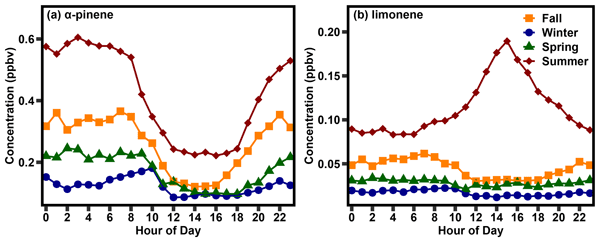
Using a custom-made gas chromatography flame ionization detector, 2 years of speciated hourly biogenic volatile organic compound data were collected in a forest in central Virginia. We identify diurnal and seasonal variability in the data, which is shown to impact atmospheric oxidant budgets. A comparison with emission models identified discrepancies with implications for model outcomes. We suggest increased monitoring of speciated biogenic volatile organic compounds to improve modeled results.
Sungwoo Kim, Brian M. Lerner, Donna T. Sueper, and Gabriel Isaacman-VanWertz
Atmos. Meas. Tech., 15, 5061–5075, https://doi.org/10.5194/amt-15-5061-2022, https://doi.org/10.5194/amt-15-5061-2022, 2022
Short summary
Short summary
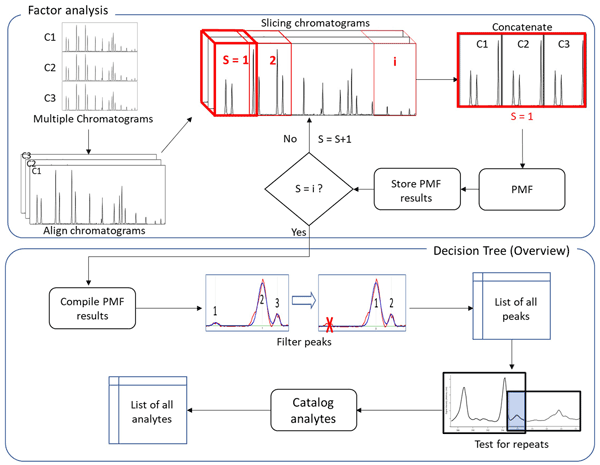
Atmospheric samples can be complex, and current analysis methods often require substantial human interaction and discard potentially important information. To improve analysis accuracy and computational cost of these large datasets, we developed an automated analysis algorithm that utilizes a factor analysis approach coupled with a decision tree. We demonstrate that this algorithm cataloged approximately 10 times more analytes compared to a manual analysis and in a quarter of the analysis time.
Chenyang Bi, Jordan E. Krechmer, Graham O. Frazier, Wen Xu, Andrew T. Lambe, Megan S. Claflin, Brian M. Lerner, John T. Jayne, Douglas R. Worsnop, Manjula R. Canagaratna, and Gabriel Isaacman-VanWertz
Atmos. Meas. Tech., 14, 6835–6850, https://doi.org/10.5194/amt-14-6835-2021, https://doi.org/10.5194/amt-14-6835-2021, 2021
Short summary
Short summary
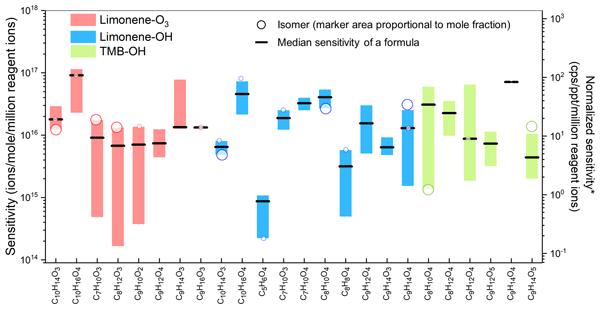
Iodide-adduct chemical ionization mass spectrometry (I-CIMS) has been widely used to analyze airborne organics. In this study, I-CIMS sensitivities of isomers within a formula are found to generally vary by 1 and up to 2 orders of magnitude. Comparisons between measured and predicted moles, obtained using a voltage-scanning calibration approach, show that predictions for individual compounds or formulas might carry high uncertainty, yet the summed moles of analytes agree reasonably well.
Deborah F. McGlynn, Laura E. R. Barry, Manuel T. Lerdau, Sally E. Pusede, and Gabriel Isaacman-VanWertz
Atmos. Chem. Phys., 21, 15755–15770, https://doi.org/10.5194/acp-21-15755-2021, https://doi.org/10.5194/acp-21-15755-2021, 2021
Short summary
Short summary
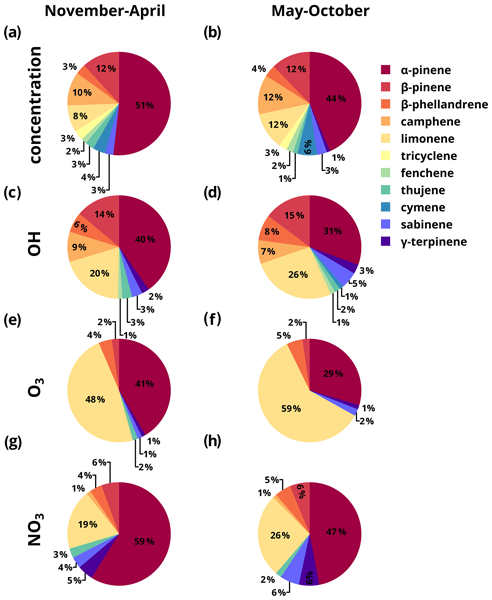
We present 1 year of hourly measurements of chemically resolved Biogenic volatile organic compound (BVOCs) between 15 September 2019 and 15 September 2020, collected at a research tower in central Virginia. Concentrations of a range of BVOCs are described and examined for their impact on atmospheric reactivity. The majority of reactivity comes from α-pinene and limonene, highlighting the importance of both concentration and structure in assessing atmospheric impacts of emissions.
Chenyang Bi, Jordan E. Krechmer, Manjula R. Canagaratna, and Gabriel Isaacman-VanWertz
Atmos. Meas. Tech., 14, 6551–6560, https://doi.org/10.5194/amt-14-6551-2021, https://doi.org/10.5194/amt-14-6551-2021, 2021
Short summary
Short summary
Calibration techniques have been recently developed to log-linearly correlate analyte sensitivity with CIMS operating conditions particularly for compounds without authentic standards. In this work, we examine the previously ignored bias in the log-linear-based calibration method and estimate an average bias of 30 %, with 1 order of magnitude for less sensitive compounds in some circumstances. A step-by-step guide was provided to reduce and even remove the bias.
Chenyang Bi, Jordan E. Krechmer, Graham O. Frazier, Wen Xu, Andrew T. Lambe, Megan S. Claflin, Brian M. Lerner, John T. Jayne, Douglas R. Worsnop, Manjula R. Canagaratna, and Gabriel Isaacman-VanWertz
Atmos. Meas. Tech., 14, 3895–3907, https://doi.org/10.5194/amt-14-3895-2021, https://doi.org/10.5194/amt-14-3895-2021, 2021
Short summary
Short summary
Measurement techniques that can achieve molecular characterizations are necessary to understand the differences of fate and transport within isomers produced in the atmospheric oxidation process. In this work, we develop an instrument to conduct isomer-resolved measurements of particle-phase organics. We assess the number of isomers per chemical formula in atmospherically relevant samples and examine the feasibility of extending the use of an existing instrument to a broader range of analytes.
Gabriel Isaacman-VanWertz and Bernard Aumont
Atmos. Chem. Phys., 21, 6541–6563, https://doi.org/10.5194/acp-21-6541-2021, https://doi.org/10.5194/acp-21-6541-2021, 2021
Short summary
Short summary
There are tens of thousands of different chemical compounds in the atmosphere. To tackle this complexity, there are a wide range of different methods to estimate their physical and chemical properties. We use these methods to understand how much the detailed structure of a molecule impacts its properties, and the extent to which properties can be estimated without knowing this level of detail. We find that structure matters, but methods lacking that level of detail still perform reasonably well.
Cited articles
Aumont, B., Szopa, S., and Madronich, S.: Modelling the evolution of organic carbon during its gas-phase tropospheric oxidation: development of an explicit model based on a self generating approach, Atmos. Chem. Phys., 5, 2497–2517, https://doi.org/10.5194/acp-5-2497-2005, 2005.
Betz, W. R. and Supina, W. R.: Use of thermally modified carbon black and
carbon molecular sieve adsorbents in sampling air contaminants, Pure Appl.
Chem., 61, 2047–2050, https://doi.org/10.1351/pac198961112047, 1989.
Bianchi, A. P. and Varney, M. S.: Sampling and analysis of volatile organic
compounds in estuarine air by gas chromatography and mass spectrometry, J.
Chromatogr. A, 643, 11–23, https://doi.org/10.1016/0021-9673(93)80536-H, 1993.
Borusiewicz, R. and Zięba-Palus, J.: Comparison of the effectiveness of
Tenax TA® and Carbotrap 300® in concentration of
flammable liquids compounds, J. Forensic Sci., 52, 70–74,
https://doi.org/10.1111/j.1556-4029.2006.00314.x, 2007.
Burnett, R. T., Pope III, C. A., Ezzati, M., Olives, C., Lim, S. S., and Mehta, S.: An Integrated Risk Function for Estimating the Global Burden of Disease Attributable to Ambient Fine Particulate Matter Exposure, Environ. Health Persp., 122, 397–404, https://doi.org/10.1289/ehp.1307049, 2014.
Cao, X. L. and Nicholas Hewitt, C.: Build-up of artifacts on adsorbents
during storage and its effect on passive sampling and gas
chromatography-flame ionization detection of low concentrations of volatile
organic compounds in air, J. Chromatogr. A, 688, 368–374,
https://doi.org/10.1016/0021-9673(94)00908-2, 1994.
Ciccioli, P., Cecinato, A., Brancaleoni, E., Frattoni, M., and Liberti, A.:
Use of carbon adsorption traps combined with high resolution gas
chromatography – mass spectrometry for the analysis of polar and non-polar
C4-C14 hydrocarbons involved in photochemical smog formation, J. High
Res. Chromatog., 15, 75–84, https://doi.org/10.1002/jhrc.1240150205, 1992.
Dockery, D. W., Pope III, C. A., Xu, X., Spengler, J. D., Ware, J. H., Fay,
M. E., Ferris Jr., B. G., and Speizer, F. E.: An Association between Air
Pollution and Mortality in Six U.S. Cities, N. Engl. J. Med., 329, 1753–1759, https://doi.org/10.1056/NEJM199312093292401, 1993.
Ernle, L., Ringsdorf, M. A., and Williams, J.: Influence of ozone and humidity on PTR-MS and GC-MS VOC measurements with and without a Na2S2O3 ozone scrubber, Atmos. Meas. Tech., 16, 1179–1194, https://doi.org/10.5194/amt-16-1179-2023, 2023.
Felzer, B. S., Cronin, T., Reilly, J. M., Melillo, J. M., and Wang, X.:
Impacts of ozone on trees and crops, C.R. Geosci., 339, 784–798, https://doi.org/10.1016/j.crte.2007.08.008, 2007.
Fitzky, A. C., Peron, A., Kaser, L., Karl, T., Graus, M., Tholen, D.,
Pesendorfer, M., Mahmoud, M., Sandén, H., and Rewald, B.: Diversity and
Interrelations Among the Constitutive VOC Emission Blends of Four
Broad-Leaved Tree Species at Seedling Stage, Front. Plant Sci., 12, 1–12, https://doi.org/10.3389/fpls.2021.708711, 2021.
Goldstein, A. H. and Galbally, I. E.: Known and unexplored organic constituents in the earth's atmosphere, Environ. Sci. Technol., 41,
1514–1521, https://doi.org/10.1021/es072476p, 2007.
Guenther, A., Nicholas, C., Fall, R., Klinger, L., Mckay, W. A., and Scholes,
B.: A global model of natural volatile organic compound emissions, J.
Geophys. Res., 100, 8873–8892, https://doi.org/10.1029/94JD02950, 1995.
Haagen-Smit, A. J.: The chemistry and physiology of Los Angeles smog, Ind. Eng. Chem., 44, 1342–1346, https://doi.org/10.1021/ie50510a045, 1952.
Hamilton, J. F.: Using comprehensive two-dimensional gas chromatography to
study the atmosphere, J. Chromatogr. Sci., 48, 274–282,
https://doi.org/10.1093/chromsci/48.4.274, 2010.
Harper, M.: Evaluation of solid sorbent sampling methods by breakthrough
volume studies, Ann. Occup. Hyg., 37, 65–88, https://doi.org/10.1093/annhyg/37.1.65,
1993.
Heald, C. L. and Kroll, J. H.: The fuel of atmospheric chemistry: Toward a
complete description of reactive organic carbon, Sci. Adv., 6, 1–9,
https://doi.org/10.1126/sciadv.aay8967, 2020.
Ilieş, B. D., Khandavilli, M., Li, Y., Kukkadapu, G., Wagnon, S. W.,
Jameel, A. G. A., and Sarathy, S. M.: Probing the chemical kinetics of
minimalist functional group gasoline surrogates, Energ. Fuel., 35, 3315–3332, https://doi.org/10.1021/acs.energyfuels.0c02815, 2021.
Isaacman, G., Wilson, K. R., Chan, A. W. H., Worton, D. R., Kimmel, J. R.,
Nah, T., Hohaus, T., Gonin, M., Kroll, J. H., Worsnop, D. R., and Goldstein,
A. H.: Improved resolution of hydrocarbon structures and constitutional
isomers in complex mixtures using gas chromatography-vacuum ultraviolet-mass
spectrometry, Anal. Chem., 84, 2335–2342, https://doi.org/10.1021/ac2030464, 2012.
Isaacman-VanWertz, G., Sueper, D. T., Aikin, K. C., Lerner, B. M., Gilman,
J. B., de Gouw, J. A., Worsnop, D. R., and Goldstein, A. H.: Automated
single-ion peak fitting as an efficient approach for analyzing complex
chromatographic data, J. Chromatogr. A, 1529, 81–92,
https://doi.org/10.1016/j.chroma.2017.11.005, 2017.
Isaacman-VanWertz, G., Lerner, B. M., and Sueper, D. T.: TAG Explorer and iNtegration (TERN), Zenodo [code], https://doi.org/10.5281/zenodo.6914068, 2023.
Klenø, J. G., Wolkoff, P., Clausen, P. A., Wilkins, C. K., and Pedersen,
T.: Degradation of the adsorbent tenax TA by nitrogen oxides, ozone,
hydrogen peroxide, OH radical, and limonene oxidation products, Environ.
Sci. Technol., 36, 4121–4126, https://doi.org/10.1021/es025680f, 2002.
Lee, J. H., Batterman, S. A., Jia, C., and Chernyak, S.: Ozone artifacts
and carbonyl measurements using tenax GR, tenax TA, carbopack B, and
carbopack X adsorbents, J. Air Waste Manage., 56, 1503–1517,
https://doi.org/10.1080/10473289.2006.10464560, 2006.
Lippmann, M.: Health Effects Of Ozone A Critical Review, JAPCA J. Air Waste Ma., 39, 672–695, https://doi.org/10.1080/08940630.1989.10466554, 1989.
MacLeod, G. and Ames, J. M.: Comparative assessment of the artefact
background on thermal desorption of tenax GC and tenax TA, J. Chromatogr. A,
355, 393–398, https://doi.org/10.1016/S0021-9673(01)97343-1, 1986.
Manion, J. A., Huie, R. E., Levin, R. D., Burgess Jr., D. R., Orkin, V. L.,
Tsang, W., McGivern, W. S., Hudgens, J. W., Knyazev, V. D., Atkinson, D. B.,
Chai, E., Tereza, A. M., Lin, C.-Y., Allison, T. C., Mallard, W. G.,
Westley, F., Herron, J. T., Hampson, R. F., and Frizzell, D. H.: NIST
Chemical Kinetics Database, Standard Reference Database 17, Version 7.1 (Web Version), Release 1.6.8 Data Version 2023, National Institute of Standards and Technology (NIST), Gaithersburg, MD, https://kinetics.nist.gov/ (last access: 23 September 2023), 2015.
Nazaroff, W. W. and Weschler, C. J.: Indoor ozone: Concentrations and
influencing factors, Indoor Air, 32, 1–21, https://doi.org/10.1111/ina.12942, 2022.
Ngo, D., Liu, H., Chen, Z., Kaya, H., Zimudzi, T. J., Gin, S., Mahadevan,
T., Du, J., and Kim, S. H.: Hydrogen bonding interactions of H2O and SiOH on a boroaluminosilicate glass corroded in aqueous solution, npj Mater.
Degrad., 4, 1–14, https://doi.org/10.1038/s41529-019-0105-2, 2020.
Nozière, B., Kalberer, M., Claeys, M., Allan, J., D'Anna, B., Decesari,
S., Finessi, E., Glasius, M., Grgić, I., Hamilton, J. F., Hoffmann, T.,
Iinuma, Y., Jaoui, M., Kahnt, A., Kampf, C. J., Kourtchev, I., Maenhaut, W.,
Marsden, N., Saarikoski, S., Schnelle-Kreis, J., Surratt, J. D., Szidat, S.,
Szmigielski, R., and Wisthaler, A.: The Molecular Identification of Organic
Compounds in the Atmosphere: State of the Art and Challenges, Chem. Rev.,
115, 3919–3983, https://doi.org/10.1021/cr5003485, 2015.
Pollmann, J., Ortega, J., and Helmig, D.: Analysis of atmospheric
sesquiterpenes: Sampling losses and mitigation of ozone interferences, Environ. Sci. Technol., 39, 9620–9629, https://doi.org/10.1021/es050440w, 2005.
Rothweiler, H., Wäger, P. A., and Schlatter, C.: Comparison of Tenax Ta
and Carbotrap for sampling and analysis of volatile organic compounds in
air, Atmos. Environ. B-Urb., 25, 231–235, https://doi.org/10.1016/0957-1272(91)90058-M, 1991.
Sheu, R., Marcotte, A., Khare, P., Charan, S., Ditto, J. C., and Gentner, D.
R.: Advances in offline approaches for chemically speciated measurements of
trace gas-phase organic compounds via adsorbent tubes in an integrated
sampling-to-analysis system, J. Chromatogr. A, 1575, 80–90,
https://doi.org/10.1016/j.chroma.2018.09.014, 2018.
Spinelle, L., Gerboles, M., Kok, G., Persijn, S., and Sauerwald, T.: Review
of portable and low-cost sensors for the ambient air monitoring of benzene
and other volatile organic compounds, Sensors-Basel, 17, 1520, https://doi.org/10.3390/s17071520, 2017.
Steinemann, A.: Volatile emissions from common consumer products, Air Qual.
Atmos. Hlth., 8, 273–281, https://doi.org/10.1007/s11869-015-0327-6, 2015.
Trowbridge, A. M., Stoy, P. C., Monson, R. K., and Niinemets, Ü.:
Biology, Controls and Models of Tree Volatile Organic Compound Emissions, in: Tree Physiology, edited by: Niinemets, Ü and Monson, R. K., Springer Dordrecht, 5, 21–46, https://doi.org/10.1007/978-94-007-6606-8, 2013.
Tsai, W.-T.: An overview of health hazards of volatile organic compounds
regulated as indoor air pollutants, Rev. Environ. Health, 34, 81–89,
https://doi.org/10.1515/reveh-2018-0046, 2019.
US Environmental Protection Agency (EPA): Compendium Method TO-17:
Determination of Volatile Organic Compounds in Ambient Air Using Active
Sampling Onto Sorbent Tubes, Compendium of Methods for the Determination of Toxic Organic Compounds in Ambient Air, EPA/625/R-96/010b, 1–53, 1999.
US Environmental Protection Agency (EPA): Hazardous Air Pollutants, https://www.epa.gov/haps (last access: 24 March 2023), 2023a.
US Environmental Protection Agency (EPA): Integrated Risk Information System,
https://www.epa.gov/iris (last access: 24 March 2023), 2023b.
Wallace, W. E.: Mass Spectra, in: NIST Chemistry WebBook, NIST Standard
Reference Database, Number 69, edited by: Linstrom, P. J. and Mallard, W. G.,
National Institute of Standards and Technology, Gaithersburg, MD 20899, https://doi.org/10.18434/T4D303, 2019.
Wang, Q. and Chen, C. P.: Simulated Kinetics and Chemical and Physical
Properties of a Four-Component Diesel Surrogate Fuel, Energ. Fuel., 31, 13190–13197, https://doi.org/10.1021/acs.energyfuels.7b01940, 2017.
Wark, K., Warner, C. F., and Davis, W. T.: Air Pollution, 3rd edn.,
Addison-Wesley-Longman, ISBN-10: 0673994163; ISBN-13: 978-0673994165, 1998.
Woolfenden, E.: Monitoring vocs in air using sorbent tubes followed by
thermal desorption-capillary gc analysis: Summary of data and practical
guidelines, J. Air Waste Manage., 47, 20–36,
https://doi.org/10.1080/10473289.1997.10464411, 1997.
World Meteorological Organization (WMO): Guidelines for Measurements of
Non-Methane Hydrocarbons in the Troposphere, GAW Report No. 281, https://library.wmo.int/idurl/4/66281 (last access: 2 October 2023), 2023.
Yokouchi, Y., Mukai, H., Nakajima, K., and Ambe, Y.: Semi-volatile aldehydes
as predominant organic gases in remote areas, Atmos. Environ. A-Gen., 24, 439–442, https://doi.org/10.1016/0960-1686(90)90126-8, 1990.
Yuan, B., Koss, A. R., Warneke, C., Coggon, M., Sekimoto, K., and de Gouw, J.
A.: Proton-Transfer-Reaction Mass Spectrometry: Applications in Atmospheric
Sciences, Chem. Rev., 117, 13187–13229, https://doi.org/10.1021/acs.chemrev.7b00325, 2017.
Zeng, G. L.: Medical image reconstruction: A conceptual tutorial,
Springer Berlin, Heidelberg, https://doi.org/10.1007/978-3-642-05368-9, 2010.
Short summary
Volatile organic compounds (VOCs) have a wide range of sources and impacts on environments and human health that make them spatially, temporally, and chemically varied. Current methods lack the ability to collect samples in ways that provide spatial and chemical resolution without complex, costly instrumentation. We describe and validate a low-cost, portable VOC sampler and demonstrate its utility in collecting distributed coordinated samples.
Volatile organic compounds (VOCs) have a wide range of sources and impacts on environments and...