
Articles | Volume 12, issue 2
https://doi.org/10.5194/amt-12-903-2019
© Author(s) 2019. This work is distributed under
the Creative Commons Attribution 4.0 License.
the Creative Commons Attribution 4.0 License.
https://doi.org/10.5194/amt-12-903-2019
© Author(s) 2019. This work is distributed under
the Creative Commons Attribution 4.0 License.
the Creative Commons Attribution 4.0 License.
Research article
| 
11 Feb 2019
Research article |
| 11 Feb 2019
| 11 Feb 2019
Development of a general calibration model and long-term performance evaluation of low-cost sensors for air pollutant gas monitoring
Center for Atmospheric Particle Studies, Carnegie Mellon University,
Pittsburgh, Pennsylvania, 15213, USA
Rebecca Tanzer
Center for Atmospheric Particle Studies, Carnegie Mellon University,
Pittsburgh, Pennsylvania, 15213, USA
Department of Mechanical Engineering, Carnegie Mellon University,
Pittsburgh, Pennsylvania, 15213, USA
Aliaksei Hauryliuk
Center for Atmospheric Particle Studies, Carnegie Mellon University,
Pittsburgh, Pennsylvania, 15213, USA
Sriniwasa P. N. Kumar
Center for Atmospheric Particle Studies, Carnegie Mellon University,
Pittsburgh, Pennsylvania, 15213, USA
Naomi Zimmerman
Department of Mechanical Engineering, University of British Columbia,
Vancouver, British Columbia, V6T 1Z4, Canada
Levent B. Kara
Department of Mechanical Engineering, Carnegie Mellon University,
Pittsburgh, Pennsylvania, 15213, USA
Albert A. Presto
Center for Atmospheric Particle Studies, Carnegie Mellon University,
Pittsburgh, Pennsylvania, 15213, USA
Department of Mechanical Engineering, Carnegie Mellon University,
Pittsburgh, Pennsylvania, 15213, USA
R. Subramanian
Center for Atmospheric Particle Studies, Carnegie Mellon University,
Pittsburgh, Pennsylvania, 15213, USA
Related authors

Ashley S. Bittner, Eben S. Cross, David H. Hagan, Carl Malings, Eric Lipsky, and Andrew P. Grieshop
Atmos. Meas. Tech., 15, 3353–3376, https://doi.org/10.5194/amt-15-3353-2022, https://doi.org/10.5194/amt-15-3353-2022, 2022
Short summary
Short summary
We present findings from a 1-year pilot deployment of low-cost integrated air quality sensor packages in rural Malawi using calibration models developed during collocation with US regulatory monitors. We compare the results with data from remote sensing products and previous field studies. We conclude that while the remote calibration approach can help extract useful data, great care is needed when assessing low-cost sensor data collected in regions without reference instrumentation.
Theobard Habineza, Allen L. Robinson, H. Langley DeWitt, Jimmy Gasore, Philip L. Croteau, and Albert A. Presto
Atmos. Chem. Phys., 25, 15953–15968, https://doi.org/10.5194/acp-25-15953-2025, https://doi.org/10.5194/acp-25-15953-2025, 2025
Short summary
Short summary
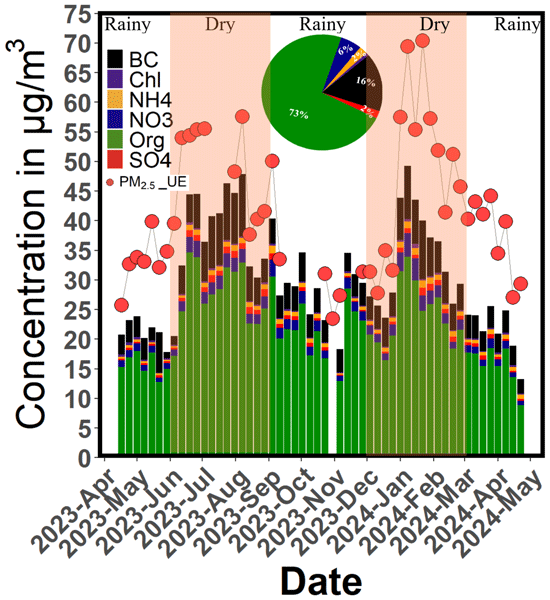
This study reports year-long PM1 (particulate matter) chemical composition in Eastern Africa using aerosol mass spectrometry. Results show PM is dominated by organic aerosol (73 %), black carbon (16 %), and inorganics (11 %), with BC largely from fossil fuel (59 %) and biomass burning (41 %). Findings highlight the impact of solid fuels and aging vehicles and stress the need for regional mitigation strategies to reduce air pollution-related health risks.
Daniel Furuta, Bruce Wilson, Albert A. Presto, and Jiayu Li
Atmos. Meas. Tech., 17, 2103–2121, https://doi.org/10.5194/amt-17-2103-2024, https://doi.org/10.5194/amt-17-2103-2024, 2024
Short summary
Short summary
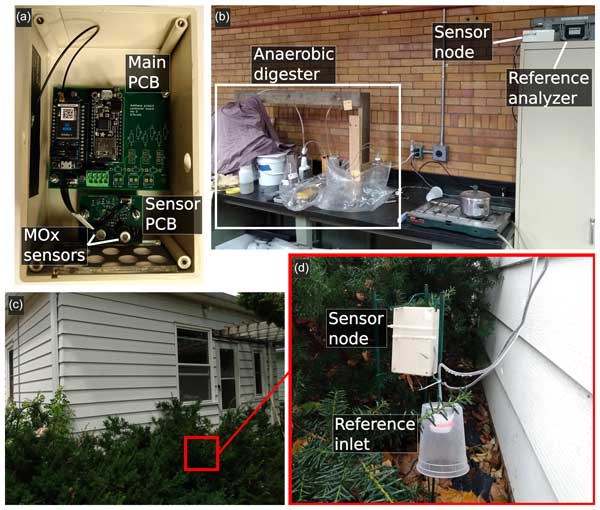
Methane is an important driver of climate change and is challenging to inexpensively sense in low atmospheric concentrations. We developed a low-cost sensor to monitor methane and tested it in indoor and outdoor settings. Our device shows promise for monitoring low levels of methane. We characterize its limitations and suggest future research directions for further development.
Sunhye Kim, Jo Machesky, Drew R. Gentner, and Albert A. Presto
Atmos. Chem. Phys., 24, 1281–1298, https://doi.org/10.5194/acp-24-1281-2024, https://doi.org/10.5194/acp-24-1281-2024, 2024
Short summary
Short summary
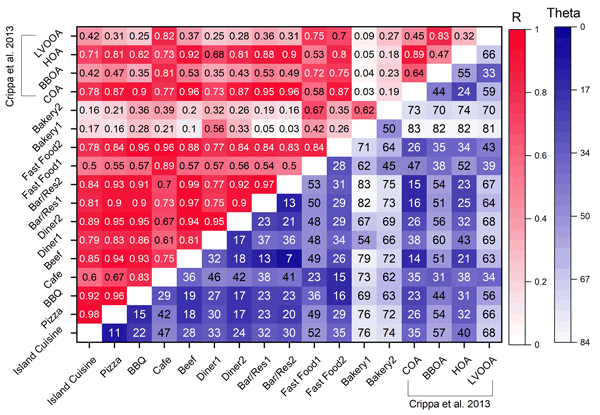
Cooking emissions are often an overlooked source of air pollution. We used a mobile lab to measure the characteristics of particles emitted from cooking sites in two cities. Our findings showed that cooking releases a substantial number of fine particles. While most emissions were similar, a bakery site showed distinctive chemical compositions with higher nitrogen compound levels. Thus, understanding the particle emissions from different cooking activities is crucial.
Mrinmoy Chakraborty, Amanda Giang, and Naomi Zimmerman
Atmos. Meas. Tech., 16, 2333–2352, https://doi.org/10.5194/amt-16-2333-2023, https://doi.org/10.5194/amt-16-2333-2023, 2023
Short summary
Short summary
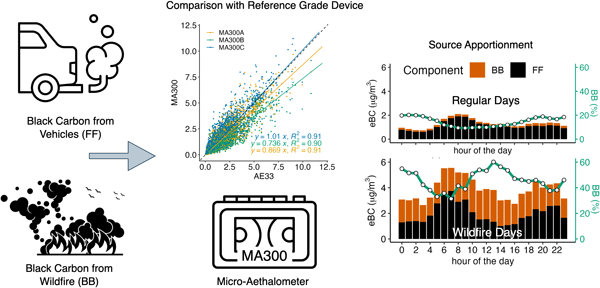
Black carbon (BC) has important climate and human health impacts. Aethalometers are used to measure BC, but they are hard to deploy in many environments (remote, mobile). We evaluate how well a portable micro-aethalometer (MA300) performs compared to a reference aethalometer at a road-side site in Vancouver, BC, Canada, during regular and wildfire conditions. We find that the MA300 can reproduce overall patterns in concentrations and source characterization but with some underestimation.
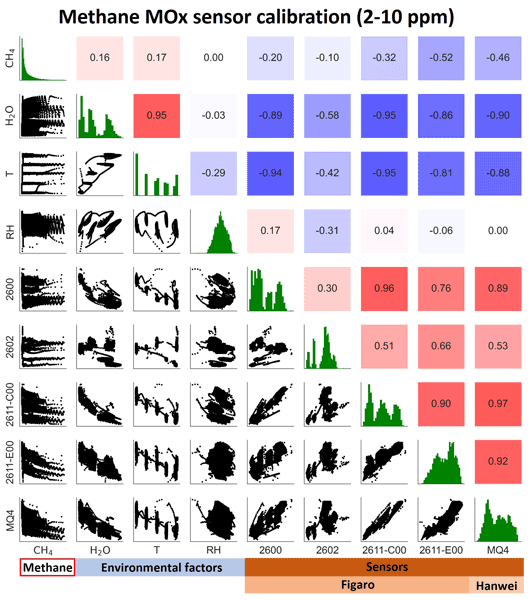
Daniel Furuta, Tofigh Sayahi, Jinsheng Li, Bruce Wilson, Albert A. Presto, and Jiayu Li
Atmos. Meas. Tech., 15, 5117–5128, https://doi.org/10.5194/amt-15-5117-2022, https://doi.org/10.5194/amt-15-5117-2022, 2022
Short summary
Short summary
Methane is a major greenhouse gas and contributor to climate change with various human-caused and natural sources. Currently, atmospheric methane is expensive to sense. We investigate repurposing cheap methane safety sensors for atmospheric sensing, finding several promising sensors and identifying some of the challenges in this approach. This work will help in developing inexpensive sensor networks for methane monitoring, which will aid in reducing methane leaks and emissions.
Ashley S. Bittner, Eben S. Cross, David H. Hagan, Carl Malings, Eric Lipsky, and Andrew P. Grieshop
Atmos. Meas. Tech., 15, 3353–3376, https://doi.org/10.5194/amt-15-3353-2022, https://doi.org/10.5194/amt-15-3353-2022, 2022
Short summary
Short summary
We present findings from a 1-year pilot deployment of low-cost integrated air quality sensor packages in rural Malawi using calibration models developed during collocation with US regulatory monitors. We compare the results with data from remote sensing products and previous field studies. We conclude that while the remote calibration approach can help extract useful data, great care is needed when assessing low-cost sensor data collected in regions without reference instrumentation.
Cited articles
Afshar-Mohajer, N., Zuidema, C., Sousan, S., Hallett, L., Tatum, M., Rule, A.
M., Thomas, G., Peters, T. M., and Koehler, K.: Evaluation of low-cost
electro-chemical sensors for environmental monitoring of ozone, nitrogen
dioxide, and carbon monoxide, J. Occup. Environ. Hyg., 15, 87–98,
https://doi.org/10.1080/15459624.2017.1388918, 2018.
Aleksander, I. and Morton, H.: An introduction to neural computing, 2nd Edn.,
International Thomson Computer Press, London, 1995.
Camalier, L., Eberly, S., Miller, J., and Papp, M.: Guideline on the Meaning
and the Use of Precision and Bias Data Required by 40 CFR Part 58 Appendix A,
U.S. Environmental Protection Agency, available at:
https://www3.epa.gov/ttn/amtic/files/ambient/monitorstrat/precursor/07workshopmeaning.pdf
(last access: 5 February 2019), 2007.
Castell, N., Dauge, F. R., Schneider, P., Vogt, M., Lerner, U., Fishbain, B.,
Broday, D., and Bartonova, A.: Can commercial low-cost sensor platforms
contribute to air quality monitoring and exposure estimates?, Environ. Int.,
99, 293–302, https://doi.org/10.1016/j.envint.2016.12.007, 2017.
Cross, E. S., Williams, L. R., Lewis, D. K., Magoon, G. R., Onasch, T. B.,
Kaminsky, M. L., Worsnop, D. R., and Jayne, J. T.: Use of electrochemical
sensors for measurement of air pollution: correcting interference response
and validating measurements, Atmos. Meas. Tech., 10, 3575–3588,
https://doi.org/10.5194/amt-10-3575-2017, 2017.
English, P. B., Olmedo, L., Bejarano, E., Lugo, H., Murillo, E., Seto, E.,
Wong, M., King, G., Wilkie, A., Meltzer, D., Carvlin, G., Jerrett, M., and
Northcross, A.: The Imperial County Community Air Monitoring Network: A Model
for Community-based Environmental Monitoring for Public Health Action,
Environ. Health Persp., 125, 074501, https://doi.org/10.1289/EHP1772, 2017.
Hacker, K.: Air Monitoring Network Plan for 2018, Allegheny County Health
Department Air Quality Program, Pittsburgh, PA, available at:
http://www.achd.net/air/publiccomment2017/ANP2018_final.pdf (last
access: 17 August 2017), 2017.
Hagan, D. H., Isaacman-VanWertz, G., Franklin, J. P., Wallace, L. M. M.,
Kocar, B. D., Heald, C. L., and Kroll, J. H.: Calibration and assessment of
electrochemical air quality sensors by co-location with regulatory-grade
instruments, Atmos. Meas. Tech., 11, 315–328,
https://doi.org/10.5194/amt-11-315-2018, 2018.
Hornik, K.: Approximation capabilities of multilayer feedforward networks,
Neural Networks, 4, 251–257, https://doi.org/10.1016/0893-6080(91)90009-T, 1991.
Jerrett, M., Burnett, R. T., Ma, R., Pope, C. A., Krewski, D., Newbold, K.
B., Thurston, G., Shi, Y., Finkelstein, N., Calle, E. E., and Thun, M. J.:
Spatial Analysis of Air Pollution and Mortality in Los Angeles, Epidemiology,
16, 727–736, https://doi.org/10.1097/01.ede.0000181630.15826.7d, 2005.
Karner, A. A., Eisinger, D. S., and Niemeier, D. A.: Near-Roadway Air
Quality: Synthesizing the Findings from Real-World Data, Environ. Sci.
Technol., 44, 5334–5344, https://doi.org/10.1021/es100008x, 2010.
Loh, M., Sarigiannis, D., Gotti, A., Karakitsios, S., Pronk, A., Kuijpers,
E., Annesi-Maesano, I., Baiz, N., Madureira, J., Oliveira Fernandes, E.,
Jerrett, M., and Cherrie, J.: How Sensors Might Help Define the External
Exposome, Int. J. Env. Res. Pub. He., 14, 434, https://doi.org/10.3390/ijerph14040434,
2017.
Malings, C.: Supplementary Data for “Development of a General Calibration
Model and Long-Term Performance Evaluation of Low-Cost Sensors for Air
Pollutant Gas Monitoring”, Zenodo, https://doi.org/10.5281/zenodo.1302030, 2018a.
Malings, C.: Supplementary Data for “Development of a General Calibration
Model and Long-Term Performance Evaluation of Low-Cost Sensors for Air
Pollutant Gas Monitoring” (abridged version), Zenodo,
https://doi.org/10.5281/zenodo.1482011, 2018b.
Marshall, J. D., Nethery, E., and Brauer, M.: Within-urban variability in
ambient air pollution: Comparison of estimation methods, Atmos. Environ., 42,
1359–1369, https://doi.org/10.1016/j.atmosenv.2007.08.012, 2008.
Masson, N., Piedrahita, R., and Hannigan, M.: Quantification Method for
Electrolytic Sensors in Long-Term Monitoring of Ambient Air Quality, Sensors,
15, 27283–27302, https://doi.org/10.3390/s151027283, 2015.
Mead, M. I., Popoola, O. A. M., Stewart, G. B., Landshoff, P., Calleja, M.,
Hayes, M., Baldovi, J. J., McLeod, M. W., Hodgson, T. F., Dicks, J., Lewis,
A., Cohen, J., Baron, R., Saffell, J. R., and Jones, R. L.: The use of
electrochemical sensors for monitoring urban air quality in low-cost,
high-density networks, Atmos. Environ., 70, 186–203,
https://doi.org/10.1016/j.atmosenv.2012.11.060, 2013.
Nabney, I.: NETLAB: algorithms for pattern recognitions, Springer, London,
New York, 2002.
Popoola, O. A. M., Stewart, G. B., Mead, M. I., and Jones, R. L.: Development
of a baseline-temperature correction methodology for electrochemical sensors
and its implications for long-term stability, Atmos. Environ., 147, 330–343,
https://doi.org/10.1016/j.atmosenv.2016.10.024, 2016.
Rasmussen, C. E. and Williams, C. K. I.: Gaussian processes for machine
learning, MIT Press, Cambridge, Mass., 2006.
Sadighi, K., Coffey, E., Polidori, A., Feenstra, B., Lv, Q., Henze, D. K.,
and Hannigan, M.: Intra-urban spatial variability of surface ozone in
Riverside, CA: viability and validation of low-cost sensors, Atmos. Meas.
Tech., 11, 1777–1792, https://doi.org/10.5194/amt-11-1777-2018, 2018.
Smith, K. R., Edwards, P. M., Evans, M. J., Lee, J. D., Shaw, M. D., Squires,
F., Wilde, S., and Lewis, A. C.: Clustering approaches to improve the
performance of low cost air pollution sensors, Faraday Discuss., 200,
621–637, https://doi.org/10.1039/C7FD00020K, 2017.
Snyder, E. G., Watkins, T. H., Solomon, P. A., Thoma, E. D., Williams, R. W.,
Hagler, G. S. W., Shelow, D., Hindin, D. A., Kilaru, V. J., and Preuss, P.
W.: The Changing Paradigm of Air Pollution Monitoring, Environ. Sci.
Technol., 47, 11369–11377, https://doi.org/10.1021/es4022602, 2013.
Spinelle, L., Aleixandre, M., Gerboles, M., European Commission, Joint
Research Centre and Institute for Environment and Sustainability: Protocol of
evaluation and calibration of low-cost gas sensors for the monitoring of air
pollution., Publications Office, Luxembourg, available at:
http://dx.publications.europa.eu/10.2788/9916 (last access:
13 February 2018), 2013.
Spinelle, L., Gerboles, M., Villani, M. G., Aleixandre, M., and Bonavitacola,
F.: Field calibration of a cluster of low-cost available sensors for air
quality monitoring. Part A: Ozone and nitrogen dioxide, Sensor. Actuat.
B-Chem., 215, 249–257, https://doi.org/10.1016/j.snb.2015.03.031, 2015.
Tan, Y., Lipsky, E. M., Saleh, R., Robinson, A. L., and Presto, A. A.:
Characterizing the Spatial Variation of Air Pollutants and the Contributions
of High Emitting Vehicles in Pittsburgh, PA, Environ. Sci. Technol., 48,
14186–14194, https://doi.org/10.1021/es5034074, 2014.
Turner, M. C., Nieuwenhuijsen, M., Anderson, K., Balshaw, D., Cui, Y.,
Dunton, G., Hoppin, J. A., Koutrakis, P., and Jerrett, M.: Assessing the
Exposome with External Measures: Commentary on the State of the Science and
Research Recommendations, Annu. Rev. Publ. Health, 38, 215–239,
https://doi.org/10.1146/annurev-publhealth-082516-012802, 2017.
Williams, R., Vasu Kilaru, Snyder, E., Kaufman, A., Dye, T., Rutter, A.,
Russel, A., and Hafner, H.: Air Sensor Guidebook, U.S. Environmental
Protection Agency, Washington, DC, available at:
https://cfpub.epa.gov/si/si_public_file_download.cfm?p_download_id=519616
(last access: 10 October 2018), 2014.
Zimmerman, N., Presto, A. A., Kumar, S. P. N., Gu, J., Hauryliuk, A.,
Robinson, E. S., Robinson, A. L., and R. Subramanian: A machine learning
calibration model using random forests to improve sensor performance for
lower-cost air quality monitoring, Atmos. Meas. Tech., 11, 291–313,
https://doi.org/10.5194/amt-11-291-2018, 2018.
Short summary
This paper compares several methods for calibrating data from low-cost air quality monitors to reflect the concentrations of various gaseous pollutants in the atmosphere, identifying the best-performing approaches. With these calibration methods, such monitors can be used to gather information on air quality at a higher spatial resolution than is possible using traditional technologies and can be deployed to areas (e.g. developing countries) where there are no existing monitor networks.
This paper compares several methods for calibrating data from low-cost air quality monitors to...


