
Articles | Volume 11, issue 12
https://doi.org/10.5194/amt-11-6651-2018
© Author(s) 2018. This work is distributed under
the Creative Commons Attribution 4.0 License.
the Creative Commons Attribution 4.0 License.
https://doi.org/10.5194/amt-11-6651-2018
© Author(s) 2018. This work is distributed under
the Creative Commons Attribution 4.0 License.
the Creative Commons Attribution 4.0 License.
Research article
| 
17 Dec 2018
Research article |
| 17 Dec 2018
| 17 Dec 2018
Improving algorithms and uncertainty estimates for satellite NO2 retrievals: results from the quality assurance for the essential climate variables (QA4ECV) project
Royal Netherlands Meteorological Institute, Satellite Observations, De Bilt, the Netherlands
Wageningen University, Meteorology and Air Quality Group, Wageningen, the Netherlands
Henk J. Eskes
Royal Netherlands Meteorological Institute, Satellite Observations, De Bilt, the Netherlands
Andreas Richter
Institute of Environmental Physics (IUP-UB), University of Bremen, Bremen, Germany
Isabelle De Smedt
Belgian Institute for Space Aeronomy (BIRA-IASB), Brussels, Belgium
Alba Lorente
Wageningen University, Meteorology and Air Quality Group, Wageningen, the Netherlands
Steffen Beirle
Max-Planck Institute for Chemistry (MPI-C), Mainz, Germany
Jos H. G. M. van Geffen
Royal Netherlands Meteorological Institute, Satellite Observations, De Bilt, the Netherlands
Marina Zara
Royal Netherlands Meteorological Institute, Satellite Observations, De Bilt, the Netherlands
Enno Peters
Institute of Environmental Physics (IUP-UB), University of Bremen, Bremen, Germany
Michel Van Roozendael
Belgian Institute for Space Aeronomy (BIRA-IASB), Brussels, Belgium
Thomas Wagner
Max-Planck Institute for Chemistry (MPI-C), Mainz, Germany
Joannes D. Maasakkers
Harvard University, Cambridge, Massachusetts, USA
Ronald J. van der A
Royal Netherlands Meteorological Institute, Satellite Observations, De Bilt, the Netherlands
Joanne Nightingale
National Physics Laboratory (NPL), Teddington, UK
Anne De Rudder
Belgian Institute for Space Aeronomy (BIRA-IASB), Brussels, Belgium
Hitoshi Irie
Center for Environmental Remote Sensing (CEReS), Chiba University, Chiba, Japan
Gaia Pinardi
Belgian Institute for Space Aeronomy (BIRA-IASB), Brussels, Belgium
Jean-Christopher Lambert
Belgian Institute for Space Aeronomy (BIRA-IASB), Brussels, Belgium
Steven C. Compernolle
Belgian Institute for Space Aeronomy (BIRA-IASB), Brussels, Belgium
Related authors
Juliëtte C. S. Anema, K. Folkert Boersma, Lieuwe G. Tilstra, Ruben van 't Loo, and Olaf N. E. Tuinder
Earth Syst. Sci. Data, 18, 5643–5661, https://doi.org/10.5194/essd-18-5643-2026, https://doi.org/10.5194/essd-18-5643-2026, 2026
Short summary
Short summary
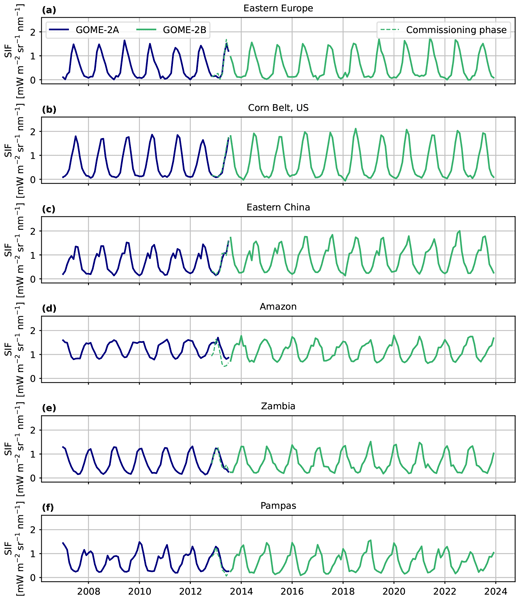
The GOME-2 series offers a long solar-induced fluorescence (SIF) record, but sensor-specific instrumental artefacts diverge intersensor observations. We developed a combined GOME-2 SIF record (2007–2023) from GOME-2A and GOME-2B SIF using the SIFTER v3 algorithm, which corrects these artefacts. Both records show strong spatial and temporal coherence. A framework is provided to detect and, if needed, correct intersensor offsets, supporting consistent long-term monitoring of vegetation dynamics.
Herizo Narivelo, Bastien Sauvage, Klaas Folkert Boersma, Isabelle De Smedt, Isidora Anglou, Michel Van Roozendael, Eric Le Flochmoën, and Brice Barret
EGUsphere, https://doi.org/10.5194/egusphere-2026-1652, https://doi.org/10.5194/egusphere-2026-1652, 2026
Short summary
Short summary
Tropospheric ozone is a key component of air pollution; it is produced by the photochemical oxidation of volatile organic compounds in the presence of nitrogen oxides. Using satellite observations, we determine the best combination of emission inventories for biomass-burning and anthropogenic sources, we analyse the impact of the evolution of two surface emissions in tropics on tropospheric ozone and its chemical regime, using numerical simulations over the last few decades.

Bas Mijling, Benjamin Afotey, Tim Henrik Eckert, Magdalena Mairhofer, Águeda Gil Pascual, Emmanuel Yuorkuu, Philip Darko, Phiona Amakah, Klaas Folkert Boersma, and Prince Junior Asilevi
Atmos. Meas. Tech., 19, 3063–3081, https://doi.org/10.5194/amt-19-3063-2026, https://doi.org/10.5194/amt-19-3063-2026, 2026
Short summary
Short summary
We established the first Palmes tube laboratory in Sub-Saharan Africa to monitor urban nitrogen dioxide (NO2) in Kumasi, Ghana. Our measurements reveal high surface NO2 levels that satellites underestimate, showing the importance of local measurements. This low-cost, scalable approach provides continuous local data and improves the interpretation of satellite observations, helping policymakers better understand and manage air quality in tropical cities.
Felipe Cifuentes, Henk Eskes, Ankie Piters, Julian Gomez, John Douros, Gaia Pinardi, Martina M. Friedrich, Enrico Dammers, Manuel Gebetsberger, and K. Folkert Boersma
Atmos. Meas. Tech., 19, 2437–2477, https://doi.org/10.5194/amt-19-2437-2026, https://doi.org/10.5194/amt-19-2437-2026, 2026
Short summary
Short summary
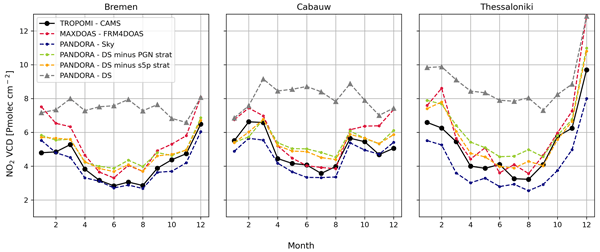
Satellite NO2 data are essential for monitoring air pollution, but they are affected by several sources of uncertainty. This study evaluates the major error contributors in TROPOMI (TROPOspheric Monitoring Instrument) NO2 retrievals by analyzing each retrieval step and comparing with ground-based observations. Key findings include biases in the separation of stratospheric and tropospheric NO2, representation and smoothing errors, and substantial variability among the ground-based instruments used for validation.
Alba Mols, Klaas Folkert Boersma, Hugo Denier van der Gon, and Maarten Krol
Atmos. Chem. Phys., 26, 1497–1513, https://doi.org/10.5194/acp-26-1497-2026, https://doi.org/10.5194/acp-26-1497-2026, 2026
Short summary
Short summary
We created a new method to estimate city air pollution (NOx emissions) using satellite data. Testing showed our approach works well to track how pollution spreads in urban areas. By combining observations with prior knowledge, we improved the accuracy of emission estimates. Applying this method in Paris, we found emissions were 9 % lower than expected and dropped significantly during COVID-19 lockdowns. Our method offers a reliable way to monitor pollution and support environmental policies.
Isolde Glissenaar, Klaas Folkert Boersma, Isidora Anglou, Pieter Rijsdijk, Tijl Verhoelst, Steven Compernolle, Gaia Pinardi, Jean-Christopher Lambert, Michel Van Roozendael, and Henk Eskes
Earth Syst. Sci. Data, 17, 4627–4650, https://doi.org/10.5194/essd-17-4627-2025, https://doi.org/10.5194/essd-17-4627-2025, 2025
Short summary
Short summary
We developed a new global dataset of nitrogen dioxide (NO2) levels in the lower atmosphere, using data from TROPOMI for 2018–2021. This dataset offers improved accuracy and detail compared to earlier versions, meeting high international standards for climate data. By refining how measurement errors are calculated and reduced over time and space, we provide clearer insights into pollution patterns. This work supports better air quality monitoring and informs actions to address pollution globally.
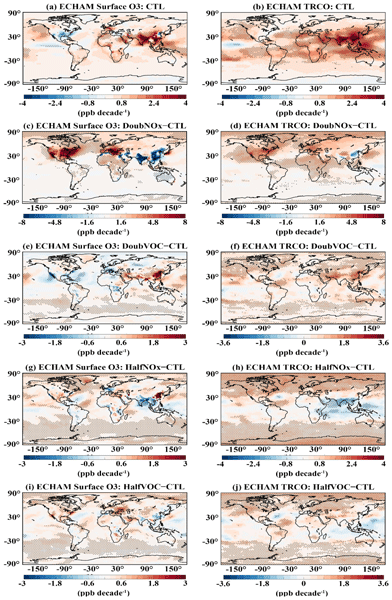
Suvarna Fadnavis, Yasin Elshorbany, Jerald Ziemke, Brice Barret, Alexandru Rap, P. R. Satheesh Chandran, Richard J. Pope, Vijay Sagar, Domenico Taraborrelli, Eric Le Flochmoen, Juan Cuesta, Catherine Wespes, Folkert Boersma, Isolde Glissenaar, Isabelle De Smedt, Michel Van Roozendael, Hervé Petetin, and Isidora Anglou
Atmos. Chem. Phys., 25, 8229–8254, https://doi.org/10.5194/acp-25-8229-2025, https://doi.org/10.5194/acp-25-8229-2025, 2025
Short summary
Short summary
Satellites and model simulations show enhancement in tropospheric ozone, which is highly impacted by human-produced nitrous oxides compared to volatile organic compounds. The increased amount of ozone enhances ozone radiative forcing. The ozone enhancement and associated radiative forcing are the highest over South and East Asia. The emissions of nitrous oxides show a higher influence on shifting ozone photochemical regimes than volatile organic compounds.
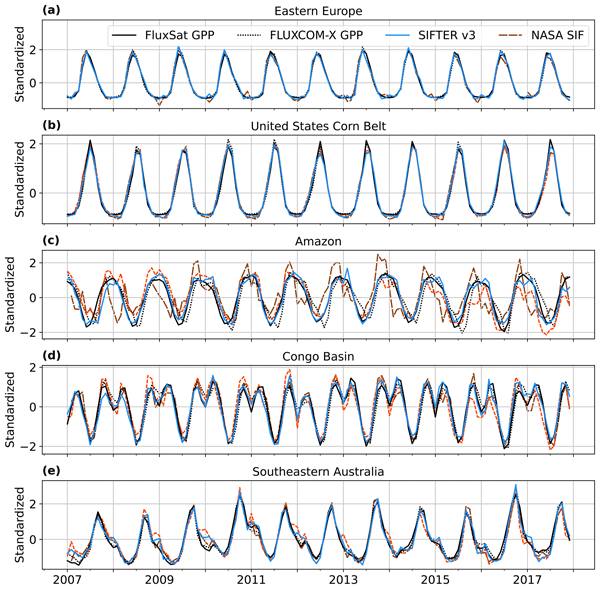
Juliëtte C. S. Anema, K. Folkert Boersma, Lieuwe G. Tilstra, Olaf N. E. Tuinder, and Willem W. Verstraeten
Atmos. Meas. Tech., 18, 1961–1979, https://doi.org/10.5194/amt-18-1961-2025, https://doi.org/10.5194/amt-18-1961-2025, 2025
Short summary
Short summary
Long-term records of plant fluorescence offer vital insights into changing vegetation activity. The GOME-2A sensor provides extensive global observations but suffers from calibration and instrument degradation, which affects data consistency. This study presents the SIFTER v3 algorithm, which effectively resolves these issues and includes other improvements, resulting in robust, accurate, and consistent GOME-2A fluorescence measurements from 2007 to 2017.
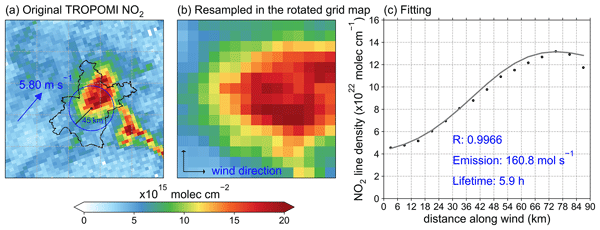
Qianqian Zhang, K. Folkert Boersma, Chiel van der Laan, Alba Mols, Bin Zhao, Shengyue Li, and Yuepeng Pan
Atmos. Chem. Phys., 25, 3313–3326, https://doi.org/10.5194/acp-25-3313-2025, https://doi.org/10.5194/acp-25-3313-2025, 2025
Short summary
Short summary
Accurate NOx emission estimates are required to better understand air pollution. This study investigates and demonstrates the ability of the superposition column model in combination with TROPOMI tropospheric NO2 column data to estimate city-scale NOx emissions and lifetimes and their variabilities. The results of this work nevertheless confirm the strength of the superposition column model in estimating urban NOx emissions with reasonable accuracy.
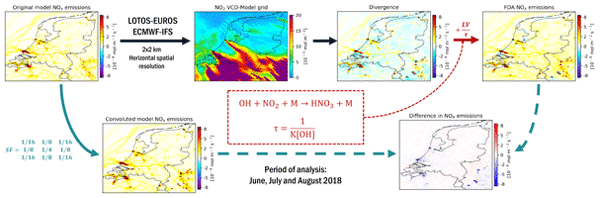
Felipe Cifuentes, Henk Eskes, Enrico Dammers, Charlotte Bryan, and Folkert Boersma
Geosci. Model Dev., 18, 621–649, https://doi.org/10.5194/gmd-18-621-2025, https://doi.org/10.5194/gmd-18-621-2025, 2025
Short summary
Short summary
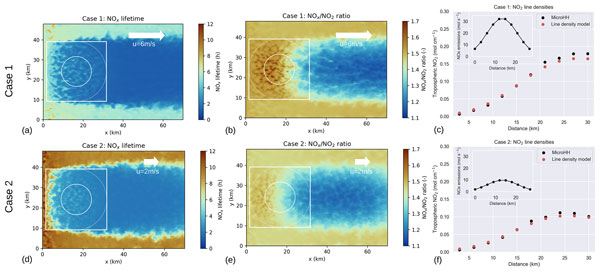
We tested the capability of the flux divergence approach (FDA) to reproduce known NOx emissions using synthetic NO2 satellite column retrievals from high-resolution model simulations. The FDA accurately reproduced NOx emissions when column observations were limited to the boundary layer and when the variability of the NO2 lifetime, the NOx : NO2 ratio, and NO2 profile shapes were correctly modeled. This introduces strong model dependency, reducing the simplicity of the original FDA formulation.
Pieter Rijsdijk, Henk Eskes, Arlene Dingemans, K. Folkert Boersma, Takashi Sekiya, Kazuyuki Miyazaki, and Sander Houweling
Geosci. Model Dev., 18, 483–509, https://doi.org/10.5194/gmd-18-483-2025, https://doi.org/10.5194/gmd-18-483-2025, 2025
Short summary
Short summary
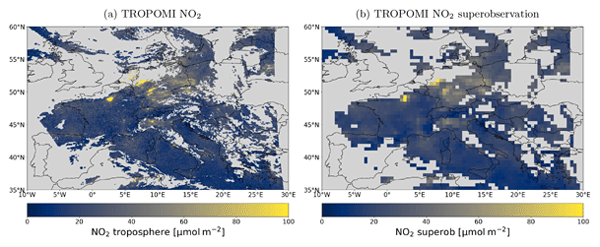
Clustering high-resolution satellite observations into superobservations improves model validation and data assimilation applications. In our paper, we derive quantitative uncertainties for satellite NO2 column observations based on knowledge of the retrievals, including a detailed analysis of spatial error correlations and representativity errors. The superobservations and uncertainty estimates are tested in a global chemical data assimilation system and are found to improve the forecasts.
Tong Sha, Siyu Yang, Qingcai Chen, Liangqing Li, Xiaoyan Ma, Yan-Lin Zhang, Zhaozhong Feng, K. Folkert Boersma, and Jun Wang
Atmos. Chem. Phys., 24, 8441–8455, https://doi.org/10.5194/acp-24-8441-2024, https://doi.org/10.5194/acp-24-8441-2024, 2024
Short summary
Short summary
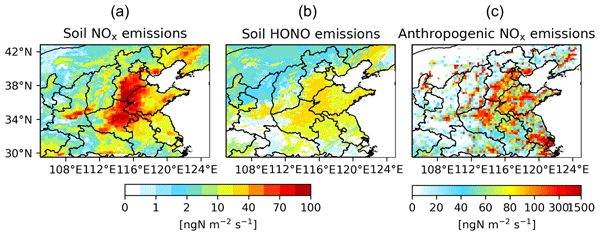
Using an updated soil reactive nitrogen emission scheme in the Unified Inputs for Weather Research and Forecasting coupled with Chemistry (UI-WRF-Chem) model, we investigate the role of soil NO and HONO (Nr) emissions in air quality and temperature in North China. Contributions of soil Nr emissions to O3 and secondary pollutants are revealed, exceeding effects of soil NOx or HONO emission. Soil Nr emissions play an important role in mitigating O3 pollution and addressing climate change.
Maarten Krol, Bart van Stratum, Isidora Anglou, and Klaas Folkert Boersma
Atmos. Chem. Phys., 24, 8243–8262, https://doi.org/10.5194/acp-24-8243-2024, https://doi.org/10.5194/acp-24-8243-2024, 2024
Short summary
Short summary
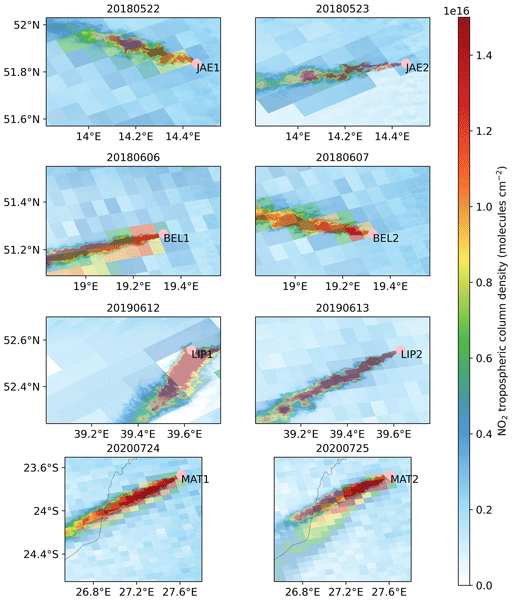
This paper presents detailed plume simulations of nitrogen oxides and carbon dioxide that are emitted from four large industrial facilities world-wide. Results from the high-resolution simulations that include atmospheric chemistry are compared to nitrogen dioxide observations from satellites. We find good performance of the model and show that common assumptions that are used in simplified models need revision. This work is important for the monitoring of emissions using satellite data.
Juliëtte C. S. Anema, Klaas Folkert Boersma, Piet Stammes, Gerbrand Koren, William Woodgate, Philipp Köhler, Christian Frankenberg, and Jacqui Stol
Biogeosciences, 21, 2297–2311, https://doi.org/10.5194/bg-21-2297-2024, https://doi.org/10.5194/bg-21-2297-2024, 2024
Short summary
Short summary
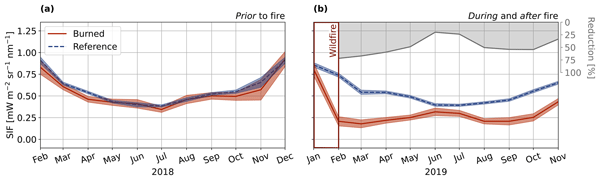
To keep the Paris agreement goals within reach, negative emissions are necessary. They can be achieved with mitigation techniques, such as reforestation, which remove CO2 from the atmosphere. While governments have pinned their hopes on them, there is not yet a good set of tools to objectively determine whether negative emissions do what they promise. Here we show how satellite measurements of plant fluorescence are useful in detecting carbon uptake due to reforestation and vegetation regrowth.
Tobias Christoph Valentin Werner Riess, Klaas Folkert Boersma, Ward Van Roy, Jos de Laat, Enrico Dammers, and Jasper van Vliet
Atmos. Meas. Tech., 16, 5287–5304, https://doi.org/10.5194/amt-16-5287-2023, https://doi.org/10.5194/amt-16-5287-2023, 2023
Short summary
Short summary
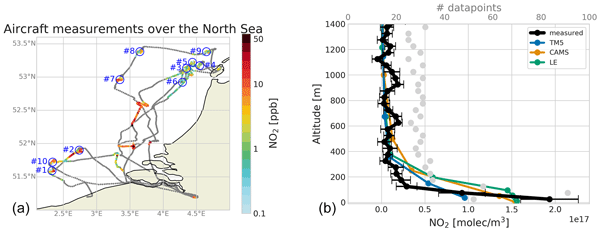
Satellite retrievals of trace gases require prior knowledge of the vertical distribution of the pollutant, which is usually obtained from models. Using aircraft-measured vertical NO2 profiles over the North Sea in summer 2021, we evaluate the Transport Model 5 profiles used in the TROPOMI NO2 retrieval. We conclude that driven by the low horizontal resolution and the overestimated vertical mixing, resulting NO2 columns are 20 % too low. This has important implications for emission estimates.
John Douros, Henk Eskes, Jos van Geffen, K. Folkert Boersma, Steven Compernolle, Gaia Pinardi, Anne-Marlene Blechschmidt, Vincent-Henri Peuch, Augustin Colette, and Pepijn Veefkind
Geosci. Model Dev., 16, 509–534, https://doi.org/10.5194/gmd-16-509-2023, https://doi.org/10.5194/gmd-16-509-2023, 2023
Short summary
Short summary
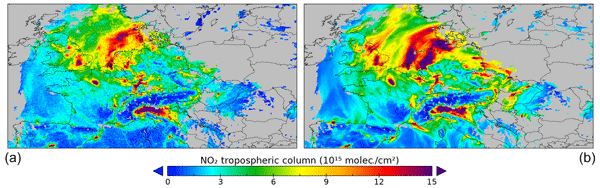
We focus on the challenges associated with comparing atmospheric composition models with satellite products such as tropospheric NO2 columns. The aim is to highlight the methodological difficulties and propose sound ways of doing such comparisons. Building on the comparisons, a new satellite product is proposed and made available, which takes advantage of higher-resolution, regional atmospheric modelling to improve estimates of troposheric NO2 columns over Europe.
Viral Shah, Daniel J. Jacob, Ruijun Dang, Lok N. Lamsal, Sarah A. Strode, Stephen D. Steenrod, K. Folkert Boersma, Sebastian D. Eastham, Thibaud M. Fritz, Chelsea Thompson, Jeff Peischl, Ilann Bourgeois, Ilana B. Pollack, Benjamin A. Nault, Ronald C. Cohen, Pedro Campuzano-Jost, Jose L. Jimenez, Simone T. Andersen, Lucy J. Carpenter, Tomás Sherwen, and Mat J. Evans
Atmos. Chem. Phys., 23, 1227–1257, https://doi.org/10.5194/acp-23-1227-2023, https://doi.org/10.5194/acp-23-1227-2023, 2023
Short summary
Short summary
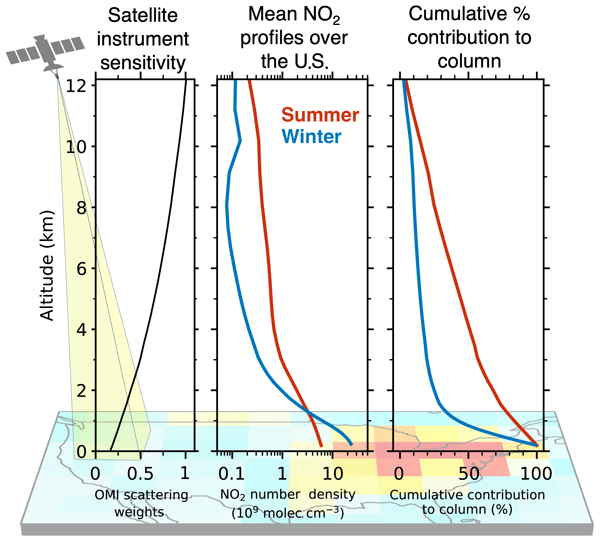
NOx in the free troposphere (above 2 km) affects global tropospheric chemistry and the retrieval and interpretation of satellite NO2 measurements. We evaluate free tropospheric NOx in global atmospheric chemistry models and find that recycling NOx from its reservoirs over the oceans is faster than that simulated in the models, resulting in increases in simulated tropospheric ozone and OH. Over the U.S., free tropospheric NO2 contributes the majority of the tropospheric NO2 column in summer.

Qianqian Zhang, K. Folkert Boersma, Bin Zhao, Henk Eskes, Cuihong Chen, Haotian Zheng, and Xingying Zhang
Atmos. Chem. Phys., 23, 551–563, https://doi.org/10.5194/acp-23-551-2023, https://doi.org/10.5194/acp-23-551-2023, 2023
Short summary
Short summary
We developed an improved superposition column model and used the latest released (v2.3.1) TROPOMI satellite NO2 observations to estimate daily city-scale NOx and CO2 emissions. The results are verified against bottom-up emissions and OCO-2 XCO2 observations. We obtained the day-to-day variation of city NOx and CO2 emissions, allowing policymakers to gain real-time information on spatial–temporal emission patterns and the effectiveness of carbon and nitrogen regulation in urban environments.
Srijana Lama, Sander Houweling, K. Folkert Boersma, Ilse Aben, Hugo A. C. Denier van der Gon, and Maarten C. Krol
Atmos. Chem. Phys., 22, 16053–16071, https://doi.org/10.5194/acp-22-16053-2022, https://doi.org/10.5194/acp-22-16053-2022, 2022
Short summary
Short summary
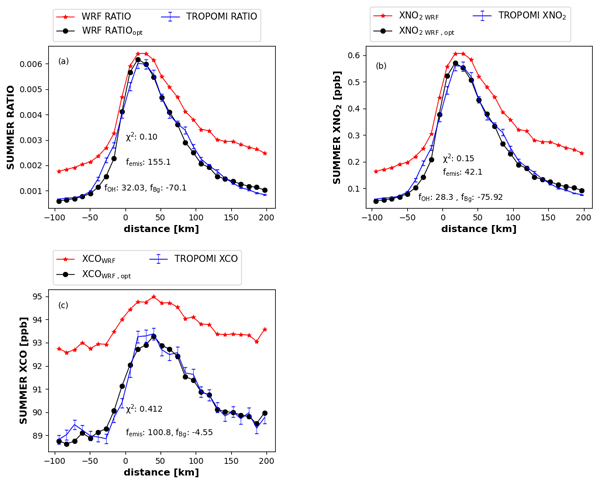
Hydroxyl radical (OH) is the important chemical species that determines the lifetime of some greenhouse gases and trace gases. OH plays a vital role in air pollution chemistry. OH has a short lifetime and is extremely difficult to measure directly. OH concentrations derived from the chemistry transport model (CTM) have uncertainties of >50 %. Therefore, in this study, OH is derived indirectly using satellite date in urban plumes.
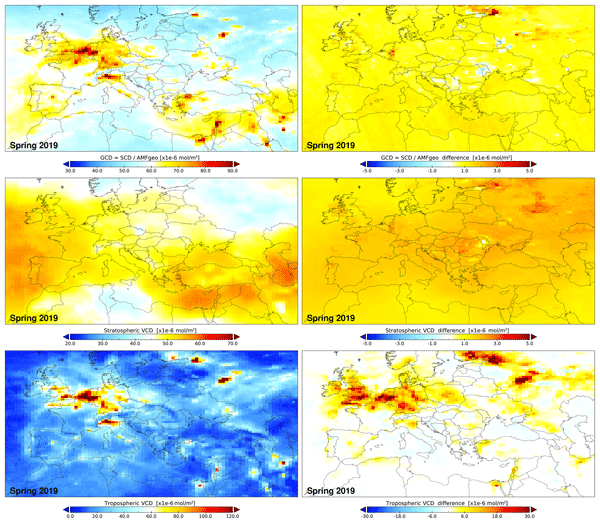
Jos van Geffen, Henk Eskes, Steven Compernolle, Gaia Pinardi, Tijl Verhoelst, Jean-Christopher Lambert, Maarten Sneep, Mark ter Linden, Antje Ludewig, K. Folkert Boersma, and J. Pepijn Veefkind
Atmos. Meas. Tech., 15, 2037–2060, https://doi.org/10.5194/amt-15-2037-2022, https://doi.org/10.5194/amt-15-2037-2022, 2022
Short summary
Short summary
Nitrogen dioxide (NO2) is one of the main data products measured by the Tropospheric Monitoring Instrument (TROPOMI) on the Sentinel-5 Precursor (S5P) satellite. This study describes improvements in the TROPOMI NO2 retrieval leading to version v2.2, operational since 1 July 2021. It compares results with previous versions v1.2–v1.4 and with Ozone Monitoring Instrument (OMI) and ground-based measurements.
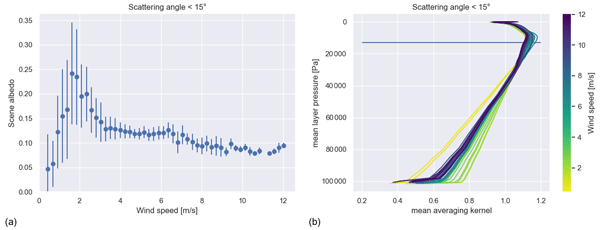
Tobias Christoph Valentin Werner Riess, Klaas Folkert Boersma, Jasper van Vliet, Wouter Peters, Maarten Sneep, Henk Eskes, and Jos van Geffen
Atmos. Meas. Tech., 15, 1415–1438, https://doi.org/10.5194/amt-15-1415-2022, https://doi.org/10.5194/amt-15-1415-2022, 2022
Short summary
Short summary
This paper reports on improved monitoring of ship nitrogen oxide emissions by TROPOMI. With its fantastic resolution we can identify lanes of ship nitrogen dioxide (NO2) pollution not detected from space before. The quality of TROPOMI NO2 data over sea is improved further by recent upgrades in cloud retrievals and the use of sun glint scenes. Lastly, we study the impact of COVID-19 on ship NO2 in European seas and compare the found reductions to emission estimates gained from ship-specific data.
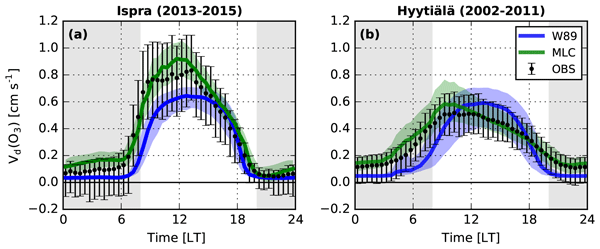
Auke J. Visser, Laurens N. Ganzeveld, Ignacio Goded, Maarten C. Krol, Ivan Mammarella, Giovanni Manca, and K. Folkert Boersma
Atmos. Chem. Phys., 21, 18393–18411, https://doi.org/10.5194/acp-21-18393-2021, https://doi.org/10.5194/acp-21-18393-2021, 2021
Short summary
Short summary
Dry deposition is an important sink for tropospheric ozone that affects ecosystem carbon uptake, but process understanding remains incomplete. We apply a common deposition representation in atmospheric chemistry models and a multi-layer canopy model to multi-year ozone deposition observations. The multi-layer canopy model performs better on diurnal timescales compared to the common approach, leading to a substantially improved simulation of ozone deposition and vegetation ozone impact metrics.
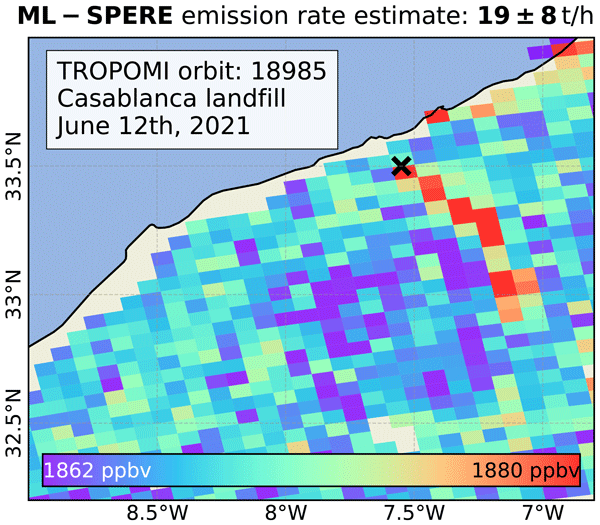
Clayton Roberts, Joannes D. Maasakkers, Tobias A. de Jong, Berend J. Schuit, Shubham Sharma, Theo Huegens, Anne-Wil van den Berg, Sander Houweling, and Ilse Aben
Atmos. Meas. Tech., 19, 5659–5682, https://doi.org/10.5194/amt-19-5659-2026, https://doi.org/10.5194/amt-19-5659-2026, 2026
Short summary
Short summary
Methane is a powerful greenhouse gas, and cutting its emissions can slow climate change in the near term. We have created ML-SPERE, a new machine-learning based method that uses TROPOMI observations and weather data to better estimate emission rates for large methane plumes. It has proved more accurate than the Integrated Mass Enhancement (IME) method when tested on simulated satellite observations. When applied to real TROPOMI plumes, ML-SPERE produces estimates that agree with other methods.
Leonardo M. A. Alvarado, Sora Seo, Adrian Doicu, Andreas Richter, and Diego Loyola
EGUsphere, https://doi.org/10.5194/egusphere-2026-4360, https://doi.org/10.5194/egusphere-2026-4360, 2026
This preprint is open for discussion and under review for Atmospheric Measurement Techniques (AMT).
Short summary
Short summary
Chlorine dioxide reveals the chemistry that destroys ozone in the upper atmosphere, but it is hard to measure from space, especially in the dim light of polar winter. We built a new method to analyse satellite measurements that separates the true signal from instrument noise and gives a trustworthy uncertainty for every observation, without extra corrections. It matches an existing product while being more reliable, supporting operational European monitoring and future missions for other gases.
Daniel A. Potts, Harjinder Sembhi, Matthieu Dogniaux, Joannes D. Maasakkers, Berend J. Schuit, Dirk Schuettemeyer, Timon Hummel, Rocio Barrio Guillo, Oliver Schneising, Luis Guanter, and Ilse Aben
EGUsphere, https://doi.org/10.5194/egusphere-2026-3797, https://doi.org/10.5194/egusphere-2026-3797, 2026
This preprint is open for discussion and under review for Atmospheric Chemistry and Physics (ACP).
Short summary
Short summary
Routine monitoring of industrial emissions is vital to understand the location, frequency, and intensity of methane emissions. We used satellite and aircraft measurements to understand methane emissions from Madrid across various scales and sectors. Using a range of methods, we identify a clear gap between top-down and bottom-up approaches, discuss challenges associated with satellite interpretation, connect emissions to on-site practices, and make recommendations towards operational use.
Gytha Mettepenningen, Caroline Fayt, Cato Van Doorne, Aurélien Aubry, Sophie Berkenbosch, Martine De Mazière, Filip Desmet, Lars Jacobs, Eddy Neefs, Frederik Tack, Timo Van Laar, Clemens Mensink, and Michel Van Roozendael
EGUsphere, https://doi.org/10.5194/egusphere-2026-3783, https://doi.org/10.5194/egusphere-2026-3783, 2026
This preprint is open for discussion and under review for Atmospheric Measurement Techniques (AMT).
Short summary
Short summary
Pollution from ships impacts air quality in dense coastal regions of the North Sea. SEMPAS (Ship Emission Monitoring with Passive Absorption Spectroscopy) remotely monitors the emissions of ships passing by. Without ships nearby, SEMPAS is used for atmospheric research in a marine environment. This study presents the instrument’s development. Tests in the Belgian port of Zeebrugge show strong variations in ship emissions, while atmospheric measurements agree well with satellite observations.
Juliëtte C. S. Anema, K. Folkert Boersma, Lieuwe G. Tilstra, Ruben van 't Loo, and Olaf N. E. Tuinder
Earth Syst. Sci. Data, 18, 5643–5661, https://doi.org/10.5194/essd-18-5643-2026, https://doi.org/10.5194/essd-18-5643-2026, 2026
Short summary
Short summary
The GOME-2 series offers a long solar-induced fluorescence (SIF) record, but sensor-specific instrumental artefacts diverge intersensor observations. We developed a combined GOME-2 SIF record (2007–2023) from GOME-2A and GOME-2B SIF using the SIFTER v3 algorithm, which corrects these artefacts. Both records show strong spatial and temporal coherence. A framework is provided to detect and, if needed, correct intersensor offsets, supporting consistent long-term monitoring of vegetation dynamics.
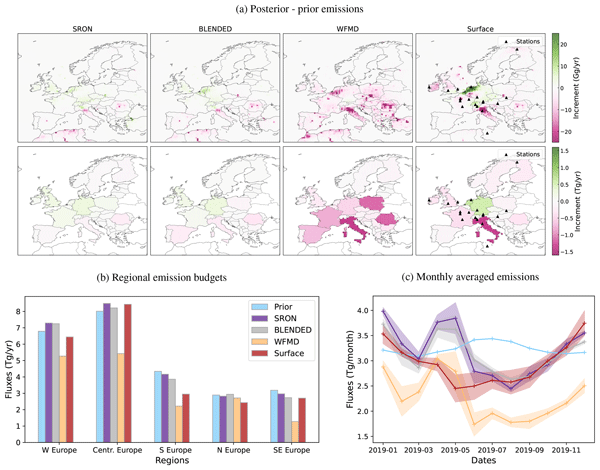
Aurélien Sicsik-Paré, Audrey Fortems-Cheiney, Isabelle Pison, Grégoire Broquet, Alvin Opler, Elise Potier, Adrien Martinez, Oliver Schneising, Michael Buchwitz, Joannes D. Maasakkers, Tobias Borsdorff, and Antoine Berchet
Atmos. Chem. Phys., 26, 10423–10454, https://doi.org/10.5194/acp-26-10423-2026, https://doi.org/10.5194/acp-26-10423-2026, 2026
Short summary
Short summary
Assimilating satellite methane observations provides top-down quantification of regional methane emissions. This study compares European emissions in 2019 estimated from the inversion of three satellite datasets. We find inconsistencies in national budgets and spatial patterns, with no product clearly superior. We disentangle drivers of the differences in emissions, highlighting the impact of differences in coverage, observations and errors on the consistency of methane emission estimates.
Yaqiu Zhao, Ronald J. van der A, Jieying Ding, Xiaojuan Lin, and Qianqian Zhang
EGUsphere, https://doi.org/10.5194/egusphere-2026-3440, https://doi.org/10.5194/egusphere-2026-3440, 2026
This preprint is open for discussion and under review for Atmospheric Chemistry and Physics (ACP).
Short summary
Short summary
To quantify soil nitrogen oxide (NOx) emissions, we develop a satellite-based method to derive land-use-specific soil NOx emissions. We apply it to eastern China and generate a regional emission inventory. We identify the optimal emission temperatures not included in conventional models. Global inventories likely underestimate China's forest soil NOx emissions. These results reduce uncertainty in soil NOx estimation and improve understanding of biogenic emissions under climate change.

Xin Zhang, Joannes D. Maasakkers, Tobias A. de Jong, Paul Tol, Frances Reuland, Adam R. Brandt, Eric A. Kort, Taylor J. Adams, and Ilse Aben
Geosci. Model Dev., 19, 5979–6000, https://doi.org/10.5194/gmd-19-5979-2026, https://doi.org/10.5194/gmd-19-5979-2026, 2026
Short summary
Short summary
Reducing emissions of greenhouse gases such as methane and carbon dioxide is essential for addressing climate change. We developed HyperGas, an open tool that uses hyperspectral satellite images to retrieve and detect greenhouse gas plumes. It helps scientists locate emission sources, estimate their strength, and examine uncertainties through an easy workflow and visual app. Our goal is to make tracking human-made emissions more accurate and accessible, supporting better climate monitoring.
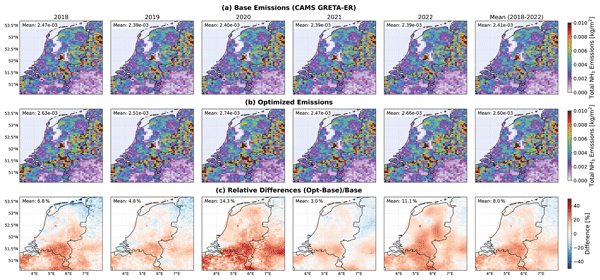
Tyler Wizenberg, Enrico Dammers, Arjo Segers, Mark W. Shephard, Pierre Coheur, Lieven Clarisse, Martin Van Damme, Henk Eskes, Roy Wichink Kruit, Shelley van der Graaf, and Martijn Schaap
Atmos. Chem. Phys., 26, 9589–9623, https://doi.org/10.5194/acp-26-9589-2026, https://doi.org/10.5194/acp-26-9589-2026, 2026
Short summary
Short summary
We combined five years of satellite data on ammonia and nitrogen dioxide concentrations with a regional model to better estimate nitrogen emissions and deposition in the Netherlands. This improved the accuracy of pollution maps and trends, especially in agricultural regions. Our approach helps identify when and where emissions are highest, supporting better air quality management and environmental protection by showing the benefits of using multiple complimentary satellite datasets together.
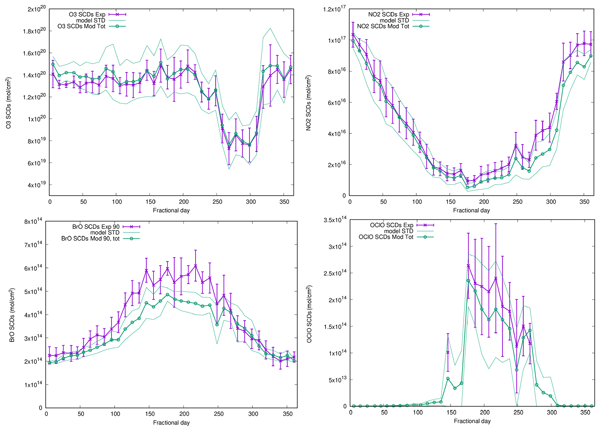
Laura Gómez-Martín, Cristina Prados-Roman, Martyn P. Chipperfield, Michel Van Roozendael, Olga Puentedura, Monica Navarro-Comas, Hector Ochoa, and Margarita Yela
Atmos. Meas. Tech., 19, 4393–4413, https://doi.org/10.5194/amt-19-4393-2026, https://doi.org/10.5194/amt-19-4393-2026, 2026
Short summary
Short summary
The Antarctic ozone hole remains a critical global challenge. Accurately measuring the gases that cause it during twilights is difficult due to rapid chemical changes. We used advanced computer simulations to reproduce observations at 2 Antarctic stations to account for these fluctuations and the Earth's curvature. Our results improve the accuracy of atmospheric monitoring, helping scientists better track the recovery of the ozone layer and understand the complex chemistry driving its depletion.
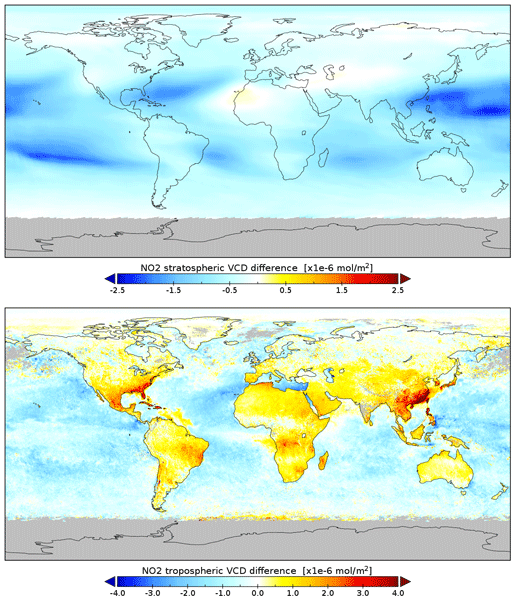
Jos van Geffen, Henk Eskes, Maarten Sneep, Mark ter Linden, and J. Pepijn Veefkind
Atmos. Meas. Tech., 19, 4233–4254, https://doi.org/10.5194/amt-19-4233-2026, https://doi.org/10.5194/amt-19-4233-2026, 2026
Short summary
Short summary
The Fraunhofer absorption feature at 430 nm, which varies in strength with the solar activity cycle influences the retrieval of nitrogen dioxide (NO2) from from Tropospheric Monitoring Instrument (TROPOMI) and Ozone Monitoring Instrument (OMI) measurements. This study describes the benefits of removing the wavelength range 428–433 nm from the retrieval, which is implemented for TROPOMI retrievals as of v2.9.1.
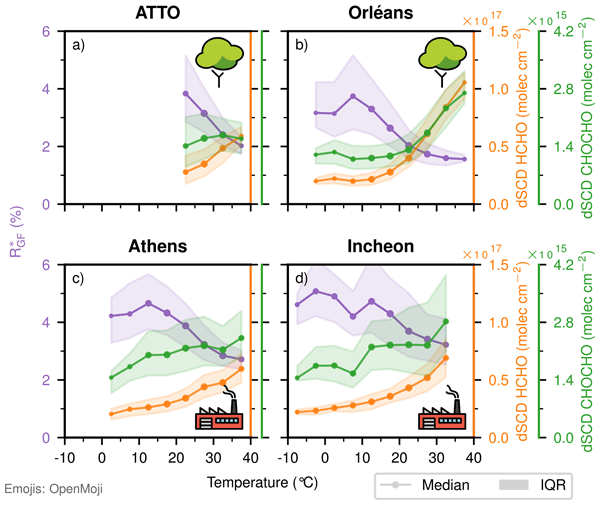
Simon Bittner, Andreas Richter, Bianca Zilker, Sebastian Donner, Thomas Wagner, Alexandros Panagiotis Poulidis, Leonardo Alvarado, and Mihalis Vrekoussis
Atmos. Chem. Phys., 26, 8809–8838, https://doi.org/10.5194/acp-26-8809-2026, https://doi.org/10.5194/acp-26-8809-2026, 2026
Short summary
Short summary
Knowing where air pollutants come from helps assess their impact on human health and climate. One proposed tool is the ratio of two trace gases, glyoxal and formaldehyde, measured from the ground at four sites. This ratio was found to be lower at natural and higher at human-influenced sites, and to vary systematically over the day, season, and with temperature. These patterns suggest that our current understanding of this ratio remains incomplete, limiting its reliable use as a source indicator.
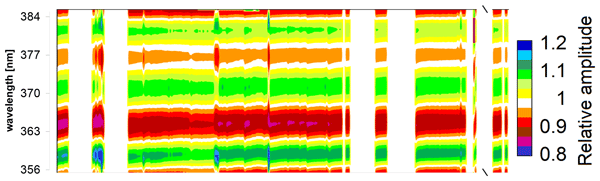
Thomas Wagner, Steffen Beirle, Sebastian Donner, Carl-Fredrik Enell, Myojeong Gu, Bianca Lauster, Ulrich Platt, Janis Pukite, Uwe Raffalski, and Steffen Ziegler
Atmos. Meas. Tech., 19, 4065–4097, https://doi.org/10.5194/amt-19-4065-2026, https://doi.org/10.5194/amt-19-4065-2026, 2026
Short summary
Short summary
The characterisation of spectroscopic properties of Differential Optical Absorption Spectroscopy (DOAS) instruments is important for accurate trace gas retrievals. In this study, we evaluate and extend existing methods for the determination of such properties using high-resolution solar spectra. These methods can be applied to routine observations in the field. Our results and developed techniques are especially important for trend analyses from long-term measurements.
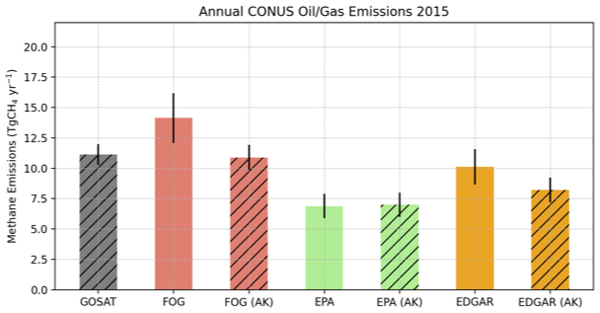
John Worden, Sudhanshu Pandey, Hannah Nesser, Kevin Bowman, Colin Harkins, Congmeng Lyu, Joannes D. Maasakkers, Deborah Gordon, Daniel Jacob, Lucas Estrada, Daniel J. Varon, James D. East, Lauren Schmeisser, and Zhen Qu
Atmos. Chem. Phys., 26, 8855–8873, https://doi.org/10.5194/acp-26-8855-2026, https://doi.org/10.5194/acp-26-8855-2026, 2026
Short summary
Short summary
To support methane reduction, we compared three widely used maps of methane emissions in the United States with estimates derived from a methane-measuring satellite from 2012 to 2020. The satellite indicates higher emissions from oil and gas production and from livestock in several regions, while other sources were harder to pin down. Neither approach shows a clear change over time. The results point to where better measurements can most improve emissions reporting and guide mitigation.
Pradeep Khatri, Hitoshi Irie, Hiroshi Kobayashi, Isamu Morino, Yoshitaka Jin, Tadahiro Hayasaka, Hironobu Iwabuchi, Tamio Takamura, and Yoshiki Takayama
EGUsphere, https://doi.org/10.5194/egusphere-2026-2943, https://doi.org/10.5194/egusphere-2026-2943, 2026
Short summary
Short summary
This study investigates the spectral characteristics of zenith sky radiances under clear- and cloudy-sky conditions using SKYNET sky radiometer observations. It proposes a simple, physically interpretable method for distinguishing sky states and demonstrates that wavelength-dependent radiance information can support reliable sky-state detection across diverse atmospheric environments.
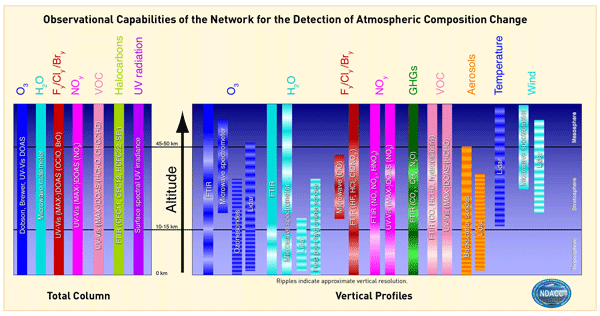
Irina Petropavlovskikh, Martine De Mazière, Anne M. Thompson, Jeannette D. Wild, James W. Hannigan, Henry B. Selkirk, Reem A. Hannun, Wolfgang Steinbrecht, Jean-Christopher Lambert, Roeland Van Malderen, Elizabeth Asher, Raul R. Cordero, Sophie Godin-Beekmann, Daan Hubert, Sergey Khaykin, Karin Kreher, Thierry Leblanc, Emmanuel Mahieu, Eliane Maillard Barras, Glen McConville, Gerald Nedoluha, Ivan Ortega, Alberto Redondas Marrero, Gunther Seckmeyer, Ryan M. Stauffer, Sarah A. Strode, Kim Strong, Takafumi Sugita, Michel Van Roozendael, Voltaire Velazco, Corinne Vigouroux, and Bärbel Vogel
Atmos. Chem. Phys., 26, 8637–8675, https://doi.org/10.5194/acp-26-8637-2026, https://doi.org/10.5194/acp-26-8637-2026, 2026
Short summary
Short summary
This introduction to the special issue "Achievements and perspectives of the Network for the Detection of Atmospheric Composition Change after 35 years of operation” provides an overview of important research findings achieved under the NDACC objectives. The future of NDACC is discussed in the light of the evolution of the scientific questions, evolving collaborations with partners and Cooperating Networks, and the current landscape of gaps in satellite and ground-based observations.
Erna Frins, Thomas Wagner, Nicolás Casaballe, Sebastian Donner, and Steffen Ziegler
EGUsphere, https://doi.org/10.5194/egusphere-2026-2556, https://doi.org/10.5194/egusphere-2026-2556, 2026
This preprint is open for discussion and under review for Atmospheric Measurement Techniques (AMT).
Short summary
Short summary
We use a hyperspectral camera to show that the absorptions of the oxygen dimer can be well determined from the measured spectra. The retrieved oxygen dimer images together with calibrated radiances are used to determine atmospheric profiles of the aerosol extinction and cloud properties. We also exploit the advantage of the 2D imaging capabilities: the unambiguous distinction between clear and cloudy parts within the recorded image.
Wenfu Sun, Frederik Tack, Lieven Clarisse, and Michel Van Roozendael
Atmos. Chem. Phys., 26, 7741–7764, https://doi.org/10.5194/acp-26-7741-2026, https://doi.org/10.5194/acp-26-7741-2026, 2026
Short summary
Short summary
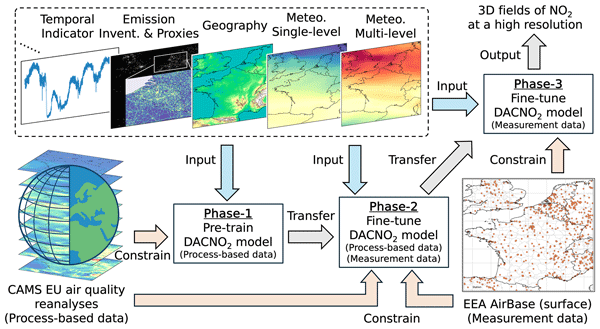
Accurate maps of nitrogen dioxide pollution at fine scales are essential for assessing air quality and protecting public health. We developed a machine learning model that produces daily high-resolution 3D nitrogen dioxide fields across Western Europe by combining large-scale atmospheric simulations with ground-based measurements. This approach outperforms traditional methods, especially over cities and complex terrain, and can enhance satellite-based air quality monitoring.
Dimitris Karagkiozidis, Alkiviadis Bais, Katerina Garane, Michel Van Roozendael, Dimitris Nikolis, Manuel Roca, and Dimitris Balis
Atmos. Meas. Tech., 19, 3309–3332, https://doi.org/10.5194/amt-19-3309-2026, https://doi.org/10.5194/amt-19-3309-2026, 2026
Short summary
Short summary
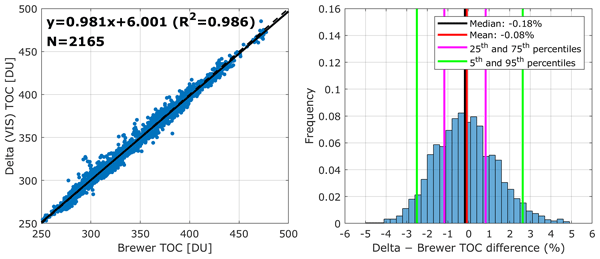
This study presents total ozone column (TOC) measurements over Thessaloniki, Greece, using a ground-based Ultraviolet-Visible (UV-VIS) instrument, by applying the direct sun Differential Optical Absorption Spectroscopy (DOAS) technique. The retrievals in both the UV (Huggins) and VIS (Chappuis) bands show very good agreement with collocated Brewer and Pandora observations. The results highlight the successful exploitation of the Chappuis bands for reliable ozone monitoring, providing a complementary approach to traditional UV-based TOC retrievals.
Herizo Narivelo, Bastien Sauvage, Klaas Folkert Boersma, Isabelle De Smedt, Isidora Anglou, Michel Van Roozendael, Eric Le Flochmoën, and Brice Barret
EGUsphere, https://doi.org/10.5194/egusphere-2026-1652, https://doi.org/10.5194/egusphere-2026-1652, 2026
Short summary
Short summary
Tropospheric ozone is a key component of air pollution; it is produced by the photochemical oxidation of volatile organic compounds in the presence of nitrogen oxides. Using satellite observations, we determine the best combination of emission inventories for biomass-burning and anthropogenic sources, we analyse the impact of the evolution of two surface emissions in tropics on tropospheric ozone and its chemical regime, using numerical simulations over the last few decades.
Brian Auffarth, Mark Weber, Alexei Rozanov, Carlo Arosio, John P. Burrows, Melanie Coldewey-Egbers, Sean M. Davis, Doug Degenstein, Kimberlee Dubé, Stacey M. Frith, Lucien Froidevaux, Diego Loyola, Vitali E. Fioletov, Viktoria Sofieva, Ronald van der A, and Jeannette D. Wild
EGUsphere, https://doi.org/10.5194/egusphere-2026-2576, https://doi.org/10.5194/egusphere-2026-2576, 2026
Short summary
Short summary
This study examines the trends of stratospheric and total ozone between 2000 and 2024, using long-term satellite datasets. Our results show positive trends in the upper stratosphere and a strong ozone recovery in the Southern Hemisphere, while changes in lower altitudes remain mostly small. The total and stratospheric trends show very similar results, indicating that tropospheric ozone contributes little to total column changes, while the stratospheric column is the dominant driver.
Xiaoyi Zhao, Vitali Fioletov, Irina Petropavlovskikh, Voltaire Velazco, Alberto Redondas, Anna Solomatnikova, Corinne Vigouroux, Kimberly Strong, Michel Van Roozendael, Andrea Pazmino, Thomas F. Hanisco, Alexander Cede, Martin Tiefengraber, Gordon Labow, Masatomo Fujiwara, Ronald van der A, Debora Griffin, Chris McLinden, Tom Kralidis, Wolfgang Steinbrecht, and Sum Chi Lee
EGUsphere, https://doi.org/10.5194/egusphere-2026-2009, https://doi.org/10.5194/egusphere-2026-2009, 2026
Short summary
Short summary
Total column ozone (TCO) records from six ground-based networks are compiled and evaluated using multiple satellites and reanalysis data. Station performance (1940–2024) is assessed using harmonized metrics. Ground-based annual means agree within ±2 %, while pre-satellite reanalyses show larger biases (up to −5 %). The resulting quality-assessed dataset supports trend analysis and satellite validation.
Bas Mijling, Benjamin Afotey, Tim Henrik Eckert, Magdalena Mairhofer, Águeda Gil Pascual, Emmanuel Yuorkuu, Philip Darko, Phiona Amakah, Klaas Folkert Boersma, and Prince Junior Asilevi
Atmos. Meas. Tech., 19, 3063–3081, https://doi.org/10.5194/amt-19-3063-2026, https://doi.org/10.5194/amt-19-3063-2026, 2026
Short summary
Short summary
We established the first Palmes tube laboratory in Sub-Saharan Africa to monitor urban nitrogen dioxide (NO2) in Kumasi, Ghana. Our measurements reveal high surface NO2 levels that satellites underestimate, showing the importance of local measurements. This low-cost, scalable approach provides continuous local data and improves the interpretation of satellite observations, helping policymakers better understand and manage air quality in tropical cities.
Jinkyul Choi, Kazuyuki Miyazaki, Takashi Sekiya, Jinhyeok Yu, Shin-Ya Ogino, Henk Eskes, Pieter Rijdijk, Ryan Bennett, Anke Roiger, Leon Knez, Glenn S. Diskin, Jason A. Miech, Joshua P. DiGangi, Yonghoon Choi, Alessandro Franchin, Changmin Cho, Eric C. Apel, Louisa K. Emmons, Nattamon Maneenoi, Jason M. St. Clair, Reem A. Hannun, Glenn M. Wolfe, Erin Delaria, Abby Sebol, Donald R. Blake, Monica Crippa, Rachel M. Hoesly, Steven J. Smith, Jung-Hun Woo, Le Kuai, and Ronald Macatangay
EGUsphere, https://doi.org/10.5194/egusphere-2026-2380, https://doi.org/10.5194/egusphere-2026-2380, 2026
Short summary
Short summary
Asia produces half of the world's air pollution, yet emission estimates from different sources disagree widely. We assimilated satellite observations of six pollutant species to correct both concentrations and emissions. Aircraft measurements from a 2024 NASA campaign across four Asian countries confirmed the improvements. Our results reveal underreported emissions in some countries, overestimated vegetation emissions, unresolved fire estimates, and weather control on cross-border pollution.
Qidi Li, Yuhan Luo, Xin Yang, Bianca Zilker, Andreas Richter, Ke Dou, Haijin Zhou, Kai Zhan, Fuqi Si, and Wenqing Liu
Atmos. Chem. Phys., 26, 6165–6196, https://doi.org/10.5194/acp-26-6165-2026, https://doi.org/10.5194/acp-26-6165-2026, 2026
Short summary
Short summary
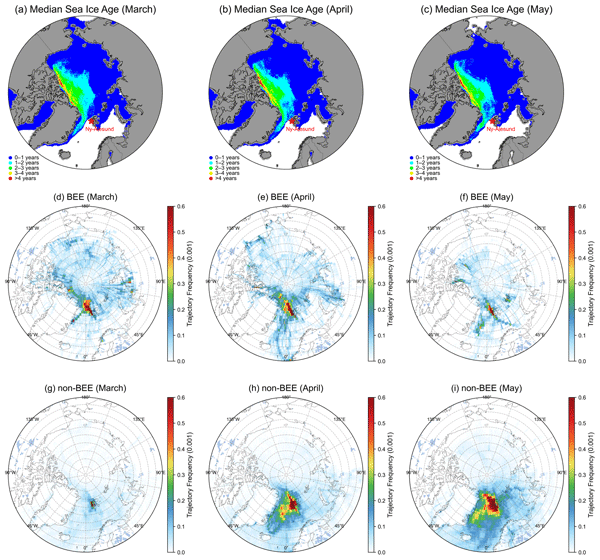
We investigated why reactive bromine increases in the Arctic atmosphere during spring. Using observations in Ny-Ålesund and modeling. We found that BrO increases are strongly linked to airborne particles and bromine emissions from snow over sea ice. Both snow over first-year and multi-year sea ice contribute comparably. These processes are enhanced by strong winds and drive depletion of surface ozone and mercury.
Glenn-Michael Oomen, Jean-François Müller, Trissevgeni Stavrakou, Isabelle De Smedt, Vincent Huijnen, Flora Kluge, Antje Inness, and Johannes Flemming
EGUsphere, https://doi.org/10.5194/egusphere-2026-2362, https://doi.org/10.5194/egusphere-2026-2362, 2026
Short summary
Short summary
Isoprene is a commonly emitted organic gas emitted by trees. In this work, we strongly simplified the chemical mechanism through parametric fitting, which helps scientists study air pollution and climate more efficiently. By comparing it with a detailed model and satellite observations, we show that the simplified version produces very similar results. This means faster calculations are possible without losing accuracy, improving studies of emissions and air quality worldwide.
Takashi Sekiya, Kazuyuki Miyazaki, Henk Eskes, Pieter Rijsdijk, Kengo Sudo, and Yugo Kanaya
EGUsphere, https://doi.org/10.5194/egusphere-2026-1681, https://doi.org/10.5194/egusphere-2026-1681, 2026
Short summary
Short summary
This study evaluates the synergistic effects of satellite aerosol optical depth (AOD) and trace gas data assimilation on aerosol composition analyses. The simultaneous data assimilation (DA) improved the PM2.5 model biases in Northeast Asia compared to conventional DA run that separately assimilate AOD satellite observations. This coupled aerosol and trace gas DA framework offers significant advantages for improving global aerosol composition analyses.
Yutao Chen, Ronald J. van der A, Jieying Ding, Henk Eskes, Felipe Cifuentes, and Pieternel F. Levelt
Atmos. Meas. Tech., 19, 2737–2750, https://doi.org/10.5194/amt-19-2737-2026, https://doi.org/10.5194/amt-19-2737-2026, 2026
Short summary
Short summary
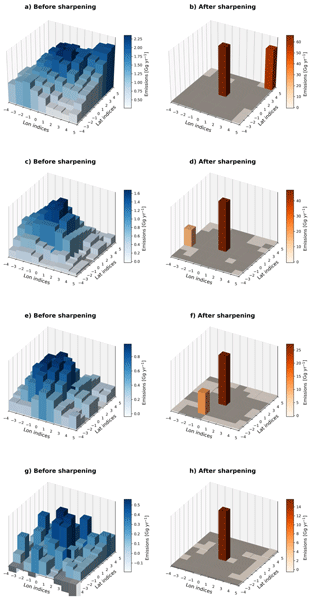
The SO2 gridded point emissions calculated from satellite measurements appear spread out around the source. This is inherent to the inversion method and the resolution of the satellite measurements. We made a new sharpening algorithm to reverse the spreading and make the emission signal clearer. With this method, the effective resolution is improved. Known sources can be located more precisely, and new ones can be found from space. The same approach also works for other gases like NOx.
Hannes Witt, Ronald J. van der A, Jieying Ding, Jeroen Kuenen, and Margreet C. van Zanten
Atmos. Chem. Phys., 26, 5237–5248, https://doi.org/10.5194/acp-26-5237-2026, https://doi.org/10.5194/acp-26-5237-2026, 2026
Short summary
Short summary
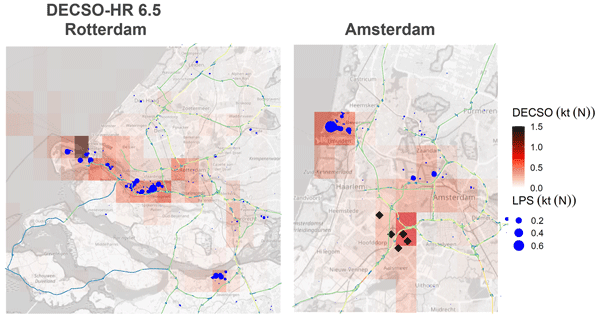
We present a detailed comparison of NOx emissions from the Dutch national emission inventory with completely independent emission data derived from satellite observations with the DECSO algorithm. We find good agreement in overall emission levels, regional emissions, and the 5-year emission trend. Our results demonstrate the robustness of the national inventory and the satellite-derived emissions and might serve as a use-case for the adoption of similar methods in other countries.
Felipe Cifuentes, Henk Eskes, Ankie Piters, Julian Gomez, John Douros, Gaia Pinardi, Martina M. Friedrich, Enrico Dammers, Manuel Gebetsberger, and K. Folkert Boersma
Atmos. Meas. Tech., 19, 2437–2477, https://doi.org/10.5194/amt-19-2437-2026, https://doi.org/10.5194/amt-19-2437-2026, 2026
Short summary
Short summary
Satellite NO2 data are essential for monitoring air pollution, but they are affected by several sources of uncertainty. This study evaluates the major error contributors in TROPOMI (TROPOspheric Monitoring Instrument) NO2 retrievals by analyzing each retrieval step and comparing with ground-based observations. Key findings include biases in the separation of stratospheric and tropospheric NO2, representation and smoothing errors, and substantial variability among the ground-based instruments used for validation.
Hitoshi Irie, Masataka Nomoto, Yoshikazu Kamiya, and Yukio Terao
Atmos. Meas. Tech., 19, 2369–2378, https://doi.org/10.5194/amt-19-2369-2026, https://doi.org/10.5194/amt-19-2369-2026, 2026
Short summary
Short summary
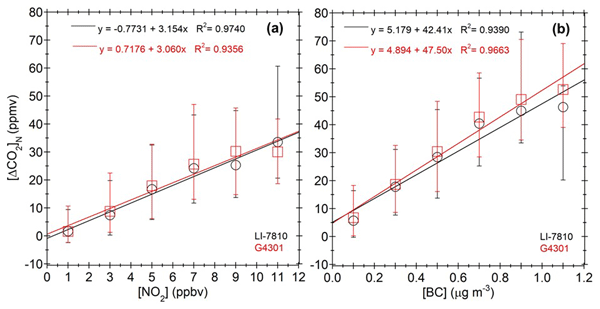
Continuous year-round measurements in Chiba, Japan, combining in‑situ CO2 observations with MAX‑DOAS (Multi-Axis Differential Optical Absorption Spectroscopy) NO2, showed that CO2 levels decrease on days with low near-surface NO2. CO2 enhancements quantified using these low-NO2 days correlated strongly with NO₂ and black carbon, indicating that this metric effectively tracks fossil-fuel-derived CO₂. The approach offers a simple, accurate method for monitoring urban CO2 emissions in megacities.
Huanhuan Yan, Andreas Richter, Xingying Zhang, Anja Schönhardt, Thomas Visarius, Qian Wang, Lu Zhang, Yichen Li, Chao Yu, and Weihe Wang
Atmos. Meas. Tech., 19, 2279–2311, https://doi.org/10.5194/amt-19-2279-2026, https://doi.org/10.5194/amt-19-2279-2026, 2026
Short summary
Short summary
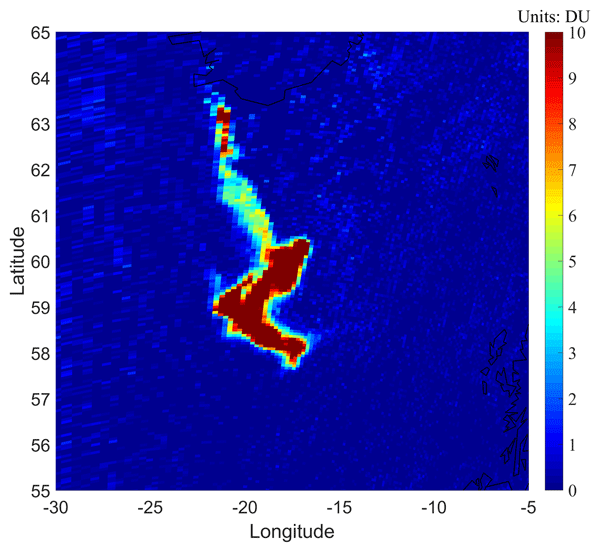
The Ozone Monitoring Suite (OMS) launched in August 2023 is a new Chinese hyperspectral UV-VIS (Ultraviolet-Visible) instrument. This study used the OMS measurements and Differential Optical Absorption Spectroscopy (DOAS) inversion to for the first time retrieve global SO2 columns from OMS. The results show that the OMS SO2 retrievals exhibit good stability over clean oceanic regions, successfully capture volcanic SO2 plumes, and effectively detect the elevated SO2 columns from anthropogenic emissions.
Lorenzo Fabris, Nicolas Theys, Lieven Clarisse, Bruno Franco, Jonas Vlietinck, Huan Yu, Hugues Brenot, Thomas Danckaert, Pascal Hedelt, and Michel Van Roozendael
Atmos. Meas. Tech., 19, 1801–1824, https://doi.org/10.5194/amt-19-1801-2026, https://doi.org/10.5194/amt-19-1801-2026, 2026
Short summary
Short summary
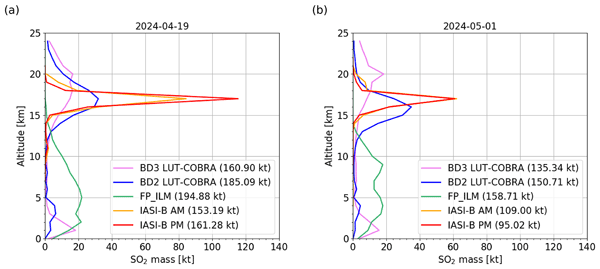
In this study, we developed an improved algorithm to retrieve the sulfur dioxide plume height and column density from the spectral band 2 of the TROPOspheric Monitoring Instrument onboard the Sentinel-5 Precursor satellite. We tested its sensitivity to various conditions and applied it to real volcanic eruptions. Overall, our approach shows high precision, accuracy, and sensitivity, and the results are consistent with other satellite measurements.
Sean Davis, William Ball, Yue Jia, Gabriel Chiodo, Justin Alsing, James Keeble, Hideharu Akiyoshi, Carlo Arosio, Ewa Bednarz, Andreas Chrysanthou, Melanie Coldewey-Egbers, Robert Damadeo, Sandip Dhomse, Mohamadou Diallo, Simone Dietmuller, Roland Eichinger, Stacey Frith, Birgit Hassler, Michaela Hegglin, Daan Hubert, Patrick Jöckel, Béatrice Josse, Natalya Kramarova, Diego Loyola, Eliane Maillard Barras, Marion Marchand, Olaf Morgenstern, David Plummer, Robert Portmann, Karen Rosenlof, Alexei Rozanov, Viktoria Sofieva, Johannes Staehelin, Timofei Sukhodolov, Kleareti Tourpali, Ronald Van der A, H. J. Ray Wang, Krzysztof Wargan, Shingo Watanabe, Mark Weber, Jeannette Wild, Yousuke Yamashita, and Jerry Ziemke
EGUsphere, https://doi.org/10.5194/egusphere-2026-532, https://doi.org/10.5194/egusphere-2026-532, 2026
Short summary
Short summary
This study investigates how tropical ozone levels have changed since 2000 in chemistry climate models and satellite observations to determine how well they agree with one another, and to see if current trends can help predict future levels. At some, satellite records disagree significantly on the magnitude of ozone changes. The study shows a connection between recent ozone trends and future ozone levels, suggesting that satellite measurements could help constrain future ozone changes.
Gaia Pinardi, Martina M. Friedrich, Corinne Vigouroux, Bavo Langerock, Isabelle De Smedt, Caroline Fayt, Christian Hermans, Steffen Beirle, Thomas Wagner, Minqiang Zhou, Ting Wang, Pucai Wang, Martine De Mazière, and Michel Van Roozendael
Atmos. Meas. Tech., 19, 1259–1291, https://doi.org/10.5194/amt-19-1259-2026, https://doi.org/10.5194/amt-19-1259-2026, 2026
Short summary
Short summary
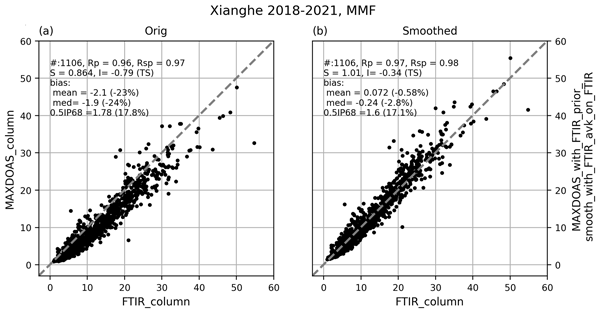
We evaluate ground-based remote-sensing measurements of formaldehyde from three techniques at a suburban site in China. A systematic −20 % bias in Multi-AXis Differential Optical Absorption Spectroscopy compared to direct-sun ultraviolet and infrared data is linked to limited sensitivity above a few kilometers and simplified vertical profiles assumptions. Using model-based priors and accounting for vertical sensitivity removes these differences, improving consistency for satellite validation.
Srijana Lama, Joannes D. Maasakkers, Xin Zhang, Marianne Girard, Swarna Dutt, Suyash Nandgaonkar, Daniel J. Varon, Melissa P. Sulprizio, Lucas A. Estrada, Nicholas Balasus, Robert J. Parker, Yukio Terao, and Ilse Aben
EGUsphere, https://doi.org/10.5194/egusphere-2025-6528, https://doi.org/10.5194/egusphere-2025-6528, 2026
Short summary
Short summary
Methane is the second most important anthropogenic greenhouse gas in terms of radiative forcing, with a global warming potential 27–30 times that of CO2 over a 100-year timescale. Effective mitigation requires a detailed understanding of the spatial distribution and magnitude of emissions. Here, we quantify India’s 2021 methane emissions at a resolution of up to 0.25° × 0.3125° using TROPOMI observations within the Bayesian Integrated Methane Inversion framework.
Simone Pulimeno, Angelo Lupi, Vito Vitale, Claudia Frangipani, Carlos Toledano, Stelios Kazadzis, Natalia Kouremeti, Christoph Ritter, Sandra Graßl, Kerstin Stebel, Vitali Fioletov, Ihab Abboud, Sandra Blindheim, Lynn Ma, Norm O'Neill, Piotr Sobolewski, Pawan Gupta, Elena Lind, Thomas F. Eck, Antti Hyvärinen, Veijo Aaltonen, Rigel Kivi, Janae Csavina, Dmitry Kabanov, Sergey M. Sakerin, Olga R. Sidorova, Robert S. Stone, Hagen Telg, Laura Riihimaki, Raul R. Cordero, Martin Radenz, Ronny Engelmann, Michel Van Roozendal, Anatoli Chaikovsky, Philippe Goloub, Junji Hisamitsu, and Mauro Mazzola
Atmos. Chem. Phys., 26, 1809–1846, https://doi.org/10.5194/acp-26-1809-2026, https://doi.org/10.5194/acp-26-1809-2026, 2026
Short summary
Short summary
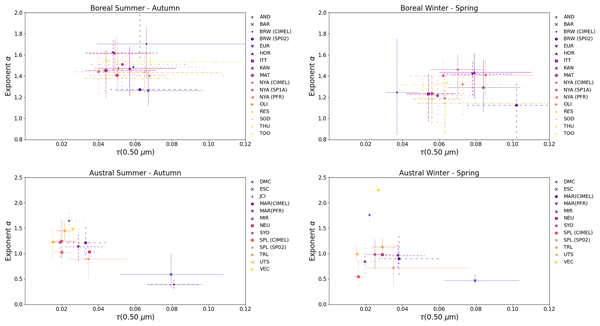
This study analyzed aerosols optical properties over the Arctic and Antarctic to measure them even during long periods of darkness. It found that pollution in the Arctic is decreasing, likely due to European emission regulations, while wildfires are becoming a more important source of particles. In Antarctica, particle levels are higher near the coast than inland, and vary by season. These results help us better understand how air pollution and climate are changing at the Earth’s poles.
Alba Mols, Klaas Folkert Boersma, Hugo Denier van der Gon, and Maarten Krol
Atmos. Chem. Phys., 26, 1497–1513, https://doi.org/10.5194/acp-26-1497-2026, https://doi.org/10.5194/acp-26-1497-2026, 2026
Short summary
Short summary
We created a new method to estimate city air pollution (NOx emissions) using satellite data. Testing showed our approach works well to track how pollution spreads in urban areas. By combining observations with prior knowledge, we improved the accuracy of emission estimates. Applying this method in Paris, we found emissions were 9 % lower than expected and dropped significantly during COVID-19 lockdowns. Our method offers a reliable way to monitor pollution and support environmental policies.
Yasmine Sfendla, Trissevgeni Stavrakou, Jean-François Müller, Glenn-Michael Oomen, Beata Opacka, Thomas Danckaert, Isabelle De Smedt, and Christophe Lerot
Atmos. Chem. Phys., 26, 733–767, https://doi.org/10.5194/acp-26-733-2026, https://doi.org/10.5194/acp-26-733-2026, 2026
Short summary
Short summary
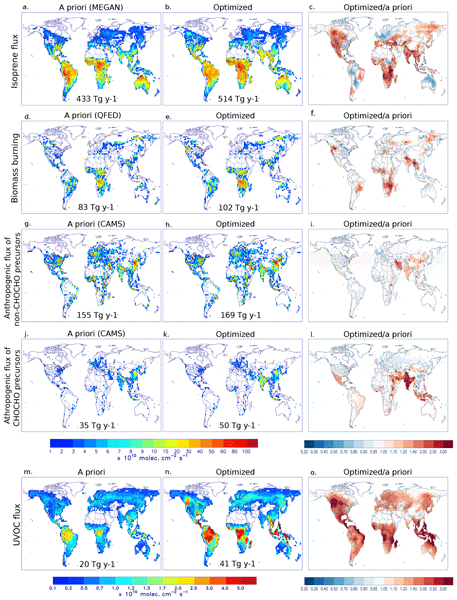
Volatile organic compounds (VOC) emitted from industry, wildfires, fuel use and vegetation impact the climate and are detrimental to human health. To guide regulation aimed at mitigating their impacts, it is important to know their emissions. We used satellite observations of formaldehyde and glyoxal, combined with a chemical transport model, and demonstrate that VOC emissions are about 20 % larger than expected; furthermore, unknown chemical pathways must be invoked to explain the observations.
Pradeep Khatri, Tamio Takamura, and Hitoshi Irie
Atmos. Meas. Tech., 19, 231–247, https://doi.org/10.5194/amt-19-231-2026, https://doi.org/10.5194/amt-19-231-2026, 2026
Short summary
Short summary
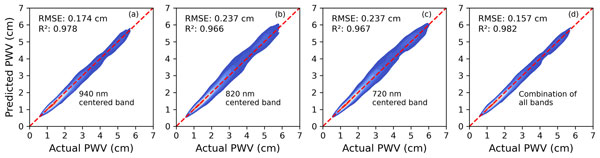
Precipitable water vapor (PWV) is important for various climate and weather studies, but difficult to monitor under various weather conditions. This study shows that surface-based spectral irradiance combined with deep neural network models can accurately estimate PWV under various atmospheric conditions. Models using global, direct, and diffuse irradiances performed best, while even global-only data gave reliable results.
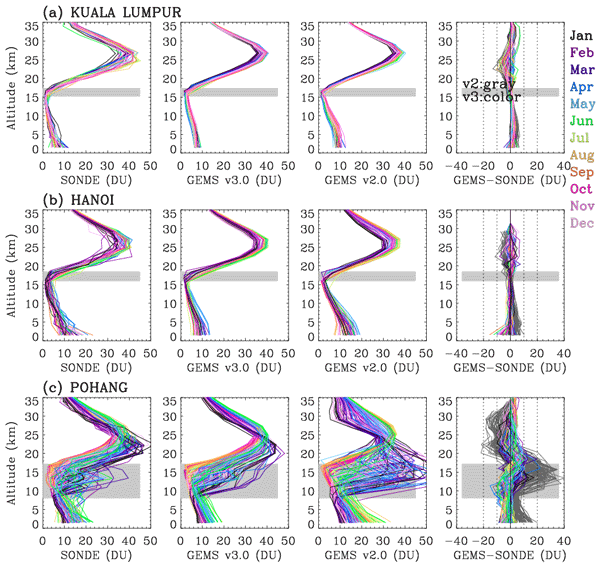
Juseon Bak, Arno Keppens, Daesung Choi, Sungjae Hong, Jae-Hwan Kim, Cheol-Hee Kim, Hyo-Jung Lee, Wonbae Jeon, Jhoon Kim, Ja-Ho Koo, Joowan Kim, Kanghyun Baek, Kai Yang, Xiong Liu, Gonzalo González Abad, Klaus-Peter Heue, Jean-Christopher Lambert, Yeonjin Jung, Hyunkee Hong, and Won-Jin Lee
Atmos. Meas. Tech., 19, 119–134, https://doi.org/10.5194/amt-19-119-2026, https://doi.org/10.5194/amt-19-119-2026, 2026
Short summary
Short summary
This study presents the first complete description of the operational version 3 ozone profile retrieval algorithm for the Geostationary Environment Monitoring Spectrometer (GEMS) and its performance characteristics. Improvements in radiometric and wavelength calibration reduce spectral fitting uncertainties and enhance agreement with ozonesonde profiles and Pandora total ozone measurements.
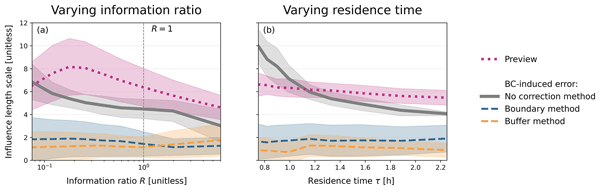
Hannah Nesser, Kevin W. Bowman, Matthew D. Thill, Daniel J. Varon, Cynthia A. Randles, Ashutosh Tewari, Felipe J. Cardoso-Saldaña, Emily Reidy, Joannes D. Maasakkers, and Daniel J. Jacob
Geosci. Model Dev., 18, 9279–9291, https://doi.org/10.5194/gmd-18-9279-2025, https://doi.org/10.5194/gmd-18-9279-2025, 2025
Short summary
Short summary
Regional analyses of atmospheric trace gases can improve knowledge of fluxes at high resolution but rely on specified boundary conditions (BCs) at the domain edges. Biases in the often-uncertain BCs propagate to the inferred fluxes. We develop a framework to explain how errors in the BCs influence the optimized fluxes, derive two metrics to estimate this influence, and compare two methods to correct for the biases. We demonstrate correcting BCs directly is more effective at reducing bias.
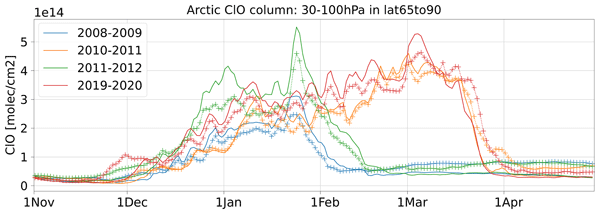
Simon Chabrillat, Samuel Rémy, Quentin Errera, Vincent Huijnen, Christine Bingen, Jonas Debosscher, François Hendrick, Swen Metzger, Adrien Mora, Daniele Minganti, Marc Op de beek, Léa Reisenfeld, Jason E. Williams, Henk Eskes, and Johannes Flemming
Geosci. Model Dev., 18, 8973–9014, https://doi.org/10.5194/gmd-18-8973-2025, https://doi.org/10.5194/gmd-18-8973-2025, 2025
Short summary
Short summary
We document the forecasts of the composition of the stratosphere by the Copernicus Atmosphere Monitoring Service. The model's predictions are compared with satellite measurements over a recent period, during polar ozone depletion events, and after the Mount Pinatubo volcanic eruption. The system performs well for sulfate aerosols, ozone and several other key gases but not as well for several nitrogen-containing gases. Chemical processes in aerosols and polar clouds should be improved.
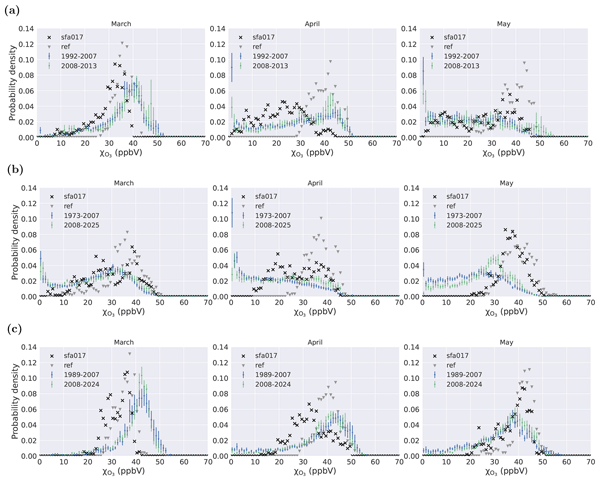
Stefanie Falk, Luca Reißig, Bianca Zilker, Andreas Richter, and Björn-Martin Sinnhuber
Atmos. Chem. Phys., 25, 15653–15682, https://doi.org/10.5194/acp-25-15653-2025, https://doi.org/10.5194/acp-25-15653-2025, 2025
Short summary
Short summary
Ozone depletion events (ODEs) and bromine explosions in the Arctic were studied for 2019/20. Our model underestimated boundary layer height and showed warm biases, affecting ODE simulation. Updates improved coastal ozone agreement but failed to capture strong ODEs. Bromine monoxide (BrO) was overestimated at the surface yet underestimated in columns. Long-term data show declining strong ODEs since 2008, suggesting additional climate-driven factors beyond sea ice age.
Melanie Coldewey-Egbers, Diego G. Loyola R., Barry Latter, Richard Siddans, Brian Kerridge, Daan Hubert, Michel van Roozendael, and Michael Eisinger
Atmos. Meas. Tech., 18, 5485–5505, https://doi.org/10.5194/amt-18-5485-2025, https://doi.org/10.5194/amt-18-5485-2025, 2025
Short summary
Short summary
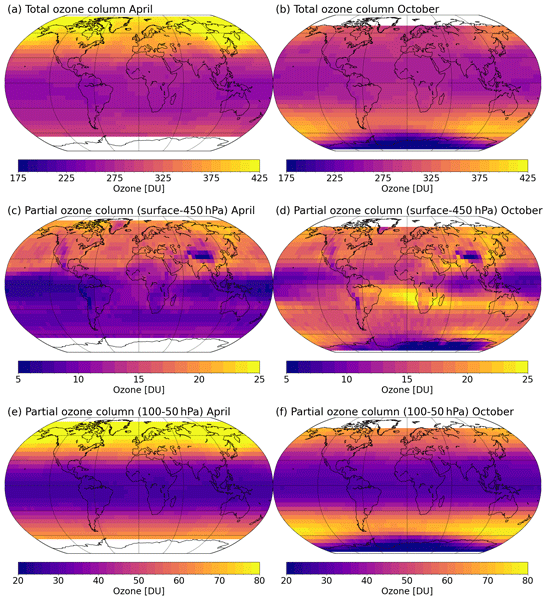
The Global Ozone Monitoring Experiment (GOME)-type Ozone Profile Essential Climate Variable (GOP-ECV) data record provides monthly mean ozone profiles with global coverage from 1995 to 2021 at a spatial resolution of 5° × 5°. Measurements from five nadir-viewing satellite sensors are first harmonized and then merged into a coherent record. The long-term stability of the data record is further improved through scaling the profiles using the GOME-type Total Ozone Essential Climate Variable (GTO-ECV) data record as a reference.
Augustin Colette, Gaëlle Collin, François Besson, Etienne Blot, Vincent Guidard, Frédérik Meleux, Adrien Royer, Valentin Petiot, Claire Miller, Oihana Fermond, Alizé Jeant, Mario Adani, Joaquim Arteta, Anna Benedictow, Robert Bergström, Dene Bowdalo, Jorgen Brandt, Gino Briganti, Ana C. Carvalho, Jesper Heile Christensen, Florian Couvidat, Ilaria D'Elia, Massimo D'Isidoro, Hugo Denier van der Gon, Gaël Descombes, Enza Di Tomaso, John Douros, Jeronimo Escribano, Henk Eskes, Hilde Fagerli, Yalda Fatahi, Johannes Flemming, Elmar Friese, Lise Frohn, Michael Gauss, Camilla Geels, Guido Guarnieri, Marc Guevara, Antoine Guion, Jonathan Guth, Risto Hänninen, Kaj Hansen, Ulas Im, Ruud Janssen, Marine Jeoffrion, Mathieu Joly, Luke Jones, Oriol Jorba, Evgeni Kadantsev, Michael Kahnert, Jacek W. Kaminski, Rostislav Kouznetsov, Richard Kranenburg, Jeroen Kuenen, Anne Caroline Lange, Joachim Langner, Victor Lannuque, Francesca Macchia, Astrid Manders, Mihaela Mircea, Agnes Nyiri, Miriam Olid, Carlos Pérez García-Pando, Yuliia Palamarchuk, Antonio Piersanti, Blandine Raux, Miha Razinger, Lennard Robertson, Arjo Segers, Martijn Schaap, Pilvi Siljamo, David Simpson, Mikhail Sofiev, Anders Stangel, Joanna Struzewska, Carles Tena, Renske Timmermans, Thanos Tsikerdekis, Svetlana Tsyro, Svyatoslav Tyuryakov, Anthony Ung, Andreas Uppstu, Alvaro Valdebenito, Peter van Velthoven, Lina Vitali, Zhuyun Ye, Vincent-Henri Peuch, and Laurence Rouïl
Geosci. Model Dev., 18, 6835–6883, https://doi.org/10.5194/gmd-18-6835-2025, https://doi.org/10.5194/gmd-18-6835-2025, 2025
Short summary
Short summary
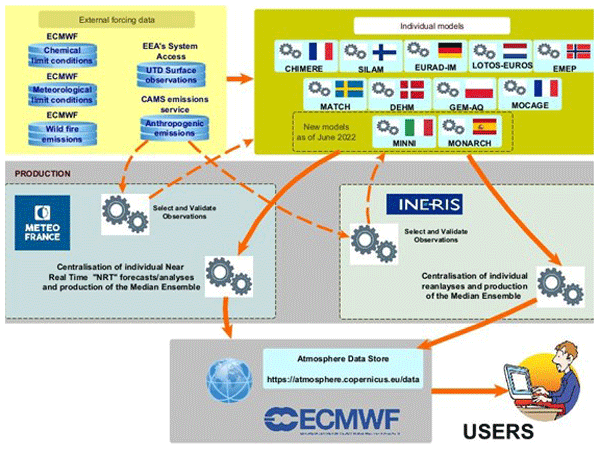
The Copernicus Atmosphere Monitoring Service – Regional Production delivers daily forecasts, analyses, and reanalyses of air quality in Europe. The service relies on a distributed modelling production by 11 leading European modelling teams following stringent requirements with an operational design that has no equivalent in the world. All the products are free, open, and quality-assured and disseminated with a high level of reliability.
Bas Mijling, Henk Eskes, Sascha Hofmann, Pau Moreno, David García Falin, and María Encarnación de Vega Pastor
Geosci. Model Dev., 18, 6439–6460, https://doi.org/10.5194/gmd-18-6439-2025, https://doi.org/10.5194/gmd-18-6439-2025, 2025
Short summary
Short summary
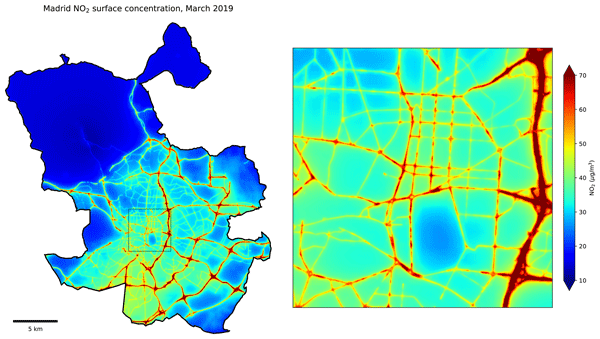
Given the serious health risks of urban air pollution, monitoring local pollution levels is crucial. The Retina v2 algorithm creates high-resolution pollution maps by integrating satellite and local measurements with an air quality model. Easily portable to other cities, it balances accuracy with low computational demands, matching or outperforming complex dispersion models and data-heavy machine learning. Satellite data proves especially valuable in cities with sparse or no monitoring networks.
Isolde Glissenaar, Klaas Folkert Boersma, Isidora Anglou, Pieter Rijsdijk, Tijl Verhoelst, Steven Compernolle, Gaia Pinardi, Jean-Christopher Lambert, Michel Van Roozendael, and Henk Eskes
Earth Syst. Sci. Data, 17, 4627–4650, https://doi.org/10.5194/essd-17-4627-2025, https://doi.org/10.5194/essd-17-4627-2025, 2025
Short summary
Short summary
We developed a new global dataset of nitrogen dioxide (NO2) levels in the lower atmosphere, using data from TROPOMI for 2018–2021. This dataset offers improved accuracy and detail compared to earlier versions, meeting high international standards for climate data. By refining how measurement errors are calculated and reduced over time and space, we provide clearer insights into pollution patterns. This work supports better air quality monitoring and informs actions to address pollution globally.
Miriam Latsch, Andreas Richter, John P. Burrows, and Hartmut Bösch
Atmos. Meas. Tech., 18, 4373–4395, https://doi.org/10.5194/amt-18-4373-2025, https://doi.org/10.5194/amt-18-4373-2025, 2025
Short summary
Short summary
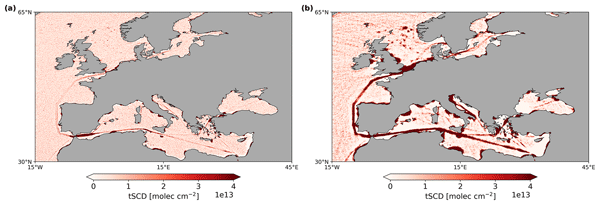
This study presents our advanced methods to qualitatively detect ship-related nitrogen dioxide (NO2) signals in TROPOMI satellite data. By applying filtering techniques, we identify numerous global shipping routes, including previously undetected ones, as well as emissions from offshore platforms. Additionally, we compare the filtered satellite data with high-pass-filtered CAMS global model data to estimate the differences between observed and modeled NO2 emissions.
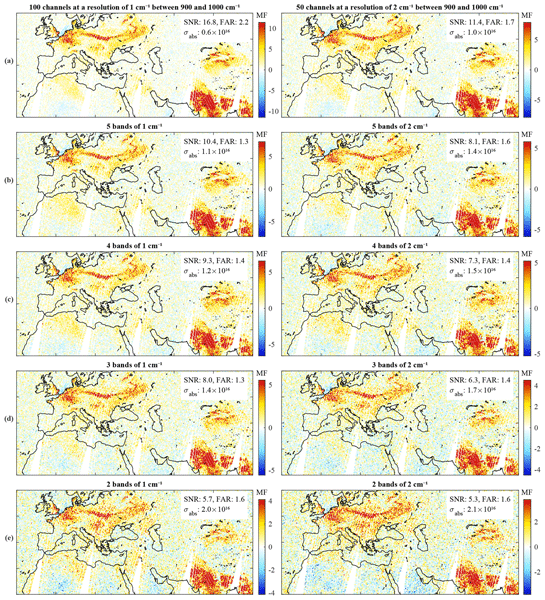
Lara Noppen, Lieven Clarisse, Frederik Tack, Thomas Ruhtz, Martin Van Damme, Michel Van Roozendael, Dirk Schuettemeyer, and Pierre Coheur
Atmos. Meas. Tech., 18, 4183–4205, https://doi.org/10.5194/amt-18-4183-2025, https://doi.org/10.5194/amt-18-4183-2025, 2025
Short summary
Short summary
Current infrared satellite sounders offer high spectral but low spatial resolution, limiting their ability to quantify atmospheric ammonia (NH3) at small scales. Through simulations and analysis of real data, we show that NH3 can be measured effectively from spectra with reduced resolution, either in a contiguous spectral range or in select well-chosen bands. This approach opens possibilities for the development of smaller dedicated instruments for observing NH3 at high spatial resolution.
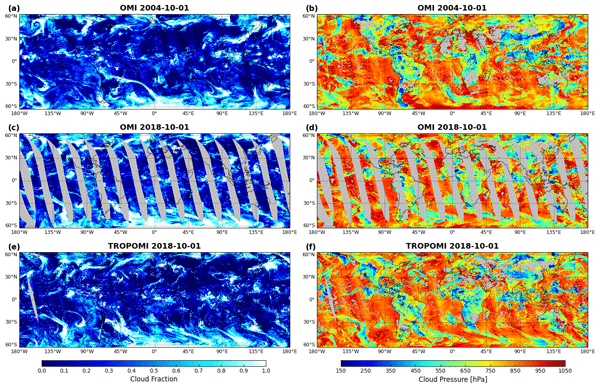
Huan Yu, Isabelle De Smedt, Nicolas Theys, Maarten Sneep, Pepijn Veefkind, and Michel Van Roozendael
Atmos. Meas. Tech., 18, 4131–4163, https://doi.org/10.5194/amt-18-4131-2025, https://doi.org/10.5194/amt-18-4131-2025, 2025
Short summary
Short summary
We introduce a new cloud retrieval algorithm using the O2–O2 absorption band at 477 nm to generate harmonized cloud datasets from OMI and TROPOMI. The algorithm improves upon the OMI O2–O2 operational cloud algorithm in several aspects. The new approach improves consistency in cloud parameters and NO2 retrievals between two sensors.
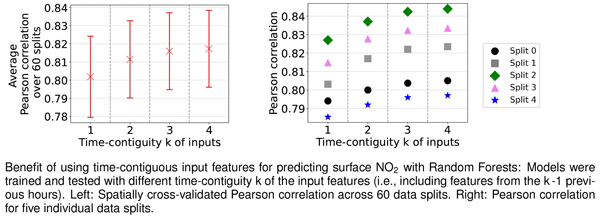
Janek Gödeke, Andreas Richter, Kezia Lange, Peter Maaß, Hyunkee Hong, Hanlim Lee, and Junsung Park
Atmos. Meas. Tech., 18, 3747–3779, https://doi.org/10.5194/amt-18-3747-2025, https://doi.org/10.5194/amt-18-3747-2025, 2025
Short summary
Short summary
The Korean Geostationary Environmental Monitoring Spectrometer (GEMS) monitors trace gases over Asia, e.g., NO2. GEMS provides hourly data, improving the time resolution compared to the daily overpasses by other satellites. For the prediction of hourly surface NO2 over South Korea from GEMS observations and meteorological data, this study shows that machine learning models benefit from this higher time resolution. This is achieved by using observations from previous hours as additional inputs.
Suvarna Fadnavis, Yasin Elshorbany, Jerald Ziemke, Brice Barret, Alexandru Rap, P. R. Satheesh Chandran, Richard J. Pope, Vijay Sagar, Domenico Taraborrelli, Eric Le Flochmoen, Juan Cuesta, Catherine Wespes, Folkert Boersma, Isolde Glissenaar, Isabelle De Smedt, Michel Van Roozendael, Hervé Petetin, and Isidora Anglou
Atmos. Chem. Phys., 25, 8229–8254, https://doi.org/10.5194/acp-25-8229-2025, https://doi.org/10.5194/acp-25-8229-2025, 2025
Short summary
Short summary
Satellites and model simulations show enhancement in tropospheric ozone, which is highly impacted by human-produced nitrous oxides compared to volatile organic compounds. The increased amount of ozone enhances ozone radiative forcing. The ozone enhancement and associated radiative forcing are the highest over South and East Asia. The emissions of nitrous oxides show a higher influence on shifting ozone photochemical regimes than volatile organic compounds.
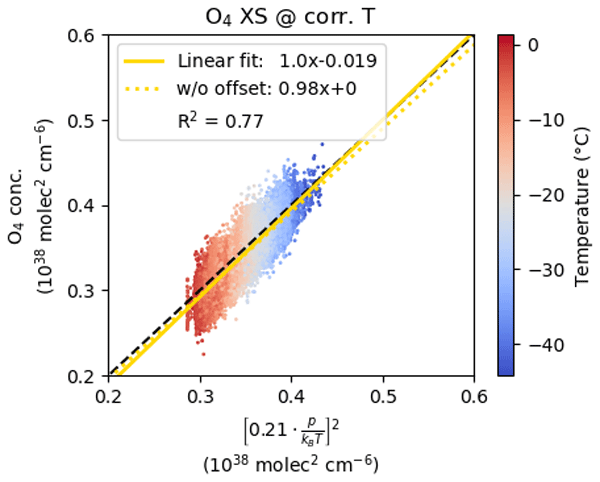
Bianca Lauster, Udo Frieß, Jan-Marcus Nasse, Ulrich Platt, and Thomas Wagner
Atmos. Meas. Tech., 18, 3393–3405, https://doi.org/10.5194/amt-18-3393-2025, https://doi.org/10.5194/amt-18-3393-2025, 2025
Short summary
Short summary
Remote sensing measurements of scattered sunlight use the atmospheric absorption of O2–O2 (or O4) to derive cloud and aerosol properties. However, inconsistencies between measurements and radiative transfer simulations were found recently, and, so far, there has been no consensus on how to deal with these appropriately. In this study, long-term long-path differential optical absorption spectroscopy (LP-DOAS) observations were analysed and very good agreement with laboratory measurements was found.
Rimal Abeed, Audrey Fortems-Cheiney, Grégoire Broquet, Robin Plauchu, Isabelle Pison, Antoine Berchet, Elise Potier, Bo Zheng, Gaëlle Dufour, Adriana Coman, Dilek Savas, Guillaume Siour, Henk Eskes, Beatriz Revilla-Romero, Antony Delavois, and Philippe Ciais
EGUsphere, https://doi.org/10.5194/egusphere-2025-3329, https://doi.org/10.5194/egusphere-2025-3329, 2025
Preprint archived
Short summary
Short summary
We investigate changes in air pollution from nitrogen oxides NOx (=NO+NO2) across Eastern China from 2019 to 2021, using a satellite-based modelling approach. Our results show a drop in pollution in 2020 in most provinces, and along the China-Mongolia-Russia Economic Corridor. The analysis also captures emission variations during the Lunar New Year. By estimating emissions at the provincial level, the study provides insights into how major events and policy measures influence local air quality.
Matthias Kohl, Christoph Brühl, Jennifer Schallock, Holger Tost, Patrick Jöckel, Adrian Jost, Steffen Beirle, Michael Höpfner, and Andrea Pozzer
Geosci. Model Dev., 18, 3985–4007, https://doi.org/10.5194/gmd-18-3985-2025, https://doi.org/10.5194/gmd-18-3985-2025, 2025
Short summary
Short summary
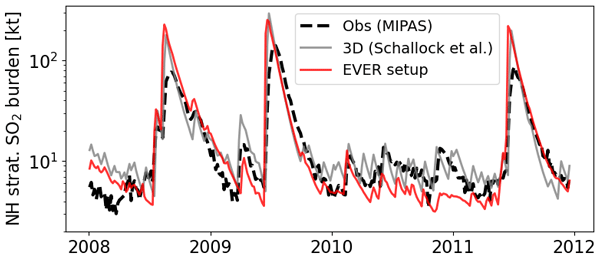
SO2 from explosive volcanic eruptions reaching the stratosphere can oxidize and form sulfur aerosols, potentially persisting for several years. We developed a new submodel, Explosive Volcanic ERuptions (EVER), that seamlessly includes stratospheric volcanic SO2 emissions in global numerical simulations based on a novel standard historical model setup, successfully evaluated with satellite observations. Sensitivity studies on the Nabro eruption in 2011 evaluate different emission methods.
Audrey Fortems-Cheiney, Grégoire Broquet, Elise Potier, Antoine Berchet, Isabelle Pison, Adrien Martinez, Robin Plauchu, Rimal Abeed, Aurélien Sicsik-Paré, Gaelle Dufour, Adriana Coman, Dilek Savas, Guillaume Siour, Henk Eskes, Hugo A. C. Denier van der Gon, and Stijn N. C. Dellaert
Atmos. Chem. Phys., 25, 6047–6068, https://doi.org/10.5194/acp-25-6047-2025, https://doi.org/10.5194/acp-25-6047-2025, 2025
Short summary
Short summary
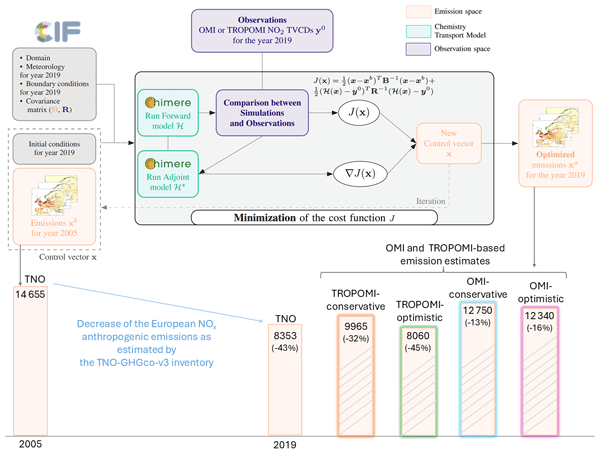
This study assesses the potential of the Ozone Monitoring Instrument (OMI) and the TROPOspheric Monitoring Instrument (TROPOMI) satellite observations to inform about the decrease in anthropogenic emissions of nitrogen oxides (NOx) in 2019 compared with 2005 at regional to national scales in Europe. Both the OMI and TROPOMI inversions show decreases in European NOx anthropogenic emission budgets in 2019 compared to 2005 but with different magnitudes.
Lucas A. Estrada, Daniel J. Varon, Melissa Sulprizio, Hannah Nesser, Zichong Chen, Nicholas Balasus, Sarah E. Hancock, Megan He, James D. East, Todd A. Mooring, Alexander Oort Alonso, Joannes D. Maasakkers, Ilse Aben, Sabour Baray, Kevin W. Bowman, John R. Worden, Felipe J. Cardoso-Saldaña, Emily Reidy, and Daniel J. Jacob
Geosci. Model Dev., 18, 3311–3330, https://doi.org/10.5194/gmd-18-3311-2025, https://doi.org/10.5194/gmd-18-3311-2025, 2025
Short summary
Short summary
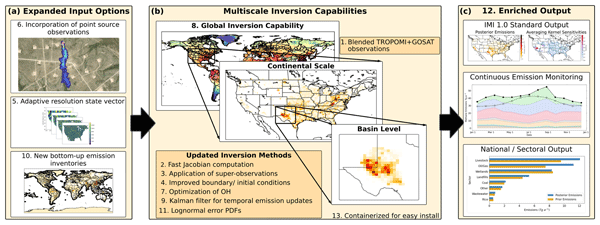
Reducing emissions of methane, a powerful greenhouse gas, is a top policy concern for mitigating anthropogenic climate change. The Integrated Methane Inversion (IMI) is an advanced, cloud-based software that translates satellite observations into actionable emissions data. Here we present IMI version 2.0 with vastly expanded capabilities. These updates enable a wider range of scientific and stakeholder applications from individual basin to global scales with continuous emissions monitoring.
Juliëtte C. S. Anema, K. Folkert Boersma, Lieuwe G. Tilstra, Olaf N. E. Tuinder, and Willem W. Verstraeten
Atmos. Meas. Tech., 18, 1961–1979, https://doi.org/10.5194/amt-18-1961-2025, https://doi.org/10.5194/amt-18-1961-2025, 2025
Short summary
Short summary
Long-term records of plant fluorescence offer vital insights into changing vegetation activity. The GOME-2A sensor provides extensive global observations but suffers from calibration and instrument degradation, which affects data consistency. This study presents the SIFTER v3 algorithm, which effectively resolves these issues and includes other improvements, resulting in robust, accurate, and consistent GOME-2A fluorescence measurements from 2007 to 2017.
Yuhang Zhang, Huan Yu, Isabelle De Smedt, Jintai Lin, Nicolas Theys, Michel Van Roozendael, Gaia Pinardi, Steven Compernolle, Ruijing Ni, Fangxuan Ren, Sijie Wang, Lulu Chen, Jos Van Geffen, Mengyao Liu, Alexander M. Cede, Martin Tiefengraber, Alexis Merlaud, Martina M. Friedrich, Andreas Richter, Ankie Piters, Vinod Kumar, Vinayak Sinha, Thomas Wagner, Yongjoo Choi, Hisahiro Takashima, Yugo Kanaya, Hitoshi Irie, Robert Spurr, Wenfu Sun, and Lorenzo Fabris
Atmos. Meas. Tech., 18, 1561–1589, https://doi.org/10.5194/amt-18-1561-2025, https://doi.org/10.5194/amt-18-1561-2025, 2025
Short summary
Short summary
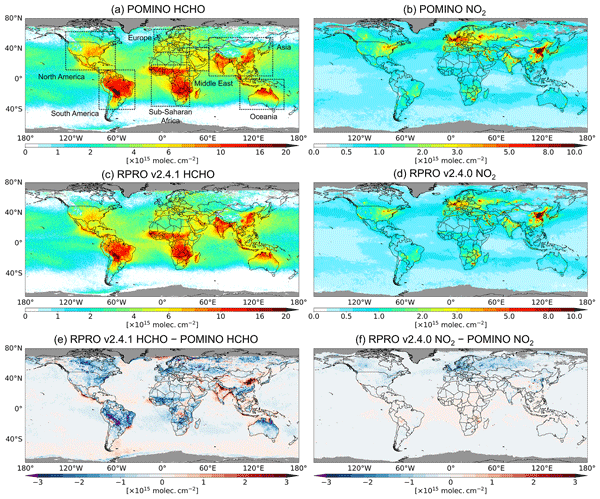
We developed an advanced algorithm for global retrieval of TROPOspheric Monitoring Instrument (TROPOMI) HCHO and NO2 vertical column densities with much improved consistency. Sensitivity tests demonstrate the complexity and nonlinear interactions of auxiliary parameters in the air mass factor calculation. An improved agreement is found with measurements from a global ground-based instrument network. The scientific retrieval provides a useful source of information for studies combining HCHO and NO2.
Qianqian Zhang, K. Folkert Boersma, Chiel van der Laan, Alba Mols, Bin Zhao, Shengyue Li, and Yuepeng Pan
Atmos. Chem. Phys., 25, 3313–3326, https://doi.org/10.5194/acp-25-3313-2025, https://doi.org/10.5194/acp-25-3313-2025, 2025
Short summary
Short summary
Accurate NOx emission estimates are required to better understand air pollution. This study investigates and demonstrates the ability of the superposition column model in combination with TROPOMI tropospheric NO2 column data to estimate city-scale NOx emissions and lifetimes and their variabilities. The results of this work nevertheless confirm the strength of the superposition column model in estimating urban NOx emissions with reasonable accuracy.
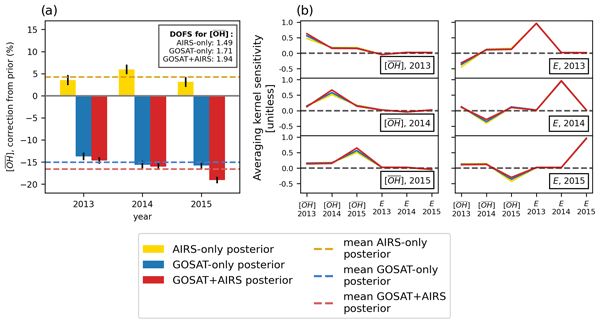
Elise Penn, Daniel J. Jacob, Zichong Chen, James D. East, Melissa P. Sulprizio, Lori Bruhwiler, Joannes D. Maasakkers, Hannah Nesser, Zhen Qu, Yuzhong Zhang, and John Worden
Atmos. Chem. Phys., 25, 2947–2965, https://doi.org/10.5194/acp-25-2947-2025, https://doi.org/10.5194/acp-25-2947-2025, 2025
Short summary
Short summary
The hydroxyl radical (OH) destroys many air pollutants, including methane. Global-mean OH cannot be directly measured, and thus it is inferred with the methyl chloroform (MCF) proxy. MCF is decreasing, and a replacement is needed. We use satellite observations of methane in two spectral ranges as a proxy for OH. We find shortwave infrared observations can characterize yearly OH and its seasonality but not the latitudinal distribution. Thermal infrared observations add little information.
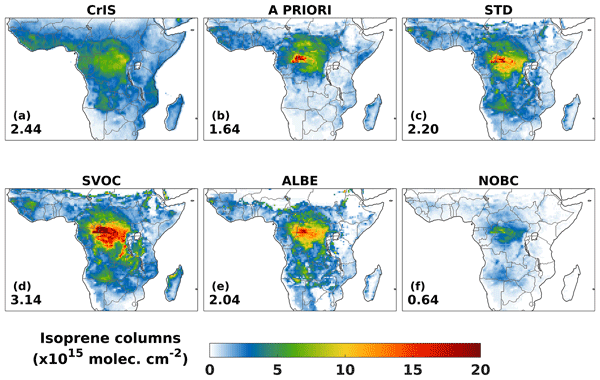
Beata Opacka, Trissevgeni Stavrakou, Jean-François Müller, Isabelle De Smedt, Jos van Geffen, Eloise A. Marais, Rebekah P. Horner, Dylan B. Millet, Kelly C. Wells, and Alex B. Guenther
Atmos. Chem. Phys., 25, 2863–2894, https://doi.org/10.5194/acp-25-2863-2025, https://doi.org/10.5194/acp-25-2863-2025, 2025
Short summary
Short summary
Vegetation releases biogenic volatile organic compounds, while soils and lightning contribute to the natural emissions of nitrogen oxides into the atmosphere. These gases interact in complex ways. Using satellite data and models, we developed a new method to simultaneously optimize these natural emissions over Africa in 2019. Our approach resulted in an increase in natural emissions, supported by independent data indicating that current estimates are underestimated.
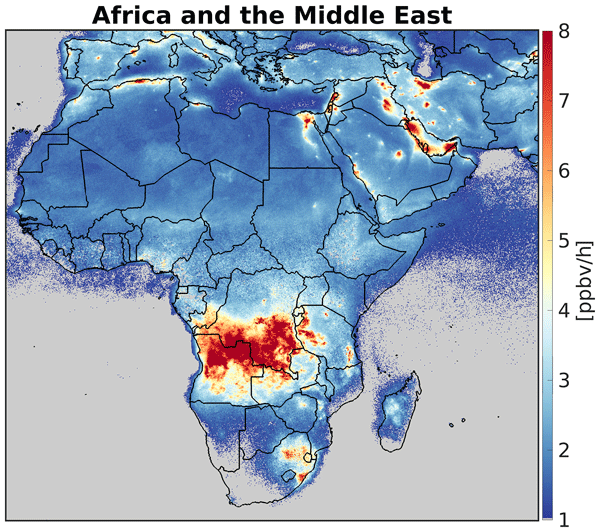
Amir H. Souri, Gonzalo González Abad, Glenn M. Wolfe, Tijl Verhoelst, Corinne Vigouroux, Gaia Pinardi, Steven Compernolle, Bavo Langerock, Bryan N. Duncan, and Matthew S. Johnson
Atmos. Chem. Phys., 25, 2061–2086, https://doi.org/10.5194/acp-25-2061-2025, https://doi.org/10.5194/acp-25-2061-2025, 2025
Short summary
Short summary
We establish a simple yet robust relationship between ozone production rates and geophysical parameters obtained from several intensive atmospheric composition campaigns. We show that satellite remote sensing data can effectively constrain these parameters, enabling us to produce the first global maps of ozone production rates with unprecedented resolution.
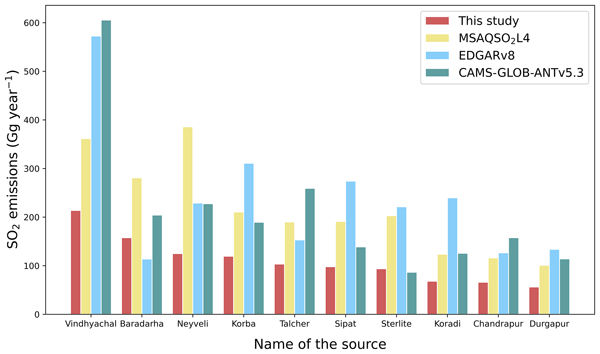
Yutao Chen, Ronald J. van der A, Jieying Ding, Henk Eskes, Jason E. Williams, Nicolas Theys, Athanasios Tsikerdekis, and Pieternel F. Levelt
Atmos. Chem. Phys., 25, 1851–1868, https://doi.org/10.5194/acp-25-1851-2025, https://doi.org/10.5194/acp-25-1851-2025, 2025
Short summary
Short summary
There is a lack of local SO2 top-down emission inventories in India. With the improvement in the divergence method and the derivation of SO2 local lifetime, gridded SO2 emissions over a large area can be estimated efficiently. This method can be applied to any region in the world to derive SO2 emissions. Especially for regions with high latitudes, our methodology has the potential to significantly improve the top-down derivation of SO2 emissions.
Felipe Cifuentes, Henk Eskes, Enrico Dammers, Charlotte Bryan, and Folkert Boersma
Geosci. Model Dev., 18, 621–649, https://doi.org/10.5194/gmd-18-621-2025, https://doi.org/10.5194/gmd-18-621-2025, 2025
Short summary
Short summary
We tested the capability of the flux divergence approach (FDA) to reproduce known NOx emissions using synthetic NO2 satellite column retrievals from high-resolution model simulations. The FDA accurately reproduced NOx emissions when column observations were limited to the boundary layer and when the variability of the NO2 lifetime, the NOx : NO2 ratio, and NO2 profile shapes were correctly modeled. This introduces strong model dependency, reducing the simplicity of the original FDA formulation.
Min Huang, Gregory R. Carmichael, Kevin W. Bowman, Isabelle De Smedt, Andreas Colliander, Michael H. Cosh, Sujay V. Kumar, Alex B. Guenther, Scott J. Janz, Ryan M. Stauffer, Anne M. Thompson, Niko M. Fedkin, Robert J. Swap, John D. Bolten, and Alicia T. Joseph
Atmos. Chem. Phys., 25, 1449–1476, https://doi.org/10.5194/acp-25-1449-2025, https://doi.org/10.5194/acp-25-1449-2025, 2025
Short summary
Short summary
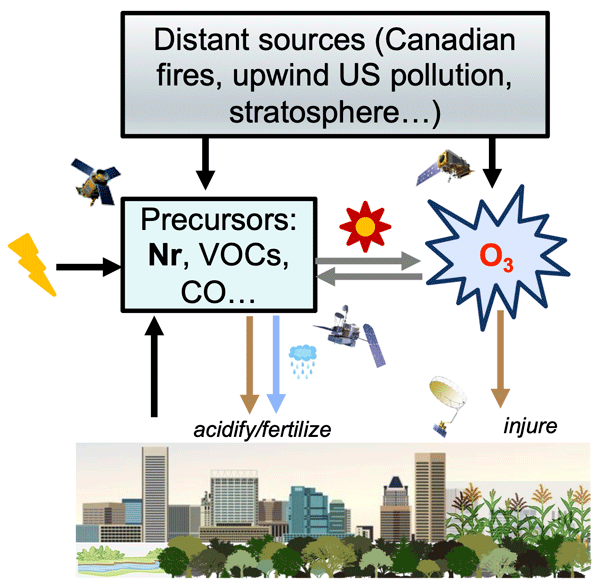
We use model simulations along with multiplatform, multidisciplinary observations and a range of analysis methods to estimate and understand the distributions, temporal changes, and impacts of reactive nitrogen and ozone over the most populous US region that has undergone significant environmental changes. Deposition, biogenic emissions, and extra-regional sources have been playing increasingly important roles in controlling pollutant budgets in this area as local anthropogenic emissions drop.
Pieter Rijsdijk, Henk Eskes, Arlene Dingemans, K. Folkert Boersma, Takashi Sekiya, Kazuyuki Miyazaki, and Sander Houweling
Geosci. Model Dev., 18, 483–509, https://doi.org/10.5194/gmd-18-483-2025, https://doi.org/10.5194/gmd-18-483-2025, 2025
Short summary
Short summary
Clustering high-resolution satellite observations into superobservations improves model validation and data assimilation applications. In our paper, we derive quantitative uncertainties for satellite NO2 column observations based on knowledge of the retrievals, including a detailed analysis of spatial error correlations and representativity errors. The superobservations and uncertainty estimates are tested in a global chemical data assimilation system and are found to improve the forecasts.
Chengxin Zhang, Xinhan Niu, Hongyu Wu, Zhipeng Ding, Ka Lok Chan, Jhoon Kim, Thomas Wagner, and Cheng Liu
Atmos. Chem. Phys., 25, 759–770, https://doi.org/10.5194/acp-25-759-2025, https://doi.org/10.5194/acp-25-759-2025, 2025
Short summary
Short summary
This research utilizes hourly air pollution observations from the world’s first geostationary satellite to develop a spatiotemporal neural network model for full-coverage surface NO2 pollution prediction over the next 24 hours, achieving outstanding forecasting performance and efficacy. These results highlight the profound impact of geostationary satellite observations in advancing air quality forecasting models, thereby contributing to future models for health exposure to air pollution.
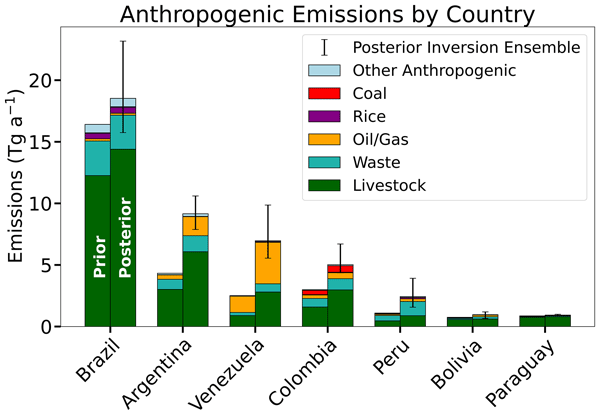
Sarah E. Hancock, Daniel J. Jacob, Zichong Chen, Hannah Nesser, Aaron Davitt, Daniel J. Varon, Melissa P. Sulprizio, Nicholas Balasus, Lucas A. Estrada, María Cazorla, Laura Dawidowski, Sebastián Diez, James D. East, Elise Penn, Cynthia A. Randles, John Worden, Ilse Aben, Robert J. Parker, and Joannes D. Maasakkers
Atmos. Chem. Phys., 25, 797–817, https://doi.org/10.5194/acp-25-797-2025, https://doi.org/10.5194/acp-25-797-2025, 2025
Short summary
Short summary
We quantify 2021 methane emissions in South America at up to 25 km × 25 km resolution using satellite methane observations. We find a 55 % upward adjustment to anthropogenic emission inventories, including those reported to the UN Framework Convention on Climate Change under the Paris Agreement. Our estimates match inventories for Brazil, Bolivia, and Paraguay but are much higher for other countries. Livestock emissions (65 % of anthropogenic emissions) show the largest discrepancies.
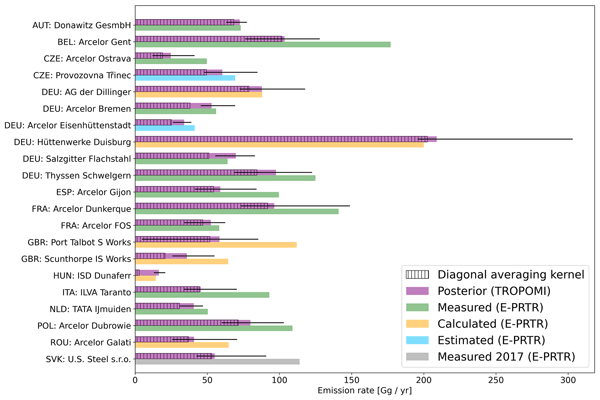
Gijs Leguijt, Joannes D. Maasakkers, Hugo A. C. Denier van der Gon, Arjo J. Segers, Tobias Borsdorff, Ivar R. van der Velde, and Ilse Aben
Atmos. Chem. Phys., 25, 555–574, https://doi.org/10.5194/acp-25-555-2025, https://doi.org/10.5194/acp-25-555-2025, 2025
Short summary
Short summary
The production of steel coincides with large emissions of greenhouse gases and air pollutants including carbon monoxide. European facilities are required to report their emissions, which are estimated using a variety of methods. We evaluate these estimates using carbon monoxide concentrations measured via satellite. We find generally good agreement between our values and those reported but also identify some uncertainties, showing that satellites can provide insights into these emissions.
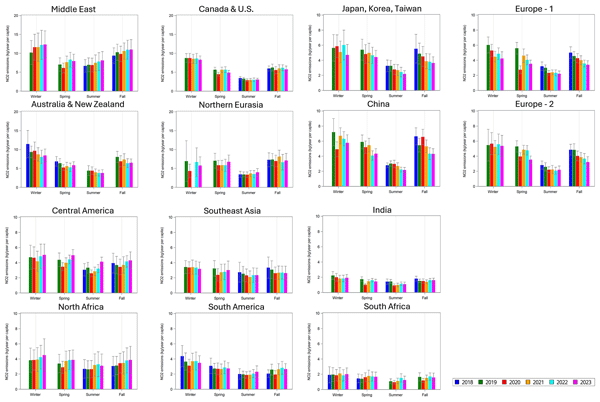
Vitali Fioletov, Chris A. McLinden, Debora Griffin, Xiaoyi Zhao, and Henk Eskes
Atmos. Chem. Phys., 25, 575–596, https://doi.org/10.5194/acp-25-575-2025, https://doi.org/10.5194/acp-25-575-2025, 2025
Short summary
Short summary
Satellite data were used to estimate urban per capita emissions for 261 major cities worldwide. Three components in tropospheric NO2 data (background NO2, NO2 from urban sources, and NO2 from industrial point sources) were isolated, and then each of these components was analyzed separately. The largest per capita emissions were found in the Middle East and the smallest in India and southern Africa. Urban weekend emissions are 20 %–50 % less than workday emissions for all regions except China.
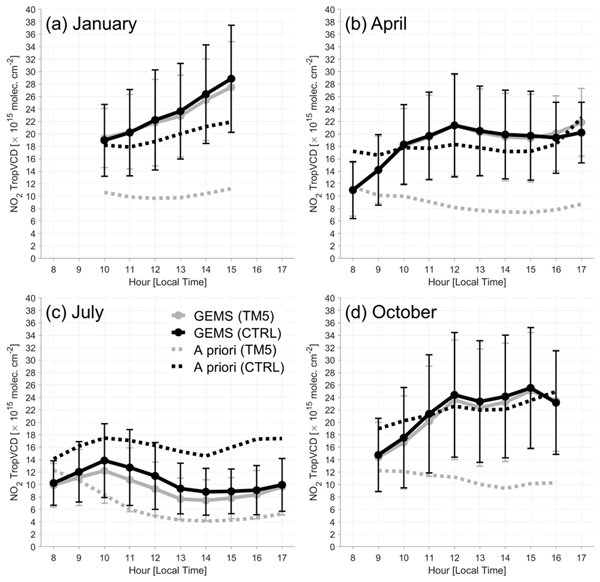
Seunghwan Seo, Si-Wan Kim, Kyoung-Min Kim, Andreas Richter, Kezia Lange, John P. Burrows, Junsung Park, Hyunkee Hong, Hanlim Lee, Ukkyo Jeong, Jung-Hun Woo, and Jhoon Kim
Atmos. Meas. Tech., 18, 115–128, https://doi.org/10.5194/amt-18-115-2025, https://doi.org/10.5194/amt-18-115-2025, 2025
Short summary
Short summary
Over the Seoul metropolitan area, tropospheric NO2 vertical column densities from the Geostationary Environment Monitoring Spectrometer show distinct seasonal features. Also, varying a priori data have substantial impacts on the observed NO2 columns. The a priori data from different chemical transport models resulted in differences of up to −18.3 %. Notably, diurnal patterns of observed NO2 columns are similar for all datasets, although their a priori data exhibit contrasting diurnal patterns.
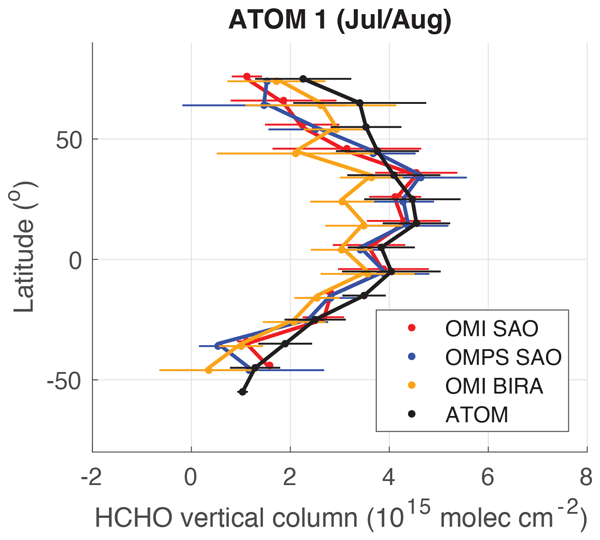
Jin Liao, Glenn M. Wolfe, Alexander E. Kotsakis, Julie M. Nicely, Jason M. St. Clair, Thomas F. Hanisco, Gonzalo González Abad, Caroline R. Nowlan, Zolal Ayazpour, Isabelle De Smedt, Eric C. Apel, and Rebecca S. Hornbrook
Atmos. Meas. Tech., 18, 1–16, https://doi.org/10.5194/amt-18-1-2025, https://doi.org/10.5194/amt-18-1-2025, 2025
Short summary
Short summary
Validation of satellite HCHO over the remote marine regions is relatively low, and modeled HCHO in these regions is usually added as a global satellite HCHO background. This paper intercompares three satellite HCHO retrievals and validates them against in situ observations from the NASA ATom mission. All retrievals are correlated with ATom-integrated columns over remote oceans, with OMI SAO (v004) showing the best agreement. A persistent low bias is found in all retrievals at high latitudes.
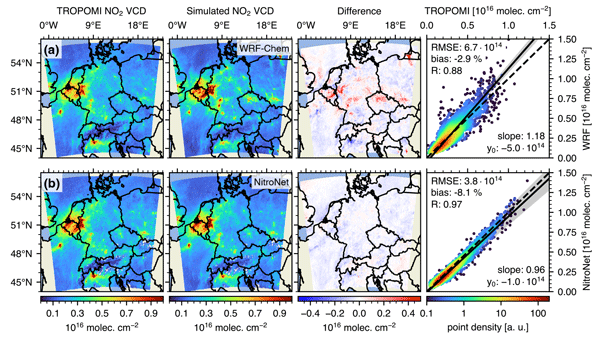
Leon Kuhn, Steffen Beirle, Sergey Osipov, Andrea Pozzer, and Thomas Wagner
Atmos. Meas. Tech., 17, 6485–6516, https://doi.org/10.5194/amt-17-6485-2024, https://doi.org/10.5194/amt-17-6485-2024, 2024
Short summary
Short summary
This paper presents a new machine learning model that allows us to compute NO2 concentration profiles from satellite observations. A neural network was trained on synthetic data from the regional chemistry and transport model WRF-Chem. This is the first model of its kind. We present a thorough model validation study, covering various seasons and regions of the world.
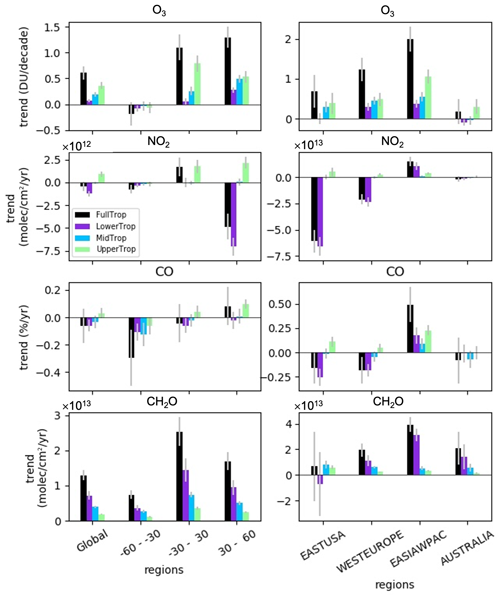
Yasin Elshorbany, Jerald R. Ziemke, Sarah Strode, Hervé Petetin, Kazuyuki Miyazaki, Isabelle De Smedt, Kenneth Pickering, Rodrigo J. Seguel, Helen Worden, Tamara Emmerichs, Domenico Taraborrelli, Maria Cazorla, Suvarna Fadnavis, Rebecca R. Buchholz, Benjamin Gaubert, Néstor Y. Rojas, Thiago Nogueira, Thérèse Salameh, and Min Huang
Atmos. Chem. Phys., 24, 12225–12257, https://doi.org/10.5194/acp-24-12225-2024, https://doi.org/10.5194/acp-24-12225-2024, 2024
Short summary
Short summary
We investigated tropospheric ozone spatial variability and trends from 2005 to 2019 and related those to ozone precursors on global and regional scales. We also investigate the spatiotemporal characteristics of the ozone formation regime in relation to ozone chemical sources and sinks. Our analysis is based on remote sensing products of the tropospheric column of ozone and its precursors, nitrogen dioxide, formaldehyde, and total column CO, as well as ozonesonde data and model simulations.
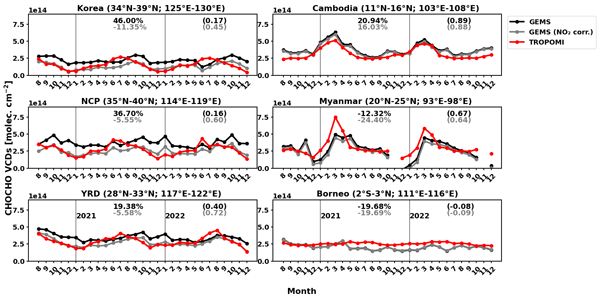
Eunjo S. Ha, Rokjin J. Park, Hyeong-Ahn Kwon, Gitaek T. Lee, Sieun D. Lee, Seunga Shin, Dong-Won Lee, Hyunkee Hong, Christophe Lerot, Isabelle De Smedt, Thomas Danckaert, Francois Hendrick, and Hitoshi Irie
Atmos. Meas. Tech., 17, 6369–6384, https://doi.org/10.5194/amt-17-6369-2024, https://doi.org/10.5194/amt-17-6369-2024, 2024
Short summary
Short summary
In this study, we evaluated the GEMS glyoxal products by comparing them with TROPOMI and MAX-DOAS measurements. GEMS and TROPOMI VCDs present similar spatial distributions. Monthly variations in GEMS VCDs and TROPOMI and MAX-DOAS VCDs differ in northeastern Asia, which we attributed to a polluted reference spectrum and high NO2 concentrations. GEMS glyoxal products with unparalleled temporal resolution would enrich our understanding of VOC emissions and diurnal variation.
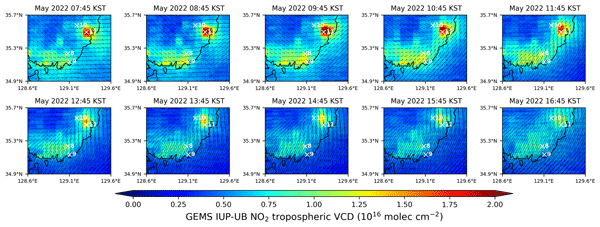
Kezia Lange, Andreas Richter, Tim Bösch, Bianca Zilker, Miriam Latsch, Lisa K. Behrens, Chisom M. Okafor, Hartmut Bösch, John P. Burrows, Alexis Merlaud, Gaia Pinardi, Caroline Fayt, Martina M. Friedrich, Ermioni Dimitropoulou, Michel Van Roozendael, Steffen Ziegler, Simona Ripperger-Lukosiunaite, Leon Kuhn, Bianca Lauster, Thomas Wagner, Hyunkee Hong, Donghee Kim, Lim-Seok Chang, Kangho Bae, Chang-Keun Song, Jong-Uk Park, and Hanlim Lee
Atmos. Meas. Tech., 17, 6315–6344, https://doi.org/10.5194/amt-17-6315-2024, https://doi.org/10.5194/amt-17-6315-2024, 2024
Short summary
Short summary
Instruments for air quality observations on geostationary satellites provide multiple observations per day and allow for the analysis of the diurnal variation of important air pollutants such as nitrogen dioxide (NO2) over large areas. The South Korean instrument GEMS, launched in February 2020, is the first instrument in geostationary orbit and covers a large part of Asia. Our investigations show the observed diurnal evolution of NO2 at different measurement sites.
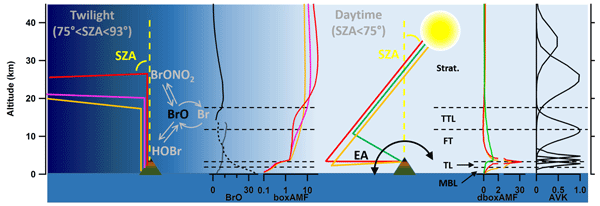
Theodore K. Koenig, François Hendrick, Douglas Kinnison, Christopher F. Lee, Michel Van Roozendael, and Rainer Volkamer
Atmos. Meas. Tech., 17, 5911–5934, https://doi.org/10.5194/amt-17-5911-2024, https://doi.org/10.5194/amt-17-5911-2024, 2024
Short summary
Short summary
Atmospheric bromine destroys ozone, impacts oxidation capacity, and oxidizes mercury into its toxic form. We constrain bromine by remote sensing of BrO from a mountaintop. Previous measurements retrieved two to three pieces of information vertically; we apply new methods to get five and a half vertically and two more in time. We compare with aircraft measurements to validate the methods and look at variations in BrO over the Pacific.
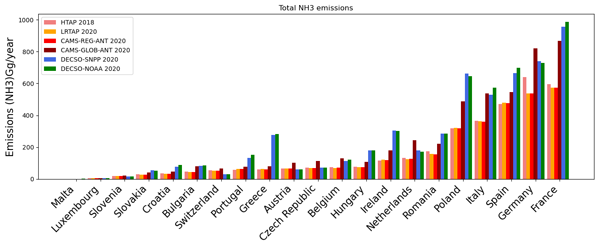
Jieying Ding, Ronald van der A, Henk Eskes, Enrico Dammers, Mark Shephard, Roy Wichink Kruit, Marc Guevara, and Leonor Tarrason
Atmos. Chem. Phys., 24, 10583–10599, https://doi.org/10.5194/acp-24-10583-2024, https://doi.org/10.5194/acp-24-10583-2024, 2024
Short summary
Short summary
Here we applied the existing Daily Emissions Constrained by Satellite Observations (DECSO) inversion algorithm to NH3 observations from the CrIS satellite instrument to estimate NH3 emissions. As NH3 in the atmosphere is influenced by NOx, we implemented DECSO to estimate NOx and NH3 emissions simultaneously. The emissions are derived over Europe for 2020 at a spatial resolution of 0.2° using daily observations from CrIS and TROPOMI. Results are compared to bottom-up emission inventories.
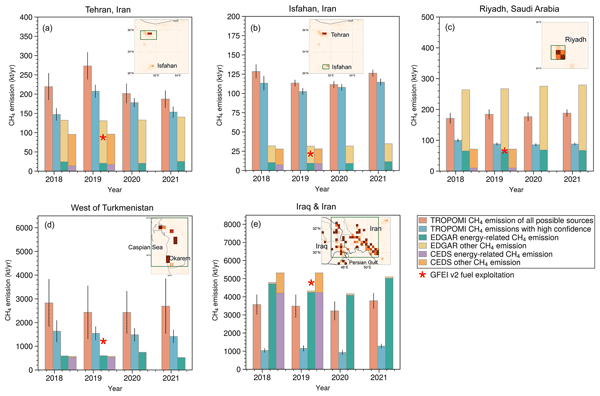
Mengyao Liu, Ronald van der A, Michiel van Weele, Lotte Bryan, Henk Eskes, Pepijn Veefkind, Yongxue Liu, Xiaojuan Lin, Jos de Laat, and Jieying Ding
Atmos. Meas. Tech., 17, 5261–5277, https://doi.org/10.5194/amt-17-5261-2024, https://doi.org/10.5194/amt-17-5261-2024, 2024
Short summary
Short summary
A new divergence method was developed and applied to estimate methane emissions from TROPOMI observations over the Middle East, where it is typically challenging for a satellite to measure methane due to its complicated orography and surface albedo. Our results show the potential of TROPOMI to quantify methane emissions from various sources rather than big emitters from space after objectively excluding the artifacts in the retrieval.
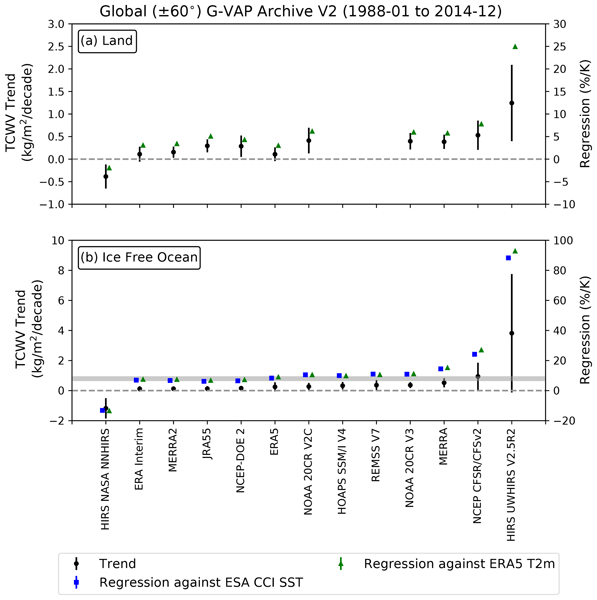
Tim Trent, Marc Schröder, Shu-Peng Ho, Steffen Beirle, Ralf Bennartz, Eva Borbas, Christian Borger, Helene Brogniez, Xavier Calbet, Elisa Castelli, Gilbert P. Compo, Wesley Ebisuzaki, Ulrike Falk, Frank Fell, John Forsythe, Hans Hersbach, Misako Kachi, Shinya Kobayashi, Robert E. Kursinski, Diego Loyola, Zhengzao Luo, Johannes K. Nielsen, Enzo Papandrea, Laurence Picon, Rene Preusker, Anthony Reale, Lei Shi, Laura Slivinski, Joao Teixeira, Tom Vonder Haar, and Thomas Wagner
Atmos. Chem. Phys., 24, 9667–9695, https://doi.org/10.5194/acp-24-9667-2024, https://doi.org/10.5194/acp-24-9667-2024, 2024
Short summary
Short summary
In a warmer future, water vapour will spend more time in the atmosphere, changing global rainfall patterns. In this study, we analysed the performance of 28 water vapour records between 1988 and 2014. We find sensitivity to surface warming generally outside expected ranges, attributed to breakpoints in individual record trends and differing representations of climate variability. The implication is that longer records are required for high confidence in assessing climate trends.
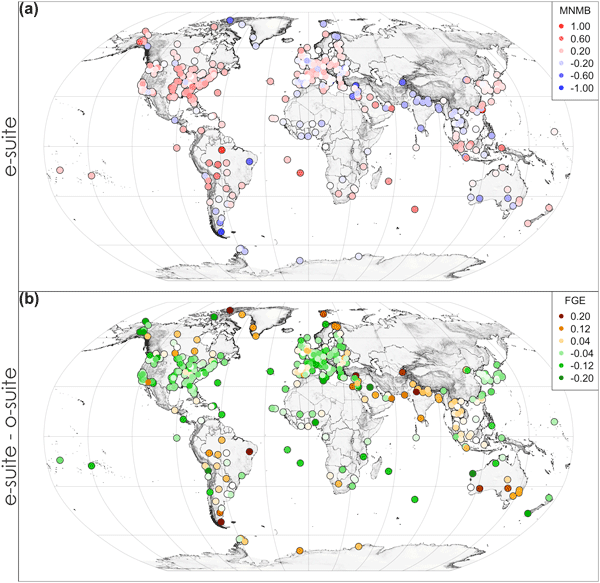
Henk Eskes, Athanasios Tsikerdekis, Melanie Ades, Mihai Alexe, Anna Carlin Benedictow, Yasmine Bennouna, Lewis Blake, Idir Bouarar, Simon Chabrillat, Richard Engelen, Quentin Errera, Johannes Flemming, Sebastien Garrigues, Jan Griesfeller, Vincent Huijnen, Luka Ilić, Antje Inness, John Kapsomenakis, Zak Kipling, Bavo Langerock, Augustin Mortier, Mark Parrington, Isabelle Pison, Mikko Pitkänen, Samuel Remy, Andreas Richter, Anja Schoenhardt, Michael Schulz, Valerie Thouret, Thorsten Warneke, Christos Zerefos, and Vincent-Henri Peuch
Atmos. Chem. Phys., 24, 9475–9514, https://doi.org/10.5194/acp-24-9475-2024, https://doi.org/10.5194/acp-24-9475-2024, 2024
Short summary
Short summary
The Copernicus Atmosphere Monitoring Service (CAMS) provides global analyses and forecasts of aerosols and trace gases in the atmosphere. On 27 June 2023 a major upgrade, Cy48R1, became operational. Comparisons with in situ, surface remote sensing, aircraft, and balloon and satellite observations show that the new CAMS system is a significant improvement. The results quantify the skill of CAMS to forecast impactful events, such as wildfires, dust storms and air pollution peaks.
Tong Sha, Siyu Yang, Qingcai Chen, Liangqing Li, Xiaoyan Ma, Yan-Lin Zhang, Zhaozhong Feng, K. Folkert Boersma, and Jun Wang
Atmos. Chem. Phys., 24, 8441–8455, https://doi.org/10.5194/acp-24-8441-2024, https://doi.org/10.5194/acp-24-8441-2024, 2024
Short summary
Short summary
Using an updated soil reactive nitrogen emission scheme in the Unified Inputs for Weather Research and Forecasting coupled with Chemistry (UI-WRF-Chem) model, we investigate the role of soil NO and HONO (Nr) emissions in air quality and temperature in North China. Contributions of soil Nr emissions to O3 and secondary pollutants are revealed, exceeding effects of soil NOx or HONO emission. Soil Nr emissions play an important role in mitigating O3 pollution and addressing climate change.
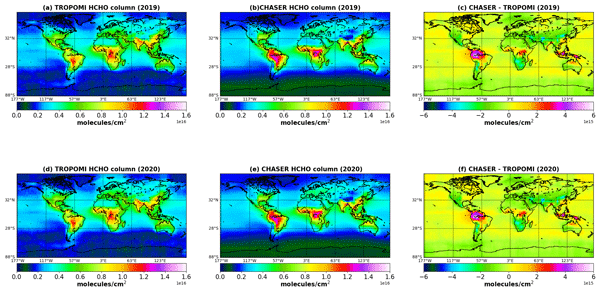
Hossain Mohammed Syedul Hoque, Kengo Sudo, Hitoshi Irie, Yanfeng He, and Md Firoz Khan
Geosci. Model Dev., 17, 5545–5571, https://doi.org/10.5194/gmd-17-5545-2024, https://doi.org/10.5194/gmd-17-5545-2024, 2024
Short summary
Short summary
Using multi-platform observations, we validated global formaldehyde (HCHO) simulations from a chemistry transport model. HCHO is a crucial intermediate in the chemical catalytic cycle that governs the ozone formation in the troposphere. The model was capable of replicating the observed spatiotemporal variability in HCHO. In a few cases, the model's capability was limited. This is attributed to the uncertainties in the observations and the model parameters.
Maarten Krol, Bart van Stratum, Isidora Anglou, and Klaas Folkert Boersma
Atmos. Chem. Phys., 24, 8243–8262, https://doi.org/10.5194/acp-24-8243-2024, https://doi.org/10.5194/acp-24-8243-2024, 2024
Short summary
Short summary
This paper presents detailed plume simulations of nitrogen oxides and carbon dioxide that are emitted from four large industrial facilities world-wide. Results from the high-resolution simulations that include atmospheric chemistry are compared to nitrogen dioxide observations from satellites. We find good performance of the model and show that common assumptions that are used in simplified models need revision. This work is important for the monitoring of emissions using satellite data.
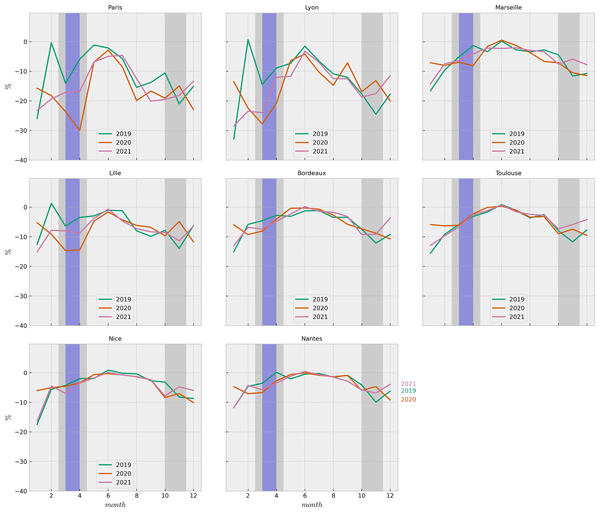
Robin Plauchu, Audrey Fortems-Cheiney, Grégoire Broquet, Isabelle Pison, Antoine Berchet, Elise Potier, Gaëlle Dufour, Adriana Coman, Dilek Savas, Guillaume Siour, and Henk Eskes
Atmos. Chem. Phys., 24, 8139–8163, https://doi.org/10.5194/acp-24-8139-2024, https://doi.org/10.5194/acp-24-8139-2024, 2024
Short summary
Short summary
This study uses the Community Inversion Framework and CHIMERE model to assess the potential of TROPOMI-S5P PAL NO2 tropospheric column data to estimate NOx emissions in France (2019–2021). Results show a 3 % decrease in average emissions compared to the 2016 CAMS-REG/INS, lower than the 14 % decrease from CITEPA. The study highlights challenges in capturing emission anomalies due to limited data coverage and error levels but shows promise for local inventory improvements.
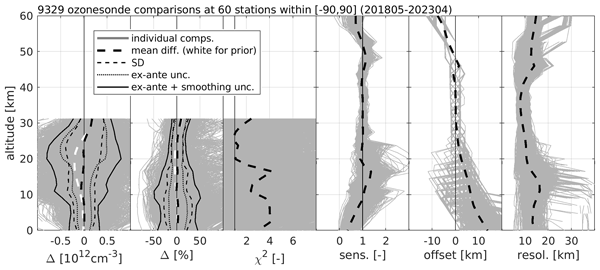
Arno Keppens, Serena Di Pede, Daan Hubert, Jean-Christopher Lambert, Pepijn Veefkind, Maarten Sneep, Johan De Haan, Mark ter Linden, Thierry Leblanc, Steven Compernolle, Tijl Verhoelst, José Granville, Oindrila Nath, Ann Mari Fjæraa, Ian Boyd, Sander Niemeijer, Roeland Van Malderen, Herman G. J. Smit, Valentin Duflot, Sophie Godin-Beekmann, Bryan J. Johnson, Wolfgang Steinbrecht, David W. Tarasick, Debra E. Kollonige, Ryan M. Stauffer, Anne M. Thompson, Angelika Dehn, and Claus Zehner
Atmos. Meas. Tech., 17, 3969–3993, https://doi.org/10.5194/amt-17-3969-2024, https://doi.org/10.5194/amt-17-3969-2024, 2024
Short summary
Short summary
The Sentinel-5P satellite operated by the European Space Agency has carried the TROPOspheric Monitoring Instrument (TROPOMI) around the Earth since October 2017. This mission also produces atmospheric ozone profile data which are described in detail for May 2018 to April 2023. Independent validation using ground-based reference measurements demonstrates that the operational ozone profile product mostly fully and at least partially complies with all mission requirements.
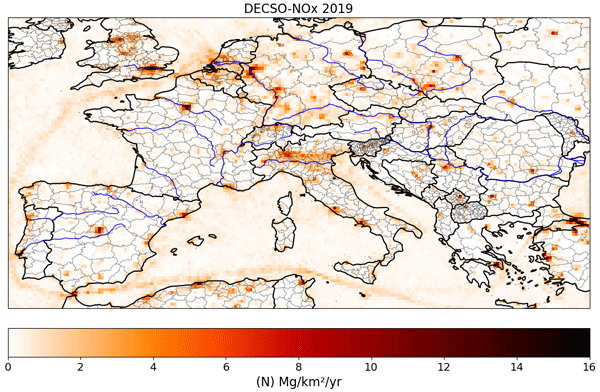
Ronald J. van der A, Jieying Ding, and Henk Eskes
Atmos. Chem. Phys., 24, 7523–7534, https://doi.org/10.5194/acp-24-7523-2024, https://doi.org/10.5194/acp-24-7523-2024, 2024
Short summary
Short summary
Using observations of the Sentinel-5P satellite and the latest version of the inversion algorithm DECSO, anthropogenic NOx emissions are derived for Europe for the years 2019–2022 with a spatial resolution of 0.2°. The results are compared with European emissions of the Copernicus Atmosphere Monitoring Service.
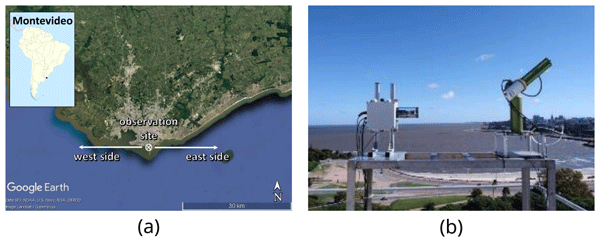
Matías Osorio, Alejandro Agesta, Tim Bösch, Nicolás Casaballe, Andreas Richter, Leonardo M. A. Alvarado, and Erna Frins
Atmos. Chem. Phys., 24, 7447–7465, https://doi.org/10.5194/acp-24-7447-2024, https://doi.org/10.5194/acp-24-7447-2024, 2024
Short summary
Short summary
This study concerns the detection and quantification of long-transport emissions of a biomass burning event, which represents a major source of air pollutants, due to the release of large amounts of aerosols and chemical species into the atmosphere. The quantification was done using ground-based observations (which play an important role in assessing the abundance of trace gases and aerosols) over Montevideo (Uruguay) and using satellite observations.
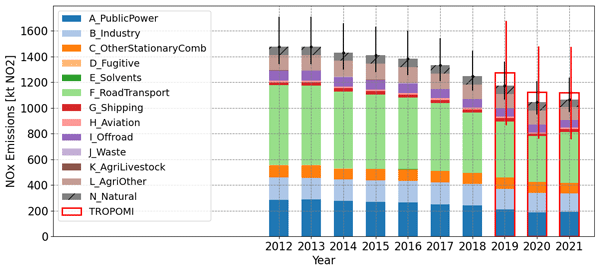
Enrico Dammers, Janot Tokaya, Christian Mielke, Kevin Hausmann, Debora Griffin, Chris McLinden, Henk Eskes, and Renske Timmermans
Geosci. Model Dev., 17, 4983–5007, https://doi.org/10.5194/gmd-17-4983-2024, https://doi.org/10.5194/gmd-17-4983-2024, 2024
Short summary
Short summary
Nitrogen dioxide (NOx) is produced by sources such as industry and traffic and is directly linked to negative impacts on health and the environment. The current construction of emission inventories to keep track of NOx emissions is slow and time-consuming. Satellite measurements provide a way to quickly and independently estimate emissions. In this study, we apply a consistent methodology to derive NOx emissions over Germany and illustrate the value of having such a method for fast projections.
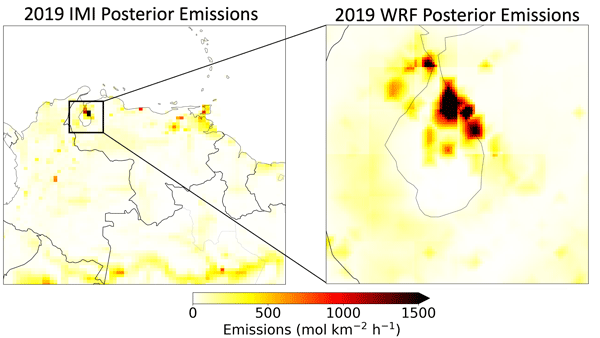
Brian Nathan, Joannes D. Maasakkers, Stijn Naus, Ritesh Gautam, Mark Omara, Daniel J. Varon, Melissa P. Sulprizio, Lucas A. Estrada, Alba Lorente, Tobias Borsdorff, Robert J. Parker, and Ilse Aben
Atmos. Chem. Phys., 24, 6845–6863, https://doi.org/10.5194/acp-24-6845-2024, https://doi.org/10.5194/acp-24-6845-2024, 2024
Short summary
Short summary
Venezuela's Lake Maracaibo region is notoriously hard to observe from space and features intensive oil exploitation, although production has strongly decreased in recent years. We estimate methane emissions using 2018–2020 TROPOMI satellite observations with national and regional transport models. Despite the production decrease, we find relatively constant emissions from Lake Maracaibo between 2018 and 2020, indicating that there could be large emissions from abandoned infrastructure.
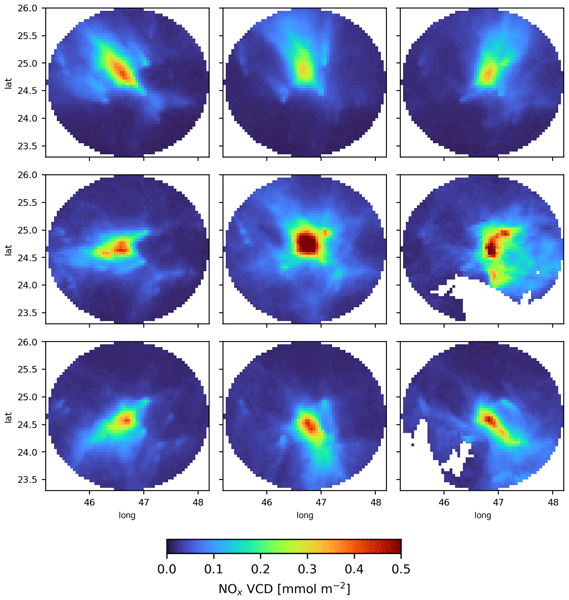
Steffen Beirle and Thomas Wagner
Atmos. Meas. Tech., 17, 3439–3453, https://doi.org/10.5194/amt-17-3439-2024, https://doi.org/10.5194/amt-17-3439-2024, 2024
Short summary
Short summary
We present a new method for estimating emissions and lifetimes for nitrogen oxides emitted from large cities by using satellite NO2 observations combined with wind fields. The estimate is based on the simultaneous evaluation of the downwind plumes for opposing wind directions. This allows us to derive seasonal mean emissions and lifetimes for 100 cities around the globe.
Drew C. Pendergrass, Daniel J. Jacob, Yujin J. Oak, Jeewoo Lee, Minseok Kim, Jhoon Kim, Seoyoung Lee, Shixian Zhai, Hitoshi Irie, and Hong Liao
Earth Syst. Sci. Data Discuss., https://doi.org/10.5194/essd-2024-172, https://doi.org/10.5194/essd-2024-172, 2024
Preprint withdrawn
Short summary
Short summary
Fine particles suspended in the atmosphere are a major form of air pollution and an important public health burden. However, measurements of particulate matter are sparse in space and in places like East Asia monitors are established after regulatory policies to improve pollution have changed. In this paper, we use machine learning to fill in the gaps. We train an algorithm to predict pollution at the surface from the atmosphere’s opacity, then produce high resolution maps of data without gaps.
Juliëtte C. S. Anema, Klaas Folkert Boersma, Piet Stammes, Gerbrand Koren, William Woodgate, Philipp Köhler, Christian Frankenberg, and Jacqui Stol
Biogeosciences, 21, 2297–2311, https://doi.org/10.5194/bg-21-2297-2024, https://doi.org/10.5194/bg-21-2297-2024, 2024
Short summary
Short summary
To keep the Paris agreement goals within reach, negative emissions are necessary. They can be achieved with mitigation techniques, such as reforestation, which remove CO2 from the atmosphere. While governments have pinned their hopes on them, there is not yet a good set of tools to objectively determine whether negative emissions do what they promise. Here we show how satellite measurements of plant fluorescence are useful in detecting carbon uptake due to reforestation and vegetation regrowth.
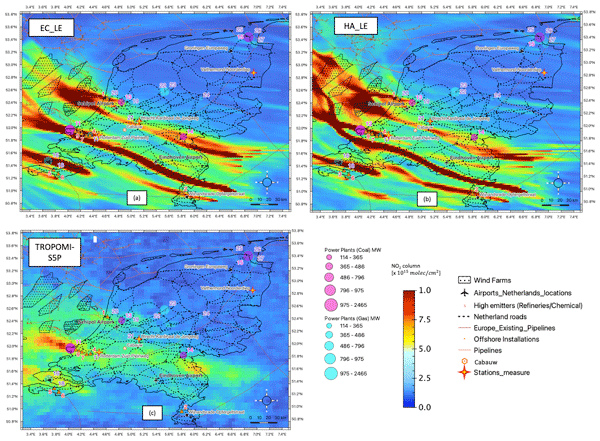
Andrés Yarce Botero, Michiel van Weele, Arjo Segers, Pier Siebesma, and Henk Eskes
Geosci. Model Dev., 17, 3765–3781, https://doi.org/10.5194/gmd-17-3765-2024, https://doi.org/10.5194/gmd-17-3765-2024, 2024
Short summary
Short summary
HARMONIE WINS50 reanalysis data with 0.025° × 0.025° resolution from 2019 to 2021 were coupled with the LOTOS-EUROS Chemical Transport Model. HARMONIE and ECMWF meteorology configurations against Cabauw observations (52.0° N, 4.9° W) were evaluated as simulated NO2 concentrations with ground-level sensors. Differences in crucial meteorological input parameters (boundary layer height, vertical diffusion coefficient) between the hydrostatic and non-hydrostatic models were analysed.
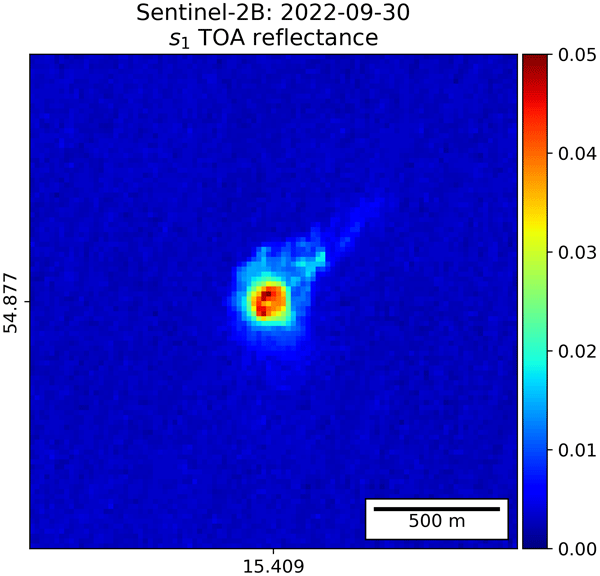
Matthieu Dogniaux, Joannes D. Maasakkers, Daniel J. Varon, and Ilse Aben
Atmos. Meas. Tech., 17, 2777–2787, https://doi.org/10.5194/amt-17-2777-2024, https://doi.org/10.5194/amt-17-2777-2024, 2024
Short summary
Short summary
We analyze Landsat 8 (L8) and Sentinel-2B (S-2B) observations of the 2022 Nord Stream 2 methane leak and show how challenging this case is for usual data analysis methods. We provide customized calibrations for this Nord Stream 2 case and assess that no firm conclusion can be drawn from L8 or S-2B single overpasses. However, if we opportunistically assume that L8 and S-2B results are independent, we find an averaged L8 and S-2B combined methane leak rate of 502 ± 464 t h−1.
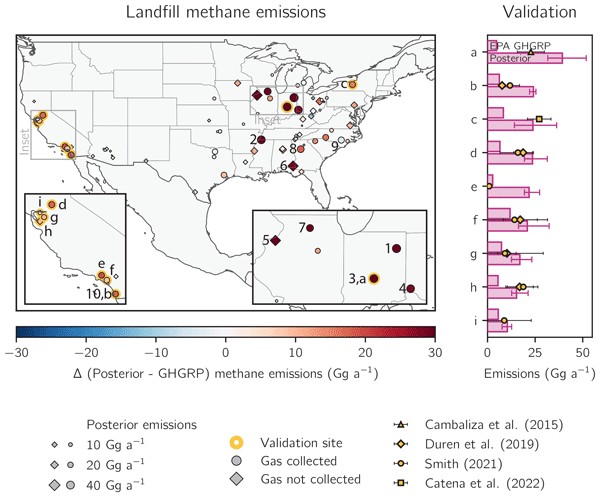
Hannah Nesser, Daniel J. Jacob, Joannes D. Maasakkers, Alba Lorente, Zichong Chen, Xiao Lu, Lu Shen, Zhen Qu, Melissa P. Sulprizio, Margaux Winter, Shuang Ma, A. Anthony Bloom, John R. Worden, Robert N. Stavins, and Cynthia A. Randles
Atmos. Chem. Phys., 24, 5069–5091, https://doi.org/10.5194/acp-24-5069-2024, https://doi.org/10.5194/acp-24-5069-2024, 2024
Short summary
Short summary
We quantify 2019 methane emissions in the contiguous US (CONUS) at a ≈ 25 km × 25 km resolution using satellite methane observations. We find a 13 % upward correction to the 2023 US Environmental Protection Agency (EPA) Greenhouse Gas Emissions Inventory (GHGI) for 2019, with large corrections to individual states, urban areas, and landfills. This may present a challenge for US climate policies and goals, many of which target significant reductions in methane emissions.
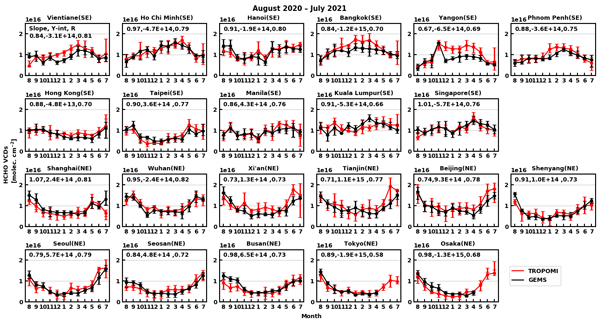
Gitaek T. Lee, Rokjin J. Park, Hyeong-Ahn Kwon, Eunjo S. Ha, Sieun D. Lee, Seunga Shin, Myoung-Hwan Ahn, Mina Kang, Yong-Sang Choi, Gyuyeon Kim, Dong-Won Lee, Deok-Rae Kim, Hyunkee Hong, Bavo Langerock, Corinne Vigouroux, Christophe Lerot, Francois Hendrick, Gaia Pinardi, Isabelle De Smedt, Michel Van Roozendael, Pucai Wang, Heesung Chong, Yeseul Cho, and Jhoon Kim
Atmos. Chem. Phys., 24, 4733–4749, https://doi.org/10.5194/acp-24-4733-2024, https://doi.org/10.5194/acp-24-4733-2024, 2024
Short summary
Short summary
This study evaluates the Geostationary Environment Monitoring Spectrometer (GEMS) HCHO product by comparing its vertical column densities (VCDs) with those of TROPOMI and ground-based observations. Based on some sensitivity tests, obtaining radiance references under clear-sky conditions significantly improves HCHO retrieval quality. GEMS HCHO VCDs captured seasonal and diurnal variations well during the first year of observation, showing consistency with TROPOMI and ground-based observations.
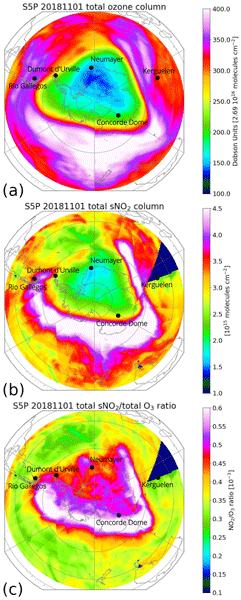
Adrianus de Laat, Jos van Geffen, Piet Stammes, Ronald van der A, Henk Eskes, and J. Pepijn Veefkind
Atmos. Chem. Phys., 24, 4511–4535, https://doi.org/10.5194/acp-24-4511-2024, https://doi.org/10.5194/acp-24-4511-2024, 2024
Short summary
Short summary
Removal of stratospheric nitrogen oxides is crucial for the formation of the ozone hole. TROPOMI satellite measurements of nitrogen dioxide reveal the presence of a not dissimilar "nitrogen hole" that largely coincides with the ozone hole. Three very distinct regimes were identified: inside and outside the ozone hole and the transition zone in between. Our results introduce a valuable and innovative application highly relevant for Antarctic ozone hole and ozone layer recovery.
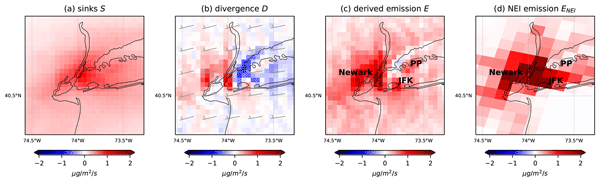
Fei Liu, Steffen Beirle, Joanna Joiner, Sungyeon Choi, Zhining Tao, K. Emma Knowland, Steven J. Smith, Daniel Q. Tong, Siqi Ma, Zachary T. Fasnacht, and Thomas Wagner
Atmos. Chem. Phys., 24, 3717–3728, https://doi.org/10.5194/acp-24-3717-2024, https://doi.org/10.5194/acp-24-3717-2024, 2024
Short summary
Short summary
Using satellite data, we developed a coupled method independent of the chemical transport model to map NOx emissions across US cities. After validating our technique with synthetic data, we charted NOx emissions from 2018–2021 in 39 cities. Our results closely matched EPA estimates but also highlighted some inconsistencies in both magnitude and spatial distribution. This research can help refine strategies for monitoring and managing air quality.
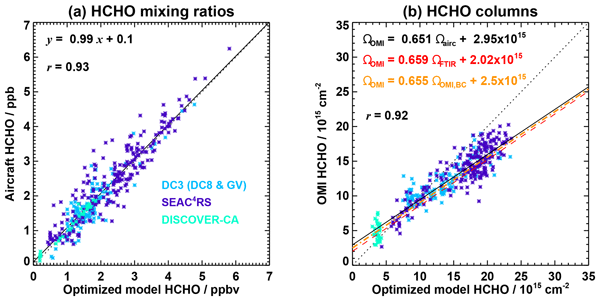
Jean-François Müller, Trissevgeni Stavrakou, Glenn-Michael Oomen, Beata Opacka, Isabelle De Smedt, Alex Guenther, Corinne Vigouroux, Bavo Langerock, Carlos Augusto Bauer Aquino, Michel Grutter, James Hannigan, Frank Hase, Rigel Kivi, Erik Lutsch, Emmanuel Mahieu, Maria Makarova, Jean-Marc Metzger, Isamu Morino, Isao Murata, Tomoo Nagahama, Justus Notholt, Ivan Ortega, Mathias Palm, Amelie Röhling, Wolfgang Stremme, Kimberly Strong, Ralf Sussmann, Yao Té, and Alan Fried
Atmos. Chem. Phys., 24, 2207–2237, https://doi.org/10.5194/acp-24-2207-2024, https://doi.org/10.5194/acp-24-2207-2024, 2024
Short summary
Short summary
Formaldehyde observations from satellites can be used to constrain the emissions of volatile organic compounds, but those observations have biases. Using an atmospheric model, aircraft and ground-based remote sensing data, we quantify these biases, propose a correction to the data, and assess the consequence of this correction for the evaluation of emissions.
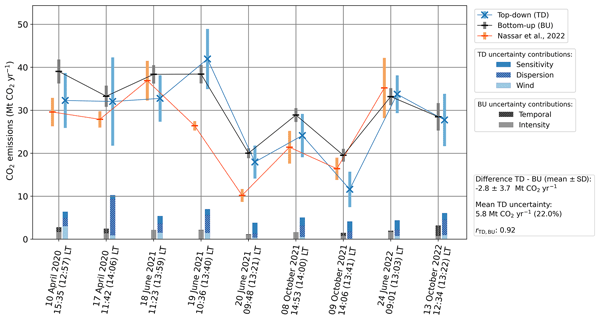
Blanca Fuentes Andrade, Michael Buchwitz, Maximilian Reuter, Heinrich Bovensmann, Andreas Richter, Hartmut Boesch, and John P. Burrows
Atmos. Meas. Tech., 17, 1145–1173, https://doi.org/10.5194/amt-17-1145-2024, https://doi.org/10.5194/amt-17-1145-2024, 2024
Short summary
Short summary
We developed a method to estimate CO2 emissions from localized sources, such as power plants, using satellite data and applied it to estimate CO2 emissions from the Bełchatów Power Station (Poland). As the detection of CO2 emission plumes from satellite data is difficult, we used observations of co-emitted NO2 to constrain the emission plume region. Our results agree with CO2 emission estimations based on the power-plant-generated power and emission factors.
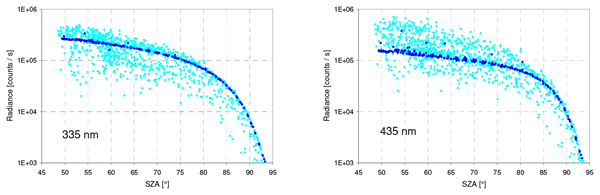
Thomas Wagner and Jānis Puķīte
Atmos. Meas. Tech., 17, 277–297, https://doi.org/10.5194/amt-17-277-2024, https://doi.org/10.5194/amt-17-277-2024, 2024
Short summary
Short summary
We present a radiance calibration method based on the comparison of measurements and radiative transfer simulations of the zenith-scattered sun radiance during twilight. Cloud-free conditions are required. The method can be applied to measurements in the filed, and no laboratory measurements are required. The accuracy is estimated to range from about 4 % at 340 nm to about 10 % at 700 nm.
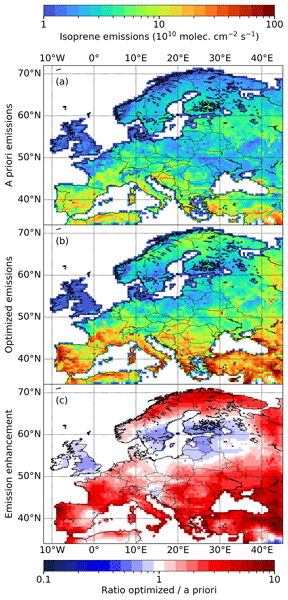
Glenn-Michael Oomen, Jean-François Müller, Trissevgeni Stavrakou, Isabelle De Smedt, Thomas Blumenstock, Rigel Kivi, Maria Makarova, Mathias Palm, Amelie Röhling, Yao Té, Corinne Vigouroux, Martina M. Friedrich, Udo Frieß, François Hendrick, Alexis Merlaud, Ankie Piters, Andreas Richter, Michel Van Roozendael, and Thomas Wagner
Atmos. Chem. Phys., 24, 449–474, https://doi.org/10.5194/acp-24-449-2024, https://doi.org/10.5194/acp-24-449-2024, 2024
Short summary
Short summary
Natural emissions from vegetation have a profound impact on air quality for their role in the formation of harmful tropospheric ozone and organic aerosols, yet these emissions are highly uncertain. In this study, we quantify emissions of organic gases over Europe using high-quality satellite measurements of formaldehyde. These satellite observations suggest that emissions from vegetation are much higher than predicted by models, especially in southern Europe.
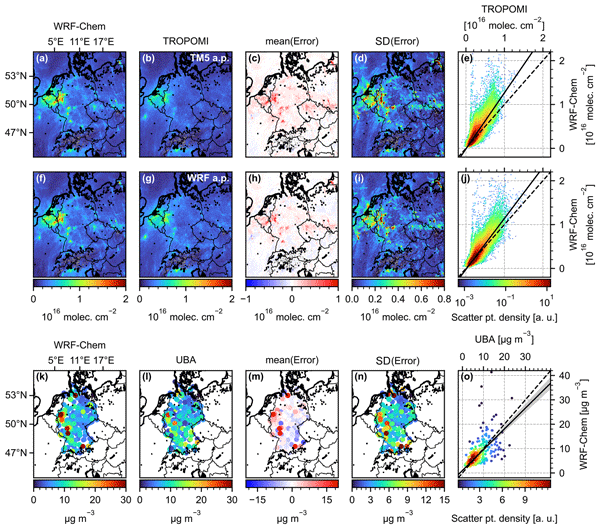
Leon Kuhn, Steffen Beirle, Vinod Kumar, Sergey Osipov, Andrea Pozzer, Tim Bösch, Rajesh Kumar, and Thomas Wagner
Atmos. Chem. Phys., 24, 185–217, https://doi.org/10.5194/acp-24-185-2024, https://doi.org/10.5194/acp-24-185-2024, 2024
Short summary
Short summary
NO₂ is an important air pollutant. It was observed that the WRF-Chem model shows significant deviations in NO₂ abundance when compared to measurements. We use a 1-month simulation over central Europe to show that these deviations can be mostly resolved by reparameterization of the vertical mixing routine. In order to validate our results, they are compared to in situ, satellite, and MAX-DOAS measurements.
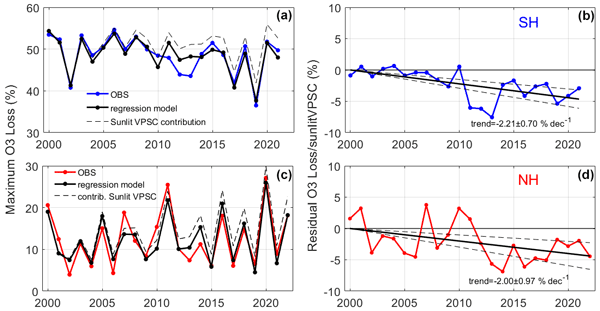
Andrea Pazmiño, Florence Goutail, Sophie Godin-Beekmann, Alain Hauchecorne, Jean-Pierre Pommereau, Martyn P. Chipperfield, Wuhu Feng, Franck Lefèvre, Audrey Lecouffe, Michel Van Roozendael, Nis Jepsen, Georg Hansen, Rigel Kivi, Kimberly Strong, and Kaley A. Walker
Atmos. Chem. Phys., 23, 15655–15670, https://doi.org/10.5194/acp-23-15655-2023, https://doi.org/10.5194/acp-23-15655-2023, 2023
Short summary
Short summary
The vortex-averaged ozone loss over the last 3 decades is evaluated for both polar regions using the passive ozone tracer of the chemical transport model TOMCAT/SLIMCAT and total ozone observations from the SAOZ network and MSR2 reanalysis. Three metrics were developed to compute ozone trends since 2000. The study confirms the ozone recovery in the Antarctic and shows a potential sign of quantitative detection of ozone recovery in the Arctic that needs to be robustly confirmed in the future.
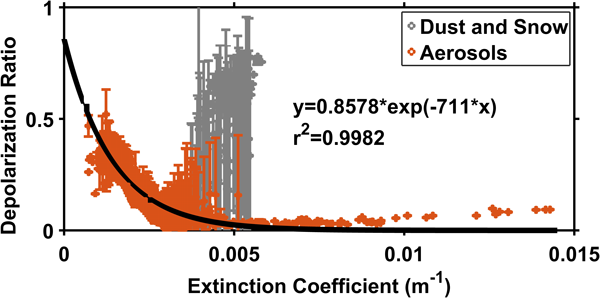
Nofel Lagrosas, Kosuke Okubo, Hitoshi Irie, Yutaka Matsumi, Tomoki Nakayama, Yutaka Sugita, Takashi Okada, and Tatsuo Shiina
Atmos. Meas. Tech., 16, 5937–5951, https://doi.org/10.5194/amt-16-5937-2023, https://doi.org/10.5194/amt-16-5937-2023, 2023
Short summary
Short summary
This work examines the near-ground aerosol–weather relationship from 7-month continuous lidar and weather observations in Chiba, Japan. Optical parameters from lidar data are compared with weather parameters to understand and quantify the aerosol–weather relationship and how these optical parameters are affected by the weather and season. The results provide insights into analyzing optical properties of radioactive aerosols when the lidar system is continuously operated in a radioactive area.
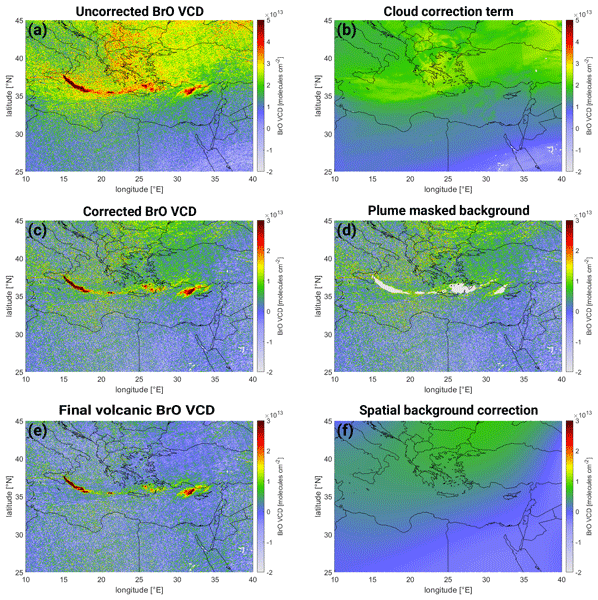
Simon Warnach, Holger Sihler, Christian Borger, Nicole Bobrowski, Steffen Beirle, Ulrich Platt, and Thomas Wagner
Atmos. Meas. Tech., 16, 5537–5573, https://doi.org/10.5194/amt-16-5537-2023, https://doi.org/10.5194/amt-16-5537-2023, 2023
Short summary
Short summary
BrO inside volcanic gas plumes but can be used in combination with SO2 to characterize the volcanic property and its activity state. High-quality satellite observations can provide a global inventory of this important quantity. This paper investigates how to accurately detect BrO inside volcanic plumes from the satellite UV spectrum. A sophisticated novel non-volcanic background correction scheme is presented, and systematic errors including cross-interference with formaldehyde are minimized.
Tobias Christoph Valentin Werner Riess, Klaas Folkert Boersma, Ward Van Roy, Jos de Laat, Enrico Dammers, and Jasper van Vliet
Atmos. Meas. Tech., 16, 5287–5304, https://doi.org/10.5194/amt-16-5287-2023, https://doi.org/10.5194/amt-16-5287-2023, 2023
Short summary
Short summary
Satellite retrievals of trace gases require prior knowledge of the vertical distribution of the pollutant, which is usually obtained from models. Using aircraft-measured vertical NO2 profiles over the North Sea in summer 2021, we evaluate the Transport Model 5 profiles used in the TROPOMI NO2 retrieval. We conclude that driven by the low horizontal resolution and the overestimated vertical mixing, resulting NO2 columns are 20 % too low. This has important implications for emission estimates.
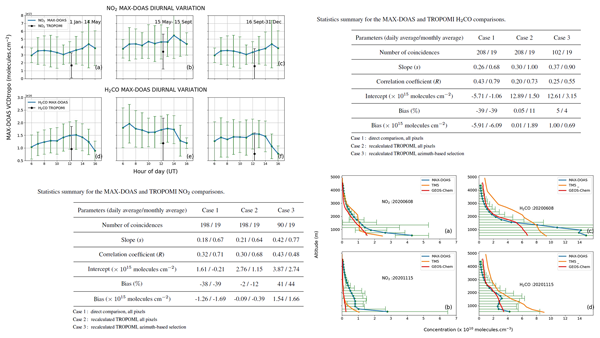
Rodriguez Yombo Phaka, Alexis Merlaud, Gaia Pinardi, Martina M. Friedrich, Michel Van Roozendael, Jean-François Müller, Trissevgeni Stavrakou, Isabelle De Smedt, François Hendrick, Ermioni Dimitropoulou, Richard Bopili Mbotia Lepiba, Edmond Phuku Phuati, Buenimio Lomami Djibi, Lars Jacobs, Caroline Fayt, Jean-Pierre Mbungu Tsumbu, and Emmanuel Mahieu
Atmos. Meas. Tech., 16, 5029–5050, https://doi.org/10.5194/amt-16-5029-2023, https://doi.org/10.5194/amt-16-5029-2023, 2023
Short summary
Short summary
We present air quality measurements in Kinshasa, Democratic Republic of the Congo, performed with a newly developed instrument which was installed on a roof of the University of Kinshasa in November 2019. The instrument records spectra of the scattered sunlight, from which we derive the abundances of nitrogen dioxide and formaldehyde, two important pollutants. We compare our ground-based measurements with those of the TROPOspheric Monitoring Instrument (TROPOMI).
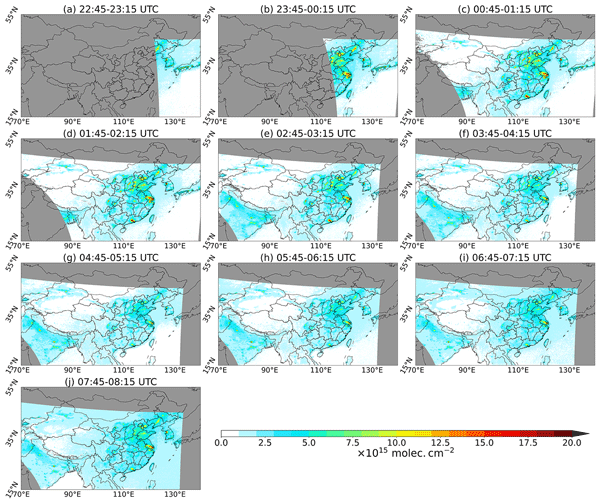
Yuhang Zhang, Jintai Lin, Jhoon Kim, Hanlim Lee, Junsung Park, Hyunkee Hong, Michel Van Roozendael, Francois Hendrick, Ting Wang, Pucai Wang, Qin He, Kai Qin, Yongjoo Choi, Yugo Kanaya, Jin Xu, Pinhua Xie, Xin Tian, Sanbao Zhang, Shanshan Wang, Siyang Cheng, Xinghong Cheng, Jianzhong Ma, Thomas Wagner, Robert Spurr, Lulu Chen, Hao Kong, and Mengyao Liu
Atmos. Meas. Tech., 16, 4643–4665, https://doi.org/10.5194/amt-16-4643-2023, https://doi.org/10.5194/amt-16-4643-2023, 2023
Short summary
Short summary
Our tropospheric NO2 vertical column density product with high spatiotemporal resolution is based on the Geostationary Environment Monitoring Spectrometer (GEMS) and named POMINO–GEMS. Strong hotspot signals and NO2 diurnal variations are clearly seen. Validations with multiple satellite products and ground-based, mobile car and surface measurements exhibit the overall great performance of the POMINO–GEMS product, indicating its capability for application in environmental studies.
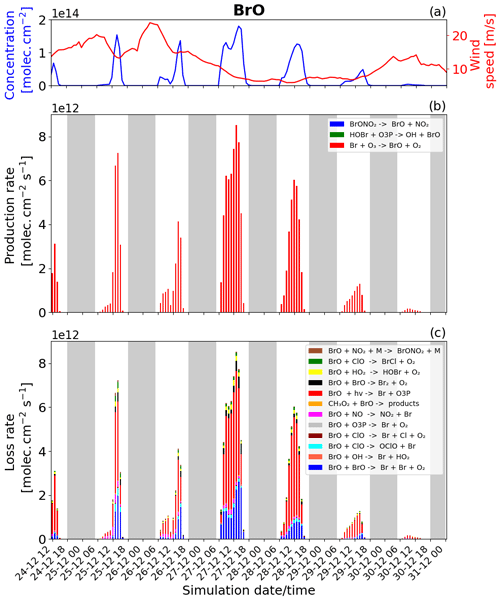
Herizo Narivelo, Paul David Hamer, Virginie Marécal, Luke Surl, Tjarda Roberts, Sophie Pelletier, Béatrice Josse, Jonathan Guth, Mickaël Bacles, Simon Warnach, Thomas Wagner, Stefano Corradini, Giuseppe Salerno, and Lorenzo Guerrieri
Atmos. Chem. Phys., 23, 10533–10561, https://doi.org/10.5194/acp-23-10533-2023, https://doi.org/10.5194/acp-23-10533-2023, 2023
Short summary
Short summary
Volcanic emissions emit large quantities of gases and primary aerosols that can play an important role in atmospheric chemistry. We present a study of the fate of volcanic bromine emissions from the eruption of Mount Etna around Christmas 2018. Using a numerical model and satellite observations, we analyse the impact of the volcanic plume and how it modifies the composition of the air over the whole Mediterranean basin, in particular on tropospheric ozone through the bromine-explosion cycle.
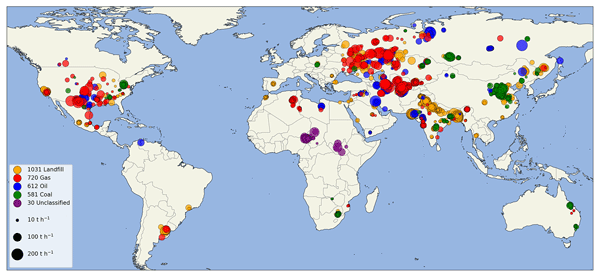
Berend J. Schuit, Joannes D. Maasakkers, Pieter Bijl, Gourav Mahapatra, Anne-Wil van den Berg, Sudhanshu Pandey, Alba Lorente, Tobias Borsdorff, Sander Houweling, Daniel J. Varon, Jason McKeever, Dylan Jervis, Marianne Girard, Itziar Irakulis-Loitxate, Javier Gorroño, Luis Guanter, Daniel H. Cusworth, and Ilse Aben
Atmos. Chem. Phys., 23, 9071–9098, https://doi.org/10.5194/acp-23-9071-2023, https://doi.org/10.5194/acp-23-9071-2023, 2023
Short summary
Short summary
Using two machine learning models, which were trained on TROPOMI methane satellite data, we detect 2974 methane plumes, so-called super-emitters, in 2021. We detect methane emissions globally related to urban areas or landfills, coal mining, and oil and gas production. Using our monitoring system, we identify 94 regions with frequent emissions. For 12 locations, we target high-resolution satellite instruments to enlarge and identify the exact infrastructure responsible for the emissions.
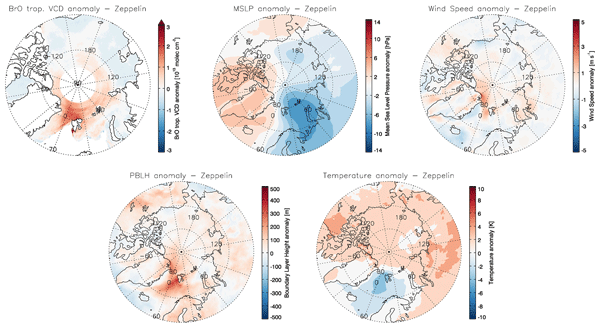
Bianca Zilker, Andreas Richter, Anne-Marlene Blechschmidt, Peter von der Gathen, Ilias Bougoudis, Sora Seo, Tim Bösch, and John Philip Burrows
Atmos. Chem. Phys., 23, 9787–9814, https://doi.org/10.5194/acp-23-9787-2023, https://doi.org/10.5194/acp-23-9787-2023, 2023
Short summary
Short summary
During Arctic spring, near-surface ozone is depleted by bromine released from salty sea ice and/or snow-covered areas under certain meteorological conditions. To study this ozone depletion and the prevailing meteorological conditions, two ozone data sets from Ny-Ålesund, Svalbard, have been evaluated. We found that during ozone depletion events lower pressure over the Barents Sea and higher pressure in the Icelandic Low area led to a transport of cold polar air from the north to Ny-Ålesund.
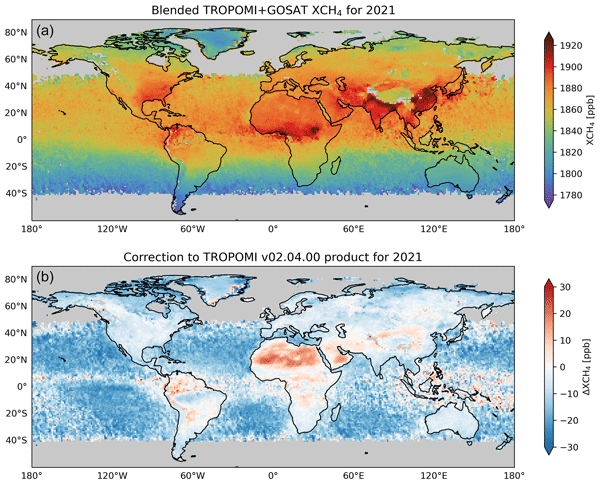
Nicholas Balasus, Daniel J. Jacob, Alba Lorente, Joannes D. Maasakkers, Robert J. Parker, Hartmut Boesch, Zichong Chen, Makoto M. Kelp, Hannah Nesser, and Daniel J. Varon
Atmos. Meas. Tech., 16, 3787–3807, https://doi.org/10.5194/amt-16-3787-2023, https://doi.org/10.5194/amt-16-3787-2023, 2023
Short summary
Short summary
We use machine learning to remove biases in TROPOMI satellite observations of atmospheric methane, with GOSAT observations serving as a reference. We find that the TROPOMI biases relative to GOSAT are related to the presence of aerosols and clouds, the surface brightness, and the specific detector that makes the observation aboard TROPOMI. The resulting blended TROPOMI+GOSAT product is more reliable for quantifying methane emissions.
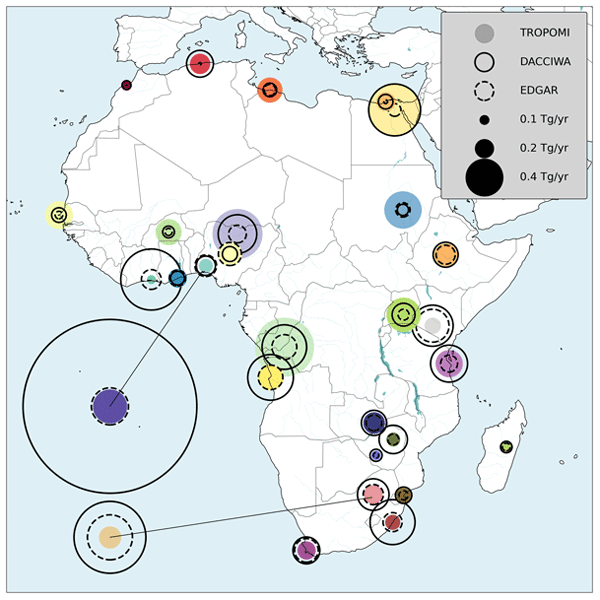
Gijs Leguijt, Joannes D. Maasakkers, Hugo A. C. Denier van der Gon, Arjo J. Segers, Tobias Borsdorff, and Ilse Aben
Atmos. Chem. Phys., 23, 8899–8919, https://doi.org/10.5194/acp-23-8899-2023, https://doi.org/10.5194/acp-23-8899-2023, 2023
Short summary
Short summary
We present a fast method to evaluate carbon monoxide emissions from cities in Africa. Carbon monoxide is important for climate change in an indirect way, as it is linked to ozone, methane, and carbon dioxide. Our measurements are made with a satellite that sees the entire globe every single day. This means that we can check from space whether the current knowledge of emission rates is up to date. We make the comparison and show that the emission rates in northern Africa are underestimated.
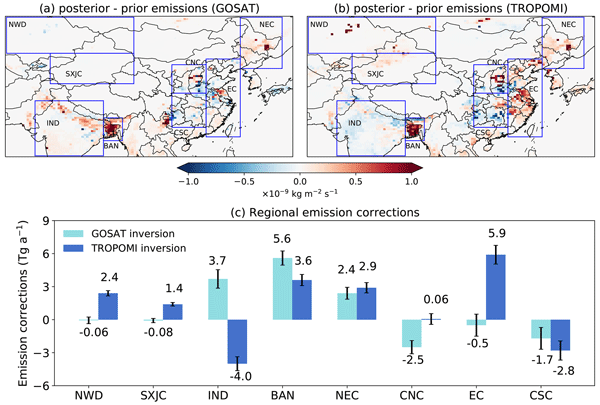
Ruosi Liang, Yuzhong Zhang, Wei Chen, Peixuan Zhang, Jingran Liu, Cuihong Chen, Huiqin Mao, Guofeng Shen, Zhen Qu, Zichong Chen, Minqiang Zhou, Pucai Wang, Robert J. Parker, Hartmut Boesch, Alba Lorente, Joannes D. Maasakkers, and Ilse Aben
Atmos. Chem. Phys., 23, 8039–8057, https://doi.org/10.5194/acp-23-8039-2023, https://doi.org/10.5194/acp-23-8039-2023, 2023
Short summary
Short summary
We compare and evaluate East Asian methane emissions inferred from different satellite observations (GOSAT and TROPOMI). The results show discrepancies over northern India and eastern China. Independent ground-based observations are more consistent with TROPOMI-derived emissions in northern India and GOSAT-derived emissions in eastern China.
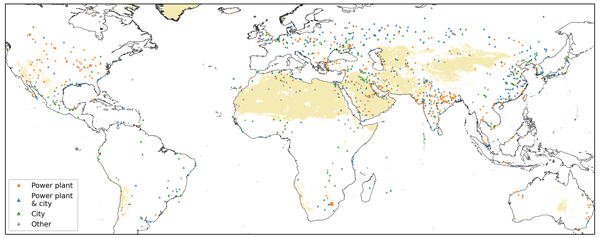
Steffen Beirle, Christian Borger, Adrian Jost, and Thomas Wagner
Earth Syst. Sci. Data, 15, 3051–3073, https://doi.org/10.5194/essd-15-3051-2023, https://doi.org/10.5194/essd-15-3051-2023, 2023
Short summary
Short summary
We present a catalog of nitrogen oxide emissions from point sources (like power plants or metal smelters) based on satellite observations of NO2 combined with meteorological wind fields.
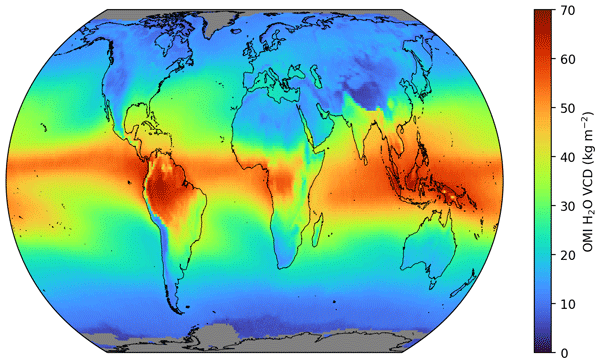
Christian Borger, Steffen Beirle, and Thomas Wagner
Earth Syst. Sci. Data, 15, 3023–3049, https://doi.org/10.5194/essd-15-3023-2023, https://doi.org/10.5194/essd-15-3023-2023, 2023
Short summary
Short summary
This study presents a long-term data set of monthly mean total column water vapour (TCWV) based on measurements of the Ozone Monitoring Instrument (OMI) covering the time range from January 2005 to December 2020. We describe how the TCWV values are retrieved from UV–Vis satellite spectra and demonstrate that the OMI TCWV data set is in good agreement with various different reference data sets. Moreover, we also show that it fulfills typical stability requirements for climate data records.
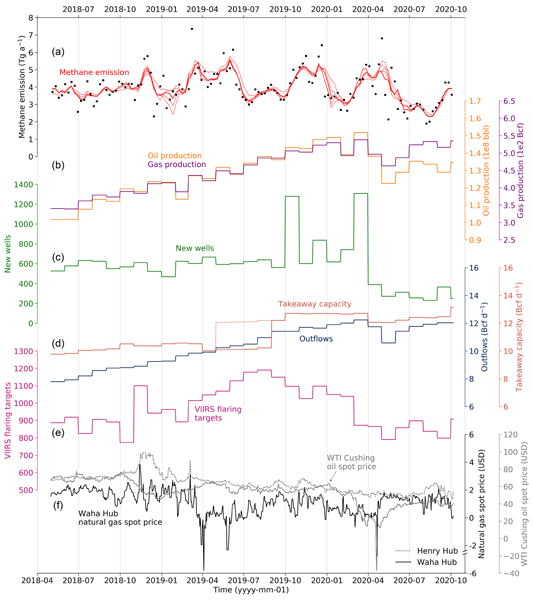
Daniel J. Varon, Daniel J. Jacob, Benjamin Hmiel, Ritesh Gautam, David R. Lyon, Mark Omara, Melissa Sulprizio, Lu Shen, Drew Pendergrass, Hannah Nesser, Zhen Qu, Zachary R. Barkley, Natasha L. Miles, Scott J. Richardson, Kenneth J. Davis, Sudhanshu Pandey, Xiao Lu, Alba Lorente, Tobias Borsdorff, Joannes D. Maasakkers, and Ilse Aben
Atmos. Chem. Phys., 23, 7503–7520, https://doi.org/10.5194/acp-23-7503-2023, https://doi.org/10.5194/acp-23-7503-2023, 2023
Short summary
Short summary
We use TROPOMI satellite observations to quantify weekly methane emissions from the US Permian oil and gas basin from May 2018 to October 2020. We find that Permian emissions are highly variable, with diverse economic and activity drivers. The most important drivers during our study period were new well development and natural gas price. Permian methane intensity averaged 4.6 % and decreased by 1 % per year.
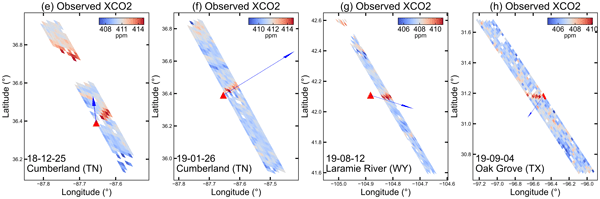
Xiaojuan Lin, Ronald van der A, Jos de Laat, Henk Eskes, Frédéric Chevallier, Philippe Ciais, Zhu Deng, Yuanhao Geng, Xuanren Song, Xiliang Ni, Da Huo, Xinyu Dou, and Zhu Liu
Atmos. Chem. Phys., 23, 6599–6611, https://doi.org/10.5194/acp-23-6599-2023, https://doi.org/10.5194/acp-23-6599-2023, 2023
Short summary
Short summary
Satellite observations provide evidence for CO2 emission signals from isolated power plants. We use these satellite observations to quantify emissions. We found that for power plants with multiple observations, the correlation of estimated and reported emissions is significantly improved compared to a single observation case. This demonstrates that accurate estimation of power plant emissions can be achieved by monitoring from future satellite missions with more frequent observations.
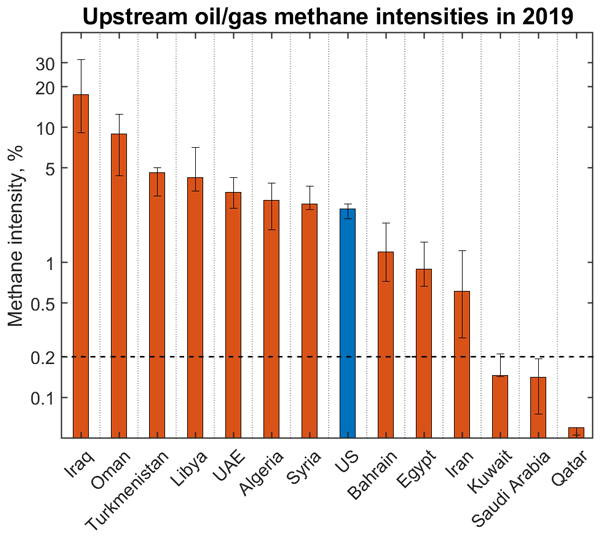
Zichong Chen, Daniel J. Jacob, Ritesh Gautam, Mark Omara, Robert N. Stavins, Robert C. Stowe, Hannah Nesser, Melissa P. Sulprizio, Alba Lorente, Daniel J. Varon, Xiao Lu, Lu Shen, Zhen Qu, Drew C. Pendergrass, and Sarah Hancock
Atmos. Chem. Phys., 23, 5945–5967, https://doi.org/10.5194/acp-23-5945-2023, https://doi.org/10.5194/acp-23-5945-2023, 2023
Short summary
Short summary
We quantify methane emissions from individual countries in the Middle East and North Africa by inverse analysis of 2019 TROPOMI satellite observations of atmospheric methane. We show that the ability to simply relate oil/gas emissions to activity metrics is compromised by stochastic nature of local infrastructure and management practices. We find that the industry target for oil/gas methane intensity is achievable through associated gas capture, modern infrastructure, and centralized operations.
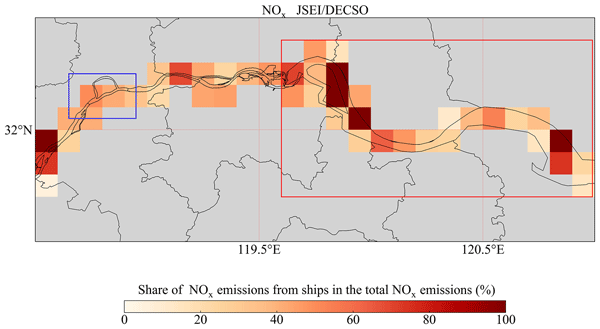
Xiumei Zhang, Ronald van der A, Jieying Ding, Xin Zhang, and Yan Yin
Atmos. Chem. Phys., 23, 5587–5604, https://doi.org/10.5194/acp-23-5587-2023, https://doi.org/10.5194/acp-23-5587-2023, 2023
Short summary
Short summary
We compiled a ship emission inventory based on automatic identification system (AIS) signals in the Jiangsu section of the Yangtze River. This ship emission inventory was compared with Chinese bottom-up inventories and the satellite-derived emissions from TROPOMI. The result shows a consistent spatial distribution, with riverine cities having high NOx emissions. Inland ship emissions of NOx are shown to contribute at least 40 % to air pollution along the river.
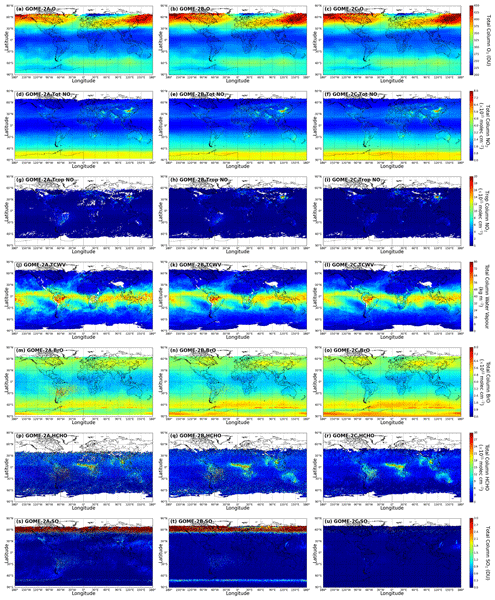
Ka Lok Chan, Pieter Valks, Klaus-Peter Heue, Ronny Lutz, Pascal Hedelt, Diego Loyola, Gaia Pinardi, Michel Van Roozendael, François Hendrick, Thomas Wagner, Vinod Kumar, Alkis Bais, Ankie Piters, Hitoshi Irie, Hisahiro Takashima, Yugo Kanaya, Yongjoo Choi, Kihong Park, Jihyo Chong, Alexander Cede, Udo Frieß, Andreas Richter, Jianzhong Ma, Nuria Benavent, Robert Holla, Oleg Postylyakov, Claudia Rivera Cárdenas, and Mark Wenig
Earth Syst. Sci. Data, 15, 1831–1870, https://doi.org/10.5194/essd-15-1831-2023, https://doi.org/10.5194/essd-15-1831-2023, 2023
Short summary
Short summary
This paper presents the theoretical basis as well as verification and validation of the Global Ozone Monitoring Experiment-2 (GOME-2) daily and monthly level-3 products.
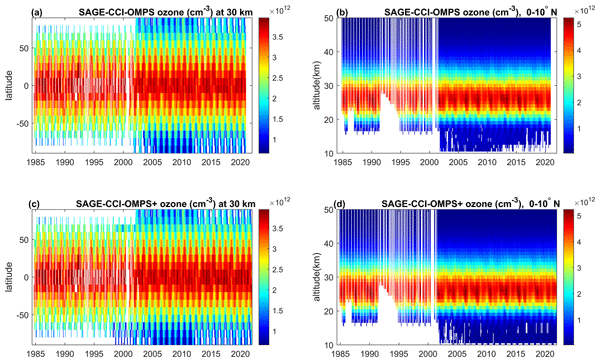
Viktoria F. Sofieva, Monika Szelag, Johanna Tamminen, Carlo Arosio, Alexei Rozanov, Mark Weber, Doug Degenstein, Adam Bourassa, Daniel Zawada, Michael Kiefer, Alexandra Laeng, Kaley A. Walker, Patrick Sheese, Daan Hubert, Michel van Roozendael, Christian Retscher, Robert Damadeo, and Jerry D. Lumpe
Atmos. Meas. Tech., 16, 1881–1899, https://doi.org/10.5194/amt-16-1881-2023, https://doi.org/10.5194/amt-16-1881-2023, 2023
Short summary
Short summary
The paper presents the updated SAGE-CCI-OMPS+ climate data record of monthly zonal mean ozone profiles. This dataset covers the stratosphere and combines measurements by nine limb and occultation satellite instruments (SAGE II, OSIRIS, MIPAS, SCIAMACHY, GOMOS, ACE-FTS, OMPS-LP, POAM III, and SAGE III/ISS). The update includes new versions of MIPAS, ACE-FTS, and OSIRIS datasets and introduces data from additional sensors (POAM III and SAGE III/ISS) and retrieval processors (OMPS-LP).
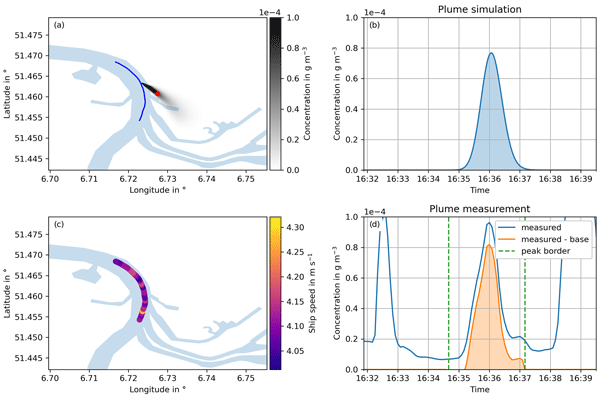
Kai Krause, Folkard Wittrock, Andreas Richter, Dieter Busch, Anton Bergen, John P. Burrows, Steffen Freitag, and Olesia Halbherr
Atmos. Meas. Tech., 16, 1767–1787, https://doi.org/10.5194/amt-16-1767-2023, https://doi.org/10.5194/amt-16-1767-2023, 2023
Short summary
Short summary
Inland shipping is an important source of nitrogen oxides (NOx). The amount of emitted NOx depends on the characteristics of the individual vessels and the traffic density. Ship emissions are often characterised by the amount of emitted NOx per unit of burnt fuel, and further knowledge about fuel consumption is needed to quantify the total emissions caused by ship traffic. In this study, a new approach to derive absolute emission rates (in g s−1) from onshore measurements is presented.

Hervé Petetin, Marc Guevara, Steven Compernolle, Dene Bowdalo, Pierre-Antoine Bretonnière, Santiago Enciso, Oriol Jorba, Franco Lopez, Albert Soret, and Carlos Pérez García-Pando
Atmos. Chem. Phys., 23, 3905–3935, https://doi.org/10.5194/acp-23-3905-2023, https://doi.org/10.5194/acp-23-3905-2023, 2023
Short summary
Short summary
This study analyses the potential of the TROPOMI space sensor for monitoring the variability of NO2 pollution over the Iberian Peninsula. A reduction of NO2 levels is observed during the weekend and in summer, especially over most urbanized areas, in agreement with surface observations. An enhancement of NO2 is found during summer with TROPOMI over croplands, potentially related to natural soil NO emissions, which illustrates the outstanding value of TROPOMI for complementing surface networks.
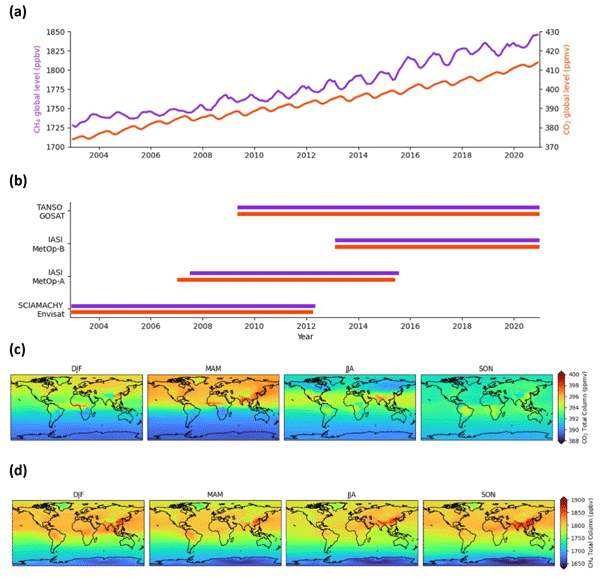
Anna Agustí-Panareda, Jérôme Barré, Sébastien Massart, Antje Inness, Ilse Aben, Melanie Ades, Bianca C. Baier, Gianpaolo Balsamo, Tobias Borsdorff, Nicolas Bousserez, Souhail Boussetta, Michael Buchwitz, Luca Cantarello, Cyril Crevoisier, Richard Engelen, Henk Eskes, Johannes Flemming, Sébastien Garrigues, Otto Hasekamp, Vincent Huijnen, Luke Jones, Zak Kipling, Bavo Langerock, Joe McNorton, Nicolas Meilhac, Stefan Noël, Mark Parrington, Vincent-Henri Peuch, Michel Ramonet, Miha Razinger, Maximilian Reuter, Roberto Ribas, Martin Suttie, Colm Sweeney, Jérôme Tarniewicz, and Lianghai Wu
Atmos. Chem. Phys., 23, 3829–3859, https://doi.org/10.5194/acp-23-3829-2023, https://doi.org/10.5194/acp-23-3829-2023, 2023
Short summary
Short summary
We present a global dataset of atmospheric CO2 and CH4, the two most important human-made greenhouse gases, which covers almost 2 decades (2003–2020). It is produced by combining satellite data of CO2 and CH4 with a weather and air composition prediction model, and it has been carefully evaluated against independent observations to ensure validity and point out deficiencies to the user. This dataset can be used for scientific studies in the field of climate change and the global carbon cycle.
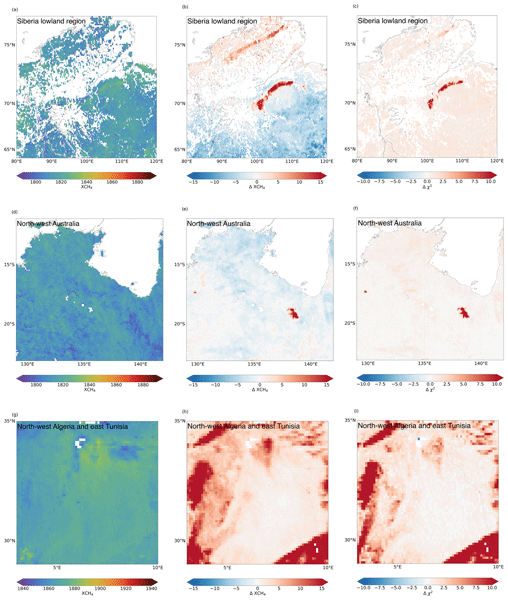
Alba Lorente, Tobias Borsdorff, Mari C. Martinez-Velarte, and Jochen Landgraf
Atmos. Meas. Tech., 16, 1597–1608, https://doi.org/10.5194/amt-16-1597-2023, https://doi.org/10.5194/amt-16-1597-2023, 2023
Short summary
Short summary
In the TROPOMI methane data, there are few false methane anomalies that can be misinterpreted as enhancements caused by strong emission sources. These artefacts are caused by features of the underlying surfaces that are not well characterized in the retrieval algorithm. Here we improve the representation of the surface reflectance dependency with wavelength in the forward model, removing the artificial localized CH4 enhancements found in several locations like Siberia, Australia and Algeria.
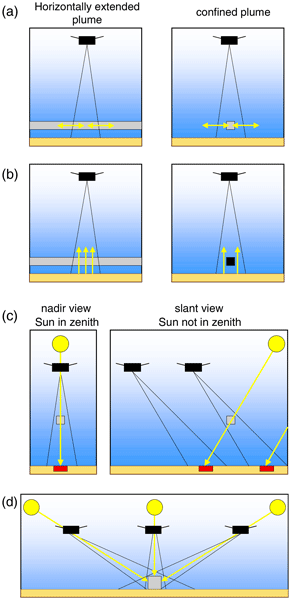
Thomas Wagner, Simon Warnach, Steffen Beirle, Nicole Bobrowski, Adrian Jost, Janis Puķīte, and Nicolas Theys
Atmos. Meas. Tech., 16, 1609–1662, https://doi.org/10.5194/amt-16-1609-2023, https://doi.org/10.5194/amt-16-1609-2023, 2023
Short summary
Short summary
We investigate 3D effects of volcanic plumes on the retrieval results of satellite and ground-based UV–Vis observations. With its small ground pixels of 3.5 x 5.5 km², the TROPOMI instrument can detect much smaller volcanic plumes than previous instruments. At the same time, 3D effects become important. The effect of horizontal photon paths especially can lead to a strong underestimation of the derived plume contents of up to > 50 %, which can be further increased for strong absorbers like SO2.
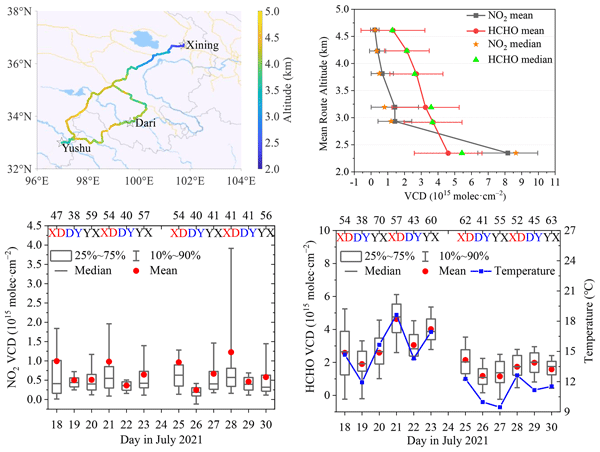
Siyang Cheng, Xinghong Cheng, Jianzhong Ma, Xiangde Xu, Wenqian Zhang, Jinguang Lv, Gang Bai, Bing Chen, Siying Ma, Steffen Ziegler, Sebastian Donner, and Thomas Wagner
Atmos. Chem. Phys., 23, 3655–3677, https://doi.org/10.5194/acp-23-3655-2023, https://doi.org/10.5194/acp-23-3655-2023, 2023
Short summary
Short summary
We made mobile MAX-DOAS measurements in the background atmosphere over the Tibetan Plateau in summer 2021. We retrieved the tropospheric NO2 and HCHO vertical column densities (VCDs) along extended driving routes and found a decreasing trend of the VCDs with altitude. Elevated NO2 VCDs along the driving routes could be attributed to enhanced traffic emissions from the towns crossed. The spatio-temporal distribution of the HCHO VCDs correlated strongly with the surface temperature.
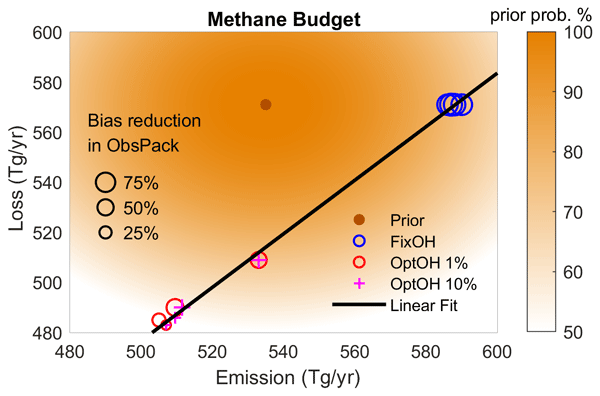
Xueying Yu, Dylan B. Millet, Daven K. Henze, Alexander J. Turner, Alba Lorente Delgado, A. Anthony Bloom, and Jianxiong Sheng
Atmos. Chem. Phys., 23, 3325–3346, https://doi.org/10.5194/acp-23-3325-2023, https://doi.org/10.5194/acp-23-3325-2023, 2023
Short summary
Short summary
We combine satellite measurements with a novel downscaling method to map global methane emissions at 0.1°×0.1° resolution. These fine-scale emission estimates reveal unreported emission hotspots and shed light on the roles of agriculture, wetlands, and fossil fuels for regional methane budgets. The satellite-derived emissions point in particular to missing fossil fuel emissions in the Middle East and to a large emission underestimate in South Asia that appears to be tied to monsoon rainfall.
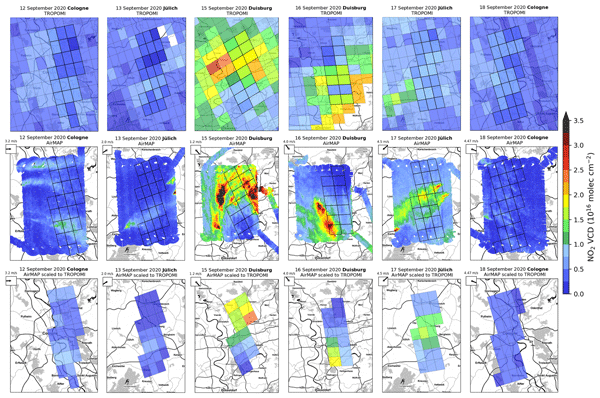
Kezia Lange, Andreas Richter, Anja Schönhardt, Andreas C. Meier, Tim Bösch, André Seyler, Kai Krause, Lisa K. Behrens, Folkard Wittrock, Alexis Merlaud, Frederik Tack, Caroline Fayt, Martina M. Friedrich, Ermioni Dimitropoulou, Michel Van Roozendael, Vinod Kumar, Sebastian Donner, Steffen Dörner, Bianca Lauster, Maria Razi, Christian Borger, Katharina Uhlmannsiek, Thomas Wagner, Thomas Ruhtz, Henk Eskes, Birger Bohn, Daniel Santana Diaz, Nader Abuhassan, Dirk Schüttemeyer, and John P. Burrows
Atmos. Meas. Tech., 16, 1357–1389, https://doi.org/10.5194/amt-16-1357-2023, https://doi.org/10.5194/amt-16-1357-2023, 2023
Short summary
Short summary
We present airborne imaging DOAS and ground-based stationary and car DOAS measurements conducted during the S5P-VAL-DE-Ruhr campaign in the Rhine-Ruhr region. The measurements are used to validate spaceborne NO2 data products from the Sentinel-5 Precursor TROPOspheric Monitoring Instrument (TROPOMI). Auxiliary data of the TROPOMI NO2 retrieval, such as spatially higher resolved a priori NO2 vertical profiles, surface reflectivity, and cloud treatment are investigated to evaluate their impact.
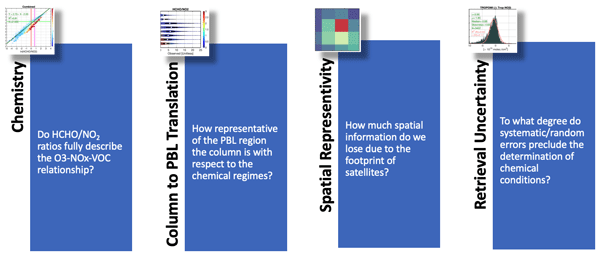
Amir H. Souri, Matthew S. Johnson, Glenn M. Wolfe, James H. Crawford, Alan Fried, Armin Wisthaler, William H. Brune, Donald R. Blake, Andrew J. Weinheimer, Tijl Verhoelst, Steven Compernolle, Gaia Pinardi, Corinne Vigouroux, Bavo Langerock, Sungyeon Choi, Lok Lamsal, Lei Zhu, Shuai Sun, Ronald C. Cohen, Kyung-Eun Min, Changmin Cho, Sajeev Philip, Xiong Liu, and Kelly Chance
Atmos. Chem. Phys., 23, 1963–1986, https://doi.org/10.5194/acp-23-1963-2023, https://doi.org/10.5194/acp-23-1963-2023, 2023
Short summary
Short summary
We have rigorously characterized different sources of error in satellite-based HCHO / NO2 tropospheric columns, a widely used metric for diagnosing near-surface ozone sensitivity. Specifically, the errors were categorized/quantified into (i) an inherent chemistry error, (ii) the decoupled relationship between columns and the near-surface concentration, (iii) the spatial representativeness error of ground satellite pixels, and (iv) the satellite retrieval errors.
John Douros, Henk Eskes, Jos van Geffen, K. Folkert Boersma, Steven Compernolle, Gaia Pinardi, Anne-Marlene Blechschmidt, Vincent-Henri Peuch, Augustin Colette, and Pepijn Veefkind
Geosci. Model Dev., 16, 509–534, https://doi.org/10.5194/gmd-16-509-2023, https://doi.org/10.5194/gmd-16-509-2023, 2023
Short summary
Short summary
We focus on the challenges associated with comparing atmospheric composition models with satellite products such as tropospheric NO2 columns. The aim is to highlight the methodological difficulties and propose sound ways of doing such comparisons. Building on the comparisons, a new satellite product is proposed and made available, which takes advantage of higher-resolution, regional atmospheric modelling to improve estimates of troposheric NO2 columns over Europe.
Viral Shah, Daniel J. Jacob, Ruijun Dang, Lok N. Lamsal, Sarah A. Strode, Stephen D. Steenrod, K. Folkert Boersma, Sebastian D. Eastham, Thibaud M. Fritz, Chelsea Thompson, Jeff Peischl, Ilann Bourgeois, Ilana B. Pollack, Benjamin A. Nault, Ronald C. Cohen, Pedro Campuzano-Jost, Jose L. Jimenez, Simone T. Andersen, Lucy J. Carpenter, Tomás Sherwen, and Mat J. Evans
Atmos. Chem. Phys., 23, 1227–1257, https://doi.org/10.5194/acp-23-1227-2023, https://doi.org/10.5194/acp-23-1227-2023, 2023
Short summary
Short summary
NOx in the free troposphere (above 2 km) affects global tropospheric chemistry and the retrieval and interpretation of satellite NO2 measurements. We evaluate free tropospheric NOx in global atmospheric chemistry models and find that recycling NOx from its reservoirs over the oceans is faster than that simulated in the models, resulting in increases in simulated tropospheric ozone and OH. Over the U.S., free tropospheric NO2 contributes the majority of the tropospheric NO2 column in summer.
Qianqian Zhang, K. Folkert Boersma, Bin Zhao, Henk Eskes, Cuihong Chen, Haotian Zheng, and Xingying Zhang
Atmos. Chem. Phys., 23, 551–563, https://doi.org/10.5194/acp-23-551-2023, https://doi.org/10.5194/acp-23-551-2023, 2023
Short summary
Short summary
We developed an improved superposition column model and used the latest released (v2.3.1) TROPOMI satellite NO2 observations to estimate daily city-scale NOx and CO2 emissions. The results are verified against bottom-up emissions and OCO-2 XCO2 observations. We obtained the day-to-day variation of city NOx and CO2 emissions, allowing policymakers to gain real-time information on spatial–temporal emission patterns and the effectiveness of carbon and nitrogen regulation in urban environments.
Srijana Lama, Sander Houweling, K. Folkert Boersma, Ilse Aben, Hugo A. C. Denier van der Gon, and Maarten C. Krol
Atmos. Chem. Phys., 22, 16053–16071, https://doi.org/10.5194/acp-22-16053-2022, https://doi.org/10.5194/acp-22-16053-2022, 2022
Short summary
Short summary
Hydroxyl radical (OH) is the important chemical species that determines the lifetime of some greenhouse gases and trace gases. OH plays a vital role in air pollution chemistry. OH has a short lifetime and is extremely difficult to measure directly. OH concentrations derived from the chemistry transport model (CTM) have uncertainties of >50 %. Therefore, in this study, OH is derived indirectly using satellite date in urban plumes.
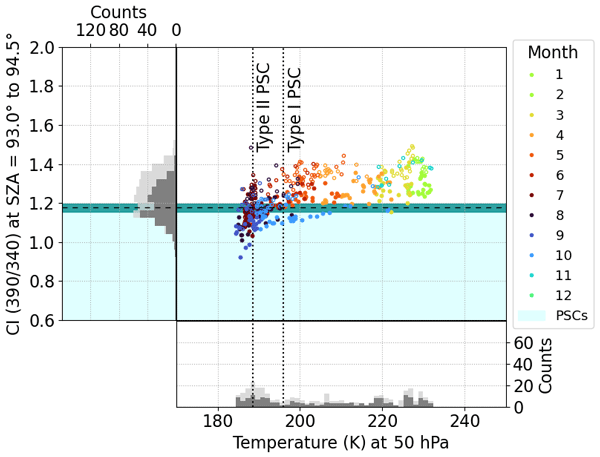
Bianca Lauster, Steffen Dörner, Carl-Fredrik Enell, Udo Frieß, Myojeong Gu, Janis Puķīte, Uwe Raffalski, and Thomas Wagner
Atmos. Chem. Phys., 22, 15925–15942, https://doi.org/10.5194/acp-22-15925-2022, https://doi.org/10.5194/acp-22-15925-2022, 2022
Short summary
Short summary
Polar stratospheric clouds (PSCs) are an important component in ozone chemistry. Here, we use two differential optical absorption spectroscopy (DOAS) instruments in the Antarctic and Arctic to investigate the occurrence of PSCs based on the colour index, i.e. the colour of the zenith sky. Additionally using radiative transfer simulations, the variability and the seasonal cycle of PSC occurrence are analysed and an unexpectedly high signal during spring suggests the influence of volcanic aerosol.
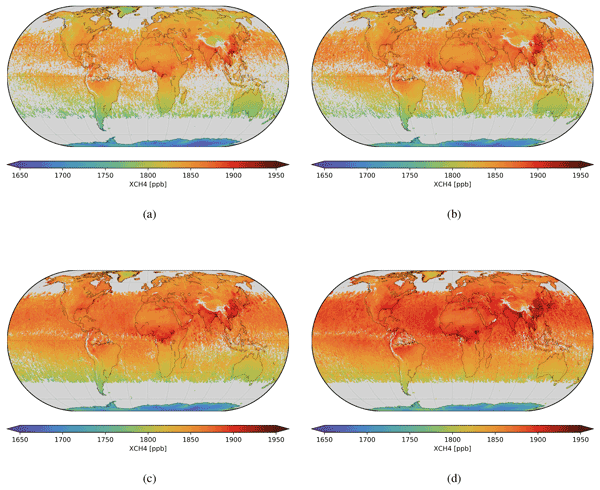
Alba Lorente, Tobias Borsdorff, Mari C. Martinez-Velarte, Andre Butz, Otto P. Hasekamp, Lianghai Wu, and Jochen Landgraf
Atmos. Meas. Tech., 15, 6585–6603, https://doi.org/10.5194/amt-15-6585-2022, https://doi.org/10.5194/amt-15-6585-2022, 2022
Short summary
Short summary
The TROPOspheric Monitoring Instrument (TROPOMI) performs observations over ocean in every orbit, enhancing the monitoring capabilities of methane from space. In the sun glint geometry the mirror-like reflection at the water surface provides a signal that is high enough to retrieve methane with high accuracy and precision. We present 4 years of methane concentrations over the ocean, and we assess its quality. We also show the importance of ocean observations to quantify total CH4 emissions.
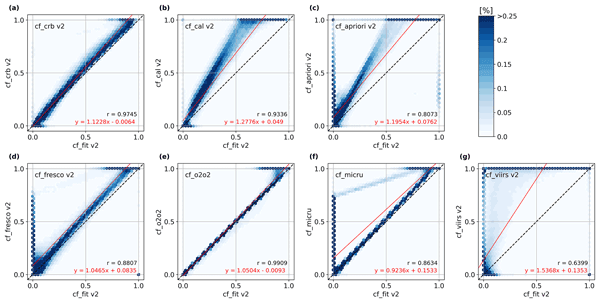
Miriam Latsch, Andreas Richter, Henk Eskes, Maarten Sneep, Ping Wang, Pepijn Veefkind, Ronny Lutz, Diego Loyola, Athina Argyrouli, Pieter Valks, Thomas Wagner, Holger Sihler, Michel van Roozendael, Nicolas Theys, Huan Yu, Richard Siddans, and John P. Burrows
Atmos. Meas. Tech., 15, 6257–6283, https://doi.org/10.5194/amt-15-6257-2022, https://doi.org/10.5194/amt-15-6257-2022, 2022
Short summary
Short summary
The article investigates different S5P TROPOMI cloud retrieval algorithms for tropospheric trace gas retrievals. The cloud products show differences primarily over snow and ice and for scenes under sun glint. Some issues regarding across-track dependence are found for the cloud fractions as well as for the cloud heights.
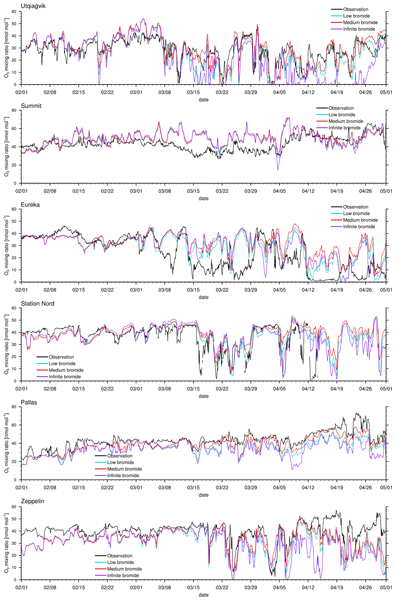
Maximilian Herrmann, Moritz Schöne, Christian Borger, Simon Warnach, Thomas Wagner, Ulrich Platt, and Eva Gutheil
Atmos. Chem. Phys., 22, 13495–13526, https://doi.org/10.5194/acp-22-13495-2022, https://doi.org/10.5194/acp-22-13495-2022, 2022
Short summary
Short summary
Ozone depletion events (ODEs) are a common occurrence in the boundary layer during Arctic spring. Ozone is depleted by bromine species in an autocatalytic reaction cycle. Previous modeling studies assumed an infinite bromine source at the ground. An alternative emission scheme is presented in which a finite amount of bromide in the snow is tracked over time. The Weather Research and Forecasting model coupled with Chemistry (WRF-Chem) is used to study ODEs in the Arctic from February to May 2019.
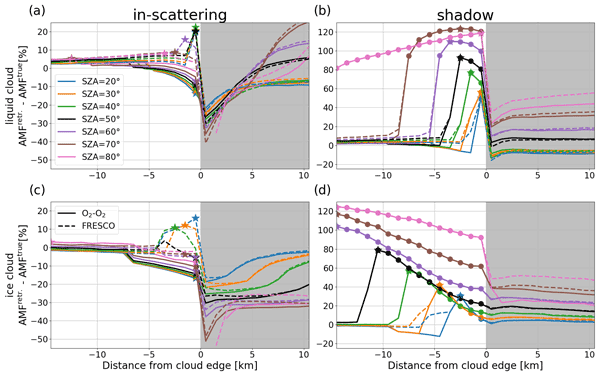
Huan Yu, Claudia Emde, Arve Kylling, Ben Veihelmann, Bernhard Mayer, Kerstin Stebel, and Michel Van Roozendael
Atmos. Meas. Tech., 15, 5743–5768, https://doi.org/10.5194/amt-15-5743-2022, https://doi.org/10.5194/amt-15-5743-2022, 2022
Short summary
Short summary
In this study, we have investigated the impact of 3D clouds on the tropospheric NO2 retrieval from UV–visible sensors. We applied standard NO2 retrieval methods including cloud corrections to synthetic data generated by the 3D radiative transfer model. A sensitivity study was done for synthetic data, and dependencies on various parameters were investigated. Possible mitigation strategies were investigated and compared based on 3D simulations and observed data.
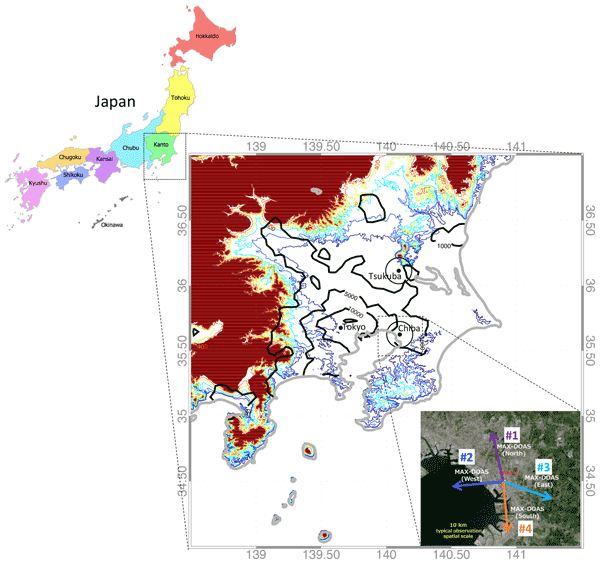
Alessandro Damiani, Hitoshi Irie, Dmitry A. Belikov, Shuei Kaizuka, Hossain Mohammed Syedul Hoque, and Raul R. Cordero
Atmos. Chem. Phys., 22, 12705–12726, https://doi.org/10.5194/acp-22-12705-2022, https://doi.org/10.5194/acp-22-12705-2022, 2022
Short summary
Short summary
We analyzed the variabilities in tropospheric gases and aerosols within the Greater Tokyo Area, Japan. Beyond highlighting air quality changes caused by the pandemic during the lockdown, we found that the degree of weekly cycling of most gases and aerosols was enhanced during the whole of 2020. The changes were unprecedented in recent years and potentially related to coincident reduced mobility in Japan, which, in contrast to other countries, was anomalously low on weekends in 2020.

Hossain Mohammed Syedul Hoque, Kengo Sudo, Hitoshi Irie, Alessandro Damiani, Manish Naja, and Al Mashroor Fatmi
Atmos. Chem. Phys., 22, 12559–12589, https://doi.org/10.5194/acp-22-12559-2022, https://doi.org/10.5194/acp-22-12559-2022, 2022
Short summary
Short summary
Nitrogen dioxide (NO2) and formaldehyde (HCHO) are essential trace graces regulating tropospheric ozone chemistry. These trace constituents are measured using an optical passive remote sensing technique. In addition, NO2 and HCHO are simulated with a computer model and evaluated against the observations. Such evaluations are essential to assess model uncertainties and improve their predictability. The results yielded good agreement between the two datasets with some discrepancies.
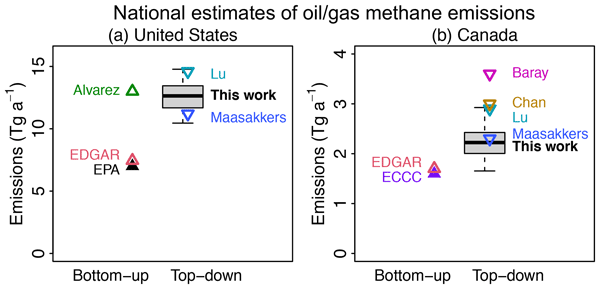
Lu Shen, Ritesh Gautam, Mark Omara, Daniel Zavala-Araiza, Joannes D. Maasakkers, Tia R. Scarpelli, Alba Lorente, David Lyon, Jianxiong Sheng, Daniel J. Varon, Hannah Nesser, Zhen Qu, Xiao Lu, Melissa P. Sulprizio, Steven P. Hamburg, and Daniel J. Jacob
Atmos. Chem. Phys., 22, 11203–11215, https://doi.org/10.5194/acp-22-11203-2022, https://doi.org/10.5194/acp-22-11203-2022, 2022
Short summary
Short summary
We use 22 months of TROPOMI satellite observations to quantity methane emissions from the oil (O) and natural gas (G) sector in the US and Canada at the scale of both individual basins as well as country-wide aggregates. We find that O/G-related methane emissions are underestimated in these inventories by 80 % for the US and 40 % for Canada, and 70 % of the underestimate in the US is from five O/G basins, including Permian, Haynesville, Anadarko, Eagle Ford, and Barnett.
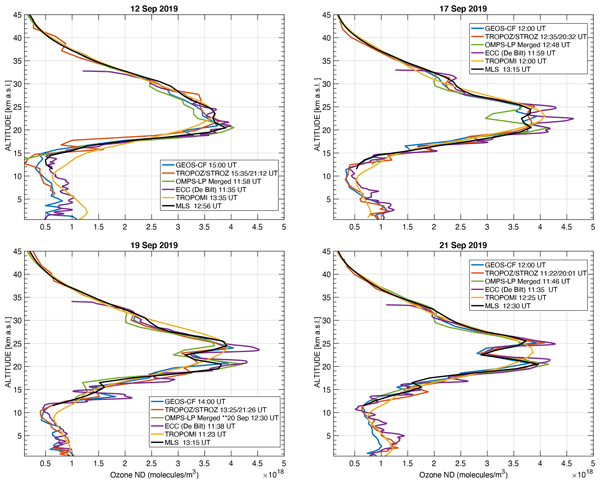
John T. Sullivan, Arnoud Apituley, Nora Mettig, Karin Kreher, K. Emma Knowland, Marc Allaart, Ankie Piters, Michel Van Roozendael, Pepijn Veefkind, Jerry R. Ziemke, Natalya Kramarova, Mark Weber, Alexei Rozanov, Laurence Twigg, Grant Sumnicht, and Thomas J. McGee
Atmos. Chem. Phys., 22, 11137–11153, https://doi.org/10.5194/acp-22-11137-2022, https://doi.org/10.5194/acp-22-11137-2022, 2022
Short summary
Short summary
A TROPOspheric Monitoring Instrument (TROPOMI) validation campaign (TROLIX-19) was held in the Netherlands in September 2019. The research presented here focuses on using ozone lidars from NASA’s Goddard Space Flight Center to better evaluate the characterization of ozone throughout TROLIX-19 as compared to balloon-borne, space-borne and ground-based passive measurements, as well as a global coupled chemistry meteorology model.

Zichong Chen, Daniel J. Jacob, Hannah Nesser, Melissa P. Sulprizio, Alba Lorente, Daniel J. Varon, Xiao Lu, Lu Shen, Zhen Qu, Elise Penn, and Xueying Yu
Atmos. Chem. Phys., 22, 10809–10826, https://doi.org/10.5194/acp-22-10809-2022, https://doi.org/10.5194/acp-22-10809-2022, 2022
Short summary
Short summary
We quantify methane emissions in China and contributions from different sectors by inverse analysis of 2019 TROPOMI satellite observations of atmospheric methane. We find that anthropogenic methane emissions for China are underestimated in the national inventory. Our estimate of emissions indicates a small life-cycle loss rate, implying net climate benefits from the current
coal-to-gasenergy transition in China. However, this small loss rate can be misleading given China's high gas imports.

Nicolas Theys, Christophe Lerot, Hugues Brenot, Jeroen van Gent, Isabelle De Smedt, Lieven Clarisse, Mike Burton, Matthew Varnam, Catherine Hayer, Benjamin Esse, and Michel Van Roozendael
Atmos. Meas. Tech., 15, 4801–4817, https://doi.org/10.5194/amt-15-4801-2022, https://doi.org/10.5194/amt-15-4801-2022, 2022
Short summary
Short summary
Sulfur dioxide plume height after a volcanic eruption is an important piece of information for many different scientific studies and applications. Satellite UV retrievals are useful in this respect, but available algorithms have shown so far limited sensitivity to SO2 height. Here we present a new technique to improve the retrieval of SO2 plume height for SO2 columns as low as 5 DU. We demonstrate the algorithm using TROPOMI measurements and compare with other height estimates.
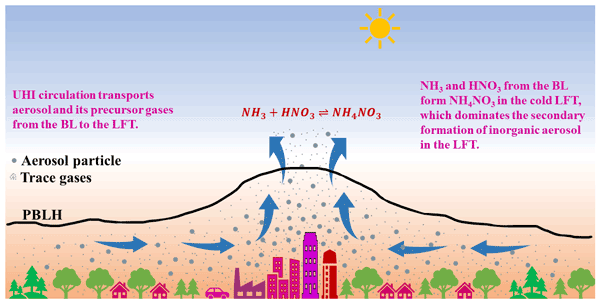
Hanqing Kang, Bin Zhu, Gerrit de Leeuw, Bu Yu, Ronald J. van der A, and Wen Lu
Atmos. Chem. Phys., 22, 10623–10634, https://doi.org/10.5194/acp-22-10623-2022, https://doi.org/10.5194/acp-22-10623-2022, 2022
Short summary
Short summary
This study quantified the contribution of each urban-induced meteorological effect (temperature, humidity, and circulation) to aerosol concentration. We found that the urban heat island (UHI) circulation dominates the UHI effects on aerosol. The UHI circulation transports aerosol and its precursor gases from the warmer lower boundary layer to the colder lower free troposphere and promotes the secondary formation of ammonium nitrate aerosol in the cold atmosphere.

Christian Borger, Steffen Beirle, and Thomas Wagner
Atmos. Chem. Phys., 22, 10603–10621, https://doi.org/10.5194/acp-22-10603-2022, https://doi.org/10.5194/acp-22-10603-2022, 2022
Short summary
Short summary
In this study, we analyse trends of total column water vapour (TCWV) using multiple years of satellite observations and find, on the global average, an increase in the TCWV amount by about 0.21 % per year. Further investigations of the hydrological cycle reveal that the assumption of temporally invariant relative humidity is not always fulfilled and that the response of the global water vapour turnover time to global warming is 2 to 3 times higher than previously reported values.
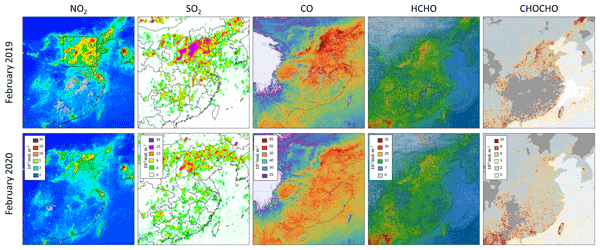
Pieternel F. Levelt, Deborah C. Stein Zweers, Ilse Aben, Maite Bauwens, Tobias Borsdorff, Isabelle De Smedt, Henk J. Eskes, Christophe Lerot, Diego G. Loyola, Fabian Romahn, Trissevgeni Stavrakou, Nicolas Theys, Michel Van Roozendael, J. Pepijn Veefkind, and Tijl Verhoelst
Atmos. Chem. Phys., 22, 10319–10351, https://doi.org/10.5194/acp-22-10319-2022, https://doi.org/10.5194/acp-22-10319-2022, 2022
Short summary
Short summary
Using the COVID-19 lockdown periods as an example, we show how Sentinel-5P/TROPOMI trace gas data (NO2, SO2, CO, HCHO and CHOCHO) can be used to understand impacts on air quality for regions and cities around the globe. We also provide information for both experienced and inexperienced users about how we created the data using state-of-the-art algorithms, where to get the data, methods taking meteorological and seasonal variability into consideration, and insights for future studies.
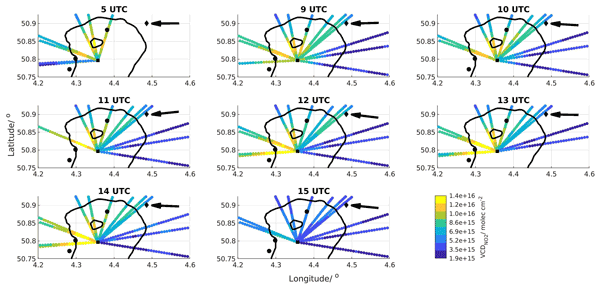
Ermioni Dimitropoulou, François Hendrick, Martina Michaela Friedrich, Frederik Tack, Gaia Pinardi, Alexis Merlaud, Caroline Fayt, Christian Hermans, Frans Fierens, and Michel Van Roozendael
Atmos. Meas. Tech., 15, 4503–4529, https://doi.org/10.5194/amt-15-4503-2022, https://doi.org/10.5194/amt-15-4503-2022, 2022
Short summary
Short summary
A total of 2 years of dual-scan ground-based MAX-DOAS measurements of tropospheric NO2 and aerosols in Uccle (Belgium) have been used to develop a new optimal-estimation-based inversion approach to retrieve horizontal profiles of surface NO2 concentration and aerosol extinction profiles. We show that the combination of an appropriate sampling of TROPOMI pixels by ground-based measurements and an adequate a priori NO2 profile shape in TROPOMI retrievals improves the agreement between datasets.
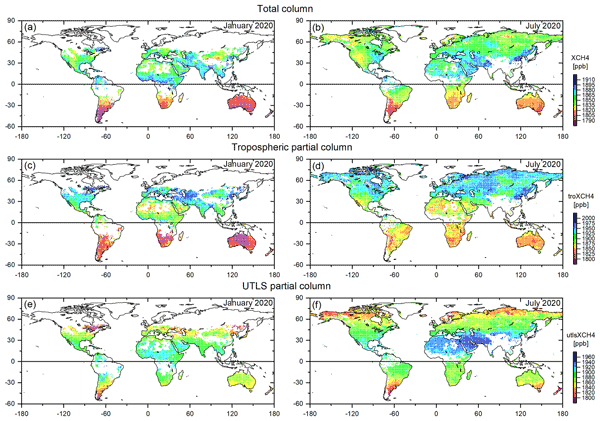
Matthias Schneider, Benjamin Ertl, Qiansi Tu, Christopher J. Diekmann, Farahnaz Khosrawi, Amelie N. Röhling, Frank Hase, Darko Dubravica, Omaira E. García, Eliezer Sepúlveda, Tobias Borsdorff, Jochen Landgraf, Alba Lorente, André Butz, Huilin Chen, Rigel Kivi, Thomas Laemmel, Michel Ramonet, Cyril Crevoisier, Jérome Pernin, Martin Steinbacher, Frank Meinhardt, Kimberly Strong, Debra Wunch, Thorsten Warneke, Coleen Roehl, Paul O. Wennberg, Isamu Morino, Laura T. Iraci, Kei Shiomi, Nicholas M. Deutscher, David W. T. Griffith, Voltaire A. Velazco, and David F. Pollard
Atmos. Meas. Tech., 15, 4339–4371, https://doi.org/10.5194/amt-15-4339-2022, https://doi.org/10.5194/amt-15-4339-2022, 2022
Short summary
Short summary
We present a computationally very efficient method for the synergetic use of level 2 remote-sensing data products. We apply the method to IASI vertical profile and TROPOMI total column space-borne methane observations and thus gain sensitivity for the tropospheric methane partial columns, which is not achievable by the individual use of TROPOMI and IASI. These synergetic effects are evaluated theoretically and empirically by inter-comparisons to independent references of TCCON, AirCore, and GAW.
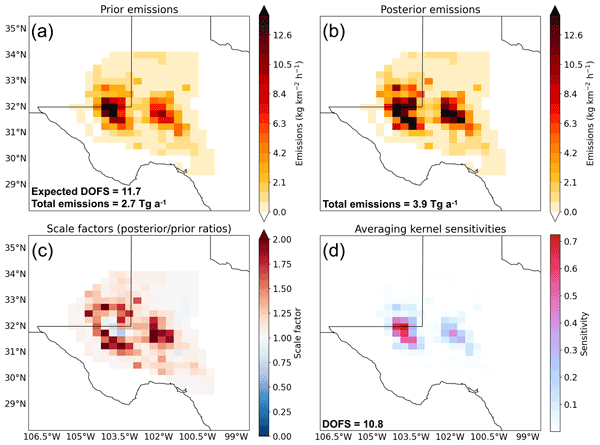
Daniel J. Varon, Daniel J. Jacob, Melissa Sulprizio, Lucas A. Estrada, William B. Downs, Lu Shen, Sarah E. Hancock, Hannah Nesser, Zhen Qu, Elise Penn, Zichong Chen, Xiao Lu, Alba Lorente, Ashutosh Tewari, and Cynthia A. Randles
Geosci. Model Dev., 15, 5787–5805, https://doi.org/10.5194/gmd-15-5787-2022, https://doi.org/10.5194/gmd-15-5787-2022, 2022
Short summary
Short summary
Reducing atmospheric methane emissions is critical to slow near-term climate change. Globally surveying satellite instruments like the TROPOspheric Monitoring Instrument (TROPOMI) have unique capabilities for monitoring atmospheric methane around the world. Here we present a user-friendly cloud-computing tool that enables researchers and stakeholders to quantify methane emissions across user-selected regions of interest using TROPOMI satellite observations.
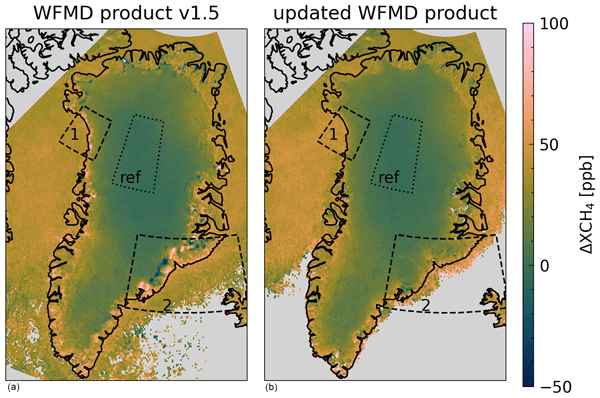
Jonas Hachmeister, Oliver Schneising, Michael Buchwitz, Alba Lorente, Tobias Borsdorff, John P. Burrows, Justus Notholt, and Matthias Buschmann
Atmos. Meas. Tech., 15, 4063–4074, https://doi.org/10.5194/amt-15-4063-2022, https://doi.org/10.5194/amt-15-4063-2022, 2022
Short summary
Short summary
Sentinel-5P trace gas retrievals rely on elevation data in their calculations. Outdated or inaccurate data can lead to significant errors in e.g. dry-air mole fractions of methane (XCH4). We show that the use of inadequate elevation data leads to strong XCH4 anomalies in Greenland. Similar problems can be expected for other regions with inaccurate elevation data. However, we expect these to be more localized. We show that updating elevation data used in the retrieval solves this issue.

Arve Kylling, Claudia Emde, Huan Yu, Michel van Roozendael, Kerstin Stebel, Ben Veihelmann, and Bernhard Mayer
Atmos. Meas. Tech., 15, 3481–3495, https://doi.org/10.5194/amt-15-3481-2022, https://doi.org/10.5194/amt-15-3481-2022, 2022
Short summary
Short summary
Atmospheric trace gases such as nitrogen dioxide (NO2) may be measured by satellite instruments sensitive to solar ultraviolet–visible radiation reflected from Earth and its atmosphere. For a single pixel, clouds in neighbouring pixels may affect the radiation and hence the retrieved trace gas amount. We found that for a solar zenith angle less than about 40° this cloud-related NO2 bias is typically below 10 %, while for larger solar zenith angles the NO2 bias is on the order of tens of percent.
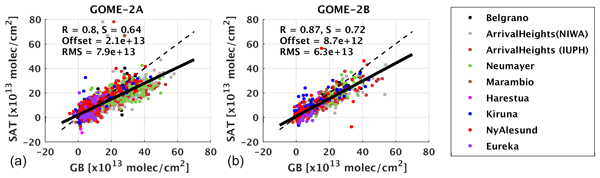
Gaia Pinardi, Michel Van Roozendael, François Hendrick, Andreas Richter, Pieter Valks, Ramina Alwarda, Kristof Bognar, Udo Frieß, José Granville, Myojeong Gu, Paul Johnston, Cristina Prados-Roman, Richard Querel, Kimberly Strong, Thomas Wagner, Folkard Wittrock, and Margarita Yela Gonzalez
Atmos. Meas. Tech., 15, 3439–3463, https://doi.org/10.5194/amt-15-3439-2022, https://doi.org/10.5194/amt-15-3439-2022, 2022
Short summary
Short summary
We report on the GOME-2A and GOME-2B OClO dataset (2007 to 2016, from the EUMETSAT's AC SAF) validation using data from nine NDACC zenith-scattered-light DOAS (ZSL-DOAS) instruments distributed in both the Arctic and Antarctic. Specific sensitivity tests are performed on the ground-based data to estimate the impact of the different OClO DOAS analysis settings and their typical errors. Good agreement is found for both the inter-annual variability and the overall OClO seasonal behavior.
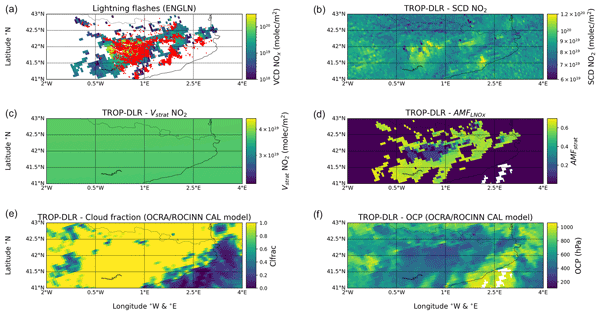
Francisco J. Pérez-Invernón, Heidi Huntrieser, Thilo Erbertseder, Diego Loyola, Pieter Valks, Song Liu, Dale J. Allen, Kenneth E. Pickering, Eric J. Bucsela, Patrick Jöckel, Jos van Geffen, Henk Eskes, Sergio Soler, Francisco J. Gordillo-Vázquez, and Jeff Lapierre
Atmos. Meas. Tech., 15, 3329–3351, https://doi.org/10.5194/amt-15-3329-2022, https://doi.org/10.5194/amt-15-3329-2022, 2022
Short summary
Short summary
Lightning, one of the major sources of nitrogen oxides in the atmosphere, contributes to the tropospheric concentration of ozone and to the oxidizing capacity of the atmosphere. In this work, we contribute to improving the estimation of lightning-produced nitrogen oxides in the Ebro Valley and the Pyrenees by using two different TROPOMI products and comparing the results.
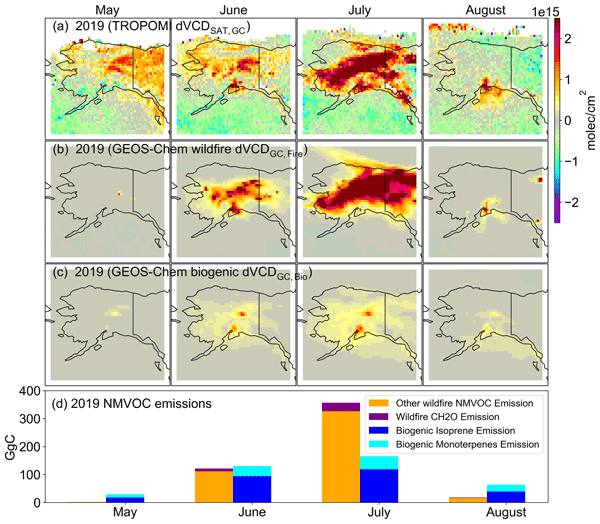
Tianlang Zhao, Jingqiu Mao, William R. Simpson, Isabelle De Smedt, Lei Zhu, Thomas F. Hanisco, Glenn M. Wolfe, Jason M. St. Clair, Gonzalo González Abad, Caroline R. Nowlan, Barbara Barletta, Simone Meinardi, Donald R. Blake, Eric C. Apel, and Rebecca S. Hornbrook
Atmos. Chem. Phys., 22, 7163–7178, https://doi.org/10.5194/acp-22-7163-2022, https://doi.org/10.5194/acp-22-7163-2022, 2022
Short summary
Short summary
Monitoring formaldehyde (HCHO) can help us understand Arctic vegetation change. Here, we compare satellite data and model and show that Alaska summertime HCHO is largely dominated by a background from methane oxidation during mild wildfire years and is dominated by wildfire (largely from direct emission of fire) during strong fire years. Consequently, it is challenging to use satellite HCHO to study vegetation change in the Arctic region.
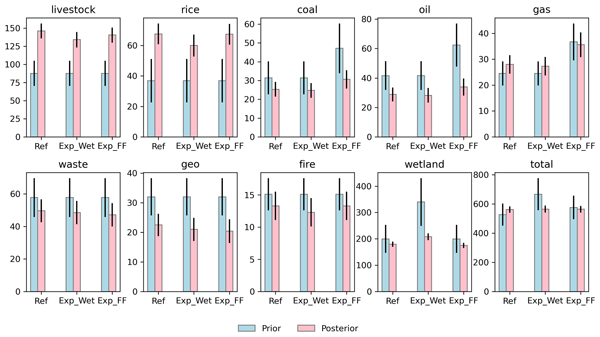
John R. Worden, Daniel H. Cusworth, Zhen Qu, Yi Yin, Yuzhong Zhang, A. Anthony Bloom, Shuang Ma, Brendan K. Byrne, Tia Scarpelli, Joannes D. Maasakkers, David Crisp, Riley Duren, and Daniel J. Jacob
Atmos. Chem. Phys., 22, 6811–6841, https://doi.org/10.5194/acp-22-6811-2022, https://doi.org/10.5194/acp-22-6811-2022, 2022
Short summary
Short summary
This paper is intended to accomplish two goals: 1) describe a new algorithm by which remotely sensed measurements of methane or other tracers can be used to not just quantify methane fluxes, but also attribute these fluxes to specific sources and regions and characterize their uncertainties, and 2) use this new algorithm to provide methane emissions by sector and country in support of the global stock take.
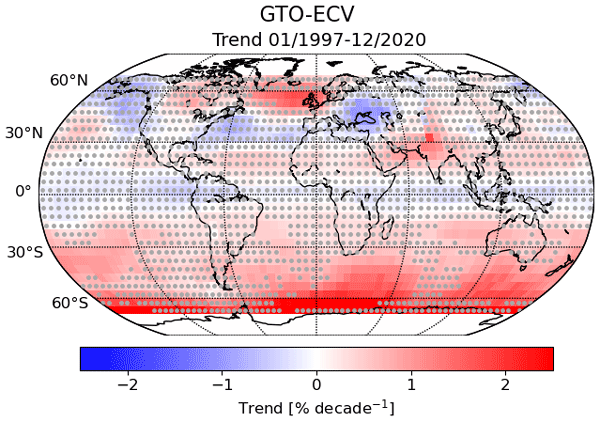
Melanie Coldewey-Egbers, Diego G. Loyola, Christophe Lerot, and Michel Van Roozendael
Atmos. Chem. Phys., 22, 6861–6878, https://doi.org/10.5194/acp-22-6861-2022, https://doi.org/10.5194/acp-22-6861-2022, 2022
Short summary
Short summary
Monitoring the long-term evolution of ozone and the evaluation of trends is essential to assess the efficacy of the Montreal Protocol and its amendments. The first signs of recovery as a consequence of decreasing amounts of ozone-depleting substances have been reported, but the impact needs to be investigated in more detail. In the Southern Hemisphere significant positive trends were found, but in the Northern Hemisphere the expected increase is still not yet visible.
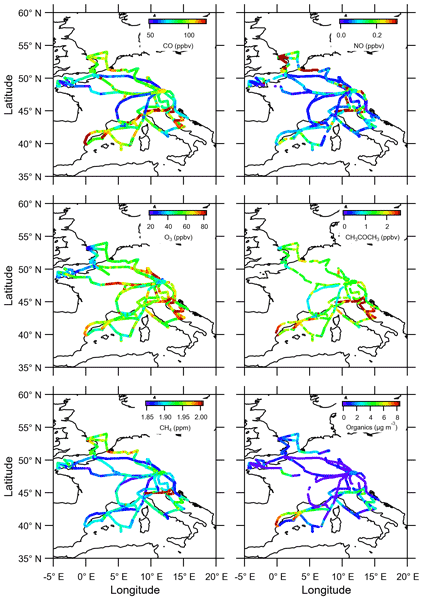
M. Dolores Andrés Hernández, Andreas Hilboll, Helmut Ziereis, Eric Förster, Ovid O. Krüger, Katharina Kaiser, Johannes Schneider, Francesca Barnaba, Mihalis Vrekoussis, Jörg Schmidt, Heidi Huntrieser, Anne-Marlene Blechschmidt, Midhun George, Vladyslav Nenakhov, Theresa Harlass, Bruna A. Holanda, Jennifer Wolf, Lisa Eirenschmalz, Marc Krebsbach, Mira L. Pöhlker, Anna B. Kalisz Hedegaard, Linlu Mei, Klaus Pfeilsticker, Yangzhuoran Liu, Ralf Koppmann, Hans Schlager, Birger Bohn, Ulrich Schumann, Andreas Richter, Benjamin Schreiner, Daniel Sauer, Robert Baumann, Mariano Mertens, Patrick Jöckel, Markus Kilian, Greta Stratmann, Christopher Pöhlker, Monica Campanelli, Marco Pandolfi, Michael Sicard, José L. Gómez-Amo, Manuel Pujadas, Katja Bigge, Flora Kluge, Anja Schwarz, Nikos Daskalakis, David Walter, Andreas Zahn, Ulrich Pöschl, Harald Bönisch, Stephan Borrmann, Ulrich Platt, and John P. Burrows
Atmos. Chem. Phys., 22, 5877–5924, https://doi.org/10.5194/acp-22-5877-2022, https://doi.org/10.5194/acp-22-5877-2022, 2022
Short summary
Short summary
EMeRGe provides a unique set of in situ and remote sensing airborne measurements of trace gases and aerosol particles along selected flight routes in the lower troposphere over Europe. The interpretation uses also complementary collocated ground-based and satellite measurements. The collected data help to improve the current understanding of the complex spatial distribution of trace gases and aerosol particles resulting from mixing, transport, and transformation of pollution plumes over Europe.
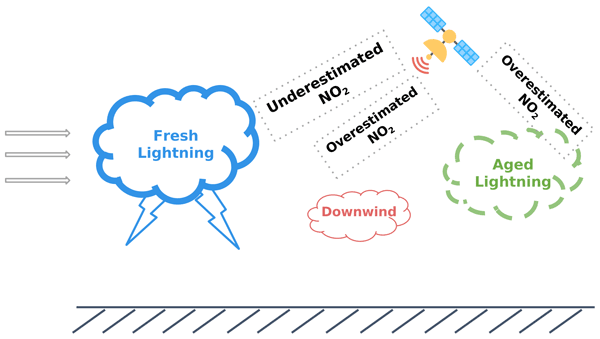
Xin Zhang, Yan Yin, Ronald van der A, Henk Eskes, Jos van Geffen, Yunyao Li, Xiang Kuang, Jeff L. Lapierre, Kui Chen, Zhongxiu Zhen, Jianlin Hu, Chuan He, Jinghua Chen, Rulin Shi, Jun Zhang, Xingrong Ye, and Hao Chen
Atmos. Chem. Phys., 22, 5925–5942, https://doi.org/10.5194/acp-22-5925-2022, https://doi.org/10.5194/acp-22-5925-2022, 2022
Short summary
Short summary
The importance of convection to the ozone and nitrogen oxides (NOx) produced from lightning has long been an open question. We utilize the high-resolution chemistry model with ozonesondes and space observations to discuss the effects of convection over southeastern China, where few studies have been conducted. Our results show the transport and chemistry contributions for various storms and demonstrate the ability of TROPOMI to estimate the lightning NOx production over small-scale convection.
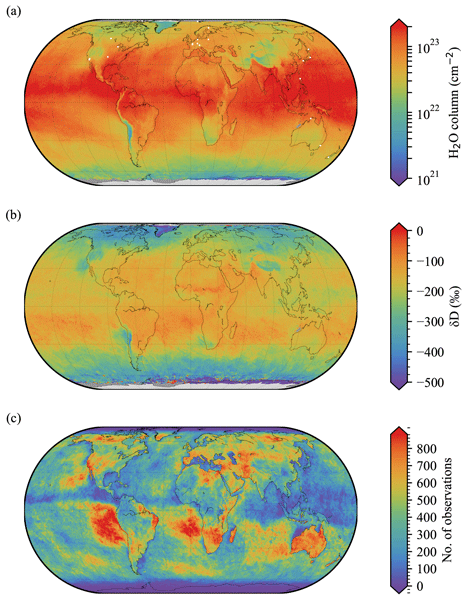
Andreas Schneider, Tobias Borsdorff, Joost aan de Brugh, Alba Lorente, Franziska Aemisegger, David Noone, Dean Henze, Rigel Kivi, and Jochen Landgraf
Atmos. Meas. Tech., 15, 2251–2275, https://doi.org/10.5194/amt-15-2251-2022, https://doi.org/10.5194/amt-15-2251-2022, 2022
Short summary
Short summary
This paper presents an extended H₂O/HDO total column dataset from short-wave infrared measurements by TROPOMI including cloudy and clear-sky scenes. Coverage is tremendously increased compared to previous TROPOMI HDO datasets. The new dataset is validated against recent ground-based FTIR measurements from TCCON and against aircraft measurements over the ocean. The use of the new dataset is demonstrated with a case study of a cold air outbreak in January 2020.
Jos van Geffen, Henk Eskes, Steven Compernolle, Gaia Pinardi, Tijl Verhoelst, Jean-Christopher Lambert, Maarten Sneep, Mark ter Linden, Antje Ludewig, K. Folkert Boersma, and J. Pepijn Veefkind
Atmos. Meas. Tech., 15, 2037–2060, https://doi.org/10.5194/amt-15-2037-2022, https://doi.org/10.5194/amt-15-2037-2022, 2022
Short summary
Short summary
Nitrogen dioxide (NO2) is one of the main data products measured by the Tropospheric Monitoring Instrument (TROPOMI) on the Sentinel-5 Precursor (S5P) satellite. This study describes improvements in the TROPOMI NO2 retrieval leading to version v2.2, operational since 1 July 2021. It compares results with previous versions v1.2–v1.4 and with Ozone Monitoring Instrument (OMI) and ground-based measurements.
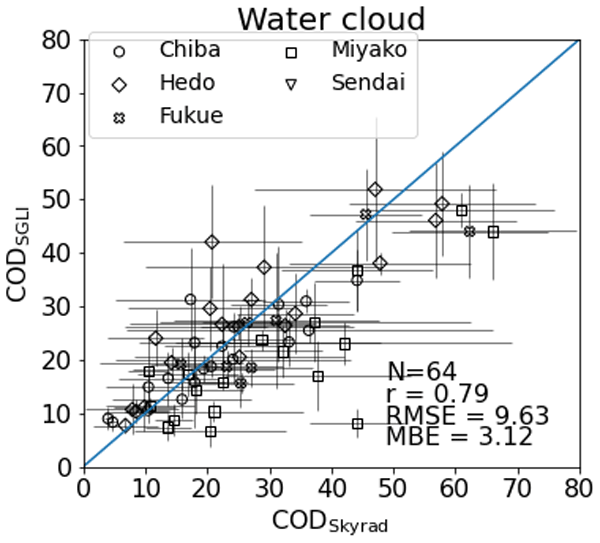
Pradeep Khatri, Tadahiro Hayasaka, Hitoshi Irie, Husi Letu, Takashi Y. Nakajima, Hiroshi Ishimoto, and Tamio Takamura
Atmos. Meas. Tech., 15, 1967–1982, https://doi.org/10.5194/amt-15-1967-2022, https://doi.org/10.5194/amt-15-1967-2022, 2022
Short summary
Short summary
Cloud properties observed by the Second-generation Global Imager (SGLI) onboard the Global Change Observation Mission – Climate (GCOM-C) satellite are evaluated using surface observation data. The study finds that SGLI-observed cloud properties are qualitative enough, although water cloud properties are suggested to be more qualitative, and both water and ice cloud properties can reproduce surface irradiance quite satisfactorily. Thus, SGLI cloud products are very useful for different studies.

Hisahiro Takashima, Yugo Kanaya, Saki Kato, Martina M. Friedrich, Michel Van Roozendael, Fumikazu Taketani, Takuma Miyakawa, Yuichi Komazaki, Carlos A. Cuevas, Alfonso Saiz-Lopez, and Takashi Sekiya
Atmos. Chem. Phys., 22, 4005–4018, https://doi.org/10.5194/acp-22-4005-2022, https://doi.org/10.5194/acp-22-4005-2022, 2022
Short summary
Short summary
We have undertaken atmospheric iodine monoxide (IO) observations in the global marine boundary layer with a wide latitudinal coverage and sea surface temperature (SST) range. We conclude that atmospheric iodine is abundant over the Western Pacific warm pool, appearing as an iodine fountain, where ozone (O3) minima occur. Our study also found negative correlations between IO and O3 concentrations over IO maxima, which requires reconsideration of the initiation process of halogen activation.
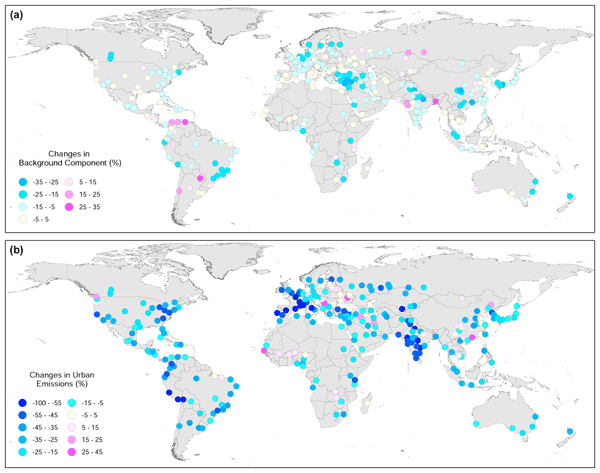
Vitali Fioletov, Chris A. McLinden, Debora Griffin, Nickolay Krotkov, Fei Liu, and Henk Eskes
Atmos. Chem. Phys., 22, 4201–4236, https://doi.org/10.5194/acp-22-4201-2022, https://doi.org/10.5194/acp-22-4201-2022, 2022
Short summary
Short summary
The COVID-19 lockdown had a large impact on anthropogenic emissions and particularly on nitrogen dioxide (NO2). A new method of isolation of background, urban, and industrial components in NO2 is applied to estimate the lockdown impact on each of them. From 16 March to 15 June 2020, urban NO2 declined by −18 % to −28 % in most regions of the world, while background NO2 typically declined by less than −10 %.

Takashi Sekiya, Kazuyuki Miyazaki, Henk Eskes, Kengo Sudo, Masayuki Takigawa, and Yugo Kanaya
Atmos. Meas. Tech., 15, 1703–1728, https://doi.org/10.5194/amt-15-1703-2022, https://doi.org/10.5194/amt-15-1703-2022, 2022
Short summary
Short summary
This study gives a systematic comparison of TROPOMI version 1.2 and OMI QA4ECV tropospheric NO2 column through global chemical data assimilation (DA) integration for April–May 2018. DA performance is controlled by measurement sensitivities, retrieval errors, and coverage. Due to reduced errors in TROPOMI, agreements against assimilated and independent observations were improved by TROPOMI DA compared to OMI DA. These results demonstrate that TROPOMI DA improves global analyses of NO2 and ozone.
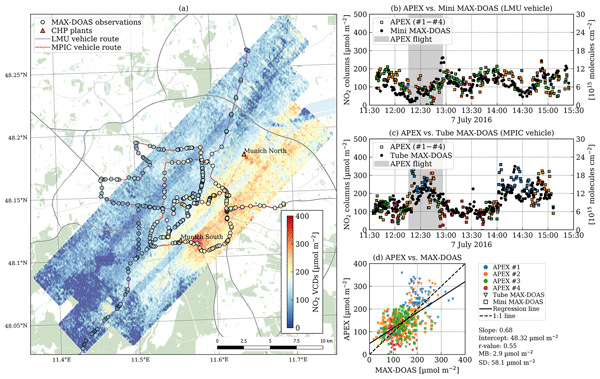
Gerrit Kuhlmann, Ka Lok Chan, Sebastian Donner, Ying Zhu, Marc Schwaerzel, Steffen Dörner, Jia Chen, Andreas Hueni, Duc Hai Nguyen, Alexander Damm, Annette Schütt, Florian Dietrich, Dominik Brunner, Cheng Liu, Brigitte Buchmann, Thomas Wagner, and Mark Wenig
Atmos. Meas. Tech., 15, 1609–1629, https://doi.org/10.5194/amt-15-1609-2022, https://doi.org/10.5194/amt-15-1609-2022, 2022
Short summary
Short summary
Nitrogen dioxide (NO2) is an air pollutant whose concentration often exceeds air quality guideline values, especially in urban areas. To map the spatial distribution of NO2 in Munich, we conducted the Munich NO2 Imaging Campaign (MuNIC), where NO2 was measured with stationary, mobile, and airborne in situ and remote sensing instruments. The campaign provides a unique dataset that has been used to compare the different instruments and to study the spatial variability of NO2 and its sources.
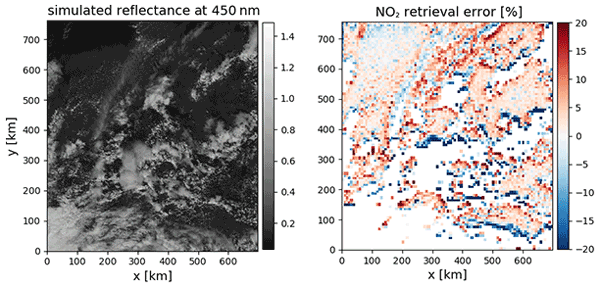
Claudia Emde, Huan Yu, Arve Kylling, Michel van Roozendael, Kerstin Stebel, Ben Veihelmann, and Bernhard Mayer
Atmos. Meas. Tech., 15, 1587–1608, https://doi.org/10.5194/amt-15-1587-2022, https://doi.org/10.5194/amt-15-1587-2022, 2022
Short summary
Short summary
Retrievals of trace gas concentrations from satellite observations can be affected by clouds in the vicinity, either by shadowing or by scattering of radiation from clouds in the clear region. We used a Monte Carlo radiative transfer model to generate synthetic satellite observations, which we used to test retrieval algorithms and to quantify the error of retrieved NO2 vertical column density due to cloud scattering.
Tobias Christoph Valentin Werner Riess, Klaas Folkert Boersma, Jasper van Vliet, Wouter Peters, Maarten Sneep, Henk Eskes, and Jos van Geffen
Atmos. Meas. Tech., 15, 1415–1438, https://doi.org/10.5194/amt-15-1415-2022, https://doi.org/10.5194/amt-15-1415-2022, 2022
Short summary
Short summary
This paper reports on improved monitoring of ship nitrogen oxide emissions by TROPOMI. With its fantastic resolution we can identify lanes of ship nitrogen dioxide (NO2) pollution not detected from space before. The quality of TROPOMI NO2 data over sea is improved further by recent upgrades in cloud retrievals and the use of sun glint scenes. Lastly, we study the impact of COVID-19 on ship NO2 in European seas and compare the found reductions to emission estimates gained from ship-specific data.
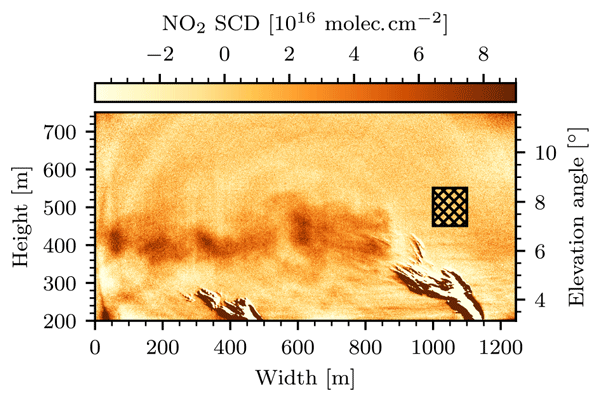
Leon Kuhn, Jonas Kuhn, Thomas Wagner, and Ulrich Platt
Atmos. Meas. Tech., 15, 1395–1414, https://doi.org/10.5194/amt-15-1395-2022, https://doi.org/10.5194/amt-15-1395-2022, 2022
Short summary
Short summary
We present a novel instrument for imaging measurements of NO2 with high spatiotemporal resolution based on gas correlation spectroscopy, called the GCS NO2 camera. The instrument works by placing two gas cells (cuvettes) in front of two photosensor arrays, one filled with air and one filled with a high concentration of NO2, acting as a non-dispersive spectral filter. NO2 images are then generated on the basis of the signal ratio of the two channels in the spectral region of 430–445 nm.
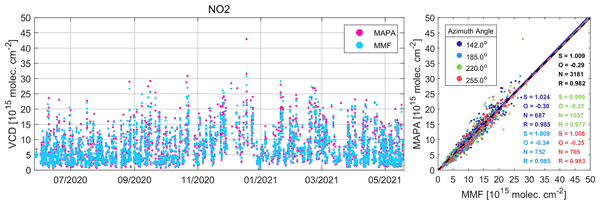
Dimitris Karagkiozidis, Martina Michaela Friedrich, Steffen Beirle, Alkiviadis Bais, François Hendrick, Kalliopi Artemis Voudouri, Ilias Fountoulakis, Angelos Karanikolas, Paraskevi Tzoumaka, Michel Van Roozendael, Dimitris Balis, and Thomas Wagner
Atmos. Meas. Tech., 15, 1269–1301, https://doi.org/10.5194/amt-15-1269-2022, https://doi.org/10.5194/amt-15-1269-2022, 2022
Short summary
Short summary
In this study we focus on the retrieval of aerosol, NO2, and HCHO vertical profiles from multi-axis differential optical absorption spectroscopy (MAX-DOAS) observations for the first time over Thessaloniki, Greece. We use two independent inversion algorithms for the profile retrievals. We evaluate their performance, we intercompare their results, and we validate their products with ancillary data, measured by other co-located reference instruments.
Thomas von Clarmann, Steven Compernolle, and Frank Hase
Atmos. Meas. Tech., 15, 1145–1157, https://doi.org/10.5194/amt-15-1145-2022, https://doi.org/10.5194/amt-15-1145-2022, 2022
Short summary
Short summary
Contrary to the claims put forward in
Evaluation of measurement data – Guide to the expression of uncertainty in measurementissued by the JCGM, the error concept and the uncertainty concept are the same. Arguments in favor of the contrary were found not to be compelling. Neither was any evidence presented that
errorsand
uncertaintiesdefine a different relation between the measured and true values, nor is a Bayesian concept beyond the mere subjective probability referred to.

Kezia Lange, Andreas Richter, and John P. Burrows
Atmos. Chem. Phys., 22, 2745–2767, https://doi.org/10.5194/acp-22-2745-2022, https://doi.org/10.5194/acp-22-2745-2022, 2022
Short summary
Short summary
In this study, we investigated short time variability of NOx emissions and lifetimes on a global scale. We combined 2 years of satellite Sentinel-5P TROPOMI tropospheric NO2 column data with wind data. Fifty NOx sources distributed around the world are analyzed. The retrieved emissions show a clear seasonal dependence. NOx lifetime shows a latitudinal dependence but only a week seasonal dependence. NOx emissions show a clear weekly pattern which in contrast is not visible for NOx lifetimes.
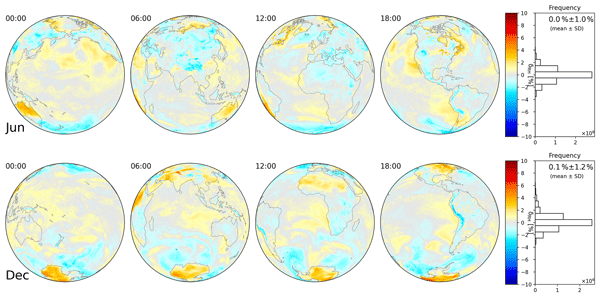
Steffen Beirle, Christian Borger, Steffen Dörner, Vinod Kumar, and Thomas Wagner
Atmos. Meas. Tech., 15, 987–1006, https://doi.org/10.5194/amt-15-987-2022, https://doi.org/10.5194/amt-15-987-2022, 2022
Short summary
Short summary
We present a formalism that relates the vertical column density (VCD) of the oxygen collision complex O4 to surface values of temperature and pressure, based on physical laws. In addition, we propose an empirical modification which also accounts for surface relative humidity (RH). This allows for simple and quick but still accurate calculation of the O4 VCD without the need for constructing full vertical profiles, which is expected to be useful in particular for MAX-DOAS applications.
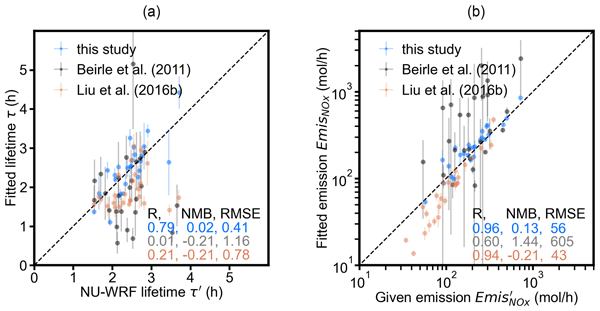
Fei Liu, Zhining Tao, Steffen Beirle, Joanna Joiner, Yasuko Yoshida, Steven J. Smith, K. Emma Knowland, and Thomas Wagner
Atmos. Chem. Phys., 22, 1333–1349, https://doi.org/10.5194/acp-22-1333-2022, https://doi.org/10.5194/acp-22-1333-2022, 2022
Short summary
Short summary
In this work, we present a novel method to infer NOx emissions and lifetimes based on tropospheric NO2 observations together with reanalysis wind fields for cities located in polluted backgrounds. We evaluate the accuracy of the method using synthetic NO2 observations derived from a high-resolution model simulation. Our work provides an estimate for uncertainties in satellite-derived emissions inferred from chemical transport model (CTM)-independent approaches.
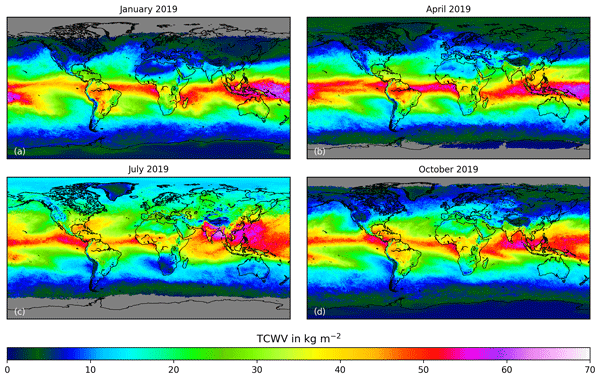
Tobias Küchler, Stefan Noël, Heinrich Bovensmann, John Philip Burrows, Thomas Wagner, Christian Borger, Tobias Borsdorff, and Andreas Schneider
Atmos. Meas. Tech., 15, 297–320, https://doi.org/10.5194/amt-15-297-2022, https://doi.org/10.5194/amt-15-297-2022, 2022
Short summary
Short summary
We applied the air-mass-corrected differential optical absorption spectroscopy (AMC-DOAS) method to derive total column water vapour (TCWV) from Sentinel-5P measurements and compared it to independent data sets. The correlation coefficients of typically more than 0.9 and the small deviations up to 2.5 kg m−2 reveal good agreement between our data product and other TCWV data sets. In particular for the different Sentinel-5P water vapour products, the deviations are around 1 kg m−2.

Xiao Lu, Daniel J. Jacob, Haolin Wang, Joannes D. Maasakkers, Yuzhong Zhang, Tia R. Scarpelli, Lu Shen, Zhen Qu, Melissa P. Sulprizio, Hannah Nesser, A. Anthony Bloom, Shuang Ma, John R. Worden, Shaojia Fan, Robert J. Parker, Hartmut Boesch, Ritesh Gautam, Deborah Gordon, Michael D. Moran, Frances Reuland, Claudia A. Octaviano Villasana, and Arlyn Andrews
Atmos. Chem. Phys., 22, 395–418, https://doi.org/10.5194/acp-22-395-2022, https://doi.org/10.5194/acp-22-395-2022, 2022
Short summary
Short summary
We evaluate methane emissions and trends for 2010–2017 in the gridded national emission inventories for the United States, Canada, and Mexico by inversion of in situ and satellite methane observations. We find that anthropogenic methane emissions for all three countries are underestimated in the national inventories, largely driven by oil emissions. Anthropogenic methane emissions in the US peak in 2014, in contrast to the report of a steadily decreasing trend over 2010–2017 from the US EPA.
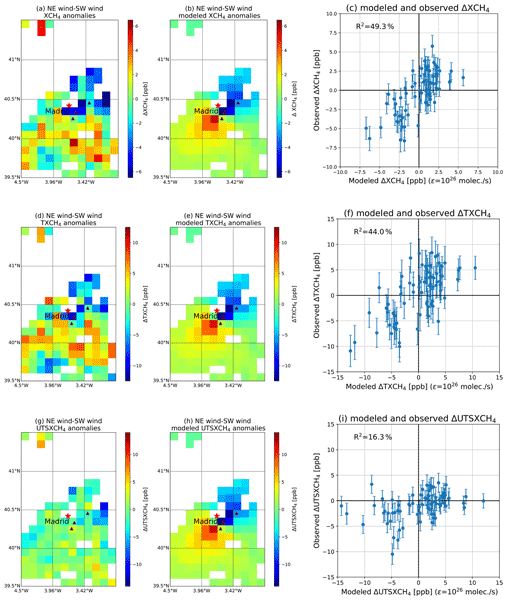
Qiansi Tu, Frank Hase, Matthias Schneider, Omaira García, Thomas Blumenstock, Tobias Borsdorff, Matthias Frey, Farahnaz Khosrawi, Alba Lorente, Carlos Alberti, Juan J. Bustos, André Butz, Virgilio Carreño, Emilio Cuevas, Roger Curcoll, Christopher J. Diekmann, Darko Dubravica, Benjamin Ertl, Carme Estruch, Sergio Fabián León-Luis, Carlos Marrero, Josep-Anton Morgui, Ramón Ramos, Christian Scharun, Carsten Schneider, Eliezer Sepúlveda, Carlos Toledano, and Carlos Torres
Atmos. Chem. Phys., 22, 295–317, https://doi.org/10.5194/acp-22-295-2022, https://doi.org/10.5194/acp-22-295-2022, 2022
Short summary
Short summary
We use different methane ground- and space-based remote sensing data sets for investigating the emission strength of three waste disposal sites close to Madrid. We present a method that uses wind-assigned anomalies for deriving emission strengths from satellite data and estimate their uncertainty to 9–14 %. The emission strengths estimated from the remote sensing data sets are significantly larger than the values published in the official register.
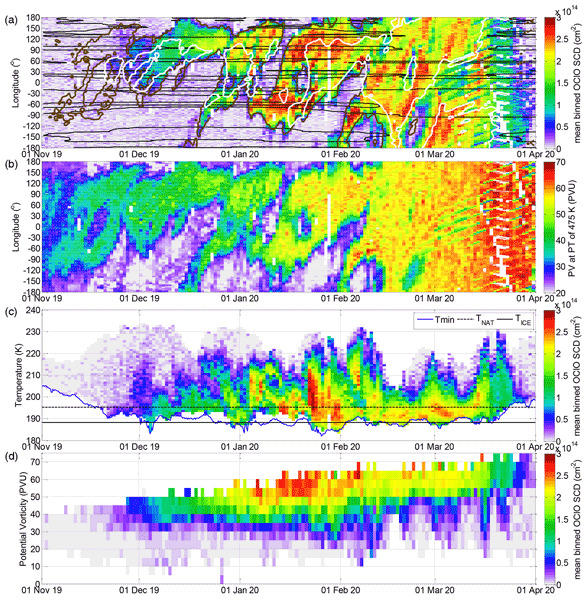
Jānis Puķīte, Christian Borger, Steffen Dörner, Myojeong Gu, and Thomas Wagner
Atmos. Chem. Phys., 22, 245–272, https://doi.org/10.5194/acp-22-245-2022, https://doi.org/10.5194/acp-22-245-2022, 2022
Short summary
Short summary
Chlorine dioxide (OClO) is an indicator for chlorine activation. New OClO data by TROPOMI (S5P) are interpreted in a meteorological context and related to CALIOP PSC observations. We report very high OClO levels for the northern hemispheric winter 2019/20 with an extraordinarily long period with a stable polar vortex. A minor stratospheric warming in the Southern Hemisphere was also observed in September 2019, where usual OClO values rapidly deactivated 1–2 weeks earlier.
Auke J. Visser, Laurens N. Ganzeveld, Ignacio Goded, Maarten C. Krol, Ivan Mammarella, Giovanni Manca, and K. Folkert Boersma
Atmos. Chem. Phys., 21, 18393–18411, https://doi.org/10.5194/acp-21-18393-2021, https://doi.org/10.5194/acp-21-18393-2021, 2021
Short summary
Short summary
Dry deposition is an important sink for tropospheric ozone that affects ecosystem carbon uptake, but process understanding remains incomplete. We apply a common deposition representation in atmospheric chemistry models and a multi-layer canopy model to multi-year ozone deposition observations. The multi-layer canopy model performs better on diurnal timescales compared to the common approach, leading to a substantially improved simulation of ozone deposition and vegetation ozone impact metrics.
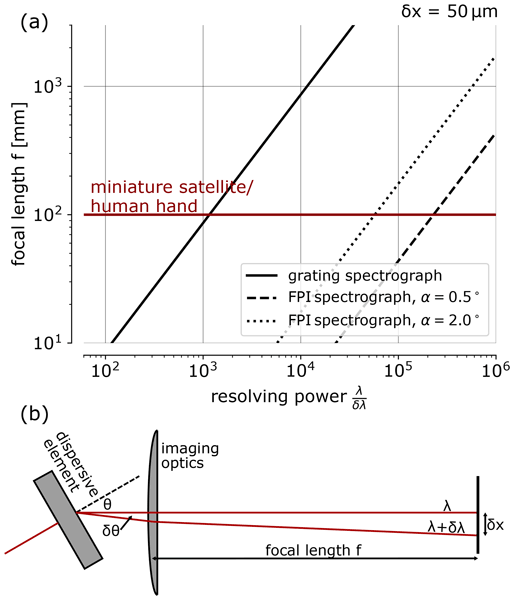
Jonas Kuhn, Nicole Bobrowski, Thomas Wagner, and Ulrich Platt
Atmos. Meas. Tech., 14, 7873–7892, https://doi.org/10.5194/amt-14-7873-2021, https://doi.org/10.5194/amt-14-7873-2021, 2021
Short summary
Short summary
We propose spectrograph implementations using Fabry–Pérot interferometers for atmospheric trace gas remote sensing. Compared with widely used grating spectrographs, we find substantial light throughput and mobility advantages for high resolving powers. Besides lowering detection limits and increasing the spatial and temporal resolution of many atmospheric trace gas measurements, this approach might enable remote sensing of further important gases such as tropospheric OH radicals.
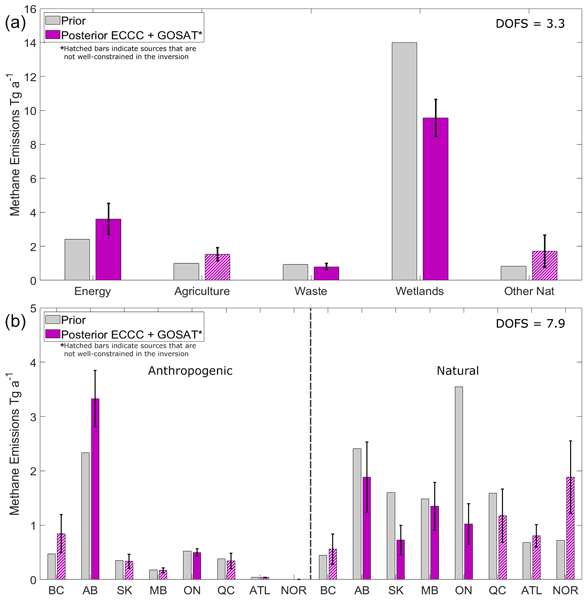
Sabour Baray, Daniel J. Jacob, Joannes D. Maasakkers, Jian-Xiong Sheng, Melissa P. Sulprizio, Dylan B. A. Jones, A. Anthony Bloom, and Robert McLaren
Atmos. Chem. Phys., 21, 18101–18121, https://doi.org/10.5194/acp-21-18101-2021, https://doi.org/10.5194/acp-21-18101-2021, 2021
Short summary
Short summary
We use 2010–2015 surface and satellite observations to disentangle methane from anthropogenic and natural sources in Canada. Using a chemical transport model (GEOS-Chem), the mismatch between modelled and observed methane concentrations can be used to infer emissions according to Bayesian statistics. Compared to prior knowledge, we show higher anthropogenic emissions attributed to energy and/or agriculture in Western Canada and lower natural emissions from Boreal wetlands.
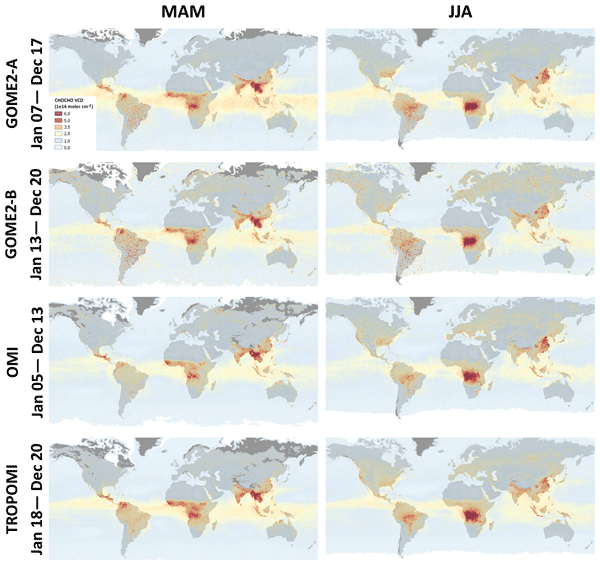
Christophe Lerot, François Hendrick, Michel Van Roozendael, Leonardo M. A. Alvarado, Andreas Richter, Isabelle De Smedt, Nicolas Theys, Jonas Vlietinck, Huan Yu, Jeroen Van Gent, Trissevgeni Stavrakou, Jean-François Müller, Pieter Valks, Diego Loyola, Hitoshi Irie, Vinod Kumar, Thomas Wagner, Stefan F. Schreier, Vinayak Sinha, Ting Wang, Pucai Wang, and Christian Retscher
Atmos. Meas. Tech., 14, 7775–7807, https://doi.org/10.5194/amt-14-7775-2021, https://doi.org/10.5194/amt-14-7775-2021, 2021
Short summary
Short summary
Global measurements of glyoxal tropospheric columns from the satellite instrument TROPOMI are presented. Such measurements can contribute to the estimation of atmospheric emissions of volatile organic compounds. This new glyoxal product has been fully characterized with a comprehensive error budget, with comparison with other satellite data sets as well as with validation based on independent ground-based remote sensing glyoxal observations.
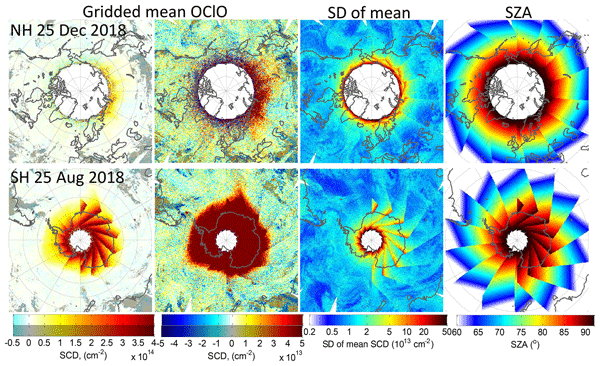
Jānis Puķīte, Christian Borger, Steffen Dörner, Myojeong Gu, Udo Frieß, Andreas Carlos Meier, Carl-Fredrik Enell, Uwe Raffalski, Andreas Richter, and Thomas Wagner
Atmos. Meas. Tech., 14, 7595–7625, https://doi.org/10.5194/amt-14-7595-2021, https://doi.org/10.5194/amt-14-7595-2021, 2021
Short summary
Short summary
Chlorine dioxide (OClO) is used as an indicator for chlorine activation. We present a new differential optical absorption spectroscopy retrieval algorithm for OClO from measurements of TROPOMI on the Sentinel-5P satellite. To achieve a substantially improved accuracy for the weak absorber OClO, we consider several additional fit parameters accounting for various higher-order spectral effects. The retrieved OClO slant column densities are compared with ground-based zenith sky measurements.
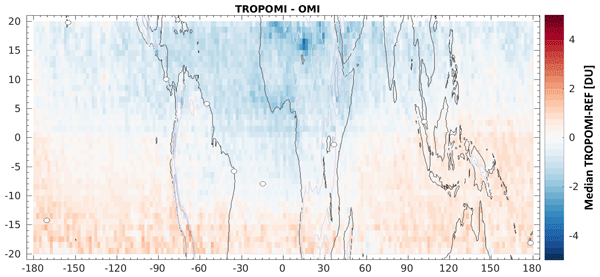
Daan Hubert, Klaus-Peter Heue, Jean-Christopher Lambert, Tijl Verhoelst, Marc Allaart, Steven Compernolle, Patrick D. Cullis, Angelika Dehn, Christian Félix, Bryan J. Johnson, Arno Keppens, Debra E. Kollonige, Christophe Lerot, Diego Loyola, Matakite Maata, Sukarni Mitro, Maznorizan Mohamad, Ankie Piters, Fabian Romahn, Henry B. Selkirk, Francisco R. da Silva, Ryan M. Stauffer, Anne M. Thompson, J. Pepijn Veefkind, Holger Vömel, Jacquelyn C. Witte, and Claus Zehner
Atmos. Meas. Tech., 14, 7405–7433, https://doi.org/10.5194/amt-14-7405-2021, https://doi.org/10.5194/amt-14-7405-2021, 2021
Short summary
Short summary
We assess the first 2 years of TROPOMI tropical tropospheric ozone column data. Comparisons to reference measurements by ozonesonde and satellite sensors show that TROPOMI bias (−0.1 to +2.3 DU) and precision (1.5 to 2.5 DU) meet mission requirements. Potential causes of bias and its spatio-temporal structure are discussed, as well as ways to identify sampling errors. Our analysis of known geophysical patterns demonstrates the improved performance of TROPOMI with respect to its predecessors.
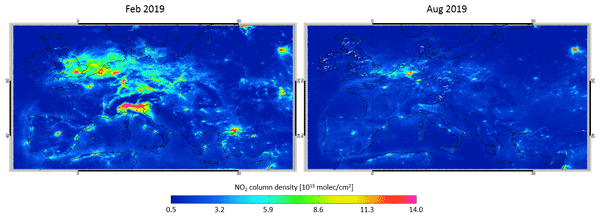
Song Liu, Pieter Valks, Gaia Pinardi, Jian Xu, Ka Lok Chan, Athina Argyrouli, Ronny Lutz, Steffen Beirle, Ehsan Khorsandi, Frank Baier, Vincent Huijnen, Alkiviadis Bais, Sebastian Donner, Steffen Dörner, Myrto Gratsea, François Hendrick, Dimitris Karagkiozidis, Kezia Lange, Ankie J. M. Piters, Julia Remmers, Andreas Richter, Michel Van Roozendael, Thomas Wagner, Mark Wenig, and Diego G. Loyola
Atmos. Meas. Tech., 14, 7297–7327, https://doi.org/10.5194/amt-14-7297-2021, https://doi.org/10.5194/amt-14-7297-2021, 2021
Short summary
Short summary
In this work, an improved tropospheric NO2 retrieval algorithm from TROPOMI measurements over Europe is presented. The stratospheric estimation is implemented with correction for the dependency of the stratospheric NO2 on the viewing geometry. The AMF calculation is implemented using improved surface albedo, a priori NO2 profiles, and cloud correction. The improved tropospheric NO2 data show good correlations with ground-based MAX-DOAS measurements.
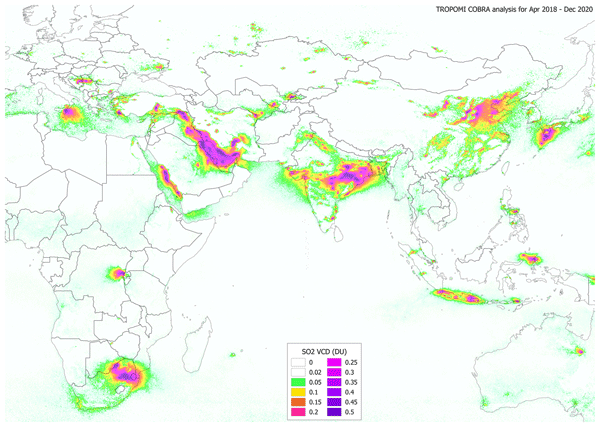
Nicolas Theys, Vitali Fioletov, Can Li, Isabelle De Smedt, Christophe Lerot, Chris McLinden, Nickolay Krotkov, Debora Griffin, Lieven Clarisse, Pascal Hedelt, Diego Loyola, Thomas Wagner, Vinod Kumar, Antje Innes, Roberto Ribas, François Hendrick, Jonas Vlietinck, Hugues Brenot, and Michel Van Roozendael
Atmos. Chem. Phys., 21, 16727–16744, https://doi.org/10.5194/acp-21-16727-2021, https://doi.org/10.5194/acp-21-16727-2021, 2021
Short summary
Short summary
We present a new algorithm to retrieve sulfur dioxide from space UV measurements. We apply the technique to high-resolution TROPOMI measurements and demonstrate the high sensitivity of the approach to weak SO2 emissions worldwide with an unprecedented limit of detection of 8 kt yr−1. This result has broad implications for atmospheric science studies dealing with improving emission inventories and identifying and quantifying missing sources, in the context of air quality and climate.
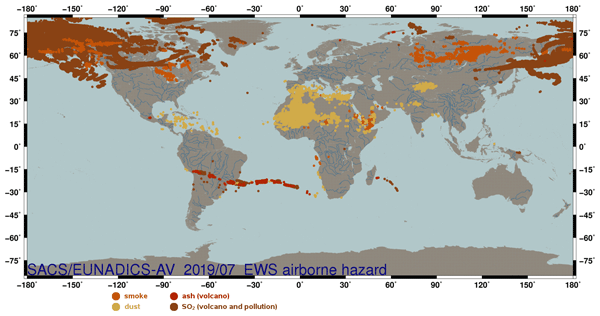
Hugues Brenot, Nicolas Theys, Lieven Clarisse, Jeroen van Gent, Daniel R. Hurtmans, Sophie Vandenbussche, Nikolaos Papagiannopoulos, Lucia Mona, Timo Virtanen, Andreas Uppstu, Mikhail Sofiev, Luca Bugliaro, Margarita Vázquez-Navarro, Pascal Hedelt, Michelle Maree Parks, Sara Barsotti, Mauro Coltelli, William Moreland, Simona Scollo, Giuseppe Salerno, Delia Arnold-Arias, Marcus Hirtl, Tuomas Peltonen, Juhani Lahtinen, Klaus Sievers, Florian Lipok, Rolf Rüfenacht, Alexander Haefele, Maxime Hervo, Saskia Wagenaar, Wim Som de Cerff, Jos de Laat, Arnoud Apituley, Piet Stammes, Quentin Laffineur, Andy Delcloo, Robertson Lennart, Carl-Herbert Rokitansky, Arturo Vargas, Markus Kerschbaum, Christian Resch, Raimund Zopp, Matthieu Plu, Vincent-Henri Peuch, Michel Van Roozendael, and Gerhard Wotawa
Nat. Hazards Earth Syst. Sci., 21, 3367–3405, https://doi.org/10.5194/nhess-21-3367-2021, https://doi.org/10.5194/nhess-21-3367-2021, 2021
Short summary
Short summary
The purpose of the EUNADICS-AV (European Natural Airborne Disaster Information and Coordination System for Aviation) prototype early warning system (EWS) is to develop the combined use of harmonised data products from satellite, ground-based and in situ instruments to produce alerts of airborne hazards (volcanic, dust, smoke and radionuclide clouds), satisfying the requirement of aviation air traffic management (ATM) stakeholders (https://cordis.europa.eu/project/id/723986).
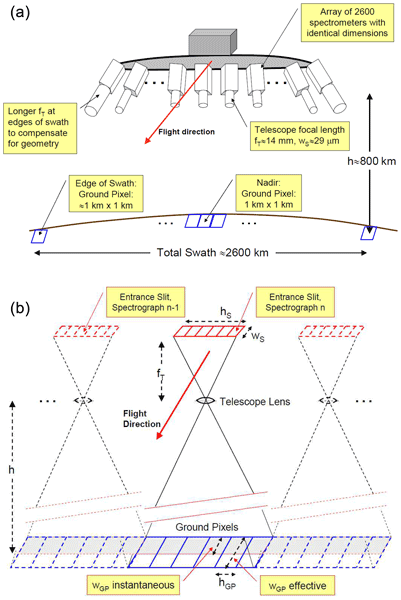
Ulrich Platt, Thomas Wagner, Jonas Kuhn, and Thomas Leisner
Atmos. Meas. Tech., 14, 6867–6883, https://doi.org/10.5194/amt-14-6867-2021, https://doi.org/10.5194/amt-14-6867-2021, 2021
Short summary
Short summary
Absorption spectroscopy of scattered sunlight is extremely useful for the analysis of atmospheric trace gas distributions. A central parameter for the achievable sensitivity of spectroscopic instruments is the light throughput, which can be enhanced in a number of ways. We present new ideas and considerations of how instruments could be optimized. Particular emphasis is on arrays of massively parallel instruments. Such arrays can reduce the size and weight of instruments by orders of magnitude.
Hossain M. S. Hoque, Kengo Sudo, Hitoshi Irie, Alessandro Damiani, and Al Mashroor Fatmi
Atmos. Chem. Phys. Discuss., https://doi.org/10.5194/acp-2021-815, https://doi.org/10.5194/acp-2021-815, 2021
Revised manuscript not accepted
Short summary
Short summary
Nitrogen dioxide (NO2) and formaldehyde (HCHO) profiles, retrieved from remote sensing observations, are used to evaluate the global chemistry transport model CHASER. Overall, CHASER has demonstrated good skills in reproducing the seasonal climatology of NO2 and HCHO on a local scale at sites in South and East Asia. Around mountainous terrains, the model performs better on a regional scale. The improved spatial resolution of CHASER can likely reduce the observed discrepancies in the datasets.
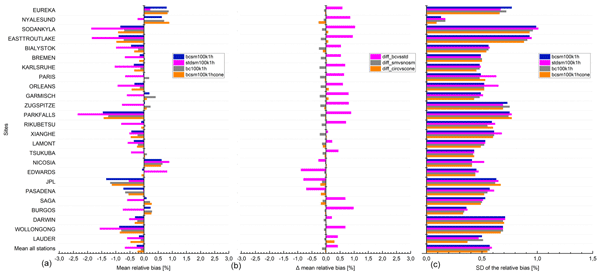
Mahesh Kumar Sha, Bavo Langerock, Jean-François L. Blavier, Thomas Blumenstock, Tobias Borsdorff, Matthias Buschmann, Angelika Dehn, Martine De Mazière, Nicholas M. Deutscher, Dietrich G. Feist, Omaira E. García, David W. T. Griffith, Michel Grutter, James W. Hannigan, Frank Hase, Pauli Heikkinen, Christian Hermans, Laura T. Iraci, Pascal Jeseck, Nicholas Jones, Rigel Kivi, Nicolas Kumps, Jochen Landgraf, Alba Lorente, Emmanuel Mahieu, Maria V. Makarova, Johan Mellqvist, Jean-Marc Metzger, Isamu Morino, Tomoo Nagahama, Justus Notholt, Hirofumi Ohyama, Ivan Ortega, Mathias Palm, Christof Petri, David F. Pollard, Markus Rettinger, John Robinson, Sébastien Roche, Coleen M. Roehl, Amelie N. Röhling, Constantina Rousogenous, Matthias Schneider, Kei Shiomi, Dan Smale, Wolfgang Stremme, Kimberly Strong, Ralf Sussmann, Yao Té, Osamu Uchino, Voltaire A. Velazco, Corinne Vigouroux, Mihalis Vrekoussis, Pucai Wang, Thorsten Warneke, Tyler Wizenberg, Debra Wunch, Shoma Yamanouchi, Yang Yang, and Minqiang Zhou
Atmos. Meas. Tech., 14, 6249–6304, https://doi.org/10.5194/amt-14-6249-2021, https://doi.org/10.5194/amt-14-6249-2021, 2021
Short summary
Short summary
This paper presents, for the first time, Sentinel-5 Precursor methane and carbon monoxide validation results covering a period from November 2017 to September 2020. For this study, we used global TCCON and NDACC-IRWG network data covering a wide range of atmospheric and surface conditions across different terrains. We also show the influence of a priori alignment, smoothing uncertainties and the sensitivity of the validation results towards the application of advanced co-location criteria.
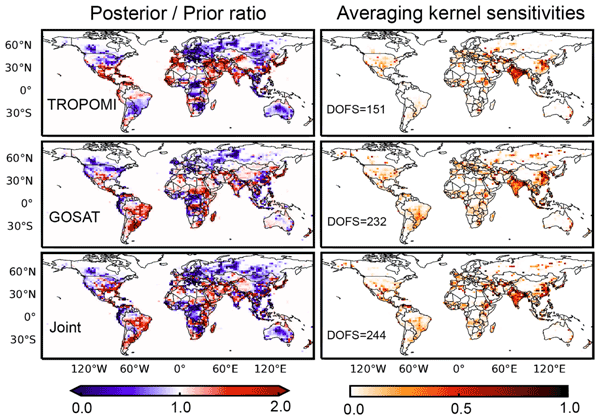
Zhen Qu, Daniel J. Jacob, Lu Shen, Xiao Lu, Yuzhong Zhang, Tia R. Scarpelli, Hannah Nesser, Melissa P. Sulprizio, Joannes D. Maasakkers, A. Anthony Bloom, John R. Worden, Robert J. Parker, and Alba L. Delgado
Atmos. Chem. Phys., 21, 14159–14175, https://doi.org/10.5194/acp-21-14159-2021, https://doi.org/10.5194/acp-21-14159-2021, 2021
Short summary
Short summary
The recent launch of TROPOMI offers an unprecedented opportunity to quantify the methane budget from a top-down perspective. We use TROPOMI and the more mature GOSAT methane observations to estimate methane emissions and get consistent global budgets. However, TROPOMI shows biases over regions where surface albedo is small and provides less information for the coarse-resolution inversion due to the larger error correlations and spatial variations in the number of observations.
Cited articles
Anand, J. S., Monks, P. S., and Leigh, R. J.: An improved retrieval of
tropospheric NO2 from space over polluted regions using an Earth
radiance reference, Atmos. Meas. Tech., 8, 1519–1535,
https://doi.org/10.5194/amt-8-1519-2015, 2015.
Beirle, S., Sihler, H., and Wagner, T.: Linearisation of the effects of
spectral shift and stretch in DOAS analysis, Atmos. Meas. Tech., 6, 661–675,
https://doi.org/10.5194/amt-6-661-2013, 2013.
Beirle, S., Hörmann, C., Jöckel, P., Liu, S., Penning de Vries, M.,
Pozzer, A., Sihler, H., Valks, P., and Wagner, T.: The STRatospheric
Estimation Algorithm from Mainz (STREAM): estimating stratospheric
NO2 from nadir-viewing satellites by weighted convolution, Atmos.
Meas. Tech., 9, 2753–2779, https://doi.org/10.5194/amt-9-2753-2016, 2016.
Boersma, K. F., Eskes, H. J., and Brinksma, E. J.: Error analysis for
tropospheric NO2 retrieval from space, J. Geophys. Res., 109,
D04311, https://doi.org/10.1029/2003JD003962, 2004.
Boersma, K. F., Eskes, H. J., Veefkind, J. P., Brinksma, E. J., van der A, R.
J., Sneep, M., van den Oord, G. H. J., Levelt, P. F., Stammes, P., Gleason,
J. F., and Bucsela, E. J.: Near-real time retrieval of tropospheric
NO2 from OMI, Atmos. Chem. Phys., 7, 2103–2118,
https://doi.org/10.5194/acp-7-2103-2007, 2007.
Boersma, K. F., Eskes, H. J., Dirksen, R. J., van der A, R. J., Veefkind, J.
P., Stammes, P., Huijnen, V., Kleipool, Q. L., Sneep, M., Claas, J.,
Leitão, J., Richter, A., Zhou, Y., and Brunner, D.: An improved
tropospheric NO2 column retrieval algorithm for the Ozone
Monitoring Instrument, Atmos. Meas. Tech., 4, 1905–1928,
https://doi.org/10.5194/amt-4-1905-2011, 2011.
Boersma, K. F., Vinken, G. C. M., and Eskes, H. J.: Representativeness errors
in comparing chemistry transport and chemistry climate models with satellite
UV–Vis tropospheric column retrievals, Geosci. Model Dev., 9, 875–898,
https://doi.org/10.5194/gmd-9-875-2016, 2016.
Boersma, K. F., De Smedt, I., George, M., Compernolle, S., Eskes, H. J.,
Zara, M., van Geffen, J., Lorente, A., Richter, A., Peters, E., Hilboll, A.,
Yu. H., Van Roozendael, M., Beirle, S., Dörner, S., Wagner, T.,
Nightingale, J., Lambert, J.-C., Coheur, P.-F., and Clerbaux, C.: Report on
the assessment and characterization of uncertainties in the retrieval
algorithms for Atmosphere ECV records, 71 pp.,
available at: http://www.qa4ecv.eu/sites/default/files/D5.5_v1.0.compressed.pdf (last
access: 12 April 2018), 2017a.
Boersma, K. F., Eskes, H., Richter, A., De Smedt, I., Lorente, A., Beirle,
S., Van Geffen, J., Peters, E., Van Roozendael, M., and Wagner, T.: QA4ECV
NO2 tropospheric and stratospheric vertical column data from GOME
(Version 1.1) (data set), Royal Netherlands Meteorological Institute (KNMI),
https://doi.org/10.21944/qa4ecv-no2-gome-v1.1, 2017b.
Boersma, K. F., Eskes, H., Richter, A., De Smedt, I., Lorente, A., Beirle,
S., Van Geffen, J., Peters, E., Van Roozendael, M., and Wagner, T.: QA4ECV
NO2 tropospheric and stratospheric vertical column data from
SCIAMACHY (Version 1.1) (data set). Royal Netherlands Meteorological
Institute (KNMI), https://doi.org/10.21944/qa4ecv-no2-scia-v1.1, 2017c.
Boersma, K. F., Eskes, H., Richter, A., De Smedt, I., Lorente, A., Beirle,
S., Van Geffen, J., Peters, E., Van Roozendael, M. and Wagner, T.: QA4ECV
NO2 tropospheric and stratospheric vertical column data from
GOME-2A (Version 1.1) (data set), Royal Netherlands Meteorological Institute
(KNMI), https://doi.org/10.21944/qa4ecv-no2-gome2a-v1.1, 2017d.
Boersma, K. F., Eskes, H., Richter, A., De Smedt, I., Lorente, A., Beirle,
S., Van Geffen, J., Peters, E., Van Roozendael, M. and Wagner, T.: QA4ECV
NO2 tropospheric and stratospheric vertical column data from OMI
(Version 1.1) (data set), Royal Netherlands Meteorological Institute (KNMI).
https://doi.org/10.21944/qa4ecv-no2-omi-v1.1, 2017e.
Boersma, K. F., van Geffen, J., Eskes, H., van der A, R. J., De Smedt, I.,
Van Roozendael, M., Yu, H., Richter, A., Peters, E., Beirle, S., Wagner, T.,
Lorente, A., Scanlon, T., Compernolle, S., and Lambert, J.-C.: Product
Specification Document for the QA4ECV NO2 Precursor Product
(Version 1.1), available at:
http://temis.nl/qa4ecv/no2col/QA4ECV_NO_2_PSD_v1.1.compressed.pdf (last
access: 25 April 2018), 2017f.
Bojinski, S., Verstraete, M., Peterson, T. C., Richter, C., Simmons, A., and
Zemp, M.: The concept of Essential Climate Variables in support of climate
research, applications, and policy, B. Am. Meteor. Soc., 1431–1443,
https://doi.org/10.1175/BAMS-D-13-00047.1, 2014.
Bovensmann, H., Burrows, J. P., Buchwitz, M., Frerick, J., Noel, S.,
Rozanov, V. V., Chance, K. V., and Goede, A. P. H.: SCIA- MACHY: Mission
objectives and measurement modes, J. Atmos. Sci., 56, 127–150, 1999.
Bucsela, E. J., Celarier, E. A., Wenig, M. O., Gleason, J. F., Veefkind, J.
P., Boersma, K. F., and Brinksma, E. J.: Algorithm for NO2 vertical
column retrieval from the Ozone Monitoring Instrument, IEEE T. Geosci. Remote
Sens., 44, 1245–1258, https://doi.org/10.1109/TGRS.2005.863715, 2006.
Burrows, J. P., Weber, M., Buchwitz, M., Rozanov, V.,
Ladstätter-Weißenmayer, A., Richter, A., DeBeek, R., Hoogen, R.,
Bramstedt, K., Eichmann, K.-U., Eisinger, M., and Perner, D.: The Global
Ozone Monitoring Experiment (GOME): Mission Concept and First Scientific
Results, J. Atmos. Sci., 56, 151–175, 1999.
Chance, K., Kurosu, T. P., and Sioris, C. E.: Undersampling correction for
array detector-based satellite spectrometers., Appl. Opt., 44, 1296–1304,
https://doi.org/10.1364/AO.44.001296, 2005.
Compernolle, S., Lambert, J.-C., Boersma, K. F., Schulz, J., Müller,
J.-P., Coheur, P.-F., De Smedt, I., Van Roozendael, M., Blessing, S., George,
M., and Gobron, N.: Report on the compliance of ECV records with GCOS and
user requirements (QA4ECV Deliverable 6.1), 69 pp.,
available at: http://www.qa4ecv.eu/sites/default/files/QA4ECV_D6p1_FINAL%
2BSMM.pdf
(last access: 12 April 2018), 2018.
Crutzen, P. J.: The influence of nitrogen oxides on the atmospheric ozone
content, Q. J. Roy. Meteorol. Soc., 96, 320–325, https://doi.org/10.1002/qj.49709640815,
1970.
Deutschmann, T., Beirle, S., Friess, U., Grzegorski, M., Kern, C., Kritten,
L., Platt, U., Prados-Román, C., Puíite, J., Wagner, T., Werner, B.,
Pfeilsticker, K.,: The Monte Carlo atmospheric radiative transfer model
McArtim: Introduction and validation of Jacobians and 3D features, J.
Quant. Spectrosc. Ra., 112, 1119–1137,
https://doi.org/10.1016/j.jqsrt.2010.12.009, 2011.
Dikty, S., Richter, A., Weber, M., Noel, S., Bovensmann, H., Wittrock, F.,
and Burrows, J. P.: GOME-2 on MetOp-A Support for Analysis of GOME-2
In-Orbit Degradation and Impacts on Level 2 Data Products – Final Report,
Tech. rep., Inst. of Environ. Phys., Bremen, Germany, available at:
https://www.eumetsat.int/website/home/index.html, document ITT 09/10000262 (last access: 25
September 2012), 2011.
Dirksen, R. J., Boersma, K. F., Eskes, H. J., Ionov, D. V., Bucsela, E. J.,
Levelt, P. F., and Kelder, H. M.: Evaluation of stratospheric NO2
retrieved from the ozone monitoring instrument: intercomparison, diurnal
cycle, and trending, J. Geophys. Res., 116, D08305, https://doi.org/10.1029/2010JD014943,
2011.
DLR, Max-Planck Institute, IUP, RAL Space, Royal Netherlands Meteorological
Institute: Sentinel-5P TROPOMI Science Verification Report, Issue
2.1, S5P-IUP-L2-ScVR-RP, Technical Document, 314 pp.,
available at: https://earth.esa.int/web/sentinel/user-guides/sentinel-5p-tropomi/document-library/-/asset_publisher/w9Mnd6VPjXlc/content/sentinel-5p-tropomi-science-verification-report,
(last access: 22 August 2017), 2015.
Dobber, M. R., Kleipool, Q., Dirksen, R., Levelt, P. F., Jaross, G., Taylor,
S., Kelly, T., Flynn, L., Leppelmeier, G., and Rozemeijer, N.: Validation of
ozone monitoring instrument level 1b data products, J. Geophys. Res., 113,
D15S06, https://doi.org/10.1029/2007JD008665, 2008.
Drosoglou, T., Bais, A. F., Zyrichidou, I., Kouremeti, N., Poupkou, A.,
Liora, N., Giannaros, C., Koukouli, M. E., Balis, D., and Melas, D.:
Comparisons of ground-based tropospheric NO2 MAX-DOAS measurements
to satellite observations with the aid of an air quality model over the
Thessaloniki area, Greece, Atmos. Chem. Phys., 17, 5829–5849,
https://doi.org/10.5194/acp-17-5829-2017, 2017.
Eskes, H. J. and Boersma, K. F.: Averaging kernels for DOAS total-column
satellite retrievals, Atmos. Chem. Phys., 3, 1285–1291,
https://doi.org/10.5194/acp-3-1285-2003, 2003.
Eskes, H. J., van Velthoven, P. F. J., Valks, P. J. M., and Kelder, H. M.:
Assimilation of GOME total-ozone satellite observations in a
three-dimensional tracer-transport model, Q. J. Roy. Meteor. Soc., 129,
1663–1681, https://doi.org/10.1256/qj.02.14, 2003.
Fayt, C. and Van Roozendael, M.: WinDOAS 2.1 software user manual, Uccle,
Belgium, BIRA-IASB, http://bro.aeronomie.be/WinDOAS-SUM-210b.pdf (last
access: 13 December 2018), 2001.
Galloway, J. N., Aber, J. D., Erisman, J. W., Seitzinger, S. P., Howarth, R.
W., Cowling, E. B., and Cosby, B. J.: The Nitrogen Cascade, BioScience,
53, 341–356, https://doi.org/10.1641/0006-3568(2003)053[0341:TNC]2.0.CO;2, 2003.
GCOS: Implementation plan for the Global Observing System for climate in
support of the UNFCC (2010 Update), available at: https://library.wmo.int/opac/doc_num.php?explnum_id=3851 (last access: 12
April 2018), GCOS-138, 180 pp., 2010.
GCOS-200: The Global Observing System for Climate: Implementation Needs,
GCOS 2016,
Implementation Plan, GCOS No. 200, available at:
https://library.wmo.int/opac/doc_num.php?explnum_id=3417, last access: November 2016.
GOME Products and Algorithms, available at:
https://earth.esa.int/web/sppa/mission-performance/esa-missions/ers-2/gome/products-and-algorithms/products-information
(last access: 13 December 2018), 2018.
Grewe, V., Dahlmann, K., Matthes, S., and Steinbrecht, W.: Attributing ozone
to NOx emissions: Implications for climate mitigation measures, Atmos.
Environ., 59, 102–107, https://doi.org/10.1016/j.atmosenv.2012.05.002, 2012.
GUM: Joint Committee for Guides in Metrology (JCGM/WG 1) 100:2008, Evaluation
of measurement data – Guide to the expression of uncertainty in a
measurement (GUM), ISO/IEC Guide 98-3:2008, available at:
http://www.bipm.org/utils/common/documents/jcgm/JCGM_100_2008_E.pdf
(last access: 13 December 2018), 2008.
Hains, J. C., Boersma, K. F., Kroon, M., Dirksen, R. J., Cohen, R. C.,
Perring, A. E., Bucsela, E., Volten, H., Swart, D. P. J., Richter, A.,
Wittrock, F., Schoenhardt, A., Wagner, T., Ibrahim, O. W., Van Roozendael,
M., Pinardi, G., Gleason, J. F., Veefkind, J. P., and Levelt, P.: Testing and
improving OMI DOMINO tropospheric NO2 using observations from the
DANDELIONS and INTEX-B validation campaigns, J. Geophys. Res., 115, D05301,
https://doi.org/10.1029/2009JD012399, 2010.
Hassinen, S., Balis, D., Bauer, H., Begoin, M., Delcloo, A., Eleftheratos,
K., Gimeno Garcia, S., Granville, J., Grossi, M., Hao, N., Hedelt, P.,
Hendrick, F., Hess, M., Heue, K.-P., Hovila, J., Jønch-Sørensen, H.,
Kalakoski, N., Kauppi, A., Kiemle, S., Kins, L., Koukouli, M. E.,
Kujanpää, J., Lambert, J.-C., Lang, R., Lerot, C., Loyola, D.,
Pedergnana, M., Pinardi, G., Romahn, F., van Roozendael, M., Lutz, R., De
Smedt, I., Stammes, P., Steinbrecht, W., Tamminen, J., Theys, N., Tilstra,
L. G., Tuinder, O. N. E., Valks, P., Zerefos, C., Zimmer, W., and
Zyrichidou, I.: Overview of the O3M SAF GOME-2 operational atmospheric
composition and UV radiation data products and data availability, Atmos.
Meas. Tech., 9, 383–407, https://doi.org/10.5194/amt-9-383-2016, 2016.
Hilboll, A., Richter, A., Rozanov, A., Hodnebrog, Ø., Heckel, A., Solberg,
S., Stordal, F., and Burrows, J. P.: Improvements to the retrieval of
tropospheric NO2 from satellite – stratospheric correction using
SCIAMACHY limb/nadir matching and comparison to Oslo CTM2 simulations, Atmos.
Meas. Tech., 6, 565–584, https://doi.org/10.5194/amt-6-565-2013, 2013.
Hoek, G., Krishnan, R. M., Beelen, R., Peters, A., Ostro, B., Brunekreef, B.,
and Kaufman, J. D.: Long-term air pollution exposure and cardio- respiratory
mortality: a review, Environ. Health, 12, 1–15,
https://doi.org/10.1186/1476-069X-12-43, 2013.
Irie, H., Kanaya, Y., Akimoto, H., Tanimoto, H., Wang, Z., Gleason, J. F.,
and Bucsela, E. J.: Validation of OMI tropospheric NO2 column data
using MAX-DOAS measurements deep inside the North China Plain in June 2006:
Mount Tai Experiment 2006, Atmos. Chem. Phys., 8, 6577–6586,
https://doi.org/10.5194/acp-8-6577-2008, 2008.
Irie, H., Boersma, K. F., Kanaya, Y., Takashima, H., Pan, X., and Wang, Z.
F.: Quantitative bias estimates for tropospheric NO2 columns
retrieved from SCIAMACHY, OMI, and GOME-2 using a common standard for East
Asia, Atmos. Meas. Tech., 5, 2403–2411,
https://doi.org/10.5194/amt-5-2403-2012, 2012.
Inness, A., Baier, F., Benedetti, A., Bouarar, I., Chabrillat, S., Clark, H.,
Clerbaux, C., Coheur, P., Engelen, R. J., Errera, Q., Flemming, J., George,
M., Granier, C., Hadji-Lazaro, J., Huijnen, V., Hurtmans, D., Jones, L.,
Kaiser, J. W., Kapsomenakis, J., Lefever, K., Leitão, J., Razinger, M.,
Richter, A., Schultz, M. G., Simmons, A. J., Suttie, M., Stein, O.,
Thépaut, J.-N., Thouret, V., Vrekoussis, M., Zerefos, C., and the MACC
team: The MACC reanalysis: an 8 yr data set of atmospheric composition,
Atmos. Chem. Phys., 13, 4073–4109, https://doi.org/10.5194/acp-13-4073-2013,
2013.
Jin, J., Ma, J., Lin, W., Zhao, H., Shaiganfar, R., Beirle, S., and Wagner,
T.: MAX-DOAS measurements and satellite validation of tropospheric NO2 and
SO2 vertical column densities at a rural site of North China, Atmos.
Environ., 133, 12–25,
https://doi.org/10.1016/j.atmosenv.2016.03.031, 2016.
Kleipool, Q. L., Dobber, M. R., de Haan, J. F., and Levelt, P. F.: Earth
surface reflectance climatology from 3 years of OMI data, J. Geophys.
Res.-Atmos., 113, D18308, https://doi.org/10.1029/2008JD010290, 2008.
Krotkov, N. A., McLinden, C. A., Li, C., Lamsal, L. N., Celarier, E. A.,
Marchenko, S. V., Swartz, W. H., Bucsela, E. J., Joiner, J., Duncan, B. N.,
Boersma, K. F., Veefkind, J. P., Levelt, P. F., Fioletov, V. E., Dickerson,
R. R., He, H., Lu, Z., and Streets, D. G.: Aura OMI observations of regional
SO2 and NO2 pollution changes from 2005 to 2015, Atmos.
Chem. Phys., 16, 4605-4629, https://doi.org/10.5194/acp-16-4605-2016, 2016.
Kollonige, D. E., Thompson, A. M., Josipovic, M., Tzortziou, M., Beukes, J.
P., Burger, R., Martins, D. K. van Zyl, P. G., Vakkari, V., and
Laakso, L.: OMI satellite and ground-based Pandora observations and their
application to surface NO2 estimations at terrestrial and marine
sites,J. Geophys. Res.-Atmos., 123,
1441–1459, https://doi.org/10.1002/2017JD026518, 2018.
Levelt, P. F., Van den Oord, G. H. J., Dobber, M. R., Malkki, A., Visser,
H., de Vries, J., Stammes, P., Lundell, J. O. V., and Saari, H.: The Ozone
Monitoring Instrument, IEEE T. Geosci. Remote, 44, 1093–1101, 2006.
Lin, J.-T., Martin, R. V., Boersma, K. F., Sneep, M., Stammes, P., Spurr, R.,
Wang, P., Van Roozendael, M., Clémer, K., and Irie, H.: Retrieving
tropospheric nitrogen dioxide from the Ozone Monitoring Instrument: effects
of aerosols, surface reflectance anisotropy, and vertical profile of nitrogen
dioxide, Atmos. Chem. Phys., 14, 1441–1461, https://doi.org/10.5194/acp-14-1441-2014,
2014.
Liu, S. C., Trainer, M., Fehsenfeld, F. C., Parrish, D. D., Williams, E. J.,
Fahey, D. W., Hübler, G., and Murphy, P. C.: Ozone production in the
rural troposphere and the implications for regional and global ozone
distributions, J. Geophys. Res., 92, 4191–4207,
https://doi.org/10.1029/JD092iD04p04191, 1987.
Lorente, A., Folkert Boersma, K., Yu, H., Dörner, S., Hilboll, A.,
Richter, A., Liu, M., Lamsal, L. N., Barkley, M., De Smedt, I., Van
Roozendael, M., Wang, Y., Wagner, T., Beirle, S., Lin, J.-T., Krotkov, N.,
Stammes, P., Wang, P., Eskes, H. J., and Krol, M.: Structural uncertainty in
air mass factor calculation for NO2 and HCHO satellite retrievals,
Atmos. Meas. Tech., 10, 759-782, https://doi.org/10.5194/amt-10-759-2017,
2017.
Lorente, A., Boersma, K. F., Stammes, P., Tilstra, L. G., Richter, A., Yu,
H., Kharbouche, S., and Muller, J.-P.: The importance of surface reflectance
anisotropy for cloud and NO2 retrievals from GOME-2 and OMI, Atmos.
Meas. Tech., 11, 4509–4529, https://doi.org/10.5194/amt-11-4509-2018, 2018.
Maasakkers, J. D.: Vital improvements to the retrieval of tropospheric
NO2 columns from the Ozone Monitoring instrument, M.Sc. thesis,
Eindhoven University of Technology, The Netherlands, 67 pp., 2013.
Marchenko, S., Krotkov, N. A., Lamsal, L. N., Celarier, E. A., Swartz, W.
H., and Bucsela, E. J.: Revising the slant column density retrieval of
nitrogen dioxide observed by the Ozone Monitoring Instrument, J. Geophys. Res.-Atmos., 120,
5670–5692, https://doi.org/10.1002/2014JD022913, 2015.
Miyazaki, K., Eskes, H. J., and Sudo, K.: Global NOx emission estimates
derived from an assimilation of OMI tropospheric NO2columns, Atmos.
Chem. Phys., 12, 2263–2288, https://doi.org/10.5194/acp-12-2263-2012, 2012.
Müller, J.-P., Kharbouche, S., Gobron, N., Scanlon, T., Govaerts, Y.,
Danne, O., Schultz, J., Lattanzio, A., Peters, E., De Smedt, I., Beirle, S.,
Lorente, A., Coheur, P. F., George, M., Wagner, T., Hilboll, A., Richter,
A., Van Roozendael, M., and Boersma, K. F.: Recommendations (scientific) on
best practices for retrievals for Land and Atmosphere ECVs (QA4ECV
Deliverable 4.2 version 1.0), 186 pp.,
http://www.qa4ecv.eu/sites/default/files/D4.2.pdf (last access: 12 April
2018), 2016.
Munro, R., Eisinger, M., Anderson, C., Callies, J., Corpaccioli, E., Lang,
R., Lefebvre, A., Livschitz, Y., and Albin Pana, A. P.: GOME-2 on MetOp,
Proc. of The 2006 EUMETSAT Meteoro- logical Satellite Conference, Helsinki,
Finland, 12–16 June 2006, EUMETSAT P.48, 2006.
Munro, R., Lang, R., Klaes, D., Poli, G., Retscher, C., Lindstrot, R.,
Huckle, R., Lacan, A., Grzegorski, M., Holdak, A., Kokhanovsky, A.,
Livschitz, J., and Eisinger, M.: The GOME-2 instrument on the Metop series
of satellites: instrument design, calibration, and level 1 data processing
– an overview, Atmos. Meas. Tech., 9, 1279–1301,
https://doi.org/10.5194/amt-9-1279-2016, 2016.
Nightingale, J., De Rudder, A., Boersma, F., Scanlon, T., Farquhar, C.,
Muller, J.-P., and Fox, N.: Results from the QA4ECV user requirements survey
on quality assurance in satellite data products (QA4ECV Deliverable 1.1
version 2.0), 16 pp.,
http://www.qa4ecv.eu/sites/default/files/QA4ECV_D.1.1_survey_report_V2.0_20150922.pdf,
last access: 10 April 2018, 2015.
Nightingale J., Boersma, K. F., Muller, J.-P., Compernolle, S.,
Lambert, J.-C., Blessing, S., Giering, R., Gobron, N., De Smedt, I., Coheur,
P., George, M., Schulz, J., and Wood, A.: Quality Assurance Framework
Development Based on Six New ECV Data Products to Enhance User Confidence
for Climate Applications, Remote Sens., 10, 1254, https://doi.org/10.3390/rs10081254,
2018.
Oldeman, A.: Effect of including an intensity offset in the DOAS
NO2 retrieval of TROPOMI, Internship report, R-1944-SE, Eindhoven
University of Technology/KNMI, Eindhoven, May 2018,
https://kfolkertboersma.files.wordpress.com/2018/06/report_oldeman_22052018.pdf,
(last access: 30 October 2018), 2018.
Pinardi, G., Van Roozendael, M., Hendrick, F., Van Roozendael, M., Hendrick,
F., Compernolle, S., Lambert, J.-C., Granville, J., Gielen, C., Cede, A.,
Kanaya, Y., Irie, H., Wittrock, F., Richter, A., Peters, E., Wagner, T.,
Remmers, J., Friess, U., Vlemmix, T., Piters, A., Tiefengraber, M., Herman,
J., Abuhassan, N., Holla, R., Bais, A., Balis, D., Drosoglou, T., Kouremeti,
N., Hovila, J., Chong, J., Postylyakov, O., Borovski, A., and Ma, J.: Satellite nadir NO2
validation based on direct-sun and MAXDOAS network observations, 8th
International DOAS Workshop, Yokohama, Japan, 4–6 September 2017, O2-01,
2017.
Richter, A.: Absorptionsspektroskopische Messungen stratosphärischer
Spurengase über Bremen, 53° N, PhD-Thesis, University of Bremen,
June 1997, 1997.
Richter, A. and Wagner, T.: Diffuser plate spectral structures and their
influence on GOME slant columns, Tech. Rep., Inst. Env. Phys., Univ. Bremen
and Inst. Env. Phys., Univ. Heidelberg, 2001.
Richter, A., Begoin, M., Hilboll, A., and Burrows, J. P.: An improved
NO2 retrieval for the GOME-2 satellite instrument, Atmos. Meas.
Tech., 4, 1147–1159, https://doi.org/10.5194/amt-4-1147-2011, 2011.
Roscoe, H. K., Van Roozendael, M., Fayt, C., du Piesanie, A., Abuhassan, N.,
Adams, C., Akrami, M., Cede, A., Chong, J., Clémer, K., Friess, U., Gil
Ojeda, M., Goutail, F., Graves, R., Griesfeller, A., Grossmann, K.,
Hemerijckx, G., Hendrick, F., Herman, J., Hermans, C., Irie, H., Johnston, P.
V., Kanaya, Y., Kreher, K., Leigh, R., Merlaud, A., Mount, G. H., Navarro,
M., Oetjen, H., Pazmino, A., Perez-Camacho, M., Peters, E., Pinardi, G.,
Puentedura, O., Richter, A., Schönhardt, A., Shaiganfar, R., Spinei, E.,
Strong, K., Takashima, H., Vlemmix, T., Vrekoussis, M., Wagner, T., Wittrock,
F., Yela, M., Yilmaz, S., Boersma, F., Hains, J., Kroon, M., Piters, A., and
Kim, Y. J.: Intercomparison of slant column measurements of NO2 and
O4 by MAX-DOAS and zenith-sky UV and visible spectrometers, Atmos.
Meas. Tech., 3, 1629–1646, https://doi.org/10.5194/amt-3-1629-2010, 2010.
S5P/TROPOMI Science Verification Report, S5P-IUP-L2-ScVR-RP, Richter A. and
the Verification Teams: European Space Agency, 314 pp., available at:
https://earth.esa.int/web/sentinel/user-guides/sentinel-5p-tropomi/document-library/-/asset_publisher/w9Mnd6VPjXlc/content/sentinel-5p-tropomi-science-verification-report
(last access: 12 April 2018), 2015.
Schenkeveld, V. M. E., Jaross, G., Marchenko, S., Haffner, D., Kleipool, Q.
L., Rozemeijer, N. C., Veefkind, J. P., and Levelt, P. F.: In-flight
performance of the Ozone Monitoring Instrument, Atmos. Meas. Tech., 10,
1957–1986, https://doi.org/10.5194/amt-10-1957-2017, 2017.
Shindell, D. T., Faluvegi, G., Koch, D. M., Schmidt, G. A., Unger, N., and
Bauer, S. E.: Improved Attribution of Climate Forcing to Emissions, Science,
325, 716–718, https://doi.org/10.1126/science.1174760, 2009.
Slijkhuis, S., Aberle, B., Coldewey-Egbers, M., Loyola, D., Dehn, A., and
Fehr, T.: GOME/ERS-2: New homogeneous Level 1B data from an old instrument,
Proceeding at the ESA ATMOS conference, 8–12 June 2015, University of Crete
Heraklion, Greece, 2015.
Solomon, S., Portmann, R. W., Sanders, R. W., Daniel, J. S., Madsen, W.,
Bartram, B., and Dutton, E. G.: On the role of nitrogen dioxide in the
absorption of solar radiation, J. Geophys. Res., 104, 12047–12058,
https://doi.org/10.1029/1999JD900035, 1999.
Tilstra, L. G., Tuinder, O. N. E., Wang, P., and Stammes, P.: Surface
reflectivity climatologies from UV to NIR determined from Earth observations
by GOME-2 and SCIAMACHY, J. Geophys. Res.-Atmos., 122, 4084–4111,
https://doi.org/10.1002/2016JD025940, 2017.
Vandaele, A. C., Hermans, C., Simon, P. C., Carleer, M., Colin, R., Fally,
S., Mérienne, M. F., Jenouvrier, A., and Coquart, B.: Measurements of the
NO2 absorption cross section from 42 000 cm−1 to 10 000 cm−1
(238–1000 nm) at 220 K and 294 K, J. Quant. Spectrosc. Radiat. Transf.,
59, 171–184, 1998.
van Geffen, J. H. G. M., Boersma, K. F., Van Roozendael, M., Hendrick, F.,
Mahieu, E., De Smedt, I., Sneep, M., and Veefkind, J. P.: Improved spectral
fitting of nitrogen dioxide from OMI in the 405–465 nm window, Atmos. Meas.
Tech., 8, 1685–1699, https://doi.org/10.5194/amt-8-1685-2015, 2015.
van Noije, T. P. C., Eskes, H. J., Dentener, F. J., Stevenson, D. S.,
Ellingsen, K., Schultz, M. G., Wild, O., Amann, M., Atherton, C. S.,
Bergmann, D. J., Bey, I., Boersma, K. F., Butler, T., Cofala, J., Drevet, J.,
Fiore, A. M., Gauss, M., Hauglustaine, D. A., Horowitz, L. W., Isaksen, I. S.
A., Krol, M. C., Lamarque, J.-F., Lawrence, M. G., Martin, R. V., Montanaro,
V., Müller, J.-F., Pitari, G., Prather, M. J., Pyle, J. A., Richter, A.,
Rodriguez, J. M., Savage, N. H., Strahan, S. E., Sudo, K., Szopa, S., and van
Roozendael, M.: Multi-model ensemble simulations of tropospheric NO2
compared with GOME retrievals for the year 2000, Atmos. Chem. Phys., 6,
2943–2979, https://doi.org/10.5194/acp-6-2943-2006, 2006.
Veefkind, J. P., de Haan, J. F., Sneep, M., and Levelt, P. F.: Improvements
to the OMI O2-O2 operational cloud algorithm and
comparisons with ground-based radar–lidar observations, Atmos. Meas. Tech.,
9, 6035–6049, https://doi.org/10.5194/amt-9-6035-2016, 2016.
Verstraeten, W. W., Neu, J. L., Williams, J. E., Bowman, K. W., Worden, J.
R., and Boersma, K. F.: Rapid increases in tropospheric ozone production and
export from China, Nat. Geosci., 8, 690–695, https://doi.org/10.1038/ngeo2493, 2015.
Vinken, G. C. M., Boersma, K. F., Maasakkers, J. D., Adon, M., and Martin, R.
V.: Worldwide biogenic soil NOx emissions inferred from
OMI NO2 observations, Atmos. Chem. Phys., 14, 10363–10381,
https://doi.org/10.5194/acp-14-10363-2014, 2014.
Wang, P., Stammes, P., van der A, R., Pinardi, G., and van Roozendael, M.:
FRESCO+: an improved O2 A-band cloud retrieval algorithm for
tropospheric trace gas retrievals, Atmos. Chem. Phys., 8, 6565–6576,
https://doi.org/10.5194/acp-8-6565-2008, 2008.
Williams, J. E., Boersma, K. F., Le Sager, P., and Verstraeten, W. W.: The
high-resolution version of TM5-MP for optimized satellite retrievals:
description and validation, Geosci. Model Dev., 10, 721–750,
https://doi.org/10.5194/gmd-10-721-2017, 2017.
Witman, S., Holloway, T., and Reddy, P.: Integrating Satellite Data into Air
Quality Management: Experience from Colorado, Environmental Manager (EM)
Magazine, 34–38, February 2014 Issue, 2014.
World Health Organization: Review of evidence on health aspects of air
pollution REVIHAAP Project, Tech. rep., Copenhagen, Denmark, 302 pp.,
available at:
http://www.euro.who.int/__data/assets/pdf_file/0004/193108/REVIHAAP-Final-technical-report-final-version.pdf?ua=1
(last access: 1 April 2018), 2013.
World Meteorological Organization: Guideline for the Generation of Datasets
and Products Meeting GCOS Requirements, Geneva, Switzerland, 12 pp.,
available at: https://library.wmo.int/opac/doc_num.php?explnum_id=3854
(last access: 1 April 2018), 2010.
World Meteorological Organization: Systematic Observation Requirements for
Satellite-Based Data Products for Climate – 2011 Update, Geneva,
Switzerland, 128 pp., available at:
https://library.wmo.int/opac/doc_num.php?explnum_id=3710 (last access:
1 April 2018), 2011.
Xu, X., Wang, J., Henze, D. K., Qu, W., and Kopacz, M.: Constraints on
aerosol sources using GEOS-Chem adjoint and MODIS radiances, and evaluation
with multisensor (OMI, MISR) data, J. Geophys. Res. Atmos., 118, 6396–6413,
https://doi.org/10.1002/jgrd.50515, 2013.
Zara, M., Boersma, K. F., De Smedt, I., Richter, A., Peters, E., van Geffen,
J. H. G. M., Beirle, S., Wagner, T., Van Roozendael, M., Marchenko, S.,
Lamsal, L. N., and Eskes, H. J.: Improved slant column density retrieval of
nitrogen dioxide and formaldehyde for OMI and GOME-2A from QA4ECV:
intercomparison, uncertainty characterisation, and trends, Atmos. Meas.
Tech., 11, 4033–4058, https://doi.org/10.5194/amt-11-4033-2018, 2018.
Zhang, L., Jacob, D. J., Boersma, K. F., Jaffe, D. A., Olson, J. R., Bowman,
K. W., Worden, J. R., Thompson, A. M., Avery, M. A., Cohen, R. C., Dibb, J.
E., Flock, F. M., Fuelberg, H. E., Huey, L. G., McMillan, W. W., Singh, H.
B., and Weinheimer, A. J.: Transpacific transport of ozone pollution and the
effect of recent Asian emission increases on air quality in North America: an
integrated analysis using satellite, aircraft, ozonesonde, and surface
observations, Atmos. Chem. Phys., 8, 6117–6136,
https://doi.org/10.5194/acp-8-6117-2008, 2008.
Download
- Article
(4337 KB) - Full-text XML
Short summary
This paper describes a new, improved data record of 22+ years of coherent nitrogen dioxide (NO2) pollution measurements from different satellite instruments. Our work helps to ensure that climate data are of sufficient quality to draw reliable conclusions and shape decisions. It shows how dedicated intercomparisons of retrieval sub-steps have led to improved NO2 measurements from the GOME, SCIAMACHY, GOME-2(A), and OMI sensors, and how quality assurance of the new data product is achieved.
This paper describes a new, improved data record of 22+ years of coherent nitrogen dioxide (NO2)...


